EP0924980B1 - Verfahren zur herstellung eines gesteckes aus einem harten kern und dafür verwendeter kern - Google Patents
Verfahren zur herstellung eines gesteckes aus einem harten kern und dafür verwendeter kern Download PDFInfo
- Publication number
- EP0924980B1 EP0924980B1 EP97931870A EP97931870A EP0924980B1 EP 0924980 B1 EP0924980 B1 EP 0924980B1 EP 97931870 A EP97931870 A EP 97931870A EP 97931870 A EP97931870 A EP 97931870A EP 0924980 B1 EP0924980 B1 EP 0924980B1
- Authority
- EP
- European Patent Office
- Prior art keywords
- core
- plants
- bouquet
- tape
- skirt
- Prior art date
- Legal status (The legal status is an assumption and is not a legal conclusion. Google has not performed a legal analysis and makes no representation as to the accuracy of the status listed.)
- Expired - Lifetime
Links
- 238000000034 method Methods 0.000 title claims abstract description 24
- 239000000203 mixture Substances 0.000 title claims abstract description 22
- 238000007493 shaping process Methods 0.000 claims abstract 2
- 241000196324 Embryophyta Species 0.000 claims description 53
- 239000003292 glue Substances 0.000 claims description 11
- 238000005034 decoration Methods 0.000 claims description 7
- 239000000853 adhesive Substances 0.000 claims description 6
- 230000001070 adhesive effect Effects 0.000 claims description 6
- 239000000463 material Substances 0.000 claims description 6
- 239000002390 adhesive tape Substances 0.000 claims description 4
- GNFTZDOKVXKIBK-UHFFFAOYSA-N 3-(2-methoxyethoxy)benzohydrazide Chemical compound COCCOC1=CC=CC(C(=O)NN)=C1 GNFTZDOKVXKIBK-UHFFFAOYSA-N 0.000 claims description 3
- 239000013598 vector Substances 0.000 claims description 3
- 238000004026 adhesive bonding Methods 0.000 claims description 2
- 239000004927 clay Substances 0.000 claims description 2
- 239000002131 composite material Substances 0.000 claims description 2
- 239000011521 glass Substances 0.000 claims description 2
- 239000002184 metal Substances 0.000 claims description 2
- 239000002023 wood Substances 0.000 claims description 2
- 241000195940 Bryophyta Species 0.000 claims 1
- 235000011929 mousse Nutrition 0.000 claims 1
- 238000005476 soldering Methods 0.000 claims 1
- YFXPPSKYMBTNAV-UHFFFAOYSA-N bensultap Chemical compound C=1C=CC=CC=1S(=O)(=O)SCC(N(C)C)CSS(=O)(=O)C1=CC=CC=C1 YFXPPSKYMBTNAV-UHFFFAOYSA-N 0.000 description 12
- 230000008569 process Effects 0.000 description 10
- 238000004519 manufacturing process Methods 0.000 description 4
- 241001080024 Telles Species 0.000 description 2
- 230000008901 benefit Effects 0.000 description 2
- KRQUFUKTQHISJB-YYADALCUSA-N 2-[(E)-N-[2-(4-chlorophenoxy)propoxy]-C-propylcarbonimidoyl]-3-hydroxy-5-(thian-3-yl)cyclohex-2-en-1-one Chemical compound CCC\C(=N/OCC(C)OC1=CC=C(Cl)C=C1)C1=C(O)CC(CC1=O)C1CCCSC1 KRQUFUKTQHISJB-YYADALCUSA-N 0.000 description 1
- 241000209761 Avena Species 0.000 description 1
- 235000007319 Avena orientalis Nutrition 0.000 description 1
- 241001024327 Oenanthe <Aves> Species 0.000 description 1
- 241000897276 Termes Species 0.000 description 1
- 241000209140 Triticum Species 0.000 description 1
- 235000021307 Triticum Nutrition 0.000 description 1
- 240000008042 Zea mays Species 0.000 description 1
- OFCNXPDARWKPPY-UHFFFAOYSA-N allopurinol Chemical compound OC1=NC=NC2=C1C=NN2 OFCNXPDARWKPPY-UHFFFAOYSA-N 0.000 description 1
- 239000000470 constituent Substances 0.000 description 1
- 210000005069 ears Anatomy 0.000 description 1
- 230000000694 effects Effects 0.000 description 1
- 229940082150 encore Drugs 0.000 description 1
- 239000006260 foam Substances 0.000 description 1
- 235000021189 garnishes Nutrition 0.000 description 1
- 230000008570 general process Effects 0.000 description 1
- 238000002360 preparation method Methods 0.000 description 1
- NHDHVHZZCFYRSB-UHFFFAOYSA-N pyriproxyfen Chemical compound C=1C=CC=NC=1OC(C)COC(C=C1)=CC=C1OC1=CC=CC=C1 NHDHVHZZCFYRSB-UHFFFAOYSA-N 0.000 description 1
- 230000003252 repetitive effect Effects 0.000 description 1
- 230000035939 shock Effects 0.000 description 1
- 238000011144 upstream manufacturing Methods 0.000 description 1
- 235000013311 vegetables Nutrition 0.000 description 1
- 238000003466 welding Methods 0.000 description 1
Images

Classifications
-
- A—HUMAN NECESSITIES
- A01—AGRICULTURE; FORESTRY; ANIMAL HUSBANDRY; HUNTING; TRAPPING; FISHING
- A01G—HORTICULTURE; CULTIVATION OF VEGETABLES, FLOWERS, RICE, FRUIT, VINES, HOPS OR SEAWEED; FORESTRY; WATERING
- A01G5/00—Floral handling
- A01G5/04—Mountings for wreaths, or the like; Racks or holders for flowers
Definitions
- the present invention relates to a method of production of a floral composition according to the preamble of claim 1, and more particularly a bouquet comprising plants and / or decorative elements based on surfaces of a rigid volume support called the nucleus.
- the invention has also aim to describe nuclei according to the preamble of claim 6 particularly adapted for the implementation of this process.
- This traditional technique also requires a volume of plants which is equivalent to the final volume of the desired bouquet, and the realization of a traditional floral bouquet requires preparation important and a good knowledge of the means and plants necessary for its execution; we know for example that the plants or the decorative elements used should preferably have similar lengths or default be guardians.
- the professional must manage at all times not only artistic assembly techniques but also the evolution of shapes and volumes that we ultimately want achieve.
- the traditional floral bouquet is a homogeneous unit and therefore the elements of the composition are therefore chronologically and mechanically interdependent others ; this general principle is binding in the since it does not allow reversibility of execution; indeed, if the professional decides to substitute a decorative element placed in the heart of the bouquet or more generally upstream of the execution path, it is practically obliged to dismantle the realization until level he wants to change.
- Patent GB-2,147,205 already knew systems allowing floral realizations comprising a full cylindrical and perforated support on top and on the lateral surface to position and hold the rods plants by sinking into holes advantageously identified, however, this device does not allow bouquets as defined above, i.e. a external arrangement of plants on stem, arranged side by side rib all around the lateral surface, since the stems here are inserted transversely into the support.
- the core according to the invention can be of any shape and geometric volume, which offers the possibility of achieving both technically that artistic floral arrangements of forms unusual and original.
- the different surfaces of the nucleus playing distinct roles will precisely allow this great diversity of creation.
- the upper surface of the core helps to compose the inner and upper part of the achievement, to get what traditionally forms the center or the heart of a floral bouquet.
- the surface side will be used to give the composition external volume guidelines floral; in this sense, the side surface (s) constitute the vectors of the general form of the bouquet.
- a floral composition 1 is generally made up 2 decorative plants or decorative elements from advantageously mix with said plants 2; these latter normally have a decorative head 3 for example ears of wheat or flowers, mounted on stems 4 of which the length can vary significantly depending on the plant used.
- plants for example multi-flowered or dispersed plants on a pole that has only very short stems difficult to use in the floral composition.
- plants such as wheat ears or oats or flowers on the stem may present relatively long rod lengths which will be as will see it later, more particularly intended for the outer covering of the flower arrangement.
- the elements used to decorate the heart 17 of bouquet 1 can be chosen without necessarily considering the length of their shank 4. Indeed, it is not necessary here that a minimum of rod 4 to be pricked in the part upper of core 5 made of a flexible material such as it will be said later. It is clear that this principle allows to save on the plants used which can be multi-flowering plants or scattered on a stem that can dissect to optimize resources quantitative and decorative in plants or even as an element of decoration.
- the absence of rods 4 inside the bouquet 1 object of the invention makes it possible to increase the rigidity of the floral realization; indeed, the presence of a rigid core 5 at the center of the realization offers to the whole a completely uniform and constant density at even absorb mechanical shock without deformation much larger than normal bear a traditional bouquet.
- the number of rows of plants and / or decorative elements constituting the outer envelope of the bouquet 1, essentially depends on the quality, size, shape and nature of the products used whether or not it is necessary to stack successive rows even a different tightening of the products between them constituting each row.
- Core 5 for making compositions floral using the process according to the invention comprises at least an upper part 20 suitable for receiving and holding plants 2 whose rod length 4 is arbitrary or supports for decorative elements forming with plants 2 the heart 17 of the bouquet 1; coming to surround the upper part 20 of the core, a side skirt 21 of surface normally and globally continuous and closed on itself demarcates with the upper 20 a volume.
- the core 5 is remarkable in that the outer surface of the skirt lateral 21 is continuous and able to direct the rods of the plants arranged side by side on this external surface all around the skirt, so that said rods meet at a coincident convergence point 14 with the lower part 22 of said volume or located at proximity thereof, depending on whether said part 22 has respectively a vertex or that it is truncated open or possibly closed by an attached cover 23.
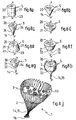
- the core 5 shown in FIG. 8 a has a generally cylindrical shape, that is to say that it is composed of an upper part 20 which will be explained below, d 'a side skirt 21 of cylindrical shape and a closure cover 23 of the same dimension as the upper part 20; according to this variant, the floral bouquet will have a final general shape different from FIG. 7 in that the core having no point of convergence 14 will be used for the development of purely cylindrical bouquets.
- the core 5 is here composed as above of an upper part 20 which will be described in more detail below and of a vertical skirt 21 in the general shape of a cone, having a summit zone coinciding with the point of convergence 14.
- This type of core used by way of example in the process, provides in particular bouquets 1 in accordance with the representation of FIG. 7.
- the core 5 a prismatic structure of revolution around an axis X, X ′ comprising for example a square base forming the upper part 20 of the core 5 and triangular facets 24 , four in number, meeting at a vertex coinciding with the point of convergence 14 as in the conical variant of FIG. 8 b .
- a core 5 of hemispherical shape consequently comprising a circular part forming the upper part 20 of the core 5 and a side skirt 21 constituted by a spherical cap.
- any other execution starting from the general forms proposed above would enter the field of protection and more especially for all the cores having the preceding but truncated forms.
- Figure 8 e it is a variant of frustoconical core flared at the bottom, in 8 f the same variant but tightened down; the representation 8 g is a prismatic variant truncated from below, finally the 8 h variant is a variant with lateral skirt 21 of truncated toric or spherical shape, such as a spherical cap associated with a circular upper part to form the heart 17 of the bouquet.
- the variants f , g , h which have no vertex in the lower part nevertheless determine a zone of convergence where the ligation 15 of a bouquet can be carried out as has been said.
- kernel 5 it can be obtained according to any shape of the top 20 and on which comes to bear laterally any shape of the side skirt 21 which can nevertheless determine a point of convergence or a vertex 14 advantageously used to do as it was said a ligature 15 of stems 4 of plants 2 giving the whole a whole shape completely unknown to date.
- the part upper 20 of said core 5 normally consists of a flexible material such as synthetic foam for example or any other product known for its mechanical qualities of maintains plants 2 positioned by simple stitching.
- the flexible material must first be compatible with plants 2 and / or the elements of decoration chosen and likely to be associated in periphery, with the side skirt 21 to which it is united by all known means such as for example gluing, stapling, welding or the like; said skirt 21 whose first quality is to be sufficiently rigid to support the general envelope of the bouquet, is advantageously obtained in materials such as cardboard, plastic, clay, terracotta, metal, glass, wood, or composite material and their derivatives, compatible with 2 and the glues used to secure them on its outer face (s).
- the process is particularly applicable to the production of industrial bouquets, i.e. repetitive, as well as unitary realization or handcrafted with original floral arrangements.
Landscapes
- Life Sciences & Earth Sciences (AREA)
- Environmental Sciences (AREA)
- Credit Cards Or The Like (AREA)
- Moulds For Moulding Plastics Or The Like (AREA)
- General Preparation And Processing Of Foods (AREA)
- Pens And Brushes (AREA)
- Molds, Cores, And Manufacturing Methods Thereof (AREA)
Claims (9)
- Herstellungsverfahren einer Blumenkomposition und insbesondere eines Blumenbouquets (1) bestehend aus Pflanzen (2) und/oder Dekorationselementen, unter Verwendung eines "Kern" (5) genannten festen dichten Untergrundes, gebildet aus mindestens einer oberen Oberfläche (20) und einer äußeren Wand oder Seitenverkleidung (21), die sich von dem Umkreis der oberen Oberfläche (21) nach unten erstreckt und der sogenannten Oberfläche die Form und das Volumen des Kerns (5) ausmacht, dadurch gekennzeichnet, dass:die Seitenverkleidung (21) des Kerns (5) als Formvektor des Blumenbouquets (1) verwendet wird, welcher die Leitlinien des äußeren Raumes der Blumenkomposition schafft, indem er sie mit den Pflanzen (2) umgibt, um so die äußere Ummantelung des fertigen Blumenbouquets zu bilden.man über Pflanzen (2) und/oder Dekorationselemente auf der oberen Oberfläche (20) des Kerns (5) verfügt, um das Herz zu bilden (17), d.h. das sichtbare Zentrum des Blumenbouquets (1),und dies alles in der Art und Weise, dass die so bedeckte obere Oberfläche (20) sowie die so bedeckte Seitenverkleidung (21) den Kern (5) vollkommen unsichtbar machen.
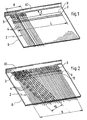
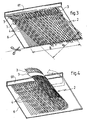
- Herstellungsverfahren einer Blumenkomposition (1) gemäß Anspruch 1, dadurch gekennzeichnet, dass man die folgenden Schritte durchführt:auf einer Arbeitsfläche (6) klebt man mit seiner klebenden Seite ein Klebeband (7) geradlinig in einer Länge auf, die mindestens dem oberen Umfang (L) des Kerns (5) entspricht, und dannsteckt man vorzugsweise mit einem speziellen Pflanzenklebstoff auf dem Band (7) eine erste Reihe Pflanzen (2) und/oder Dekorationselemente gegenüberliegend und parallel zueinander und in einer senkrecht zum Klebeband liegenden Richtung zusammen, und zwar auf einer Länge (L), die dem oberen Umfang des Kerns (5) entspricht, wobei die Köpfe (3) der Pflanzen (2) und/oder der Dekorationselemente vorzugsweise in ein- und demselben Abstand (1) eines oberen Randes (9) des Bandes (7) zu halten sind, unddann klebt man gegebenenfalls über der ersten Reihe (8) und unter Anwendung der gleichen Mittel eine zweite Reihe (10) von Pflanzen (2) auf, welche sich vorteilhaft voneinander bzw. von den gegenüberliegend angeordneten Dekorationselementen abheben, die parallel zueinander und in einer vorteilhaft schräg zum Band (7) liegenden Richtung angeordnet sind, wobei die Köpfe (3) der Pflanzen (2) bzw. der Dekorationselemente vorzugsweise in gleicher Entfernung zu einem Rand (9) des Klebebandes (7) gehalten werden.danach klebt man gegebenenfalls oder erforderlichenfalls eine dritte oder sogar noch weitere Reihen über die zweite Reihe (10), um eine zusätzliche, entweder dichtere oder gleichmäßigere Dekoration zu erhalten, undnach vollständiger Trocknung des Klebemittels nimmt man eine erste Angleichung der Länge der Stiele (L) der Pflanzen (2) vor, um eine Stabilität des Blumenbouquets (1) zu erhalten, und dannzieht man das so dekorierte Klebeband (7) von der Arbeitsfläche ab und legt das Ganze dann auf die gleiche Arbeitsfläche (6) in vorteilhafter Weise zurück, wobei die klebende Seite des Bandes (7) nach oben zeigt, um dannden auf dem Klebeband (7) abgestützten Kern (5) zu schwenken (f), indem man die Oberseite (9) des Bandes (7) vom einen Ende des Bandes (7) her mit der Oberseite (13) des Kerns (5) abstimmt, bis dass der Kern (5) vollständig ummantelt ist,woraufhin man die Stiele (4) auf der Grundlage des Kerns (5) dann umschichtet, wenn dieser im unteren Teil einen Konvergenzpunkt aufweist, wobei man die Biegung der Stiele (4) der Pflanzen (2) der zweiten Reihe (10) sowie die eventuellen nachfolgenden Reihen beibehält und sie mit der Schnur (15) oder Gleichwertigem zusammenbindet, dannordnet man die Enden (16) der Stiele (2) gleichmäßig an und kürzt sie gegebenenfalls, und schließlichdekoriert man die obere Oberfläche (20), um das Herz (17) des Bouquets zu bilden.
- Verfahren gemäß Anspruch 2, unter Verwendung eines Kerns (5) mit Facetten (24), dessen obere Oberfläche (20) sich in ein vorzugsweise regelmäßiges Vieleck einlässt, dadurch gekennzeichnet, dass man die Herstellungsschritte a, b, c, d, e und f anwendet, um jede Facette (24) des Kerns (5) unabhängig voneinander gemäß Schritt g zu dekorieren, um dann normal mit den Schritten h, i und j weiterzumachen.
- Verfahren gemäß irgendeinem der Ansprüche 2 und 3, dadurch gekennzeichnet, dass man Striche (11) von speziellem Pflanzenklebemittel auf die klebende Seite des Bandes (7) hinzufügt, bevor man es auf den Kern überträgt (Schritt g).
- Verfahren gemäß einem der vorgenannten Ansprüche, dadurch gekennzeichnet, dass die Pflanzen (2) bzw. die auf der oberen Oberfläche (2) angeordneten Dekorationselemente Stiele (4) bzw. verkleinerte Grundlagen haben, welche die mit mehreren Blüten versehenen bzw. auf einem Schaft verteilten Pflanzen brauchbar machen und der gesamten Anordnung eine konstante und homogene Dichte gewähren.
- (5) für die Herstellung einer Blumenkomposition (1) wie ein gemäß Anspruch 1 hergestelltes Blumenbouquet mit mindestens einer oberen Oberfläche (20), die geeignet ist zur Aufnahme sowie Beibehaltung der Position der Pflanzen (2), deren Länge der Stiele (4) bzw. der Dekorationsuntergründe beliebig ist, sowie einer Seitenverkleidung (21), welche den genannten oberen Teil (20) umgibt und welche in sich geschlossen ist, um mit dem oberen Teil (2) einen Raum abzugrenzen, dadurch gekennzeichnet, dass sich die äußere Oberfläche der Seitenverkleidung (21) fortsetzt und geeignet ist, die auf dieser äußeren Oberfläche nebeneinander angeordneten Pflanzenstiele um die Verkleidung herum auszurichten, und zwar so, dass die genannten Stiele sich in einem Konvergenzpunkt (14) treffen, um sich mit dem unteren Teil (22) des genannten Raumes zu decken oder neben diesem anzuordnen, wonach der genannte Teil (22) jeweils eine Spitze aufweist oder offen abgeschnitten ist oder eventuell durch einen aufgesteckten Deckel (23) verschlossen ist.
- Kern gemäß vorgenanntem Anspruch, insbesondere für die Herstellung des Blumenbouquets gemäß Anspruch 3, dadurch gekennzeichnet, dass es eine Symmetrieachse (X, X') aufweist, welche durch den Mittelteil des oberen Teiles (20) und senkrecht hierzu stehend läuft, wobei die Seitenverkleidung (21) entweder umlaufend oder mit flachen, hohlen oder gewölbten Facetten (24) versehen ist, wobei die allgemeine Form des Kerns (5) kegelförmig oder prismenförmig, kegelstumpfartig oder abgestumpft prismatisch, oder sogar wulstförmig oder abgeschnitten kugelförmig wie z.B. eine Kugelkappe sein kann.
- Kern gemäß Anspruch 6, dadurch gekennzeichnet, dass der obere Teil (20), die damit zusammenhängende Verkleidung (21) sowie der eventuelle Deckel (23) irgendeine beliebige Form haben.
- Kern gemäß einem der Ansprüche 6 bis 8, dadurch gekennzeichnet, dass der obere Teil (2) aus einem weichen Material besteht, welches sich mit den Pflanzen (2) und/oder den Dekorationselementen verträgt, wie z.B. geschäumter Kunststoff, in welchen man die Pflanzen (2) hineinstecken kann, und eine Verkleidung (21), die aus einem festen Material besteht wie z.B. Karton, Kunststoff, Ton, Terrakotta, Metall, Glas, Holz oder Verbundwerkstoff und deren Derivate, die mit dem oberen Teil (20) verträglich sind, an welchen sie durch sämtliche bekannten Mittel wie z.B. Kleben, Heften, Schwenken oder Ähnlichem angebunden ist.
Applications Claiming Priority (3)
| Application Number | Priority Date | Filing Date | Title |
|---|---|---|---|
| FR9608454A FR2750589B1 (fr) | 1996-07-04 | 1996-07-04 | Dispositif pour realiser des bouquets floraux |
| FR9608454 | 1996-07-04 | ||
| PCT/FR1997/001203 WO1998001019A1 (fr) | 1996-07-04 | 1997-07-04 | Procede de realisation d'une composition florale a partir d'un noyau rigide et noyau ainsi utilise |
Publications (2)
| Publication Number | Publication Date |
|---|---|
| EP0924980A1 EP0924980A1 (de) | 1999-06-30 |
| EP0924980B1 true EP0924980B1 (de) | 2002-10-09 |
Family
ID=9493791
Family Applications (1)
| Application Number | Title | Priority Date | Filing Date |
|---|---|---|---|
| EP97931870A Expired - Lifetime EP0924980B1 (de) | 1996-07-04 | 1997-07-04 | Verfahren zur herstellung eines gesteckes aus einem harten kern und dafür verwendeter kern |
Country Status (6)
| Country | Link |
|---|---|
| EP (1) | EP0924980B1 (de) |
| AT (1) | ATE225597T1 (de) |
| AU (1) | AU3547197A (de) |
| DE (1) | DE69716279T2 (de) |
| FR (1) | FR2750589B1 (de) |
| WO (1) | WO1998001019A1 (de) |
Families Citing this family (2)
| Publication number | Priority date | Publication date | Assignee | Title |
|---|---|---|---|---|
| DE29801536U1 (de) * | 1998-01-31 | 1998-05-14 | Volker Goertz Papier- u. Kunststoffbearbeitung, 38667 Bad Harzburg | Halterung für Blumen o.dgl. |
| FR3001610B1 (fr) * | 2013-02-05 | 2015-02-20 | Bruno Chereau | Procede de realisation d'une composition florale |
Family Cites Families (5)
| Publication number | Priority date | Publication date | Assignee | Title |
|---|---|---|---|---|
| CH145372A (de) * | 1930-02-05 | 1931-02-28 | Sellmann Theodor | Kernkörper für Blumenarrangements. |
| FR2513849A1 (fr) * | 1981-10-06 | 1983-04-08 | Floralux Sarl | Dispositif pour la presentation de decors floraux |
| GB8326007D0 (en) * | 1983-09-28 | 1983-11-02 | Odom D C | Duplicate work of three dimensional arrangements |
| DE8902156U1 (de) * | 1989-02-23 | 1989-04-06 | Schwarzenberg, Hans Josef, 4792 Bad Lippspringe | Kernkörper für Pflanzen und Blumengebinde |
| US5477637A (en) * | 1994-10-25 | 1995-12-26 | Xl Group, Inc. | Floral bouquet stem separator |
-
1996
- 1996-07-04 FR FR9608454A patent/FR2750589B1/fr not_active Expired - Fee Related
-
1997
- 1997-07-04 WO PCT/FR1997/001203 patent/WO1998001019A1/fr not_active Ceased
- 1997-07-04 AT AT97931870T patent/ATE225597T1/de not_active IP Right Cessation
- 1997-07-04 EP EP97931870A patent/EP0924980B1/de not_active Expired - Lifetime
- 1997-07-04 AU AU35471/97A patent/AU3547197A/en not_active Abandoned
- 1997-07-04 DE DE69716279T patent/DE69716279T2/de not_active Expired - Lifetime
Also Published As
| Publication number | Publication date |
|---|---|
| EP0924980A1 (de) | 1999-06-30 |
| WO1998001019A1 (fr) | 1998-01-15 |
| DE69716279T2 (de) | 2003-06-18 |
| FR2750589B1 (fr) | 1998-10-02 |
| FR2750589A1 (fr) | 1998-01-09 |
| ATE225597T1 (de) | 2002-10-15 |
| AU3547197A (en) | 1998-02-02 |
| DE69716279D1 (de) | 2002-11-14 |
Similar Documents
| Publication | Publication Date | Title |
|---|---|---|
| EP3378346B1 (de) | Stein und sein herstellungsverfahren | |
| CH693662A5 (fr) | Pièce de bijouterie. | |
| EP0267841B1 (de) | Mehrfachverpackung, bestimmt zum Festhalten einer Vielzahl von Gegenständen | |
| EP0924980B1 (de) | Verfahren zur herstellung eines gesteckes aus einem harten kern und dafür verwendeter kern | |
| EP2437638B1 (de) | Behälterformende verpackungsvorrichtung | |
| EP2382861A1 (de) | Unterschiedlich biologisch abbaubarer Blumentopf | |
| EP2437986B1 (de) | Vase aus einem gehäuse mit einem stabilisierungssystem | |
| FR2580458A1 (fr) | Support a usage horticole pour cointainers | |
| FR2971680A1 (fr) | Bijou ou accessoire vestimentaire a mecanisme de deplacement de pierre | |
| EP2761996B1 (de) | Herstellungsverfahren für einen Blumenstrauss | |
| FR2685994A1 (fr) | Procede de fabrication d'un godet pour vegetaux. | |
| FR2517023A1 (fr) | Ensemble d'elements pour la realisation d'un abat-jour | |
| EP0952423B1 (de) | Verzierungsplatte für Feuerwerk | |
| FR2619671A1 (fr) | Procede de multiplication et de culture de plantes de la famille des bromeliacees, et plantes ainsi obtenues | |
| CA2154233A1 (fr) | Dispositif pour le maintien de fleurs coupees facilitant la preparation de bouquets ronds | |
| FR2908265A1 (fr) | Dispositif pour la conservation et la presentation de fleurs de muguet coupees | |
| FR1419898A (fr) | Perfectionnements aux boîtes, cornets ou emballages de carton utilisés notamment pour la présentation et la vente d'articles de confiserie | |
| WO2002087998A1 (fr) | Emballage de fleurs, transformable en vase | |
| FR2594012A1 (fr) | Procede pour la mise en oeuvre d'un decor floral et decor floral ainsi obtenu. | |
| FR2636272A1 (fr) | Procede pour la fabrication de sujets decoratifs en forme de fleurs ou similaires, et sujets decoratifs obtenus par ce procede | |
| FR2829119A1 (fr) | Conditionnement pour bulbes | |
| EP1362507A1 (de) | Herstellungsverfahren für Schaumblöcke, erhaltener Schaumblock und eine, so einen Schaumblock aufweisende, Ausstellungsvorrichtung für Blumensträusse | |
| EP1493362A1 (de) | Abstütze für die Präsentation von Produkten | |
| FR2707143A1 (fr) | Procédé de fabrication d'un bijou quelconque, châssis pour la réalisation d'un bijou suivant ce procédé et boucle d'oreille fabriquée suivant ce procédé. | |
| CH420981A (fr) | Emballage en matière plastique pour un objet présentant au moins un équateur |
Legal Events
| Date | Code | Title | Description |
|---|---|---|---|
| PUAI | Public reference made under article 153(3) epc to a published international application that has entered the european phase |
Free format text: ORIGINAL CODE: 0009012 |
|
| 17P | Request for examination filed |
Effective date: 19990204 |
|
| AK | Designated contracting states |
Kind code of ref document: A1 Designated state(s): AT BE CH DE DK ES FI FR GB GR IE IT LI LU NL PT SE |
|
| GRAG | Despatch of communication of intention to grant |
Free format text: ORIGINAL CODE: EPIDOS AGRA |
|
| 17Q | First examination report despatched |
Effective date: 20020206 |
|
| GRAG | Despatch of communication of intention to grant |
Free format text: ORIGINAL CODE: EPIDOS AGRA |
|
| GRAH | Despatch of communication of intention to grant a patent |
Free format text: ORIGINAL CODE: EPIDOS IGRA |
|
| GRAG | Despatch of communication of intention to grant |
Free format text: ORIGINAL CODE: EPIDOS AGRA |
|
| GRAH | Despatch of communication of intention to grant a patent |
Free format text: ORIGINAL CODE: EPIDOS IGRA |
|
| GRAH | Despatch of communication of intention to grant a patent |
Free format text: ORIGINAL CODE: EPIDOS IGRA |
|
| GRAA | (expected) grant |
Free format text: ORIGINAL CODE: 0009210 |
|
| AK | Designated contracting states |
Kind code of ref document: B1 Designated state(s): AT BE CH DE DK ES FI FR GB GR IE IT LI LU NL PT SE |
|
| PG25 | Lapsed in a contracting state [announced via postgrant information from national office to epo] |
Ref country code: NL Free format text: LAPSE BECAUSE OF FAILURE TO SUBMIT A TRANSLATION OF THE DESCRIPTION OR TO PAY THE FEE WITHIN THE PRESCRIBED TIME-LIMIT Effective date: 20021009 Ref country code: IT Free format text: LAPSE BECAUSE OF FAILURE TO SUBMIT A TRANSLATION OF THE DESCRIPTION OR TO PAY THE FEE WITHIN THE PRE;WARNING: LAPSES OF ITALIAN PATENTS WITH EFFECTIVE DATE BEFORE 2007 MAY HAVE OCCURRED AT ANY TIME BEFORE 2007. THE CORRECT EFFECTIVE DATE MAY BE DIFFERENT FROM THE ONE RECORDED.SCRIBED TIME-LIMIT Effective date: 20021009 Ref country code: IE Free format text: LAPSE BECAUSE OF FAILURE TO SUBMIT A TRANSLATION OF THE DESCRIPTION OR TO PAY THE FEE WITHIN THE PRESCRIBED TIME-LIMIT Effective date: 20021009 Ref country code: GR Free format text: LAPSE BECAUSE OF FAILURE TO SUBMIT A TRANSLATION OF THE DESCRIPTION OR TO PAY THE FEE WITHIN THE PRESCRIBED TIME-LIMIT Effective date: 20021009 Ref country code: FI Free format text: LAPSE BECAUSE OF FAILURE TO SUBMIT A TRANSLATION OF THE DESCRIPTION OR TO PAY THE FEE WITHIN THE PRESCRIBED TIME-LIMIT Effective date: 20021009 Ref country code: AT Free format text: LAPSE BECAUSE OF FAILURE TO SUBMIT A TRANSLATION OF THE DESCRIPTION OR TO PAY THE FEE WITHIN THE PRESCRIBED TIME-LIMIT Effective date: 20021009 |
|
| REF | Corresponds to: |
Ref document number: 225597 Country of ref document: AT Date of ref document: 20021015 Kind code of ref document: T |
|
| REG | Reference to a national code |
Ref country code: GB Ref legal event code: FG4D Free format text: NOT ENGLISH |
|
| REG | Reference to a national code |
Ref country code: CH Ref legal event code: EP |
|
| REG | Reference to a national code |
Ref country code: IE Ref legal event code: FG4D Free format text: FRENCH |
|
| REF | Corresponds to: |
Ref document number: 69716279 Country of ref document: DE Date of ref document: 20021114 |
|
| PG25 | Lapsed in a contracting state [announced via postgrant information from national office to epo] |
Ref country code: SE Free format text: LAPSE BECAUSE OF FAILURE TO SUBMIT A TRANSLATION OF THE DESCRIPTION OR TO PAY THE FEE WITHIN THE PRESCRIBED TIME-LIMIT Effective date: 20030109 Ref country code: PT Free format text: LAPSE BECAUSE OF FAILURE TO SUBMIT A TRANSLATION OF THE DESCRIPTION OR TO PAY THE FEE WITHIN THE PRESCRIBED TIME-LIMIT Effective date: 20030109 Ref country code: DK Free format text: LAPSE BECAUSE OF FAILURE TO SUBMIT A TRANSLATION OF THE DESCRIPTION OR TO PAY THE FEE WITHIN THE PRESCRIBED TIME-LIMIT Effective date: 20030109 |
|
| GBT | Gb: translation of ep patent filed (gb section 77(6)(a)/1977) |
Effective date: 20030205 |
|
| NLV1 | Nl: lapsed or annulled due to failure to fulfill the requirements of art. 29p and 29m of the patents act | ||
| PG25 | Lapsed in a contracting state [announced via postgrant information from national office to epo] |
Ref country code: ES Free format text: LAPSE BECAUSE OF FAILURE TO SUBMIT A TRANSLATION OF THE DESCRIPTION OR TO PAY THE FEE WITHIN THE PRESCRIBED TIME-LIMIT Effective date: 20030429 |
|
| PG25 | Lapsed in a contracting state [announced via postgrant information from national office to epo] |
Ref country code: LU Free format text: LAPSE BECAUSE OF NON-PAYMENT OF DUE FEES Effective date: 20030704 |
|
| REG | Reference to a national code |
Ref country code: IE Ref legal event code: FD4D Ref document number: 0924980E Country of ref document: IE |
|
| PG25 | Lapsed in a contracting state [announced via postgrant information from national office to epo] |
Ref country code: LI Free format text: LAPSE BECAUSE OF NON-PAYMENT OF DUE FEES Effective date: 20030731 Ref country code: CH Free format text: LAPSE BECAUSE OF NON-PAYMENT OF DUE FEES Effective date: 20030731 |
|
| PLBE | No opposition filed within time limit |
Free format text: ORIGINAL CODE: 0009261 |
|
| STAA | Information on the status of an ep patent application or granted ep patent |
Free format text: STATUS: NO OPPOSITION FILED WITHIN TIME LIMIT |
|
| 26N | No opposition filed |
Effective date: 20030710 |
|
| REG | Reference to a national code |
Ref country code: CH Ref legal event code: PL |
|
| PGFP | Annual fee paid to national office [announced via postgrant information from national office to epo] |
Ref country code: BE Payment date: 20060822 Year of fee payment: 10 |
|
| BERE | Be: lapsed |
Owner name: *CHEREAU BRUNO Effective date: 20070731 |
|
| PG25 | Lapsed in a contracting state [announced via postgrant information from national office to epo] |
Ref country code: BE Free format text: LAPSE BECAUSE OF NON-PAYMENT OF DUE FEES Effective date: 20070731 |
|
| PGFP | Annual fee paid to national office [announced via postgrant information from national office to epo] |
Ref country code: GB Payment date: 20120719 Year of fee payment: 16 |
|
| PGFP | Annual fee paid to national office [announced via postgrant information from national office to epo] |
Ref country code: DE Payment date: 20130722 Year of fee payment: 17 |
|
| PGFP | Annual fee paid to national office [announced via postgrant information from national office to epo] |
Ref country code: FR Payment date: 20130726 Year of fee payment: 17 |
|
| GBPC | Gb: european patent ceased through non-payment of renewal fee |
Effective date: 20130704 |
|
| PG25 | Lapsed in a contracting state [announced via postgrant information from national office to epo] |
Ref country code: GB Free format text: LAPSE BECAUSE OF NON-PAYMENT OF DUE FEES Effective date: 20130704 |
|
| REG | Reference to a national code |
Ref country code: DE Ref legal event code: R119 Ref document number: 69716279 Country of ref document: DE |
|
| REG | Reference to a national code |
Ref country code: FR Ref legal event code: ST Effective date: 20150331 |
|
| PG25 | Lapsed in a contracting state [announced via postgrant information from national office to epo] |
Ref country code: DE Free format text: LAPSE BECAUSE OF NON-PAYMENT OF DUE FEES Effective date: 20150203 |
|
| REG | Reference to a national code |
Ref country code: DE Ref legal event code: R119 Ref document number: 69716279 Country of ref document: DE Effective date: 20150203 |
|
| PG25 | Lapsed in a contracting state [announced via postgrant information from national office to epo] |
Ref country code: FR Free format text: LAPSE BECAUSE OF NON-PAYMENT OF DUE FEES Effective date: 20140731 |