EP0917536B1 - Polynucleotide et son utilisation pour moduler une reponse de defense dans des plantes - Google Patents
Polynucleotide et son utilisation pour moduler une reponse de defense dans des plantes Download PDFInfo
- Publication number
- EP0917536B1 EP0917536B1 EP97933789A EP97933789A EP0917536B1 EP 0917536 B1 EP0917536 B1 EP 0917536B1 EP 97933789 A EP97933789 A EP 97933789A EP 97933789 A EP97933789 A EP 97933789A EP 0917536 B1 EP0917536 B1 EP 0917536B1
- Authority
- EP
- European Patent Office
- Prior art keywords
- mlo
- sequence
- plant
- polynucleotide according
- amino acid
- Prior art date
- Legal status (The legal status is an assumption and is not a legal conclusion. Google has not performed a legal analysis and makes no representation as to the accuracy of the status listed.)
- Expired - Lifetime
Links
Images








Classifications
-
- C—CHEMISTRY; METALLURGY
- C07—ORGANIC CHEMISTRY
- C07K—PEPTIDES
- C07K14/00—Peptides having more than 20 amino acids; Gastrins; Somatostatins; Melanotropins; Derivatives thereof
- C07K14/415—Peptides having more than 20 amino acids; Gastrins; Somatostatins; Melanotropins; Derivatives thereof from plants
-
- C—CHEMISTRY; METALLURGY
- C12—BIOCHEMISTRY; BEER; SPIRITS; WINE; VINEGAR; MICROBIOLOGY; ENZYMOLOGY; MUTATION OR GENETIC ENGINEERING
- C12N—MICROORGANISMS OR ENZYMES; COMPOSITIONS THEREOF; PROPAGATING, PRESERVING, OR MAINTAINING MICROORGANISMS; MUTATION OR GENETIC ENGINEERING; CULTURE MEDIA
- C12N15/00—Mutation or genetic engineering; DNA or RNA concerning genetic engineering, vectors, e.g. plasmids, or their isolation, preparation or purification; Use of hosts therefor
- C12N15/09—Recombinant DNA-technology
- C12N15/63—Introduction of foreign genetic material using vectors; Vectors; Use of hosts therefor; Regulation of expression
- C12N15/79—Vectors or expression systems specially adapted for eukaryotic hosts
- C12N15/82—Vectors or expression systems specially adapted for eukaryotic hosts for plant cells, e.g. plant artificial chromosomes (PACs)
- C12N15/8241—Phenotypically and genetically modified plants via recombinant DNA technology
- C12N15/8261—Phenotypically and genetically modified plants via recombinant DNA technology with agronomic (input) traits, e.g. crop yield
- C12N15/8271—Phenotypically and genetically modified plants via recombinant DNA technology with agronomic (input) traits, e.g. crop yield for stress resistance, e.g. heavy metal resistance
- C12N15/8279—Phenotypically and genetically modified plants via recombinant DNA technology with agronomic (input) traits, e.g. crop yield for stress resistance, e.g. heavy metal resistance for biotic stress resistance, pathogen resistance, disease resistance
- C12N15/8282—Phenotypically and genetically modified plants via recombinant DNA technology with agronomic (input) traits, e.g. crop yield for stress resistance, e.g. heavy metal resistance for biotic stress resistance, pathogen resistance, disease resistance for fungal resistance
Definitions
- the present invention relates to stimulating a defence response in plants, with a view to providing the plants with enhanced pathogen resistance. More specifically, it has resulted from cloning of the barley Mlo gene, various mutant mlo alleles, and a number of homologues from various species.
- the Mlo gene has been isolated using a positional cloning approach which has never previously been successful in Barley. Details and discussion are provided below. Wild-type Mlo exerts a negative regulatory function on a pathogen defence response, such that mutants exhibit a defence response in the absence of pathogen.
- down-regulation or out-competition of Mlo function may be used to stimulate a defence response in transgenic plants, conferring increased pathogen resistance.
- Mutations have been described in several plants in which defence responses to pathogens appear to be constitutively expressed. Mutation-induced recessive alleles ( mlo ) of the barley Mlo locus exhibit a leaf lesion phenotype and confer an apparently durable, broad spectrum resistance to the powdery mildew pathogen, Erysiphe graminis f sp hordei .
- Resistance responses to the powdery mildew pathogen have been genetically well characterized (Wiberg, 1974; S ⁇ gaard and J ⁇ rgensen, 1988; J ⁇ rgensen, 1994). In most analyzed cases resistance is specified by race-specific resistance genes following the rules of Flor's gene-for-gene hypothesis (Flor, 1971). In this type of plant/pathogen interaction, resistance is specified by and dependent on the presence of two complementary genes, one from the host and one from the fungal pathogen. The complementary genes have been termed operationally (pathogen) resistance (“R”) gene and avirulence gene, respectively. Most of the powdery mildew resistance genes ( Mlx ) act as dominant or semidominant traits (J ⁇ rgensen, 1994).
- Monogenic resistance mediated by recessive ( Mlo ) alleles of the Mlo locus is different. Apart from being recessive, it differs from race-specific resistance to single pathogen strains in that (i) it confers broad spectrum resistance to almost all known isolates of the pathogen (ii) Mlo resistance alleles have been obtained by mutagen treatment of any tested susceptible wild type ( Mlo ) variety, and (iii) mlo resistance alleles exhibit a defence mimic phenotype in the absence of the pathogen (Wolter et al. , 1993). Thus, the genetic data indicate the Mlo wild type allele exerts a negative regulatory function on defence responses to pathogen attack.
- Mlo alleles Resistance mediated by Mlo alleles is currently widely used in barley breeding and an estimated 10 million hectares are annually planted in Europe with seeds of this genotype.
- a mlo like' inherited resistance to powdery mildew in other cereal plants has not been reported so far although the fungus is a relevant pathogen in wheat (attacked by Erysiphe graminis f sp tritici ), oat (attacked by E. g. f sp avenae ), and rye (attacked by E. g. f sp secalis ). Because cereals are morphologically, genetically and biochemically highly related to each other (Moore et al.
- RFLP markers closely linked to Mlo on barley chromosome 4 were previously identified on the basis of a mlo backcross line collection containing mlo alleles from six genetic backgrounds (Hinze et al. , 1991). The map position of Mlo on the basis of RFLP markers was consistent with its chromosomal localization as determined by a previous mapping with morphological markers (Jorgensen, 1977).
- a nucleic acid molecule may comprise a nucleotide sequence encoding a peptide with Mlo function.
- Mlo function refers to the ability to suppress a defence response, said defence response being race and/or pathogen independent and autonomous of the presence of a pathogen, such as, for example, the Mlo gene of barley, the Acd gene and the Lsd gene of Arabidopsis .
- Mlo function can be determined by assessing the level of constitutive defence response and/or susceptibility of the plant to a pathogen such as, for example, powdery mildew or rust (e.g. yellow rust). Accordingly, a putative nucleotide sequence with Mlo function can be tested upon complementation of a suitable mlo mutant.
- pathogen such as, for example, powdery mildew or rust (e.g. yellow rust). Accordingly, a putative nucleotide sequence with Mlo function can be tested upon complementation of a suitable mlo mutant.
- mlo function is used to refer to sequences which confer a mlo mutant phenotype on a plant.
- a mlo mutant phenotype is characterised by the exhibition of an increased resistance against one or more pathogens, which is race and/or pathogen independent and autonomous of the presence of a pathogen.
- the test plant may be monocotyledonous or dicotyledonous.
- Suitable monocots include any of barley, rice, wheat, maize or oat, particularly barley.
- Suitable dicots include Arabidopsis.
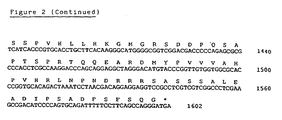
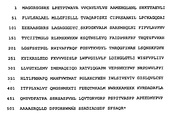
- Nucleic acid may encode a polypeptide comprising the amino acid sequence shown in Figure 2 , or an allele, variant, derivative or mutant, or homologue, thereof.
- Nucleic acid may have the sequence of a Mlo gene of barley, or be a mutant, variant (or derivative) or allele of the sequence provided, or a homologue thereof.
- Preferred mutants, variants and alleles are those which encode a sequence which retains a functional characteristic of the wild-type gene, especially the ability to suppress a defence response as discussed herein.
- Other preferred mutants, variants and alleles encode a sequence which, in a homozygote, cause constitutive activation of a defence response, or at least promotes activation of a defence response (i.e. is a mlo mutant sequence), e.g. by reducing or wholly or partly abolishing Mlo function.
- Preferred mutations giving mlo mutant sequences are shown in Table 1.
- Changes to a sequence, to produce a mutant, derivative or variant may be by one or more of addition, insertion, deletion or substitution of one or more nucleotides in the nucleic acid, leading to the addition, insertion, deletion and/or substitution of one or more amino acids.
- changes to the nucleic acid which make no difference to the encoded amino acid sequence are included.
- Particular variants, mutants, alleles and derivatives are discussed further below, as well as homologues.
- Nucleic acid may be subject to alteration by way of substitution of nucleotides and/or a combination of addition, insertion and/or substitution of one or more nucleotides with or without altering the encoded amino acids sequence (by virtue of the degeneracy of the genetic code).
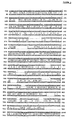
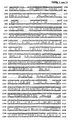
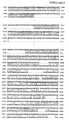
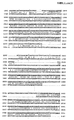
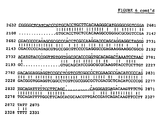
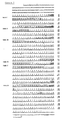
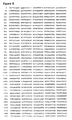
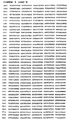
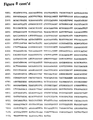
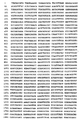
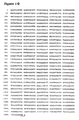
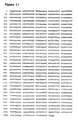
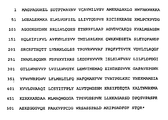
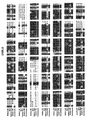
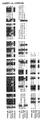
- homologues of the Mlo sequence shown in Figure 2 may include from rice (genomic sequence Figure 5 , bottom line, cDNA sequence Figure 10 , amino acid sequence Figure 13) and barley (genomic sequence Figure 6 , bottom line, cDNA.sequence Figure 11 , amino acid sequence Figure 14); also Table 5B (nucleotide sequences) and Figure 5A (amino acid sequences) show homologous EST's from rice and Arabidopsis.
- a vector may comprise nucleic acid with any one of the provided sequences, preferably a vector from which a product can be expressed.
- the vector is preferably suitable for transformation into a plant cell and/or a microbial cell.
- the invention further encompasses a host cell transformed with such a vector, especially a plant cell or a microbial cell (e.g. Agrobacterium tumefaciens ).
- a host cell such as a plant cell, comprising nucleic acid is provided.
- the nucleic acid may be incorporated within the nuclear genome, i.e. a chromosome. There may be more than one heterologous nucleotide sequence per haploid genome.
- a vector comprising nucleic acid need not include a promoter, particularly if the vector is to be used to introduce the nucleic acid into cells for recombination into the genome.
- Nucleic acid molecules and vectors may be provided in a form isolated and/or purified from their natural environment, in substantially pure or homogeneous form, or free or substantially free of nucleic acid or genes of the species of interest or origin other than the relevant sequence.
- Nucleic acid may comprise cDNA, RNA, genomic DNA and may be wholly or partially synthetic. The term “isolate” may encompass all these possibilities.
- any of the nucleic acid sequences disclosed may be produced by expression from encoding nucleic acid therefore under suitable conditions in suitably host cells, e.g. E. coli .
- host cells e.g. E. coli .
- Suitable vectors can be chosen or constructed, containing one or more appropriate regulatory sequences, including promoter sequences, terminator fragments, polyadenylation sequences, enhancer sequences, marker genes and other sequences as appropriate.
- Suitable vectors can be chosen or constructed, containing one or more appropriate regulatory sequences, including promoter sequences, terminator fragments, polyadenylation sequences, enhancer sequences, marker genes and other sequences as appropriate.
- Purified Mlo protein, or a fragment, mutant or variant thereof, e.g. produced recombinantly by expression from encoding nucleic acid therefor, may be used to raise Antibodies employing techniques which are standard in the art.
- Antibodies and polypeptides comprising antigen-binding-fragments of antibodies may be used in identifying homologues from other species as discussed further below.
- Methods of producing antibodies include immunising a mammal (eg human, mouse, rat, rabbit, horse, goat, sheep or monkey) with the protein or a fragment thereof.
- Antibodies may be obtained from immunised animals using any of a variety of techniques known in the art, and might be screened, preferably using binding of antibody to antigen of interest. For instance, Western blotting techniques or immunoprecipitation may be used ( Armitage et al, 1992, Nature 357: 80-82 ).
- Antibodies may be polyclonal or monoclonal.
- antibodies with appropriate binding specificity may be obtained from a recombinantly produced library of expressed immunoglobulin variable domains, eg using lambda bacteriophage or filamentous bacteriophage which display functional immunoglobulin binding domains on their surfaces; for instance see WO92 /01047 .
- Antibodies raised to a polypeptide or peptide can be used in the identification and/or isolation of homologous polypeptides, and then the encoding genes.
- a method of identifying or isolating a polypeptide with Mlo or mlo function may comprise screening candidate peptides or polypeptides with a polypeptide comprising the antigen-binding domain of an antibody (for example whole antibody or a fragment thereof) which is able to bind an Mlo or mlo peptide, polypeptide or fragment, variant or variant thereof or preferably has binding specificity for such a peptide or polypeptide, such as having an amino acid sequence identified herein.
- Specific binding members such as antibodies and polypeptides may comprise antigen binding domains of antibodies that bind and are preferably specific for a Mlo or mlo peptide or polypeptide or mutant, variant or derivative thereof.
- Candidate peptides or polypeptides for screening may for instance be the products of an expression library created using nucleic acid derived from an plant of interest, or may be the product of a purification process from a natural source.
- a peptide or polypeptide found to bind the antibody may be isolated and then may be subject to amino acid sequencing. Any suitable technique may be used to sequence the peptide or polypeptide either wholly or partially (for instance a fragment of a polypeptide may be sequenced). Amino acid sequence information may be used in obtaining nucleic acid encoding the peptide or polypeptide, for instance by designing one or more oligonucleotides (e.g. a degenerate pool of oligonucleotides) for use as probes or primers in hybridisation to candidate nucleic acid, or by searching computer sequence databases, as discussed further below.
- oligonucleotides e.g. a degenerate pool of oligonucleotides
- a method of identifying and cloning Mlo homologues from plants, including species other than Barley, may employ a nucleotide sequence derived from that shown in Figure 2 or a nucleotide sequence derived from any of the other Figures provided herein.
- Nucleic acid libraries may be screened using techniques well known to those killed in the art and homologous sequences thereby identified then tested. The provision of sequence information for the Mlo gene of Barley and various homologues enables the obtention of homologous sequences from Barley and other plant species, as exemplified further herein.
- PCR primers based on putative exon sequences, which might be identified by comparison with the Mlo sequence provided in Figure 2 wherein exons are highlighted, and perform RT-PCR with total RNA from the plant of interest, e.g. barley and rice for the homologues shown in Figures 5 and 6 , with cDNA and amino acid sequences shown in other figures herein.
- Nucleic acid may encode a Mlo homologue obtained using a nucleotide sequence derived from that shown in Figure 2 , or the amino acid sequence shown in Figure 2 .
- the nucleotide sequence and/or amino acid sequence shares homology with the sequence encoded by the nucleotide sequence of Figure 2 , preferably at least about 50%, or at least about 55%, or at least about 60%, or at least about 65%, or at least about 70%, or at least about 75%, or at least about 80% homology, or at least about 85% homology, or at least about 90% homology, most preferably at least about 95% homology.
- "Homology" in relation to an amino acid sequence may be used to refer to identity or similarity, preferably identity. High levels of amino acid identity may be limited to functionally significant domains or regions.
- a mutant, allele, variant or derivative amino acid sequence may include within the sequence shown in Figure 2 , a single amino acid change with respect to the sequence shown in Figure 2, or 2 , 3 , 4 , 5 , 6 , 7 , 8 , or 9 changes, about 10, 15, 20, 30, 40 or 50 changes, or greater than about 50, 60, 70, 80 or 90 changes.
- a mutant, allele, variant or derivative amino acid sequence may include additional amino acids at the C-terminus and/or N-terminus.
- homology at the amino acid level is generally in terms of amino acid similarity or identity. Similarity allows for "conservative variation", i.e. substitution of one hydrophobic residue such as isoleucine, valine, leucine or methionine for another, or the substitution of one polar residue for another, such as arginine for lysine, glutamic for aspartic acid, or glutamine for asparagine. Similarity may be as defined and determined by the TBLASTN program, of Altschul et al. (1990) J. Mol. Biol.
- BestFit which is part of the Wisconsin Package, Version 8, September 1994, (Genetics Computer Group, 575 Science Drive, Madison, Wisconsin, USA, Wisconsin 53711). BestFit makes an optimal alignment of the best segment of similarity between two sequences. Optimal alignments are found by inserting gaps to maximize the number of matches using the local homology algorithm of Smith and Waterman
- Homology may be over the full-length of the relevant sequence shown herein, or may more preferably be over a contiguous sequence of about or greater than about 20, 25, 30, 33, 40, 50, 67, 133, 167, 200, 233, 267, 300, 333, 400, 450, 500, 550, 600 or more amino acids or codons, compared with the relevant amino acid sequence or nucleotide sequence as the case may be.
- An allele, variant, derivative, mutant or homologue of the specific sequence may show little overall homology, say about 20%, or about 25%, or about 30%, or about 35%, or about 40% or about 45%, with the specific sequence.
- the amino acid homology may be much higher.
- Putative functionally significant domains or regions can be identified using processes of bioinformatics, including comparison of the sequences of homologues.
- Functionally significant domains or regions of different polypeptides may be combined for expression from encoding nucleic acid as a fusion protein.
- particularly advantageous or desirable properties of different homologues may be combined in a hybrid protein, such that the resultant expression product, with Mlo or mlo function, may comprise fragments of various parent proteins.
- nucleotide sequence information may be used in a data-base search to find homologous sequences, expression products of which can be tested for Mlo or mlo function. These may have ability to complement a mlo mutant phenotype in a plant or may, upon expression in a plant, confer a mlo phenotype.
- homologues may be exploited in the identification of further homologues, for example using oligonucleotides (e.g. a degenerate pool) designed on the basis of sequence conservation.
- oligonucleotides e.g. a degenerate pool
- a method of identifying or a method of cloning a Mlo homologue may employ a nucleotide sequence derived from that shown in Figure 2 or that shown in any of the other Figures herein.
- such a method may employ an oligonucleotide or oligonucleotides which comprises or comprise a sequence or sequences that are conserved between the sequences of Figures 2 and/or 5 and/or 6 and/or 10 and/or 11 and/or 12, or encoding an amino acid sequence conserved between Figure 2 and/or 7 and/or 13 and/or 14 and/or 15 to search for homologues.
- a method of obtaining nucleic acid comprising hybridisation of an oligonucleotide or a nucleic acid molecule comprising such an oligonucleotide to target/candidate nucleic acid.
- Target or candidate nucleic acid may, for example, comprise a genomic or cDNA library obtainable from an organism known to contain or suspected of containing such nucleic acid, either monocotyledonous or dicotyledonous.
- Successful hybridisation may be identified and target/candidate nucleic acid isolated for further investigation and/or use.
- Hybridisation may involve probing nucleic acid and identifying positive hybridisation under suitably stringent conditions (in accordance with known techniques) and/or use of oligonucleotides as primers in a method of nucleic acid amplification, such as PCR.
- stringent conditions in accordance with known techniques
- oligonucleotides as primers in a method of nucleic acid amplification, such as PCR.
- preferred conditions are those which are stringent enough for there to be a simple pattern with a small number of hybridisations identified as positive which can be investigated further. It is well known in the art to increase stringency of hybridisation gradually until only a few positive clones remain.
- oligonucleotides designed to amplify DNA sequences may be used in PCR reactions or other methods involving amplification of nucleic acid, using routine procedures. See for instance "PCR protocols; A Guide to Methods and Applications", Eds. Innis et al, 1990, Academic Press, New York .
- Preferred amino acid sequences suitable for use in the design of probes or PCR primers for some purposes are sequences conserved (completely, substantially or partly) between at least two Mlo peptides or polypeptides encoded by genes able to suppress a defence response in a plant, e.g. with any of the amino acid sequences of any of the various figures herein and/or encoded by the nucleotide sequences of any of the various figures herein.
- oligonucleotide probes or primers may be designed, taking into account the degeneracy of the genetic code, and, where appropriate, codon usage of the organism from the candidate nucleic acid is derived.
- an oligonucleotide e.g. for use in nucleic acid amplification, is up to about 50 nucleotides, or about 40 nucleotides or about 30 or fewer nucleotides in length (e.g. 18, 21 or 24).
- a PCR band from such a reaction might contain a complex mix of products. Individual products may be cloned and each one individually screened. It may be analysed by transformation to assess function on introduction into a plant of interest.
- nucleic acid is obtainable using oligonucleotides, designed on the basis of sequence information provided herein, as probes or primers.
- Nucleic acid isolated and/or purified from one or more cells of barley or another plant (see above), or a nucleic acid library derived from nucleic acid isolated and/or purified from the plant may be probed under conditions for selective hybridisation and/or subjected to a specific nucleic acid amplification reaction such as the polymerase chain reaction (PCR).
- the nucleic acid probed or used as template in the amplification reaction may be genomic DNA, cDNA or RNA. If necessary, one or more gene fragments may be ligated to generate a full-length coding sequence.
- primers tested include: 25L 5'-GTG CAT CTG CGT GTG CGT A-3' 25LN 5'-GTG TGC GTA CCT GGT AGA G-3' 25R 5'-AAC GAC GTC TGG TGC GTG-3' 33 5'-TGC AGC TAT ATG ACC TTC CCC CTC-3' 37 5'-GGA CAT GCT GAT GGC TCA GA-3' 38 5'-CAG AAC TTG TCT CAT CCC TG-3 38A 5'-GGC TAT ACA TTG GGA CTA ACA-3' 38B 5'-CGA ATC ATC ACA TCC TAT GTT-3' 39 5'-GCA AGT TCG ACT TCC AC-3' 39A 5'-TCG ACT TCC ACA AGT ACA TCA-3' 53 5'-AGC GTA CCT GCG TAC GTA G-3'
- sequence information provided herein also allows the design of diagnostic tests for determination of the presence of a specific mlo resistance allele, or a susceptibility allele (e.g. wild-type), in any given plant, cultivar, variety, population, landrace, part of a family or other selection in a breeding programme or other such genotype.
- a diagnostic test may be based on determination of the presence or absence of a particular allele by means of nucleic acid or polypeptide determination.
- this may involve hybridisation of a suitable oligo- or poly-nucleotide, such as a fragment of the Mlo gene or a homologue thereof, including any homologue disclosed herein, or any particular allele, such as an allele which gives an mlo phenotype, such as any such allele disclosed herein.
- the hybridisation may involve PCR designed to amplify a product from a given allelic version of mlo, with subsequent detection of an amplified product by any of a number of possible methods including but not limited to gel electrophoresis, capillary electrophoresis, direct hybridisation of nucleotide sequence probes and so on.
- a diagnostic test may be based on PCR designed to amplify various alleles or any allele from the Mlo locus, with a test to distinguish the different possible alleles by any of a number of possible methods, including DNA fragment size, restriction site variation (e.g. CAPS - cleaved amplified polymorphic sites) and so on.
- a diagnostic test may also be based on a great number of possible variants of nucleic acid analysis that will be apparent to those skilled in the art, such as use of a synthetic mlo -derived sequence as a hybridisation probe.
- the methods divide into those screening for the presence of nucleic acid sequences and those that rely on detecting the presence or absence of a polypeptide.
- the methods may make use of biological samples from one or more plants or cells that are suspected to contain the nucleic acid sequences or polypeptide.
- Exemplary approaches for detecting nucleic acid or polypeptides include analysing a sample from the plant or plant cell by:
- the nucleic acid in the sample will initially be amplified, e.g. using PCR, to increase the amount of the analyte as compared to other sequences present in the sample. This allows the target sequences to be detected with a high degree of sensitivity if they are present in the sample. This initial step may be avoided by using highly sensitive array techniques that are becoming increasingly important in the art.
- a variant form of the gene may contain one or more insertions, deletions, substitutions and/or additions of one or more nucleotides compared with the wild-type sequence (such as shown in Table 1) which may or may not disrupt the gene function. Differences at the nucleic acid level are not necessarily reflected by a difference in the amino acid sequence of the encoded polypeptide. However, a mutation or other difference in a gene may result in a frame-shift or stop codon, which could seriously affect the nature of the polypeptide produced (if any), or a point mutation or gross mutational change to the encoded polypeptide, including insertion, deletion, substitution and/or addition of one or more amino acids or regions in the polypeptide. A mutation in a promoter sequence or other regulatory region may prevent or reduce expression from the gene or affect the processing or stability of the mRNA transcript.
- Tests may be carried out on preparations containing genomic DNA, cDNA and/or mRNA.
- Testing cDNA or mRNA has the advantage of the complexity of the nucleic acid being reduced by the absence of intron sequences, but the possible disadvantage of extra time and effort being required in making the preparations.
- RNA is more difficult to manipulate than DNA because of the wide-spread occurrence of RN'ases.
- Nucleic acid in a test sample may be sequenced and the sequence compared with the sequence shown in Figure 2 , or other figure herein, to determine whether or not a difference is present. If so, the difference can be compared with known susceptibility alleles (e.g. as summarised in Table 1) to determine whether the test nucleic acid contains one or more of the variations indicated, or the difference can be investigated for association with disease resistance.
- known susceptibility alleles e.g. as summarised in Table 1
- the amplified nucleic acid may then be sequenced as above, and/or tested in any other way to determine the presence or absence of a particular feature.
- Nucleic acid for testing may be prepared from nucleic acid removed from cells or in a library using a variety of other techniques such as restriction enzyme digest and electrophoresis.
- Nucleic acid may be screened using a variant- or allele-specific probe.
- a probe corresponds in sequence to a region of the gene, or its complement, containing a sequence alteration known to be associated with disease resistance.
- specific hybridisation of such a probe to test nucleic acid is indicative of the presence of the sequence alteration in the test nucleic acid.
- more than one probe may be used on the same test sample.
- Allele- or variant-specific oligonucleotides may similarly be used in PCR to specifically amplify particular sequences if present in a test sample.
- Assessment of whether a PCR band contains a gene variant may be carried out in a number of ways familiar to those skilled in the art.
- the PCR product may for instance be treated in a way that enables one to display the mutation or polymorphism on a denaturing polyacrylamide DNA sequencing gel, with specific bands that are linked to the gene variants being selected.
- An alternative or supplement to looking for the presence of variant sequences in a test sample is to look for the presence of the normal sequence, e.g. using a suitably specific oligonucleotide probe or primer.
- RN'ase A cleaves at the site of a mis-match. Cleavage can be detected by electrophoresing test nucleic acid to which the relevant probe or probe has annealed and looking for smaller molecules (i.e. molecules with higher electrophoretic mobility) than the full length probe/test hybrid.
- Other approaches rely on the use of enzymes such as resolvases or endonucleases.
- an oligonucleotide probe that has the sequence of a region of the normal gene (either sense or anti-sense strand) in which mutations associated with disease resistance are known to occur (e.g. see Table 1) may be annealed to test nucleic acid and the presence or absence of a mis-match determined. Detection of the presence of a mis-match may indicate the presence in the test nucleic acid of a mutation associated with disease resistance.
- an oligonucleotide probe that has the sequence of a region of the gene including a mutation associated with disease resistance may be annealed to test nucleic acid and the presence or absence of a mis-match determined. The presence of a mis-match may indicate that the nucleic acid in the test sample has the normal sequence, or a different mutant or allele sequence. In either case, a battery of probes to different regions of the gene may be employed.
- the presence of differences in sequence of nucleic acid molecules may be detected by means of restriction enzyme digestion, such as in a method of DNA fingerprinting where the restriction pattern produced when one or more restriction enzymes are used to cut a sample of nucleic acid is compared with the pattern obtained when a sample containing the normal gene or a variant or allele is digested with the same enzyme or enzymes.
- the presence of absence of a lesion in a promoter or other regulatory sequence may also be assessed by determining the level of mRNA production by transcription or the level of polypeptide production by translation from the mRNA.
- Nucleic acid isolated and/or purified from one or more cells of a plant or a nucleic acid library derived from nucleic acid isolated and/or purified from cells may be probed under conditions for selective hybridisation and/or subjected to a specific nucleic acid amplification reaction such as the polymerase chain reaction (PCR).
- PCR polymerase chain reaction
- a method may include hybridisation of one or more (e.g. two) probes or primers to target nucleic acid. Where the nucleic acid is double-stranded DNA, hybridisation will generally be preceded by denaturation to produce single-stranded DNA.
- the hybridisation may be as part of a PCR procedure, or as part of a probing procedure not involving PCR.
- An example procedure would be a combination of PCR and low stringency hybridisation.
- a screening procedure chosen from the many available to those skilled in the art, is used to identify successful hybridisation events and isolate hybridised nucleic acid.
- Binding of a probe to target nucleic acid may be measured using any of a variety of techniques at the disposal of those skilled in the art.
- probes may be radioactively, fluorescently or enzymatically labelled.
- Other methods not employing labelling of probe include examination of restriction fragment length polymorphisms, amplification using PCR, RNAase cleavage and allele specific oligonucleotide probing.
- Probing may employ the standard Southern blotting technique. For instance DNA may be extracted from cells and digested with different restriction enzymes. Restriction fragments may then be separated by electrophoresis on an agarose gel, before denaturation and transfer to a nitrocellulose filter. Labelled probe may be hybridised to the DNA fragments on the filter and binding determined. DNA for probing may be prepared from RNA preparations from cells.
- Preliminary experiments may be performed by hybridising under low stringency conditions various probes to Southern blots of DNA digested with restriction enzymes. Suitable conditions would be achieved when a large number of hybridising fragments were obtained while the background hybridisation was low. Using these conditions nucleic acid libraries, e.g. cDNA libraries representative of expressed sequences, may be searched.
- oligonucleotide length and base composition are well able to employ suitable conditions of the desired stringency for selective hybridisation, taking into account factors such as oligonucleotide length and base composition, temperature and so on.
- oligonucleotides that are fragments of any of the sequences shown in Figure 2 , or any allele associated with disease resistance, e.g. as identified in Table 1, are at least about 10 nucleotides in length, more preferably at least about 15 nucleotides in length, more preferably at least about 20 nucleotides in length, more preferably about 30 nucleotides in length. Such fragments themselves individually represent aspects of the present invention. Fragments and other oligonucleotides may be used as primers or probes as discussed but may also be generated (e.g. by PCR) in methods concerned with determining the presence in a test sample of a sequence indicative of disease resistance.
- a sample may be tested for the presence of a binding partner for a specific binding member such as an antibody (or mixture of antibodies), specific for one or more particular variants of the polypeptide shown in Figure 2 , e.g. see Table 1.
- a binding partner for a specific binding member such as an antibody (or mixture of antibodies), specific for one or more particular variants of the polypeptide shown in Figure 2 , e.g. see Table 1.
- the sample may be tested by being contacted with a specific binding member such as an antibody under appropriate conditions for specific binding, before binding is determined, for instance using a reporter system as discussed.
- a specific binding member such as an antibody under appropriate conditions for specific binding
- different reporting labels may be employed for each antibody so that binding of each can be determined.
- a specific binding member such as an antibody may be used to isolate and/or purify its binding partner polypeptide from a test sample, to allow for sequence and/or biochemical analysis of the polypeptide to determine whether it has the sequence and/or properties of the wild-type polypeptide or a particular mutant, variant or allele thereof.
- Amino acid sequence is routine in the art using automated sequencing machines.
- mlo alleles allow the researcher or plant breeder to establish, with full confidence and independent from time consuming resistance tests, whether or not a desired allele is present in the plant of interest (or a cell thereof), whether the plant is a representative of a collection of other genetically identical plants (e.g. an inbred variety or cultivar) or one individual in a sample of related (e.g. breeders' selection) or unrelated plants.
- the mlo alleles conferring the desirable disease resistance phenotype are recessive, and are not therefore detectable at the whole plant phenotype level when in a heterozygous condition in the presence of a wild-type Mlo allele.
- Phenotypic screening for the presence of such recessive alleles is therefore only possible on material homozygous for the mlo locus and so delays substantially the generation in a plant breeding programme at which selection can be reliably and cost-effectively applied.
- a backcross breeding programme where, for example, a breeder is aiming to introgress a desirable mlo allele into an elite adapted high performing target genotype, the mlo locus will be permanently in the heterozygous condition until selfing is carried out. Nucleic acid or polypeptide testing for the presence of the recessive allele avoids the need to test selfed progeny of backcross generation individuals, thus saving considerable time and money.
- nucleic acid or polypeptide diagnostics for the desirable mlofenders in high throughput, low cost assays as provided by this invention reliable selection for the desirable mlo alleles can be made at early generations and on more material than would otherwise be possible. This gain in reliability of selection plus the time saving by being able to test material earlier and without costly resistance phenotype screening is of considerable value in plant breeding.
- the barley mlo-5 resistance allele is characterized by a G- to A-nucleotide substitution in the predicted start codon of the Mlo gene (Table 1).
- the mutation may easily be detected by standard PCR amplification of a Mlo gene segment from genomic template DNA with the primers:
- the mlo-9 resistance allele is characterized by a C- to T-nucleotide substitution (Table 1). This allele is of particular relevance since it is used frequently in breeding material. The mutational event may be easily detected using the primers:
- a third, particularly interesting allele is mlo-12 , characterised by a substitution a residue 240, specifically a Phe240 to leucine replacement. This may result from a C720 to A substitution in the encoding nucleotide sequence (Table 1). This is the only currently documented mlo allele for which conclusive evidence is available that the altered protein retains residual wild-type activity ( Hentrich, 1979, Arch. Züchtungsvorsch., Berlin 9, S. 283-291 ). mlo -12 exhibits no detectable spontaneous cell death reaction but confers a sufficient level of resistance to pathogens such as the powdery mildew fungus.
- mlo -12 may therefore be the allele of choice in breeding programs if minimal pleiotropic effects (spontaneous cell death) are desirable after introgression of the mlo resistance in elite breeding lines.
- the molecular site of the amino acid substitution within the Mlo protein allows the design of alleles with a residual wild-type activity, and also the obtention of interacting and/or inhibitory molecules, reducing undesirable pleiotropic effects from a complete loss of function of the Mlo protein.
- Nucleic,acid-based determination of the presence or absence of mlo alleles may be combined with determination of the genotype of the flanking linked genomic DNA and other unlinked genomic DNA using established sets of markers such as RFLPs, microsatellites or SSRs, AFLPs, RAPDs etc. This enables the researcher or plant breeder to select for not only the presence of the desirable mlo allele but also for individual plant or families of plants which have the most desirable combinations of linked and unlinked genetic background. Such recombinations of desirable material may occur only rarely within a given segregating breeding population or backcross progeny.
- Direct assay of the mlo locus as afforded by the present invention allows the researcher to make a stepwise approach to fixing (making homozygous) the desired combination of flanking markers and mlo alleles, by first identifying individuals fixed for one flanking marker and then identifying progeny fixed on the other side of the mlo locus all the time knowing with confidence that the desirable mlo allele is still present.
- mlo alleles to which this may be applied include, for example, mlo- 1, mlo -3, mlo -4, mlo -5, mlo- 6 , Mlo -7, mlo -8, mlo- 9, mlo -10, mlo- 12, mlo -13, mlo -16, mlo -17, mlo -26 and mlo -28, for all of which sequence information is provided herein (see e.g.
- An oligonucleotide fragment of a mlo allele may have a sequence which allows it to hybridise specifically to that allele as compared with other mlo alleles.
- Such an oligonucleotide spans a nucleotide at which a mlo mutation occurs, and may include the mutated nucleotide at or towards its 3' or 5' end.
- Such an oligonucleotide may hybridise with the sense or anti-sense strand.
- the variation may be within the coding sequence of the mlo gene, or may lie within an intron sequence or in an upstream or downstream noncoding sequence, wherein disruption affects or is otherwise related to the lesion in Mlo that results in the mildew resistant phenotype.
- mlo -9 allele is-widely but not exclusively used in plant breeding ( J Helms Jorgensen - Euphytica (1992) 63: 141-152 ), mlo -11 is also used.
- Use of mlo mutants in practical breeding has largely been restricted to spring barley, because the spontaneous cell death response associated with many of the mutant alleles appears to represent a penalty to plant growth and performance when incorporated into high yielding winter barley genotypes.
- different mlo alleles have different degrees of associated spontaneous cell death response, and thus some, either existing or newly created from mutagenesis programmes or isolated as spontaneous mutants, are more suitable than others for incorporation into winter barley backgrounds.
- the mlo -12 allele may be particularly suitable since no detectable pleiotropic effects occur despite conferring a sufficient level of pathogen resistance.
- the use of mlo based mildew resistance more widely in winter barleys will have significant value for barley growers as well as significant economic and environmental implications such as reduced use of fungicide inputs with their associated treatment costs.
- the provision of nucleic acid diagnostics as provided herein enables rapid and accurate deployment of new and existing mlo alleles into winter barley germplasm.
- Plants which include a plant cell as described herein may be provided, along with any part or propagule thereof, seed, selfed or hybrid progeny and descendants.
- a plant may be one which does not breed true in one or more properties. Plant varieties may be excluded, particularly registrable plant varieties according to Plant Breeders' Rights. It is noted that a plant need not be considered a "plant variety” simply because it contains stably within its genome a transgene, introduced into a cell of the plant or an ancestor thereof.
- any clone of such a plant, seed, selfed or hybrid progeny and descendants, and any part of any of these, such as cuttings, seed may be provided.
- Any plant propagule, that is any part which may be used in reproduction or propagation, sexual or asexual, including cuttings, seed and so on may be provided.
- a plant which is a sexually or asexually propagated off-spring, clone or descendant of such a plant, or any part or propagule of said plant, off-spring, clone or descendant may be provided.
- a method of making a plant cell involving introduction of the sequence (e.g as part of a suitable victor) into a plant cell and causing or allowing recombination between the vector and the plant cell genome to introduce the sequence of:nucleotides into the genome.
- a plant Following transformation of a plant cell a plant may be regenerated.
- a method of modulating Mlo expression in a plant which may modulate a defence response in the plant, may comprise expression of a heterologous Mlo gene sequence (or mutant, allele, variant or homologue thereof, as discussed) within cells of the plant.
- modulation or alteration of the level of constitutive defence response in a plant may be by way of suppression, repression or reduction (in the manner of wild-type Mlo ) or promotion, stimulation, activation, increase, enhancement or augmentation (in the manner of mutant mlo ).
- Activation or enhancement of the defence response may confer or increase pathogen resistance of the plant, especially resistance to powdery mildew and/or rust (such as yellow rust).
- heterologous may be used to indicate that the gene/sequence of nucleotides in question have been introduced into said cells of the plant or an ancestor thereof, using genetic engineering, ie by human intervention.
- a transgenic plant cell i.e. transgenic for the nucleic acid in question, may be provided.
- the transgene may be on an extra-genomic vector or incorporated, preferably stably, into the genome.
- a heterologous gene may replace an endogenous equivalent gene, ie one which normally performs the same or a similar function, or the inserted sequence may be additional to the endogenous gene or other sequence.
- An advantage of introduction of a heterologous gene is the ability to place expression of a sequence under the control of a promoter of choice, in order to be able to influence expression according to preference, such as under particular developmental, spatial or temporal control, or under control of an inducible promoter. Furthermore, mutants, variants and derivatives of the wild-type gene, e.g. with higher or lower activity than wild-type, may be used in place of the endogenous gene. Nucleic acid heterologous, or exogenous or foreign, to a plant cell may be non-naturally occuring in cells of that type, variety or species.
- nucleic acid may include a coding sequence of or derived from a particular type of plant cell or species or variety of plant, placed within the context of a plant cell of a different type or species or variety of plant.
- a nucleic acid sequence may be placed within a cell in which it or a homologue is found naturally, but wherein the nucleic acid sequence is linked and/or adjacent to nucleic acid which does not occur naturally within the cell, or cells of that type or species or variety of plant, such as operably linked to one or more regulatory sequences, such as a promoter sequence, for control of expression.
- a sequence within a plant or other host cell may be identifiably heterologous, exogenous or foreign.
- the nucleic acid may be placed under the control of an inducible gene promoter thus placing expression under the control of the user.
- a gene construct may comprise an inducible promoter operatively linked to a nucleotide sequence provided by the present invention. As discussed, this enables control of expression of the gene. Plants may be transformed with said gene construct and methods may comprise introduction of such a construct into a plant cell and/or induction of expression of a construct within a plant cell, e.g. by application of a suitable stimulus, such as an effective exogenous inducer or endogenous signal.
- a suitable stimulus such as an effective exogenous inducer or endogenous signal.
- inducible as applied to a promoter is well understood by those skilled in the art. In essence, expression under the control of an inducible promoter is "switched on” or increased in response to an applied stimulus (which may be generated within a cell or provided exogenously). The nature of the stimulus varies between promoters. Some inducible promoters cause little or undetectable levels of expression (or no expression) in the absence of the appropriate stimulus. Other inducible promoters cause detectable constitutive expression in the absence of the stimulus. Whatever the level of expression is in the absence of the stimulus, expression from any inducible promoter is increased in the presence of the correct stimulus. The preferable situation is where the level of expression increases upon application of the relevant stimulus by an amount effective to alter a phenotypic characteristic.
- an inducible (or “switchable”) promoter may be used which causes a basic level of expression in the absence of the stimulus which level is too low to bring about a desired phenotype (and may in fact be zero).
- expression is increased (or switched on) to a level which brings about the desired phenotype.
- Suitable promoters include the Cauliflower Mosaic Virus 35S (CaMV 35S) gene promoter that is expressed at a high level in virtually all plant tissues ( Benfey et al, (1990a) EMBO J 9: 1677-1684 ); the cauliflower meri 5 promoter that is expressed in the vegetative apical meristem as well as several well localised positions in the plant body, eg inner phloem, flower primordia, branching points in root and shoot ( Medford, J.I.
- CaMV 35S Cauliflower Mosaic Virus 35S
- Nucleic acid may be used in the production of a transgenic plant.
- nucleic acid to be inserted should be assembled within a construct which contains effective regulatory elements which will drive transcription. There must be available a method of transporting the construct into the cell. Once the construct is within the cell membrane, integration into the endogenous chromosomal material either will or will not occur. Finally, as far as plants are concerned the target cell type must be such that cells can be regenerated into whole plants.
- Plants transformed with the DNA segment containing the sequence may be produced by standard techniques which are already known for the genetic manipulation of plants.
- DNA can be transformed into plant cells using any suitable technology, such as a disarmed Ti-plasmid vector carried by Agrobacterium exploiting its natural gene transfer ability ( EP-A-270355 , EP-A-0116718 , NAR 12(22) 8711 - 87215 1984 ), particle or microprojectile bombardment ( US 5100792 , EP-A-444882 , EP-A-434616 ) microinjection ( WO 92/09696 , WO 94/00583 , EP 331083 , EP 175966 , Green et al.
- a disarmed Ti-plasmid vector carried by Agrobacterium exploiting its natural gene transfer ability ( EP-A-270355 , EP-A-0116718 , NAR 12(22) 8711 - 87215 1984 ), particle or microprojectile bombardment ( US 5100792 , EP-
- Agrobacterium transformation is widely used by those skilled in the art to transform dicotyledonous species. Recently, there has been substantial progress towards the routine production of stable, fertile transgenic plants in almost all economically relevant monocot plants ( Toriyama, et al. (1988) Bio/Technology 6, 1072-1074 ; Zhang, et al. (1988) Plant Cell Rep. 7, 379-384 ; Zhang, et al. (1988) Theor Appl Genet 76, 835-840 ; Shimamoto, et al. (1989) Nature 338, 274-276 ; Datta, et al. (1990) Bio/Technology 8, 736-740 ; Christou, et al.
- Microprojectile bombardment, electroporation and direct DNA uptake are preferred where Agrobacterium is inefficient or ineffective.
- a combination of different techniques may be employed to enhance the efficiency of the transformation process, eg bombardment with Agrobacterium coated microparticles ( EP-A-486234 ) or microprojectile bombardment to induce wounding followed by co-cultivation with Agrobacterium ( EP-A-486233 ).
- a plant may be regenerated, e.g. from single cells, callus tissue or leaf discs, as is standard in the art. Almost any plant can be entirely regenerated from cells, tissues and organs of the plant. Available techniques are reviewd in Vasil et al., Cell Culture and Somatic Cel Genetics of Plants, Vol I, II and III, Laboratory Procedures and Their Applications, Academic Press, 1984 , and Weissbach and Weissbach, Methods for Plant Molecular Biology, Academic Press, 1989 .
- a method of modulation of a defence response in a plant may comprise causing or allowing expression of nucleic acid within cells of the plant.
- it will be desirable to stimulate the defence response and this may be achieved by disrupting Mlo gene function.
- Down-regulation of expression of a target gene may be achieved using anti-sense technology or "sense regulation" ("co-suppression”).
- a nucleotide sequence is placed under the control of a promoter in a "reverse orientation" such that transcription yields RNA which is complementary to normal mRNA transcribed from the "sense" strand of the target gene.
- Antisense technology is also reviewed in Bourque, (1995), Plant Science 105, 125-149 , and Flavell, (1994) PNAS USA 91, 3490-3496 .
- An alternative is to use a copy of all or part of the target gene inserted in sense, that is the same, orientation as the target gene, to achieve reduction in expression of the target gene by co-suppression.
- van der Krol et al. (1990) The Plant Cell 2, 291-299 ; Napoli et al., (1990) The Plant Cell 2, 279-289 ; Zhang et al., (1992) The Plant Cell 4, 1575-1588 , and US-A-5,231,020 .
- the complete sequence corresponding to the coding sequence need not be used. For example fragments of sufficient length may be used. It is a routine matter for the person skilled in the art to screen fragments of various sizes and from various parts of the coding sequence to optimise the level of anti-sense inhibition. It may be advantageous to include the initiating methionine ATG codon, and perhaps one or more nucleotides upstream of the initiating codon. A further possibility is to target a conserved sequence of a gene, e.g. a sequence that is characteristic of one or more genes, such as a regulatory sequence. Antisense constructs may involve 3'end or 5'end sequences of Mlo or homologues. In cases where several Mlo homologues exist in a plant species, the involvement of 5'- and 3'-end untranslated sequences in the construct will enhance specificity of silencing.
- the sequence employed may be about 500 nucleotides or less, possibly about 400 nucleotides, about 300 nucleotides, about 200 nucleotides, or about 100 nucleotides. It may be possible to use oligonucleotides of much shorter lengths, 14-23 nucleotides, although longer fragments, and generally even longer than about 500 nucleotides are preferable where possible, such as longer than about 600 nucleotides, than about 700 nucleotides, than about 800 nucleotides, than about 1000 nucleotides, than about 1200 nucleotides, than about 1400 nucleotides, or more.
- a sequence employed in a down-regulation of gene expression in accordance with the present invention may be a wild-type sequence (e.g. gene) selected from those available, or a mutant, derivative, variant or allele, by way of insertion, addition, deletion or substitution of one or more nucleotides, of such a sequence.
- the sequence need not include an open reading frame or specify an RNA that would be translatable. It may be preferred for there to be sufficient homology for the respective anti-sense and sense RNA molecules to hybridise. There may be down regulation of gene expression even where there is about 5%, 10%, 15% or 20% or more mismatch between the sequence used and the target gene.
- the transcribed nucleic acid may represent a fragment of an Mlo gene, such as including a nucleotide sequence shown in Figure 2 , or the complement thereof, or may be a mutant, derivative, variant or allele thereof, in similar terms as discussed above in relation to alterations being made to a coding sequence and the homology of the altered sequence.
- the homology may be sufficient for the transcribed anti-sense RNA to hybridise with nucleic acid within cells of the plant, though irrespective of whether hybridisation takes place the desired effect is down-regulation of gene expression.
- Anti-sense regulation may itself be regulated by employing an inducible promoter in an appropriate construct.
- Constructs may be expressed using the natural promoter, by a constitutively expressed promotor such as the CaMV 35S promotor, by a tissue-specific or cell-type specific promoter, or by a promoter that can be activated by an external signal or agent.
- a constitutively expressed promotor such as the CaMV 35S promotor
- tissue-specific or cell-type specific promoter or by a promoter that can be activated by an external signal or agent.
- the CaMV 35S promoter but also the rice actin1 and maize ubiquitin promoters have been shown to give high levels of reporter gene expression in rice ( Fujimoto et al., (1993) Bio/Technology 11, 1151-1155 ; Zhang, et al., (1991) Plant Cell 3, 1155-1165 ; Cornejo et al., (1993) Plant Molecular Biology 23, 567-581 ).
- nucleic acid including a nucleotide sequence complementary to a coding sequence of a Mlo gene (i.e. including homologues), or a fragment of a said coding sequence suitable for use in anti-sense regulation of expression, is provided.
- This may be DNA and under control of an appropriate regulatory sequence for anti-sense transcription in cells of interest.
- a method of conferring pathogen resistance on a plant may include causing or allowing anti-sense transcription from heterologous nucleic acid within cells of the plant.
- nucleotide sequence of Figure 2 or a fragment, mutant, derivative, allele, variant or homologue thereof, such as any sequence shown or identified herein, may be used for down-regulation of gene expression, particularly down-regulation of expression of an Mlo gene or homologue thereof, preferably in order to confer pathogen resistance on a plant.
- fragments, mutants and so on may be used in similar terms as described above for use in anti-sense regulation.
- a method of conferring pathogen resistance on a plant may include causing or allowing expression from nucleic acid according to the invention within cells of the plant. This may be used to suppress Mlo activity.
- the activity of the product is preferably suppressed as a result of under-expression within the plant cells.
- Mlo down-regulation may promote activation of a defence response, which may in turn confer or augment pathogen resistance of the plant, especially resistance to powdery mildew and/or rust (e.g. yellow rust).
- a defence response may confer or augment pathogen resistance of the plant, especially resistance to powdery mildew and/or rust (e.g. yellow rust).
- a method of modulating Mlo function in a plant may comprise causing or allowing expression from nucleic acid according to the invention within cells of the plant to suppress endogenous Mlo expression.
- Modified versions of Mlo may be used to down-regulate endogenous Mlo function.
- mutants, variants, derivatives etc. may be employed.
- expression of a mlo mutant sequence at a high level may out-compete activity of endogenous Mlo.
- Reduction of Mlo wild type activity may be achieved by using ribozymes, such as replication ribozymes, e.g. of the hammerhead class ( Haseloff and Gerlach, 1988, Nature 334: 585-591 ; Feyter et al. Mol., 1996, Gen. Genet. 250: 329-338 ).
- ribozymes such as replication ribozymes, e.g. of the hammerhead class ( Haseloff and Gerlach, 1988, Nature 334: 585-591 ; Feyter et al. Mol., 1996, Gen. Genet. 250: 329-338 ).
- transposon mutagenesis Another way to reduce Mlo function in a plant employs transposon mutagenesis (reviewed by Osborne et al., (1995) Current Opinion in Cell Biology 7, 406-413 ). Inactivation of genes has been demonstrated via a 'targeted tagging' approach using either endogenous mobile elements or heterologous cloned transposons which retain their mobility in alien genomes. Mlo alleles carrying any insertion of known sequence could be identified by using PCR primers with binding specificities both in the insertion sequence and the Mlo homologue. 'Two-element systems' could be used to stabilize the transposon within inactivated alleles.
- a T-DNA is constructed bearing a non-autonomous transposon containing selectable or screenable marker gene inserted into an excision marker. Plants bearing these T-DNAs are crossed to plants bearing a second T-DNA expressing transposase function. Hybrids are double-selected for excision and for the marker within the transposon yielding F 2 plants with transposed elements.
- the two-element approach has a particular advantage with respect to Ac / Ds of maize, as the transposed Ds is likely to be unlinked to the transposase, facilitating outcrossing and stabilization of the Ds insertion ( Jones et al.,(1994) Science 266, 789-793 ; Osborne et al., (1995) Current Opinion in Cell Biology 7, 406-413 ).
- the mlo -based powdery mildew resistance is caused by the inactivation of the Mlo wild type allele, resulting in a recessive resistance phenotype.
- Substances that inhibit the activity of the Mlo wild type protein may be used to induce the resistance phenotype.
- the Mlo protein is predicted to be membrane-anchored by seven transmembrane helices (see e.g. Figure 7 ). This structure prediction has been reinforced by recent analysis of Mlo homologues in rice and Arabidopsis thaliana . Structure prediction of the Arabidopsis thaliana homologue also suggests the presence of seven transmembrane helices. A comparison of the Mlo homologues revealed in addition conserved cysteine residues in the putative extracellular loops 1 and 3 and high probabilities of amphipathic helices in the second intracellular loop adjacent to the predicted transmembrane helices 3 and 4. These conserved structural motifs in the family of Mlo proteins are reminiscent of G protein coupled receptors (GPCR) described extensively in mammalian systems.
- GPCR G protein coupled receptors
- GPCRs are known to be activated by ligands and to amplify signals intracellularly via heterotrimeric G proteins. Without in any way providing a limitation on the nature or scope of any aspect of the present invention, it is predicted that Mlo activates an inhibitory G alpha subunit of heterotrimeric G proteins, thus leading to a downregulation of as yet unknown effector proteins.
- Mlo sequence information enables the identification of antagonists of function of the Mlo protein (e.g. GPCR function).
- Antagonists of Mlo may block receptor activation by its unknown genuine ligand, mimicking recessive mutations in the Mlo gene.
- Mlo antagonists may be used as crop protection compounds, for example applied externally to the plant or crop or, where the compound is peptidyl in nature, delivered internally via a biological vector (e.g.
- Leaf segments of Mlo wild type plants may be tested with a test substance, e.g. from a random or combinatorial compound library, for resistance upon challenge with pathogen such as powdery mildew.
- the detached leaf segment assay is used as a standard test system to score for susceptibility/resistance upon inoculation with powdery mildew spores.
- Leaf segments of 7-day-old seedlings of the genotype Mlo RorI may be placed on agar, for example individual wells of 96-well microtiter plates containing 50 ⁇ l agar. Different compounds may be applied to the agar surface in each well at a concentration of about 1ppm dissolved in DMSO.
- pathogen such as spores of a virulent powdery mildew isolate
- compounds which induce resistance may be recognised by the absence of fungal mycelium on leaf segments in the microtiter plates.
- a further selection may be used to discriminate between compounds that act in the mlo pathway and those that confer resistance by other mechanisms, or those which exhibit a direct fungitoxic activity.
- mutants in genes (Ror genes) which may be required for mlo resistance ( Freialdenhoven et al., (1996), The Plant Cell 8, 5-14 ) may be used. Mutants of these genes confer susceptibility to powdery mildew attack despite the presence of mlo resistance alleles.
- Plants of the genotype Mlo rorl may be used, for example, to test compounds which induce resistance on Mlo Rorl genotypes but exhibit susceptibility on the Mlo rorl genotype, enabling selection of candidate Mlo antagonists. Testing candidate compounds identified using a leaf segment test may be used to drastically reduce the number of candidate compounds for further in vitro tests.
- a further selection step of candidate antagonists may involve heterologous expression of the Mlo protein or a fragment thereof (e.g. in a baculovirus insect cell system) and subsequent binding assays with labelled molecules. Specific binding of compounds to cell lines expressing wild type Mlo protein is a good indicator of their antagonistic mode of action. Analsis of the deduced Mlo protein sequence has provided strong evidence that the protein is anchored in the membrane via seven transmembrane helices and may represent a novel member of the so-called serpentine receptor family. The conclusion is supported by the sequence data derived from homologous genes identified in barley, rice and Arabidopsis.
- the present invention relates to assays for substances able to interfere with Mlo function, i.e. confer a mlo mutant phenotype, such substances themselves and uses thereof.
- Mlo may be used in identifying and/or obtaining a substance which inhibits Mlo function. Mlo may be used in identifying and/or obtaining a substance which induces pathogen resistance in a plant.
- Agents may be identified by screening techniques which involve determining whether an agent under test inhibits or disrupts Mlo function to induce an mlo phenotype.
- Candidate inhibitors are substances which bind Mlo.
- references to "Mlo" in relation to assays and screens should be taken to refer to homologues, such as in other species, including rice and wheat, not just in barley, also appropriate fragments, variants, alleles and derivatives thereof. Assessment of whether a test substance is able to bind the Mlo protein does not necessarily require the use of full-length Mlo protein. A suitable fragment may be used (or a suitable analogue or variant thereof).
- Suitable fragments of Mlo include those which include residues known to be crucial for Mlo function as identified by mlo mutant alleles (Table 1). Smaller fragments, and analogues and variants of this fragment may similarly be employed, e.g. as identified using techniques such as deletion analysis or alanine scanning.
- one class of agents that can be used to disrupt Mlo activity are peptides fragments of it.
- Such peptides tend to be short, and may be about 40 amino acids in length or less, preferably about 35 amino acids in length or less, more preferably about 30 amino acids in length, or less, more preferably about 25 amino acids or less, more preferably about 20 amino acids or less, more preferably about 15 amino acids or less, more preferably about 10 amino acids or less, or 9, 8, 7, 6, 5 or less in length.
- Peptides may be sequence variants or derivatives of a wild type Mlo sequence, which retain ability to interfere with Mlo function, e.g. to induce an mlo mutant phenotype.
- amino acids may be from Mlo or may be heterologous or foreign to Mlo.
- a peptide may also be included within a larger fusion protein, particularly where the peptide is fused to a non-Mlo(i.e. heterologous or foreign) sequence, such as a polypeptide or protein domain.
- Peptides may be generated wholly or partly by chemical synthesis.
- the compounds can be readily prepared according to well-established, standard liquid or, preferably, solid-phase peptide synthesis methods, general descriptions of which are broadly available (see, for example, in J.M. Stewart and J.D. Young, Solid Phase Peptide Synthesis, 2nd edition, Pierce Chemical Company, Rockford, Illinois 1984 ), in M. Bodanzsky and A. Bodanzsky, The Practice of Peptide Synthesis, Springer Verlag, New York (1984 ); and Applied Biosystems 430A Users Manual, ABI Inc., Foster City, California ), or they may be prepared in solution, by the liquid phase method or by any combination of solid-phase, liquid phase and solution chemistry, e.g. by first completing the respective peptide portion and then, if desired and appropriate, after removal of any protecting groups being present, by introduction of the residue X by reaction of the respective carbonic or sulfonic acid or a reactive derivative thereof.
- peptidyl molecule peptide or polypeptide
- Another convenient way of producing a peptidyl molecule is to express nucleic acid encoding it, by use of nucleic acid in an expression system, as discussed elsewhere herein. This allows for peptide agents to be delivered to plants transgenically, by means of encoding nucleic acid. If coupled to an inducible promoter for expression under control of the user, this allows for flexibility in induction of an mlo phenotype and pathogen resistance. This may allow for any side-effects arising from interference with Mlo function to be moderated.
- An assay method for a substance able to interact with the relevant region of Mlo may include:
- a test compound found to interact with the relevant portion of Mlo may be tested for ability to modulate, e.g. disrupt or interfere with, Mlo function, as discussed already above.
- An assay method for a substance able to induce an mlo mutant phenotype in a plant may include:
- Susceptibility or resistance to a pathogen may be determined by assessing pathogen growth, e.g. for powdery mildew the presence or absence, or extent, of mycelial growth.
- Binding of a test compound to a polypeptide or peptide may be assessed in addition to ability of the test compound to stimulate a defence response in a plant. Such tests may be run in parallel or one test may be performed on a substance which tests positive in another test.
- Performance of an assay method may be followed by isolation and/or manufacture and/or use of a compound, substance or molecule which tests positive for ability to modulate Mlo function and/or induce pathogen resistance, such as resistance to powdery mildew.
- an assay may be varied by those of skill in the art using routine skill and knowledge.
- interaction between substances may be studied in vitro by labelling one with a detectable label and bringing it into contact with the other which has been immobilised on a solid support.
- Suitable detectable labels, especially for peptidyl substances include 35 S-methionine which may be incorporated into recombinantly produced peptides and polypeptides.
- Recombinantly produced peptides and polypeptides may also be expressed as a fusion protein containing an epitope which can be labelled with an antibody.
- An assay may also take the form of an in vivo assay.
- the in vivo assay may be performed in a cell line such as a yeast strain or mammalian cell line in which the relevant polypeptides or peptides are expressed from one or more vectors introduced into the cell.
- a polypeptide or peptide containing a fragment of Mlo or a peptidyl analogue or variant thereof as disclosed may be fused to a DNA binding domain such as that of the yeast transcription factor GAL 4.
- the GAL 4 transcription factor includes two functional domains. These domains are the DNA binding domain (GAL4DBD) and the GAL4 transcriptional activation domain (GAL4TAD).
- GAL4DBD DNA binding domain
- GAL4TAD GAL4 transcriptional activation domain
- interaction of the polypeptides or peptides may be measured by the use of a reporter gene probably linked to a GAL 4 DNA binding site which is capable of activating transcription of said reporter gene.
- This assay format is described by Fields and Song, 1989, Nature 340 ; 245-246. This type of assay format can be used in both mammalian cells and in yeast. Other combinations of DNA binding domain and transcriptional activation domain are available in the art and may be preferred, such as the LexA DNA binding domain and the VP60 transcriptional activation domain.
- the Mlo polypeptide or peptide When looking for peptides or other substances which interact with Mlo, the Mlo polypeptide or peptide may be employed as a fusion with (e.g.) the LexA DNA binding domain, with test polypeptide or peptide (e.g. a random or combinatorial peptide library) as a fusion with (e.g.) VP60.
- test polypeptide or peptide e.g. a random or combinatorial peptide library
- An increase in reporter gene expression results from the presence of a peptide which interacts with Mlo, which interaction is required for transcriptional activation of the ⁇ -galactosidase gene.
- test substance or compound which may be added to an assay will normally be determined by trial and error depending upon the type of compound used. Typically, from about 0.001 nM to 1mM or more concentrations of putative inhibitor compound may be used, for example from 0.01 nM to 100 ⁇ M, e.g. 0.1 to 50 ⁇ M, such as about 10 ⁇ M. Greater concentrations may be used when a peptide is the test substance. Even a molecule which has a weak effect may be a useful lead compound for further investigation and development.
- Compounds which may be used may be natural or synthetic chemical compounds used in drug screening programmes. Extracts of plants which contain several characterised or uncharacterised components may also be used. Antibodies directed to Mlo or a fragment thereof form a further class of putative inhibitor compounds.
- Candidate inhibitor antibodies may be characterised and their binding regions determined to provide single chain antibodies and fragments thereof which are responsible for disrupting the interaction.
- Other candidate inhibitor compounds may be based on modelling the 3-dimensional structure of a polypeptide or peptide fragment and using rational drug design to provide potential inhibitor compound with particular molecular shape, size and charge characteristics. It is worth noting, however, that combinatorial library technology provides an efficient way of testing a potentially vast number of different substances for ability to interact with and/or modulate the activity of a polypeptide.
- Such libraries and their use are known in the art, for all manner of natural products, small molecules and peptides, among others. The use of peptide libraries may be preferred in certain circumstances.
- the substance or agent may be investigated further. Furthermore, it may be manufactured and/or used in preparation, i.e. manufacture or formulation, of a composition for inducing pathogen resistance in a plant. These may be applied to plants, e.g. for inducing pathogen resistance, such as resistance to poisery mildew.
- a method of inducing pathogen resistance in a plant may include applying such a substance to the plant.
- a peptidyl molecule may be applied to a plant transgenically, by expression from encoding nucleic acid, as noted.
- a polypeptide, peptide or other substance able to modulate or interfere with Mlo function, inducing pathogen resistance in a plant as disclosed herein, or a nucleic acid molecule encoding a peptidyl such molecule, may be provided in a kit, e.g. sealed in a suitable container which protects its contents from the external environment.
- a kit may include instructions for use.
- BC line based cross allowed testing of colinearity of DNA markers in the vicinity of Mlo as determined from the cross Carlsberg II Mlo x Grannenlose Zweizetze mlo-11 (Hinze et al ., 1991).
- mlo-3 backcross (BC) line was used that had been backcrossed seven times into the genetic background Ingrid (BC 7 Ingrid mlo-3 ; Hinze et al ., 1991).
- the line was previously characterized to carry a relatively small introgressed DNA segment on barley chromosome 4.
- the donor parent line Malteria Heda mlo-3 exhibits in comparison to DNA from the recurrent parent Ingrid polymorphisms with most of the identified RFLP loci linked to Mlo .
- searching polymorphisms only between two DNA templates, from lines Ingrid Mlo and BC 7 Ingrid mlo-3 we hoped to increase the density of DNA markers with AFLPs around Mlo in a targeted manner.
- AFLP marker candidates were identified by testing all possible Pst I/ Mse I primer combinations (1,024) extending into genomic sequences up to nucleotide positions +2 and +3, respectively. Similarly, almost 1,900 Eco RI/ Mse I primer combinations (+3/+3) have been analyzed.
- Four DNA templates were included in this analysis: Ingrid Mlo , BC 7 Ingrid mlo-3, a DNA pool of two phenotypically mlo resistant F 2 individuals, and a DNA pool of nine phenotypically susceptible F 2 individuals. The resistant and susceptible F 2 individuals which were included as DNA pools in the AFLP search had been selected from the above mentioned RFLP analysis of 77 F 2 segregants.
- the pooled F 2 DNA enabled us to control whether candidate polymorphisms detected between template DNA from the parents were heritable traits in the F 2 .
- All identified AFLP candidate markers have been re-examined with eight DNA templates: Ingrid Mlo , BC 7 Ingrid mlo-3 , DNA pools from individuals of three F 3 families which were phenotypically homozygous susceptible ( MloMlo ) according to K1 inoculation experiments; DNA of three resistant F 2 individuals.
- a total of 18 Pst I/ Mse I and 20 Eco RI/ Mse I primers were confirmed based on the selection procedure.
- AFLP assignment we used those four recombinants that had been identified with RFLP markers out of the above mentioned small sample of 77 F 2 segregants from Ingrid Mlo x BC 7 Ingrid mlo-3 (two recombinants in interval bAP91-bAL88, one in Mlo -bAO11, and one in bAO11-ABG366).
- a total of 18 AFLPs were found to be located within a genetic distance of approximately 3.5 cM including Mlo .
- a two-step procedure was used to construct the high resolution AFLP map.
- All 2,026 segregants were screened for recombination events between two AFLP markers on opposite sides of Mlo and subsequently only the few identified recombinants were used to map all the identified AFLPs in the 3.5 cM target interval.
- AFLP markers Bpm1 and Bpm9 were chosen, detecting each allelic DNA fragments in Ingrid Mlo and BC 7 Ingrid mlo-3 and located on opposite sites of Mlo to screen DNA templates of the segregants for recombination events.
- the search for recombinants could have been carried out with the flanking RFLP markers bAO11 and bAL88.
- the recombinants have been selfed and inoculation experiments with powdery mildew isolate K1 were performed using at least 25 individuals of each recombinant family to deduce the alleles of the previous generation at the Mlo locus.
- the obtained data enabled the construction of a high resolution map around Mlo based on more than 4,000 meiotic events and a resolution of at least 0.025 cM derived via two-point estimates.
- the essential result has been the identification of a DNA marker cosegregating with Mlo (Bpm16) and two flanking markers (Bpm2 and Bpm9) at a distance of 0.25 and 0.4 cM respectively ( Figure 1 ).
- yeast strain AB1380 After ligation with Eco RI digested pYAC4, the DNA was transformed into yeast strain AB1380 and colonies carrying recombinant pYAC4 DNA were selected on solidified synthetic complete medium lacking tryptophan and uracil (Sherman et al ., 1986). Forty randomly selected yeast colonies were tested for the presence of barley DNA using labelled barley genomic DNA in Southern experiments. The size of the YAC inserts was found after PFGE separations to vary between 500 and 800 kb. On average a genetic distance of 0.2 cM was expected to be represented on the individual recombinant YAC clone. A total of ⁇ 40,000 clones representing four barley genome equivalents have been generated.
- YAC clones designated 303A6, 322G2, 400H11, and 417D1
- Their insert size was determined by PFGE to be 650, 710, 650, and 820 kb respectively.
- AFLP analysis had shown that three of these clones (303A6, 322G2, and 417D1) contain also both flanking marker loci whereas clone 400H11 contains only loci Bpm16 and Bpm2.
- YAC 303A6 was chosen for subcloning experiments into BAC vector pECSBAC4 containing a unique Eco RI site (Shizuya et al ., 1992; the vector pECSBAC4 is described by Frijters and Michelmore, 1996; submitted). Total yeast DNA of this clone was partially digested with Eco RI to obtain DNA fragments with an average size of 50 kb and ligated into Eco RI digested and dephosphorylated BAC vector. Bacterial colonies containing YAC 303A6-derived DNA in pECSBAC4 were identified by replica colony hybridization experiments.
- BAC F15 containing an insert of ⁇ 60 kb was chosen for further detailed studies. It was found that the recombinant BAC clone contained in addition the AFLP marker locus Bpm2, but not Bpm9. At this point the BAC F15 insert DNA indicated successful physical delimitation in telomeric orientation but it was an open question whether the insert would contain bordering sequences in centromeric direction. Instead of constructing a BAC contig between Bpm 16 and Bpm9, the option to develop new polymorphic markers from BAC F15 was chosen. An allelic Xba I/ Mse I polymorphism (designated Bxm2) was identified between the parental lines Ingrid Mlo and BC 7 Ingrid mlo-3.
- a random sequencing project was initiated to determine sequence contigs of the ⁇ 60 kb insert of BAC F15 before marker Bxm2 was identified and shown to delimit the gene in telomeric orientation.
- a physical map was generated ( Figure 1 ). The physical map indicated that the flanking markers Bpm2 and Bxm2 are physically separated by ⁇ 30 kb.
- the sequence contigs were searched for regions of high coding probability using the UNIX versions of the STADEN program package. Only one sequence contig of almost 6 kb, including the cosegregating marker Bpm16, revealed an extensive region of high coding probability.
- RT-PCR reactions were performed with total leaf RNA derived from cultivar Ingrid Mlo using a series of primers deduced from regions which indicated high coding probabilities and obtained in each case a distinct amplification product. Sequencing of the largest RT-PCR products revealed a single extensive open reading frame of 1,602 bp ( Figure 2 ). The deduced putative protein of 533 amino acids has a molecular weight of 60.4 kDal. The ⁇ 1.7 kb RT-PCR product was used as a hybridization probe and detected a single RNA transcript of ⁇ 1.9 kb length. ( Figure 3 ). A comparison of the genomic sequence and the largest RT-PCR fragment reveals 12 exons and 11 introns, each flanked by the characteristic splice site sequences ( Figure 1 ).
- marker Bpm16 is located at the 3' end of the above described gene (exon 11) and cosegregates with the Mlo locus.
- We suspect that mutant allele mlo-2 is located within the promoter- or 5' untranslated sequences. The region is notoriously difficult to be sequenced via direct PCR sequencing from genomic DNA templates but experiments using a series of nested primers are likely to solve this problem.
- the comparative sequencing of genomic DNA from various mutant mlo lines and their respective Mlo wild type ciltivars provided strong evidence that Mlo has been identified.
- a crossing scheme was devised involving mlo resistance alleles mlo-1, mlo-5, and mlo-8.
- the mutant alleles originate from the genetic backgrounds Haisa ( mlo-1 ) and Carlsberg II ( mlo-5 and mlo-8 ).
- Intermutant crosses were performed as shown in Table 2 generating in each case at least 10 F 1 plants.
- F 2 populations were obtained by self-fertilization.
- F 2 seedlings were screened for rare susceptible individuals after inoculation with powdery mildew isolate K1 which is virulent on each of the parental Mlo wild type cultivars. Susceptible F 2 individuals were identified with a frequency of ⁇ 6 x 10 -4 .
- RFLP marker WG114 maps in centromeric orientation relative to Mlo
- marker ABG366 maps in the direction of the telomere.
- Detected RFLP alleles are shown for the intermutant crosses mlo-8 x mlo-1 (A) and mlo-1 x mlo-5 (B).
- DNA was analyzed either from susceptible F 2 individuals (indicated by *) or from homozygous susceptible (S) and homozygous resistant (R) F 3 progeny obtained from selfed susceptible F 2 individuals.
- the homozygous susceptible F 3 progeny from the susceptible F 2 plant #1 of cross mlo-8 x mlo-1 ( Figure 4 ) reveals the WG114 allele derived from the mlo-1 parent in centromeric orientation next to Mlo and the ABG366 allele from the mlo-8 parent in telomeric orientation to Mlo .
- the homozygous resistant F 3 progeny from F 2 plant #1 of this cross reveals in contrast only the flanking marker alleles derived from parent mlo-1 .
- susceptibility in F 2 plant #1 is caused by a cross-over type of recombination in the preceding meiosis of one chromosome which results in a restoration of the Mlo wild type allele whereas the second F 2 chromosome of individual 1 contains a functionally unaltered mlo-1 allele.
- the allelotypes of the RFLP loci of the homozygous susceptible F 3 progeny from susceptible F 2 plant #2 are identical to the one described above.
- flanking marker alleles from the homozygous resistant F 3 progeny of this individual are in both cases derived from the mlo-8 parent. It is concluded that again a cross-over type of recombination restored one Mlo wild type allele in the susceptible F 2 individual #2.
- #1, #2, #4, #7, and #9 is caused by a cross-over type of recombination restoring the Mlo wild type allele.
- Non cross-over types of recombination may have restored the Mlo wild type allele in individuals no. #3, #5, #6, and #8.
- a rice BAC library (Wang et al ., 1995) has also been screened with a labelled barley genomic fragment containing Mlo.
- a BAC clone containing an insert of ⁇ 23 kb was isolated.
- Subsequent subcloning enabled isolation of a 2.5 kb Pst I genomic rice fragment showing strong cross-hybridization with the barley Mlo gene probe.
- DNA sequencing of this fragment revealed remarkable DNA sequence similarities within exon sequences of the barley Mlo gene ( Figure 5 ).
- Mlo and mlo nucleic acid and polypeptides should provide no limitation on the nature or scope of any aspect or embodiment of the present invention.
- the surprising finding is that the deduced proteins share remarkable similar structural domains although they trigger resistance reactions to pathogens such as viruses, fungi, and bacteria (Dangl, 1995; Staskawicz et al ., 1995).
- the isolated genes code for proteins that either contain a leucine-rich region (LRR), with or without an attached nucleotide binding site (NBS), indicative of ligand-binding and protein-protein interaction or encode a simple serine/threonine kinase.
- LRR leucine-rich region
- NBS nucleotide binding site
- a structural combination of LRR and the kinase domain has been reported in the deduced protein from the rice Xa21 resistance gene (Song et al ., 1995).
- the structural similarity of resistance genes in 'gene-for-gene' defence makes the existence of a common underlying resistance mechanisms likely.
- Pleiotropic effects of mlo alleles have provided some clues towards the development of a molecular concept of the observed broad spectrum resistance response.
- CWAs cell wall appositions
- mlo in barley confers increased resistance to different types of yellow rust ( Puccinia struciformis ) when a one to one mixture of talcum powder and spores were aviblown onto leaves of mlo barley plants after onset of constitutive expression of defence related genes (10-11 day old mlo seedlings).
- Mlo The deduced amino acid sequence of Mlo reveals no significant homologies to any of the described plant resistance genes so far, supporting the idea of a distinct molecular resistance mechanism.
- the Mlo gene shows also no striking similarities to any characterized plant or mammalian gene sequence in the various data bases.
- highly significant homologous sequences have been identified in the EST and genomic databases both from rice and Arabidopsis thaliana (Table 5 and Figure 5 ). This strongly suggests that the Mlo protein represents a member of a novel protein family.
- a putative nuclear localization motif (NLS) is found within exon 12 providing indication of nuclear localization of the protein (KEKKKVR; Nigg et al ., 1991).
- acd and lsd mutants exhibit elevated resistance to a bacterial ( P. syringae ) and fungal ( P. parasitica ) pathogen.
- the lsd1 mutant is exceptional in that it confers heightened pathogen resistance at a prelesion state, in contrast to the other defective loci which exhibit elevated pathogen resistance only in the lesion-positive state. In this respect, lsd1 resembles the mlo mutants in barley. Another striking feature of lsd1 is the indeterminate spread of lesions in contrast to the other mutants where lesion growth is determinate.
- mutant 2118 has not been assigned to an allele number so far, we designate the allele here as mlo -26, according to current numbering in the GrainGene database (gopher://greengenes.cit.cornell.edu:70/77/.graingenes.ndx/ index?mlo).
- the high resolution map is based on a cross between Ingrid Mlo x BC 7 Ingrid mlo -3. F 1 plants were selfed generating a segregating F 2 population of approximately 600 plants. Phenotypically susceptible F 2 plants which showed heterozygosity for RFLP markers on opposite sites of Mlo were selfed and generated further segregants in the F 3 generation for high resolution mapping.
- the fungal isolate K1 (Hinze et al., 1991) is virulent on all cultivars used in this study carrying the Mlo allele and avirulent on all tested mlo genotypes. Plant growth and inoculation with Erysiphe graminis f sp hordei were carried out as described previously (Freialdenhoven et al., 1996). The genotype at Mlo of recombinants used for the high resolution map were determined after selfing and subsequent inoculation experiments in F 3 or F 4 families comprising at least 24 individuals.
- Genomic DNA for AFLP analysis was isolated according to Stewart and Via (1993). AFLP analysis was carried out with minor modifications as described by Vos et al. (1995).
- Pst I/Mse I for screening of AFLP markers linked to Mlo we used the enzyme combinations Pst I/Mse I with amplification primers carrying +2 and +3 selective bases respectively in genomic sequences of amplified fragments.
- Eco RI/Mse I amplification primers we used +3 and +3 selective bases respectively.
- a set of four DNA templates has been used: from the susceptible parent cultivar Ingrid Mlo, the resistant parent BC 7 Ingrid mlo-3, a pool of two resistant F 2 individuals ( mlo -3 mlo -3) and a pool of nine susceptible F 2 individuals ( Mlo Mlo ) derived from the cross Ingrid Mlo x BC 7 Ingrid mlo- 3.
- Amplified genomic fragments representing AFLP markers Bpm2, Bpm9, and Bpm16 ( Figure 1 ) were cloned and sequenced as follows: gel pieces (fixed by vacuum drying to Whatman 3MM paper) containing the amplified genomic fragments were identified via autoradiography and subsequently excised. 100 ⁇ l water were added, boiled for 10 min.
- the YAC library of barley cultivar Ingrid was established using the pYAC4 vector (Burke et al., 1987; Kuhn and Ludwig 1994) and yeast strain AB 1380. Details of the library construction and its characterization will be described elsewhere. Screening for YAC clones containing marker Bpm16 was done by AFLP analysis. For construction of a BAC sublibrary of YAC YHV303-A6, total DNA of this yeast clone was used. After partial Eco RI digestion and preparative pulsed-field gel electrophoresis, DNA fragments in the size range of 50 kb were recovered and subcloned in the pECSBAC4 vector.
- Clones carrying YHV303-A6 derived inserts were identified by a two-step colony hybridization procedure. First total labelled DNA of the non-recombinant yeast strain AB 1380 was used as a probe to eliminate most of the clones carrying insert DNA derived from the host strain. In a subsequent hybridization step the remaining clones were probed with the labelled recombinant chromosome YHV303-A6 after enrichment by preparative pulsed-field gel electrophoresis.
- DNA of BAC F15 was isolated by an alkaline lysis large scale plasmid preparation according to Sambrook et al. (1989). 50 ⁇ g of purified DNA were nebulized by high pressure treatment with argon gas in a reaction chamber for 150 seconds. The ends of the sheared and reprecipitated DNA were blunt-ended by a T4 DNA polymerase-mediated fill in reaction. DNA fragments in the size range between 800 bp and 3 kb were isolated from agarose gels using a DNA isolation kit (Jetsorb, Genomed Inc., U.S.A.), subcloned into the pBluescript SK vector (Stratagene) and propagated in E. coli DN5 ⁇ .
- Clones carrying BAC F15 derived inserts were selected by hybridization using the sheared DNA of BAC F15 as a probe. Sequencing reactions were performed as described above. Evaluation of the sequencing data, construction of sequence contigs, and estimation of coding propabilities were done by means of the STADEN software package for Unix users (4th edition, 1994). Assessment of coding probabilities was based on a combined evaluation of uneven positional base frequencies, positional base preference and barley codon usage in the investigated contigs. Homology searches were done using the BLAST software.
- Plant chromosomal DNA for this purpose was isolated according to Chunwongse et al. (1993). DNA sequences of Mlo alleles of the different barley varieties, mlo mutants, BC lines, and intragenic recombinants used in this study were obtained by PCR-based sequencing. Seven overlapping subfragments of the gene (each 400 bp-600 bp in length) were amplified by PCR (35 cycles, 60°C annealing temperature) using sets of specific primers. After preparative agarose gel electrophoresis and isolation of the amplification products using the Jetsorb kit (Genomed Inc., U.S.A.) fragments were reamplified to increase specificity.
- Jetsorb kit Genemed Inc., U.S.A.
- mutant alleles and corresponding regions of the parental lines and the intragenic recombinants were derived from both strands and confirmed two times in independent sets of experiments.
- mutant alleles mlo-1, mlo -3, mlo- 4, mlo- 5, mlo- 7, mlo- 8, mlo -9, and mlo- 10 were also verified in the corresponding BC lines in cultivar Ingrid.
- RT-PCR was performed using the SUPERSCRIPT preamplification system for first strand cDNA synthesis (Gibco BRL).
- First strand cDNA synthesis was primed by an oligo(dT) primer.
- the putative coding region of the Mlo gene was subsequently amplified using oligonucleotides 25L (GTGCATCTGCGTGTGCGTA) and 38 (CAGAAACTTGTCTCATCCCTG) in a single amplification step (35 cycles, 60°C annealing temperature).
- the resulting product was analyzed by direct sequencing.
- 5'- and 3'-ends of the Mlo cDNA were determined by RACE (Frohman et al., 1988) using the MARATHON cDNA amplification kit (Clontech). Corresponding experimental procedures were mainly carried out according to the instructions of the manufacturer. To obtain specific RACE products, two consecutive rounds of amplification (35 cycles, 55°C annealing temperature) were necessary.
- oligonucleotides 46 AGGGTCAGGATCGCCAC
- TTGTGGAGGCCGTGTTCC TTGTGGAGGCCGTGTTCC
- primers 33 TGCAGCTATATGACCTTCCCCCTC
- GGACATGCTGATGGCTCAGA GGACATGCTGATGGCTCAGA
- AFLPs are used herein to refer to "AFLP markers”.
- Table 1 summarizes the identified mutation sites of various mutants within the Mlo gene. The origin, the mutagen and the predicted effect of the mutation at the amino acid level are indicated.
- Table 2 shows the results of heteroallelic mlo crosses and selfings of the respective mlo lines to isolate intragenic recombination events.
- Table 3 summarizes the genotypes at flanking RFLP markers in susceptible F 2 or homozygous F 3 progeny from the intermutant crosses. CO and NCO indicate crossover type and non crossover type recombinants deduced from flanking molecular marker exchange. Table 3 summarizes DNA sequence analysis of suceptible intragenic crossover type recombinants (from homozygous susceptible F 3 progeny) and the corresponding parental mlo mutant lines. Sequences flanking the identified mutation sites are shown.
- Table 4 shows the results of direct PCR sequencing of genomic DNA of susceptible intragenic recombinants derived from both heteroallelic crosses mlo-1 x mlo-8 and mlo-1 x mlo-5, revealing restoration of wild type sequences.
- Table 5 shows several Arabidopsis thaliana and two rice expressed sequence tags (ESTs) with homology to the Mlo protein.
- Table 5A show amino acid sequences, with "query” indicating part of the Mlo protein sequence to which homology has been found, with the predicted amino acid sequence of each identified EST marked with "subject”.
- Table 5B shows EST nucleotide sequences encoding the amino acid sequences shown in Table 5A.
- GenBank Accession number T22145 (definition 4153 Arabidopsis thaliana cDNA clone 97N8T7, NCBI Seq ID 932185), number T22146 (definition 4153 Arabidopsis thaliana cDNA clone 97N9T7, NCBI Seq ID 932186), number N37544 (definition 18771 Arabidopsis thaliana cDNA clone 205N12T7, NCBI Seq ID 1158686), number T88073 (definition 11769 Arabidopsis thaliana cDNA clone 155I23T7, NCBI Seq ID 935932) number H76041 (definition 17746 Arabidopsis thaliana cDNA clone 193P6T7, NCBI seq ID 1053292), number D24287 (rice c
- the Arabidopsis sequences are from Newman et al. (1994) Plant Physiol. 106 1241-55 .
- the rice sequences are from Minobe, Y. and Sasaki, T. submitted 2 Nov 1993 to DDBJ . Table 1.
- EMS ethylmethane sulfonate
- NMU nitrosomethylurea
- NaN 3 sodium azide.
- a Next start codon is at nucleotide positions 79-81 and is in frame with the coding sequence.
Landscapes
- Health & Medical Sciences (AREA)
- Genetics & Genomics (AREA)
- Life Sciences & Earth Sciences (AREA)
- Chemical & Material Sciences (AREA)
- Organic Chemistry (AREA)
- Molecular Biology (AREA)
- Engineering & Computer Science (AREA)
- Biomedical Technology (AREA)
- Biochemistry (AREA)
- Biophysics (AREA)
- General Health & Medical Sciences (AREA)
- Wood Science & Technology (AREA)
- Bioinformatics & Cheminformatics (AREA)
- General Engineering & Computer Science (AREA)
- Biotechnology (AREA)
- Zoology (AREA)
- Physics & Mathematics (AREA)
- Botany (AREA)
- Proteomics, Peptides & Aminoacids (AREA)
- Plant Pathology (AREA)
- Medicinal Chemistry (AREA)
- Microbiology (AREA)
- Gastroenterology & Hepatology (AREA)
- Cell Biology (AREA)
- Measuring Or Testing Involving Enzymes Or Micro-Organisms (AREA)
- Breeding Of Plants And Reproduction By Means Of Culturing (AREA)
- Micro-Organisms Or Cultivation Processes Thereof (AREA)
- Peptides Or Proteins (AREA)
- Agricultural Chemicals And Associated Chemicals (AREA)
- Investigating Or Analysing Biological Materials (AREA)
Claims (33)
- Polynucléotide isolé codant pour un polypeptide qui contient la séquence d'acides aminés montrée à la Figure 2.
- Polynucléotide selon la revendication où la séquence de codage est la séquence de codage montrée à la Figure 2.
- Polynucléotide isolé qui, lors d'une expression dans une plante transgénique, exerce un effet régulateur négatif sur une réponse de défense à un pathogène de la plante au mildiou ou la rouille, laquelle réponse de défense est indépendante du pathogène et autonome de la présence du pathogène, le polynucléotide codant pour un polypeptide qui contient une séquence d'acides aminés qui est un mutant, allèle, variant ou dérivé de la séquence Mlo de l'orge montrée à la Figure 2 ou est homologue d'une autre espèce ou un mutant, allèle variant ou dérivé de celle-ci, la séquence d'acides aminés différant de celle montrée à la Figure 2 par le moyen de l'addition, de la substitution, de la délétion et/ou de l'insertion d'un ou plusieurs acides aminés.
- Polynucléotide selon la revendication 3 codant pour un polypeptide qui contient la séquence d'acides aminés montrée à la Figure 13.
- Polynucléotide selon la revendication 4 où la séquence de codage est celle montrée à la Figure 10.
- Polynucléotide selon la revendication 3 codant pour un polypeptide qui contient la séquence d'acides aminés montrée à la Figure 14.
- Polynucléotide selon la revendication 6 où la séquence de codage est celle montrée à la Figure 11.
- Polynucléotide selon la revendication 3 codant pour un polypeptide qui contient la séquence d'acides aminés montrée à la Figure 15.
- Polynucléotide selon la revendication 8 où la séquence de codage est celle montrée à la Figure 12.
- Polynucléotide selon toute revendication précédente opérativement enchaîné à une séquence régulatrice pour l'expression.
- Polynucléotide isolé codant pour un polypeptide qui, à l'expression dans une plante transgénique, produit un polypeptide qui peut stimuler ou maintenir une réponse de défense de la plante au mildiou ou à la rouille, le polypeptide codé comprenant une séquence d'acides aminés qui est un mutant, allèle, variant ou dérivé de la séquence Mlo de l'orge montrée à la Figure 2 ou d'un homologue d'une autre espèce, la séquence d'acides aminés différant de celle montrée à la Figure 2 par l'addition, la substitution, la délétion et/ou l'insertion d'un ou plusieurs acides aminés.
- Polynucléotide selon la revendication 11 qui stimule ou maintient ladite réponse de défense de la plante lors d'une expression homozygote dans la plante.
- Polynucléotide selon la revendication 11, où la séquence d'acides aminés contient une modification sélectionnée dans le groupe consistant en :Trp162 à Arg, décalage de cadre après Phe395, décalage de cadre après Trp159, Met1 à Ilea, Gly226 à Asp, Met1 à Vala, Arg10 à Trp, délétion de Phe182 et Thr183, Val30 à Glu, Ser31 à Phe et Leu270 à His,où a indique que le codon de début suivant est à des positions de nucléotides 79-81 et est en cadre avec la séquence de codage et,où lesdits nucléotides et lesdits acides aminés sont numérotés au site de début de traduction de la séquence d'ADNc de Mlo montrée à la Figure 2.
- Polynucléotide selon la revendication 13, où la séquence d'acides aminés est celle de la Figure 2 comprennent une substitution au résidu 240.
- Polynucléotide selon la revendication 13, où la séquence d'acides aminés comprend Leucine au résidu 240.
- Polynucléotide selon l'une quelconque des revendications 11 à 15 opérativement enchaîné à une séquence régulatrice pour l'expression.
- Polynucléotide isolé qui a au moins environ 600 nucléotides contigus de la séquence des nucléotides de l'une quelconque des revendications 1 à 9 ou son complément.
- Polynucléotide selon la revendication 17 opérativement enchaîné à une séquence régulatrice pour la transcription.
- Polynucléotide isolé qui a au moins environ 300 nucléotides contigus de la séquence de l'une quelconque des revendications 1 à 9 ou son complément, opérativement enchaînés à une séquence régulatrice pour la transcription.
- Polynucléotide selon la revendication 18 ou la revendication 19, où la séquence régulatrice comprend un promoteur inductible.
- Vecteur d'acide nucléique approprié pour une transformation d'une cellule de plante et comprenant un polynucléotide selon l'une quelconque des revendications précédentes.
- Cellule de plante contenant un polynucléotide hétérologue ou un vecteur d'acide nucléique selon toute revendication précédente.
- Cellule selon la revendication 22 qui est comprise dans une plante.
- Plante comprenant une cellule de plante selon la revendication 22.
- Utilisation d'un polynucléotide selon l'une quelconque des revendications 1 à 10 pour la stimulation d'une réponse de défense dans une plante.
- Utilisation d'un polynucléotide selon l'une quelconque des revendications 11 à 16 pour la stimulation d'une réponse de défense dans une plante.
- Utilisation d'un polynucléotide selon l'une quelconque des revendications 17 à 20 pour la stimulation d'une réponse de défense dans une plante.
- Utilisation d'un polynucléotide selon l'une quelconque des revendications 17 à 20 pour la régulation vers le bas de l'expression d'un gène codé par un polypeptide codé par un polynucléotide selon l'une quelconque des revendications 1 à 10.
- Utilisation d'un polynucléotide selon l'une quelconque des revendications 1 à 10 dans la production d'une plante transgénique.
- Utilisation d'un polynucléotide selon l'une quelconque des revendications 11 à 16 dans la production d'une plante transgénique.
- Utilisation d'un polynucléotide selon l'une quelconque des revendications 17 à 20 dans la production d'une plante transgénique.
- Utilisation d'un polypeptide codé par un polynucléotide selon l'une quelconque des revendications 1 à 10 dans le criblage de composés capables de stimuler une réponse de défense dans une plante.
- Utilisation d'un polypeptide codé par un polynucléotide selon l'une quelconque des revendications 11 à 16 dans le criblage de composés capables de stimuler une réponse de défense dans une plante.
Applications Claiming Priority (7)
| Application Number | Priority Date | Filing Date | Title |
|---|---|---|---|
| GBGB9615879.5A GB9615879D0 (en) | 1996-07-29 | 1996-07-29 | Methods and materials for stimulating a defence response in plants |
| GB9615879 | 1996-07-29 | ||
| GBGB9622626.1A GB9622626D0 (en) | 1996-07-29 | 1996-10-30 | Methods and materials for stimulating a defence response in plants |
| GB9622626 | 1996-10-30 | ||
| GB9704789 | 1997-03-07 | ||
| GBGB9704789.8A GB9704789D0 (en) | 1997-03-07 | 1997-03-07 | Methods and materials for stimulating a defence response in plants |
| PCT/GB1997/002046 WO1998004586A2 (fr) | 1996-07-29 | 1997-07-29 | Polynucleotide et son utilisation pour moduler une reponse de defense dans des plantes |
Publications (3)
| Publication Number | Publication Date |
|---|---|
| EP0917536A2 EP0917536A2 (fr) | 1999-05-26 |
| EP0917536B1 true EP0917536B1 (fr) | 2008-10-22 |
| EP0917536B8 EP0917536B8 (fr) | 2009-01-07 |
Family
ID=27268407
Family Applications (1)
| Application Number | Title | Priority Date | Filing Date |
|---|---|---|---|
| EP97933789A Expired - Lifetime EP0917536B8 (fr) | 1996-07-29 | 1997-07-29 | Polynucleotide et son utilisation pour moduler une reponse de defense dans des plantes |
Country Status (10)
| Country | Link |
|---|---|
| US (1) | US6791007B1 (fr) |
| EP (1) | EP0917536B8 (fr) |
| JP (1) | JP4324656B2 (fr) |
| CN (1) | CN1231673B (fr) |
| AT (1) | ATE412008T1 (fr) |
| AU (1) | AU731487B2 (fr) |
| CA (1) | CA2260363C (fr) |
| DE (1) | DE69739059D1 (fr) |
| ES (1) | ES2317652T3 (fr) |
| WO (1) | WO1998004586A2 (fr) |
Families Citing this family (47)
| Publication number | Priority date | Publication date | Assignee | Title |
|---|---|---|---|---|
| US6211437B1 (en) | 1997-03-04 | 2001-04-03 | Pioneer Hi-Bred International, Inc. | Nucleic acids from maize encoding proteins which suppress plant cell death |
| JP3331367B2 (ja) * | 1997-03-11 | 2002-10-07 | 独立行政法人農業生物資源研究所 | 細胞死抑制遺伝子が導入されたストレス抵抗性植物およびその作出方法 |
| WO1999023235A1 (fr) * | 1997-11-05 | 1999-05-14 | E.I. Du Pont De Nemours And Company | ADNc DE MAIS CODANT POUR LA PROTEINE DE LA RESISTANCE A L'HELMINTHOSPORIOSE DU SUD |
| US6680427B1 (en) | 1997-11-05 | 2004-01-20 | E. I. Du Pont De Nemours And Company | Corn cDNAs encoding corn Mlo proteins |
| USRE38252E1 (en) | 1997-11-05 | 2003-09-16 | E.I. Dupont De Nemours & Company | Corn cDNA encoding southern leaf blight resistance |
| US6271439B1 (en) | 1998-03-04 | 2001-08-07 | Pioneer Hi-Bred International, Inc. | Methods and compositions for regulating cell death and enhancing disease resistance to plant pathogens |
| TR200002537T2 (tr) * | 1998-03-17 | 2000-11-21 | Novartis Ag. | Mlo proteinlerini kodlayan ve bitki üzerinde mantar direnci veren genler |
| US6576814B1 (en) | 1998-07-07 | 2003-06-10 | Pioneer Hi-Bred International, Inc. | Manipulation of Mlo genes to enhance disease resistance in plants |
| GB9817169D0 (en) * | 1998-08-06 | 1998-10-07 | Plant Bioscience Ltd | A plant disease resistance signalling gene materials and methods relating thereto |
| WO2000036110A2 (fr) * | 1998-12-18 | 2000-06-22 | E.I. Du Pont De Nemours And Company | Genes resistants aux maladies de plantes |
| US6995253B1 (en) | 1999-05-26 | 2006-02-07 | Advanced Research & Technology Institute | Genes for regulating disease resistance in plants |
| WO2000071696A1 (fr) * | 1999-05-26 | 2000-11-30 | Advanced Research & Technology Institute | Gene permettant de reguler la resistance aux maladies chez les plantes |
| AU5815500A (en) * | 1999-06-18 | 2001-01-09 | Novartis Ag | Genes controlling diseases |
| AU6066300A (en) * | 1999-07-02 | 2001-01-22 | Duke University | Negative regulators of systemic acquired resistance |
| FR2796653B1 (fr) * | 1999-07-23 | 2003-11-28 | Agronomique Inst Nat Rech | Acides nucleiques codant pour la proteine svn1, application a la modulation des mecanismes de mort cellulaire programmee, notamment la reponse hypersensible (hr), chez les plantes |
| US6864404B1 (en) * | 1999-10-15 | 2005-03-08 | Carnegie Institution Of Washington | Engineering disease resistance with pectate lyase-like genes |
| AU1538201A (en) * | 1999-11-29 | 2001-06-12 | Iowa State University Research Foundation Inc. | Resistance gene |
| US7456335B2 (en) | 2001-09-03 | 2008-11-25 | Basf Plant Science Gmbh | Nucleic acid sequences and their use in methods for achieving pathogen resistance in plants |
| US7572950B2 (en) | 2002-07-04 | 2009-08-11 | Sungene Gmbh & Co. Kgaa | Methods for obtaining pathogen resistance in plants |
| DE10233327A1 (de) | 2002-07-22 | 2004-02-05 | Basf Ag | Verfahren zum Erreichen einer Pathogenresistenz in Pflanzen |
| WO2007051483A1 (fr) | 2005-11-01 | 2007-05-10 | Universiteit Utrecht Holding B.V. | Plantes résistantes aux maladies |
| CA2628505A1 (fr) | 2005-11-08 | 2007-05-18 | Basf Plant Science Gmbh | Utilisation de polynucleotides a repetition armadillo (arm1) pour obtenir une resistance elevees aux agents pathogenes chez des vegetaux |
| WO2007080143A1 (fr) | 2006-01-12 | 2007-07-19 | Basf Plant Science Gmbh | Utilisation de polynucléotides de la stomatine (stm1) pour obtenir une résistance à un pathogène dans des végétaux |
| CN101511865A (zh) * | 2006-08-10 | 2009-08-19 | 巴斯福植物科学有限公司 | 在转基因植物中增加抗大豆锈病抗性的方法 |
| CA2669812A1 (fr) | 2006-08-30 | 2008-03-06 | Basf Plant Science Gmbh | Procede d'augmentation de la resistance aux agents pathogenes des plantes transgeniques |
| AU2007306345B2 (en) | 2006-10-12 | 2013-05-23 | Basf Plant Science Gmbh | Method for increasing pathogen resistance in transgenic plants |
| ES2389689T3 (es) | 2006-10-24 | 2012-10-30 | Basf Plant Science Gmbh | Método para incrementar la resistencia frente a hongos biotrópicos en vegetales |
| EP2057273A2 (fr) | 2007-01-15 | 2009-05-13 | BASF Plant Science GmbH | Utilisation de polynucléotides de la subtilisine (rnr9) pour obtenir une résistance à un pathogène dans les plantes |
| US10501754B2 (en) | 2007-02-01 | 2019-12-10 | Enza Zaden Beheer B.V. | Disease resistant potato plants |
| WO2008092505A1 (fr) | 2007-02-01 | 2008-08-07 | Enza Zaden Beheer B.V. | Plantes résistantes à la maladie |
| US11685926B2 (en) | 2007-02-01 | 2023-06-27 | Enza Zaden Beheer B.V. | Disease resistant onion plants |
| US10787673B2 (en) | 2007-02-01 | 2020-09-29 | Enza Zaden Beheer B.V. | Disease resistant Brassica plants |
| PL2455476T3 (pl) | 2007-02-01 | 2018-03-30 | Enza Zaden Beheer B.V. | Rośliny odporne na choroby |
| CN101532029B (zh) * | 2009-03-19 | 2010-12-08 | 中国农业大学 | 利用植物铝诱导表达基因增加植物抗铝性的方法 |
| CN102586267A (zh) * | 2011-01-13 | 2012-07-18 | 中国科学院遗传与发育生物学研究所 | 植物抗性相关基因edos1的克隆及其在植物抗病中的应用 |
| CN103459413B (zh) * | 2011-03-01 | 2016-04-06 | 安莎种子公司 | 甜瓜中的白粉病抗性提供基因 |
| ES2698002T3 (es) * | 2011-03-01 | 2019-01-30 | Enza Zaden Beheer Bv | Genes que proporcionan resistencia al mildiú pulverulento en Cucumis Sativus |
| BR112015008706A2 (pt) * | 2012-10-18 | 2018-02-06 | Monsanto Technology Llc | métodos e composições para controle de praga de plantas |
| US20140283211A1 (en) | 2013-03-14 | 2014-09-18 | Monsanto Technology Llc | Methods and Compositions for Plant Pest Control |
| UA118850C2 (uk) | 2013-07-22 | 2019-03-25 | Ш'Єнца Байотекнолоджіз 5 Б.В. | Рослина соняшника, стійка до несправжньої борошнистої роси |
| EP3094722B1 (fr) | 2014-01-14 | 2021-05-12 | Enza Zaden Beheer B.V. | Plantes résistantes à phytophthora appartenant à la famille des solanacées |
| WO2015109752A1 (fr) * | 2014-01-21 | 2015-07-30 | The Institute Of Genetics And Developmental Biology Chinese Academy Of Sciences | Plantes modifiées |
| ES2886551T3 (es) | 2014-06-18 | 2021-12-20 | Enza Zaden Beheer Bv | Plantas resistentes a Phytophthora pertenecientes a la familia Solanaceae |
| WO2017005323A1 (fr) | 2015-07-08 | 2017-01-12 | Fondazione Edmund Mach | Gènes procurant une résistance à erysiphe necator dans vitis vinifera |
| CN108026540A (zh) | 2015-07-17 | 2018-05-11 | 中国科学院遗传与发育生物学研究所 | 抗白粉病的小麦植物 |
| WO2019042935A1 (fr) | 2017-08-29 | 2019-03-07 | Scienza Biotechnologies 3 B.V. | Plants de soja résistant à phytophthora sojae |
| CN116987709B (zh) * | 2023-08-02 | 2025-02-18 | 上海市农业科学院 | 一种mlo基因及其突变基因和在提高大麦白粉病抗性中的应用 |
Family Cites Families (3)
| Publication number | Priority date | Publication date | Assignee | Title |
|---|---|---|---|---|
| DE4234131C2 (de) | 1992-10-09 | 1995-08-24 | Max Planck Gesellschaft | Transgener pathogen-resistenter Organismus |
| WO1995031564A2 (fr) * | 1994-05-11 | 1995-11-23 | John Innes Centre Innovations Limited | Procede d'introduction d'une resistance aux agents pathogenes chez les vegetaux |
| US5629470A (en) | 1995-01-20 | 1997-05-13 | Rutgers, The State University Of New Jersey | Transgenic plants and plant cells with enhanced pathogen resistance and related methods |
-
1997
- 1997-07-29 AT AT97933789T patent/ATE412008T1/de not_active IP Right Cessation
- 1997-07-29 DE DE69739059T patent/DE69739059D1/de not_active Expired - Lifetime
- 1997-07-29 CN CN971983151A patent/CN1231673B/zh not_active Expired - Lifetime
- 1997-07-29 WO PCT/GB1997/002046 patent/WO1998004586A2/fr not_active Ceased
- 1997-07-29 EP EP97933789A patent/EP0917536B8/fr not_active Expired - Lifetime
- 1997-07-29 AU AU37028/97A patent/AU731487B2/en not_active Expired
- 1997-07-29 JP JP50862098A patent/JP4324656B2/ja not_active Expired - Fee Related
- 1997-07-29 ES ES97933789T patent/ES2317652T3/es not_active Expired - Lifetime
- 1997-07-29 CA CA2260363A patent/CA2260363C/fr not_active Expired - Lifetime
-
2000
- 2000-11-28 US US09/722,377 patent/US6791007B1/en not_active Expired - Lifetime
Also Published As
| Publication number | Publication date |
|---|---|
| AU731487B2 (en) | 2001-03-29 |
| CN1231673A (zh) | 1999-10-13 |
| AU3702897A (en) | 1998-02-20 |
| WO1998004586A3 (fr) | 1998-03-05 |
| CA2260363A1 (fr) | 1998-02-05 |
| EP0917536B8 (fr) | 2009-01-07 |
| US6791007B1 (en) | 2004-09-14 |
| WO1998004586A2 (fr) | 1998-02-05 |
| JP4324656B2 (ja) | 2009-09-02 |
| DE69739059D1 (de) | 2008-12-04 |
| CN1231673B (zh) | 2012-05-02 |
| CA2260363C (fr) | 2011-02-08 |
| JP2000516811A (ja) | 2000-12-19 |
| EP0917536A2 (fr) | 1999-05-26 |
| ATE412008T1 (de) | 2008-11-15 |
| ES2317652T3 (es) | 2009-04-16 |
Similar Documents
| Publication | Publication Date | Title |
|---|---|---|
| AU731487B2 (en) | Polynucleotide and its use for modulating a defence response in plants | |
| CA2359231C (fr) | Procedes et moyens de modification des caracteristiques des plantes mettant en oeuvre un gene vrn2 de vernalisation | |
| AU735665B2 (en) | Acquired resistance npr genes and uses thereof | |
| US20030074699A1 (en) | Genetic control of flowering | |
| EP0820220A1 (fr) | Plants de tomates transgeniques contenant un gene de resistance au fusarium | |
| US8389803B2 (en) | Genes for enhancing resistance to Magnaporthe oryzae and uses thereof | |
| US7078591B2 (en) | Cyclin-dependent kinase inhibitors as plant growth regulators | |
| WO1998037755A1 (fr) | Gene de regulation de la reponse de plantes aux pathogenes | |
| AU760571B2 (en) | A plant disease resistance signalling gene: materials and methods relating thereto | |
| WO2000008189A2 (fr) | Gene vegetal de resistance | |
| US7696410B1 (en) | Rps-1-κ nucleotide sequence and proteins | |
| US6225532B1 (en) | Tomato CF-5 gene encoding a disease resistance polypeptide | |
| WO1998053073A1 (fr) | Gene indicateur de resistance aux maladies vegetales, materiaux et procedes y relatifs | |
| CA2329684C (fr) | Inhibiteurs de la kinase dependant de la cycline, utilises comme regulateur de croissance des plantes | |
| WO2001040512A2 (fr) | Gene de resistance | |
| MXPA00001449A (en) | Genetic control of plant growth and development |
Legal Events
| Date | Code | Title | Description |
|---|---|---|---|
| PUAI | Public reference made under article 153(3) epc to a published international application that has entered the european phase |
Free format text: ORIGINAL CODE: 0009012 |
|
| 17P | Request for examination filed |
Effective date: 19990218 |
|
| AK | Designated contracting states |
Kind code of ref document: A2 Designated state(s): AT BE CH DE DK ES FI FR GB GR IE IT LI NL PT SE |
|
| RIN1 | Information on inventor provided before grant (corrected) |
Inventor name: VAN DER LEE, THEODOOR A.J. Inventor name: GROENENDIJK, JOHANNES.S. Inventor name: SIMONS; AUGUSTINUS,F.M. Inventor name: BUESCHGES, RAINER Inventor name: PANSTRUGA, RALPH Inventor name: SCHULZE-LEFERT, PAUL, MARIA, JOSEF |
|
| RAP1 | Party data changed (applicant data changed or rights of an application transferred) |
Owner name: KEYGENE N.V. Owner name: PLANT BIOSCIENCE LIMITED |
|
| 17Q | First examination report despatched |
Effective date: 20040119 |
|
| GRAP | Despatch of communication of intention to grant a patent |
Free format text: ORIGINAL CODE: EPIDOSNIGR1 |
|
| GRAS | Grant fee paid |
Free format text: ORIGINAL CODE: EPIDOSNIGR3 |
|
| GRAA | (expected) grant |
Free format text: ORIGINAL CODE: 0009210 |
|
| AK | Designated contracting states |
Kind code of ref document: B1 Designated state(s): AT BE CH DE DK ES FI FR GB GR IE IT LI NL PT SE |
|
| REG | Reference to a national code |
Ref country code: GB Ref legal event code: FG4D |
|
| REG | Reference to a national code |
Ref country code: CH Ref legal event code: EP |
|
| RAP2 | Party data changed (patent owner data changed or rights of a patent transferred) |
Owner name: KEYGENE N.V. |
|
| REG | Reference to a national code |
Ref country code: IE Ref legal event code: FG4D |
|
| REF | Corresponds to: |
Ref document number: 69739059 Country of ref document: DE Date of ref document: 20081204 Kind code of ref document: P |
|
| NLT2 | Nl: modifications (of names), taken from the european patent patent bulletin |
Owner name: KEYGENE N.V. Effective date: 20081119 |
|
| REG | Reference to a national code |
Ref country code: ES Ref legal event code: FG2A Ref document number: 2317652 Country of ref document: ES Kind code of ref document: T3 |
|
| PG25 | Lapsed in a contracting state [announced via postgrant information from national office to epo] |
Ref country code: AT Free format text: LAPSE BECAUSE OF FAILURE TO SUBMIT A TRANSLATION OF THE DESCRIPTION OR TO PAY THE FEE WITHIN THE PRESCRIBED TIME-LIMIT Effective date: 20081022 |
|
| PG25 | Lapsed in a contracting state [announced via postgrant information from national office to epo] |
Ref country code: PT Free format text: LAPSE BECAUSE OF FAILURE TO SUBMIT A TRANSLATION OF THE DESCRIPTION OR TO PAY THE FEE WITHIN THE PRESCRIBED TIME-LIMIT Effective date: 20090323 Ref country code: FI Free format text: LAPSE BECAUSE OF FAILURE TO SUBMIT A TRANSLATION OF THE DESCRIPTION OR TO PAY THE FEE WITHIN THE PRESCRIBED TIME-LIMIT Effective date: 20081022 |
|
| PG25 | Lapsed in a contracting state [announced via postgrant information from national office to epo] |
Ref country code: DK Free format text: LAPSE BECAUSE OF FAILURE TO SUBMIT A TRANSLATION OF THE DESCRIPTION OR TO PAY THE FEE WITHIN THE PRESCRIBED TIME-LIMIT Effective date: 20081022 Ref country code: BE Free format text: LAPSE BECAUSE OF FAILURE TO SUBMIT A TRANSLATION OF THE DESCRIPTION OR TO PAY THE FEE WITHIN THE PRESCRIBED TIME-LIMIT Effective date: 20081022 |
|
| PLBE | No opposition filed within time limit |
Free format text: ORIGINAL CODE: 0009261 |
|
| STAA | Information on the status of an ep patent application or granted ep patent |
Free format text: STATUS: NO OPPOSITION FILED WITHIN TIME LIMIT |
|
| PG25 | Lapsed in a contracting state [announced via postgrant information from national office to epo] |
Ref country code: SE Free format text: LAPSE BECAUSE OF FAILURE TO SUBMIT A TRANSLATION OF THE DESCRIPTION OR TO PAY THE FEE WITHIN THE PRESCRIBED TIME-LIMIT Effective date: 20090122 Ref country code: IT Free format text: LAPSE BECAUSE OF FAILURE TO SUBMIT A TRANSLATION OF THE DESCRIPTION OR TO PAY THE FEE WITHIN THE PRESCRIBED TIME-LIMIT Effective date: 20081022 |
|
| 26N | No opposition filed |
Effective date: 20090723 |
|
| REG | Reference to a national code |
Ref country code: CH Ref legal event code: PL |
|
| PG25 | Lapsed in a contracting state [announced via postgrant information from national office to epo] |
Ref country code: LI Free format text: LAPSE BECAUSE OF NON-PAYMENT OF DUE FEES Effective date: 20090731 Ref country code: CH Free format text: LAPSE BECAUSE OF NON-PAYMENT OF DUE FEES Effective date: 20090731 |
|
| PG25 | Lapsed in a contracting state [announced via postgrant information from national office to epo] |
Ref country code: IE Free format text: LAPSE BECAUSE OF NON-PAYMENT OF DUE FEES Effective date: 20090729 |
|
| PG25 | Lapsed in a contracting state [announced via postgrant information from national office to epo] |
Ref country code: GR Free format text: LAPSE BECAUSE OF FAILURE TO SUBMIT A TRANSLATION OF THE DESCRIPTION OR TO PAY THE FEE WITHIN THE PRESCRIBED TIME-LIMIT Effective date: 20090123 |
|
| REG | Reference to a national code |
Ref country code: FR Ref legal event code: PLFP Year of fee payment: 20 |
|
| PGFP | Annual fee paid to national office [announced via postgrant information from national office to epo] |
Ref country code: NL Payment date: 20160726 Year of fee payment: 20 |
|
| PGFP | Annual fee paid to national office [announced via postgrant information from national office to epo] |
Ref country code: DE Payment date: 20160726 Year of fee payment: 20 Ref country code: GB Payment date: 20160720 Year of fee payment: 20 |
|
| PGFP | Annual fee paid to national office [announced via postgrant information from national office to epo] |
Ref country code: FR Payment date: 20160726 Year of fee payment: 20 |
|
| PGFP | Annual fee paid to national office [announced via postgrant information from national office to epo] |
Ref country code: ES Payment date: 20160728 Year of fee payment: 20 |
|
| REG | Reference to a national code |
Ref country code: DE Ref legal event code: R071 Ref document number: 69739059 Country of ref document: DE |
|
| REG | Reference to a national code |
Ref country code: NL Ref legal event code: MK Effective date: 20170728 |
|
| REG | Reference to a national code |
Ref country code: GB Ref legal event code: PE20 Expiry date: 20170728 |
|
| PG25 | Lapsed in a contracting state [announced via postgrant information from national office to epo] |
Ref country code: GB Free format text: LAPSE BECAUSE OF EXPIRATION OF PROTECTION Effective date: 20170728 |
|
| REG | Reference to a national code |
Ref country code: ES Ref legal event code: FD2A Effective date: 20180508 |
|
| PG25 | Lapsed in a contracting state [announced via postgrant information from national office to epo] |
Ref country code: ES Free format text: LAPSE BECAUSE OF EXPIRATION OF PROTECTION Effective date: 20170730 |