EP0913369B1 - Plaque en matériau verrier - Google Patents
Plaque en matériau verrier Download PDFInfo
- Publication number
- EP0913369B1 EP0913369B1 EP98402698A EP98402698A EP0913369B1 EP 0913369 B1 EP0913369 B1 EP 0913369B1 EP 98402698 A EP98402698 A EP 98402698A EP 98402698 A EP98402698 A EP 98402698A EP 0913369 B1 EP0913369 B1 EP 0913369B1
- Authority
- EP
- European Patent Office
- Prior art keywords
- plate
- profile
- frame
- profiled section
- glass
- Prior art date
- Legal status (The legal status is an assumption and is not a legal conclusion. Google has not performed a legal analysis and makes no representation as to the accuracy of the status listed.)
- Expired - Lifetime
Links
- 239000011521 glass Substances 0.000 title claims description 11
- 229920001296 polysiloxane Polymers 0.000 claims description 34
- 239000000463 material Substances 0.000 claims description 28
- 238000000034 method Methods 0.000 claims description 20
- 229920000642 polymer Polymers 0.000 claims description 6
- 239000005341 toughened glass Substances 0.000 claims description 6
- 238000004026 adhesive bonding Methods 0.000 claims description 3
- 238000001125 extrusion Methods 0.000 claims description 3
- 238000011065 in-situ storage Methods 0.000 claims description 2
- 239000006112 glass ceramic composition Substances 0.000 claims 1
- 239000003292 glue Substances 0.000 description 18
- 239000000919 ceramic Substances 0.000 description 15
- 239000002184 metal Substances 0.000 description 14
- 239000002241 glass-ceramic Substances 0.000 description 13
- 238000007789 sealing Methods 0.000 description 8
- 230000000295 complement effect Effects 0.000 description 5
- 238000006116 polymerization reaction Methods 0.000 description 5
- 238000010438 heat treatment Methods 0.000 description 4
- 230000008901 benefit Effects 0.000 description 3
- 238000002347 injection Methods 0.000 description 3
- 239000007924 injection Substances 0.000 description 3
- 238000012423 maintenance Methods 0.000 description 3
- 230000002093 peripheral effect Effects 0.000 description 3
- 238000003825 pressing Methods 0.000 description 3
- 239000000654 additive Substances 0.000 description 2
- 230000008859 change Effects 0.000 description 2
- 230000006835 compression Effects 0.000 description 2
- 238000007906 compression Methods 0.000 description 2
- 238000005520 cutting process Methods 0.000 description 2
- 230000000694 effects Effects 0.000 description 2
- 230000005489 elastic deformation Effects 0.000 description 2
- 239000005357 flat glass Substances 0.000 description 2
- 235000013305 food Nutrition 0.000 description 2
- 238000004519 manufacturing process Methods 0.000 description 2
- 235000011837 pasties Nutrition 0.000 description 2
- 238000004064 recycling Methods 0.000 description 2
- 238000000926 separation method Methods 0.000 description 2
- 230000008961 swelling Effects 0.000 description 2
- XLYOFNOQVPJJNP-UHFFFAOYSA-N water Substances O XLYOFNOQVPJJNP-UHFFFAOYSA-N 0.000 description 2
- 241000252254 Catostomidae Species 0.000 description 1
- 229920002449 FKM Polymers 0.000 description 1
- 229920004482 WACKER® Polymers 0.000 description 1
- 238000010411 cooking Methods 0.000 description 1
- 239000003599 detergent Substances 0.000 description 1
- 238000011161 development Methods 0.000 description 1
- 239000000428 dust Substances 0.000 description 1
- 229920001971 elastomer Polymers 0.000 description 1
- 239000000806 elastomer Substances 0.000 description 1
- 230000005684 electric field Effects 0.000 description 1
- 238000005538 encapsulation Methods 0.000 description 1
- 238000009499 grossing Methods 0.000 description 1
- 229910052736 halogen Inorganic materials 0.000 description 1
- 230000002140 halogenating effect Effects 0.000 description 1
- 150000002367 halogens Chemical class 0.000 description 1
- 238000001746 injection moulding Methods 0.000 description 1
- 238000003780 insertion Methods 0.000 description 1
- 230000037431 insertion Effects 0.000 description 1
- 238000009434 installation Methods 0.000 description 1
- 230000003993 interaction Effects 0.000 description 1
- 238000012432 intermediate storage Methods 0.000 description 1
- 239000007788 liquid Substances 0.000 description 1
- 239000002245 particle Substances 0.000 description 1
- 238000002360 preparation method Methods 0.000 description 1
- 230000001105 regulatory effect Effects 0.000 description 1
- 230000008439 repair process Effects 0.000 description 1
- 230000002441 reversible effect Effects 0.000 description 1
- 238000006748 scratching Methods 0.000 description 1
- 230000002393 scratching effect Effects 0.000 description 1
- 230000035945 sensitivity Effects 0.000 description 1
- 230000035939 shock Effects 0.000 description 1
- 239000007787 solid Substances 0.000 description 1
- 238000012360 testing method Methods 0.000 description 1
- 229920001169 thermoplastic Polymers 0.000 description 1
- 239000004416 thermosoftening plastic Substances 0.000 description 1
- 229920003249 vinylidene fluoride hexafluoropropylene elastomer Polymers 0.000 description 1
- 230000003313 weakening effect Effects 0.000 description 1
Images

Classifications
-
- C—CHEMISTRY; METALLURGY
- C03—GLASS; MINERAL OR SLAG WOOL
- C03C—CHEMICAL COMPOSITION OF GLASSES, GLAZES OR VITREOUS ENAMELS; SURFACE TREATMENT OF GLASS; SURFACE TREATMENT OF FIBRES OR FILAMENTS MADE FROM GLASS, MINERALS OR SLAGS; JOINING GLASS TO GLASS OR OTHER MATERIALS
- C03C17/00—Surface treatment of glass, not in the form of fibres or filaments, by coating
- C03C17/28—Surface treatment of glass, not in the form of fibres or filaments, by coating with organic material
- C03C17/30—Surface treatment of glass, not in the form of fibres or filaments, by coating with organic material with silicon-containing compounds
-
- C—CHEMISTRY; METALLURGY
- C03—GLASS; MINERAL OR SLAG WOOL
- C03C—CHEMICAL COMPOSITION OF GLASSES, GLAZES OR VITREOUS ENAMELS; SURFACE TREATMENT OF GLASS; SURFACE TREATMENT OF FIBRES OR FILAMENTS MADE FROM GLASS, MINERALS OR SLAGS; JOINING GLASS TO GLASS OR OTHER MATERIALS
- C03C17/00—Surface treatment of glass, not in the form of fibres or filaments, by coating
- C03C17/28—Surface treatment of glass, not in the form of fibres or filaments, by coating with organic material
- C03C17/32—Surface treatment of glass, not in the form of fibres or filaments, by coating with organic material with synthetic or natural resins
-
- E—FIXED CONSTRUCTIONS
- E06—DOORS, WINDOWS, SHUTTERS, OR ROLLER BLINDS IN GENERAL; LADDERS
- E06B—FIXED OR MOVABLE CLOSURES FOR OPENINGS IN BUILDINGS, VEHICLES, FENCES OR LIKE ENCLOSURES IN GENERAL, e.g. DOORS, WINDOWS, BLINDS, GATES
- E06B3/00—Window sashes, door leaves, or like elements for closing wall or like openings; Layout of fixed or moving closures, e.g. windows in wall or like openings; Features of rigidly-mounted outer frames relating to the mounting of wing frames
- E06B3/54—Fixing of glass panes or like plates
-
- F—MECHANICAL ENGINEERING; LIGHTING; HEATING; WEAPONS; BLASTING
- F24—HEATING; RANGES; VENTILATING
- F24C—DOMESTIC STOVES OR RANGES ; DETAILS OF DOMESTIC STOVES OR RANGES, OF GENERAL APPLICATION
- F24C15/00—Details
- F24C15/10—Tops, e.g. hot plates; Rings
- F24C15/108—Mounting of hot plate on worktop
-
- Y—GENERAL TAGGING OF NEW TECHNOLOGICAL DEVELOPMENTS; GENERAL TAGGING OF CROSS-SECTIONAL TECHNOLOGIES SPANNING OVER SEVERAL SECTIONS OF THE IPC; TECHNICAL SUBJECTS COVERED BY FORMER USPC CROSS-REFERENCE ART COLLECTIONS [XRACs] AND DIGESTS
- Y10—TECHNICAL SUBJECTS COVERED BY FORMER USPC
- Y10T—TECHNICAL SUBJECTS COVERED BY FORMER US CLASSIFICATION
- Y10T428/00—Stock material or miscellaneous articles
- Y10T428/24—Structurally defined web or sheet [e.g., overall dimension, etc.]
- Y10T428/2419—Fold at edge
-
- Y—GENERAL TAGGING OF NEW TECHNOLOGICAL DEVELOPMENTS; GENERAL TAGGING OF CROSS-SECTIONAL TECHNOLOGIES SPANNING OVER SEVERAL SECTIONS OF THE IPC; TECHNICAL SUBJECTS COVERED BY FORMER USPC CROSS-REFERENCE ART COLLECTIONS [XRACs] AND DIGESTS
- Y10—TECHNICAL SUBJECTS COVERED BY FORMER USPC
- Y10T—TECHNICAL SUBJECTS COVERED BY FORMER US CLASSIFICATION
- Y10T428/00—Stock material or miscellaneous articles
- Y10T428/24—Structurally defined web or sheet [e.g., overall dimension, etc.]
- Y10T428/24777—Edge feature
-
- Y—GENERAL TAGGING OF NEW TECHNOLOGICAL DEVELOPMENTS; GENERAL TAGGING OF CROSS-SECTIONAL TECHNOLOGIES SPANNING OVER SEVERAL SECTIONS OF THE IPC; TECHNICAL SUBJECTS COVERED BY FORMER USPC CROSS-REFERENCE ART COLLECTIONS [XRACs] AND DIGESTS
- Y10—TECHNICAL SUBJECTS COVERED BY FORMER USPC
- Y10T—TECHNICAL SUBJECTS COVERED BY FORMER US CLASSIFICATION
- Y10T428/00—Stock material or miscellaneous articles
- Y10T428/24—Structurally defined web or sheet [e.g., overall dimension, etc.]
- Y10T428/24802—Discontinuous or differential coating, impregnation or bond [e.g., artwork, printing, retouched photograph, etc.]
-
- Y—GENERAL TAGGING OF NEW TECHNOLOGICAL DEVELOPMENTS; GENERAL TAGGING OF CROSS-SECTIONAL TECHNOLOGIES SPANNING OVER SEVERAL SECTIONS OF THE IPC; TECHNICAL SUBJECTS COVERED BY FORMER USPC CROSS-REFERENCE ART COLLECTIONS [XRACs] AND DIGESTS
- Y10—TECHNICAL SUBJECTS COVERED BY FORMER USPC
- Y10T—TECHNICAL SUBJECTS COVERED BY FORMER US CLASSIFICATION
- Y10T428/00—Stock material or miscellaneous articles
- Y10T428/24—Structurally defined web or sheet [e.g., overall dimension, etc.]
- Y10T428/24802—Discontinuous or differential coating, impregnation or bond [e.g., artwork, printing, retouched photograph, etc.]
- Y10T428/24926—Discontinuous or differential coating, impregnation or bond [e.g., artwork, printing, retouched photograph, etc.] including ceramic, glass, porcelain or quartz layer
-
- Y—GENERAL TAGGING OF NEW TECHNOLOGICAL DEVELOPMENTS; GENERAL TAGGING OF CROSS-SECTIONAL TECHNOLOGIES SPANNING OVER SEVERAL SECTIONS OF THE IPC; TECHNICAL SUBJECTS COVERED BY FORMER USPC CROSS-REFERENCE ART COLLECTIONS [XRACs] AND DIGESTS
- Y10—TECHNICAL SUBJECTS COVERED BY FORMER USPC
- Y10T—TECHNICAL SUBJECTS COVERED BY FORMER US CLASSIFICATION
- Y10T428/00—Stock material or miscellaneous articles
- Y10T428/31504—Composite [nonstructural laminate]
- Y10T428/31652—Of asbestos
- Y10T428/31663—As siloxane, silicone or silane
Definitions
- the invention relates to plates made of glass material, more particularly intended for equipping cooktops, such as tempered glass plates or vitroceramic plates.
- tempered glass plates are used to form the top of gas hobs, burners that can pass through said toughened glass plates.
- the plaques vitroceramics are more particularly intended to cover elements heating.
- hobs include including heating elements such as radiant fireplaces or fireplaces halogen, and regulating means for varying their powers.
- silicone glue Another function of silicone glue is to dampen mechanical shocks: on the one hand it avoids a direct contact between the metal structure and the plate glass ceramic and secondly, it can compensate for the thermal expansion of the metal structure, the vitroceramic plate having a coefficient of expansion almost zero thermal.
- a characteristic of silicone glues is to present a good temperature resistance. Although silicone glue is only used in periphery of the glass-ceramic plate and therefore remote from the heating zones, this resistance to temperature is important; indeed, first of all the the periphery of the vitroceramic plate is still subject to a rise in temperature when one or more hotplates are turned on. Of more, a heated element, such as a saucepan can be placed on the edge of the plate and therefore quickly subject the glue to a high temperature.
- silicone glue for some fixtures is aesthetic order; at least a part of the glue being deposited from above, it it is important to be able to smooth it so that it looks good because less a part can remain apparent, or a silicone glue is easily formable.
- this assembly consisting in sticking the glass-ceramic plate to the metal structure using a silicone glue has different disadvantages.
- Another disadvantage is related to the polymerization time which increases with the amount of material and which also leads to increase manufacturing costs, in particular because of the need for intermediate plates.
- plaques vitroceramics are usually delivered as is to manufacturers of tables cooking which are responsible for the assembly.
- a priori such a factory assembly, where the workers have the necessary tools, do not present problems.
- By against, such a montage seems much more delicate for a craftsman who must reassemble a ceramic hob on a metal structure, after having performed a repair of electrical nature or to change this plate vitroceramic that may have suffered damage.
- the object of the invention is to remedy these drawbacks and more particularly to propose a plate made of glass material such as tempered glass or vitroceramic, the mounting of which on a metal structure, or equivalent has a cost lower than the techniques mentioned previously, especially with regard to the fastening material and which can be dismounted and possibly reassemble, simply and without risk of damaging the plate ceramic.
- the invention also aims at such a plate made of glass material the fastening means will provide the functions of sealing, damper mechanical and temperature resistance and will give a good appearance aesthetic.
- a plate of glass material such as tempered glass or glass-ceramic to be fixed in a frame by metal example, comprising at least one polymer profile on its periphery, said profile having on at least a part of its length a shape ensuring a fixation such as a nested with the frame.
- Periphery means the peripheral zone of the material plate glassmaker; that is, the profile can cover at least a portion of the song of the plate and / or at least a peripheral portion of a surface of said plate.
- the fastening is obtained by a calibrated section section and therefore having a quantity of material necessary and sufficient for its function. Moreover, since the fastener is of the interlocking type, it is simple to use. and can be reversible. Preferably, the nesting is obtained by the choice of a elastically deformable polymer profile.
- An embodiment of the invention provides that the shape present on the profile is hollow and that it is associated with a relief of complementary shape provided on the frame.
- the present form on the profile is a protrusion and it associates with a light or hollow form complementary provided on the frame.
- the fixing of the plate in glass material in the frame is carried out simply by mechanical pressing.
- the elastic deformation of the profile and therefore that of the projection when it exists allows pressing to insert the plate in the frame by deforming the profile that returns to its original shape as soon as the protruding reaches the housing provided for this purpose in the frame.
- dimensions and shape of the profile are provided so that once the plate fixed in the frame, the latter exerts a pressure on the profile on the periphery of the plate. Such an association thus also makes it possible to ensure good sealing between the glass plate itself and the frame.
- the polymer profile is example made on the entire edge of the plate and optionally on a part of the underside, so that the profile fills both the fastening and sealing functions.
- the plate comprises at least two sections, one covering part or all of the edge of the plate and ensuring sealing, the other covering another part of the song and / or part of the face bottom of the plate and providing the fixing function.
- the profile comprises the shape over the entire length and this is associated with a complementary shape provided on the entire periphery of the frame.
- a complementary shape provided on the entire periphery of the frame.
- the dimensions of the shape are advantageously provided to allow disassembly of the plate. This can be done for example using suction cup positioned in at least one corner of the plate.
- the material constituting the profile must be a material presenting a sufficient temperature holding, that is to say stable at about 200 ° C.
- the material exhibits, after polymerization, properties elastic. It is still preferably inert with respect to food, stable face detergents or the like, which can be used in a kitchen.
- the profile is a silicone.
- he is for example one of the silicones marketed by RHONE POULENC under the references RTV 585, RTV 1525, or one of the silicones marketed by WACKER under the reference ELASTOSIL LR 3004/50.
- the profile can be made from elastomers such as the one marketed by the SAFIC-ALCAN company under the reference VITON or that marketed by the Company 3 M under the reference FLUOREL. If these materials meet the requirements of the application they are economically less interesting.
- the invention then allows mainly in relation to the techniques known, to limit the amount of silicone used, the profile being totally realized before assembly and therefore with the necessary and sufficient dimensions.
- the profile is made by overmolding and more precisely by injection molding.
- a profile made of silicone there are different techniques for the realization said profile, in particular the choice of silicone. These techniques most often consist in hot vulcanizing the silicone to make it pass a short time of a pasty state in the solid state, more or less elastic.
- a first method more particularly adapted to silicones presenting a high viscosity consists of a very high pressure injection type EPDM (Ethylene-propylene-diene). This technique involves injecting a silicone into a mold maintained at 200 ° C with very high pressures. This technique requires a lot of precautions to avoid breakage of the material plates glassblower due to high pressures.
- Another technique adapted to two-component pasty silicones of which the viscosity is between 200,000 and 2,000,000 mPa.s, is an injection high pressure thermoplastic type in a mold heated to 200 ° C. The pressures are then less dangerous for the material plates glass.
- a last technique more adapted to silicones whose viscosity is Closer to the liquids is a high-frequency, low-pressure injection. Unlike the previous techniques, the mold is refrigerated and the material heats up under the influence of the high frequency electric field. In the case of silicones, additives such as FREQUON additives which improve the sensitivity to the high frequency field. This last technique presents the advantage of being very fast.
- the polymer is produced by extrusion in situ.
- extrusion in situ Such a technique is for example described in patent EP 0 524 092 for other automotive applications. This technique can especially be used with silicones.
- the profile is extruded beforehand and attached to the plate of glass material by clipping or gluing.
- This last has particular advantages for the recycling of materials; in effect the separation between the profile and the plate appears very simple in particular in the case of clipping.
- the subsequent stage of assembly can thus be simplified with respect to techniques and can be very fast, no waiting step being necessary.
- FIG. 1 shows a partial side view of a plate glass ceramic 1 on the periphery of which a polymer gasket 2 has been overmolded.
- a seal 2 is for example made by HF encapsulation of a silicone such that that marketed under the reference RTV 585 by the company RHONE Poulenc.
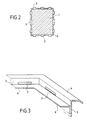
- the seal 2 as shown more clearly in FIG. 2, is formed on the entire periphery, especially to ensure a good seal, function on which he will return later.
- the profile 2 At its base, the profile 2 comprises a protrusion or pin 3 which will serve for fixing.
- the lug 3 can be formed either continuously on the entire periphery of the glazing, either discontinuously, as shown in Figure 2.
- FIGS. 1b and 1c show more precisely the mounting or fixing of the glass-ceramic plate-shaped set in a frame 4.
- the frame 4 which the most often is metallic, consists of several parts: it includes at least a portion forming substantially vertical uprights 5, these constituting the opening of the frame 4 in which the glass-ceramic-profile plate assembly comes fit.
- the contact, after insertion of said assembly, between the profile 2 and the uprights 5 must form a perfect seal to prevent any water inlet in the area where the heating elements are placed. sealing obtained also prevents the encrustation of dust or particles food.
- the frame 4 then comprises a second part which extends also on the whole periphery of the frame, it is about carrying elements 6 positioned horizontally that support the plate-shaped assembly, the contact with the elements 6 being advantageously through the profile.
- a light or opening 7 in which the lug 3 can be inserted is provided in the vertical elements 5, a light or opening 7 in which the lug 3 can be inserted.
- a continuous 3 lug on the entire periphery of the plate it will not be understood more than one light but of a cavity whose hollow volume is at least complementary to that of ergot 3.
- FIG 3 partially illustrates such a frame 4 by a perspective view.
- the frame 4 presented here is intended to receive a profile comprising pins 3 distributed on the periphery of the vitroceramic plate discontinuously.
- the frame 4 thus represented has several lights or openings 7 distributed on the vertical elements 5. Such openings are elsewhere very simple to achieve, especially by stamping.
- FIG. 1b shows that the choice of the material constituting the profile, in the present case a silicone such as that described above, is made so that said profile can deform elastically.
- the "frame" that form the profile 2 at the periphery of the glass-ceramic plate has dimensions in addition to the presence of the pin 3, greater than those of the orifice of the frame 4 in which the glass-ceramic profile-plate assembly must fit. So, as illustrated in FIG. 1b, a pressure force, symbolized by the arrow 8, must be exerted on the glass-ceramic plate-shaped assembly for the introduction in the frame 4 so as to deform the profile 2 and more particularly the lug 3.
- this elastic deformation of the profile 2 allows after assembly with frame 4, to show an interaction between the section 2 and the amount vertical 5 of the frame; this creates on the one hand friction forces which contribute to the maintenance of the ceramic hob 1 in frame 4 and other part ensures a good seal of the connection.
- FIG. 1c illustrates the glass-ceramic-shaped plate assembly set up in the frame 4.
- the glass-ceramic-shaped plate assembly has inserted in frame 4, so that on the one hand the profile is supported on the support elements 6 and in contact with the vertical elements 5 and that on the other hand the pin 3, enters the opening 7.
- the profile has been deformed, as shown in Figure 1b, and has almost returned to its original shape; only the part of the upper profile to the area where the pin 3 is located remains compressed, as explained previously, in particular to obtain a perfect seal.
- the positioning of the lug 3 in the opening 7 provided for this effect guarantees the maintenance of the glass-ceramic plate in the frame 4. This maintenance is further reinforced by the friction forces exerted between the uprights 5 and profile 2.
- the profile 2 associated with the ceramic hob 1 After inserting the plate-profile assembly in the frame, it was explained that the profile undergoes a compression of the vertical amounts 5, it is then possible to see a deformation in the upper part of the profile 2 and in particular a swelling. In the assembly of FIG. 1c, that part of the profile which surrounds the plate vitroceramic 1 remains visible. It is therefore desirable to have a surface apparent profile that remains flat and flawless.
- the invention thus proposes form the profile with an upper part which compensates in advance the swelling due to the compression exerted by the uprights 5, so that the upper surface of the section 2 is flat after assembly.
- a lug 3 on the profile 2 whose shape and dimensions can provide functions other than fixation.
- an ergot 3 may be used to position the glass-ceramic plate by centering during its set up or even while it is in place in the frame.
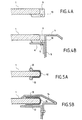
- Figures 4a and 4b illustrate another variant of the invention.
- a vitroceramic plate is associated with a peripheral section 9 made of silicone according to the same techniques as those of FIGS. 1 and 2.
- the shape which ensures the attachment to the frame is not a protrusion, but a hollow form 10 placed on the underside of the 9. The positioning of this shape must of course not be interpreted in a limiting way.
- Figure 4b shows that on the frame 4 and more particularly on the element 6 is provided a fixing head 11, whose shape is complementary that of the form 10.
- a fixing head 11 whose shape is complementary that of the form 10.
- FIGs 5a and 5b illustrate a completely different type of profile 12; this profile 12 is a profile made beforehand for example by extrusion. In the present case, it surrounds a core 15 such as a metal clip or any other rigid material which allows to fix it to the glass-ceramic plate by pinching. In the case shown, the profile is not visible after mounting but will be covered by a part of the frame 14. The profile has protrusions 13 visible in the figure 5a which during assembly as shown in Figure 5b are deformed on the one hand to fix the ceramic hob 1 in the frame 14 and on the other hand to guarantee a good seal. It appears that the assembly and disassembly are not as simple as in the previous cases, because the frame 14 covers the profile for aesthetic reasons. On the other hand, as mentioned above, this type of pre-extruded profile has a great advantage when it comes to recycling vitroceramic plates since it can be dissociated easily from the said plate.
- a core 15 such as a metal clip or any other rigid material which allows to fix it to
- the association of a profile to the plate prior to assembly of it in a frame allows to dimension it so that it performs its functions fixing and possibly sealing, without additional cost, due to an excess of material.
- the invention allows simplified mounting, in particular without need for intermediate storage for the polymerization of the profile, and simple to implementation, but still a possible dismantling by the choice of a form adapted.
Landscapes
- Chemical & Material Sciences (AREA)
- Engineering & Computer Science (AREA)
- Materials Engineering (AREA)
- Life Sciences & Earth Sciences (AREA)
- Chemical Kinetics & Catalysis (AREA)
- General Chemical & Material Sciences (AREA)
- Geochemistry & Mineralogy (AREA)
- Organic Chemistry (AREA)
- Mechanical Engineering (AREA)
- General Engineering & Computer Science (AREA)
- Combustion & Propulsion (AREA)
- Civil Engineering (AREA)
- Structural Engineering (AREA)
- Securing Of Glass Panes Or The Like (AREA)
- Electric Stoves And Ranges (AREA)
Description
- figures 1a, b, c : un exemple de plaque vitrocéramique comportant un profilé selon l'invention et sa fixation dans un cadre,
- figure 2 : une vue de dessus d'une plaque selon la figure 1,
- figure 3 : une vue en perspective d'un cadre s'associant avec les plaques selon les figures 1 et 2,
- figures 4a, b : un autre exemple de réalisation de l'invention,
- figures 5a, b : un autre exemple de réalisation de l'invention.
Claims (10)
- Plaque en matériau verrier, tel que verre trempé ou vitrocéramique, destinée à être fixée dans un cadre, comportant au moins un profilé polymère sur sa périphérie, caractérisée en ce que ledit profilé présente sur au moins une partie de sa longueur une forme assurant une fixation telle qu'un emboítement direct avec le cadre, cette forme étant une partie intégrante du profilé.
- Plaque selon la revendication 1, caractérisée en ce que le profilé est déformable de façon élastique.
- Plaque selon la revendication 1 ou 2, caractérisée en ce que la forme est une saillie.
- Plaque selon l'une des revendications 1 ou 2, caractérisée en ce que la forme est en creux.
- Plaque selon l'une des revendications 1 à 4, caractérisée en ce que la forme est présente sur toute la longueur du profilé.
- Plaque selon l'une des revendications 1 à 4, caractérisée en ce que la forme présente sur le profilé est discontinue.
- Plaque selon l'une des revendications 1 à 6, caractérisée en ce que le profilé est une silicone.
- Plaque selon l'une des revendications précédentes, caractérisée en ce que le profilé est réalisé selon une technique de surmoulage.
- Plaque selon l'une des revendications 1 à 7, caractérisée en ce que le profilé est réalisé par extrusion in-situ.
- Plaque selon l'une des revendications 1 à 7, caractérisée en ce que le profilé est extrudé et fixé à ladite plaque par clipsage ou collage.
Applications Claiming Priority (2)
| Application Number | Priority Date | Filing Date | Title |
|---|---|---|---|
| FR9713552 | 1997-10-29 | ||
| FR9713552A FR2770212B1 (fr) | 1997-10-29 | 1997-10-29 | Plaque en materiau verrier destinee a etre fixee dans un cadre |
Publications (2)
| Publication Number | Publication Date |
|---|---|
| EP0913369A1 EP0913369A1 (fr) | 1999-05-06 |
| EP0913369B1 true EP0913369B1 (fr) | 2005-01-12 |
Family
ID=9512774
Family Applications (1)
| Application Number | Title | Priority Date | Filing Date |
|---|---|---|---|
| EP98402698A Expired - Lifetime EP0913369B1 (fr) | 1997-10-29 | 1998-10-29 | Plaque en matériau verrier |
Country Status (6)
| Country | Link |
|---|---|
| US (1) | US6399183B1 (fr) |
| EP (1) | EP0913369B1 (fr) |
| CA (1) | CA2252343A1 (fr) |
| DE (1) | DE69828563T2 (fr) |
| ES (1) | ES2236878T3 (fr) |
| FR (1) | FR2770212B1 (fr) |
Families Citing this family (5)
| Publication number | Priority date | Publication date | Assignee | Title |
|---|---|---|---|---|
| US8899704B2 (en) | 2005-03-25 | 2014-12-02 | Gemtron Corporation | Refrigerator shelf |
| US8286561B2 (en) | 2008-06-27 | 2012-10-16 | Ssw Holding Company, Inc. | Spill containing refrigerator shelf assembly |
| US11786036B2 (en) | 2008-06-27 | 2023-10-17 | Ssw Advanced Technologies, Llc | Spill containing refrigerator shelf assembly |
| DE102011085428A1 (de) | 2011-10-28 | 2013-05-02 | Schott Ag | Einlegeboden |
| ES2574931B1 (es) | 2014-12-22 | 2017-04-06 | Bsh Electrodomésticos España, S.A. | Dispositivo de protección para placas de campo de cocción con recubrimiento |
Family Cites Families (13)
| Publication number | Priority date | Publication date | Assignee | Title |
|---|---|---|---|---|
| DE7813233U1 (de) * | 1978-04-29 | 1978-08-24 | Jenaer Glaswerk Schott & Gen., 6500 Mainz | Glas- oder glaskeramik- heiz- und/oder kochflaeche mit angeklebten rahmen- und befestigungselementen |
| DE3104114C2 (de) * | 1981-02-06 | 1984-06-14 | Schott Glaswerke, 6500 Mainz | Halterung für eine Platte aus Glas, Glaskeramik oder ähnlichem Material, insbesondere für eine Kochfläche |
| EP0081426A1 (fr) * | 1981-12-04 | 1983-06-15 | Boussois S.A. | Cordon en matière thermo-plastique pour fixer une feuille de verre, procédé pour fixer celle-ci et couche conductrice utilisée à cet effet |
| GB2192023B (en) * | 1986-06-26 | 1990-01-04 | Pilkington Brothers Plc | An edge-encapsulated glazing module |
| US5384995A (en) | 1989-09-12 | 1995-01-31 | St. Gobain Vitrage International | Spacer for windshield bracket |
| DE3930414C2 (de) * | 1989-09-12 | 2002-01-10 | Saint Gobain Sekurit D Gmbh | Verfahren und Vorrichtung zur Herstellung einer für die Direktverklebung mit dem Befestigungsflansch einer Fensteröffnung vorgesehenen Glasscheibe |
| ES2113567T3 (es) * | 1989-09-12 | 1998-05-01 | Saint Gobain Vitrage | Cristal con marco perfilado, particularmente cristal para automoviles. |
| US5185047A (en) * | 1989-12-01 | 1993-02-09 | Whirlpool Corporation | Frameless glass-ceramic cooktop mounting assembly |
| JP3056531B2 (ja) * | 1990-12-27 | 2000-06-26 | 東海興業株式会社 | シール体付きパネルの製造方法及び製造装置 |
| DE4123256C1 (fr) * | 1991-07-13 | 1992-10-08 | Saint Gobain Vitrage | |
| ATE159900T1 (de) * | 1993-01-16 | 1997-11-15 | Saint Gobain Vitrage | Zur verklebung in eine rahmenöffnung vorgefertigte farbzeugverglasung und herstellungsverfahren |
| DE4327475C2 (de) * | 1993-08-16 | 1999-04-22 | Schott Glas | Verfahren zur Ausbildung einer dauerelastischen, im Demontagefall leicht lösbaren Klebeverbindung |
| FR2744201B3 (fr) * | 1996-01-26 | 1998-03-13 | Eurokera | Plaque vitroceramique |
-
1997
- 1997-10-29 FR FR9713552A patent/FR2770212B1/fr not_active Expired - Lifetime
-
1998
- 1998-10-29 US US09/181,920 patent/US6399183B1/en not_active Expired - Lifetime
- 1998-10-29 EP EP98402698A patent/EP0913369B1/fr not_active Expired - Lifetime
- 1998-10-29 CA CA002252343A patent/CA2252343A1/fr not_active Abandoned
- 1998-10-29 ES ES98402698T patent/ES2236878T3/es not_active Expired - Lifetime
- 1998-10-29 DE DE69828563T patent/DE69828563T2/de not_active Expired - Lifetime
Also Published As
| Publication number | Publication date |
|---|---|
| ES2236878T3 (es) | 2005-07-16 |
| FR2770212B1 (fr) | 1999-11-26 |
| US6399183B1 (en) | 2002-06-04 |
| DE69828563T2 (de) | 2006-01-05 |
| DE69828563D1 (de) | 2005-02-17 |
| CA2252343A1 (fr) | 1999-04-29 |
| EP0913369A1 (fr) | 1999-05-06 |
| FR2770212A1 (fr) | 1999-04-30 |
Similar Documents
| Publication | Publication Date | Title |
|---|---|---|
| EP2737247B1 (fr) | Vitrage multiple lumineux de meuble | |
| EP1480805B1 (fr) | Projecteur de phare de vehicule automobile comprenant une lentille en verre et un support de lentille en matiere plastique et procede de realisation d'un tel projecteur par surmoulage du support sur la lentille | |
| EP1372437B1 (fr) | Etagere pour le support d'articles, en particulier dans des installations refrigerees | |
| WO2004046567A1 (fr) | Inserts sous forme de douille filetee destines a equiper des plaques, notamment en verre, en vue de leur fixation et les plaques ainsi equipees | |
| EP3870793B1 (fr) | Procede d'obtention d'un vitrage isolant et vitrage isolant obtenu par le procécé | |
| EP3336439B1 (fr) | Radiateur electrique a coeur de chauffe | |
| EP2761227B1 (fr) | Plaque de cuisson a fenetre, appareil de cuisson, et procede de fabrication de la plaque | |
| FR2770212A1 (fr) | Plaque en materiau verrier destinee a etre fixee dans un cadre | |
| FR2889580A1 (fr) | Plaque de cuisson, appareil de cuisson et procede de fabrication de la plaque | |
| EP1032792B1 (fr) | Ensemble prefabrique destine a la realisation de tables de cuisson | |
| FR2744201A1 (fr) | Plaque vitroceramique | |
| EP2923154A1 (fr) | Plaque de cuisson a fenêtre et flasque, appareil de cuisson, et procédé de fabrication de la plaque | |
| EP2923153B1 (fr) | Plaque de cuisson a fenêtre et flasque, appareil de cuisson, et procédé de fabrication de la plaque | |
| CH619284A5 (en) | Fire-resistant window | |
| FR2878131A1 (fr) | Elements de liaison destines a equiper des plaques, notamment en verre, en vue de leur fixation et les plaques ainsi equipees | |
| EP0721862B1 (fr) | Procédé de fabrication d'un élément d'étanchéité comportant un joint élastique et une bande telle qu'une bande adhésive | |
| FR3054024A1 (fr) | Radiateur electrique a coeur mineral de chauffe et son procede de montage | |
| FR2745028A1 (fr) | Procede de realisation d'un joint espaceur pour vitrage colle | |
| WO2025088111A1 (fr) | Plaque vitrocéramique avec fenêtre d'affichage | |
| EP0914188B1 (fr) | Filtre resistant a haute temperature, notamment pour installation de peinture | |
| WO2025088110A1 (fr) | Plaque vitrocéramique avec fenêtre d'affichage fixée par surmoulage | |
| EP0483056A1 (fr) | Cadre pour panneau de revêtement ou de fenêtre | |
| FR2846074A1 (fr) | Plaque vitroceramique et son procede de fabrication | |
| FR2889581A1 (fr) | Procede de fabrication d'un capot, capot, appareil de cuisson, et utilisation de ce capot | |
| FR2797239A1 (fr) | Joint pour assurer l'etancheite et la finition entre deux elements de carrosserie d'un vehicule automobile et son procede de mise en place |
Legal Events
| Date | Code | Title | Description |
|---|---|---|---|
| PUAI | Public reference made under article 153(3) epc to a published international application that has entered the european phase |
Free format text: ORIGINAL CODE: 0009012 |
|
| AK | Designated contracting states |
Kind code of ref document: A1 Designated state(s): DE DK ES GB IT NL SE |
|
| AX | Request for extension of the european patent |
Free format text: AL;LT;LV;MK;RO;SI |
|
| 17P | Request for examination filed |
Effective date: 19991008 |
|
| AKX | Designation fees paid |
Free format text: DE DK ES GB IT NL SE |
|
| 17Q | First examination report despatched |
Effective date: 20001220 |
|
| GRAP | Despatch of communication of intention to grant a patent |
Free format text: ORIGINAL CODE: EPIDOSNIGR1 |
|
| GRAS | Grant fee paid |
Free format text: ORIGINAL CODE: EPIDOSNIGR3 |
|
| GRAA | (expected) grant |
Free format text: ORIGINAL CODE: 0009210 |
|
| AK | Designated contracting states |
Kind code of ref document: B1 Designated state(s): DE DK ES GB IT NL SE |
|
| PG25 | Lapsed in a contracting state [announced via postgrant information from national office to epo] |
Ref country code: NL Free format text: LAPSE BECAUSE OF FAILURE TO SUBMIT A TRANSLATION OF THE DESCRIPTION OR TO PAY THE FEE WITHIN THE PRESCRIBED TIME-LIMIT Effective date: 20050112 |
|
| REG | Reference to a national code |
Ref country code: GB Ref legal event code: FG4D Free format text: NOT ENGLISH |
|
| REF | Corresponds to: |
Ref document number: 69828563 Country of ref document: DE Date of ref document: 20050217 Kind code of ref document: P |
|
| PG25 | Lapsed in a contracting state [announced via postgrant information from national office to epo] |
Ref country code: SE Free format text: LAPSE BECAUSE OF FAILURE TO SUBMIT A TRANSLATION OF THE DESCRIPTION OR TO PAY THE FEE WITHIN THE PRESCRIBED TIME-LIMIT Effective date: 20050412 Ref country code: DK Free format text: LAPSE BECAUSE OF FAILURE TO SUBMIT A TRANSLATION OF THE DESCRIPTION OR TO PAY THE FEE WITHIN THE PRESCRIBED TIME-LIMIT Effective date: 20050412 |
|
| GBT | Gb: translation of ep patent filed (gb section 77(6)(a)/1977) |
Effective date: 20050419 |
|
| NLV1 | Nl: lapsed or annulled due to failure to fulfill the requirements of art. 29p and 29m of the patents act | ||
| REG | Reference to a national code |
Ref country code: ES Ref legal event code: FG2A Ref document number: 2236878 Country of ref document: ES Kind code of ref document: T3 |
|
| PLBE | No opposition filed within time limit |
Free format text: ORIGINAL CODE: 0009261 |
|
| STAA | Information on the status of an ep patent application or granted ep patent |
Free format text: STATUS: NO OPPOSITION FILED WITHIN TIME LIMIT |
|
| 26N | No opposition filed |
Effective date: 20051013 |
|
| PGFP | Annual fee paid to national office [announced via postgrant information from national office to epo] |
Ref country code: GB Payment date: 20101027 Year of fee payment: 13 |
|
| GBPC | Gb: european patent ceased through non-payment of renewal fee |
Effective date: 20121029 |
|
| PG25 | Lapsed in a contracting state [announced via postgrant information from national office to epo] |
Ref country code: GB Free format text: LAPSE BECAUSE OF NON-PAYMENT OF DUE FEES Effective date: 20121029 |
|
| PGFP | Annual fee paid to national office [announced via postgrant information from national office to epo] |
Ref country code: ES Payment date: 20140911 Year of fee payment: 17 |
|
| PGFP | Annual fee paid to national office [announced via postgrant information from national office to epo] |
Ref country code: IT Payment date: 20141014 Year of fee payment: 17 |
|
| PG25 | Lapsed in a contracting state [announced via postgrant information from national office to epo] |
Ref country code: IT Free format text: LAPSE BECAUSE OF NON-PAYMENT OF DUE FEES Effective date: 20151029 |
|
| REG | Reference to a national code |
Ref country code: ES Ref legal event code: FD2A Effective date: 20161128 |
|
| PG25 | Lapsed in a contracting state [announced via postgrant information from national office to epo] |
Ref country code: ES Free format text: LAPSE BECAUSE OF NON-PAYMENT OF DUE FEES Effective date: 20151030 |
|
| PGFP | Annual fee paid to national office [announced via postgrant information from national office to epo] |
Ref country code: DE Payment date: 20171025 Year of fee payment: 20 |
|
| REG | Reference to a national code |
Ref country code: DE Ref legal event code: R071 Ref document number: 69828563 Country of ref document: DE |