EP0913027B1 - Verfahren zum kommutieren eines bürstenlosen motors undstromversorgung für einen bürstenlosen motor - Google Patents
Verfahren zum kommutieren eines bürstenlosen motors undstromversorgung für einen bürstenlosen motor Download PDFInfo
- Publication number
- EP0913027B1 EP0913027B1 EP97930363A EP97930363A EP0913027B1 EP 0913027 B1 EP0913027 B1 EP 0913027B1 EP 97930363 A EP97930363 A EP 97930363A EP 97930363 A EP97930363 A EP 97930363A EP 0913027 B1 EP0913027 B1 EP 0913027B1
- Authority
- EP
- European Patent Office
- Prior art keywords
- current
- motor
- intermediary circuit
- commutation
- value
- Prior art date
- Legal status (The legal status is an assumption and is not a legal conclusion. Google has not performed a legal analysis and makes no representation as to the accuracy of the status listed.)
- Expired - Lifetime
Links
- 238000000034 method Methods 0.000 title claims description 15
- 238000012937 correction Methods 0.000 claims abstract description 10
- 230000003111 delayed effect Effects 0.000 claims abstract description 7
- 238000005259 measurement Methods 0.000 claims description 8
- 230000001419 dependent effect Effects 0.000 claims description 6
- 238000001914 filtration Methods 0.000 claims description 6
- 238000005070 sampling Methods 0.000 claims description 6
- 238000004804 winding Methods 0.000 description 7
- 230000007423 decrease Effects 0.000 description 4
- 238000010586 diagram Methods 0.000 description 3
- 230000015572 biosynthetic process Effects 0.000 description 2
- 239000003990 capacitor Substances 0.000 description 2
- 238000012545 processing Methods 0.000 description 2
- 230000002035 prolonged effect Effects 0.000 description 2
- 238000005057 refrigeration Methods 0.000 description 2
- 230000006641 stabilisation Effects 0.000 description 2
- 238000012360 testing method Methods 0.000 description 2
- 102000016550 Complement Factor H Human genes 0.000 description 1
- 108010053085 Complement Factor H Proteins 0.000 description 1
- 238000004378 air conditioning Methods 0.000 description 1
- 238000004364 calculation method Methods 0.000 description 1
- 230000006835 compression Effects 0.000 description 1
- 238000007906 compression Methods 0.000 description 1
- 230000001276 controlling effect Effects 0.000 description 1
- 238000001816 cooling Methods 0.000 description 1
- 230000003247 decreasing effect Effects 0.000 description 1
- 238000013461 design Methods 0.000 description 1
- 238000011161 development Methods 0.000 description 1
- 238000007599 discharging Methods 0.000 description 1
- 230000004907 flux Effects 0.000 description 1
- 102000051759 human factor J Human genes 0.000 description 1
- 108700008420 human factor J Proteins 0.000 description 1
- 230000001788 irregular Effects 0.000 description 1
- 238000004519 manufacturing process Methods 0.000 description 1
- 238000012544 monitoring process Methods 0.000 description 1
- 230000010355 oscillation Effects 0.000 description 1
- 230000002265 prevention Effects 0.000 description 1
- 239000003507 refrigerant Substances 0.000 description 1
- 230000001105 regulatory effect Effects 0.000 description 1
- 230000001360 synchronised effect Effects 0.000 description 1
- 230000003245 working effect Effects 0.000 description 1
Images

Classifications
-
- H—ELECTRICITY
- H02—GENERATION; CONVERSION OR DISTRIBUTION OF ELECTRIC POWER
- H02P—CONTROL OR REGULATION OF ELECTRIC MOTORS, ELECTRIC GENERATORS OR DYNAMO-ELECTRIC CONVERTERS; CONTROLLING TRANSFORMERS, REACTORS OR CHOKE COILS
- H02P6/00—Arrangements for controlling synchronous motors or other dynamo-electric motors using electronic commutation dependent on the rotor position; Electronic commutators therefor
- H02P6/14—Electronic commutators
-
- H—ELECTRICITY
- H02—GENERATION; CONVERSION OR DISTRIBUTION OF ELECTRIC POWER
- H02P—CONTROL OR REGULATION OF ELECTRIC MOTORS, ELECTRIC GENERATORS OR DYNAMO-ELECTRIC CONVERTERS; CONTROLLING TRANSFORMERS, REACTORS OR CHOKE COILS
- H02P29/00—Arrangements for regulating or controlling electric motors, appropriate for both AC and DC motors
- H02P29/40—Regulating or controlling the amount of current drawn or delivered by the motor for controlling the mechanical load
-
- H—ELECTRICITY
- H02—GENERATION; CONVERSION OR DISTRIBUTION OF ELECTRIC POWER
- H02P—CONTROL OR REGULATION OF ELECTRIC MOTORS, ELECTRIC GENERATORS OR DYNAMO-ELECTRIC CONVERTERS; CONTROLLING TRANSFORMERS, REACTORS OR CHOKE COILS
- H02P2201/00—Indexing scheme relating to controlling arrangements characterised by the converter used
- H02P2201/07—DC-DC step-up or step-down converter inserted between the power supply and the inverter supplying the motor, e.g. to control voltage source fluctuations, to vary the motor speed
Definitions
- the invention concerns a method for commutating a brushless motor, supplied with electrical energy from a DC intermediary circuit via a multi-phase inverter, by which a first current value and a second current value are determined, and the duration of a commutation interval is set in dependence of these current values. Further, the invention concerns a power supply for a brushless motor, the motor being connected with a DC intermediary circuit via an inverter, comprising a control unit with an input connected to the DC intermediary circuit.
- the motor can also be controlled by means of this information.
- This principle can be used for both AC and three-phase current synchronous motors, and for brushless DC motors as well.
- commutation time dynamically as a function of the current in the intermediary circuit.
- the current is measured and converted to a processable parameter.
- This parameter is compared with a predetermined reference parameter.
- the commutation interval is either kept constant or reduced or prolonged.
- commutation interval means the time between the individual commutations.
- US 5,420,492 describes a design, in which the commutation frequency, i.e. the frequency of commutations, is changed in dependence of the current over time, i.e. in dependence of the current waveshape profile.
- This current waveshape profile is compared with a pre-set profile. The contour of the current profile depends on whether the commutation time was correct, too early or too late.
- the slope of the current is determined. When the moment of commutation occurs too early, i.e. is ahead of the rotor, the slope will be too flat. When the commutation occurs too late, the slope will be too steep.
- the commutation interval is either reduced or prolonged, and a new test is made, until the correct profile, and thus the correct commutation interval, has been set. This is done via a change of the commutation frequency.
- the optimum profile of the current i.e. the optimum slope or the optimum relation between the two current values.
- the values can be determined empirically for the unloaded motor and then be taken from a look-up table during the operation. For a loaded motor, however, this determination is relatively difficult, as the kind and size of the load is not known. In dynamic systems with heavily varying loads, a correspondingly large number of reference parameters would be necessary.
- Piston compressors are for example used in refrigeration systems, in which they drive a refrigerant gas through a capacitor and an evaporator.
- the load torque is varying over a cycle, i.e. over a piston stroke.
- a typical load curve starts in the lower dead point with a small torque of approximately 0 Nm. The closer the piston comes to the upper dead point, the faster the torque increases. In most cases this increase is not linear.
- the outlet valve of the compressor opens in the range of the upper dead point, or somewhat earlier, e.g. at 150°.
- the load torque then decreases very rapidly and steeply. Normally this load-torque-decrease is not linear either.
- the task of the invention is to create a stable operation of motors with unequal loads.
- this task is solved in that a correction value is added to a given commutation interval determined by the speed of the motor, said correction value resulting from the difference between the actual value of the intermediary circuit current and a filtered, time delayed value of the intermediary circuit current, the difference being multiplied by a weighting factor, and that the actual value of the intermediary circuit current is determined at a predetermined time during the commutation interval.
- the information contained in both current values are immediately used to change the commutation interval, as the load of the motor is immediately expressed in a change of the intermediary circuit current.
- the intermediary circuit current increases correspondingly.
- the commutation interval must be changed simultaneously. It has been found that the required change of the commutation interval is approximately proportional to the difference between the two current values, provided that the current values are not used immediately, but only after a filtering of at least the delayed, i.e. the previous, current value.
- filtering can also be understood as the formation of a mean value.
- the monitoring is not limited to a current waveshape profile. On the contrary, the overall current increase and decrease occurring on load changes of the motor are evaluated to determine the commutation interval.
- the commutation interval is determined on the basis of the speed of the motor, which can be pre-set, the result of the proposed method is that the changes will always be close to this pre-set reference value. Thus there will be no "wild" changes of the commutation intervals. On the contrary, the commutation interval corresponding to the speed will only be slightly increased or decreased, as required by the load. Thus the sampling is load dependent.
- the weighting factor is chosen in dependence of the speed.
- the weighting factor is reversely proportional to the speed, i.e. the higher the speed, the lower the weighting factor.
- the speed is the desired speed or reference speed.
- the actual or instantaneous value of the intermediary circuit current is determined at least once per commutation interval and no earlier than in the middle of this commutation interval.
- the actual value of the intermediary circuit current is not submitted to filtering. Thus, it also changes rather markedly within a commutation interval. At the beginning of a commutation interval the current is small and then it increases. Awaiting the end of this increase, which will with sufficient certainty be finished in the middle of a commutation interval, a statement of the "real" current value in this commutation interval is obtained.
- the inverter is block commutated.
- the block commutation means that the inverter is operated with a constant duty ratio. This means that the current in the intermediary circuit corresponds approximately to the current through the individual phases, i.e. the individual phases are not modulated in the meantime.
- PWM pulse width modulation
- a brushless DC motor is used as motor.
- Such a motor has for instance a rotor with magnets on the surface, which produce a trapezoidal counter-electromotive force.
- the motor is a switched reluctance motor.
- This motor can be controlled in the same way as a brushless DC motor, as the current in the intermediary circuit is an expression of the shaft load. The currents measured in the intermediary circuit can then be used as reference values for the commutation times.
- the reluctance motor turns out to be robust, especially with regard to temperature influences.
- control unit comprises a filter device filtering, delaying and inverting the intermediary circuit current, a summation point forming the difference between the filtered and delayed intermediary circuit current and the actual intermediary circuit current, a multiplier multiplying the difference by a weighting factor and another summation point in which the product of this multiplication is added as correction value to a speed dependent commutation interval, by which the output of the last summation point is connected with the inverter.
- This power supply provides an easy way of subtracting the mean or filtered and time-delayed intermediary circuit current from the actual intermediary circuit current, and multiplying the resulting difference by a weighting factor.
- the inversion of the current creates the negative value of the current, so that the difference is obtained at the summation point.
- the parameter occurring in this way can be used to change the commutation interval. Therefore, this size can also be lead immediately to the inverter, without requiring further cumbersome workings or calculations.
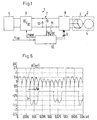
- Fig. 1 shows a power supply 1 for a motor-compressor unit 2, comprising a brushless DC motor 3 and a compressor 4.
- the compressor is part of a not shown refrigeration system needed for the operation of an air-conditioning system in a vehicle.
- the power supply 1 comprises a voltage source 5, e.g. a car battery, which is connected with a DC intermediary circuit 7 via a DC/DC voltage converter 6.
- the DC intermediary circuit 7 is connected with an inverter 8.
- the DC/DC converter 6 is controllable. If the voltage source 5 is an AC voltage source, the DC/DC converter 6 can be replaced by a controlled rectifier.
- the DC voltage supplied to the intermediary circuit 7 by the DC/DC converter 6 is collected via a pick-off or sensor 9 and supplied to an input U DC of a control unit 10.
- the DC current through the intermediary circuit is determined via a resistor 11 and also supplied to the control unit 10 via an input I DC .
- a capacitor 12 can also be arranged parallel to the output of the DC/DC converter 6.
- control unit 10 controls DC/DC converter 6 so that the power in the DC intermediary circuit 7, i.e. the product of intermediary circuit current I DC and intermediary circuit voltage U DC is minimised.
- the control unit 10 produces the control impulses for the switches in the inverter 8.
- the inverter 8 can be block commutated, and as usual consisting of six switches and six diodes.
- the switches in the inverter are active in pairs, so that the current from the intermediary circuit flows in through a first switch, then through a first motor winding of a first phase, on through a second motor winding of a second phase and out through a second switch.
- Each switch is closed for 120° and open for 240° (electrical degrees).
- a complete block commutation of the inverter 8 takes place without any modulation at all, i.e. the inverter 8 emits voltage blocks, whose amplitude corresponds to the intermediary circuit voltage U DC .
- the motor 3 drives a compressor 4, it has a period with a very unstable load behaviour, which appears from fig. 2.
- the piston of the compressor 4 starts in the lower dead point (0°) and moves towards the upper dead point (180°), and during this movement the load torque increases quickly and unlinearily. The increase continues until the pressure valve opens, which normally happens somewhat before the upper dead point is reached, e.g. at 150°. Then the load torque decreases to the value zero again during the down-movement of the piston.
- the motor speed falls during the load rise, which can be seen from fig. 4, which shows the motor speed with the same time scale as the one stated in fig. 2.
- the rotor changes its rotational speed during a rotation. Sometimes it rotates slower, sometimes faster, than the actually pre-set speed of 2,000 r.p.m.
- the inverter normally produces a rotary field rotating at constant angle speed, which rotary field, due to the load pattern described above, would run either ahead of or behind the rotor. This involves the risk that the rotor can no longer rotate synchronously with the rotary field causing the rotor to stop or jump. Both things are undesirable.
- control unit 10 controls the inverter 8 so that the commutation intervals change within one rotation.
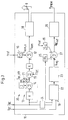
- the control unit 10 is shown in detail in fig. 3. It has two branches 19, 20.
- the branch 20 is used for the control of the commutation times of the inverter 8.
- the instantaneous or actual current I DC measured in the resistor 11 is led through the branch 20, which comprises a digital filter 13.
- the branch 20 ends at a signal generator 18 supplying the commutation signals for the switches in the inverter 8.
- the digital filter 13 consists of the factors H, J and K.
- the values in this embodiment example are 0.1, 0.9 and 0.38 (ms/A), respectively.
- the measured current I DC is multiplied by the factor H (0.1) and in a summation point 14 added to a value I DC,filt .
- This value I DC,filt is delayed in a delay link 21 and weighted with the factor J (0.9).
- the correction contribution K x (I DC - I DC,filt ) is added to a commutation interval reference value t kom0, which has been converted from the speed reference value n ref into a commutation interval in a converter 16.
- the sum, t kom formed in the summation point 17 represents the final commutation time, which is the basis of the control of the inverter 8.
- the commutation interval t kom0 can be calculated directly on the basis of the speed.
- a required speed of e.g. 2000 r.p.m. and a four-pole motor results in a fundamental frequency of 66.7 Hz. With twelve commutations per rotation this gives a commutation time t kom0 of 2.5 ms per commutation.
- Fig. 5 shows how the lengths of the commutation intervals change at a rotation of the rotor.
- Fig. 5 has the same time scale as the figs. 2 and 4. It is clearly seen that the commutation interval at the highest load, i.e. when the piston is at 150°, also has the longest extension, whereas the commutation interval is shortest when the motor is not loaded.
- the factor K is speed dependent. In this case it has the value of 0.38 ms/A at a speed of 2,000 r.p.m. At 4,000 r.p.m. it would be 0.19 ms/A. Thus the dynamic of the stabilisation is secured at all speeds.
- the current I DC,filt has been filtered through a digital filter.
- a continuos arithmetic mean value formation of the current as filtering.
- the measurement of the current in the intermediary circuit takes place in the second half of a commutation period, i.e. not earlier than in the middle of a commutation period and not later than shortly before it ends. Tests have shown that this gives the most reliable result.
- fig. 6 shows the intermediary circuit current I DC with loaded motor.
- Curve b shows the current in one of the motor windings.
- the current I DC in the intermediary circuit does not reach its maximum until some time after the commutation. The time required by the current to reach its maximum among other things depends on when the commutation takes place, i.e. if it takes place early or late.
- the increase in the current is much slower. Therefore, it is important not to sample until the current has at least approximately reached its maximum value.
- the current I DC should not be measured until the middle of a commutation period t p has been reached, which, in this embodiment example, means about 1.25 ms after a commutation.
- t p the sampling instant is shown by means of points in two periods.
- one of the phase currents to the motor is equal to the intermediary circuit current I DC , when disregarding short discharging phenomena at turning off the current to a phase winding.
- the shape of the current pulses among others depends on the type of rotor used. In this example the rotor has surface-mounted permanent magnets producing a trapezoidal counter-electromotive force.
- the method of commutation of a brushless DC motor described here bears the advantage that the control of the motor remains stable in spite of a very irregular type of load torque.
- the motor does not stop or jump.
- the control permits an operation with improved operational reliability.
- it is relatively inexpensive, as current measurements must only be made in the intermediary circuit. Information about rotor speed and position is not required.
- the power minimising algorithm is carried through.
- the measured intermediary circuit current I DC is filtered in an analogue filter 24, and is led to a processing unit 22 together with the intermediary circuit voltage U DC , in which processing unit the power consumption in the intermediary circuit is calculated on the basis of the product I DC x U DC .
- processing unit the power consumption in the intermediary circuit is calculated on the basis of the product I DC x U DC .
- the intermediary circuit voltage U DC is varying.
- the actual power consumption is compared with a previously measured power consumption, and the output signal is a voltage U reg , which can be either positive or negative.
- U reg is the sum of the previous U reg and a control contribution dU reg , which is in this case set fixedly at 0.25 V.
- dU reg a voltage change is carried through stepwise, and for so long that a power minimum has been reached.
- the voltage U reg is led to a summation point 27, which also receives a load dependent voltage contribution formed in a unit 25.
- This load dependent contribution is determined by means of the product of twice R f x I DCF , the F in the index of the current meaning that this current has already passed the analogue filter 24. This contribution helps to speed up the control and normally amounts to 10 to 20% of the output value of the summation point 27. In less time critical applications this contribution can be omitted.
- a speed reference value is led to the summation point 27, which value is created in a unit 26 by the speed reference value n ref .
- the voltage determined on the basis of this can be calculated by means of a motor constant K e .
- the voltage determined in the unit 26 corresponds to the electromotive counter-voltage of the motor 3.
- the voltage contribution U reg led to the summation point 27 can either increase or reduce the voltage U DC,ref . If the actual power consumption is lower than the previously measured power consumption after a reduction of the intermediary circuit voltage, the sign of the control contribution dU reg is maintained, i.e. the intermediary circuit voltage is reduced by another step, and this loop is passed until an increase in the power consumption occurs. Then the control contribution dU reg will change its sign.
- the DC regulating unit 6 can be a boost converter with one single switch, said converter being pulse width modulated.
- the switch losses are considerably reduced. Further, this will reduce the heat development and thus the need for cooling.
Landscapes
- Engineering & Computer Science (AREA)
- Power Engineering (AREA)
- Control Of Motors That Do Not Use Commutators (AREA)
Claims (9)
- Verfahren zum Kommutieren eines bürstenlosen Motors, der über einen mehrphasigen Wechselrichter aus einem Gleichstromzwischenkreis mit elektrischer Energie versorgt wird, bei dem ein erster Stromwert und zweiter Stromwert des Gleichstromzwischenkreises ermittelt werden und die Länge eines Kommutierungsintervalls in Abhängigkeit von den Stromwerten eingestellt wird, dadurch gekennzeichnet, daß einem vorgegebenen, von der Drehzahl des Motors bestimmten Kommutierungsintervall ein Korrekturwert hinzugefügt wird, der sich aus der Differenz des aktuellen Werts des Zwischenkreisstroms und eines gefilterten, zeitverzögerten Wertes des Zwischenkreisstromes ergibt, wobei die Differenz mit einem Bewertungsfaktor multipliziert wird, und wo der Zeitpunkt der Abtastung oder Messung des aktuellen Wertes des Zwischenkreisstromes in Abhängigkeit der Belastung gewählt wird.
- Verfahren nach Anspruch 1, dadurch gekennzeichnet, daß die Belastung des Motors durch ein Kommutierungsintervall (tkom) ausgedrückt wird, wobei der Zeitpunkt der Abtastung als eine Funktion des Kommutierungsintervalls berechnet wird.
- Verfahren nach Anspruch 1 oder 2, dadurch gekennzeichnet, daß der aktuelle Wert des Zwischenkreisstromes mindestens einmal pro Kommutierungsintervall und frühestens in der Mitte des jeweiligen Kommutierungsintervalls ermittelt wird.
- Verfahren nach Anspruch 1, dadurch gekennzeichnet, daß der Bewertungsfaktor in Abhängigkeit der Drehzahl gewählt wird.
- Verfahren nach einem der Ansprüche 1 bis 4, dadurch gekennzeichnet, daß der Wechselrichter blockkommutiert wird.
- Verfahren nach einem der Ansprüche 1 bis 4, dadurch gekennzeichnet, daß der Wechselrichter pulsbreitenmoduliert wird.
- Verfahren nach einem der Ansprüche 1 bis 6, dadurch gekennzeichnet, daß als Motor ein bürstenloser Gleichstrommotor verwendet wird.
- Verfahren nach einem der Ansprüche 1 bis 6, dadurch gekennzeichnet, daß als Motor ein geschalteter Reluktanzmotor verwendet wird.
- Speiseschaltung für einen bürstenlosen Motor, der über einen mehrphasigen Wechselrichter mit einem Gleichstromzwischenkreis verbunden ist, mit einer Steuereinrichtung, die einen mit dem Gleichstromzwischenkreis verbundenen Eingang aufweist, und wo ein erster Stromwert und zweiter Stromwert des Gleichstromzwischenkreises ermittelt werden und die Länge eines Kommutierungsintervalls in Abhängigkeit von den Stromwerten eingestellt wird, dadurch gekennzeichnet, daß die Steuereinrichtung (10) eine Filteranordnung (13), die den Zwischenkreisstrom filtert, zeitlich verzögert und invertiert, einen Summationspunkt (15), der die Differenz zwischen dem gefilterten und zeitverzögerten Zwischenkreisstrom (IDC,filt) und dem aktuellen Zwischenkreisstrom (IDC) bildet, einen Multiplizierer, der die Differenz mit einem Bewertungsfaktor (K) multipliziert und einen weiteren Summationspunkt (17), an dem das so erhaltene Produkt als Korrekturwert dem drehzahlabhängigen Kommutierungsintervall (Tcom0) hinzugefügt wird, aufweist, wobei der Ausgang des anderen Summationspunkts (17) mit dem Wechselrichter (8, 18) verbunden ist.
Applications Claiming Priority (3)
| Application Number | Priority Date | Filing Date | Title |
|---|---|---|---|
| DE19628585 | 1996-07-16 | ||
| DE19628585A DE19628585C2 (de) | 1996-07-16 | 1996-07-16 | Verfahren zum Kommutieren eines bürstenlosen Motors und Speiseschaltung für einen bürstenlosen Motor |
| PCT/DK1997/000309 WO1998002959A1 (en) | 1996-07-16 | 1997-07-14 | Method for commutating a brushless motor and power supply for a brushless motor |
Publications (2)
| Publication Number | Publication Date |
|---|---|
| EP0913027A1 EP0913027A1 (de) | 1999-05-06 |
| EP0913027B1 true EP0913027B1 (de) | 2003-01-22 |
Family
ID=7799927
Family Applications (1)
| Application Number | Title | Priority Date | Filing Date |
|---|---|---|---|
| EP97930363A Expired - Lifetime EP0913027B1 (de) | 1996-07-16 | 1997-07-14 | Verfahren zum kommutieren eines bürstenlosen motors undstromversorgung für einen bürstenlosen motor |
Country Status (7)
| Country | Link |
|---|---|
| US (1) | US6028406A (de) |
| EP (1) | EP0913027B1 (de) |
| AT (1) | ATE231664T1 (de) |
| AU (1) | AU3434197A (de) |
| BR (1) | BR9710313A (de) |
| DE (2) | DE19628585C2 (de) |
| WO (1) | WO1998002959A1 (de) |
Cited By (1)
| Publication number | Priority date | Publication date | Assignee | Title |
|---|---|---|---|---|
| EP4350966A1 (de) * | 2022-10-05 | 2024-04-10 | Infineon Technologies Austria AG | Schaltwandler mit teilleistungsverarbeitung |
Families Citing this family (57)
| Publication number | Priority date | Publication date | Assignee | Title |
|---|---|---|---|---|
| AUPO478297A0 (en) * | 1997-01-24 | 1997-02-20 | Commonwealth Scientific And Industrial Research Organisation | Improvements in high speed electric motors |
| DE19859622A1 (de) * | 1998-12-23 | 2000-07-06 | Braun Gmbh | Antriebseinrichtung für oszillierende elektrische Produkte des persönlichen Bedarfs, insbesondere Trockenrasierer |
| TW396674B (en) * | 1998-12-28 | 2000-07-01 | Delta Electronics Inc | Method for converter compensation |
| US6462491B1 (en) * | 1999-01-27 | 2002-10-08 | Matsushita Electric Industrial Co., Ltd. | Position sensorless motor control apparatus |
| CN1334985A (zh) | 1999-11-29 | 2002-02-06 | 三菱电机株式会社 | 逆变器控制装置 |
| JP2002369584A (ja) * | 2001-06-06 | 2002-12-20 | Sanden Corp | 車載空気調和装置用電動圧縮機の駆動装置 |
| US7005812B2 (en) * | 2001-07-23 | 2006-02-28 | Lawrence Hardy Mitchell | Commutation converter for a brushless servo motor |
| WO2003042999A1 (de) * | 2001-11-10 | 2003-05-22 | Robert Bosch Gmbh | Elektronisch kommutierter motor |
| WO2003056694A1 (fr) * | 2001-12-26 | 2003-07-10 | Toyota Jidosha Kabushiki Kaisha | Appareil de charge electrique, procede de commande de charge electrique, et support d'enregistrement lisible par ordinateur dote d'un programme enregistre permettant a l'ordinateur de commander la charge electrique |
| US9694651B2 (en) * | 2002-04-29 | 2017-07-04 | Bergstrom, Inc. | Vehicle air conditioning and heating system providing engine on and off operation |
| US6889762B2 (en) * | 2002-04-29 | 2005-05-10 | Bergstrom, Inc. | Vehicle air conditioning and heating system providing engine on and engine off operation |
| KR100480118B1 (ko) * | 2002-10-04 | 2005-04-06 | 엘지전자 주식회사 | 왕복동식 압축기의 스트로크 검출장치 및 방법 |
| KR100480117B1 (ko) * | 2002-10-04 | 2005-04-07 | 엘지전자 주식회사 | 왕복동식 압축기의 스트로크 보상장치 및 방법 |
| WO2005034332A1 (en) * | 2003-09-30 | 2005-04-14 | Emerson Electric Co. | Position detection for a switched reluctance machine |
| DE102005028344A1 (de) | 2005-02-05 | 2006-08-17 | Diehl Ako Stiftung & Co. Kg | Verfahren und Schaltungsanordnung zur Regelung eines mehrphasigen bürstenlosen Elektromotors |
| DE102005041825A1 (de) * | 2005-09-02 | 2007-03-15 | Siemens Ag | Regelvorrichtung für eine dreiphasige Drehstrommaschine |
| KR100693505B1 (ko) * | 2005-11-17 | 2007-03-14 | 현대자동차주식회사 | 전기 자동차용 디씨 링크의 전압 제어 방법 |
| EP1837986B1 (de) | 2006-03-24 | 2018-12-19 | ebm-papst St. Georgen GmbH & Co. KG | Verfahren und Anordnung zum Betrieb eines elektronisch kommutierten Motors |
| JP4742992B2 (ja) * | 2006-05-30 | 2011-08-10 | トヨタ自動車株式会社 | 動力出力装置およびそれを備えた車両 |
| JP2008086129A (ja) * | 2006-09-28 | 2008-04-10 | Hitachi Ltd | 交流電動機の制御装置および定数測定装置 |
| US8517087B2 (en) * | 2007-02-20 | 2013-08-27 | Bergstrom, Inc. | Combined heating and air conditioning system for vehicles |
| US8141377B2 (en) * | 2007-02-21 | 2012-03-27 | Bergstrom, Inc. | Truck electrified engine-off air conditioning system |
| US8604709B2 (en) | 2007-07-31 | 2013-12-10 | Lsi Industries, Inc. | Methods and systems for controlling electrical power to DC loads |
| US8903577B2 (en) | 2009-10-30 | 2014-12-02 | Lsi Industries, Inc. | Traction system for electrically powered vehicles |
| US7598683B1 (en) * | 2007-07-31 | 2009-10-06 | Lsi Industries, Inc. | Control of light intensity using pulses of a fixed duration and frequency |
| US8950206B2 (en) * | 2007-10-05 | 2015-02-10 | Emerson Climate Technologies, Inc. | Compressor assembly having electronics cooling system and method |
| US7895003B2 (en) * | 2007-10-05 | 2011-02-22 | Emerson Climate Technologies, Inc. | Vibration protection in a variable speed compressor |
| US8459053B2 (en) | 2007-10-08 | 2013-06-11 | Emerson Climate Technologies, Inc. | Variable speed compressor protection system and method |
| US8448459B2 (en) * | 2007-10-08 | 2013-05-28 | Emerson Climate Technologies, Inc. | System and method for evaluating parameters for a refrigeration system with a variable speed compressor |
| US8418483B2 (en) * | 2007-10-08 | 2013-04-16 | Emerson Climate Technologies, Inc. | System and method for calculating parameters for a refrigeration system with a variable speed compressor |
| US9541907B2 (en) * | 2007-10-08 | 2017-01-10 | Emerson Climate Technologies, Inc. | System and method for calibrating parameters for a refrigeration system with a variable speed compressor |
| US20090092501A1 (en) * | 2007-10-08 | 2009-04-09 | Emerson Climate Technologies, Inc. | Compressor protection system and method |
| US8539786B2 (en) * | 2007-10-08 | 2013-09-24 | Emerson Climate Technologies, Inc. | System and method for monitoring overheat of a compressor |
| US20090092502A1 (en) * | 2007-10-08 | 2009-04-09 | Emerson Climate Technologies, Inc. | Compressor having a power factor correction system and method |
| WO2012089513A1 (en) * | 2010-12-27 | 2012-07-05 | Arcelik Anonim Sirketi | A cooling device suitable for using in motor vehicles |
| DE102012006495B4 (de) * | 2011-04-01 | 2024-11-21 | Secop Gmbh | Verfahren zum Starten einer Pumpe bei nicht konstantem Momentverlauf |
| CN105531130B (zh) | 2013-03-13 | 2019-05-31 | 博格思众公司 | 利用来自压缩流体膨胀的热容量的空调系统 |
| EP2969613B1 (de) | 2013-03-13 | 2018-08-08 | Bergstrom, Inc. | Klimaanlage mit wärmerückgewinnungslüftung für frischluftzufuhr und temperatursteuerung |
| EP2784931B1 (de) * | 2013-03-25 | 2022-06-08 | ebm-papst Mulfingen GmbH & Co. KG | Verfahren und Ansteuerschaltung zum Ansteuern eines bürstenlosen Elektromotors |
| EP3065959B1 (de) | 2013-11-04 | 2020-06-10 | Bergstrom, Inc. | Klimaanlagensystem mit flachem profil |
| DE102014217687A1 (de) * | 2014-09-04 | 2016-03-10 | Zf Friedrichshafen Ag | Steuerung eines Elektromotors |
| US9783024B2 (en) | 2015-03-09 | 2017-10-10 | Bergstrom Inc. | System and method for remotely managing climate control systems of a fleet of vehicles |
| US10006684B2 (en) | 2015-12-10 | 2018-06-26 | Bergstrom, Inc. | Air conditioning system for use in vehicle |
| US9874384B2 (en) | 2016-01-13 | 2018-01-23 | Bergstrom, Inc. | Refrigeration system with superheating, sub-cooling and refrigerant charge level control |
| US10589598B2 (en) | 2016-03-09 | 2020-03-17 | Bergstrom, Inc. | Integrated condenser and compressor system |
| DE102016209179B4 (de) * | 2016-05-25 | 2025-01-16 | Vitesco Technologies GmbH | Automatische Optimierung eines Betriebsparameters einer elektrischen Maschine |
| US12420616B2 (en) | 2016-08-22 | 2025-09-23 | Bergstrom, Inc. | Multi-compressor oil migration mitigation climate system |
| US10081226B2 (en) | 2016-08-22 | 2018-09-25 | Bergstrom Inc. | Parallel compressors climate system |
| US10562372B2 (en) | 2016-09-02 | 2020-02-18 | Bergstrom, Inc. | Systems and methods for starting-up a vehicular air-conditioning system |
| US10675948B2 (en) | 2016-09-29 | 2020-06-09 | Bergstrom, Inc. | Systems and methods for controlling a vehicle HVAC system |
| US10724772B2 (en) | 2016-09-30 | 2020-07-28 | Bergstrom, Inc. | Refrigerant liquid-gas separator having an integrated check valve |
| US10369863B2 (en) | 2016-09-30 | 2019-08-06 | Bergstrom, Inc. | Refrigerant liquid-gas separator with electronics cooling |
| US11448441B2 (en) | 2017-07-27 | 2022-09-20 | Bergstrom, Inc. | Refrigerant system for cooling electronics |
| EP3665770B1 (de) * | 2018-03-31 | 2025-03-19 | Turntide Technologies Inc. | Verfahren und system zur steuerung einer geschalteten reluktanzmaschine |
| US11420496B2 (en) | 2018-04-02 | 2022-08-23 | Bergstrom, Inc. | Integrated vehicular system for conditioning air and heating water |
| CN110138283B (zh) * | 2019-06-27 | 2021-03-30 | 上海雷诺尔科技股份有限公司 | 多逆变器同步控制方法、装置和系统 |
| US11206743B2 (en) | 2019-07-25 | 2021-12-21 | Emerson Climate Technolgies, Inc. | Electronics enclosure with heat-transfer element |
Family Cites Families (7)
| Publication number | Priority date | Publication date | Assignee | Title |
|---|---|---|---|---|
| CH660100A5 (fr) * | 1981-12-18 | 1987-03-13 | Cerac Inst Sa | Dispositif d'entrainement d'un compresseur. |
| DE3239284A1 (de) * | 1982-10-23 | 1984-05-03 | DC-Aggregate Engineering AG, 6363 Fürigen | Drehstrom-asynchronmotor |
| CH664244A5 (de) * | 1984-11-06 | 1988-02-15 | Sodeco Compteurs De Geneve | Verfahren zur behebung der instabilitaet eines schrittmotors und einrichtung zur verwirklichung dieses verfahrens. |
| US5420492A (en) * | 1993-01-14 | 1995-05-30 | Emerson Electric Co. | Method and apparatus of operating a dynamoelectric machine using DC bus current profile |
| US5457375A (en) * | 1994-05-27 | 1995-10-10 | Emerson Electric Co. | Sensorless commutation controller for a poly-phase dynamoelectric machine |
| US5465210A (en) * | 1994-08-18 | 1995-11-07 | General Motors Corporation | Method for determining a vehicle steering wheel center position |
| US5600575A (en) * | 1994-10-05 | 1997-02-04 | Anticole; Robert B. | Drive protection monitor for motor and amplifier |
-
1996
- 1996-07-16 DE DE19628585A patent/DE19628585C2/de not_active Expired - Fee Related
-
1997
- 1997-07-14 AT AT97930363T patent/ATE231664T1/de not_active IP Right Cessation
- 1997-07-14 WO PCT/DK1997/000309 patent/WO1998002959A1/en not_active Ceased
- 1997-07-14 DE DE69718647T patent/DE69718647D1/de not_active Expired - Lifetime
- 1997-07-14 BR BR9710313A patent/BR9710313A/pt not_active Application Discontinuation
- 1997-07-14 EP EP97930363A patent/EP0913027B1/de not_active Expired - Lifetime
- 1997-07-14 US US09/214,450 patent/US6028406A/en not_active Expired - Lifetime
- 1997-07-14 AU AU34341/97A patent/AU3434197A/en not_active Abandoned
Cited By (1)
| Publication number | Priority date | Publication date | Assignee | Title |
|---|---|---|---|---|
| EP4350966A1 (de) * | 2022-10-05 | 2024-04-10 | Infineon Technologies Austria AG | Schaltwandler mit teilleistungsverarbeitung |
Also Published As
| Publication number | Publication date |
|---|---|
| DE19628585A1 (de) | 1998-01-22 |
| BR9710313A (pt) | 1999-08-17 |
| ATE231664T1 (de) | 2003-02-15 |
| DE69718647D1 (de) | 2003-02-27 |
| DE19628585C2 (de) | 2001-12-20 |
| US6028406A (en) | 2000-02-22 |
| WO1998002959A1 (en) | 1998-01-22 |
| EP0913027A1 (de) | 1999-05-06 |
| AU3434197A (en) | 1998-02-09 |
Similar Documents
| Publication | Publication Date | Title |
|---|---|---|
| EP0913027B1 (de) | Verfahren zum kommutieren eines bürstenlosen motors undstromversorgung für einen bürstenlosen motor | |
| US5440218A (en) | Reversible switched reluctance motor operating without a shaft position sensor | |
| KR100400516B1 (ko) | 스위치 릴럭턴스 기계용 콘트롤러 | |
| US5420492A (en) | Method and apparatus of operating a dynamoelectric machine using DC bus current profile | |
| KR101517101B1 (ko) | 상전류 추정방법 | |
| US6208112B1 (en) | Method for controlling a voltage/frequency converter controlled single-phase or polyphase electric motor | |
| US5640073A (en) | Brushless dc motor unit and method of driving the unit | |
| US6741050B2 (en) | Method of controlling and switching for braking an electronically commutated electrical motor | |
| EP1942575A2 (de) | Verfahren und Vorrichtung zum Treiben eines Gleichstrommotors | |
| EP1850471A2 (de) | System und Verfahren zur Schätzung der Motordrehzahl auf Transientenbasis mit Transientenerregung | |
| US5864218A (en) | Method for controlling the switching-off process in the phase windings of a reluctance motor | |
| US6979967B2 (en) | Efficiency optimization control for permanent magnet motor drive | |
| MXPA04005367A (es) | Deteccion de posicion de rotor de un impulsor de reluctancia conmutada. | |
| WO2004049552A1 (en) | Method and apparatus for estimating rotor position and for sensorless control of a switched reluctance motor | |
| JP4511682B2 (ja) | 圧縮機用モータの制御装置 | |
| EP0994561B1 (de) | Verfahren zum Wiederstarten eines noch rotierenden permanent-magnetischen Synchronmotors | |
| KR20120041755A (ko) | 주기적 부하에 적용된 전기 모터를 위한 예측 제어 시스템 및 전기 모터를 위한 예측 제어 방법 | |
| JP7199535B2 (ja) | ブラシレス永久磁石モータを制御する方法 | |
| RU2014720C1 (ru) | Способ пуска и самозапуска синхронного двигателя | |
| JP2000253690A (ja) | 圧縮機用電動機の制御方法とその装置 | |
| MXPA99000537A (en) | Method for switching a motor without brushes and power supply for a motor without scrub | |
| JP2001128477A (ja) | スイッチトリラクタンスモータ制御方法、圧縮機駆動方法およびこれらの装置 | |
| Soltani et al. | Simultaneous speed and rotor time constant identification of an induction motor drive based on the model reference adaptive system combined with a fuzzy resistance estimator | |
| KR100323294B1 (ko) | 전동기 | |
| Oh et al. | A novel control scheme for low cost SRM drive |
Legal Events
| Date | Code | Title | Description |
|---|---|---|---|
| PUAI | Public reference made under article 153(3) epc to a published international application that has entered the european phase |
Free format text: ORIGINAL CODE: 0009012 |
|
| 17P | Request for examination filed |
Effective date: 19981221 |
|
| AK | Designated contracting states |
Kind code of ref document: A1 Designated state(s): AT BE CH DE DK ES FI FR GB GR IE IT LI LU MC NL PT SE |
|
| GRAH | Despatch of communication of intention to grant a patent |
Free format text: ORIGINAL CODE: EPIDOS IGRA |
|
| GRAH | Despatch of communication of intention to grant a patent |
Free format text: ORIGINAL CODE: EPIDOS IGRA |
|
| GRAA | (expected) grant |
Free format text: ORIGINAL CODE: 0009210 |
|
| AK | Designated contracting states |
Kind code of ref document: B1 Designated state(s): AT BE CH DE DK ES FI FR GB GR IE IT LI LU MC NL PT SE |
|
| PG25 | Lapsed in a contracting state [announced via postgrant information from national office to epo] |
Ref country code: NL Free format text: LAPSE BECAUSE OF FAILURE TO SUBMIT A TRANSLATION OF THE DESCRIPTION OR TO PAY THE FEE WITHIN THE PRESCRIBED TIME-LIMIT Effective date: 20030122 Ref country code: LI Free format text: LAPSE BECAUSE OF FAILURE TO SUBMIT A TRANSLATION OF THE DESCRIPTION OR TO PAY THE FEE WITHIN THE PRESCRIBED TIME-LIMIT Effective date: 20030122 Ref country code: GR Free format text: LAPSE BECAUSE OF FAILURE TO SUBMIT A TRANSLATION OF THE DESCRIPTION OR TO PAY THE FEE WITHIN THE PRESCRIBED TIME-LIMIT Effective date: 20030122 Ref country code: FI Free format text: LAPSE BECAUSE OF FAILURE TO SUBMIT A TRANSLATION OF THE DESCRIPTION OR TO PAY THE FEE WITHIN THE PRESCRIBED TIME-LIMIT Effective date: 20030122 Ref country code: CH Free format text: LAPSE BECAUSE OF FAILURE TO SUBMIT A TRANSLATION OF THE DESCRIPTION OR TO PAY THE FEE WITHIN THE PRESCRIBED TIME-LIMIT Effective date: 20030122 Ref country code: BE Free format text: LAPSE BECAUSE OF FAILURE TO SUBMIT A TRANSLATION OF THE DESCRIPTION OR TO PAY THE FEE WITHIN THE PRESCRIBED TIME-LIMIT Effective date: 20030122 Ref country code: AT Free format text: LAPSE BECAUSE OF FAILURE TO SUBMIT A TRANSLATION OF THE DESCRIPTION OR TO PAY THE FEE WITHIN THE PRESCRIBED TIME-LIMIT Effective date: 20030122 |
|
| REG | Reference to a national code |
Ref country code: GB Ref legal event code: FG4D |
|
| REG | Reference to a national code |
Ref country code: CH Ref legal event code: EP |
|
| REG | Reference to a national code |
Ref country code: IE Ref legal event code: FG4D |
|
| REF | Corresponds to: |
Ref document number: 69718647 Country of ref document: DE Date of ref document: 20030227 Kind code of ref document: P |
|
| PG25 | Lapsed in a contracting state [announced via postgrant information from national office to epo] |
Ref country code: SE Free format text: LAPSE BECAUSE OF FAILURE TO SUBMIT A TRANSLATION OF THE DESCRIPTION OR TO PAY THE FEE WITHIN THE PRESCRIBED TIME-LIMIT Effective date: 20030422 Ref country code: PT Free format text: LAPSE BECAUSE OF FAILURE TO SUBMIT A TRANSLATION OF THE DESCRIPTION OR TO PAY THE FEE WITHIN THE PRESCRIBED TIME-LIMIT Effective date: 20030422 Ref country code: DK Free format text: LAPSE BECAUSE OF FAILURE TO SUBMIT A TRANSLATION OF THE DESCRIPTION OR TO PAY THE FEE WITHIN THE PRESCRIBED TIME-LIMIT Effective date: 20030422 |
|
| PG25 | Lapsed in a contracting state [announced via postgrant information from national office to epo] |
Ref country code: DE Free format text: LAPSE BECAUSE OF FAILURE TO SUBMIT A TRANSLATION OF THE DESCRIPTION OR TO PAY THE FEE WITHIN THE PRESCRIBED TIME-LIMIT Effective date: 20030423 |
|
| NLV1 | Nl: lapsed or annulled due to failure to fulfill the requirements of art. 29p and 29m of the patents act | ||
| PG25 | Lapsed in a contracting state [announced via postgrant information from national office to epo] |
Ref country code: LU Free format text: LAPSE BECAUSE OF NON-PAYMENT OF DUE FEES Effective date: 20030714 Ref country code: IE Free format text: LAPSE BECAUSE OF NON-PAYMENT OF DUE FEES Effective date: 20030714 Ref country code: GB Free format text: LAPSE BECAUSE OF NON-PAYMENT OF DUE FEES Effective date: 20030714 |
|
| PG25 | Lapsed in a contracting state [announced via postgrant information from national office to epo] |
Ref country code: ES Free format text: LAPSE BECAUSE OF FAILURE TO SUBMIT A TRANSLATION OF THE DESCRIPTION OR TO PAY THE FEE WITHIN THE PRESCRIBED TIME-LIMIT Effective date: 20030730 |
|
| PG25 | Lapsed in a contracting state [announced via postgrant information from national office to epo] |
Ref country code: MC Free format text: LAPSE BECAUSE OF NON-PAYMENT OF DUE FEES Effective date: 20030731 |
|
| REG | Reference to a national code |
Ref country code: CH Ref legal event code: PL |
|
| ET | Fr: translation filed | ||
| PLBE | No opposition filed within time limit |
Free format text: ORIGINAL CODE: 0009261 |
|
| STAA | Information on the status of an ep patent application or granted ep patent |
Free format text: STATUS: NO OPPOSITION FILED WITHIN TIME LIMIT |
|
| 26N | No opposition filed |
Effective date: 20031023 |
|
| GBPC | Gb: european patent ceased through non-payment of renewal fee |
Effective date: 20030714 |
|
| REG | Reference to a national code |
Ref country code: IE Ref legal event code: MM4A |
|
| PGFP | Annual fee paid to national office [announced via postgrant information from national office to epo] |
Ref country code: FR Payment date: 20040630 Year of fee payment: 8 |
|
| PG25 | Lapsed in a contracting state [announced via postgrant information from national office to epo] |
Ref country code: FR Free format text: LAPSE BECAUSE OF NON-PAYMENT OF DUE FEES Effective date: 20060331 |
|
| REG | Reference to a national code |
Ref country code: FR Ref legal event code: ST Effective date: 20060331 |
|
| PGFP | Annual fee paid to national office [announced via postgrant information from national office to epo] |
Ref country code: IT Payment date: 20090721 Year of fee payment: 13 |
|
| PG25 | Lapsed in a contracting state [announced via postgrant information from national office to epo] |
Ref country code: IT Free format text: LAPSE BECAUSE OF NON-PAYMENT OF DUE FEES Effective date: 20100714 |