EP0904989B1 - Procédé et dispositif pour l'activation d'un système de protection de passagers - Google Patents
Procédé et dispositif pour l'activation d'un système de protection de passagers Download PDFInfo
- Publication number
- EP0904989B1 EP0904989B1 EP98115900A EP98115900A EP0904989B1 EP 0904989 B1 EP0904989 B1 EP 0904989B1 EP 98115900 A EP98115900 A EP 98115900A EP 98115900 A EP98115900 A EP 98115900A EP 0904989 B1 EP0904989 B1 EP 0904989B1
- Authority
- EP
- European Patent Office
- Prior art keywords
- protection systems
- occupant protection
- vehicle occupant
- activating
- sensor
- Prior art date
- Legal status (The legal status is an assumption and is not a legal conclusion. Google has not performed a legal analysis and makes no representation as to the accuracy of the status listed.)
- Expired - Lifetime
Links
- 238000000034 method Methods 0.000 title claims description 28
- 230000003213 activating effect Effects 0.000 title claims description 17
- 230000004913 activation Effects 0.000 claims description 8
- 238000011156 evaluation Methods 0.000 claims description 8
- 230000010355 oscillation Effects 0.000 claims description 4
- 230000005236 sound signal Effects 0.000 claims description 4
- 230000001143 conditioned effect Effects 0.000 claims description 2
- 230000005855 radiation Effects 0.000 claims description 2
- 230000006870 function Effects 0.000 claims 3
- 230000001133 acceleration Effects 0.000 description 10
- 230000000875 corresponding effect Effects 0.000 description 5
- 230000001419 dependent effect Effects 0.000 description 5
- 230000001960 triggered effect Effects 0.000 description 4
- 230000002596 correlated effect Effects 0.000 description 3
- 238000005259 measurement Methods 0.000 description 3
- 238000013459 approach Methods 0.000 description 2
- 238000013461 design Methods 0.000 description 2
- 238000012544 monitoring process Methods 0.000 description 2
- 230000005540 biological transmission Effects 0.000 description 1
- 230000001939 inductive effect Effects 0.000 description 1
- 230000000977 initiatory effect Effects 0.000 description 1
- 230000007257 malfunction Effects 0.000 description 1
- 230000000737 periodic effect Effects 0.000 description 1
- 239000007787 solid Substances 0.000 description 1
- 238000001228 spectrum Methods 0.000 description 1
- 238000002604 ultrasonography Methods 0.000 description 1
Images
Classifications
-
- B—PERFORMING OPERATIONS; TRANSPORTING
- B60—VEHICLES IN GENERAL
- B60R—VEHICLES, VEHICLE FITTINGS, OR VEHICLE PARTS, NOT OTHERWISE PROVIDED FOR
- B60R21/00—Arrangements or fittings on vehicles for protecting or preventing injuries to occupants or pedestrians in case of accidents or other traffic risks
- B60R21/01—Electrical circuits for triggering passive safety arrangements, e.g. airbags, safety belt tighteners, in case of vehicle accidents or impending vehicle accidents
- B60R21/013—Electrical circuits for triggering passive safety arrangements, e.g. airbags, safety belt tighteners, in case of vehicle accidents or impending vehicle accidents including means for detecting collisions, impending collisions or roll-over
-
- B—PERFORMING OPERATIONS; TRANSPORTING
- B60—VEHICLES IN GENERAL
- B60R—VEHICLES, VEHICLE FITTINGS, OR VEHICLE PARTS, NOT OTHERWISE PROVIDED FOR
- B60R21/00—Arrangements or fittings on vehicles for protecting or preventing injuries to occupants or pedestrians in case of accidents or other traffic risks
- B60R21/01—Electrical circuits for triggering passive safety arrangements, e.g. airbags, safety belt tighteners, in case of vehicle accidents or impending vehicle accidents
- B60R21/013—Electrical circuits for triggering passive safety arrangements, e.g. airbags, safety belt tighteners, in case of vehicle accidents or impending vehicle accidents including means for detecting collisions, impending collisions or roll-over
- B60R2021/01302—Electrical circuits for triggering passive safety arrangements, e.g. airbags, safety belt tighteners, in case of vehicle accidents or impending vehicle accidents including means for detecting collisions, impending collisions or roll-over monitoring vehicle body vibrations or noise
-
- B—PERFORMING OPERATIONS; TRANSPORTING
- B60—VEHICLES IN GENERAL
- B60R—VEHICLES, VEHICLE FITTINGS, OR VEHICLE PARTS, NOT OTHERWISE PROVIDED FOR
- B60R21/00—Arrangements or fittings on vehicles for protecting or preventing injuries to occupants or pedestrians in case of accidents or other traffic risks
- B60R21/01—Electrical circuits for triggering passive safety arrangements, e.g. airbags, safety belt tighteners, in case of vehicle accidents or impending vehicle accidents
- B60R21/013—Electrical circuits for triggering passive safety arrangements, e.g. airbags, safety belt tighteners, in case of vehicle accidents or impending vehicle accidents including means for detecting collisions, impending collisions or roll-over
- B60R21/0134—Electrical circuits for triggering passive safety arrangements, e.g. airbags, safety belt tighteners, in case of vehicle accidents or impending vehicle accidents including means for detecting collisions, impending collisions or roll-over responsive to imminent contact with an obstacle, e.g. using radar systems
Definitions
- the invention relates to a method and a device for activating Occupant protection systems in motor vehicles in accidents, in which the protection systems be activated depending on sensor thresholds.
- inertial sensors consist of mass elements, when shifted by acceleration, or negative acceleration, a Change location. This change of location is detected in various ways or implemented as a signal. Exceed the accelerations and the resulting resulting mass shifts predeterminable limits, this leads to Activation of the above occupant protection systems, of which airbags and Belt tensioning systems are the best known.
- an inertial sensor in which an inertial mass a level is arranged.
- This inertial mass is connected to a rope and the rope is in turn connected to a rotatable toothed disc.
- the inertial mass is moved and leads over the rope one Turning on the toothed disk.
- the toothed disk is in the light beam a photocell, so that the periodic interruptions caused by the rotation provides a dependent of the rotational speed of the toothed pulley frequency signal. This leads to an evaluation of the acceleration acting on the inertial mass.
- US-A-4 842 301 discloses an automotive acoustic crash sensor. Out The received signal is filtered out of an interesting frequency range. The resulting signal is compared with a threshold. Once the threshold one predetermined time is exceeded, a corresponding protection signal is triggered.
- EP-A-0 728 628 a method is known in which the Relative speed between obstacle and vehicle determined and exclusive An accident assessment is created from this.
- the invention is therefore based on the object, a method and a device of further develop generic type such that on the one hand the Occupant protection systems are activated earlier and on the other just as fast one Information about the severity of the expected impact for initiation or activation appropriate measures or facilities is given.
- the parameters of the speed are determined from the relative speed.
- To the one is the own vehicle speed over the own speedometer system, and on the other hand, from the relative speed, for example, by infrared, Radar or ultrasonic transmission is determined according to the Doppler principle formed. That is, that the speed signal is present before the collision, and to record this Signals no valuable time is wasted during the accident.
- the second additional inventive measure is the ratio of the colliding Determine masses. This is based on the knowledge that from relative velocity and the mass ratio of the colliding vehicles or objects the Severity of the accident is clearly determinable. The mass is due to a frequency or amplitude measurement of that sound vibration, which is determined by the impact on the own vehicle is created.
- the sound vibration meant that on Body shell or the body shell of the own vehicle on impact arises.
- a major difference is acceleration or Not to use deformation sensors.
- the sound vibration at Shell of own vehicle measured. Amplitude and possibly also the frequency of this Vibration reflect the mass ratio of the colliding vehicles, or Vehicle and objects, again. From this, the severity of the impact as such or the energy now available for the deformation can be determined.
- the considerable The advantage is that such information is already executed after the first one Sound vibration or after the first or possibly even after the first half Vibration period is present.
- the structure-borne sound of the shell, which is generated on impact, although it lies in the audible sound spectrum, but the relevant vibration has a Period of one or less milliseconds.
- the information about the sounder is at an extremely early stage of the accident. The possibly correlated Relative speed is already present before the accident.
- the advantage of this method according to the invention lies essentially in the fact that the accident As such, it can be detected very quickly and, moreover, in the same short time already is assessable.
- Furnishings are here via the appropriately specified distance sensors a or several sound sensors used in the shell or the body of the Vehicle are attached. These are so easy from their mechanical effort designed or ipsbar that they compared to most other known so-called Inertia sensors work more reliably. This increases over the above functional Advantages include the active security and the event-dependent availability of the individual Occupant protection systems.
- the Speed by sending signals and receiving reflection signals is determined according to the Doppler principle.
- the determination of the relative velocity and the Knowledge of the own vehicle speed over the in-vehicle Tachometer device allows the evaluation of a variety of individual speeds, such as your own speed, the speed of the oncoming obstacle or of the other vehicle resulting therefrom Relative speed, as well as the rating may be a standing Obstacle too.
- the determined according to the Doppler principle Relative speed correlated with own speed.
- the task is achieved in that the shell of the Motor vehicle is connected in a structure-borne sound with a sound sensor, that at least one sensor for detecting the speed or the relative speed is provided to a colliding vehicle or object, and that over a electronic assessment unit can determine the severity of the collision and the Occupant protection systems are activated.
- Core here is also the invention Thought that on the one hand detects a structure-borne noise signal on the shell of the motor vehicle and on the other hand the relative speed to the colliding vehicle or Item is determined. From the structure-borne sound signal of the carcass can at rating the amplitude of the mass ratio of the colliding masses are determined; also the Evaluation of the frequency provides further information. Then be Speed signal and sound signal correlated with each other and it can from the Severity of the accident can be determined. Dependent on it then can, as above with the Revelation of the inventive method already shown, the Occupant protection systems are activated accordingly.
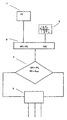
- the invention is in accordance with the method as well as in the manner according to the device in the Drawing shown and described in more detail below.
- the drawing shows the essential furnishings according to the device in such Linkage that also the procedure according to the invention can be seen therefrom.
- a speed sensor. 1 On the vehicle, which is not shown here, is a speed sensor. 1 arranged. This is located in the front of the vehicle and is either as Infrared sensor arrangement or as a radar signal arrangement or as an ultrasonic arrangement executed. In all three versions, according to the Doppler principle, the speed of the oncoming vehicle or the relative speed of the two themselves towards one another or the relative speed of a vehicle a standing object. Furthermore, a sound sensor 2 is somewhere sound-proof arranged on the shell of the vehicle. The impact generated in the shell a specific sound, according to the knowledge gained, which led to the invention has, frequency and amplitude of the mass ratio of the colliding vehicles, and depends on further parameters.
- the sound sensor 2 is so on the shell of the Vehicle arranged that a sound connection is given and any Structure-borne sound acting on or generated by the shell from the bodywork Sound sensor is detected directly.
- the shell itself is solid Welded joints or forced connection elements throughout sound conclusive. Therefore, it is theoretically irrelevant at which point the sound sensor is arranged. However, to rule out malfunction, it is appropriate to this to the load-bearing elements of the shell, the frontal deformation are relatively violently exposed.
- Both signals are read into an electronics 3 and conditioned accordingly.
- the speed signal is, for example, with the help of their own Tachometer signals the relative speed determined and possibly set in proportion.
- Out the sound sensor signal 2 a corresponding resolvable signal is created, already within the first half period, the edges and the amplitude are evaluated.
- the processed in this logic unit of the electronics 2 electronic information are subsequently fed to a valuation unit 4, in which, for example, limit values or signal threshold values are stored, exceeding one or the other Occupant protection system or possibly all occupant protection systems are triggered together.
- This rating can be either in the form of pure thresholds, the factory or be subsequently set, be fixed or it may be a limited number of be deposited as a data field so-called patterns. It can be a limited number given pattern, for example, given speed and Amplitudensignalmay be stored, the one or the other accident situations represent. Depending on this, either only the belt tensioning system or else the belt tensioning system can be activated together with the airbag system. Further Occupant protection systems are possible, which are also dependent on the severity of the Accident are selectively activated.
- this device or these process-appropriate leads Approach to a very fast deployment of a qualified Decision criterion on whether and which occupant protection systems are activated should.
- the triggering of the actual signal in the case of a maximum crash occurs more short-term than is possible with most conventional inertial sensors.
- the accident as such can be qualified at an extremely early stage of the time.
Landscapes
- Engineering & Computer Science (AREA)
- Mechanical Engineering (AREA)
- Air Bags (AREA)
- Automotive Seat Belt Assembly (AREA)
Claims (14)
- Procédé pour l'activation de systèmes de protection des occupants de véhicules automobiles en cas d'accident, dans lequel les systèmes de protection sont activés en fonction de valeurs seuil de capteurs, para) mesure ou détection de la vitesse relative dV du véhicule propre par rapport à un véhicule en collision ou un objet avant une collision,b) mesure de la fréquence et/ou de l'amplitude A de la vibration sonore U se produisant directement sur la structure de la carrosserie du véhicule du fait de la collision,c) détection d'une masse du véhicule en collision ou de l'objet à partir de la fréquence et/ou de l'amplitude mesurée de la vibration sonore U etd) détection de la puissance de la collision à partir de la vitesse relative dV et de la masse du véhicule en collision ou de l'objet et activation des systèmes de protection lors d'un dépassement de valeurs limites de vitesse et d'amplitude dVx et Ax.
- Procédé pour l'activation de systèmes de protection des occupants selon la revendication 1,
caractérisé en ce que
la vitesse relative est détectée par l'émission de signaux et la réception de signaux de réflexion selon le principe de Doppler. - Procédé pour l'activation de systèmes de protection des occupants selon la revendication 1 ou 2,
caractérisé en ce que
la mesure de la vitesse relative est effectuée avec un rayonnement infrarouge. - Procédé pour l'activation de systèmes de protection des occupants selon la revendication 1 ou 2,
caractérisé en ce que
la mesure de la vitesse relative est effectuée avec des signaux radar de haute fréquence. - Procédé pour l'activation de systèmes de protection des occupants selon la revendication 1 ou 2,
caractérisé en ce que
la mesure de la vitesse relative est effectuée par des ultrasons. - Procédé pour l'activation de systèmes de protection des occupants selon l'une quelconque ou plusieurs des revendications précédentes,
caractérisé en ce que
soit seulement le système d'enrouleur de ceinture de sécurité, soit le système d'enrouleur de ceinture de sécurité conjointement avec l'airbag sont activés en fonction de la puissance de la collision. - Procédé pour l'activation de systèmes de protection des occupants selon l'une quelconque ou plusieurs des revendications précédentes,
caractérisé en ce que
la puissance de la collision est détectée par comparaison de la vitesse relative détectée dV et de l'amplitude A avec un ou plusieurs modèles mémorisés de valeurs données, et en ce que l'on en déduit sur place les valeurs limites respectives dVx et Ax destinées à être utilisées comme base. - Dispositif pour l'activation de systèmes de protection des occupants d'un véhicule automobile, comprenant
des capteurs (1, 2), par l'intermédiaires desquels, en cas d'accident, les systèmes de protection peuvent être activés en fonction de valeurs seuil de capteurs, l'un des capteurs étant un capteur sonore (2), qui peut être relié à la structure de la carrosserie du véhicule automobile par l'intermédiaire du bruit structurel, et un autre des capteurs étant un capteur (1) pour la détection de la vitesse ou de la vitesse relative par rapport à un véhicule en collision ou un objet, et
une unité d'analyse électronique (4) pour la détection d'une masse du véhicule en collision ou de l'objet à partir d'une fréquence et/ou d'une amplitude de la vibration sonore détectée par le capteur sonore (2) et en vue de la détection supplémentaire de la puissance de la collision à partir de la vitesse ou de la vitesse relative détectée et de la masse détectée ainsi que pour la fourniture de signaux d'activation correspondants aux systèmes de protection des occupants. - Dispositif pour l'activation de systèmes de protection des occupants de véhicules automobiles selon la revendication 8,
caractérisé en ce que
le capteur sonore (2) est disposé dans la partie avant de la structure de la carrosserie. - Dispositif pour l'activation de systèmes de protection des occupants de véhicules automobiles selon la revendication 8 ou 9,
caractérisé en ce que
le capteur de vitesse (1) est un capteur infrarouge, un capteur radar HF ou un capteur à ultrasons. - Dispositif pour l'activation de systèmes de protection des occupants de véhicules automobiles selon l'une quelconque ou plusieurs des revendications précédentes,
caractérisé en ce que
les capteurs (1, 2) sont mis en circuit avec une unité électronique (3) de telle sorte que l'on puisse détecter, à partir du signal de vitesse, un signal de vitesse relative, et que l'on puisse détecter à partir du signal sonore un signal à résolution temporelle. - Dispositif pour l'activation de systèmes de protection des occupants de véhicules automobiles selon l'une quelconque ou plusieurs des revendications précédentes,
caractérisé en ce que
l'unité électronique (3) est mise en circuit avec une unité d'analyse électronique (4), dans laquelle les signaux de capteurs conditionnés dV et A peuvent être comparés à des valeurs limites et, dans le cas d'un dépassement, génèrent les signaux d'activation correspondants pour les systèmes de protection des occupants (5). - Dispositif pour l'activation de systèmes de protection des occupants de véhicules automobiles selon l'une quelconque ou plusieurs des revendications précédentes,
caractérisé en ce que l'unité d'analyse électronique (4) est munie d'un élément de mémoire et d'un comparateur. - Dispositif pour l'activation de systèmes de protection des occupants de véhicules automobiles selon l'une quelconque ou plusieurs des revendications précédente,
caractérisé en ce qu'
un élément de mémoire non volatile est prévu à l'intérieur de l'unité d'analyse (4), dans lequel est mémorisé un champ de données pourvu d'un modèle de signaux dVi et Ai.
Applications Claiming Priority (2)
| Application Number | Priority Date | Filing Date | Title |
|---|---|---|---|
| DE19742606 | 1997-09-26 | ||
| DE19742606A DE19742606B4 (de) | 1997-09-26 | 1997-09-26 | Verfahren und Einrichtung zur Aktivierung von Insassenschutzsystemen in Kraftfahrzeugen |
Publications (3)
| Publication Number | Publication Date |
|---|---|
| EP0904989A2 EP0904989A2 (fr) | 1999-03-31 |
| EP0904989A3 EP0904989A3 (fr) | 2001-03-14 |
| EP0904989B1 true EP0904989B1 (fr) | 2005-01-26 |
Family
ID=7843767
Family Applications (1)
| Application Number | Title | Priority Date | Filing Date |
|---|---|---|---|
| EP98115900A Expired - Lifetime EP0904989B1 (fr) | 1997-09-26 | 1998-08-24 | Procédé et dispositif pour l'activation d'un système de protection de passagers |
Country Status (2)
| Country | Link |
|---|---|
| EP (1) | EP0904989B1 (fr) |
| DE (2) | DE19742606B4 (fr) |
Families Citing this family (14)
| Publication number | Priority date | Publication date | Assignee | Title |
|---|---|---|---|---|
| DE19913675B4 (de) * | 1999-03-25 | 2006-05-04 | Volkswagen Ag | Verfahren und Einrichtung zur Steuerung eines Sicherheitssystems bei Kraftfahrzeugen |
| DE19938891B4 (de) * | 1999-08-17 | 2010-04-22 | Continental Automotive Gmbh | Verfahren und Vorrichtung zur Steuerung der Auslösung eines Kraftfahrzeug-Insassenschutzsystems |
| US6771166B2 (en) * | 2001-11-14 | 2004-08-03 | Motorola, Inc. | Air bag deployment sensing apparatus and method |
| DE10206351B4 (de) * | 2002-02-14 | 2004-08-05 | Daimlerchrysler Ag | Verfahren und Vorrichtung zum Personen- und Kollisionsschutz an einem Fahrzeug |
| DE10234624B4 (de) * | 2002-07-29 | 2008-08-07 | Spies, Martin, Dipl.-Ing. (FH) | Passives Sicherheitssystem für Kraftfahrzeuge mit Precrash-Sensor |
| DE10360138A1 (de) * | 2003-12-20 | 2005-07-21 | Daimlerchrysler Ag | System zur Erkennung einer Kollision eines Kraftfahrzeuges |
| DE10360769B4 (de) * | 2003-12-23 | 2012-04-12 | Conti Temic Microelectronic Gmbh | Verfahren und Vorrichtung zum Auslösen mindestens einer Insassenschutzeinrichtung in einem Fahrzeug |
| DE102004035738A1 (de) * | 2004-07-23 | 2005-09-15 | Siemens Ag | Einrichtung zum Auslösen eines Personenschutzsystems |
| DE102004043597A1 (de) | 2004-09-06 | 2006-03-09 | Robert Bosch Gmbh | Einrichtung zur Erfassung einer Kollision eines Fahrzeugs mit einem Hindernis |
| DE102005014013A1 (de) * | 2005-03-26 | 2006-09-28 | Conti Temic Microelectronic Gmbh | Fahrzeugsensor |
| DE102007061658A1 (de) | 2007-12-18 | 2009-06-25 | Adc Automotive Distance Control Systems Gmbh | Klassifikation der Fahrzeugumgebung |
| DE102008039957A1 (de) | 2008-08-27 | 2010-03-04 | Continental Automotive Gmbh | Verfahren zur Ermittlung eines Unfallschwerekriteriums mittels eines Beschleunigungssignals und eines Körperschallsignals |
| KR102587096B1 (ko) * | 2019-02-22 | 2023-10-10 | 현대자동차주식회사 | 차량의 충격부위 검출 장치 및 그 방법 |
| CN118379832A (zh) * | 2024-06-27 | 2024-07-23 | 山东冠县恒良管业有限公司 | 一种高速公路护栏板的碰撞报警系统 |
Family Cites Families (26)
| Publication number | Priority date | Publication date | Assignee | Title |
|---|---|---|---|---|
| US3735398A (en) * | 1971-05-20 | 1973-05-22 | Sperry Rand Corp | Base band short range pre-collision sensor for actuation of vehicle safety apparatus |
| JPS4858533A (fr) * | 1971-11-22 | 1973-08-16 | ||
| DE2922273A1 (de) * | 1979-05-31 | 1981-01-22 | Siemens Ag | Automatisches luftsack-rettungsgeraet fuer personenbefoerderungsmittel, insbesondere kraftfahrzeuge |
| DE3001780C2 (de) * | 1980-01-18 | 1984-09-27 | Becker Autoradiowerk Gmbh, 7516 Karlsbad | Steueranordnung für Sicherheitseinrichtungen in Fahrzeugen |
| US4346914A (en) * | 1980-12-17 | 1982-08-31 | General Motors Corporation | Acoustic emission automotive crash sensor |
| DE3205560A1 (de) * | 1982-02-17 | 1983-08-25 | Ingenieurbüro für Industrietechnik Manfred Knüfelmann GmbH, 4000 Düsseldorf | Induktiver beschleunigungsmesser |
| DE3507381A1 (de) * | 1985-03-02 | 1986-09-04 | Bosch Gmbh Robert | Vorrichtung zum schutze von kraftfahrzeug-insassen bei auffahrunfaellen |
| DE3729019A1 (de) * | 1987-08-31 | 1989-03-16 | Messerschmitt Boelkow Blohm | Einrichtung zur ausloesung einer sicherheitsvorrichtung |
| DE3733832A1 (de) * | 1987-10-07 | 1989-04-27 | Messerschmitt Boelkow Blohm | Sensor fuer kraftfahrzeuge |
| US4842301A (en) * | 1988-09-02 | 1989-06-27 | General Motors Corporation | Acoustic emission automotive crash sensor |
| DE3834005A1 (de) * | 1988-10-06 | 1990-04-19 | Schwant Wilfried Dipl Ing | Sensor zur messung von geschwindigkeitsaenderungen eines fahrzeuges, insbesondere kraftfahrzeuges, bei einem aufprall |
| US5216607A (en) * | 1989-05-30 | 1993-06-01 | Trw Vehicle Safety Systems Inc. | Method and apparatus for sensing a vehicle crash using energy and velocity as measures of crash violence |
| JPH0399957A (ja) * | 1989-09-13 | 1991-04-25 | Fuji Heavy Ind Ltd | 前方車両検出装置 |
| US5073860A (en) * | 1989-11-07 | 1991-12-17 | Trw Vehicle Safety Systems Inc. | Method and apparatus for sensing a vehicle crash in real time using frequency domain analysis |
| GB9004916D0 (en) * | 1990-03-05 | 1990-05-02 | Stresswave Tech | A collision detector for a vehicle |
| DE4035501A1 (de) * | 1990-11-08 | 1992-05-14 | Bosch Gmbh Robert | Verfahren zur bestimmung der relativen position von fahrzeugen im strassenverkehr |
| DE4040572A1 (de) * | 1990-12-19 | 1992-06-25 | Bosch Gmbh Robert | Verfahren zur messung des abstandes und der geschwindigkeit eines objekts |
| JP2879613B2 (ja) * | 1991-03-18 | 1999-04-05 | 本田技研工業株式会社 | 乗員保護装置 |
| DE9215382U1 (de) * | 1992-11-11 | 1994-03-17 | Siemens AG, 80333 München | In einem Fahrzeug angebrachter Schalldetektor |
| DE4323861C2 (de) * | 1993-07-16 | 1996-04-11 | Richard Lang | In einem Fahrzeugsitz integrierter 4-Punkt-Gurt |
| US5626359A (en) * | 1993-12-02 | 1997-05-06 | Trw Vehicle Safety Systems, Inc. | Method and apparatus for controlling an actuatable restraining device in response to discrete control zones |
| DE4426090C2 (de) * | 1994-01-14 | 1997-10-23 | Franz Mueller | Einrichtungen zum Schutz für die Fahrzeuginsassen und die Karosserie in einem Kraftfahrzeug |
| DE4425846A1 (de) * | 1994-07-21 | 1996-01-25 | Telefunken Microelectron | Verfahren zur Auslösung von Seitenairbags einer passiven Sicherheitseinrichtung für Kraftfahrzeuge |
| EP0728624A3 (fr) * | 1995-02-24 | 1996-11-06 | Trw Inc | Procédé et appareil de contrÔle d'un dispositif de retenue déclenchable avec capteur pour prévoir des collisions |
| DE19520721C2 (de) * | 1995-06-12 | 1998-12-10 | Bsrs Restraint Syst Gmbh | Gurtstraffersystem eines passiven Rückhaltesystems für ein Kraftfahrzeug |
| DE19644975B4 (de) * | 1995-10-31 | 2004-07-22 | Honda Giken Kogyo K.K. | Verfahren zur Beurteilung einer Fahrzeugkollision |
-
1997
- 1997-09-26 DE DE19742606A patent/DE19742606B4/de not_active Expired - Fee Related
-
1998
- 1998-08-24 DE DE59812510T patent/DE59812510D1/de not_active Expired - Lifetime
- 1998-08-24 EP EP98115900A patent/EP0904989B1/fr not_active Expired - Lifetime
Also Published As
| Publication number | Publication date |
|---|---|
| EP0904989A3 (fr) | 2001-03-14 |
| DE59812510D1 (de) | 2005-03-03 |
| DE19742606B4 (de) | 2005-09-15 |
| DE19742606A1 (de) | 1999-04-01 |
| EP0904989A2 (fr) | 1999-03-31 |
Similar Documents
| Publication | Publication Date | Title |
|---|---|---|
| DE19848997B4 (de) | Fahrzeuginsassenschutzsystem | |
| EP1355805B1 (fr) | Procede pour declencher des moyens de retenue dans un vehicule a moteur | |
| DE19743009B4 (de) | Verfahren und Vorrichtung zur Einzelpunktabfühlung von vorderen und seitlichen Aufschlagzusammenstoßbedingungen | |
| DE102005008190B4 (de) | Verfahren und Steuerungseinrichtung zur Auslösung von Seitenaufprall-Rückhaltesystemen | |
| DE10132681C1 (de) | Verfahren zur Klassifizierung von einem Hindernis anhand von Precrashsensorsignalen | |
| DE102004046360B4 (de) | Kraftfahrzeug mit einem präventiv wirkenden Schutzsystem | |
| DE10049911B4 (de) | Verfahren und Vorrichtung zur Aktivierung von Insassenschutzeinrichtungen | |
| DE60200126T2 (de) | Vorrichtung und Verfahren zur Kontrolle einer Insassenschutzvorrichtung | |
| EP1261509B1 (fr) | Procede pour reconnaitre une situation de tonneau | |
| EP0842829A1 (fr) | Dispositif de déclenchement pour systèmes de retenue pour occupants dans un véhicule. | |
| DE19742606B4 (de) | Verfahren und Einrichtung zur Aktivierung von Insassenschutzsystemen in Kraftfahrzeugen | |
| EP1656282A1 (fr) | Vehicule a moteur equipe d'un systeme de securite preventive | |
| EP1523688A1 (fr) | Dispositif pour la surveillance du champ peripherique a partir d'un vehicule | |
| DE10202908B4 (de) | Verfahren und Anordnung zur Bestimmung eines Detektionsbereiches eines Pre-Crash-Sensorsystems | |
| DE10157203B4 (de) | Passives Sicherheitssystem | |
| EP1542886B1 (fr) | Procede de detection d'un impact lateral | |
| DE102008043637A1 (de) | Verfahren zur Aktivierung und/oder Ansteuerung von mindestens einem Schutz-system in einem Fahrzeug | |
| DE10323483A1 (de) | Vorrichtung zur Bestimmung einer Relativgeschwindigkeit zwischen einem Fahrzeug und einem Aufprallobjekt | |
| DE102004024265B4 (de) | Sicherheitssystem zum Betrieb wenigstens einer elektrisch betätigbaren Verschlusseinrichtung einer Tür eines Fahrzeuges | |
| EP1634099A2 (fr) | Dispositif pour classer au moins un objet a l'aide d'un ensemble capteur pour champ peripherique | |
| EP0988180B1 (fr) | Dispositif pour commander un element de protection des occupants d'un vehicule a moteur | |
| DE19753160C1 (de) | Vorrichtung zum Erkennen einer bevorstehenden Unfallsituation eines Fahrzeugs | |
| DE102005020146A1 (de) | Vorrichtung und Verfahren zum Steuern eines Personenschutzsystems eines Fahrzeuges | |
| EP1641655B1 (fr) | Procede de commande d'un dispositif de protection de passager d'un vehicule | |
| EP2244912A1 (fr) | Procédé et module de commande pour amorcer des dispositifs de protection de personne pour un véhicule |
Legal Events
| Date | Code | Title | Description |
|---|---|---|---|
| PUAI | Public reference made under article 153(3) epc to a published international application that has entered the european phase |
Free format text: ORIGINAL CODE: 0009012 |
|
| AK | Designated contracting states |
Kind code of ref document: A2 Designated state(s): DE ES FR GB IT |
|
| AX | Request for extension of the european patent |
Free format text: AL;LT;LV;MK;RO;SI |
|
| PUAL | Search report despatched |
Free format text: ORIGINAL CODE: 0009013 |
|
| AK | Designated contracting states |
Kind code of ref document: A3 Designated state(s): AT BE CH CY DE DK ES FI FR GB GR IE IT LI LU MC NL PT SE |
|
| AX | Request for extension of the european patent |
Free format text: AL;LT;LV;MK;RO;SI |
|
| RIC1 | Information provided on ipc code assigned before grant |
Free format text: 7B 60R 21/00 A, 7G 01P 15/00 B, 7B 60R 21/01 B |
|
| 17P | Request for examination filed |
Effective date: 20010914 |
|
| AKX | Designation fees paid |
Free format text: DE ES FR GB IT |
|
| 17Q | First examination report despatched |
Effective date: 20020819 |
|
| GRAP | Despatch of communication of intention to grant a patent |
Free format text: ORIGINAL CODE: EPIDOSNIGR1 |
|
| GRAA | (expected) grant |
Free format text: ORIGINAL CODE: 0009210 |
|
| GRAS | Grant fee paid |
Free format text: ORIGINAL CODE: EPIDOSNIGR3 |
|
| AK | Designated contracting states |
Kind code of ref document: B1 Designated state(s): DE ES FR GB IT |
|
| PG25 | Lapsed in a contracting state [announced via postgrant information from national office to epo] |
Ref country code: IT Free format text: LAPSE BECAUSE OF FAILURE TO SUBMIT A TRANSLATION OF THE DESCRIPTION OR TO PAY THE FEE WITHIN THE PRESCRIBED TIME-LIMIT;WARNING: LAPSES OF ITALIAN PATENTS WITH EFFECTIVE DATE BEFORE 2007 MAY HAVE OCCURRED AT ANY TIME BEFORE 2007. THE CORRECT EFFECTIVE DATE MAY BE DIFFERENT FROM THE ONE RECORDED. Effective date: 20050126 Ref country code: GB Free format text: LAPSE BECAUSE OF FAILURE TO SUBMIT A TRANSLATION OF THE DESCRIPTION OR TO PAY THE FEE WITHIN THE PRESCRIBED TIME-LIMIT Effective date: 20050126 Ref country code: FR Free format text: LAPSE BECAUSE OF FAILURE TO SUBMIT A TRANSLATION OF THE DESCRIPTION OR TO PAY THE FEE WITHIN THE PRESCRIBED TIME-LIMIT Effective date: 20050126 |
|
| REG | Reference to a national code |
Ref country code: GB Ref legal event code: FG4D Free format text: NOT ENGLISH |
|
| REF | Corresponds to: |
Ref document number: 59812510 Country of ref document: DE Date of ref document: 20050303 Kind code of ref document: P |
|
| PG25 | Lapsed in a contracting state [announced via postgrant information from national office to epo] |
Ref country code: ES Free format text: LAPSE BECAUSE OF FAILURE TO SUBMIT A TRANSLATION OF THE DESCRIPTION OR TO PAY THE FEE WITHIN THE PRESCRIBED TIME-LIMIT Effective date: 20050507 |
|
| GBV | Gb: ep patent (uk) treated as always having been void in accordance with gb section 77(7)/1977 [no translation filed] |
Effective date: 20050126 |
|
| PLBE | No opposition filed within time limit |
Free format text: ORIGINAL CODE: 0009261 |
|
| STAA | Information on the status of an ep patent application or granted ep patent |
Free format text: STATUS: NO OPPOSITION FILED WITHIN TIME LIMIT |
|
| 26N | No opposition filed |
Effective date: 20051027 |
|
| EN | Fr: translation not filed | ||
| PGFP | Annual fee paid to national office [announced via postgrant information from national office to epo] |
Ref country code: DE Payment date: 20160831 Year of fee payment: 19 |
|
| REG | Reference to a national code |
Ref country code: DE Ref legal event code: R119 Ref document number: 59812510 Country of ref document: DE |
|
| PG25 | Lapsed in a contracting state [announced via postgrant information from national office to epo] |
Ref country code: DE Free format text: LAPSE BECAUSE OF NON-PAYMENT OF DUE FEES Effective date: 20180301 |