EP0904700A1 - Innenbeschichtete Nahrungsmittelhüllen auf Basis von regenerierter Cellulose - Google Patents
Innenbeschichtete Nahrungsmittelhüllen auf Basis von regenerierter Cellulose Download PDFInfo
- Publication number
- EP0904700A1 EP0904700A1 EP98117805A EP98117805A EP0904700A1 EP 0904700 A1 EP0904700 A1 EP 0904700A1 EP 98117805 A EP98117805 A EP 98117805A EP 98117805 A EP98117805 A EP 98117805A EP 0904700 A1 EP0904700 A1 EP 0904700A1
- Authority
- EP
- European Patent Office
- Prior art keywords
- weight
- units
- food casing
- coating
- copolymer
- Prior art date
- Legal status (The legal status is an assumption and is not a legal conclusion. Google has not performed a legal analysis and makes no representation as to the accuracy of the status listed.)
- Granted
Links
- 235000013305 food Nutrition 0.000 title claims abstract description 24
- 239000004627 regenerated cellulose Substances 0.000 title claims abstract description 14
- 238000000576 coating method Methods 0.000 claims abstract description 65
- 239000011248 coating agent Substances 0.000 claims abstract description 62
- 229920001577 copolymer Polymers 0.000 claims abstract description 54
- 239000006185 dispersion Substances 0.000 claims abstract description 23
- OEPOKWHJYJXUGD-UHFFFAOYSA-N 2-(3-phenylmethoxyphenyl)-1,3-thiazole-4-carbaldehyde Chemical compound O=CC1=CSC(C=2C=C(OCC=3C=CC=CC=3)C=CC=2)=N1 OEPOKWHJYJXUGD-UHFFFAOYSA-N 0.000 claims abstract description 20
- NIXOWILDQLNWCW-UHFFFAOYSA-N 2-Propenoic acid Natural products OC(=O)C=C NIXOWILDQLNWCW-UHFFFAOYSA-N 0.000 claims abstract description 20
- NLHHRLWOUZZQLW-UHFFFAOYSA-N Acrylonitrile Chemical compound C=CC#N NLHHRLWOUZZQLW-UHFFFAOYSA-N 0.000 claims abstract description 13
- 238000000034 method Methods 0.000 claims abstract description 11
- 230000008569 process Effects 0.000 claims abstract description 7
- SMZOUWXMTYCWNB-UHFFFAOYSA-N 2-(2-methoxy-5-methylphenyl)ethanamine Chemical compound COC1=CC=C(C)C=C1CCN SMZOUWXMTYCWNB-UHFFFAOYSA-N 0.000 claims abstract description 5
- PEDCQBHIVMGVHV-UHFFFAOYSA-N Glycerine Chemical compound OCC(O)CO PEDCQBHIVMGVHV-UHFFFAOYSA-N 0.000 claims description 32
- XLYOFNOQVPJJNP-UHFFFAOYSA-N water Chemical compound O XLYOFNOQVPJJNP-UHFFFAOYSA-N 0.000 claims description 24
- 230000035699 permeability Effects 0.000 claims description 15
- 239000000835 fiber Substances 0.000 claims description 12
- QVGXLLKOCUKJST-UHFFFAOYSA-N atomic oxygen Chemical compound [O] QVGXLLKOCUKJST-UHFFFAOYSA-N 0.000 claims description 8
- 239000001301 oxygen Substances 0.000 claims description 8
- 229910052760 oxygen Inorganic materials 0.000 claims description 8
- CERQOIWHTDAKMF-UHFFFAOYSA-N Methacrylic acid Chemical group CC(=C)C(O)=O CERQOIWHTDAKMF-UHFFFAOYSA-N 0.000 claims description 5
- 244000025254 Cannabis sativa Species 0.000 claims description 4
- 235000012766 Cannabis sativa ssp. sativa var. sativa Nutrition 0.000 claims description 4
- 235000012765 Cannabis sativa ssp. sativa var. spontanea Nutrition 0.000 claims description 4
- 235000009120 camo Nutrition 0.000 claims description 4
- 235000005607 chanvre indien Nutrition 0.000 claims description 4
- 239000011487 hemp Substances 0.000 claims description 4
- 239000004952 Polyamide Substances 0.000 claims description 3
- 239000007859 condensation product Substances 0.000 claims description 3
- 229920002647 polyamide Polymers 0.000 claims description 3
- 239000000779 smoke Substances 0.000 claims description 3
- 239000007787 solid Substances 0.000 claims description 3
- BRLQWZUYTZBJKN-UHFFFAOYSA-N Epichlorohydrin Chemical compound ClCC1CO1 BRLQWZUYTZBJKN-UHFFFAOYSA-N 0.000 claims description 2
- 229920000768 polyamine Polymers 0.000 claims 1
- 238000002360 preparation method Methods 0.000 claims 1
- 238000004519 manufacturing process Methods 0.000 abstract description 8
- 238000001035 drying Methods 0.000 abstract description 5
- NIXOWILDQLNWCW-UHFFFAOYSA-M Acrylate Chemical compound [O-]C(=O)C=C NIXOWILDQLNWCW-UHFFFAOYSA-M 0.000 abstract description 2
- 125000000217 alkyl group Chemical group 0.000 abstract description 2
- WYURNTSHIVDZCO-UHFFFAOYSA-N Tetrahydrofuran Chemical compound C1CCOC1 WYURNTSHIVDZCO-UHFFFAOYSA-N 0.000 description 21
- 238000003860 storage Methods 0.000 description 21
- 239000000243 solution Substances 0.000 description 20
- 235000013580 sausages Nutrition 0.000 description 16
- 235000011187 glycerol Nutrition 0.000 description 14
- 229920002678 cellulose Polymers 0.000 description 10
- 239000001913 cellulose Substances 0.000 description 10
- YLQBMQCUIZJEEH-UHFFFAOYSA-N tetrahydrofuran Natural products C=1C=COC=1 YLQBMQCUIZJEEH-UHFFFAOYSA-N 0.000 description 10
- 235000015250 liver sausages Nutrition 0.000 description 9
- 229920001328 Polyvinylidene chloride Polymers 0.000 description 8
- 229920000297 Rayon Polymers 0.000 description 8
- 230000004888 barrier function Effects 0.000 description 8
- 239000005033 polyvinylidene chloride Substances 0.000 description 8
- 239000000463 material Substances 0.000 description 7
- 239000001993 wax Substances 0.000 description 7
- QTBSBXVTEAMEQO-UHFFFAOYSA-N Acetic acid Chemical compound CC(O)=O QTBSBXVTEAMEQO-UHFFFAOYSA-N 0.000 description 6
- ZMXDDKWLCZADIW-UHFFFAOYSA-N N,N-Dimethylformamide Chemical compound CN(C)C=O ZMXDDKWLCZADIW-UHFFFAOYSA-N 0.000 description 6
- 235000019690 meat sausages Nutrition 0.000 description 6
- BDAGIHXWWSANSR-UHFFFAOYSA-N methanoic acid Natural products OC=O BDAGIHXWWSANSR-UHFFFAOYSA-N 0.000 description 6
- LGXVIGDEPROXKC-UHFFFAOYSA-N 1,1-dichloroethene Chemical group ClC(Cl)=C LGXVIGDEPROXKC-UHFFFAOYSA-N 0.000 description 5
- 238000002425 crystallisation Methods 0.000 description 5
- 230000008025 crystallization Effects 0.000 description 5
- 230000004580 weight loss Effects 0.000 description 5
- IAZDPXIOMUYVGZ-UHFFFAOYSA-N Dimethylsulphoxide Chemical compound CS(C)=O IAZDPXIOMUYVGZ-UHFFFAOYSA-N 0.000 description 4
- 238000004873 anchoring Methods 0.000 description 4
- 230000006378 damage Effects 0.000 description 4
- 239000000203 mixture Substances 0.000 description 4
- OSWFIVFLDKOXQC-UHFFFAOYSA-N 4-(3-methoxyphenyl)aniline Chemical compound COC1=CC=CC(C=2C=CC(N)=CC=2)=C1 OSWFIVFLDKOXQC-UHFFFAOYSA-N 0.000 description 3
- JIGUQPWFLRLWPJ-UHFFFAOYSA-N Ethyl acrylate Chemical group CCOC(=O)C=C JIGUQPWFLRLWPJ-UHFFFAOYSA-N 0.000 description 3
- MUBZPKHOEPUJKR-UHFFFAOYSA-N Oxalic acid Chemical compound OC(=O)C(O)=O MUBZPKHOEPUJKR-UHFFFAOYSA-N 0.000 description 3
- 239000002318 adhesion promoter Substances 0.000 description 3
- 230000008859 change Effects 0.000 description 3
- KRKNYBCHXYNGOX-UHFFFAOYSA-N citric acid Chemical compound OC(=O)CC(O)(C(O)=O)CC(O)=O KRKNYBCHXYNGOX-UHFFFAOYSA-N 0.000 description 3
- 238000001816 cooling Methods 0.000 description 3
- 235000019253 formic acid Nutrition 0.000 description 3
- 238000005470 impregnation Methods 0.000 description 3
- RTZKZFJDLAIYFH-UHFFFAOYSA-N Diethyl ether Chemical compound CCOCC RTZKZFJDLAIYFH-UHFFFAOYSA-N 0.000 description 2
- 235000011054 acetic acid Nutrition 0.000 description 2
- 230000008901 benefit Effects 0.000 description 2
- 230000001143 conditioned effect Effects 0.000 description 2
- 230000007547 defect Effects 0.000 description 2
- XBDQKXXYIPTUBI-UHFFFAOYSA-N dimethylselenoniopropionate Natural products CCC(O)=O XBDQKXXYIPTUBI-UHFFFAOYSA-N 0.000 description 2
- 238000002845 discoloration Methods 0.000 description 2
- 150000002148 esters Chemical class 0.000 description 2
- 239000011521 glass Substances 0.000 description 2
- 210000000936 intestine Anatomy 0.000 description 2
- JVTAAEKCZFNVCJ-UHFFFAOYSA-N lactic acid Chemical compound CC(O)C(O)=O JVTAAEKCZFNVCJ-UHFFFAOYSA-N 0.000 description 2
- 235000013372 meat Nutrition 0.000 description 2
- 230000003647 oxidation Effects 0.000 description 2
- 238000007254 oxidation reaction Methods 0.000 description 2
- 239000002245 particle Substances 0.000 description 2
- 239000004014 plasticizer Substances 0.000 description 2
- 229920000728 polyester Polymers 0.000 description 2
- 238000006116 polymerization reaction Methods 0.000 description 2
- 229920000098 polyolefin Polymers 0.000 description 2
- 238000001556 precipitation Methods 0.000 description 2
- 230000008929 regeneration Effects 0.000 description 2
- 238000011069 regeneration method Methods 0.000 description 2
- 230000002787 reinforcement Effects 0.000 description 2
- 125000006702 (C1-C18) alkyl group Chemical group 0.000 description 1
- 125000003837 (C1-C20) alkyl group Chemical group 0.000 description 1
- FEWJPZIEWOKRBE-JCYAYHJZSA-N Dextrotartaric acid Chemical compound OC(=O)[C@H](O)[C@@H](O)C(O)=O FEWJPZIEWOKRBE-JCYAYHJZSA-N 0.000 description 1
- IAYPIBMASNFSPL-UHFFFAOYSA-N Ethylene oxide Chemical compound C1CO1 IAYPIBMASNFSPL-UHFFFAOYSA-N 0.000 description 1
- BAPJBEWLBFYGME-UHFFFAOYSA-N Methyl acrylate Chemical group COC(=O)C=C BAPJBEWLBFYGME-UHFFFAOYSA-N 0.000 description 1
- 239000000020 Nitrocellulose Substances 0.000 description 1
- 239000004698 Polyethylene Substances 0.000 description 1
- GOOHAUXETOMSMM-UHFFFAOYSA-N Propylene oxide Chemical compound CC1CO1 GOOHAUXETOMSMM-UHFFFAOYSA-N 0.000 description 1
- FEWJPZIEWOKRBE-UHFFFAOYSA-N Tartaric acid Natural products [H+].[H+].[O-]C(=O)C(O)C(O)C([O-])=O FEWJPZIEWOKRBE-UHFFFAOYSA-N 0.000 description 1
- 125000005396 acrylic acid ester group Chemical group 0.000 description 1
- 238000007792 addition Methods 0.000 description 1
- 150000008055 alkyl aryl sulfonates Chemical class 0.000 description 1
- 125000003118 aryl group Chemical group 0.000 description 1
- 230000015572 biosynthetic process Effects 0.000 description 1
- 238000009835 boiling Methods 0.000 description 1
- 125000000484 butyl group Chemical group [H]C([*])([H])C([H])([H])C([H])([H])C([H])([H])[H] 0.000 description 1
- 125000004432 carbon atom Chemical group C* 0.000 description 1
- 150000003857 carboxamides Chemical class 0.000 description 1
- 239000012876 carrier material Substances 0.000 description 1
- 239000007795 chemical reaction product Substances 0.000 description 1
- 235000015165 citric acid Nutrition 0.000 description 1
- 239000002131 composite material Substances 0.000 description 1
- 230000007423 decrease Effects 0.000 description 1
- 230000006735 deficit Effects 0.000 description 1
- 239000013530 defoamer Substances 0.000 description 1
- 238000009826 distribution Methods 0.000 description 1
- 230000000694 effects Effects 0.000 description 1
- 239000003995 emulsifying agent Substances 0.000 description 1
- 125000001495 ethyl group Chemical group [H]C([H])([H])C([H])([H])* 0.000 description 1
- 230000002349 favourable effect Effects 0.000 description 1
- 125000000524 functional group Chemical group 0.000 description 1
- 230000004927 fusion Effects 0.000 description 1
- 239000007789 gas Substances 0.000 description 1
- 238000010438 heat treatment Methods 0.000 description 1
- 125000004051 hexyl group Chemical group [H]C([H])([H])C([H])([H])C([H])([H])C([H])([H])C([H])([H])C([H])([H])* 0.000 description 1
- IQPQWNKOIGAROB-UHFFFAOYSA-N isocyanate group Chemical group [N-]=C=O IQPQWNKOIGAROB-UHFFFAOYSA-N 0.000 description 1
- 150000002576 ketones Chemical class 0.000 description 1
- 239000004310 lactic acid Substances 0.000 description 1
- 235000014655 lactic acid Nutrition 0.000 description 1
- 239000007788 liquid Substances 0.000 description 1
- 238000005259 measurement Methods 0.000 description 1
- 239000012528 membrane Substances 0.000 description 1
- 125000002496 methyl group Chemical group [H]C([H])([H])* 0.000 description 1
- 229920001220 nitrocellulos Polymers 0.000 description 1
- 150000007524 organic acids Chemical class 0.000 description 1
- 235000005985 organic acids Nutrition 0.000 description 1
- 239000003960 organic solvent Substances 0.000 description 1
- 235000006408 oxalic acid Nutrition 0.000 description 1
- 125000001147 pentyl group Chemical group C(CCCC)* 0.000 description 1
- PNJWIWWMYCMZRO-UHFFFAOYSA-N pent‐4‐en‐2‐one Natural products CC(=O)CC=C PNJWIWWMYCMZRO-UHFFFAOYSA-N 0.000 description 1
- 239000000049 pigment Substances 0.000 description 1
- 229920000058 polyacrylate Polymers 0.000 description 1
- -1 polyethylene Polymers 0.000 description 1
- 229920000573 polyethylene Polymers 0.000 description 1
- 229920001228 polyisocyanate Polymers 0.000 description 1
- 239000005056 polyisocyanate Substances 0.000 description 1
- 229920000642 polymer Polymers 0.000 description 1
- 229920002959 polymer blend Polymers 0.000 description 1
- 229920006254 polymer film Polymers 0.000 description 1
- 229920005862 polyol Polymers 0.000 description 1
- 150000003077 polyols Chemical class 0.000 description 1
- 229920001296 polysiloxane Polymers 0.000 description 1
- 229920002635 polyurethane Polymers 0.000 description 1
- 239000004814 polyurethane Substances 0.000 description 1
- 239000011148 porous material Substances 0.000 description 1
- 230000002035 prolonged effect Effects 0.000 description 1
- 235000019260 propionic acid Nutrition 0.000 description 1
- 125000001436 propyl group Chemical group [H]C([*])([H])C([H])([H])C([H])([H])[H] 0.000 description 1
- IUVKMZGDUIUOCP-BTNSXGMBSA-N quinbolone Chemical compound O([C@H]1CC[C@H]2[C@H]3[C@@H]([C@]4(C=CC(=O)C=C4CC3)C)CC[C@@]21C)C1=CCCC1 IUVKMZGDUIUOCP-BTNSXGMBSA-N 0.000 description 1
- 238000005096 rolling process Methods 0.000 description 1
- 239000000523 sample Substances 0.000 description 1
- 238000000926 separation method Methods 0.000 description 1
- 230000009528 severe injury Effects 0.000 description 1
- 239000002904 solvent Substances 0.000 description 1
- 150000003467 sulfuric acid derivatives Chemical class 0.000 description 1
- 230000008961 swelling Effects 0.000 description 1
- 239000011975 tartaric acid Substances 0.000 description 1
- 235000002906 tartaric acid Nutrition 0.000 description 1
- 238000005406 washing Methods 0.000 description 1
- 230000037303 wrinkles Effects 0.000 description 1
Images
Classifications
-
- A—HUMAN NECESSITIES
- A22—BUTCHERING; MEAT TREATMENT; PROCESSING POULTRY OR FISH
- A22C—PROCESSING MEAT, POULTRY, OR FISH
- A22C13/00—Sausage casings
- A22C13/0013—Chemical composition of synthetic sausage casings
-
- Y—GENERAL TAGGING OF NEW TECHNOLOGICAL DEVELOPMENTS; GENERAL TAGGING OF CROSS-SECTIONAL TECHNOLOGIES SPANNING OVER SEVERAL SECTIONS OF THE IPC; TECHNICAL SUBJECTS COVERED BY FORMER USPC CROSS-REFERENCE ART COLLECTIONS [XRACs] AND DIGESTS
- Y10—TECHNICAL SUBJECTS COVERED BY FORMER USPC
- Y10T—TECHNICAL SUBJECTS COVERED BY FORMER US CLASSIFICATION
- Y10T428/00—Stock material or miscellaneous articles
- Y10T428/13—Hollow or container type article [e.g., tube, vase, etc.]
- Y10T428/1324—Flexible food casing [e.g., sausage type, etc.]
-
- Y—GENERAL TAGGING OF NEW TECHNOLOGICAL DEVELOPMENTS; GENERAL TAGGING OF CROSS-SECTIONAL TECHNOLOGIES SPANNING OVER SEVERAL SECTIONS OF THE IPC; TECHNICAL SUBJECTS COVERED BY FORMER USPC CROSS-REFERENCE ART COLLECTIONS [XRACs] AND DIGESTS
- Y10—TECHNICAL SUBJECTS COVERED BY FORMER USPC
- Y10T—TECHNICAL SUBJECTS COVERED BY FORMER US CLASSIFICATION
- Y10T428/00—Stock material or miscellaneous articles
- Y10T428/13—Hollow or container type article [e.g., tube, vase, etc.]
- Y10T428/1348—Cellular material derived from plant or animal source [e.g., wood, cotton, wool, leather, etc.]
-
- Y—GENERAL TAGGING OF NEW TECHNOLOGICAL DEVELOPMENTS; GENERAL TAGGING OF CROSS-SECTIONAL TECHNOLOGIES SPANNING OVER SEVERAL SECTIONS OF THE IPC; TECHNICAL SUBJECTS COVERED BY FORMER USPC CROSS-REFERENCE ART COLLECTIONS [XRACs] AND DIGESTS
- Y10—TECHNICAL SUBJECTS COVERED BY FORMER USPC
- Y10T—TECHNICAL SUBJECTS COVERED BY FORMER US CLASSIFICATION
- Y10T428/00—Stock material or miscellaneous articles
- Y10T428/13—Hollow or container type article [e.g., tube, vase, etc.]
- Y10T428/1352—Polymer or resin containing [i.e., natural or synthetic]
- Y10T428/139—Open-ended, self-supporting conduit, cylinder, or tube-type article
-
- Y—GENERAL TAGGING OF NEW TECHNOLOGICAL DEVELOPMENTS; GENERAL TAGGING OF CROSS-SECTIONAL TECHNOLOGIES SPANNING OVER SEVERAL SECTIONS OF THE IPC; TECHNICAL SUBJECTS COVERED BY FORMER USPC CROSS-REFERENCE ART COLLECTIONS [XRACs] AND DIGESTS
- Y10—TECHNICAL SUBJECTS COVERED BY FORMER USPC
- Y10T—TECHNICAL SUBJECTS COVERED BY FORMER US CLASSIFICATION
- Y10T428/00—Stock material or miscellaneous articles
- Y10T428/13—Hollow or container type article [e.g., tube, vase, etc.]
- Y10T428/1352—Polymer or resin containing [i.e., natural or synthetic]
- Y10T428/139—Open-ended, self-supporting conduit, cylinder, or tube-type article
- Y10T428/1393—Multilayer [continuous layer]
-
- Y—GENERAL TAGGING OF NEW TECHNOLOGICAL DEVELOPMENTS; GENERAL TAGGING OF CROSS-SECTIONAL TECHNOLOGIES SPANNING OVER SEVERAL SECTIONS OF THE IPC; TECHNICAL SUBJECTS COVERED BY FORMER USPC CROSS-REFERENCE ART COLLECTIONS [XRACs] AND DIGESTS
- Y10—TECHNICAL SUBJECTS COVERED BY FORMER USPC
- Y10T—TECHNICAL SUBJECTS COVERED BY FORMER US CLASSIFICATION
- Y10T428/00—Stock material or miscellaneous articles
- Y10T428/13—Hollow or container type article [e.g., tube, vase, etc.]
- Y10T428/1352—Polymer or resin containing [i.e., natural or synthetic]
- Y10T428/1397—Single layer [continuous layer]
Definitions
- the invention relates to a tubular food casing based on regenerated cellulose with a coating on its inner surface as well a process for their manufacture.
- the shell is particularly artificial Suitable sausage casing.
- Fiber-reinforced food casings based on regenerated cellulose with a layer of polyvinylidene chloride applied on the outside or inside (PVDC) are already known.
- the coating on the outside is procedurally easier to accomplish.
- the inside coated covers offer advantages in later processing. Because they can give the stuffing with sausage meat without interference and thereby shrink. The sausage always has a firm shape. It is also possible to get one to use outer coated cover; however, this requires a high level of technical Expenditure. This procedure has therefore not been able to establish itself.
- the plasticizer detached from the cellulose hydrate shell by the coating dispersion is and accumulates in the dispersion.
- the coating dispersion When laying flat as well as when gathering the coating is subjected to extreme mechanical stress. At it The edges and folds that arise are often permanently coated damaged.
- DE-B 25 12 994 discloses a dispersion which is suitable for the interior coating of cellulose hydrate casings and which contains, as an essential component, a copolymer with a vinylidene chloride (VDC) unit content of 86 to 92% by weight.
- VDC vinylidene chloride
- a tubular shell made of regenerated cellulose with a gas and moisture impermeable Barrier layer on the inside or outside is in the DE-B 23 38 418 ( ⁇ US-A 3 886 979 and 4 026 985).
- the barrier layer has an elasticity of at least 4% at 0 ° C.
- the barrier layer can be made from a vinylidene chloride copolymer, polyethylene or another Polyolefin, polyester, polyamide, polyurethane or a combination thereof getting produced. Further information on the VDC copolymer is missing.
- the mixture consists of a component containing VDC copolymer and a functional group comprising polymeric anchoring component, the units from contains unsaturated carboxamide N-methylol derivatives.
- the coating is made by application a solution of a VDC homo- or copolymer, a polyisocyanate or polyester with free isocyanate groups, a reaction product a polyol with ethylene oxide, propylene oxide or butylene oxide in one low boiling ether, ester or ketone, drying the layer produced therewith and subsequent hardening by heating.
- An advantage of the chlorine-free, internally coated fiber casings is that they are biological are degradable and compostable and dioxin-free even at temperatures can be burned below 600 ° C.
- the barrier properties improve (Water vapor, oxygen and aroma permeability) of the manufactured with it Coatings; but there are also increasing errors caused by the complicated composite cellulose hydrate / PVDC.
- the improved The properties of the coating therefore do not affect the quality level the inside coated sausage casings, they tend to reduce it. So coating defects as well as damage to gathering folds and edges Avoid with increasing VDC content increasingly difficult.
- Turbidity and errors also depend on the basic material. The higher its Permeation, the easier and to a greater extent glycerin is absorbed and from the polymer film forming (from the inner surface) away. The better the film is fused, so that the Damage to edges or pleats decreases.
- the object was therefore to develop a copolymer whose film structure is independent of the particle size distribution. In particular, it should merge better than the types with a high VDC content.
- the coating produced in this way should also assume sufficient strength and toughness immediately after leaving the coating machine, so that the flat laying edges are not damaged during storage.
- this was only possible with a coating based on (C 1 -C 20 ) alkyl (meth) acrylate copolymers, as described in EP-A 457 178. Edges and pleats of the casings coated in this way are undamaged after any storage period and the coating remains haze-free when brewed.
- the disadvantage of coating with (meth) acrylate copolymers is, however, their relatively strong tendency to block, despite the high molecular weight (relative viscosity: greater than 3.0).
- An internally coated fiber intestine is expected to have a high Water vapor barrier (weight loss of 1 kg meat sausage in a 60 caliber Shell: less than 1% per week) and has a high oxygen barrier (no discolouration of veal liver sausage after 6 weeks of storage). Furthermore, required that the pleats and flat lay edges with any length of storage remain undamaged and that the inner coating does not cloud hot water shows when brewing.
- the object can be achieved with a tubular food casing based on regenerated cellulose with an internally coated surface, which is characterized in that the coating comprises at least one copolymer with 50 to 84% by weight units of vinylidene chloride, 2 to 20% by weight of units of acrylonitrile, 1 to 10% by weight of units of acrylic acid and 1 to 47% by weight of units of (meth) acrylic acid (C 1 -C 18 ) alkyl ester.
- a copolymer which contains 60 to 75% by weight units of vinylidene chloride, 3 to 10% by weight units of acrylonitrile, 2 to 8% by weight units of acrylic acid and 8 to 27% by weight units from (meth ) contains acrylic acid (C 1 -C 18 ) alkyl esters.
- the (C 1 -C 18 ) alkyl group in the ester mentioned is preferably unbranched and particularly preferably has no more than 6 C atoms.
- the methyl, ethyl, propyl, butyl, pentyl and hexyl groups should be mentioned in particular.
- a copolymer which consists of 68 to 72% by weight of units is particularly preferred Vinylidene chloride, 5 to 7% by weight units of acrylonitrile, 2 to 4% by weight Units of acrylic acid and 17 to 25 wt .-% units of (meth) acrylic acid ethyl ester contains.
- (Meth) acrylic acid” or “(meth) acrylic acid ester” stands in this connection for “acrylic acid and / or methacrylic acid” or “acrylic acid ester and / or The same applies to "(meth) acrylate”.
- the proportion of copolymer or copolymer mixture in the inner coating is at least 70% by weight, preferably at least 90% by weight, based on the total weight of the layer.
- the proportion of copolymer or copolymer mixture in the inner coating is at least 70% by weight, preferably at least 90% by weight, based on the total weight of the layer.
- the molecular weight of the copolymer should be so high that its relative viscosity is about 2.0 to 3.5.
- the throughput time of a 1% strength by weight solution of the copolymer in an organic solvent such as dimethylformamide (DMF) or dimethyl sulfoxide (DMSO), but preferably tetrahydrofuran (THF) is determined at a fixed temperature (usually 20 ° C.).
- t stands for the throughput time of the solution (L) or the pure solvent (LM) and ⁇ for the respective density.
- t stands for the throughput time of the solution (L) or the pure solvent (LM) and ⁇ for the respective density.
- t stands for the throughput time of the solution (L) or the pure
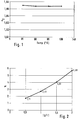
- the copolymers are also characterized by certain crystallization parameters. To determine these parameters, the copolymer is first used made a cast film. For this, the dispersion is poured onto a glass plate and dried. The film is then peeled off the glass plate.
- the weight of the inner coating is generally 8 to 20 g / m 2 , preferably 10 to 14 g / m 2 .
- the water vapor permeability of the internally coated casings determined according to DIN 53122, is generally 4 to 20 g per square meter and per day, preferably 6 to 10 g / m 2 ⁇ d.
- the inner coating forms a practically flawless, continuous layer.
- the weight loss of 1 kg of cooked sausage in a fiber-reinforced casing of caliber 60 according to the invention when stored in the refrigerator (7 ° C., 65% relative humidity) is therefore generally not more than about 0.2 to 1.5% per week, mostly no more than about 0.5 and 1.2% per week.
- the oxygen permeability of the casing according to the invention is generally 4 to 25 cm 3 / m 2 .dbar, determined in accordance with DIN 53380. It is sufficient to reliably prevent discolouration of liver sausage even after a storage period of 8 weeks.
- the structure and quality of the inner coating are also influenced by the properties of the base material, ie the tubular casing based on regenerated cellulose.
- the water permeation of the casing before the inner coating at an internal pressure of 40 bar should be 85 and 125 l / m 2 d, preferably between 90 and 115 l / m 2 d.
- the permeation values depend primarily on the structure of the outer and thus first precipitated areas of the viscose layer.
- the precipitation liquid must diffuse through the membrane formed from regenerated cellulose in order to effect regeneration even in the lower-lying areas of the viscose layer.
- Permeation can be influenced, for example, by additions to the viscose solution or by varying the precipitation conditions. This is done particularly simply by adding weak organic acids diluted in water to the viscose solution just before the spinneret, as described in DE-A 34 16 405. 1 to 3% by weight solutions of oxalic acid, acetic acid, formic acid, propionic acid, lactic acid, tartaric acid or citric acid are generally used for this. For example, the permeation can be increased by 20 to 30% by adding a 1.5 to 2% by weight aqueous formic or acetic acid solution.
- the base material can also be colored.
- it is used to manufacture it Viscose solution used suitably with dye or pigment mixed.
- the internally coated food casing according to the invention can be used in the Production of different types of sausages can be used, for example of scalded and liver sausage. So far, different have been required Envelope types are used.
- the food casings according to the invention also show a surprise good permeability to hot smoke.
- the Proportion of vinylidene chloride units in that used for internal coating should not exceed 70% by weight if possible.
- the present invention also relates to a method for Manufacture of seamless, internally coated tubular food casings.
- the ones used for coating aqueous dispersions advantageously have a solids content between 50 and 55 % By weight, based on their total weight. If the inner coating after performed in DE-B 30 12 250, it has proven to be proved to be favorable, the dispersions except for a solids content of 16 to 30% by weight, preferably 18 to 25% by weight.
- the dispersions can be further stabilized by emulsifying agents.
- Particularly suitable auxiliaries are alkyl, aryl, alkylaryl sulfonates and sulfates. The proportion of these auxiliaries is generally up to 6% by weight, based on the Weight of the polymers to be dispersed.
- defoamers preferably Silicone defoamer.
- wax preferably one natural wax
- the coated casings can be dried, for example, in one Dry tunnel take place, the temperature at its entrance, for example of 80 ° C. The temperature rises slowly until it reaches the end of the tunnel reached, for example, 140 ° C.
- the adhesion of the inner coating can be increased.
- Condensation products made from epichlorohydrin and a polyamine-polyamide are particularly suitable for impregnation.
- the amount of the adhesion promoter is generally 30 to 100 mg / m 2 .
- the impregnation is usually permeable to water and water vapor.
- the impregnation is usually applied to the inner surface of the regenerated, washed and softened hose. The hose is then dried.
- the viscose solution was distributed so that 40% of it was applied on the outside and 60% on the inside of the paper.
- the gel tube thus obtained was softened with glycerin.
- an anchoring solution polyamine-polyamide-epichlorohydrin precondensate
- the tube is then dried between two pairs of squeeze rollers in the inflated state in a hot air dryer, adjusted to a water content of 12% (“conditioned”) and wound up.
- the dispersion was moved through the entire tube.
- the Copolymers contained 70% units of vinylidene chloride, 5% units Acrylonitrile, 2% units from acrylic acid and 23% units from ethyl acrylate.
- the relative viscosity of a 1% solution of the copolymer in THF was 2.72; the refractive index of the film was 1.653; it changed between 30 and 120 ° C not, i.e. H. the film quickly reached its final structure and crystallized then no further.
- a coating weight of 12 to 14 g / m 2 was set over the nip of the pair of nip rollers.
- the envelope was dried while inflated.
- the surface temperature of the casing was around 160 ° C. at the exit from the dryer.
- the hose After leaving the dryer, the hose was moistened until the water content was 8 to 10%. It was then laid flat and wound up on a roll.
- the water vapor permeability of the coated hose was 8 g / m 2 d and the oxygen permeability was 15 cm 3 / m 2 d bar.
- a brown viscose-colored cellulose hydrate tube of caliber 75 with a fiber reinforcement made of hemp fiber paper (paper weight: 21 g / m 2 ) was first softened with glycerin. Before entering the dryer, the anchoring solution described in Example 1 was poured into the gel tube. The tube was then dried, conditioned and wound up as usual in the inflated state.
- the interior coating was used as described in Example 1 the same dispersion.
- the coating weight was adjusted to 13 to 15 g / m 2 . After a storage period of 2 weeks, the material was gathered. Ruchaltene and edges were free of errors after any length of storage. Meat sausages made with it lost 0.4% of their weight per week when stored in the refrigerator. Liver sausage remained unstained for 6 weeks. The coating was free from haze.
- the material was gathered into caterpillars after 3 weeks, the ones of any length Storage period have neither damaged pleats nor flat lay edges. At the coating remains completely free of turbidity during sausage production.
- the copolymer consisted of 82% vinylidene chloride units and 6% Acrylonitrile units, 2% from acrylic acid units and 10% from methyl acrylate units.
- the relative viscosity of a 1% solution of this copolymer in THF was 2.9.
- the water vapor permeability was 4 g / m 2 d and the oxygen permeability was 8 cm 3 / m 2 d bar.
- the film was cloud-free. Meat sausage (1 kg sausage) lost 0.3% in the refrigerator Weight per week. Liver sausage showed after 8 weeks of storage in the refrigerator no discoloration on the surface yet.
- a non-fiber-reinforced cellulose hydrate tube (caliber 45) produced as usual was impregnated with the anchoring solution described in Example 1 before drying.
- the polyamine-polyamide-epichlorohydrin condensation product used was applied in an amount of 65 mg / m 2 .
- the hose was adjusted to a residual water content of 12%. It then had a swelling value of 150% and a water permeation of 70 l / m 2 d at a pressure of 40 bar.
- the inner coating was applied as described in Example 1.
- the same coating dispersion was used as in Example 1 and the casing was dried in the inflated state at a final dryer temperature of 155 ° C.
- the application quantity was 10 g / m 2 .
- the water vapor permeability of the casing produced in this way was 8.8 g / m 2 ⁇ d at 23 ° C. and 85% relative humidity.
Landscapes
- Life Sciences & Earth Sciences (AREA)
- Engineering & Computer Science (AREA)
- Wood Science & Technology (AREA)
- Zoology (AREA)
- Food Science & Technology (AREA)
- Processing Of Meat And Fish (AREA)
Abstract
Description
- 20 %
- Copolymer der im folgenden angegebenen Zusammensetzung,
- 1,5 %
- Glycerin und
- 0,5 %
- KPS-Wachs enthielt.
- 22 %
- des im folgenden näher definierten Copolymers,
- 2 %
- Glycerin und
- 0,5 %
- KPS-Wachs
- 18 %
- des im folgenden näher definierten Copolymers,
- 3 %
- Glycerin und
- 0,3 %
- KPS-Wachs.
Claims (16)
- Schlauchförmige Nahrungsmittelhülle auf Basis von regenerierter Cellulose mit einer innenbeschichteten Oberfläche, dadurch gekennzeichnet, daß die Beschichtung mindestens ein Copolymer mit 50 bis 84 Gew.-% Einheiten aus Vinylidenchlorid, 2 bis 20 Gew.-% Einheiten aus Acrylnitril, 1 bis 10 Gew.-% Einheiten aus Acrylsäure und 1 bis 47 Gew.-% Einheiten aus (Meth)acrylsäure-(C1-C18)alkylester umfaßt.
- Nahrungsmittelhülle gemäß Anspruch 1, dadurch gekennzeichnet, daß das Copolymer 60 bis 75 Gew.-% Einheiten aus Vinylidenchlorid, 3 bis 10 Gew.-% Einheiten aus Acrylnitril, 2 bis 8 Gew.-% Einheiten aus Acrylsäure und 8 bis 27 Gew.-% Einheiten aus (Meth)acrylsäure-(C1-C18)alkylester enthält.
- Nahrungsmittelhülle gemäß Anspruch 1, dadurch gekennzeichnet, daß das Copolymer 68 bis 72 Gew.-% Einheiten aus Vinylidenchlorid, 5 bis 7 Gew.-% Einheiten aus Acrylnitril, 2 bis 4 Gew.-% Einheiten aus Acrylsäure und 17 bis 25 Gew.-% Einheiten aus (Meth)acrylsäure-ethylester enthält.
- Nahrungsmittelhülle gemäß einem oder mehreren der Ansprüche 1 bis 3, dadurch gekennzeichnet, daß das Copolymer eine relative Viskosität η von 2,0 bis 3,5 besitzt.
- Nahrungsmittelhülle gemäß einem oder mehreren der Ansprüche 1 bis 4, dadurch gekennzeichnet, daß das Gewicht der Beschichtung 8 bis 20 g/m2, bevorzugt 10 bis 14 g/m2, beträgt.
- Nahrungsmittelhülle gemäß einem oder mehreren der Ansprüche 1 bis 5, dadurch gekennzeichnet, daß die Beschichtung zu mindestens 70 Gew.-%, bevorzugt zu mindestens 90 Gew.-%, bezogen auf das Gesamtgewicht der Beschichtung, aus dem mindestens einen Copolymer besteht.
- Nahrungsmittelhülle gemäß einem oder mehreren der Ansprüche 1 bis 6, dadurch gekennzeichnet, daß die Beschichtung zusätzlich ein Wachs umfaßt, vorzugsweise in einer Menge von bis zu 4 Gew.-%, bezogen auf das Gewicht des Copolymers.
- Nahrungsmittelhülle gemäß einem oder mehreren der Ansprüche 1 bis 7, dadurch gekennzeichnet, daß ihre Wasserdampfdurchlässigkeit, bestimmt nach DIN 53122, bei 4 bis 20 g/m2 · d, bevorzugt 6 bis 10 g/m2 · d, liegt.
- Nahrungsmittelhülle gemäß einem oder mehreren der Ansprüche 1 bis 8, dadurch gekennzeichnet, daß ihre Sauerstoffdurchlässigkeit, bestimmt nach DIN 53380, bei 4 bis 25 cm3/m2 · d · bar liegt.
- Nahrungsmittelhülle gemäß einem oder mehreren der Ansprüche 1 bis 9, dadurch gekennzeichnet, daß sie auf ihrer inneren Oberfläche imprägniert ist mit einem Mittel, das eine Verankerung der später aufgebrachten Innenbeschichtung bewirkt, bevorzugt mit einem Kondensationsprodukt aus Epichlorhydrin und einem Polyamin-Polyamid.
- Nahrungsmittelhülle gemäß einem oder mehreren der Ansprüche 1 bis 10, dadurch gekennzeichnet, daß sie faserverstärkt ist, bevorzugt mit einem Faserpapier, besonders bevorzugt mit Hanffaserpapier.
- Nahrungsmittelhülle gemäß einem oder mehreren der Ansprüche 1 bis 11, dadurch gekennzeichnet, daß die Permeation des schlauchförmigen Nahrungsmittelhülle auf Basis von regenerierter Cellulose bei einem Innendruck von 40 bar bei 85 bis 125 l/m2d, bevorzugt bei 90 bis 115 l/m2d, liegt.
- Nahrungsmittelhülle gemäß einem oder mehreren der Ansprüche 1 bis 12, dadurch gekennzeichnet, daß sie heißrauchdurchlässig ist.
- Verfahren zur Herstellung der Nahrungsmittelhülle gemäß einem oder mehreren der Ansprüche 1 bis 13, dadurch gekennzeichnet, daß eine wäßrige Dispersion eines Copolymers mit 50 bis 84 mol-% Einheiten aus Vinylidenchlorid, 2 bis 20 mol-% Einheiten aus Acrylnitril, 1 bis 10 mol-% Einheiten aus Acrylsäure und 1 bis 47 mol-% Einheiten aus (Meth)-acrylsäure-(C1-C18)alkylester auf die innere Oberfläche einer gegebenenfalls faserverstärkten, schlauchförmigen Hülle auf Basis von regenerierter Cellulose aufgebracht und anschließend getrocknet wird.
- Verfahren gemäß Anspruch 14, dadurch gekennzeichnet, daß die Dispersion einen Feststoffgehalt von 50 bis 55 % besitzt.
- Verfahren gemäß Anspruch 14 oder 15, dadurch gekennzeichnet, daß die Dispersion zusätzlich Glycerin enthält, vorzugsweise in einem Anteil von bis zu 10 Gew.-%, bezogen auf das Gesamtgewicht der Dispersion.
Applications Claiming Priority (2)
| Application Number | Priority Date | Filing Date | Title |
|---|---|---|---|
| DE19742719A DE19742719A1 (de) | 1997-09-26 | 1997-09-26 | Innenbeschichtete Nahrungsmittelhüllen auf Basis von regenerierter Cellulose |
| DE19742719 | 1997-09-26 |
Publications (2)
| Publication Number | Publication Date |
|---|---|
| EP0904700A1 true EP0904700A1 (de) | 1999-03-31 |
| EP0904700B1 EP0904700B1 (de) | 2006-04-12 |
Family
ID=7843835
Family Applications (1)
| Application Number | Title | Priority Date | Filing Date |
|---|---|---|---|
| EP98117805A Expired - Lifetime EP0904700B1 (de) | 1997-09-26 | 1998-09-19 | Innenbeschichtete Nahrungsmittelhüllen auf Basis von regenerierter Cellulose |
Country Status (3)
| Country | Link |
|---|---|
| US (1) | US6627282B2 (de) |
| EP (1) | EP0904700B1 (de) |
| DE (2) | DE19742719A1 (de) |
Cited By (1)
| Publication number | Priority date | Publication date | Assignee | Title |
|---|---|---|---|---|
| EP2368435A2 (de) | 2010-03-25 | 2011-09-28 | Kalle GmbH | Schlauchförmige Nahrungsmittelhülle beschichtet mit aufschmelzbaren, thermoplastischen Polymeren |
Families Citing this family (9)
| Publication number | Priority date | Publication date | Assignee | Title |
|---|---|---|---|---|
| US20040219264A1 (en) * | 2000-12-27 | 2004-11-04 | World-Pac International Ag | Packaging wrap |
| DE10124581A1 (de) * | 2001-05-21 | 2002-11-28 | Wolff Walsrode Ag | Verfahren zur Herstellung von rauchimprägnierten Schlauchhüllen |
| DE10224084A1 (de) | 2002-05-31 | 2003-12-11 | Casetech Gmbh & Co Kg | Rauchdurchlässige Wursthülle aus faserverstärktem Cellulosehydrat mit Sperrschichten gegen Wasserdampfdurchtritt sowie ein Verfahren zu deren Herstellung |
| CN100506398C (zh) * | 2003-07-30 | 2009-07-01 | 海南赛诺实业有限公司 | 热收缩型涂布薄膜的生产方法 |
| WO2007035338A2 (en) * | 2005-09-15 | 2007-03-29 | Ratcliffe David W | Drywall repair kit and method of using the same |
| DE102006027493A1 (de) * | 2006-02-15 | 2007-08-23 | Kalle Gmbh | Nahrungsmittelhülle mit einer Bindemittelschicht, die übertragbare Additive enthält |
| US10136656B2 (en) | 2010-10-01 | 2018-11-27 | The Hillshire Brands Company | Systems and methods for providing a food product with additives |
| US9380804B2 (en) | 2012-07-12 | 2016-07-05 | The Hillshire Brands Company | Systems and methods for food product extrusion |
| DE202014003604U1 (de) | 2014-04-25 | 2014-06-27 | Karsten Berning | Backware mit herzhafter, proteinhaltiger Füllung in Strangform |
Citations (8)
| Publication number | Priority date | Publication date | Assignee | Title |
|---|---|---|---|---|
| GB814760A (en) * | 1955-10-12 | 1959-06-10 | Union Carbide Corp | Casings and method of making same |
| FR2305291A1 (fr) * | 1975-03-24 | 1976-10-22 | Hoechst Ag | Tube a base de cellulose regeneree, notamment pour l'emballage de produits pateux, et son procede de fabrication |
| FR2305290A1 (fr) * | 1975-03-24 | 1976-10-22 | Hoechst Ag | Tube ou boyau a base de cellulose regeneree revetu d'un copolymere de chlorure de vinylidene, et son procede de fabrication |
| DE2933131A1 (de) * | 1979-08-16 | 1981-02-26 | Hoechst Ag | Flexible verpackungshuelle, bestehend aus feuchtigkeitshaltigem schlauch auf basis von cellulosehydrat mit wasserdampfundurchlaessigem filmueberzug aus ynthetischem kunststoff jeweils auf seiner aussen- und auf seiner innenseite |
| DE2933108A1 (de) * | 1979-08-16 | 1981-02-26 | Hoechst Ag | Verpackungshuelle aus einem schlauch auf basis von cellulosehydrat mit einem wasserdampfundurchlaessigen ueberzug aus synthetischem kunststoff auf der aussenund einer durchlaessigen schicht aus synthetischem kunststoff auf der innenseite |
| DE2935080A1 (de) * | 1979-08-30 | 1981-03-19 | Hoechst Ag, 6000 Frankfurt | Verpackungshuelle aus einem schlauch auf basis von cellulosehydrat mit einem wasserdampfundurchlaessigen ueberzug aus synthetischem kunststoff auf der innenseite und einer durchlaessigen schicht aus synthetischem kunststoff auf der aussenseite |
| DE3328050A1 (de) * | 1983-08-03 | 1985-02-14 | Hoechst Ag, 6230 Frankfurt | Rauchdurchlaessige folie aus faserverstaerkter regenerierter cellulose zur herstellung von schlauchhuellen, insbesondere wursthuellen |
| EP0224060A1 (de) * | 1985-10-31 | 1987-06-03 | Hoechst Aktiengesellschaft | Bahn- oder schlauchförmige Verpackungsfolie, insbesondere Wursthülle, mit Sperrschicht |
Family Cites Families (10)
| Publication number | Priority date | Publication date | Assignee | Title |
|---|---|---|---|---|
| NL138341C (de) | 1963-05-22 | |||
| US3794515A (en) | 1968-04-03 | 1974-02-26 | Tee Pak Inc | Saran coating of cellulosic casing |
| US3886979A (en) | 1972-08-01 | 1975-06-03 | Union Carbide Corp | Shirred tubular food casings having a barrier coating |
| US4026985A (en) | 1972-08-01 | 1977-05-31 | Union Carbide Corporation | Shirred tubular food casings having a barrier coating |
| EP0001545B1 (de) * | 1977-08-05 | 1981-07-15 | Hoechst Aktiengesellschaft | Schlauchförmige Hülle, insbesondere Verpackungshülle, z.B. Wursthülle auf Basis von Cellulosehydrat und Verfahren zu ihrer Herstellung |
| DE2906118C2 (de) | 1979-02-17 | 1981-06-19 | Wolff Walsrode Ag, 3030 Walsrode | Wäßriges Polymerisatgemisch, Verfahren zu seiner Herstellung und seiner Verwendung als substratverankernder blockresistenter Einschichtsiegellack auf Flächengebilden |
| DE3012250C2 (de) | 1980-03-28 | 1982-10-14 | Hoechst Ag, 6000 Frankfurt | Verfahren zur Herstellung eines Schlauchs mit einem Filmüberzug aus Kunststoff auf der Innenseite, seine Verwendung, sowie Vorrichtung zur Durchführung des Verfahrens |
| DE3416406A1 (de) | 1983-05-10 | 1984-11-15 | Hoechst Ag, 6230 Frankfurt | Verfahren zur herstellung von wursthuellen aus regenerierter cellulose nach dem viskoseverfahren |
| JPH061542B2 (ja) * | 1986-10-28 | 1994-01-05 | 帝人株式会社 | 磁気記録媒体 |
| DE4015659A1 (de) | 1990-05-16 | 1991-11-21 | Hoechst Ag | Schlauchfoermige verpackungshuelle, insbesondere wursthuelle, auf basis von cellulose |
-
1997
- 1997-09-26 DE DE19742719A patent/DE19742719A1/de not_active Withdrawn
-
1998
- 1998-09-19 EP EP98117805A patent/EP0904700B1/de not_active Expired - Lifetime
- 1998-09-19 DE DE59813483T patent/DE59813483D1/de not_active Expired - Lifetime
- 1998-09-25 US US09/160,804 patent/US6627282B2/en not_active Expired - Fee Related
Patent Citations (8)
| Publication number | Priority date | Publication date | Assignee | Title |
|---|---|---|---|---|
| GB814760A (en) * | 1955-10-12 | 1959-06-10 | Union Carbide Corp | Casings and method of making same |
| FR2305291A1 (fr) * | 1975-03-24 | 1976-10-22 | Hoechst Ag | Tube a base de cellulose regeneree, notamment pour l'emballage de produits pateux, et son procede de fabrication |
| FR2305290A1 (fr) * | 1975-03-24 | 1976-10-22 | Hoechst Ag | Tube ou boyau a base de cellulose regeneree revetu d'un copolymere de chlorure de vinylidene, et son procede de fabrication |
| DE2933131A1 (de) * | 1979-08-16 | 1981-02-26 | Hoechst Ag | Flexible verpackungshuelle, bestehend aus feuchtigkeitshaltigem schlauch auf basis von cellulosehydrat mit wasserdampfundurchlaessigem filmueberzug aus ynthetischem kunststoff jeweils auf seiner aussen- und auf seiner innenseite |
| DE2933108A1 (de) * | 1979-08-16 | 1981-02-26 | Hoechst Ag | Verpackungshuelle aus einem schlauch auf basis von cellulosehydrat mit einem wasserdampfundurchlaessigen ueberzug aus synthetischem kunststoff auf der aussenund einer durchlaessigen schicht aus synthetischem kunststoff auf der innenseite |
| DE2935080A1 (de) * | 1979-08-30 | 1981-03-19 | Hoechst Ag, 6000 Frankfurt | Verpackungshuelle aus einem schlauch auf basis von cellulosehydrat mit einem wasserdampfundurchlaessigen ueberzug aus synthetischem kunststoff auf der innenseite und einer durchlaessigen schicht aus synthetischem kunststoff auf der aussenseite |
| DE3328050A1 (de) * | 1983-08-03 | 1985-02-14 | Hoechst Ag, 6230 Frankfurt | Rauchdurchlaessige folie aus faserverstaerkter regenerierter cellulose zur herstellung von schlauchhuellen, insbesondere wursthuellen |
| EP0224060A1 (de) * | 1985-10-31 | 1987-06-03 | Hoechst Aktiengesellschaft | Bahn- oder schlauchförmige Verpackungsfolie, insbesondere Wursthülle, mit Sperrschicht |
Cited By (2)
| Publication number | Priority date | Publication date | Assignee | Title |
|---|---|---|---|---|
| EP2368435A2 (de) | 2010-03-25 | 2011-09-28 | Kalle GmbH | Schlauchförmige Nahrungsmittelhülle beschichtet mit aufschmelzbaren, thermoplastischen Polymeren |
| DE102010012633A1 (de) | 2010-03-25 | 2011-09-29 | Kalle Gmbh | Schlauchförmige Nahrungsmittelhülle beschichtet mit aufschmelzbaren, thermoplastischen Polymeren |
Also Published As
| Publication number | Publication date |
|---|---|
| DE19742719A1 (de) | 1999-04-01 |
| US20010048986A1 (en) | 2001-12-06 |
| EP0904700B1 (de) | 2006-04-12 |
| DE59813483D1 (de) | 2006-05-24 |
| US6627282B2 (en) | 2003-09-30 |
Similar Documents
| Publication | Publication Date | Title |
|---|---|---|
| DE10295683B4 (de) | Einschichtige Polymerfolie für Nahrungsmittel und deren Verwendung | |
| EP0460348B1 (de) | Flächen- oder schlauchförmige Folie auf Basis von Cellulosehydrat | |
| EP0883645B1 (de) | Nach dem aminoxidverfahren hergestellte nahrungsmittelhüllen auf cellulosebasis | |
| DE3147519C2 (de) | ||
| EP1932429B2 (de) | Nahrungsmittelhülle auf Cellulosehydratbasis mit Nanopartikeln | |
| DE4334561A1 (de) | Flächen- oder schlauchförmige Folie auf Basis von Cellulosehydrat | |
| EP1703798B1 (de) | Proteinhaltige, schlauchförmige nahrungsmittelhülle mit innenverstärkung | |
| DE10147155A1 (de) | Stärkehaltige, schlauchförmige Nahrungsmittelhülle mit übertragbarer Beschichtung sowie Verfahren zu deren Herstellung | |
| DE2512994C3 (de) | Folienschlauch, insbesondere Verpackungshülle, sowie Verfahren zu seiner Herstellung und seine Verwendung | |
| EP1174036A1 (de) | Nach dem Aminoxidverfahren hergestellte Nahrungsmittelhüllen auf Cellulosebasis | |
| EP0904700B1 (de) | Innenbeschichtete Nahrungsmittelhüllen auf Basis von regenerierter Cellulose | |
| EP1125504A1 (de) | Mit einer festen, Flüssigrauch enthaltenden Schicht überzogene, schlauchförmige Nahrungsmittelhülle | |
| DE2832926A1 (de) | Cellulosehydratschlauch mit alterungsbestaendiger sperrschicht aus synthetischem copolymerisat auf der aussenseite sowie verfahren zu seiner herstellung | |
| EP3516963B1 (de) | Rauch- und wasserdampfdurchlässige nahrungsmittelhülle mit optimierten hafteigenschaften | |
| DE2637510A1 (de) | Formkoerper, insbesondere verpackungsmaterial, auf basis von mit synthetischem polymerem auf alkylenoxidbasis modifiziertem cellulosehydrat sowie verfahren zur herstellung der formkoerper | |
| DE4431992A1 (de) | Mit Flüssigrauch imprägnierte schlauchförmige Nahrungsmittelhülle auf der Basis von Cellulosehydrat | |
| EP2676547B1 (de) | Schlauchförmige Nahrungsmittelhülle auf Basis von Biopolymeren mit Innenimprägnierung, sowie Verfahren zu ihrer Herstellung | |
| DE102006029400A1 (de) | Schlauchförmige Nahrungsmittelhülle mit rauchdurchlässiger Klebenaht | |
| EP0638241B1 (de) | Nahrungsmittelhülle auf Cellulosebasis mit verbesserten Reifeeigenschaften | |
| EP0757892B1 (de) | Flächen- oder schlauchförmige Nahrungsmittelhülle auf der Basis von Cellulosehydrat | |
| EP1036502B1 (de) | Beschichtete, faserverstärkte Hülle auf Basis von Cellulosehydrat für geräucherte Leberwurst | |
| DE10207042A1 (de) | Raupenförmige Verpackungshülle und Verfahren zur Herstellung einer gerafften Verpackungshülle | |
| DE10261496A1 (de) | Eßbare Flachfolie | |
| EP1103186A1 (de) | Nahrungsmittelhülle auf Cellulosebasis mit verstärkter Bräthaftung sowie ein Verfahren zu deren Herstellung | |
| DE4303835A1 (de) | Mehrschichtlackierungen von Schlauchhüllen durch einmaligen Materialauftrag |
Legal Events
| Date | Code | Title | Description |
|---|---|---|---|
| PUAI | Public reference made under article 153(3) epc to a published international application that has entered the european phase |
Free format text: ORIGINAL CODE: 0009012 |
|
| AK | Designated contracting states |
Kind code of ref document: A1 Designated state(s): BE DE FR |
|
| AX | Request for extension of the european patent |
Free format text: AL;LT;LV;MK;RO;SI |
|
| 17P | Request for examination filed |
Effective date: 19990930 |
|
| AKX | Designation fees paid |
Free format text: BE DE FR |
|
| 17Q | First examination report despatched |
Effective date: 20030225 |
|
| RAP1 | Party data changed (applicant data changed or rights of an application transferred) |
Owner name: KALLE GMBH |
|
| GRAP | Despatch of communication of intention to grant a patent |
Free format text: ORIGINAL CODE: EPIDOSNIGR1 |
|
| GRAS | Grant fee paid |
Free format text: ORIGINAL CODE: EPIDOSNIGR3 |
|
| GRAA | (expected) grant |
Free format text: ORIGINAL CODE: 0009210 |
|
| AK | Designated contracting states |
Kind code of ref document: B1 Designated state(s): BE DE FR |
|
| REF | Corresponds to: |
Ref document number: 59813483 Country of ref document: DE Date of ref document: 20060524 Kind code of ref document: P |
|
| ET | Fr: translation filed | ||
| PLBE | No opposition filed within time limit |
Free format text: ORIGINAL CODE: 0009261 |
|
| STAA | Information on the status of an ep patent application or granted ep patent |
Free format text: STATUS: NO OPPOSITION FILED WITHIN TIME LIMIT |
|
| 26N | No opposition filed |
Effective date: 20070115 |
|
| REG | Reference to a national code |
Ref country code: FR Ref legal event code: PLFP Year of fee payment: 19 |
|
| REG | Reference to a national code |
Ref country code: FR Ref legal event code: PLFP Year of fee payment: 20 |
|
| PGFP | Annual fee paid to national office [announced via postgrant information from national office to epo] |
Ref country code: FR Payment date: 20170928 Year of fee payment: 20 |
|
| PGFP | Annual fee paid to national office [announced via postgrant information from national office to epo] |
Ref country code: DE Payment date: 20171129 Year of fee payment: 20 |
|
| PGFP | Annual fee paid to national office [announced via postgrant information from national office to epo] |
Ref country code: BE Payment date: 20171002 Year of fee payment: 20 |
|
| REG | Reference to a national code |
Ref country code: DE Ref legal event code: R071 Ref document number: 59813483 Country of ref document: DE |
|
| REG | Reference to a national code |
Ref country code: BE Ref legal event code: MK Effective date: 20180919 |