EP0902862B1 - Luftdurchströmungsvorrichtung - Google Patents
Luftdurchströmungsvorrichtung Download PDFInfo
- Publication number
- EP0902862B1 EP0902862B1 EP97923040A EP97923040A EP0902862B1 EP 0902862 B1 EP0902862 B1 EP 0902862B1 EP 97923040 A EP97923040 A EP 97923040A EP 97923040 A EP97923040 A EP 97923040A EP 0902862 B1 EP0902862 B1 EP 0902862B1
- Authority
- EP
- European Patent Office
- Prior art keywords
- air
- internal tube
- flow
- internal
- intake system
- Prior art date
- Legal status (The legal status is an assumption and is not a legal conclusion. Google has not performed a legal analysis and makes no representation as to the accuracy of the status listed.)
- Expired - Lifetime
Links
- 238000002485 combustion reaction Methods 0.000 claims description 16
- 238000007789 sealing Methods 0.000 claims description 5
- 230000000717 retained effect Effects 0.000 claims description 2
- 238000006073 displacement reaction Methods 0.000 claims 2
- 238000013016 damping Methods 0.000 description 16
- 230000000694 effects Effects 0.000 description 4
- 230000009467 reduction Effects 0.000 description 4
- 230000005284 excitation Effects 0.000 description 3
- 230000003993 interaction Effects 0.000 description 3
- 230000006978 adaptation Effects 0.000 description 2
- 230000009849 deactivation Effects 0.000 description 2
- 239000000446 fuel Substances 0.000 description 2
- 230000010349 pulsation Effects 0.000 description 2
- 238000010521 absorption reaction Methods 0.000 description 1
- 230000009471 action Effects 0.000 description 1
- 230000002238 attenuated effect Effects 0.000 description 1
- TZCXTZWJZNENPQ-UHFFFAOYSA-L barium sulfate Chemical group [Ba+2].[O-]S([O-])(=O)=O TZCXTZWJZNENPQ-UHFFFAOYSA-L 0.000 description 1
- 238000006243 chemical reaction Methods 0.000 description 1
- 238000011161 development Methods 0.000 description 1
- 230000018109 developmental process Effects 0.000 description 1
- 210000005069 ears Anatomy 0.000 description 1
- 238000009434 installation Methods 0.000 description 1
- 239000000463 material Substances 0.000 description 1
- 230000007935 neutral effect Effects 0.000 description 1
- 238000005457 optimization Methods 0.000 description 1
Images
Classifications
-
- F—MECHANICAL ENGINEERING; LIGHTING; HEATING; WEAPONS; BLASTING
- F02—COMBUSTION ENGINES; HOT-GAS OR COMBUSTION-PRODUCT ENGINE PLANTS
- F02M—SUPPLYING COMBUSTION ENGINES IN GENERAL WITH COMBUSTIBLE MIXTURES OR CONSTITUENTS THEREOF
- F02M35/00—Combustion-air cleaners, air intakes, intake silencers, or induction systems specially adapted for, or arranged on, internal-combustion engines
- F02M35/12—Intake silencers ; Sound modulation, transmission or amplification
- F02M35/1205—Flow throttling or guiding
- F02M35/1222—Flow throttling or guiding by using adjustable or movable elements, e.g. valves, membranes, bellows, expanding or shrinking elements
-
- F—MECHANICAL ENGINEERING; LIGHTING; HEATING; WEAPONS; BLASTING
- F02—COMBUSTION ENGINES; HOT-GAS OR COMBUSTION-PRODUCT ENGINE PLANTS
- F02B—INTERNAL-COMBUSTION PISTON ENGINES; COMBUSTION ENGINES IN GENERAL
- F02B27/00—Use of kinetic or wave energy of charge in induction systems, or of combustion residues in exhaust systems, for improving quantity of charge or for increasing removal of combustion residues
- F02B27/005—Oscillating pipes with charging achieved by arrangement, dimensions or shapes of intakes pipes or chambers; Ram air pipes
- F02B27/006—Oscillating pipes with charging achieved by arrangement, dimensions or shapes of intakes pipes or chambers; Ram air pipes of intake runners
-
- F—MECHANICAL ENGINEERING; LIGHTING; HEATING; WEAPONS; BLASTING
- F02—COMBUSTION ENGINES; HOT-GAS OR COMBUSTION-PRODUCT ENGINE PLANTS
- F02B—INTERNAL-COMBUSTION PISTON ENGINES; COMBUSTION ENGINES IN GENERAL
- F02B27/00—Use of kinetic or wave energy of charge in induction systems, or of combustion residues in exhaust systems, for improving quantity of charge or for increasing removal of combustion residues
- F02B27/02—Use of kinetic or wave energy of charge in induction systems, or of combustion residues in exhaust systems, for improving quantity of charge or for increasing removal of combustion residues the systems having variable, i.e. adjustable, cross-sectional areas, chambers of variable volume, or like variable means
- F02B27/0205—Use of kinetic or wave energy of charge in induction systems, or of combustion residues in exhaust systems, for improving quantity of charge or for increasing removal of combustion residues the systems having variable, i.e. adjustable, cross-sectional areas, chambers of variable volume, or like variable means characterised by the charging effect
- F02B27/0215—Oscillating pipe charging, i.e. variable intake pipe length charging
-
- F—MECHANICAL ENGINEERING; LIGHTING; HEATING; WEAPONS; BLASTING
- F02—COMBUSTION ENGINES; HOT-GAS OR COMBUSTION-PRODUCT ENGINE PLANTS
- F02B—INTERNAL-COMBUSTION PISTON ENGINES; COMBUSTION ENGINES IN GENERAL
- F02B27/00—Use of kinetic or wave energy of charge in induction systems, or of combustion residues in exhaust systems, for improving quantity of charge or for increasing removal of combustion residues
- F02B27/02—Use of kinetic or wave energy of charge in induction systems, or of combustion residues in exhaust systems, for improving quantity of charge or for increasing removal of combustion residues the systems having variable, i.e. adjustable, cross-sectional areas, chambers of variable volume, or like variable means
- F02B27/0226—Use of kinetic or wave energy of charge in induction systems, or of combustion residues in exhaust systems, for improving quantity of charge or for increasing removal of combustion residues the systems having variable, i.e. adjustable, cross-sectional areas, chambers of variable volume, or like variable means characterised by the means generating the charging effect
- F02B27/0231—Movable ducts, walls or the like
-
- F—MECHANICAL ENGINEERING; LIGHTING; HEATING; WEAPONS; BLASTING
- F02—COMBUSTION ENGINES; HOT-GAS OR COMBUSTION-PRODUCT ENGINE PLANTS
- F02B—INTERNAL-COMBUSTION PISTON ENGINES; COMBUSTION ENGINES IN GENERAL
- F02B27/00—Use of kinetic or wave energy of charge in induction systems, or of combustion residues in exhaust systems, for improving quantity of charge or for increasing removal of combustion residues
- F02B27/02—Use of kinetic or wave energy of charge in induction systems, or of combustion residues in exhaust systems, for improving quantity of charge or for increasing removal of combustion residues the systems having variable, i.e. adjustable, cross-sectional areas, chambers of variable volume, or like variable means
- F02B27/0226—Use of kinetic or wave energy of charge in induction systems, or of combustion residues in exhaust systems, for improving quantity of charge or for increasing removal of combustion residues the systems having variable, i.e. adjustable, cross-sectional areas, chambers of variable volume, or like variable means characterised by the means generating the charging effect
- F02B27/0268—Valves
- F02B27/0273—Flap valves
-
- F—MECHANICAL ENGINEERING; LIGHTING; HEATING; WEAPONS; BLASTING
- F02—COMBUSTION ENGINES; HOT-GAS OR COMBUSTION-PRODUCT ENGINE PLANTS
- F02M—SUPPLYING COMBUSTION ENGINES IN GENERAL WITH COMBUSTIBLE MIXTURES OR CONSTITUENTS THEREOF
- F02M35/00—Combustion-air cleaners, air intakes, intake silencers, or induction systems specially adapted for, or arranged on, internal-combustion engines
- F02M35/12—Intake silencers ; Sound modulation, transmission or amplification
- F02M35/1205—Flow throttling or guiding
- F02M35/1227—Flow throttling or guiding by using multiple air intake flow paths, e.g. bypass, honeycomb or pipes opening into an expansion chamber
-
- Y—GENERAL TAGGING OF NEW TECHNOLOGICAL DEVELOPMENTS; GENERAL TAGGING OF CROSS-SECTIONAL TECHNOLOGIES SPANNING OVER SEVERAL SECTIONS OF THE IPC; TECHNICAL SUBJECTS COVERED BY FORMER USPC CROSS-REFERENCE ART COLLECTIONS [XRACs] AND DIGESTS
- Y02—TECHNOLOGIES OR APPLICATIONS FOR MITIGATION OR ADAPTATION AGAINST CLIMATE CHANGE
- Y02T—CLIMATE CHANGE MITIGATION TECHNOLOGIES RELATED TO TRANSPORTATION
- Y02T10/00—Road transport of goods or passengers
- Y02T10/10—Internal combustion engine [ICE] based vehicles
- Y02T10/12—Improving ICE efficiencies
Definitions
- the invention relates to an air flow device for an assembly, for example an internal combustion engine, that requires a predetermined amount of air to function, according to the preamble of claim 1 and the sibling Claim 6.
- a suction device for one Internal combustion engine known from DE-OS 40 41 786 at to vary the passage opening through which the sucked in air flows, a controllable shut-off device available is.
- the shut-off device is located in between two intake channels and cross channel opened by control commands from control electronics or closed. The control commands depend on the Internal combustion engine speed and temperature the outside air, which is determined with a temperature sensor becomes.
- a typical application of this cylinder deactivation is the changeover of a 6-cylinder internal combustion engine from a 6-cylinder to a 3-cylinder operation. Even though the suction pulse from each of these cylinders in the Suction device remains unchanged in itself, the cyclical interplay of 6 cylinders results in one different pulsation course than that of 3 cylinders. In particular deep hums are annoying here; these low frequencies can with regard to the installation space in one Motor vehicle otherwise only through complex reflection silencers (e.g. Helmholtz resonators) reduced become.
- complex reflection silencers e.g. Helmholtz resonators
- US-A-4 858 568 describes an intake system of an internal combustion engine two intake ducts of different lengths, the shorter intake duct one larger and the longer intake duct has a smaller cross-sectional area.
- the Intake ducts are opened or closed by means of an actuator, whereby the air flow corresponding to the switching position of the actuator is redirected. If the shorter intake duct is switched, the longer one Intake channel blocked by the actuator and therefore not flowed through. Is the longer intake duct switched, the shorter intake duct is not flowed through. Since only one intake duct is flowed through, the other intake duct takes valuable space that could be used for other components.
- the invention has for its object an air flow device according to the preamble of claim 1 and the independent claim 6 in a simple manner to train that for different operating conditions of the connected unit optimal operating and in particular Noise conditions exist.
- the air flow device according to the invention solves the task posed with in the characterizing part of the claim 1 and the independent claim 6 specified Characteristics.
- the air flow device according to the invention is advantageous in particular in that by changing the suction path and the suction geometry an adaptation to different operating conditions, for example, when the number of cylinders changes Internal combustion engine, especially with regard to optimization the noise emission can be made.
- the invention describes a flexible suction system different amounts of air, especially with pulsating Flow conditions.
- two actuators according to claim 1 can advantageously Switching between the flow paths or Sound propagation paths over at least three flow channels, made of flexible hoses, for example become.
- One flap in each actuator can two in the embodiment of the invention Take switching positions with which by redirecting the Airflow either a long narrow or a short wide flow path or sound propagation path created can be.
- the flap axes of the two actuators rigidly coupled together be so that a simple arrangement to achieve of the relationships described above.
- the actuators can be placed side by side or one above the other both axes can be set the flap easily connect and need for Actuation only one servomotor.
- the two flaps are spring-loaded.
- this intermediate position can be, for example for the medium speed range of an internal combustion engine be used.
- the mechanical implementation takes place in the last described Embodiment via a driving cam on a flap axis so that over a certain one Angular range of the directly driven flap each other flap is not taken.
- the noise emissions differ in a preferred one Application of the invention, namely during operation an internal combustion engine with different numbers of cylinders, significant in these operating phases.
- the Frequency characteristic of the suction impulses is not only of the cylinder pulse vibration but also from the harmonics certainly; the frequency characteristic of the 6-cylinder engine can essentially be achieved through the interaction of the Sine waves of the 6th and 12th harmonics described the amplitudes are significantly smaller than that of the cylinder pulse.
- the noise emission at a Operation with cylinders deactivated with the flow path switch position "Long-narrow" advantageously reduced become.
- the engine acoustics in full load operation very loud humming tones that are common with the common vehicle types on top of that an easy way to the passenger interior find and resonance amplified to the ears of the Inmates could successfully be suppressed.
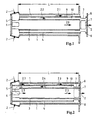
- FIG. 1 is a first embodiment with a Pipe section 1 of a suction device for one not here Shown internal combustion engine shown by the one Airflow according to arrows 2, or arrows 2.0, 2.1 and 2.2 passes through.
- pipe section 1 In pipe section 1 is concentric a first inner tube 3 fixedly attached thereto. Between this first inner tube 3 and the inner wall the pipe section 1 dips an axially displaceable second inner tube 4 a. The second inner tube 4 can be moved axially until it touches a stop plate 5 fits tightly.
- the stop plate 5 serves here also as a holder for the first inner tube 3.
- the first inner tube 3 has at the lower end on the stop plate 5 a number of windows 6 through which are sucked in Air flow into the inside of the first inner tube 3 can not if the second inner tube 4 according to Figure 1 is pushed down.
- the air sucked in flows parallel according to Figure 1 (arrows 2.0, 2.1 and 2.2) through spaces 9 and 10 and through the inner tube 3.
- the movable Inner tube 4 before switching from 6-cylinder 3-cylinder operation the position according to FIG. 1, which allows a parallel flow through the 3 tube spaces.
- the flow path is L
- the flow cross section has the value 3 * A, where A is the area of the cross-section is one of the 3 tube spaces.
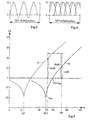
- FIG 3 is the timing of the pulse trains Suction pulse in 3-cylinder operation and in Figure 4 shown in 6-cylinder operation.
- the cycle of the 6-cylinder engine 4 shows the interaction of the Sine waves of the 6th and 12th harmonics of a 720 ° Working cycle, whereby it can be seen that the amplitudes the resulting vibration is significantly smaller than are those of the single pulse.
- it swings 3-cylinder cycle according to Figure 3 almost exclusively with the sine wave of the 3rd harmonic and the amplitude grows beyond the value of the single pulse.
- an engine speed of e.g. 3000 rpm results in the 6-cylinder operation with a disturbing frequency of 150Hz 3-cylinder operation is 75Hz.
- the suction device With the suction device according to the embodiment it is achieved that the acoustically assessed levels are maintained because the 75 Hz tone is rated weaker by 9.5 dB (A) is called the 150Hz tone.
- A 75 Hz tone is rated weaker by 9.5 dB
- One vote is enough to the resonance frequency of 22Hz, which is a um represents the factor 3 reduced frequency.
- the one now occurring 75 Hz tone is attenuated with 20dB (curve 21).
- the Embodiment according to the invention according to FIGS. 1 and 2 thus triples the length of the Damper neck and a third of the cross-sectional area and thus leads to the desired success.
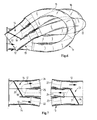
- FIG. 6 shows another preferred exemplary embodiment 11 of the air flow device according to the invention shown through which air flows according to arrows 12.
- Flow channels are between two adjusting devices 13 and 14 15, 16 and 17 arranged, the direction of flow in the flow channels 15, 16 and 17 through Flaps 18 and 19 (not visible here) can be changed.
- the flow channels 15, 16 and 17 preferably exist Made of flexible material, so this air flow device 11 also in places on an assembly (For example, in the engine compartment of a motor vehicle) can be, where not much space for Available.
- the axes 20 and 21 of the flaps 18 and 19 are in the embodiment mechanically coupled to each other, so that usually both flaps are adjusted in parallel with each other are and driven by an actuator same position in the respective adjusting device 13 or take 14.
Landscapes
- Engineering & Computer Science (AREA)
- Chemical & Material Sciences (AREA)
- Combustion & Propulsion (AREA)
- Mechanical Engineering (AREA)
- General Engineering & Computer Science (AREA)
- Characterised By The Charging Evacuation (AREA)
- Exhaust Silencers (AREA)
Description
- 1 =
- Rohrstück
- 2 =
- Pfeil (Luftströmung)
- 2.0 bis 2.5 =
- Pfeile (Teil-Luftströmungen)
- 3 =
- erstes Innenrohr
- 4 =
- zweites Innenrohr
- 5 =
- Anschlagplatte
- 6,7 =
- Fenster
- 8 =
- Dichtungsscheibe
- 9,10 =
- Zwischenräume
- 11 =
- Ausführungsbeispiel mit flex. Strömungskanälen
- 12 =
- Pfeil (Luftströmung)
- 13,14 =
- Stellvorrichtungen
- 15,16,17 =
- Strömungskanäle
- 18,19 =
- Klappen
- 20,21 =
- Klappenachsen
- 22 bis 27 =
- Öffnungen in den Stellvorrichtungen
- . . 30,31 =
- Kurven des Dämpfungsverlaufs
Claims (13)
- Luftansauganlage für ein nachgeschaltetes Aggregat,bei der im Bereich des Ansaugweges Stellvorrichtungen (13, 14) zur Veränderung der Durchströmungsgeometrie für die durchströmende Luft vorhanden sind,der Gesamtquerschnitt des Strömungsweges in Strömungsrichtung in einzelne Strömungskanäle (15, 16, 17) aufgeteilt ist und mit den Stellvorrichtungen (13, 14) die Strömungswege in den einzelnen Strömungskanälen (15, 16, 17) zur Beeinflussung der wirksamen Länge und des wirksamen Querschnitts der gesamten Luftansauganlage steuerbar sind,wobei durch Umlenkung des Luftstromes entweder ein langer oder ein kurzer Strömungsweg geschaffen werden kann, dadurch gekennzeichnet, dassmindestens drei Strömungskanäle (15, 16, 17) vorhanden sind, die mit ihren Enden an jeweils eine innere Öffnung (22 bis 27) der Stellvorrichtung (13, 14) angeschlossen sind und dassin jeder der Stellvorrichtungen (13, 14) Klappen (18, 19) vorhanden sind, die in einer ersten Schaltstellung den Luftstrom (12) vom Eingang an der ersten Stellvorrichtung (13) durch die Strömungskanäle (15, 16, 17) in wechselnder Strömungsrichtung hintereinander zum Ausgang an der zweiten Stellvorrichtung (14) führen und
in einer zweiten Schaltstellung den Luftstrom (12) vom Eingang an der ersten Stellvorrichtung (13) durch die Strömungskanäle (15, 16, 17) parallel zum Ausgang an der zweiten Stellvorrichtung (14) führen. - Luftansauganlage nach Anspruch 1, dadurch gekennzeichnet, dass die Klappen (18, 19) jeweils an einer Achse (20, 21) drehbar gelagert sind, wobei mit den Klappen (18, 19) in der ersten Schaltstellung alle drei Strömungskanäle parallel durchströmbar sind und mit den Klappen (18, 19) in der zweiten Schaltstellung jeweils zwei Öffnungen (25, 26; 23, 24) der Stellvorrichtungen (13, 14) derart verschlossen werden, dass sie zum Eingang oder zum Ausgang hin verschlossen sind, jedoch eine Luftströmung zwischen diesen Öffnungen (25, 26; 23, 24) auf den Strömungskanälen (15, 16, 17) zugewandten Seite möglich ist.
- Luftansauganlage nach Anspruch 2, dadurch gekennzeichnet, dass die Achsen (20, 21) der beiden Klappen (18, 19) starr miteinander verbunden sind und von einem Stellmotor gemeinsam angetrieben werden.
- Luftansauganlage nach Anspruch 2, dadurch gekennzeichnet, dass die Achsen (20, 21) der beiden Klappen (18, 19) von einem Stellmotor gemeinsam angetrieben werden und derart miteinander verbunden sind, dass die direkt angetriebene Achse oder die indirekt mitgeführte Achse (20, 21) einen Mitnahmenocken aufweist, so dass in einem bestimmten Drehwinkelbereich nur die direkt angetriebene Achse (20, 21) zu einer Klappenverstellung führt.
- Luftansauganlage als Ansaugvorrichtung für einen Verbrennungsmotor, bei der im Bereich des Ansaugweges Mittel zur Veränderung der Durchströmungsgeometrie für die angesaugte Luft vorhanden sind, dadurch gekennzeichnet, dass im Ansaugweg ein Rohrstück (1) mit mindestens zwei Innenrohren (3, 4) versehen ist, wobei deren Durchmesser so bemessen sind, dass das erste (3) und das zweite Innenrohr (4) im Rohrstück (1) ineinander verschiebbar sind und dass Mittel zur Veränderung des Ansaugweges im Rohrstück (1) vorhanden sind, mittels denen die Luft entweder das Rohrstück (1) mit den Innenrohren (3, 4) parallel durchströmt oder durch die in wechselnder Richtung hintereinander geschalteten Zwischenräume (9, 10) des Rohrstückes (1) und der Innenrohre (3, 4) sowie durch das Innerste der Innenrohre (3) gelangt.
- Luftansauganlage nach Anspruch 5, dadurch gekennzeichnet, dass das erste Innenrohr (3) fest im Rohrstück (1) verankert ist, wobei mindestens ein Fenster (6) zum Einströmen der Luft in das erste Innenrohr (3) vorhanden ist und dass das zweite Innenrohr (4) im Rohrstück (1) mit Öffnungen (7) und Dichtelementen (8) derart über das erste Innenrohr (3) verschiebbar ist, dass in der Ausgangslage die Luft parallel durch alle Zwischenräume (9, 10) und das erste Innenrohr (3) strömt und in der Umschaltlage sich die Hintereinanderschaltung folgender Ansaugwege ergibt:In Ansaugrichtung durchströmt die Luft einen ersten Zwischenraum (9) zwischen dem Rohrstück (1) und dem zweiten Innenrohr (4),am Ende dieses Zwischenraumes (9) strömt die Luft in entgegengesetzte Richtung durch den Zwischenraum (10) zwischen dem ersten (3) und dem zweiten Innenrohr (4) undam Ende des zweiten Zwischenraumes (10) gelangt die Luft in das erste Innenrohr (3) und strömt in Ansaugrichtung (2) aus dem Rohrstück (1) hinaus.
- Luftansauganlage nach Anspruch 6, dadurch gekennzeichnet, dass in der Umschaltlage durch das mindestens eine Fenster (6) im ersten Innenrohr (3) ein Verbindungsweg vom Zwischenraum (10) zum Austrittskanal über das anströmseitige Ende des zweiten Innenrohrs (4) gestaltet ist, dass das zweite Innenrohr (4) mindestens ein Fenster (7) aufweist zur Verbindung des ersten (9) und des zweiten Zwischenraums (10) und dass am anderen Ende des verschiebbaren zweiten Innenrohres (4) ein Dichtring (8) zur Abdichtung beider Zwischenräume (9, 10) nach außen vorhanden ist.
- Luftansauganlage nach Anspruch 6 oder 7, dadurch gekennzeichnet, dass eine Anschlagplatte (5) vorhanden ist, in deren Bereich sich Öffnungen für die Luft (2) im Ansaugweg befinden und die ferner den Anschlag für das eine Ende des zweiten verschiebbaren Innenrohres (4) in der Umschaltlage bildet und an der das erste feste Innenrohr (3) gehalten ist.
- Luftansauganlage nach einem der Ansprüche 6 bis 8, dadurch gekennzeichnet, dass das zweite Innenrohr (4) an Stützelementen verschiebbar ist, die außen auf dem ersten festen Innenrohr (3) angebracht sind.
- Luftansauganlage nach einem der Ansprüche 6 bis 9, dadurch gekennzeichnet, dass das zweite Innenrohr (4) an Stützelementen verschiebbar ist, die innen am Rohrstück (1) angebracht sind.
- Luftansauganlage nach einem der Ansprüche 6 bis 10, dadurch gekennzeichnet, dass die für die Verschiebung des zweiten Innenrohres (4) notwendigen Schaltimpulse vom Hydrauliksystem eines Kraftfahrzeuges in Abhängigkeit von der aktiven Zylinderzahl des Verbrennungsmotors erzeugt werden.
- Luftansauganlage nach einem der Ansprüche 1 bis 4, dadurch gekennzeichnet, dass es sich um eine Ansaugvorrichtung für einen Verbrennungsmotor eines Kraftfahrzeuges handelt.
- Luftansauganlage nach Anspruch 12, dadurch gekennzeichnet, dass das Kraftfahrzeug eine Vorrichtung zur Abschaltung von einem Teil der Zylinder des Verbrennungsmotors aufweist.
Applications Claiming Priority (5)
| Application Number | Priority Date | Filing Date | Title |
|---|---|---|---|
| DE19622235A DE19622235C2 (de) | 1996-06-03 | 1996-06-03 | Ansaugvorrichtung für einen Verbrennungsmotor |
| DE19622235 | 1996-06-03 | ||
| DE19631036 | 1996-08-01 | ||
| DE19631036 | 1996-08-01 | ||
| PCT/EP1997/002384 WO1997046797A1 (de) | 1996-06-03 | 1997-05-09 | Luftdurchströmungsvorrichtung |
Publications (2)
| Publication Number | Publication Date |
|---|---|
| EP0902862A1 EP0902862A1 (de) | 1999-03-24 |
| EP0902862B1 true EP0902862B1 (de) | 2000-11-15 |
Family
ID=26026260
Family Applications (1)
| Application Number | Title | Priority Date | Filing Date |
|---|---|---|---|
| EP97923040A Expired - Lifetime EP0902862B1 (de) | 1996-06-03 | 1997-05-09 | Luftdurchströmungsvorrichtung |
Country Status (7)
| Country | Link |
|---|---|
| US (1) | US6148782A (de) |
| EP (1) | EP0902862B1 (de) |
| JP (1) | JP2000515214A (de) |
| BR (1) | BR9709517A (de) |
| CA (1) | CA2257510A1 (de) |
| DE (1) | DE59702642D1 (de) |
| WO (1) | WO1997046797A1 (de) |
Cited By (1)
| Publication number | Priority date | Publication date | Assignee | Title |
|---|---|---|---|---|
| DE102015221249A1 (de) * | 2015-10-30 | 2017-05-04 | Mahle International Gmbh | Ansaugluftführung für eine Brennkraftmaschine |
Families Citing this family (15)
| Publication number | Priority date | Publication date | Assignee | Title |
|---|---|---|---|---|
| JP2000337255A (ja) | 1999-05-26 | 2000-12-05 | Toyota Autom Loom Works Ltd | 減衰装置及び圧縮機の吸入構造 |
| JP2001059458A (ja) * | 1999-06-16 | 2001-03-06 | Aichi Mach Ind Co Ltd | 内燃機関用吸気マニホールド |
| US7263961B2 (en) * | 2003-10-01 | 2007-09-04 | Leo Now | Gas directing system and method |
| US20050279320A1 (en) * | 2004-06-18 | 2005-12-22 | Roberts Alexander J | Method and means for improved efficiency of cylinder deactivation (DODTM) engines |
| US7614379B2 (en) * | 2005-05-23 | 2009-11-10 | Leo Now | Air horn for efficient fluid intake |
| DE102005029760A1 (de) * | 2005-05-23 | 2006-11-30 | Bitzer Kühlmaschinenbau Gmbh | Kältemittelverdichter |
| US7401590B2 (en) * | 2006-10-09 | 2008-07-22 | Harley-Davidson Motor Company Group, Inc. | Active air intake for an engine |
| US7556019B2 (en) * | 2006-12-15 | 2009-07-07 | Briggs And Stratton Corporation | Intake manifold regulators for internal combustion engines |
| KR100957142B1 (ko) * | 2007-07-30 | 2010-05-11 | 현대자동차주식회사 | 에너 클리너 흡기 덕트 |
| US9526707B2 (en) * | 2007-08-13 | 2016-12-27 | Howard L. Elford | Methods for treating or preventing neuroinflammation or autoimmune diseases |
| US8375915B1 (en) | 2009-02-25 | 2013-02-19 | Leo Now | Gas directing system and method |
| US7975669B2 (en) * | 2009-07-28 | 2011-07-12 | GM Global Technology Operations LLC | Apparatus and method for throttle control of internal combustion engines |
| DE102017118643A1 (de) * | 2017-08-16 | 2019-02-21 | Franz Haimer Maschinenbau Kg | Vorrichtung zur Kühlung eines Schrumpffutters |
| DE102020122027B4 (de) * | 2020-08-24 | 2023-05-04 | Mann+Hummel Gmbh | Schalldämpfer und Filtersystem |
| USD1068510S1 (en) * | 2023-08-21 | 2025-04-01 | Elevation Lab, Inc. | Tracker housing |
Family Cites Families (10)
| Publication number | Priority date | Publication date | Assignee | Title |
|---|---|---|---|---|
| US2835235A (en) * | 1955-06-20 | 1958-05-20 | Daimler Benz Ag | Intake manifold for internal combustion engines |
| JPS5818533A (ja) * | 1981-07-23 | 1983-02-03 | Nissan Motor Co Ltd | 気筒数制御エンジン |
| DE3814836A1 (de) * | 1987-05-26 | 1988-12-08 | Volkswagen Ag | Laengenveraenderbares saugrohr fuer eine brennkraftmaschine |
| JPS6424114A (en) * | 1987-07-16 | 1989-01-26 | Nippon Denso Co | Intake device for internal-combustion engine |
| JPS6424115A (en) * | 1987-07-17 | 1989-01-26 | Nippon Denso Co | Intake device for internal-combustion engine |
| GB2221954B (en) * | 1988-08-16 | 1992-07-08 | Austin Rover Group | An internal combustion engine inlet manifold |
| DE4041200C2 (de) * | 1990-12-21 | 1993-11-04 | Porsche Ag | Luftansauganlage fuer eine brennkraftmaschine |
| JP3191487B2 (ja) * | 1993-05-25 | 2001-07-23 | いすゞ自動車株式会社 | 多気筒内燃機関の吸気装置 |
| DE4333053A1 (de) * | 1993-09-29 | 1995-03-30 | Opel Adam Ag | Brennkraftmaschine mit einem Luftansaugsystem |
| DE19501411A1 (de) * | 1995-01-19 | 1996-07-25 | Mann & Hummel Filter | Ansaugvorrichtung für einen Verbrennungsmotor |
-
1997
- 1997-05-09 JP JP10500127A patent/JP2000515214A/ja active Pending
- 1997-05-09 BR BR9709517A patent/BR9709517A/pt not_active Application Discontinuation
- 1997-05-09 EP EP97923040A patent/EP0902862B1/de not_active Expired - Lifetime
- 1997-05-09 US US09/194,763 patent/US6148782A/en not_active Expired - Fee Related
- 1997-05-09 DE DE59702642T patent/DE59702642D1/de not_active Expired - Fee Related
- 1997-05-09 CA CA002257510A patent/CA2257510A1/en not_active Abandoned
- 1997-05-09 WO PCT/EP1997/002384 patent/WO1997046797A1/de not_active Ceased
Cited By (1)
| Publication number | Priority date | Publication date | Assignee | Title |
|---|---|---|---|---|
| DE102015221249A1 (de) * | 2015-10-30 | 2017-05-04 | Mahle International Gmbh | Ansaugluftführung für eine Brennkraftmaschine |
Also Published As
| Publication number | Publication date |
|---|---|
| US6148782A (en) | 2000-11-21 |
| BR9709517A (pt) | 1999-08-10 |
| WO1997046797A1 (de) | 1997-12-11 |
| DE59702642D1 (de) | 2000-12-21 |
| CA2257510A1 (en) | 1997-12-11 |
| EP0902862A1 (de) | 1999-03-24 |
| JP2000515214A (ja) | 2000-11-14 |
Similar Documents
| Publication | Publication Date | Title |
|---|---|---|
| DE102007043147B4 (de) | Kontinuierlich variabel abgestimmter Resonator | |
| EP1760279B1 (de) | Schalldämpfer für eine Abgasanlage | |
| DE102005022824B4 (de) | Elektronisch gesteuerter variabler Zweikammer-Resonator | |
| DE102004007717B4 (de) | Helmholtz-Resonator | |
| DE19720410B4 (de) | Schalldämpfer | |
| DE602004000518T2 (de) | Schalldämpfer mit einem variablen Einstellsystem und Verfahren zum betreiben eines Schalldämpfers | |
| DE69702447T2 (de) | Abgasvorrichtung für brennkraftmaschinen und fahrzeug mit dieser vorrichtung | |
| EP0902862A1 (de) | Luftdurchströmungsvorrichtung | |
| DE69102199T2 (de) | Dynamisch abgestimmtes Auspuffsystem. | |
| EP0897468B1 (de) | Ansaugvorrichtung für einen verbrennungsmotor | |
| DE102015211460A1 (de) | Abgasanlage | |
| DE10042012A1 (de) | Vorrichtung zur Geräuschgestaltung bei einem Kraftfahrzeug | |
| DE10205703A1 (de) | Pneumatisch gesteuerter Dämpfer | |
| EP1012458A1 (de) | Ansaugsystem für eine brennkraftmaschine | |
| EP1321639B2 (de) | Schalldämpfungseinrichtung | |
| DE10231238B4 (de) | Geräuschdämpfungsvorrichtung | |
| DE102017126761A1 (de) | Vakuumbetätigter mehrfrequenz-viertelwellenresonator für einen verbrennungsmotor | |
| DE102007026416B4 (de) | Vorrichtung zur Beeinflussung des Ansauggeräusches einer Brennkraftmaschine | |
| DE19520157A1 (de) | Schalldämpfer für Kraftfahrzeuge | |
| DE19622235C2 (de) | Ansaugvorrichtung für einen Verbrennungsmotor | |
| DE10332640B3 (de) | Luftansaugkanalsystem für Verbrennungskraftmaschinen | |
| DE19638304A1 (de) | Schalldämpfer | |
| DE10354699B4 (de) | Abgasschalldämpfer für Brennkraftmaschinen | |
| DE102021103187A1 (de) | Helmholtz-Resonator für ein Kraftfahrzeug sowie Kraftfahrzeug mit einem Helmholtz-Resonator | |
| DE102004022972A1 (de) | Resonator für eine Anlage mit pulsierenden Gasströmen sowie Anlage mit einem derartigen Resonator |
Legal Events
| Date | Code | Title | Description |
|---|---|---|---|
| PUAI | Public reference made under article 153(3) epc to a published international application that has entered the european phase |
Free format text: ORIGINAL CODE: 0009012 |
|
| 17P | Request for examination filed |
Effective date: 19981027 |
|
| AK | Designated contracting states |
Kind code of ref document: A1 Designated state(s): DE ES FR GB IT |
|
| 17Q | First examination report despatched |
Effective date: 19990325 |
|
| GRAG | Despatch of communication of intention to grant |
Free format text: ORIGINAL CODE: EPIDOS AGRA |
|
| GRAG | Despatch of communication of intention to grant |
Free format text: ORIGINAL CODE: EPIDOS AGRA |
|
| GRAH | Despatch of communication of intention to grant a patent |
Free format text: ORIGINAL CODE: EPIDOS IGRA |
|
| GRAH | Despatch of communication of intention to grant a patent |
Free format text: ORIGINAL CODE: EPIDOS IGRA |
|
| GRAA | (expected) grant |
Free format text: ORIGINAL CODE: 0009210 |
|
| AK | Designated contracting states |
Kind code of ref document: B1 Designated state(s): DE ES FR GB IT |
|
| PG25 | Lapsed in a contracting state [announced via postgrant information from national office to epo] |
Ref country code: IT Free format text: LAPSE BECAUSE OF FAILURE TO SUBMIT A TRANSLATION OF THE DESCRIPTION OR TO PAY THE FEE WITHIN THE PRE;WARNING: LAPSES OF ITALIAN PATENTS WITH EFFECTIVE DATE BEFORE 2007 MAY HAVE OCCURRED AT ANY TIME BEFORE 2007. THE CORRECT EFFECTIVE DATE MAY BE DIFFERENT FROM THE ONE RECORDED.SCRIBED TIME-LIMIT Effective date: 20001115 Ref country code: GB Free format text: LAPSE BECAUSE OF FAILURE TO SUBMIT A TRANSLATION OF THE DESCRIPTION OR TO PAY THE FEE WITHIN THE PRESCRIBED TIME-LIMIT Effective date: 20001115 Ref country code: FR Free format text: LAPSE BECAUSE OF FAILURE TO SUBMIT A TRANSLATION OF THE DESCRIPTION OR TO PAY THE FEE WITHIN THE PRESCRIBED TIME-LIMIT Effective date: 20001115 Ref country code: ES Free format text: THE PATENT HAS BEEN ANNULLED BY A DECISION OF A NATIONAL AUTHORITY Effective date: 20001115 |
|
| REF | Corresponds to: |
Ref document number: 59702642 Country of ref document: DE Date of ref document: 20001221 |
|
| EN | Fr: translation not filed | ||
| PGFP | Annual fee paid to national office [announced via postgrant information from national office to epo] |
Ref country code: DE Payment date: 20010509 Year of fee payment: 5 |
|
| GBV | Gb: ep patent (uk) treated as always having been void in accordance with gb section 77(7)/1977 [no translation filed] |
Effective date: 20001115 |
|
| PLBE | No opposition filed within time limit |
Free format text: ORIGINAL CODE: 0009261 |
|
| STAA | Information on the status of an ep patent application or granted ep patent |
Free format text: STATUS: NO OPPOSITION FILED WITHIN TIME LIMIT |
|
| 26N | No opposition filed | ||
| PG25 | Lapsed in a contracting state [announced via postgrant information from national office to epo] |
Ref country code: DE Free format text: LAPSE BECAUSE OF NON-PAYMENT OF DUE FEES Effective date: 20021203 |