EP0902395B1 - Verfahren zur linearen Bestimmung der drei-dimensionalen Lage mit affiner Kamerakorrektur - Google Patents
Verfahren zur linearen Bestimmung der drei-dimensionalen Lage mit affiner Kamerakorrektur Download PDFInfo
- Publication number
- EP0902395B1 EP0902395B1 EP98111042A EP98111042A EP0902395B1 EP 0902395 B1 EP0902395 B1 EP 0902395B1 EP 98111042 A EP98111042 A EP 98111042A EP 98111042 A EP98111042 A EP 98111042A EP 0902395 B1 EP0902395 B1 EP 0902395B1
- Authority
- EP
- European Patent Office
- Prior art keywords
- cameras
- affine
- dimensional position
- images
- projected
- Prior art date
- Legal status (The legal status is an assumption and is not a legal conclusion. Google has not performed a legal analysis and makes no representation as to the accuracy of the status listed.)
- Expired - Lifetime
Links
Images
Classifications
-
- G—PHYSICS
- G06—COMPUTING OR CALCULATING; COUNTING
- G06T—IMAGE DATA PROCESSING OR GENERATION, IN GENERAL
- G06T7/00—Image analysis
- G06T7/80—Analysis of captured images to determine intrinsic or extrinsic camera parameters, i.e. camera calibration
Definitions
- the present invention relates to a linear estimation method for a three-dimensional position with affine camera correction, and more particularly, it relates to a linear estimation method for a three-dimensional position with affine camera correction for estimating the three-dimensional three-dimensional position of an object point in a space from images acquired by a plurality of cameras in case of controlling a robot or the like with image information.
- a method of acquiring an image of a point (object point) existing in a three-dimensional space with a camera and estimating its three-dimensional position is a central problem of computer vision.
- Stereoscopy can be referred to as the most basic technique for solving this problem.
- two cameras located on previously known positions in previously known orientations acquire images of an object point, for deciding its three-dimensional position from the projected images with the principle of triangulation.
- This is called camera calibration, which has generally been studied in the fields of computer vision and robotics.
- the relation by perspective projection is generally employed as the method of describing the relation between the three-dimensional space and the images.
- This perspective projection model can be regarded as an ideal model for general cameras. Despite its correctness, however, this projective model is nonlinear. Due to such non-linearity, three-dimensional position estimation is weak against computation errors or measurement errors of the projected points.
- Multiple-camera stereoscopy employing a plurality of (at least two) cameras forms another flow of the stereoscopy.
- the information content increases as compared with the case of employing only two cameras and the three-dimensional position can be further stably estimated.
- “Shape and Motion from Image Streams under Orthography: a Factorization Method” by Tomasi and Kanade, International Journal of Computer Vision, Vol. 9, No. 2, pp. 137-154 (1992) describes an example of such multiple-camera stereoscopy.
- a principal object of the present invention is to provide a linear estimation method for a three-dimensional position with affine camera correction, which can reduce influence by computation errors or noise by simplifying estimation of the three-dimensional position of an object point by employing a plurality of images and correcting projected images acquired by cameras modeled by perspective projection to images acquired by a simple linear camera model.
- the present invention is directed to a method of obtaining the three-dimensional position of an object point with a plurality of cameras, by acquiring images of a plurality of reference points located on known positions in a three-dimensional space with the plurality of cameras, obtaining the coordinates of the projected points on the respective images, assuming a plurality of affine cameras having linear relation between the three-dimensional space and images, calculating how the affine cameras project the respective reference points, and correcting the coordinates of the projected points to be consistent with the projected points.
- the virtual affine cameras project all reference points once again without knowing correct projective models of the respective cameras for estimating the three-dimensional position, whereby it is possible to estimate the three-dimensional position with no regard to the types, positions and orientations of the cameras. Further, the calculation itself is simple, the three-dimensional position can be stably estimated in a linear form from the virtual affine cameras, and influence by computation errors or noise can be reduced.
- Coefficients of a second order polynominal of the coordinates of the projected points are regarded as parameters for the correction, for estimating the three-dimensional position of an arbitrary object point in the three-dimensional space in response to decision of the parameters. Further, projected points of the object point are corrected in accordance with the second order polynominal to be consistent with the coordinates of the projected points by the virtual affine cameras, for estimating the three-dimensional position of the object point by linear calculation.
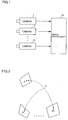
- Fig. 1 is a schematic block diagram showing an apparatus for carrying out an embodiment of the present invention.
- a plurality of cameras 1, 2, ..., N acquire images of a plurality of reference points located on known positions in a three-dimensional space and supply outputs thereof to an image processor 10, which in turn forms images acquired by virtual affine cameras and estimates a three-dimensional position by linear operation.
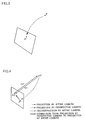
- Fig. 2 is a conceptual diagram showing a state of acquiring images of a point P in a three-dimensional space with N cameras. Definition of a camera model is now described with reference to Fig. 2. It is assumed that P stands for the point in the three-dimensional space and p stands for the position of its projected image on each image. Expressing these as P_ and p_ on homogeneous coordinates respectively, the following relation is obtained: p_ ⁇ MP_ where M represents a 3 x 4 matrix called a projective matrix, which expresses the projective model, the positions, orientation and optical properties of the cameras.
- Such a camera model is called a perspective camera model if the matrix M can be decomposed as follows: where f u and f v represent the focal lengths of the cameras, u 0 and v 0 represent the image centers, and R and t represent orientation and position of the camera expressed with rotation matrix and translation vector, respectively. These form an ideal model for general cameras.
- P A and p A are expressed in a new coordinate system with the origins at P G and p G respectively.
- Fig. 3 is a conceptual diagram of extended cameras
- Fig. 4 is adapted to illustrate correction from projection by perspective cameras to that by affine cameras.
- the relation between the three-dimensional space and a plurality of images acquired by the plurality of cameras is shown. It is assumed that, in case of acquiring images of the point P in the three-dimensional space by the plurality of (N) cameras as described above, p 1 , ..., p N denote projected points of the point P in the respective cameras is shown. These projected points, which are obtained by acquiring images of the point P with the N cameras, can also be regarded as projection of the point P in the three-dimensional space onto 2N-dimensional "image" as shown in Fig. 3.
- the cameras thus projecting the object in the three-dimensional space onto the 2N-dimensional image as shown in Fig. 3 are referred to as extended cameras. It must be noted here that the extended cameras are in a redundant observation system causing no dimensional degeneration from three dimensions.
- p* A C V P A
- C V is in the following relation: p* A represents 2N_ vectors, and C V represents a 2N x 3 matrix.
- the matrix C V corresponds to an affine camera matrix of the extended cameras on the assumption that the respective cameras are affine cameras.
- P A obtained by the expression (5) is a correct three-dimensional position. Namely, this P A is not an approximate solution, but the correct three-dimensional position can be reconstructed under the assumption of the affine cameras. If p* A have noise, on the other hand, the solution of the expression (5) is an estimation minimizing
- Images acquired by perspective cameras are corrected to those equivalent to images acquired by affine cameras here. While epipolar geometric constraint may be employed for this correction, a correction method which is as simple as possible is employed here. The following description is made with reference to extended cameras.
- p* represents images of the point P in the three-dimensional space acquired by the actual N cameras shown in Fig. 1.
- p* A represent images of the point P acquired by these cameras.
- the images p* are corrected to be consistent with p* A . While various methods may be employed for this correction, the k-th element (p* A ) k (1 ⁇ k ⁇ 2N) of p* A is approximated with a second order polynominal of p*, i.e., modeled in the following expression (6): where and T K represents a (2N + 1) x (2N + 1) symmetrical matrix.
- T The degree of freedom of T, which is 2N x (2N + 1) x (N + 1) in total, can conceivably sufficiently describe a perspective camera model. It is to be noted that T is common for all points. T is a parameter decided by the projection method of the actual cameras and the properties and arrangement of the cameras such as the positions and orientations thereof. Therefore, this parameter T can be continuously used unless the cameras are moved or the focal lengths thereof are varied.
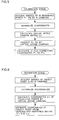
- the first stage is a calibration stage for deciding the parameters C V of the virtual extended affine cameras and the parameter T for correction.
- the second stage is an estimation stage for correcting the images acquired by the actual cameras to be equivalent to those projected by the extended affine cameras and linearly estimating the three-dimensional position of the object point.
- Figs. 5 and 6 are flow charts of the calibration and estimation stages respectively.
- the image processor shown in Fig. 1 carries out a program based on these flow charts.
- the calibration stage is now described with reference to Fig. 5.
- the extended affine camera matrix C V and the matrix T for correction must be obtained.
- This operation can be regarded as system calibration.
- M reference points P 1 , ..., P M located on previously known three-dimensional positions and projected images p* 1 , ..., p* M obtained by these N cameras. Either a lattice for calibration or an arbitrary sequence of points may be employed.
- the inventive method is an approximate three-dimensional reconstruction method, however, the reference points P 1 , ..., P M are preferably set in an area not much different from that of the three-dimensional space to be estimated in practice.
- the virtual extended affine camera matrix C A is first obtained from the sequence of reference points P 1 , ..., P M .
- the matrix C V may be any matrix, since images acquired by affine cameras can be converted to those acquired by arbitrary affine cameras by affine transformation.
- the matrix T for correction is obtained.
- the extended affine cameras C V acquire images of P j
- p* j is corrected to obtain p* Aj .
- this correction is carried out in accordance with the following expression: Since p* j and p* Aj (1 ⁇ j ⁇ M) are obtained, a linear equation may be solved in relation to the element of the term (2N + 1) x (N + 1) of each T K .
- the virtual affine camera matrix C V and the correction matrix T K (1 ⁇ k ⁇ 2N) 1 are decided from the three-dimensional positions P j of the M reference points and the projected images p* ij thereof by the N cameras.
- the three-dimensional position estimation method is now described with reference to Fig. 6.
- the N cameras acquire images of the object point P to obtain projected images q*, whose coordinates are normalized in consideration of the center of gravity P G of the reference points and the center of gravity p* G in each camera.
- projected images q* A equivalent to those acquired by the virtual extended affine cameras C V correction is made in accordance with the following expression:
- the virtual affine cameras project all reference points once again without knowing correct projective models of the respective cameras for estimating the three-dimensional position, whereby it is possible to estimate the three-dimensional position with no regard to the types, positions and orientations of the cameras. Further, the calculation itself is simple, and the three-dimensional position can be stably estimated in a linear form from the virtual affine cameras. Thus, influence by computational errors or noise can be reduced.
Landscapes
- Engineering & Computer Science (AREA)
- Computer Vision & Pattern Recognition (AREA)
- Physics & Mathematics (AREA)
- General Physics & Mathematics (AREA)
- Theoretical Computer Science (AREA)
- Length Measuring Devices By Optical Means (AREA)
- Image Processing (AREA)
- Image Analysis (AREA)
Claims (2)
- Lineares Abschätzverfahren zum Erhalten einer dreidimensionalen Position eines Objektpunktes (P) mit einer Mehrzahl von Kameras (1, 2, ..., N), miteinem ersten Schritt des Gewinnens von Bildern einer Mehrzahl von Referenzpunkten (P1, ..., Pj,..., PM), die sich auf bekannten Positionen in dem dreidimensionalen Raum befinden, durch die Mehrzahl von Kameras und des Erhaltens von Koordinaten erster projizierter Punkte (p*1, ..., p*j, ..., p*M) davon auf entsprechenden Bildern;einem zweiten Schritt des Annehmens einer Mehrzahl von affinen Kameras mit einer linearen Beziehung zwischen dem dreidimensionalen Raum und Bildern, des Berechnens, wie die Referenzpunkte (Pj) durch die affinen Kameras projiziert werden, und des Erhaltens entsprechender zweiter projizierter Punkte (p*A1, ..., p*Aj, ..., p*AM) und des Korrigierens der Koordinaten der ersten projizierten Punkte (p*j) derart, daß sie mit dem zweiten projizierten Punkten (p*Aj) äquivalent sind; und
des Betrachtens von Koeffizienten eines Polynoms zweiter Ordnung der Koordinaten der ersten projizierten Punkte (p*j) als die Parameter für die Korrektur; undeinem dritten Schritt des Abschätzens der dreidimensionalen Position eines willkürlichen Objektpunktes (P) in dem dreidimensionalen Raum basierend auf den Parametern für die Korrektur. - Verfahren des linearen Abschätzens einer dreidimensionalen Position gemäß Anspruch 1, weiter mit einem Schritt des Korrigierens dritter projizierter Punkte (q*) des Objektpunktes (P) mit dem Polynom zweiter Ordnung derart, daß sie mit den Koordinaten vierter projizierter Punkte (q*A) in den virtuellen affinen Kameras äquivalent sind, und des Abschätzens der dreidimensionalen Position des Objektpunktes (P) durch lineare Berechnung.
Applications Claiming Priority (3)
| Application Number | Priority Date | Filing Date | Title |
|---|---|---|---|
| JP9195611A JP3020898B2 (ja) | 1997-07-22 | 1997-07-22 | アフィンカメラ補正による三次元位置の線形推定方法 |
| JP19561197 | 1997-07-22 | ||
| JP195611/97 | 1997-07-22 |
Publications (2)
| Publication Number | Publication Date |
|---|---|
| EP0902395A1 EP0902395A1 (de) | 1999-03-17 |
| EP0902395B1 true EP0902395B1 (de) | 2000-03-01 |
Family
ID=16344049
Family Applications (1)
| Application Number | Title | Priority Date | Filing Date |
|---|---|---|---|
| EP98111042A Expired - Lifetime EP0902395B1 (de) | 1997-07-22 | 1998-06-16 | Verfahren zur linearen Bestimmung der drei-dimensionalen Lage mit affiner Kamerakorrektur |
Country Status (4)
| Country | Link |
|---|---|
| US (1) | US6137902A (de) |
| EP (1) | EP0902395B1 (de) |
| JP (1) | JP3020898B2 (de) |
| DE (1) | DE69800084T2 (de) |
Families Citing this family (35)
| Publication number | Priority date | Publication date | Assignee | Title |
|---|---|---|---|---|
| US6661913B1 (en) * | 1999-05-05 | 2003-12-09 | Microsoft Corporation | System and method for determining structure and motion using multiples sets of images from different projection models for object modeling |
| JP2000331160A (ja) * | 1999-05-24 | 2000-11-30 | Nec Corp | 画像マッチング装置、画像マッチング方法及び画像マッチング用プログラムを記録した記録媒体 |
| JP3476710B2 (ja) * | 1999-06-10 | 2003-12-10 | 株式会社国際電気通信基礎技術研究所 | ユークリッド的な3次元情報の復元方法、および3次元情報復元装置 |
| KR100584536B1 (ko) * | 1999-09-29 | 2006-05-30 | 삼성전자주식회사 | 화상 통신을 위한 화상처리장치 |
| US6313813B1 (en) * | 1999-10-21 | 2001-11-06 | Sony Corporation | Single horizontal scan range CRT monitor |
| FR2801123B1 (fr) * | 1999-11-12 | 2002-04-05 | Bertrand Aube | Procede de creation automatique de maquette numerique a partir de couples d'images stereoscopiques |
| GB2358307B (en) * | 1999-11-25 | 2004-03-24 | Canon Kk | Image processing apparatus |
| US6970591B1 (en) | 1999-11-25 | 2005-11-29 | Canon Kabushiki Kaisha | Image processing apparatus |
| US6606406B1 (en) * | 2000-05-04 | 2003-08-12 | Microsoft Corporation | System and method for progressive stereo matching of digital images |
| ITRM20010045A1 (it) * | 2001-01-29 | 2002-07-29 | Consiglio Nazionale Ricerche | Sistema e metodo per la rilevazione della posizione relativa di un oggetto rispetto ad un punto di riferimento. |
| GB2372659A (en) * | 2001-02-23 | 2002-08-28 | Sharp Kk | A method of rectifying a stereoscopic image |
| GB2380887A (en) * | 2001-10-13 | 2003-04-16 | Isis Innovation | Lens distortion correction using correspondence points within images which are constrained to lie on the same epipolar curve |
| FI111755B (fi) | 2001-11-23 | 2003-09-15 | Mapvision Oy Ltd | Menetelmä ja järjestelmä konenäköjärjestelmän kalibroimiseksi |
| JP3983573B2 (ja) * | 2002-03-06 | 2007-09-26 | 富士重工業株式会社 | ステレオ画像特性検査システム |
| JP3859574B2 (ja) * | 2002-10-23 | 2006-12-20 | ファナック株式会社 | 3次元視覚センサ |
| US7557966B2 (en) * | 2004-08-11 | 2009-07-07 | Acushnet Company | Apparatus and method for scanning an object |
| JP4737763B2 (ja) * | 2006-06-14 | 2011-08-03 | Kddi株式会社 | 多視点画像を用いた自由視点画像生成方法、装置及びプログラム |
| JP2008021092A (ja) * | 2006-07-12 | 2008-01-31 | Fanuc Ltd | ロボットシステムのシミュレーション装置 |
| DE102007042963A1 (de) * | 2007-09-10 | 2009-03-12 | Steinbichler Optotechnik Gmbh | Verfahren und Vorrichtung zur dreidimensionalen Digitalisierung von Objekten |
| US9513765B2 (en) | 2007-12-07 | 2016-12-06 | Sony Corporation | Three-dimensional sliding object arrangement method and system |
| JP5029424B2 (ja) * | 2008-02-28 | 2012-09-19 | Jfeスチール株式会社 | 張り剛性測定方法および装置 |
| AU2009243439A1 (en) * | 2009-11-30 | 2011-06-16 | Canon Kabushiki Kaisha | Robust image alignment for distributed multi-view imaging systems |
| JP5874649B2 (ja) * | 2011-02-17 | 2016-03-02 | コニカミノルタ株式会社 | 画像処理装置、そのプログラム、および画像処理方法 |
| JP2012223839A (ja) * | 2011-04-15 | 2012-11-15 | Yaskawa Electric Corp | ロボットシステムおよびロボットシステムの駆動方法 |
| US20140348416A1 (en) * | 2013-05-23 | 2014-11-27 | Himax Media Solutions, Inc. | Stereo image rectification apparatus and method |
| US9569850B2 (en) | 2013-10-16 | 2017-02-14 | Cognex Corporation | System and method for automatically determining pose of a shape |
| CN116110846A (zh) | 2016-01-26 | 2023-05-12 | 应用材料公司 | 晶片边缘环升降解决方案 |
| CN108369922B (zh) | 2016-01-26 | 2023-03-21 | 应用材料公司 | 晶片边缘环升降解决方案 |
| US11075105B2 (en) | 2017-09-21 | 2021-07-27 | Applied Materials, Inc. | In-situ apparatus for semiconductor process module |
| CN108830797A (zh) * | 2018-05-24 | 2018-11-16 | 桂林航天工业学院 | 一种基于仿射投影矩阵模型的直线匹配方法 |
| US11201037B2 (en) | 2018-05-28 | 2021-12-14 | Applied Materials, Inc. | Process kit with adjustable tuning ring for edge uniformity control |
| US11935773B2 (en) | 2018-06-14 | 2024-03-19 | Applied Materials, Inc. | Calibration jig and calibration method |
| US11289310B2 (en) | 2018-11-21 | 2022-03-29 | Applied Materials, Inc. | Circuits for edge ring control in shaped DC pulsed plasma process device |
| US12009236B2 (en) | 2019-04-22 | 2024-06-11 | Applied Materials, Inc. | Sensors and system for in-situ edge ring erosion monitor |
| CN113048985B (zh) * | 2021-05-31 | 2021-08-06 | 中国人民解放军国防科技大学 | 已知相对旋转角度条件下的像机相对运动估计方法 |
Family Cites Families (4)
| Publication number | Priority date | Publication date | Assignee | Title |
|---|---|---|---|---|
| JP2874710B2 (ja) * | 1996-02-26 | 1999-03-24 | 日本電気株式会社 | 三次元位置計測装置 |
| US6009210A (en) * | 1997-03-05 | 1999-12-28 | Digital Equipment Corporation | Hands-free interface to a virtual reality environment using head tracking |
| US6061468A (en) * | 1997-07-28 | 2000-05-09 | Compaq Computer Corporation | Method for reconstructing a three-dimensional object from a closed-loop sequence of images taken by an uncalibrated camera |
| JPH11139506A (ja) * | 1997-11-11 | 1999-05-25 | Taisei Denki Kogyo Kk | ごみ圧縮装置 |
-
1997
- 1997-07-22 JP JP9195611A patent/JP3020898B2/ja not_active Expired - Fee Related
-
1998
- 1998-06-16 EP EP98111042A patent/EP0902395B1/de not_active Expired - Lifetime
- 1998-06-16 DE DE69800084T patent/DE69800084T2/de not_active Expired - Fee Related
- 1998-07-15 US US09/115,516 patent/US6137902A/en not_active Expired - Fee Related
Also Published As
| Publication number | Publication date |
|---|---|
| DE69800084T2 (de) | 2000-09-14 |
| US6137902A (en) | 2000-10-24 |
| DE69800084D1 (de) | 2000-04-06 |
| EP0902395A1 (de) | 1999-03-17 |
| JP3020898B2 (ja) | 2000-03-15 |
| JPH1137721A (ja) | 1999-02-12 |
Similar Documents
| Publication | Publication Date | Title |
|---|---|---|
| EP0902395B1 (de) | Verfahren zur linearen Bestimmung der drei-dimensionalen Lage mit affiner Kamerakorrektur | |
| Lowe | Fitting parameterized three-dimensional models to images | |
| JP5285619B2 (ja) | カメラシステムのキャリブレーション | |
| CN110411476B (zh) | 视觉惯性里程计标定适配及评价方法和系统 | |
| US7333133B2 (en) | Recursive least squares approach to calculate motion parameters for a moving camera | |
| McLauchlan et al. | Active camera calibration for a head-eye platform using the variable state-dimension filter | |
| CN112184824A (zh) | 一种相机外参标定方法、装置 | |
| Sato et al. | Extrinsic camera parameter recovery from multiple image sequences captured by an omni-directional multi-camera system | |
| WO2001004837A2 (en) | Method and apparatus for detecting independent motion in three-dimensional scenes | |
| JPH1125277A (ja) | 画像間対応検出方法およびその装置 | |
| Malis et al. | Multi-view constraints between collineations: application to self-calibration from unknown planar structures | |
| KR101689335B1 (ko) | 복수 개의 불확실성 또는 상호 상관성이 있을 수 있는 데이터를 융합하는 방법 및 장치 | |
| JP4887376B2 (ja) | ステレオビジョンにおいて密な視差場を求める方法 | |
| JPH0814828A (ja) | ステレオ画像センサのキャリブレーション方法及びその装置 | |
| Chesi et al. | A simple technique for improving camera displacement estimation in eye-in-hand visual servoing | |
| McLauchlan | Gauge independence in optimization algorithms for 3D vision | |
| Fusiello | Elements of geometric computer vision | |
| Kanatani et al. | Fundamental matrix from optical flow: optimal computation and reliability evaluation | |
| Tang et al. | A factorization-based method for projective reconstruction with minimization of 2-D reprojection errors | |
| JP2007034964A (ja) | カメラ視点運動並びに3次元情報の復元及びレンズ歪パラメータの推定方法、装置、カメラ視点運動並びに3次元情報の復元及びレンズ歪パラメータの推定プログラム | |
| CN101189878B (zh) | 计算用于图像处理的变换参数 | |
| Hartley et al. | Reconstruction from six-point sequences | |
| JPH0886609A (ja) | ビーム光投影式3次元センサによる計測方法及びキャリブレーション方法並びにそれらの装置 | |
| Sturm | Self-calibration of a moving camera by pre-calibration | |
| Nakatsuji et al. | Stabilizing the focal length computation for 3-D reconstruction from two uncalibrated views |
Legal Events
| Date | Code | Title | Description |
|---|---|---|---|
| PUAI | Public reference made under article 153(3) epc to a published international application that has entered the european phase |
Free format text: ORIGINAL CODE: 0009012 |
|
| AK | Designated contracting states |
Kind code of ref document: A1 Designated state(s): DE FR GB |
|
| AX | Request for extension of the european patent |
Free format text: AL;LT;LV;MK;RO;SI |
|
| 17P | Request for examination filed |
Effective date: 19990129 |
|
| 17Q | First examination report despatched |
Effective date: 19990416 |
|
| GRAG | Despatch of communication of intention to grant |
Free format text: ORIGINAL CODE: EPIDOS AGRA |
|
| RIC1 | Information provided on ipc code assigned before grant |
Free format text: 6G 06T 7/00 A |
|
| RTI1 | Title (correction) |
Free format text: LINEAR ESTIMATION METHOD FOR THREE-DIMENSIONAL POSITION WITH AFFINE CAMERA CORRECTION |
|
| RIC1 | Information provided on ipc code assigned before grant |
Free format text: 6G 06T 7/00 A |
|
| RTI1 | Title (correction) |
Free format text: LINEAR ESTIMATION METHOD FOR THREE-DIMENSIONAL POSITION WITH AFFINE CAMERA CORRECTION |
|
| AKX | Designation fees paid |
Free format text: DE FR GB |
|
| GRAG | Despatch of communication of intention to grant |
Free format text: ORIGINAL CODE: EPIDOS AGRA |
|
| GRAH | Despatch of communication of intention to grant a patent |
Free format text: ORIGINAL CODE: EPIDOS IGRA |
|
| GRAH | Despatch of communication of intention to grant a patent |
Free format text: ORIGINAL CODE: EPIDOS IGRA |
|
| GRAA | (expected) grant |
Free format text: ORIGINAL CODE: 0009210 |
|
| AK | Designated contracting states |
Kind code of ref document: B1 Designated state(s): DE FR GB |
|
| REF | Corresponds to: |
Ref document number: 69800084 Country of ref document: DE Date of ref document: 20000406 |
|
| ET | Fr: translation filed | ||
| PLBE | No opposition filed within time limit |
Free format text: ORIGINAL CODE: 0009261 |
|
| STAA | Information on the status of an ep patent application or granted ep patent |
Free format text: STATUS: NO OPPOSITION FILED WITHIN TIME LIMIT |
|
| 26N | No opposition filed | ||
| REG | Reference to a national code |
Ref country code: GB Ref legal event code: IF02 |
|
| PGFP | Annual fee paid to national office [announced via postgrant information from national office to epo] |
Ref country code: GB Payment date: 20020610 Year of fee payment: 5 |
|
| PGFP | Annual fee paid to national office [announced via postgrant information from national office to epo] |
Ref country code: FR Payment date: 20020617 Year of fee payment: 5 |
|
| PGFP | Annual fee paid to national office [announced via postgrant information from national office to epo] |
Ref country code: DE Payment date: 20020701 Year of fee payment: 5 |
|
| PG25 | Lapsed in a contracting state [announced via postgrant information from national office to epo] |
Ref country code: GB Free format text: LAPSE BECAUSE OF NON-PAYMENT OF DUE FEES Effective date: 20030616 |
|
| PG25 | Lapsed in a contracting state [announced via postgrant information from national office to epo] |
Ref country code: DE Free format text: LAPSE BECAUSE OF NON-PAYMENT OF DUE FEES Effective date: 20040101 |
|
| GBPC | Gb: european patent ceased through non-payment of renewal fee |
Effective date: 20030616 |
|
| PG25 | Lapsed in a contracting state [announced via postgrant information from national office to epo] |
Ref country code: FR Free format text: LAPSE BECAUSE OF NON-PAYMENT OF DUE FEES Effective date: 20040227 |
|
| REG | Reference to a national code |
Ref country code: FR Ref legal event code: ST |