EP0890485A2 - Elektronisches Steuergerät im Fahrzeug - Google Patents
Elektronisches Steuergerät im Fahrzeug Download PDFInfo
- Publication number
- EP0890485A2 EP0890485A2 EP98112763A EP98112763A EP0890485A2 EP 0890485 A2 EP0890485 A2 EP 0890485A2 EP 98112763 A EP98112763 A EP 98112763A EP 98112763 A EP98112763 A EP 98112763A EP 0890485 A2 EP0890485 A2 EP 0890485A2
- Authority
- EP
- European Patent Office
- Prior art keywords
- electrical equipment
- terminal
- input
- multiple types
- side electrical
- Prior art date
- Legal status (The legal status is an assumption and is not a legal conclusion. Google has not performed a legal analysis and makes no representation as to the accuracy of the status listed.)
- Granted
Links
- 238000000034 method Methods 0.000 claims description 13
- 230000011664 signaling Effects 0.000 claims description 4
- 238000010586 diagram Methods 0.000 description 16
- 239000000446 fuel Substances 0.000 description 12
- 230000004044 response Effects 0.000 description 8
- 238000001514 detection method Methods 0.000 description 3
- 238000003780 insertion Methods 0.000 description 2
- 230000037431 insertion Effects 0.000 description 2
- 241001417501 Lobotidae Species 0.000 description 1
- 230000004397 blinking Effects 0.000 description 1
- 238000004519 manufacturing process Methods 0.000 description 1
- 230000010355 oscillation Effects 0.000 description 1
Images




Classifications
-
- B—PERFORMING OPERATIONS; TRANSPORTING
- B60—VEHICLES IN GENERAL
- B60R—VEHICLES, VEHICLE FITTINGS, OR VEHICLE PARTS, NOT OTHERWISE PROVIDED FOR
- B60R16/00—Electric or fluid circuits specially adapted for vehicles and not otherwise provided for; Arrangement of elements of electric or fluid circuits specially adapted for vehicles and not otherwise provided for
- B60R16/02—Electric or fluid circuits specially adapted for vehicles and not otherwise provided for; Arrangement of elements of electric or fluid circuits specially adapted for vehicles and not otherwise provided for electric constitutive elements
- B60R16/023—Electric or fluid circuits specially adapted for vehicles and not otherwise provided for; Arrangement of elements of electric or fluid circuits specially adapted for vehicles and not otherwise provided for electric constitutive elements for transmission of signals between vehicle parts or subsystems
- B60R16/0239—Electronic boxes
-
- B—PERFORMING OPERATIONS; TRANSPORTING
- B60—VEHICLES IN GENERAL
- B60R—VEHICLES, VEHICLE FITTINGS, OR VEHICLE PARTS, NOT OTHERWISE PROVIDED FOR
- B60R16/00—Electric or fluid circuits specially adapted for vehicles and not otherwise provided for; Arrangement of elements of electric or fluid circuits specially adapted for vehicles and not otherwise provided for
- B60R16/02—Electric or fluid circuits specially adapted for vehicles and not otherwise provided for; Arrangement of elements of electric or fluid circuits specially adapted for vehicles and not otherwise provided for electric constitutive elements
- B60R16/03—Electric or fluid circuits specially adapted for vehicles and not otherwise provided for; Arrangement of elements of electric or fluid circuits specially adapted for vehicles and not otherwise provided for electric constitutive elements for supply of electrical power to vehicle subsystems or for
- B60R16/0315—Electric or fluid circuits specially adapted for vehicles and not otherwise provided for; Arrangement of elements of electric or fluid circuits specially adapted for vehicles and not otherwise provided for electric constitutive elements for supply of electrical power to vehicle subsystems or for using multiplexing techniques
Definitions
- the invention relates to an on-vehicle electronic control unit for controlling electrical equipment.
- electronic control units for controlling the electrical equipment are arranged and mounted on automobiles in a manner such that a dedicated electronic control unit is provided for each combination of electrical equipment mounted on the vehicle.
- the conventional electronic control units are required to be manufactured such that the number of types of dedicated electronic control units is same as the number of types of combinations of electrical equipment.
- the microcomputer and the print circuit board of the electronic control unit are required to be designed and manufactured independently depending on the type of the combination of electrical equipment, there arises a problem that the cost of the electronic control unit becomes expensive and the management of the parts thereof becomes complicated.
- an object of the invention is to provide an on-vehicle electronic control unit, wherein all types of combinations of electrical equipment can be controlled by the electronic control unit via a common arrangement without changing the arrangement of the microcomputer and the print circuit board, or similar device, so as to reduce the number of parts of the on-vehicle electronic control unit to a large extent and reduce its cost.
- the control means includes a memory portion storing multiple types of control programs, in accordance with the type of the output side electrical equipment to be connectable to the output terminal, for controlling the output side electrical equipment connected to the output terminal in accordance with the input signal inputted from the input side electrical equipment through the input terminal; a control portion for controlling the output side electrical equipment connected to the output terminal on a basis of the input signal inputted from the input side electrical equipment through the input terminal in accordance with the control program read from the memory portion; and a switching portion for informing the control portion of one type of control program to be read corresponding to the output side electrical equipment connected to the output terminal from the multiple types of control programs stored in the memory portion on the basis of the signal inputted through the switching terminal so as to change the control mode of the control means into the control mode corresponding to the combination of the electrical equipment connected to the input and output terminals.
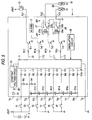
- Fig. 1 is a block diagram showing an arrangement of an on-vehicle electronic control unit according to an embodiment of the invention
- Fig. 2 is a block diagram showing an arrangement of a microcomputer provided in the electronic control unit.
- the electronic control unit 1 is provided with a battery input terminal Tb and a ground terminal Tg electrically connected to the anode and cathode electrode terminals of a battery 3, respectively, input terminals Ti1 to Ti8, and output terminals To1 to To3.
- Each of these terminals Tb, Tg, Ti1 to Ti8 and To1 to To3 is connected to the microcomputer (control means) 5 provided in the unit 1 through a certain circuit.
- the input terminals Ti7 and Ti8 of the input terminals Ti1 to Ti8 correspond to switching terminals of the invention.
- the control of an alarm 11 for a key-forgotten state and a room lamp 13, both provided normally in a vehicle, and the control of various electrical equipment provided optionally, can be performed by the common arrangement without changing the arrangement of the microcomputer 5, the print circuit board or other devices.
- the electrical equipment provided optionally include an electrical door lock system, electrical flexible outer doors, a fuel opener for electrically opening a lid of a fuel supply opening, a trunk opener for electrically opening a trunk, and left and right side cornering lamps 15 and 17 (see Fig.6) for illuminating a direction to which a vehicle changes its running direction interlocked with blinkers (flashers).
- the alarm 11 is provided in the electronic control unit 1, the alarm may be provided outside of the unit 1.
- the input terminals Ti1 to Ti4 receive signals required at the time of controlling the alarm 11 for a key-forgotten state and the room lamp 13, both of which are normally provided.
- the input terminals Ti5 and Ti6 receive signals required at the time of controlling the optionally provided electrical equipment, and the input terminals Ti7 and Ti8 receive switching signals for changing the control mode of the microcomputer 5 in accordance with the type of optionally provided electrical equipment.
- the output terminal To1 connects the unit to the room lamp 13, and the output terminals To2 and To3 connect the unit to the optionally provided electrical equipment.
- the battery input terminal Tb and the microcomputer 5 are connected by a power supply line through a diode 21 and a constant voltage circuit 23.
- the ground terminal Tg is connected to a ground line which is connected to the respective portions of the electronic control unit 1.
- Connection lines L1, L2 for connecting the input terminals Ti1, Ti2 and the input terminals of the microcomputer 5 through resistors R1, R2 are grounded through resistors R3, R4, respectively, so that low level signals are inputted to the microcomputer 5 through the connection lines L1, L2 in a state where the input terminals Ti1, Ti2 are electrically opened, respectively.
- Connection lines L3 to L8 for connecting the input terminals Ti3 to Ti8 and the input terminals of the microcomputer 5 through resistors R5 to R10 are connected to the battery through resistors R11 to R16, respectively, so that high level signals are inputted to the microcomputer 5 through the connection lines L3 to L8 in a state where the input terminals Ti3 to Ti8 are electrically opened, respectively.
- the microcomputer 5 also receives a clock signal outputted from an oscillation circuit 25.
- connection lines L9 to L12 in this embodiment are connected to the output terminals of the microcomputer 5.
- the connection line L9 is connected to the output terminal To1 through a resistor R17 and a switching transistor Tr1.
- the connection line L10 is connected to the alarm 11 through a resistor R18 and a switching transistor Tr2.
- the connection line L11 is connected to the output terminal To2 through a resistor R19, a transistor Tr3 and a relay switch 27.
- the connection line L12 is connected to the output terminal To3 through a resistor R20, a transistor Tr4 and a relay switch 29.
- Each of the transistors Tr1 to Tr4 is turned on and off in accordance with the high and low levels of the output signal from the microcomputer 5, respectively.
- the output terminal To1 is grounded.
- the alarm 11 is turned on to output an alarm.
- the transistors Tr3 and Tr4 are turned on, current is supplied to the relay coils 27a, 29a of the relay switches 27, 29, so that each of the movable contacts 27b, 29b of these relay switches is shifted from the connection position connected to a ground side contact to the connection position connected to a battery side contact.
- each of the output terminals To2 and To3 is changed from the grounded state to the state being connected to the battery.
- the movable contacts 27b, 29b connected to the battery side contacts are shifted to the ground side contacts in response to the turning-off of the transistors Tr3, Tr4, respectively.
- the microcomputer 5 includes a memory portion 5a formed by a read only memory (ROM) storing control programs (including control data) necessary for controlling the electrical equipment, a control portion 5b for controlling the respective electrical equipment on the basis of the control program and the control data stored in the memory portion 5a, and a switching portion 5c for changing the control mode of the control portion 5b in accordance with the combination of the electrical equipment to be controlled.
- the control portion 5b and the switching portion 5c are formed by a central processing unit (CPU) and a random access memory (RAM) or similar devices.
- the memory portion 5a stores therein a first control program 30a for controlling the normally provided electrical equipment of the alarm 11 and the room lamp 13, and second to fifth control programs 30b to 30e for controlling the optionally provided electrical equipment of the electrical door lock system, the electrical flexible outer doors, the fuel opener and the trunk opener, and the cornering lamps 15, 17, respectively.
- the switching portion 5c receives the switching signals for changing the control mode through the connection lines L7, L8.
- the electronic control unit 1 of this embodiment is arranged so as to be accorded with the four combinations of electrical equipment, that is, the combination of the normally provided electrical equipment of the alarm 11 and the room lamp 13 and the electrical door lock system, the combination of the normally provided electrical equipment and the electrical flexible outer doors, the combination of the normally provided electrical equipment and the set of the fuel opener and the trunk opener, and the combination of the normally provided electrical equipment and the cornering lamps 15, 17.
- the signal levels of the switching signals to be inputted into the microcomputer 5 through the connection lines L7, L8 are changed by opening and/or grounding the input terminals Ti7, Ti8, whereby the signal levels of the switching signals represent which one of the four combinations is selected, that is, which of the optionally provided electrical equipment is selected.
- the levels of the respective switching signals inputted through the connection lines L7, L8 are changed into (low, low)(Fig. 1), (high, low) (Fig. 4), (high, high) (Fig. 5) and (low, high) (Fig. 6) depending on whether the electrical door lock system, the electrical flexible outer doors, the set of the fuel opener and the trunk opener, and the cornering lamps 15, 17 are selected as the optionally provided electrical equipment, respectively.
- the switching portion 5c recognizes the combination of the electrical equipment to be controlled on the basis of the signal levels of the inputted switching signals, and then instructs the control portion 5b on one of the second to fifth control programs 30b to 30e to read in on the basis of the recognition result.
- the control portion 5b which already reads in the first control program 30a in response to the power supply thereto, reads the one of the second to fifth control programs 30b to 30e instructed by the switching portion 5c in response to the instruction firm the control portion 5b.
- control mode of the control portion 5b is shifted to that corresponding to the combination of the electrical equipment to be controlled, so that the control portion 5b controls the respective electrical equipment on the basis of the control program 30a and the one of the control programs 30b to 30e thus read.
- An ignition switch 31 provided at an ignition key cylinder, an accessory switch 33, a key detection switch 35 for detecting the key insertion state, and a courtesy switch 37 for detecting the opening and closing of the doors are connected to the input terminals Ti1 to Ti4, respectively.
- the input signals inputted into the microcomputer 5 through the connection lines L1 to L4 change between the high and low levels depending on the on and off states of the switches 31, 33, 35 and 37, respectively.
- the microcomputer 5 detects that the door has been opened and hence changes the output signal outputted through the connection line L9 from the low level to the high level to turn on the transistor Tr1 and turn on the room lamp 13.
- the microcomputer 5 detects that the door has been closed and hence changes the output signal outputted through the connection line L9 from the high level to the low level to turn off the room lamp 13.
- the microcomputer 5 In a state where the key detection switch 35, having been turned on due to the insertion of the key into the ignition key cylinder and hence the input signal inputted into the microcomputer 5 through the connection line L3, is in the low level, if the microcomputer 5 detects that the door has been opened through the turning-on of the courtesy switch 37, the microcomputer 5 changes the output signal outputted through the connection line L10 from the low level to the high level to turn on the transistor Tr2, thereby to operate the alarm 11 so as to notify a driver of the key-forgotten state.
- Figs. 1, 4, and 6 The relationship between the electronic control unit 1 and the optionally provided electrical equipment is explained with reference to Figs. 1, 4, and 6.
- Fig. 1 the positive and negative terminals of each of motors 41a to 41d, respectively provided at the doors for locking and unlocking the corresponding doors, are connected in parallel to the output terminals To2 and To3.
- An operation switch 43 for accepting a user's operation input is connected to the input terminals Ti5 and Ti6.
- the motors 41a to 41d and the operation switch 43 form the electric door lock system. In this arrangement, both the input terminals Ti7 and Ti8 are grounded.
- the operation switch 43 includes a grounded movable contact 43a interlocked with an operation portion (not shown) and two contacts 43b, 43c connected to the input terminals Ti5, Ti6, respectively.
- the movable contact 43a is selectively connected to one of the contacts 43b and 43c when the operation portion is operated so as to lock or unlock the door, and automatically restored to a state being connected to none of the contacts 43b and 43c in response to the cancellation of the operation to the operation portion.
- the microcomputer 5 When the microcomputer 5 detects that one of the input signals inputted therein through the connection lines L5 and L6 has been changed from the high level to the low level, the microcomputer changes one of the output signals outputted to the transistors Tr3 and Tr4 from the low level to the high level, thereby to drive the motors 41a to 41d to rotate forwardly or reversely to lock or unlock the respective doors.
- the operation switch 43 When the operation switch 43 is operated to connect the movable contact 43a of the operation switch 43 to the contact 43b, thereby to change the input signal inputted to the microcomputer 5 through the connection line L5 from the high level to the low level, the output signal outputted to the transistor Tr4 from the microcomputer 5 is maintained in the low level, but the output signal outputted to the transistor Tr3 is changed from the low level to the high level.
- the transistor Tr3 is turned on while the transistor Tr4 is kept in the off state, so that the movable contact 27b of the relay switch 27 is shifted from the ground side to the battery side, while the movable contact 29b of the relay switch 29 is maintained connected to the ground side.
- the respective motors 41a to 41d are supplied with power through the output terminals To2, To3 and rotated to the forward direction thereby to lock the doors.
- the operation switch 43 When the operation switch 43 is operated to connect the movable contact 43a of the operation switch 43 to the contact 43c, thereby to change the input signal inputted to the microcomputer 5 through the connection line L6 from the high level to the low level, the output signal outputted to the transistor Tr3 from the microcomputer 5 is maintained at the low level, but the output signal outputted to the transistor Tr4 is changed from the low level to the high level.
- the transistor Tr4 is turned on while the transistor Tr3 is maintained in the off state, so that the movable contact 29b of the relay switch 29 is shifted from the ground side to the battery side, while the movable contact 27b of the relay switch 27 is maintained connected to the ground side.
- the respective motors 41a to 41d are supplied with power through the output terminals To2, To3 and rotated to the reverse direction thereby to unlock the doors.
- Fig. 4 the positive and negative terminals of each of motors 51a and 51b, respectively provided at the left and right electric flexible outer mirrors for driving the mirrors to close and open the mirrors, are connected in parallel to the output terminals To2 and To3.
- An operation switch 53 for accepting a user's operation input is connected to the input terminal Ti5.
- the mirrors can be opened and closed by operating the operation switch 53. In this arrangement, both the input terminals Ti6 and Ti7 are opened and the input terminal Ti8 is grounded.
- the operation switch 53 is turned on when an operation portion (not shown) is operated and turned off in response to the cancellation of the operation to the operation portion.
- the operation switch 53 is turned on, the input terminal Ti5 is grounded through the operation switch 53, so that the signal inputted into the microcomputer 5 through the connection line L5 is changed from the high level to the low level.
- the microcomputer 5 recognizes the opening and closing state of the mirrors.
- the microcomputer detects that the input signal inputted therein through the connection line L5 has been changed from the high level to the low level, the microcomputer changes the level of one of the output signals outputted to the transistors Tr3 and Tr4 respectively through the connection lines L11 and L12 from the low level to the high level, so that the motors 51a and 51b are driven and rotated forwardly or reversely thereby to change the respective mirrors from the opened state to the closed state (housed state) or vise versa.
- a motor 61 provided at the trunk opener for opening (or unlocking) the trunk is connected to the output terminal To2
- the positive terminal of a motor 63 provided at the fuel opener for opening the lid of the fuel supply opening is connected to the output terminal To3.
- operation switches 65 and 67 for accepting a user's operation inputs for operating the trunk opener and the fuel opener are connected to the input terminals Ti5 and Ti6, respectively.
- the negative terminals of the motors 61 and 63 are grounded and both the input terminals Ti7 and Ti8 are opened.
- the operation switches 65 and 67 are turned on when operation portions (not shown) are operated and turned off in response to the cancellation of the operations to the operation portions.
- the operation switches 65 and 67 are turned on, the input terminals Ti5 and Ti6 are grounded through the operation switches 65 and 67, so that the signals inputted into the microcomputer 5 through the connection lines L5 and L6 are changed from the high level to the low level, respectively.
- the microcomputer 5 When the microcomputer 5 detects that each of the input signals inputted therein through the connection lines L5 and L6 has been changed from the high level to the low level, the microcomputer changes the output signals outputted to the transistors Tr3 and Tr4 respectively through the connection lines L11 and L12 from the low level to the high level, whereby the motors 61 and 63 are supplied with power through the output terminals To2 and To3, thereby to open the trunk and the lid of the fuel supply opening.
- the right and left cornering lamps 17 and 15 are connected to the output terminals To2 and To3, respectively, and a blinker switch 71 for turning on and off the blinkers is connected to the output terminal Ti5 and Ti6, so that the cornering lamps 15 and 17 are controlled on the basis of the signal outputted from the blinker switch 71.
- the input terminal Ti7 is grounded and the input terminal Ti8 is opened.
- the blinker switch 71 includes a grounded movable contact 71a interlocked with an operation portion (not shown) and two contacts 71b, 71c connected to the input terminals Ti5, Ti6, respectively.
- the movable contact 71a is selectively connected to one of the contacts 71b and 71c when the operation portion is operated in accordance with a change of the running direction of a vehicle, and automatically restored to a state being connected to none of the contacts 71b and 71c when the change of the running direction of the vehicle has been completed and the steering wheel of the vehicle is restored.
- the microcomputer 5 When the microcomputer 5 detects that the blinker switch 71 is operated at the time of changing the running direction of the vehicle, and the level of one of the input signals inputted to the microcomputer through the connection lines L5 and L6 is changed from the high level to the low level, the microcomputer changes the level of the corresponding one of the output signals respectively outputted to the transistors Tr3 and Tr4 through the connection lines L11 and L12 from the low level to the high level, until the level of the aforesaid one of the input signals inputted to the microcomputer is restored from the low level to the high level.
- the microcomputer changes the level of the corresponding one of the output signals outputted to the transistors Tr3 and Tr4 having been set at the high level to the low level.
- the corresponding one of the cornering lamps 15 and 17 is supplied with power through the output terminal To2 or To3, whereby the cornering lamp 15 or 17 associated with the direction to which the vehicle changes its running direction, that is, the cornering lamp on the same side as the blinker which is blinking, is turned on during a period where the associated blinker is turned on.
- Fig. 7(a) is a diagram showing the relationship between a wire harness 81 and the electronic control unit corresponding to the combination of the electrical equipment shown in Fig. 1
- Fig. 7(b) is a diagram showing a wire harness 83 corresponding to the combination of the electrical equipment shown in Fig. 4
- Fig. 7(c) is a diagram showing a wire harness 85 corresponding to the combination of the electrical equipment shown in Fig. 5
- Fig. 7(d) is a diagram showing a wire harness 87 corresponding to the combination of the electrical equipment shown in Fig. 6.
- the corresponding portions are labeled with the same reference numerals and the explanation thereof is omitted.
- the wire harnesses 81, 83, 85 and 87 are provided,as the common arrangement, with connectors 81a, 83a, 85a and 87a connected to the connector 91 of the electronic control unit 1, respectively, and further each of the wire harnesses is provided with a connector 93 for connecting the electronic control unit 1 to the anode and cathode electrode terminals of the battery and the room lamp 13, and a connector 95 for connecting the electronic control unit 1 to the ignition switch 31, accessory switch 33, key detection switch 35 and courtesy switch 37.
- the wire harness 81 is provided with a connector 97 for connecting the electronic control unit 1 to the respective motors 41a to 41d for the electric door lock system, and a connector 99 for connecting the input terminals Ti5 and Ti6 of the electronic control unit 1 to the operation switch 43 and for connecting the input terminals Ti7 and Ti8 thereof to the ground.
- the wire harness 83 is provided with a connector 101 for connecting the electronic control unit 1 to the respective motors 51a to 51d for the electric flexible outer mirrors, and a connector 103 for connecting the input terminal Ti5 of the electronic control unit 1 to the operation switch 53 and for connecting the input terminal Ti8 thereof to the ground.
- the wire harness 85 is provided with a connector 105 for connecting the electronic control unit 1 to the respective motors 61 and 63 of the trunk opener and the fuel opener, and for connecting the input terminals Ti5 and Ti6 of the electronic control unit 1 to the operation switches 65 and 67, respectively.
- the wire harness 87 is provided with a connector 107 for connecting the input terminals Ti5 and Ti6 of the electronic control unit 1 to the blinker switch 71, and for connecting the input terminal Ti7 thereof to the ground, and a connector 109 for connecting the electronic control unit 1 to the left and right cornering lamps 15 and 17.
- the connectors 81a, 83a, 85a and 87a of the electronic control unit 1 side are connected to the respective connectors 93, 95, etc. connected to the respective electrical equipment, etc. through predetermined wires 81b, 83b, 85b and 87b, respectively.
- the connector 91 and the connectors 81a, 83a, 85a and 87a are made common in standards, such as configuration or the like, so that any one of the connectors 81a, 83a, 85a and 87a of the wire harnesses 81, 83, 85 and 87 can be connected to the connector 91 of the electronic control unit 1.
- Fig. 8 is a flow chart showing the control operation of the microcomputer 5 provided in the electronic control unit 1.
- step S1 when the electronic control unit 1 is connected to both the battery 3 and the respective electrical equipment, and the power is initially supplied to the microcomputer 5, a predetermined initialization is performed, and then the first control program 30a for controlling the normally provided electrical equipment of the alarm 11 and the room lamp 13 is read from the memory portion 5a and stored in the control portion 5b. Then, the process proceeds to step S2.
- step S2 it is determined by the switching portion 5c whether or not both the input terminals Ti7 and Ti8 are grounded, that is, whether or not both the switching signals inputted into the microcomputer through the connection lines L7 and L8 are at the low level. If it is determined Yes in step S2, the process proceeds to step S3, in which the second control program 30b for controlling the e!ectric door lock system is read from the memory portion 5a and stored in the control portion 5b. Then, the process proceeds to step S4. In contrast, if it is determined No in step S2, the process proceeds to step S5.
- step S5 it is determined by the switching portion 5c whether or not the input terminal Ti7 is opened and the input terminal Ti8 is grounded, that is, whether or not the switching signals inputted into the microcomputer through the connection lines L7 and L8 are at the high and low levels, respectively. If it is determined Yes in step S5, the process proceeds to step S6, in which the third control program 30c for controlling the electric flexible outer mirrors is read from the memory portion 5a and stored in the control portion 5b. Then, the process proceeds to step S4. In contrast, if it is determined No in step S5, the process proceeds to step S7.
- step S7 it is determined by the switching portion 5c whether or not both the input terminals Ti7 and Ti8 are opened, that is, whether or not both the switching signals inputted into the microcomputer through the connection lines L7 and L8 are at the high level. If it is determined Yes in step S7, the process proceeds to step S8, in which the fourth control program 30d for controlling the fuel opener and the trunk opener is read from the memory portion 5a and stored in the control portion 5b. Then, the process proceeds to step S4. In contrast, if it is determined No in step S7, the process proceeds to step S9, in which the fifth control program 30e for controlling the cornering lamps 15 and 17 is read from the memory portion 5a and stored in the control portion 5b. Then, the process proceeds to step S4.
- step S4 the control portion 5b controls the respective electrical equipment on the basis of the control programs 30a to 30e read in steps S1, S3, S6, S8 and S9.
- one of the control programs 30a to 30e stored in the memory portion 5a corresponding to the combination of the electrical equipment to be controlled is read in accordance with the levels of the inputted switching signals and read into the control portion 5b, whereby the control mode of the control portion 5b is set to one corresponding to the combination of electrical equipment to be controlled.
- the memory portion (ROM) 5a of the microcomputer 5 stores multiple types of control programs 30a to 30e corresponding to the types of combinations of electrical equipment to be connected to the electronic control unit 1, and one of the control programs 30a to 30e is selectively read upon request. Accordingly, in the present embodiment, since various types of combinations of electrical equipment can be controlled by using only one type of ROM, the developing cost and the management cost can be reduced to a large extent, and it becomes possible to eliminate the problem that an incorrect type of ROM may be employed erroneously.
- the connector 91 of the electronic control unit 1 is made common in standards such as configuration or the like with the connectors 81a, 83a, 85a and 87a of the wire harnesses 81, 83, 85 and 87 corresponding to the respective types of combinations of the electrical equipment. Accordingly, the connector 91 of the electronic control unit 1 can be used commonly for the various types of combinations of the electrical equipment, so that the number of parts of the electronic control unit can further be reduced and the manufacturing cost thereof can also be reduced.
- the invention may be arranged to increase the types of electrical equipment to be controlled and the types of combinations of electrical equipment to be accorded by increasing the number of the input terminals Ti1 to Ti6 for inputting signals required for control, the number of the input terminals Ti7 and Ti8 for inputting the switching signals and the number of the output terminals To1 to To3 upon request.
- the number oft he electrical equipment to be controlled may be changed at every type of combination of electrical equipment.
- the respective pieces of electrical equipment are controlled such that the control means, which has multiple types of control modes corresponding to the types of combinations of the electrical equipment to be controlled, changes its control mode to one which corresponds to the type of combination of the electrical equipment connected to the input and output terminals on the basis of the signal inputted through the switching terminal. Accordingly, various types of combinations of electrical equipment can be controlled by the electronic control unit of the common arrangement without changing the arrangement of the microcomputer, the print circuit board or the like, which makes it possible to reduce the number of parts of the electronic control unit to a large extent and reduce the cost thereof.
Landscapes
- Engineering & Computer Science (AREA)
- Mechanical Engineering (AREA)
- Lock And Its Accessories (AREA)
- Stored Programmes (AREA)
- Lighting Device Outwards From Vehicle And Optical Signal (AREA)
Applications Claiming Priority (3)
| Application Number | Priority Date | Filing Date | Title |
|---|---|---|---|
| JP18510297A JP3441623B2 (ja) | 1997-07-10 | 1997-07-10 | 車載用電子制御ユニット |
| JP185102/97 | 1997-07-10 | ||
| JP18510297 | 1997-07-10 |
Publications (3)
| Publication Number | Publication Date |
|---|---|
| EP0890485A2 true EP0890485A2 (de) | 1999-01-13 |
| EP0890485A3 EP0890485A3 (de) | 2001-11-21 |
| EP0890485B1 EP0890485B1 (de) | 2006-05-10 |
Family
ID=16164897
Family Applications (1)
| Application Number | Title | Priority Date | Filing Date |
|---|---|---|---|
| EP98112763A Expired - Lifetime EP0890485B1 (de) | 1997-07-10 | 1998-07-09 | Elektronisches Steuergerät im Fahrzeug und Verfahren zum Steuern einer Vielzahl von Typen elektrischer Ausrüstung |
Country Status (4)
| Country | Link |
|---|---|
| US (1) | US6175795B1 (de) |
| EP (1) | EP0890485B1 (de) |
| JP (1) | JP3441623B2 (de) |
| DE (1) | DE69834453T2 (de) |
Cited By (3)
| Publication number | Priority date | Publication date | Assignee | Title |
|---|---|---|---|---|
| WO2001062550A1 (de) * | 2000-02-23 | 2001-08-30 | Robert Bosch Gmbh | Vorrichtung zur durchführung von steuerungs- oder regelungsfunktionen und verfahren zur steuerung oder regelung bei einem fahrzeug |
| CN101670814B (zh) * | 2009-08-28 | 2011-08-31 | 哈尔滨威帝电子股份有限公司 | 基于can总线网络的车门控制系统及控制方法 |
| WO2013046700A1 (en) * | 2011-09-28 | 2013-04-04 | Yazaki Corporation | Vehicle data setting system and output setting method thereof |
Families Citing this family (8)
| Publication number | Priority date | Publication date | Assignee | Title |
|---|---|---|---|---|
| JP2003214004A (ja) * | 2002-01-24 | 2003-07-30 | Aisin Seiki Co Ltd | ドアロックの制御方法及びドアロック装置 |
| JP2005102780A (ja) * | 2003-09-29 | 2005-04-21 | Sansei R & D:Kk | 遊技機 |
| JP2005330955A (ja) * | 2004-04-19 | 2005-12-02 | Denso Corp | 電子制御装置 |
| DE102004022767A1 (de) * | 2004-05-05 | 2005-07-21 | Daimlerchrysler Ag | Verfahren zum Ansteuern einer elektrischen Maschine und Ansteuersystem hierzu |
| JP4614085B2 (ja) * | 2005-08-30 | 2011-01-19 | 株式会社デンソー | 車載用電子機器の接続システム |
| JP2008037206A (ja) * | 2006-08-03 | 2008-02-21 | Sumitomo Wiring Syst Ltd | 電子制御ユニット |
| JP5303367B2 (ja) | 2009-06-08 | 2013-10-02 | 富士通テン株式会社 | エコラン制御装置及びエコラン制御方法 |
| US8203232B2 (en) * | 2009-12-10 | 2012-06-19 | Lear Corporation | Embedded wireless communications for electronic control unit having multiple ground references |
Family Cites Families (15)
| Publication number | Priority date | Publication date | Assignee | Title |
|---|---|---|---|---|
| GB2048590B (en) * | 1979-04-04 | 1984-01-25 | Hitachi Ltd | Apparatus and method for controlling automobile equipment |
| DE3018275A1 (de) * | 1980-05-13 | 1981-11-19 | Robert Bosch Gmbh, 7000 Stuttgart | Vorrichtung zur optimierung von daten und/oder programmen fuer programmierte steuergeraete |
| JPS5780202A (en) * | 1980-11-06 | 1982-05-19 | Hitachi Ltd | Controller for electric vehicle |
| DE3223383A1 (de) * | 1982-06-23 | 1983-12-29 | Wabco Westinghouse Fahrzeugbremsen GmbH, 3000 Hannover | Elektronische steuerung |
| DE3525085A1 (de) * | 1985-07-13 | 1987-01-22 | Stribel Gmbh | Einrichtung fuer ein kraftfahrzeug |
| DE3610620C2 (de) * | 1986-03-29 | 1996-03-28 | Teves Gmbh Alfred | Programmgesteuerter elektronischer Regler |
| US4876649A (en) * | 1986-05-06 | 1989-10-24 | Aisin Seiki Kabushikikaisha | Harm preventing apparatus for vehicle |
| DE3913266A1 (de) * | 1989-04-22 | 1990-10-25 | Bosch Gmbh Robert | Schaltungsanordnung fuer kraftfahrzeuge mit mehreren elektrischen verbrauchern |
| US5063513A (en) * | 1990-06-15 | 1991-11-05 | Nartron Corporation | Vehicle preheater control |
| EP0487995A3 (en) * | 1990-11-30 | 1994-08-17 | Rockwell International Corp | A system for control of actuators and switches by a remotely located microprocessor using a three wire harness |
| JPH04280524A (ja) * | 1991-03-08 | 1992-10-06 | Sumitomo Wiring Syst Ltd | 多重通信制御装置 |
| US5479479A (en) * | 1991-10-19 | 1995-12-26 | Cell Port Labs, Inc. | Method and apparatus for transmission of and receiving signals having digital information using an air link |
| US5394400A (en) * | 1993-06-21 | 1995-02-28 | Eaton Corporation | Multiaddress remote control of vehicular accessories without microprocessors |
| DE4326328A1 (de) * | 1993-08-05 | 1994-11-03 | Daimler Benz Ag | Audioeinrichtung in einem Kraftfahrzeug |
| JPH0865753A (ja) * | 1994-08-19 | 1996-03-08 | Sumitomo Wiring Syst Ltd | スイッチの電流制限回路 |
-
1997
- 1997-07-10 JP JP18510297A patent/JP3441623B2/ja not_active Expired - Fee Related
-
1998
- 1998-07-02 US US09/109,731 patent/US6175795B1/en not_active Expired - Lifetime
- 1998-07-09 DE DE69834453T patent/DE69834453T2/de not_active Expired - Lifetime
- 1998-07-09 EP EP98112763A patent/EP0890485B1/de not_active Expired - Lifetime
Non-Patent Citations (1)
| Title |
|---|
| None |
Cited By (6)
| Publication number | Priority date | Publication date | Assignee | Title |
|---|---|---|---|---|
| WO2001062550A1 (de) * | 2000-02-23 | 2001-08-30 | Robert Bosch Gmbh | Vorrichtung zur durchführung von steuerungs- oder regelungsfunktionen und verfahren zur steuerung oder regelung bei einem fahrzeug |
| US6754565B2 (en) | 2000-02-23 | 2004-06-22 | Robert Bosch Gmbh | Device for implementing control or regulating functions and a method of controlling or regulating in a vehicle |
| CN101670814B (zh) * | 2009-08-28 | 2011-08-31 | 哈尔滨威帝电子股份有限公司 | 基于can总线网络的车门控制系统及控制方法 |
| WO2013046700A1 (en) * | 2011-09-28 | 2013-04-04 | Yazaki Corporation | Vehicle data setting system and output setting method thereof |
| CN103842214A (zh) * | 2011-09-28 | 2014-06-04 | 矢崎总业株式会社 | 车辆数据设定系统及其输出设定方法 |
| US9376071B2 (en) | 2011-09-28 | 2016-06-28 | Yazaki Corporation | Vehicle data setting system and output setting method thereof |
Also Published As
| Publication number | Publication date |
|---|---|
| JPH1131067A (ja) | 1999-02-02 |
| JP3441623B2 (ja) | 2003-09-02 |
| US6175795B1 (en) | 2001-01-16 |
| DE69834453D1 (de) | 2006-06-14 |
| EP0890485B1 (de) | 2006-05-10 |
| EP0890485A3 (de) | 2001-11-21 |
| DE69834453T2 (de) | 2007-05-03 |
Similar Documents
| Publication | Publication Date | Title |
|---|---|---|
| EP0890485B1 (de) | Elektronisches Steuergerät im Fahrzeug und Verfahren zum Steuern einer Vielzahl von Typen elektrischer Ausrüstung | |
| US7224083B2 (en) | Remote start system for a vehicle having a data communications bus and related methods | |
| US7046126B2 (en) | Vehicle window control system for a vehicle having a data communications bus and associated methods | |
| KR0152328B1 (ko) | 다중통신시스템 | |
| WO1998009137A1 (fr) | Element moteur de compteur | |
| JP3373664B2 (ja) | 車両用電源供給装置 | |
| EP0917991A2 (de) | Kraftfahrzeugmultiplex - Übertragungssystem und Herstellungsverfahren | |
| EP1884405B1 (de) | Elektronische Steuereinheit, Steuerverfahren und Computerprogramm | |
| US5633624A (en) | Vehicle anti-theft system | |
| US5574343A (en) | Control of activators in motor vehicle doors | |
| US6417636B2 (en) | Power window device | |
| US20070016347A1 (en) | Alternative input control method and device | |
| KR0180349B1 (ko) | 자동차의 도난방지를 위한 암호화방법 | |
| JPH08216836A (ja) | 車両の表示灯コントローラ及びこれを使用した車両の施錠確認システム | |
| JP3235166B2 (ja) | 車載用電装機器 | |
| JP7033487B2 (ja) | 車両のコネクタ装置及び車両の制御装置 | |
| CN100487609C (zh) | 替换输入控制方法和装置 | |
| JP3235202B2 (ja) | 車載用電装機器 | |
| JP3383460B2 (ja) | 多重伝送装置 | |
| KR0125448Y1 (ko) | 배터리전원 제어장치 | |
| JPH08216785A (ja) | 車両用バックミラー | |
| GB2175646A (en) | Vehicle security devices | |
| KR19980050274A (ko) | 자동차의 윈도우 잠금 장치 | |
| KR200168814Y1 (ko) | 멀트박스 | |
| KR200243283Y1 (ko) | 차량의윈도우자동제어장치 |
Legal Events
| Date | Code | Title | Description |
|---|---|---|---|
| PUAI | Public reference made under article 153(3) epc to a published international application that has entered the european phase |
Free format text: ORIGINAL CODE: 0009012 |
|
| AK | Designated contracting states |
Kind code of ref document: A2 Designated state(s): AT BE CH CY DE DK ES FI FR GB GR IE IT LI LU MC NL PT SE Kind code of ref document: A2 Designated state(s): DE FR GB |
|
| AX | Request for extension of the european patent |
Free format text: AL;LT;LV;MK;RO;SI |
|
| PUAL | Search report despatched |
Free format text: ORIGINAL CODE: 0009013 |
|
| AK | Designated contracting states |
Kind code of ref document: A3 Designated state(s): AT BE CH CY DE DK ES FI FR GB GR IE IT LI LU MC NL PT SE |
|
| AX | Request for extension of the european patent |
Free format text: AL;LT;LV;MK;RO;SI |
|
| 17P | Request for examination filed |
Effective date: 20020122 |
|
| AKX | Designation fees paid |
Free format text: DE FR GB |
|
| RAP1 | Party data changed (applicant data changed or rights of an application transferred) |
Owner name: AUTONETWORKS TECHNOLOGIES, LTD. Owner name: SUMITOMO ELECTRIC INDUSTRIES, LTD. Owner name: SUMITOMO WIRING SYSTEMS, LTD. |
|
| 17Q | First examination report despatched |
Effective date: 20030218 |
|
| GRAP | Despatch of communication of intention to grant a patent |
Free format text: ORIGINAL CODE: EPIDOSNIGR1 |
|
| RTI1 | Title (correction) |
Free format text: ON-VEHICLE ELECTRONIC CONTROL UNIT AND METHOD OF CONTROLLING MULTIPLE TYPES OF ELECTRICAL EQUIPMENT |
|
| GRAS | Grant fee paid |
Free format text: ORIGINAL CODE: EPIDOSNIGR3 |
|
| GRAA | (expected) grant |
Free format text: ORIGINAL CODE: 0009210 |
|
| RIN1 | Information on inventor provided before grant (corrected) |
Inventor name: SUMIDA, YOSHITAKA,C/O AUTONETWORKS TECH., LTD. |
|
| RAP1 | Party data changed (applicant data changed or rights of an application transferred) |
Owner name: AUTONETWORKS TECHNOLOGIES, LTD. Owner name: SUMITOMO ELECTRIC INDUSTRIES, LTD. Owner name: SUMITOMO WIRING SYSTEMS, LTD. |
|
| AK | Designated contracting states |
Kind code of ref document: B1 Designated state(s): DE FR GB |
|
| REG | Reference to a national code |
Ref country code: GB Ref legal event code: FG4D |
|
| REF | Corresponds to: |
Ref document number: 69834453 Country of ref document: DE Date of ref document: 20060614 Kind code of ref document: P |
|
| ET | Fr: translation filed | ||
| PLBE | No opposition filed within time limit |
Free format text: ORIGINAL CODE: 0009261 |
|
| STAA | Information on the status of an ep patent application or granted ep patent |
Free format text: STATUS: NO OPPOSITION FILED WITHIN TIME LIMIT |
|
| 26N | No opposition filed |
Effective date: 20070213 |
|
| PGFP | Annual fee paid to national office [announced via postgrant information from national office to epo] |
Ref country code: DE Payment date: 20140702 Year of fee payment: 17 |
|
| PGFP | Annual fee paid to national office [announced via postgrant information from national office to epo] |
Ref country code: FR Payment date: 20140708 Year of fee payment: 17 Ref country code: GB Payment date: 20140709 Year of fee payment: 17 |
|
| REG | Reference to a national code |
Ref country code: DE Ref legal event code: R119 Ref document number: 69834453 Country of ref document: DE |
|
| GBPC | Gb: european patent ceased through non-payment of renewal fee |
Effective date: 20150709 |
|
| PG25 | Lapsed in a contracting state [announced via postgrant information from national office to epo] |
Ref country code: DE Free format text: LAPSE BECAUSE OF NON-PAYMENT OF DUE FEES Effective date: 20160202 Ref country code: GB Free format text: LAPSE BECAUSE OF NON-PAYMENT OF DUE FEES Effective date: 20150709 |
|
| REG | Reference to a national code |
Ref country code: FR Ref legal event code: ST Effective date: 20160331 |
|
| PG25 | Lapsed in a contracting state [announced via postgrant information from national office to epo] |
Ref country code: FR Free format text: LAPSE BECAUSE OF NON-PAYMENT OF DUE FEES Effective date: 20150731 |