EP0890096B1 - Kationselektiver sensor - Google Patents
Kationselektiver sensor Download PDFInfo
- Publication number
- EP0890096B1 EP0890096B1 EP97920558A EP97920558A EP0890096B1 EP 0890096 B1 EP0890096 B1 EP 0890096B1 EP 97920558 A EP97920558 A EP 97920558A EP 97920558 A EP97920558 A EP 97920558A EP 0890096 B1 EP0890096 B1 EP 0890096B1
- Authority
- EP
- European Patent Office
- Prior art keywords
- cation
- selective
- layer
- sensor according
- acid
- Prior art date
- Legal status (The legal status is an assumption and is not a legal conclusion. Google has not performed a legal analysis and makes no representation as to the accuracy of the status listed.)
- Expired - Lifetime
Links
- 150000001768 cations Chemical class 0.000 title claims description 134
- 150000002500 ions Chemical class 0.000 claims description 51
- 239000002253 acid Substances 0.000 claims description 44
- 229920000642 polymer Polymers 0.000 claims description 44
- 230000008878 coupling Effects 0.000 claims description 27
- 238000010168 coupling process Methods 0.000 claims description 27
- 238000005859 coupling reaction Methods 0.000 claims description 27
- 239000004014 plasticizer Substances 0.000 claims description 24
- -1 fluorescein ester Chemical class 0.000 claims description 23
- 239000000126 substance Substances 0.000 claims description 19
- 239000000463 material Substances 0.000 claims description 16
- 150000001875 compounds Chemical class 0.000 claims description 13
- 238000012360 testing method Methods 0.000 claims description 13
- 239000002861 polymer material Substances 0.000 claims description 11
- 239000007788 liquid Substances 0.000 claims description 10
- 239000011159 matrix material Substances 0.000 claims description 9
- 239000007793 ph indicator Substances 0.000 claims description 9
- 125000000524 functional group Chemical group 0.000 claims description 7
- 239000004094 surface-active agent Substances 0.000 claims description 7
- 150000002632 lipids Chemical class 0.000 claims description 6
- 238000002360 preparation method Methods 0.000 claims description 6
- 235000014113 dietary fatty acids Nutrition 0.000 claims description 3
- 229930195729 fatty acid Natural products 0.000 claims description 3
- 239000000194 fatty acid Substances 0.000 claims description 3
- NUMNZKICGJJSHN-UHFFFAOYSA-N phenyl octadecanoate Chemical compound CCCCCCCCCCCCCCCCCC(=O)OC1=CC=CC=C1 NUMNZKICGJJSHN-UHFFFAOYSA-N 0.000 claims description 3
- BIJNHUAPTJVVNQ-UHFFFAOYSA-N 1-Hydroxypyrene Chemical compound C1=C2C(O)=CC=C(C=C3)C2=C2C3=CC=CC2=C1 BIJNHUAPTJVVNQ-UHFFFAOYSA-N 0.000 claims description 2
- BTJIUGUIPKRLHP-UHFFFAOYSA-N 4-nitrophenol Chemical compound OC1=CC=C([N+]([O-])=O)C=C1 BTJIUGUIPKRLHP-UHFFFAOYSA-N 0.000 claims description 2
- CJIJXIFQYOPWTF-UHFFFAOYSA-N 7-hydroxycoumarin Natural products O1C(=O)C=CC2=CC(O)=CC=C21 CJIJXIFQYOPWTF-UHFFFAOYSA-N 0.000 claims description 2
- 150000001335 aliphatic alkanes Chemical group 0.000 claims description 2
- 229930003944 flavone Natural products 0.000 claims description 2
- 235000011949 flavones Nutrition 0.000 claims description 2
- GNBHRKFJIUUOQI-UHFFFAOYSA-N fluorescein Chemical class O1C(=O)C2=CC=CC=C2C21C1=CC=C(O)C=C1OC1=CC(O)=CC=C21 GNBHRKFJIUUOQI-UHFFFAOYSA-N 0.000 claims description 2
- 239000011344 liquid material Substances 0.000 claims description 2
- 150000002989 phenols Chemical group 0.000 claims description 2
- HSSLDCABUXLXKM-UHFFFAOYSA-N resorufin Chemical compound C1=CC(=O)C=C2OC3=CC(O)=CC=C3N=C21 HSSLDCABUXLXKM-UHFFFAOYSA-N 0.000 claims description 2
- 239000012056 semi-solid material Substances 0.000 claims description 2
- 239000011343 solid material Substances 0.000 claims description 2
- ORHBXUUXSCNDEV-UHFFFAOYSA-N umbelliferone Chemical compound C1=CC(=O)OC2=CC(O)=CC=C21 ORHBXUUXSCNDEV-UHFFFAOYSA-N 0.000 claims description 2
- 238000010494 dissociation reaction Methods 0.000 claims 2
- 230000005593 dissociations Effects 0.000 claims 2
- GAMYVSCDDLXAQW-AOIWZFSPSA-N Thermopsosid Natural products O(C)c1c(O)ccc(C=2Oc3c(c(O)cc(O[C@H]4[C@H](O)[C@@H](O)[C@H](O)[C@H](CO)O4)c3)C(=O)C=2)c1 GAMYVSCDDLXAQW-AOIWZFSPSA-N 0.000 claims 1
- 239000012928 buffer substance Substances 0.000 claims 1
- 125000005313 fatty acid group Chemical group 0.000 claims 1
- 150000002212 flavone derivatives Chemical class 0.000 claims 1
- 230000000087 stabilizing effect Effects 0.000 claims 1
- VHBFFQKBGNRLFZ-UHFFFAOYSA-N vitamin p Natural products O1C2=CC=CC=C2C(=O)C=C1C1=CC=CC=C1 VHBFFQKBGNRLFZ-UHFFFAOYSA-N 0.000 claims 1
- 239000000243 solution Substances 0.000 description 42
- 239000012528 membrane Substances 0.000 description 33
- 238000005259 measurement Methods 0.000 description 31
- 239000002585 base Substances 0.000 description 23
- 239000000523 sample Substances 0.000 description 22
- 239000000203 mixture Substances 0.000 description 17
- 230000008859 change Effects 0.000 description 15
- 239000004020 conductor Substances 0.000 description 15
- 238000000034 method Methods 0.000 description 15
- 239000012491 analyte Substances 0.000 description 13
- 241000894007 species Species 0.000 description 13
- 239000010408 film Substances 0.000 description 9
- 229910052751 metal Inorganic materials 0.000 description 9
- 239000002184 metal Substances 0.000 description 9
- 239000000872 buffer Substances 0.000 description 8
- 238000006243 chemical reaction Methods 0.000 description 8
- 238000005516 engineering process Methods 0.000 description 8
- 230000002209 hydrophobic effect Effects 0.000 description 8
- 229920000831 ionic polymer Polymers 0.000 description 8
- 238000004519 manufacturing process Methods 0.000 description 8
- 239000012488 sample solution Substances 0.000 description 8
- 150000001450 anions Chemical class 0.000 description 7
- 230000008901 benefit Effects 0.000 description 7
- 230000003287 optical effect Effects 0.000 description 7
- 229920002554 vinyl polymer Polymers 0.000 description 7
- 229920001577 copolymer Polymers 0.000 description 6
- 238000001514 detection method Methods 0.000 description 6
- 230000000694 effects Effects 0.000 description 6
- 239000011521 glass Substances 0.000 description 6
- 230000003993 interaction Effects 0.000 description 6
- OKTJSMMVPCPJKN-UHFFFAOYSA-N Carbon Chemical compound [C] OKTJSMMVPCPJKN-UHFFFAOYSA-N 0.000 description 5
- XSQUKJJJFZCRTK-UHFFFAOYSA-N Urea Chemical compound NC(N)=O XSQUKJJJFZCRTK-UHFFFAOYSA-N 0.000 description 5
- 230000002378 acidificating effect Effects 0.000 description 5
- 238000004458 analytical method Methods 0.000 description 5
- 239000007864 aqueous solution Substances 0.000 description 5
- 239000008139 complexing agent Substances 0.000 description 5
- 229910002804 graphite Inorganic materials 0.000 description 5
- 239000010439 graphite Substances 0.000 description 5
- 239000003446 ligand Substances 0.000 description 5
- 239000002245 particle Substances 0.000 description 5
- 238000002161 passivation Methods 0.000 description 5
- 229920001296 polysiloxane Polymers 0.000 description 5
- 230000035945 sensitivity Effects 0.000 description 5
- 239000004793 Polystyrene Substances 0.000 description 4
- XUIMIQQOPSSXEZ-UHFFFAOYSA-N Silicon Chemical compound [Si] XUIMIQQOPSSXEZ-UHFFFAOYSA-N 0.000 description 4
- 108010067973 Valinomycin Proteins 0.000 description 4
- 230000027455 binding Effects 0.000 description 4
- 238000009739 binding Methods 0.000 description 4
- 239000000919 ceramic Substances 0.000 description 4
- FCFNRCROJUBPLU-UHFFFAOYSA-N compound M126 Natural products CC(C)C1NC(=O)C(C)OC(=O)C(C(C)C)NC(=O)C(C(C)C)OC(=O)C(C(C)C)NC(=O)C(C)OC(=O)C(C(C)C)NC(=O)C(C(C)C)OC(=O)C(C(C)C)NC(=O)C(C)OC(=O)C(C(C)C)NC(=O)C(C(C)C)OC1=O FCFNRCROJUBPLU-UHFFFAOYSA-N 0.000 description 4
- 150000003983 crown ethers Chemical class 0.000 description 4
- 230000001419 dependent effect Effects 0.000 description 4
- 238000004377 microelectronic Methods 0.000 description 4
- 229920000767 polyaniline Polymers 0.000 description 4
- 229920000570 polyether Polymers 0.000 description 4
- 229920006254 polymer film Polymers 0.000 description 4
- 229920001184 polypeptide Polymers 0.000 description 4
- 229920002223 polystyrene Polymers 0.000 description 4
- 108090000765 processed proteins & peptides Proteins 0.000 description 4
- 102000004196 processed proteins & peptides Human genes 0.000 description 4
- 230000004044 response Effects 0.000 description 4
- 229910052710 silicon Inorganic materials 0.000 description 4
- 239000011734 sodium Substances 0.000 description 4
- 239000007787 solid Substances 0.000 description 4
- FCFNRCROJUBPLU-DNDCDFAISA-N valinomycin Chemical compound CC(C)[C@@H]1NC(=O)[C@H](C)OC(=O)[C@@H](C(C)C)NC(=O)[C@@H](C(C)C)OC(=O)[C@H](C(C)C)NC(=O)[C@H](C)OC(=O)[C@@H](C(C)C)NC(=O)[C@@H](C(C)C)OC(=O)[C@H](C(C)C)NC(=O)[C@H](C)OC(=O)[C@@H](C(C)C)NC(=O)[C@@H](C(C)C)OC1=O FCFNRCROJUBPLU-DNDCDFAISA-N 0.000 description 4
- NBQXYAJLUDQSNV-UHFFFAOYSA-N 1-[(4-methylphenyl)methyl]-5-oxopyrrolidine-3-carboxylic acid Chemical compound C1=CC(C)=CC=C1CN1C(=O)CC(C(O)=O)C1 NBQXYAJLUDQSNV-UHFFFAOYSA-N 0.000 description 3
- QTBSBXVTEAMEQO-UHFFFAOYSA-N Acetic acid Chemical compound CC(O)=O QTBSBXVTEAMEQO-UHFFFAOYSA-N 0.000 description 3
- 239000004642 Polyimide Substances 0.000 description 3
- YXFVVABEGXRONW-UHFFFAOYSA-N Toluene Chemical compound CC1=CC=CC=C1 YXFVVABEGXRONW-UHFFFAOYSA-N 0.000 description 3
- 238000010521 absorption reaction Methods 0.000 description 3
- 150000007513 acids Chemical class 0.000 description 3
- 229910052782 aluminium Inorganic materials 0.000 description 3
- 239000003242 anti bacterial agent Substances 0.000 description 3
- 229940088710 antibiotic agent Drugs 0.000 description 3
- JXLHNMVSKXFWAO-UHFFFAOYSA-N azane;7-fluoro-2,1,3-benzoxadiazole-4-sulfonic acid Chemical compound N.OS(=O)(=O)C1=CC=C(F)C2=NON=C12 JXLHNMVSKXFWAO-UHFFFAOYSA-N 0.000 description 3
- 239000011575 calcium Substances 0.000 description 3
- 229920002678 cellulose Chemical class 0.000 description 3
- KRKNYBCHXYNGOX-UHFFFAOYSA-N citric acid Chemical compound OC(=O)CC(O)(C(O)=O)CC(O)=O KRKNYBCHXYNGOX-UHFFFAOYSA-N 0.000 description 3
- 230000003750 conditioning effect Effects 0.000 description 3
- 229920001940 conductive polymer Polymers 0.000 description 3
- 125000004093 cyano group Chemical group *C#N 0.000 description 3
- 150000002148 esters Chemical class 0.000 description 3
- 150000004676 glycans Chemical class 0.000 description 3
- 229910052737 gold Inorganic materials 0.000 description 3
- 239000010931 gold Substances 0.000 description 3
- 229920001519 homopolymer Polymers 0.000 description 3
- 230000001965 increasing effect Effects 0.000 description 3
- 238000005342 ion exchange Methods 0.000 description 3
- 230000007246 mechanism Effects 0.000 description 3
- 150000002739 metals Chemical class 0.000 description 3
- VLKZOEOYAKHREP-UHFFFAOYSA-N n-Hexane Chemical compound CCCCCC VLKZOEOYAKHREP-UHFFFAOYSA-N 0.000 description 3
- 229910052759 nickel Inorganic materials 0.000 description 3
- 238000000206 photolithography Methods 0.000 description 3
- 229910052697 platinum Inorganic materials 0.000 description 3
- 229920001197 polyacetylene Polymers 0.000 description 3
- 229920000058 polyacrylate Polymers 0.000 description 3
- 229920000728 polyester Polymers 0.000 description 3
- 229920001721 polyimide Polymers 0.000 description 3
- 229920000128 polypyrrole Polymers 0.000 description 3
- 229920001282 polysaccharide Polymers 0.000 description 3
- 239000005017 polysaccharide Substances 0.000 description 3
- 229920000915 polyvinyl chloride Polymers 0.000 description 3
- 239000004800 polyvinyl chloride Substances 0.000 description 3
- CXMXRPHRNRROMY-UHFFFAOYSA-N sebacic acid Chemical class OC(=O)CCCCCCCCC(O)=O CXMXRPHRNRROMY-UHFFFAOYSA-N 0.000 description 3
- 239000004065 semiconductor Substances 0.000 description 3
- 239000010703 silicon Substances 0.000 description 3
- 229910052709 silver Inorganic materials 0.000 description 3
- 239000010409 thin film Substances 0.000 description 3
- XLYOFNOQVPJJNP-UHFFFAOYSA-N water Substances O XLYOFNOQVPJJNP-UHFFFAOYSA-N 0.000 description 3
- PUPZLCDOIYMWBV-UHFFFAOYSA-N (+/-)-1,3-Butanediol Chemical compound CC(O)CCO PUPZLCDOIYMWBV-UHFFFAOYSA-N 0.000 description 2
- DNIAPMSPPWPWGF-GSVOUGTGSA-N (R)-(-)-Propylene glycol Chemical compound C[C@@H](O)CO DNIAPMSPPWPWGF-GSVOUGTGSA-N 0.000 description 2
- 241000208199 Buxus sempervirens Species 0.000 description 2
- 229920002101 Chitin Polymers 0.000 description 2
- HEDRZPFGACZZDS-UHFFFAOYSA-N Chloroform Chemical compound ClC(Cl)Cl HEDRZPFGACZZDS-UHFFFAOYSA-N 0.000 description 2
- 229920000858 Cyclodextrin Polymers 0.000 description 2
- 108090000790 Enzymes Proteins 0.000 description 2
- 102000004190 Enzymes Human genes 0.000 description 2
- 230000005526 G1 to G0 transition Effects 0.000 description 2
- ZRALSGWEFCBTJO-UHFFFAOYSA-N Guanidine Chemical compound NC(N)=N ZRALSGWEFCBTJO-UHFFFAOYSA-N 0.000 description 2
- DGAQECJNVWCQMB-PUAWFVPOSA-M Ilexoside XXIX Chemical compound C[C@@H]1CC[C@@]2(CC[C@@]3(C(=CC[C@H]4[C@]3(CC[C@@H]5[C@@]4(CC[C@@H](C5(C)C)OS(=O)(=O)[O-])C)C)[C@@H]2[C@]1(C)O)C)C(=O)O[C@H]6[C@@H]([C@H]([C@@H]([C@H](O6)CO)O)O)O.[Na+] DGAQECJNVWCQMB-PUAWFVPOSA-M 0.000 description 2
- BDJRBEYXGGNYIS-UHFFFAOYSA-N Nonanedioid acid Natural products OC(=O)CCCCCCCC(O)=O BDJRBEYXGGNYIS-UHFFFAOYSA-N 0.000 description 2
- 229910019142 PO4 Inorganic materials 0.000 description 2
- NBIIXXVUZAFLBC-UHFFFAOYSA-N Phosphoric acid Chemical compound OP(O)(O)=O NBIIXXVUZAFLBC-UHFFFAOYSA-N 0.000 description 2
- ABLZXFCXXLZCGV-UHFFFAOYSA-N Phosphorous acid Chemical compound OP(O)=O ABLZXFCXXLZCGV-UHFFFAOYSA-N 0.000 description 2
- 239000004952 Polyamide Substances 0.000 description 2
- WYURNTSHIVDZCO-UHFFFAOYSA-N Tetrahydrofuran Chemical compound C1CCOC1 WYURNTSHIVDZCO-UHFFFAOYSA-N 0.000 description 2
- 108010046334 Urease Proteins 0.000 description 2
- 239000003513 alkali Substances 0.000 description 2
- 150000001336 alkenes Chemical group 0.000 description 2
- HSFWRNGVRCDJHI-UHFFFAOYSA-N alpha-acetylene Natural products C#C HSFWRNGVRCDJHI-UHFFFAOYSA-N 0.000 description 2
- 125000003118 aryl group Chemical group 0.000 description 2
- 239000007853 buffer solution Substances 0.000 description 2
- WERYXYBDKMZEQL-UHFFFAOYSA-N butane-1,4-diol Chemical compound OCCCCO WERYXYBDKMZEQL-UHFFFAOYSA-N 0.000 description 2
- 239000003990 capacitor Substances 0.000 description 2
- 239000004202 carbamide Substances 0.000 description 2
- 125000003178 carboxy group Chemical group [H]OC(*)=O 0.000 description 2
- 239000000969 carrier Substances 0.000 description 2
- 239000001913 cellulose Chemical class 0.000 description 2
- 239000003153 chemical reaction reagent Substances 0.000 description 2
- 239000003795 chemical substances by application Substances 0.000 description 2
- 229910052804 chromium Inorganic materials 0.000 description 2
- 239000011248 coating agent Substances 0.000 description 2
- 238000000576 coating method Methods 0.000 description 2
- 230000000536 complexating effect Effects 0.000 description 2
- 238000010668 complexation reaction Methods 0.000 description 2
- 238000010276 construction Methods 0.000 description 2
- 229910052802 copper Inorganic materials 0.000 description 2
- 125000004122 cyclic group Chemical group 0.000 description 2
- 229940097362 cyclodextrins Drugs 0.000 description 2
- 230000007423 decrease Effects 0.000 description 2
- 230000007547 defect Effects 0.000 description 2
- 238000000151 deposition Methods 0.000 description 2
- 230000008021 deposition Effects 0.000 description 2
- MHDVGSVTJDSBDK-UHFFFAOYSA-N dibenzyl ether Chemical compound C=1C=CC=CC=1COCC1=CC=CC=C1 MHDVGSVTJDSBDK-UHFFFAOYSA-N 0.000 description 2
- VJHINFRRDQUWOJ-UHFFFAOYSA-N dioctyl sebacate Chemical compound CCCCC(CC)COC(=O)CCCCCCCCC(=O)OCC(CC)CCCC VJHINFRRDQUWOJ-UHFFFAOYSA-N 0.000 description 2
- 239000007772 electrode material Substances 0.000 description 2
- 239000003792 electrolyte Substances 0.000 description 2
- 150000002170 ethers Chemical class 0.000 description 2
- 238000000605 extraction Methods 0.000 description 2
- 239000012530 fluid Substances 0.000 description 2
- WNLRTRBMVRJNCN-UHFFFAOYSA-N hexanedioic acid Natural products OC(=O)CCCCC(O)=O WNLRTRBMVRJNCN-UHFFFAOYSA-N 0.000 description 2
- 239000002555 ionophore Substances 0.000 description 2
- 230000000236 ionophoric effect Effects 0.000 description 2
- 230000002427 irreversible effect Effects 0.000 description 2
- 229920005610 lignin Polymers 0.000 description 2
- 229920002521 macromolecule Polymers 0.000 description 2
- 230000004048 modification Effects 0.000 description 2
- 238000012986 modification Methods 0.000 description 2
- 239000000178 monomer Substances 0.000 description 2
- 229920005615 natural polymer Polymers 0.000 description 2
- 230000007935 neutral effect Effects 0.000 description 2
- 238000005457 optimization Methods 0.000 description 2
- 229910052763 palladium Inorganic materials 0.000 description 2
- 235000021317 phosphate Nutrition 0.000 description 2
- 150000003013 phosphoric acid derivatives Chemical class 0.000 description 2
- XNGIFLGASWRNHJ-UHFFFAOYSA-N phthalic acid Chemical compound OC(=O)C1=CC=CC=C1C(O)=O XNGIFLGASWRNHJ-UHFFFAOYSA-N 0.000 description 2
- 229920003023 plastic Polymers 0.000 description 2
- 239000004033 plastic Substances 0.000 description 2
- 229920002239 polyacrylonitrile Polymers 0.000 description 2
- 229920002647 polyamide Polymers 0.000 description 2
- 229910021420 polycrystalline silicon Inorganic materials 0.000 description 2
- 229920005597 polymer membrane Polymers 0.000 description 2
- 238000006116 polymerization reaction Methods 0.000 description 2
- 229910052700 potassium Inorganic materials 0.000 description 2
- 239000011591 potassium Substances 0.000 description 2
- 238000004313 potentiometry Methods 0.000 description 2
- 102000004169 proteins and genes Human genes 0.000 description 2
- 108090000623 proteins and genes Proteins 0.000 description 2
- 102000005962 receptors Human genes 0.000 description 2
- 108020003175 receptors Proteins 0.000 description 2
- 150000003839 salts Chemical class 0.000 description 2
- 239000010980 sapphire Substances 0.000 description 2
- 229910052594 sapphire Inorganic materials 0.000 description 2
- 238000007650 screen-printing Methods 0.000 description 2
- 229910052708 sodium Inorganic materials 0.000 description 2
- 239000012086 standard solution Substances 0.000 description 2
- 125000001424 substituent group Chemical group 0.000 description 2
- 239000000758 substrate Substances 0.000 description 2
- 230000001629 suppression Effects 0.000 description 2
- 229910052715 tantalum Inorganic materials 0.000 description 2
- 229920001897 terpolymer Polymers 0.000 description 2
- VZGDMQKNWNREIO-UHFFFAOYSA-N tetrachloromethane Chemical compound ClC(Cl)(Cl)Cl VZGDMQKNWNREIO-UHFFFAOYSA-N 0.000 description 2
- UMGDCJDMYOKAJW-UHFFFAOYSA-N thiourea Chemical compound NC(N)=S UMGDCJDMYOKAJW-UHFFFAOYSA-N 0.000 description 2
- 229910052719 titanium Inorganic materials 0.000 description 2
- 229910001428 transition metal ion Inorganic materials 0.000 description 2
- LENZDBCJOHFCAS-UHFFFAOYSA-N tris Chemical compound OCC(N)(CO)CO LENZDBCJOHFCAS-UHFFFAOYSA-N 0.000 description 2
- 229910052720 vanadium Inorganic materials 0.000 description 2
- SMZOUWXMTYCWNB-UHFFFAOYSA-N 2-(2-methoxy-5-methylphenyl)ethanamine Chemical compound COC1=CC=C(C)C=C1CCN SMZOUWXMTYCWNB-UHFFFAOYSA-N 0.000 description 1
- NEAQRZUHTPSBBM-UHFFFAOYSA-N 2-hydroxy-3,3-dimethyl-7-nitro-4h-isoquinolin-1-one Chemical compound C1=C([N+]([O-])=O)C=C2C(=O)N(O)C(C)(C)CC2=C1 NEAQRZUHTPSBBM-UHFFFAOYSA-N 0.000 description 1
- QJZYHAIUNVAGQP-UHFFFAOYSA-N 3-nitrobicyclo[2.2.1]hept-5-ene-2,3-dicarboxylic acid Chemical compound C1C2C=CC1C(C(=O)O)C2(C(O)=O)[N+]([O-])=O QJZYHAIUNVAGQP-UHFFFAOYSA-N 0.000 description 1
- QTBSBXVTEAMEQO-UHFFFAOYSA-M Acetate Chemical compound CC([O-])=O QTBSBXVTEAMEQO-UHFFFAOYSA-M 0.000 description 1
- LSNNMFCWUKXFEE-UHFFFAOYSA-M Bisulfite Chemical class OS([O-])=O LSNNMFCWUKXFEE-UHFFFAOYSA-M 0.000 description 1
- BTBUEUYNUDRHOZ-UHFFFAOYSA-N Borate Chemical compound [O-]B([O-])[O-] BTBUEUYNUDRHOZ-UHFFFAOYSA-N 0.000 description 1
- CPELXLSAUQHCOX-UHFFFAOYSA-M Bromide Chemical compound [Br-] CPELXLSAUQHCOX-UHFFFAOYSA-M 0.000 description 1
- OYPRJOBELJOOCE-UHFFFAOYSA-N Calcium Chemical compound [Ca] OYPRJOBELJOOCE-UHFFFAOYSA-N 0.000 description 1
- KXDHJXZQYSOELW-UHFFFAOYSA-N Carbamic acid Chemical class NC(O)=O KXDHJXZQYSOELW-UHFFFAOYSA-N 0.000 description 1
- 229920000049 Carbon (fiber) Polymers 0.000 description 1
- KRKNYBCHXYNGOX-UHFFFAOYSA-K Citrate Chemical compound [O-]C(=O)CC(O)(CC([O-])=O)C([O-])=O KRKNYBCHXYNGOX-UHFFFAOYSA-K 0.000 description 1
- VGGSQFUCUMXWEO-UHFFFAOYSA-N Ethene Chemical compound C=C VGGSQFUCUMXWEO-UHFFFAOYSA-N 0.000 description 1
- 239000005977 Ethylene Substances 0.000 description 1
- 102000003886 Glycoproteins Human genes 0.000 description 1
- 108090000288 Glycoproteins Proteins 0.000 description 1
- LELOWRISYMNNSU-UHFFFAOYSA-N Hydrocyanic acid Natural products N#C LELOWRISYMNNSU-UHFFFAOYSA-N 0.000 description 1
- 108010093096 Immobilized Enzymes Proteins 0.000 description 1
- CHJJGSNFBQVOTG-UHFFFAOYSA-N N-methyl-guanidine Natural products CNC(N)=N CHJJGSNFBQVOTG-UHFFFAOYSA-N 0.000 description 1
- 229920000557 Nafion® Polymers 0.000 description 1
- RMIXHJPMNBXMBU-QIIXEHPYSA-N Nonactin Chemical compound C[C@H]([C@H]1CC[C@H](O1)C[C@@H](OC(=O)[C@@H](C)[C@@H]1CC[C@@H](O1)C[C@@H](C)OC(=O)[C@H](C)[C@H]1CC[C@H](O1)C[C@H](C)OC(=O)[C@H]1C)C)C(=O)O[C@H](C)C[C@H]2CC[C@@H]1O2 RMIXHJPMNBXMBU-QIIXEHPYSA-N 0.000 description 1
- RMIXHJPMNBXMBU-UHFFFAOYSA-N Nonactin Natural products CC1C(=O)OC(C)CC(O2)CCC2C(C)C(=O)OC(C)CC(O2)CCC2C(C)C(=O)OC(C)CC(O2)CCC2C(C)C(=O)OC(C)CC2CCC1O2 RMIXHJPMNBXMBU-UHFFFAOYSA-N 0.000 description 1
- JZTPOMIFAFKKSK-UHFFFAOYSA-N O-phosphonohydroxylamine Chemical compound NOP(O)(O)=O JZTPOMIFAFKKSK-UHFFFAOYSA-N 0.000 description 1
- 229920003171 Poly (ethylene oxide) Polymers 0.000 description 1
- 229920002845 Poly(methacrylic acid) Polymers 0.000 description 1
- 239000004698 Polyethylene Substances 0.000 description 1
- 229920002873 Polyethylenimine Polymers 0.000 description 1
- 229920000265 Polyparaphenylene Polymers 0.000 description 1
- 239000004721 Polyphenylene oxide Substances 0.000 description 1
- 239000004743 Polypropylene Substances 0.000 description 1
- 229920002396 Polyurea Polymers 0.000 description 1
- ZLMJMSJWJFRBEC-UHFFFAOYSA-N Potassium Chemical compound [K] ZLMJMSJWJFRBEC-UHFFFAOYSA-N 0.000 description 1
- 102000016611 Proteoglycans Human genes 0.000 description 1
- 108010067787 Proteoglycans Proteins 0.000 description 1
- 229910052581 Si3N4 Inorganic materials 0.000 description 1
- 229910004298 SiO 2 Inorganic materials 0.000 description 1
- VYPSYNLAJGMNEJ-UHFFFAOYSA-N Silicium dioxide Chemical compound O=[Si]=O VYPSYNLAJGMNEJ-UHFFFAOYSA-N 0.000 description 1
- 229920002472 Starch Polymers 0.000 description 1
- 239000007983 Tris buffer Substances 0.000 description 1
- 229910052770 Uranium Inorganic materials 0.000 description 1
- 125000001931 aliphatic group Chemical group 0.000 description 1
- 229910001413 alkali metal ion Inorganic materials 0.000 description 1
- 150000001447 alkali salts Chemical class 0.000 description 1
- XAGFODPZIPBFFR-UHFFFAOYSA-N aluminium Chemical compound [Al] XAGFODPZIPBFFR-UHFFFAOYSA-N 0.000 description 1
- 229910000147 aluminium phosphate Inorganic materials 0.000 description 1
- 150000001408 amides Chemical class 0.000 description 1
- 229940053200 antiepileptics fatty acid derivative Drugs 0.000 description 1
- 150000008378 aryl ethers Chemical group 0.000 description 1
- QVGXLLKOCUKJST-UHFFFAOYSA-N atomic oxygen Chemical compound [O] QVGXLLKOCUKJST-UHFFFAOYSA-N 0.000 description 1
- 229920005601 base polymer Polymers 0.000 description 1
- 239000011324 bead Substances 0.000 description 1
- 150000008331 benzenesulfonamides Chemical class 0.000 description 1
- 125000001797 benzyl group Chemical group [H]C1=C([H])C([H])=C(C([H])=C1[H])C([H])([H])* 0.000 description 1
- 230000003115 biocidal effect Effects 0.000 description 1
- 239000012472 biological sample Substances 0.000 description 1
- 230000015572 biosynthetic process Effects 0.000 description 1
- 229920001400 block copolymer Polymers 0.000 description 1
- 150000001642 boronic acid derivatives Chemical class 0.000 description 1
- 229910052791 calcium Inorganic materials 0.000 description 1
- DKVNPHBNOWQYFE-UHFFFAOYSA-N carbamodithioic acid Chemical compound NC(S)=S DKVNPHBNOWQYFE-UHFFFAOYSA-N 0.000 description 1
- 150000001721 carbon Chemical group 0.000 description 1
- 229910052799 carbon Inorganic materials 0.000 description 1
- 125000004432 carbon atom Chemical group C* 0.000 description 1
- 239000004917 carbon fiber Substances 0.000 description 1
- 239000003575 carbonaceous material Substances 0.000 description 1
- BVKZGUZCCUSVTD-UHFFFAOYSA-N carbonic acid Chemical class OC(O)=O BVKZGUZCCUSVTD-UHFFFAOYSA-N 0.000 description 1
- 125000005392 carboxamide group Chemical group NC(=O)* 0.000 description 1
- 239000003729 cation exchange resin Substances 0.000 description 1
- 229940023913 cation exchange resins Drugs 0.000 description 1
- 125000002091 cationic group Chemical group 0.000 description 1
- 229920003086 cellulose ether Polymers 0.000 description 1
- 239000013522 chelant Substances 0.000 description 1
- 239000002738 chelating agent Substances 0.000 description 1
- SFZULDYEOVSIKM-UHFFFAOYSA-N chembl321317 Chemical compound C1=CC(C(=N)NO)=CC=C1C1=CC=C(C=2C=CC(=CC=2)C(=N)NO)O1 SFZULDYEOVSIKM-UHFFFAOYSA-N 0.000 description 1
- 238000007385 chemical modification Methods 0.000 description 1
- 229910052801 chlorine Inorganic materials 0.000 description 1
- 125000001309 chloro group Chemical group Cl* 0.000 description 1
- 238000000658 coextraction Methods 0.000 description 1
- 238000004737 colorimetric analysis Methods 0.000 description 1
- 230000008602 contraction Effects 0.000 description 1
- 238000004132 cross linking Methods 0.000 description 1
- 239000002739 cryptand Substances 0.000 description 1
- 238000005137 deposition process Methods 0.000 description 1
- 238000013461 design Methods 0.000 description 1
- 238000011161 development Methods 0.000 description 1
- 230000018109 developmental process Effects 0.000 description 1
- 150000001993 dienes Chemical class 0.000 description 1
- 150000005690 diesters Chemical class 0.000 description 1
- NBIIXXVUZAFLBC-UHFFFAOYSA-M dihydrogenphosphate Chemical compound OP(O)([O-])=O NBIIXXVUZAFLBC-UHFFFAOYSA-M 0.000 description 1
- 238000010790 dilution Methods 0.000 description 1
- 239000012895 dilution Substances 0.000 description 1
- SWSQBOPZIKWTGO-UHFFFAOYSA-N dimethylaminoamidine Natural products CN(C)C(N)=N SWSQBOPZIKWTGO-UHFFFAOYSA-N 0.000 description 1
- PLSFNSJUKGEOSL-UHFFFAOYSA-N dioctoxy(oxo)phosphanium Chemical compound CCCCCCCCO[P+](=O)OCCCCCCCC PLSFNSJUKGEOSL-UHFFFAOYSA-N 0.000 description 1
- HTDKEJXHILZNPP-UHFFFAOYSA-N dioctyl hydrogen phosphate Chemical compound CCCCCCCCOP(O)(=O)OCCCCCCCC HTDKEJXHILZNPP-UHFFFAOYSA-N 0.000 description 1
- 150000002009 diols Chemical class 0.000 description 1
- 238000003618 dip coating Methods 0.000 description 1
- 239000006185 dispersion Substances 0.000 description 1
- 239000012990 dithiocarbamate Substances 0.000 description 1
- 229920001971 elastomer Polymers 0.000 description 1
- 239000000806 elastomer Substances 0.000 description 1
- 230000005684 electric field Effects 0.000 description 1
- 239000012777 electrically insulating material Substances 0.000 description 1
- 238000000840 electrochemical analysis Methods 0.000 description 1
- 230000005518 electrochemistry Effects 0.000 description 1
- 239000008151 electrolyte solution Substances 0.000 description 1
- 229940021013 electrolyte solution Drugs 0.000 description 1
- 239000012776 electronic material Substances 0.000 description 1
- 230000007613 environmental effect Effects 0.000 description 1
- 238000006911 enzymatic reaction Methods 0.000 description 1
- 239000003822 epoxy resin Substances 0.000 description 1
- HQQADJVZYDDRJT-UHFFFAOYSA-N ethene;prop-1-ene Chemical group C=C.CC=C HQQADJVZYDDRJT-UHFFFAOYSA-N 0.000 description 1
- 230000005284 excitation Effects 0.000 description 1
- 150000004665 fatty acids Chemical class 0.000 description 1
- 230000005669 field effect Effects 0.000 description 1
- 150000002213 flavones Chemical class 0.000 description 1
- UQSQSQZYBQSBJZ-UHFFFAOYSA-N fluorosulfonic acid Chemical class OS(F)(=O)=O UQSQSQZYBQSBJZ-UHFFFAOYSA-N 0.000 description 1
- 239000007789 gas Substances 0.000 description 1
- 239000000499 gel Substances 0.000 description 1
- 230000014509 gene expression Effects 0.000 description 1
- 229910021397 glassy carbon Inorganic materials 0.000 description 1
- PCHJSUWPFVWCPO-UHFFFAOYSA-N gold Chemical compound [Au] PCHJSUWPFVWCPO-UHFFFAOYSA-N 0.000 description 1
- LNEPOXFFQSENCJ-UHFFFAOYSA-N haloperidol Chemical compound C1CC(O)(C=2C=CC(Cl)=CC=2)CCN1CCCC(=O)C1=CC=C(F)C=C1 LNEPOXFFQSENCJ-UHFFFAOYSA-N 0.000 description 1
- 238000000265 homogenisation Methods 0.000 description 1
- 239000004021 humic acid Substances 0.000 description 1
- 230000036571 hydration Effects 0.000 description 1
- 238000006703 hydration reaction Methods 0.000 description 1
- 150000002430 hydrocarbons Chemical group 0.000 description 1
- 239000000017 hydrogel Substances 0.000 description 1
- 230000007062 hydrolysis Effects 0.000 description 1
- 238000006460 hydrolysis reaction Methods 0.000 description 1
- NBZBKCUXIYYUSX-UHFFFAOYSA-N iminodiacetic acid Chemical compound OC(=O)CNCC(O)=O NBZBKCUXIYYUSX-UHFFFAOYSA-N 0.000 description 1
- 238000007654 immersion Methods 0.000 description 1
- 238000002847 impedance measurement Methods 0.000 description 1
- 230000001939 inductive effect Effects 0.000 description 1
- 230000010354 integration Effects 0.000 description 1
- 239000010416 ion conductor Substances 0.000 description 1
- 125000003010 ionic group Chemical group 0.000 description 1
- 229920000554 ionomer Polymers 0.000 description 1
- 238000004811 liquid chromatography Methods 0.000 description 1
- 239000004973 liquid crystal related substance Substances 0.000 description 1
- 230000007774 longterm Effects 0.000 description 1
- 150000002678 macrocyclic compounds Chemical class 0.000 description 1
- 230000014759 maintenance of location Effects 0.000 description 1
- 150000002735 metacrylic acids Chemical class 0.000 description 1
- 239000011859 microparticle Substances 0.000 description 1
- DNIAPMSPPWPWGF-UHFFFAOYSA-N monopropylene glycol Natural products CC(O)CO DNIAPMSPPWPWGF-UHFFFAOYSA-N 0.000 description 1
- XSOFUBKAQZXPIL-UHFFFAOYSA-N n-[9-(dimethylamino)benzo[a]phenoxazin-5-ylidene]octadecanamide Chemical compound C12=CC=CC=C2C(=NC(=O)CCCCCCCCCCCCCCCCC)C=C2C1=NC1=CC=C(N(C)C)C=C1O2 XSOFUBKAQZXPIL-UHFFFAOYSA-N 0.000 description 1
- 229910000510 noble metal Inorganic materials 0.000 description 1
- 239000012454 non-polar solvent Substances 0.000 description 1
- QIQXTHQIDYTFRH-UHFFFAOYSA-N octadecanoic acid Chemical compound CCCCCCCCCCCCCCCCCC(O)=O QIQXTHQIDYTFRH-UHFFFAOYSA-N 0.000 description 1
- 229910052760 oxygen Inorganic materials 0.000 description 1
- 239000001301 oxygen Substances 0.000 description 1
- 125000004430 oxygen atom Chemical group O* 0.000 description 1
- 238000003909 pattern recognition Methods 0.000 description 1
- 229920005548 perfluoropolymer Polymers 0.000 description 1
- 230000035699 permeability Effects 0.000 description 1
- 125000001997 phenyl group Chemical group [H]C1=C([H])C([H])=C(*)C([H])=C1[H] 0.000 description 1
- 239000008363 phosphate buffer Substances 0.000 description 1
- 125000005496 phosphonium group Chemical class 0.000 description 1
- 150000003022 phthalic acids Chemical class 0.000 description 1
- 230000010287 polarization Effects 0.000 description 1
- 238000005498 polishing Methods 0.000 description 1
- 229920002006 poly(N-vinylimidazole) polymer Polymers 0.000 description 1
- 229920000447 polyanionic polymer Polymers 0.000 description 1
- 239000004417 polycarbonate Substances 0.000 description 1
- 229920000515 polycarbonate Polymers 0.000 description 1
- 150000004291 polyenes Chemical class 0.000 description 1
- 229920000647 polyepoxide Polymers 0.000 description 1
- 229920000573 polyethylene Polymers 0.000 description 1
- 229920001223 polyethylene glycol Polymers 0.000 description 1
- 229920002643 polyglutamic acid Polymers 0.000 description 1
- 229920000151 polyglycol Polymers 0.000 description 1
- 239000010695 polyglycol Substances 0.000 description 1
- 229920001228 polyisocyanate Polymers 0.000 description 1
- 239000005056 polyisocyanate Substances 0.000 description 1
- 229920000441 polyisocyanide Polymers 0.000 description 1
- 229920001195 polyisoprene Polymers 0.000 description 1
- 229920001470 polyketone Polymers 0.000 description 1
- 229920001444 polymaleic acid Polymers 0.000 description 1
- 229920002959 polymer blend Polymers 0.000 description 1
- 229920005862 polyol Polymers 0.000 description 1
- 150000003077 polyols Chemical class 0.000 description 1
- 150000008442 polyphenolic compounds Chemical class 0.000 description 1
- 235000013824 polyphenols Nutrition 0.000 description 1
- 229920001155 polypropylene Polymers 0.000 description 1
- 229920002635 polyurethane Polymers 0.000 description 1
- 239000004814 polyurethane Substances 0.000 description 1
- 229920002689 polyvinyl acetate Polymers 0.000 description 1
- 239000011118 polyvinyl acetate Substances 0.000 description 1
- 229920002451 polyvinyl alcohol Polymers 0.000 description 1
- 235000019422 polyvinyl alcohol Nutrition 0.000 description 1
- 239000011148 porous material Substances 0.000 description 1
- 229910001414 potassium ion Inorganic materials 0.000 description 1
- 230000008569 process Effects 0.000 description 1
- 235000013772 propylene glycol Nutrition 0.000 description 1
- MCJGNVYPOGVAJF-UHFFFAOYSA-N quinolin-8-ol Chemical compound C1=CN=C2C(O)=CC=CC2=C1 MCJGNVYPOGVAJF-UHFFFAOYSA-N 0.000 description 1
- 230000002468 redox effect Effects 0.000 description 1
- 238000006479 redox reaction Methods 0.000 description 1
- 230000009467 reduction Effects 0.000 description 1
- 230000027756 respiratory electron transport chain Effects 0.000 description 1
- 230000002441 reversible effect Effects 0.000 description 1
- 229920006395 saturated elastomer Polymers 0.000 description 1
- 230000008054 signal transmission Effects 0.000 description 1
- 150000004756 silanes Chemical class 0.000 description 1
- HQVNEWCFYHHQES-UHFFFAOYSA-N silicon nitride Chemical compound N12[Si]34N5[Si]62N3[Si]51N64 HQVNEWCFYHHQES-UHFFFAOYSA-N 0.000 description 1
- 229910052814 silicon oxide Inorganic materials 0.000 description 1
- 229920005573 silicon-containing polymer Polymers 0.000 description 1
- 229920002379 silicone rubber Polymers 0.000 description 1
- 239000004945 silicone rubber Substances 0.000 description 1
- 239000004332 silver Substances 0.000 description 1
- 239000002904 solvent Substances 0.000 description 1
- 238000011895 specific detection Methods 0.000 description 1
- 238000004528 spin coating Methods 0.000 description 1
- 238000005507 spraying Methods 0.000 description 1
- 238000004544 sputter deposition Methods 0.000 description 1
- 238000010561 standard procedure Methods 0.000 description 1
- 239000008107 starch Substances 0.000 description 1
- 235000019698 starch Nutrition 0.000 description 1
- 125000000446 sulfanediyl group Chemical group *S* 0.000 description 1
- PXQLVRUNWNTZOS-UHFFFAOYSA-N sulfanyl Chemical class [SH] PXQLVRUNWNTZOS-UHFFFAOYSA-N 0.000 description 1
- QAOWNCQODCNURD-UHFFFAOYSA-L sulfate group Chemical group S(=O)(=O)([O-])[O-] QAOWNCQODCNURD-UHFFFAOYSA-L 0.000 description 1
- BDHFUVZGWQCTTF-UHFFFAOYSA-M sulfonate Chemical compound [O-]S(=O)=O BDHFUVZGWQCTTF-UHFFFAOYSA-M 0.000 description 1
- 238000003786 synthesis reaction Methods 0.000 description 1
- 238000010998 test method Methods 0.000 description 1
- 239000012085 test solution Substances 0.000 description 1
- 125000005207 tetraalkylammonium group Chemical group 0.000 description 1
- 150000000000 tetracarboxylic acids Chemical class 0.000 description 1
- YLQBMQCUIZJEEH-UHFFFAOYSA-N tetrahydrofuran Natural products C=1C=COC=1 YLQBMQCUIZJEEH-UHFFFAOYSA-N 0.000 description 1
- LMYRWZFENFIFIT-UHFFFAOYSA-N toluene-4-sulfonamide Chemical class CC1=CC=C(S(N)(=O)=O)C=C1 LMYRWZFENFIFIT-UHFFFAOYSA-N 0.000 description 1
- 230000026683 transduction Effects 0.000 description 1
- 238000010361 transduction Methods 0.000 description 1
- 238000012546 transfer Methods 0.000 description 1
- 150000003626 triacylglycerols Chemical class 0.000 description 1
- SWZDQOUHBYYPJD-UHFFFAOYSA-N tridodecylamine Chemical compound CCCCCCCCCCCCN(CCCCCCCCCCCC)CCCCCCCCCCCC SWZDQOUHBYYPJD-UHFFFAOYSA-N 0.000 description 1
- 125000005590 trimellitic acid group Chemical class 0.000 description 1
- 229930195735 unsaturated hydrocarbon Natural products 0.000 description 1
- 238000001771 vacuum deposition Methods 0.000 description 1
- 238000007738 vacuum evaporation Methods 0.000 description 1
- 125000000391 vinyl group Chemical group [H]C([*])=C([H])[H] 0.000 description 1
- 238000005406 washing Methods 0.000 description 1
Images


Classifications
-
- G—PHYSICS
- G01—MEASURING; TESTING
- G01N—INVESTIGATING OR ANALYSING MATERIALS BY DETERMINING THEIR CHEMICAL OR PHYSICAL PROPERTIES
- G01N31/00—Investigating or analysing non-biological materials by the use of the chemical methods specified in the subgroup; Apparatus specially adapted for such methods
- G01N31/22—Investigating or analysing non-biological materials by the use of the chemical methods specified in the subgroup; Apparatus specially adapted for such methods using chemical indicators
- G01N31/221—Investigating or analysing non-biological materials by the use of the chemical methods specified in the subgroup; Apparatus specially adapted for such methods using chemical indicators for investigating pH value
-
- G—PHYSICS
- G01—MEASURING; TESTING
- G01N—INVESTIGATING OR ANALYSING MATERIALS BY DETERMINING THEIR CHEMICAL OR PHYSICAL PROPERTIES
- G01N27/00—Investigating or analysing materials by the use of electric, electrochemical, or magnetic means
- G01N27/02—Investigating or analysing materials by the use of electric, electrochemical, or magnetic means by investigating impedance
- G01N27/04—Investigating or analysing materials by the use of electric, electrochemical, or magnetic means by investigating impedance by investigating resistance
- G01N27/12—Investigating or analysing materials by the use of electric, electrochemical, or magnetic means by investigating impedance by investigating resistance of a solid body in dependence upon absorption of a fluid; of a solid body in dependence upon reaction with a fluid, for detecting components in the fluid
- G01N27/125—Composition of the body, e.g. the composition of its sensitive layer
- G01N27/126—Composition of the body, e.g. the composition of its sensitive layer comprising organic polymers
Definitions
- the invention relates to a cation-selective sensor, which has a cation selective coating. By to be detected with this layer Cations will be a detectable change in electrical properties of the layer.
- Ion selective electrodes are electrochemical sensors with which the concentration or the activity of certain ions by means of a potential difference can be determined.
- the ion-selective potential difference occurs at the phase boundary active electrode material / electrolyte and depends on activity according to the Nernst equation of a certain ion in the solution.
- An example for such sensors are ion-selective field effect transistors (e.g. DE 29344005 C2).
- the most common electrochemical analysis methods used those which the current flow through a suitably made or modified conductive or semi-conductive Measure the working electrode.
- the potential of this electrode is determined by that of the reference electrode.
- the measured current flow results from the electrochemical redox reaction at the interface Working electrode / solution expires.
- these measuring methods still limited by the fact that the species measured on the working electrode applied work potential must be electroactive.
- this potential must be different from that of the disruptive Species to be different. The latter often poses is a problem since there are many chemical or large groups Redox properties very similar to chemical compounds exhibit.
- non-electrochemical Procedures For the specific detection of loaded and neutral species mostly used non-electrochemical Procedures belong to the different types liquid chromatography.
- the sample to be analyzed brought into contact with a so-called stationary phase, for example one Polymer layer that is specific to the detected species binds or holds back. The strength of this bond determines the retention time of the analyte within the chromatographic column.
- stationary phase for example one Polymer layer that is specific to the detected species binds or holds back.
- the strength of this bond determines the retention time of the analyte within the chromatographic column.
- stationary phase for example one Polymer layer that is specific to the detected species binds or holds back.
- the strength of this bond determines the retention time of the analyte within the chromatographic column.
- stationary phase for example one Polymer layer that is specific to the detected species binds or holds back.
- the strength of this bond determines the retention time of the analyte within the chromatographic column.
- ion-selective optodes Another possibility for the determination of ions in Solutions form ion-selective optodes.
- ion selective Connections and indicators which structural elements contain their optical properties in the UV / VIS range can change as Chromoionophore and fluoroionophores in corresponding ion-selective Sensors with an optical signal transmission be used.
- An overview of the How ion-selective optodes work is in reproduced the following articles K. Seiler, Ion Selective Optode membranes, Fluka Chemie AG, Buchs, Switzerland (1991), ISBN 3-905617-05-6, W. Morf, K. Seiler, P. P. Sörensen, W. Simon, Ion Selective Electrodes, Vol.5, Pergammon Press, Oxford, New York, Akademiai Budapest (1989), p. 141).
- optical sensor systems have fundamental Disadvantages. So the optical systems are through Ambient light disrupted and compared to electrochemical sensors relatively tight dynamic Measuring ranges. Furthermore, the long-term stability of immobilized components through photolytic Dismantling and washing out limited and the response times of optical sensors are relatively long. Further Disadvantages of ion-selective optodes is the lack Compatibility with the microelectronics and the lack of integration.
- reagents applied to a support and during exposure with an aqueous analyte solution can accordingly Intensity or the color of the respective color an assignment to a concentration range of the respective analytes.
- the one in test papers and test sticks used reagents for the specific color reactions or changes in color are also used in colorimetric test systems.
- WO 93/06237 describes the use of IDEs for measuring the change in conductivity of a layer electroactive conductive polymer (polyaniline, polypyrrole). These changes result from the interaction the functional redox groups of the polymer with those interested in the solution Species or with species resulting from an enzyme reaction result in the layer of the immobilized enzyme, which from above onto the layer of said Polymer is applied.
- the second layer contains that selectively Valinomycin permeable to potassium ions.
- the interdigital electrodes measure the changes in capacity as a result of the specific inclusion of ions in the Valinomycin.
- GB 21 37 361 does not provide a description of the membrane composition, i.e. information on the Conditions that are necessary to achieve the required Permeability of the sensitive second layer in Ensure reference to the species of interest.
- such conditions limit in large number of detectable species on.
- the need to shield the senior Electrodes made difficult by an insulating layer the manufacture of the transducer because of the high demands to the quality of such a layer and deteriorated at the same time the sensor sensitivity.
- Another problem is one that cannot be ruled out sudden change in dielectric constant the measuring layer depending on the composition the solution to be analyzed.
- an impedimetric is proposed to use cation selective sensor which from at least one in contact with the solution, ionically conductive cation-selective layer (Membrane) from a liquid, semi-solid or solid Material exists.
- This layer stands with at least one of at least two electrodes in connection. The electrodes can be applied to a carrier his.
- the components of the cation-selective layer may be immiscible with the solution so the layer does not "bleed out".
- An aqueous solution is preferred and uses a lipophilic, cation-selective layer.
- the hydrophobic material contains at least a hydrophobic, immiscible with the aqueous solution Substance used as a matrix and / or solvent can serve for further layer components and the contains cation-recognizing coupling elements.
- the proposed new layer composition enables a completely new functionality of the impedimetric cation selective sensors.
- at a contact of the sensors according to the invention with the Solution to be analyzed takes place ion exchange between the cation selective layer and the solution.
- the cations to be detected contained in the solution enter the cation selective layer and form complexes with those present in the shift selective coupling elements.
- Kick at the same time to maintain the charge neutrality of the proton layer, which are acidic or basic functional Groupings are bound in the layer from which cation-selective layer in the solution. by virtue of the acid / base component according to the invention in the cation-selective layer therefore needs an additional layer Uptake of anions from the solution (anion co-extraction) for the necessary charge compensation not to be done.
- the ladder can be free-standing, for example in in the form of bars, wires or meshes, or in Plastic or other insulating supports embedded in this way be that only the membrane contact area is left free becomes.
- This exposed part can, for example in the form of disks or ribbons.
- the conductors can be placed on an insulating one Carriers in the form of thick or thin Layers are formed (which refer to expressions refer to the established use of the terms thick film and thin film technology in the field of Microelectronics).
- the production can for example with the help of screen printing, by chemical or electrochemical Polymerization or deposition (the the latter in the case of metals), by vacuum evaporation, Sputtering or other techniques of thick and thick Thin film technologies take place.
- the one on an isolating Carrier-attached conductors can, for example in the form of ribbons, circles, disks or Interdigital electrodes are present.
- the leaders can on the same or opposite sides of the Be arranged carrier, in one plane or vertically separated from each other.
- the surface of the measuring electrode does not necessarily have to be smooth or polished. It can be roughened to be in better contact with cation selective To produce layer and around the interface resistance to lower.
- an additional layer between the conductors and the analyte-selective layer for suppression of the interfacial resistance Substances are arranged.
- the Interface resistance suppressing, redox pair forming Substances are described in CH 677 295.
- the layer thickness of the layer is typically in the range of 0.01 ⁇ m to 100 ⁇ m.
- the cation-specific layer according to the invention which cation-selective coupling elements and components with acid / base properties have different compositions and consistencies.
- the layer material can, for example from organic liquids, polymers or ion exchangers and combinations of these Components exist.
- non-polar Solvents such as carbon tetrachloride, chloroform, hexane, Toluene and most aromatic and unsaturated Hydrocarbons.
- the cation selective layer can be one or more Plasticizers included.
- Plasticizers are liquid or solid, indifferent organic substances with little Vapor pressure, mainly of an ester-like nature. They can be predominantly without a chemical reaction through their ability to dissolve and / or swell, under certain circumstances but also without one, with high polymer Substances in chemical-physical interactions kick and form a homogeneous system with them [DIN 55945 (Dec. 1988)]. Plasticizers are preferred, which have lipophilic properties.
- plasticizers can be used such as Phthalic acid esters, trimellitic acid esters, aliphatic dicarboxylic acid esters, sebacates, Polyester from adipic, sebacic, azelaic and phthalic acid with diols such as 1,3-butanediol, 1,2-propanediol, 1,4-butanediol and others, phosphates, fatty acid esters, hydroxycarboxylic acid esters, epoxidized fatty acid derivatives especially triglycerides and monoesters, polyamide plasticizers e.g. Benzenesulfonamides or p-toluenesulfonamides or long chain aliphatic alcohols.
- diols such as 1,3-butanediol, 1,2-propanediol, 1,4-butanediol and others
- phosphates e.g. Benzenesulfonamides or p
- Mixtures of two or more plasticizers can also be used added to plasticize the receptor layers become.
- plasticizers e.g. o-nitrophenyl octyl ether
- Ester / amide plasticizers here especially dicarboxylic acid diester plasticizers, tetracarboxylic acid tetraester plasticizers, being the esterifying Component an aliphatic alcohol, in general with at least five carbon atoms, e.g. Bis (2-ethylhexyl) sebacate, diester of phosphoric acid or phosphonic acid.
- plasticizers are oxygen donors with others functional groups such as: bis (2-ethylhexyl sebacate, dioctyl phosphate, dibenzyl ether, tris-2-ethylhexyl phosphate, Etc.
- the cation-specific Layer also one or more, preferably immiscible or only slightly miscible with aqueous solutions Polymers into consideration.
- R i -H, -F, -Cl, -Br, -NO 2 , -COR, -SH, -CN, -COOR (attached to the main polymer chain via the oxygen atom or carbon atom ), Carbonitrile groups, carboxamide groups, aliphatic / aromatic ether groups, aromatic / heteroaromatic radicals.
- the polymer material can be of low molecular weight to very high molecular weight composition, but preferably high molecular weight.
- homopolymers or copolymers mentioned on the basis of monomer units from Alkenes are preferred, especially those which is a vinyl halide or vinylidene halide homo- or are copolymer.
- the copolymer is preferably a halogen atom Chlorine atom.
- polyvinyls such as polyvinyl chloride, Polyvinyl stearate or polyvinyl acetate, polymethacrylic acid ester, Cellulose derivatives such as cellulose esters and cellulose ethers, polyethylene oxides, polyamides, Polyimides, polyesters, polyethers, polyphenols, polystyrenes, Polyurethanes, polycarbonates, polypyrroles, Polyanilines, polyacethylenes, polysiloxanes, silicon-containing Polymers such as silicones, halogenated silicones or silanes, polyacroleins, polyacrylics, polyacrylonitriles, Polyethylenes, halogenated polymers, polyenes, Polyethylene glycols, polyglycols, polyureas, Polyisocyanates, polyisocyanides, polyisoprenes,
- Modified, copolymerized polymers can also be used or polymer mixtures of two or more polymers or copolymerized polymers as part of the cation-selective layer can be used.
- the hydrophobic material can be made of a combination of polymers and plasticizers.
- Layers made from polymers can contain organic, lipophilic, water-insoluble liquids, preferably Ethers and esters of aliphatic alcohols, contain.
- the selectivity of the hydrophobic layer can be modified by changes in the Layer composition and nature of the individual Components.
- the cation selective layer can also be a porous one Matrix / carrier (e.g. filter paper, tissue, microporous Glass, ceramic) to stabilize the others Include components.
- Matrix / carrier e.g. filter paper, tissue, microporous Glass, ceramic
- the use of a porous the matrix / carrier effects homogenization of the individual components.
- cation selective Layer An essential part of the cation selective Layer are the cation-selective coupling elements.
- the term includes coupling elements all connections or residues and functional Groupings that are able to in the binding cations contained in the investigating solution or complex.
- the cation-specific layer can, on the one hand, consist of Liquids and / or polymers exist that themselves corresponding coupling elements for selective extraction of cations.
- the layer as above described, polymer materials and / or organic Contains liquids and that additionally cation-selective Coupling elements are added.
- the cation-selective coupling elements are in the Layer, selectively with cations from an aqueous sample solution, which is in contact with the cation selective Layer stands to form complexes and therefore specific Include cations from the solution in the layer.
- Under cation-selective coupling elements according to the present invention i.a. functional Groups, ion exchangers, complexing groups, or chelate groups, cage connections (e.g. podands, Coronands, polyethers, cyclophanes, crown ethers, antibiotics, Cyclodextrins), natural and synthetic Polypeptides, lipids and surfactants understood.
- functional Groups ion exchangers, complexing groups, or chelate groups
- cage connections e.g. podands, Coronands, polyethers, cyclophanes, crown ethers, antibiotics, Cyclodextrins
- natural and synthetic Polypeptides lipids and surfactants understood.
- the coupling elements can be complex-forming plasticizers or plasticizers that can form chelates. They contain corresponding chelating functional groups in a covalent bond to the plasticizer. These groups can form complexes with ions both intra- and intermolecularly.
- Plasticizers such as cis- N, N, N-tetraisobutyl-1,2-cyclohexanedicarboxamide and dioctylphosphonate may be mentioned here as Li + -selective plasticizers.
- the cation-specific layer can be cation-selective Include polymers having coupling sites, which cations selectively from solution into the Can extract layer.
- the cation selective Layer is preferably an ion conductor.
- the polymers can form complexes Be polymers, e.g. polymeric chelating agents. They contain corresponding chelating functional Groups in covalent bond to polymers that are not cross-linked or can be networked. Complexation of these groups with ions can be both intra- and intermolecular.
- Complex-forming groups ligands
- the more common complex-forming polymers are iminodiacetic acid, Hydroxyquinoline, thiourea, Guanidine, dithiocarbamate, hydroxamic acid, amidoxime, Aminophosphoric acid, (cycl.) Polyamino, mercapto, 1,3-dicarbonyl, thio, cyano, u. Crown ether radicals with some very specific activities against ions of different metals.
- Base polymers of the complex-forming polymers are in addition to polystyrenes, polyacrylates, polyacrylonitriles, Polyvinyl alcohols, polyethyleneimines and polysiloxanes.
- the complex-forming polymers are produced preferably in polymer-analogous reactions on cross-linked Polyvinyl compounds.
- polymers both from natural polymers such as cellulose, Starch, lignin or chitin as well from modified natural polymers, e.g. humic acid, be won.
- the compounds can be covalent bound to the polymer, such as cage connections (e.g. cyclophanes, crown ethers, antibiotics, Cyclodextrins), natural or synthetic polypeptides, Lipids and surfactants.
- cage connections e.g. cyclophanes, crown ethers, antibiotics, Cyclodextrins
- natural or synthetic polypeptides Lipids and surfactants.
- examples of such polymers are polysaccharides with active ligands, poly crown ethers, Poly crown vinyls, polyether copolymers and polyacrylates, polysaccharides and polysiloxanes active ligands.
- Microparticles or beads can be included in the polymer films, serve as molecular carriers.
- Changes in morphology can change the electrical properties of the membrane layer, e.g. ionic conductivity. That is the case with some gels, proteins, especially receptor proteins, Lipids and surfactants, which are functional Contain groups that are able to bind cations.
- Polymer films can also be used that are covalent ligands attached to the polymer backbone contain which cations are able to complex. These films can be cross-linked, e.g. by Transition metal ions if these ions are complexes or Chelates with the ligands contained in the polymer different parts of the polymer chain.
- Cation-receptor polymer layers for example multi-phase polymer layers which are sensitive to Ca 2+ , can contain poly-L-glutamic acid chains in a block copolymer.
- polyions such as proteins and synthetic or to call natural polypeptides.
- polyanionic macromolecules proteoglycans and acidic glycoproteins, e.g. For Sodium and calcium, the above characteristics.
- These macromolecules represent polyanions and according to their carboxylated, sialic or sulfate groups.
- Containing conductive particles causes the contraction of the film an increase in film conductivity according to the increased contact between the particles.
- the conductive particles preferably have a size smaller than 10 ⁇ m, ideally smaller than 1 ⁇ m and consist e.g. from a semiconductor, metal or graphite.
- the analyte-specific layer can be an ordered one Have structure (i.e. form the components of the medium a liquid crystal phase), a partially ordered one (e.g. with the multi-double structures of films, which are formed from polyionic complexes) or an amorphous.
- an ordered one i.e. form the components of the medium a liquid crystal phase
- a partially ordered one e.g. with the multi-double structures of films, which are formed from polyionic complexes
- an amorphous e.g. with the multi-double structures of films, which are formed from polyionic complexes
- the above-mentioned multi-double structures can be formed, for example, from polyionic complexes between quaternary ammonium ions, including surfactants and lipids, and from polyions, such as, for example, polystyrene sulphonate and polyvinyl sulphonate.
- polyions such as, for example, polystyrene sulphonate and polyvinyl sulphonate.
- the components of such a film are, for example, dioctadegyldimethylammonium bromide (2C 18 N + 2CBr - ) and sodium polystyrene sulphonate (PSS-Na + ).
- the cation-specific layer can already be listed polymer materials and / or liquids additionally cation-selective coupling elements contain.
- Complexing agents are preferred as such complexing agents for cations to name, which is a complexation as well as a transfer mobility of cations enable in the hydrophobic cation-selective layer.
- complexing agents can have lipophilic properties and form complexes charged with cations. If necessary, ion exchangers also provide Components in the layer represent the mobility of ions within the layer.
- cyclic complexing agents for cations e.g. macrocycles such as crown ether (alkali selectivity), natural Antibiotics (valinomycin - potassium selectivity, Nonactin - ammonium selectivity) as well as non-cyclic, e.g. Dicarboxylic acid diamides (high selectivities towards alkali / alkaline earth ions), tridodecylamine (H + sensitivity), coronands, podands, polyethers and called cryptands.
- macrocycles such as crown ether (alkali selectivity), natural Antibiotics (valinomycin - potassium selectivity, Nonactin - ammonium selectivity) as well as non-cyclic, e.g. Dicarboxylic acid diamides (high selectivities towards alkali / alkaline earth ions), tridodecylamine (H + sensitivity), coronands, podands, polyethers and called cryptands.
- Ion exchangers and ionic polymers can also as a sensitive layer material in the sense of present invention can be used provided the Ion exchange for the detected ion is a change the electrical properties of the layer Consequence.
- the characteristic feature of an ion exchanger and ionic polymer is the presence of a large amount of hydrophilic groups attached to the polymer. These groups can be, for example, -SO 3 H and -COOH in cation exchange resins.
- Such polymers for example persulfone polymers such as Nafion or Eastman Kodak AQ polymers, can also contain essential hydrophobic regions. This creates films with a heterogeneous structure, with separate hydrophilic and hydrophobic regions. Characteristic of these materials is the fact that they internally dilute themselves by the inclusion of water and prevent local ionization, which results in a conductivity close to that of aqueous electrolytes.
- Suitable ion exchangers are e.g. tetraalkylammonium, cationic metal complexes, dialkyl phosphates, Tetraaryl borates and their salts, e.g. tetraphenylborate and its silver and alkali salts, such as Sodium tetraphenylborate.
- the phenyl cores the tetraphenylborates can be unsubstituted or substituted, preferably monochloro-substituted in Para position.
- ionic polymers (definition according to R ⁇ MPP CHEMIE LEXIKON, Georg Thieme Verlag Stuttgart, 9th edition, 1989, vol. 3, page 2038) according to the present invention on polymers which are the or bound in the backbone of the polymer possess basic or acidic functional groups.
- ionic groups the ionic polymers can et al Salts of sulfonic acid, phosphonic acid, carboxy, Ammonium or phosphonium groups act.
- the sensitive layer forming ionomers in particular the following groups include: copolymers of ethylene, acrylic or metacrylic acid, Carboxy elastomers, terpolymers, terpolymers, Ethylene propylene diene sulfonate, substituted Polyvinyls such as polyacrylates, especially polyacetates or butyrals or polyvinylimidazoles, perfluoropolymers, in particular perfluorosulfonates as well Polyampholytes.
- Acid / base component Within the meaning of the invention, i.a. functional groupings and chemical compounds understood which as a result of the delivery / inclusion of cations to be detected in the cation-selective Layer act as proton donor / acceptor and Protons are able to give up or take up.
- the Acid / base component may be due to the coupling other components of the cation selective layer or preferred because of their own high lipophilicity or only slightly miscible with aqueous solutions.
- the measurement conditions and / or the composition of the selective layer are chosen so that the corresponding functional groupings and chemical Compounds with acid / base properties in the cation-selective layer, preferably in a protonated layer Form.
- the acid / base components preferably have an acid constant pK s in the range from 3 to 12. Ideally, the acid / base component has a pK s value of approximately 6 to 8.
- each component of the layer-forming, hydrophobic material may have functional groupings which in the layer can act as an acid / base.
- the acid / base components present in the selective layer can also be preferred by additionally represented added lipophilic acids or bases his.
- lipophilic acid or base e.g. pH indicators act. These can be chemically corresponding can be modified so that they are suitable Have lipophilia. This modification can by coupling benzyl or other residues and by coupling one or more alkane chains with a chain length of preferably 4 to 20 or more hydrocarbon atoms. molecules which are suitable as pH indicators are in many Standard works have been described. So come e.g.
- phenolic compounds such as p-nitrophenol or Connections from the class of indicators and their Derivatives, such as compounds and derivatives of fluorescein, Fluorescine ester, 7-hydroxy-coumarin, resorufine, Flavones, pyren-3-ol, or components such as 7- (ndecyl) -2-methyl-4- (3 ', 5'-dichlorophen-4'-one) indonaphtol for this in question (see also US 493,951 and US 493, 981).
- lipophilic acids or bases is not limited to pH indicators. Almost all functional Groupings and connections that the required proton donor / acceptor properties own, if necessary after a corresponding chemical modification, as the invention Acid / base component in the sense of the invention in the cation-selective layer can be used.
- Suitable classes of compounds are Fatty acids, lipids and surfactants with weakly acidic or basic properties.
- the term acid / base component also a combination of several components to understand (chemical compounds) their reaction to the interaction of the detected Cations with cation-recognizing present in the layer Coupling elements a measurable change the electrical properties of the cation-selective Effect shift.
- the cation-specific layer can be applied to a carrier, for example on silicon with a passivation layer made of Si 3 N 4 or SiO 2 , on glass, metal, ceramic, sapphire, plastic or polymer, in the form of films.
- a carrier for example on silicon with a passivation layer made of Si 3 N 4 or SiO 2 , on glass, metal, ceramic, sapphire, plastic or polymer, in the form of films.
- the techniques for applying a polymer membrane layer are known from the prior art. Suitable deposition processes include, among others, deposition from solution, spotting, dip-coating, spraying, chemical, photochemical or electrochemical polymerization, spin-coating or photolithography.
- membranes Component for example an ion exchanger 1-10% by weight, present.
- Buffer compositions and individual chemical Components are from standard reference books known.
- Buffer solutions weak acids or water soluble Bases used which e.g. from product catalogs from Merck and Fluka.
- buffers tris (hydroxymethyl) aminomethane ,, N, -bis- (2-hydroxyethyl) glycine, Acetate / acetic acid, combined buffers made of borate / citrate / dihydrogen phosphate, Etc.
- the pH of the aqueous sample solution in the manner described above in the range from 3 to 11, particularly preferably between 6 and 8.
- Conditioning buffer conditioning solution
- the proposed ion sensors as disposable sensors or as a kind of test strip used with electronic data acquisition become.
- the sensor can be above the cation-selective layer additionally one Possess layer that is made of dry and soluble Buffer substances, which may be in a porous Carrier matrix can be introduced. After contact with, for example, an aqueous one Solution dissolves the top layer, causing the required adjustment of the pH value of the sample solution he follows.
- the osmolality (ionic strength) the sample can be adjusted to a standard value.
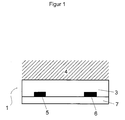
- Fig. 2 now shows analogous to the embodiment Fig. 1 shows the schematic structure of an inventive Sensors as test strips 2.
- the layer 8 contains soluble buffer substances and optionally more Components used for sample preparation required are. After contact with an aqueous Solution, the layer 8 dissolves, causing the necessary adjustment of the pH and if necessary ionic strength of the sample solution.
- layer 8 consists of filter paper, the dried components of the phosphate buffer or TRIS buffer contains and has one Layer thickness from 0.01 ⁇ m to 1 mm.
- the case 1.2 corresponds to the situation when the share the volume conductivity of the sample on the sensor output signal is minimal so that the measured signal mainly the volume conductivity of the ion-selective Membrane corresponds.
- the electrodes can, for example, be wire electrodes be designed. Proves to be advantageous the extremely simple and inexpensive Production.
- Disc electrodes have the advantage of being simple Renewal of the probe by polishing the measuring surface of the electrodes.
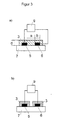
- a preferred design option for the sensor electrodes form interdigital electrodes, as in Fig. 4 shown.
- IDE interdigital electrodes
- conduction bands 5, 6 are applied to an insulating substrate 7 (Fig. 4).
- the latter can be a polymer tape (e.g. polyimide), glass, ceramics (e.g. molten aluminum or sital) sapphire or passivated Be silicon.
- the electrode materials can be made of ionic, electronic or semiconducting Materials exist.
- the passivation layer 10 only leaves the electrical tap and the sensitive area of the Leaves electrode 5, 6.
- This passivation layer 10 can e.g. be a polymer film (high temperature crosslinked Polyimide or photoresistors) or a inorganic film of, for example, pyrolytic Silicon oxide, CVD silicon nitride or applied Glass.
- the advantage of using an IDE is that Possibility of tight arrangement of the electrodes (the Dimensions a and b can reach the submicro scale be reduced) while being large Periphery, causing an increase in sensitivity conductivity measurements on a small area leads.
- the lowest achievable limit for dimensions a and b are around 0.1 ⁇ m, 2 ⁇ m and 50, respectively ⁇ m when electron photolithography, optical photolithography or screen printing technology for electrode production be applied.
- the thickness h of the Electrodes are preferably in a range of 0.01 ⁇ m to 10 ⁇ m.
- the cation-selective layer 3 is applied to the measuring surface of the IDE, which is free of passivation.
- the membrane must cover the entire sensitive area of the electrodes 5, 6. Since the electrical conductivity of the ion-selective membrane is rather low (its resistance can reach a height of 10 8 ⁇ * cm 2 ), even small parts of the electrode directly exposed to the solution make a reliable measurement of the membrane conductivity impossible because its resistance is less than the membrane resistance itself, and thus they can short-circuit the current flow in the measuring circuit.
- the dimensions of a, b and h should be as possible be chosen so that the ratio 1.2 (see above) is met is, that is, the membrane thickness d should be greater as a as well as b and h.
- the thickness of the central part of the passivation layer covering the chip preferably be larger than that of the measuring membrane. For in this case, changes in the underground conductivity interfere the measurement of the sample to the smallest extent the conductivity of the ion-selective membrane.
- the invention includes not only individual, but also Multi-analyte probes that are created by uniting or integrating of multiple electrodes on one sensor unit or be made a carrier and with for different cations coated specific layers are. Sensors with moderate selectivity can can also be integrated in a multi-sensor unit, what to get so-called "finger prints" that leads to the different compositions correspond to the sample solution. Subsequent can Use of various methods of pattern recognition a corresponding response pattern Sample composition can be assigned.
- the preferred The construction of the multisensor is based on the Use of microelectronic chips with the required Number of interdigital electrode pairs, each pair being covered with the appropriate membrane is. Such a construction has the advantage technological compatibility with IC technologies as well as the simplicity of miniaturization.
- the load resistance R L is connected in series with the sensor to be examined and the voltage drop at R L supplies the output signal.
- the preferred condition for the use of such an arrangement is that within the frequency range of the input voltage used, the impedance Z sensor of the tested sensor should be significantly larger than R L.
- ⁇ is the angular frequency of the input voltage U in and U out is the output voltage.
- R L ⁇ U inp represents, which is proportional to the measured output signal and can be calculated using equation 3, provided that R L and the amplitude of the input voltage U inp are known.
- the ad Impedance Z of the sensor measured.
- the impedance Z of a Systems provides the reciprocal of the associated admittance Impedance measurements can therefore also to characterize the conductivity of a measuring membrane be applied.
- the measurements of admittance, or alternatively a phase component of the output signal the measuring arrangement of Fig. 4 used. These values also depend on the frequency, and this dependence can in the different frequency ranges vary.
- the usual operating frequency is taking these factors into account with the aim of Optimization of sensor sensitivity, the reduction the effort with regard to the measuring equipment as well as the suppression of non-specific interference selected.
- the preferred work area is included Frequencies between 100 Hz and 100 kHz.
- Two identical pairs of interdigital thin-film metal electrodes made of Ni, Pt or Au are produced by vacuum deposition on a 0.5 mm thick ceramic substrate.
- the dimensions of a sensor chip are 5 mm x 20 mm.
- Each electrode finger is approx. 10 ⁇ m wide and approx. 1 mm long with a distance of approx. 10 ⁇ m between the electrode fingers of a pair.
- the sensitive area of each pair of electrodes forming an impedimetric transducer is approximately 1 mm 2 .
- the central part of the chip is encapsulated with a layer of Dow Corning silicone rubber. The complete chip layout is shown schematically in FIG. 4.
- High molecular weight polyvinyl chloride homopolymer is used as the polymer material used, is plasticizer o-nitrophenyl octyl ether.
- plasticizer o-nitrophenyl octyl ether.
- the cation-selective layer has the following composition: 5.5 mg ETH 2412, 15 mg valinomycin, 160 mg o-nitrophenyl octyl ether, 80 mg PVC. This composition is dissolved in 3 ml of tetrahydrofuran and by immersion of the sensor in this solution on the sensitive Surface of the transducer applied.
- the sample solution is mixed with a universal buffer (10 mM NaH 2 PO 4 , 6.6 mM citric acid, 21.5 mM Na 2 B 4 O 7 ) and adjusted to a pH of 5 with dilute H 2 SO 4 .
- a universal buffer (10 mM NaH 2 PO 4 , 6.6 mM citric acid, 21.5 mM Na 2 B 4 O 7 ) and adjusted to a pH of 5 with dilute H 2 SO 4 .
Landscapes
- Life Sciences & Earth Sciences (AREA)
- Chemical & Material Sciences (AREA)
- Health & Medical Sciences (AREA)
- General Physics & Mathematics (AREA)
- Physics & Mathematics (AREA)
- Analytical Chemistry (AREA)
- Biochemistry (AREA)
- General Health & Medical Sciences (AREA)
- Immunology (AREA)
- Pathology (AREA)
- Molecular Biology (AREA)
- Biophysics (AREA)
- Chemical Kinetics & Catalysis (AREA)
- Electrochemistry (AREA)
- Investigating Or Analyzing Materials By The Use Of Electric Means (AREA)
Description
- edle Metalle (Ag, Au, Pt, Pd,...);
- andere ausreichend chemisch stabile Metalle (Ni, Ta, Ti, Cr, Cu, V, Al,...);
- leitfähige Pasten und Metall- oder Graphitpartikel enthaltende Epoxidharze;
- Materialien auf Kohlenstoffbasis (Kohlefasern, Glaskohlenstoff, Graphit) ;
- hochdotiertes Silizium (Poly-Si);
- leitfähige Polymere (Polypyrrol, Polyanilin, Polyacetylen,...);
- leitende Polymere, die Metall- oder Graphitpartikel enthalten.

- 20-80 Gew% Polymermaterial, vorzugsweise 30-35 Gew%
- 20-80 Gew% Weichmacher, vorzugsweise 60-65 Gew%
- 1-10 Gew% Kationenselektive Kopplungselemente, vorzugsweise 1-5 Gew%
- 1-10 Gew% Komponente mit Säure/Base-Eigenschaften, vorzugsweise 1-5 Gew%
- 64 Gew.% Polymermaterial
- 32 Gew.% Weichmacher
- 2 Gew.% kationenselektive Kopplungselementen
- 2 Gew.% Komponenten mit Säure/Base-Eigenschaften.
- Die Untergrundleitfähigkeit der Probe konstant ist;
- Die Leitfähigkeit der Probe sehr viel größer ist als die Leitfähigkeit der verwendeten kationenselektiven Membranen;
- Die Sensor-Charakteristika in einer Standardlösung bekannter oder eingestellter Leitfähigkeit vor und nach der Messung in einer Lösung bestimmt wurden;
- parallele Messungen der Leitfähigkeit der probe gemacht und im betracht gezogen wurden.
Claims (27)
- Kationselektiver Sensor zur qualitativen und/oder quantitativen Bestimmung von Kationen in Lösungen, welcher Sensor mindestens eine, mit der Lösung (4) in Kontakt stehende, ionisch leitende, kationspezifische Schicht (3) aus einem flüssigen, festen oder halbfesten Material enthält,
diese Schicht (3) Kopplungselemente enthält, welche die Kationen selektiv aus der Lösung entfernen, so daß sich durch Kationenaufnahme die elektrischen Eigenschaften wie Widerstand, Leitfähigkeit, Admittanz oder Impedanz der Schicht (3) ändern,
die kationselektive Schicht (3) mindestens eine Säure/Base-Komponente enthält,
und der Sensor mindestens zwei Elektroden (5, 6), von denen mindestens eine mit der kationspezifischen Schicht (3) in Verbindung steht, umfaßt. - Kationselektiver Sensor nach Anspruch 1, dadurch gekennzeichnet, daß die Säure/Base-Komponente in Form von funktionellen Gruppierungen mit Säure/Base-Eigenschaften in der kationselektiven Schicht (3) vorhanden ist.
- Kationselektiver Sensor nach einem der vorhergehenden Ansprüche, dadurch gekennzeichnet, daß die Säure/Base-Komponente in Form von mindestens einer chemischen Verbindung mit Säure/Base-Eigenschaften in der kationselektiven Schicht (3) vorhanden ist.
- Kationselektiver Sensor nach einem der vorhergehenden Ansprüche, dadurch gekennzeichnet, daß die Säure/Base-Komponente an eine weitere Komponente der kationselektiven Schicht (3) gebunden ist.
- Kationselektiver Sensor nach einem der vorhergehenden Ansprüche, dadurch gekennzeichnet, daß die Säure/Base-Komponente lipophil ist.
- Kationselektiver Sensor nach einem der vorhergehenden Ansprüche, dadurch gekennzeichnet, daß die Säure/Base-Komponente eine lipophilen Säure oder lipophile Base ist.
- Kationselektiver Sensor nach einem der vorhergehenden Ansprüche, dadurch gekennzeichnet, daß die Säure/Base-Komponente eine Säurekonstante pKs im Bereich von 3 bis 12 besitzt.
- Kationselektiver Sensor nach einem der vorhergehenden Ansprüche, dadurch gekennzeichnet, daß die Säure/Base-Komponente eine Säurekonstante pKs im Bereich von 6 bis 8 besitzt.
- Kationselektiver Sensor nach einem der vorhergehenden Ansprüche, dadurch gekennzeichnet, daß die Säure/Base-Komponente ein pH-Indikator oder ein Derivat eines pH-Indikators ist.
- Kationselektiver Sensor nach Anspruch 9, dadurch gekennzeichnet, daß der pH-Indikator oder das Derivat lipohil ist.
- Kationselsktiver Sensor nach einem der Ansprüche 9 oder 10, dadurch gekennzeichnet, daß der pH-Indikator oder das Derivat durch Ankopplung von Benzyl-Resten oder Alkan-Ketten lipophil modifiziert ist.
- Kationselektiver Sensor nach Anspruch 9, dadurch gekennzeichnet, daß die Säure/Base-Komponente eine phenolische Verbindung wie p-Nitrophenol, eine Verbindung oder ein Derivat des Fluorescein, des Fluorescinester, des 7-Hydroxy-Cumarin, der Resorufine, der Flavone, des Pyren-3-ol oder eine Komponente wie 7-(n-decyl)-2-methyl-4-(3',5'-dichlorophen-4'-on)indonaphtol ist.
- Kationselektiver Sensor nach einem der Ansprüche 1 bis 8, dadurch gekennzeichnet, daß die Säure/Base-Komponente eine Fettsäure, ein Lipid, ein Tensid oder ein Derivat dieser Substanzen ist.
- Kationselektiver Sensor nach einem der Ansprüche 1 bis 8, dadurch gekennzeichnet, daß die Säure/Base-Komponente 3-Hydroxy-4-(4-nitrophenolazo)phenyloctadecanoat ist.
- Kationselektiver Sensor nach einem der vorhergehenden Ansprüche, dadurch gekennzeichnet, daß die kationselektive Schicht (3) mindestens eine der Komponenten organische Flüssigkeit, Weichmacher, Ionenaustauscher, Polymer, Trägermaterial oder eine beliebige Kombination dieser Komponenten enthält.
- Kationselektiver Sensor nach einem der vorhergehenden Ansprüche, dadurch gekennzeichnet, daß die kationselektive Schicht (3) lipophil ist.
- Kationselektiver Sensor nach einem der vorhergehenden Ansprüche, dadurch gekennzeichnet, daß die kationselektive Schicht (3) eine Dicke zwischen 0,01 µm und 1 mm aufweist.
- Kationselektiver Sensor nach einem der vorhergehenden Ansprüche, dadurch gekennzeichnet, daß die kationselektive Schicht (3) 20-80 Gew% Polymermaterial, 20-80 Gew% Weichmacher, 1-10 Gew% kationselektive Kopplungselemente und 1-10 Gew% Säure/Base-Komponenten enthält.
- Kationselektiver Sensor nach Anspruch 18, dadurch gekennzeichnet, daß die kationselektive Schicht (3) 1-10 Gew% Ionentauscher enthält.
- Kationselektiver Sensor nach einem der vorhergehenden Ansprüche, dadurch gekennzeichnet, daß die kationselektive Schicht (3) auf einen inerten Träger (7) aufgebracht ist.
- Kationselektiver Sensor nach einem der vorhergehenden Ansprüche, dadurch gekennzeichnet, daß auf die kationselektiven Schicht (3) eine weitere Schicht (8) aufgebracht ist.
- Kationselektiver Sensor Anspruch 21, dadurch gekennzeichnet, daß die Schicht (8) mindestens eine lösliche Puffersubstanz enthält.
- Kationselektiver Sensor nach einem der Ansprüche 21 bis 22, dadurch gekennzeichnet, daß die Schicht (8) mindestens eine der Probenvorbereitung dienende Komponente enthält.
- Kationselektiver Sensor nach einem der Ansprüche 21 bis 23, dadurch gekennzeichnet, daß die Schicht (8) einen die kationselektive Schicht (3) stabilisierenden, porösen Träger oder Matrix enthält.
- Kationselektiver Sensor nach einem der Ansprüche 21 bis 24, dadurch gekennzeichnet, daß einzelne Komponenten der Schicht (8) in der Lösung (4) löslich sind und den pH-Wert und/oder die ionische Stärke der Lösung (4) einstellen.
- Kationselektiver Sensor nach einem der Ansprüche 21 bis 25, dadurch gekennzeichnet, daß die Schicht (8) eine Dicke zwischen 0,01 µm und 1 mm aufweist.
- Kationselektiver Sensor nach einem der vorherigen Ansprüche, dadurch gekennzeichnet, daß der Sensor als Teststreifen (2) ausgeführt ist.
Applications Claiming Priority (3)
| Application Number | Priority Date | Filing Date | Title |
|---|---|---|---|
| DE19612680 | 1996-03-29 | ||
| DE19612680A DE19612680C2 (de) | 1996-03-29 | 1996-03-29 | Kationselektiver Sensor |
| PCT/DE1997/000645 WO1997037215A1 (de) | 1996-03-29 | 1997-03-27 | Kationselektiver sensor |
Publications (2)
| Publication Number | Publication Date |
|---|---|
| EP0890096A1 EP0890096A1 (de) | 1999-01-13 |
| EP0890096B1 true EP0890096B1 (de) | 2002-07-24 |
Family
ID=7789946
Family Applications (1)
| Application Number | Title | Priority Date | Filing Date |
|---|---|---|---|
| EP97920558A Expired - Lifetime EP0890096B1 (de) | 1996-03-29 | 1997-03-27 | Kationselektiver sensor |
Country Status (6)
| Country | Link |
|---|---|
| US (1) | US6200444B1 (de) |
| EP (1) | EP0890096B1 (de) |
| JP (1) | JP2000507696A (de) |
| AU (1) | AU2691497A (de) |
| DE (2) | DE19612680C2 (de) |
| WO (1) | WO1997037215A1 (de) |
Families Citing this family (33)
| Publication number | Priority date | Publication date | Assignee | Title |
|---|---|---|---|---|
| US20050019215A1 (en) * | 1998-12-10 | 2005-01-27 | Gerlinde Bischoff | Measuring probe for detecting agents and the measurement of their concentrations |
| DE19856885C2 (de) * | 1998-12-10 | 2001-03-15 | Robert Bischoff | Meßsonde und Verfahren zur Messung der Konzentration von Agenzien in Gasen und/oder Flüssigkeiten |
| AU2514900A (en) | 1999-01-27 | 2000-08-18 | United States Of America As Represented By The Secretary Of The Navy, The | Fabrication of conductive/non-conductive nanocomposites by laser evaporation |
| JP3306506B2 (ja) | 1999-08-23 | 2002-07-24 | 独立行政法人産業技術総合研究所 | 非環状ペプチドを用いたイオンセンサ |
| GB2370410A (en) * | 2000-12-22 | 2002-06-26 | Seiko Epson Corp | Thin film transistor sensor |
| DE10122150A1 (de) * | 2001-05-08 | 2002-11-21 | It Dr Gambert Gmbh | Vorrichtung zur Messung des Partialdrucks von Kohlendioxid |
| FR2840906B1 (fr) * | 2002-06-12 | 2004-07-16 | Commissariat Energie Atomique | Derives de per(3,6-anhydro) cyclodextrines, leur preparation et leur utilisation pour separer des ions, notamment des anions a base de chrome et de manganese |
| US7465425B1 (en) * | 2002-09-09 | 2008-12-16 | Yizhong Sun | Sensor and method for detecting analytes in fluids |
| DE10318115A1 (de) * | 2003-04-22 | 2004-11-11 | Robert Bosch Gmbh | Potentiometrische Sensoreinrichtung |
| US7452457B2 (en) | 2003-06-20 | 2008-11-18 | Roche Diagnostics Operations, Inc. | System and method for analyte measurement using dose sufficiency electrodes |
| US7488601B2 (en) | 2003-06-20 | 2009-02-10 | Roche Diagnostic Operations, Inc. | System and method for determining an abused sensor during analyte measurement |
| GB2404252B (en) * | 2003-07-24 | 2005-09-28 | Schlumberger Holdings | Apparatus and method for measuring concentrations of ions in downhole water |
| US7988838B2 (en) * | 2005-11-01 | 2011-08-02 | Ge Analytical Instruments, Inc. | Adhesion of membranes on nitride layer in electrochemical sensors by attachment to underlying oxide layer |
| EP1865310A1 (de) * | 2006-06-10 | 2007-12-12 | ETH Zürich | Enantioselektiver kapazitiver Sensor |
| WO2009113250A1 (ja) * | 2008-03-12 | 2009-09-17 | パナソニック株式会社 | 薄膜電極、これを備えた測定セル及び検査装置 |
| DE102009023035A1 (de) * | 2009-05-28 | 2010-12-02 | Siemens Aktiengesellschaft | Diagnosegerät |
| FR2943421B1 (fr) * | 2009-03-18 | 2012-11-30 | Commissariat Energie Atomique | Detection et quantification electrique de derives mercuriques |
| US20120061257A1 (en) * | 2010-09-14 | 2012-03-15 | University Of Southern California | Concentric bipolar electrochemical impedance spectroscopy to assess vascular oxidative stress |
| JP5740299B2 (ja) * | 2011-12-28 | 2015-06-24 | 株式会社堀場製作所 | 液膜型イオン選択性電極 |
| US9494541B2 (en) * | 2012-07-05 | 2016-11-15 | General Electricity Company | Sensors for gas dosimetry |
| US11175268B2 (en) | 2014-06-09 | 2021-11-16 | Biometry Inc. | Mini point of care gas chromatographic test strip and method to measure analytes |
| EP3152557A4 (de) | 2014-06-09 | 2017-12-13 | Biometry Inc. | Kostengünstiger teststreifen und verfahren zur messung von analyten |
| EA037290B1 (ru) * | 2015-12-30 | 2021-03-04 | Автономная некоммерческая образовательная организация высшего образования "Сколковский институт науки и технологий" | Наноэлектрод для определения ионов cu (ii) и способ получения и применения наноэлектрода |
| AU2017300528C1 (en) * | 2016-07-19 | 2022-10-20 | Biometry Inc. | Methods of and systems for measuring analytes using batch calibratable test strips |
| WO2018068079A1 (en) | 2016-10-13 | 2018-04-19 | University Of South Australia | Apparatus and method for anion detection and/or measurement |
| US11567030B2 (en) * | 2019-07-29 | 2023-01-31 | Rosemount Inc. | Electrochemical sensor |
| CN114487032B (zh) * | 2020-10-26 | 2024-08-06 | 戴念华 | 气体感测元件及检测系统 |
| DE102021127227A1 (de) | 2021-10-20 | 2023-04-20 | Endress+Hauser Conducta Gmbh+Co. Kg | Sensor zur Messung eines pH-Werts |
| CN114199976A (zh) * | 2021-11-16 | 2022-03-18 | 江苏大学 | 一种基于阻抗分析的钾离子浓度传感器和检测装置及方法 |
| CN114923970A (zh) * | 2022-04-29 | 2022-08-19 | 南京工业大学 | 一种pvc钙离子选择电极及其制备方法 |
| EP4431930B1 (de) * | 2023-03-13 | 2025-07-09 | EXIAS Medical GmbH | Sensor zur bestimmung der konzentration einer sauren oder basischen verbindung und verwendung einer wasserlöslichen schutzschicht mit ph-pufferungseigenschaften zum schutz desselben |
| WO2025240995A1 (en) * | 2024-05-22 | 2025-11-27 | SensorC Pty Ltd | Soil carbon sensing methodology and electrode arrangement |
| DE102024120774A1 (de) * | 2024-07-22 | 2026-01-22 | Pyroscience Gmbh | Optochemischer Ionen-Sensor mit Antifouling-Beschichtung |
Family Cites Families (11)
| Publication number | Priority date | Publication date | Assignee | Title |
|---|---|---|---|---|
| JPS5539042A (en) * | 1978-09-14 | 1980-03-18 | Tokyo Daigaku | Ion selecting field-effect sensor |
| US4334880A (en) * | 1980-10-20 | 1982-06-15 | Malmros Mark K | Analytical device having semiconductive polyacetylene element associated with analyte-binding substance |
| US4571543A (en) * | 1983-03-28 | 1986-02-18 | Southwest Medical Products, Inc. | Specific material detection and measuring device |
| CA1253057A (en) * | 1984-02-24 | 1989-04-25 | Mary L. Gantzer | Ion test means having a porous carrier matrix |
| JPS61207443A (ja) * | 1985-03-09 | 1986-09-13 | Agency Of Ind Science & Technol | イオン選択電極膜 |
| GB2204408A (en) * | 1987-03-04 | 1988-11-09 | Plessey Co Plc | Biosensor device |
| CH677295A5 (en) * | 1989-02-10 | 1991-04-30 | Wilhelm Prof Dr Simon | Device with reduced interface resistance - between conductive solid (electrode) and ion-conductive polymer (membrane) |
| US5312762A (en) | 1989-03-13 | 1994-05-17 | Guiseppi Elie Anthony | Method of measuring an analyte by measuring electrical resistance of a polymer film reacting with the analyte |
| DE4241438C2 (de) * | 1992-06-27 | 1995-06-14 | Draegerwerk Ag | Sensor zum Nachweis von Analyten in einem fluiden Medium |
| DE4437274C2 (de) * | 1994-10-18 | 1998-11-05 | Inst Chemo Biosensorik | Analytselektiver Sensor |
| EP0861439B1 (de) * | 1996-06-21 | 2002-11-06 | Dade Behring Inc. | Zusammensetzung und verfahren zur herstellung von sensoren mit ionenselektiver elektrode |
-
1996
- 1996-03-29 DE DE19612680A patent/DE19612680C2/de not_active Expired - Lifetime
-
1997
- 1997-03-27 DE DE59707789T patent/DE59707789D1/de not_active Expired - Lifetime
- 1997-03-27 WO PCT/DE1997/000645 patent/WO1997037215A1/de not_active Ceased
- 1997-03-27 EP EP97920558A patent/EP0890096B1/de not_active Expired - Lifetime
- 1997-03-27 AU AU26914/97A patent/AU2691497A/en not_active Abandoned
- 1997-03-27 US US09/155,510 patent/US6200444B1/en not_active Expired - Fee Related
- 1997-03-27 JP JP9534820A patent/JP2000507696A/ja active Pending
Also Published As
| Publication number | Publication date |
|---|---|
| WO1997037215A1 (de) | 1997-10-09 |
| DE19612680A1 (de) | 1997-10-02 |
| DE59707789D1 (de) | 2002-08-29 |
| EP0890096A1 (de) | 1999-01-13 |
| AU2691497A (en) | 1997-10-22 |
| US6200444B1 (en) | 2001-03-13 |
| JP2000507696A (ja) | 2000-06-20 |
| DE19612680C2 (de) | 2000-02-03 |
Similar Documents
| Publication | Publication Date | Title |
|---|---|---|
| DE19612680C2 (de) | Kationselektiver Sensor | |
| DE4437274C2 (de) | Analytselektiver Sensor | |
| DE69220915T2 (de) | Ionenselektive Festkörperelektroden auf Graphitbasis mit Polymermembran | |
| DE69422687T2 (de) | Biosensor zur hämatokritbestimmung | |
| DE60012946T2 (de) | Interferenzreduzierter wegwerfbarer sensor und herstellungsverfahren | |
| DE68928017T2 (de) | Referenz-elektrode | |
| DE60025334T2 (de) | Wegwerfteststreifen mit einer intgrierten reagenz/blut trennschicht | |
| DE102007054230A1 (de) | Verfahren zum Nachweisen von Verunreinigungen in einer Flüssigkeit | |
| DE69123519T2 (de) | Verfahren und Vorrichtung zur Bestimmung von Ionen | |
| EP1346220B1 (de) | Sensor zur lumineszenz-optischen bestimmung eines analyten | |
| DE2722617C2 (de) | Ionenselektive Elektrode und Verwendung derselben | |
| DE69623006T2 (de) | Sensor | |
| DE69331726T2 (de) | Verfahren zur potentiometrischen Bestimmung von Ionen unter Verwendung einer asymmetrischen ionenselektiven Membranelektrode mit erhöhter Selektivität | |
| WO2010072510A1 (de) | Ionenselektive elektrode | |
| DE112012003198T5 (de) | Sensorkopf, elektrochemischer Sensor und Verfahren zur Verwendung des elektrochemischen Sensors | |
| DE69737627T2 (de) | Analysezelle | |
| DE102004044299A1 (de) | Vorrichtung und Verfahren zum Nachweis von geladenen Makromolekülen | |
| DE69225818T2 (de) | Elektroden für potentiometrische Sensoren | |
| DE19509518A1 (de) | Sensitive Materialien und Vorrichtungen zur Detektion organischer Komponenten und Lösungsmitteldämpfen in der Luft | |
| DE102005047443A1 (de) | Gassensor | |
| EP0709679B1 (de) | Verfahren und mizellares System zur Bestimmung einer Substanz | |
| DE102010062224A1 (de) | Messvorrichtung zur Bestimmung einer Konzentration einer vorgegebenen Ionenart in einer Messflüssigkeit | |
| DE69315705T2 (de) | Analytisches verfahren und vorrichtung zur bestimmung von hydrogen peroxid | |
| DE4212910C2 (de) | Verfahren zur Beschichtung von Sensoren mit selektiv durchlässigen Polymermembranen | |
| EP2414821B1 (de) | Vorrichtung nach art einer elektrochemischen kamera sowie verfahren zur herstellung und verwendung der vorrichtung |
Legal Events
| Date | Code | Title | Description |
|---|---|---|---|
| PUAI | Public reference made under article 153(3) epc to a published international application that has entered the european phase |
Free format text: ORIGINAL CODE: 0009012 |
|
| 17P | Request for examination filed |
Effective date: 19980922 |
|
| AK | Designated contracting states |
Kind code of ref document: A1 Designated state(s): DE ES FR GB NL |
|
| GRAG | Despatch of communication of intention to grant |
Free format text: ORIGINAL CODE: EPIDOS AGRA |
|
| 17Q | First examination report despatched |
Effective date: 20010816 |
|
| GRAG | Despatch of communication of intention to grant |
Free format text: ORIGINAL CODE: EPIDOS AGRA |
|
| GRAG | Despatch of communication of intention to grant |
Free format text: ORIGINAL CODE: EPIDOS AGRA |
|
| GRAH | Despatch of communication of intention to grant a patent |
Free format text: ORIGINAL CODE: EPIDOS IGRA |
|
| GRAH | Despatch of communication of intention to grant a patent |
Free format text: ORIGINAL CODE: EPIDOS IGRA |
|
| GRAA | (expected) grant |
Free format text: ORIGINAL CODE: 0009210 |
|
| AK | Designated contracting states |
Kind code of ref document: B1 Designated state(s): DE ES FR GB NL |
|
| PG25 | Lapsed in a contracting state [announced via postgrant information from national office to epo] |
Ref country code: NL Free format text: LAPSE BECAUSE OF FAILURE TO SUBMIT A TRANSLATION OF THE DESCRIPTION OR TO PAY THE FEE WITHIN THE PRESCRIBED TIME-LIMIT Effective date: 20020724 Ref country code: GB Free format text: LAPSE BECAUSE OF FAILURE TO SUBMIT A TRANSLATION OF THE DESCRIPTION OR TO PAY THE FEE WITHIN THE PRESCRIBED TIME-LIMIT Effective date: 20020724 Ref country code: FR Free format text: LAPSE BECAUSE OF NON-PAYMENT OF DUE FEES Effective date: 20020724 |
|
| REG | Reference to a national code |
Ref country code: GB Ref legal event code: FG4D Free format text: NOT ENGLISH |
|
| REF | Corresponds to: |
Ref document number: 59707789 Country of ref document: DE Date of ref document: 20020829 |
|
| NLV1 | Nl: lapsed or annulled due to failure to fulfill the requirements of art. 29p and 29m of the patents act | ||
| GBV | Gb: ep patent (uk) treated as always having been void in accordance with gb section 77(7)/1977 [no translation filed] |
Effective date: 20020724 |
|
| PG25 | Lapsed in a contracting state [announced via postgrant information from national office to epo] |
Ref country code: ES Free format text: LAPSE BECAUSE OF FAILURE TO SUBMIT A TRANSLATION OF THE DESCRIPTION OR TO PAY THE FEE WITHIN THE PRESCRIBED TIME-LIMIT Effective date: 20030130 |
|
| EN | Fr: translation not filed | ||
| PG25 | Lapsed in a contracting state [announced via postgrant information from national office to epo] |
Ref country code: DE Free format text: LAPSE BECAUSE OF THE APPLICANT RENOUNCES Effective date: 20030404 |
|
| PLBE | No opposition filed within time limit |
Free format text: ORIGINAL CODE: 0009261 |
|
| STAA | Information on the status of an ep patent application or granted ep patent |
Free format text: STATUS: NO OPPOSITION FILED WITHIN TIME LIMIT |
|
| 26N | No opposition filed |
Effective date: 20030425 |