EP0889155A1 - Verfahren zur Erkennung unzulässiger Betriebszustände in einem Warmluft-Wäschetrockner sowie Wäschetrockner mit einem solchen Erkennungsverfahren - Google Patents
Verfahren zur Erkennung unzulässiger Betriebszustände in einem Warmluft-Wäschetrockner sowie Wäschetrockner mit einem solchen Erkennungsverfahren Download PDFInfo
- Publication number
- EP0889155A1 EP0889155A1 EP98110697A EP98110697A EP0889155A1 EP 0889155 A1 EP0889155 A1 EP 0889155A1 EP 98110697 A EP98110697 A EP 98110697A EP 98110697 A EP98110697 A EP 98110697A EP 0889155 A1 EP0889155 A1 EP 0889155A1
- Authority
- EP
- European Patent Office
- Prior art keywords
- difference value
- value
- count
- temperature
- permissible
- Prior art date
- Legal status (The legal status is an assumption and is not a legal conclusion. Google has not performed a legal analysis and makes no representation as to the accuracy of the status listed.)
- Granted
Links
- 238000000034 method Methods 0.000 title claims description 36
- 230000004064 dysfunction Effects 0.000 title 1
- 238000010438 heat treatment Methods 0.000 claims abstract description 19
- 238000001035 drying Methods 0.000 claims description 16
- 238000001514 detection method Methods 0.000 claims description 5
- 238000013021 overheating Methods 0.000 description 18
- 238000009833 condensation Methods 0.000 description 3
- 230000005494 condensation Effects 0.000 description 3
- 230000008569 process Effects 0.000 description 3
- 230000008901 benefit Effects 0.000 description 2
- 230000006378 damage Effects 0.000 description 2
- 238000009529 body temperature measurement Methods 0.000 description 1
- 239000003990 capacitor Substances 0.000 description 1
- 230000008859 change Effects 0.000 description 1
- 238000004140 cleaning Methods 0.000 description 1
- 230000009849 deactivation Effects 0.000 description 1
- 238000010586 diagram Methods 0.000 description 1
- 230000000737 periodic effect Effects 0.000 description 1
- 239000002244 precipitate Substances 0.000 description 1
- 230000009467 reduction Effects 0.000 description 1
- 230000000630 rising effect Effects 0.000 description 1
- 230000003685 thermal hair damage Effects 0.000 description 1
Images
Classifications
-
- D—TEXTILES; PAPER
- D06—TREATMENT OF TEXTILES OR THE LIKE; LAUNDERING; FLEXIBLE MATERIALS NOT OTHERWISE PROVIDED FOR
- D06F—LAUNDERING, DRYING, IRONING, PRESSING OR FOLDING TEXTILE ARTICLES
- D06F58/00—Domestic laundry dryers
- D06F58/32—Control of operations performed in domestic laundry dryers
- D06F58/34—Control of operations performed in domestic laundry dryers characterised by the purpose or target of the control
- D06F58/50—Responding to irregular working conditions, e.g. malfunctioning of blowers
-
- D—TEXTILES; PAPER
- D06—TREATMENT OF TEXTILES OR THE LIKE; LAUNDERING; FLEXIBLE MATERIALS NOT OTHERWISE PROVIDED FOR
- D06F—LAUNDERING, DRYING, IRONING, PRESSING OR FOLDING TEXTILE ARTICLES
- D06F2103/00—Parameters monitored or detected for the control of domestic laundry washing machines, washer-dryers or laundry dryers
- D06F2103/02—Characteristics of laundry or load
- D06F2103/08—Humidity
-
- D—TEXTILES; PAPER
- D06—TREATMENT OF TEXTILES OR THE LIKE; LAUNDERING; FLEXIBLE MATERIALS NOT OTHERWISE PROVIDED FOR
- D06F—LAUNDERING, DRYING, IRONING, PRESSING OR FOLDING TEXTILE ARTICLES
- D06F2103/00—Parameters monitored or detected for the control of domestic laundry washing machines, washer-dryers or laundry dryers
- D06F2103/28—Air properties
- D06F2103/32—Temperature
-
- D—TEXTILES; PAPER
- D06—TREATMENT OF TEXTILES OR THE LIKE; LAUNDERING; FLEXIBLE MATERIALS NOT OTHERWISE PROVIDED FOR
- D06F—LAUNDERING, DRYING, IRONING, PRESSING OR FOLDING TEXTILE ARTICLES
- D06F2103/00—Parameters monitored or detected for the control of domestic laundry washing machines, washer-dryers or laundry dryers
- D06F2103/42—Parameters monitored or detected for the control of domestic laundry washing machines, washer-dryers or laundry dryers related to filters or pumps
-
- D—TEXTILES; PAPER
- D06—TREATMENT OF TEXTILES OR THE LIKE; LAUNDERING; FLEXIBLE MATERIALS NOT OTHERWISE PROVIDED FOR
- D06F—LAUNDERING, DRYING, IRONING, PRESSING OR FOLDING TEXTILE ARTICLES
- D06F2105/00—Systems or parameters controlled or affected by the control systems of washing machines, washer-dryers or laundry dryers
- D06F2105/28—Electric heating
-
- D—TEXTILES; PAPER
- D06—TREATMENT OF TEXTILES OR THE LIKE; LAUNDERING; FLEXIBLE MATERIALS NOT OTHERWISE PROVIDED FOR
- D06F—LAUNDERING, DRYING, IRONING, PRESSING OR FOLDING TEXTILE ARTICLES
- D06F2105/00—Systems or parameters controlled or affected by the control systems of washing machines, washer-dryers or laundry dryers
- D06F2105/58—Indications or alarms to the control system or to the user
-
- D—TEXTILES; PAPER
- D06—TREATMENT OF TEXTILES OR THE LIKE; LAUNDERING; FLEXIBLE MATERIALS NOT OTHERWISE PROVIDED FOR
- D06F—LAUNDERING, DRYING, IRONING, PRESSING OR FOLDING TEXTILE ARTICLES
- D06F37/00—Details specific to washing machines covered by groups D06F21/00 - D06F25/00
- D06F37/42—Safety arrangements, e.g. for stopping rotation of the receptacle upon opening of the casing door
-
- D—TEXTILES; PAPER
- D06—TREATMENT OF TEXTILES OR THE LIKE; LAUNDERING; FLEXIBLE MATERIALS NOT OTHERWISE PROVIDED FOR
- D06F—LAUNDERING, DRYING, IRONING, PRESSING OR FOLDING TEXTILE ARTICLES
- D06F58/00—Domestic laundry dryers
- D06F58/32—Control of operations performed in domestic laundry dryers
- D06F58/34—Control of operations performed in domestic laundry dryers characterised by the purpose or target of the control
- D06F58/36—Control of operational steps, e.g. for optimisation or improvement of operational steps depending on the condition of the laundry
- D06F58/38—Control of operational steps, e.g. for optimisation or improvement of operational steps depending on the condition of the laundry of drying, e.g. to achieve the target humidity
Definitions
- the present invention relates to a method for recognizing impermissible operating states in a warm air dryer with a laundry drum and a dryer, in which such a process is implemented.
- the laundry drum In conventional tumble dryers, the laundry drum is usually rotating laundry is dried by the fact that the drum and thus the Laundry is passed through a heated air stream that is capable of moist To remove moisture from the laundry, which gradually dries the laundry.
- the supplied air flow is in a supply line in front of the drum by means of a suitable one Heater heats up, and is in the drum after crossing the laundry either discharged to the outside (exhaust air dryer) or a heat exchanger supplied, in which the air is cooled and the moisture precipitates as condensate.
- the drying of the laundry is such that the supply air is heated and through the laundry flows, depending on the moisture level of the laundry and its own temperature removes a corresponding amount of moisture from the laundry. It is necessary that after reaching a certain degree of drying of the laundry too large heating of the supply air flow and thus both overheating of the laundry on the one hand and overheating of the clothes dryer on the other hand is avoided.
- DE-OS-16 10 314 describes a method for automatically controlling the drying process until a desired degree of dryness is reached the gradient of the rising temperature in a laundry drying system known, during or at the end of the drying process the difference between the temperatures of the supply air and the extract air is determined and the Change over time of this difference as a criterion for switching off the heating device is used.
- This procedure requires at least two temperature sensors a corresponding control system, the control system only permitting when exceeded The maximum temperature switches off the heating process.
- DE-30 30 864 C2 describes a method for automatically controlling the drying process in a laundry drying system and a device for carrying it out known of the method in which a corresponding operating time in comparison is calculated with a fictitious operating time of the drying process, and the Drying process is controlled accordingly.
- the present invention is therefore based on the object of a method in The preamble of claim 1 to improve the type mentioned so far in advance such an inadmissible operating state when a critical operating state is reached is recognized and, if necessary, such an operating state well before it Reaching is prevented or can be prevented.
- the present invention is also based on the object of a corresponding one to propose a tumble dryer, in which inadmissible operating conditions are recognized in good time and can be prevented.
- the recognition method becomes inadmissible Operating conditions in a tumble dryer the temperature in the supply air flow above Supply air heating and periodically recorded in front of the laundry drum, from two successive a difference value (gradient) is formed, this difference value (Gradient) is compared with a predetermined permissible difference value (gradient), if the newly formed difference value is greater than the predetermined permissible difference value is, a count is increased by one step, this count with a predetermined permissible count value is compared, and if the current count value is larger than the predetermined permissible count value, the dryer of the dryer is switched off and / or a corresponding display is activated.
- the overheating of the supply air flow can be determined as such or Such a risk of overheating in time before the temperature is too high can be recognized and appropriate countermeasures, especially that Turning off the heater, done, causing damage to components and also the laundry in the dryer can be safely avoided.
- the process according to the invention can be used with great advantage both in condensation dryers as well as used in exhaust air dryers, making it universal for use can come.
- the temperature of the supply air flow from the beginning of the drying process is particularly advantageous to detected, whereby the entire temperature profile in the dryer is detected becomes.
- the procedure for recognizing impermissible operating conditions in a tumble dryer has a control method in which the measured according to a flow chart Values can be compared with specified values.
- This will be advantageous periodically successively recorded temperature difference values (gradients) with at least compared to a permissible overheating difference value (gradient).
- this current difference value is advantageously included compared to a second predetermined permissible difference value, that of a permissible Corresponds to temperature increase, which results from a lint filter blockage.
- the lint filter count increases by one Count value increased, the newly formed fluff filter count with a predetermined fluff filter count compared and if the newly formed lint filter count is greater than that predefined lint filter count value, the display of the lint filter blockage is activated.
- the present invention advantageously further relates to a tumble dryer a drum to hold the laundry to be dried, a blower to generate it an air flow that is passed through the laundry to be dried, a heater for heating the supplied air flow and a temperature sensor in the supply air duct, which is in the section between the heating of the supply air flow and the drum the dryer.
- a control is implemented in this tumble dryer, which is able to carry out the procedure for recognizing impermissible operating states.
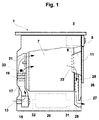
- FIG. 1 shows a clothes dryer 1 according to the invention in a partial sectional view.
- this has a program control device 3 which can be set by an operating handle 5 and preferably a fuzzy processor control may contain (not shown).
- the dryer has a laundry drum 7 in the usual way, which has a Pot 9 is accessible from a loading door 11 and through which the laundry in the Drum 7 can be inserted and removed again.
- a supply air opening 13 is arranged on the lower rear side of the clothes dryer 1, which draws in air from outside via a blower 15 and flows into a supply air duct 17 leaves.
- the fresh supply air continues to flow from the supply air duct 17 via a heating device 19 to the entrance 21 of the laundry drum 7.
- the supply air passes through the laundry drum 7 and flows at the outlet 23 through an exhaust air duct 25 and one inserted into this exhaust air duct Fluff filter 26 to an exhaust air outlet 27, from where it flows back into the open.
- the tumble dryer 1 thus described works according to the exhaust air principle.
- the drying air circuit can also be used to form a circulating air dryer are closed, the exhaust air being guided from the exhaust air duct 25 to a condenser 29 becomes.
- the condenser 29 is designed as a heat exchanger in which the moist Exhaust air is cooled down and the increased air humidity condenses accordingly. This Air is then conveyed again through the fan 15 into the supply air duct 17.
- the Condensate can be removed from the tumble dryer at a suitable point in a manner not shown be drained or pumped into a condensate tank, from which it is hand is removable.
- a temperature sensor 33 is arranged in the air duct above the heating device 19, which periodically detects the temperature of the air at predetermined time intervals and the Measured value supplies a corresponding control device (not shown).
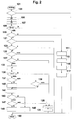
- FIG. 2 There is shown a block diagram showing the sequence of the inventive Method for detecting inadmissible operating states shows.
- control begins by a sensed temperature difference value, or a temperature gradient that is fed for processing in the controller.
- Step 103 checks whether the difference value of step 101 is acceptable Area is. If this is not the case, the program returns to the beginning.
- a value Z1 is read in, which is the permissible count of the temperature before overheating.
- a value Z2 is read in, which corresponds to the permissible count before the lint filter clogging to be signaled corresponds.
- step 109 it is checked whether Z1 is equal to zero. If this is the case, the program runs in a step 111, which initiates the deactivation of the gradient method, by setting the temperature count to zero. Then in one Step 113 set the counter to zero and in step 115 the count value of the periodic Temperature measurement also set to zero. Then in a step 117 an overheating signal is also set to zero and the program returns to Beginning back.
- step 109 a check is carried out in a step 119 to determine whether the dryer has started. If this is not the case, the program continues with steps 113 to 117 and returns to the beginning. If the dryer is active, it is checked in a subsequent step 121 whether the fluff filter signal is already present is set. If this is the case, the program returns to the beginning. Is this not the case, it is checked in a step 123 whether the overheating signal or the fluff filter overheating signal is set. If this is the case, the program returns back to the beginning. If this is not the case, a check is carried out in a next step 125 whether the set timer has already expired or not.
- step 127 by checking whether it already exists there is an old temperature value. If this is not the case, then the current temperature value saved as the initial temperature value (step 129) and the timer restarted (Step 131). Then the program returns to the beginning, and a second The temperature value is determined.
- step 129 it is checked whether the temperature difference ⁇ is less than zero. If this is the case, the program continues in step 129. If this is not the case, the program continues in step 137, in which it is checked whether ⁇ is greater than the permissible superheat difference value or not. If not If so, it is checked in a subsequent step 139 whether ⁇ is greater than a difference value is the difference resulting from a blockage of the fluff filter. Is if this is not the case, the program continues in step 129. If this is the case, go the program continues in step 141, in which the count value for the fluff filter clogging "one" is increased or incremented.
- step 137 If it is determined in step 137 that the current temperature difference value ⁇ or Gradient ⁇ / t is greater than the permissible superheat difference value, so in one subsequent step 140 before step 141 the count value of the overheating by "one" increased or incremented.
- step 143 it is checked whether the count value is larger than the allowable count value is Z2. If this is the case, the program continues in step 145 continues, in which the fluff filter signal is set and the indication "fluff" flashes becomes. This will make the operator aware of the condition of a clogged lint filter displayed. The program then goes back to the beginning.
- Step 147 If the value is less than Z2, then it is checked in a subsequent step 147 whether the count value is greater than the permissible Overheating count Z1. If this is not the case, the program runs in Step 129 continues. If this is the case, the overheating signal is opened in a step 149 "1" set and the heating switched off accordingly. Then the program goes via step 150 back to the beginning.
- detection methods are also carried out separately and independently of one another or implemented only one of the two methods in a corresponding tumble dryer become.
- the method according to the invention for the detection of impermissible operating states in a tumble dryer is thus advantageously created on the basis of of the temperature rise well before actually reaching a too high one Temperature to detect the condition of the dryer and the heating in time switch off before the temperature is too high. Not only that Components of the dryer itself but also those in the drum Laundry items safely protected from overheating. Instead of a lint filter clogging or in addition to this, the method according to the invention also any other impediment to the air flow detected in the air duct become.
Landscapes
- Engineering & Computer Science (AREA)
- Textile Engineering (AREA)
- Control Of Washing Machine And Dryer (AREA)
Abstract
Description
- Fig. 1
- einen Teilschnitt durch einen Wäschetrockner zeigt, der sowohl die Variante eines Abluftwäschetrocknertyps (durchgezogene Linien) als auch den Typ eines Kondensationswäschetrockners mit Umluftprinzip (gestrichelte Linien) zeigt;
- Fig. 2
- ein Ablaufdiagramm zeigt, daß die zweistufige Verfahrensweise des erfindungsgemäßen Erkennungsverfahrens zeigt, bei dem sowohl eine Überhitzung des Zuluftstromes einerseits als auch eine Flusensiebverstopfung andererseits angezeigt bzw. zur Steuerung der Heizung verwendet wird.
Claims (7)
- Verfahren zur Erkennung unzulässiger Betriebszustände in einem Warmluff-Wäschetrockner (1) mit Wäschetrommel (7), bei dem die Temperatur im Zuluftstrom oberhalb einer Zuluftheizung (19) und vor der Wäschetrommel (7) periodisch erfaßt wird, aus zwei aufeinanderfolgend erfaßten Werten ein Differenzwert (Δϑ) bzw. ein Gradient (ϑ/t) gebildet wird, dieser Differenzwert (Gradient) mit einem vorgegebenen Differenzwert (Gradient) verglichen wird, wobei, wenn der neu gebildete Differenzwert (Δϑ) absolut größer als der vorgegebene Differenzwert ist, ein Zählwert um einen Schritt erhöht wird, dieser Zählwert mit einem vorgegebenen Zählwert (Z1; Z2) verglichen wird, und, wenn der aktuelle Zählwert größer als der vorgegebene Zählwert (Z1; Z2) ist, die Heizung des Wäschetrockners abgeschaltet und/oder eine Betriebszustandsanzeige aktiviert wird.
- Verfahren nach Anspruch 1, dadurch gekennzeichnet, daß die Temperatur (ϑ) des Zuluftstroms von Anfang des Trocknungsvorgangs an erfaßt wird.
- Verfahren nach Anspruch 1 oder 2, dadurch gekennzeichnet, daß der erste vorgegebene zulässige Differenzwert einem noch zulässigen Überhitzungsdifferenzwert entspricht.
- Verfahren nach Anspruch 3, dadurch gekennzeichnet, daß, wenn der ermittelte Temperaturdifferenzwert (Δϑ) kleiner als der zulässige Überhitzungsdifferenzwert ist, der aktuelle Temperaturdifferenzwert (Δϑ) mit einem zweiten vorgegebenen zulässigen Temperaturdifferenzwert verglichen wird, der einer zulässigen Temperaturerhöhung entspricht, die sich aufgrund einer Flusensiebverstopfung ergibt.
- Verfahren nach Anspruch 4, dadurch gekennzeichnet, daß, wenn der ermittelte Differenzwert (Δϑ) kleiner als der zulässige Flusensieb-Temperaturdifferenzwert ist, der Flusensiebzählwert um einen Zählwert erhöht wird, der neu gebildete Flusensiebzählwert mit einem vorgegebenen Flusensiebzählwert (Z2) verglichen wird, und, wenn der neu gebildete Flusensiebzählwert größer als der vorgegebene Flusensiebzählwert (Z2) ist, die Anzeige oder Angabe der Flusensiebverstopfung aktiviert wird.
- Verfahren nach Anspruch 1 oder 2, dadurch gekennzeichnet, daß der vorgegebene zulässige Differenzwert einem zulässigen Flusensiebverstopfungsgrad-Temperaturdifferenzwert entspricht.
- Warmluft-Wäschetrockner (1) mit einer Wäschetrommel (7) zur Aufnahme der zu trocknenden Wäsche, einem Gebläse (15) zur Erzeugung eines Luftstromes, der durch die zu trocknende Wäsche geführt wird, einer Heizung (19) zur Erhitzung des zugeführten Luftstromes, und einem Temperatursensor (33) im Zuluftkanal, der sich im Abschnitt zwischen der Heizung (19) des Zuluftstromes und der Wäschetrommel (7) befindet, dadurch gekennzeichnet, daß der Wäschetrockner eine Steuerung aufweist, die in der Lage ist, das Verfahren zur Erkennung unzulässiger Betriebszustände nach einem der Ansprüche 1 bis 6
Applications Claiming Priority (2)
| Application Number | Priority Date | Filing Date | Title |
|---|---|---|---|
| DE19728197A DE19728197A1 (de) | 1997-07-02 | 1997-07-02 | Verfahren zur Erkennung unzulässiger Betriebszustände in einem Wäschetrockner sowie Wäschetrockner mit einem solchen Erkennungsverfahren |
| DE19728197 | 1997-07-02 |
Publications (2)
| Publication Number | Publication Date |
|---|---|
| EP0889155A1 true EP0889155A1 (de) | 1999-01-07 |
| EP0889155B1 EP0889155B1 (de) | 2003-05-14 |
Family
ID=7834391
Family Applications (1)
| Application Number | Title | Priority Date | Filing Date |
|---|---|---|---|
| EP98110697A Expired - Lifetime EP0889155B1 (de) | 1997-07-02 | 1998-06-10 | Verfahren zur Erkennung unzulässiger Betriebszustände in einem Warmluft-Wäschetrockner sowie Wäschetrockner mit einem solchen Erkennungsverfahren |
Country Status (3)
| Country | Link |
|---|---|
| US (1) | US6158148A (de) |
| EP (1) | EP0889155B1 (de) |
| DE (2) | DE19728197A1 (de) |
Cited By (2)
| Publication number | Priority date | Publication date | Assignee | Title |
|---|---|---|---|---|
| WO2008043705A1 (de) * | 2006-10-09 | 2008-04-17 | BSH Bosch und Siemens Hausgeräte GmbH | Wäschetrockner mit einer anzeigevorrichtung zur anzeige eines verschmutzungsgrades |
| WO2009132942A1 (de) | 2008-04-29 | 2009-11-05 | BSH Bosch und Siemens Hausgeräte GmbH | Ablufttrockner mit gegenlufterkennung sowie verfahren zu seinem betrieb |
Families Citing this family (37)
| Publication number | Priority date | Publication date | Assignee | Title |
|---|---|---|---|---|
| DE10029428A1 (de) * | 2000-06-15 | 2002-01-03 | Bsh Bosch Siemens Hausgeraete | Luftführendes Haushaltsgerät mit waschbarem Filter |
| US6505418B1 (en) * | 2001-08-15 | 2003-01-14 | American Dryer Corporation | Apparatus and method for a clothing dryer having a fire protection system |
| CA2390660C (en) * | 2002-06-13 | 2007-10-16 | Camco Inc. | Control system for an automatic clothes dryer |
| US6779279B2 (en) * | 2002-07-09 | 2004-08-24 | Lg Electronics Inc. | Dryer having a filter sensing system |
| KR100556503B1 (ko) * | 2002-11-26 | 2006-03-03 | 엘지전자 주식회사 | 건조기의 건조 시간제어 방법 |
| US6715216B1 (en) | 2003-07-11 | 2004-04-06 | Cissell Manufacturing Company | Clothes dryer with fire suppression system |
| CN101010456B (zh) * | 2004-08-18 | 2010-12-29 | Lg电子株式会社 | 用于自动干燥的设备及其控制方法 |
| KR100700780B1 (ko) * | 2004-11-12 | 2007-03-27 | 엘지전자 주식회사 | 건조 겸용 세탁기 및 건조 겸용 세탁기의 세탁 제어 방법 |
| ES2279674B1 (es) * | 2005-03-23 | 2008-08-01 | Ibai, S. Coop. | Armario de desarrugado y secado de ropa. |
| CA2505565C (en) * | 2005-04-28 | 2008-09-16 | Camco Inc. | Apparatus and method for controlling a clothes dryer |
| US8015726B2 (en) * | 2005-06-23 | 2011-09-13 | Whirlpool Corporation | Automatic clothes dryer |
| DE102006025952A1 (de) | 2006-06-02 | 2007-12-06 | BSH Bosch und Siemens Hausgeräte GmbH | Verfahren zur Erkennung des Stillstands einer Trommel in einem Trommeltrockner, und hierzu geeigneter Trommeltrockner |
| DE102006037239A1 (de) * | 2006-08-09 | 2008-02-14 | BSH Bosch und Siemens Hausgeräte GmbH | Verfahren und Wäschetrockner bzw. Waschtrockner zum Steuern des Trocknens von feuchter Wäsche |
| CA2599353C (en) | 2006-09-06 | 2011-05-24 | Lg Electronics Inc. | Dryer with clogging detecting function |
| CA2599375C (en) | 2006-09-06 | 2011-06-21 | Lg Electronics Inc. | Clogging detecting system for dryer |
| KR100844617B1 (ko) * | 2006-12-26 | 2008-07-07 | 엘지전자 주식회사 | 건조기의 안전 장치 |
| US8146265B2 (en) * | 2007-04-18 | 2012-04-03 | Lg Electronics Inc. | Display device of dryer |
| KR100872234B1 (ko) * | 2007-04-18 | 2008-12-05 | 엘지전자 주식회사 | 건조기의 막힘감지방법 |
| ES2618342T3 (es) * | 2007-12-17 | 2017-06-21 | Arçelik Anonim Sirketi | Secadora |
| CA2629495A1 (en) * | 2008-04-18 | 2009-10-18 | Mabe Canada Inc. | Apparatus for controlling a clothes dryer |
| DE102008040846A1 (de) * | 2008-07-29 | 2010-02-04 | BSH Bosch und Siemens Hausgeräte GmbH | Kondensationstrockner mit einem Wärmetauscher sowie Verfahren zu seinem Betrieb |
| DE102008040853A1 (de) * | 2008-07-30 | 2010-02-04 | BSH Bosch und Siemens Hausgeräte GmbH | Kondensationstrockner mit einer Wärmepumpe und Erkennung eines unzulässigen Betriebszustands sowie Verfahren zu seinem Betrieb |
| DE102008040946A1 (de) * | 2008-08-01 | 2010-02-04 | BSH Bosch und Siemens Hausgeräte GmbH | Kondensationstrockner mit einer Wärmepumpe und Erkennung eines unzulässigen Betriebszustands sowie Verfahren zu seinem Betrieb |
| DE102008041019A1 (de) * | 2008-08-06 | 2010-02-11 | BSH Bosch und Siemens Hausgeräte GmbH | Kondensationstrockner mit einer Wärmepumpe und Erkennung eines unzulässigen Betriebszustands sowie Verfahren zu seinem Betrieb |
| DE102008041265A1 (de) * | 2008-08-14 | 2010-02-18 | BSH Bosch und Siemens Hausgeräte GmbH | Kondensationstrockner mit einer Wärmepumpe und Erkennung eines unzulässigen Betriebszustands |
| DE102009026527A1 (de) | 2009-05-28 | 2010-12-02 | BSH Bosch und Siemens Hausgeräte GmbH | Verfahren zum Steuern eines Trocknungsprozesses in einem Hausgerät und Hausgerät zum Trocknen von Wäschestücken |
| US9580860B2 (en) * | 2009-12-18 | 2017-02-28 | Whirlpool Corporation | Method for operating a clothes dryer using load temperature determined by an infrared sensor |
| US8549770B2 (en) | 2009-12-18 | 2013-10-08 | Whirlpool Corporation | Apparatus and method of drying laundry with drying uniformity determination |
| US8245415B2 (en) | 2009-12-18 | 2012-08-21 | Whirlpool Corporation | Method for determining load size in a clothes dryer using an infrared sensor |
| CN102506486B (zh) * | 2011-10-11 | 2016-07-06 | 美的集团股份有限公司 | 一种空调器的控制方法 |
| US9920469B2 (en) * | 2014-05-20 | 2018-03-20 | Haier Us Appliance Solutions, Inc. | Dryer appliance and a method for operating a dryer appliance |
| DE102014218254A1 (de) | 2014-09-11 | 2016-03-17 | BSH Hausgeräte GmbH | Kondensationstrockner mit einem Temperatursensor, sowie Verfahren zu seinem Betreiben |
| KR102658780B1 (ko) * | 2016-09-21 | 2024-04-19 | 엘지전자 주식회사 | 건조기의 제어 방법 |
| US11655584B2 (en) | 2020-10-01 | 2023-05-23 | Haier Us Appliance Solutions, Inc. | Dryer appliance nuisance trip detection |
| US11629445B2 (en) * | 2021-01-22 | 2023-04-18 | Haier Us Appliance Solutions, Inc. | System and method for measuring laundry appliance air flow using a camera and artificial intelligence |
| CN118547484A (zh) * | 2023-02-24 | 2024-08-27 | 青岛海尔洗衣机有限公司 | 烘干设备的控制方法及烘干设备 |
| US20240376662A1 (en) * | 2023-05-09 | 2024-11-14 | State Farm Mutual Automobile Insurance Company | Dryer duct sensing and cleaning |
Citations (6)
| Publication number | Priority date | Publication date | Assignee | Title |
|---|---|---|---|---|
| DE7147412U (de) * | 1971-12-13 | 1973-05-24 | Siemens Electrogeraete Gmbh | Wäschetrockner |
| EP0312072A1 (de) * | 1987-10-14 | 1989-04-19 | INDUSTRIE ZANUSSI S.p.A. | Sicherheitsvorrichtung für einen Wäschetrockner |
| EP0351276A1 (de) * | 1988-07-13 | 1990-01-17 | Ciapem | Verfahren zur Feststellung eines Fehlerzustandes in einem Wäschetrockner und dieses Verfahren anwendender Wäschetrockner |
| EP0483731A2 (de) * | 1990-10-27 | 1992-05-06 | Zanker GmbH | Wäschetrockner und Verfahren zur Temperaturüberwachung bei einem Wäschetrockner |
| EP0512940A1 (de) * | 1991-05-07 | 1992-11-11 | Nyborg Vaskerimaskiner A/S | Wäschetrockner |
| DE4337735A1 (de) * | 1992-11-25 | 1994-05-26 | Miele & Cie | Wäschetrockner mit einer Einrichtung zur Erkennung unzulässiger Betriebszustände sowie Verfahren zur Erkennung solcher Betriebszustände |
Family Cites Families (6)
| Publication number | Priority date | Publication date | Assignee | Title |
|---|---|---|---|---|
| US4206552A (en) * | 1978-04-28 | 1980-06-10 | Mallory Components Group Emhart Industries, Inc. | Means and method for controlling the operation of a drying apparatus |
| DE3030864C2 (de) * | 1980-08-14 | 1985-04-25 | Bosch-Siemens Hausgeräte GmbH, 7000 Stuttgart | Verfahren zum automatischen Steuern des Trocknungsvorganges in einem Wäschetrocknungssystem und Einrichtung zur Durchführung des Verfahrens |
| JPS6150599A (ja) * | 1984-08-18 | 1986-03-12 | 松下電器産業株式会社 | 乾燥機の制御装置 |
| KR940006250B1 (ko) * | 1991-12-23 | 1994-07-13 | 주식회사 금성사 | 복합 센서 방식 의류 건조기의 제어방법 및 그 회로 |
| US5367787A (en) * | 1992-08-05 | 1994-11-29 | Sanyo Electric Co., Ltd. | Drying machine |
| US5649372A (en) * | 1996-03-14 | 1997-07-22 | American Dryer Corporation | Drying cycle controller for controlling drying as a function of humidity and temperature |
-
1997
- 1997-07-02 DE DE19728197A patent/DE19728197A1/de not_active Withdrawn
-
1998
- 1998-06-10 EP EP98110697A patent/EP0889155B1/de not_active Expired - Lifetime
- 1998-06-10 DE DE59808325T patent/DE59808325D1/de not_active Expired - Lifetime
- 1998-07-02 US US09/109,580 patent/US6158148A/en not_active Expired - Lifetime
Patent Citations (6)
| Publication number | Priority date | Publication date | Assignee | Title |
|---|---|---|---|---|
| DE7147412U (de) * | 1971-12-13 | 1973-05-24 | Siemens Electrogeraete Gmbh | Wäschetrockner |
| EP0312072A1 (de) * | 1987-10-14 | 1989-04-19 | INDUSTRIE ZANUSSI S.p.A. | Sicherheitsvorrichtung für einen Wäschetrockner |
| EP0351276A1 (de) * | 1988-07-13 | 1990-01-17 | Ciapem | Verfahren zur Feststellung eines Fehlerzustandes in einem Wäschetrockner und dieses Verfahren anwendender Wäschetrockner |
| EP0483731A2 (de) * | 1990-10-27 | 1992-05-06 | Zanker GmbH | Wäschetrockner und Verfahren zur Temperaturüberwachung bei einem Wäschetrockner |
| EP0512940A1 (de) * | 1991-05-07 | 1992-11-11 | Nyborg Vaskerimaskiner A/S | Wäschetrockner |
| DE4337735A1 (de) * | 1992-11-25 | 1994-05-26 | Miele & Cie | Wäschetrockner mit einer Einrichtung zur Erkennung unzulässiger Betriebszustände sowie Verfahren zur Erkennung solcher Betriebszustände |
Cited By (3)
| Publication number | Priority date | Publication date | Assignee | Title |
|---|---|---|---|---|
| WO2008043705A1 (de) * | 2006-10-09 | 2008-04-17 | BSH Bosch und Siemens Hausgeräte GmbH | Wäschetrockner mit einer anzeigevorrichtung zur anzeige eines verschmutzungsgrades |
| WO2009132942A1 (de) | 2008-04-29 | 2009-11-05 | BSH Bosch und Siemens Hausgeräte GmbH | Ablufttrockner mit gegenlufterkennung sowie verfahren zu seinem betrieb |
| CN102016157B (zh) * | 2008-04-29 | 2012-05-30 | Bsh博世和西门子家用器具有限公司 | 可探测逆流空气的通风式烘干机及其操作方法 |
Also Published As
| Publication number | Publication date |
|---|---|
| DE59808325D1 (de) | 2003-06-18 |
| EP0889155B1 (de) | 2003-05-14 |
| DE19728197A1 (de) | 1999-01-07 |
| US6158148A (en) | 2000-12-12 |
Similar Documents
| Publication | Publication Date | Title |
|---|---|---|
| EP0889155B1 (de) | Verfahren zur Erkennung unzulässiger Betriebszustände in einem Warmluft-Wäschetrockner sowie Wäschetrockner mit einem solchen Erkennungsverfahren | |
| EP2035617B1 (de) | Verfahren zur erkennung des stillstands einer trommel in einem trommeltrockner, und hierzu geeigneter trommeltrockner | |
| DE4243594C2 (de) | Verfahren zum Steuern eines kombinierten Wäschetrockners der Sensorbauart | |
| DE112009000776B4 (de) | Wäschebehandlungsmaschine und Steuerverfahren für dieselbe | |
| EP2315867B1 (de) | Kondensationstrockner mit einer wärmepumpe und erkennung eines unzulässigen betriebszustands sowie verfahren zu seinem betrieb | |
| EP2326761A2 (de) | Kondensationstrockner mit einer wärmepumpe und erkennung eines unzulässigen betriebszustands sowie verfahren zu seinem betrieb | |
| EP0767267B1 (de) | Verfahren und Vorrichtung zum Trockenreinigen von Textilien | |
| DE69203290T2 (de) | Wäschetrockner. | |
| DE4447270A1 (de) | Verfahren zum Steuern von Trockenvorgängen in Haushalt-Wäschetrocknern | |
| EP0997571B1 (de) | Verfahren zur Überwachung des Trocknungsluftstroms in einem Haushaltwäschetrockner sowie nach diesem Verfahren arbeitender Haushaltwäschetrockner | |
| EP0679754B1 (de) | Verfahren und Vorrichtung zur Behandlung von textilem Warengut während des Trocknungsprozesses | |
| DE69603225T2 (de) | Wäschetrockner mit einem Kondensator mit einer Sicherheitsvorrichtung gegen Wassermangel | |
| DE102007046066A1 (de) | Trockner und Verfahren zum Steuern desselben | |
| DE102011052463A1 (de) | Verfahren zum feststellen des programmendes in einem wäschetrockner | |
| EP2041359B1 (de) | Hausgerät zur pflege von wäschestücken und verfahren zum leiten von kühlluft in einem solchen hausgerät | |
| EP2813615B1 (de) | Trockner mit Flusensiebeinheit und Überwachungseinrichtung mit Leitanordnungen | |
| WO2014095465A1 (de) | Haushalts-wäschetrocknungsgerät mit reinigungseinrichtung für flusenfilter | |
| DE19613310C2 (de) | Verfahren zum Trocknen von Wäsche | |
| DE4034273A1 (de) | Waeschetrockner und verfahren zur ueberwachung eines waeschetrockners | |
| EP2734667B1 (de) | Verfahren zum betreiben eines wärmepumpentrockners | |
| EP3392396A1 (de) | Trommelwäschetrockner mit raumlufttrocknungsfunktion | |
| DE2642830C3 (de) | Verfahren und Vorrichtung zum chemischen Reinigen von Textilien | |
| DE19704213C1 (de) | System zur Erkennung unzulässiger Betriebszustände in einem Wäschetrockner | |
| DE102012107218A1 (de) | Verfahren zum steuern des trockengangs in einem waschgut-behandlungsgerät | |
| EP3904587A1 (de) | Verfahren und steuereinheit zum einstellen einer trockentemperatur für ein trockengerät und trockengerät |
Legal Events
| Date | Code | Title | Description |
|---|---|---|---|
| PUAI | Public reference made under article 153(3) epc to a published international application that has entered the european phase |
Free format text: ORIGINAL CODE: 0009012 |
|
| AK | Designated contracting states |
Kind code of ref document: A1 Designated state(s): CH DE FR GB IT LI NL |
|
| AX | Request for extension of the european patent |
Free format text: AL;LT;LV;MK;RO;SI |
|
| 17P | Request for examination filed |
Effective date: 19990705 |
|
| AKX | Designation fees paid |
Free format text: CH DE FR GB IT LI NL |
|
| 17Q | First examination report despatched |
Effective date: 20010515 |
|
| GRAH | Despatch of communication of intention to grant a patent |
Free format text: ORIGINAL CODE: EPIDOS IGRA |
|
| GRAH | Despatch of communication of intention to grant a patent |
Free format text: ORIGINAL CODE: EPIDOS IGRA |
|
| GRAA | (expected) grant |
Free format text: ORIGINAL CODE: 0009210 |
|
| AK | Designated contracting states |
Designated state(s): CH DE FR GB IT LI NL |
|
| REG | Reference to a national code |
Ref country code: GB Ref legal event code: FG4D Free format text: NOT ENGLISH |
|
| REG | Reference to a national code |
Ref country code: CH Ref legal event code: NV Representative=s name: ISLER & PEDRAZZINI AG Ref country code: CH Ref legal event code: EP |
|
| GBT | Gb: translation of ep patent filed (gb section 77(6)(a)/1977) |
Effective date: 20030515 |
|
| REF | Corresponds to: |
Ref document number: 59808325 Country of ref document: DE Date of ref document: 20030618 Kind code of ref document: P |
|
| ET | Fr: translation filed | ||
| RAP2 | Party data changed (patent owner data changed or rights of a patent transferred) |
Owner name: BSH BOSCH UND SIEMENS HAUSGERAETE GMBH |
|
| PLBE | No opposition filed within time limit |
Free format text: ORIGINAL CODE: 0009261 |
|
| STAA | Information on the status of an ep patent application or granted ep patent |
Free format text: STATUS: NO OPPOSITION FILED WITHIN TIME LIMIT |
|
| NLT2 | Nl: modifications (of names), taken from the european patent patent bulletin |
Owner name: BSH BOSCH UND SIEMENS HAUSGERAETE GMBH |
|
| 26N | No opposition filed |
Effective date: 20040217 |
|
| PGFP | Annual fee paid to national office [announced via postgrant information from national office to epo] |
Ref country code: NL Payment date: 20050620 Year of fee payment: 8 |
|
| PG25 | Lapsed in a contracting state [announced via postgrant information from national office to epo] |
Ref country code: NL Free format text: LAPSE BECAUSE OF NON-PAYMENT OF DUE FEES Effective date: 20070101 |
|
| NLV4 | Nl: lapsed or anulled due to non-payment of the annual fee |
Effective date: 20070101 |
|
| REG | Reference to a national code |
Ref country code: CH Ref legal event code: PCAR Free format text: ISLER & PEDRAZZINI AG;POSTFACH 1772;8027 ZUERICH (CH) |
|
| PGFP | Annual fee paid to national office [announced via postgrant information from national office to epo] |
Ref country code: CH Payment date: 20080624 Year of fee payment: 11 |
|
| REG | Reference to a national code |
Ref country code: CH Ref legal event code: PL |
|
| PG25 | Lapsed in a contracting state [announced via postgrant information from national office to epo] |
Ref country code: LI Free format text: LAPSE BECAUSE OF NON-PAYMENT OF DUE FEES Effective date: 20090630 Ref country code: CH Free format text: LAPSE BECAUSE OF NON-PAYMENT OF DUE FEES Effective date: 20090630 |
|
| PGFP | Annual fee paid to national office [announced via postgrant information from national office to epo] |
Ref country code: FR Payment date: 20120705 Year of fee payment: 15 |
|
| PGFP | Annual fee paid to national office [announced via postgrant information from national office to epo] |
Ref country code: IT Payment date: 20120623 Year of fee payment: 15 |
|
| REG | Reference to a national code |
Ref country code: FR Ref legal event code: ST Effective date: 20140228 |
|
| PG25 | Lapsed in a contracting state [announced via postgrant information from national office to epo] |
Ref country code: FR Free format text: LAPSE BECAUSE OF NON-PAYMENT OF DUE FEES Effective date: 20130701 Ref country code: IT Free format text: LAPSE BECAUSE OF NON-PAYMENT OF DUE FEES Effective date: 20130610 |
|
| REG | Reference to a national code |
Ref country code: DE Ref legal event code: R081 Ref document number: 59808325 Country of ref document: DE Owner name: BSH HAUSGERAETE GMBH, DE Free format text: FORMER OWNER: BSH BOSCH UND SIEMENS HAUSGERAETE GMBH, 81739 MUENCHEN, DE Effective date: 20150402 |
|
| PGFP | Annual fee paid to national office [announced via postgrant information from national office to epo] |
Ref country code: GB Payment date: 20170626 Year of fee payment: 20 |
|
| PGFP | Annual fee paid to national office [announced via postgrant information from national office to epo] |
Ref country code: DE Payment date: 20170630 Year of fee payment: 20 |
|
| REG | Reference to a national code |
Ref country code: DE Ref legal event code: R071 Ref document number: 59808325 Country of ref document: DE |
|
| REG | Reference to a national code |
Ref country code: GB Ref legal event code: PE20 Expiry date: 20180609 |
|
| PG25 | Lapsed in a contracting state [announced via postgrant information from national office to epo] |
Ref country code: GB Free format text: LAPSE BECAUSE OF EXPIRATION OF PROTECTION Effective date: 20180609 |