EP0880897A1 - Verfahren und Vorrichtung zum Backen von Teig - Google Patents
Verfahren und Vorrichtung zum Backen von Teig Download PDFInfo
- Publication number
- EP0880897A1 EP0880897A1 EP98108056A EP98108056A EP0880897A1 EP 0880897 A1 EP0880897 A1 EP 0880897A1 EP 98108056 A EP98108056 A EP 98108056A EP 98108056 A EP98108056 A EP 98108056A EP 0880897 A1 EP0880897 A1 EP 0880897A1
- Authority
- EP
- European Patent Office
- Prior art keywords
- dough
- belt conveyor
- texture
- upstream
- downstream
- Prior art date
- Legal status (The legal status is an assumption and is not a legal conclusion. Google has not performed a legal analysis and makes no representation as to the accuracy of the status listed.)
- Withdrawn
Links
- 238000000034 method Methods 0.000 title claims description 55
- 238000011144 upstream manufacturing Methods 0.000 claims abstract description 56
- 235000008429 bread Nutrition 0.000 abstract description 11
- 239000004615 ingredient Substances 0.000 abstract description 11
- 238000004519 manufacturing process Methods 0.000 abstract description 9
- 239000000203 mixture Substances 0.000 abstract description 9
- 239000002245 particle Substances 0.000 description 7
- 238000007664 blowing Methods 0.000 description 6
- 238000010438 heat treatment Methods 0.000 description 6
- 238000005096 rolling process Methods 0.000 description 5
- 108010068370 Glutens Proteins 0.000 description 4
- 235000021312 gluten Nutrition 0.000 description 4
- 238000000855 fermentation Methods 0.000 description 3
- 230000004151 fermentation Effects 0.000 description 3
- 240000004808 Saccharomyces cerevisiae Species 0.000 description 2
- 238000010521 absorption reaction Methods 0.000 description 2
- 230000015572 biosynthetic process Effects 0.000 description 2
- 238000001816 cooling Methods 0.000 description 2
- 238000010586 diagram Methods 0.000 description 2
- 230000000694 effects Effects 0.000 description 2
- 230000005611 electricity Effects 0.000 description 2
- 238000002156 mixing Methods 0.000 description 2
- 238000010298 pulverizing process Methods 0.000 description 2
- WQZGKKKJIJFFOK-GASJEMHNSA-N Glucose Chemical compound OC[C@H]1OC(O)[C@H](O)[C@@H](O)[C@@H]1O WQZGKKKJIJFFOK-GASJEMHNSA-N 0.000 description 1
- 230000003111 delayed effect Effects 0.000 description 1
- 235000013312 flour Nutrition 0.000 description 1
- 235000013305 food Nutrition 0.000 description 1
- 239000003205 fragrance Substances 0.000 description 1
- 235000014593 oils and fats Nutrition 0.000 description 1
- 210000003254 palate Anatomy 0.000 description 1
- 239000002994 raw material Substances 0.000 description 1
- 150000003839 salts Chemical class 0.000 description 1
- 235000002639 sodium chloride Nutrition 0.000 description 1
- XLYOFNOQVPJJNP-UHFFFAOYSA-N water Substances O XLYOFNOQVPJJNP-UHFFFAOYSA-N 0.000 description 1
Images



Classifications
-
- A—HUMAN NECESSITIES
- A21—BAKING; EDIBLE DOUGHS
- A21C—MACHINES OR EQUIPMENT FOR MAKING OR PROCESSING DOUGHS; HANDLING BAKED ARTICLES MADE FROM DOUGH
- A21C3/00—Machines or apparatus for shaping batches of dough before subdivision
- A21C3/02—Dough-sheeters; Rolling-machines; Rolling-pins
-
- A—HUMAN NECESSITIES
- A21—BAKING; EDIBLE DOUGHS
- A21B—BAKERS' OVENS; MACHINES OR EQUIPMENT FOR BAKING
- A21B2/00—Baking apparatus employing high-frequency or infrared heating
Definitions
- the present invention relates to a method and apparatus for baking dough, more particularly to those capable of adjusting texture of dough.
- dough is considered as a first point or first step of baking process, and its quality delicately influences upon eat feeling such as the fragrance, color, resistance to the teeth, palate, etc.
- eat feeling largely depends on texture of dough which is a microscopic structure of dough. This is caused by the fact that the resistance to the teeth when eating bread depends on the structure of the texture of dough. It is a common sense in the field of art that the texture of dough is slightly varied owing to the difference of mixture of ingredients.
- the difference of mixture of ingredients includes the difference of ratio of ingredients and the difference of raw materials or ingredients per se (hereinafter referred to simply as mixture of ingredients). It is possible to adjust the texture of dough positively utilizing the difference of mixture of ingredients.
- the inventors endeavor themselves to study these problems, and have found that if the texture of dough having particles oriented in a specific direction when it is stretched immediately before it is baked by a microwave, then it is subject to heating process by the microwave, the thus prepared texture of dough can be quickly fixed as a whole. Based on this finding, the present invention has been completed.
- a first aspect of the invention resides in a method of baking dough comprising adjusting texture of dough immediately before dough is baked while it is irradiated with a microwave to bake the dough.
- a second aspect of the invention resides in the method according to the first aspect of the invention wherein the texture of dough is adjusted by a pair of upstream and downstream belt conveyers which are moved at different speeds, wherein the dough is placed on the pair of belt conveyors and stretched while no load is applied thereto (hereinafter defined as under non-pressure state).
- a third aspect of the invention resides in the method according to the first aspect of the invention wherein the texture of dough is adjusted by a pair of belt conveyers which are differentiated in height thereof and moved at different speeds, wherein the dough is placed on the pair of belt conveyors and stretched under non-pressure state.
- a fourth aspect of the invention resides in the method according to any of the first to third aspects of the invention, wherein the dough is irradiated with the microwave which ranges from 300 to 3000 MHz in frequency.
- a fifth aspect of the invention resides in a method of baking dough comprising steps of adjusting texture of dough by a pair of upstream and downstream belt conveyers which are moved at different speeds, wherein the downstream belt is positioned under the upstream conveyor and the dough is placed on the pair of belt conveyors and stretched under non-pressure state, and fixing the adjusted texture of dough by subjecting the dough to be irradiated with the microwave ranging from 300 to 3000 MHz in frequency.
- a sixth aspect of the invention resides in an apparatus for baking dough comprising a microwave irradiation part provided with a downstream belt conveyor and an upstream belt conveyor which is disposed immediately before the downstream belt conveyor and moves slower than the downstream belt conveyor.
- a seventh aspect of the invention resides in the apparatus according to the sixth aspect of the invention wherein the upstream belt conveyor is disposed in a position which is higher than the downstream belt conveyor which moves through the microwave irradiation part.
- An eighth aspect of the invention resides in the apparatus according to the sixth aspect of the invention wherein the upstream conveyor can be adjusted in height.
- a ninth aspect of the invention resides in the apparatus according to the sixth aspect of the invention, wherein the upstream conveyor has a downstream roller which can be adjusted in height.
- a tenth aspect of the invention resides in the apparatus for baking dough comprising a microwave irradiation part provided with a downstream belt conveyor, and an upstream belt conveyor which is disposed higher than and immediately before the downstream belt conveyor and moves slower than the downstream belt conveyor, wherein the upstream conveyor has a downstream roller which can be adjusted in height.
- the texture of dough can be adjusted before it is baked and the adjusted texture of dough can be securely fixed when it is baked.
- Figs. 1(A) and 1(B) are views each showing a method of baking dough according to the present invention.
- the adjustment of dough can be performed in a state before, particularly immediately before the texture of dough is baked.
- the dough to be adjusted according to the invention is one which was subjected to rolling and stretching process, and riping process, described later.
- the adjustment of texture of dough is performed by stretching the dough which is placed under non-pressure state on two belt conveyors, i.e. upstream and downstream belt conveyors C1 and C2 which are differentiated in moving speed (see Fig. 1 (A)).
- the upstream belt conveyor C2 includes an upstream roller and a downstream roller 20 and the downstream belt conveyor C1 includes an upstream roller 13 and a downstream roller, wherein only the downstream roller 20 and upstream roller 13 are enlarged in Fig. 1 (A).
- a moving speed V2 of the upstream belt conveyor C2 is slower than a moving speed V1 of the downstream belt conveyor C1, namely, it is expressed as V1>V2. Since the dough is stretched under non-pressure state between the belt conveyors C1 and C2 at the ratio of speeds expressed by V1/V2, in microscopic point of view, the reticular structure of an infinite number of gluten which is present in the dough and bubbles of gas caused by fermentation are respectively stretched to be changed to long bubbles and the gluten texture of dough having particles oriented in a specific direction, and hence the texture of dough is changed to a stretched state.
- the dough is changed to a state where, for example, the width of the dough is reduced (e.g., 80%) and the thickness of the dough is thinned (e.g., 60%).
- the speed V2 of the upstream belt conveyor C2 and the speed V1 of the downstream belt conveyor C1 are respectively changed to freely change a supply speed or a degree of stretching (stretching ratio) of the texture of dough.
- the stretching ratio When the stretching ratio is changed, the size of the texture of dough can be adjusted to a desired length, thereby freely forming the dough internal structure of which is differentiated.
- the ratio of speeds expressed by V1/V2 is set in the range from 1.1 to 4.2 and preferably set in the range from 1.2 to 2.8.
- the dough is subject to the baking while it is irradiated with a microwave (see Fig. 1 (B)).
- the dough must be quickly baked while it is irradiated with the microwave after the formation of the texture of dough.
- the reason is that the dough is fermented upon elapse of time after the adjustment of texture of dough, and the texture of dough is gradually relaxed and closed or collapsed, and hence the texture of dough having particles oriented in a specific direction will be deprived from the dough.
- the dough is irradiated with the microwave and baked in a state where a dough having a shape like a sheet (hereinafter referred to as a dough K), which is moved together with the downstream belt conveyor C1, is irradiated with the microwave.
- a dough K a dough having a shape like a sheet
- a plurality of microwave irradiation sources 1A are provided on upper and lower parts of an outer covering body 11 wherein the dough is irradiated with the microwave when the dough K is placed on a reticular endless belt 14 and is moved between the microwave irradiation sources 1A.
- the microwave used in the present invention ranges from 300 MHz to 3000 MHz in frequency in view of efficiently fixing the texture of dough. Hot air is blown from a hot air blowing port 1B to dry and remove moisture given out from the dough when it is heated by an auxiliary external heat source or baked.
- the baking using the microwave can quickly heat the dough as a whole including the inside of the dough, which is different from an ordinarily used oven which does not use microwave but use gas, electricity and hot air, etc., and hence the dough can be fixed immediately before the texture of dough is relaxed and collapsed.
- the texture of dough which can be previously formed by the adjustment thereof can be accurately and efficiently baked and fixed in a state as it is.
- the baking by the microwave is different from the baking by the ordinarily used oven, and hence there are effects that the surface or crust of dough is hardly colored, and white crumbs can be produced even if the crust of the dough is mixed in the perverizing process.
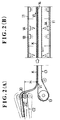
- Figs. 2 (A) and 2 (B) show a method of baking a dough according to a second embodiment of the invention.
- the upstream belt conveyor C2 is disposed on the same level as the downstream belt conveyor C1, but in the second embodiment, the upstream belt conveyor C2 is not disposed on the same level as the downstream belt conveyor C1, namely, the former is disposed with a given stage (difference of height) relative to the latter (see Fig. 2 (A)).
- the upstream belt conveyor C2 is positioned higher than the downstream belt conveyor C1 with a stage H.
- the upstream belt conveyor C2 is designed to be adjusted in height. More in detail, when the downstream roller 20 is vertically moved, the height of the upstream belt conveyor C2 is varied, and hence the difference of the stage of the upstream belt conveyor C2 relative to the downstream belt conveyor C1 can be adjusted.
- a moving speed V2 of the upstream belt conveyor C2 is slower than a moving speed V1 of the downstream belt conveyor C1 which is expressed as V1>V2.
- the adjustment of the texture of dough is performed when the dough is stretched owing to the difference of moving speed between the downstream belt conveyor C1 and upstream belt conveyor C2.
- the dough is stretched under non-pressure and non-contact state (by the difference of the stage H) between a pair of downstream belt conveyor C1 and upstream belt conveyor C2 which are positioned with the stage H, and hence undue internal stress which has been already present in the dough is reduced and the dough is efficiently stretched in the stretching direction, thereby uniformly forming a long texture of dough.
- the length of the dough can be adjusted under non-pressure and non-contact state, and the formation of the optimum texture of dough can be assured depending on a quantity of dough.
- the baking in the second embodiment can be performed by the same manner as the first embodiment shown in Fig. 1 (see Fig. 2 (B)).
- Fig. 3 shows an apparatus for baking dough (hereinafter referred to as dough baking apparatus A).
- the dough baking apparatus A comprises a microwave irradiation part 1 and the upstream belt conveyor C2 which is disposed immediately before the microwave irradiation part 1.
- the microwave irradiation part 1 employs a known microwave irradiation apparatus and mainly comprises an outer covering body 11, microwave irradiation sources 1A which are disposed inside the outer covering body 11 at the upper and lower parts thereof, and the downstream belt conveyor C1 which passes through the microwave irradiation sources 1A.
- Microwave absorption regions 12 are provided at both ends of the microwave irradiation part 1 through which the downstream belt conveyor C1 moves in and moves out.
- the microwave absorption regions 12 are provided for preventing the microwave from leaking from an input I and an output O of the microwave irradiation part 1 to influence upon the human body or other equipment.
- the microwave irradiation sources 1A oscillate microwaves, wherein the dough K is baked while it is irradiated with the microwave.
- the microwave irradiation part 1 is also provided with hot air blowing ports 1B or other external heating sources such as gas, electricity as an auxiliary heating means.
- the hot air blowing ports 1B are disposed inside the outer covering body 11 through which hot air is blown out.
- the microwave irradiation sources 1A and the hot air blowing ports 1B of the microwave irradiation part 1 are respectively paired and are disposed in the moving direction of the downstream belt conveyor C1 at the upper and lower parts of the microwave irradiation part 1 so as to clamp the downstream belt conveyor C1. Since a belt of the downstream belt conveyor C1 is formed of a belt, and more specifically a reticular endless belt 14, hot air or microwave can sufficiently pass through the endless belt 14 from the lower part of the microwave irradiation part 1 without a hitch.
- the upstream belt conveyor C2 is provided at an outer frame body A1 which is extended from the microwave irradiation part 1, and it comprises a downstream roller 20, an upstream roller 21 and an endless belt 22 which is extended between or entrained around the downstream roller 20 and upstream roller 21.
- a tension roller is frequently provided to give tension to the endless belt 22.
- a stage H is defined between the downstream belt conveyor C1 and upstream belt conveyor C2. That is, the downstream roller 20 of the upstream belt conveyor C2 is disposed to position over the upstream roller 13 of the downstream belt conveyor C1.
- the upstream belt conveyor C2 is designed to be adjusted in height so that the stage H or the difference in height between the downstream belt conveyor C1 and upstream belt conveyor C2 can be adjusted. More in detail, when the downstream roller 20 is changed in height by a vertically movable adjusting means in the upstream belt conveyor C2, the stage H between the downstream belt conveyor C1 and upstream belt conveyor C2 can be adjusted.
- a supporting link 23 is attached to a shaft of the downstream roller 20 by way of bearings, not shown.
- the supporting link 23 has a screw portion 24 at the other end thereof, and the screw portion 24 is screwed into a female screw portion formed in an inner periphery of a cylinder 25.
- the cylinder 25 is attached to a motor 28 by way of a speed change gear 27.
- the motor 28, speed change gear 27 and screw portion 24 are respectively provided on a base plate 26 which is pivotally mounted on a fulcrum 29.
- the motor 28 can be normally or reversely rotated by a switch 30. Accordingly, the rotation or torque of the motor is transmitted to the cylinder 25 via the speed change gear 27 to move the supporting link 23 vertically, so that the downstream roller 20 is moved vertically and eventually the height of the upstream belt conveyor C2 can be changed.
- the stage H between the belt conveyors C1 and C2 can be adjusted by the vertically movable adjusting means by a given distance.
- the supplied dough K is moved away from the upstream belt conveyor C2 and is delivered onto the downstream belt conveyor C1 while it is dropped.
- the dough K is stretched under non-pressure and non-contact state so that undue internal stress which has been already present therein is reduced and the dough is efficiently stretched in the stretching direction, thereby uniformly forming a long texture of dough having particles oriented in a specific direction.
- the belt conveyors C1 and C2 are structured that the moving speeds thereof can be changed independently, and hence if the ratio therebetween is changed, the size of the texture of dough can be freely adjusted. After the texture of dough is adjusted to a given size, it is transferred to the microwave irradiation part 1 where it is baked and fixed while it is irradiated with the microwave.
- An apparatus for carrying out the method of baking dough according to the first embodiment is the same as that illustrated in Fig. 3 except the position of the upstream belt conveyor C2, and hence the detailed structure thereof is omitted.
- the dough baking apparatus for carrying out the method of the first embodiment is structured.
- the microwave irradiation sources 1A and hot air blowing ports 1B of the microwave irradiation part 1 may be attached to a middle wall body 11A extended from the outer covering body 11 as shown in Fig. 1 (B).
- Fig. 4 is a block diagram showing a series of processes of the method of producing crumbs.
- the processes comprise a dough continuously supplying process A, rolling and stretching process B, a riping process C, baking process D, a cooling process E and a pulverizing process F.
- the Fig. 5 is a schematic view showing a concrete production line of crumbs for carrying out the processes A to E but the pulverizing process F is carried out in a different spot.
- dough prepared by mixing flour, yeast, yeast food, salt, grape sugar, oils and fats, water is introduced into a continuous dough supplying apparatus, through which dough is continuously supplied in a shape of belt having a given thickness.
- the thus continuously supplied belt-shaped dough is rolled and stretched.
- the rolling and stretching of the dough is normally performed when it passes through a pair of vertically disposed rollers (front roller and back roller) which are disposed in different positions, namely at the front or rear positions. Pressure is applied from the vertical rollers to the dough so that the dough is rolled, then it is subject to a stretching operation owing to the difference of rotating speeds of the front and back rollers, and is finally stretched.
- the rolling and stretching operations are repeated a couple of times, the dough is gradually rolled and stretched.
- the dough was subject to the rolling and stretching operations, the dough is changed to the dough K when it is discharged from the continuous dough supplying apparatus.
- the dough K is ripened in a drier for a given time.
- the temperature and humidity are held at a given value, for example, at 37 to 40 °C in temperature and 70 to 90% in humidity where the dough is fermented for about 30 to 40 minutes.
- the texture of dough is clearly formed and the thickness of dough is doubled.
- the baking of the dough is then performed using the baking apparatus of this invention.
- the dough which is completed in fermentation is stretched under non-pressure state between the downstream belt conveyor C1 and upstream belt conveyor C2, thereby forming the texture of dough having particles oriented in a specific direction.
- the texture of dough is adjusted in a given size when the stretching rate is varied.
- the dough which is adjusted in the texture thereof is baked while it is irradiated with the microwave at the microwave irradiation part 1 of the baking apparatus quickly before the texture of dough is not contracted, and hence the texture of dough is fixed.
- the dough which is baked and the texture of which is fixedly formed is positively cooled, for example, by the normal cooling or cold air, to the normal temperature.
- the dough which has been baked and cooled to the room temperature is then pulverized finely by a perverizer, and is finally changed to crumbs.
- the dough is cut to pieces when it is pulverized to have a size to be inserted into the perverizer.
- the crumbs keeps the same shape as the texture of dough which is fixed in the baking process.
- the dough is changed to the crumbs having a given texture using the method and apparatus for producing crumbs of the present invention.
- the method and apparatus for baking dough When the method and apparatus for baking dough is used for producing crumbs, the effect can be very easily determined since it directly influences upon the shape of the crumbs, but the method and apparatus for baking dough of this invention can be also applied to the production or baking of bread per se not limiting to the production of crumbs.
- the texture of dough which is present when baked in the shape of bread can be freely adjusted, thereby freely change eat feeling, particularly resistance to the teeth.
- the present invention is not limited to the aforementioned embodiments, but it can be modified variously without departing from the scope of this invention.
- the upstream belt conveyor may be positioned lower than the downstream belt conveyor of the microwave irradiation part.
- the hot air blowing ports 1B in the microwave irradiation part may be replaced with other external heating means or may be omitted, if not necessary.
- the texture of dough can be easily adjusted in size even if the mixture of the ingredients is not changed. Accordingly, if the apparatus for baking dough is incorporated into a crumbs production line or bread production line, crumbs or bread having different texture can be freely produced.
Landscapes
- Life Sciences & Earth Sciences (AREA)
- Engineering & Computer Science (AREA)
- Food Science & Technology (AREA)
- Bakery Products And Manufacturing Methods Therefor (AREA)
- Manufacturing And Processing Devices For Dough (AREA)
Applications Claiming Priority (2)
| Application Number | Priority Date | Filing Date | Title |
|---|---|---|---|
| JP158092/97 | 1997-05-31 | ||
| JP09158092A JP3129241B2 (ja) | 1997-05-31 | 1997-05-31 | パン生地の焼成方法及びその装置 |
Publications (1)
| Publication Number | Publication Date |
|---|---|
| EP0880897A1 true EP0880897A1 (de) | 1998-12-02 |
Family
ID=15664134
Family Applications (1)
| Application Number | Title | Priority Date | Filing Date |
|---|---|---|---|
| EP98108056A Withdrawn EP0880897A1 (de) | 1997-05-31 | 1998-05-04 | Verfahren und Vorrichtung zum Backen von Teig |
Country Status (3)
| Country | Link |
|---|---|
| US (1) | US5906764A (de) |
| EP (1) | EP0880897A1 (de) |
| JP (1) | JP3129241B2 (de) |
Cited By (2)
| Publication number | Priority date | Publication date | Assignee | Title |
|---|---|---|---|---|
| GB2359003A (en) * | 2000-01-12 | 2001-08-15 | Sasib Uk Ltd | Breadcrumb production |
| WO2010047667A3 (en) * | 2008-10-23 | 2010-09-02 | Ahmet Bahadir Otaran | A compact apparatus and process for fast and continuous production of baklava dough |
Families Citing this family (5)
| Publication number | Priority date | Publication date | Assignee | Title |
|---|---|---|---|---|
| US6852957B2 (en) | 2002-06-28 | 2005-02-08 | Kerry Group Services International, Ltd. | Breadcrumb processing line and method |
| KR101260702B1 (ko) | 2010-04-16 | 2013-05-10 | 보리원 주식회사 | 냉각수단이 구비된 빵 제조장치 |
| US9814244B1 (en) * | 2014-10-09 | 2017-11-14 | Kirt McFarland | Oven forming assembly for proofing and cooking corrugated dough crusts |
| IT201800020068A1 (it) * | 2018-12-18 | 2020-06-18 | Italgi S R L | Metodo di pastorizzazione di prodotti alimentari in particolare di pasta fresca o prodotti alimentari in genere, sfusi o già confezionati, e gruppo pastorizzatore per lattuazione del detto metodo |
| KR102017794B1 (ko) * | 2019-01-21 | 2019-09-03 | 문현수 | 빵가루 제조장치 및 이를 이용하는 빵가루 제조방법 |
Citations (7)
| Publication number | Priority date | Publication date | Assignee | Title |
|---|---|---|---|---|
| DE899031C (de) * | 1949-08-11 | 1953-12-07 | Anton Harff | Einrichtung zur Herstellung von Backwaren mit Formwalzwerk und anschliessender Backanlage |
| US3424590A (en) * | 1966-02-28 | 1969-01-28 | Peter J Booras | Breadmaking process |
| US3795183A (en) * | 1971-06-28 | 1974-03-05 | Dca Food Ind | Apparatus for making cakes |
| US4321023A (en) * | 1973-05-16 | 1982-03-23 | Everex Corporation | Machine for making strudel leaf, dough sheets |
| DE3816027A1 (de) * | 1988-05-10 | 1989-11-23 | Dany S Snack Gmbh & Co | Verfahren zum aufbacken von nahrungsmitteln, insbesondere fast-food-nahrungsmittel, und vorrichtung zur durchfuehrung des verfahrens |
| EP0353036A1 (de) * | 1988-07-26 | 1990-01-31 | Rheon Automatic Machinery Co. Ltd. | Verfahren zur Herstellung von Teig |
| JPH09154521A (ja) * | 1995-12-01 | 1997-06-17 | Furaisutaa Kk | パン粉の製造方法 |
Family Cites Families (8)
| Publication number | Priority date | Publication date | Assignee | Title |
|---|---|---|---|---|
| US4170659A (en) * | 1977-07-18 | 1979-10-09 | The Pillsbury Company | Fried dough product and method |
| US4285979A (en) * | 1978-05-30 | 1981-08-25 | Izzi Edmund F | Bread making process and product thereof particularly well suited for freezing and reheating |
| US4910040A (en) * | 1987-02-20 | 1990-03-20 | Horizons International Foods, Inc. | Method and protein product having aligned fibers |
| US4911939A (en) * | 1988-10-21 | 1990-03-27 | Nabisco Brands, Inc. | Shelf-stable microwavable cookie dough |
| US5175010A (en) * | 1991-08-05 | 1992-12-29 | Dca Food Industries, Inc. | Bread crumb manufacture |
| US5523106A (en) * | 1994-02-03 | 1996-06-04 | Nabisco, Inc. | Juice-based expanded snacks and process for preparing them |
| US5714178A (en) * | 1995-02-01 | 1998-02-03 | Keener; Michael J. | Rounder bar |
| US5589210A (en) * | 1995-08-23 | 1996-12-31 | Centro De Investigacion Y De Estudios-Avanzados Del I.P.N. | Method for cooking wheat flour products by using infrared radiation |
-
1997
- 1997-05-31 JP JP09158092A patent/JP3129241B2/ja not_active Expired - Fee Related
- 1997-07-30 US US08/902,717 patent/US5906764A/en not_active Expired - Lifetime
-
1998
- 1998-05-04 EP EP98108056A patent/EP0880897A1/de not_active Withdrawn
Patent Citations (7)
| Publication number | Priority date | Publication date | Assignee | Title |
|---|---|---|---|---|
| DE899031C (de) * | 1949-08-11 | 1953-12-07 | Anton Harff | Einrichtung zur Herstellung von Backwaren mit Formwalzwerk und anschliessender Backanlage |
| US3424590A (en) * | 1966-02-28 | 1969-01-28 | Peter J Booras | Breadmaking process |
| US3795183A (en) * | 1971-06-28 | 1974-03-05 | Dca Food Ind | Apparatus for making cakes |
| US4321023A (en) * | 1973-05-16 | 1982-03-23 | Everex Corporation | Machine for making strudel leaf, dough sheets |
| DE3816027A1 (de) * | 1988-05-10 | 1989-11-23 | Dany S Snack Gmbh & Co | Verfahren zum aufbacken von nahrungsmitteln, insbesondere fast-food-nahrungsmittel, und vorrichtung zur durchfuehrung des verfahrens |
| EP0353036A1 (de) * | 1988-07-26 | 1990-01-31 | Rheon Automatic Machinery Co. Ltd. | Verfahren zur Herstellung von Teig |
| JPH09154521A (ja) * | 1995-12-01 | 1997-06-17 | Furaisutaa Kk | パン粉の製造方法 |
Non-Patent Citations (1)
| Title |
|---|
| PATENT ABSTRACTS OF JAPAN vol. 97, no. 10 31 October 1997 (1997-10-31) * |
Cited By (3)
| Publication number | Priority date | Publication date | Assignee | Title |
|---|---|---|---|---|
| GB2359003A (en) * | 2000-01-12 | 2001-08-15 | Sasib Uk Ltd | Breadcrumb production |
| GB2359003B (en) * | 2000-01-12 | 2003-11-26 | Sasib Uk Ltd | Method of and line for breadcrumb production |
| WO2010047667A3 (en) * | 2008-10-23 | 2010-09-02 | Ahmet Bahadir Otaran | A compact apparatus and process for fast and continuous production of baklava dough |
Also Published As
| Publication number | Publication date |
|---|---|
| US5906764A (en) | 1999-05-25 |
| JP3129241B2 (ja) | 2001-01-29 |
| JPH10327742A (ja) | 1998-12-15 |
Similar Documents
| Publication | Publication Date | Title |
|---|---|---|
| EP0353036B1 (de) | Verfahren zur Herstellung von Teig | |
| EP0311240B1 (de) | Verfahren zur Herstellung von tiefgefrorenen Teigprodukten | |
| US3332781A (en) | Process for making shaped cereals | |
| JP2752641B2 (ja) | ワッフル製品の製造方法及び装置 | |
| CN101511198B (zh) | 通过挤出生产可食用华夫饼 | |
| RU2473218C2 (ru) | Способ производства хлебобулочных изделий, таких как саечный хлеб, и хлебобулочные изделия, изготовленные таким способом | |
| US6852957B2 (en) | Breadcrumb processing line and method | |
| US5906764A (en) | Method of and apparatus for baking dough | |
| US9210941B2 (en) | Continuous process for making a pita chip | |
| Bozkurt et al. | Principles and recent applications of vacuum technology in the processing of dough-based cereal products: A comprehensive review | |
| HUE034045T2 (en) | A method for preparing biscuits with improved organoleptic characteristics | |
| AP194A (en) | Preparation of flakes. | |
| US5272962A (en) | Method and apparatus for producing a sheet of dough | |
| AU2004315841A1 (en) | Method for the production of pasta, pasta obtainable according thereto and system for carrying out said method | |
| CN104982821A (zh) | 一种工业化手抻方便烩面的加工工艺 | |
| KR102769485B1 (ko) | 누룽지 제조 방법 및 장치 | |
| JPH09154521A (ja) | パン粉の製造方法 | |
| KR102665521B1 (ko) | 면류 제조장치 | |
| TWI907296B (zh) | 抓餅配方及其製造方法 | |
| Groff | Perfect pretzel production | |
| KR200179791Y1 (ko) | 만두제조장치 | |
| KR930003094B1 (ko) | 생두부 스낵 제조방법 | |
| RU2063137C1 (ru) | Способ производства крекера | |
| US20070110846A1 (en) | Standard loaves, process and installation for obtaining them | |
| Fuentes et al. | 10 ProductionBased of Wheat |
Legal Events
| Date | Code | Title | Description |
|---|---|---|---|
| PUAI | Public reference made under article 153(3) epc to a published international application that has entered the european phase |
Free format text: ORIGINAL CODE: 0009012 |
|
| AK | Designated contracting states |
Kind code of ref document: A1 Designated state(s): DE FR GB IT NL SE |
|
| AX | Request for extension of the european patent |
Free format text: AL;LT;LV;MK;RO;SI |
|
| 17P | Request for examination filed |
Effective date: 19990505 |
|
| AKX | Designation fees paid |
Free format text: DE FR GB IT NL SE |
|
| 17Q | First examination report despatched |
Effective date: 20011023 |
|
| STAA | Information on the status of an ep patent application or granted ep patent |
Free format text: STATUS: THE APPLICATION IS DEEMED TO BE WITHDRAWN |
|
| 18D | Application deemed to be withdrawn |
Effective date: 20020305 |