EP0879792A2 - Verfahren zur Reduzierung des Algen- und Nährstoffgehalts eines Gewässers und Vorrichtung zur Durchführung dieses Verfahrens - Google Patents
Verfahren zur Reduzierung des Algen- und Nährstoffgehalts eines Gewässers und Vorrichtung zur Durchführung dieses Verfahrens Download PDFInfo
- Publication number
- EP0879792A2 EP0879792A2 EP98107153A EP98107153A EP0879792A2 EP 0879792 A2 EP0879792 A2 EP 0879792A2 EP 98107153 A EP98107153 A EP 98107153A EP 98107153 A EP98107153 A EP 98107153A EP 0879792 A2 EP0879792 A2 EP 0879792A2
- Authority
- EP
- European Patent Office
- Prior art keywords
- water
- algae
- nutrient
- filter
- mixture
- Prior art date
- Legal status (The legal status is an assumption and is not a legal conclusion. Google has not performed a legal analysis and makes no representation as to the accuracy of the status listed.)
- Withdrawn
Links
- XLYOFNOQVPJJNP-UHFFFAOYSA-N water Substances O XLYOFNOQVPJJNP-UHFFFAOYSA-N 0.000 title claims abstract description 148
- 241000195493 Cryptophyta Species 0.000 title claims abstract description 87
- 235000015097 nutrients Nutrition 0.000 title claims abstract description 46
- 238000000034 method Methods 0.000 title claims abstract description 43
- 239000000203 mixture Substances 0.000 claims abstract description 17
- 230000001678 irradiating effect Effects 0.000 claims abstract description 8
- 230000000243 photosynthetic effect Effects 0.000 claims abstract description 8
- 235000021049 nutrient content Nutrition 0.000 claims abstract description 7
- CURLTUGMZLYLDI-UHFFFAOYSA-N Carbon dioxide Chemical compound O=C=O CURLTUGMZLYLDI-UHFFFAOYSA-N 0.000 claims description 22
- 238000000926 separation method Methods 0.000 claims description 19
- 239000000463 material Substances 0.000 claims description 14
- QVGXLLKOCUKJST-UHFFFAOYSA-N atomic oxygen Chemical compound [O] QVGXLLKOCUKJST-UHFFFAOYSA-N 0.000 claims description 12
- 229910052760 oxygen Inorganic materials 0.000 claims description 12
- 239000001301 oxygen Substances 0.000 claims description 12
- 229910002092 carbon dioxide Inorganic materials 0.000 claims description 11
- 239000001569 carbon dioxide Substances 0.000 claims description 11
- 239000004576 sand Substances 0.000 claims description 10
- 238000005259 measurement Methods 0.000 claims description 8
- PNEYBMLMFCGWSK-UHFFFAOYSA-N aluminium oxide Inorganic materials [O-2].[O-2].[O-2].[Al+3].[Al+3] PNEYBMLMFCGWSK-UHFFFAOYSA-N 0.000 claims description 7
- 230000005855 radiation Effects 0.000 claims description 7
- 239000000126 substance Substances 0.000 claims description 7
- 230000004913 activation Effects 0.000 claims description 5
- 239000002352 surface water Substances 0.000 claims description 5
- 239000008187 granular material Substances 0.000 claims description 4
- 239000012535 impurity Substances 0.000 claims description 4
- 230000000717 retained effect Effects 0.000 claims description 3
- 238000005406 washing Methods 0.000 claims description 3
- 238000004140 cleaning Methods 0.000 claims description 2
- 238000005112 continuous flow technique Methods 0.000 claims description 2
- 230000001276 controlling effect Effects 0.000 claims 1
- 229910052593 corundum Inorganic materials 0.000 claims 1
- 230000001105 regulatory effect Effects 0.000 claims 1
- 229910001845 yogo sapphire Inorganic materials 0.000 claims 1
- 241000238634 Libellulidae Species 0.000 description 8
- 229910019142 PO4 Inorganic materials 0.000 description 7
- 235000021317 phosphate Nutrition 0.000 description 7
- 235000015816 nutrient absorption Nutrition 0.000 description 5
- 239000010452 phosphate Substances 0.000 description 5
- 238000001556 precipitation Methods 0.000 description 5
- NBIIXXVUZAFLBC-UHFFFAOYSA-K phosphate Chemical compound [O-]P([O-])([O-])=O NBIIXXVUZAFLBC-UHFFFAOYSA-K 0.000 description 4
- 230000029553 photosynthesis Effects 0.000 description 4
- 238000010672 photosynthesis Methods 0.000 description 4
- 239000010802 sludge Substances 0.000 description 4
- 239000002028 Biomass Substances 0.000 description 3
- 230000003698 anagen phase Effects 0.000 description 3
- 239000004927 clay Substances 0.000 description 3
- 238000011161 development Methods 0.000 description 3
- 230000018109 developmental process Effects 0.000 description 3
- 229910001385 heavy metal Inorganic materials 0.000 description 3
- 230000033001 locomotion Effects 0.000 description 3
- 238000004519 manufacturing process Methods 0.000 description 3
- 235000021231 nutrient uptake Nutrition 0.000 description 3
- 238000009418 renovation Methods 0.000 description 3
- 239000003643 water by type Substances 0.000 description 3
- 238000004804 winding Methods 0.000 description 3
- IJGRMHOSHXDMSA-UHFFFAOYSA-N Atomic nitrogen Chemical compound N#N IJGRMHOSHXDMSA-UHFFFAOYSA-N 0.000 description 2
- DGAQECJNVWCQMB-PUAWFVPOSA-M Ilexoside XXIX Chemical compound C[C@@H]1CC[C@@]2(CC[C@@]3(C(=CC[C@H]4[C@]3(CC[C@@H]5[C@@]4(CC[C@@H](C5(C)C)OS(=O)(=O)[O-])C)C)[C@@H]2[C@]1(C)O)C)C(=O)O[C@H]6[C@@H]([C@H]([C@@H]([C@H](O6)CO)O)O)O.[Na+] DGAQECJNVWCQMB-PUAWFVPOSA-M 0.000 description 2
- 230000005791 algae growth Effects 0.000 description 2
- 239000000356 contaminant Substances 0.000 description 2
- 230000034994 death Effects 0.000 description 2
- 230000008030 elimination Effects 0.000 description 2
- 238000003379 elimination reaction Methods 0.000 description 2
- 239000012530 fluid Substances 0.000 description 2
- 230000031700 light absorption Effects 0.000 description 2
- 235000006286 nutrient intake Nutrition 0.000 description 2
- 230000003287 optical effect Effects 0.000 description 2
- 150000003013 phosphoric acid derivatives Chemical class 0.000 description 2
- 239000008213 purified water Substances 0.000 description 2
- 238000005067 remediation Methods 0.000 description 2
- 230000000630 rising effect Effects 0.000 description 2
- 229910052708 sodium Inorganic materials 0.000 description 2
- 239000011734 sodium Substances 0.000 description 2
- 238000001179 sorption measurement Methods 0.000 description 2
- 238000001228 spectrum Methods 0.000 description 2
- 239000002351 wastewater Substances 0.000 description 2
- 241000251468 Actinopterygii Species 0.000 description 1
- 229910018072 Al 2 O 3 Inorganic materials 0.000 description 1
- QGZKDVFQNNGYKY-UHFFFAOYSA-O Ammonium Chemical compound [NH4+] QGZKDVFQNNGYKY-UHFFFAOYSA-O 0.000 description 1
- -1 Hydroxide ions Chemical class 0.000 description 1
- 241001503485 Mammuthus Species 0.000 description 1
- 102000006335 Phosphate-Binding Proteins Human genes 0.000 description 1
- 108010058514 Phosphate-Binding Proteins Proteins 0.000 description 1
- OAICVXFJPJFONN-UHFFFAOYSA-N Phosphorus Chemical compound [P] OAICVXFJPJFONN-UHFFFAOYSA-N 0.000 description 1
- 241000305776 Rynchops Species 0.000 description 1
- 230000009286 beneficial effect Effects 0.000 description 1
- 239000003181 biological factor Substances 0.000 description 1
- 230000005540 biological transmission Effects 0.000 description 1
- 230000015572 biosynthetic process Effects 0.000 description 1
- 238000006243 chemical reaction Methods 0.000 description 1
- 230000007812 deficiency Effects 0.000 description 1
- 238000010586 diagram Methods 0.000 description 1
- 238000007599 discharging Methods 0.000 description 1
- 230000007613 environmental effect Effects 0.000 description 1
- 238000012851 eutrophication Methods 0.000 description 1
- 238000011156 evaluation Methods 0.000 description 1
- 229920002457 flexible plastic Polymers 0.000 description 1
- 230000005484 gravity Effects 0.000 description 1
- JEGUKCSWCFPDGT-UHFFFAOYSA-N h2o hydrate Chemical compound O.O JEGUKCSWCFPDGT-UHFFFAOYSA-N 0.000 description 1
- 150000002823 nitrates Chemical class 0.000 description 1
- 150000002826 nitrites Chemical class 0.000 description 1
- 229910052757 nitrogen Inorganic materials 0.000 description 1
- 229910017464 nitrogen compound Inorganic materials 0.000 description 1
- 150000002830 nitrogen compounds Chemical class 0.000 description 1
- 239000002245 particle Substances 0.000 description 1
- 239000000546 pharmaceutical excipient Substances 0.000 description 1
- 229910052698 phosphorus Inorganic materials 0.000 description 1
- 239000011574 phosphorus Substances 0.000 description 1
- 150000003018 phosphorus compounds Chemical class 0.000 description 1
- 229920003023 plastic Polymers 0.000 description 1
- 238000012545 processing Methods 0.000 description 1
- 239000008400 supply water Substances 0.000 description 1
- 230000008719 thickening Effects 0.000 description 1
- 238000011144 upstream manufacturing Methods 0.000 description 1
- 238000012800 visualization Methods 0.000 description 1
- 239000002699 waste material Substances 0.000 description 1
- 238000009941 weaving Methods 0.000 description 1
Images
Classifications
-
- C—CHEMISTRY; METALLURGY
- C02—TREATMENT OF WATER, WASTE WATER, SEWAGE, OR SLUDGE
- C02F—TREATMENT OF WATER, WASTE WATER, SEWAGE, OR SLUDGE
- C02F3/00—Biological treatment of water, waste water, or sewage
- C02F3/32—Biological treatment of water, waste water, or sewage characterised by the animals or plants used, e.g. algae
-
- C—CHEMISTRY; METALLURGY
- C02—TREATMENT OF WATER, WASTE WATER, SEWAGE, OR SLUDGE
- C02F—TREATMENT OF WATER, WASTE WATER, SEWAGE, OR SLUDGE
- C02F1/00—Treatment of water, waste water, or sewage
- C02F1/30—Treatment of water, waste water, or sewage by irradiation
-
- C—CHEMISTRY; METALLURGY
- C02—TREATMENT OF WATER, WASTE WATER, SEWAGE, OR SLUDGE
- C02F—TREATMENT OF WATER, WASTE WATER, SEWAGE, OR SLUDGE
- C02F2103/00—Nature of the water, waste water, sewage or sludge to be treated
- C02F2103/06—Contaminated groundwater or leachate
-
- Y—GENERAL TAGGING OF NEW TECHNOLOGICAL DEVELOPMENTS; GENERAL TAGGING OF CROSS-SECTIONAL TECHNOLOGIES SPANNING OVER SEVERAL SECTIONS OF THE IPC; TECHNICAL SUBJECTS COVERED BY FORMER USPC CROSS-REFERENCE ART COLLECTIONS [XRACs] AND DIGESTS
- Y02—TECHNOLOGIES OR APPLICATIONS FOR MITIGATION OR ADAPTATION AGAINST CLIMATE CHANGE
- Y02W—CLIMATE CHANGE MITIGATION TECHNOLOGIES RELATED TO WASTEWATER TREATMENT OR WASTE MANAGEMENT
- Y02W10/00—Technologies for wastewater treatment
- Y02W10/30—Wastewater or sewage treatment systems using renewable energies
- Y02W10/37—Wastewater or sewage treatment systems using renewable energies using solar energy
Definitions
- the invention relates to a method for reducing the algae and nutrient content a body of water, in particular a surface water. Furthermore The invention relates to a device for performing this method.
- nitrogen and especially phosphorus compounds are particularly critical to look at, even in very small amounts an increased algae development with an increased algae bloom in the summer months.
- the consequences are oxygen loss, fish death and the Formation of layers of digested sludge up to several meters thick Cover the bottom of the water and nip all life in the bud.
- the object of the present invention is to provide a method and an apparatus for Reducing the algae and nutrient content of a body of water is available too make that simple and essentially without the addition of Chemical as well as inexpensive and largely automated can be.
- This object is achieved according to the invention in the method of the type mentioned at the outset solved by taking algae-containing water from the body of water are taken from the body of water nutrient-containing amounts of water Mixture of the withdrawn water is irradiated in such a way that the algae at least part of the nutrients due to photosynthetic activation absorb, the algae are at least partially separated from the water, and that nutrient and algae-reduced water is returned to the body of water.
- a device of the introduction mentioned type solved by a device for removing algae Amounts of water, a facility for withdrawing amounts of nutrient-containing water, a device for irradiating a mixture of the withdrawn water, whereby the algae are at least a part of the nutrients due to Record photosynthetic activation, at least a device partial separation of the algae from the water and a device for returning the nutrient and algae-reduced water is marked in the body of water.
- the advantages of the invention are in particular that in the water existing algae to reduce the amount also contained in the water Nutrients are used.
- water quantities with the highest possible Algae and nutrient content taken from the water and a mixture of these Amounts of water irradiated to increase nutrient uptake.
- the radiation takes place according to the invention outside the water, since there the parameters for a optimized nutrient intake can be better adjusted.
- the radiation duration the mixture here is preferably in the minute range to large Water volumes within a short time using the method according to the invention to clean. Large throughput quantities can thus be achieved in continuous operation reach so that, for example, extensive lakes can be rehabilitated.
- the algae take the nutrients during the short radiation period - especially Phosphate - on without a during the radiation phase Algae growth is desired or is necessary. Instead, save the algae the nutrients in reservoirs and only give them when they decompose or destroy from.
- the subsequently separated algal biomass can be removed for further economic utilization, for example for heavy metal sorption from waste water.
- Another advantage of the invention The method is that the water to be purified by the photosynthetic Algae oxygen production during nutrient absorption and conversion is enriched with oxygen. Finally arise when using the method according to the invention does not require any precipitation products or landfill other waste materials.
- the method according to the invention is particularly suitable for surface waters such as natural or artificial lakes or rivers clean.
- the method according to the invention is advantageously used throughout the process Growth phase of the microalgae used, which usually at the end of Winter begins and lasts until the next beginning of winter. In winter they are Nutrient concentrations, especially the phosphate concentrations, very high, because at this time the algae die off and those that are taken in in summer Nutrients - possibly also in a modified form - are returned to the water submit. With increasing light and rising temperatures in the In spring the new generation of algae absorbs these nutrients dissolved in the water. A correspondingly increased algae bloom then takes place in the summer months instead of. To prevent this, it should be at the beginning of the growth phase be started to algae and nutrient-containing water according to the invention to treat.
- the specified method is particularly suitable for simultaneous implementation with conventional sludge removal measures, such as the Removal of upper layers of water by means of suitable excavators. Of the this causes an increase in the amount of turbidity in the water Implementation of the method according to the invention not to any appreciable extent.
- the algae-containing and the quantities of water containing nutrients to the body of water in a common step taken can be done, for example, by deriving the amounts of water a conventional suction pipe.
- a positionable skimmer is advantageously used to remove the algae-containing and optionally the nutrient-containing amounts of water used with the for example, algae carpets can be vacuumed over a large area.
- the skimmer is preferably positioned about 10 to 50 cm below the surface of the water, because at this height the greatest concentration of photosynthetically active microalgae is available. So that small creatures are not sucked away, the Skimmer advantageously on appropriately trained gauze.
- the artificial Light is used, for example, at night to make a continuous one To achieve photosynthesis. It can also be used in addition to sunlight during the day be switched on.
- the natural and artificial light provides the energy for rapid nutrient absorption by algae, especially phosphates, however also of ammonium, nitrates and nitrites.
- the nutrient intake can additionally supported by a carbon dioxide deficiency induced in the photobioreactor.
- the photobioreactor particularly preferably has an upright support frame and at least one circumferential, transparent one arranged on the carrier frame tubular line through which the batch is passed.
- the line is made of weatherproof and flexible plastic.
- the Diameter of the tubular line and the vertical distance between the turns is adapted to an optimal light output.
- the residence time of the Mixture in the photobioreactor for a time-optimized light absorption can be tuned by the algae.
- the support frame is largely translucent, wherein the tubular line is arranged outside around the support frame.
- the tubular line is preferably in several superimposed Windings wound, the windings preferably rotationally symmetrical run around a central vertical axis.
- the support frame of the photobioreactor is particularly preferably in the form of a Truncated cone formed, so that the line turns upwards frustoconical can be arranged tapered. This shape is the course of the Adjusted sun throughout the day and thus enables compared to one cylindrical support frame a larger light entry into the from the batch flow through line.
- the photobioreactor preferably contains a device for directing light the tubular pipe.
- This device preferably has one above the tube Collecting lens that bundles the incoming sunlight and its optical axis for this purpose advantageously coincides with the vertical axis around which the tubular line is wound rotationally symmetrically.
- the device for guiding light comprises one - preferably the Lens opposite in the bottom area of the reactor - inner reflector with a reflective surface, which both the natural light and the artificial light that passes through the lens and, if necessary, between the Pipe windings enters the reactor, onto the tubular line reflects and the light yield and thus the nutrient absorption by the algae elevated.
- an im for the artificial irradiation of the water Interior of the photobioreactor uses positionable artificial light source whose spectrum prefers the wavelength range of maximum light absorption on the part of the algae. For this reason, for example, a sodium vapor lamp used.
- a plurality of photobioreactors are advantageously in series or in parallel switched. With different uses of the reactors, the corresponding needs through an adapted number and capacity of reactors Be taken into account.
- the reactors are also preferred - for example by arrangement on movable ones Containers - designed for mobile use.
- Non-aquatic algae can be found in particular in the winter months are used for nutrient elimination, because at this time the nutrient content in the water is very large, but the algae content is very low is.
- the batch is preferably a separation device supplied in which turbidities as well as the nutrient-enriched algae be continuously deposited.
- the separation device particularly preferably comprises a dynamic filter with a continuously moving bed made of granular material, on which the Algae are retained for separation from the water.
- a dynamic filter has compared to conventional filters, which periodically backwash must be made, the advantage of being continuous and therefore low-cost operation is possible.
- Sand and / or active alumina are preferably used as the granular material. Since active clay can effectively bind phosphates at pH values that are not too high, the appropriate use of this material is particularly advantageous when the algae concentration is low compared to the nutrient concentration. In this case, even after the irradiation of the batch, high phosphate concentrations are sometimes present in the batch, which are to be separated off before the batch is returned to the water. Such a procedure is particularly useful in winter, since the concentration of philosophy in the water is high and the concentration of algae is low.
- active clay offers the further advantage that it is a Represents flocculant for the algae.
- a preferred dynamic filter of the above type is as upright standing elongated, essentially hollow cylindrical body with conical tapered lower end.
- the filter shows in its upper area an inlet, from which a central tube in the lower region of the Filter interior leads.
- the filter bed is arranged in the filter interior which the batch is passed in an upward movement, the Algae and other turbid substances are held in the filter bed.
- the filtered water leaves the filter after passing a filter overflow through a first outlet.
- a Pump for example a mammoth pump, conveys the dirty filter material from the lower area of the filter up to one centrally in the filter interior arranged washer, in which the filter material in a downward movement part of the rising filtered water in the countercurrent principle is washed and trickled back onto the filter bed.
- the resulting wash water which contains the algae and the turbid substances leaves the filter via a second outlet.
- Such a dynamic filter is, for example, a "DynaSand" filter the company Axel Johnson Engineering
- the filtered water is preferably returned to the water during the wash water - if necessary after further thickening, for example by means of a Sack filter and a possible partial separation - preferably from the water removed amounts of water mixed and returned to the radiation to ensure a balanced ratio of algae / nutrients in the Adjust radiation device.
- the separation device can also be a self-discharging device Continuous centrifuge and / or a sand filter, preferably with a Chamber filter press or a corresponding drainage device, include, whereby the water quality improves with regard to smell and appearance and at the same time by swirling an oxygen enrichment of the in the water water to be returned is reached.
- the sand filter can also be used as a backwash filter be trained.
- a bag filter can also be made from one suitable weaving material and / or a septic tank can be used.
- the algal biomass deposited in the separation device can expand Environmental remediation, e.g. Heavy metals absorbed from rivers or streams flowing into the water with the help of algae will.
- Environmental remediation e.g. Heavy metals absorbed from rivers or streams flowing into the water with the help of algae will.
- the use of algae for heavy metal elimination is also out Waste water possible in appropriately designed devices.
- the quality of the Water and / or the purified water before being returned to the water determined by means of suitable measuring devices.
- suitable measuring devices concern for example the pH value, the turbidity content, the oxygen concentration, the electrical conductivity and temperature.
- Individual process steps are evaluated using a computer controllable with appropriate devices. For example the also measurable volume flow through the photobioreactor (s) to a Optimized nutrient uptake on the part of the algae.
- the measurement recording can either be repeated cyclically or continuously.
- the control center is preferably spatially separated from the renovation device. In this way, the measurement data acquisition and its visualization of controlled and monitored over a long distance by a remote control center will.
- the remote data query, the evaluation of the data in the control center and the transmission of appropriate control commands for individual process steps minimizes the use of people at the location of the renovation device.
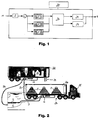
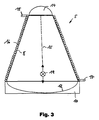
- FIGS. 1 and 2 Like the first embodiment shown in FIGS. 1 and 2 can be seen from the surface area of a lake 1 using a Skimmers 2 and a hose 3 removed amounts of water that are rich in Microalgae and nutrients are, including in particular phosphorus and Nitrogen compounds.
- a pump 4 conveys the water quantities to three in parallel switched photobioreactors 5, which in one on the sides and upwards open first container module 20 are arranged.
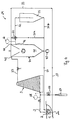
- a photobioreactor 5 is shown in longitudinal section, the one upright a base 10 attached frustoconical support frame 8 with a the outside of which has wound, transparent and flexible tube 16.
- a transparent hose can also be used.
- the Support frame 8 has closed walls and is made of transparent Made of plastic.
- On the free end of the tube 16 in the lower region of the Carrier frame 8 is a tube inlet 17 through which the to be irradiated fluid material is pumped into the tube 16.
- the other end of the tube 16 in upper region of the reactor has a tube outlet 18 through which the flowing material leaves the reactor at the end of the irradiation process.
- the fluid can pass through the tube 16 from top to bottom.
- Slidably positionable light source 19 arranged, for example by a Sodium vapor lamp with an optimized light spectrum or a plant fluorescent lamp is formed.
- the light source 19 becomes a continuous biomass production preferably turned on at night when photosynthetic activity is low due to the lack of daylight. Of course, it is a continuous one Use of the light source 19 to support sunlight stimulated photosynthesis is also possible.
- the light collecting lens 14 is a hood formed, which closes the reactor upwards. Together with the closed walls of the support frame 8 protects the hood on the one hand Reactor interior 4 in unfavorable weather conditions, on the other hand it prevents large temperature fluctuations within the reactor.
- the base 10 of the photobioreactor is one with the mirror surface facing up directional, concave inner reflector 12, which extends essentially over the Base area of the reactor extends and to increase the light output sunlight and / or cast artificial light on the tube 16.
- the optical axis 15 of the Collecting lens 14 and that of the inner reflector coincide.
- the algae for enhanced photosynthesis stimulated, which provides the necessary energy to absorb the nutrients. Due to the induced nutrient uptake by the algae, the nutrient percentage the water at the outlet 18 of the photobioreactor 5 reduced and in same ratio of oxygen content due to oxygen production during the photosynthesis increased so that from the outlet 18 of the photobioreactor 5 nutrient-depleted and therefore oxygen-enriched water together with the nutrient-enriched algae is released.
- the algae-containing water becomes two in parallel switched separation devices 29 supplied, which pass centrifuges and have sand filters.
- the water is separated from the algae instead of. While the algae can be removed for further processing, it will purified, low-odor and oxygenated water with the help of Pump units 32 returned to the lake 1 via hoses 33. Every single one
- the method step is by means of an electronic measuring and control device 25 controllable.
- the hydrocyclone 27, the separation devices 29 and the measuring and control device 25 are arranged in a second container module 22.
- the two Container modules 20, 22 are arranged on movable chassis 24 which for example, brought by tractors 35 to their respective locations can be, whereby the possible uses are expanded considerably.
- hydrocyclones 27 can be optional take place because of the efficiency of the separation of impurities in the hydrocyclones 27 may vary depending on the nature of the water.
- FIG. 4 schematically shows a second embodiment of the invention Device shown, in which the separation device 29 a dynamic Filter 40 having an inlet 42 and a first outlet 44 and a second Has outlet 44. That the water 1 over the provided with a pump 2a Skimmer 2 and the valve-controlled hose 3 is removed after Passing through the photobioreactor 5 via a valve-controlled line 23 Inlet 42 of the dynamic filter 44, into which granular filter material, for example sand and / or active alumina. The batch goes through the filter bed 48, preferably in an upward movement, algae and Suspended particles are retained in the filter material.
- granular filter material for example sand and / or active alumina
- the Filter material continuously conveyed by means of a pump 43, so that it is in one Washer section of this part of the filtered water in the countercurrent principle is going through.
- the algae and the turbid matter go from the filter material into the water, which is known as wash water via the second outlet 46 leaves the filter 40.
- the wash water is supplied by a measuring station 60 is determined, either by means of a correspondingly controlled valve 62 Lines 50a, 50 to skimmer 2 or in line 3 (the corresponding Connecting line is not shown) returned or - at higher Degree of turbidity - via a line 52 through a bag filter 55 from a suitable, for example woven, filter material. From the bag filter 55 can at least part of the wash water via the lines 50b, 50 in the Return skimmer 2 or line 3. In this way, algae can be in the wash water for renewed nutrient absorption in the photobioreactor 5 use.
- the described photobioreactor 5 has, for example, a volume of approximately 100 l and is operated at a throughput rate of 7000 l / h or higher.
- the method according to the invention can be used for smaller or larger - artificial or natural - surface waters. For example, lakes with an area of approx. 10 ha are planned for renovation. If one assumes that the skimmer is placed 50 cm below the surface of the water, 50,000 m 3 would be removed from the water - without taking the return of the purified water into account. Due to the cyclical operation, the throughput increases still considerably. In the case of such extensive waters, the method according to the invention is assumed to be used over a period of a few years, the duration of use of course being shortened as the number of devices according to the invention used increases.
Landscapes
- Life Sciences & Earth Sciences (AREA)
- Engineering & Computer Science (AREA)
- Organic Chemistry (AREA)
- Chemical & Material Sciences (AREA)
- Hydrology & Water Resources (AREA)
- Environmental & Geological Engineering (AREA)
- Water Supply & Treatment (AREA)
- Biotechnology (AREA)
- Health & Medical Sciences (AREA)
- Toxicology (AREA)
- Botany (AREA)
- Biodiversity & Conservation Biology (AREA)
- Microbiology (AREA)
- Purification Treatments By Anaerobic Or Anaerobic And Aerobic Bacteria Or Animals (AREA)
- Apparatus Associated With Microorganisms And Enzymes (AREA)
- Micro-Organisms Or Cultivation Processes Thereof (AREA)
Abstract
Description
- Fig. 1
- eine schematische Darstellung einer ersten Ausführungsform der Vorrichtung als Blockschaltbild;
- Fig. 2
- eine vereinfachte Darstellung der Vorrichtungskomponenten gemäß der Fig. 1;
- Fig. 3
- einen kegelstumpfförmigen Photobioreaktor im Längsschnitt; und
- Fig. 4
- eine schematische Darstellung einer zweiten Ausführungsform der Vorrichtung.
Claims (19)
- Verfahren zur Reduzierung des Algen- und Nährstoffgehalts eines Gewässers (1), insbesondere eines Oberflächengewässers, dadurch gekennzeichnet, daßdem Gewässer (1) algenhaltige Wassermengen entnommen werden;dem Gewässer (1) nährstoffhaltige Wassermengen entnommen werden;ein Gemenge der entnommenen Wassermengen derart bestrahlt wird, daß die Algen zumindest einen Teil der Nährstoffe aufgrund von photosynthetischer Aktivierung aufnehmen;die Algen zumindest teilweise vom Wasser getrennt werden; unddas nährstoff- und algenreduzierte Wasser in das Gewässer (1) zurückgeleitet wird.
- Verfahren nach Anspruch 1,
dadurch gekennzeichnet, daß die algenhaltigen Wassermengen und die nährstoffhaltigen Wassermengen identisch sind und dem Gewässer (1) in einem gemeinsamen Schritt entnommen werden. - Verfahren nach Anspruch 1 oder 2,
dadurch gekennzeichnet, daß die algenhaltigen Wassermengen dem Gewässer (1) mittels eines vorzugsweise etwa 10 bis 50 cm unterhalb der Gewässeroberfläche positionierbaren Skimmers (2) entnommen werden. - Verfahren nach einem der vorhergehenden Ansprüche,
dadurch gekennzeichnet, daß das Gemenge in einem oder mehreren hintereinander oder parallel geschalteten landseitigen Photobioreaktor(en) (5) mit natürlichem und/oder künstlichem Licht bestrahlt wird. - Verfahren nach einem der vorhergehenden Ansprüche,
dadurch gekennzeichnet, daß das zu bestrahlende Gemenge und/oder das Gewässer zusätzlich mit gewässerfremden Algen beimpft wird. - Verfahren nach einem der vorhergehenden Ansprüche,
dadurch gekennzeichnet, daß das Gemenge nach der Bestrahlung einer Separationseinrichtung (29) zugeführt wird, in dem Trübstoffe und Algen abgeschieden werden. - Verfahren nach Anspruch 6,
dadurch gekennzeichnet, daß das Gemenge durch einen dynamischen Filter (40) mit einem kontinuierlich bewegten Filterbett (48) aus körnigem Material, vorzugsweise Sand und/oder Aktivtonerde (Al2O3), geleitet wird, an welchem die Algen zur Trennung von dem Wasser zurückgehalten werden. - Verfahren nach Anspruch 7,
dadurch gekennzeichnet, daß bei Verwendung eines zumindest teilweise mit Aktivtonerde beschickten dynamischen Filters (40) Kohlendioxid vorzugsweise vor der Bestrahlung dem Gemenge zugegeben wird. - Verfahren nach Anspruch 7 oder 8,
dadurch gekennzeichnet, daß das im dynamischen Filter (40) filtrierte Wasser zu einem Teil über einen ersten Auslaß (44) aus dem dynamischen Filter herausgeleitet und zu einem anderen Teil als Waschwasser zur Reinigung des mit Algen beladenene Filtermaterials verwendet und anschließend über einen zweiten Auslaß (46) aus dem dynamischen Filter (40) herausgeleitet wird. - Verfahren nach Anspruch 9,
dadurch gekennzeichnet, daß das filtrierte Wasser in das Gewässer (1) zurückgeleitet und das Waschwasser mit dem aus dem Gewässer (1) entnommenen Gemenge vermischt und erneut der Bestrahlung zugeführt wird. - Verfahren nach einem der Ansprüche 5 bis 10,
dadurch gekennzeichnet, daß zwischen Photobioreaktor (5) und Separationseinrichtung (29) ein Hydrozyklon (27) zwischengeschaltet ist, in dem Störstoffe, wie beispielsweise Sand, abgeschieden werden. - Verfahren nach einem der vorhergehenden Ansprüche,
dadurch gekennzeichnet, daß die Entnahme der Wassermengen, die Lichtbestrahlung des Gemenges der Wassermengen, die Trennung von Wasser und Algen, sowie die Rückführung des algen- und nährstoffreduzierten Wassers in das Gewässer (1) in einem kontinuierlichen Durchflußprozeß durchgeführt werden. - Verfahren nach einem der vorhergehenden Ansprüche,
dadurch gekennzeichnet, daß mittels einer Meß- und Steuerregelung (25) Messungen des pH-Werts, des Trübstoffgehalts, der Sauerstoffkonzentration, der elektrischen Leitfähigkeit, der Temperatur, der Betriebsstundendauer und/oder des Volumenstroms durchgeführt werden und daß auf Basis dieser Meßwerte einzelne Verfahrensschritte (25) geregelt werden. - Vorrichtung zum Durchführen des Verfahrens gemäß einem der vorhergehenden Ansprüche, gekennzeichnet durcheine Einrichtung (2, 3, 4) zur Entnahme algenhaltiger Wassermengen,eine Einrichtung (2, 3, 4) zur Entnahme nährstoffhaltiger Wassermengen,eine Einrichtung (5, 19) zur Bestrahlung eines Gemenges der entnommenen Wassermengen, wobei die Algen zumindest einen Teil der Nährstoffe aufgrund von photosynthetischer Aktivierung aufnehmen,eine Einrichtung (29) zum zumindest teilweise Trennen der Algen vom Wasser, undeine Einrichtung (32, 33) zum Zurückleiten des nährstoff- und algenreduzierten Wassers in das Gewässer.
- Vorrichtung nach Anspruch 14,
dadurch gekennzeichnet, daß die Einrichtung zur Entnahme der algenhaltigen und/oder der nährstoffhaltigen Wassermengen einen positionierbaren Skimmer (2) umfaßt. - Vorrichtung nach Anspruch 14 oder 15,
dadurch gekennzeichnet, daß die Einrichtung zur Bestrahlung des Gemenges einen Photobioreaktor (5) mit einem Trägergestell (8) und mindestens einer am Trägergestell (8) angeordneten umlaufenden, transparenten rohrförmigen Leitung (16), durch welche das Gemenge geleitet wird, aufweist. - Vorrichtung nach einem der Ansprüche 14 bis 16,
dadurch gekennzeichnet, daß die Einrichtung zur Trennung der Algen und des Wassers eine Separationseinrichtung (29) umfaßt, welcher der Einrichtung (5) zur Bestrahlung des Gemenges nachgeschaltet ist. - Vorrichtung nach Anspruch 17,
dadurch gekennzeichnet, daß die Separationseinrichtung (29) wahlweise einen dynamischen Filter (40) mit einem kontinuierlich bewegten Filterbett (48) aus körnigem Material, eine Durchlaufzentrifuge (29), einen Sandfilter, vorzugsweise mit einer Kammerfilterpresse oder einer entsprechenden Entwässerungseinrichtung, einen Sackfilter (55) und/oder eine Sickergrube umfaßt. - Vorrichtung nach einem der Ansprüche 14 bis 18,
gekennzeichnet durch eine Meß- und Steuerregelung zur Messung des pH-Werts, des Trübstoffgehalts, der Sauerstoffkonzentration, der elektrischen Leitfähigkeit, der Temperatur, der Betriebsstundendauer und/oder des Volumenstroms durch die Einrichtung (5) zur Bestrahlung des Gemenges und zur Steuerung einzelner Verfahrensschritte auf Basis dieser Meßwerte.
Applications Claiming Priority (2)
| Application Number | Priority Date | Filing Date | Title |
|---|---|---|---|
| DE19716169 | 1997-04-18 | ||
| DE1997116169 DE19716169C2 (de) | 1997-04-18 | 1997-04-18 | Verfahren zur Reduzierung des Algen- und Nährstoffgehalts eines Gewässers und Vorrichtung zur Durchführung dieses Verfahrens |
Publications (2)
| Publication Number | Publication Date |
|---|---|
| EP0879792A2 true EP0879792A2 (de) | 1998-11-25 |
| EP0879792A3 EP0879792A3 (de) | 2001-04-04 |
Family
ID=7826858
Family Applications (1)
| Application Number | Title | Priority Date | Filing Date |
|---|---|---|---|
| EP19980107153 Withdrawn EP0879792A3 (de) | 1997-04-18 | 1998-04-20 | Verfahren zur Reduzierung des Algen- und Nährstoffgehalts eines Gewässers und Vorrichtung zur Durchführung dieses Verfahrens |
Country Status (2)
| Country | Link |
|---|---|
| EP (1) | EP0879792A3 (de) |
| DE (1) | DE19716169C2 (de) |
Cited By (2)
| Publication number | Priority date | Publication date | Assignee | Title |
|---|---|---|---|---|
| WO2000034189A1 (en) * | 1998-12-11 | 2000-06-15 | Wexler Howard M | Method for treating a waste stream using photosynthetic microorganisms |
| CN1315711C (zh) * | 1999-10-04 | 2007-05-16 | 奥蒂斯电梯公司 | 自动执行在建筑物内提供空间访问或记录电梯系统内服务呼唤的方法和设备 |
Families Citing this family (1)
| Publication number | Priority date | Publication date | Assignee | Title |
|---|---|---|---|---|
| DE10217373B8 (de) * | 2002-04-18 | 2005-09-15 | Brewaba Wasserbaugesellschaft Bremen Mbh | Verfahren zur Behandlung von Gewässersedimenten |
Family Cites Families (7)
| Publication number | Priority date | Publication date | Assignee | Title |
|---|---|---|---|---|
| US3955318A (en) * | 1973-03-19 | 1976-05-11 | Bio-Kinetics Inc. | Waste purification system |
| EP0078033B1 (de) * | 1981-10-28 | 1986-07-30 | S.C.R.A.M.B.L.E. S.r.l. | Kontinuierliches Verfahren und Anlage zur tertiären Abwasserbehandlung mittels Fotosynthese |
| SE8505383D0 (sv) * | 1985-11-13 | 1985-11-13 | Atlas Copco Ab | Device for improving the phosphorus elimination capacity of a body of water |
| DE239272T1 (de) * | 1986-03-19 | 1988-02-25 | Biotechna Ltd., London | Produktion von biomasse. |
| JP2662623B2 (ja) * | 1988-11-01 | 1997-10-15 | 清水建設株式会社 | 環境水浄化装置および人工藻場 |
| JPH04298297A (ja) * | 1991-03-27 | 1992-10-22 | Ishikawajima Harima Heavy Ind Co Ltd | 廃水の三次処理方法 |
| DE29707043U1 (de) * | 1997-04-18 | 1997-12-11 | Umweltschutz Nord GmbH & Co, 27777 Ganderkesee | Photobioreaktor |
-
1997
- 1997-04-18 DE DE1997116169 patent/DE19716169C2/de not_active Expired - Fee Related
-
1998
- 1998-04-20 EP EP19980107153 patent/EP0879792A3/de not_active Withdrawn
Cited By (2)
| Publication number | Priority date | Publication date | Assignee | Title |
|---|---|---|---|---|
| WO2000034189A1 (en) * | 1998-12-11 | 2000-06-15 | Wexler Howard M | Method for treating a waste stream using photosynthetic microorganisms |
| CN1315711C (zh) * | 1999-10-04 | 2007-05-16 | 奥蒂斯电梯公司 | 自动执行在建筑物内提供空间访问或记录电梯系统内服务呼唤的方法和设备 |
Also Published As
| Publication number | Publication date |
|---|---|
| DE19716169A1 (de) | 1998-10-22 |
| DE19716169C2 (de) | 2001-04-05 |
| EP0879792A3 (de) | 2001-04-04 |
Similar Documents
| Publication | Publication Date | Title |
|---|---|---|
| EP0286870B1 (de) | System zur Wasseraufbereitung mit Ozon | |
| DE1517526C3 (de) | Verfahren zur Herstellung von trinkbarem Wasser aus Abwasser | |
| DE102011087171A1 (de) | System zum Kultivieren und Wiedergewinnen von Mikroalgen | |
| DE2739690A1 (de) | Verfahren und vorrichtung zum reinigen von abwaessern | |
| EP2213629A1 (de) | Anlage und Verfahren zur Aufbereitung und Entsorgung von salz- und ölhaltigem Abwasser | |
| EP1134194B1 (de) | Verfahren zur Biomasse-Rückhaltung bei Bioreaktoren | |
| DE833928C (de) | Verfahren zur Abwasserreinigung mit Gewinnung von Faulschlamm | |
| CH662109A5 (de) | Verfahren zum klaeren von faserige festsubstanz enthaltender fluessigkeit. | |
| DE3423226A1 (de) | Anlage zur biologischen reinigung von abwasser | |
| DE1658101A1 (de) | Verfahren und Vorrichtung zum Reinigen von Abwasser | |
| DE2455633A1 (de) | Verfahren und anlage zur reinigung von abwasser | |
| DE1961201A1 (de) | Biologische Abwasserbehandlung | |
| DE4303529A1 (en) | Chemical-physical and biological physical cleaning of soil - comprises mixing with water, coarse material is separated, and sludge is sedimented and biologically treated using fluidised bed procedure | |
| DE4415637A1 (de) | Verfahren und Vorrichtung zur Klärung und Aufbereitung von Waschwassern aus Fahrzeugwaschanlagen | |
| DE2163283A1 (de) | Verfahren und anlage zur reinigung von abwasser | |
| DE69308886T2 (de) | Entfernung von verunreinigungen | |
| DD146938A5 (de) | Verfahren und anlage zur wasseraufbereitung,abwasserreinigung und reinigung des verunreinigten wassers | |
| DE666060C (de) | Verfahren und Vorrichtung zur Abwasserreinigung | |
| EP1035906B1 (de) | Verfahren zur reduzierung der konzentration von inhaltsstoffen in einem gas und in einer flüssigkeit und vorrichtung zur durchführung dieses verfahrens | |
| DE19716169C2 (de) | Verfahren zur Reduzierung des Algen- und Nährstoffgehalts eines Gewässers und Vorrichtung zur Durchführung dieses Verfahrens | |
| DE2461727C3 (de) | Verfahren zur Behandlung und Reinigung von ölhaltigem Abwasser | |
| DE2801030A1 (de) | Verfahren zur biologischen wasserreinigung | |
| EP1584606B1 (de) | Verfahren zur biologischen Wassergewinnung aus Abwasser mit Hilfe eines Wirbelbettreaktors | |
| EP1265819B1 (de) | Verfahren und vorrichtung zur abwasserreinigung | |
| DE4240064C2 (de) | Verfahren und Anlage zum Reinigen von Abwasser |
Legal Events
| Date | Code | Title | Description |
|---|---|---|---|
| PUAI | Public reference made under article 153(3) epc to a published international application that has entered the european phase |
Free format text: ORIGINAL CODE: 0009012 |
|
| AK | Designated contracting states |
Kind code of ref document: A2 Designated state(s): AT DE DK ES FI GB GR IT PT SE |
|
| AX | Request for extension of the european patent |
Free format text: AL;LT;LV;MK;RO;SI |
|
| PUAL | Search report despatched |
Free format text: ORIGINAL CODE: 0009013 |
|
| AK | Designated contracting states |
Kind code of ref document: A3 Designated state(s): AT BE CH CY DE DK ES FI FR GB GR IE IT LI LU MC NL PT SE |
|
| AX | Request for extension of the european patent |
Free format text: AL;LT;LV;MK;RO;SI |
|
| RIC1 | Information provided on ipc code assigned before grant |
Free format text: 7C 02F 1/00 A, 7C 02F 1/30 B, 7C 02F 1/38 B, 7C 02F 3/32 B |
|
| STAA | Information on the status of an ep patent application or granted ep patent |
Free format text: STATUS: THE APPLICATION HAS BEEN WITHDRAWN |
|
| 17P | Request for examination filed |
Effective date: 20011004 |
|
| 18W | Application withdrawn |
Withdrawal date: 20011107 |
|
| AKX | Designation fees paid |
Free format text: AT DE DK ES FI GB GR IT PT SE |