EP0866783B1 - Materiaux composites thermostructuraux avec renforts en fibres carbone ou revetues de carbone, ayant une resistance accrue a l'oxydation - Google Patents
Materiaux composites thermostructuraux avec renforts en fibres carbone ou revetues de carbone, ayant une resistance accrue a l'oxydation Download PDFInfo
- Publication number
- EP0866783B1 EP0866783B1 EP96941714A EP96941714A EP0866783B1 EP 0866783 B1 EP0866783 B1 EP 0866783B1 EP 96941714 A EP96941714 A EP 96941714A EP 96941714 A EP96941714 A EP 96941714A EP 0866783 B1 EP0866783 B1 EP 0866783B1
- Authority
- EP
- European Patent Office
- Prior art keywords
- matrix
- layers
- fibers
- thickness
- carbon
- Prior art date
- Legal status (The legal status is an assumption and is not a legal conclusion. Google has not performed a legal analysis and makes no representation as to the accuracy of the status listed.)
- Expired - Lifetime
Links
- 239000000835 fiber Substances 0.000 title claims description 64
- 239000002131 composite material Substances 0.000 title claims description 47
- OKTJSMMVPCPJKN-UHFFFAOYSA-N Carbon Chemical compound [C] OKTJSMMVPCPJKN-UHFFFAOYSA-N 0.000 title claims description 26
- 229910052799 carbon Inorganic materials 0.000 title claims description 26
- 230000002787 reinforcement Effects 0.000 title claims description 23
- 238000007254 oxidation reaction Methods 0.000 title claims description 11
- 230000003647 oxidation Effects 0.000 title claims description 10
- 239000011159 matrix material Substances 0.000 claims description 82
- 239000000463 material Substances 0.000 claims description 60
- 230000008595 infiltration Effects 0.000 claims description 23
- 238000001764 infiltration Methods 0.000 claims description 23
- 239000000919 ceramic Substances 0.000 claims description 21
- 238000000034 method Methods 0.000 claims description 20
- HBMJWWWQQXIZIP-UHFFFAOYSA-N silicon carbide Chemical compound [Si+]#[C-] HBMJWWWQQXIZIP-UHFFFAOYSA-N 0.000 claims description 20
- 229910010271 silicon carbide Inorganic materials 0.000 claims description 18
- 230000015572 biosynthetic process Effects 0.000 claims description 17
- 238000005336 cracking Methods 0.000 claims description 16
- 239000011248 coating agent Substances 0.000 claims description 12
- 238000000576 coating method Methods 0.000 claims description 12
- 239000000126 substance Substances 0.000 claims description 11
- 229910010293 ceramic material Inorganic materials 0.000 claims description 9
- 239000002296 pyrolytic carbon Substances 0.000 claims description 9
- 230000000694 effects Effects 0.000 claims description 7
- PZNSFCLAULLKQX-UHFFFAOYSA-N Boron nitride Chemical compound N#B PZNSFCLAULLKQX-UHFFFAOYSA-N 0.000 claims description 6
- 230000005489 elastic deformation Effects 0.000 claims description 6
- 229910052580 B4C Inorganic materials 0.000 claims description 5
- 229910052582 BN Inorganic materials 0.000 claims description 5
- INAHAJYZKVIDIZ-UHFFFAOYSA-N boron carbide Chemical compound B12B3B4C32B41 INAHAJYZKVIDIZ-UHFFFAOYSA-N 0.000 claims description 5
- 230000008569 process Effects 0.000 claims description 5
- 230000001965 increasing effect Effects 0.000 claims description 4
- 230000001939 inductive effect Effects 0.000 claims description 4
- 239000012783 reinforcing fiber Substances 0.000 claims description 4
- 229910021332 silicide Inorganic materials 0.000 claims description 4
- 150000001875 compounds Chemical class 0.000 claims description 3
- 230000007423 decrease Effects 0.000 claims description 3
- 238000004519 manufacturing process Methods 0.000 claims description 3
- 150000001247 metal acetylides Chemical class 0.000 claims description 3
- 238000002360 preparation method Methods 0.000 claims 1
- 230000035882 stress Effects 0.000 description 13
- 239000012071 phase Substances 0.000 description 10
- 239000003570 air Substances 0.000 description 8
- 239000005055 methyl trichlorosilane Substances 0.000 description 8
- JLUFWMXJHAVVNN-UHFFFAOYSA-N methyltrichlorosilane Chemical compound C[Si](Cl)(Cl)Cl JLUFWMXJHAVVNN-UHFFFAOYSA-N 0.000 description 8
- 230000032683 aging Effects 0.000 description 7
- VNWKTOKETHGBQD-UHFFFAOYSA-N methane Chemical compound C VNWKTOKETHGBQD-UHFFFAOYSA-N 0.000 description 7
- 238000009864 tensile test Methods 0.000 description 7
- 229920000049 Carbon (fiber) Polymers 0.000 description 6
- 239000004917 carbon fiber Substances 0.000 description 6
- 239000011521 glass Substances 0.000 description 6
- 230000016507 interphase Effects 0.000 description 6
- FAQYAMRNWDIXMY-UHFFFAOYSA-N trichloroborane Chemical compound ClB(Cl)Cl FAQYAMRNWDIXMY-UHFFFAOYSA-N 0.000 description 6
- ATUOYWHBWRKTHZ-UHFFFAOYSA-N Propane Chemical compound CCC ATUOYWHBWRKTHZ-UHFFFAOYSA-N 0.000 description 5
- 230000006378 damage Effects 0.000 description 5
- 239000007789 gas Substances 0.000 description 5
- 238000012163 sequencing technique Methods 0.000 description 5
- 229910015844 BCl3 Inorganic materials 0.000 description 4
- QVGXLLKOCUKJST-UHFFFAOYSA-N atomic oxygen Chemical compound [O] QVGXLLKOCUKJST-UHFFFAOYSA-N 0.000 description 4
- 239000000203 mixture Substances 0.000 description 4
- 239000001301 oxygen Substances 0.000 description 4
- 229910052760 oxygen Inorganic materials 0.000 description 4
- 230000000930 thermomechanical effect Effects 0.000 description 4
- ZOXJGFHDIHLPTG-UHFFFAOYSA-N Boron Chemical compound [B] ZOXJGFHDIHLPTG-UHFFFAOYSA-N 0.000 description 3
- UFHFLCQGNIYNRP-UHFFFAOYSA-N Hydrogen Chemical compound [H][H] UFHFLCQGNIYNRP-UHFFFAOYSA-N 0.000 description 3
- 238000002441 X-ray diffraction Methods 0.000 description 3
- 229910052796 boron Inorganic materials 0.000 description 3
- 230000035876 healing Effects 0.000 description 3
- 230000001590 oxidative effect Effects 0.000 description 3
- 241000894007 species Species 0.000 description 3
- 239000012808 vapor phase Substances 0.000 description 3
- 208000018672 Dilatation Diseases 0.000 description 2
- XUIMIQQOPSSXEZ-UHFFFAOYSA-N Silicon Chemical compound [Si] XUIMIQQOPSSXEZ-UHFFFAOYSA-N 0.000 description 2
- 239000003963 antioxidant agent Substances 0.000 description 2
- 230000003078 antioxidant effect Effects 0.000 description 2
- 238000005253 cladding Methods 0.000 description 2
- 239000000470 constituent Substances 0.000 description 2
- 230000008021 deposition Effects 0.000 description 2
- 230000010339 dilation Effects 0.000 description 2
- 239000007792 gaseous phase Substances 0.000 description 2
- 230000000750 progressive effect Effects 0.000 description 2
- 238000001228 spectrum Methods 0.000 description 2
- 230000003068 static effect Effects 0.000 description 2
- 241001639412 Verres Species 0.000 description 1
- 240000008042 Zea mays Species 0.000 description 1
- 239000006096 absorbing agent Substances 0.000 description 1
- 239000012080 ambient air Substances 0.000 description 1
- 238000004458 analytical method Methods 0.000 description 1
- 230000003064 anti-oxidating effect Effects 0.000 description 1
- 230000003416 augmentation Effects 0.000 description 1
- 230000004888 barrier function Effects 0.000 description 1
- 230000008901 benefit Effects 0.000 description 1
- 238000007664 blowing Methods 0.000 description 1
- 229910052810 boron oxide Inorganic materials 0.000 description 1
- 239000011203 carbon fibre reinforced carbon Substances 0.000 description 1
- 210000004027 cell Anatomy 0.000 description 1
- 239000012700 ceramic precursor Substances 0.000 description 1
- 238000012512 characterization method Methods 0.000 description 1
- 238000006243 chemical reaction Methods 0.000 description 1
- 230000008645 cold stress Effects 0.000 description 1
- 230000000052 comparative effect Effects 0.000 description 1
- 230000021615 conjugation Effects 0.000 description 1
- 238000002425 crystallisation Methods 0.000 description 1
- 230000008025 crystallization Effects 0.000 description 1
- 230000001934 delay Effects 0.000 description 1
- 230000003111 delayed effect Effects 0.000 description 1
- 230000018109 developmental process Effects 0.000 description 1
- JKWMSGQKBLHBQQ-UHFFFAOYSA-N diboron trioxide Chemical compound O=BOB=O JKWMSGQKBLHBQQ-UHFFFAOYSA-N 0.000 description 1
- 238000009826 distribution Methods 0.000 description 1
- 229940082150 encore Drugs 0.000 description 1
- 238000010438 heat treatment Methods 0.000 description 1
- 150000002431 hydrogen Chemical class 0.000 description 1
- 239000001257 hydrogen Substances 0.000 description 1
- 229910052739 hydrogen Inorganic materials 0.000 description 1
- 238000005470 impregnation Methods 0.000 description 1
- 230000000977 initiatory effect Effects 0.000 description 1
- 239000012705 liquid precursor Substances 0.000 description 1
- 230000007246 mechanism Effects 0.000 description 1
- 230000008018 melting Effects 0.000 description 1
- 238000002844 melting Methods 0.000 description 1
- CSJDCSCTVDEHRN-UHFFFAOYSA-N methane;molecular oxygen Chemical compound C.O=O CSJDCSCTVDEHRN-UHFFFAOYSA-N 0.000 description 1
- 238000000386 microscopy Methods 0.000 description 1
- 230000000877 morphologic effect Effects 0.000 description 1
- 230000003287 optical effect Effects 0.000 description 1
- 235000011837 pasties Nutrition 0.000 description 1
- 230000035515 penetration Effects 0.000 description 1
- 239000002243 precursor Substances 0.000 description 1
- 239000001294 propane Substances 0.000 description 1
- 239000011253 protective coating Substances 0.000 description 1
- 239000012495 reaction gas Substances 0.000 description 1
- 239000011819 refractory material Substances 0.000 description 1
- 238000010008 shearing Methods 0.000 description 1
- FVBUAEGBCNSCDD-UHFFFAOYSA-N silicide(4-) Chemical compound [Si-4] FVBUAEGBCNSCDD-UHFFFAOYSA-N 0.000 description 1
- 229910052710 silicon Inorganic materials 0.000 description 1
- 239000010703 silicon Substances 0.000 description 1
- 230000009466 transformation Effects 0.000 description 1
Images


Classifications
-
- C—CHEMISTRY; METALLURGY
- C04—CEMENTS; CONCRETE; ARTIFICIAL STONE; CERAMICS; REFRACTORIES
- C04B—LIME, MAGNESIA; SLAG; CEMENTS; COMPOSITIONS THEREOF, e.g. MORTARS, CONCRETE OR LIKE BUILDING MATERIALS; ARTIFICIAL STONE; CERAMICS; REFRACTORIES; TREATMENT OF NATURAL STONE
- C04B35/00—Shaped ceramic products characterised by their composition; Ceramics compositions; Processing powders of inorganic compounds preparatory to the manufacturing of ceramic products
- C04B35/622—Forming processes; Processing powders of inorganic compounds preparatory to the manufacturing of ceramic products
- C04B35/626—Preparing or treating the powders individually or as batches ; preparing or treating macroscopic reinforcing agents for ceramic products, e.g. fibres; mechanical aspects section B
- C04B35/628—Coating the powders or the macroscopic reinforcing agents
- C04B35/62844—Coating fibres
- C04B35/62857—Coating fibres with non-oxide ceramics
- C04B35/6286—Carbides
-
- C—CHEMISTRY; METALLURGY
- C04—CEMENTS; CONCRETE; ARTIFICIAL STONE; CERAMICS; REFRACTORIES
- C04B—LIME, MAGNESIA; SLAG; CEMENTS; COMPOSITIONS THEREOF, e.g. MORTARS, CONCRETE OR LIKE BUILDING MATERIALS; ARTIFICIAL STONE; CERAMICS; REFRACTORIES; TREATMENT OF NATURAL STONE
- C04B35/00—Shaped ceramic products characterised by their composition; Ceramics compositions; Processing powders of inorganic compounds preparatory to the manufacturing of ceramic products
- C04B35/515—Shaped ceramic products characterised by their composition; Ceramics compositions; Processing powders of inorganic compounds preparatory to the manufacturing of ceramic products based on non-oxide ceramics
- C04B35/56—Shaped ceramic products characterised by their composition; Ceramics compositions; Processing powders of inorganic compounds preparatory to the manufacturing of ceramic products based on non-oxide ceramics based on carbides or oxycarbides
- C04B35/563—Shaped ceramic products characterised by their composition; Ceramics compositions; Processing powders of inorganic compounds preparatory to the manufacturing of ceramic products based on non-oxide ceramics based on carbides or oxycarbides based on boron carbide
-
- C—CHEMISTRY; METALLURGY
- C04—CEMENTS; CONCRETE; ARTIFICIAL STONE; CERAMICS; REFRACTORIES
- C04B—LIME, MAGNESIA; SLAG; CEMENTS; COMPOSITIONS THEREOF, e.g. MORTARS, CONCRETE OR LIKE BUILDING MATERIALS; ARTIFICIAL STONE; CERAMICS; REFRACTORIES; TREATMENT OF NATURAL STONE
- C04B35/00—Shaped ceramic products characterised by their composition; Ceramics compositions; Processing powders of inorganic compounds preparatory to the manufacturing of ceramic products
- C04B35/515—Shaped ceramic products characterised by their composition; Ceramics compositions; Processing powders of inorganic compounds preparatory to the manufacturing of ceramic products based on non-oxide ceramics
- C04B35/56—Shaped ceramic products characterised by their composition; Ceramics compositions; Processing powders of inorganic compounds preparatory to the manufacturing of ceramic products based on non-oxide ceramics based on carbides or oxycarbides
- C04B35/565—Shaped ceramic products characterised by their composition; Ceramics compositions; Processing powders of inorganic compounds preparatory to the manufacturing of ceramic products based on non-oxide ceramics based on carbides or oxycarbides based on silicon carbide
-
- C—CHEMISTRY; METALLURGY
- C04—CEMENTS; CONCRETE; ARTIFICIAL STONE; CERAMICS; REFRACTORIES
- C04B—LIME, MAGNESIA; SLAG; CEMENTS; COMPOSITIONS THEREOF, e.g. MORTARS, CONCRETE OR LIKE BUILDING MATERIALS; ARTIFICIAL STONE; CERAMICS; REFRACTORIES; TREATMENT OF NATURAL STONE
- C04B35/00—Shaped ceramic products characterised by their composition; Ceramics compositions; Processing powders of inorganic compounds preparatory to the manufacturing of ceramic products
- C04B35/622—Forming processes; Processing powders of inorganic compounds preparatory to the manufacturing of ceramic products
- C04B35/626—Preparing or treating the powders individually or as batches ; preparing or treating macroscopic reinforcing agents for ceramic products, e.g. fibres; mechanical aspects section B
- C04B35/628—Coating the powders or the macroscopic reinforcing agents
- C04B35/62844—Coating fibres
- C04B35/62857—Coating fibres with non-oxide ceramics
- C04B35/6286—Carbides
- C04B35/62863—Silicon carbide
-
- C—CHEMISTRY; METALLURGY
- C04—CEMENTS; CONCRETE; ARTIFICIAL STONE; CERAMICS; REFRACTORIES
- C04B—LIME, MAGNESIA; SLAG; CEMENTS; COMPOSITIONS THEREOF, e.g. MORTARS, CONCRETE OR LIKE BUILDING MATERIALS; ARTIFICIAL STONE; CERAMICS; REFRACTORIES; TREATMENT OF NATURAL STONE
- C04B35/00—Shaped ceramic products characterised by their composition; Ceramics compositions; Processing powders of inorganic compounds preparatory to the manufacturing of ceramic products
- C04B35/622—Forming processes; Processing powders of inorganic compounds preparatory to the manufacturing of ceramic products
- C04B35/626—Preparing or treating the powders individually or as batches ; preparing or treating macroscopic reinforcing agents for ceramic products, e.g. fibres; mechanical aspects section B
- C04B35/628—Coating the powders or the macroscopic reinforcing agents
- C04B35/62844—Coating fibres
- C04B35/62857—Coating fibres with non-oxide ceramics
- C04B35/62865—Nitrides
- C04B35/62868—Boron nitride
-
- C—CHEMISTRY; METALLURGY
- C04—CEMENTS; CONCRETE; ARTIFICIAL STONE; CERAMICS; REFRACTORIES
- C04B—LIME, MAGNESIA; SLAG; CEMENTS; COMPOSITIONS THEREOF, e.g. MORTARS, CONCRETE OR LIKE BUILDING MATERIALS; ARTIFICIAL STONE; CERAMICS; REFRACTORIES; TREATMENT OF NATURAL STONE
- C04B35/00—Shaped ceramic products characterised by their composition; Ceramics compositions; Processing powders of inorganic compounds preparatory to the manufacturing of ceramic products
- C04B35/622—Forming processes; Processing powders of inorganic compounds preparatory to the manufacturing of ceramic products
- C04B35/626—Preparing or treating the powders individually or as batches ; preparing or treating macroscopic reinforcing agents for ceramic products, e.g. fibres; mechanical aspects section B
- C04B35/628—Coating the powders or the macroscopic reinforcing agents
- C04B35/62844—Coating fibres
- C04B35/62857—Coating fibres with non-oxide ceramics
- C04B35/62873—Carbon
-
- C—CHEMISTRY; METALLURGY
- C04—CEMENTS; CONCRETE; ARTIFICIAL STONE; CERAMICS; REFRACTORIES
- C04B—LIME, MAGNESIA; SLAG; CEMENTS; COMPOSITIONS THEREOF, e.g. MORTARS, CONCRETE OR LIKE BUILDING MATERIALS; ARTIFICIAL STONE; CERAMICS; REFRACTORIES; TREATMENT OF NATURAL STONE
- C04B35/00—Shaped ceramic products characterised by their composition; Ceramics compositions; Processing powders of inorganic compounds preparatory to the manufacturing of ceramic products
- C04B35/622—Forming processes; Processing powders of inorganic compounds preparatory to the manufacturing of ceramic products
- C04B35/626—Preparing or treating the powders individually or as batches ; preparing or treating macroscopic reinforcing agents for ceramic products, e.g. fibres; mechanical aspects section B
- C04B35/628—Coating the powders or the macroscopic reinforcing agents
- C04B35/62884—Coating the powders or the macroscopic reinforcing agents by gas phase techniques
-
- C—CHEMISTRY; METALLURGY
- C04—CEMENTS; CONCRETE; ARTIFICIAL STONE; CERAMICS; REFRACTORIES
- C04B—LIME, MAGNESIA; SLAG; CEMENTS; COMPOSITIONS THEREOF, e.g. MORTARS, CONCRETE OR LIKE BUILDING MATERIALS; ARTIFICIAL STONE; CERAMICS; REFRACTORIES; TREATMENT OF NATURAL STONE
- C04B35/00—Shaped ceramic products characterised by their composition; Ceramics compositions; Processing powders of inorganic compounds preparatory to the manufacturing of ceramic products
- C04B35/622—Forming processes; Processing powders of inorganic compounds preparatory to the manufacturing of ceramic products
- C04B35/626—Preparing or treating the powders individually or as batches ; preparing or treating macroscopic reinforcing agents for ceramic products, e.g. fibres; mechanical aspects section B
- C04B35/628—Coating the powders or the macroscopic reinforcing agents
- C04B35/62894—Coating the powders or the macroscopic reinforcing agents with more than one coating layer
-
- C—CHEMISTRY; METALLURGY
- C04—CEMENTS; CONCRETE; ARTIFICIAL STONE; CERAMICS; REFRACTORIES
- C04B—LIME, MAGNESIA; SLAG; CEMENTS; COMPOSITIONS THEREOF, e.g. MORTARS, CONCRETE OR LIKE BUILDING MATERIALS; ARTIFICIAL STONE; CERAMICS; REFRACTORIES; TREATMENT OF NATURAL STONE
- C04B35/00—Shaped ceramic products characterised by their composition; Ceramics compositions; Processing powders of inorganic compounds preparatory to the manufacturing of ceramic products
- C04B35/622—Forming processes; Processing powders of inorganic compounds preparatory to the manufacturing of ceramic products
- C04B35/626—Preparing or treating the powders individually or as batches ; preparing or treating macroscopic reinforcing agents for ceramic products, e.g. fibres; mechanical aspects section B
- C04B35/628—Coating the powders or the macroscopic reinforcing agents
- C04B35/62897—Coatings characterised by their thickness
-
- C—CHEMISTRY; METALLURGY
- C04—CEMENTS; CONCRETE; ARTIFICIAL STONE; CERAMICS; REFRACTORIES
- C04B—LIME, MAGNESIA; SLAG; CEMENTS; COMPOSITIONS THEREOF, e.g. MORTARS, CONCRETE OR LIKE BUILDING MATERIALS; ARTIFICIAL STONE; CERAMICS; REFRACTORIES; TREATMENT OF NATURAL STONE
- C04B35/00—Shaped ceramic products characterised by their composition; Ceramics compositions; Processing powders of inorganic compounds preparatory to the manufacturing of ceramic products
- C04B35/71—Ceramic products containing macroscopic reinforcing agents
- C04B35/78—Ceramic products containing macroscopic reinforcing agents containing non-metallic materials
- C04B35/80—Fibres, filaments, whiskers, platelets, or the like
-
- C—CHEMISTRY; METALLURGY
- C04—CEMENTS; CONCRETE; ARTIFICIAL STONE; CERAMICS; REFRACTORIES
- C04B—LIME, MAGNESIA; SLAG; CEMENTS; COMPOSITIONS THEREOF, e.g. MORTARS, CONCRETE OR LIKE BUILDING MATERIALS; ARTIFICIAL STONE; CERAMICS; REFRACTORIES; TREATMENT OF NATURAL STONE
- C04B2235/00—Aspects relating to ceramic starting mixtures or sintered ceramic products
- C04B2235/02—Composition of constituents of the starting material or of secondary phases of the final product
- C04B2235/50—Constituents or additives of the starting mixture chosen for their shape or used because of their shape or their physical appearance
- C04B2235/52—Constituents or additives characterised by their shapes
- C04B2235/5208—Fibers
- C04B2235/5216—Inorganic
- C04B2235/524—Non-oxidic, e.g. borides, carbides, silicides or nitrides
- C04B2235/5244—Silicon carbide
-
- C—CHEMISTRY; METALLURGY
- C04—CEMENTS; CONCRETE; ARTIFICIAL STONE; CERAMICS; REFRACTORIES
- C04B—LIME, MAGNESIA; SLAG; CEMENTS; COMPOSITIONS THEREOF, e.g. MORTARS, CONCRETE OR LIKE BUILDING MATERIALS; ARTIFICIAL STONE; CERAMICS; REFRACTORIES; TREATMENT OF NATURAL STONE
- C04B2235/00—Aspects relating to ceramic starting mixtures or sintered ceramic products
- C04B2235/02—Composition of constituents of the starting material or of secondary phases of the final product
- C04B2235/50—Constituents or additives of the starting mixture chosen for their shape or used because of their shape or their physical appearance
- C04B2235/52—Constituents or additives characterised by their shapes
- C04B2235/5208—Fibers
- C04B2235/5216—Inorganic
- C04B2235/524—Non-oxidic, e.g. borides, carbides, silicides or nitrides
- C04B2235/5248—Carbon, e.g. graphite
-
- C—CHEMISTRY; METALLURGY
- C04—CEMENTS; CONCRETE; ARTIFICIAL STONE; CERAMICS; REFRACTORIES
- C04B—LIME, MAGNESIA; SLAG; CEMENTS; COMPOSITIONS THEREOF, e.g. MORTARS, CONCRETE OR LIKE BUILDING MATERIALS; ARTIFICIAL STONE; CERAMICS; REFRACTORIES; TREATMENT OF NATURAL STONE
- C04B2235/00—Aspects relating to ceramic starting mixtures or sintered ceramic products
- C04B2235/02—Composition of constituents of the starting material or of secondary phases of the final product
- C04B2235/50—Constituents or additives of the starting mixture chosen for their shape or used because of their shape or their physical appearance
- C04B2235/52—Constituents or additives characterised by their shapes
- C04B2235/5208—Fibers
- C04B2235/526—Fibers characterised by the length of the fibers
-
- C—CHEMISTRY; METALLURGY
- C04—CEMENTS; CONCRETE; ARTIFICIAL STONE; CERAMICS; REFRACTORIES
- C04B—LIME, MAGNESIA; SLAG; CEMENTS; COMPOSITIONS THEREOF, e.g. MORTARS, CONCRETE OR LIKE BUILDING MATERIALS; ARTIFICIAL STONE; CERAMICS; REFRACTORIES; TREATMENT OF NATURAL STONE
- C04B2235/00—Aspects relating to ceramic starting mixtures or sintered ceramic products
- C04B2235/60—Aspects relating to the preparation, properties or mechanical treatment of green bodies or pre-forms
- C04B2235/614—Gas infiltration of green bodies or pre-forms
-
- C—CHEMISTRY; METALLURGY
- C04—CEMENTS; CONCRETE; ARTIFICIAL STONE; CERAMICS; REFRACTORIES
- C04B—LIME, MAGNESIA; SLAG; CEMENTS; COMPOSITIONS THEREOF, e.g. MORTARS, CONCRETE OR LIKE BUILDING MATERIALS; ARTIFICIAL STONE; CERAMICS; REFRACTORIES; TREATMENT OF NATURAL STONE
- C04B2235/00—Aspects relating to ceramic starting mixtures or sintered ceramic products
- C04B2235/70—Aspects relating to sintered or melt-casted ceramic products
- C04B2235/96—Properties of ceramic products, e.g. mechanical properties such as strength, toughness, wear resistance
-
- Y—GENERAL TAGGING OF NEW TECHNOLOGICAL DEVELOPMENTS; GENERAL TAGGING OF CROSS-SECTIONAL TECHNOLOGIES SPANNING OVER SEVERAL SECTIONS OF THE IPC; TECHNICAL SUBJECTS COVERED BY FORMER USPC CROSS-REFERENCE ART COLLECTIONS [XRACs] AND DIGESTS
- Y10—TECHNICAL SUBJECTS COVERED BY FORMER USPC
- Y10S—TECHNICAL SUBJECTS COVERED BY FORMER USPC CROSS-REFERENCE ART COLLECTIONS [XRACs] AND DIGESTS
- Y10S428/00—Stock material or miscellaneous articles
- Y10S428/902—High modulus filament or fiber
-
- Y—GENERAL TAGGING OF NEW TECHNOLOGICAL DEVELOPMENTS; GENERAL TAGGING OF CROSS-SECTIONAL TECHNOLOGIES SPANNING OVER SEVERAL SECTIONS OF THE IPC; TECHNICAL SUBJECTS COVERED BY FORMER USPC CROSS-REFERENCE ART COLLECTIONS [XRACs] AND DIGESTS
- Y10—TECHNICAL SUBJECTS COVERED BY FORMER USPC
- Y10S—TECHNICAL SUBJECTS COVERED BY FORMER USPC CROSS-REFERENCE ART COLLECTIONS [XRACs] AND DIGESTS
- Y10S428/00—Stock material or miscellaneous articles
- Y10S428/903—Microfiber, less than 100 micron diameter
-
- Y—GENERAL TAGGING OF NEW TECHNOLOGICAL DEVELOPMENTS; GENERAL TAGGING OF CROSS-SECTIONAL TECHNOLOGIES SPANNING OVER SEVERAL SECTIONS OF THE IPC; TECHNICAL SUBJECTS COVERED BY FORMER USPC CROSS-REFERENCE ART COLLECTIONS [XRACs] AND DIGESTS
- Y10—TECHNICAL SUBJECTS COVERED BY FORMER USPC
- Y10T—TECHNICAL SUBJECTS COVERED BY FORMER US CLASSIFICATION
- Y10T428/00—Stock material or miscellaneous articles
- Y10T428/29—Coated or structually defined flake, particle, cell, strand, strand portion, rod, filament, macroscopic fiber or mass thereof
- Y10T428/2913—Rod, strand, filament or fiber
- Y10T428/2918—Rod, strand, filament or fiber including free carbon or carbide or therewith [not as steel]
- Y10T428/292—In coating or impregnation
-
- Y—GENERAL TAGGING OF NEW TECHNOLOGICAL DEVELOPMENTS; GENERAL TAGGING OF CROSS-SECTIONAL TECHNOLOGIES SPANNING OVER SEVERAL SECTIONS OF THE IPC; TECHNICAL SUBJECTS COVERED BY FORMER USPC CROSS-REFERENCE ART COLLECTIONS [XRACs] AND DIGESTS
- Y10—TECHNICAL SUBJECTS COVERED BY FORMER USPC
- Y10T—TECHNICAL SUBJECTS COVERED BY FORMER US CLASSIFICATION
- Y10T428/00—Stock material or miscellaneous articles
- Y10T428/29—Coated or structually defined flake, particle, cell, strand, strand portion, rod, filament, macroscopic fiber or mass thereof
- Y10T428/2913—Rod, strand, filament or fiber
- Y10T428/2933—Coated or with bond, impregnation or core
- Y10T428/2938—Coating on discrete and individual rods, strands or filaments
-
- Y—GENERAL TAGGING OF NEW TECHNOLOGICAL DEVELOPMENTS; GENERAL TAGGING OF CROSS-SECTIONAL TECHNOLOGIES SPANNING OVER SEVERAL SECTIONS OF THE IPC; TECHNICAL SUBJECTS COVERED BY FORMER USPC CROSS-REFERENCE ART COLLECTIONS [XRACs] AND DIGESTS
- Y10—TECHNICAL SUBJECTS COVERED BY FORMER USPC
- Y10T—TECHNICAL SUBJECTS COVERED BY FORMER US CLASSIFICATION
- Y10T428/00—Stock material or miscellaneous articles
- Y10T428/29—Coated or structually defined flake, particle, cell, strand, strand portion, rod, filament, macroscopic fiber or mass thereof
- Y10T428/2913—Rod, strand, filament or fiber
- Y10T428/2933—Coated or with bond, impregnation or core
- Y10T428/294—Coated or with bond, impregnation or core including metal or compound thereof [excluding glass, ceramic and asbestos]
- Y10T428/2956—Glass or silicic fiber or filament with metal coating
-
- Y—GENERAL TAGGING OF NEW TECHNOLOGICAL DEVELOPMENTS; GENERAL TAGGING OF CROSS-SECTIONAL TECHNOLOGIES SPANNING OVER SEVERAL SECTIONS OF THE IPC; TECHNICAL SUBJECTS COVERED BY FORMER USPC CROSS-REFERENCE ART COLLECTIONS [XRACs] AND DIGESTS
- Y10—TECHNICAL SUBJECTS COVERED BY FORMER USPC
- Y10T—TECHNICAL SUBJECTS COVERED BY FORMER US CLASSIFICATION
- Y10T428/00—Stock material or miscellaneous articles
- Y10T428/31504—Composite [nonstructural laminate]
- Y10T428/31678—Of metal
- Y10T428/31714—Next to natural gum, natural oil, rosin, lac or wax
Definitions
- the present invention aims to improve oxidation resistance of thermostructural composite materials having a fiber reinforcement carbon or coated with carbon.
- Thermostructural composite materials are materials comprising a fibrous reinforcement, or fibrous preform, whose fibers are in refractory material, such as carbon or ceramic, and a filling matrix at least partially the initial porosity of the fibrous reinforcement. These materials are remarkable for their mechanical properties, which allow them to be used for structural elements, and by their ability to conserve these properties at high temperatures, especially when the matrix is ceramic.
- the ceramic matrix of such composite materials is subject to cracking.
- the presence of cracks is noted already at the stage of material development, especially when the matrix is subject to thermal constraints due to its chemical infiltration vapor phase or by impregnation with a liquid precursor and transformation of the ceramic precursor by heat treatment.
- These Initial cracks multiply under the effect of the solicitations thermomechanical encountered during the use of the material.
- the character Damage to the material by cracking the matrix does not affect immediately its integrity, thus conferring thermo-structural characteristics to the material.
- Thermostructural composite materials find applications in different areas where is exploited their ability to withstand high mechanical stresses under high temperatures, particularly in the fields of aeronautics, space and braking. In their use, these materials are most often exposed to an environment oxidizing exterior, especially ambient air.
- the reinforcing fibers are made of an oxidizable material, such that carbon, the conjugation of a network of cracks within the matrix, an oxidizing environment and a high temperature conducts inexorably to the destruction of the fibers and, consequently, to the collapse of the mechanical properties of the material.
- the protective coating comprises at least one self-healing layer, usually a vitreous layer which, through the passage of the glass to the state pasty, allows the clogging of cracks at temperatures exceeding the point glass melting.
- the effect healing can only satisfactorily be achieved in a range limited temperatures. At lower temperatures, the viscosity of the glass is too strong, while at higher temperatures the viscosity becomes too low and the self-healing composition may be damaged by friction, shearing or even blowing, that is to say by exposure to a strong gaseous current.
- Another known solution is to make a matrix sequenced, forming the matrix by layers of materials having alternatively a relatively high rigidity, especially a material ceramic, and a relatively low shear stiffness, especially pyrolytic carbon of rough laminar type or boron nitride.
- a such solution is described in particular in document EP-A-0 385 869 of the plaintiff.
- the sequencing of the matrix has the effect of complicating the crack propagation and thereby slow down the spread of the oxygen inside the material.
- the present invention aims to overcome the disadvantages methods of the prior art.
- the object of the invention is more particularly to improve the resistance to oxidation of a thermostructural matrix composite material ceramic and carbon fiber or carbon-coated reinforcement a sequencing of the matrix such that the cracking of the matrix can be delayed to the maximum.
- thermostructural composite material having a mainly ceramic matrix which, at the stage of the elaboration of the material composite, does not show initial cracking.
- the particular sequencing adopted can do in so that during the exposure of the composite material to solicitations thermomechanical, non-damaging behavior is first observed, which makes it possible to have a material having a deformation of elastic linear type up to a certain solicitation threshold. Beyond this threshold, we find a behavior with progressive cracking of ceramic layers, so out of the elastic linear range, but the ability to deflect and, optionally, offer free healing of cracks by relatively soft layers further delays the risk of exposure directly to the carbon oxygen constituting the fibers or their coating.
- the relatively rigid ceramic material layers forming part of the matrix may be of the same ceramic material or of several different ceramic materials.
- the ceramic material or materials may be chosen from carbides, borides and silicides, for example from boron carbide B 13 C 2 and silicon carbide SiC.
- each layer of the matrix is formed by chemical vapor infiltration in pulsed mode, that is by a succession of cycles leading to elementary deposits.
- chemical vapor infiltration in pulsed mode allows precise control of the microstructure of the deposits formed.
- a fibrous reinforcement consisting of wicks is used.
- Each layer of each sequence is formed by infiltration chemical vapor phase in pulsed mode.
- the fibrous reinforcement is placed in an enclosure where are established conditions of temperature and predetermined pressure.
- a volume of the reaction gas phase giving the desired deposit is admitted into the enclosure and stays there for a fixed period, before evacuation of gaseous species from the enclosure and re-introducing a new gas phase volume.
- the cycle including the introduction of the gas phase into the enclosure, the residence of the gas phase inside the enclosure and evacuation of gaseous species out of the speaker is repeated the number of times needed to reach the desired deposit thickness.
- composition Deposition chemistry measured on the X-ray microprobe, is 12 at. % boron for 88 at. % of carbon.
- a characterization of the deposition by formation of a relatively thick layer on a sample of fibers actually shows a composition close to the rhombohedral carbide B 13 C 2 , while the X-ray diffraction spectrum reveals an amorphous deposit.
- Morphological analysis of the deposit formed on a sample shows that the surface is smooth.
- X-ray analysis gives 52 at. % of carbon and 48 at. % of silicon.
- the X-ray diffraction spectrum shows a low degree of crystallization.
- Fiber reinforcement tows 150 mm long are densified by a matrix consisting of the repetition of the double BC / B 13 C 2 / BC / SiC sequence under the conditions indicated above.
- the volume ratio of the fibers in the initial wick is 24% (percentage of the apparent volume of the wick actually occupied by the fibers).
- Two first double sequences are produced in which the thickness of the BC layers is 0.1 ⁇ m, the thickness of the B 13 C 2 layer is 0.4 ⁇ m and the thickness of the SiC layer is 0.4 ⁇ m, giving a total thickness of 1 ⁇ m.
- a third double sequence is carried out in which the thickness of the deviating layers BC is 0.2 ⁇ m, the thickness of the layer B 13 C 2 is 2 ⁇ m and the thickness of the SiC layer is 2 ⁇ m, giving a total thickness. 4.4 ⁇ m.
- a fourth double sequence is carried out in which the thickness of the deviating layers BC is 0.2 ⁇ m, the thickness of the layer B 13 C 2 is 3 ⁇ m and the thickness of the SiC layer is 3 ⁇ m, giving a total thickness of 6.4 ⁇ m.
- the total thickness relatively soft layers BC is equal to 1.2 microns.
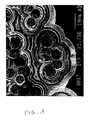
- Figure 1 is a snapshot with a scanning electron microscope a section of the densified material by the sequenced matrix.
- the fibers of carbon are coated individually by the layers formed during first two sequences, except for the areas of contact between fibers, these layers being arranged concentrically around the fibers.
- the layers formed during the third infiltration sequence envelop groups of fibers, while the layers formed in the fourth infiltration sequence virtually surround the fiber wick.
- the observations under the microscope reveal that, remarkably, none Initial cracking is not present in the matrix.
- a first tensile test at ambient temperature is carried out on a wick densified by the sequenced matrix.
- Curve B of the FIG. 2A shows the measured relative elongation (in%) as a function of the effort tensile force exerted, until breaking which occurs at about 460 MPa.
- a second tensile test is carried out at 700 ° C. in air after application of an external coating constituted by a P 2 O 5 type glass, in order to achieve an antioxidant protection during the duration of the test.
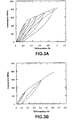
- Curves B in FIG. 3A show the relationships between elongation and stress during several stretch-relaxation cycles.
- a third tensile test is carried out after aging at 700 ° C. under air for 70 hours on densified tows deprived of additional coating P 2 O 5 .
- the mechanical behavior in tension during several stretch-relaxation cycles, then until rupture, is illustrated by the curves of FIG.
- Strands of carbon fibers are densified by a matrix sequenced in the same way as in Example 1, with the exception of the thickness of the relatively soft layers BC which is halved, giving a total thickness of 0.6 ⁇ m. Observation under a microscope Composite material thus developed reveals no cracking network initial within the matrix.
- Curve A in Figure 2A shows the relationship between the relative elongation and force exerted during a tensile test carried out at ambient temperature until the rupture of a wick thus densified by a sequenced matrix.
- Strands of carbon fibers are densified by a matrix sequenced in the same way as in Example 1, with the exception of the thickness of the relatively soft layers BC which is multiplied by two, giving a total thickness of 2.4 ⁇ m. Observation under a microscope Composite material thus developed reveals no cracking network initial within the matrix.
- Curve C in Figure 2A shows the relationship between the relative elongation and force exerted during a tensile test carried out at ambient temperature until the rupture of a wick thus densified by a sequenced matrix.
- strands of fibers such as those used in Example 1 are densified by a monolithic matrix of silicon carbide, after formation on the fibers of a coating of pyrolytic carbon interphase of rough laminar type.
- the number of cycles is chosen so as to reach a thickness of 2.4 ⁇ m for the interphase coating.
- a first tensile test at ambient temperature is carried out on a wick densified by the SiC matrix.
- Curve D of FIG. 2B shows the relative elongation measured as a function of the tensile force exerted until it breaks down at about 405 MPa.
- a second tensile test is carried out at 700 ° C. in air after application of an outer coating constituted by a P 2 O 5 type glass in order to achieve an antioxidant protection during the duration of the test.
- the curves D in FIG. 3B show the relationship between elongation and stress during several stretch-relaxation cycles.
- Figure 2B shows that SiC matrix composite material non-sequenced exhibits nonlinear behavior from the beginning of the mechanical stress, which is associated with damage mechanisms of the matrix and interphase initiated from the beginning of the elaboration process of the material.
- Figure 2A shows that composite materials sequenced matrix with BC deviating layers of cracks exhibit a initial linear behavior.
- the constraint corresponding to the beginning of the non-linearity is even higher than the total thickness of the BC layers is weak, however the fracture is less fragile for a total thickness of 1.2 ⁇ m. It seems that the optimum of total thickness for BC layers is between 0.6 micron and 2.4 microns, that is, a percentage, for the total thickness of the relatively soft layers, between 4% and about 20% of the total thickness of the deposited sequences.
- FIG. 3B shows that with heat, with external anti-oxidation protection, the damage phase extends to a level of higher than cold stress for SiC matrix composite material not sequenced.
- the hot behavior of materials sequenced matrix composites is little different from the behavior to cold: it is linear at first, then damaged.
- the phase damage is much more extensive.
- the levels of stress and elongation at rupture are quite high: about 800 MPa and 1%. It is noted that the breaking stress is very close to that of the lock of non-densified fibers.
- Figure 4 shows, after aging under air, a Tensile behavior of the same type as that observed at temperature ambient or hot for the sequenced matrix composite material. The However, deformation at break appears to be greater than during the test in traction at room temperature without aging.
- a remarkable property of the elaborate composite material according to the invention lies in the absence of cracking network initial result of the manufacturing process.
- each fiber of the fibrous reinforcement by at least a matrix sequence comprising a relatively flexible layer and a relatively rigid layer helps to absorb dilations differentials without inducing cracking of the rigid layers.
- the thickness of the first or first filed sequences must be relatively low and take into account the fiber volume ratio in the fiber reinforcement, that is to say, the fraction of the apparent volume of the reinforcement actually occupied by the fibers. In general, this thickness is chosen from preferably less than 1 micron.
- the thickness of the matrix sequences formed after that (s) fiber-sheathing is increasing continuously or in stages, the sequences successively coating groups of fibers and then strands of fibers. Indeed, this increase in thickness, which can be more marked for rigid layers than for flexible layers, does not affect the overall capacity of the matrix to absorb the differential dilations between constituents of the composite material and avoids unnecessary multiplication of the number of sequences, multiplication which would result in an increase important time and cost of developing the material. increasing progressive thickness achieved more markedly for layers relatively rigid ceramics also helps to preserve the matrix's essentially ceramic character.
- the thickness of sequences formed successively can grow by a value between about 0.2 micron and 1 micron to a value greater than 2 microns, while that, in successive sequences, the percentage S represented by the thickness of the relatively soft layer with respect to the total thickness of the sequence can decrease by a value between about 10% and about 35% up to a value of between about 3% and about 20%.
- a carbon doped with boron, BC is suitable for producing relatively soft layers, its anisotropic nature and its capacity for elastic deformation in shear and transversely.
- Boron doped carbon BC has also the advantage of having a better resistance to oxidation.
- others materials, which do not necessarily have the property of self-healing, may to be suitable, for example pyrolytic carbon, in particular of laminar type rough, and BN boron nitride.
- the relatively rigid layers consist of a ceramic material that can be deposited by chemical infiltration in the vapor phase, for example a carbide, a boride, a silicide, or any other ceramics likely to allow healing of cracks when they appear.
- a ceramic material that can be deposited by chemical infiltration in the vapor phase, for example a carbide, a boride, a silicide, or any other ceramics likely to allow healing of cracks when they appear.
Landscapes
- Chemical & Material Sciences (AREA)
- Engineering & Computer Science (AREA)
- Ceramic Engineering (AREA)
- Manufacturing & Machinery (AREA)
- Materials Engineering (AREA)
- Structural Engineering (AREA)
- Organic Chemistry (AREA)
- Inorganic Chemistry (AREA)
- Chemical Kinetics & Catalysis (AREA)
- Laminated Bodies (AREA)
- Ceramic Products (AREA)
Applications Claiming Priority (3)
| Application Number | Priority Date | Filing Date | Title |
|---|---|---|---|
| FR9514843A FR2742433B1 (fr) | 1995-12-14 | 1995-12-14 | Materiaux composites thermostructuraux avec renforts en fibres carbone ou revetues de carbone, ayant une resistance accrue a l'oxydation |
| FR9514843 | 1995-12-14 | ||
| PCT/FR1996/001951 WO1997021645A1 (fr) | 1995-12-14 | 1996-12-06 | Materiaux composites thermostructuraux avec renforts en fibres carbone ou revetues de carbone, ayant une resistance accrue a l'oxydation |
Publications (2)
| Publication Number | Publication Date |
|---|---|
| EP0866783A1 EP0866783A1 (fr) | 1998-09-30 |
| EP0866783B1 true EP0866783B1 (fr) | 1999-09-22 |
Family
ID=9485514
Family Applications (1)
| Application Number | Title | Priority Date | Filing Date |
|---|---|---|---|
| EP96941714A Expired - Lifetime EP0866783B1 (fr) | 1995-12-14 | 1996-12-06 | Materiaux composites thermostructuraux avec renforts en fibres carbone ou revetues de carbone, ayant une resistance accrue a l'oxydation |
Country Status (7)
| Country | Link |
|---|---|
| US (1) | US6068930A (enExample) |
| EP (1) | EP0866783B1 (enExample) |
| JP (1) | JP4191247B2 (enExample) |
| DE (1) | DE69604419T2 (enExample) |
| ES (1) | ES2138838T3 (enExample) |
| FR (1) | FR2742433B1 (enExample) |
| WO (1) | WO1997021645A1 (enExample) |
Families Citing this family (35)
| Publication number | Priority date | Publication date | Assignee | Title |
|---|---|---|---|---|
| FR2882356B1 (fr) * | 2005-02-23 | 2008-08-15 | Snecma Propulsion Solide Sa | Procede de fabrication de piece en materiau composite a matrice ceramique et piece ainsi obtenue |
| US7798769B2 (en) * | 2007-02-15 | 2010-09-21 | Siemens Energy, Inc. | Flexible, high-temperature ceramic seal element |
| FR2929690B1 (fr) | 2008-04-03 | 2012-08-17 | Snecma Propulsion Solide | Chambre de combustion sectorisee en cmc pour turbine a gaz |
| FR2929689B1 (fr) | 2008-04-03 | 2013-04-12 | Snecma Propulsion Solide | Chambre de combustion de turbine a gaz a parois interne et externe sectorisees |
| FR2936517B1 (fr) * | 2008-09-29 | 2011-07-29 | Snecma Propulsion Solide | Procede de fabrication de pieces en materiau composite thermostructural |
| FR2939430B1 (fr) | 2008-12-04 | 2011-01-07 | Snecma Propulsion Solide | Procede pour le lissage de la surface d'une piece en materiau cmc |
| FR2939789B1 (fr) * | 2008-12-16 | 2011-02-11 | Snecma Propulsion Solide | Procede de traitement de fibres ceramiques |
| FR2940278B1 (fr) | 2008-12-24 | 2011-05-06 | Snecma Propulsion Solide | Barriere environnementale pour substrat refractaire contenant du silicium |
| FR2944010B1 (fr) | 2009-04-02 | 2012-07-06 | Snecma Propulsion Solide | Procede pour le lissage de la surface d'une piece en materiau cmc |
| FR2950622B1 (fr) | 2009-09-28 | 2011-10-21 | Snecma Propulsion Solide | Piece en materiau composite a matrice ceramique et procede pour sa fabrication. |
| CH704833A1 (de) | 2011-04-04 | 2012-10-15 | Alstom Technology Ltd | Komponente für eine Turbomaschine und ein Verfahren zum Herstellen einer derartigen Komponente. |
| US8986845B2 (en) * | 2011-07-22 | 2015-03-24 | United Technologies Corporation | Ceramic composite article having laminar ceramic matrix |
| FR2983193B1 (fr) | 2011-11-30 | 2014-05-09 | Snecma Propulsion Solide | Procede de fabrication de piece en materiau cmc |
| FR2983851B1 (fr) | 2011-12-13 | 2013-12-27 | Snecma Propulsion Solide | Piece en materiau cmc |
| FR2987079B1 (fr) | 2012-02-17 | 2017-02-10 | Snecma Propulsion Solide | Cone d'echappement avec systeme d'attenuation acoustique |
| FR2988777B1 (fr) * | 2012-03-29 | 2014-04-25 | Snecma Propulsion Solide | Integration de pieces d'arriere-corps de moteur aeronautique |
| FR2996549B1 (fr) | 2012-10-04 | 2016-01-29 | Herakles | Procede de fabrication d'une piece aerodynamique par surmoulage d'une enveloppe ceramique sur une preforme composite |
| US9708226B2 (en) | 2013-03-15 | 2017-07-18 | Rolls-Royce Corporation | Method for producing high strength ceramic matrix composites |
| US10370301B2 (en) | 2013-03-15 | 2019-08-06 | Rolls-Royce Corporation | Ceramic matrix composite and method and article of manufacture |
| FR3007028B1 (fr) | 2013-06-13 | 2015-07-03 | Herakles | Barriere environnementale pour substrat refractaire contenant du silicium |
| FR3008968B1 (fr) | 2013-07-23 | 2016-12-09 | Herakles | Procede de fabrication de pieces en materiau composite par impregnation a basse temperature de fusion |
| DE102014116933A1 (de) * | 2014-11-19 | 2016-05-19 | Airbus Operations Gmbh | Verfahren zur Herstellung einer Luftfahrzeug- oder Raumfahrzeugkomponente, die einen Rissstopper umfasst, unter Anwendung von Additive Layer Manufacturing |
| US11431285B2 (en) | 2016-07-08 | 2022-08-30 | Corosolar Llc | Dynamic stabilizer for solar trackers |
| FR3063725B1 (fr) | 2017-03-07 | 2019-04-12 | Safran Ceramics | Procede de realisation d'une preforme fibreuse consolidee |
| FR3084445B1 (fr) | 2018-07-25 | 2021-01-22 | Safran Aircraft Engines | Fabrication d'une chambre de combustion en materiau composite |
| WO2020025878A1 (fr) | 2018-08-03 | 2020-02-06 | Safran Ceramics | Procede de fabrication d'une piece en cmc |
| IT201800009953A1 (it) | 2018-10-31 | 2020-05-01 | Petroceramics Spa | Metodo ed un assieme di infiltrazione e la deposizione rapida da fase vapore di componenti porosi |
| EP3647459A1 (en) | 2018-10-31 | 2020-05-06 | Petroceramics S.p.A. | Method and an assembly by chemical vapor infiltration of porous components |
| CN111196733B (zh) * | 2020-01-09 | 2021-06-04 | 青岛理工大学 | 一种氧化致型形状记忆纤维及其制备方法和应用 |
| FR3120811B1 (fr) | 2021-03-18 | 2023-03-17 | Safran Ceram | Procédé amélioré de réalisation d'une préforme fibreuse consolidée |
| FR3130273B1 (fr) | 2021-12-10 | 2023-12-15 | Safran Ceram | Procédé de fabrication d’une pièce en matériau composite SiC/SiC |
| FR3141164B1 (fr) | 2022-10-21 | 2024-10-04 | Safran Ceram | Preforme fibreuse et son procede de fabrication pour realiser une piece en materiau composite a matrice ceramique |
| FR3147805A1 (fr) | 2023-04-12 | 2024-10-18 | Safran Ceramics | Consolidation d’une préforme fibreuse |
| FR3147804A1 (fr) | 2023-04-12 | 2024-10-18 | Safran Ceramics | Consolidation d’une préforme fibreuse |
| FR3157384A1 (fr) | 2023-12-21 | 2025-06-27 | Safran Ceramics | Procédé de fabrication d'une aube par infiltration chimique en phase vapeur |
Family Cites Families (4)
| Publication number | Priority date | Publication date | Assignee | Title |
|---|---|---|---|---|
| FR2643898B1 (fr) * | 1989-03-02 | 1993-05-07 | Europ Propulsion | Procede de fabrication d'un materiau composite a matrice ceramique a tenacite amelioree |
| FR2668477B1 (fr) * | 1990-10-26 | 1993-10-22 | Propulsion Ste Europeenne | Materiau composite refractaire protege contre la corrosion, et procede pour son elaboration. |
| FR2705664B1 (fr) * | 1993-05-24 | 1995-08-25 | Europ Propulsion | Procédé de fabrication d'un matériau composite à interphase en carbone pyrolytique de microtexture lamellaire entre fibres de renfort et matrice, et matériau tel qu'obtenu par le procédé. |
| DE4409099C2 (de) * | 1994-03-17 | 1997-02-20 | Dornier Gmbh | Verfahren zur Herstellung eines Faserverbundwerkstoffs mit keramischer Matrix sowie Verwendung eines solchen Werkstoffs |
-
1995
- 1995-12-14 FR FR9514843A patent/FR2742433B1/fr not_active Expired - Fee Related
-
1996
- 1996-12-06 JP JP52178597A patent/JP4191247B2/ja not_active Expired - Fee Related
- 1996-12-06 EP EP96941714A patent/EP0866783B1/fr not_active Expired - Lifetime
- 1996-12-06 WO PCT/FR1996/001951 patent/WO1997021645A1/fr not_active Ceased
- 1996-12-06 ES ES96941714T patent/ES2138838T3/es not_active Expired - Lifetime
- 1996-12-06 DE DE69604419T patent/DE69604419T2/de not_active Expired - Lifetime
- 1996-12-06 US US09/091,274 patent/US6068930A/en not_active Expired - Lifetime
Also Published As
| Publication number | Publication date |
|---|---|
| DE69604419D1 (de) | 1999-10-28 |
| JP2000515840A (ja) | 2000-11-28 |
| US6068930A (en) | 2000-05-30 |
| DE69604419T2 (de) | 2000-05-11 |
| FR2742433B1 (fr) | 1998-03-13 |
| JP4191247B2 (ja) | 2008-12-03 |
| WO1997021645A1 (fr) | 1997-06-19 |
| EP0866783A1 (fr) | 1998-09-30 |
| FR2742433A1 (fr) | 1997-06-20 |
| ES2138838T3 (es) | 2000-01-16 |
Similar Documents
| Publication | Publication Date | Title |
|---|---|---|
| FR2742433A1 (fr) | Materiaux composites thermostructuraux avec renforts en fibres carbone ou revetues de carbone, ayant une resistance accrue a l'oxydation | |
| EP0817762B1 (fr) | Materiau composite protege contre l'oxydation par une matrice autocicatrisante et son procede de fabrication | |
| EP0948469B1 (fr) | MATERIAU COMPOSITE A MATRICE CERAMIQUE ET RENFORT EN FIBRES SiC ET PROCEDE POUR SA FABRICATION | |
| EP0721438B1 (fr) | Procede de fabrication d'un materiau composite a interphase lamellaire entre fibres de renfort et matrice, et materiau tel qu'obtenu par le procede | |
| EP0282386B1 (fr) | Matériau composite à matrice et fibres de renforcement en carbone et son procédé de fabrication | |
| EP1594816B1 (fr) | Procede de siliciuration de materiaux composites thermostructuraux et pieces telles qu obtenues par le procede | |
| EP0483009B1 (fr) | Procédé d'élaboration d'un matériau composite réfractaire protégé contre la corrosion | |
| EP2373596B1 (fr) | Procede de traitement de fibres ceramiques | |
| EP0482994B1 (fr) | Pièce en matériau composite carboné, protégée contre l'oxydation et son procédé de fabrication | |
| FR2852003A1 (fr) | Procede de realisation d'une piece multiperforee en materiau composite a matrice ceramique | |
| CA2919590A1 (fr) | Procede de fabrication de pieces en materiau composite par impregnation a basse temperature de fusion | |
| FR2668480A1 (fr) | Procede pour la protection anti-oxydation d'un materiau composite contenant du carbone, et materiau ainsi protege. | |
| EP0598631B1 (fr) | Pièce en matériau composite carbone-carbone à matrice dopée SiC, résistant à l'oxydation et son procédé de fabrication | |
| EP2234944B1 (fr) | Procede de realisation d'une couche de carbure refractaire sur une piece en materiau composite c/c | |
| EP0500424B1 (fr) | Procédé pour la protection anti-oxydation d'un matériau qui, au moins en surface, est constitué d'une céramique formée par un composé du silicium, et matériau tel qu'obtenu par le procédé | |
| FR2697518A1 (fr) | Procédé et système de protection contre l'oxydation d'un matériau oxydable. | |
| FR2675141A1 (fr) | Materiau composite a matrice ceramique avec interphase lamellaire entre fibres de renfort refractaires et matrice, et procede pour sa fabrication. | |
| EP0451043B1 (fr) | Procédé de réalisation d'un matériau composite thermostructural à interphase carbone entre fibres de renfort et matrice | |
| FR3115784A1 (fr) | Formation de nitrure de bore sur fibres par la méthode des sels fondus | |
| CA2272075A1 (fr) | Procede d'elaboration d'un materiau d'interphase, materiau obtenu, procede de traitement d'une fibre ceramique de renfort avec ce materiau et procede de fabrication d'un materiau thermostructural associe | |
| FR2727436A1 (fr) | Procede pour revetir en continu d'une couche de carbure des fibres multifilamentaires en un materiau refractaire | |
| EP4605356A1 (fr) | Préforme fibreuse et son procédé de fabrication pour réaliser une pièce en matériau composite à matrice céramique |
Legal Events
| Date | Code | Title | Description |
|---|---|---|---|
| PUAI | Public reference made under article 153(3) epc to a published international application that has entered the european phase |
Free format text: ORIGINAL CODE: 0009012 |
|
| 17P | Request for examination filed |
Effective date: 19980615 |
|
| AK | Designated contracting states |
Kind code of ref document: A1 Designated state(s): DE ES FR GB SE |
|
| GRAG | Despatch of communication of intention to grant |
Free format text: ORIGINAL CODE: EPIDOS AGRA |
|
| 17Q | First examination report despatched |
Effective date: 19981116 |
|
| GRAG | Despatch of communication of intention to grant |
Free format text: ORIGINAL CODE: EPIDOS AGRA |
|
| GRAH | Despatch of communication of intention to grant a patent |
Free format text: ORIGINAL CODE: EPIDOS IGRA |
|
| GRAH | Despatch of communication of intention to grant a patent |
Free format text: ORIGINAL CODE: EPIDOS IGRA |
|
| GRAA | (expected) grant |
Free format text: ORIGINAL CODE: 0009210 |
|
| AK | Designated contracting states |
Kind code of ref document: B1 Designated state(s): DE ES FR GB SE |
|
| REF | Corresponds to: |
Ref document number: 69604419 Country of ref document: DE Date of ref document: 19991028 |
|
| REG | Reference to a national code |
Ref country code: ES Ref legal event code: FG2A Ref document number: 2138838 Country of ref document: ES Kind code of ref document: T3 |
|
| GBT | Gb: translation of ep patent filed (gb section 77(6)(a)/1977) |
Effective date: 19991223 |
|
| PLBE | No opposition filed within time limit |
Free format text: ORIGINAL CODE: 0009261 |
|
| STAA | Information on the status of an ep patent application or granted ep patent |
Free format text: STATUS: NO OPPOSITION FILED WITHIN TIME LIMIT |
|
| 26N | No opposition filed | ||
| REG | Reference to a national code |
Ref country code: GB Ref legal event code: IF02 |
|
| REG | Reference to a national code |
Ref country code: FR Ref legal event code: TP Ref country code: FR Ref legal event code: CD |
|
| REG | Reference to a national code |
Ref country code: DE Ref legal event code: R082 Ref document number: 69604419 Country of ref document: DE Representative=s name: CBDL PATENTANWAELTE, DE |
|
| REG | Reference to a national code |
Ref country code: DE Ref legal event code: R082 Ref document number: 69604419 Country of ref document: DE Representative=s name: CBDL PATENTANWAELTE, DE |
|
| REG | Reference to a national code |
Ref country code: DE Ref legal event code: R082 Ref document number: 69604419 Country of ref document: DE Representative=s name: CBDL PATENTANWAELTE, DE |
|
| PGFP | Annual fee paid to national office [announced via postgrant information from national office to epo] |
Ref country code: ES Payment date: 20121205 Year of fee payment: 17 |
|
| REG | Reference to a national code |
Ref country code: DE Ref legal event code: R082 Ref document number: 69604419 Country of ref document: DE Representative=s name: CBDL PATENTANWAELTE, DE Effective date: 20130115 Ref country code: DE Ref legal event code: R082 Ref document number: 69604419 Country of ref document: DE Representative=s name: CBDL PATENTANWAELTE, DE Effective date: 20130111 Ref country code: DE Ref legal event code: R082 Ref document number: 69604419 Country of ref document: DE Representative=s name: CBDL PATENTANWAELTE, DE Effective date: 20130117 Ref country code: DE Ref legal event code: R082 Ref document number: 69604419 Country of ref document: DE Representative=s name: CBDL PATENTANWAELTE, DE Effective date: 20130114 Ref country code: DE Ref legal event code: R081 Ref document number: 69604419 Country of ref document: DE Owner name: HERAKLES, FR Free format text: FORMER OWNER: SNECMA PROPULSION SOLIDE, LE HAILLAN, FR Effective date: 20130117 Ref country code: DE Ref legal event code: R081 Ref document number: 69604419 Country of ref document: DE Owner name: HERAKLES, FR Free format text: FORMER OWNER: LEXVALL, PARIS, FR Effective date: 20130114 Ref country code: DE Ref legal event code: R081 Ref document number: 69604419 Country of ref document: DE Owner name: HERAKLES, FR Free format text: FORMER OWNER: LEXVALL 8, VELIZY-VILLACOUBLAY, FR Effective date: 20130115 Ref country code: DE Ref legal event code: R081 Ref document number: 69604419 Country of ref document: DE Owner name: HERAKLES, FR Free format text: FORMER OWNER: SNECMA MOTEURS, PARIS, FR Effective date: 20130114 Ref country code: DE Ref legal event code: R081 Ref document number: 69604419 Country of ref document: DE Owner name: HERAKLES, FR Free format text: FORMER OWNER: SOCIETE NATIONALE D'ETUDE ET DE CONSTRUCTION DE MOTEURS D'AVIATION "S.N.E.C.M.A.", PARIS, FR Effective date: 20130111 |
|
| REG | Reference to a national code |
Ref country code: FR Ref legal event code: TP Owner name: HERAKLES, FR Effective date: 20130513 Ref country code: FR Ref legal event code: CD Owner name: HERAKLES, FR Effective date: 20130513 Ref country code: FR Ref legal event code: CA Effective date: 20130513 |
|
| PGFP | Annual fee paid to national office [announced via postgrant information from national office to epo] |
Ref country code: SE Payment date: 20131125 Year of fee payment: 18 Ref country code: GB Payment date: 20131125 Year of fee payment: 18 Ref country code: DE Payment date: 20131121 Year of fee payment: 18 |
|
| PGFP | Annual fee paid to national office [announced via postgrant information from national office to epo] |
Ref country code: FR Payment date: 20131209 Year of fee payment: 18 |
|
| REG | Reference to a national code |
Ref country code: ES Ref legal event code: FD2A Effective date: 20150327 |
|
| PG25 | Lapsed in a contracting state [announced via postgrant information from national office to epo] |
Ref country code: ES Free format text: LAPSE BECAUSE OF NON-PAYMENT OF DUE FEES Effective date: 20131207 |
|
| REG | Reference to a national code |
Ref country code: DE Ref legal event code: R119 Ref document number: 69604419 Country of ref document: DE |
|
| PG25 | Lapsed in a contracting state [announced via postgrant information from national office to epo] |
Ref country code: SE Free format text: LAPSE BECAUSE OF NON-PAYMENT OF DUE FEES Effective date: 20141207 |
|
| REG | Reference to a national code |
Ref country code: SE Ref legal event code: EUG |
|
| GBPC | Gb: european patent ceased through non-payment of renewal fee |
Effective date: 20141206 |
|
| REG | Reference to a national code |
Ref country code: FR Ref legal event code: ST Effective date: 20150831 |
|
| PG25 | Lapsed in a contracting state [announced via postgrant information from national office to epo] |
Ref country code: DE Free format text: LAPSE BECAUSE OF NON-PAYMENT OF DUE FEES Effective date: 20150701 Ref country code: GB Free format text: LAPSE BECAUSE OF NON-PAYMENT OF DUE FEES Effective date: 20141206 |
|
| PG25 | Lapsed in a contracting state [announced via postgrant information from national office to epo] |
Ref country code: FR Free format text: LAPSE BECAUSE OF NON-PAYMENT OF DUE FEES Effective date: 20141231 |