EP0839204B1 - Procede de production, par des cellules vegetales, de proteines heminiques, proteines ainsi obtenues et produits contenant ces proteines - Google Patents
Procede de production, par des cellules vegetales, de proteines heminiques, proteines ainsi obtenues et produits contenant ces proteines Download PDFInfo
- Publication number
- EP0839204B1 EP0839204B1 EP96925810A EP96925810A EP0839204B1 EP 0839204 B1 EP0839204 B1 EP 0839204B1 EP 96925810 A EP96925810 A EP 96925810A EP 96925810 A EP96925810 A EP 96925810A EP 0839204 B1 EP0839204 B1 EP 0839204B1
- Authority
- EP
- European Patent Office
- Prior art keywords
- protein
- globin
- sequence
- nucleic acid
- coding
- Prior art date
- Legal status (The legal status is an assumption and is not a legal conclusion. Google has not performed a legal analysis and makes no representation as to the accuracy of the status listed.)
- Expired - Lifetime
Links
- 108090000623 proteins and genes Proteins 0.000 title claims abstract description 154
- 102000004169 proteins and genes Human genes 0.000 title claims abstract description 121
- 238000004519 manufacturing process Methods 0.000 title claims abstract description 21
- BTIJJDXEELBZFS-UHFFFAOYSA-K hemin Chemical compound [Cl-].[Fe+3].[N-]1C(C=C2C(=C(C)C(C=C3C(=C(C)C(=C4)[N-]3)C=C)=N2)C=C)=C(C)C(CCC(O)=O)=C1C=C1C(CCC(O)=O)=C(C)C4=N1 BTIJJDXEELBZFS-UHFFFAOYSA-K 0.000 title abstract 5
- 235000018102 proteins Nutrition 0.000 claims abstract description 118
- 150000007523 nucleic acids Chemical class 0.000 claims abstract description 55
- 108020004707 nucleic acids Proteins 0.000 claims abstract description 53
- 102000039446 nucleic acids Human genes 0.000 claims abstract description 53
- 229910052760 oxygen Inorganic materials 0.000 claims abstract description 45
- QVGXLLKOCUKJST-UHFFFAOYSA-N atomic oxygen Chemical compound [O] QVGXLLKOCUKJST-UHFFFAOYSA-N 0.000 claims abstract description 41
- 239000001301 oxygen Substances 0.000 claims abstract description 41
- 235000004252 protein component Nutrition 0.000 claims abstract description 21
- 230000009261 transgenic effect Effects 0.000 claims abstract description 17
- 241001465754 Metazoa Species 0.000 claims abstract description 15
- 239000003795 chemical substances by application Substances 0.000 claims abstract description 8
- PMVSDNDAUGGCCE-TYYBGVCCSA-L Ferrous fumarate Chemical compound [Fe+2].[O-]C(=O)\C=C\C([O-])=O PMVSDNDAUGGCCE-TYYBGVCCSA-L 0.000 claims abstract description 5
- 238000000034 method Methods 0.000 claims description 100
- 108091005904 Hemoglobin subunit beta Proteins 0.000 claims description 69
- 239000002299 complementary DNA Substances 0.000 claims description 68
- 102100021519 Hemoglobin subunit beta Human genes 0.000 claims description 66
- 108090000765 processed proteins & peptides Proteins 0.000 claims description 62
- 102100027685 Hemoglobin subunit alpha Human genes 0.000 claims description 56
- 108091005902 Hemoglobin subunit alpha Proteins 0.000 claims description 56
- 108091026890 Coding region Proteins 0.000 claims description 46
- 230000009466 transformation Effects 0.000 claims description 43
- 150000003278 haem Chemical class 0.000 claims description 33
- 108010076504 Protein Sorting Signals Proteins 0.000 claims description 29
- XEEYBQQBJWHFJM-UHFFFAOYSA-N Iron Chemical compound [Fe] XEEYBQQBJWHFJM-UHFFFAOYSA-N 0.000 claims description 27
- 239000013598 vector Substances 0.000 claims description 24
- 230000002438 mitochondrial effect Effects 0.000 claims description 23
- 235000013311 vegetables Nutrition 0.000 claims description 20
- 102000004196 processed proteins & peptides Human genes 0.000 claims description 16
- 238000000746 purification Methods 0.000 claims description 16
- 230000001105 regulatory effect Effects 0.000 claims description 16
- 150000001413 amino acids Chemical class 0.000 claims description 14
- 229920001184 polypeptide Polymers 0.000 claims description 14
- 238000013518 transcription Methods 0.000 claims description 14
- 230000035897 transcription Effects 0.000 claims description 14
- 238000012217 deletion Methods 0.000 claims description 13
- 230000037430 deletion Effects 0.000 claims description 13
- 229910052742 iron Inorganic materials 0.000 claims description 13
- KSFOVUSSGSKXFI-GAQDCDSVSA-N CC1=C/2NC(\C=C3/N=C(/C=C4\N\C(=C/C5=N/C(=C\2)/C(C=C)=C5C)C(C=C)=C4C)C(C)=C3CCC(O)=O)=C1CCC(O)=O Chemical compound CC1=C/2NC(\C=C3/N=C(/C=C4\N\C(=C/C5=N/C(=C\2)/C(C=C)=C5C)C(C=C)=C4C)C(C)=C3CCC(O)=O)=C1CCC(O)=O KSFOVUSSGSKXFI-GAQDCDSVSA-N 0.000 claims description 12
- 229950003776 protoporphyrin Drugs 0.000 claims description 12
- 230000014759 maintenance of location Effects 0.000 claims description 11
- 230000014616 translation Effects 0.000 claims description 10
- 210000003660 reticulum Anatomy 0.000 claims description 9
- 239000007788 liquid Substances 0.000 claims description 8
- 229930182817 methionine Natural products 0.000 claims description 8
- 238000006467 substitution reaction Methods 0.000 claims description 8
- FFEARJCKVFRZRR-BYPYZUCNSA-N L-methionine Chemical compound CSCC[C@H](N)C(O)=O FFEARJCKVFRZRR-BYPYZUCNSA-N 0.000 claims description 7
- 210000004369 blood Anatomy 0.000 claims description 6
- 239000008280 blood Substances 0.000 claims description 6
- 108010062374 Myoglobin Proteins 0.000 claims description 5
- 238000003780 insertion Methods 0.000 claims description 5
- 230000037431 insertion Effects 0.000 claims description 5
- KAESVJOAVNADME-UHFFFAOYSA-N Pyrrole Chemical compound C=1C=CNC=1 KAESVJOAVNADME-UHFFFAOYSA-N 0.000 claims description 4
- 230000006872 improvement Effects 0.000 claims description 4
- 230000008929 regeneration Effects 0.000 claims description 4
- 238000011069 regeneration method Methods 0.000 claims description 4
- 239000000758 substrate Substances 0.000 claims description 4
- 101001009007 Homo sapiens Hemoglobin subunit alpha Proteins 0.000 claims description 3
- 239000002537 cosmetic Substances 0.000 claims description 3
- 238000011084 recovery Methods 0.000 claims description 3
- 239000000546 pharmaceutical excipient Substances 0.000 claims description 2
- 239000000825 pharmaceutical preparation Substances 0.000 claims description 2
- 229940127557 pharmaceutical product Drugs 0.000 claims description 2
- 238000002360 preparation method Methods 0.000 claims description 2
- 238000002560 therapeutic procedure Methods 0.000 claims description 2
- 229940079593 drug Drugs 0.000 claims 2
- 239000003814 drug Substances 0.000 claims 2
- 230000010874 maintenance of protein location Effects 0.000 claims 2
- 102100030856 Myoglobin Human genes 0.000 claims 1
- 230000010261 cell growth Effects 0.000 claims 1
- 239000003153 chemical reaction reagent Substances 0.000 claims 1
- 238000002331 protein detection Methods 0.000 claims 1
- 230000001902 propagating effect Effects 0.000 abstract 1
- 230000001172 regenerating effect Effects 0.000 abstract 1
- 239000013612 plasmid Substances 0.000 description 164
- 108020004414 DNA Proteins 0.000 description 123
- 102000001554 Hemoglobins Human genes 0.000 description 86
- 108010054147 Hemoglobins Proteins 0.000 description 85
- 241000196324 Embryophyta Species 0.000 description 72
- 108020004705 Codon Proteins 0.000 description 71
- 239000012634 fragment Substances 0.000 description 55
- UGFAIRIUMAVXCW-UHFFFAOYSA-N Carbon monoxide Chemical compound [O+]#[C-] UGFAIRIUMAVXCW-UHFFFAOYSA-N 0.000 description 52
- 229910002091 carbon monoxide Inorganic materials 0.000 description 51
- 210000004027 cell Anatomy 0.000 description 51
- 230000014509 gene expression Effects 0.000 description 49
- 102000018146 globin Human genes 0.000 description 47
- 108060003196 globin Proteins 0.000 description 47
- 230000006862 enzymatic digestion Effects 0.000 description 42
- 238000010276 construction Methods 0.000 description 38
- 244000061176 Nicotiana tabacum Species 0.000 description 35
- 235000002637 Nicotiana tabacum Nutrition 0.000 description 34
- 230000009089 cytolysis Effects 0.000 description 33
- 239000002773 nucleotide Substances 0.000 description 29
- 125000003729 nucleotide group Chemical group 0.000 description 29
- LFQSCWFLJHTTHZ-UHFFFAOYSA-N Ethanol Chemical compound CCO LFQSCWFLJHTTHZ-UHFFFAOYSA-N 0.000 description 28
- 239000000872 buffer Substances 0.000 description 27
- 238000012163 sequencing technique Methods 0.000 description 27
- 102000008015 Hemeproteins Human genes 0.000 description 26
- 108010089792 Hemeproteins Proteins 0.000 description 26
- 239000004098 Tetracycline Substances 0.000 description 20
- 229960002180 tetracycline Drugs 0.000 description 20
- 229930101283 tetracycline Natural products 0.000 description 20
- 235000019364 tetracycline Nutrition 0.000 description 20
- 150000003522 tetracyclines Chemical class 0.000 description 20
- AVKUERGKIZMTKX-NJBDSQKTSA-N ampicillin Chemical compound C1([C@@H](N)C(=O)N[C@H]2[C@H]3SC([C@@H](N3C2=O)C(O)=O)(C)C)=CC=CC=C1 AVKUERGKIZMTKX-NJBDSQKTSA-N 0.000 description 18
- 241000589155 Agrobacterium tumefaciens Species 0.000 description 16
- 210000003763 chloroplast Anatomy 0.000 description 16
- 238000010494 dissociation reaction Methods 0.000 description 16
- 230000005593 dissociations Effects 0.000 description 16
- 230000009471 action Effects 0.000 description 15
- 238000000246 agarose gel electrophoresis Methods 0.000 description 15
- 244000309466 calf Species 0.000 description 15
- 239000003999 initiator Substances 0.000 description 15
- 239000002609 medium Substances 0.000 description 15
- QKNYBSVHEMOAJP-UHFFFAOYSA-N 2-amino-2-(hydroxymethyl)propane-1,3-diol;hydron;chloride Chemical compound Cl.OCC(N)(CO)CO QKNYBSVHEMOAJP-UHFFFAOYSA-N 0.000 description 14
- 102000012410 DNA Ligases Human genes 0.000 description 14
- 108010061982 DNA Ligases Proteins 0.000 description 14
- 229960000723 ampicillin Drugs 0.000 description 14
- 239000003446 ligand Substances 0.000 description 14
- 238000012545 processing Methods 0.000 description 14
- 239000000243 solution Substances 0.000 description 14
- 244000017020 Ipomoea batatas Species 0.000 description 13
- 235000002678 Ipomoea batatas Nutrition 0.000 description 13
- 230000001086 cytosolic effect Effects 0.000 description 13
- 230000004927 fusion Effects 0.000 description 13
- 229940046166 oligodeoxynucleotide Drugs 0.000 description 13
- 239000002243 precursor Substances 0.000 description 13
- 238000001262 western blot Methods 0.000 description 13
- HEDRZPFGACZZDS-UHFFFAOYSA-N Chloroform Chemical compound ClC(Cl)Cl HEDRZPFGACZZDS-UHFFFAOYSA-N 0.000 description 12
- 238000012408 PCR amplification Methods 0.000 description 12
- 230000000717 retained effect Effects 0.000 description 12
- KCXVZYZYPLLWCC-UHFFFAOYSA-N EDTA Chemical compound OC(=O)CN(CC(O)=O)CCN(CC(O)=O)CC(O)=O KCXVZYZYPLLWCC-UHFFFAOYSA-N 0.000 description 11
- 101710108868 Sporamin A Proteins 0.000 description 11
- 230000029087 digestion Effects 0.000 description 11
- 230000036961 partial effect Effects 0.000 description 11
- 238000006303 photolysis reaction Methods 0.000 description 11
- 230000006798 recombination Effects 0.000 description 11
- 238000005215 recombination Methods 0.000 description 11
- 102000002260 Alkaline Phosphatase Human genes 0.000 description 10
- 108020004774 Alkaline Phosphatase Proteins 0.000 description 10
- 241000588724 Escherichia coli Species 0.000 description 10
- 235000001014 amino acid Nutrition 0.000 description 10
- 238000003776 cleavage reaction Methods 0.000 description 10
- 230000004186 co-expression Effects 0.000 description 10
- 238000000605 extraction Methods 0.000 description 10
- PHTQWCKDNZKARW-UHFFFAOYSA-N isoamylol Chemical compound CC(C)CCO PHTQWCKDNZKARW-UHFFFAOYSA-N 0.000 description 10
- 230000007017 scission Effects 0.000 description 10
- 230000028327 secretion Effects 0.000 description 10
- 241000894006 Bacteria Species 0.000 description 9
- 238000006243 chemical reaction Methods 0.000 description 9
- 108010030074 endodeoxyribonuclease MluI Proteins 0.000 description 9
- 239000000284 extract Substances 0.000 description 9
- 230000000977 initiatory effect Effects 0.000 description 9
- 210000000936 intestine Anatomy 0.000 description 9
- IJGRMHOSHXDMSA-UHFFFAOYSA-N Atomic nitrogen Chemical compound N#N IJGRMHOSHXDMSA-UHFFFAOYSA-N 0.000 description 8
- FAPWRFPIFSIZLT-UHFFFAOYSA-M Sodium chloride Chemical compound [Na+].[Cl-] FAPWRFPIFSIZLT-UHFFFAOYSA-M 0.000 description 8
- 238000001962 electrophoresis Methods 0.000 description 8
- 210000002472 endoplasmic reticulum Anatomy 0.000 description 8
- 230000006870 function Effects 0.000 description 8
- 235000006109 methionine Nutrition 0.000 description 8
- 239000000203 mixture Substances 0.000 description 8
- 230000037432 silent mutation Effects 0.000 description 8
- 230000008685 targeting Effects 0.000 description 8
- 238000013519 translation Methods 0.000 description 8
- INGWEZCOABYORO-UHFFFAOYSA-N 2-(furan-2-yl)-7-methyl-1h-1,8-naphthyridin-4-one Chemical compound N=1C2=NC(C)=CC=C2C(O)=CC=1C1=CC=CO1 INGWEZCOABYORO-UHFFFAOYSA-N 0.000 description 7
- 241000701489 Cauliflower mosaic virus Species 0.000 description 7
- 241000620209 Escherichia coli DH5[alpha] Species 0.000 description 7
- 240000008042 Zea mays Species 0.000 description 7
- 235000002017 Zea mays subsp mays Nutrition 0.000 description 7
- 239000002253 acid Substances 0.000 description 7
- 238000001514 detection method Methods 0.000 description 7
- 230000004048 modification Effects 0.000 description 7
- 238000012986 modification Methods 0.000 description 7
- 108020004635 Complementary DNA Proteins 0.000 description 6
- 102100024319 Intestinal-type alkaline phosphatase Human genes 0.000 description 6
- 101710184243 Intestinal-type alkaline phosphatase Proteins 0.000 description 6
- ISWSIDIOOBJBQZ-UHFFFAOYSA-N Phenol Chemical compound OC1=CC=CC=C1 ISWSIDIOOBJBQZ-UHFFFAOYSA-N 0.000 description 6
- VMHLLURERBWHNL-UHFFFAOYSA-M Sodium acetate Chemical compound [Na+].CC([O-])=O VMHLLURERBWHNL-UHFFFAOYSA-M 0.000 description 6
- 239000012528 membrane Substances 0.000 description 6
- 230000008569 process Effects 0.000 description 6
- 230000002441 reversible effect Effects 0.000 description 6
- 239000001632 sodium acetate Substances 0.000 description 6
- 235000017281 sodium acetate Nutrition 0.000 description 6
- YAHZABJORDUQGO-NQXXGFSBSA-N D-ribulose 1,5-bisphosphate Chemical compound OP(=O)(O)OC[C@@H](O)[C@@H](O)C(=O)COP(O)(O)=O YAHZABJORDUQGO-NQXXGFSBSA-N 0.000 description 5
- 241000208133 Nicotiana plumbaginifolia Species 0.000 description 5
- 240000004713 Pisum sativum Species 0.000 description 5
- 235000010582 Pisum sativum Nutrition 0.000 description 5
- 240000004808 Saccharomyces cerevisiae Species 0.000 description 5
- 235000014680 Saccharomyces cerevisiae Nutrition 0.000 description 5
- 241000700605 Viruses Species 0.000 description 5
- 230000015572 biosynthetic process Effects 0.000 description 5
- 239000012141 concentrate Substances 0.000 description 5
- 210000003470 mitochondria Anatomy 0.000 description 5
- 108091008146 restriction endonucleases Proteins 0.000 description 5
- 229920006395 saturated elastomer Polymers 0.000 description 5
- 239000011734 sodium Substances 0.000 description 5
- 238000002415 sodium dodecyl sulfate polyacrylamide gel electrophoresis Methods 0.000 description 5
- 239000006228 supernatant Substances 0.000 description 5
- 210000001519 tissue Anatomy 0.000 description 5
- 230000032258 transport Effects 0.000 description 5
- 230000003612 virological effect Effects 0.000 description 5
- 108700007698 Genetic Terminator Regions Proteins 0.000 description 4
- DHMQDGOQFOQNFH-UHFFFAOYSA-N Glycine Chemical compound NCC(O)=O DHMQDGOQFOQNFH-UHFFFAOYSA-N 0.000 description 4
- 241000880493 Leptailurus serval Species 0.000 description 4
- 102000036675 Myoglobin Human genes 0.000 description 4
- 240000007594 Oryza sativa Species 0.000 description 4
- 235000007164 Oryza sativa Nutrition 0.000 description 4
- 102000007056 Recombinant Fusion Proteins Human genes 0.000 description 4
- 108010008281 Recombinant Fusion Proteins Proteins 0.000 description 4
- ILVGMCVCQBJPSH-WDSKDSINSA-N Ser-Val Chemical compound CC(C)[C@@H](C(O)=O)NC(=O)[C@@H](N)CO ILVGMCVCQBJPSH-WDSKDSINSA-N 0.000 description 4
- 244000061456 Solanum tuberosum Species 0.000 description 4
- 235000002595 Solanum tuberosum Nutrition 0.000 description 4
- 108091081024 Start codon Proteins 0.000 description 4
- 235000016383 Zea mays subsp huehuetenangensis Nutrition 0.000 description 4
- 230000003321 amplification Effects 0.000 description 4
- 101150055766 cat gene Proteins 0.000 description 4
- 238000010367 cloning Methods 0.000 description 4
- 239000000539 dimer Substances 0.000 description 4
- 238000005516 engineering process Methods 0.000 description 4
- 238000003473 flash photolysis reaction Methods 0.000 description 4
- 239000000499 gel Substances 0.000 description 4
- 238000001502 gel electrophoresis Methods 0.000 description 4
- 238000000338 in vitro Methods 0.000 description 4
- 235000009973 maize Nutrition 0.000 description 4
- 229910052757 nitrogen Inorganic materials 0.000 description 4
- 108010058731 nopaline synthase Proteins 0.000 description 4
- 238000003199 nucleic acid amplification method Methods 0.000 description 4
- 230000003287 optical effect Effects 0.000 description 4
- YBYRMVIVWMBXKQ-UHFFFAOYSA-N phenylmethanesulfonyl fluoride Chemical compound FS(=O)(=O)CC1=CC=CC=C1 YBYRMVIVWMBXKQ-UHFFFAOYSA-N 0.000 description 4
- 235000009566 rice Nutrition 0.000 description 4
- 239000011780 sodium chloride Substances 0.000 description 4
- 230000002103 transcriptional effect Effects 0.000 description 4
- 230000001131 transforming effect Effects 0.000 description 4
- 210000003934 vacuole Anatomy 0.000 description 4
- QCUPYFTWJOZAOB-HWKANZROSA-N (e)-n-carbamoyl-2-ethylbut-2-enamide Chemical compound CC\C(=C/C)C(=O)NC(N)=O QCUPYFTWJOZAOB-HWKANZROSA-N 0.000 description 3
- NWUYHJFMYQTDRP-UHFFFAOYSA-N 1,2-bis(ethenyl)benzene;1-ethenyl-2-ethylbenzene;styrene Chemical compound C=CC1=CC=CC=C1.CCC1=CC=CC=C1C=C.C=CC1=CC=CC=C1C=C NWUYHJFMYQTDRP-UHFFFAOYSA-N 0.000 description 3
- QRXMUCSWCMTJGU-UHFFFAOYSA-N 5-bromo-4-chloro-3-indolyl phosphate Chemical compound C1=C(Br)C(Cl)=C2C(OP(O)(=O)O)=CNC2=C1 QRXMUCSWCMTJGU-UHFFFAOYSA-N 0.000 description 3
- -1 Acids Amines Chemical class 0.000 description 3
- 102000007469 Actins Human genes 0.000 description 3
- 108010085238 Actins Proteins 0.000 description 3
- 229920000936 Agarose Polymers 0.000 description 3
- 239000002028 Biomass Substances 0.000 description 3
- 102000018832 Cytochromes Human genes 0.000 description 3
- 108010052832 Cytochromes Proteins 0.000 description 3
- IAZDPXIOMUYVGZ-UHFFFAOYSA-N Dimethylsulphoxide Chemical compound CS(C)=O IAZDPXIOMUYVGZ-UHFFFAOYSA-N 0.000 description 3
- 102000004190 Enzymes Human genes 0.000 description 3
- 108090000790 Enzymes Proteins 0.000 description 3
- BBBXWRGITSUJPB-YUMQZZPRSA-N Glu-Lys Chemical group NCCCC[C@@H](C(O)=O)NC(=O)[C@@H](N)CCC(O)=O BBBXWRGITSUJPB-YUMQZZPRSA-N 0.000 description 3
- PEDCQBHIVMGVHV-UHFFFAOYSA-N Glycerine Chemical compound OCC(O)CO PEDCQBHIVMGVHV-UHFFFAOYSA-N 0.000 description 3
- 102000014150 Interferons Human genes 0.000 description 3
- 108010050904 Interferons Proteins 0.000 description 3
- OKKJLVBELUTLKV-UHFFFAOYSA-N Methanol Chemical compound OC OKKJLVBELUTLKV-UHFFFAOYSA-N 0.000 description 3
- 230000004988 N-glycosylation Effects 0.000 description 3
- 108091092724 Noncoding DNA Proteins 0.000 description 3
- 108091028043 Nucleic acid sequence Proteins 0.000 description 3
- 108010003581 Ribulose-bisphosphate carboxylase Proteins 0.000 description 3
- 229920002684 Sepharose Polymers 0.000 description 3
- 108010071390 Serum Albumin Proteins 0.000 description 3
- 239000006180 TBST buffer Substances 0.000 description 3
- 235000005824 Zea mays ssp. parviglumis Nutrition 0.000 description 3
- 238000010521 absorption reaction Methods 0.000 description 3
- 239000011543 agarose gel Substances 0.000 description 3
- 108010053584 alpha-Globins Proteins 0.000 description 3
- 230000008901 benefit Effects 0.000 description 3
- 238000005119 centrifugation Methods 0.000 description 3
- 235000013339 cereals Nutrition 0.000 description 3
- 235000005822 corn Nutrition 0.000 description 3
- 238000000151 deposition Methods 0.000 description 3
- 238000002474 experimental method Methods 0.000 description 3
- 238000002744 homologous recombination Methods 0.000 description 3
- 230000006801 homologous recombination Effects 0.000 description 3
- 230000002209 hydrophobic effect Effects 0.000 description 3
- 208000015181 infectious disease Diseases 0.000 description 3
- 229940079322 interferon Drugs 0.000 description 3
- 239000003456 ion exchange resin Substances 0.000 description 3
- 229920003303 ion-exchange polymer Polymers 0.000 description 3
- 229960000318 kanamycin Drugs 0.000 description 3
- 229930027917 kanamycin Natural products 0.000 description 3
- SBUJHOSQTJFQJX-NOAMYHISSA-N kanamycin Chemical compound O[C@@H]1[C@@H](O)[C@H](O)[C@@H](CN)O[C@@H]1O[C@H]1[C@H](O)[C@@H](O[C@@H]2[C@@H]([C@@H](N)[C@H](O)[C@@H](CO)O2)O)[C@H](N)C[C@@H]1N SBUJHOSQTJFQJX-NOAMYHISSA-N 0.000 description 3
- 229930182823 kanamycin A Natural products 0.000 description 3
- MYWUZJCMWCOHBA-VIFPVBQESA-N methamphetamine Chemical compound CN[C@@H](C)CC1=CC=CC=C1 MYWUZJCMWCOHBA-VIFPVBQESA-N 0.000 description 3
- 230000035772 mutation Effects 0.000 description 3
- 210000004940 nucleus Anatomy 0.000 description 3
- 239000000419 plant extract Substances 0.000 description 3
- 235000021251 pulses Nutrition 0.000 description 3
- 239000012429 reaction media Substances 0.000 description 3
- 239000011541 reaction mixture Substances 0.000 description 3
- 239000000725 suspension Substances 0.000 description 3
- 238000003786 synthesis reaction Methods 0.000 description 3
- 238000012546 transfer Methods 0.000 description 3
- 230000007704 transition Effects 0.000 description 3
- 238000011144 upstream manufacturing Methods 0.000 description 3
- 238000005406 washing Methods 0.000 description 3
- LWTDZKXXJRRKDG-KXBFYZLASA-N (-)-phaseollin Chemical compound C1OC2=CC(O)=CC=C2[C@H]2[C@@H]1C1=CC=C3OC(C)(C)C=CC3=C1O2 LWTDZKXXJRRKDG-KXBFYZLASA-N 0.000 description 2
- JBFQOLHAGBKPTP-NZATWWQASA-N (2s)-2-[[(2s)-4-carboxy-2-[[3-carboxy-2-[[(2s)-2,6-diaminohexanoyl]amino]propanoyl]amino]butanoyl]amino]-4-methylpentanoic acid Chemical compound CC(C)C[C@@H](C(O)=O)NC(=O)[C@H](CCC(O)=O)NC(=O)C(CC(O)=O)NC(=O)[C@@H](N)CCCCN JBFQOLHAGBKPTP-NZATWWQASA-N 0.000 description 2
- JFOWDKWFHZIMTR-RUCXOUQFSA-N (2s)-2-aminopentanedioic acid;(2s)-2,5-diamino-5-oxopentanoic acid Chemical compound OC(=O)[C@@H](N)CCC(N)=O.OC(=O)[C@@H](N)CCC(O)=O JFOWDKWFHZIMTR-RUCXOUQFSA-N 0.000 description 2
- HRPVXLWXLXDGHG-UHFFFAOYSA-N Acrylamide Chemical compound NC(=O)C=C HRPVXLWXLXDGHG-UHFFFAOYSA-N 0.000 description 2
- 229920001817 Agar Polymers 0.000 description 2
- 241000589158 Agrobacterium Species 0.000 description 2
- 241000589156 Agrobacterium rhizogenes Species 0.000 description 2
- LIWMQSWFLXEGMA-WDSKDSINSA-N Ala-Val Chemical compound CC(C)[C@@H](C(O)=O)NC(=O)[C@H](C)N LIWMQSWFLXEGMA-WDSKDSINSA-N 0.000 description 2
- 240000002791 Brassica napus Species 0.000 description 2
- 235000011299 Brassica oleracea var botrytis Nutrition 0.000 description 2
- 240000003259 Brassica oleracea var. botrytis Species 0.000 description 2
- 235000004977 Brassica sinapistrum Nutrition 0.000 description 2
- 240000001829 Catharanthus roseus Species 0.000 description 2
- HZZVJAQRINQKSD-UHFFFAOYSA-N Clavulanic acid Natural products OC(=O)C1C(=CCO)OC2CC(=O)N21 HZZVJAQRINQKSD-UHFFFAOYSA-N 0.000 description 2
- OELDIVRKHTYFNG-WDSKDSINSA-N Cys-Val Chemical compound CC(C)[C@@H](C(O)=O)NC(=O)[C@@H](N)CS OELDIVRKHTYFNG-WDSKDSINSA-N 0.000 description 2
- LMKYZBGVKHTLTN-NKWVEPMBSA-N D-nopaline Chemical compound NC(=N)NCCC[C@@H](C(O)=O)N[C@@H](C(O)=O)CCC(O)=O LMKYZBGVKHTLTN-NKWVEPMBSA-N 0.000 description 2
- 102000053602 DNA Human genes 0.000 description 2
- 238000001712 DNA sequencing Methods 0.000 description 2
- 101710187052 Flavohemoprotein Proteins 0.000 description 2
- 241000702463 Geminiviridae Species 0.000 description 2
- 239000004471 Glycine Substances 0.000 description 2
- 102220622875 Hemoglobin subunit delta_F41Y_mutation Human genes 0.000 description 2
- 101100288095 Klebsiella pneumoniae neo gene Proteins 0.000 description 2
- 241000209510 Liliopsida Species 0.000 description 2
- 241000234435 Lilium Species 0.000 description 2
- 235000007688 Lycopersicon esculentum Nutrition 0.000 description 2
- 108010086093 Mung Bean Nuclease Proteins 0.000 description 2
- 101150005851 NOS gene Proteins 0.000 description 2
- 241000283973 Oryctolagus cuniculus Species 0.000 description 2
- 108010021757 Polynucleotide 5'-Hydroxyl-Kinase Proteins 0.000 description 2
- 102000008422 Polynucleotide 5'-hydroxyl-kinase Human genes 0.000 description 2
- 239000012506 Sephacryl® Substances 0.000 description 2
- 229920005654 Sephadex Polymers 0.000 description 2
- 239000012507 Sephadex™ Substances 0.000 description 2
- 102000007562 Serum Albumin Human genes 0.000 description 2
- 240000003768 Solanum lycopersicum Species 0.000 description 2
- 229930006000 Sucrose Natural products 0.000 description 2
- CZMRCDWAGMRECN-UGDNZRGBSA-N Sucrose Chemical compound O[C@H]1[C@H](O)[C@@H](CO)O[C@@]1(CO)O[C@@H]1[C@H](O)[C@@H](O)[C@H](O)[C@@H](CO)O1 CZMRCDWAGMRECN-UGDNZRGBSA-N 0.000 description 2
- 108010006785 Taq Polymerase Proteins 0.000 description 2
- 239000007983 Tris buffer Substances 0.000 description 2
- OYOQKMOWUDVWCR-RYUDHWBXSA-N Tyr-Val Chemical compound CC(C)[C@@H](C(O)=O)NC(=O)[C@@H](N)CC1=CC=C(O)C=C1 OYOQKMOWUDVWCR-RYUDHWBXSA-N 0.000 description 2
- 238000009825 accumulation Methods 0.000 description 2
- 230000003213 activating effect Effects 0.000 description 2
- 239000008272 agar Substances 0.000 description 2
- 230000003281 allosteric effect Effects 0.000 description 2
- 150000001412 amines Chemical class 0.000 description 2
- 238000004458 analytical method Methods 0.000 description 2
- 238000002399 angioplasty Methods 0.000 description 2
- 238000013459 approach Methods 0.000 description 2
- 239000012298 atmosphere Substances 0.000 description 2
- 230000003416 augmentation Effects 0.000 description 2
- 229940098164 augmentin Drugs 0.000 description 2
- 230000001580 bacterial effect Effects 0.000 description 2
- 108010058966 bacteriophage T7 induced DNA polymerase Proteins 0.000 description 2
- 230000002051 biphasic effect Effects 0.000 description 2
- 238000004113 cell culture Methods 0.000 description 2
- 239000000470 constituent Substances 0.000 description 2
- 238000005520 cutting process Methods 0.000 description 2
- 210000000805 cytoplasm Anatomy 0.000 description 2
- 230000003247 decreasing effect Effects 0.000 description 2
- 238000004925 denaturation Methods 0.000 description 2
- 230000036425 denaturation Effects 0.000 description 2
- 230000008021 deposition Effects 0.000 description 2
- 238000011161 development Methods 0.000 description 2
- 230000018109 developmental process Effects 0.000 description 2
- 238000000502 dialysis Methods 0.000 description 2
- 235000021186 dishes Nutrition 0.000 description 2
- 230000000694 effects Effects 0.000 description 2
- 238000010828 elution Methods 0.000 description 2
- 238000011067 equilibration Methods 0.000 description 2
- 239000013613 expression plasmid Substances 0.000 description 2
- 238000001914 filtration Methods 0.000 description 2
- 230000013595 glycosylation Effects 0.000 description 2
- 238000006206 glycosylation reaction Methods 0.000 description 2
- 238000009396 hybridization Methods 0.000 description 2
- 230000010354 integration Effects 0.000 description 2
- 210000003734 kidney Anatomy 0.000 description 2
- 108010089256 lysyl-aspartyl-glutamyl-leucine Proteins 0.000 description 2
- 239000000463 material Substances 0.000 description 2
- ZIUHHBKFKCYYJD-UHFFFAOYSA-N n,n'-methylenebisacrylamide Chemical compound C=CC(=O)NCNC(=O)C=C ZIUHHBKFKCYYJD-UHFFFAOYSA-N 0.000 description 2
- 235000015097 nutrients Nutrition 0.000 description 2
- 210000000056 organ Anatomy 0.000 description 2
- 210000003463 organelle Anatomy 0.000 description 2
- 239000008188 pellet Substances 0.000 description 2
- 230000035515 penetration Effects 0.000 description 2
- 230000007030 peptide scission Effects 0.000 description 2
- 239000008363 phosphate buffer Substances 0.000 description 2
- 229920000036 polyvinylpyrrolidone Polymers 0.000 description 2
- 235000013855 polyvinylpyrrolidone Nutrition 0.000 description 2
- 150000004032 porphyrins Chemical class 0.000 description 2
- 235000012015 potatoes Nutrition 0.000 description 2
- 239000000047 product Substances 0.000 description 2
- 230000001737 promoting effect Effects 0.000 description 2
- NGVDGCNFYWLIFO-UHFFFAOYSA-N pyridoxal 5'-phosphate Chemical compound CC1=NC=C(COP(O)(O)=O)C(C=O)=C1O NGVDGCNFYWLIFO-UHFFFAOYSA-N 0.000 description 2
- 239000011347 resin Substances 0.000 description 2
- 229920005989 resin Polymers 0.000 description 2
- 238000000926 separation method Methods 0.000 description 2
- 241000894007 species Species 0.000 description 2
- 238000003756 stirring Methods 0.000 description 2
- 239000000126 substance Substances 0.000 description 2
- 239000005720 sucrose Substances 0.000 description 2
- LENZDBCJOHFCAS-UHFFFAOYSA-N tris Chemical compound OCC(N)(CO)CO LENZDBCJOHFCAS-UHFFFAOYSA-N 0.000 description 2
- 238000000108 ultra-filtration Methods 0.000 description 2
- XLYOFNOQVPJJNP-UHFFFAOYSA-N water Substances O XLYOFNOQVPJJNP-UHFFFAOYSA-N 0.000 description 2
- DGVVWUTYPXICAM-UHFFFAOYSA-N β‐Mercaptoethanol Chemical compound OCCS DGVVWUTYPXICAM-UHFFFAOYSA-N 0.000 description 2
- SBKVPJHMSUXZTA-MEJXFZFPSA-N (2S)-2-[[(2S)-2-[[(2S)-1-[(2S)-5-amino-2-[[2-[[(2S)-1-[(2S)-6-amino-2-[[(2S)-2-[[(2S)-5-amino-2-[[(2S)-2-[[(2S)-2-[[(2S)-2-[[(2S)-2-amino-3-(1H-indol-3-yl)propanoyl]amino]-3-(1H-imidazol-4-yl)propanoyl]amino]-3-(1H-indol-3-yl)propanoyl]amino]-4-methylpentanoyl]amino]-5-oxopentanoyl]amino]-4-methylpentanoyl]amino]hexanoyl]pyrrolidine-2-carbonyl]amino]acetyl]amino]-5-oxopentanoyl]pyrrolidine-2-carbonyl]amino]-4-methylsulfanylbutanoyl]amino]-3-(4-hydroxyphenyl)propanoic acid Chemical compound C([C@@H](C(=O)N[C@@H](CC=1C2=CC=CC=C2NC=1)C(=O)N[C@@H](CC(C)C)C(=O)N[C@@H](CCC(N)=O)C(=O)N[C@@H](CC(C)C)C(=O)N[C@@H](CCCCN)C(=O)N1CCC[C@H]1C(=O)NCC(=O)N[C@@H](CCC(N)=O)C(=O)N1CCC[C@H]1C(=O)N[C@@H](CCSC)C(=O)N[C@@H](CC=1C=CC(O)=CC=1)C(O)=O)NC(=O)[C@@H](N)CC=1C2=CC=CC=C2NC=1)C1=CNC=N1 SBKVPJHMSUXZTA-MEJXFZFPSA-N 0.000 description 1
- PREOBXYMXLETCA-UHFFFAOYSA-N 2-[4-(2-carboxyphenoxy)-4-oxobutanoyl]oxybenzoic acid Chemical compound OC(=O)C1=CC=CC=C1OC(=O)CCC(=O)OC1=CC=CC=C1C(O)=O PREOBXYMXLETCA-UHFFFAOYSA-N 0.000 description 1
- FHVDTGUDJYJELY-UHFFFAOYSA-N 6-{[2-carboxy-4,5-dihydroxy-6-(phosphanyloxy)oxan-3-yl]oxy}-4,5-dihydroxy-3-phosphanyloxane-2-carboxylic acid Chemical compound O1C(C(O)=O)C(P)C(O)C(O)C1OC1C(C(O)=O)OC(OP)C(O)C1O FHVDTGUDJYJELY-UHFFFAOYSA-N 0.000 description 1
- 108010044267 Abnormal Hemoglobins Proteins 0.000 description 1
- QTBSBXVTEAMEQO-UHFFFAOYSA-M Acetate Chemical compound CC([O-])=O QTBSBXVTEAMEQO-UHFFFAOYSA-M 0.000 description 1
- 108700037654 Acyl carrier protein (ACP) Proteins 0.000 description 1
- 101100301006 Allochromatium vinosum (strain ATCC 17899 / DSM 180 / NBRC 103801 / NCIMB 10441 / D) cbbL2 gene Proteins 0.000 description 1
- 244000068687 Amelanchier alnifolia Species 0.000 description 1
- 235000009027 Amelanchier alnifolia Nutrition 0.000 description 1
- 241000208173 Apiaceae Species 0.000 description 1
- 240000007087 Apium graveolens Species 0.000 description 1
- 235000015849 Apium graveolens Dulce Group Nutrition 0.000 description 1
- 235000010591 Appio Nutrition 0.000 description 1
- 241000219194 Arabidopsis Species 0.000 description 1
- 241000219195 Arabidopsis thaliana Species 0.000 description 1
- QJMCHPGWFZZRID-BQBZGAKWSA-N Asn-Lys Chemical compound NCCCC[C@@H](C(O)=O)NC(=O)[C@@H](N)CC(N)=O QJMCHPGWFZZRID-BQBZGAKWSA-N 0.000 description 1
- 235000016068 Berberis vulgaris Nutrition 0.000 description 1
- 241000335053 Beta vulgaris Species 0.000 description 1
- 241000283690 Bos taurus Species 0.000 description 1
- 240000007124 Brassica oleracea Species 0.000 description 1
- 235000003899 Brassica oleracea var acephala Nutrition 0.000 description 1
- 235000011301 Brassica oleracea var capitata Nutrition 0.000 description 1
- 235000001169 Brassica oleracea var oleracea Nutrition 0.000 description 1
- 101100268670 Caenorhabditis elegans acc-3 gene Proteins 0.000 description 1
- 101100275473 Caenorhabditis elegans ctc-3 gene Proteins 0.000 description 1
- OKTJSMMVPCPJKN-UHFFFAOYSA-N Carbon Chemical compound [C] OKTJSMMVPCPJKN-UHFFFAOYSA-N 0.000 description 1
- CURLTUGMZLYLDI-UHFFFAOYSA-N Carbon dioxide Chemical compound O=C=O CURLTUGMZLYLDI-UHFFFAOYSA-N 0.000 description 1
- 108010053835 Catalase Proteins 0.000 description 1
- 102000016938 Catalase Human genes 0.000 description 1
- 241000871189 Chenopodiaceae Species 0.000 description 1
- 108010035563 Chloramphenicol O-acetyltransferase Proteins 0.000 description 1
- 241000270722 Crocodylidae Species 0.000 description 1
- 101710190853 Cruciferin Proteins 0.000 description 1
- 244000241257 Cucumis melo Species 0.000 description 1
- 235000015510 Cucumis melo subsp melo Nutrition 0.000 description 1
- 108010014303 DNA-directed DNA polymerase Proteins 0.000 description 1
- 102000016928 DNA-directed DNA polymerase Human genes 0.000 description 1
- 244000000626 Daucus carota Species 0.000 description 1
- 235000002767 Daucus carota Nutrition 0.000 description 1
- 101100364969 Dictyostelium discoideum scai gene Proteins 0.000 description 1
- 108010082495 Dietary Plant Proteins Proteins 0.000 description 1
- 241000701959 Escherichia virus Lambda Species 0.000 description 1
- 241001524679 Escherichia virus M13 Species 0.000 description 1
- 101710129170 Extensin Proteins 0.000 description 1
- CWYNVVGOOAEACU-UHFFFAOYSA-N Fe2+ Chemical group [Fe+2] CWYNVVGOOAEACU-UHFFFAOYSA-N 0.000 description 1
- 241000282326 Felis catus Species 0.000 description 1
- 108010044495 Fetal Hemoglobin Proteins 0.000 description 1
- 102220532039 Gametogenetin_K66Q_mutation Human genes 0.000 description 1
- LSPKYLAFTPBWIL-BYPYZUCNSA-N Glu-Gly Chemical compound OC(=O)CC[C@H](N)C(=O)NCC(O)=O LSPKYLAFTPBWIL-BYPYZUCNSA-N 0.000 description 1
- SITLTJHOQZFJGG-XPUUQOCRSA-N Glu-Val Chemical compound CC(C)[C@@H](C(O)=O)NC(=O)[C@@H](N)CCC(O)=O SITLTJHOQZFJGG-XPUUQOCRSA-N 0.000 description 1
- SCCPDJAQCXWPTF-VKHMYHEASA-N Gly-Asp Chemical compound NCC(=O)N[C@H](C(O)=O)CC(O)=O SCCPDJAQCXWPTF-VKHMYHEASA-N 0.000 description 1
- 244000068988 Glycine max Species 0.000 description 1
- 235000010469 Glycine max Nutrition 0.000 description 1
- 206010066476 Haematological malignancy Diseases 0.000 description 1
- 244000020551 Helianthus annuus Species 0.000 description 1
- 235000003222 Helianthus annuus Nutrition 0.000 description 1
- 108010085682 Hemoglobin A Proteins 0.000 description 1
- 102000007513 Hemoglobin A Human genes 0.000 description 1
- 208000032843 Hemorrhage Diseases 0.000 description 1
- 102000007625 Hirudins Human genes 0.000 description 1
- 108010007267 Hirudins Proteins 0.000 description 1
- NIKBMHGRNAPJFW-IUCAKERBSA-N His-Arg Chemical compound NC(N)=NCCC[C@@H](C(O)=O)NC(=O)[C@@H](N)CC1=CN=CN1 NIKBMHGRNAPJFW-IUCAKERBSA-N 0.000 description 1
- 241000282412 Homo Species 0.000 description 1
- 101000899111 Homo sapiens Hemoglobin subunit beta Proteins 0.000 description 1
- 101000635854 Homo sapiens Myoglobin Proteins 0.000 description 1
- 240000005979 Hordeum vulgare Species 0.000 description 1
- 235000007340 Hordeum vulgare Nutrition 0.000 description 1
- DGAQECJNVWCQMB-PUAWFVPOSA-M Ilexoside XXIX Chemical compound C[C@@H]1CC[C@@]2(CC[C@@]3(C(=CC[C@H]4[C@]3(CC[C@@H]5[C@@]4(CC[C@@H](C5(C)C)OS(=O)(=O)[O-])C)C)[C@@H]2[C@]1(C)O)C)C(=O)O[C@H]6[C@@H]([C@H]([C@@H]([C@H](O6)CO)O)O)O.[Na+] DGAQECJNVWCQMB-PUAWFVPOSA-M 0.000 description 1
- 108091092195 Intron Proteins 0.000 description 1
- 108010025815 Kanamycin Kinase Proteins 0.000 description 1
- 102400000243 Leu-enkephalin Human genes 0.000 description 1
- 108010022337 Leucine Enkephalin Proteins 0.000 description 1
- 102000003960 Ligases Human genes 0.000 description 1
- 108090000364 Ligases Proteins 0.000 description 1
- 241000218922 Magnoliophyta Species 0.000 description 1
- 241000124008 Mammalia Species 0.000 description 1
- 108010038049 Mating Factor Proteins 0.000 description 1
- 108010061951 Methemoglobin Proteins 0.000 description 1
- 101100364971 Mus musculus Scai gene Proteins 0.000 description 1
- SITLTJHOQZFJGG-UHFFFAOYSA-N N-L-alpha-glutamyl-L-valine Natural products CC(C)C(C(O)=O)NC(=O)C(N)CCC(O)=O SITLTJHOQZFJGG-UHFFFAOYSA-N 0.000 description 1
- 101710202365 Napin Proteins 0.000 description 1
- 206010028980 Neoplasm Diseases 0.000 description 1
- 239000000020 Nitrocellulose Substances 0.000 description 1
- 230000004989 O-glycosylation Effects 0.000 description 1
- 108091034117 Oligonucleotide Proteins 0.000 description 1
- 108010064719 Oxyhemoglobins Proteins 0.000 description 1
- 229910019142 PO4 Inorganic materials 0.000 description 1
- 108700020962 Peroxidase Proteins 0.000 description 1
- 102000003992 Peroxidases Human genes 0.000 description 1
- 101710163504 Phaseolin Proteins 0.000 description 1
- 244000046052 Phaseolus vulgaris Species 0.000 description 1
- 235000010627 Phaseolus vulgaris Nutrition 0.000 description 1
- 102000004160 Phosphoric Monoester Hydrolases Human genes 0.000 description 1
- 108090000608 Phosphoric Monoester Hydrolases Proteins 0.000 description 1
- 108700001094 Plant Genes Proteins 0.000 description 1
- 239000004353 Polyethylene glycol 8000 Substances 0.000 description 1
- 229920001213 Polysorbate 20 Polymers 0.000 description 1
- 229920005830 Polyurethane Foam Polymers 0.000 description 1
- KWYUFKZDYYNOTN-UHFFFAOYSA-M Potassium hydroxide Chemical compound [OH-].[K+] KWYUFKZDYYNOTN-UHFFFAOYSA-M 0.000 description 1
- 102000029797 Prion Human genes 0.000 description 1
- 108091000054 Prion Proteins 0.000 description 1
- 102000015176 Proton-Translocating ATPases Human genes 0.000 description 1
- 108010039518 Proton-Translocating ATPases Proteins 0.000 description 1
- 244000088415 Raphanus sativus Species 0.000 description 1
- 235000006140 Raphanus sativus var sativus Nutrition 0.000 description 1
- 108020004511 Recombinant DNA Proteins 0.000 description 1
- 244000007853 Sarothamnus scoparius Species 0.000 description 1
- 241001515849 Satellite Viruses Species 0.000 description 1
- 206010070834 Sensitisation Diseases 0.000 description 1
- 241000208292 Solanaceae Species 0.000 description 1
- 241000194019 Streptococcus mutans Species 0.000 description 1
- 108700009124 Transcription Initiation Site Proteins 0.000 description 1
- 108700019146 Transgenes Proteins 0.000 description 1
- 239000007984 Tris EDTA buffer Substances 0.000 description 1
- 235000019714 Triticale Nutrition 0.000 description 1
- 235000021307 Triticum Nutrition 0.000 description 1
- 244000098338 Triticum aestivum Species 0.000 description 1
- FJJCIZWZNKZHII-UHFFFAOYSA-N [4,6-bis(cyanoamino)-1,3,5-triazin-2-yl]cyanamide Chemical compound N#CNC1=NC(NC#N)=NC(NC#N)=N1 FJJCIZWZNKZHII-UHFFFAOYSA-N 0.000 description 1
- JQRLYSGCPHSLJI-UHFFFAOYSA-N [Fe].N1C(C=C2N=C(C=C3NC(=C4)C=C3)C=C2)=CC=C1C=C1C=CC4=N1 Chemical class [Fe].N1C(C=C2N=C(C=C3NC(=C4)C=C3)C=C2)=CC=C1C=C1C=CC4=N1 JQRLYSGCPHSLJI-UHFFFAOYSA-N 0.000 description 1
- 238000002835 absorbance Methods 0.000 description 1
- 238000000862 absorption spectrum Methods 0.000 description 1
- 230000001154 acute effect Effects 0.000 description 1
- 229940072056 alginate Drugs 0.000 description 1
- 235000010443 alginic acid Nutrition 0.000 description 1
- 229920000615 alginic acid Polymers 0.000 description 1
- BFNBIHQBYMNNAN-UHFFFAOYSA-N ammonium sulfate Chemical compound N.N.OS(O)(=O)=O BFNBIHQBYMNNAN-UHFFFAOYSA-N 0.000 description 1
- 210000004102 animal cell Anatomy 0.000 description 1
- 150000001450 anions Chemical class 0.000 description 1
- 238000000137 annealing Methods 0.000 description 1
- 239000003242 anti bacterial agent Substances 0.000 description 1
- 230000003602 anti-herpes Effects 0.000 description 1
- 229940088710 antibiotic agent Drugs 0.000 description 1
- 239000000427 antigen Substances 0.000 description 1
- 108091007433 antigens Proteins 0.000 description 1
- 102000036639 antigens Human genes 0.000 description 1
- 238000000429 assembly Methods 0.000 description 1
- 230000000712 assembly Effects 0.000 description 1
- 238000006701 autoxidation reaction Methods 0.000 description 1
- 230000003385 bacteriostatic effect Effects 0.000 description 1
- 108010021384 barley lectin Proteins 0.000 description 1
- 239000007640 basal medium Substances 0.000 description 1
- 230000004071 biological effect Effects 0.000 description 1
- 210000000601 blood cell Anatomy 0.000 description 1
- UDSAIICHUKSCKT-UHFFFAOYSA-N bromophenol blue Chemical compound C1=C(Br)C(O)=C(Br)C=C1C1(C=2C=C(Br)C(O)=C(Br)C=2)C2=CC=CC=C2S(=O)(=O)O1 UDSAIICHUKSCKT-UHFFFAOYSA-N 0.000 description 1
- 239000006227 byproduct Substances 0.000 description 1
- 210000004899 c-terminal region Anatomy 0.000 description 1
- 229910052799 carbon Inorganic materials 0.000 description 1
- 235000011089 carbon dioxide Nutrition 0.000 description 1
- 230000003197 catalytic effect Effects 0.000 description 1
- 101150004101 cbbL gene Proteins 0.000 description 1
- 230000032823 cell division Effects 0.000 description 1
- 239000001913 cellulose Substances 0.000 description 1
- 229920002678 cellulose Polymers 0.000 description 1
- 230000008859 change Effects 0.000 description 1
- JQXXHWHPUNPDRT-YOPQJBRCSA-N chembl1332716 Chemical compound O([C@](C1=O)(C)O\C=C/[C@@H]([C@H]([C@@H](OC(C)=O)[C@H](C)[C@H](O)[C@H](C)[C@@H](O)[C@@H](C)/C=C\C=C(C)/C(=O)NC=2C(O)=C3C(O)=C4C)C)OC)C4=C1C3=C(O)C=2\C=N\N1CCN(C)CC1 JQXXHWHPUNPDRT-YOPQJBRCSA-N 0.000 description 1
- 229960005091 chloramphenicol Drugs 0.000 description 1
- WIIZWVCIJKGZOK-RKDXNWHRSA-N chloramphenicol Chemical compound ClC(Cl)C(=O)N[C@H](CO)[C@H](O)C1=CC=C([N+]([O-])=O)C=C1 WIIZWVCIJKGZOK-RKDXNWHRSA-N 0.000 description 1
- 238000011210 chromatographic step Methods 0.000 description 1
- 238000004587 chromatography analysis Methods 0.000 description 1
- 210000000349 chromosome Anatomy 0.000 description 1
- 230000001684 chronic effect Effects 0.000 description 1
- 238000004440 column chromatography Methods 0.000 description 1
- 238000010835 comparative analysis Methods 0.000 description 1
- 230000000295 complement effect Effects 0.000 description 1
- 150000001875 compounds Chemical class 0.000 description 1
- 238000007796 conventional method Methods 0.000 description 1
- 238000012136 culture method Methods 0.000 description 1
- SUYVUBYJARFZHO-RRKCRQDMSA-N dATP Chemical compound C1=NC=2C(N)=NC=NC=2N1[C@H]1C[C@H](O)[C@@H](COP(O)(=O)OP(O)(=O)OP(O)(O)=O)O1 SUYVUBYJARFZHO-RRKCRQDMSA-N 0.000 description 1
- SUYVUBYJARFZHO-UHFFFAOYSA-N dATP Natural products C1=NC=2C(N)=NC=NC=2N1C1CC(O)C(COP(O)(=O)OP(O)(=O)OP(O)(O)=O)O1 SUYVUBYJARFZHO-UHFFFAOYSA-N 0.000 description 1
- RGWHQCVHVJXOKC-SHYZEUOFSA-J dCTP(4-) Chemical compound O=C1N=C(N)C=CN1[C@@H]1O[C@H](COP([O-])(=O)OP([O-])(=O)OP([O-])([O-])=O)[C@@H](O)C1 RGWHQCVHVJXOKC-SHYZEUOFSA-J 0.000 description 1
- HAAZLUGHYHWQIW-KVQBGUIXSA-N dGTP Chemical compound C1=NC=2C(=O)NC(N)=NC=2N1[C@H]1C[C@H](O)[C@@H](COP(O)(=O)OP(O)(=O)OP(O)(O)=O)O1 HAAZLUGHYHWQIW-KVQBGUIXSA-N 0.000 description 1
- NHVNXKFIZYSCEB-XLPZGREQSA-N dTTP Chemical compound O=C1NC(=O)C(C)=CN1[C@@H]1O[C@H](COP(O)(=O)OP(O)(=O)OP(O)(O)=O)[C@@H](O)C1 NHVNXKFIZYSCEB-XLPZGREQSA-N 0.000 description 1
- 208000002925 dental caries Diseases 0.000 description 1
- LNNWVNGFPYWNQE-GMIGKAJZSA-N desomorphine Chemical compound C1C2=CC=C(O)C3=C2[C@]24CCN(C)[C@H]1[C@@H]2CCC[C@@H]4O3 LNNWVNGFPYWNQE-GMIGKAJZSA-N 0.000 description 1
- 239000005546 dideoxynucleotide Substances 0.000 description 1
- 230000003292 diminished effect Effects 0.000 description 1
- 238000004520 electroporation Methods 0.000 description 1
- 230000008030 elimination Effects 0.000 description 1
- 238000003379 elimination reaction Methods 0.000 description 1
- 239000002158 endotoxin Substances 0.000 description 1
- 239000003623 enhancer Substances 0.000 description 1
- 230000002255 enzymatic effect Effects 0.000 description 1
- 210000003743 erythrocyte Anatomy 0.000 description 1
- 150000002170 ethers Chemical class 0.000 description 1
- 241001233957 eudicotyledons Species 0.000 description 1
- 239000013604 expression vector Substances 0.000 description 1
- 239000004744 fabric Substances 0.000 description 1
- 239000000706 filtrate Substances 0.000 description 1
- 230000002068 genetic effect Effects 0.000 description 1
- 230000004153 glucose metabolism Effects 0.000 description 1
- 150000004676 glycans Chemical class 0.000 description 1
- 125000003630 glycyl group Chemical group [H]N([H])C([H])([H])C(*)=O 0.000 description 1
- 238000000227 grinding Methods 0.000 description 1
- 108010036302 hemoglobin AS Proteins 0.000 description 1
- 208000006454 hepatitis Diseases 0.000 description 1
- 231100000283 hepatitis Toxicity 0.000 description 1
- 208000002672 hepatitis B Diseases 0.000 description 1
- WQPDUTSPKFMPDP-OUMQNGNKSA-N hirudin Chemical compound C([C@@H](C(=O)N[C@@H](CCC(O)=O)C(=O)N[C@@H](CCC(O)=O)C(=O)N[C@@H]([C@@H](C)CC)C(=O)N1[C@@H](CCC1)C(=O)N[C@@H](CCC(O)=O)C(=O)N[C@@H](CCC(O)=O)C(=O)N[C@@H](CC=1C=CC(OS(O)(=O)=O)=CC=1)C(=O)N[C@@H](CC(C)C)C(=O)N[C@@H](CCC(N)=O)C(O)=O)NC(=O)[C@H](CC(O)=O)NC(=O)CNC(=O)[C@H](CC(O)=O)NC(=O)[C@H](CC(N)=O)NC(=O)[C@H](CC=1NC=NC=1)NC(=O)[C@H](CO)NC(=O)[C@H](CCC(N)=O)NC(=O)[C@H]1N(CCC1)C(=O)[C@H](CCCCN)NC(=O)[C@H]1N(CCC1)C(=O)[C@@H](NC(=O)CNC(=O)[C@H](CCC(O)=O)NC(=O)CNC(=O)[C@@H](NC(=O)[C@@H](NC(=O)[C@H]1NC(=O)[C@H](CCC(N)=O)NC(=O)[C@H](CC(N)=O)NC(=O)[C@H](CCCCN)NC(=O)[C@H](CCC(O)=O)NC(=O)CNC(=O)[C@H](CC(O)=O)NC(=O)[C@H](CO)NC(=O)CNC(=O)[C@H](CC(C)C)NC(=O)[C@H]([C@@H](C)CC)NC(=O)[C@@H]2CSSC[C@@H](C(=O)N[C@@H](CCC(O)=O)C(=O)NCC(=O)N[C@@H](CO)C(=O)N[C@@H](CC(N)=O)C(=O)N[C@H](C(=O)N[C@H](C(NCC(=O)N[C@@H](CCC(N)=O)C(=O)NCC(=O)N[C@@H](CC(N)=O)C(=O)N[C@@H](CCCCN)C(=O)N2)=O)CSSC1)C(C)C)NC(=O)[C@H](CC(C)C)NC(=O)[C@H]1NC(=O)[C@H](CC(C)C)NC(=O)[C@H](CC(N)=O)NC(=O)[C@H](CCC(N)=O)NC(=O)CNC(=O)[C@H](CO)NC(=O)[C@H](CCC(O)=O)NC(=O)[C@H]([C@@H](C)O)NC(=O)[C@@H](NC(=O)[C@H](CC(O)=O)NC(=O)[C@@H](NC(=O)[C@H](CC=2C=CC(O)=CC=2)NC(=O)[C@@H](NC(=O)[C@@H](N)C(C)C)C(C)C)[C@@H](C)O)CSSC1)C(C)C)[C@@H](C)O)[C@@H](C)O)C1=CC=CC=C1 WQPDUTSPKFMPDP-OUMQNGNKSA-N 0.000 description 1
- 229940006607 hirudin Drugs 0.000 description 1
- 239000012510 hollow fiber Substances 0.000 description 1
- 229940088597 hormone Drugs 0.000 description 1
- 239000005556 hormone Substances 0.000 description 1
- 230000001900 immune effect Effects 0.000 description 1
- 239000000677 immunologic agent Substances 0.000 description 1
- 229940124541 immunological agent Drugs 0.000 description 1
- 230000001771 impaired effect Effects 0.000 description 1
- 238000011065 in-situ storage Methods 0.000 description 1
- 230000002779 inactivation Effects 0.000 description 1
- 238000011534 incubation Methods 0.000 description 1
- 230000006698 induction Effects 0.000 description 1
- 230000002458 infectious effect Effects 0.000 description 1
- 238000002347 injection Methods 0.000 description 1
- 239000007924 injection Substances 0.000 description 1
- 235000021374 legumes Nutrition 0.000 description 1
- URLZCHNOLZSCCA-UHFFFAOYSA-N leu-enkephalin Chemical compound C=1C=C(O)C=CC=1CC(N)C(=O)NCC(=O)NCC(=O)NC(C(=O)NC(CC(C)C)C(O)=O)CC1=CC=CC=C1 URLZCHNOLZSCCA-UHFFFAOYSA-N 0.000 description 1
- 230000000670 limiting effect Effects 0.000 description 1
- 210000004072 lung Anatomy 0.000 description 1
- 210000001161 mammalian embryo Anatomy 0.000 description 1
- 239000011159 matrix material Substances 0.000 description 1
- 230000035800 maturation Effects 0.000 description 1
- 238000005259 measurement Methods 0.000 description 1
- 230000007246 mechanism Effects 0.000 description 1
- 125000001360 methionine group Chemical group N[C@@H](CCSC)C(=O)* 0.000 description 1
- 150000002742 methionines Chemical group 0.000 description 1
- 238000002156 mixing Methods 0.000 description 1
- 238000010369 molecular cloning Methods 0.000 description 1
- 238000002703 mutagenesis Methods 0.000 description 1
- 231100000350 mutagenesis Toxicity 0.000 description 1
- JPXMTWWFLBLUCD-UHFFFAOYSA-N nitro blue tetrazolium(2+) Chemical compound COC1=CC(C=2C=C(OC)C(=CC=2)[N+]=2N(N=C(N=2)C=2C=CC=CC=2)C=2C=CC(=CC=2)[N+]([O-])=O)=CC=C1[N+]1=NC(C=2C=CC=CC=2)=NN1C1=CC=C([N+]([O-])=O)C=C1 JPXMTWWFLBLUCD-UHFFFAOYSA-N 0.000 description 1
- 229920001220 nitrocellulos Polymers 0.000 description 1
- 238000006213 oxygenation reaction Methods 0.000 description 1
- 239000002245 particle Substances 0.000 description 1
- 230000008506 pathogenesis Effects 0.000 description 1
- LWTDZKXXJRRKDG-UHFFFAOYSA-N phaseollin Natural products C1OC2=CC(O)=CC=C2C2C1C1=CC=C3OC(C)(C)C=CC3=C1O2 LWTDZKXXJRRKDG-UHFFFAOYSA-N 0.000 description 1
- NBIIXXVUZAFLBC-UHFFFAOYSA-K phosphate Chemical compound [O-]P([O-])([O-])=O NBIIXXVUZAFLBC-UHFFFAOYSA-K 0.000 description 1
- 239000010452 phosphate Substances 0.000 description 1
- 230000015843 photosynthesis, light reaction Effects 0.000 description 1
- 230000004962 physiological condition Effects 0.000 description 1
- 230000008121 plant development Effects 0.000 description 1
- 210000002706 plastid Anatomy 0.000 description 1
- 229920002401 polyacrylamide Polymers 0.000 description 1
- 229940085678 polyethylene glycol 8000 Drugs 0.000 description 1
- 235000019446 polyethylene glycol 8000 Nutrition 0.000 description 1
- 239000000256 polyoxyethylene sorbitan monolaurate Substances 0.000 description 1
- 235000010486 polyoxyethylene sorbitan monolaurate Nutrition 0.000 description 1
- 229920001282 polysaccharide Polymers 0.000 description 1
- 239000005017 polysaccharide Substances 0.000 description 1
- 239000011496 polyurethane foam Substances 0.000 description 1
- 239000001267 polyvinylpyrrolidone Substances 0.000 description 1
- 230000001323 posttranslational effect Effects 0.000 description 1
- 239000000843 powder Substances 0.000 description 1
- 238000004321 preservation Methods 0.000 description 1
- 230000002035 prolonged effect Effects 0.000 description 1
- 230000006920 protein precipitation Effects 0.000 description 1
- 238000001243 protein synthesis Methods 0.000 description 1
- 210000001938 protoplast Anatomy 0.000 description 1
- 235000007682 pyridoxal 5'-phosphate Nutrition 0.000 description 1
- 239000011589 pyridoxal 5'-phosphate Substances 0.000 description 1
- 229960001327 pyridoxal phosphate Drugs 0.000 description 1
- 125000000168 pyrrolyl group Chemical group 0.000 description 1
- 101150074945 rbcL gene Proteins 0.000 description 1
- 239000011535 reaction buffer Substances 0.000 description 1
- 230000022532 regulation of transcription, DNA-dependent Effects 0.000 description 1
- 238000004153 renaturation Methods 0.000 description 1
- 238000011160 research Methods 0.000 description 1
- 239000012465 retentate Substances 0.000 description 1
- 229960001225 rifampicin Drugs 0.000 description 1
- 239000006152 selective media Substances 0.000 description 1
- 230000008313 sensitization Effects 0.000 description 1
- 230000035939 shock Effects 0.000 description 1
- 238000002741 site-directed mutagenesis Methods 0.000 description 1
- 235000020183 skimmed milk Nutrition 0.000 description 1
- 150000003384 small molecules Chemical class 0.000 description 1
- 229910052708 sodium Inorganic materials 0.000 description 1
- JVBXVOWTABLYPX-UHFFFAOYSA-L sodium dithionite Chemical compound [Na+].[Na+].[O-]S(=O)S([O-])=O JVBXVOWTABLYPX-UHFFFAOYSA-L 0.000 description 1
- 239000007787 solid Substances 0.000 description 1
- 239000002904 solvent Substances 0.000 description 1
- 230000003595 spectral effect Effects 0.000 description 1
- 238000004611 spectroscopical analysis Methods 0.000 description 1
- 238000001228 spectrum Methods 0.000 description 1
- 230000000087 stabilizing effect Effects 0.000 description 1
- 238000012360 testing method Methods 0.000 description 1
- 229940055329 tobacco leaf extract Drugs 0.000 description 1
- 230000005030 transcription termination Effects 0.000 description 1
- 230000014621 translational initiation Effects 0.000 description 1
- 108010087967 type I signal peptidase Proteins 0.000 description 1
- 239000013603 viral vector Substances 0.000 description 1
- 239000011782 vitamin Substances 0.000 description 1
- 235000013343 vitamin Nutrition 0.000 description 1
- 229940088594 vitamin Drugs 0.000 description 1
- 229930003231 vitamin Natural products 0.000 description 1
- 241000228158 x Triticosecale Species 0.000 description 1
Images




Classifications
-
- C—CHEMISTRY; METALLURGY
- C12—BIOCHEMISTRY; BEER; SPIRITS; WINE; VINEGAR; MICROBIOLOGY; ENZYMOLOGY; MUTATION OR GENETIC ENGINEERING
- C12N—MICROORGANISMS OR ENZYMES; COMPOSITIONS THEREOF; PROPAGATING, PRESERVING, OR MAINTAINING MICROORGANISMS; MUTATION OR GENETIC ENGINEERING; CULTURE MEDIA
- C12N15/00—Mutation or genetic engineering; DNA or RNA concerning genetic engineering, vectors, e.g. plasmids, or their isolation, preparation or purification; Use of hosts therefor
- C12N15/09—Recombinant DNA-technology
- C12N15/63—Introduction of foreign genetic material using vectors; Vectors; Use of hosts therefor; Regulation of expression
- C12N15/79—Vectors or expression systems specially adapted for eukaryotic hosts
- C12N15/82—Vectors or expression systems specially adapted for eukaryotic hosts for plant cells, e.g. plant artificial chromosomes (PACs)
- C12N15/8241—Phenotypically and genetically modified plants via recombinant DNA technology
- C12N15/8242—Phenotypically and genetically modified plants via recombinant DNA technology with non-agronomic quality (output) traits, e.g. for industrial processing; Value added, non-agronomic traits
-
- C—CHEMISTRY; METALLURGY
- C07—ORGANIC CHEMISTRY
- C07K—PEPTIDES
- C07K14/00—Peptides having more than 20 amino acids; Gastrins; Somatostatins; Melanotropins; Derivatives thereof
- C07K14/795—Porphyrin- or corrin-ring-containing peptides
- C07K14/805—Haemoglobins; Myoglobins
-
- C—CHEMISTRY; METALLURGY
- C12—BIOCHEMISTRY; BEER; SPIRITS; WINE; VINEGAR; MICROBIOLOGY; ENZYMOLOGY; MUTATION OR GENETIC ENGINEERING
- C12N—MICROORGANISMS OR ENZYMES; COMPOSITIONS THEREOF; PROPAGATING, PRESERVING, OR MAINTAINING MICROORGANISMS; MUTATION OR GENETIC ENGINEERING; CULTURE MEDIA
- C12N15/00—Mutation or genetic engineering; DNA or RNA concerning genetic engineering, vectors, e.g. plasmids, or their isolation, preparation or purification; Use of hosts therefor
- C12N15/09—Recombinant DNA-technology
- C12N15/63—Introduction of foreign genetic material using vectors; Vectors; Use of hosts therefor; Regulation of expression
- C12N15/79—Vectors or expression systems specially adapted for eukaryotic hosts
- C12N15/82—Vectors or expression systems specially adapted for eukaryotic hosts for plant cells, e.g. plant artificial chromosomes (PACs)
- C12N15/8241—Phenotypically and genetically modified plants via recombinant DNA technology
- C12N15/8242—Phenotypically and genetically modified plants via recombinant DNA technology with non-agronomic quality (output) traits, e.g. for industrial processing; Value added, non-agronomic traits
- C12N15/8257—Phenotypically and genetically modified plants via recombinant DNA technology with non-agronomic quality (output) traits, e.g. for industrial processing; Value added, non-agronomic traits for the production of primary gene products, e.g. pharmaceutical products, interferon
-
- A—HUMAN NECESSITIES
- A61—MEDICAL OR VETERINARY SCIENCE; HYGIENE
- A61K—PREPARATIONS FOR MEDICAL, DENTAL OR TOILETRY PURPOSES
- A61K38/00—Medicinal preparations containing peptides
-
- C—CHEMISTRY; METALLURGY
- C07—ORGANIC CHEMISTRY
- C07K—PEPTIDES
- C07K2319/00—Fusion polypeptide
- C07K2319/01—Fusion polypeptide containing a localisation/targetting motif
- C07K2319/02—Fusion polypeptide containing a localisation/targetting motif containing a signal sequence
Definitions
- the invention relates to a production method, by plant cells, heme proteins, and in particular the heme proteins capable of reversibly fix oxygen, for example hemoglobin and its derivatives, and myoglobin. She furthermore relates to the proteins obtained by implementation of the method.
- the invention also aims at genetically transformed cells and plants capable to produce these proteins, and the acid constructs nucleic acids involved in the transformation.
- the invention relates to products for example, pharmaceutical or cosmetic products, containing these heme proteins.
- Heme proteins are molecules complexes composed of one or more string (s) polypeptide (s) in combination with one or more ferroporphyic nucleus (s). These nuclei are composed four pyrrole cycles, juxtaposed into a structure closed and connected by methenic bridges, and containing in the center of the molecule, an atom of iron. Heme proteins are distinguished from each other others by nature and number of channels polypeptides and by the nature of the side chains carried by the eight atoms ⁇ of the pyrrole rings.
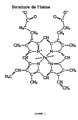
- a example of ferroporphyric core is the protoporphyrin IX iron also known as of "protoheme” or simply "heme” (figure 1).
- the family of heme proteins includes many important substances on the plane in animals and plants, hemoglobin, myoglobin, cytochromes, peroxidases, catalases.
- Hemoglobin is the main constituent of red blood cells. Its function is essential to fix, transport and deliver the amount of oxygen required for normal operation fabrics.
- the hemoglobin molecule is composed of two types of globin chains or subunits, named ⁇ and ⁇ (141 and 146 amino acids respectively), paired pairwise to form an ⁇ 2 ⁇ 2 tetramer.
- Each of these subunits contains, securely attached in a hydrophobic pocket, a heme molecule (i.e., protoporphyrin IX) containing at its center a divalent iron atom (Fe 2+ ) to which reversibly a molecule of oxygen.
- a heme molecule i.e., protoporphyrin IX
- Fe 2+ divalent iron atom
- Each molecule of tetrameric hemoglobin thus contains 4 iron atoms and 4 molecules of oxygen that it fixes during its passage in the lungs.
- the molecular mass of the tetramer is 64 650 D.
- the ⁇ and ⁇ chains are synthesized from two types of genes located on chromosomes 16 and 11 respectively.
- beta-type or “non-alpha” covers, not only the beta channels, but also the chains denominated epsilon, gamma or delta.
- hemoglobin Normally, in adults, more than 95% of the hemoglobin consists of alpha 2 tetraam 2 , that is to say the combination of two heterologous alpha-beta dimers, associated with the catalytic complex, the heme. 2% to 3% of a hemoglobin consisting of alpha 2 delta 2 tetramers and traces of fetal hemoglobin alpha 2 gamma 2 are found .
- the tetrameric human hemoglobin molecule exists in two forms or quaternary structures depending on whether the oxygen is linked or not to the iron atoms.
- hemoglobin In the presence of oxygen, hemoglobin is said to be in a state R (for laxity) and its affinity for oxygen is strong.
- hemoglobin In the absence of oxygen, hemoglobin is called in state T (for tension) and its affinity for oxygen is 100 times lower (Perutz, 1970).
- affinity resultant is related to the balance between concentrations of R and T forms. This affinity is all the weaker than the concentration of hemoglobin in T form is higher at all level of oxygenation.
- DPG co-factor - 2,3-diphosphoglycerate
- the technical problem to be solved the present invention is to produce proteins hemoglobin and its derivatives, in large quantities at low costs, without risk of viral or subviral infections.
- the inventors have brought a solution to this problem by using as a host for processing and production, plant cells.
- hepatitis B surface antigen (Mason et al., PNAS, 1992, 89, 11745-11749); human interferon (Edelbaum J. of Interferon Res., 1992, 12, 449-453); mouse anti- Streptococcus mutans antibody, tooth decay agent (Hiatt and Ma, FEBS, 1992, 307, 71-75); an anti-Herpes antibody (Russel, 1994) and hirudin (Moloney, 1994).
- the invention relates to a production method, by plant cells, heme proteins Recombinant.
- the plant cell is genetically modified in order to ability to express the protein component of a protein heme.
- the porphyry core is produced by the cell endogenously, the assembly of protein and porphyry components taking place spontaneously thanks to their high affinity one for the other.
- heme protein means any protein having an iron porphyry nucleus as a group prosthetic, and in particular protoporphyrin IX as it exists in hemoglobin and human myoglobin ( Figure 1).
- the porphyry core can also be derivatives of heme from those of the human heme.
- the side chains are hydrophobic.
- the heme proteins of the invention encompass especially the heme proteins having like main function the reversible fixation of oxygen, that is, myoglobin and hemoglobin, as well as cytochromes whose role is to carry electrons.
- the derivatives of these proteins retaining these features are also encompassed by the invention.
- a “variant" of a component protein, and particularly ⁇ - or ⁇ -globin means an amino acid sequence that gets differentiates from the natural sequence, by one or more substitution (s), deletion (s) or insertion (s) of amino acids.
- the variant present at least 90%, and preferably at least 95% homology, or identity with the natural sequence.
- the percentage of homology between two acid sequences Amines is calculated as the number of identical amines plus the number of amino acids similar in the alignment of the two sequences, divided by the length of the sequences between two given positions. If, between the two positions data, the two sequences do not have the same length, the percentage of homology is the number identical and similar amino acids divided by the length of the longest hall.
- Acids Amines considered to be "similar” are known in the art, see for example R.F. Feng, M.S. Jobson and R.F. Doolittle; J. Mol. Evol. ; 1985; 21; 112-115. They are normally considered to be those who, within a permutation matrix, have a positive substitution coefficient.
- variants also includes fragments polypeptide chains, for example ⁇ - or ⁇ -globin, normally having a length of less 90% of the parent molecule. Variants can also be made longer than the molecule mother by the addition of non-functional sequences. Preferably, the variants retain the properties biological and immunological properties of the parent molecule.
- the first step of the method of the invention consists of introducing, into cells of one or more acid molecule (s) nucleic acid comprising at least one coding sequence protein component of a heme protein from mammal, or for a variant of this component.
- s acid molecule
- the nucleic acid introduced into the plant cells normally involves a copy of the coding sequence for this protein.
- the sequences coding the different protein units are introduced into the plant cell, either within the same molecule of nucleic acid, either within distinct nucleic acid molecules.
- the sequences encoding ⁇ - and ⁇ -globin, or their variants are within the same vector, called co-expression vector.
- the vector can have one or more copies of each sequence coding.
- sequences encoding ⁇ - and ⁇ -globin, or their variants can be found on distinct nucleic acid molecules.
- the two molecules can be introduced into the same plant cell, provided to have an appropriate selection system.
- a another technique involves the introduction of one molecules in a first plant cell, and the other in a second plant cell. Each transformed cells is then regenerated into whole plant, the plants thus obtained being then be crossed to give rise to an offspring able to produce both ⁇ and ⁇ chains. This approach can be used to optimize the hemoglobin yield.
- the sequences encoding the component proteins encode animal ⁇ - or ⁇ -globin, by example human or bovine, or variants of them.
- animal ⁇ - or ⁇ -globin by example human or bovine, or variants of them.
- mutants whose functional properties correspond to the physiological conditions of oxygen transport: reversible binding, cooperability and low rate of autooxidation.
- mutants we will preferably use the double mutants ⁇ 2 ⁇ 2 F41Y, K82D (that is to say a mutant whose chain ⁇ has the following modifications: Phe-41 is replaced by Tyr, and Lys-82 is replaced by Asp) or ⁇ 2 ⁇ 2 F41Y, K66T (that is to say a mutant whose chain ⁇ has the following modifications: Phe-41 is replaced by Tyr, and Lys-66 is replaced by Thr) which correspond to to these functional characteristics.
- the modification of the chains ⁇ and ⁇ can also be carried out in order to stabilize the molecule, that is to say to avoid dissociation of the tetramer in dimers of small sizes quickly filtered by kidneys and limiting the intra-vascular life of hemoglobin.
- Covalent bridging, using phosphate or diaspirin, has been shown to be an effective technique for stabilizing the tetramer (Benesch and Kwong, 1994).
- the same result can be obtained through modifications of the chain in amino acids.
- ⁇ subunits are produced under alpha-alpha dimeric form linked by a glycyl residue. In this form, they retain their ability to to assemble correctly with partner sub-units beta and heme to form a soluble hemoglobin.
- This hemoglobin can no longer dissociate into dimers because the tetrameric structure is stabilized by a covalent bond (peptide bond) between alpha-beta dimers.
- This technique makes it possible to increase the half intravascular life
- a hybrid protein composed of a part of the alpha channel and part of the beta chain.
- the nucleic acid comprises, in addition to the coding sequences ⁇ - or ⁇ -globin, sequences encoding signals addressing.
- these signals are chloroplast or Mitochondrial.
- the expression and / or accumulation of recombinant proteins in these organelles is particularly preferred because of the availability of endogenous porphyrins that are find here. The yield of heme proteins is so increased.
- protein addressing towards chloroplasts and mitochondria avoids the glycosylation of the protein, which can be advantageous in that the hemoglobin molecule natural is not glycosylated.
- chloroplast targeting signals mention may be made of the sequence coding for the transit peptide of the precursor of the small subunit of the ribulose 1,5-bisphosphate carboxylase of Pisum sativum (see examples).
- mitochondrial targeting signals there may be mentioned the sequence encoding the transit peptide of the beta subunit precursor of mitochondrial ATP-aseF1 of Nicotiana plumbaginifolia (see examples).
- sequences addressing may be sequences encoding a N-terminal signal peptide ("prepeptide”), possibly in combination with a responsible signal retention of the protein in the reticulum endoplasmic (KDEL type signal), or a signal of vacuolar addressing or "propeptide".
- prepeptide N-terminal signal peptide
- KDEL type signal reticulum endoplasmic
- propeptide a signal of vacuolar addressing or vacuolar addressing or "propeptide”.
- the presence of N-terminal signal peptide or prepeptide allows the penetration of the nascent protein into the reticulum endoplasmic where a number of post-translational maturation, including signal peptide cleavage, the N-glycosylations, if the protein in question has N-glycosylation sites, and the formation of disulfide bridges.
- the prepeptide responsible for addressing the protein in the endoplasmic reticulum, is dominant. It's about normally a hydrophobic N-terminal signal peptide having between 10 and 40 amino acids and being of origin animal or vegetable. Preferably, it is a prepeptide of plant origin, for example that of sporamine, barley lectin, extensin plant, the ⁇ -mating factor, the protein pathogenesis 1 or 2.
- the signal peptide is cleaved by a signal peptidase from the co-translational introduction nascent polypeptide in the light of the RER.
- the mature protein no longer has this N-terminal extension.
- the addressing sequences may, in addition to the prepeptide, also contain a retention signal endoplasmic peptide consisting of KDEL, SEKDEL peptides or HEKDEL. These signals are normally the C-terminus of the protein and subsist on the mature protein. The presence of this signal has tendency to increase protein yields Recombinant.
- the addressing signals may, in addition to the prepeptide, also include an addressing signal vacuolar or "propeptide".
- an addressing signal vacuolar or "propeptide” In the presence of such signal, after passing through the RER, the protein is addressed to vacuoles of aqueous tissues, for example leaves, as well as the protein bodies of tissues for example, seeds, tubers and roots. Addressing the protein to the body protein from the seed is particularly interesting because of the seed's ability to accumulate protein, up to 40% of proteins per compared to the dry matter, in organelles cells derived from vacuoles, called body proteins and because of the possibility of storing several years the seeds containing the proteins recombinants in the dehydrated state.
- propeptide we can use a signal animal or vegetable origin, plant signals being particularly preferred, for example prosporamine.
- the propeptide can be N-terminal ("N-terminal targeting peptide "or NTTP), or C terminal (CTTP) insofar as the propeptides are normally cleaved upon entry of the protein into the vacuole, it is not present in the mature protein.
- the use of the signal peptide or prepeptide can lead to glycosylation of the protein.
- globin does not have N-glycosylation sites, but these can be introduced by mutagenesis.
- the chains ⁇ and ⁇ can also present O-glycosylation sites.
- the protein In the absence of any addressing signal, the protein is expressed in the cytoplasm.
- the nucleic acid introduced into the plant cell may also comprise transcriptional regulatory sequences recognized by the plant cell.
- the nucleic acid is then a "chimeric gene".
- Regulatory sequences include one or more promoters of plant, viral or Agrobacterium tumefaciens origin. They may be constitutive promoters, for example 35S of CaMV, double 35S, Nos or OCS promoters, or promoters specific to certain tissues such as grain or specific to certain phases of plant development.
- Seed-specific promoters include the promoter of the napin and acyl carrier protein (ACP) gene (EP-A-0255378), as well as the AT2S promoters of Arabidopsis thaliana , that is, that is, the PAT2S1, PAT2S2, PAT2S3, and PAT2S4 promoters (Krebbers et al., Plant Physiol., 1988, 87, 859-866). It is particularly preferred to use the promoter of cruciferin or phaseolin or pGEA1 and pGEA6 of Arabidopsis , promoters of type "Em, Early Methionine labeled protein" genes strongly expressed during the phases of desiccation of the seed.
- ACP acyl carrier protein
- Transcription regulatory sequences normally include transcription termination sequences that are of plant or viral origin, for example 35S, or bacterial ( Agrobacterium ).
- the transforming nucleic acid does not comprise regulatory sequences
- the nucleic acids of the invention can also include one or more intron (s), preferably of plant origin. These introns from of a plant gene are introduced artificially in order to increase the efficiency of the expression of the heterologous sequence.
- the intron (s) used this way come preferably from a monocotyledonous such as corn. It is preference, but not necessarily, of the first intron of the gene.
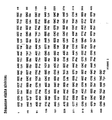
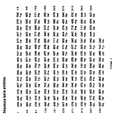
- nucleic acid sequence encoding the ⁇ - and ⁇ -globin and its variants is normally cDNA. Appropriate sequences are illustrated in Figures 2 and 3, any degenerate sequence may also be used as well as sequences of variants as defined above.
- the introduction of the molecule (s) of acids nucleic acid in the plant cell can occur stably either by genome transformation nuclear, or by transformation of the genome chloroplast of the plant cell, either by transformation of the mitochondrial genome.
- any means known to introduce foreign DNA into plant cells can be used, for example Agrobacterium, electroporation, protoplast fusion, particle gun bombardment, or DNA penetration into cells such as pollen, microspore, the seed and the immature embryo.
- Viral vectors such as Geminiviruses or satellite viruses can also be used as introduction means.
- Agrobacterium tumefaciens and rhizogenes are the preferred means.
- the sequence of the invention is introduced into a suitable vector with all the necessary regulatory sequences such as promoters, terminators, etc. as well as any sequence necessary to select the transformants having integrated the heterologous sequences.
- the transformation of the nuclear genome of the plant cell is often performed using the addressing signals mentioned above and which determine the cell compartment where will be done expression and / or accumulation of the protein.
- the introduction of the nucleic acid into the cell plant can be carried out through the processing of mitochondrial or chloroplast genomes (see by Carrer et al., Mol. Gen. Genet., 1993, 241, 49-56).
- two homologous DNA fragments to genomic sequences for example the rbcL genes and ORF 512 are added to each end of the DNA to insert into the genome.
- the acid heterologous nucleic can be introduced into the plant cell via a vector viral.
- the method of the invention comprises a step of detection of heme proteins, particularly hemoglobin and its derivatives. This allows check if the plant or plant cell is able not only to express the proteins heterologous, but also to assemble them correctly with the porphyry core.
- heme proteins particularly hemoglobin and its derivatives.
- This technique is described in detail in the examples.
- Other techniques of detection consist in the use of antibodies specific for alpha or beta globin chains, or their variants. Spectrometric techniques and immunological agents may be used in combination with each other. The implementation of these techniques allows to select the plants that are capable of producing hemoglobin and its derivatives according to the invention.
- the method of the invention further comprises a step of recovery or extraction of hemoglobin or its derivatives of plant tissues.
- extraction is normally made by grinding the tissue, by example leaves or grains, in an appropriate buffer, filtration of the mash, precipitation of proteins in the supernatant, centrifugation and resumption of the pellet in an appropriate buffer with dialysis.
- a step of partial purification can also be performed at this stage by exchange column chromatography anion.
- Hemoglobin tetramer, or its derivatives is purified by two successive chromatographies on ion exchange resin followed by a step of concentration and saturation of the monoxide concentrate of carbon. These techniques are described in detail in the examples.
- hemoglobin and its derivatives takes place under the control of a promoter component, such as the double 35S promoter, a expression of at least 1% hemoglobin relative to total protein can be obtained.
- the proteins represent about 10% of the dry mass of the leaf and a ton of dry tobacco leaves is harvested per hectare. It is therefore possible to obtain of the order of 100 grams of hemoglobin per hectare of grown tobacco assuming purify only 10% of the hemoglobin produced.
- the method of the invention thus allows the hemoglobin production at very low costs with a higher production capacity than the one obtained using fermentors for culture bacteria or yeast.
- the invention also encompasses vectors comprising one or more Nucleic acid (s) or chimeric gene (s) defined above.
- vectors comprising one or more Nucleic acid (s) or chimeric gene (s) defined above.
- s Nucleic acid
- s chimeric gene
- vectors viruses such as geminiviruses or CaMVs.
- the invention also relates to the cells Vegetables transformed with acid sequences nucleic acids of the invention.
- this is transformed plant cells capable of producing one or more hemoglobin (s) or derivatives of hemoglobin according to the invention.
- Different culture modes ("batch", "fed batch” or continuous) for this type of cells are currently under study.
- the “batch” cultures are comparable to those carried out in Erlenmeyer flasks since the medium is not renewed, the cells thus have only a limited amount of nutrients.
- the culture in "fed batch” corresponds to a culture in "batch” with a feed programmed in substrate.
- the cells are continuously fed with nutrient medium.
- An equal volume of the biomass-medium mixture is removed in order to keep the volume of the reactor constant.
- the quantities of plant biomass that can be envisaged with bioreactor cultures vary according to the plant species, the culture method and the type of bioreactor. Under certain conditions, biomass densities of about 10 to 30 g dry weight per liter of culture can be obtained for species such as Nicotiana tabacum , Vinca rosea and Catharanthus roseus .
- the cells of the invention can also be immobilized, which makes it possible to obtain constant and prolonged hemoglobin.
- the separation of hemoglobin and plant biomass is also facilitated.
- immobilization one can mention the immobilization of alginate, agar, the interior of polyurethane foam, or even in hollow fibers.
- the cells of the invention may also be root cultures. Roots grown in vitro , in liquid medium, are called “Hairy roots", they are roots transformed by the bacterium Agrobacterium rhizogenes .
- hemoglobin of the invention By producing the hemoglobin of the invention by plant cell culture, we can regenerate chimeric or transgenic plants from of explants transformed, using techniques known per se.
- Suitable plants include Angiosperms including monocotyledons and dicotyledons.
- tobacco, species belonging to botanical families such as legumes (eg beans, peas, etc ...), cruciferous (eg cabbages, radish, rapeseed, etc.), Solanaceae (for example tomatoes, potatoes, etc %), cucurbits (eg melon), chenopodiaceae (by vegetable beet), umbelliferae (by example carrots, celery, etc ).
- cereals such as wheat, maize, barley, triticale and rice, and oleaginous crops such as sunflower and soybeans.
- the tobacco, potatoes, tomatoes and corn are particularly preferred.
- the expression is preferably in the tubers.
- the invention also relates to the seeds of transgenic plants capable of producing hemoglobin and their progeny.
- the invention also relates to proteins which may be obtained by the process of the invention, in particular proteins hemicans able to fix reversibly oxygen, for example hemoglobins and derivatives of them.
- the hemoglobins of the invention are capable of reversibly binding O 2 with affinity (P 50 ) preferably close to physiological values (37 ° C), pH 7.40).
- the affinity of the molecule for O 2 is expressed as P 50 : that is to say the partial pressure of O 2 when the hemoglobin or its derivatives is 50% saturated.
- the P 50 is measured according to the usual techniques, for example by means of an analyzer which measures the percentage of O 2 saturation as a function of the O 2 pressure (Kister et al., 1987).
- the hemoglobins of the invention have an acceptable autooxidation rate to minimize the formation of methemoglobin unsuitable for transporting O 2 . This characteristic can be measured by the absorption spectrum.
- the hemoglobins of the invention are tetramers, preferably alpha 2 , 2 or 4 , or possibly tetramers of ⁇ / ⁇ chimeric subunits (Dumoulin et al., 1994, Cell, Blood Subst. Biotech., 22, 733-738) or multiples of 4 subunits.
- the physical size of the complex must be at least that of the tetramer in order to avoid its filtration by the kidneys.
- the heme proteins of the invention may be used in many applications pharmaceutical, cosmetic or industrial.
- the invention particularly relates to compositions pharmaceutical products comprising one or more protein (s) according to any one of claims 15 to 23 in association with a excipient acceptable from the physiological point of view.
- the hemoglobins of the invention are normally used as an injection into solutions possibly stabilized with regard to the form tetrameric complex (for example, addition of pyridoxal phosphate or diaspirine) with regard to autoxidation. It is also possible to use suspensions of hemoglobin grafted onto a support to increase the life in the traffic.
- the support can be any conventional support in this area, for example polysaccharides.
- the plasmid pGA492 was doubly digested with SacI (restriction site of the polylinker) and with ScaI (restriction site present in the sequence of the cat gene) and then submitted to the action of the enzyme T4 DNA polymerase (New England Biolabs) according to the manufacturer's recommendations.
- the ligation of the modified plasmid (20 ng) was carried out in a 10 ⁇ l reaction medium containing 1 ⁇ l of T4 DNA ligase x 10 buffer (Amersham) and 2.5 U of T4 DNA ligase enzyme (Amersham) at 14 ° C. for 16 hours.
- the bacteria, E. coli DH5 ⁇ made previously competent, were transformed (Hanahan, 1983).
- plasmid DNA of the retained clone were digested with HindIII, dephosphorylated by the alkaline phosphatase enzyme of calf intestine (Boehringer Mannheim) according to the manufacturer's recommendations and co-precipitated in the presence of 1500 ng of HindIII-EcoRI adapter DNA, 1/10 volume of 3M sodium acetate pH4.8 and 2.5 volumes of absolute ethanol at -80 ° C for 30 min. After centrifugation at 12000 g for 30 min., The precipitated DNA was washed with 70% ethanol, dried, taken up in 8 ⁇ l of water, heated at 65 ° C. for 10 min, then ligated in the presence of 1 ⁇ l.
- T4 DNA ligase x 10 buffer (Amersham) and 2.5 U of T4 DNA ligase enzyme (Amersham) at 14 ° C for 16 hours.
- the ligation reaction mixture was digested with EcoRI, purified by electroeluted 0.8% agarose gel electrophoresis (Sambrook et al., 1989), precipitated in the presence of 1/10 volume of 3M sodium acetate pH 4.8 and 2.5 volumes of absolute ethanol at -80 ° C for 30 min, centrifuged at 12000 g for 30 min., washed with ethanol 70%, then dried.
- the bacteria E.
- coli DH5 ⁇ made previously competent, were transformed (Hanahan, 1983).
- the resulting binary plasmid which has only the last 9 codons of the coding sequence of the cat gene and whose EcoRI site is unique, has been called pBIOC4.
- the expression cassette consisting of the pd35S promoter and the polyA 35S terminator, was isolated from plasmid pJIT163D.
- the plasmid pJIT163D is derived from the plasmid pJIT163 which itself derives from the plasmid pJIT60 (Guerineau and Mullineaux, 1993).
- Plasmid pJIT163 has an ATG codon between the HindIII and SalI sites of the polylinker.
- the pJIT163 plasmid DNA was double digested with HindIII and SalI, purified by electroeluted 0.8% agarose gel electrophoresis (Sambrook et al., 1989), precipitated in the presence 1/10 volume of 3M sodium acetate pH4.8 and 2.5 volumes of absolute ethanol at -80 ° C for 30 min, centrifuged at 12000 g for 30 min, washed with 70% ethanol, dried, subjected to the action of the Klenow enzyme (New England Biolabs) according to the manufacturer's recommendations, deproteinized by extraction with 1 volume of phenol: chloroform: isoamyl alcohol (25: 24: 1) then 1 volume of chloroform: alcohol isoamyl (24: 1), precipitated in the presence of 1/10 volume of 3M sodium acetate pH4.8 and 2.5 volumes of absolute ethanol at -80 ° C for 30 min., centrifuged at 12000g for 30 min was
- SacI-XhoI fragment carrying the expression cassette was purified by electroeluted 0.8% agarose gel electrophoresis (Sambrook et al., 1989), precipitated in the presence of 1/10 volume of 3M acetate. of sodium pH4.8 and 2.5 volumes of absolute ethanol at -80 ° C for 30 min, centrifuged at 12000g for 30 min, washed with 70% ethanol, dried, then subjected to the action of the enzyme Mung Bean nuclease (New England Biolabs) according to the manufacturer's recommendations.
- Mung Bean nuclease New England Biolabs
- This purified insert (200 ng) was cloned into the EcoRI-digested pBIOC4 plasmid DNA (20 ng), treated with the enzyme Mung Bean nuclease and dephosphorylated by the calf intestinal alkaline phosphatase enzyme (Boehringer Mannheim). according to the manufacturer's recommendations.
- the ligation reaction was carried out in 20 ⁇ l in the presence of 2 ⁇ l of T4 DNA ligase x 10 buffer (Amersham), 2 ⁇ l of 50% polyethylene glycol 8000 and 5 U of T4 DNA ligase enzyme (Amersham) at 14 ⁇ l. ° C for 16 hours.
- the bacteria, E. coli DH5 ⁇ made previously competent, were transformed (Hanahan, 1983).
- the binary plasmid of coexpression will allow an expression of two genes in the same vector binary.
- the binary co-expression plasmid derives from pBIOC21. It contains two expression cassettes each consisting of a pd35S promoter and a 35S polyA terminator but different by the polylinker separating the promoter from the terminator.
- One of the expression cassettes is that of pBIOC21 already described in paragraph I. a.
- the other expression cassette was obtained by replacing the HindIII-BamHI-SmaI-EcoRI polylinker of pJIT163D (described in paragraph I.a.) by a HindIII-EcoRI adapter carrying the PacI, AscI, MluI and HpaI restriction sites. .
- This adapter was obtained by renaturation of the two oligodeoxynucleotides WD11 (5 'AGC TGA TTA ATT AGC GCG CGC CAC GCG TTA AC 3') and WD12 (5 'AAT TGT TAA CGC GTG CGC CGC CTT AAT TAA TC 3') which are complementary for their 28 nucleotides 3 'terminals.
- the HindIII-EcoRI DNA fragment was then cloned at the HindIII-EcoRI sites of the plasmid DNA pJIT163D previously dephosphorylated by the calf intestinal alkaline phosphatase enzyme (New England Biolabs) according to the manufacturer's recommendations.
- the ligation reaction was carried out in a reaction volume of 20 ⁇ l in the presence of 1 U of T4 DNA ligase (Gibco-BRL) for a total DNA concentration of 8.5 nM with a vector / insert molar ratio of 1 and of 4 ⁇ l of T4 DNA ligase x 5 buffer (Gibco-BRL) at 25 ° C. for 16 hours.
- the bacteria E.
- coli DH5 ⁇ made previously competent, were transformed (Hanahan, 1985).
- the resulting clone was named pBIOC42. Its validity was verified by sequencing using the "Sequenase Version 2.0 DNA Sequencing" kit marketed by United States Biochemical (USB) according to the dideoxynucleotide method (Sanger et al., 1977). The reaction conditions follow the manufacturer's instructions except for denaturation and hybridization.
- the DNA fragment coding for the expression cassette consisting of the pd35S promoter and the 35S polyA terminator was isolated by double digestion with SacI and XhoI. It was purified by electrophoresis on 0.75% agarose gel and then subjected to the action of the "Geneclean II" kit marketed by BIO101 according to the manufacturer's indications. Then, this DNA fragment was inserted at the SacI and XhoI sites of the plasmid pBCSK + marketed by Stratagene and previously dephosphorylated by the alkaline phosphatase enzyme of calf intestine (New England Biolabs) according to the manufacturer's recommendations.
- the ligation was carried out in a reaction volume of 20 ⁇ l in the presence of 1 U of T4 DNA ligase (Gibco-BRL) for a total DNA concentration of 8.5 nM with a vector / insert molar ratio of 1 and 4. ⁇ l of T4 DNA ligase x 5 buffer (Gibco-BRL) at 25 ° C for 16 hours.
- the bacteria, E. coli DH5 ⁇ made previously competent, were transformed (Hanahan, 1985).
- the DNA fragment carrying the expression cassette consisting of the pd35S promoter and the 35S polyA terminator was isolated by KpnI digestion. It was purified by electrophoresis on 0.75% agarose gel and then subjected to the action of the "Geneclean II" kit marketed by BIO101 according to the manufacturer's indications. Then, this DNA fragment was ligated to the plasmid DNA of pBIOC21 digested with KpnI and dephosphorylated by the calf intestinal alkaline phosphatase enzyme (New England Biolabs) according to the manufacturer's recommendations.
- the ligation was carried out in a reaction volume of 20 ⁇ l in the presence of 1 U of T4 DNA ligase (Gibco-BRL) for a total DNA concentration of 8.5 nM with a vector / insert molar ratio of 1 and 4. ⁇ l of T4 DNA ligase x 5 buffer (Gibco-BRL) at 25 ° C for 16 hours.
- the plasmid alphalpJW101 contains the cDNA of the ⁇ -globin chain cloned into plasmid pMB9 as described by Wilson et al. (1978).
- the phage M13mp10 cIIFX beta contains the cDNA of the chain B of globin cloned in phage M13 mp10 as described by Nagai et al. (1985).
- the cDNA encoding B globin was inserted 3 'of the coding sequence for the protein lambda phage, followed by that coding for the tetrapeptide FX, forming a fusion gene in which the ATG initiator codon of ⁇ globin has been deleted.
- the initiator methionine codon of the ⁇ globin chain has been maintained.
- the cDNA coding for the alpha globin chaln at Cytoplasmic addressing was obtained in three steps. The first two steps have eliminated the HindIII internal site (substitution of a T in a C) in position 276 of the coding sequence while the third step brings together the 2 coding cDNA fragments for the recombinant ⁇ globin chain.
- the first step was amplification the first 95 codons of the mature ⁇ globin chalne on the plasmid alphalpJW101 using the 2 oligodeoxynucleotides, WD13 (5 'tacaagcttaaca ATG GTG CTG TCT CCg GCC GAC 3 ') and AD27 (5' CGG GTC CAC CCG GAG CTT GTG 3 ').
- the WD13 primer brings the site of HindIII restriction, the favoring aaca sequence the initiation of translation (Joshi, 1987) and preceding the initiator codon ATG followed by the first 6 codons of the mature ⁇ globin chain whose fourth (CCT) is substituted for CCg (silent mutation) for create the EagI restriction site.
- the AD27 primer allows the deletion of the HindIII restriction site by substitution of nucleotide T at C (position 276 of the coding sequence).
- PCR amplification has been carried out in 100 ⁇ l of reaction medium containing 10 ⁇ l of Taq DNA polymerase x 10 buffer (100 mM Tris-HCl pH 8.4, 500 mM KCl and 20 mM MgCl 2), 16 ⁇ l of mixture of dNTPs (1.25 mM dATP, 1.25 mM dCTP, 1.25 mM dGTP and 1.25 mM dTTP), 10 ⁇ l of each of the primers described above at 10 ⁇ M, 10 ⁇ l of template DNA (alphalpJW101) at 1 ng / ⁇ l and 0.5 ⁇ l of Taq DNA polymerase at 5 U / ⁇ l (Perkin Elmer).
- Taq DNA polymerase x 10 buffer 100 mM Tris-HCl pH 8.4, 500 mM KCl and 20 mM MgCl 2
- 16 ⁇ l of mixture of dNTPs (1.25 mM dATP, 1.25
- the second step was amplification of the last 54 codons of the mature ⁇ globin chain on the plasmid alphalpJW101 using the 2 oligodeoxynucleotides, AD26 (5 'CAC AAG CTC CGG GTG GAC CCG 3 ') and WD14 (5' gcgaattc TCA ACG GTA TT GGA GGT CAG CAC 3 ').
- the WD14 primer brings the site of EcoRI restriction located just after the stop codon.
- the AD26 primer allows the removal of the HindIII restriction by substitution of nucleotide T at C (position 276 of the coding sequence).
- PCR amplification was performed as described in the first step.
- Treatment of DNA fragments amplified was performed as described in the first step.
- the third step was the PCR amplification of the complete cDNA coding for the ⁇ globin chain (142 codons including the initiator ATG). Both types of amplified DNA fragments in the first and second stages were used as template DNA and the two primers used were WD13 and WD14. PCR amplification was performed as described in the first step except that the annealing temperature of the cycle is 60 ° C. The amplified DNA fragments were then extracted with H 2 O saturated ether after adjusting the volume to 500 ⁇ l with TE buffer (10 mM Tris-HCl pH 8.0, 1 mM EDTA).
- the methionine codon has been fused to the first codon of the ⁇ globin chain mature by maintaining the open reading phase since the ATG had been deleted in the construction M13mp10 cIIFX beta.
- the cDNA coding for the ⁇ -globin chain at cytoplasmic addressing was obtained by amplification PCR of the 146 codons constituting the ⁇ -globin chain mature on phage M13mp10 cIIFX beta using 2 oligodeoxynucleotides, WD15 (5 'gtcattaattaaca ATG GTG CAC CTG ACT CCT GAG GAG AAG TCg GCC GTT AC 3 ') and WD16 (5 'aatgagctcgttaacgcgt TTA GTG ATA CTT GTG GGC CAG GGC 3 ').
- the WD15 primer brings the site of PacI restriction, the favoring aaca sequence the initiation of translation (Joshi, 1987) and the ATG initiator codon followed by the first 12 codons of the mature ⁇ globin chain whose ninth (TCT) is substituted in TCg (silent mutation) to create the EagI restriction site.
- the primer WD16 brings the MluI, HpaI and SacI restriction sites placed after the stop codon. PCR amplification and treatment amplified DNA fragments were made as described in the third stage of Chapter II. at.
- the DNA plasmid of clones obtained, selected out of 100 ⁇ g / ml ampicillin was extracted according to the method of alkaline lysis (Stephen et al., 1990) and analyzed by enzymatic digestion. The resulting clone has been called pBIOC45.
- the nucleotide sequence of the cDNA coding for the recombinant ⁇ globin chain has been verified by sequencing as described in Chapter I. b.
- the HindIII-EcoRI fragment bearing the cDNA coding for the cytoplasmic-addressed ⁇ globin chain was isolated by enzymatic double digestion with HindIII and EcoRI, purified by 1.8% agarose gel electrophoresis and by kit "Geneclean II" (BIO101). Then, this DNA fragment was ligated to the plasmid DNA of pBIOC21 double digested with HindIII and EcoRI, and dephosphorylated by the calf intestinal alkaline phosphatase enzyme (New England Biolabs) according to the manufacturer's recommendations. Ligation and transformation were carried out as described in Chapter I. b.
- the plasmid DNA of the binary vector pBIOC46 was introduced by direct transformation into Agrobacterium tumefaciens strain LBA4404 according to the method of Holsters et al. (1978). The validity of the retained clone was verified by enzymatic digestion of the introduced plasmid DNA.
- the HindIII-EcoRI fragment bearing the cDNA coding for the ⁇ -globin chain at cytoplasmic addressing was isolated by double enzymatic digestion with HindIII (total digestion) and EcoRI (partial digestion), purified by 1.8% agarose gel electrophoresis and by kit "Geneclean II" (BIO101). Then, this DNA fragment has was ligated to the plasmid DNA of pBIOC21 doubled digested with HindIII and EcoRI, and dephosphorylated by alkaline phosphatase enzyme of calf intestine (New England Biolabs) according to the recommendations of maker. Ligation and processing have been performed as described in Chapter I. b.
- the plasmid DNA of the binary vector pBIOC47 was introduced by direct transformation into Agrobacterium tumefaciens strain LBA4404 according to the method of Holsters et al. (1978). The validity of the retained clone was verified by enzymatic digestion of the introduced plasmid DNA.
- the HindIII-EcoRI fragment carrying the coding cDNA for the ⁇ globin chain with cytoplasmic was isolated from pBIOC44 described in Chapter II. vs. 1., and ligated to the plasmid DNA of pBIOC43 double digested with HindIII and EcoRI, and previously dephosphorylated by the phosphatase enzyme calf intestine alkaline (New England Biolabs) according to the manufacturer's recommendations. Ligation and transformation were carried out as described in chapter I. b.
- the plasmid DNA of the clones obtained was extracted according to the method of alkaline lysis (Stephen et al., 1990) and analyzed by enzymatic digestion.
- the clone resulting was called pBIOC48.
- the PacI-MluI fragment bearing the cDNA coding for the ⁇ -globin chain with cytoplasmic targeting was isolated from pBIOC45 described in Chapter II. vs. 2., and ligated to plasmid DNA of pBIOC48 double digested with PacI and MluI, and dephosphorylated by calf intestinal alkaline phosphatase enzyme (New England Biolabs) according to the manufacturer's recommendations. Ligation and transformation were performed as described in Chapter I. b, except that strain E. coli Sure tet - was used instead of DH5 ⁇ .
- the strain Sure tet - derives from the Sure strain (Stratagene) made sensitive to tetracycline by the loss of the F 'episome.
- the nucleotide sequence of the cDNAs coding for the ⁇ and ⁇ chains of recombinant globin was verified by sequencing as described in Chapter I. b.
- the plasmid DNA of the binary vector pBIOC49 was introduced by direct transformation into Agrobacterium tumefaciens strain LBA4404 according to the method of Holsters et al. (1978). The validity of the retained clone was verified by enzymatic digestion of the introduced plasmid DNA.
- the sequence encoding the transit peptide of the mitochondrial ATPase-F1 subunit ⁇ subunit of Nicotiana plumbaginifolia (ATG GCT TCT CGG AGG CTT CTC GCC TCT CTC CTC CGT CAA TCG GCT CAA CGT GGC GGC GGT CTA ATT TCC CGA TCG TTA GGA AAC TCC ATC CCT AAA TCC GCT TCA CGC GCC TCT TCA CGC GCA TCC CCT AAG GGA TTC CTC TTA AAC CGC GCC GTA CAG TAC) is fused to the first codon of the coding sequence for a on the other hand, the mature ⁇ -globin chain (deletion of the initiator ATG) and secondly, the mature ⁇ -globin chain (deletion of the initiator ATG) while maintaining the open reading phases.
- the sequence encoding the ⁇ subunit of the mitochondrial F1 ATPase of Nicotiana plumbaginifolia is contained in the plasmid pTZ-catp2-1 provided by Boutry.
- This plasmid corresponds to plasmid pTZ18R containing the cDNA (cNP10) as described by Boutry and Chua (1985).
- N-terminal transit peptide composed of 54 amino acids as defined by Chaumont et al. (1994) was used when carrying out the constructions.
- the sequence coding for the transit peptide of the ⁇ -subunit precursor of the mitochondrial ATPase-F1 of Nicotiana plumbaginifolia was fused to the first codon of the sequence coding for the chain.
- a mature globin by maintaining the open reading phase.
- the cleavage sequence between the sequences of the transit peptide and the mature ⁇ globin chain is Tyr-Val.
- the sequence coding for the transit peptide of precursor of the ⁇ subunit of ATPase-F1 mitochondrial was amplified by PCR on the plasmid pTZ-catp2-1 using 2 oligodeoxynucleotides, WD17 (5'cgcaagcttaaca ATG GCTTCT CGG AGG CTT CTC 3 ') and WD18 (5 'aat tC tag GGC cGG AGA CAG CAC GTA CTG TAC GGC GCG GTT TAA G 3 ').
- the WD17 primer brings the site HindIII restriction, the aaca sequence favoring the initiation of translation (Joshi, 1987) and the 7 first transit peptide codons (including ATG initiator).
- the WD18 primer brings the site of restriction, the first 5 codons of the sequence encoding the mature ⁇ globin chain (a site of EagI restriction is created by silent muting in the fourth codon (CCT modified in CCg) and the 7 last codons of the transit peptide sequence.
- PCR amplification and fragment processing amplified DNA were made as described in the third stage of Chapter II. at. Then, these DNA fragments were double digested by HindIII and EagI, purified by agarose gel electrophoresis 1.8% and per action of the "Geneclean II" kit (BIO101) and cloned at HindIII and EagI sites of plasmid pBIOC44 described in Chapter II.
- the plasmid pBIOC44 was dephosphorylated by the enzyme alkaline phosphatase of calf intestines (New England Biolabs) according to manufacturer's recommendations. Ligation and transformation were carried out as described in chapter I. b.
- sequence nucleotide of this chimeric gene resulting from the translational fusion between the coding sequence for the transit peptide and the cDNA coding for the ⁇ chain mature globin was verified by sequencing as described in chapter I. b. Sequencing revealed two silent mutations at the tenth nucleotide (C changed to A) and to the one hundred and forty-first (C modified in G) of the coding sequence for the peptide transit.
- the sequence coding for the transit peptide of the ⁇ -subunit precursor of the mitochondrial ATPase-F1 of Nicotiana plumbaginifolia was fused to the first codon of the sequence coding for the chain.
- ⁇ globin mature while maintaining the open reading phase.
- the cleavage sequence between the sequences of the transit peptide and the mature ⁇ globin chain is Tyr - Val.
- the sequence coding for the transit peptide of precursor of the ⁇ subunit of ATPase-F1 mitochondrial was amplified by PCR on the plasmid pTZ-catp2-1 using 2 oligodeoxynucleotides, WD19 (5 'gtcattaattaaca ATG GCT TCT CGG AGG CTT CTC GCC TCT C 3 ') and WD20 (5' aatgagct C GGC cGA CTT CTC CTC AGG AGT CAG GTG CAC GTA CTG TAC GGC GCG GTT TAA G 3 ').
- the WD19 primer brings the restriction site PacI, the aaca sequence favoring the initiation of translation (Joshi, 1987) and preceding the first 9 codons of the transit peptide (including the initiator ATG).
- the WD20 primer brings the SacI restriction site, the First 10 codons of the sequence encoding the ⁇ chain mature globin (an EagI restriction site is created by silent mutation in the ninth codon (TCT modified in TCg)) and the last 7 codons of the sequence of the transit peptide.
- PCR amplification and processing amplified DNA fragments were carried out as described in the third step of Chapter II. at.
- DNA fragments were double digested by PacI and EagI, purified by 1.8% agarose gel electrophoresis and by kit "Geneclean II" (BI0101) and cloned at PacI sites and EagI of plasmid pBIOC45 described in Chapter II. b., previously purified by gel electrophoresis 0.75% agarose and the "Geneclean II” kit.
- the plasmid pBIOC45 was dephosphorylated by the enzyme alkaline phosphatase of calf intestine (New England Biolabs) according to the manufacturer's recommendations. The ligation and transformation were carried out as described in Chapter I. b.
- the nucleotide sequence of this gene chimeric resulting from the translational fusion between the sequence coding for the transit peptide and the cDNA coding for the chain ⁇ globin mature has been verified by sequencing as described in Chapter I. b.
- the PacI-MluI fragment bearing the cDNA coding for the mitochondrial-directed ⁇ globin chain was isolated from pBIOC51 described in Chapter III. b., and ligated to plasmid DNA of pBIOC52 double digested with PacI and MluI, and dephosphorylated by calf intestinal alkaline phosphatase enzyme (New England Biolabs). Ligation and transformation were performed as described in Chapter II.c.3 using E. coli Sure tet - strain. The plasmid DNA of the clones obtained, selected on 10 ⁇ g / ml tetracycline, was extracted according to the alkaline lysis method (Stephen et al., 1990) and analyzed by enzymatic digestion. The resulting clone was named pBIOC53.
- the nucleotide sequence of the cDNAs coding for the ⁇ and ⁇ chains of recombinant globin allowing a mitochondrial addressing was verified by sequencing as described in Chapter I. b.
- the plasmid DNA of the binary vector pBIOC53 was introduced by direct transformation into Agrobacterium tumefaciens strain LBA4404 according to the method of Holsters et al. (1978). The validity of the retained clone was verified by enzymatic digestion of the introduced plasmid DNA.
- the sequence coding for the transit peptide of the precursor of the small subunit of ribulose 1,5-biphosphate carboxylase of Pisum sativum L. (ATG GCT TCT ATG ATA TCC TCT TCA GCT GTG ACT ACA GTC AGC CGT GCT TCT ACG GTG CAA TCG GCC GCG GTG GCT CCA TTC GGC GGC CTC AAA TCC ATG ACT GGA TTC CCA GTT AAG AAG GTC AAC ACT GAC ATT ACT TCC ATT ACA AGC AAT GGT GGA AGA GTA AAG TGC) is fused to the first codon of the coding sequence for, on the one hand, the mature ⁇ globin chain (deletion of the initiator ATG) and, on the other hand, the mature ⁇ -globin chain (deletion of the initiator ATG) while maintaining the open reading phases.
- This N-terminal transit peptide composed of 57 amino acids as defined by Anderson et al. (1986) was isolated from plasmid pJIT117 (Guerineau et al. al., 1988) and used in the production of constructions.
- the sequence coding for the transit peptide of the precursor of the small subunit of ribulose 1,5-biphosphate carboxylase of Pisum sativum L. was fused to the first codon of the sequence. coding for the mature ⁇ globin chain while maintaining the open reading phase.
- the cleavage sequence between the sequences of the transit peptide and the mature ⁇ globin chain is Cys - Val.
- the transit peptide sequence of the precursor the small subunit of ribulose 1,5-bisphosphate carboxylase was amplified by PCR on the plasmid pJIT117 using 2 oligodeoxynucleotides, WD21 (5 'cgcaagcttaaca ATG GCT TCT ATG ATA TCC TCT TCA GC 3 ') and WD22 (5' tag aat tC GGC cGG AGA CAG CAC GCA CTT TAC TCT ACC ACC ATT GC 3 ').
- the WD21 primer brings the HindIII restriction site, the aaca sequence promoting the initiation of translation (Joshi, 1987) and the first 8 codons of the transit peptide (of which the initiating ATG).
- the WD22 primer brings the site of restriction, the first 5 codons of the sequence encoding the mature ⁇ globin chain (a site of EagI restriction is created by silent muting in the fourth codon (CCT modified in CCg)) and the 7 last codons of the transit peptide sequence.
- PCR amplification and fragment processing amplified DNA were made as described in third stage of Chapter II. at.
- the fragment HindIII-EagI carrying the coding sequence for the transit peptide of the precursor of the small subunit of ribulose 1,5-bisphosphate carboxylase and the 4 first codons of the mature ⁇ globin chain, has been isolated by double digestion, HindIII (total digestion) and EagI (partial digestion).
- This HindIII-EagI fragment purified by agarose gel electrophoresis 1.8% and per action of the "Geneclean II" kit (BIO101), cloned at the HindIII and EagI sites of the plasmid pBIOC44 dephosphorylated as described in Chapter II. at. Ligation and transformation have been realized as described in chapter I.
- the sequence coding for the transit peptide of the precursor of the small subunit of the ribulose 1,5-biphosphate carboxylase of Pisum sativum L. was fused to the first codon of the sequence coding for the mature ⁇ -globin chain while maintaining the open reading phase.
- the cleavage sequence between the sequences of the transit peptide and the mature ⁇ globin chain is Cys - Val.
- the sequence coding for the transit peptide of precursor of the small subunit of ribulose 1,5-bisphosphate carboxylase was amplified by PCR on the plasmid pJIT117 using the 2 oligodeoxynucleotides, WD23 (5 'gtcattaattaaca ATG GCT TCT ATG ATA TCC TCT TCA GCT GTG 3 ') and WD24 (5' aatgagct C GGC cGA CTT CTC CTC AGG AGT CAG GTG CAC GCA CTT TAC TCT TCC ACC 3 ').
- the WD23 primer brings the site PacI restriction, the favoring aaca sequence the initiation of translation (Joshi, 1987) and preceding the first 10 codons of the transit peptide (including the initiator ATG).
- the WD24 primer brings the site SacI restriction, the first 10 codons of the sequence coding the chain ⁇ globin mature (a site of EagI restriction is created by silent mutation in the ninth codon (TCT modified in TCg)) and the 6 last codons of the transit peptide sequence.
- PCR amplification and fragment processing amplified DNA were made as described in third stage of Chapter II. at.
- the resulting clone has been called pBIOC56.
- the nucleotide sequence of this gene chimeric resulting from the translational fusion between the sequence coding for the transit peptide and the cDNA coding for the chain ⁇ globin mature has been verified by sequencing as described in Chapter I. b.
- the PacI-EagI fragment carrying the transit peptide sequence of precursor of the small subunit of ribulose 1,5-bisphosphate carboxylase and the first 9 codons of the sequence encoding the chain ⁇ globin mature, a been isolated by double digestion, PacI (digestion total) and EagI (partial digestion).
- PacI-EagI purified by gel electrophoresis of agarose 1,8% and by action of the kit "Geneclean II" (BIO101), has been cloned at the PacI and EagI sites of pBIOC45 plasmid dephosphorylated as described in Chapter II. at. Ligation and processing performed as described in Chapter I. b.
- the DNA plasmid of clones obtained, selected out of 100 ⁇ g / ml ampicillin was extracted according to the method of alkaline lysis (Stephen et al., 1990) and analyzed by enzymatic digestion.
- the resulting clone has been called pBIOC57.
- the nucleotide sequence of this gene chimeric resulting from the translational fusion between the sequence coding for the transit peptide and the cDNA coding for the chain ⁇ globin mature has been verified by sequencing as described in Chapter I. b.
- the HindIII-EcoRI fragment carrying the coding cDNA for the ⁇ globin chain with chloroplastic was isolated from pBIOC55 described in Chapter IV. a., and ligated to the plasmid DNA of doubled pBIOC43 digested with HindIII and EcoRI, and dephosphorylated as described in II. at. Ligation and processing performed as described in Chapter I. b.
- the PacI-MluI fragment bearing the cDNA coding for the chloroplast-directed ⁇ globin chain was isolated from pBIOC57 described in Chapter IV. b., and ligated to the plasmid DNA of pBIOC58 double digested with PacI and MluI, and dephosphorylated as described in II. at. Ligation and transformation were performed as described in Chapter II.c.3 using E. coli Sure tet - strain.
- the nucleotide sequence of the cDNAs coding for the ⁇ and ⁇ chains of recombinant globin allowing a chloroplast addressing was verified by sequencing as described in Chapter I. b.
- the plasmid DNA of the binary vector pBIOC59 was introduced by direct transformation into Agrobacterium tumefaciens strain LBA4404 according to the method of Holsters et al. (1978). The validity of the retained clone was verified by enzymatic digestion of the introduced plasmid DNA.
- the coding sequence for the signal peptide (PS) of sporamine A tuberous roots of sweet potato (Murakami and al., 1986; Matsuoka and Nakamura, 1991) (ATG AAA GCC TTC ACA CTC GCT CTC TTC TTA GCT CTT TCC CTC TAT CTC CTG CCC AAT ACC GCC CAT TCC), is merged with the first codon of the coding sequence for the one hand, the string mature ⁇ globin (deletion of the initiator ATG) and on the other hand, the mature ⁇ globin chain (deletion of ATG initiator) by maintaining the open phases of reading.
- This signal peptide of 23 amino acids was isolated from plasmid pMAT103 (Matuoka and Nakamura, 1991) and used in the realization of constructions.
- the coding sequence for the signal peptide of sporamin A sweet potato was merged into first codon of the mature globin ⁇ chain in now the open reading phase.
- the sequence of cleavage between the signal peptide sequences and the ⁇ chain of mature globin is Ser-Val.
- the coding sequence for the signal peptide (PS) of sporamin A tuberous roots of sweet potato was amplified by PCR on plasmid pMAT103 at using 2 oligodeoxynucleotides, WD25 (5 ' cgcaagcttaaca ATG AAA GCC TTC ACA CTC GC 3 ') and WD26 (5 'tagaattc GGC cGG AGA CAG CAC GGA ATG GGC TGG ATT GGG CAG G 3 ').
- the WD25 primer brings the site of HindIII restriction, the favoring aaca sequence the initiation of translation (Joshi, 1987) and the 6 first codons of the signal peptide (including ATG initiator).
- the WD26 primer brings the site of restriction Ecori, the first 5 codons of the sequence encoding the mature ⁇ globin chain (a site of EagI restriction is created by silent muting in the fourth codon (CCT modified in CCg)) and the 7 last codons of the signal peptide sequence.
- PCR amplification and fragment processing amplified DNA were made as described in the third stage of Chapter II. at.
- the coding sequence for the signal peptide of sporamin A sweet potato was merged into first codon of the ⁇ chain of mature globin in now the open reading phase.
- the sequence of cleavage between the signal peptide sequences and the ⁇ chain of mature globin is Ser-Val.
- the coding sequence for the signal peptide (PS) of sporamin A tuberous roots of sweet potato was amplified by PCR on plasmid pMAT103 at using 2 oligodeoxynucleotides, WD27 (5 ' gtcattaattaaca ATG AAA GCC TTC ACA CTC GC 3 ') and WD28 (5 'aatgagct C GGC cGA CTT CTC CTC AGG AGT CAG GTG CAC GGA ATG GGC TGG AT ATT GGG CAG G 3 ').
- PS signal peptide
- the primer WD27 brings the PacI restriction site, the aaca sequence promoting the initiation of translation (Joshi, 1987) and the first 6 codons of the signal peptide (including ATG initiator).
- the WD28 primer brings the site of SacI restriction, the first 10 codons of the sequence encoding the mature ⁇ globin chain (a site EagI is created by silent mutation in the ninth codon (TCT modified in TCg)) and the last 7 codons of the signal peptide sequence.
- PCR amplification and fragment processing amplified DNA were made as described in third stage of Chapter II. at.
- the HindIII-EcoRI fragment carrying the cDNA coding for the ⁇ globin chain for secretion was isolated from pBIOC60 described in Chapter V. a., And ligated to the plasmid DNA of pBIOC43 double digested with HindIII and EcoRI, and dephosphorylated. as described in II. at. Ligation and transformation were carried out as described in Chapter II.c.3 using E. coli Sure tet.
- the PacI-MluI fragment carrying the cDNA coding for the ⁇ -globin chain for secretion has been isolated at from pBIOC61 described in chapter V. b., and ligated to the plasmid DNA of pBIOC62 doubly digested by PacI and MluI, and dephosphorylated as described in II. at. Ligation and transformation have been realized as described in chapter I. b.
- the nucleotide sequence of the cDNAs encoding ⁇ and ⁇ globin chains for secretion was verified by sequencing as described in Chapter I. b.
- the plasmid DNA of the binary vector pBIOC63 was introduced by direct transformation into Agrobacterium tumefaciens strain LBA4404 according to the method of Holsters et al. (1978). The validity of the retained clone was verified by enzymatic digestion of the introduced plasmid DNA.
- the coding sequence for the KDEL signal placed at the C-terminus of the chains ⁇ and ⁇ globin upstream of the stop codon combined with the presence of the coding sequence for the signal peptide N-terminal (PS) of sporamin A roots sweet potato tubers allows for addressing in the endoplasmic reticulum.
- the plasmid containing the cDNA coding for the ⁇ -globin chain which contains the coding sequence for the KDEL signal placed before its first stop codon a been obtained by following the same steps as for the manufacture of the plasmid pBIOC44 described in II. at., except that the primer WD29 (5 'gcgaattc TCA tag ctc atc ttt ACG GTA TT GGA GGT CAG CAC 3 ') replaces the primer WD14.
- the WD29 primer brings the restriction site EcoRI and the KDEL sequence respectively after and before the stop codon.
- the resulting plasmid obtained was called pBIOC64.
- the nucleotide sequence of the chimeric gene between the cDNA coding for the chain ⁇ globin and the coding sequence for the KDEL signal has been verified by sequencing as described in Chapter I. b.
- the plasmid pBIOC64 was modified as described in V. a. by translational fusion with the signal peptide of sporamin A roots tubers of sweet potato to lead to the plasmid pBIOC65 allowing addressing in the reticulum endoplasmic.
- the nucleotide sequence of the gene chimeric between the peptide coding sequence signal, the cDNA encoding the mature ⁇ globin chain and the coding sequence for the KDEL signal has been verified by sequencing as described in Chapter I. b.
- the cleavage sequence between the peptide sequences signal and mature ⁇ globin chain is Ser - Val.
- the plasmid containing the cDNA coding for the ⁇ -globin chain which contains the coding sequence for the KDEL signal before its first stop codon was obtained by following the same steps as for the manufacture of the plasmid pBIOC45 described in II. b., except that the primer WD30 (5 'aatgagctcgttaacgcgt TTA tag ctc atc GTG TTA CTG GTG GGC CAG GGC 3 ') replaces the WD16 primer.
- the primer WD30 brings the MluI, HpaI and SacI restriction sites, and the KDEL sequences placed respectively after and before the stop codon.
- the resulting plasmid obtained was called pBIOC66.
- the nucleotide sequence of the chimeric gene between the cDNA coding for the ⁇ -globin chain and the coding sequence for the KDEL signal was verified by sequencing as described in Chapter I. b.
- the plasmid pBIOC66 was modified as described in V. b. by translational fusion with the signal peptide of sporamin A roots tubers of sweet potato to lead to the plasmid pBIOC67 allowing addressing in the reticulum endoplasmic.
- the nucleotide sequence of the gene chimeric between the peptide coding sequence signal, the cDNA encoding the mature ⁇ globin chain and the coding sequence for the KDEL signal has been verified by sequencing as described in Chapter I. b.
- the cleavage sequence between the peptide sequences Signal and chain ⁇ globin mature is Ser - Val.
- the HindIII-EcoRI fragment carrying the coding cDNA for the chain ⁇ globin allowing the retention in the endoplasmic reticulum was isolated from pBIOC65 described in Chapter VI. a., and ligated to the DNA plasmid of pBIOC43 double digested with HindIII and EcoRI, and dephosphorylated as described in II. at. The ligation and transformation were carried out as described in chapter I. b.
- the PacI-MluI fragment carrying the cDNA coding for the ⁇ -globin chain allowing retention in the endoplasmic reticulum was isolated from pBIOC67 described in Chapter VI. b., and ligated to the plasmid DNA of pBIOC68 double digested with PacI and MluI, and dephosphorylated as described in II.a. Ligation and transformation were performed as described in Chapter II.c.3 using E. coli Sure tet - strain. The plasmid DNA of the clones obtained, selected on 10 ⁇ g / ml tetracycline, was extracted according to the alkaline lysis method (Stephen et al., 1990) and analyzed by enzymatic digestion. The resulting clone was called pBIOC69.
- the nucleotide sequence of the cDNAs coding for the ⁇ and ⁇ chains of globin allowing their retention in the endoplasmic reticulum was verified by sequencing as described in Chapter I. b.
- the plasmid DNA of the binary vector pBIOC69 was introduced by direct transformation into Agrobacterium tumefaciens strain LBA4404 according to the method of Holsters et al. (1978). The validity of the retained clone was verified by enzymatic digestion of the introduced plasmid DNA.
- the sequence coding for the prepropeptide (PPS) of the sporamine has tuberous roots of sweet potato (Murakami et al., 1986, Matsuoka and Nakamura, 1991), which corresponds to the signal peptide followed by the sequence N-terminal Vacuolar Addressing (ATG AAA GCC TTC ACA CTC GCT CTC TTC TTA GCT CTT CTC TTC CTC CTG CCC AAT CCA GCC CAT TCC AGG TTC AAT CCC ATC CGC CTC CCC ACC ACA CCC GAA CCC GCC), is merged with the first codon of the coding sequence for the one hand, the string mature ⁇ globin (deletion of the initiator ATG) and on the other hand, the mature ⁇ globin chain (deletion of ATG initiator) by maintaining the open phases of reading.
- This prepropeptide of 37 amino acids has been isolated from plasmid pMAT103 (Matuoka and Nakamura
- the coding sequence for the prepropeptide sporamin A sweet potato was merged at the first codon of the mature globin ⁇ chain in now the open reading phase.
- the sequence of cleavage between the signal peptide sequences and the ⁇ -chain of mature globin is Ala-Val.
- the coding sequence for the N-terminal prepropeptide (PPS) of sporamin A roots tuberosity of sweet potato was amplified by PCR on the plasmid pMAT103 using the 2 oligodeoxynucleotides, WD25 (5 'cgcaagcttaaca ATG AAA GCC TTC ACA CTC GC 3 ') described in V. a. and WD31 (5 ' tagaattc GGC cGG AGA CAG CAC GGC GGG TTC GTG TGT GGT TG 3 ').
- the WD31 primer brings the restriction site EcoRI, the first 5 codons of the sequence coding the mature ⁇ globin chain (an EagI site is created by silent mutation in the fourth codon (CCT modified in CCg)) and the last 6 codons of the sequence of the N-terminal prepropeptide.
- amplification PCR and treatment of amplified DNA fragments have been carried out as described in the third step of the Chapter II. at.
- the coding sequence for the prepropeptide sporamin A sweet potato was merged at the first codon of the ⁇ chain of mature globin in now the open reading phase.
- the sequence of cleavage between the signal peptide sequences and the ⁇ chain of mature globin is Ala-Val.
- the coding sequence for the N-terminal prepropeptide (PPS) of sporamin A roots tuberosity of sweet potato was amplified by PCR on the plasmid pMAT103 using the 2 oligodeoxynucleotides, WD27 (5 'gtcattaattaaca ATG AAA GCC TTC ACA CTC GC 3 ') described in V. b. and WD32 (5 ' aatgagct C GGC cGA CTT CTC CTC AGG AGT CAG GTG CAC GGC GGG TTC GTG TGT GGT TG 3 ').
- the WD32 primer brings the SacI restriction site, the first 10 codons of the sequence encoding the mature ⁇ globin chain (a site EagI restriction is created by silent muting in the ninth codon (TCT modified in TCg)) and the 6 last codons of the N-terminal prepropeptide sequence.
- PCR amplification and treatment of amplified DNA fragments were made as described in the third stage of Chapter II. at.
- the HindIII-EcoRI fragment carrying the coding cDNA for the vacuolar addressing ⁇ globin chain was isolated from pBIOC70 described in Chapter VII. at., and ligated to the plasmid DNA of doubled pBIOC43 digested with HindIII and EcoRI, and dephosphorylated as described in II.a. Ligation and processing performed as described in Chapter I. b.
- the PacI-MluI fragment carrying the cDNA coding for the vacuolar-directed ⁇ globin chain was isolated from pBIOC71 described in Chapter VII. b., and ligated to plasmid DNA of pBIOC72 double digested with PacI and MluI, and dephosphorylated as described in II.a. Ligation and transformation were performed as described in Chapter II.c.3 using E. coli Sure tet - strain. The plasmid DNA of the clones obtained, selected on 10 ⁇ g / ml tetracycline, was extracted according to the alkaline lysis method (Stephen et al., 1990) and analyzed by enzymatic digestion. The resulting clone was named pBIOC73.
- the nucleotide sequence of the cDNAs encoding vacuolar targeting globin ⁇ and ⁇ chains was verified by sequencing as described in Chapter I. b.
- the plasmid DNA of the binary vector pBIOC73 was introduced by direct transformation into Agrobacterium tumefaciens strain LBA4404 according to the method of Holsters et al. (1978). The validity of the retained clone was verified by enzymatic digestion of the introduced plasmid DNA.
- the tobacco plants used for the transformation experiments are cultured in vitro on the Murashige and Skoog (1962) basal medium supplemented with vitamins from Gamborg et al. (1968, Sigma reference M0404), sucrose at 20g / L and agar (Merck) at 8g / L.
- the pH of the medium is adjusted to 5.8 with a potassium hydroxide solution before autoclaving at 120 ° C. for 20 minutes.
- Tobacco seedlings are transplanted by cuttings of internodes every 30 days on this MS20 multiplication medium.
- the transformation technique used is derived from that of Horsch et al. (1985).
- a preculture of Agrobacterium tumefaciens strain LBA4404 containing plasmids pBIOC46 or pBIOC47 or pBIOC49 or pBIOC53 or pBIOC59 is carried out during 48 h at 28 ° C. with stirring, in LB medium supplemented with the appropriate antibiotics (rifampicin and tetracycline).
- the preculture is then diluted 50th in the same medium and grown in the same conditions. After one night, the culture is centrifuged (10 min, 3000 g), the bacteria are included in a equivalent volume of MS30 medium (30g / L sucrose) liquid and this suspension is diluted to 10th.
- Explants of approximately 1 cm 2 are cut from the leaves of the seedlings described above. They are then placed in contact with the bacterial suspension for 1 hour, then quickly dried on filter paper and placed on a coculture medium (MS30 solid).
- the explants are transferred to Petri dishes on the MS30 regeneration medium, containing a selective agent, kanamycin (200 mg / L), bacteriostatic, augmentin (400mg / L) and hormones necessary for bud induction (BAP, 1mg / L and ANA, 0.1mg / L).
- Transplanting of the explants is performed on the same medium after 2 weeks of culture. After 2 new weeks, the buds are transplanted into petri dishes on the middle of compound development of MS20 medium supplemented with kanamycin and augmentin. After 15 days, buds are transplanted into pots on the same medium whose kanamycin concentration has been decreased by half. Rooting takes about 20 days, at term of which seedlings can be cloned by internode cuttings or greenhouse exits.
- the pellet After centrifugation for 20 min at 10000 g, the pellet is resumed in 50mM Tris-HCl buffer pH 8 supplemented with DTT 1mM and 1mM EDTA and dialysed 2 times 12 hours against this same stamp. After dialysis, the retentate is centrifuged and filtered on miracloth. A dosage of protein is also performed according to the technique of Bradford (1976).
- First purification step Equilibration in 10 mM phosphate buffer pH 6,7-EDTA 1 mM by passing on a Sephadex G25 resin and then depositing on an ion exchange resin (CM cellulose) equilibrated in 10 mM phosphate buffer pH 6.7 EDTA 1 mM. Washing with 4 volumes of this same buffer then elution with a linear gradient of 10 mM Na 2 HPO 4 pH 6.7 1 mM EDTA to 100 mM Na 2 HPO 4 pH 6.7 1 mM EDTA.
- CM cellulose ion exchange resin
- Second purification step Equilibration in 10 mM Tris-HCl buffer pH 8.4-EDTA 1 mM by passage over a Sephadex G25 resin and then deposition on a DEAE-Sephacel ion exchange resin equilibrated in 10 mM Tris-HCl buffer pH 8 , 4 mM EDTA. Washing with 4 volumes of this same buffer then elution with a 20 mM KH 2 PO 4 buffer pH 7.4. The conditions of pH and ionic strength may be modified depending on the nature of the hemoglobin variant.
- Hemoglobin is detected by its chromophore, the heme, which gives it its color feature. At low concentration and in the presence other chromophore or molecule that diffuses the light, the signal due to Hb can be masked. This problem can be overcome through a technique dynamic to detect the presence of Hb in a complex system.
- This method relies on differential spectra corresponding to a transition between two forms of Hb and on the photodissociation properties of ligands such as O 2 and CO (Gibson, 1956, Mardenet et al., 1994). The probability of dissociation is higher for CO, so this ligand is used preferably.
- the samples are prepared anaerobically.
- Experimental equipment consists of two sources of light: the first is a source pulse (laser) which dissociates the ligands, and the second is a continuous lamp that allows you to observe recombination of the ligands, thanks to a change of the intensity of transmitted light (FIGS. 4, 5 and 6).
- Photodissociation is effective throughout the field visible spectral; our system consists of a laser YAG whose pulses have a duration of 10 ns to 532 mm. Detection is more sensitive in the band of Soret (416 nm); we chose 436 nm close to the maximum absorption of the deoxy form.
- Sample preparation is carried out as described below. Tobacco leaves (20 g) are crushed in liquid nitrogen, then the crushed is mixed with 60 ml of the extraction solution (25 mM Tris-HCl pH 7.5, 10 mM ⁇ -mercaptoethanol, EDTA 1 mM). The homogenate is centrifuged at 10,000 g at 4 ° C. for 15 minutes. The supernatant containing the soluble protein is removed. The dosage of protein is done according to Bradford's technique (1976). To 1 ml of vegetable protein extract (1 mg / ml), 32 ⁇ l and 3.2 ⁇ l of a hemoglobin solution concentrated human (3.13 mg / ml) are added to to obtain 100% solutions, 10% and 1% hemoglobin versus protein Total.
- Proteins are separated according to their mass molecular weight by gel electrophoresis polyacrylamide in the presence of SDS according to the method from Laemmli (Laemmli, 1970) under reducing conditions.
- the equipment used is Mini-Protean II (Bio-Rad).
- the gel consists of a concentration gel (5% acrylamide, 0.17% bis-acrylamide, 63 mM Tris-HCl pH 6.8, SDS 0.1%) and a separation gel (17% acrylamide, 0.56% bis-acrylamide, Tris-HCl 375 mM pH 8.8, SDS 0.1%).
- Protein samples are diluted by 0.25 volume of solution deposition (200 mM Tris-HCl pH 6.8, 400 mM DTT, glycerol 40%, SDS 8%, bromophenol blue 0.2%), then treated at 100 ° C for 5 min and finally deposited on the gel.
- the electrophoresis is carried out in Trisglycine-SDS buffer (25 mM Tris, 250 mM glycine, 1% SDS) at 25 my.
- the proteins are transferred to a nitrocellulose membrane (BA 85, Schleicher & Schuell) by electrotransfer according to the technique of Towbin et al. (1979).
- the transfer is carried out using the device "mini trans blot module" (Bio-Rad) at 150 V for 90 min in the presence of the transfer solution (25 mM Tris, 192 mM glycine, 20% methanol).
- the membrane is rinsed for 5 min at room temperature in 1 ⁇ PBS buffer (10.4 mM Na 2 HPO 4 , 3.2 mM KH 2 PO 4 , 116 mM NaCl) and then dried.
- the presence of globin chains on the western blot is detected using as antibodies primary anti-human hemoglobin rabbit (ref: H-4890, Sigma) and as antibodies secondary anti-rabbit IgG monoclonal antibody coupled with alkaline phosphatase (A-8025, Sigma).
- the revelation is performed using the substrate chromogen [5-bromo-4-chloro-3-indoyl phosphate / nitro blue tetrazolium (BCIP / NBT)].
- the membrane is incubated with stirring for 5 min in a TBST buffer solution (10 mM Tris-HCl pH 7.5, 150 mM NaCl, 0.05% Tween 20), then for at least 30 min in the same solution added with 5 ml. % of skimmed milk powder (Régilait). This last solution is renewed, 1/5000 volume of anti-hemoglobin antiserum is added and the membrane is incubated for at least 2 hours. It is rinsed 3 times for 5 minutes with TBST solution. Incubation with the secondary antibody is performed for 1 hour with rabbit anti-rabbit IgG monoclonal antibody diluted 1/10000 in TBST solution. Then, the membrane is rinsed again 3 times.
- the alkaline phosphatase activity is revealed by incubating the membrane in the revealing solution (100 mM Tris-HCl pH 9.5, 100 mM NaCl, 5 mM MgCl 2 , BCIP 330 ⁇ g / ml, NBT 165 ⁇ g / ml). The reaction is stopped by rinsing with water.
- Figure 7 shows Western blot analysis of the protein composition of the seed extracts of tobacco transformed or not by the plasmid pBIOC59.
- the polyclonal antibody recognizes both chains of adult normal hemoglobin globin (HbA) separated during SDS-PAGE electrophoresis.
- HbA hemoglobin globin
- Partial purification was carried out at from a mixture of tobacco seeds transgenic transformed with the plasmid pBIOC59 and expressing the rHb.
- Transgenic plants receive genetic information only for globin synthesis and not for heme. Consequently, if the functional Hb (globins + heme) is expressed in plants, it is because it has captured the heme in situ .
- Other hemoproteins present in plants can give an optical signal after flash photolysis. These hemoproteins will not give a signal if the heme iron is in ferric form that does not bind the CO and O 2 ligands. CO and O 2 bind reversibly only if the iron atom is in ferrous form. It is therefore important to demonstrate the existence of kinetic processes for both phases and the variation of the relative contributions of the two phases due to factors known to influence the function of hemoglobin.
- the enriched sample FE-rHb shows a signal of photodissociation of CO of 48 mDO (optical density) and allows to perform certain experiments at different dissociation levels; these experiences are performed in the absence of sodium dithionite for avoid any spurious contribution due to the presence of hemoproteins.
- the same experience, realized with the FE-Control fraction showed a signal of 1 mDO ( Figure 9).
- the type of vector used derives from pBSIISK + (Stratagene). Each vector has a cassette expression, namely one of the promoters, one of the ⁇ or ⁇ chains of human hemoglobin and one of the terminators. Vectors with both expression cassettes of each of the ⁇ and ⁇ chains human hemoglobin were also constructed. Cloning was carried out according to the methods conventional.
Landscapes
- Health & Medical Sciences (AREA)
- Genetics & Genomics (AREA)
- Life Sciences & Earth Sciences (AREA)
- Chemical & Material Sciences (AREA)
- Molecular Biology (AREA)
- Organic Chemistry (AREA)
- Engineering & Computer Science (AREA)
- Bioinformatics & Cheminformatics (AREA)
- Biotechnology (AREA)
- General Engineering & Computer Science (AREA)
- Biomedical Technology (AREA)
- Wood Science & Technology (AREA)
- Zoology (AREA)
- Biophysics (AREA)
- General Health & Medical Sciences (AREA)
- Biochemistry (AREA)
- Physics & Mathematics (AREA)
- Microbiology (AREA)
- Plant Pathology (AREA)
- Cell Biology (AREA)
- Medicinal Chemistry (AREA)
- Gastroenterology & Hepatology (AREA)
- Proteomics, Peptides & Aminoacids (AREA)
- Pharmacology & Pharmacy (AREA)
- Peptides Or Proteins (AREA)
- Micro-Organisms Or Cultivation Processes Thereof (AREA)
- Preparation Of Compounds By Using Micro-Organisms (AREA)
Description
| Quelques hémoglobines humaines mutées (Int. Hemoglobin Center, 1995) | ||
| Hémoglobine anormale | Positions et résidus normaux | Remplacement |
| chaíne α | ||
| I | 16 Lys | Glu |
| GHonolulu | 30 Glu | Gln |
| Norfolk | 57 Gly | Asp |
| MBoston | 58 His | Tyr |
| GPhiladelphia | 68 Asn | Lys |
| OIndonesia | 116 Glu | Lys |
| chaíne β | ||
| C | 6 Glu | Lys |
| S | 6 Glu | Val |
| GSan José | 7 Glu | Gly |
| E | 26 Glu | Lys |
| MSaskatoon | 63 His | Tyr |
| Zürich | 63 His | Arg |
| MMilwaukee | 67 Val | Glu |
| DPunjab | 121 Glu | Gln |
| Mequon | 41 Phe | Tyr |
| Providence | 82 Lys | Asp |
où des séquences régulatrices endogènes peuvent contrôler l'expression des séquences hétérologues.
- hémorragies aigües ou chroniques,
- états de chocs,
- angioplasties coronariennes ou sylviennes,
- traitements des tumeurs solides, sensibilisation à la gamma-thérapie,
- conservation d'organes avant greffe et pendant le transport,
- hémopathies malignes.
- Figure 1 : Protoporphyrine III (IX) à fer,
- Figure 2 : Séquence du cDNA de l'α-globine humaine (423 paires de bases), et protéine correspondante,
- Figure 3 : Séquence du cDNA de la β-globine humaine (438 paires de bases), et protéine correspondante,
- Figure 4 : Dispositif expérimental pour photolyse éclair. Un laser à impulsion sert pour la photodissociation des ligands de l'Hb : (HbCO → Hb + CO). Un deuxième faisceau optique, orienté à 90°, détecte les changements d'absorption en fonction de temps après dissociation.
- Figure 5 : Cinétiques de recombinaison bimoléculaire du CO à l'hémoglobine dans l'extrait de plante. Les deux phases correspondent aux deux états allostériques de l'Hb : R (rapide) et T (lente). Conditions : 0.1 atm CO, pH 6-6, 25°C, environ 50% dissociation, 0-1, 1 et 10 µM Hb.
- Figure 6 : cinétiques de recombinaison du CO à l'hémoglobine en fonction du pourcentage de dissociation (par variation de l'énergie laser). Les cinétiques sont sensibles au nombre de ligands dissociés (1 à 4). A fort niveau de dissociation, l'Hb (désoxy ou mono-ligandée) bascule vers la forme lente "T". A faible énergie laser, les tétramères (principalement avec trois ligands) restent dans la forme rapide "R".
- Figure 7 : Analyse par western blot de l'extrait des graines du tabac transgénique T26-22 transformé par le plasmide pBIOC59. Les extraits de graines (75 µg de protéines) d'un tabac non-transformé (1) et d'un tabac transgénique (T26-22) (2), des marqueurs de poids moléculaire (3) et de l'HbA (50 ng) (4) sont séparés en électrophorèse SDS-PAGE 17% en conditions réductrices. Le western blot est réalisé dans les conditions décrites au chapitre X.a. Les marqueurs de poids moléculaire et les globines α et β sont indiqués.
- Figure 8 : Analyse par western blot des fractions obtenues lors de la purification partielle. Les protéines des fractions éluées de la Sephacryl S-100 (37 µg), de la S-Sepharose (30 µg) obtenues pendant la purification à partir des mélanges de graines témoins [respectivement (2) et FE-Témoin (4)] et de graines accumulant la rHb [respectivement (3) et FE-rHb (5)], de l'HbA (50 ng) (1) et des marqueurs de poids moléculaire (6) ont été séparés en électrophorèse SDS-PAGE 17% en conditions réductrices. Le western blot est effectué dans les conditions décrites dans le chapitre X.a. Les marqueurs de poids moléculaires et les globines α et β sont indiqués.
- Figure 9 : Cinétique de recombinaison du CO à la fraction FE-rHb. La cinétique après photolyse éclair est caractéristique de l'Hb tétramèrique normale. La fraction FE-Témoin provenant des plantes de contrôle donne un signal d'amplitude de 1 mDO soit environ 50 fois plus faible que celle observée pour la fraction FE-rHb (48 mDO).
- Figure 10 : Cinétique de recombinaison du CO à la fraction FE-rHb à différents niveaux d'intensité de laser. Des résultats similaires sont observés pour l'HbA (figure 6).
- Figure 11 : Démonstration de la liaison réversible de l'oxygène à l'échantillon FE-rHb. Comme les échantillons d'oxyhémoglobine ne donnent que des signaux faibles, nous avons utilisé pour ces mesures la technique du mélange d'une atmosphère CO et d'O2. Après photodissociation du CO, la phase rapide correspond à la liaison de l'oxygène. L'oxygène est ensuite remplacé par le CO qui peut être photodissocié à nouveau. La figure montre également les cinétiques de recombinaison du CO du même échantillon équilibré sous 1 atm ou 0.1 atm CO.
- le promoteur constitutif du gène nos codant pour la nopaline synthase (Depicker et al., 1982),
- la séquence codante du gène nptII codant pour la néomycine phosphotransférase II (Berg et Berg, 1983) délétée de la région des 8 premiers codons dont le codon initiateur méthionine ATG et fusionnée à la séquence des 14 premiers codons de la séquence codante du gène nos (Depicker et al., 1982), la séquence codante du gène nos dépourvue de la région des 14 premiers codons, le terminateur nos (Depicker et al., 1982), un polylinker (HindIII-XbaI-SacI-HpaI-KpnI-ClaI-BglII) précédant le gène cat codant pour la chloramphénicol acétyltransférase (Close et Rodriguez, 1982) et les séquences terminatrices du gène 6 du plasmide pTiA6 d'Agrobacterium tumefaciens (Liu et al., 1993).
- Intensité lumineuse de 30µE.m-2.S-1 ; photopériode de 16h ;
- Thermopériode de 26°C le jour, 24°C la nuit.
HbCO → Hb + CO
k-on -CO
- une recombinaison du CO biphasique avec des vitesses rapide et lente similaires à celles observées dans l'Hb A tétramèrique ;
- une diminution de la fraction lente à énergie faible du laser comme pour l'Hb A ;
- une augmentation de la vitesse pour des concentrations de CO plus élevées comme pour l'Hb normale ;
- une liaison réversible de l'oxygène avec des vitesses on et off similaires à celles de l'Hb A normale ;
- promoteur actine de riz suivi de l'intron actine de riz (pAR-IAR) contenu dans le plasmide pActl-F4 décrit par McElroy et al. (1991) ;
- promoteur constitutif double 35S (pd35S) du CaMV (virus de la mosaïque du chou-fleur). Il correspond à une duplication des séquences activant la transcription situées en amont de l'élément TATA du promoteur 35S naturel (Kay et al., 1987);
- le promoteur du gène de γzéine de maïs (pγzéine) contenu dans le plasmide pγ63 (Reina et al., 1990). Le plasmide pγ63 résulte du clonage de pγzéine aux sites HindIII et XbaI d'un plasmide pUC18 renfermant, entre ses sites HindIII et EcoRI, la cassette d'expression "p35S-gus-tNOS" de pBI221 commercialisé par Clontech. Il permet une expression dans l'albumen des semences de maïs. Combiné à l'intron actine de riz, ce promoteur confère une expression est de type constitutive ;
- la séquence terminatrice de transcription, terminateur polyA 35S, qui correspond à la région en 3' non codante de la séquence du virus à ADN bicaténaire circulaire de la mosaïque du chou-fleur produisant le transcrit 35S (Franck et al., 1980) ;
- la séquence terminatrice de transcription, terminateur polyA NOS, qui correspond à la région en 3' non codante du gène de la nopaline synthase du plasmide Ti d'Agrobacterium tumefaciens souche à nopaline (Depicker et al., 1982).
- Benesch & Kwong. Hemoglobin 1994, 18, 185-192.
- Birnboim & Doly. Nucleic Acids Res. 1979, 7, 1513-
- Boutry & Chua. EMBO J. 1985, 4, 2159-2165.
- Bradford. Anal. Biochem. 1976, 72, 248-254.
- Carrer et al. Mol. Gen. Genet. 1993, 241, 49-56.
- Chaumont et al. Plant Mol. Biol. 1994, 24, 631-641.
- Gamborg et al. Exp. Cell Res. 1968, 50, 151-158.
- Guerineau et al. Nucleic Acid Res. 1988, 16 11380.
- Gibson. J. Physiol. 1956, 134, 123.
- Edelbaum. J. Interferon Res. 1992, 12, 449-453.
- Hanahan. J. MoL Biol. 1983, 166, 557-
- Hanahan. In "DNA cloning volume I, a practical approach" (Ed: Glover D.M.) IRL Press, 1985, pp 109-135.
- Hiatt & Ma. FEBS Let. 1992, 307, 71-75.
- Hoffman et al. Proc. Natl. Acad. Sci. USA 1990, 87 : 8521-8525.
- Horsch et al. Science 1985, 227, 1229-1231.
- International Hemoglobin Information Center (1995) Hemoglobin, 19, 37-124.
- Jessen et al. Meth Enzymol, 1994, 231, 347-364.
- Joshi. Nucleic Acid Res. 1987, 15, 6643-6653.
- Kister et al. J. Biol. Chem. 1987, 262, 12085-12091.
- Krebbers et al. Plant Physiol. 1988, 87, 859-866.
- Marden et al. Meth Enzymol. 1994, 232 71-86.
- Mason et aL Proc. Natl. Acad. Sci. USA 1992, 89, 11745-11749.
- Moloney. Int. Meeting of Production of Recombinant Proteins in Plants, Leicester 1994, page 36-38
- Murashige & Skoog. Physiol. Plantarum 1962, 15, 473-497.
- Nagai & Thogersen. Meth. Enzymol. 1987,153, 461-481.
- Nagai et al. Proc. Natl. Acad. Sci. USA 1985, 82, 7252-7255.
- Peratz. Nature 1970, 228, 726-739.
- Russel. Int. Meeting of Production of Recombinant Proteins in Plants, Leicester 1994, page 43
- Sambrook et al. Molecular Cloning: A Laboratory Manual. Second Edition. Cold Spring Harbor Laboratory Press, Cold Spring Harbor, NY (1989).
- Sanger et al. Proc. NatL Acad. Sci. USA 1977, 74, 5463-5467
- Stephen et al. Nucleic Acid Res. 1990, 18, 7463-7464.
- Svab et al. Proc. Natl. Acad. Sci. USA 1990, 87, 8526-8530.
- Swanson et al. Bio/Technology 1991, 9, 57-61.
- Symons et al. Bio/Technology 1990, 8, 217-221.
- Vanderkerckhove et al. Bio/Technology 1989, 7, 929-932.
- Wagenbach et aL Biotechnology 1991, 9 : 57-61.
- Wilson et al. Nucleic Acid Res. 1978, 5, 563-581.
- Kay R. et al., Science, 1987, 236 : 1299.
- Franck A. et al., Cell, 1980, 21 : 285.
- Depicker A. et al., J. Mol. Appl. Genet., 1982, 1 : 561.
- Mc Elroy et al., Mol. Gen. Genet., 1991, 231 : 150.
- Reina et al., N.A.R., 1990, 18 : 6426.
- Dumoulin et al., Prot. Sci., 1996, 5 : 114-120.
- Feng et al., J. Mol. Evol., 1985, 21 : 112-115.
- Dumoulin et al., Art. Cells Blood Subs. Immob. Biotech., 1994, 22 : 733-738.
- Looker et al., Nature, 1992, 356 : 258-260.
- Laemmli, Nature, 1970, 227 : 680-685.
- Towbin et al., Proc. Natl. Acad. Sci. USA, 1979, 76 : 4350-4354.
Claims (42)
- Procédé de production de protéines héminiques comprenant les étapes suivantes :i) introduction, dans des cellules végétales, d'une ou plusieurs molécule(s) d'acides nucléiques dont chacune comporte au moins une séquence codant pour un composant protéique d'une protéine héminique d'origine animale capable de fixer réversiblement l'oxygène, ou pour une variante d'origine animale ou une partie de ce composant protéique, ladite variante ou ladite partie étant capable de fixer reversiblement l'oxygène, et éventuellement une séquence codant pour un agent de sélection ;ii) sélection des cellules contenant l'acide nucléique codant pour le composant protéique de la protéine héminique ;iii) éventuellement, propagation des cellules transformées, soit en culture, soit par la régénération de plantes entières transgéniques ou chimériques ;iv) récupération, et éventuellement purification, d'une protéine héminique comprenant un complexe constitué de la protéine ou des protéines codées par le susdit acide nucléique et au moins un noyau porphyrique à fer, ou une pluralité de ces complexes.
- Procédé selon la revendication 1 caractérisé en ce que la protéine héminique est à chaíne polypeptidique unique, par exemple la myoglobine.
- Procédé selon la revendication 1 caractérisé en ce que la protéine héminique est un hétéro-oligomère, le ou les acide(s) nucléique(s) comportant les séquences codant pour chacune des différentes unités protéiques.
- Procédé selon la revendication 3, caractérisé en ce que la protéine héminique est l'hémoglobine humaine, ou un dérivé de celle-ci, le ou les acide(s) nucléique(s) comprenant des séquences codant pour l'α- et β-globine, ou pour des variantes de l'α- ou de la β-globine, les variantes se différenciant de la séquence naturelle par une ou plusieurs substitution(s), délétion(s) ou insertion(s) d'acides aminés.
- Procédé selon la revendication 4 caractérisé en ce que les séquences codant pour les différentes unités protéiques, α- et β-globine, sont comprises au sein de la même molécule d'acide nucléique.
- Procédé selon la revendication 4 caractérisé en ce que les séquences codant pour les différentes unités protéiques, α- et β-globine, sont comprises au sein de molécules d'acide nucléique distinctes.
- Procédé selon l'une quelconque des revendications 1 à 6, caractérisé en ce que l'introduction de la ou des molécule(s) d'acide nucléique s'effectue par transformation du génome nucléaire de la cellule végétale.
- Procédé selon la revendication 7 caractérisé en ce que la séquence codant pour le composant protéique comprend une ou plusieurs séquence(s) codant pour des signaux d'adressage chloroplastiques, ou pour des signaux d'adressage mitochondriaux.
- Procédé selon la revendication 7 caractérisé en ce que la séquence codant pour le composant protéique comprend une ou plusieurs séquence(s) codant pour un peptide signal N-terminal et éventuellement un signal responsable de la rétention de la protéine dans le réticulum endoplasmique, ou un signal d'adressage vacuolaire.
- Procédé selon l'une quelconque des revendications 1 à 6 caractérisé en ce que l'introduction de l'acide nucléique s'effectue par la transformation du génome mitochondrial ou chloroplastique.
- Procédé selon l'une quelconque des revendications 1 à 9 caractérisé en ce que l'acide nucléique comprend, outre la ou les séquence(s) codante(s), des séquences régulatrices de transcription reconnues par les cellules végétales.
- Procédé selon l'une quelconque des revendications 4 à 11 caractérisé en ce que la ou les séquence(s) codante(s) code(nt) pour une molécule hybride composée d'au moins les parties actives de l'α-globine et de la β-globine.
- Procédé selon l'une quelconque des revendications 1 à 12 caractérisé en ce qu'il comprend, entre l'étape de propagation et l'étape de récupération, une étape de détection de protéines héminiques, et en particulier de protéines héminiques dont le noyau porphyrique est constitué de protoporphyrine IX à fer.
- Procédé selon la revendication 13 caractérisé en ce que lors de l'étape de propagation des cellules végétales, de la protoporphyrine IX à fer est additionnée au milieu de culture utilisé pour la croissance des cellules.
- Protéine héminique ayant la capacité de fixer réversiblement l'oxygène, caractérisée en ce qu'elle comporte au moins un noyau porphyrique à fer, d'origine végétale, et un composant protéique comprenant au moins une chaíne polypeptidique, d'origine animale.
- Protéine selon la revendication 15 caractérisée en ce que le noyau porphyrique à fer est la protoporphyrine IX à fer, ou une protoporphyrine se distinguant de la protoporphyrine IX par la nature des chaínes latérales portées par les atomes β des cycles pyrrole.
- Protéine selon la revendication 16 caractérisée en ce que le composant protéique comprend au moins une chaíne polypeptidique α- et/ou β-globine, ou des variantes de celles-ci comportant une ou plusieurs substitution(s), délétion(s) ou insertion(s) d'acides aminés, la protéine héminique étant capable de fixer l'oxygène, de manière réversible.
- Protéine selon la revendication 17 caractérisée en ce que la chaíne d'α- ou β-globine, ou les variantes de celles-ci, comprend en outre un signal d'adressage chloroplastique, un signal d'adressage mitochondrial, ou un peptide signal N-terminal éventuellement en combinaison avec un signal responsable de la rétention de la protéine dans le réticulum endoplasmique, ou un signal d'adressage vacuolaire.
- Protéine selon la revendication 17, caractérisée en ce que chaque chaíne polypeptidique est dépourvue de Méthionine NH2-terminale.
- Protéine selon l'une quelconque des revendications 17 à 19, caractérisée en ce que le composant protéique comprend au moins quatre chaínes polypeptidiques d'α- et/ou de β-globine, ou des variantes de celles-ci, chaque chaíne polypeptidique étant liée à un noyau protoporphyrine à fer.
- Protéine selon la revendication 20 caractérisée en ce qu'elle comprend 2 chaínes α-globines et 2 chaínes β-globines, ou des variantes de celles-ci.
- Protéine selon l'une quelconque des revendications 15 à 21 caractérisée en ce qu'elle fixe l'oxygène avec une affinité comprise entre 7 et 40 mm Hg, de préférence 15 à 20 mm Hg.
- Acide nucléique comportant :i) une ou plusieurs séquence(s) codant un composant protéique d'une protéine héminique animale, ladite protéine ayant la capacité de fixer réversiblement l'oxygène, etii) des séquences régulatrices de transcription reconnues par une cellule végétale, comprenant un promoteur et des séquences régulatrices de terminaison, etiii) une ou plusieurs séquence(s) codant un signal d'adressage d'origine végétale.
- Acide nucléique selon la revendication 23 caractérisé en ce que les séquences régulatrices comprennent un ou plusieurs promoteur(s) d'origine végétale.
- Acide nucléique selon la revendication -23 ou 24 caractérisé en ce que les séquences codant le signal d'adressage codent pour un peptide d'adressage mitochondrial ou chloroplastique dit peptide "transit".
- Acide nucléique selon la revendication 23 ou 24 caractérisé en ce que les séquences codant le signal d'adressage codent un peptide signal N-terminal d'origine végétale, éventuellement en combinaison avec une séquence codant un signal de rétention endoplasmique ou un signal d'adressage vacuolaire.
- Acide nucléique selon l'une quelconque des revendications 23 à 26 caractérisé en ce que la séquence codante code l'α- ou β-globine humaine, ou une variante de celles-ci se différenciant de la séquence naturelle par une ou plusieurs substitution(s), délétion(s) ou remplacement(s) d'acides aminés, ou une partie de l'α- et/ou β-globine humaine.
- Acide nucléique selon l'une quelconque des revendications 23 à 27 comportant en outre un ou plusieurs intron(s) de préférence d'origine végétale.
- Acide nucléique selon l'une quelconque des revendications 23 à 28 caractérisé en ce que la séquence codant pour le composant protéique est un cDNA.
- Vecteur comprenant une ou plusieurs molécule(s) d'acide nucléique selon l'une quelconque des revendications 23 à 29.
- Cellules végétales transformées de manière stable par l'acide nucléique selon l'une quelconque des revendications 23 et 29.
- Cellules végétales capables de produire une ou plusieurs protéine(s) héminique(s) selon l'une quelconque des revendications 15 à 22.
- Cellules végétales selon la revendication 32 caractérisées en ce qu'elles comportent un acide nucléique comprenant une ou plusieurs séquence(s) codant pour un composant protéique de ladite protéine héminique en association à une ou plusieurs séquence(s) régulatrice(s) de transcription reconnue(s) par la cellule.
- Cellules végétales selon l'une quelconque des revendications 31 à 33 caractérisées en ce qu'il s'agit d'une culture de cellules végétales, par exemple en milieu liquide ou immobilisées, ou une culture de racines.
- Cellules végétales selon l'une quelconque des revendications 31 à 33 caractérisées en ce qu'il s'agit de cellules faisant partie d'une plante transformée entière.
- Plante chimérique ou transgénique capable de produire une ou plusieurs protéine(s) héminique(s), par exemple l'hémoglobine ou un dérivé de celle-ci, caractérisée en ce qu'elle comporte des cellules selon l'une quelconque des revendications 31 à 33.
- Graines de plante transgénique selon la revendication 36.
- Produit pharmaceutique comprenant une ou plusieurs protéine(s) héminique(s) selon l'une quelconque des revendications 15 à 22 en association avec un excipient acceptable du point de vue physiologique.
- Protéines héminiques selon l'une quelconque des revendications 15 à 22 pour utilisation comme médicament.
- Protéine héminique selon la revendication 39 pour une utilisation en thérapie de conditions nécessitant une amélioration du transport d'oxygène dans le sang.
- Utilisation d'une protéine héminique selon l'une quelconque des revendications 15 à 22 pour la préparation d'un médicament pour le traitement de conditions nécessitant une amélioration du transport d'oxygène dans le sang.
- Utilisation d'une protéine héminique selon l'une quelconque des revendications 15 à 22 dans un produit cosmétique, industriel ou en tant que réactif chimique.
Applications Claiming Priority (3)
| Application Number | Priority Date | Filing Date | Title |
|---|---|---|---|
| FR9508615A FR2736930B1 (fr) | 1995-07-17 | 1995-07-17 | Procede de production, par des cellules vegetales, de proteines heminiques, proteines ainsi obtenues et produits contenant ces proteines |
| FR9508615 | 1995-07-17 | ||
| PCT/FR1996/001123 WO1997004115A2 (fr) | 1995-07-17 | 1996-07-17 | Procede de production, par des cellules vegetales, de proteines heminiques, proteines ainsi obtenues et produits contenant ces proteines |
Publications (2)
| Publication Number | Publication Date |
|---|---|
| EP0839204A2 EP0839204A2 (fr) | 1998-05-06 |
| EP0839204B1 true EP0839204B1 (fr) | 2005-09-14 |
Family
ID=9481043
Family Applications (1)
| Application Number | Title | Priority Date | Filing Date |
|---|---|---|---|
| EP96925810A Expired - Lifetime EP0839204B1 (fr) | 1995-07-17 | 1996-07-17 | Procede de production, par des cellules vegetales, de proteines heminiques, proteines ainsi obtenues et produits contenant ces proteines |
Country Status (7)
| Country | Link |
|---|---|
| US (2) | US6344600B1 (fr) |
| EP (1) | EP0839204B1 (fr) |
| AT (1) | ATE304601T1 (fr) |
| AU (1) | AU6619096A (fr) |
| DE (1) | DE69635186T2 (fr) |
| FR (1) | FR2736930B1 (fr) |
| WO (1) | WO1997004115A2 (fr) |
Families Citing this family (28)
| Publication number | Priority date | Publication date | Assignee | Title |
|---|---|---|---|---|
| FR2736930B1 (fr) * | 1995-07-17 | 1997-09-19 | Biocem | Procede de production, par des cellules vegetales, de proteines heminiques, proteines ainsi obtenues et produits contenant ces proteines |
| FR2762850B1 (fr) * | 1997-05-02 | 2000-02-11 | Biocem | Lactoferrines recombinantes, leurs procedes de production par les plantes ainsi que leurs utilisations |
| RU2001111881A (ru) * | 1998-10-07 | 2003-06-20 | Зингента Партисипейшнс Аг (Ch) | Терапевтически активные протеины в растениях |
| NZ512185A (en) | 1998-12-09 | 2004-02-27 | Dow Chemical Co | A method for manufacturing glycoproteins having human- type glycosylation in plant cells |
| AU1738401A (en) | 1999-10-26 | 2001-05-08 | Plant Research International B.V. | Mammalian-type glycosylation in plants |
| US7304208B2 (en) | 2000-05-02 | 2007-12-04 | Ventria Bioscience | Expression of human serum albumin (HSA) in monocot seeds |
| RU2254790C2 (ru) * | 2000-09-12 | 2005-06-27 | Филлижент Лимитед | Табачный фильтр |
| GB0025225D0 (en) * | 2000-10-14 | 2000-11-29 | Cambridge Advanced Tech | Plant cell death system |
| CA2434364C (fr) | 2001-01-19 | 2013-03-19 | The Dow Chemical Company | Procede de production secretoire d'une glycoproteine possedant une chaine glucidique de type humain au moyen d'une cellule vegetale |
| MXPA03008001A (es) * | 2001-03-06 | 2004-10-15 | Dow Chemical Co | Celula vegetal que tiene funcion de adicion de cadena de azucar tipo animal. |
| KR20040029122A (ko) * | 2001-08-27 | 2004-04-03 | 신젠타 파티서페이션즈 아게 | 자가-프로세싱 식물 및 식물 부분 |
| EP2339004B1 (fr) | 2002-03-19 | 2015-02-25 | Stichting Dienst Landbouwkundig Onderzoek | Optimisation du traitement du glycane chez les plantes |
| EP2319935B1 (fr) | 2002-03-19 | 2016-04-27 | Stichting Dienst Landbouwkundig Onderzoek | Expression de GnTIII (UDP-N-acétylglucosamine: Beta -D mannoside Beta (1,4)-N-acétylglucosaminyltransferase III) dans des plantes |
| CL2003002461A1 (es) * | 2002-11-27 | 2005-01-07 | Dow Chemical Company Agroscien | Inmunoglobulina que comprende al menos un glicano afucosilado, composicion que la contiene, secuencia nucleotidica y vector que la comprende, procedimiento para producir dicha inmunoglobulina en plantas. |
| CA2525493C (fr) * | 2003-04-11 | 2018-10-30 | Ventria Bioscience | Proteines de sang humain exprimees dans les semences d'oryza |
| US7261544B2 (en) | 2003-05-21 | 2007-08-28 | Genzyme Corporation | Methods for producing preparations of recombinant AAV virions substantially free of empty capsids |
| JP2007517504A (ja) * | 2003-12-09 | 2007-07-05 | ベントリア バイオサイエンス | 融合担体として種子貯蔵蛋白を利用する植物種子中の融合ポリペプチドの高水準発現 |
| US20080010697A1 (en) * | 2003-12-23 | 2008-01-10 | Daichang Yang | Methods of Expressing Heterologous Protein in Plant Seeds Using Monocot Non Seed-Storage Protein Promoters |
| NZ580510A (en) | 2007-04-17 | 2011-06-30 | Stichting Dienst Landbouwkundi | Mammalian-type glycosylation in plants by expression of non-mammalian glycosyltransferases |
| EP2281047B1 (fr) | 2008-04-15 | 2020-04-08 | Genzyme Corporation | Procédés de production du facteur rdcvf |
| PT3044320T (pt) * | 2013-09-11 | 2020-04-13 | Impossible Foods Inc | Secreção de polipéptidos contendo heme |
| CN107614516A (zh) | 2015-05-11 | 2018-01-19 | 非凡食品有限公司 | 用于基因工程改造甲基营养型酵母的表达构建体和方法 |
| WO2018102721A1 (fr) * | 2016-12-02 | 2018-06-07 | City Of Hope | Plantes transgéniques à biosynthèse d'hème régulée à la hausse |
| WO2019060759A1 (fr) * | 2017-09-21 | 2019-03-28 | Dana-Farber Cancer Institute, Inc. | Isolement, conservation, compositions et utilisations d'extraits de plantes justicia |
| KR20220004090A (ko) | 2019-04-25 | 2022-01-11 | 임파서블 푸즈 인크. | 헴-함유 단백질의 생산을 위한 균주 및 방법 |
| US20220127631A1 (en) * | 2020-10-28 | 2022-04-28 | Pioneer Hi-Bred International, Inc. | Leghemoglobin in soybean |
| US20240200088A1 (en) * | 2021-04-13 | 2024-06-20 | Kyomei Ltd. | Transgenic Plants Comprising Myoglobin and Methods for Producing Myoglobin in Transgenic Plants |
| US20240209387A1 (en) * | 2022-12-21 | 2024-06-27 | Cornell University | Novel expression system for production of industrial enzymes |
Family Cites Families (11)
| Publication number | Priority date | Publication date | Assignee | Title |
|---|---|---|---|---|
| SE8605621D0 (sv) * | 1986-12-30 | 1986-12-30 | Biokonsult Ab | Heteromultimeric proteins and their manufacture |
| US5316931A (en) * | 1988-02-26 | 1994-05-31 | Biosource Genetics Corp. | Plant viral vectors having heterologous subgenomic promoters for systemic expression of foreign genes |
| US5202422A (en) | 1989-10-27 | 1993-04-13 | The Scripps Research Institute | Compositions containing plant-produced glycopolypeptide multimers, multimeric proteins and method of their use |
| HUT64571A (en) * | 1990-11-29 | 1994-01-28 | Upjohn Co | A method for producing hemoglobin preparatives containing imido ester cross bind |
| ATE212671T1 (de) * | 1991-08-01 | 2002-02-15 | Large Scale Biology Corp | Rekombinierte virale nukleinsäure aus pflanzen |
| WO1993008831A1 (fr) * | 1991-10-30 | 1993-05-13 | Strohtech, Inc. | Expression d'hemoglobine recombinee et de variants d'hemoglobine recombines dans des levures |
| WO1993025697A1 (fr) * | 1992-06-15 | 1993-12-23 | California Institute Of Technology | Renforcement de la croissance des cellules par expression de proteines clonees fixatrices d'oxygene |
| JP3746293B2 (ja) * | 1993-02-22 | 2006-02-15 | アメリカン バイオサイエンス、インコーポレイテッド | 生物製剤のインビボ送達の方法とそのための組成物 |
| US5521852A (en) * | 1993-10-29 | 1996-05-28 | Holophane Lighting, Inc. | Method and system for designing lighting installations |
| FR2736930B1 (fr) * | 1995-07-17 | 1997-09-19 | Biocem | Procede de production, par des cellules vegetales, de proteines heminiques, proteines ainsi obtenues et produits contenant ces proteines |
| US5959187A (en) * | 1996-09-26 | 1999-09-28 | Bailey; James E. | Expression of oxygen-binding proteins in plants |
-
1995
- 1995-07-17 FR FR9508615A patent/FR2736930B1/fr not_active Expired - Fee Related
-
1996
- 1996-07-17 EP EP96925810A patent/EP0839204B1/fr not_active Expired - Lifetime
- 1996-07-17 AU AU66190/96A patent/AU6619096A/en not_active Abandoned
- 1996-07-17 AT AT96925810T patent/ATE304601T1/de not_active IP Right Cessation
- 1996-07-17 DE DE69635186T patent/DE69635186T2/de not_active Expired - Fee Related
- 1996-07-17 WO PCT/FR1996/001123 patent/WO1997004115A2/fr not_active Ceased
- 1996-07-17 US US08/983,564 patent/US6344600B1/en not_active Expired - Fee Related
-
2001
- 2001-10-18 US US10/085,853 patent/US6916787B2/en not_active Expired - Fee Related
Also Published As
| Publication number | Publication date |
|---|---|
| AU6619096A (en) | 1997-02-18 |
| US20020194643A1 (en) | 2002-12-19 |
| FR2736930B1 (fr) | 1997-09-19 |
| DE69635186D1 (de) | 2005-10-20 |
| ATE304601T1 (de) | 2005-09-15 |
| WO1997004115A2 (fr) | 1997-02-06 |
| US6344600B1 (en) | 2002-02-05 |
| DE69635186T2 (de) | 2006-06-29 |
| FR2736930A1 (fr) | 1997-01-24 |
| US6916787B2 (en) | 2005-07-12 |
| EP0839204A2 (fr) | 1998-05-06 |
| WO1997004115A3 (fr) | 1997-02-27 |
Similar Documents
| Publication | Publication Date | Title |
|---|---|---|
| EP0839204A2 (fr) | Procede de production, par des cellules vegetales, de proteines heminiques, proteines ainsi obtenues et produits contenant ces proteines | |
| CA2242903C (fr) | Proteines de reserve de plantes enrichies en acides amines, notamment .gamma.-zeine de mais enrichie en lysine, plantes exprimant ces proteines | |
| EP1186666B1 (fr) | Utilisation d'inhibiteurs d' hydroxylphenyl pyruvate dioxygenase (HPPD) comme agents de sélection dans la transformation de plantes | |
| EP0938568A1 (fr) | Phytases de plantes et applications biotechnologiques | |
| EP0755449B1 (fr) | SEQUENCES D'ADN CODANT POUR UNE CINNAMOYL CoA REDUCTASE, ET LEURS APPLICATIONS DANS LE DOMAINE DE LA REGULATION DES TENEURS EN LIGNINES DES PLANTES | |
| WO1998013506A1 (fr) | Methodes binaires pour augmenter l'accumulation des acides amines essentiels dans des graines | |
| FR2673642A1 (fr) | Gene chimere comprenant un promoteur capable de conferer a une plante une tolerance accrue au glyphosate. | |
| EA009181B1 (ru) | Рекомбинантные мультимерные белковые комплексы, связанные с масляными тельцами, способы получения указанных комплексов и масляных телец и содержащие их продукты и композиции | |
| WO1998050543A1 (fr) | Lactoferrines recombinantes, leurs procedes de production par les plantes ainsi que leurs utilisations | |
| JPH07507199A (ja) | 植物中の高価値ペプチドの担体用の油体タンパク質 | |
| EP1051503A1 (fr) | Procede de production, par des cellules vegetales, d' alpha 1-antitrypsine et de ses variantes, et produits contenant l' alpha1-antitrypsine ainsi ob | |
| US6624342B1 (en) | Manipulation of tocopherol content in transgenic plants | |
| EP0672124B1 (fr) | Utilisation d'une sequence d'adn codant pour une proteine susceptible de degrader l'acide oxalique a titre de gene de selection | |
| FR2787466A1 (fr) | Procede pour augmenter la teneur en cysteine, methionine et glutathion chez les plantes et plantes obtenues | |
| RU2235129C2 (ru) | Рекомбинантные предуоденальные липазы и полипептидные производные, продуцируемые растениями, способ их получения и их применение | |
| FR2799203A1 (fr) | Promoteurs specifiques de l'albumen des graines de vegetaux | |
| CA2416203C (fr) | Sequences d'adn codant pour un transporteur de polyols et leur utilisation, notamment pour la preparation de plantes transgeniques | |
| EP0941343A1 (fr) | Lipases pancreatiques et/ou colipases recombinantes et polypeptides derives produits par les plantes, leurs procedes d'obtention et leurs utilisations | |
| CA2414588A1 (fr) | Acides nucleiques codant pour une phosphatase vegetale de type mipp a activite phytasique et applications | |
| Sabater et al. | Thylakoid Ndh Complex | |
| CA2396523A1 (fr) | Procede d'obtention de plantes a teneur enrichie en cysteine et glutathion | |
| WO1998041616A9 (fr) | Production d'alcool deshydrogenase et d'aldehyde deshydrogenase de mammifere dans des vegetaux | |
| WO1998041616A1 (fr) | Production d'alcool deshydrogenase et d'aldehyde deshydrogenase de mammifere dans des vegetaux | |
| WO2001009355A2 (fr) | S-ADENOSYLMETHIONIN:Mg-PROTOPORPHYRIN-IX-O-METHYLTRANSFERASE VEGETALE, VEGETAUX A TENEUR EN CHLOROPHYLLE VARIABLE ET/OU A TOLERANCE AUX HERBICIDES VARIABLE, ET PROCEDE DE PRODUCTION |
Legal Events
| Date | Code | Title | Description |
|---|---|---|---|
| PUAI | Public reference made under article 153(3) epc to a published international application that has entered the european phase |
Free format text: ORIGINAL CODE: 0009012 |
|
| 17P | Request for examination filed |
Effective date: 19980123 |
|
| AK | Designated contracting states |
Kind code of ref document: A2 Designated state(s): AT BE CH DE DK ES FI FR GB GR IE IT LI LU MC NL PT SE |
|
| RAP1 | Party data changed (applicant data changed or rights of an application transferred) |
Owner name: INSTITUT NATIONAL DE LA SANTE ET DE LA RECHERCHE Owner name: MERISTEM THERAPEUTICS |
|
| 17Q | First examination report despatched |
Effective date: 20030930 |
|
| GRAP | Despatch of communication of intention to grant a patent |
Free format text: ORIGINAL CODE: EPIDOSNIGR1 |
|
| GRAS | Grant fee paid |
Free format text: ORIGINAL CODE: EPIDOSNIGR3 |
|
| GRAA | (expected) grant |
Free format text: ORIGINAL CODE: 0009210 |
|
| AK | Designated contracting states |
Kind code of ref document: B1 Designated state(s): AT BE CH DE DK ES FI FR GB GR IE IT LI LU MC NL PT SE |
|
| PG25 | Lapsed in a contracting state [announced via postgrant information from national office to epo] |
Ref country code: NL Free format text: LAPSE BECAUSE OF FAILURE TO SUBMIT A TRANSLATION OF THE DESCRIPTION OR TO PAY THE FEE WITHIN THE PRESCRIBED TIME-LIMIT Effective date: 20050914 Ref country code: IT Free format text: LAPSE BECAUSE OF FAILURE TO SUBMIT A TRANSLATION OF THE DESCRIPTION OR TO PAY THE FEE WITHIN THE PRESCRIBED TIME-LIMIT;WARNING: LAPSES OF ITALIAN PATENTS WITH EFFECTIVE DATE BEFORE 2007 MAY HAVE OCCURRED AT ANY TIME BEFORE 2007. THE CORRECT EFFECTIVE DATE MAY BE DIFFERENT FROM THE ONE RECORDED. Effective date: 20050914 Ref country code: IE Free format text: LAPSE BECAUSE OF FAILURE TO SUBMIT A TRANSLATION OF THE DESCRIPTION OR TO PAY THE FEE WITHIN THE PRESCRIBED TIME-LIMIT Effective date: 20050914 Ref country code: FI Free format text: LAPSE BECAUSE OF FAILURE TO SUBMIT A TRANSLATION OF THE DESCRIPTION OR TO PAY THE FEE WITHIN THE PRESCRIBED TIME-LIMIT Effective date: 20050914 Ref country code: AT Free format text: LAPSE BECAUSE OF FAILURE TO SUBMIT A TRANSLATION OF THE DESCRIPTION OR TO PAY THE FEE WITHIN THE PRESCRIBED TIME-LIMIT Effective date: 20050914 |
|
| REG | Reference to a national code |
Ref country code: GB Ref legal event code: FG4D Free format text: NOT ENGLISH |
|
| REG | Reference to a national code |
Ref country code: CH Ref legal event code: EP |
|
| REG | Reference to a national code |
Ref country code: IE Ref legal event code: FG4D Free format text: LANGUAGE OF EP DOCUMENT: FRENCH |
|
| REF | Corresponds to: |
Ref document number: 69635186 Country of ref document: DE Date of ref document: 20051020 Kind code of ref document: P |
|
| PG25 | Lapsed in a contracting state [announced via postgrant information from national office to epo] |
Ref country code: SE Free format text: LAPSE BECAUSE OF FAILURE TO SUBMIT A TRANSLATION OF THE DESCRIPTION OR TO PAY THE FEE WITHIN THE PRESCRIBED TIME-LIMIT Effective date: 20051214 Ref country code: GR Free format text: LAPSE BECAUSE OF FAILURE TO SUBMIT A TRANSLATION OF THE DESCRIPTION OR TO PAY THE FEE WITHIN THE PRESCRIBED TIME-LIMIT Effective date: 20051214 Ref country code: DK Free format text: LAPSE BECAUSE OF FAILURE TO SUBMIT A TRANSLATION OF THE DESCRIPTION OR TO PAY THE FEE WITHIN THE PRESCRIBED TIME-LIMIT Effective date: 20051214 |
|
| PG25 | Lapsed in a contracting state [announced via postgrant information from national office to epo] |
Ref country code: ES Free format text: LAPSE BECAUSE OF FAILURE TO SUBMIT A TRANSLATION OF THE DESCRIPTION OR TO PAY THE FEE WITHIN THE PRESCRIBED TIME-LIMIT Effective date: 20051225 |
|
| GBT | Gb: translation of ep patent filed (gb section 77(6)(a)/1977) |
Effective date: 20051205 |
|
| PG25 | Lapsed in a contracting state [announced via postgrant information from national office to epo] |
Ref country code: PT Free format text: LAPSE BECAUSE OF FAILURE TO SUBMIT A TRANSLATION OF THE DESCRIPTION OR TO PAY THE FEE WITHIN THE PRESCRIBED TIME-LIMIT Effective date: 20060214 |
|
| NLV1 | Nl: lapsed or annulled due to failure to fulfill the requirements of art. 29p and 29m of the patents act | ||
| REG | Reference to a national code |
Ref country code: IE Ref legal event code: FD4D |
|
| PLBE | No opposition filed within time limit |
Free format text: ORIGINAL CODE: 0009261 |
|
| STAA | Information on the status of an ep patent application or granted ep patent |
Free format text: STATUS: NO OPPOSITION FILED WITHIN TIME LIMIT |
|
| PG25 | Lapsed in a contracting state [announced via postgrant information from national office to epo] |
Ref country code: MC Free format text: LAPSE BECAUSE OF NON-PAYMENT OF DUE FEES Effective date: 20060731 Ref country code: LI Free format text: LAPSE BECAUSE OF NON-PAYMENT OF DUE FEES Effective date: 20060731 Ref country code: CH Free format text: LAPSE BECAUSE OF NON-PAYMENT OF DUE FEES Effective date: 20060731 Ref country code: BE Free format text: LAPSE BECAUSE OF NON-PAYMENT OF DUE FEES Effective date: 20060731 |
|
| 26N | No opposition filed |
Effective date: 20060615 |
|
| REG | Reference to a national code |
Ref country code: CH Ref legal event code: PL |
|
| PGFP | Annual fee paid to national office [announced via postgrant information from national office to epo] |
Ref country code: DE Payment date: 20070711 Year of fee payment: 12 |
|
| BERE | Be: lapsed |
Owner name: INSTITUT NATIONAL DE LA SANTE ET DE LA RECHERCHE Effective date: 20060731 Owner name: MERISTEM THERAPEUTICS Effective date: 20060731 |
|
| PGFP | Annual fee paid to national office [announced via postgrant information from national office to epo] |
Ref country code: GB Payment date: 20070717 Year of fee payment: 12 |
|
| PGFP | Annual fee paid to national office [announced via postgrant information from national office to epo] |
Ref country code: FR Payment date: 20070629 Year of fee payment: 12 |
|
| PG25 | Lapsed in a contracting state [announced via postgrant information from national office to epo] |
Ref country code: LU Free format text: LAPSE BECAUSE OF NON-PAYMENT OF DUE FEES Effective date: 20060717 |
|
| GBPC | Gb: european patent ceased through non-payment of renewal fee |
Effective date: 20080717 |
|
| PG25 | Lapsed in a contracting state [announced via postgrant information from national office to epo] |
Ref country code: DE Free format text: LAPSE BECAUSE OF NON-PAYMENT OF DUE FEES Effective date: 20090203 |
|
| REG | Reference to a national code |
Ref country code: FR Ref legal event code: ST Effective date: 20090331 |
|
| PG25 | Lapsed in a contracting state [announced via postgrant information from national office to epo] |
Ref country code: GB Free format text: LAPSE BECAUSE OF NON-PAYMENT OF DUE FEES Effective date: 20080717 |
|
| PG25 | Lapsed in a contracting state [announced via postgrant information from national office to epo] |
Ref country code: FR Free format text: LAPSE BECAUSE OF NON-PAYMENT OF DUE FEES Effective date: 20080731 |