EP0820002B1 - Mehrfachfenster mit sich restrukturierenden Arbeitsflächen - Google Patents
Mehrfachfenster mit sich restrukturierenden Arbeitsflächen Download PDFInfo
- Publication number
- EP0820002B1 EP0820002B1 EP97304748A EP97304748A EP0820002B1 EP 0820002 B1 EP0820002 B1 EP 0820002B1 EP 97304748 A EP97304748 A EP 97304748A EP 97304748 A EP97304748 A EP 97304748A EP 0820002 B1 EP0820002 B1 EP 0820002B1
- Authority
- EP
- European Patent Office
- Prior art keywords
- panes
- contents
- window
- overlapping
- resizeable
- Prior art date
- Legal status (The legal status is an assumption and is not a legal conclusion. Google has not performed a legal analysis and makes no representation as to the accuracy of the status listed.)
- Expired - Lifetime
Links
Images



Classifications
-
- G—PHYSICS
- G06—COMPUTING OR CALCULATING; COUNTING
- G06F—ELECTRIC DIGITAL DATA PROCESSING
- G06F3/00—Input arrangements for transferring data to be processed into a form capable of being handled by the computer; Output arrangements for transferring data from processing unit to output unit, e.g. interface arrangements
- G06F3/01—Input arrangements or combined input and output arrangements for interaction between user and computer
- G06F3/048—Interaction techniques based on graphical user interfaces [GUI]
- G06F3/0481—Interaction techniques based on graphical user interfaces [GUI] based on specific properties of the displayed interaction object or a metaphor-based environment, e.g. interaction with desktop elements like windows or icons, or assisted by a cursor's changing behaviour or appearance
-
- G—PHYSICS
- G06—COMPUTING OR CALCULATING; COUNTING
- G06F—ELECTRIC DIGITAL DATA PROCESSING
- G06F2203/00—Indexing scheme relating to G06F3/00 - G06F3/048
- G06F2203/048—Indexing scheme relating to G06F3/048
- G06F2203/04803—Split screen, i.e. subdividing the display area or the window area into separate subareas
Definitions
- the present invention relates generally to user interfaces for computer systems. More particularly, the present invention relates to multiple workspaces in a user interface environment for a computer system.
- Windows may overlap each other and obscure windows beneath the topmost window in what is often referred to as a "cascade" or windows may be "tiled" across the screen so that the windows do not overlap.
- the tile method of displaying windows has previously been utilized primarily as a user selected option after creation of cascaded overlapping windows, in for example, Windows and Windows applications such as WordPerfect* 4 for Windows.
- the creation or destruction of windows does not affect the sizing of existing windows on the screen.
- windows may be independently moved about the screen to relocate the window on the desktop.
- present user interfaces only allow independently sized and positioned windows or windows which bear a fixed relationship between each other. Thus, as a user opens new windows the older windows may be overlapped and obscured. When the user resizes one window the remaining windows open on the desktop are not resized and the user may resize each window individually to correct for overlap of multiple windows that the user desires to be visible.
- window based operating systems such as Windows 95 and Apple System 7 display disk information within windows.
- Windows 95 and Apple System 7 display disk information within windows.
- a user interface for a data processing system comprising:
- the present invention may be embodied as a method, data processing system or program product. Accordingly, the present invention may take the form of an entirely hardware embodiment, an entirely software embodiment or an embodiment combining software and hardware aspects. Furthermore, the present invention may take the form of a computer program product on a computer-readable storage medium having computer-readable program code means embodied in the medium. Any suitable computer readable medium may be utilized including hard disks, CD-ROMs, optical storage devices, or magnetic storage devices.
- FIG. 1 illustrates a data processing system on which user interfaces according to the present invention may be utilized.
- a data processor 20 may have an operating system 21 resident in the processor 20 .
- An application 22 may be running on the operating system 21 .
- the processor 20 displays information on a display device 23 .
- the display device 23 has a plurality of picture elements (collectively referred to as a screen) which may define the appearance of a user interface environment displayed on the display device 23 .
- the contents of the screen of the display device 23 and, therefore, the appearance of the user interface environment may be controlled or altered by the application 22 or the operating system 21 either individually or in combination.
- the operating system 21 may utilize user input devices 24 .
- User input devices 24 may include a pointing device 25 and a keyboard 26 or other input devices known to those of skill in the art.
- User input devices 24 may be used to designate areas of the screen or locations on the screen such as the border of a workspace or the corner of the borders of the workspace.
- the user interface may display a separate icon to indicate that selection of that location of the screen may translate the feature of the workspace or the workspace itself to a different location on the screen.
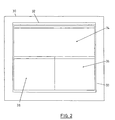
- Figures 2 and 3 illustrate a user interface for a data processing system which utilizes automatically resized panes.
- a screen 30 which may be displayed on display device 23 , has a window 32 having a workspace 33 .
- Figure 2 illustrates a first set of non-overlapping resizeable panes 34 , 36 and 38 . This plurality of non-overlapping resizeable panes is contained within the workspace 33 of window 32 and occupy substantially the entirety of the workspace.
- User input received from user input devices 24 may create or open a new pane, uncover or expose a minimized or existing pane or close or hide an existing pane.
- Figure 3 illustrates the creation of a new pane. As discussed below, this operation on a pane may be accomplished by a single user input of a check box or other fast path to manipulation of a pane within a window. As seen in Figure 3 , user input has instructed the processor 20 to open a new pane. Thus a second set of panes 34 , 36 , 38 and 39 in window 32 is created.
- This second set of panes includes the first set of panes 34 , 36 and 38 and the new pane 39 in non-overlapping relationship with each other and without requiring resizing of the new pane 39 or the first set of panes 34 , 36 , and 38 by the user.
- the reverse operation of closing a pane within the workspace 33 may also be carried out based on user input.
- user input from the user input devices 24 selects one of a set of panes.
- the selected pane is closed and a set of panes comprising the non-selected panes is created.
- This new set of panes is created such that the remaining panes are in non-overlapping relationship without requiring resizing by the user.
- the resized non-selected panes occupy substantially the entirety of the workspace 33 .
- Figure 2 may illustrate the resized panes after one of the panes of Figure 3 is closed.
- FIG. 4 and Figure 5 illustrate windows within a screen.
- a plurality of icons are provided as contents of a pane.
- Pane 40 contained within the workspace 33 of window 32 has four icons 42, 44, 46 and 48 . These icons may represent any number of user selectable options, such as, for example, applications, directories, folders or files in a directory structure.
- the icons 42 , 44, 46 and 48 are contained within pane 40 which also has a title bar 50 with a title 54 which may be utilized to identify the grouping of icons.
- the pane 40 may also have means for deactivating, hiding or closing the pane such as is illustrated by the check box 52 .
- Check box 52 allows for a single user input to manipulate the visibility of the pane through either hiding or closing the pane.
- a user selectable option such as with pointing device icon 56
- the user activates a user selectable option which replaces the contents of a pane, such as pane 40 , with contents based upon the user selected option.
- selection of the "Recovery" icon 44 has replaced the contents of pane 40 with the Recovery application user interface.
- the title bar 50 of pane 40 now has a title 58 which indicates the "Recovery” application occupies pane 40 .
- the menu bar 62 and a button bar 64 have been included in pane 40 as part of the "Recovery” user interface.
- a dialogue box 60 for the "Recovery” application is illustrated in pane 40 to indicate that the contents of pane 40 is now controlled by the "Recovery” application.
- Figure 5 illustrates the creation of a view stack 66 which contains a view icon 68 .
- the view stack 66 indicates the contents of pane 40 which have been replaced by selection of a user selectable option.
- the view icon 68 is associated with the replaced contents such that selection of the view icon 68 would cause the contents of pane 40 to revert to the "Tools" view of Figure 4.
- any number of previous panes may be reflected in the view stack such that a plurality of icons may be contained in the stack with each icon associated with previous contents of the pane.
- deactivation of a pane by the user selectable check box 52 or its equivalent may remove from the view stack any icon associated with the deactivated contents of the pane.
- selection of a user selectable option provides the desired results of that selection to the user without a proliferation of windows.
- any contents in the path to the topmost contents of the pane are also available to the user in a single operation and may be selectively removed from the stack of views to further reduce the complication and clutter of the interface.
- Figure 6 illustrates a further user interface for a data processing system.
- the contents of pane 40 from Figure 5 have been removed from window 30 and a new window 80 has been created with the workspace 83 of window 80 containing the contents of pane 40 from Figure 5.
- the new window 80 has a title bar 82 with a title 84 indicating that the "Recovery" application controls the contents of the workspace 83 of window 80.
- the menu bar 62, button bar 64 and dialogue box 56 are now removed from pane 40 and reside in window 80.
- pane 40 has reverted to the underlying contents of Figure 4.
- transfer of the contents of a pane to a new, stand-alone, window may simply close the pane in the original window.
- the pane could also close when the contents are transferred to a new window.
- the user may simultaneously display the contents of multiple windows selectively without the proliferation of every window in the path to the desired contents.
- New window 80 may be created by selecting the contents of pane 40 by user input, such as with a pointing device, and then "dragging" the contents of pane 40 to outside window 32 on screen 30 . This operation creates a new window in a single user operation.
- any number of methods of selecting a pane and creating an new window with the contents of the selected pane may be utilized, including, for example, keyboard input, pointing device input or a combination of the two input methods.
- the contents of the panes of a window contain related information or related user selectable options. Accordingly, selection of a user selectable option in one pane may cause the contents of a related pane to also change. Furthermore, it is desirable that the panes within a window be resizeable with minimal user input. Accordingly, methods such as those described in United States Patent No. 5,771,042 entitled Multi-size Control for Multiple Adjacent Workspaces may be utilized. Utilizing such methods, the resizing of one pane causes the automatic resizing of other panes within the window so as to maintain their non-overlapping relationship.
- FIGS 7 and 8 are flowchart illustrations of methods, apparatus (systems) and computer program products according to the above examples. It will be understood that each block of the flowchart illustrations, and combinations of blocks in the flowchart illustrations, can be implemented by computer program instructions. These computer program instructions may be loaded onto a computer or other programmable data processing apparatus to produce a machine, such that the instructions which execute on the computer or other programmable data processing apparatus create means for implementing the functions specified in the flowchart block or blocks. These computer program instructions may also be stored in a computer-readable memory that can direct a computer or other programmable data processing apparatus to function in a particular manner, such that the instructions stored in the computer-readable memory produce an article of manufacture including instruction means which implement the function specified in the flowchart block or blocks.
- the computer program instructions may also be loaded onto a computer or other programmable data processing apparatus to cause a series of operational steps to be performed on the computer or other programmable apparatus to produce a computer implemented process such that the instructions which execute on the computer or other programmable apparatus provide steps for implementing the functions specified in the flowchart block or blocks.
- blocks of the flowchart illustrations support combinations of means for performing the specified functions, combinations of steps for performing the specified functions and program instruction means for performing the specified functions. It will also be understood that each block of the flowchart illustrations, and combinations of blocks in the flowchart illustrations, can be implemented by special purpose hardware-based computer systems which perform the specified functions or steps, or combinations of special purpose hardware and computer instructions.
- a window is created with a plurality of panes 90 .
- User input is then received as reflected in block 91 . If the user input specified opening a new pane, then as seen in blocks 92 and 94 , a new set of panes is created incorporating the new pane and resizing the existing panes. If the user input specifies the closing or deactivation of a pane, then, as seen in blocks 96 and 98 , a new set of panes is created removing the pane to be closed and with the remaining panes resized to occupy substantially all of the workspace of the created window.
- Figure 8 illustrates the selection of a user selectable option by user input.
- the contents of the pane containing that icon are replaced with the contents associated with that icon. This operation is reflected in block 102 . If there are no underlying layers for the pane, then a view stack does not exist for the pane and one is created, as reflected in blocks 104 and 106. A stack item or view icon is then created and added to the view stack as seen in block 108.
- the terms "open” and “close” when used with regard to a pane within a window refer to operations to make the contents of a pane visible or to hide the contents of a pane. Accordingly, any method known to those of skill in the art to hide a pane, such as minimizing, iconizing or closing a pane may be utilized. Furthermore, any method known to those of skill in the art of making a pane visible, such as creating a pane, opening a pane, or expanding from an iconized or minimized pane may be utilized in practicing the present invention.
Landscapes
- Engineering & Computer Science (AREA)
- General Engineering & Computer Science (AREA)
- Theoretical Computer Science (AREA)
- Human Computer Interaction (AREA)
- Physics & Mathematics (AREA)
- General Physics & Mathematics (AREA)
- User Interface Of Digital Computer (AREA)
Claims (11)
- Benutzeroberfläche für ein Datenverarbeitungssystem, wobei die Benutzeroberfläche Folgendes umfasst:ein Fenster (32) mit einem Arbeitsbereich (33);eine Vielzahl von nichtüberlappenden, skalierbaren Teilfenstern (34, 36, 38) in dem Arbeitsbereich (33) des Fensters (32);auswählbaren Inhalt, der in mindestens einem der nichtüberlappenden, skalierbaren Teilfenster enthalten ist, wobei der auswählbare Inhalt mindestens ein Optionssymbol von benutzerwählbaren Optionen enthält und wobei die Auswahl des mindestens einen Optionssymbols veranlasst, dass der Inhalt des mindestens einen nichtüberlappenden, skalierbaren Teilfensters durch einen Inhalt ersetzt wird, der dem ausgewählten Optionssymbol zugeordnet ist, undeinen Anzeigestapel, der dem mindestens einen der nichtüberlappenden, skalierbaren Teilfenster, dessen Inhalt ersetzt wurde, zugeordnet ist, wobei der Anzeigestapel eine sichtbare Anzeige eines oder mehrerer Anzeigesymbole umfasst, wobei:jedes der Anzeigesymbole einem zuvor ersetzten Inhalt des zugeordneten nichtüberlappenden, skalierbaren Teilfensters zugeordnet ist;die sichtbare Anzeige eine visuelle Darstellung eines Stapels ist; unddie Auswahl eines beliebigen der Anzeigesymbole in einem Pfad zu einem Anfang des Stapels veranlasst, dass der Inhalt des zugeordneten nichtüberlappenden, skalierbaren Teilfensters in einem einzigen Arbeitsgang durch den zuvor ersetzten Inhalt ersetzt wird, der dem ausgewählten Anzeigesymbol zugeordnet ist.
- Benutzeroberfläche nach Anspruch 1, wobei das Fenster ein erstes Fenster umfasst, wobei die Benutzeroberfläche weiter Folgendes umfasst:Mittel für die Erzeugung eines zweiten Fensters mit einem Arbeitsbereich;Mittel, die auf eine Benutzereingabe reagieren, mit denen eines aus der Vielzahl der nichtüberlappenden, skalierbaren Teilfenster ausgewählt wird; undMittel, die auf die Mittel für die Erzeugung eines zweiten Fensters und auf die Mittel für die Auswahl reagieren, mit denen der Inhalt, der dem ausgewählten einen aus der Vielzahl der nichtüberlappenden, skalierbaren Teilfenster entspricht, in dem zweiten Fenster platziert wird.
- Benutzeroberfläche nach Anspruch 1, wobei das Fenster ein erstes Fenster umfasst, wobei die Benutzeroberfläche weiter Folgendes umfasst:Mittel, die der Vielzahl der nichtüberlappenden, skalierbaren Teilfenster zugeordnet sind, mit denen eines aus der Vielzahl der nichtüberlappenden, skalierbaren Teilfenster ausgewählt wird;Mittel, die den Auswahlmitteln zugeordnet sind, mit denen das ausgewählte eine aus der Vielzahl der nichtüberlappenden, skalierbaren Teilfenster an eine Stelle außerhalb des ersten Fensters gezogen wird; undMittel, die den Mitteln für die Auswahl und den Mitteln für das Ziehen zugeordnet sind, mit denen ein zweites Fenster mit einem Arbeitsbereich erzeugt wird, dessen Inhalt dem ausgewählten und gezogenen einen aus der Vielzahl der nichtüberlappenden, skalierbaren Teilfenster entspricht.
- Benutzeroberfläche nach einem beliebigen vorangehenden Anspruch, wobei die Skalierung von einem aus der Vielzahl der skalierbaren Teilfenster veranlasst, dass die anderen skalierbaren Teilfenster skaliert werden.
- Benutzeroberfläche nach einem beliebigen vorangehenden Anspruch, wobei die Vielzahl der skalierbaren Teilfenster verwandte Informationen enthalten und wobei die Auswahl des auswählbaren Inhalts des mindestens einen aus der Vielzahl der skalierbaren Teilfenster veranlasst, dass der Inhalt eines anderen aus der Vielzahl der skalierbaren Teilfenster überarbeitet wird.
- Verfahren für die Bereitstellung einer Benutzeroberfläche für ein Datenverarbeitungssystem, welches die folgenden Schritte umfasst:Bereitstellen eines Fensters (32) mit einem Arbeitsbereich (33);Bereitstellen einer Vielzahl von nichtüberlappenden, skalierbaren Teilfenstern (34, 36, 38) in dem Arbeitsbereich (33) des Fensters (32);Bereitstellen von auswählbarem Inhalt, der in mindestens einem der nichtüberlappenden, skalierbaren Teilfenster enthalten ist, wobei der auswählbare Inhalt mindestens ein Optionssymbol von benutzerwählbaren Optionen enthält und wobei das Auswählen dieses mindestens einen Optionssymbols veranlasst, dass der Inhalt des mindestens einen der nichtüberlappenden, skalierbaren Teilfenster durch den Inhalt ersetzt wird, der dem ausgewählten Optionssymbol zugeordnet ist, undBereitstellen eines Anzeigestapels, der dem mindestens einen der nichtüberlappenden, skalierbaren Teilfenster zugeordnet ist, dessen Inhalt ersetzt wurde, wobei der Anzeigestapel eine sichtbare Anzeige eines oder mehrerer Anzeigesymbole umfasst, wobei:jedes der Anzeigesymbole einem zuvor ersetzten Inhalt des zugeordneten nichtüberlappenden, skalierbaren Teilfensters zugeordnet ist;die sichtbare Anzeige eine visuelle Darstellung eines Stapels ist; unddie Auswahl eines beliebigen der Anzeigesymbole in einem Pfad zu einem Anfang des Stapels veranlasst, dass der Inhalt des zugeordneten nichtüberlappenden, skalierbaren Teilfensters in einem einzigen Arbeitsgang durch den zuvor ersetzten Inhalt ersetzt wird, der dem ausgewählten Anzeigesymbol zugeordnet ist.
- Verfahren nach Anspruch 6, wobei das Fenster ein erstes Fenster umfasst, wobei das Verfahren weiter die folgenden Schritte umfasst:Erzeugen eines zweiten Fensters mit einem Arbeitsbereich; Auswählen eines aus der Vielzahl der nichtüberlappenden, skalierbaren Teilfenster; undPlatzieren des Inhalts, der dem ausgewählten einen aus der Vielzahl der nichtüberlappenden, skalierbaren Teilfenster entspricht, in dem zweiten Fenster.
- Verfahren nach Anspruch 6, wobei das Fenster ein erstes Fenster umfasst, wobei das Verfahren weiter die folgenden Schritte umfasst:Auswählen eines aus der Vielzahl der nichtüberlappenden, skalierbaren Teilfenster;Erhalten einer Benutzereingabe, die angibt, dass das ausgewählte eine aus der Vielzahl der nichtüberlappenden, skalierbaren Teilfenster an eine Stelle außerhalb des ersten Fensters gezogen wurde; undErzeugen eines zweiten Fensters mit einem Arbeitsbereich, dessen Inhalt dem ausgewählten und gezogenen einen aus der Vielzahl der nichtüberlappenden, skalierbaren Teilfenster entspricht.
- Verfahren nach Anspruch 6, 7 oder 8, das weiter die folgenden Schritte umfasst:Erhalten einer Benutzereingabe, um eines aus der Vielzahl der skalierbaren Teilfenster der ersten Gruppe von Teilfenstern zu skalieren; danachausgehend von der erhaltenen Benutzereingabe, Skalieren eines anderen der skalierbaren Teilfenster.
- Verfahren für die Bereitstellung einer Benutzerschnittstelle nach Anspruch 6, 7, 8 oder 9, das weiter die folgenden Schritte umfasst:Auswählen des auswählbaren Inhalts (42, 44, 46, 48), der in mindestens einem der nichtüberlappenden, skalierbaren Teilfenster enthalten ist; danachÜberarbeiten des Inhalts eines anderen aus der Vielzahl der skalierbaren Teilfenster ausgehend von der Auswahl des auswählbaren Inhalts.
- Computerlesbares Speichermedium mit computerlesbaren Programmcodemitteln für die Ausführung des Verfahrens eines beliebigen der Ansprüche 6 bis 10.
Applications Claiming Priority (2)
| Application Number | Priority Date | Filing Date | Title |
|---|---|---|---|
| US685899 | 1996-07-17 | ||
| US08/685,899 US5920315A (en) | 1996-07-17 | 1996-07-17 | Multi-pane window with recoiling workspaces |
Publications (2)
| Publication Number | Publication Date |
|---|---|
| EP0820002A1 EP0820002A1 (de) | 1998-01-21 |
| EP0820002B1 true EP0820002B1 (de) | 2002-10-09 |
Family
ID=24754138
Family Applications (1)
| Application Number | Title | Priority Date | Filing Date |
|---|---|---|---|
| EP97304748A Expired - Lifetime EP0820002B1 (de) | 1996-07-17 | 1997-07-01 | Mehrfachfenster mit sich restrukturierenden Arbeitsflächen |
Country Status (3)
| Country | Link |
|---|---|
| US (1) | US5920315A (de) |
| EP (1) | EP0820002B1 (de) |
| DE (1) | DE69716186T2 (de) |
Families Citing this family (110)
| Publication number | Priority date | Publication date | Assignee | Title |
|---|---|---|---|---|
| US6832355B1 (en) | 1998-07-28 | 2004-12-14 | Microsoft Corporation | Web page display system |
| US7117452B1 (en) | 1998-12-15 | 2006-10-03 | International Business Machines Corporation | System and method for customizing workspace |
| AUPP926899A0 (en) * | 1999-03-17 | 1999-04-15 | O'neill, Damien | System and method for implementing a computer help function |
| US7058647B1 (en) | 1999-08-31 | 2006-06-06 | Charles E. Hill & Associates | Electronic presentation generation system and method |
| US7149982B1 (en) | 1999-12-30 | 2006-12-12 | Microsoft Corporation | System and method for saving user-specified views of internet web page displays |
| US7210093B1 (en) * | 2000-03-09 | 2007-04-24 | International Business Machines Corporation | Method, system, and program for displaying pages downloaded from over a network in an application window |
| US6654036B1 (en) | 2000-06-05 | 2003-11-25 | International Business Machines Corporation | Method, article of manufacture and apparatus for controlling relative positioning of objects in a windows environment |
| US7433881B1 (en) | 2000-08-31 | 2008-10-07 | Charles E. Hill & Associates, Inc. | System and method for handling multi-resolution graphics files |
| TW594556B (en) * | 2000-11-03 | 2004-06-21 | Synq Technology Inc | Computer system for displaying multiple window screens |
| US6864905B2 (en) | 2001-03-23 | 2005-03-08 | International Business Machines Corporation | Method to redisplay active panels |
| US20020191028A1 (en) * | 2001-06-19 | 2002-12-19 | Senechalle David A. | Window manager user interface |
| US6971068B2 (en) * | 2001-07-26 | 2005-11-29 | International Business Machines Corporation | Dialog box positioning |
| US20030043197A1 (en) * | 2001-09-05 | 2003-03-06 | Kremer Karl Heinz | Image-forming system having a graphic user interface with a companion application window |
| US7620908B2 (en) * | 2001-12-28 | 2009-11-17 | Sap Ag | Managing a user interface |
| US7036089B2 (en) * | 2002-04-23 | 2006-04-25 | Hewlett-Packard Development Company, L.P. | Distribution of application windows in a computing device display |
| DE10225316A1 (de) | 2002-06-06 | 2003-12-18 | Philips Intellectual Property | Verfahren zur Optimierung der Darstellung von mittels Bedienelemente frei platzier-und skalierbaren Objekten einer Benutzeroberfläche auf einem Bildschirm |
| US7343566B1 (en) | 2002-07-10 | 2008-03-11 | Apple Inc. | Method and apparatus for displaying a window for a user interface |
| US20040066407A1 (en) * | 2002-10-08 | 2004-04-08 | Microsoft Corporation | Intelligent windows movement and resizing |
| US7536650B1 (en) | 2003-02-25 | 2009-05-19 | Robertson George G | System and method that facilitates computer desktop use via scaling of displayed objects with shifts to the periphery |
| US8225224B1 (en) | 2003-02-25 | 2012-07-17 | Microsoft Corporation | Computer desktop use via scaling of displayed objects with shifts to the periphery |
| US8230359B2 (en) * | 2003-02-25 | 2012-07-24 | Microsoft Corporation | System and method that facilitates computer desktop use via scaling of displayed objects with shifts to the periphery |
| WO2004097615A2 (en) * | 2003-05-01 | 2004-11-11 | Maz Laboratory | A method of displaying a document |
| US20040230914A1 (en) * | 2003-05-16 | 2004-11-18 | Udo Arend | Displaying view sets of an object for data input |
| EP1477894A3 (de) * | 2003-05-16 | 2006-10-25 | Sap Ag | System, Verfahren, Computerprogrammprodukt und Herstellungsartikel zur Manipulierung einer graphischen Benutzerschnittstelle |
| US7486291B2 (en) * | 2003-07-08 | 2009-02-03 | Berson Barry L | Systems and methods using enhanced vision to provide out-the-window displays for a device |
| JP4193629B2 (ja) * | 2003-07-25 | 2008-12-10 | ソニー株式会社 | 画面表示装置,プログラム,および画面表示方法 |
| US20050050301A1 (en) * | 2003-08-29 | 2005-03-03 | Yahoo!, Inc. | Extensible user interface |
| US8745515B2 (en) * | 2004-04-07 | 2014-06-03 | Nokia Corporation | Presentation of large pages on small displays |
| CA2537100A1 (en) * | 2003-09-24 | 2005-03-31 | Nokia Corporation | Improved presentation of large objects on small displays |
| US7555730B2 (en) * | 2005-05-12 | 2009-06-30 | Hewlett-Packard Development Company, L.P. | Method for arranging graphic assemblies |
| US8056013B2 (en) | 2005-05-13 | 2011-11-08 | Hewlett-Packard Development Company, L.P. | Method for arranging graphic assemblies |
| US7743322B2 (en) * | 2003-09-30 | 2010-06-22 | Hewlett-Packard Development Company, L.P. | Automatic photo album page layout |
| US8065627B2 (en) * | 2003-09-30 | 2011-11-22 | Hewlett-Packard Development Company, L.P. | Single pass automatic photo album page layout |
| US8276095B2 (en) * | 2004-02-20 | 2012-09-25 | Advanced Intellectual Property Group, Llc | System for and method of generating and navigating within a workspace of a computer application |
| US7376912B2 (en) | 2004-03-25 | 2008-05-20 | Morgan Stanley | Interactive user interface for displaying supply chain information |
| US8276096B2 (en) * | 2004-04-02 | 2012-09-25 | International Business Machines Corporation | Multicast file viewing and editing |
| US7694233B1 (en) * | 2004-04-30 | 2010-04-06 | Apple Inc. | User interface presentation of information in reconfigured or overlapping containers |
| EP1758019A4 (de) * | 2004-05-06 | 2010-06-23 | Takatoshi Yanase | Fensteranzeigesystem, fensteranzeigeverfahren, programmentwicklungs-unterstützungseinrichtung und server-einrichtung |
| US7173619B2 (en) * | 2004-07-08 | 2007-02-06 | Microsoft Corporation | Matching digital information flow to a human perception system |
| US7721197B2 (en) * | 2004-08-12 | 2010-05-18 | Microsoft Corporation | System and method of displaying content on small screen computing devices |
| DE102004043175A1 (de) * | 2004-09-03 | 2006-03-23 | Siemens Ag | Grafische Benutzeroberfläche, Computervorrichtung, Verwendung, Verfahren zur Darstellung von Informationen mit einer Benutzeroberfläche, Computerprogramm-Produkt und computerlesbares Medium |
| US7656543B2 (en) * | 2004-11-12 | 2010-02-02 | Hewlett-Packard Development Company, L.P. | Albuming images |
| US8418075B2 (en) | 2004-11-16 | 2013-04-09 | Open Text Inc. | Spatially driven content presentation in a cellular environment |
| US8001476B2 (en) | 2004-11-16 | 2011-08-16 | Open Text Inc. | Cellular user interface |
| US20060184895A1 (en) * | 2005-02-17 | 2006-08-17 | Dolph Blaine H | Visibly persisting one or more computer desktop windows |
| US8161377B2 (en) * | 2005-03-01 | 2012-04-17 | Hewlett-Packard Development Company, L.P. | Arranging images on pages of an album |
| US7760956B2 (en) | 2005-05-12 | 2010-07-20 | Hewlett-Packard Development Company, L.P. | System and method for producing a page using frames of a video stream |
| US7644356B2 (en) * | 2005-06-10 | 2010-01-05 | Hewlett-Packard Development Company, L.P. | Constraint-based albuming of graphic elements |
| US20070016875A1 (en) * | 2005-07-12 | 2007-01-18 | International Business Machines Corporation | Method and system for partial sizing adjacency constraint in a multi-pane window frame |
| US7590940B2 (en) | 2005-10-11 | 2009-09-15 | Morgan Stanley | Interactive user interface for displaying correlation |
| US7437678B2 (en) * | 2005-10-27 | 2008-10-14 | International Business Machines Corporation | Maximizing window display area using window flowing |
| USD551247S1 (en) * | 2005-11-14 | 2007-09-18 | Microsoft Corporation | Icon for a portion of a display screen |
| US7783990B2 (en) * | 2006-05-05 | 2010-08-24 | Microsoft Corporation | Association of display elements |
| KR20080024734A (ko) * | 2006-09-14 | 2008-03-19 | 삼성전자주식회사 | 웹문서 구성 장치 및 방법과 웹문서 배열 설정 장치 |
| USD563982S1 (en) * | 2006-10-13 | 2008-03-11 | Microsoft Corporation | Icon for a display screen or packaging |
| KR101406289B1 (ko) * | 2007-03-08 | 2014-06-12 | 삼성전자주식회사 | 스크롤 기반 아이템 제공 장치 및 방법 |
| US8839142B2 (en) * | 2007-06-08 | 2014-09-16 | Apple Inc. | Desktop system object removal |
| JP4342578B2 (ja) | 2007-07-24 | 2009-10-14 | 株式会社エヌ・ティ・ティ・ドコモ | 情報処理装置およびプログラム |
| US20090113292A1 (en) * | 2007-10-26 | 2009-04-30 | Microsoft Corporation | Flexibly editing heterogeneous documents |
| US8214760B2 (en) * | 2008-01-16 | 2012-07-03 | Microsoft Corporation | Window minimization trigger |
| US9189250B2 (en) * | 2008-01-16 | 2015-11-17 | Honeywell International Inc. | Method and system for re-invoking displays |
| US20100175104A1 (en) * | 2008-03-03 | 2010-07-08 | Khalid Atm Shafiqul | Safe and secure program execution framework with guest application space |
| TWI386843B (zh) * | 2008-07-03 | 2013-02-21 | Wistron Corp | 螢幕顯示區分割方法、螢幕顯示區分割系統,及電腦程式產品 |
| JP2010191935A (ja) * | 2009-01-26 | 2010-09-02 | Toshiba Tec Corp | 注文受付装置およびプログラム |
| US9152292B2 (en) | 2009-02-05 | 2015-10-06 | Hewlett-Packard Development Company, L.P. | Image collage authoring |
| KR101640460B1 (ko) | 2009-03-25 | 2016-07-18 | 삼성전자 주식회사 | 휴대 단말기의 분할 화면 운용 방법 및 이를 지원하는 휴대 단말기 |
| US8161384B2 (en) * | 2009-04-23 | 2012-04-17 | Hewlett-Packard Development Company, L.P. | Arranging graphic objects on a page with text |
| US8291314B2 (en) * | 2009-04-23 | 2012-10-16 | Hewlett-Packard Development Company, L.P. | Arranging graphic objects on a page |
| USD613756S1 (en) * | 2009-04-29 | 2010-04-13 | Microsoft Corporation | Icon for a display screen |
| US9292196B2 (en) * | 2010-10-19 | 2016-03-22 | Apple Inc. | Modifying the presentation of clustered application windows in a user interface |
| US9542202B2 (en) | 2010-10-19 | 2017-01-10 | Apple Inc. | Displaying and updating workspaces in a user interface |
| US10740117B2 (en) * | 2010-10-19 | 2020-08-11 | Apple Inc. | Grouping windows into clusters in one or more workspaces in a user interface |
| US9658732B2 (en) * | 2010-10-19 | 2017-05-23 | Apple Inc. | Changing a virtual workspace based on user interaction with an application window in a user interface |
| US8689123B2 (en) | 2010-12-23 | 2014-04-01 | Microsoft Corporation | Application reporting in an application-selectable user interface |
| US10152192B2 (en) | 2011-02-21 | 2018-12-11 | Apple Inc. | Scaling application windows in one or more workspaces in a user interface |
| US9104307B2 (en) | 2011-05-27 | 2015-08-11 | Microsoft Technology Licensing, Llc | Multi-application environment |
| US20130057587A1 (en) | 2011-09-01 | 2013-03-07 | Microsoft Corporation | Arranging tiles |
| US9146670B2 (en) | 2011-09-10 | 2015-09-29 | Microsoft Technology Licensing, Llc | Progressively indicating new content in an application-selectable user interface |
| US9424439B2 (en) | 2011-09-12 | 2016-08-23 | Microsoft Technology Licensing, Llc | Secure data synchronization |
| US9134807B2 (en) | 2012-03-02 | 2015-09-15 | Microsoft Technology Licensing, Llc | Pressure sensitive key normalization |
| US9075566B2 (en) | 2012-03-02 | 2015-07-07 | Microsoft Technoogy Licensing, LLC | Flexible hinge spine |
| US9146655B2 (en) * | 2012-04-06 | 2015-09-29 | Samsung Electronics Co., Ltd. | Method and device for executing object on display |
| US20130300590A1 (en) | 2012-05-14 | 2013-11-14 | Paul Henry Dietz | Audio Feedback |
| KR101961860B1 (ko) | 2012-08-28 | 2019-03-25 | 삼성전자주식회사 | 사용자 단말 장치 및 그 제어 방법 |
| US9921711B2 (en) * | 2013-03-14 | 2018-03-20 | Samsung Electronics Co., Ltd. | Automatically expanding panes |
| US11294529B2 (en) * | 2013-04-15 | 2022-04-05 | Microsoft Technology Licensing, Llc | Application window divider control for window layout management |
| US9594603B2 (en) | 2013-04-15 | 2017-03-14 | Microsoft Technology Licensing, Llc | Application-to-application launch windowing |
| US10754536B2 (en) | 2013-04-29 | 2020-08-25 | Microsoft Technology Licensing, Llc | Content-based directional placement application launch |
| KR20140133072A (ko) * | 2013-05-09 | 2014-11-19 | 삼성디스플레이 주식회사 | 모바일 장치 및 이의 구동 방법 |
| US9535565B2 (en) * | 2013-05-13 | 2017-01-03 | Microsoft Technology Licensing, Llc | Smart insertion of applications into layouts |
| USD749610S1 (en) * | 2013-09-03 | 2016-02-16 | Samsung Electronics Co., Ltd. | Display screen or portion thereof with graphical user interface |
| USD749109S1 (en) * | 2013-09-03 | 2016-02-09 | Samsung Electronics Co., Ltd. | Display screen or portion thereof with graphical user interface |
| USD753710S1 (en) * | 2014-02-10 | 2016-04-12 | Vision Dealer Services, LLC | Display screen or portion thereof with a transitional graphical user interface |
| USD776688S1 (en) * | 2014-02-10 | 2017-01-17 | Vision Dealer Services, LLC | Display screen or portion thereof with a graphical user interface |
| USD776671S1 (en) * | 2014-02-10 | 2017-01-17 | Vision Dealer Services, LLC | Display screen or portion thereof with a graphical user interface |
| US10402034B2 (en) | 2014-04-02 | 2019-09-03 | Microsoft Technology Licensing, Llc | Adaptive user interface pane manager |
| US10324733B2 (en) | 2014-07-30 | 2019-06-18 | Microsoft Technology Licensing, Llc | Shutdown notifications |
| US10678412B2 (en) | 2014-07-31 | 2020-06-09 | Microsoft Technology Licensing, Llc | Dynamic joint dividers for application windows |
| US10254942B2 (en) | 2014-07-31 | 2019-04-09 | Microsoft Technology Licensing, Llc | Adaptive sizing and positioning of application windows |
| US10592080B2 (en) | 2014-07-31 | 2020-03-17 | Microsoft Technology Licensing, Llc | Assisted presentation of application windows |
| US9787576B2 (en) | 2014-07-31 | 2017-10-10 | Microsoft Technology Licensing, Llc | Propagating routing awareness for autonomous networks |
| US10949075B2 (en) | 2014-11-06 | 2021-03-16 | Microsoft Technology Licensing, Llc | Application command control for small screen display |
| US20160132992A1 (en) | 2014-11-06 | 2016-05-12 | Microsoft Technology Licensing, Llc | User interface scaling for devices based on display size |
| US10209849B2 (en) | 2015-01-21 | 2019-02-19 | Microsoft Technology Licensing, Llc | Adaptive user interface pane objects |
| US10042655B2 (en) | 2015-01-21 | 2018-08-07 | Microsoft Technology Licensing, Llc. | Adaptable user interface display |
| USD841661S1 (en) * | 2016-06-07 | 2019-02-26 | Amadeus S.A.S. | Display screen with animated graphical user interface |
| US10540076B2 (en) | 2016-09-27 | 2020-01-21 | E-Kalite Yazilim Donanim Muhendislik Tasarim Ve Internet Hizmetleri San. Tic. Ltd. Sti. | Clone feature to compare data visualization |
| CN107015721A (zh) * | 2016-10-20 | 2017-08-04 | 阿里巴巴集团控股有限公司 | 一种应用界面的管理方法和装置 |
| CN110569094B (zh) * | 2019-07-29 | 2022-04-12 | 华为技术有限公司 | 一种显示方法及电子设备 |
| US11487397B2 (en) * | 2021-03-30 | 2022-11-01 | Slack Technologies, Llc | Multiple windows for a group-based communication system |
Family Cites Families (14)
| Publication number | Priority date | Publication date | Assignee | Title |
|---|---|---|---|---|
| US5072412A (en) * | 1987-03-25 | 1991-12-10 | Xerox Corporation | User interface with multiple workspaces for sharing display system objects |
| US5233687A (en) * | 1987-03-25 | 1993-08-03 | Xerox Corporation | User interface with multiple workspaces for sharing display system objects |
| US5394521A (en) * | 1991-12-09 | 1995-02-28 | Xerox Corporation | User interface with multiple workspaces for sharing display system objects |
| US4975690A (en) * | 1988-11-07 | 1990-12-04 | Ibm Corporation | Method for concurrent data entry and manipulation in multiple applications |
| US5289574A (en) * | 1990-09-17 | 1994-02-22 | Hewlett-Packard Company | Multiple virtual screens on an "X windows" terminal |
| US5390295A (en) * | 1991-12-20 | 1995-02-14 | International Business Machines Corporation | Method and apparatus for proportionally displaying windows on a computer display screen |
| EP0572205B1 (de) * | 1992-05-26 | 1998-09-30 | International Business Machines Corporation | Objektorientiertes Anzeigesystem |
| US5371847A (en) * | 1992-09-22 | 1994-12-06 | Microsoft Corporation | Method and system for specifying the arrangement of windows on a display |
| EP0695448B1 (de) * | 1993-04-20 | 2001-11-07 | Apple Computer, Inc. | Interaktive anwenderschnittstelle |
| US5583984A (en) * | 1993-06-11 | 1996-12-10 | Apple Computer, Inc. | Computer system with graphical user interface including automated enclosures |
| US5572649A (en) * | 1993-11-12 | 1996-11-05 | Intel Corporation | Process for dynamically switching between a single top level window and multiple top level windows |
| US5487143A (en) * | 1994-04-06 | 1996-01-23 | Altera Corporation | Computer user interface having tiled and overlapped window areas |
| US5577187A (en) * | 1994-05-20 | 1996-11-19 | Microsoft Corporation | Method and system for tiling windows based on previous position and size |
| US5712995A (en) * | 1995-09-20 | 1998-01-27 | Galileo Frames, Inc. | Non-overlapping tiling apparatus and method for multiple window displays |
-
1996
- 1996-07-17 US US08/685,899 patent/US5920315A/en not_active Expired - Fee Related
-
1997
- 1997-07-01 DE DE69716186T patent/DE69716186T2/de not_active Expired - Lifetime
- 1997-07-01 EP EP97304748A patent/EP0820002B1/de not_active Expired - Lifetime
Also Published As
| Publication number | Publication date |
|---|---|
| US5920315A (en) | 1999-07-06 |
| DE69716186T2 (de) | 2003-06-12 |
| EP0820002A1 (de) | 1998-01-21 |
| DE69716186D1 (de) | 2002-11-14 |
Similar Documents
| Publication | Publication Date | Title |
|---|---|---|
| US5920315A (en) | Multi-pane window with recoiling workspaces | |
| US5140678A (en) | Computer user interface with window title bar icons | |
| US5771042A (en) | Multi-size control for multiple adjacent workspaces | |
| US6348935B1 (en) | Programmable tree viewer graphical user interface with integrated control panel | |
| US5920316A (en) | Taskbar with start menu | |
| US5664128A (en) | Object storage apparatus for use with data sets in computer applications | |
| US6806892B1 (en) | Layer viewport for enhanced viewing in layered drawings | |
| US5745718A (en) | Folder bar widget | |
| US6133918A (en) | Computer system with graphical user interface including drawer-like windows | |
| US5140677A (en) | Computer user interface with window title bar mini-icons | |
| US6025841A (en) | Method for managing simultaneous display of multiple windows in a graphical user interface | |
| US6970749B1 (en) | Grouped palette stashing | |
| US5550969A (en) | Graphical method of indicating the position of and performing an operation on a plurality of selected objects in a computer system | |
| US6040833A (en) | Method and system for display manipulation of multiple applications in a data processing system | |
| US7350154B2 (en) | Virtual desktop manager | |
| US6201539B1 (en) | Method and system for customizing a data processing system graphical user interface | |
| US6710788B1 (en) | Graphical user interface | |
| US5917483A (en) | Advanced windows management for a computer system | |
| JP3773452B2 (ja) | コンピュータ制御情報管理システム及び情報管理方法 | |
| US6008809A (en) | Apparatus and method for viewing multiple windows within a dynamic window | |
| JPH09269885A (ja) | ウィンドウのサイズ変更方法及びグラフィカル・ユーザ・インタフェース | |
| US6072484A (en) | Graphic user interface for tab setting with a re-sizeable scale | |
| US6023273A (en) | User interface with repeating interactive background elements | |
| JP2001255976A (ja) | 共通レジストリを含むタブ付きノートブックおよびその表示操作方法 | |
| Wang | Organizing Windows |
Legal Events
| Date | Code | Title | Description |
|---|---|---|---|
| PUAI | Public reference made under article 153(3) epc to a published international application that has entered the european phase |
Free format text: ORIGINAL CODE: 0009012 |
|
| AK | Designated contracting states |
Kind code of ref document: A1 Designated state(s): DE GB |
|
| AX | Request for extension of the european patent |
Free format text: AL;LT;LV;RO;SI |
|
| 17P | Request for examination filed |
Effective date: 19980512 |
|
| 17Q | First examination report despatched |
Effective date: 19980723 |
|
| AKX | Designation fees paid |
Free format text: DE GB |
|
| RBV | Designated contracting states (corrected) |
Designated state(s): DE GB |
|
| GRAG | Despatch of communication of intention to grant |
Free format text: ORIGINAL CODE: EPIDOS AGRA |
|
| GRAG | Despatch of communication of intention to grant |
Free format text: ORIGINAL CODE: EPIDOS AGRA |
|
| GRAH | Despatch of communication of intention to grant a patent |
Free format text: ORIGINAL CODE: EPIDOS IGRA |
|
| GRAH | Despatch of communication of intention to grant a patent |
Free format text: ORIGINAL CODE: EPIDOS IGRA |
|
| GRAA | (expected) grant |
Free format text: ORIGINAL CODE: 0009210 |
|
| AK | Designated contracting states |
Kind code of ref document: B1 Designated state(s): DE GB |
|
| REG | Reference to a national code |
Ref country code: GB Ref legal event code: FG4D |
|
| REF | Corresponds to: |
Ref document number: 69716186 Country of ref document: DE Date of ref document: 20021114 |
|
| PLBE | No opposition filed within time limit |
Free format text: ORIGINAL CODE: 0009261 |
|
| STAA | Information on the status of an ep patent application or granted ep patent |
Free format text: STATUS: NO OPPOSITION FILED WITHIN TIME LIMIT |
|
| 26N | No opposition filed |
Effective date: 20030710 |
|
| REG | Reference to a national code |
Ref country code: GB Ref legal event code: 746 Effective date: 20080704 |
|
| PGFP | Annual fee paid to national office [announced via postgrant information from national office to epo] |
Ref country code: GB Payment date: 20160726 Year of fee payment: 20 Ref country code: DE Payment date: 20160819 Year of fee payment: 20 |
|
| REG | Reference to a national code |
Ref country code: DE Ref legal event code: R071 Ref document number: 69716186 Country of ref document: DE |
|
| REG | Reference to a national code |
Ref country code: GB Ref legal event code: PE20 Expiry date: 20170630 |
|
| PG25 | Lapsed in a contracting state [announced via postgrant information from national office to epo] |
Ref country code: GB Free format text: LAPSE BECAUSE OF EXPIRATION OF PROTECTION Effective date: 20170630 |