EP0809805B2 - Verwendung von polyklonalen humanen anti-htg-autoantikörpern als reagenz für die klinische diagnostik von schilddrüsen-autoimmunerkrankungen sowie reagenziensatz für eine bestimmung von anti-htg-autoantikörpern in patientenseren - Google Patents
Verwendung von polyklonalen humanen anti-htg-autoantikörpern als reagenz für die klinische diagnostik von schilddrüsen-autoimmunerkrankungen sowie reagenziensatz für eine bestimmung von anti-htg-autoantikörpern in patientenseren Download PDFInfo
- Publication number
- EP0809805B2 EP0809805B2 EP96901792A EP96901792A EP0809805B2 EP 0809805 B2 EP0809805 B2 EP 0809805B2 EP 96901792 A EP96901792 A EP 96901792A EP 96901792 A EP96901792 A EP 96901792A EP 0809805 B2 EP0809805 B2 EP 0809805B2
- Authority
- EP
- European Patent Office
- Prior art keywords
- htg
- autoantibodies
- neg
- human
- thyroglobulin
- Prior art date
- Legal status (The legal status is an assumption and is not a legal conclusion. Google has not performed a legal analysis and makes no representation as to the accuracy of the status listed.)
- Expired - Lifetime
Links
Images
Classifications
-
- G—PHYSICS
- G01—MEASURING; TESTING
- G01N—INVESTIGATING OR ANALYSING MATERIALS BY DETERMINING THEIR CHEMICAL OR PHYSICAL PROPERTIES
- G01N33/00—Investigating or analysing materials by specific methods not covered by groups G01N1/00 - G01N31/00
- G01N33/48—Biological material, e.g. blood, urine; Haemocytometers
- G01N33/50—Chemical analysis of biological material, e.g. blood, urine; Testing involving biospecific ligand binding methods; Immunological testing
- G01N33/53—Immunoassay; Biospecific binding assay; Materials therefor
- G01N33/564—Immunoassay; Biospecific binding assay; Materials therefor for pre-existing immune complex or autoimmune disease, i.e. systemic lupus erythematosus, rheumatoid arthritis, multiple sclerosis, rheumatoid factors or complement components C1-C9
-
- Y—GENERAL TAGGING OF NEW TECHNOLOGICAL DEVELOPMENTS; GENERAL TAGGING OF CROSS-SECTIONAL TECHNOLOGIES SPANNING OVER SEVERAL SECTIONS OF THE IPC; TECHNICAL SUBJECTS COVERED BY FORMER USPC CROSS-REFERENCE ART COLLECTIONS [XRACs] AND DIGESTS
- Y10—TECHNICAL SUBJECTS COVERED BY FORMER USPC
- Y10S—TECHNICAL SUBJECTS COVERED BY FORMER USPC CROSS-REFERENCE ART COLLECTIONS [XRACs] AND DIGESTS
- Y10S435/00—Chemistry: molecular biology and microbiology
- Y10S435/975—Kit
Definitions
- the present invention relates to the detection of antibodies in biological fluids with the help of immunological Determination procedures performed using reagent kits for clinical diagnostics that are produced and sold on an industrial scale by diagnostic manufacturers.
- the present invention relates to the detection of autoantibodies, in particular autoantibodies against the autoantigens of the thyroid gland, of which in turn the determination within the scope of the present invention of human autoantibodies against thyroglobulin (hTg) in a human serum or plasma in the foreground stands.
- hTg thyroglobulin
- Thyroglobulin is one of the thyroid autoantigens and is a high molecular weight protein that consists of two identical glycosylated subunits, each with a molecular weight of approximately 330 kD (see, e.g., J. Furmaniak and B. Rees Smith, in: Autoimmunity, 1990, Vol. 7, pp. 63-80). Thyroglobulin is a main component of the thyroid colloid and is the precursor of the thyroid hormones triiodothyronine (T 3 ) and thyroxine (T 4 ).
- thyroid peroxidase TPO
- unbound iodine or circulating tyroidite or iodide circulating Iodine tyrosine residues of Tg installed.
- the thyroid hormones T 3 and T 4 are then released from the iodinated thyroglobulin by hormonal control mechanisms that react to the levels of T 3 and T 4 in the blood.
- Anti-hTg autoantibody For thyroid autoimmune diseases, especially those that lead to hypothyroidism destructive Hashimoto's thyroiditis, are found in the patient's blood in addition to autoantibodies against thyroid peroxidase autoantibodies against thyroglobulin have been found in significant amounts (in the following, such antibodies always referred to as an "anti-hTg autoantibody").
- the detection and quantitative determination of such Anti-hTg autoantibodies are of considerable importance in the clinical diagnosis of thyroid diseases to.
- anti-hTg autoantibodies in patient sera is possible using various techniques, among other things also according to immunological determination methods.
- a determination method commercially available (HENNINGtest®anti-Tg) is done in such a way that pre-diluted serum samples are in the test tubes incubated simultaneously with a labeled Tg (as a tracer) and a protein A suspension.
- Anti-hTg autoantibodies are present in the sample, so they react with the antigen hTg added as a tracer. simultaneously binds the protein A present in the form of particles of a suspended solid phase non-specifically to the Fc subunits the antibody, and a sandwich complex is formed.
- the particles are removed by centrifugation the solid phase suspension with all the molecules bound to it is transferred into a sediment, and the supernatant with the unbound tracer is removed.
- the concentration of anti-hTg autoantibodies is therefore directly proportional to that in the sediment detectable amount of tracer, for example in the case of radioactive labeling of the radioactivity measurable in the sediment.
- anti-hTg autoantibodies it would therefore be desirable in itself to also determine anti-hTg autoantibodies to be able to carry out according to a determination method that works according to the coated tube technique and belongs to the competitive determination methods and in which the presence of those to be determined Antibodies in the examined serum sample as a reduction in the binding of the labeled reagent (tracer) to the Walls of a test tube.
- glutamate decarboxylase can be cited as examples of such antigens (Type I diabetes), the acetylcholine receptor (myasthenia gravis), the so-called “myelin basic protein” (Multiple sclerosis), the TSH receptor and especially the thyroglobulin (hTg).
- Thyroglobulin a very large protein antigen with a very high number of potential antigens Determinants (epitopes) that lead to the fact that when using human thyroglobulin Generation of heterologous antibodies by direct immunization of an animal a population of polyclonal antibodies which have been found to be active against a large number of different epitopes of human thyroglobulin judge.
- autoimmune diseases anti-hTg autoantibodies apparently only against a limited number of epitopes on the thyroglobulin surface be formed (J. Furmaniak and B.
- the conformative antibodies include what is attempted using an epitope mapping monoclonal anti-hTg antibodies of animal origin further complicated and a mapping of the relevant Epitopes prevented using recombinant sequential antibodies (Q. Dong, M. Ludgate and G. Vassart, in: Journal of Endocrinology (1989) 122, pp.169-176).
- polyclonal heterologous IgG populations do not correspond to those occurring in autoimmune diseases anti-hTg autoantibody populations and are therefore obvious for use in competitive immunological Determination method little or not suitable.
- the present invention is therefore based on the object of determining competitive methods of determining antibodies, in particular to design competitive determination methods for the determination of anti-hTg autoantibodies, that such autoantibodies can also be determined with high accuracy and reliability, if these autoantibodies against antigens are formed with a variety of relevant epitopes and as a population of polyclonal antibodies.
- This task is performed as part of the determination of anti-hTg autoantibodies in patient sera Claim 1 solved in that polyclonal human autoantibodies as a specific binding reagent against thyroglobulin, in particular affinity-purified polyclonal human IgG autoantibodies against thyroglobulin from sera from human patients suffering from thyroid autoimmune disease.
- the present invention further relates to a set of reagents for the immunological determination of anti-hTg autoantibodies in patient sera according to claim 8, which is essentially characterized in that it in addition to the usual components of such a reagent set, affinity-purified anti-hTg autoantibodies (a affinity-purified anti-hTg-IgG preparation) contains.
- polyclonal human autoantibodies against thyroglobulin can be used as a "specific binding reagent", which means that it can be used as a Reactants are used in an immunological determination method in which a specific immunological Reaction between antigen and antibody (s) is used.
- Specific binding reagent will not used in the sense of "binder for analytes", since the antibodies to be determined should be regarded as “analytes”, with which the polyclonal human autoantibodies to be used according to the invention against thyroglobulin as Competitors compete for binding sites of the antigen thyroglobulin.
- the present invention is based on the finding that it is possible to use anti-hTg autoantibodies in serum of a patient very reliably, if not as in the field of industrial manufacturing Reagent sets for immunological determination methods previously common, with antibodies (polyclonal or monoclonal anti-hTg antibodies) of animal origin, but with polyclonal human autoantibodies, which were obtained directly from the serum of patients suffering from the thyroid autoimmune disease to be detected proven to suffer.
- such polyclonal can generally human autoantibodies in the form of a serum from a single patient with the typical symptoms of the detected Thyroid autoimmune disease can be used, however it is preferred as a source of the polyclonal human autoantibodies to use the pooled sera of a plurality of such patients, to ensure that the starting serum used is as complete a population of all autoantibodies as possible contains that can be formed in humans in connection with the disease to be detected.
- the polyclonal human autoantibodies are preferred not used in such a way that all IgG autoantibodies present in such a serum are used, rather, the polyclonal human autoantibodies are preferably used after affinity purification an hTg affinity matrix is used so that the immunoglobulin fraction used as a specific binding reagent comprises essentially only anti-hTg autoantibodies.
- Thyroglobulin or human Thyroglobulin for the purpose of affinity purification or as a reagent in an immunological determination method spoken, it means primarily a common human thyroglobulin, as used by various Manufacturers are commercially available, for example from the British company Scipac. Since more recently, however has shown that the development of autoantibodies in thyroid autoimmune diseases is very specific Thyroglobutin fractions may be involved above average (Ali M. Saboori, Noel R. Rose, Rudolf C. Kuppers, Wayne G. Butscher, Herbert S. Bresler and C.
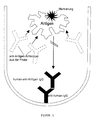
- the determination method can be carried out in such a way that (cf. FIG. 1) according to a variant, the polyclonal human anti-HTG autoantibodies, in particular in the form of an affinity-purified anti-hTg-IgG preparation, binds to a solid carrier phase, in particular to the wall of a test tube, and that as a further reagent a labeled human thyroglobulin, for example a radioiodinated human Thyroglobulin.
- a labeled human thyroglobulin for example a radioiodinated human Thyroglobulin.
- anti-hTg autoantibodies of the type to be detected are present in the patient sample, it happens competition between the antibodies used in the process as a specific binding reagent and the antibodies in the patient serum, which is expressed in that the binding of the labeled thyroglobulin to the solid phase is reduced is what leads to a solid-liquid separation that means that less marking is found on the solid phase.
- the presence of the autoantibodies to be determined leads in a patient sample to reduce the binding of the label to the solid phase.
- the solid phase can also be the wall of a microtiter plate or another coarsely disperse known per se or finely dispersed solid phase, the selection of the suitable solid phase primarily based on practical Considerations for the specific application can be made.
- polyclonal human anti-hTg autoantibodies as a specific binding reagent presumably the advantage that in such a polyclonal specific binding reagent binding partner for all possible epitopes are present on the hTg molecule, which are associated with the disease-related development of anti-hTg autoantibodies have to do.
- this ensures that any occurrence of such anti-hTg autoantibodies in a patient serum leads to a demonstrable effect, the effect with the amount and / or the number of individual autoantibody types in a patient serum increases.
- anti-hTg autoantibodies obtained from sera from diseased human donors instead of working as usual with antibodies obtained by animal immunization were or with appropriate monoclonal antibodies. It was surprisingly found that anti-hTg autoantibodies are present in sera from patients with Hashimoto's thyroiditis in such amounts that a relatively small Amount of donor serum sufficient to produce a large amount of coated test tubes to secure. For example, using 10 ml of patient serum containing z. B.
- the tubes used as solid phases in all of the exemplary embodiments are tubes from the company Nunc, Maxisorp quality 75 x 12 mm with star insert.
- Buffer A phosphate buffered saline PBS
- Buffer B 10mM TRIS HCl
- 10mM NaCl pH 7.8
- Buffer C 20 mM sodium phosphate
- pH 7.0 Buffer D 25 mM citric acid
- Buffer E 0.5 M sodium phosphate
- pH 8.0 Buffer F 20 mM sodium phosphate 1% bovine serum albumin (BSA; Sigma) 3% crystallization-delayed sorbitol syrup (Karion FP; Merck), pH 7.5
- Serum samples from patients with the indications Hashimoto's thyroiditis, autoimmune thyroiditis and disease Basedow (Graves Disease) were obtained from various German clinics. They were used for manufacturing of the reagents or as test sera. Serum samples used as control samples are sera from individuals who who were without signs of any infection, autoimmune, or allergic disease.
- the HENNINGtest anti-Tg determination method used as a comparison method is a commercial one Determination method and in the form of a reagent set with instructions from BRAHMS Diagnostica GmbH, Berlin.
- Human thyroglobulin labeled with iodine 125 was taken from the commercial HENNING test anti-Tg mentioned.
Landscapes
- Health & Medical Sciences (AREA)
- Life Sciences & Earth Sciences (AREA)
- Immunology (AREA)
- Hematology (AREA)
- Engineering & Computer Science (AREA)
- Urology & Nephrology (AREA)
- Molecular Biology (AREA)
- Biomedical Technology (AREA)
- Chemical & Material Sciences (AREA)
- Physics & Mathematics (AREA)
- Biochemistry (AREA)
- Cell Biology (AREA)
- Rehabilitation Therapy (AREA)
- Biotechnology (AREA)
- Food Science & Technology (AREA)
- Medicinal Chemistry (AREA)
- Rheumatology (AREA)
- Analytical Chemistry (AREA)
- Microbiology (AREA)
- General Health & Medical Sciences (AREA)
- General Physics & Mathematics (AREA)
- Pathology (AREA)
- Peptides Or Proteins (AREA)
- Investigating Or Analysing Biological Materials (AREA)
- Measuring Or Testing Involving Enzymes Or Micro-Organisms (AREA)
- Medicines That Contain Protein Lipid Enzymes And Other Medicines (AREA)
Description
- Figur 1
- das Verfahrensprinzip einer ersten Variante einer anti-hTg-Autoantikörperbestimmung unter Verwendung einer affinitätsgereinigten polyklonalen humanen IgG-Fraktion, die als immobilisierter spezifischer Binder für das in markierter Form eingesetzte hTg dient;
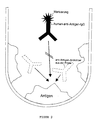
- Figur 2
- das Verfahrensprinzip einer zweiten Variante einer anti-hTg-Autoantikörperbestimmung unter Verwendung einer affinitätsgereinigten polyklonalen humanen IgG-Fraktion, die in markierter Form als spezifischer Binder für das in imobilisierter Form eingesetzte hTg verwendet wird;
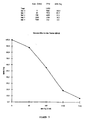
- Figur 3
- eine typische Meßkurve mit zugehöriger Meßwerttabelle für eine Bestimmung von anti-hTg-Autoantikörpern bei einem Bestimmungsverfahren gemäß Ausführungsbeispiel 1; und
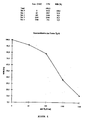
- Figur 4
- eine typische Meßkurve mit zugehöriger Meßwerttabelle für eine Bestimmung von anti-hTg-Autoantikörpern bei einem Bestimmungsverfahren gemäß Ausführungsbeispiel 2.
| Puffer A | phosphatgepufferte Salzlösung (PBS), 0,1 % Tween 20 |
| Puffer B | 10 mM TRIS HCI, 10 mM NaCl, pH 7,8 |
| Puffer C | 20 mM Natriumphosphat, pH 7,0 |
| Puffer D | 25 mM Zitronensäure |
| Puffer E | 0,5 M Natriumphosphat, pH 8,0 |
| Puffer F | 20 mM Natriumphosphat 1 % Rinderserumalbumin (BSA; Sigma) 3 % kristallisationsverzögerter Sorbitsirup (Karion FP; Merck), pH 7,5 |
| Messung von Kontrollseren | ||||||
| Kontrollgruppe | ||||||
| No. | Immu anti-Tg U/ml | HD-R U/ml | Tg-R U/ml | |||
| 1 | <100 | neg. | <30 | neg. | <60 | neg. |
| 2 | <100 | neg. | <30 | neg. | <60 | neg. |
| 3 | <100 | neg. | <30 | neg. | <60 | neg. |
| 4 | <100 | neg. | <30 | neg. | <60 | neg. |
| 5 | <100 | neg. | <30 | neg. | <60 | neg. |
| 6 | <100 | neg. | <30 | neg. | <60 | neg |
| 7 | <100 | neg. | <30 | neg. | <60 | neg. |
| 8 | <100 | neg. | <30 | neg. | <60 | neg. |
| 9 | <100 | neg. | <30 | neg. | <60 | neg. |
| 10 | <100 | neg. | <30 | neg. | <60 | neg. |
| 11 | <100 | neg. | <30 | neg. | ||
| 12 | <100 | neg. | <30 | neg. | ||
| 13 | <100 | neg. | <30 | neg. | ||
| 14 | <100 | neg. | <30 | neg. | ||
| 15 | <100 | neg. | <30 | neg. | ||
| 16 | <100 | neg. | <30 | neg. | ||
| 17 | <100 | neg. | <30 | neg. | ||
| 18 | <100 | neg. | <30 | neg. | ||
| 19 | <100 | neg. | <30 | neg. | ||
| 20 | <100 | neg. | <30 | neg. | ||
| 21 | <100 | neg. | <30 | neg. | ||
| 22 | <100 | neg. | <30 | neg. | ||
| 23 | <100 | neg. | <30 | neg. | ||
| 24 | <100 | neg. | <30 | neg. | ||
| 25 | <100 | neg. | <30 | neg. | ||
| 26 | <100 | neg. | <30 | neg. | ||
| 27 | <100 | neg. | <30 | neg. | ||
| 28 | <100 | neg. | <30 | neg. | ||
| 29 | <100 | neg. | <30 | neg. | ||
| 30 | <100 | neg. | <30 | neg. | ||
| 31 | <100 | neg. | <30 | neg. | ||
| 32 | <100 | neg. | <30 | neg. | ||
| 33 | <100 | neg. | <30 | neg. | ||
| 34 | <100 | neg. | <30 | neg. | ||
| 35 | <100 | neg. | <30 | neg. | ||
| 36 | <100 | neg. | <30 | neg. | ||
| 37 | <100 | neg. | <30 | neg. | ||
| 38 | <100 | neg. | <30 | neg. | ||
| 39 | <100 | neg. | <30 | neg. | ||
| 40 | <100 | neg. | <30 | neg. | ||
| 41 | <100 | neg. | <30 | neg. |
| Patientenseren mit folgenden Diagnosen: Hashimoto Morbus Basedow.Immunthyreoditis | ||||||
| No. | Henningtest anti-Tg U/ml | HD-R U/ml | Tg-R U/ml | |||
| 1 | <100 | neg. | <30 | neg. | <60 | neg. |
| 2 | 2156 | pos | 1350 | pos. | 685 | pos. |
| 3 | 2020 | pos. | 1747 | pos. | 850 | pos. |
| 4 | 1148 | pos. | <30 | neg. | <60 | neg. |
| 5 | 221 | pos. | 422 | pos. | 174 | pos. |
| 6 | 1248 | pos. | 1434 | pos. | 820 | pos. |
| 7 | 4155 | pos. | 4208 | pos. | 4150 | pos. |
| 8 | 1030 | pos. | 870 | pos. | 794 | pos. |
| 9 | 2568 | pos. | 2940 | pos. | 1849 | pos. |
| 10 | 2338 | pos. | 2520 | pos. | 1644 | pos. |
| 11 | <100 | neg. | <30 | neg. | <60 | neg. |
| 12 | 107 | pos. | 158 | pos. | <60 | neg. |
| 13 | 4416 | pos. | 3910 | pos. | 4635 | pos. |
| 14 | 1576 | pos. | 170 | pos. | 144 | pos. |
| 15 | 972 | pos. | 973 | pos. | 620 | pos. |
| 16 | <100 | neg. | <30 | neg | 333 | pos. |
| 17 | <100 | neg. | 77 | pos. | <60 | neg. |
| 18 | 2467 | pos. | 701 | pos. | 441 | pos. |
| 19 | <100 | neg. | <30 | neg. | <60 | neg. |
| 20 | <100 | neg. | <30 | neg. | <60 | neg. |
| 21 | <100 | neg. | <30 | neg. | <60 | neg. |
| 22 | <100 | neg | <30 | neg. | 407 | pos |
| 23 | <100 | neg. | <30 | neg. | <60 | neg. |
| 24 | 963 | pos. | <30 | neg. | <60 | neg. |
| 25 | <100 | neg | <30 | neg. | <60 | neg. |
| 26 | 170 | pos | 345 | pos | 84 | pos. |
| 27 | 724 | pos. | 111 | pos | 134 | pos |
| 28 | <100 | neg. | <30 | neg. | ||
| 29 | <100 | neg | <30 | neg | ||
| 30 | <100 | neg. | <30 | neg. | ||
| 31 | <100 | neg. | <30 | neg. | ||
| 32 | 2122 | pos. | 223 | pos. | ||
| 33 | 952 | pos. | <30 | neg. | ||
| 34 | 567 | pos. | 94 | pos. | ||
| 35 | 221 | pos. | 318 | pos. | ||
| 36 | <100 | neg. | <30 | neg. | ||
| 37 | <100 | neg. | <30 | neg | ||
| 38 | 5139 | pos | 66 | pos. | ||
| 39 | <100 | neg. | 335 | neg. | ||
| 40 | <100 | neg. | <30 | neg | ||
| 41 | <100 | neg. | <30 | neg. | ||
| 42 | <100 | neg. | <30 | neg. | ||
| 43 | 322 | pos. | 84 | pos. | ||
| 44 | <100 | neg. | <30 | neg. | ||
| 45 | <100 | neg. | <30 | neg. | ||
| 46 | <100 | neg. | <30 | neg. | ||
| 47 | <100 | neg. | <30 | neg. | ||
| 48 | <100 | neg. | <30 | neg. | ||
| 49 | <100 | neg. | 46 | pos. | ||
| 50 | <100 | neg. | <30 | neg. | ||
| 51 | <100 | neg. | 139 | pos | ||
| 52 | 16443 | pos. | 17173 | pos. | ||
| 53 | 645 | pos. | 413 | pos. | ||
| 54 | <100 | neg. | <30 | neg. | ||
| 55 | <100 | neg. | <30 | neg. | ||
| 56 | <100 | neg. | <30 | neg. | ||
| 57 | <100 | neg. | <30 | neg. | ||
| 58 | <100 | neg. | <30 | neg. | ||
| 59 | <100 | neg. | <30 | neg. | ||
| 60 | <100 | neg. | <30 | neg. | ||
| 61 | <100 | neg. | <30 | neg. | ||
| 62 | <100 | neg. | <30 | neg. | ||
| 63 | <100 | neg. | 69 | pos. | ||
| 64 | <100 | neg. | <30 | neg. | ||
| 65 | <100 | neg. | <30 | neg. | ||
| 66 | 3449 | pos. | 3796 | pos. | ||
| 67 | <100 | neg. | <30 | neg. | ||
| 68 | 971 | pos. | <30 | neg. | ||
| 69 | <100 | neg. | <30 | neg. | ||
| 70 | <100 | neg. | 90 | pos. | ||
| 71 | <100 | neg. | <30 | neg. | ||
| 72 | <100 | neg. | 83 | pos. | ||
| 73 | <100 | neg. | <30 | neg. | ||
| 74 | 274 | pos. | 207 | pos. | ||
| 75 | 156 | pos | 241 | pos. | ||
| 76 | <100 | neg. | <30 | neg. | ||
| 77 | 976 | pos. | 42 | pos. | ||
| 78 | <100 | neg. | <30 | neg. | ||
| 79 | <100 | neg. | <30 | neg. | ||
| 80 | <100 | neg. | <30 | neg. | ||
| 81 | <100 | neg. | <30 | neg. | ||
| 82 | 822 | pos. | 608 | pos. | ||
| 83 | 978 | pos. | 265 | pos. | ||
| 84 | <100 | neg. | <30 | neg. | ||
| 85 | <100 | neg. | <30 | neg. |
Claims (8)
- Verwendung von polyklonalen humanen Autoantikörpern gegen Thyreoglobulin (anti-hTg-Autoantikörpern) als spezifisches Bindungsreagenz in einem immunologischen Bestimmungsverfahren zum klinischen Nachweis von Autoantikörpern gegen Thyreoglobulin (anti-hTg-Autoantikörpern) in einer Probe einer biologischen Flüssigkeit eines Patienten.
- Verwendung nach Anspruch 1, dadurch gekennzeichnet, daß die polyklonalen humanen anti-hTg-Autoantikörper in Form eines Serumspräparats von einem einzelnen oder von mehreren Patienten, die an einer Schilddrüsen-Autoimmunerkrankung, die mit dem Auftreten von anti-hTg-Autoantikörpern im Serum des Patienten verbunden ist, erkrankt sind, oder in Form einer daraus durch Affinitätsreinigung gewonnenen anti-hTg-IgG-Fraktion verwendet werden.
- Verwendung nach Anspruch 1 oder 2, dadurch gekennzeichnet, daß das immunologische Bestimmungsverfahren ein kompetitives Bestimmungsverfahren ist, bei dem die zu bestimmenden anti-hTg-Autoantikörper in der Probe und die als spezifisches Bindungsreagenz eingesetzten polyklonalen humanen anti-hTg-Autoantikörper um die Bindungsstellen eines als weiteres Reagenz des Bestimmungsverfahrens eingesetzten humanen Thyreoglobulins (hTg) konkurrieren, wobei jeweils eines der genannten Reagenzien markiert ist und das jeweils andere an eine Festphase gebunden ist, und bei dem die Anwesenheit der zu bestimmenden anti-hTg-Autoantikörper in der Probe anhand der Verminderung der Bindung des markierten Reagenz an die Festphase nachgewiesen wird.
- Verwendung nach einem der Ansprüche 1 bis 3, dadurch gekennzeichnet, daß die polyklonalen humanen anti-hTg-Autoantikörper in Form einer affinitätsgereinigten anti-hTg-IgG-Präparation eingesetzt werden, die an eine feste Trägerphase gebunden ist, und daß sich die Anwesenheit von anti-hTg-Autoantikörpern in der untersuchten Patientenprobe als Verminderung der Bindung eines zugesetzen markierten humanen Thyreoglobulins an die feste Trägerphase äußert.
- Verwendung nach Anspruch 4, dadurch gekennzeichnet, daß als feste Trägerphase die Wand eines Teströhrchens verwendet wird und die affinitätsgereinigte anti-hTg-IgG-Präparation mit Hilfe eines unspezifischen Binders für humane IgG an die Wand des Teströhrchens gebunden ist.
- Verwendung nach einem der Ansprüche 1 bis 3, dadurch gekennzeichnet, daß die polyklonalen humanen anti-hTg-Autoantikörper in Form einer affinitätsgereinigten und durch Anfügung eines Labels markierten anti-hTg-IgG-Präparation in einem Bestimmungsverfahren eingesetzt werden, bei dem als weiteres Reagenz eine mit humanem Thyreoglobulin beschichtete feste Trägerphase eingesetzt wird.
- Verwendung nach einem der vorausgehenden Ansprüche, dadurch gekennzeichnet, daß die polyklonalen humanen anti-hTg-Autoantikörper in Form einer affinitätsgereinigten anti-hTg-IgG-Fraktion dadurch gewonnen werden, daß man Seren verschiedener Spenderpatienten, die an der Schilddrüsen-Autoimmunerkrankung leiden, für die das Auftreten der zu bestimmenden Autoantikörper typisch ist, zusammengibt und daraus durch Bindung an eine hTg-Affinitätsmatrix und anschließende Elution mit einem geeigneten Puffer die affinitätsgereinigte anti-hTg-IgG-Präparation gewinnt.
- Reagenziensatz für die klinische Diagnostik zur immunologischen Bestimmung von anti-hTganti-hTg-Autoantikörpern in Patientenseren, dadurch gekennzeichnet, daß er neben den üblichen Komponenten Verdünnungs- und/oder Pufferlösungen, anti-Tg-Standards und anti-Tg-Nullstandard sowie ggf. Kontrollseren als zwei weitere Komponenten humanes Thyreoglobulin sowie eine affinitätsgereinigte Präparation von polyklonalen humanen Autoantikörpern gegen Thyreoglobulin (anti-hTg-Autoantikörper-Präparation) enthält, wobei entweder das humane Thyreoglobulin oder die anti-hTg-Autoantikörper-Präparation in markierter Form vorliegt und die jeweils andere der genannten beiden Komponenten als Beschichtung auf der Innenwand eines Teströhrchens vorliegt.
Applications Claiming Priority (3)
| Application Number | Priority Date | Filing Date | Title |
|---|---|---|---|
| DE19505266 | 1995-02-16 | ||
| DE19505266A DE19505266C1 (de) | 1995-02-16 | 1995-02-16 | Verwendung von polyklonalen humanen anti-hTg-Autoantikörpern als Reagenz für die klinische Diagnostik von Schilddrüsen-Autoimmunerkrankungen sowie Reagenziensatz für eine Bestimmung von anti-hTg-Autoantikörpern in Patientenseren |
| PCT/EP1996/000514 WO1996025668A1 (de) | 1995-02-16 | 1996-02-07 | Verwendung von polyklonalen humanen anti-htg-autoantikörpern als reagenz für die klinische diagnostik von schilddrüsen-autoimmunerkrankungen sowie reagenziensatz für eine bestimmung von anti-htg-autoantikörpern in patientenseren |
Publications (3)
| Publication Number | Publication Date |
|---|---|
| EP0809805A1 EP0809805A1 (de) | 1997-12-03 |
| EP0809805B1 EP0809805B1 (de) | 1999-06-02 |
| EP0809805B2 true EP0809805B2 (de) | 2003-03-26 |
Family
ID=7754171
Family Applications (1)
| Application Number | Title | Priority Date | Filing Date |
|---|---|---|---|
| EP96901792A Expired - Lifetime EP0809805B2 (de) | 1995-02-16 | 1996-02-07 | Verwendung von polyklonalen humanen anti-htg-autoantikörpern als reagenz für die klinische diagnostik von schilddrüsen-autoimmunerkrankungen sowie reagenziensatz für eine bestimmung von anti-htg-autoantikörpern in patientenseren |
Country Status (6)
| Country | Link |
|---|---|
| US (1) | US5919632A (de) |
| EP (1) | EP0809805B2 (de) |
| JP (1) | JP3558645B2 (de) |
| AT (1) | ATE180894T1 (de) |
| DE (2) | DE19505266C1 (de) |
| WO (1) | WO1996025668A1 (de) |
Families Citing this family (9)
| Publication number | Priority date | Publication date | Assignee | Title |
|---|---|---|---|---|
| GB9909661D0 (en) * | 1998-06-06 | 1999-06-23 | Rsr Ltd | Assays for TSH receptor autoantibodies |
| IT1305309B1 (it) * | 1999-03-31 | 2001-05-04 | Consiglio Nazionale Ricerche | Procedimento per la purificazione di anticorpi anti-tireoglobulina eusi di detti anticorpi. |
| CN1322748A (zh) * | 2000-05-09 | 2001-11-21 | 上海博德基因开发有限公司 | 一种新的多肽——人甲状腺球蛋白11和编码这种多肽的多核苷酸 |
| ES2732276T3 (es) | 2001-08-23 | 2019-11-21 | Rsr Ltd | Regiones del epítopo de un receptor de tirotropina (TSH), usos del mismo y anticuerpos para el mismo |
| US20040101909A1 (en) * | 2002-08-20 | 2004-05-27 | Hema-Quebec, 2535 Boul. Laurier, Ste-Foy, Quebec, Canada G1V 4M3 | Purification of polyreactive autoantibodies and uses thereof |
| US20090017477A1 (en) * | 2005-12-30 | 2009-01-15 | Harri Harma | Method for determination of concentration, charge or unit size of a substance |
| RU2657834C1 (ru) * | 2017-04-20 | 2018-06-15 | Станислав Анатольевич Кедик | Тест-система на основе конъюгатов "полимерная микросфера-тиреоглобулин" для экспресс-диагностики аутоиммунных заболеваний щитовидной железы |
| SG10201908826UA (en) * | 2018-10-22 | 2020-05-28 | Euroimmun Medizinische Labordiagnostika Ag | Diagnosis of blistering autoimmune diseases |
| CN122541561A (zh) | 2023-07-25 | 2026-08-11 | 深圳迈瑞生物医疗电子股份有限公司 | 抗甲状腺球蛋白抗体、试剂盒和用途 |
Family Cites Families (8)
| Publication number | Priority date | Publication date | Assignee | Title |
|---|---|---|---|---|
| US4356164A (en) * | 1979-05-21 | 1982-10-26 | Govt. of the U.S., as represented by the Secretary, Dept. of Health & Human Services | Detection of non-A, non-B hepatitis associated antigen |
| EP0093438B1 (de) * | 1982-05-05 | 1988-07-20 | Louisiana State University and Agricultural and Mechanical College | Nicht-A, nicht-B Hepatitis-Antigen |
| US4472508A (en) * | 1982-12-30 | 1984-09-18 | The Beth Israel Hospital Association | Test for detecting and measuring the graves' disease-specific immunoglobulins |
| US4818688A (en) * | 1986-11-21 | 1989-04-04 | E. I. Du Pont De Nemours And Company | Assays for antibody to hepatitis B core antigen |
| PL162445B1 (pl) * | 1990-02-01 | 1993-12-31 | Inst Chemii Przemyslowej | Sposób otrzymywania preparatu diagnostycznego do wykrywania autoprzeciwciał tyreoglobuliny w surowicy krwi |
| WO1992021031A1 (en) * | 1991-05-10 | 1992-11-26 | Alain De Weck | PROCEDURE FOR DETECTING AND PREPARING ANTI-IgE AUTOANTIBODIES AND USE OF THESE ANTIBODIES AS ACTIVE AGENTS IN DIAGNOSTIC AND THERAPEUTIC COMPOSITIONS |
| DE4120412C1 (de) * | 1991-06-20 | 1993-01-07 | Henning Berlin Gmbh Chemie- Und Pharmawerk, 1000 Berlin, De | |
| GB2265713A (en) * | 1992-05-16 | 1993-10-06 | R S R Limited | Assay for autoantibodies against thyroglobulin or thyroid peroxidase |
-
1995
- 1995-02-16 DE DE19505266A patent/DE19505266C1/de not_active Expired - Fee Related
-
1996
- 1996-02-07 DE DE59602091T patent/DE59602091D1/de not_active Expired - Lifetime
- 1996-02-07 JP JP52463396A patent/JP3558645B2/ja not_active Expired - Lifetime
- 1996-02-07 EP EP96901792A patent/EP0809805B2/de not_active Expired - Lifetime
- 1996-02-07 US US08/894,332 patent/US5919632A/en not_active Expired - Lifetime
- 1996-02-07 AT AT96901792T patent/ATE180894T1/de active
- 1996-02-07 WO PCT/EP1996/000514 patent/WO1996025668A1/de not_active Ceased
Also Published As
| Publication number | Publication date |
|---|---|
| DE59602091D1 (de) | 1999-07-08 |
| EP0809805A1 (de) | 1997-12-03 |
| EP0809805B1 (de) | 1999-06-02 |
| ATE180894T1 (de) | 1999-06-15 |
| DE19505266C1 (de) | 1996-10-02 |
| JP3558645B2 (ja) | 2004-08-25 |
| WO1996025668A1 (de) | 1996-08-22 |
| US5919632A (en) | 1999-07-06 |
| JPH11500529A (ja) | 1999-01-12 |
Similar Documents
| Publication | Publication Date | Title |
|---|---|---|
| DE3115115C2 (de) | Immunologisches Verfahren | |
| EP0098590B1 (de) | Immunchemisches Messverfahren | |
| DE3783928T2 (de) | Verfahren zur immunoassay. | |
| DE3136579C2 (de) | ||
| EP0544869B1 (de) | Immunologisches bestimmungsverfahren zur bestimmung von antikörpern in biologischen flüssigkeiten sowie kit zur durchführung des verfahrens | |
| EP0363942B1 (de) | Verfahren zur Bestimmung einer spezifisch bindefähigen Substanz | |
| EP0089008A2 (de) | Hochspezifisches Antiserum gegen Prokollagen-Peptid Col 1 (Typ III) und Prokollagen-Peptid (Typ III), seine Herstellung und Verwendung. | |
| EP0174652B1 (de) | Immunchemisches Messverfahren für Haptene und Proteine | |
| EP0143209B1 (de) | Verfahren zur immunologischen Bestimmung von extrazellulären Matrixproteinen in Körperflüssigkeiten, unter Verwendung monovalenter Antikörperfragmente | |
| DE2902676A1 (de) | Immunoassays unter verwendung von f(ab') tief 2 -untergruppen | |
| EP0782585B1 (de) | RHEUMAFAKTOR-ENTSTÖRUNG MIT ANTI-Fd-ANTIKÖRPERN | |
| DE4328070C1 (de) | Verfahren zur Bestimmung eines Analyten in einem Volumen einer flüssigen Probe sowie seine Anwendung zur Bestimmung von anti-TSH-Rezeptor-Autoantikörpern in einem Patientenserum | |
| EP0356964A2 (de) | Verfahren zur Bestimmung einer spezifisch bindefähigen Substanz | |
| EP0291086B1 (de) | Verfahren zur Bestimmung eines Antikörpers in menschlichen Körperflüssigkeiten | |
| EP1562984A1 (de) | Sandwich-immunoassay zur bestimmung bon proanp-teilpeptiden | |
| DE3873877T2 (de) | Bestimmung von monokinen. | |
| EP0809805B1 (de) | Verwendung von polyklonalen humanen anti-htg-autoantikörpern als reagenz für die klinische diagnostik von schilddrüsen-autoimmunerkrankungen sowie reagenziensatz für eine bestimmung von anti-htg-autoantikörpern in patientenseren | |
| WO1998026294A1 (de) | Rezeptorbindungsassay zum nachweis von tsh-rezeptor-autoantikörpern | |
| DE19637418A1 (de) | Homogene Nachweisverfahren zur Bestimmung von Subpopulationen eines Analyten | |
| DE68914252T2 (de) | Verfahren zur Bestimmung eines Antigens. | |
| DE3852797T2 (de) | Hoch empfindlicher Immunoassay. | |
| DE2816830A1 (de) | Antikoerper-doppelbeschichtetes testroehrchen und seine verwendung im radioimmunassay | |
| DE3854834T2 (de) | Immuntest unter Verwendung von Antigenen, produziert in heterologen Organismen | |
| DE69426383T2 (de) | Verfahren zur Bestimmung vom rheumatoiden Faktor und Kit dazu | |
| EP0345732A2 (de) | Verfahren zur Bestimmung eines Antikörpertiters |
Legal Events
| Date | Code | Title | Description |
|---|---|---|---|
| PUAI | Public reference made under article 153(3) epc to a published international application that has entered the european phase |
Free format text: ORIGINAL CODE: 0009012 |
|
| 17P | Request for examination filed |
Effective date: 19970827 |
|
| AK | Designated contracting states |
Kind code of ref document: A1 Designated state(s): AT BE CH DE FR IT LI |
|
| GRAG | Despatch of communication of intention to grant |
Free format text: ORIGINAL CODE: EPIDOS AGRA |
|
| 17Q | First examination report despatched |
Effective date: 19980330 |
|
| GRAG | Despatch of communication of intention to grant |
Free format text: ORIGINAL CODE: EPIDOS AGRA |
|
| GRAH | Despatch of communication of intention to grant a patent |
Free format text: ORIGINAL CODE: EPIDOS IGRA |
|
| GRAH | Despatch of communication of intention to grant a patent |
Free format text: ORIGINAL CODE: EPIDOS IGRA |
|
| GRAA | (expected) grant |
Free format text: ORIGINAL CODE: 0009210 |
|
| AK | Designated contracting states |
Kind code of ref document: B1 Designated state(s): AT BE CH DE FR IT LI |
|
| REF | Corresponds to: |
Ref document number: 180894 Country of ref document: AT Date of ref document: 19990615 Kind code of ref document: T |
|
| REG | Reference to a national code |
Ref country code: CH Ref legal event code: NV Representative=s name: REBMANN-KUPFER & CO. PATENTANWAELTE Ref country code: CH Ref legal event code: EP |
|
| REF | Corresponds to: |
Ref document number: 59602091 Country of ref document: DE Date of ref document: 19990708 |
|
| ET | Fr: translation filed | ||
| ITF | It: translation for a ep patent filed | ||
| PLBQ | Unpublished change to opponent data |
Free format text: ORIGINAL CODE: EPIDOS OPPO |
|
| PLBI | Opposition filed |
Free format text: ORIGINAL CODE: 0009260 |
|
| PLBF | Reply of patent proprietor to notice(s) of opposition |
Free format text: ORIGINAL CODE: EPIDOS OBSO |
|
| 26 | Opposition filed |
Opponent name: MEDIPAN DIAGNOSTICA ENTWICKLUNGS-UND VERTRIEBS GMB Effective date: 20000224 |
|
| PLBF | Reply of patent proprietor to notice(s) of opposition |
Free format text: ORIGINAL CODE: EPIDOS OBSO |
|
| PLAW | Interlocutory decision in opposition |
Free format text: ORIGINAL CODE: EPIDOS IDOP |
|
| PLAW | Interlocutory decision in opposition |
Free format text: ORIGINAL CODE: EPIDOS IDOP |
|
| PUAH | Patent maintained in amended form |
Free format text: ORIGINAL CODE: 0009272 |
|
| STAA | Information on the status of an ep patent application or granted ep patent |
Free format text: STATUS: PATENT MAINTAINED AS AMENDED |
|
| 27A | Patent maintained in amended form |
Effective date: 20030326 |
|
| AK | Designated contracting states |
Designated state(s): AT BE CH DE FR IT LI |
|
| REG | Reference to a national code |
Ref country code: CH Ref legal event code: AEN Free format text: AUFRECHTERHALTUNG DES PATENTES IN GEAENDERTER FORM |
|
| ET3 | Fr: translation filed ** decision concerning opposition | ||
| REG | Reference to a national code |
Ref country code: DE Ref legal event code: R082 Ref document number: 59602091 Country of ref document: DE Representative=s name: ANDRAE WESTENDORP PATENTANWAELTE PARTNERSCHAFT, DE |
|
| REG | Reference to a national code |
Ref country code: FR Ref legal event code: PLFP Year of fee payment: 20 |
|
| PGFP | Annual fee paid to national office [announced via postgrant information from national office to epo] |
Ref country code: CH Payment date: 20150218 Year of fee payment: 20 Ref country code: DE Payment date: 20150219 Year of fee payment: 20 Ref country code: IT Payment date: 20150226 Year of fee payment: 20 |
|
| PGFP | Annual fee paid to national office [announced via postgrant information from national office to epo] |
Ref country code: FR Payment date: 20150219 Year of fee payment: 20 Ref country code: AT Payment date: 20150219 Year of fee payment: 20 |
|
| PGFP | Annual fee paid to national office [announced via postgrant information from national office to epo] |
Ref country code: BE Payment date: 20150218 Year of fee payment: 20 |
|
| REG | Reference to a national code |
Ref country code: DE Ref legal event code: R071 Ref document number: 59602091 Country of ref document: DE |
|
| REG | Reference to a national code |
Ref country code: CH Ref legal event code: PL |
|
| REG | Reference to a national code |
Ref country code: AT Ref legal event code: MK07 Ref document number: 180894 Country of ref document: AT Kind code of ref document: T Effective date: 20160207 |