EP0807652A2 - Verfahren zur Herstellung von faserverstärkten Verbundstoffen - Google Patents
Verfahren zur Herstellung von faserverstärkten Verbundstoffen Download PDFInfo
- Publication number
- EP0807652A2 EP0807652A2 EP97810284A EP97810284A EP0807652A2 EP 0807652 A2 EP0807652 A2 EP 0807652A2 EP 97810284 A EP97810284 A EP 97810284A EP 97810284 A EP97810284 A EP 97810284A EP 0807652 A2 EP0807652 A2 EP 0807652A2
- Authority
- EP
- European Patent Office
- Prior art keywords
- oder
- cyclohexyl
- mold
- und
- phenyl
- Prior art date
- Legal status (The legal status is an assumption and is not a legal conclusion. Google has not performed a legal analysis and makes no representation as to the accuracy of the status listed.)
- Granted
Links
Classifications
-
- C—CHEMISTRY; METALLURGY
- C08—ORGANIC MACROMOLECULAR COMPOUNDS; THEIR PREPARATION OR CHEMICAL WORKING-UP; COMPOSITIONS BASED THEREON
- C08G—MACROMOLECULAR COMPOUNDS OBTAINED OTHERWISE THAN BY REACTIONS ONLY INVOLVING UNSATURATED CARBON-TO-CARBON BONDS
- C08G61/00—Macromolecular compounds obtained by reactions forming a carbon-to-carbon link in the main chain of the macromolecule
- C08G61/02—Macromolecular compounds containing only carbon atoms in the main chain of the macromolecule, e.g. polyxylylenes
- C08G61/04—Macromolecular compounds containing only carbon atoms in the main chain of the macromolecule, e.g. polyxylylenes only aliphatic carbon atoms
- C08G61/06—Macromolecular compounds containing only carbon atoms in the main chain of the macromolecule, e.g. polyxylylenes only aliphatic carbon atoms prepared by ring-opening of carbocyclic compounds
- C08G61/08—Macromolecular compounds containing only carbon atoms in the main chain of the macromolecule, e.g. polyxylylenes only aliphatic carbon atoms prepared by ring-opening of carbocyclic compounds of carbocyclic compounds containing one or more carbon-to-carbon double bonds in the ring
-
- B—PERFORMING OPERATIONS; TRANSPORTING
- B29—WORKING OF PLASTICS; WORKING OF SUBSTANCES IN A PLASTIC STATE IN GENERAL
- B29C—SHAPING OR JOINING OF PLASTICS; SHAPING OF MATERIAL IN A PLASTIC STATE, NOT OTHERWISE PROVIDED FOR; AFTER-TREATMENT OF THE SHAPED PRODUCTS, e.g. REPAIRING
- B29C67/00—Shaping techniques not covered by groups B29C39/00 - B29C65/00, B29C70/00 or B29C73/00
- B29C67/24—Shaping techniques not covered by groups B29C39/00 - B29C65/00, B29C70/00 or B29C73/00 characterised by the choice of material
- B29C67/246—Moulding high reactive monomers or prepolymers, e.g. by reaction injection moulding [RIM], liquid injection moulding [LIM]
-
- B—PERFORMING OPERATIONS; TRANSPORTING
- B29—WORKING OF PLASTICS; WORKING OF SUBSTANCES IN A PLASTIC STATE IN GENERAL
- B29K—INDEXING SCHEME ASSOCIATED WITH SUBCLASSES B29B, B29C OR B29D, RELATING TO MOULDING MATERIALS OR TO MATERIALS FOR MOULDS, REINFORCEMENTS, FILLERS OR PREFORMED PARTS, e.g. INSERTS
- B29K2023/00—Use of polyalkenes or derivatives thereof as moulding material
- B29K2023/38—Polymers of cycloalkenes, e.g. norbornene or cyclopentene
Definitions
- the present invention relates to a process for the production of fiber-reinforced composites, the composites produced by this process and the use of these composites in the manufacture of automobiles, aircraft or sports equipment.
- Cycloolefins which can be polymerized using ring-opening metathesis polymerization (ROMP), should be suitable as impregnation resins for the production of fiber-reinforced composites due to their property profile.
- EP-A-424 833 describes a method for coating or impregnating substrates with polycycloolefins by means of the RIM process (reaction injection molding). A two-component system consisting of a catalyst and a cocatalyst is used for the ring-opening metathesis polymerization. The fabric is first coated with the ROMP catalyst and shaped. The cycloolefin is then mixed with the cocatalyst and this mixture is let into the heated mold. In an exothermic reaction, the cycloolefin then polymerizes in a very short time.
- reaction injection molding reaction injection molding
- S-RIM structural reaction injection molding
- RTM reactive transfer molding
- the impregnation of the fabric and the subsequent curing take place at the same temperature; that is, the mold is preferably heated to the curing temperature before impregnation. After the fabric has been completely impregnated, the mold is heated, preferably to 40-300 ° C., in particular 60-200 ° C., until the resin has completely hardened.
- all common fibers can be impregnated.
- Glass fibers, carbon fibers or aramid fibers e.g. Kevlar® are preferably used.
- strained cycloolefins are understood to mean all cycloolefins with the exception of cyclohexene and its derivatives, which cannot be polymerized using the ring-opening metathesis.
- Examples of strained cycloolefins include described in WO 96/16100 and WO 96/20235.
- a Diels-Alder adduct of cyclopentadiene such as, for example, a compound of the formula III, is preferably used as component (a) wherein R 5 and R 6 independently of one another are hydrogen, C 1 -C 12 alkyl, phenyl, tolyl, cyclohexyl, cyclohexenyl, halogen, cyano, C 1 -C 12 hydroxyalkyl or C 1 -C 12 haloalkyl or R 5 and R 6 together with the carbon atoms to which they are attached form a five- or six-membered ring.
- R 5 and R 6 independently of one another are hydrogen, C 1 -C 12 alkyl, phenyl, tolyl, cyclohexyl, cyclohexenyl, halogen, cyano, C 1 -C 12 hydroxyalkyl or C 1 -C 12 haloalkyl or R 5 and R 6 together with the carbon atoms to which
- Suitable Diels-Alder adducts are, for example, the following compounds:
- Preferred Diels-Alder adducts are tetracyclododecene (14), methyltetracyclododecene (11) and in particular dicyclopentadiene (18).
- ROMP catalysts to be used as component (b) are described in WO 96/16100, WO 96/20235 and WO 93/20111.
- ROMP catalysts are [(cyclohexyl) 3 P] 2 RuCl 2 , [(C 6 H 5 ) 3 P] 3 RuCl 2 , [(C 6 H 5 ) 3 P] 3 (CO) RuH 2 , [( C 6 H 5 ) 3 P] 3 RuCl (cyclopentadienyl), [(cyclohexyl) 3 P] 2 (CH 3 OH) Ru (tosylate) 2 , [(o-tolyl) 3 P] 3 RuCl 2 , [(CH 3 ) 2 CH] 3 P (p-cymene) RuCl 2 and in particular (cyclohexyl) 3 P (p-cymene) RuCl 2 .
- compositions according to the invention preferably contain, based on the total composition, 90.0-99.999% by weight, in particular 98.0-99.99% by weight, of component (a) and 0.001-10.0% by weight, in particular 0.01-2.0% by weight of component (b).
- the desired viscosity of the curable mixture can be adjusted by adding thermoplastic materials.
- suitable thermoplastics are polystyrene, polynorbornene (eg Norsorex® NS from Nippon Zeon), hydrogenated polynorbornene derivatives (eg Zeonex® from Nippon Zeon), polycyclooctene (eg Vestenamer® from Hüls) and polybutadiene.
- the curable mixtures can contain tougheners, such as, for example, core / shell polymers or the elastomers or graft polymers containing those known to the person skilled in the art as "rubber tougers". Suitable tougheners are described, for example, in EP-A-449 776.
- the curable mixtures can be silanes, such as the compounds offered by Osi Specialties under the name Silquest® silane.
- Suitable silanes are, for example, octyltriethoxysilane, methyltriethoxysilane, vinyltriethoxysilane, methyltrimethoxysilane, vinyltrimethoxysilane, ⁇ -aminopropyltrimethoxysilane and ⁇ -glycidyloxypropyltrimethoxysilane.
- compositions according to the invention may contain other conventional additives, such as Antioxidants, light stabilizers, plasticizers, dyes, fillers, pigments, thixotropic agents, defoamers, antistatic agents, lubricants and mold release agents.
- additives such as Antioxidants, light stabilizers, plasticizers, dyes, fillers, pigments, thixotropic agents, defoamers, antistatic agents, lubricants and mold release agents.
- the ROMP catalysts to be used as component (b) are insensitive to moisture. In the method according to the invention, it is therefore not necessary to work with the exclusion of moisture. The separate coating of the fabric with the catalyst described in EP-A-424 833 is also not necessary.
- a very uniform impregnation is achieved with the method according to the invention.
- the desired latency of the reaction mixture can be set by the choice of the catalyst and its amount.
- a high latency means a high stability at the respective storage temperature without significantly reducing the reactivity at the desired curing temperature.
- the fiber-reinforced composites produced by the process according to the invention are notable in particular for high thermal stability, high toughness and mechanical properties Strength and are particularly suitable for the production of tools or molded parts for the automotive, aircraft or sports equipment.
- Norsorex® NS thermoplastic polynorbornen from Nippon Zeon
- 97.4 g of dicyclopentadiene dicyclopentadiene
- the mixture is degassed under vacuum (3 mbar) for 10 min.
- 0.5 g of vinyl trimethoxysilane (Silquest® A-171 from Osi Specialties) and 0.3 g of Byk 066 (defoamer from Byk Chemie) are added.
- 0.3 g (cyclohexyl) 3 P (p-cymene) RuCl 2 is added.
- the mixture is heated to 60 ° C. and stirred at this temperature for about 20 minutes until the catalyst has completely dissolved.
- the mixture is then degassed again for 10 min under vacuum (3 mbar). After cooling to room temperature, the mixture is ready for use in the RTM process.
- a two-part steel mold with an interior measuring 25 cm is used . 25 cm . 0.3 cm used.
- the lower part of the mold has an opening on the bottom with a diameter of 3 mm, which is connected to the resin container by a channel.
- a valve is installed between the resin container and the mold.
- a second opening with a diameter of 3 mm in the middle of the upper part of the mold is connected to a vacuum pump.
- Several layers of glass fiber fabric are cut and placed in the mold.
- the mold is evacuated to 10 mbar at room temperature.
- the reaction resin mixture is transferred into the mold by opening the valve.
- the resin flows evenly from the edge to the center of the mold.
- the flow rate can be regulated by the position of the valve or by the pressure in the mold. To get a good impregnation of the fabric, the filling time should be 1-3 minutes.
- the mold is then heated to 95 ° C. After 4-5 hours, the hardened material can be removed from the mold and post-hardened in the oven.
Landscapes
- Chemical & Material Sciences (AREA)
- Engineering & Computer Science (AREA)
- Chemical Kinetics & Catalysis (AREA)
- Medicinal Chemistry (AREA)
- Polymers & Plastics (AREA)
- Organic Chemistry (AREA)
- Health & Medical Sciences (AREA)
- Mechanical Engineering (AREA)
- Reinforced Plastic Materials (AREA)
- Injection Moulding Of Plastics Or The Like (AREA)
- Polyoxymethylene Polymers And Polymers With Carbon-To-Carbon Bonds (AREA)
- Moulding By Coating Moulds (AREA)
- Compositions Of Macromolecular Compounds (AREA)
Abstract
- (a) ein gespanntes Cycloolefin und
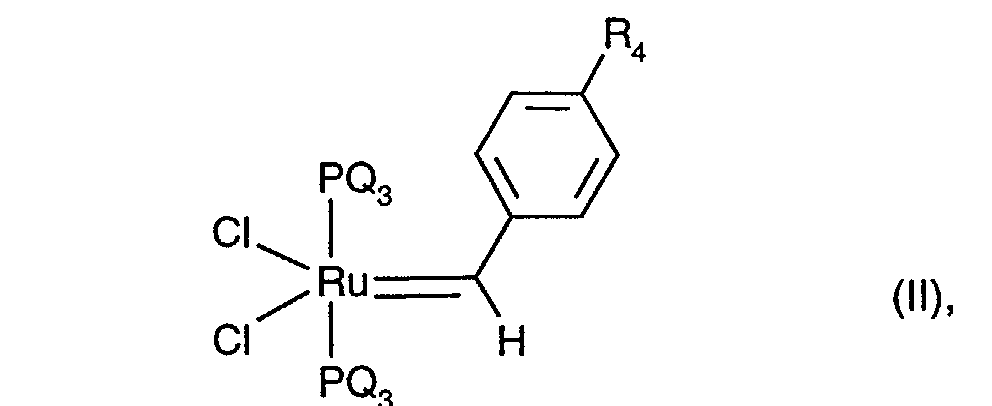
- (b) eine Verbindung der Formel I oder II
(R1R2R3P)xLyRu2+Z1 - Z2 - (I),
- L für unsubstituiertes oder mit 1 bis 3 C1-C4-Alkyl substituiertes Benzol, Thiophen, Benzonitril, Acetonitril, Stickstoff (N2), einen unsubstituierten oder teilweise oder vollständig fluorierten C1-C4-Alkohol, CO, H2O oder NH3 steht,
- Z1 - und Z2 - unabhängig voneinander für H-, Cl-, Br-, BF4 -, PF6 -, SbF6 -, AsF6 -, CF3SO3 -, C6H5-SO3 -, p-Toluolsulfonat (Tosylat), 3,5-Dimethylphenylsulfonat, 2,4,6-Trimethylphenylsulfonat, 4-Trifluormethylphenylsulfonat oder Cyclopentadienyl stehen,
- x eine Zahl von 1 bis 3 und y eine Zahl von 0 bis 3 darstellen, wobei gilt 2 ≤ x+y ≤ 4,
- Q für Phenyl, Cyclopentyl oder Cyclohexyl steht und R4 Wasserstoff, Chlor oder tert.-Butyl bedeutet,
Description
- Die vorliegende Erfindung betrifft ein Verfahren zur Herstellung von faserverstärkten Verbundstoffen, die nach diesem Verfahren hergestellten Verbundstoffe sowie die Verwendung dieser Verbundstoffe im Automobil-, Flugzeug- oder Sportgerätebau.
- Cycloolefine, die mittels ringöffnender Metathese-Polymerisation (ROMP) polymerisiert werden können, sollten aufgrund ihres Eigenschaftsprofils als Imprägnierharze zur Herstellung von faserverstärkten Verbundstoffen geeignet sein.
In der EP-A-424 833 wird ein Verfahren zum Beschichten oder Imprägnieren von Substraten mit Polycycloolefinen mittels des RIM-Prozesses (reaction injection molding) beschrieben. Dabei wird ein Zwei-Komponenten-System aus einem Katalysator und einem Co-Katalysator für die ringöffnende Metathese-Polymerisation verwendet. Das Gewebe wird zunächst mit dem ROMP-Katalysator beschichtet und in eine Form gebracht. Anschliessend wird das Cycloolefin mit dem Cokatalysator gemischt und diese Mischung in die erwärmte Form eingelassen. In einer exothermen Reaktion polymerisiert das Cycloolefin daraufhin in sehr kurzer Zeit. - Dieses Verfahren ist jedoch wegen der separaten Beschichtung des Gewebes mit dem Katalysator relativ aufwendig. Die Verwendung von Alkylaluminiumchloriden als Cokatalysator erfordert ausserdem den Ausschluss von Feuchtigkeit.
- Es wurde nun gefunden, dass ein Gemisch aus einem Cycloolefin und spezifischen Ruthenium-Katalysatoren zur Imprägnierung von Fasern im RIM-Prozess geeignet ist.
- Gegenstand der vorliegenden Erfindung ist ein Verfahren zur Herstellung von faserverstärkten Verbundstoffen, dadurch gekennzeichnet, dass ein Gewebe in das Unterteil einer offenen zweiteiligen Form gebracht wird, die Form geschlossen wird und ein Reaktionsharzgemisch enthaltend
- (a) ein gespanntes Cycloolefin und
- (b) eine Verbindung der Formel I oder II
(R1R2R3P)xLyRu2+Z1 -Z2 - (I),

- R1, R2 und R3 unabhängig voneinander Phenyl, Tolyl oder Cyclohexyl bedeuten,
- L für unsubstituiertes oder mit 1 bis 3 C1-C4-Alkyl substituiertes Benzol, Thiophen, Benzonitril, Acetonitril, Stickstoff (N2), einen unsubstituierten oder teilweise oder vollständig fluorierten C1-C4-Alkohol, CO, H2O oder NH3 steht,
- Z1 - und Z2 - unabhängig voneinander für H-, Cl-, Br-, BF4 -, PF6 -, SbF6 -, AsF6 -, CF3SO3 -, C6H5-SO3 -, p-Toluolsulfonat (Tosylat), 3,5-Dimethylphenylsulfonat, 2,4,6-Trimethylphenylsulfonat, 4-Trifluormethylphenylsulfonat oder Cyclopentadienyl stehen,
- x eine Zahl von 1 bis 3 und y eine Zahl von 0 bis 3 darstellen, wobei gilt 2 ≤ x+y ≤ 4,
- Q für Phenyl, Cyclopentyl oder Cyclohexyl steht und R4 Wasserstoff, Chlor oder tert.-Butyl bedeutet,
- Das Einspritzen eines Reaktionsharzes in eine Form ist dem Fachmann unter den Begriffen RIM (reaction injection molding) bzw. S-RIM (structural reaction injection molding) oder auch als RTM (resin transfer molding) bekannt. Das Harz kann dabei mit Überdruck (zweckmässig bis ca. 10 bar) in die unter Normaldruck stehende Form gepumpt werden. Es ist aber auch möglich, die Form zu evakuieren und dann über ein Ventil die Verbindung zu dem unter Normaldruck oder Überdruck stehenden Harzreservoir herzustellen. Die Form kann sowohl bei Raumtemperatur als auch bei höheren Temperaturen (bis zur Härtungstemperatur) befüllt werden. Es ist jedoch zweckmässig, vor allem bei der industriellen Anwendung, dass die Imprägnierung des Gewebes und die nachfolgende Aushärtung bei derselben Temperatur erfolgen; d.h. vorzugsweise wird die Form bereits vor der Imprägnierung auf die Härtungstemperatur erwärmt.
Nach der vollständigen Imprägnierung des Gewebes wird die Form erwärmt, vorzugsweise auf 40-300 °C, insbesondere 60-200 °C, bis zur vollständigen Härtung des Harzes. - Mit dem erfindungsgemässen Verfahren können alle gebräuchlichen Fasern imprägniert werden. Vorzugsweise werden Glasfasern, Kohlefasern oder Aramidfasern (z.B. Kevlar®) verwendet.
- Unter gespannten Cycloolefinen sind im Rahmen der vorliegenden Erfindung alle Cycloolefine mit Ausnahme des Cyclohexens und seiner Derivate, die nicht mit der ringöffnenden Metathese polymerisiert werden können, zu verstehen. Beispiele für gespannte Cycloolefine sind u.a. in der WO 96/16100 und der WO 96/20235 beschrieben.
- Vorzugsweise wird als Komponente (a) ein Diels-Alder-Addukt von Cyclopentadien eingesetzt, wie z.B. eine Verbindung der Formel III

- Geeignete Diels-Alder-Addukte sind beispielsweise die folgenden Verbindungen:


- Bevorzugte Diels-Alder-Addukte sind Tetracyclododecen (14), Methyltetracyclododecen (11) und insbesondere Dicyclopentadien (18).
- Die als Komponente (b) zu verwendeten ROMP-Katalysatoren sind in WO 96/16100, WO 96/20235 und WO 93/20111 beschrieben.
- Besonders bevorzugte ROMP-Katalysatoren sind [(Cyclohexyl)3P]2RuCl2, [(C6H5)3P]3 RuCl2, [(C6H5)3P]3 (CO)RuH2, [(C6H5)3P]3 RuCl(Cyclopentadienyl), [(Cyclohexyl)3P]2(CH3OH)Ru(Tosylat)2, [(o-Tolyl)3P]3RuCl2, [(CH3)2CH]3P(p-Cymol)RuCl2 und insbesondere (Cyclohexyl)3P(p-Cymol)RuCl2.
- Die Mengen der Komponenten (a) und (b) können in den erfindungsgemässen Zusammensetzungen in weiten Bereichen variieren.
Vorzugsweise enthalten die erfindungsgemässen Zusammensetzungen, bezogen auf die Gesamtzusammensetzung, 90,0-99,999 Gew.-%, insbesondere 98,0-99,99 Gew.-%, der Komponente (a) und 0,001-10,0 Gew.-%, insbesondere 0,01-2,0 Gew.-%, der Komponente (b). - Die gewünschte Viskosität des härtbaren Gemisches kann durch Zusatz von thermoplastischen Materialien eingestellt werden. Beispiele für geeignete Thermoplasten sind Polystyrol, Polynorbornen (z.B. Norsorex® NS der Fa. Nippon Zeon), hydrierte Polynorbornenderivate (z.B. Zeonex® der Fa. Nippon Zeon), Polycycloocten (z.B. Vestenamer® der Fa. Hüls) und Polybutadien.
- Weiterhin können die härtbaren Mischungen Zähigkeitsvermittler ("Toughener") enthalten, wie zum Beispiel Core/Shell-Polymere oder die dem Fachmann als "Rubber Toughener" bekannten Elastomere oder Elastomere enthaltende Pfropfpolymere.
Geeignete Zähigkeitsvermittler sind beispielsweise in der EP-A-449 776 beschrieben. - Zur Verbesserung der elektrischen Eigenschaften (Dielektrizitätskonstante, Verlustfaktor) können den härtbaren Mischungen Silane, wie z.B. die von der Fa. Osi Specialties unter der Bezeichnung Silquest® Silan angebotenen Verbindungen, zugesetzt werden. Geeignete Silane sind beispielsweise Octyltriethoxysilan, Methyltriethoxysilan, Vinyltriethoxysilan, Methyltrimethoxysilan, Vinyltrimethoxysilan, γ-Aminopropyltrimethoxysilan und γ-Glycidyloxypropyltrimethoxysilan.
- Neben den oben erwähnten Additiven können die erfindungsgemässen Zusammensetzungen weitere übliche Zusatzstoffe enthalten, wie z.B. Antioxidantien, Lichtschutzmittel, Weichmacher, Farbstoffe, Füllstoffe, Pigmente, Thixotropiemittel, Entschäumer, Antistatika, Gleitmittel und Entformungshilfsmitrel.
- Die als Komponente (b) zu verwendenden ROMP-Katalysatoren sind feuchtigkeitsunempfindlich. Bei dem erfindungsgemässen Verfahren muss daher nicht notwendigerweise unter Feuchtigkeitsausschluss gearbeitet werden. Auch die in der EP-A-424 833 beschriebene separate Beschichtung des Gewebes mit dem Katalysator ist nicht erforderlich.
- Mit dem erfindungsgemässen Verfahren wird eine sehr gleichmässige Imprägnierung erzielt.
Durch die Wahl des Katalalysators und dessen Menge lässt sich die gewünschte Latenz der Reaktionsmischung einstellen. Eine hohe Latenz bedeutet eine hohe Stabilität bei der jeweiligen Lagertemperatur, ohne dass die Reaktivität bei der gewünschten Härtungstemperatur wesentlich reduziert wird. - Die nach dem erfindungsgemässen Verfahren hergestellten faserverstärkten Verbundstoffe zeichnen sich vor allem durch eine hohe Wärmestabilität, hohe Zähigkeit und mechanische Festigkeit aus und eignen sich besonders zur Herstellung von Werkzeugen oder Formteilen für den Automobil-, Flugzeug- oder Sportgerätebau.
- Die nach dem erfindungsgemässen Verfahren hergestellten faserverstärkten Verbundstoffe sowie deren Verwendung zur Herstellung von Werkzeugen oder Formteilen für den Automobil-, Flugzeug- oder Sportgerätebau bilden daher einen weiteren Erfindungsgegenstand.
- 1,5 g Norsorex® NS (thermoplastisches Polynorbornen der Firma Nippon Zeon) wird bei 80 °C in 97,4 g Dicyclopentadien gelöst. Nach Abkühlen auf 60 °C wird die Mischung 10 min unter Vakuum (3 mbar) entgast. Anschliessend werden 0,5 g Vinyltrimethoxysilan (Silquest® A-171 der Firma Osi Specialties) und 0,3 g Byk 066 (Entschäumer der Firma Byk Chemie) hinzugegeben. Nach Abkühlen auf Raumtemperatur wird 0,3 g (Cyclohexyl)3P(p-Cymol)RuCl2 zugefügt. Die Mischung wird auf 60 °C erwärmt und ca. 20 min bei dieser Temperatur gerührt bis zur vollständigen Auflösung des Katalysators. Das Gemisch wird dann noch einmal 10 min unter Vakuum (3 mbar) entgast. Nach Abkühlen auf Raumtemperatur ist die Mischung gebrauchsfertig für den RTM-Prozess.
- Für den RTM-Prozess wird eine zweiteilige Stahlform mit einem Innenraum der Abmessungen 25 cm.25 cm.0,3 cm verwendet. Der untere Teil der Form besitzt seitlich am Boden eine Öffnung mit einem Durchmesser von 3 mm, die durch einen Kanal mit dem Harzbehälter verbunden ist. Zwischen dem Harzbehälter und der Form ist ein Ventil eingebaut. Eine zweite Öffnung mit einem Durchmesser von 3 mm in der Mitte des oberen Teils der Form ist mit einer Vakuumpumpe verbunden.
Mehrere Lagen Glasfasergewebe werden zugeschnitten und in die Form gelegt. Bei Raumtemperatur wird die Form auf 10 mbar evakuiert. Durch Öffnen des Ventils wird das Reaktionsharzgemisch in die Form transferiert. Dabei fliesst das Harz gleichmässig vom Rand zur Mitte der Form. Die Fliessgeschwindigkeit lässt sich durch die Stellung des Ventils oder durch die Höhe des Drucks in der Form regulieren. Um eine gute Imprägnierung des Gewebes zu erhalten, sollte die Füllzeit 1-3 min betragen. - Anschliessend wird die Form auf 95 °C erwärmt. Nach 4-5 h kann das angehärtete Material aus der Form genommen und im Ofen nachgehärtet werden.
Claims (7)
- Verfahren zur Herstellung von faserverstärkten Verbundstoffen, dadurch gekennzeichnet, dass ein Gewebe in den Unterteil einer offenen zweiteiligen Form gebracht wird, die Form geschlossen wird und ein Reaktionsharzgemisch enthaltend(a) ein gespanntes Cycloolefin und(b) eine Verbindung der Formel I oder IIunter Druck in die Form eingespritzt und gehärtet wird.
(R1R2R3P)xLyRu2+Z1 -Z2 - (I),
 R1, R2 und R3 unabhängig voneinander Phenyl, Tolyl oder Cyclohexyl bedeuten,L für unsubstituiertes oder mit 1 bis 3 C1-C4-Alkyl substituiertes Benzol, Thiophen, Benzonitril, Acetonitril, Stickstoff (N2), einen unsubstituierten oder teilweise oder vollständig fluorierten C1-C4-Alkohol, CO, H2O oder NH3 steht,Z1 - und Z2 - unabhängig voneinander für H-, Cl-, Br-, BF4 -, PF6 -, SbF6 -, AsF6 -, CF3SO3 -, C6H5-SO3 -, p-Toluolsulfonat (Tosylat), 3,5-Dimethylphenylsulfonat, 2,4,6-Trimethylphenylsulfonat, 4-Trifluormethylphenylsulfonat oder Cyclopentadienyl stehen,x eine Zahl von 1 bis 3 und y eine Zahl von 0 bis 3 darstellen, wobei gilt 2 ≤ x+y ≤ 4,Q für Phenyl, Cyclopentyl oder Cyclohexyl steht und R4 Wasserstoff, Chlor oder tert.-Butyl bedeutet,
 - Verfahren nach Anspruch 1, dadurch gekennzeichnet, dass das Gewebe Glasfasern, Kohlefasern oder Aramidfasern enthält.
- Verfahren nach Anspruch 1, dadurch gekennzeichnet, dass das Reaktionsharzgemisch als Komponente (a) ein Diels-Alder-Addukt von Cyclopentadien enthält.
- Verfahren nach Anspruch 1, dadurch gekennzeichnet, dass das Reaktionsharzgemisch als Komponente (a) Dicyclopentadien enthält.
- Verfahren nach Anspruch 1, dadurch gekennzeichnet, dass das Reaktionsharzgemisch als Komponente (b) (1-Methyl-4-isopropylbenzol)RuCl2P(Cyclohexyl)3.enthält.
- Faserverstärkter Verbundstoff erhältlich nach dem Verfahren nach Anspruch 1.
- Verwendung von faserverstärkten Verbundstoffen nach Anspruch 6 zur Herstellung von Werkzeugen oder Formteilen für den Automobil-, Flugzeug- oder Sportgerätebau.
Applications Claiming Priority (3)
| Application Number | Priority Date | Filing Date | Title |
|---|---|---|---|
| CH122796 | 1996-05-14 | ||
| CH122796 | 1996-05-14 | ||
| CH1227/96 | 1996-05-14 |
Publications (3)
| Publication Number | Publication Date |
|---|---|
| EP0807652A2 true EP0807652A2 (de) | 1997-11-19 |
| EP0807652A3 EP0807652A3 (de) | 1998-04-15 |
| EP0807652B1 EP0807652B1 (de) | 2001-11-14 |
Family
ID=4205473
Family Applications (1)
| Application Number | Title | Priority Date | Filing Date |
|---|---|---|---|
| EP97810284A Expired - Lifetime EP0807652B1 (de) | 1996-05-14 | 1997-05-06 | Verfahren zur Herstellung von faserverstärkten Verbundstoffen |
Country Status (7)
| Country | Link |
|---|---|
| US (1) | US5840238A (de) |
| EP (1) | EP0807652B1 (de) |
| JP (1) | JPH1080933A (de) |
| BR (1) | BR9703155A (de) |
| CA (1) | CA2205217C (de) |
| DE (1) | DE59705333D1 (de) |
| ES (1) | ES2166059T3 (de) |
Cited By (1)
| Publication number | Priority date | Publication date | Assignee | Title |
|---|---|---|---|---|
| EP0879251A4 (de) * | 1996-02-08 | 2000-05-31 | Advanced Polymer Technologies | Polymerisation von dpcd monomeren geringer qualität unter verwendung eines metathese katalysators |
Families Citing this family (41)
| Publication number | Priority date | Publication date | Assignee | Title |
|---|---|---|---|---|
| US7285593B1 (en) | 1998-05-19 | 2007-10-23 | Advanced Polymer Technologies, Inc. | Polyolefin compositions optionally having variable toughness and/or hardness |
| US20020015519A1 (en) * | 1998-12-11 | 2002-02-07 | Lord Corporation | Fiber substrate adhesion and coatings by contact metathesis polymerization |
| EP1196455B1 (de) | 1999-02-05 | 2008-01-16 | Materia, Inc. | Metathese-aktive adhäsionsagenzien und verfahren zur vergrösserung der adhäsion von polymeren an oberflächen |
| EP1165630A4 (de) | 1999-02-05 | 2004-07-07 | Materia Inc | Polyolefinmischungen mit variabler dichte, verfahren zur herstellung und ihre verwendung |
| US20140088260A1 (en) | 1999-02-05 | 2014-03-27 | Materia, Inc. | Metathesis-active adhesion agents and methods for enhancing polymer adhesion to surfaces |
| ATE268221T1 (de) * | 1999-04-21 | 2004-06-15 | Degussa | Homogene polymerkatalysatoren |
| US7329758B1 (en) | 1999-05-24 | 2008-02-12 | California Institute Of Technology | Imidazolidine-based metal carbene metathesis catalysts |
| US6436476B1 (en) | 2000-02-14 | 2002-08-20 | Owens Corning Fiberglas Technology, Inc. | Polyolefin fiber-reinforced composites using a fiber coating composition compatible with romp catalysts |
| US6518330B2 (en) | 2001-02-13 | 2003-02-11 | Board Of Trustees Of University Of Illinois | Multifunctional autonomically healing composite material |
| US6750272B2 (en) | 2001-06-25 | 2004-06-15 | Board Of Trustees Of University Of Illinois | Catalyzed reinforced polymer composites |
| US7138028B2 (en) * | 2001-07-26 | 2006-11-21 | The Boeing Company | Vacuum assisted resin transfer method for co-bonding composite laminate structures |
| US20030019567A1 (en) * | 2001-07-26 | 2003-01-30 | Burpo Steven J. | Vacuum assisted resin transfer method for co-bonding composite laminate structures |
| CA2458904C (en) * | 2001-08-30 | 2012-07-17 | Materia, Inc. | Infusion of cyclic olefin resins into porous materials |
| WO2004069895A1 (ja) * | 2003-01-31 | 2004-08-19 | Zeon Corporation | 環状オレフィン系樹脂フィルムの製造方法、および環状オレフィン系ポリマーシートまたはフィルムの製造方法 |
| US7566747B2 (en) * | 2004-05-07 | 2009-07-28 | The Board Of Trustees Of The University Of Illinois | Wax particles for protection of activators, and multifunctional autonomically healing composite materials |
| US7612152B2 (en) * | 2005-05-06 | 2009-11-03 | The Board Of Trustees Of The University Of Illinois | Self-healing polymers |
| US7723405B2 (en) | 2006-01-05 | 2010-05-25 | The Board Of Trustees Of The University Of Illinois | Self-healing coating system |
| US7569625B2 (en) * | 2006-06-02 | 2009-08-04 | The Board Of Trustees Of The University Of Illinois | Self-healing elastomer system |
| US20080299391A1 (en) * | 2007-05-31 | 2008-12-04 | White Scott R | Capsules, methods for making capsules, and self-healing composites including the same |
| US7994238B2 (en) * | 2007-09-04 | 2011-08-09 | General Electric Company | Article and associated method |
| US7906568B2 (en) * | 2007-09-04 | 2011-03-15 | General Electric Company | Coupling agent composition and associated method |
| US8039543B2 (en) * | 2007-09-04 | 2011-10-18 | General Electric Company | Composition comprising a coupling agent and a cycloolefin, the coupling agent comprising a reaction product of an epoxy-substituted cycloolefin and an aromatic amine |
| US8039544B2 (en) * | 2007-09-04 | 2011-10-18 | General Electric Company | Coupling agent comprising a reaction product of an epoxy-substituted cycloolefin and an aromatic amine |
| WO2009059209A2 (en) * | 2007-10-31 | 2009-05-07 | Movado Llc | Integrated watchband and methods therefor |
| US7902279B2 (en) * | 2007-12-04 | 2011-03-08 | General Electric Company | Composition, article, and associated method |
| US7879963B2 (en) * | 2007-12-18 | 2011-02-01 | General Electric Company | Composition, article, and associated method |
| US20090181254A1 (en) * | 2008-01-15 | 2009-07-16 | The Board Of Trustees Of The University Of Illinois | Multi-capsule system and its use for encapsulating active agents |
| EP2608949B1 (de) | 2010-08-23 | 2023-03-29 | Materia, Inc. | Vartm-flussänderungen für harzsysteme mit niedriger viskosität |
| US8227371B2 (en) | 2010-09-24 | 2012-07-24 | Exxonmobil Chemical Patents Inc. | Class of olefin metathesis catalysts, methods of preparation, and processes for the use thereof |
| JP2012121956A (ja) * | 2010-12-07 | 2012-06-28 | Sumitomo Bakelite Co Ltd | 付加型ノルボルネン系樹脂、その製造方法、該樹脂を含む樹脂組成物、ならびに該樹脂を含む成形体および該成形体を含む複合部材 |
| US8900671B2 (en) | 2011-02-28 | 2014-12-02 | General Electric Company | Method for manufacture of an infused spar cap using a low viscosity matrix material |
| IN2014DN00290A (de) | 2011-06-17 | 2015-06-05 | Materia Inc | |
| US9181360B2 (en) | 2011-08-12 | 2015-11-10 | Exxonmobil Chemical Patents Inc. | Polymers prepared by ring opening / cross metathesis |
| US20150152283A1 (en) | 2012-06-12 | 2015-06-04 | Materia, Inc. | Method and composition for improving adhesion of metathesis compositions to substrates |
| US9527982B2 (en) | 2012-12-19 | 2016-12-27 | Materia, Inc. | Storage stable adhesion promoter compositions for cyclic olefin resin compositions |
| US9598531B2 (en) | 2013-02-27 | 2017-03-21 | Materia, Inc. | Olefin metathesis catalyst compositions comprising at least two metal carbene olefin metathesis catalysts |
| US10633484B2 (en) | 2014-01-10 | 2020-04-28 | Materia, Inc. | Method and composition for improving adhesion of metathesis compositions to substrates |
| WO2015130802A1 (en) | 2014-02-27 | 2015-09-03 | Materia, Inc. | Adhesion promoter compositions for cyclic olefin resin compositions |
| CN107207679A (zh) | 2015-02-12 | 2017-09-26 | 马特里亚公司 | 包含官能弹性体的环烯烃树脂组合物 |
| US10487446B2 (en) | 2016-03-18 | 2019-11-26 | The Board Of Trustees Of The University Of Illinois | Frontal polymerization for fiber-reinforced composites |
| CN113400683A (zh) * | 2021-06-23 | 2021-09-17 | 张玉清 | 一种双环戊二烯组合料制备纤维织物增强聚双环戊二烯复合材料的方法及装置 |
Family Cites Families (10)
| Publication number | Priority date | Publication date | Assignee | Title |
|---|---|---|---|---|
| US5096644A (en) * | 1988-06-27 | 1992-03-17 | Hercules Incorporated | Process for making a filled metathesis polymer article |
| JPH0229308A (ja) * | 1988-07-19 | 1990-01-31 | Nippon Zeon Co Ltd | 反応射出成形方法 |
| US4883851A (en) * | 1988-07-25 | 1989-11-28 | California Institute Of Technology | Ring opening metathesis polymerization of strained cyclic ethers |
| CA2028239A1 (en) * | 1989-10-24 | 1991-04-25 | Brian L. Goodall | Coated reinforcing material |
| EP0513380B2 (de) * | 1990-11-30 | 2011-02-23 | Idemitsu Kosan Company Limited | Verfahren zur herstellung von olefinpolymeren |
| JP3082354B2 (ja) * | 1991-09-27 | 2000-08-28 | 日本ゼオン株式会社 | メタセシス共触媒、それを含む触媒系およびシクロオレフィンの重合方法 |
| US5198511A (en) * | 1991-12-20 | 1993-03-30 | Minnesota Mining And Manufacturing Company | Polymerizable compositions containing olefin metathesis catalysts and cocatalysts, and methods of use therefor |
| US5312940A (en) * | 1992-04-03 | 1994-05-17 | California Institute Of Technology | Ruthenium and osmium metal carbene complexes for olefin metathesis polymerization |
| EP0792305A1 (de) * | 1994-11-17 | 1997-09-03 | Ciba SC Holding AG | Thermisches metathesepolymerisationsverfahren und polymerisierbare zusammensetzung |
| US6235856B1 (en) * | 1994-12-23 | 2001-05-22 | Ciba Specialty Chemicals Corporation | Polymerization of dicyclopentadiene |
-
1997
- 1997-05-06 ES ES97810284T patent/ES2166059T3/es not_active Expired - Lifetime
- 1997-05-06 EP EP97810284A patent/EP0807652B1/de not_active Expired - Lifetime
- 1997-05-06 DE DE59705333T patent/DE59705333D1/de not_active Expired - Fee Related
- 1997-05-12 CA CA002205217A patent/CA2205217C/en not_active Expired - Fee Related
- 1997-05-13 US US08/856,620 patent/US5840238A/en not_active Expired - Lifetime
- 1997-05-14 BR BR9703155A patent/BR9703155A/pt not_active IP Right Cessation
- 1997-05-14 JP JP9139242A patent/JPH1080933A/ja not_active Withdrawn
Cited By (1)
| Publication number | Priority date | Publication date | Assignee | Title |
|---|---|---|---|---|
| EP0879251A4 (de) * | 1996-02-08 | 2000-05-31 | Advanced Polymer Technologies | Polymerisation von dpcd monomeren geringer qualität unter verwendung eines metathese katalysators |
Also Published As
| Publication number | Publication date |
|---|---|
| CA2205217A1 (en) | 1997-11-14 |
| US5840238A (en) | 1998-11-24 |
| DE59705333D1 (de) | 2001-12-20 |
| BR9703155A (pt) | 1998-09-08 |
| JPH1080933A (ja) | 1998-03-31 |
| EP0807652A3 (de) | 1998-04-15 |
| EP0807652B1 (de) | 2001-11-14 |
| ES2166059T3 (es) | 2002-04-01 |
| CA2205217C (en) | 2003-12-16 |
Similar Documents
| Publication | Publication Date | Title |
|---|---|---|
| EP0807652B1 (de) | Verfahren zur Herstellung von faserverstärkten Verbundstoffen | |
| EP0771830B1 (de) | Härtbare Zusammensetzung enthaltend Cycloolefin, Silan und Füllstoff | |
| EP0799266B1 (de) | Polymerisierbare zusammensetzung und polymerisationsverfahren | |
| EP0794207B1 (de) | Härtbare Zusammensetzung enthaltend ein Diels-Alder-Addukt von Cyclopentadien und einen Füllstoff | |
| US6040363A (en) | Metathesis polymerizered olefin composites including sized reinforcement material | |
| DE69317369T2 (de) | Einstückig geformter Gegenstand aus Polycarbonat und Siliconkautschuk und dessen Herstellungsverfahren | |
| DE60022322T2 (de) | Polyolefinzusammensetzungen mit verbesserter uv- und oxidationsbeständigkeit und verfahren zu deren herstellung sowie verwendung | |
| DE69334059T2 (de) | Klebende Silikonkautschukzusammensetzungen, Verfahren zu deren Herstellung und deren Anwendung | |
| DE69223366T2 (de) | Silizium-enthaltende Polymere | |
| EP0792305A1 (de) | Thermisches metathesepolymerisationsverfahren und polymerisierbare zusammensetzung | |
| EP0885911A1 (de) | 2-Komponenten-Katalysator für ROMP | |
| DE1720663A1 (de) | Verfahren zur Herstellung von Kunststoffen | |
| DE69907765T2 (de) | Harzzusammensetzung zur Verwendung in Dichtmittel und flüssiges Dichtmittel verwendend die Harzzusammensetzung | |
| EP0200674A1 (de) | (Acylthiopropyl)-Polyphenole | |
| US20020172787A1 (en) | Pipe made from metathesis polymerized olefins | |
| EP0844264B1 (de) | Katalysatorgemisch für ringöffnende Metathesepolymerisation | |
| DE3021376A1 (de) | Verfahren zum herstellen eines formteils aus kationisch polymerisierbarem organischem material | |
| EP3692088B1 (de) | Latente katalysatoren mit chelatliganden zur polymerisation von dicyclopentadien (dcpd) | |
| DE2052856A1 (de) | Verfahren zum Polymerisieren ungesättigter alicyclischer Verbindungen | |
| US10501488B2 (en) | Metal carbene olefin metathesis catalysts | |
| EP0824125A1 (de) | Umhüllungsmassen auf Basis von Dicyclopentadienderivaten | |
| DE19625563A1 (de) | Hitzehärtbare, elastomere Zusammensetzungen | |
| EP3947547A1 (de) | Kautschukzusammensetzungen mit polyorganosiloxanen als weichmacher | |
| DE2166867B2 (de) | Verfahren zur herstellung von polymeren kohlenwasserstoffen mit reaktiven silylendgruppen | |
| EP0799284B1 (de) | Polymerisierbare zusammensetzung mit acetylenen und verfahren zur photopolymerisation von acetylenen |
Legal Events
| Date | Code | Title | Description |
|---|---|---|---|
| PUAI | Public reference made under article 153(3) epc to a published international application that has entered the european phase |
Free format text: ORIGINAL CODE: 0009012 |
|
| AK | Designated contracting states |
Kind code of ref document: A2 Designated state(s): BE CH DE ES FR GB IT LI NL SE |
|
| PUAL | Search report despatched |
Free format text: ORIGINAL CODE: 0009013 |
|
| AK | Designated contracting states |
Kind code of ref document: A3 Designated state(s): BE CH DE ES FR GB IT LI NL SE |
|
| 17P | Request for examination filed |
Effective date: 19980914 |
|
| 17Q | First examination report despatched |
Effective date: 20000218 |
|
| GRAG | Despatch of communication of intention to grant |
Free format text: ORIGINAL CODE: EPIDOS AGRA |
|
| GRAG | Despatch of communication of intention to grant |
Free format text: ORIGINAL CODE: EPIDOS AGRA |
|
| GRAH | Despatch of communication of intention to grant a patent |
Free format text: ORIGINAL CODE: EPIDOS IGRA |
|
| GRAH | Despatch of communication of intention to grant a patent |
Free format text: ORIGINAL CODE: EPIDOS IGRA |
|
| GRAA | (expected) grant |
Free format text: ORIGINAL CODE: 0009210 |
|
| AK | Designated contracting states |
Kind code of ref document: B1 Designated state(s): BE CH DE ES FR GB IT LI NL SE |
|
| REG | Reference to a national code |
Ref country code: CH Ref legal event code: EP |
|
| GBT | Gb: translation of ep patent filed (gb section 77(6)(a)/1977) |
Effective date: 20011114 |
|
| REF | Corresponds to: |
Ref document number: 59705333 Country of ref document: DE Date of ref document: 20011220 |
|
| REG | Reference to a national code |
Ref country code: GB Ref legal event code: IF02 |
|
| REG | Reference to a national code |
Ref country code: ES Ref legal event code: FG2A Ref document number: 2166059 Country of ref document: ES Kind code of ref document: T3 |
|
| PLBE | No opposition filed within time limit |
Free format text: ORIGINAL CODE: 0009261 |
|
| STAA | Information on the status of an ep patent application or granted ep patent |
Free format text: STATUS: NO OPPOSITION FILED WITHIN TIME LIMIT |
|
| 26N | No opposition filed | ||
| PGFP | Annual fee paid to national office [announced via postgrant information from national office to epo] |
Ref country code: NL Payment date: 20040423 Year of fee payment: 8 |
|
| PGFP | Annual fee paid to national office [announced via postgrant information from national office to epo] |
Ref country code: GB Payment date: 20040429 Year of fee payment: 8 |
|
| PGFP | Annual fee paid to national office [announced via postgrant information from national office to epo] |
Ref country code: SE Payment date: 20040503 Year of fee payment: 8 |
|
| PGFP | Annual fee paid to national office [announced via postgrant information from national office to epo] |
Ref country code: ES Payment date: 20040506 Year of fee payment: 8 |
|
| PGFP | Annual fee paid to national office [announced via postgrant information from national office to epo] |
Ref country code: FR Payment date: 20040510 Year of fee payment: 8 |
|
| PGFP | Annual fee paid to national office [announced via postgrant information from national office to epo] |
Ref country code: CH Payment date: 20040512 Year of fee payment: 8 |
|
| PGFP | Annual fee paid to national office [announced via postgrant information from national office to epo] |
Ref country code: DE Payment date: 20040513 Year of fee payment: 8 |
|
| PGFP | Annual fee paid to national office [announced via postgrant information from national office to epo] |
Ref country code: BE Payment date: 20040623 Year of fee payment: 8 |
|
| PG25 | Lapsed in a contracting state [announced via postgrant information from national office to epo] |
Ref country code: IT Free format text: LAPSE BECAUSE OF NON-PAYMENT OF DUE FEES Effective date: 20050506 Ref country code: GB Free format text: LAPSE BECAUSE OF NON-PAYMENT OF DUE FEES Effective date: 20050506 |
|
| PG25 | Lapsed in a contracting state [announced via postgrant information from national office to epo] |
Ref country code: SE Free format text: LAPSE BECAUSE OF NON-PAYMENT OF DUE FEES Effective date: 20050507 Ref country code: ES Free format text: LAPSE BECAUSE OF NON-PAYMENT OF DUE FEES Effective date: 20050507 |
|
| PG25 | Lapsed in a contracting state [announced via postgrant information from national office to epo] |
Ref country code: LI Free format text: LAPSE BECAUSE OF NON-PAYMENT OF DUE FEES Effective date: 20050531 Ref country code: CH Free format text: LAPSE BECAUSE OF NON-PAYMENT OF DUE FEES Effective date: 20050531 Ref country code: BE Free format text: LAPSE BECAUSE OF NON-PAYMENT OF DUE FEES Effective date: 20050531 |
|
| BERE | Be: lapsed |
Owner name: *CIBA SPECIALTY CHEMICALS HOLDING INC. Effective date: 20050531 |
|
| PG25 | Lapsed in a contracting state [announced via postgrant information from national office to epo] |
Ref country code: NL Free format text: LAPSE BECAUSE OF NON-PAYMENT OF DUE FEES Effective date: 20051201 Ref country code: DE Free format text: LAPSE BECAUSE OF NON-PAYMENT OF DUE FEES Effective date: 20051201 |
|
| REG | Reference to a national code |
Ref country code: CH Ref legal event code: PL |
|
| EUG | Se: european patent has lapsed | ||
| GBPC | Gb: european patent ceased through non-payment of renewal fee |
Effective date: 20050506 |
|
| PG25 | Lapsed in a contracting state [announced via postgrant information from national office to epo] |
Ref country code: FR Free format text: LAPSE BECAUSE OF NON-PAYMENT OF DUE FEES Effective date: 20060131 |
|
| NLV4 | Nl: lapsed or anulled due to non-payment of the annual fee |
Effective date: 20051201 |
|
| REG | Reference to a national code |
Ref country code: FR Ref legal event code: ST Effective date: 20060131 |
|
| REG | Reference to a national code |
Ref country code: ES Ref legal event code: FD2A Effective date: 20050507 |
|
| BERE | Be: lapsed |
Owner name: *CIBA SPECIALTY CHEMICALS HOLDING INC. Effective date: 20050531 |