EP0807458A2 - Verfahren zum Verbrennen von Schadstoffen in überkritischem Kohlendioxid - Google Patents
Verfahren zum Verbrennen von Schadstoffen in überkritischem Kohlendioxid Download PDFInfo
- Publication number
- EP0807458A2 EP0807458A2 EP97104767A EP97104767A EP0807458A2 EP 0807458 A2 EP0807458 A2 EP 0807458A2 EP 97104767 A EP97104767 A EP 97104767A EP 97104767 A EP97104767 A EP 97104767A EP 0807458 A2 EP0807458 A2 EP 0807458A2
- Authority
- EP
- European Patent Office
- Prior art keywords
- carbon dioxide
- pollutants
- oxidation
- der
- solution
- Prior art date
- Legal status (The legal status is an assumption and is not a legal conclusion. Google has not performed a legal analysis and makes no representation as to the accuracy of the status listed.)
- Granted
Links
Images

Classifications
-
- B—PERFORMING OPERATIONS; TRANSPORTING
- B01—PHYSICAL OR CHEMICAL PROCESSES OR APPARATUS IN GENERAL
- B01D—SEPARATION
- B01D53/00—Separation of gases or vapours; Recovering vapours of volatile solvents from gases; Chemical or biological purification of waste gases, e.g. engine exhaust gases, smoke, fumes, flue gases, aerosols
- B01D53/34—Chemical or biological purification of waste gases
- B01D53/46—Removing components of defined structure
- B01D53/72—Organic compounds not provided for in groups B01D53/48 - B01D53/70, e.g. hydrocarbons
Definitions
- the invention relates to a method for burning organic pollutants in supercritical carbon dioxide according to the first claim.
- Oxidation in supercritical carbon dioxide is also described in the publication "Oxidation Catalysis in a Supercritical Fluid Medium” by Kerry M. Dooley and F. Carl Knopf in Ind. Eng. Chem. Res. 1987 , 26 , 1910-1916.
- Toluene is brought into contact with air in the presence of redox or acid catalysts and mainly oxidized to benzaldehyde.
- the temperature during the oxidation was kept in the range between 400 and 500 K (127 ° C to 227 ° C); the reaction pressure is 80 atm. With this method, too, complete oxidation of the organic compounds is not achieved.
- the object of the invention is to provide a method by means of which organic pollutants, in particular aromatic compounds, can be completely oxidized in supercritical carbon dioxide without the need for a catalyst.
- the invention is based on the observation that no catalyst is required for the complete oxidation of organic pollutants if the components pollutant, oxygen and supercritical carbon dioxide are brought into contact with a hot body.
- the hot body is preferably kept at a temperature of 200 ° C or more.
- the temperature of the hot body is chosen according to the oxidation resistance of the pollutant. While some aliphatic compounds can already be completely oxidized at temperatures from 200 ° C., for example at 250 ° C., it is expedient for aromatic compounds which are difficult to oxidize, e.g. B. benzene to choose a temperature of 300 ° C or more. However, temperatures above 500 ° C are generally not necessary.
- any body can be considered as a hot body.
- an electrically heatable and controllable heating rod made of a material that cannot be oxidized under the reaction conditions can be used as the hot body.
- the container wall of the reactor in which the oxidation is carried out can be heated entirely or partially from the outside.
- the carbon portion of the pollutant is largely or completely oxidized to carbon dioxide.
- the additional carbon dioxide generated by the oxidation can compensate for losses of supercritical carbon dioxide that can occur in a cycle operation.
- the oxidation of the pollutants takes place more uniformly, in particular without pronounced temperature and pressure peaks, if 1 to 10% by volume of water or hydrogen peroxide is added to the supercritical solution of the pollutant. Therefore, if the supercritical carbon dioxide is circulated, it is it is not necessary to completely remove the water which forms from the oxidation of the hydrogen content of organic pollutants.
- the pressure of the supercritical solvent carbon dioxide only needs to be slightly above the critical pressure during the oxidation on the hot body. Pressures between 70 and 300 bar are therefore advisable. Higher pressures are avoided for cost reasons.
- An important area of application of the method according to the invention is the oxidation of organic pollutants which arise during the regeneration of filters.
- Particular advantages result when filters which have been used for cleaning contaminated soil are regenerated with supercritical carbon dioxide, whereupon the carbon dioxide now loaded with the filtered-out pollutants is treated by the process according to the invention. After the oxidation, parts of the water formed and, if appropriate, the oxidation products of hetero atoms of the pollutant can be separated off, after which the supercritical carbon dioxide is used again for filter regeneration.
- Fig. 1 the experimental plant is shown schematically.
- An organic compound and / or the pollutant is introduced from a container 1 into a preheater 4 via a membrane pump 5.
- the preheater 4 is also fed via a further membrane pump 5 from a container 2 supercritical carbon dioxide and air 3 via a compressor 9.
- the carbon dioxide is cooled before compression so that it becomes pumpable.
- the organic compound and / or the pollutant are dissolved in a mixing head 6 in the supercritical carbon dioxide, which is connected downstream of the preheater 4.
- the solution of the organic compound and / or the pollutant in supercritical carbon dioxide is mixed with the air in a further mixing head 7.
- the further mixing head 7 is located in a fluidized bed sand bath 8 which surrounds a reactor 10. With the fluidized bed sand bath 8, the reactor 10 is heated and its surface temperature is kept constant.
- the test temperature can be set in the range between 250 ° C and 450 ° C.
- the reactor 10 consists of a high pressure pipe made of Inconel with an inner diameter of 2 mm; it is 6 m long. After the oxidation of the organic compound and / or the pollutant, the reaction mixture is cooled in a cooler to initially 17 ° C. and then expanded to normal pressure via a valve 12. After separation into liquid and gas phases, the CO, CO 2 and O 2 content of the gas phase is measured on-line. In addition, 13 gas and liquid samples are taken in a sampling section and subjected to an analysis.
- the device is purged with air before carrying out the tests; then the reactor is immersed in the hot fluidized bed sand bath 8 and brought to the operating pressure. Then the carbon dioxide and finally the organic compound and / or the pollutant is added.
- the organic compound ethanol is often added to carbon dioxide extractions to improve the extractability of certain pollutants. If the oxidation is carried out after the extraction of the pollutant, it may be necessary to burn larger amounts of ethanol in addition to smaller amounts of pollutant. For this reason, ethanol is a suitable model substance for the oxidation of organic compounds, especially pollutants, in carbon dioxide.
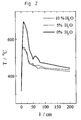
- the reactor temperature is plotted against the reactor length for ethanol with 10 vol.% And 5 vol.% Water and for pure ethanol.
- the oxidation of ethanol takes place at the beginning of the reactor. It was found that the addition of about 5 to 10% by volume of water to the ethanol lower the temperature formed by the exothermic reaction and ensure a quieter, easily controlled reaction. By adding water, the temperature peak at the beginning of the reactor, which is formed with pure ethanol, is largely avoided. Based on the remaining TOC content (TOC: Total Organic Carbon), sales are> 99.9%.
- the results shown in Fig. 2 were obtained with a sand bath temperature of 450 ° C, an air flow of 450 l / h, a carbon dioxide flow of 350 g / h and an ethanol flow of 36 g / h.
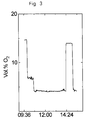
- the oxygen content in the reactor is plotted against time, the sand bath temperature being varied.
- the oxidation of ethanol starts at a sand bath temperature of 330 ° C and then persists even when the temperature is reduced to 275 ° C, with practically complete oxidation to carbon dioxide in this temperature range and water is achieved. If the sand bath temperature drops below 275 ° C, the reaction goes out, which can be seen from the abruptly increasing oxygen content. The reaction starts again at 330 ° C.
- the experiment was carried out at 350 g carbon dioxide / h, 35 g ethanol / h and 450 l air / h.
- Toluene is more difficult to oxidize than ethanol and is a model compound for aromatic pollutants. Toluene burns with similarly good conversions as ethanol, but tends to form soot at higher reactor temperatures. Toluene also burns with intense heat, which leads to a local temperature increase in the reaction zone.
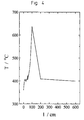
- Fig. 4 shows an example of the heat development.
- the reactor temperature is plotted against the length of the reactor. The highest temperature is between 0 and 200 cm.
- the sand bath temperature was 400 ° C, the air flow 720 l / h, the flow of carbon dioxide 500 g / h and the toluene flow 35 g / h.
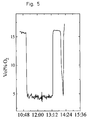
- the oxygen content in the reactor is plotted against time at changing sand bath temperatures.
- the oxidation ignites from a sand bath temperature of 370 ° C.
- the oxidation extinguishes when the sand bath temperature is lowered below 308 ° C.
- the oxygen content in the reactor rises again.
- the oxidation of the toluene was either complete or did not take place.
Landscapes
- Chemical & Material Sciences (AREA)
- Engineering & Computer Science (AREA)
- Chemical Kinetics & Catalysis (AREA)
- Environmental & Geological Engineering (AREA)
- Biomedical Technology (AREA)
- Analytical Chemistry (AREA)
- General Chemical & Material Sciences (AREA)
- Oil, Petroleum & Natural Gas (AREA)
- Health & Medical Sciences (AREA)
- Organic Low-Molecular-Weight Compounds And Preparation Thereof (AREA)
- Carbon And Carbon Compounds (AREA)
- Treating Waste Gases (AREA)
- Physical Or Chemical Processes And Apparatus (AREA)
- Treatment Of Water By Oxidation Or Reduction (AREA)
- Catalysts (AREA)
- Exhaust Gas Treatment By Means Of Catalyst (AREA)
Abstract
- a) eine Lösung der Schadstoffe in überkritischem Kohlendioxid herstellt,
- b) in der im überkritischen Zustand vorliegenden Lösung eine zur vollständigen Oxidation der Schadstoffe ausreichende Menge an Sauerstoff löst,
- c) die Lösung mit einem heißen Körper in Kontakt bringt, der eine solche Temperatur aufweist, daß der Kohlenstoffanteil der Schadstoffe durch den Sauerstoff zu Kohlendioxid oxidiert wird.
Description
- Die Erfindung betrifft ein Verfahren zum Verbrennen von organischen Schadstoffen in überkritischem Kohlendioxid gemäß dem ersten Patentanspruch.
- In der Veröffentlichung "OXIDATION OF CUMENE IN SUPERCRITICAL REACTION MEDIA" von G. J. Suppes, R. N. Occhiogrosso und M. A. McHugh in Ind. Eng. Chem. Res. 1989,28, 1152-1156 ist ein Verfahren beschrieben, bei dem Isopropylbenzol (Cumol) in überkritischem Kohlendioxid mit einer überstöchiometrischen Menge Sauerstoff oder Luft zu 2-Phenyl-2-Hydroperoxyl-Propan oxidiert wird. Die Oxidation wird bei ca. 110° C in einer Vorrichtung durchgeführt, bei der die Reaktanden mit einer Oberfläche aus Edelstahl oder Gold in Kontakt stehen. Diese Oberflächen bewirken eine katalytische Beschleunigung der Oxidation. Zusätzlich wird 2-Phenyl-2-Hydroperoxyl-Propan als Initiator beigemischt. Bei diesem Verfahren findet keine vollständige Oxidation der organischen Verbindung statt; sie ist auch nicht beabsichtigt.
- Über eine Oxidation in überkritischem Kohlendioxid wird auch in der Veröffentlichung "Oxidation Catalysis in a Supercritical Fluid Medium" von Kerry M. Dooley und F. Carl Knopf in Ind. Eng. Chem. Res. 1987, 26, 1910-1916 berichtet. Toluol wird in Gegenwart von Redox- oder Säurekatalysatoren mit Luft in Kontakt gebracht und hauptsächlich zu Benzaldehyd oxidiert. Die Temperatur während der Oxidation wurde im Bereich zwischen 400 und 500 K (127° C bis 227° C) gehalten; der Reaktionsdruck beträgt 80 atm. Auch mit diesem Verfahren wird keine vollständige Oxidation der organischen Verbindungen erzielt.
- Aus der Veröffentlichung "CATALYTIC OXIDATION OF MODEL WASTE AROMATIC HYDROCARBONS IN A DENSE FLUID" von Tien-Hai Pang, Minghua Ye, F. Carl Knopf und Kerry M. Dooley in Chem. Eng. Comm. 1991, Vol. 110, pp. 85-97 ist ein weiteres Verfahren zur Oxidation von organischen Stoffen in überkritischem Kohlendioxid bekannt. Bei diesem Verfahren werden aromatische Verbindungen mit einer stöchiometrischen Menge Luft in Kontakt mit einem Katalysator vollständig oxidiert. Die Autoren geben an (Seite 89/90), daß in Abwesenheit eines Katalysators bei Einspeisetemperaturen von weniger als 573 K (300° C) keine Reaktionen beobachtet wurden. Ein Katalysator ist daher nach Ansicht der Autoren zur vollständigen Oxidation aromatischer Verbindungen in überkritischem Kohlendioxid notwendig.
- In der Veröffentlichung "Catalytic Oxidation of Toluene and Tetralin in Supercritical Carbon Dioxide" von Lubo Zhou, Can Erkey und Aydin Akgerman, AIChE-Journal Vol. 41, No. 9 (September 1995) 2122-2130 wird die vollständige Oxidation von Toluol und Tetrahydronaphtalin (Tetralin) mit Sauerstoff in überkritischem Kohlendioxid beschrieben. Die Oxidation wird bei Temperaturen von 573 K (300°C) bis 663 K (390° C) in einem Festbettreaktor durchgeführt; sie wird durch einen Platin-Katalysator (0,5 % Platin auf Gamma-Aluminiumoxid), der einem Vorbehandlungsprozeß unterzogen worden war, katalysiert.
- Die Autoren geben an, daß der Katalysator wahrscheinlich infolge von Wasser, das mit Platin reagiert, bei Temperaturen zwischen 150° C und 250° C (423-523 K) unwirksam wird. Die Messung der Katalysator-Wirksamkeit wurde vor den kinetischen Experimenten bei der niedrigsten Verfahrenstemperatur für jede Reaktion durchgeführt. Oberhalb der angegebenen Temperaturen wird keine Deaktivierung des Katalysators beobachtet.
- Aufgabe der Erfindung ist es, ein Verfahren anzugeben, mit dessen Hilfe organische Schadstoffe, insbesondere aromatische Verbindungen, in überkritischem Kohlendioxid vollständig oxidiert werden können, ohne daß ein Katalysator erforderlich ist.
- Die Aufgabe wird durch das im ersten Patentanspruch beschriebene Verfahren gelöst. In den weiteren Patentansprüchen sind bevorzugte Ausgestaltungen des Verfahrens angegeben.
- Die Erfindung beruht auf der Beobachtung, daß zur vollständigen Oxidation organischer Schadstoffe kein Katalysator erforderlich ist, wenn die Komponenten Schadstoff, Sauerstoff und überkritisches Kohlendioxid mit einem heißen Körper in Kontakt gebracht werden. Der heiße Körper wird vorzugsweise auf einer Temperatur von 200° C oder mehr gehalten. Die Temperatur des heißen Körpers wird entsprechend der Oxidationsbeständigkeit des Schadstoffs gewählt. Während einige aliphatische Verbindungen bereits bei Temperaturen ab 200° C, etwa bei 250° C vollständig oxidiert werden können, ist es zweckmäßig, für schwer oxidierbare aromatische Verbindungen, z. B. Benzol, eine Temperatur von 300° C oder mehr zu wählen. Temperaturen über 500° C sind jedoch in der Regel nicht notwendig.
- Als heißer Körper kommt ein beliebiger Körper in Betracht. Beispielsweise kann als heißer Körper ein elektrisch heiz- und regelbarer Heizstab aus einem unter den Reaktionsbedingungen nicht oxidierbaren Material eingesetzt werden. Alternativ kann die Behälterwand des Reaktors, in dem die Oxidation durchgeführt wird, von außen ganz oder teilweise beheizt werden.
- Beim erfindungsgemäßen Verfahren wird der Kohlenstoffanteil des Schadstoffs weitgehend oder vollständig zu Kohlendioxid oxidiert. Mit dem durch die Oxidation entstehenden zusätzlichen Kohlendioxid können Verluste an überkritischem Kohlendioxid, die bei einem Kreislaufbetrieb auftreten können, kompensiert werden.
- Die Oxidation der Schadstoffe erfolgt gleichmäßiger, insbesondere ohne ausgeprägte Temperatur- und Druckspitzen, wenn der überkritischen Lösung des Schadstoffs 1 bis 10 Vol.-% Wasser oder Wasserstoffperoxid zugemischt werden. Wird das überkritische Kohlendioxid im Kreislauf gefahren, ist es daher nicht notwendig, das sich aus der Oxidation des Wasserstoffanteils organischer Schadstoffe bildende Wasser vollständig zu entfernen.
- Der Druck des überkritischen Lösungsmittels Kohlendioxid braucht während der Oxidation an dem heißen Körper nur knapp über dem kritischen Druck zu liegen. Zweckmäßig sind daher Drücke zwischen 70 und 300 bar. Höhere Drücke werden aus Kostengründen vermieden.
- Ein wichtiges Einsatzgebiet des erfindungsgemäßen Verfahrens ist die Oxidation von organischen Schadstoffen, die bei der Regenerierung von Filtern anfallen. Besondere Vorteile ergeben sich, wenn Filter, die zur Reinigung von kontaminiertem Erdboden eingesetzt wurden, mit überkritischem Kohlendioxid regeneriert werden, woauf das nunmehr mit den ausgefilterten Schadstoffen beladene Kohlendioxid nach dem erfindungsgemäßen Verfahren behandelt wird. Nach der Oxidation können Teile des gebildeten Wassers und gegebenenfalls die Oxidationsprodukte von Hetero-Atomen des Schadstoffs abgetrennt werden, wonach das überkritische Kohlendioxid wieder zur Filterregeneration eingesetzt wird.
- Die Erfindung wird im folgenden anhand von Ausführungsbeispielen und Figuren näher erläutert.
- Es zeigen:
- Fig. 1 ein Schema der für die Versuche verwendeten Anlage;
- Fig. 2 das Temperaturprofil der Oxidation von Ethanol entlang des Reaktors;
- Fig. 3 den Sauerstoffgehalt im Ausfluß des Reaktors bei der Oxidation von Ethanol im Ausfluß bei wechselnden Temperaturen;
- Fig. 4 das Temperaturprofilbei der Oxidation von Toluol;
- Fig. 5 den Sauerstoffgehalt im Ausfluß des Reaktors bei der Oxidation von Toluol.
- In Fig. 1 ist die Versuchsanlage schematisch dargestellt. Aus einem Behälter 1 wird eine organische Verbindung und/oder der Schadstoff über eine Membranpumpe 5 in einen Vorwärmer 4 eingeleitet. Dem Vorwärmer 4 werden außerdem über eine weitere Membranpumpe 5 aus einem Behälter 2 überkritisches Kohlendioxid und über einen Kompressor 9 Luft 3 zugeführt. Das Kohlendioxid wird vor der Kompression gekühlt, damit es pumpfähig wird. Die organische Verbindung und/oder der Schadstoff werden in einem Mischkopf 6 in dem überkritischen Kohlendioxid gelöst, der dem Vorwärmer 4 nachgeschaltet ist. Die Lösung der organischen Verbindung und/oder des Schadstoffs in überkritischem Kohlendioxid wird in einem weiteren Mischkopf 7 mit der Luft versetzt. Der weitere Mischkopf 7 befindet sich in einem Wirbelschicht-Sandbad 8, das einen Reaktor 10 umgibt. Mit dem Wirbelschicht-Sandbad 8 wird der Reaktor 10 aufgeheizt und seine Oberflächentemperatur konstant gehalten. Die Versuchstemperatur läßt sich im Bereich zwischen 250° C und 450° C einstellen.
- Der Reaktor 10 besteht aus einem Hochdruckrohr aus Inconel mit einem Innendurchmesser von 2 mm; er ist 6 m lang. Nach der Oxidation der organischen Verbindung und/oder des Schadstoffs wird das Reaktionsgemisch in einem Kühler auf zunächst 17° C abgekühlt und dann über ein Ventil 12 auf Normaldruck expandiert. Nach der Auftrennung in flüssige und Gasphase wird der CO-, CO2- und O2-Gehalt der Gasphase on-line gemessen. Außerdem werden in einer Probenahmestrecke 13 Gas- und Flüssigkeitsproben genommen und einer Analyse unterzogen.
- Die Vorrichtung wird vor der Durchführung der Versuche mit Luft gespült; danach wird der Reaktor in das heiße Wirbelschicht-Sandbad 8 getaucht und auf den Betriebsdruck gebracht. Danach wird das Kohlendioxid und schließlich die organische Verbindung und/oder der Schadstoff zugeführt.
- Die organische Verbindung Ethanol wird häufig bei Extraktionen mit Kohlendioxid zugesetzt, um die Extrahierbarkeit bestimmter Schadstoffe zu verbessern. Wird im Anschluß an die Extraktion des Schadstoffs die Oxidation durchgeführt, müssen unter Umständen größere Mengen Ethanol neben kleineren Mengen Schadstoff verbrannt werden. Aus diesem Grund ist Ethanol eine geeignete Modellsubstanz für die Oxidation organischer Verbindungen, insbesondere von Schadstoffen, in Kohlendioxid.
- In Fig. 2 ist die Reaktortemperatur gegen die Reaktorlänge für Ethanol mit 10 Vol.-% und 5 Vol.-% Wasser sowie für reines Ethanol aufgetragen. Wie sich aus dem Temperaturanstieg zwischen 0 und 25 cm Reaktorlänge ergibt, verläuft die Oxidation von Ethanol am Anfang des Reaktors. Es zeigte sich, daß ein Zusatz von etwa 5 bis 10 Vol.-% Wasser zum Ethanol die sich durch die Exothermie ausbildende Temperatur absenken und für eine ruhigere, leicht zu kontrollierende Reaktion sorgen. Durch die Wasserzugabe wird die Temperaturspitze am Anfang des Reaktors, die sich mit reinem Ethanol ausbildet, weitgehend vermieden. Anhand des verbleibenden TOC-Gehalts (TOC: Total Organic Carbon) ergibt sich ein Umsatz von > 99,9 %. Die in Fig. 2 dargestellten Ergebnisse wurden mit einer Sandbadtemperatur von 450° C, einem Luftdurchfluß von 450 l/h, einem Kohlendioxid-Fluß von 350 g/h und einem Ethanolfluß von 36 g/h erhalten.
- In Fig. 3 ist der Sauerstoff-Gehalt im Reaktor gegen die Zeit aufgetragen, wobei die Sandbad-Temperatur variiert wurde. Wie aus der Abnahme des Sauerstoffgehalts ersichtlich ist, setzt die Oxidation von Ethanol bei einer Sandbad-Temperatur von 330° C ein und bleibt dann auch bei einer Temperaturerniedrigung bis auf 275° C bestehen, wobei in diesem Temperaturbereich eine praktisch vollständige Oxidation zu Kohlendioxid und Wasser erzielt wird. Bei einer Absenkung der Sandbad-Temperatur unter 275° C erlischt die Reaktion, was an dem abrupt ansteigenden Sauerstoffgehalt erkennbar ist. Die Reaktion startet bei 330° C erneut. Der Versuch wurde mit 350 g Kohlendioxid/h, 35 g Ethanol/h und 450 l Luft/h durchgeführt.
- Toluol ist schwerer zu oxidieren als Ethanol und ist eine Modellverbindung für aromatische Schadstoffe. Toluol verbrennt mit ähnlich guten Umsätzen wie Ethanol, neigt aber bei höheren Reaktortemperaturen stärker zur Rußbildung. Toluol verbrennt ebenfalls unter starker Wärmeentwicklung, was zu einer lokalen Temperaturerhöhung in der Reaktionszone führt.
- Fig. 4 zeigt ein Beispiel für die Wärmeentwicklung. Die Reaktortemperatur ist gegen die Reaktorlänge aufgetragen. Die höchste Temperatur stellt sich im Bereich zwischen 0 und 200 cm ein. Die Sandbad-Temperatur betrug 400° C, der Luftdurchfluß 720 l/h, der Fluß des Kohlendioxids 500 g/h und der Toluol-Fluß 35 g/h.
- In Fig. 5 ist der Sauerstoff-Gehalt im Reaktor bei wechselnden Sandbad-Temperaturen gegen die Zeit aufgetragen. Wie der abrupt sinkende Sauerstoff-Gehalt im Reaktor zeigt, zündet die Oxidation ab einer Sandbad-Temperatur von 370° C. Die Oxidation erlischt, wenn die Sandbad-Temperatur unter 308° C abgesenkt wird. Dabei steigt der Sauerstoff-Gehalt im Reaktor wieder an. Ebenso wie bei den Versuchen mit Ethanol war die Oxidation des Toluols entweder vollständig oder fand nicht statt.
- Untersucht wurden Mischungen, die entweder aus 30 Vol.-% oder 30 Vol.-% Toluol bestanden. Das Zündverhalten und das sich ausbildende Temperaturprofil war dem reinen Ethanol sehr ähnlich. Auch hier war der Umsatz praktisch vollständig. Die Mischungen zeigten je nach Toluol-Gehalt eine erhöhte Neigung zur Rußbildung bei höheren Sandbad-Temperaturen, die aber bei weitem nicht so ausgeprägt war wie bei reinem Toluol.
Claims (6)
- Verfahren zum Verbrennen von organischen Schadstoffen in überkritischem Kohlendioxid, bei dem mana) ohne einen Katalysator einzusetzenb) eine Lösung der Schadstoffe in überkritischem Kohlendioxid herstellt,c) in der im überkritischen Zustand vorliegenden Lösung eine zur vollständigen Oxidation der Schadstoffe ausreichende Menge an Sauerstoff löst,d) die Lösung mit einem heißen Körper in Kontakt bringt, der eine solche Temperatur aufweist, daß der Kohlenstoffanteil der Schadstoffe durch den Sauerstoff zu Kohlendioxid oxidiert wird.
- Verfahren nach Anspruch 1, bei dem in der im überkritischen Zustand vorliegenden Lösung zusätzlich Wasser oder Wasserstoffperoxid gelöst wird.
- Verfahren nach Anspruch 1, bei dem der heiße Körper eine Temperatur von mindestens 200° C aufweist.
- Verfahren nach Anspruch 1, 2 oder 3, bei dem der Druck während der Oxidationsreaktion im Bereich zwischen 70 bar und 300 bar gehalten wird.
- Verfahren nach Anspruch 1 mit Benzol oder Benzolderivaten als Schadstoff.
- Verfahren nach Anspruch 1, bei dem die Lösung der Schadstoffe hergestellt wird, indem ein Filter, das zur Reinigung von mit dem Schadstoff verunreinigtem Erdboden eingesetzt worden war, mit überkritischem Kohlendioxid regeneriert wird.
Applications Claiming Priority (2)
| Application Number | Priority Date | Filing Date | Title |
|---|---|---|---|
| DE19619559 | 1996-05-14 | ||
| DE19619559A DE19619559A1 (de) | 1996-05-14 | 1996-05-14 | Verfahren zum Verbrennen von Schadstoffen in überkritischem Kohlendioxid |
Publications (3)
| Publication Number | Publication Date |
|---|---|
| EP0807458A2 true EP0807458A2 (de) | 1997-11-19 |
| EP0807458A3 EP0807458A3 (de) | 1998-02-11 |
| EP0807458B1 EP0807458B1 (de) | 2001-12-12 |
Family
ID=7794371
Family Applications (1)
| Application Number | Title | Priority Date | Filing Date |
|---|---|---|---|
| EP97104767A Expired - Lifetime EP0807458B1 (de) | 1996-05-14 | 1997-03-20 | Verfahren zum Verbrennen von Schadstoffen in überkritischem Kohlendioxid |
Country Status (3)
| Country | Link |
|---|---|
| EP (1) | EP0807458B1 (de) |
| AT (1) | ATE210489T1 (de) |
| DE (2) | DE19619559A1 (de) |
Cited By (1)
| Publication number | Priority date | Publication date | Assignee | Title |
|---|---|---|---|---|
| EP2916075A1 (de) * | 2014-03-05 | 2015-09-09 | Alstom Technology Ltd | Verfahren und System zur Kraftstoffversorgung einer Brennkammer |
Family Cites Families (3)
| Publication number | Priority date | Publication date | Assignee | Title |
|---|---|---|---|---|
| US5170727A (en) * | 1991-03-29 | 1992-12-15 | Union Carbide Chemicals & Plastics Technology Corporation | Supercritical fluids as diluents in combustion of liquid fuels and waste materials |
| AU2436192A (en) * | 1991-08-09 | 1993-03-02 | Board Of Regents, The University Of Texas System | High temperature wet oxidation using sintered separators |
| DE4406899A1 (de) * | 1994-03-03 | 1995-09-07 | Fraunhofer Ges Forschung | Verfahren zur Dekontamination von Böden |
-
1996
- 1996-05-14 DE DE19619559A patent/DE19619559A1/de not_active Ceased
-
1997
- 1997-03-20 EP EP97104767A patent/EP0807458B1/de not_active Expired - Lifetime
- 1997-03-20 AT AT97104767T patent/ATE210489T1/de not_active IP Right Cessation
- 1997-03-20 DE DE59705727T patent/DE59705727D1/de not_active Expired - Fee Related
Cited By (1)
| Publication number | Priority date | Publication date | Assignee | Title |
|---|---|---|---|---|
| EP2916075A1 (de) * | 2014-03-05 | 2015-09-09 | Alstom Technology Ltd | Verfahren und System zur Kraftstoffversorgung einer Brennkammer |
Also Published As
| Publication number | Publication date |
|---|---|
| DE59705727D1 (de) | 2002-01-24 |
| ATE210489T1 (de) | 2001-12-15 |
| EP0807458A3 (de) | 1998-02-11 |
| DE19619559A1 (de) | 1997-11-27 |
| EP0807458B1 (de) | 2001-12-12 |
Similar Documents
| Publication | Publication Date | Title |
|---|---|---|
| Fortuny et al. | Catalytic removal of phenol from aqueous phase using oxygen or air as oxidant | |
| DE69101040T2 (de) | Verfahren zur Beseitigung von chemischen Stoffen durch Oxidation in einer Plasmaflamme. | |
| EP0082513B1 (de) | Verfahren zur Beseitigung von H2S aus Erdgas, Erdöl und deren Gemischen | |
| EP1797954B1 (de) | Verfahren zum Behandeln von Rauchgas-Katalysatoren | |
| DE19805552A1 (de) | Verfahren und Reaktor zur Herstellung eines Epoxids | |
| WO2007033934A2 (de) | Verfahren zur ermittlung der tortuosität, katalysatorträger, katalysator und verfahren zur dehydrierung von kohlenwasserstoffen | |
| DD237181A5 (de) | Verfahren zur verminderung der konzentration von mercaptanverbindungen | |
| DE69632873T2 (de) | Methode zur reaktivierung eines rutheniumkatalysators | |
| DE60215164T2 (de) | Verfahren zur wiedergewinnung von brennbaren bestandteilen aus einem gasstrom | |
| DE2714947B2 (de) | Verfahren zur Entfernung von Mercaptane·! aus einer Kohlenwasserstoffbeschickung | |
| EP0807458B1 (de) | Verfahren zum Verbrennen von Schadstoffen in überkritischem Kohlendioxid | |
| EP0208987A1 (de) | Verfahren zur Herstellung von Katalysatoren und ihre Verwendung bei Hydrier- und Aminierreaktionen | |
| DE69708982T2 (de) | Verfahren zum Regenerieren von Katalysatoren und Sportionsmitteln | |
| EP2340120B1 (de) | Verfahren zur entfernung von kohlenstoffhaltigen ablagerungen auf oberflächen von katalysatoren und anlagenteilen | |
| DE2853065A1 (de) | Verfahren zur extraktion der reaktionsprodukte aus altkatalysatoren | |
| DE2428577C3 (de) | Verfahren zur Trennung von gasförmigen Stoffgemischen | |
| EP0033084B1 (de) | Verfahren und Vorrichtung zum sicheren Zuführen von molekularem Sauerstoff oder solchen enthaltenden Gasen bei der Oxidation von Kohlenwasserstoffen | |
| EP1296758A2 (de) | Vorrichtung zum ausführen einer katalytischen reaktion | |
| DE19643154A1 (de) | Verfahren zur Herstellung von Oxidationsprodukten des Cyclohexans im Gegenstrom | |
| EP0844916A2 (de) | Verfahren zur dekontaminierung von schluff, schadstoffe und wasser enthaltenden suspensionen | |
| DE2703521C3 (de) | Verfahren zum Regenerieren von mit Koks verunreinigten Katalysatoren mit gleichzeitiger sorgfältig gesteuerter Verbrennung von Kohlenmonoxyd | |
| DE102007006310B4 (de) | Verfahren und Vorrichtung zur Regenerierung deaktivierter Katalysatorpartikel | |
| DE69503173T2 (de) | Reaktor und seine Anwendung | |
| DE1915194A1 (de) | Verfahren zur Verminderung des Chloridgehalts von Olefinderivaten,wie Vinylacetat | |
| DE3544163A1 (de) | Verfahren zur entfernung von verunreinigungen aus methan, ethan und deren mischungen |
Legal Events
| Date | Code | Title | Description |
|---|---|---|---|
| PUAI | Public reference made under article 153(3) epc to a published international application that has entered the european phase |
Free format text: ORIGINAL CODE: 0009012 |
|
| AK | Designated contracting states |
Kind code of ref document: A2 Designated state(s): AT BE CH DE FR GB LI |
|
| PUAL | Search report despatched |
Free format text: ORIGINAL CODE: 0009013 |
|
| AK | Designated contracting states |
Kind code of ref document: A3 Designated state(s): AT BE CH DE FR GB LI |
|
| 17P | Request for examination filed |
Effective date: 19980209 |
|
| 17Q | First examination report despatched |
Effective date: 19991119 |
|
| GRAG | Despatch of communication of intention to grant |
Free format text: ORIGINAL CODE: EPIDOS AGRA |
|
| GRAG | Despatch of communication of intention to grant |
Free format text: ORIGINAL CODE: EPIDOS AGRA |
|
| GRAH | Despatch of communication of intention to grant a patent |
Free format text: ORIGINAL CODE: EPIDOS IGRA |
|
| GRAH | Despatch of communication of intention to grant a patent |
Free format text: ORIGINAL CODE: EPIDOS IGRA |
|
| GRAA | (expected) grant |
Free format text: ORIGINAL CODE: 0009210 |
|
| AK | Designated contracting states |
Kind code of ref document: B1 Designated state(s): AT BE CH DE FR GB LI |
|
| REF | Corresponds to: |
Ref document number: 210489 Country of ref document: AT Date of ref document: 20011215 Kind code of ref document: T |
|
| REG | Reference to a national code |
Ref country code: CH Ref legal event code: NV Representative=s name: ROTTMANN, ZIMMERMANN + PARTNER AG Ref country code: CH Ref legal event code: EP |
|
| REG | Reference to a national code |
Ref country code: GB Ref legal event code: IF02 |
|
| REF | Corresponds to: |
Ref document number: 59705727 Country of ref document: DE Date of ref document: 20020124 |
|
| GBT | Gb: translation of ep patent filed (gb section 77(6)(a)/1977) |
Effective date: 20020308 |
|
| ET | Fr: translation filed | ||
| PLBE | No opposition filed within time limit |
Free format text: ORIGINAL CODE: 0009261 |
|
| STAA | Information on the status of an ep patent application or granted ep patent |
Free format text: STATUS: NO OPPOSITION FILED WITHIN TIME LIMIT |
|
| 26N | No opposition filed | ||
| PGFP | Annual fee paid to national office [announced via postgrant information from national office to epo] |
Ref country code: GB Payment date: 20070323 Year of fee payment: 11 Ref country code: BE Payment date: 20070323 Year of fee payment: 11 Ref country code: AT Payment date: 20070323 Year of fee payment: 11 |
|
| PGFP | Annual fee paid to national office [announced via postgrant information from national office to epo] |
Ref country code: CH Payment date: 20070329 Year of fee payment: 11 |
|
| PGFP | Annual fee paid to national office [announced via postgrant information from national office to epo] |
Ref country code: DE Payment date: 20070523 Year of fee payment: 11 |
|
| PGFP | Annual fee paid to national office [announced via postgrant information from national office to epo] |
Ref country code: FR Payment date: 20070321 Year of fee payment: 11 |
|
| BERE | Be: lapsed |
Owner name: FORSCHUNGSZENTRUM *KARLSRUHE G.M.B.H. Effective date: 20080331 |
|
| REG | Reference to a national code |
Ref country code: CH Ref legal event code: PL |
|
| GBPC | Gb: european patent ceased through non-payment of renewal fee |
Effective date: 20080320 |
|
| PG25 | Lapsed in a contracting state [announced via postgrant information from national office to epo] |
Ref country code: AT Free format text: LAPSE BECAUSE OF NON-PAYMENT OF DUE FEES Effective date: 20080320 |
|
| REG | Reference to a national code |
Ref country code: FR Ref legal event code: ST Effective date: 20081125 |
|
| PG25 | Lapsed in a contracting state [announced via postgrant information from national office to epo] |
Ref country code: LI Free format text: LAPSE BECAUSE OF NON-PAYMENT OF DUE FEES Effective date: 20080331 Ref country code: DE Free format text: LAPSE BECAUSE OF NON-PAYMENT OF DUE FEES Effective date: 20081001 Ref country code: CH Free format text: LAPSE BECAUSE OF NON-PAYMENT OF DUE FEES Effective date: 20080331 |
|
| PG25 | Lapsed in a contracting state [announced via postgrant information from national office to epo] |
Ref country code: BE Free format text: LAPSE BECAUSE OF NON-PAYMENT OF DUE FEES Effective date: 20080331 |
|
| PG25 | Lapsed in a contracting state [announced via postgrant information from national office to epo] |
Ref country code: FR Free format text: LAPSE BECAUSE OF NON-PAYMENT OF DUE FEES Effective date: 20080331 |
|
| PG25 | Lapsed in a contracting state [announced via postgrant information from national office to epo] |
Ref country code: GB Free format text: LAPSE BECAUSE OF NON-PAYMENT OF DUE FEES Effective date: 20080320 |