EP0807451A2 - Platine de fixation de harnais de sécurité pour guider deux ceintures croisées - Google Patents
Platine de fixation de harnais de sécurité pour guider deux ceintures croisées Download PDFInfo
- Publication number
- EP0807451A2 EP0807451A2 EP97104201A EP97104201A EP0807451A2 EP 0807451 A2 EP0807451 A2 EP 0807451A2 EP 97104201 A EP97104201 A EP 97104201A EP 97104201 A EP97104201 A EP 97104201A EP 0807451 A2 EP0807451 A2 EP 0807451A2
- Authority
- EP
- European Patent Office
- Prior art keywords
- belt
- overlap
- belts
- holding plate
- bushings
- Prior art date
- Legal status (The legal status is an assumption and is not a legal conclusion. Google has not performed a legal analysis and makes no representation as to the accuracy of the status listed.)
- Withdrawn
Links
Images

Classifications
-
- A—HUMAN NECESSITIES
- A62—LIFE-SAVING; FIRE-FIGHTING
- A62B—DEVICES, APPARATUS OR METHODS FOR LIFE-SAVING
- A62B35/00—Safety belts or body harnesses; Similar equipment for limiting displacement of the human body, especially in case of sudden changes of motion
- A62B35/0006—Harnesses; Accessories therefor
- A62B35/0025—Details and accessories
- A62B35/0031—Belt sorting accessories, e.g. devices keeping the belts in comfortable positions
Definitions
- the invention relates to a holding plate for a safety harness for guiding two intersecting belts.
- the holding plate has at least one slit-shaped overlap lead-through, through which both straps are passed, the straps crossing within the overlap lead-through.
- the holding plate additionally has a number of first slot-shaped belt bushings for the first belt and a number of second slot-shaped belt bushings for the second belt.
- the invention further relates to a safety harness with such a holding plate.
- Various belt guides are known for safety harnesses.
- they have an abdominal belt with fastenings on the front and a pair of back belts, which extend from the back and intersect at the shoulder blade height, and which are continued upward as shoulder belts and adjoining front belt regions.
- the front belt areas are brought together at the bottom as a seat belt, with leg straps extending from the central area thereof, which can be connected to the lower ends of the back belts. It is also possible to let the sloping seat belts continue to run upwards to a locking eye in the chest area. It is important that the force is distributed as evenly as possible on the back and buttocks when positioning the workstation.
- the holding plates are used in two or three versions for a safety harness, namely for fixing the two back belts and for fixing a front belt area crossing the waist belt, a shoulder-seat belt.
- the handling of these holding plates is made more difficult by the fact that it must always be ensured that none of the belts folds when pulled through the bushings.
- Such a holding plate is known from US-A-5,433,289 and DE-C-28 24 734.
- This holding plate has a belt feed-through for each of the first and second belts and an overlap feed-through, through which both belts are pulled: the overlap feed-through is a slot of uniform width.
- a holding plate with two slit-shaped belt bushings is known from EP-A-0 584 521. It is called a buckle there.
- the two straps cross within the buckle.
- the buckle moves relatively easily and there is also the risk that one of the straps folds in the longitudinal direction.
- Holding plates are also known from EP-A-0 508 278, DE-A-28 24 734 and DE-U-89 14 878. They serve to fix the crossing point of the back belts and thereby ensure that the safety harness is properly seated.
- the bushings have a uniform width.
- the invention has for its object to provide a holding plate for guiding two belts in their intersection, for example two back belts or the waist belt and the shoulder-seat belt.
- the holding plate is intended to fix the two belts in this area, largely eliminate the risk of the belts folding and be easy to handle.
- the holding plate has means for guiding the two belts such that at least one of the two belts only partially overlaps with the other belt within the overlap bushing and that the at least one overlapping bushing has a graduated slot width, wherein the larger slot width is in the area in which the first and the second belt partially overlap in the retracted state within the overlap passage.
- the means for guiding the two belts in such a way that at least one of the two belts is only partially overlapped by the other can consist in a corresponding arrangement of the first and second bushings mentioned at the beginning or in one or more further overlapping bushings within which both belts are completely or partially overlap.
- two overlap feedthroughs are provided in which the belts only partially overlap, the point of complete overlap being between the two overlap feedthroughs, and before and after the overlap feedthroughs is at least a first feedthrough only for the first belt and a second feedthrough only intended for the second belt.
- the outline of the overlap bushing is adapted to the combined cross-sectional profile of the belts which intersect in the retracted state at this point.
- the area of the larger slot width of the overlap bushing is preferably aligned with both the first bushings and the second bushings. This ensures that the straps do not kink laterally in the area of the holding plate.
- the overlap bushing or the overlap bushings is preferably arranged between two of the first and / or two of the second bushings.
- Such holding plates are used in particular for guiding an abdominal belt and a front belt region of a shoulder-seat belt of a safety harness crossing the abdominal belt.
- the waist belt is pulled through the first bushings and these are arranged next to each other along an approximately horizontal straight line.
- the front one The belt area is drawn through the second bushings, which are arranged along an oblique straight line.
- the first and the second bushings are each aligned approximately at right angles to the straight line along which they are arranged. For the first bushings, this means that they are aligned approximately vertically, while the second bushings have an orientation of approximately 45 ° to the vertical. In general, however, this only applies to the second bushings close to the seat, i.e. the second bushings below the overlapping bushings.
- the alignment of the second feedthroughs close to the chest depends on the intended course of the front belt area in the chest area. The closer the course of the vertical approaches, the more the breast-near passage is tilted into the horizontal. If several breast passages close to the chest are provided, the bushings are gradually tilted more. Preferably, a plurality of second passages close to the chest are provided, which are successively tilted more horizontally, the belt only being threaded up to the passage which gives it the desired course.
- Two overlap bushings are preferably provided. Like the first bushings, they are aligned vertically. Between the overlap feed-throughs, both belts are expediently guided on the outside, ie the side remote from the body, of the holding plate and at the same time through a holding eye, for example a D-shaped ring, which serves as an attachment point for a safety belt or holding belt. The two straps cross in the eyelet.
- the shoulder-seat belt is expediently in the overlap area directly against the holding plate or the eyelet, while the abdominal belt lies above it.
- the holding plate is preferably reinforced by a roof-like support, the ridge line of the roof-like reinforcement coinciding with the edge of the overlap feedthrough near the chest, so that this overlap feedthrough is located in the sloping surface of the roof-like reinforcement near the seat.
- This inclined surface merges into the plane of the holding plate approximately along the center line between the two overlap passages.
- the sloping surface of the roof-like reinforcement close to the chest extends to the subsequent first implementation.
- the roof-like reinforcement ensures that the retaining eyelet protrudes somewhat, thereby creating a connecting element, e.g. a snap hook that can be hooked in more easily.
- the roof-like reinforcement is attached to both sides of the holding plate so that it can be used on both the right and left side of the body.
- a safety harness generally has two such holding plates, namely in the area of intersection of each of the shoulder-seat belts and the abdominal belt.
- the closure of the waist belt is located between the two holding plates.
- the holding plate should offer the possibility of an additional connecting element on the intersecting back straps, e.g. a catch eye to attach without the back straps can slide over each other.
- the overlap bushings are generally horizontally at a distance above and below the horizontal line on which the two back belts overlap completely, ie the horizontal diagonal of the rhombus formed by the overlap area.
- the distance between the overlap bushings is generally at least about 25 mm, so that connecting elements, for example in the form of a webbing of this width, can be placed at this point around the two intersecting back belts.
- a recess is provided between the overlap feedthroughs at the location of the horizontal diagonal of the overlap diamond, which holds a connecting element in the form of a collecting eye in place.
- the two back straps are pulled through the eyelet.
- the first bushings preferably run parallel to one another, and likewise the second bushings, but the first bushings run at an angle to the second bushings.
- the associated bushings are immediately recognizable and it is hardly possible to swap the back straps when pulling them into the holding plate.
- An overall particularly small dimension of a holding plate for back belts results when the upper first and upper second bushings and the lower first and lower second bushings partially overlap as seen in the vertical.
- the back straps are drawn in in such a way that the one back strap runs from the front of the holding plate, that is to say the side facing away from the person, through the upper first passage to the rear of the holding plate, then from the rear the upper overlap lead through to the front again, then possibly pulled through a catch eye and through the lower overlap lead back to the back, from which it then reaches the front through the lower first lead-through and leaves the back plate again.
- the second back belt is correspondingly through the upper one second, the two overlapping and the lower second passage pulled. Due to this course of the back straps within the holding plate, it bends in the event of a fall and can thus dampen the impact force that occurs.
- the holding plate generally consists of an approximately 4 mm thick plastic or light metal plate.
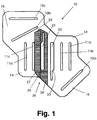
- the holding plate 10 shown in FIGS. 1 to 4 has an overall elongated shape with triangular projections 13, 14 in the central region and a region 15 which bends upward at approximately 45 ° at the upper end.
- the holding plate 10 shown in the drawing is located on the left side of a safety harness and is shown in the position in which it is when the safety harness is put on and in which its general orientation, as seen by the user, extends from the bottom left to the top right .
- the right holding plate would be a mirror image.
- a total of four first slot-shaped bushings 11a, b, c, d are arranged in the middle of the holding plate 10.
- the first bushings 11 run vertically and are aligned horizontally, i.e. the lower and upper ends of the first bushings 11 lie on a horizontal straight line.
- the first bushings 11 serve to carry out an abdominal belt B.
- Second slot-shaped bushings 12 are used to guide the front belt area S of a shoulder-seat belt.
- a total of three second bushings 12a, b, c are provided.
- the second bushings 12 are arranged approximately along a straight line and in alignment with one another, i.e. their ends lie on a straight line. This runs at an angle of approximately 45 ° to the horizontal. Since the holding plate 10 is shown in its actual position in FIG. 1, the lower right end in FIG. 1 is the end 16 near the seat and the kinking region 15 at the top left is the end of the holding plate 10 near the chest.
- the second bushing 12a at the end 16 near the seat is arranged at right angles to the alignment line.
- the second bushing 12b in the end 15 of the holding plate 10 near the chest is tilted into the horizontal by approximately 10 ° in order to deflect the direction of the front belt region S somewhat into the vertical.
- the second passage 12c arranged above it runs horizontally and also does not align with the other second bushings 12a and 12b in order, if necessary, to completely redirect the front belt area S into the vertical.
- Two overlap passages 20 and 21 are formed between the middle first passages 11b and 11c and the second passages 12a and 12b. While the first and second bushings 11, 12 all have a constant slot width, the overlap bushings 20, 21 are graduated in the slot width at 22, 23. The mutually facing edges of the overlap feed-throughs 20 and 21 are straight and the steps 22 and 23 are located in the mutually facing edges of the overlap feed-throughs 20 and 21.
- the slot width is larger, namely approximately twice the width of the first and second passages 11, 12 and the downwardly protruding area of the overlap passage 20 and the upwardly protruding area of the overlap passage 21.
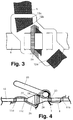
- the belts are pulled in or threaded in such a way that first the front belt region S of the shoulder-seat belt is threaded, from above through the second passage 12a near the seat and then alternately from below and above through the overlapping passages 20 and 21 and the second passage 12b near the chest (FIG. 2) and, if the front belt area S is to be continued vertically upward, also through the uppermost second passage 12c (FIG. 3).
- the front belt area S runs between the overlap feed-throughs 20 and 21 on the outside or top of the holding plate 10 and extends over the entire length of the overlap feed-throughs 20, 21.
- the front belt area S is still guided through a retaining eye in the form of a D-ring 25.
- the abdominal belt B is then passed from below through the first passage 11a and then alternately from above and below through the further first passages 11b to d and the overlap passages 20, 21. Between the overlap feed-throughs 20 and 21, it runs on the outer or upper side of the holding plate 10 and above the front belt area S through the holding eyelet 35.
- the overlap feed-through 21 near the chest is located in the area of a reinforcement 26 of the holding plate 10.
- the reinforcement 26 extends parallel to the first feed-throughs 11 and has the shape of a flat, isosceles triangle in cross section, so that it is roof-shaped overall. It has a sloping surface 27 and 28 near the chest and near the seat, which meet on a ridge line 29.
- the overlap passage 21 close to the chest is located completely in the inclined surface 28 near the seat, one edge of the overlap passage 21 coinciding with the ridge line 29.
- the inclined surface 27 near the chest extends to the following first passage 11c.
- the reinforcement 26 is located on both the top and the bottom of the holding plate 10 so that it can be used on the left or right.
- the roof-like reinforcement 26 ensures that the retaining eyelet 25 cannot tilt to the left, as seen in FIG. 4, to the extent that it can lie on the waist belt B.
- the retaining eyelet 25 can only lie to the left according to the angle of the inclined surface 28 near the seat, as a result of which a connecting element, e.g. a snap hook that can be hooked in more easily.
- 5 to 8 show an embodiment of the holding plate 10 for fixing back belts R1 and R2.
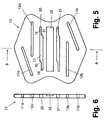
- FIG. 5 shows the holding plate 10 from the front, ie from the side that faces away from the person who put on the safety harness.
- the holding plate 10 is approximately hexagonal, the two vertically running edges being slightly curved inwards.
- the holding plate 10 has a total of six slot-like bushings or openings, namely two first bushings 11a, b for the first back belt R1, two second bushings 12a, b for the second back belt R2 and two overlap bushings 20, 21 through which both back belts R1, R2 pass will.
- the first bushings 11a, b are arranged parallel to one another in the top left and bottom right in FIG. 1 and approximately parallel to the edge of the holding plate 10 there.
- the second bushings 12a, b are horizontally offset somewhat inwards from the first bushings 11 and, viewed vertically, each overlap somewhat with the first bushings 11.
- the overlapping bushings 20, 21 run horizontally in the central region of the holding plate 10 at a distance of about 25 mm. While the first and second bushings 11, 12 are each approximately rectangular and have a uniform slot width, the overlap bushings 20, 21 each have a central region 17 and edge regions 18, 19, the central region 17 having approximately twice the slot width as the peripheral regions 18, 19. The width of the overlap bushing 20, 21 is reduced in the transition between the central region 17 and the left edge region 18 only at the upper edge, so that a step 30 is present there.
- the width of the overlap bushings 20, 21 is reduced at the transition between the central region 17 and the right edge region at the lower edge, so that there is a step 31 here.
- the holding plate 10 is smooth at the corresponding point.
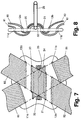
- FIGS. 7 and 8 show the holding plate with retracted back straps R1 and R2.
- the first back strap R1 runs from top left to bottom right, while the second back strap R2 runs from top right to bottom left.
- the first back belt R1 is drawn from the front visible in FIGS. 5 and 7 through the upper first passage 11a to the rear, comes through the upper overlap passage 20, namely through the central region 17 and the left edge region 18, onto the Front side, from here through the lower overlap lead-through 21, specifically through the central region and the right edge region, again on the rear side and then through the lower first lead-through 11 b again onto the front side.
- the second back strap R2 runs from the front through the upper second passage 12a to the rear of the holding plate 10, from there under the first back strap R1 through the upper overlap passage 20, namely through its central region 17 and right edge region 19 to the top, whereby now the second back strap R2 lies above the first back strap R1, from there through the lower overlap lead-through 21, namely through its central region and left edge region to the underside and from there finally through the lower second lead-through 12b to the front of the holding plate 10.
- the two back belts R1 and R2 run between the overlap passages 20, 21 through a D-shaped catch eye 25 and thereby hold them in the cutout 32.
- the catch eye 25 is fixed. A slipping of the back belts R1, R2 is prevented by the graded slot width of the overlap bushings 20, 21.
Landscapes
- Health & Medical Sciences (AREA)
- General Health & Medical Sciences (AREA)
- Business, Economics & Management (AREA)
- Emergency Management (AREA)
- Emergency Lowering Means (AREA)
- Electric Cable Arrangement Between Relatively Moving Parts (AREA)
Applications Claiming Priority (4)
| Application Number | Priority Date | Filing Date | Title |
|---|---|---|---|
| DE29608883U | 1996-05-17 | ||
| DE29608883U DE29608883U1 (de) | 1996-05-17 | 1996-05-17 | Rückenplatte für ein Sicherheitsgeschirr |
| DE29617932U | 1996-10-15 | ||
| DE29617932U DE29617932U1 (de) | 1996-10-15 | 1996-10-15 | Halteplatte zur Führung eines Bauchgurtes und eines diesen kreuzenden Schulter-Sitz-Gurtes eines Sicherheitsgeschirrs |
Publications (2)
| Publication Number | Publication Date |
|---|---|
| EP0807451A2 true EP0807451A2 (fr) | 1997-11-19 |
| EP0807451A3 EP0807451A3 (fr) | 1999-02-17 |
Family
ID=26058985
Family Applications (1)
| Application Number | Title | Priority Date | Filing Date |
|---|---|---|---|
| EP97104201A Withdrawn EP0807451A3 (fr) | 1996-05-17 | 1997-03-13 | Platine de fixation de harnais de sécurité pour guider deux ceintures croisées |
Country Status (1)
| Country | Link |
|---|---|
| EP (1) | EP0807451A3 (fr) |
Cited By (6)
| Publication number | Priority date | Publication date | Assignee | Title |
|---|---|---|---|---|
| WO1999013947A1 (fr) * | 1997-09-17 | 1999-03-25 | Rose Manufacturing Company | Baudrier complet permettant d'interrompre une chute |
| US5957091A (en) * | 1997-11-19 | 1999-09-28 | Rose Manufacturing Company | Full body harness for fall arrest |
| EP1220704A4 (fr) * | 1999-10-15 | 2003-01-22 | Protecta International Inc | Harnais de securite complet |
| WO2004033045A1 (fr) * | 2002-10-04 | 2004-04-22 | Mine Safety Appliances Company | Baudrier complet permettant d'arreter une chute |
| JP2015080578A (ja) * | 2013-10-22 | 2015-04-27 | 株式会社谷沢製作所 | 安全帯 |
| WO2020077189A1 (fr) | 2018-10-12 | 2020-04-16 | Msa Technology, Llc | Plaque arrière de harnais et agencement de sangle |
Family Cites Families (2)
| Publication number | Priority date | Publication date | Assignee | Title |
|---|---|---|---|---|
| DE8914878U1 (de) * | 1989-12-20 | 1991-04-18 | Mittelmann Armaturen GmbH + Co KG, 5603 Wülfrath | Auffanggurt für absturzgefährdete Personen |
| DE4224334A1 (de) * | 1992-07-23 | 1994-01-27 | Manfred Meckel Fabrik Fuer Sic | Auffanggurt zur Sicherung einer Person bei Arbeiten an exponierten und/oder hochgelegenen Arbeitsstellen |
-
1997
- 1997-03-13 EP EP97104201A patent/EP0807451A3/fr not_active Withdrawn
Cited By (11)
| Publication number | Priority date | Publication date | Assignee | Title |
|---|---|---|---|---|
| WO1999013947A1 (fr) * | 1997-09-17 | 1999-03-25 | Rose Manufacturing Company | Baudrier complet permettant d'interrompre une chute |
| AU731313B2 (en) * | 1997-09-17 | 2001-03-29 | Rose Manufacturing Company | Full body harness for fall arrest |
| US5957091A (en) * | 1997-11-19 | 1999-09-28 | Rose Manufacturing Company | Full body harness for fall arrest |
| EP1220704A4 (fr) * | 1999-10-15 | 2003-01-22 | Protecta International Inc | Harnais de securite complet |
| WO2004033045A1 (fr) * | 2002-10-04 | 2004-04-22 | Mine Safety Appliances Company | Baudrier complet permettant d'arreter une chute |
| US6804830B2 (en) | 2002-10-04 | 2004-10-19 | Mine Safety Appliances Company | Full body harness for fall arrest |
| CN1688366B (zh) * | 2002-10-04 | 2010-05-26 | 矿井安全装置公司 | 适用于防止跌落的整体式背带装置 |
| JP2015080578A (ja) * | 2013-10-22 | 2015-04-27 | 株式会社谷沢製作所 | 安全帯 |
| WO2020077189A1 (fr) | 2018-10-12 | 2020-04-16 | Msa Technology, Llc | Plaque arrière de harnais et agencement de sangle |
| EP3863733A4 (fr) * | 2018-10-12 | 2021-12-01 | MSA Technology, LLC | Plaque arrière de harnais et agencement de sangle |
| US11497948B2 (en) | 2018-10-12 | 2022-11-15 | Msa Technology, Llc | Harness back plate and strap arrangement |
Also Published As
| Publication number | Publication date |
|---|---|
| EP0807451A3 (fr) | 1999-02-17 |
Similar Documents
| Publication | Publication Date | Title |
|---|---|---|
| DE2917327C2 (de) | Schnalle zum einstellbaren Verbinden von Gurtenden | |
| DE3007645A1 (de) | Sicherheitssitz fuer kraftfahrzeuge | |
| DE69902348T2 (de) | Biderektionale sperreinrichtung für absturzsicherung | |
| DE2364797A1 (de) | Verstellbare sitzanordnung fuer ein fahrzeug | |
| DE102012000202B4 (de) | Vorrichtung zur Verankerung eines Gurtschlosses und Vorrichtungsanordnung mit wenigstens zwei solchen Vorrichtungen | |
| DE69413580T2 (de) | Verstellbare Schnalle mit selbsthemmender Gurtbefestigung | |
| DE2923283C2 (fr) | ||
| DE3242696A1 (de) | Befestigungsvorrichtung fuer eine umlenkhalterung, insbesondere fuer kraftfahrzeug-sicherheitsgurte | |
| DE69412269T2 (de) | Schutzbahn hergestellt aus mit ringen verbundenen platten sowie schürzen daraus gefertigt | |
| DE4108433A1 (de) | Hoehenverstellbare rohrabhaengung | |
| EP0239903B1 (fr) | Mousqueton, notamment pour l'alpinisme | |
| DE4224334A1 (de) | Auffanggurt zur Sicherung einer Person bei Arbeiten an exponierten und/oder hochgelegenen Arbeitsstellen | |
| DE102009025380A1 (de) | Strahlenschutzanordnung | |
| DE69914123T2 (de) | Schnalle für einen Sicherheitsgurt | |
| EP0389831A2 (fr) | Dispositif pour ligaturer des éléments allongés | |
| DE2824734C2 (de) | Klettergürtel | |
| DE3342453C2 (de) | Reißverschlußschieber | |
| AT398322B (de) | Schwimmende öl- und chemiesperre | |
| DE69201340T2 (de) | Vorrichtung zum automatischen Kuppeln einer Sicherheitsgurtverankerung mit dem Boden eines Fahrzeuges. | |
| DE29617932U1 (de) | Halteplatte zur Führung eines Bauchgurtes und eines diesen kreuzenden Schulter-Sitz-Gurtes eines Sicherheitsgeschirrs | |
| DE2830187C2 (de) | Armlehne für Fahrzeuge | |
| DE8914878U1 (de) | Auffanggurt für absturzgefährdete Personen | |
| DE20022993U1 (de) | Auffanggurt und Verschluss- und Haltevorrichtung hierfür | |
| DE9215059U1 (de) | Verbindungselement für stirnseitig aneinanderstoßende Installationskanäle | |
| DE102012014693A1 (de) | Verschlusselement eines Sicherheitsgeschirrs |
Legal Events
| Date | Code | Title | Description |
|---|---|---|---|
| PUAI | Public reference made under article 153(3) epc to a published international application that has entered the european phase |
Free format text: ORIGINAL CODE: 0009012 |
|
| AK | Designated contracting states |
Kind code of ref document: A2 Designated state(s): DE FR GB IT |
|
| PUAL | Search report despatched |
Free format text: ORIGINAL CODE: 0009013 |
|
| AK | Designated contracting states |
Kind code of ref document: A3 Designated state(s): DE FR GB IT |
|
| 17P | Request for examination filed |
Effective date: 19990608 |
|
| STAA | Information on the status of an ep patent application or granted ep patent |
Free format text: STATUS: THE APPLICATION IS DEEMED TO BE WITHDRAWN |
|
| 18D | Application deemed to be withdrawn |
Effective date: 20031001 |