EP0807422A1 - Procédé pour la production de reconstructions dentaires et ébauche pour la mise en oeuvre du procédé - Google Patents
Procédé pour la production de reconstructions dentaires et ébauche pour la mise en oeuvre du procédé Download PDFInfo
- Publication number
- EP0807422A1 EP0807422A1 EP97106979A EP97106979A EP0807422A1 EP 0807422 A1 EP0807422 A1 EP 0807422A1 EP 97106979 A EP97106979 A EP 97106979A EP 97106979 A EP97106979 A EP 97106979A EP 0807422 A1 EP0807422 A1 EP 0807422A1
- Authority
- EP
- European Patent Office
- Prior art keywords
- area
- reinforcement
- blank
- blank according
- reinforcement area
- Prior art date
- Legal status (The legal status is an assumption and is not a legal conclusion. Google has not performed a legal analysis and makes no representation as to the accuracy of the status listed.)
- Granted
Links
- 238000000034 method Methods 0.000 title claims description 28
- 238000004519 manufacturing process Methods 0.000 title claims description 21
- 239000002131 composite material Substances 0.000 claims abstract description 47
- 239000000463 material Substances 0.000 claims abstract description 45
- 238000003754 machining Methods 0.000 claims abstract description 16
- 230000002787 reinforcement Effects 0.000 claims description 101
- 238000012545 processing Methods 0.000 claims description 27
- 239000000919 ceramic Substances 0.000 claims description 20
- 239000011148 porous material Substances 0.000 claims description 8
- 238000005299 abrasion Methods 0.000 claims description 7
- 239000011521 glass Substances 0.000 claims description 5
- 229920000642 polymer Polymers 0.000 claims description 5
- 239000004033 plastic Substances 0.000 claims description 4
- VYPSYNLAJGMNEJ-UHFFFAOYSA-N Silicium dioxide Chemical compound O=[Si]=O VYPSYNLAJGMNEJ-UHFFFAOYSA-N 0.000 claims description 3
- 229910052574 oxide ceramic Inorganic materials 0.000 claims description 3
- 239000011224 oxide ceramic Substances 0.000 claims description 3
- TWNQGVIAIRXVLR-UHFFFAOYSA-N oxo(oxoalumanyloxy)alumane Chemical compound O=[Al]O[Al]=O TWNQGVIAIRXVLR-UHFFFAOYSA-N 0.000 claims description 3
- 239000002861 polymer material Substances 0.000 claims description 3
- 239000000395 magnesium oxide Substances 0.000 claims description 2
- CPLXHLVBOLITMK-UHFFFAOYSA-N magnesium oxide Inorganic materials [Mg]=O CPLXHLVBOLITMK-UHFFFAOYSA-N 0.000 claims description 2
- AXZKOIWUVFPNLO-UHFFFAOYSA-N magnesium;oxygen(2-) Chemical compound [O-2].[Mg+2] AXZKOIWUVFPNLO-UHFFFAOYSA-N 0.000 claims description 2
- RVTZCBVAJQQJTK-UHFFFAOYSA-N oxygen(2-);zirconium(4+) Chemical compound [O-2].[O-2].[Zr+4] RVTZCBVAJQQJTK-UHFFFAOYSA-N 0.000 claims description 2
- 229910001928 zirconium oxide Inorganic materials 0.000 claims description 2
- 229910052814 silicon oxide Inorganic materials 0.000 claims 1
- 238000002360 preparation method Methods 0.000 abstract description 10
- 230000003014 reinforcing effect Effects 0.000 abstract 1
- 238000000227 grinding Methods 0.000 description 12
- 230000001055 chewing effect Effects 0.000 description 7
- 230000003287 optical effect Effects 0.000 description 6
- 229910010293 ceramic material Inorganic materials 0.000 description 4
- 238000013461 design Methods 0.000 description 4
- 238000010304 firing Methods 0.000 description 4
- 229910052751 metal Inorganic materials 0.000 description 4
- 239000002184 metal Substances 0.000 description 4
- 238000005516 engineering process Methods 0.000 description 3
- 238000000465 moulding Methods 0.000 description 3
- 238000002679 ablation Methods 0.000 description 2
- PNEYBMLMFCGWSK-UHFFFAOYSA-N aluminium oxide Inorganic materials [O-2].[O-2].[O-2].[Al+3].[Al+3] PNEYBMLMFCGWSK-UHFFFAOYSA-N 0.000 description 2
- 238000010276 construction Methods 0.000 description 2
- 238000009826 distribution Methods 0.000 description 2
- 238000007731 hot pressing Methods 0.000 description 2
- 229910052573 porcelain Inorganic materials 0.000 description 2
- 238000009417 prefabrication Methods 0.000 description 2
- 238000003825 pressing Methods 0.000 description 2
- 239000012779 reinforcing material Substances 0.000 description 2
- 238000005245 sintering Methods 0.000 description 2
- 210000000332 tooth crown Anatomy 0.000 description 2
- 230000007704 transition Effects 0.000 description 2
- OKTJSMMVPCPJKN-UHFFFAOYSA-N Carbon Chemical compound [C] OKTJSMMVPCPJKN-UHFFFAOYSA-N 0.000 description 1
- 229910019142 PO4 Inorganic materials 0.000 description 1
- RTAQQCXQSZGOHL-UHFFFAOYSA-N Titanium Chemical compound [Ti] RTAQQCXQSZGOHL-UHFFFAOYSA-N 0.000 description 1
- 239000000853 adhesive Substances 0.000 description 1
- 230000001070 adhesive effect Effects 0.000 description 1
- 238000004873 anchoring Methods 0.000 description 1
- 229910052799 carbon Inorganic materials 0.000 description 1
- 238000005266 casting Methods 0.000 description 1
- 239000004568 cement Substances 0.000 description 1
- 239000007795 chemical reaction product Substances 0.000 description 1
- 238000000576 coating method Methods 0.000 description 1
- 238000004040 coloring Methods 0.000 description 1
- 239000004567 concrete Substances 0.000 description 1
- 239000010433 feldspar Substances 0.000 description 1
- 238000007654 immersion Methods 0.000 description 1
- 229910052746 lanthanum Inorganic materials 0.000 description 1
- FZLIPJUXYLNCLC-UHFFFAOYSA-N lanthanum atom Chemical compound [La] FZLIPJUXYLNCLC-UHFFFAOYSA-N 0.000 description 1
- 150000002739 metals Chemical class 0.000 description 1
- 238000003801 milling Methods 0.000 description 1
- 239000000203 mixture Substances 0.000 description 1
- NBIIXXVUZAFLBC-UHFFFAOYSA-K phosphate Chemical compound [O-]P([O-])([O-])=O NBIIXXVUZAFLBC-UHFFFAOYSA-K 0.000 description 1
- 239000010452 phosphate Substances 0.000 description 1
- 238000007750 plasma spraying Methods 0.000 description 1
- 238000006116 polymerization reaction Methods 0.000 description 1
- 239000005401 pressed glass Substances 0.000 description 1
- 238000003908 quality control method Methods 0.000 description 1
- 239000012858 resilient material Substances 0.000 description 1
- 238000007493 shaping process Methods 0.000 description 1
- 239000000377 silicon dioxide Substances 0.000 description 1
- 235000012239 silicon dioxide Nutrition 0.000 description 1
- 239000011029 spinel Substances 0.000 description 1
- 229910052596 spinel Inorganic materials 0.000 description 1
- 238000013517 stratification Methods 0.000 description 1
- 239000000126 substance Substances 0.000 description 1
- 229910052719 titanium Inorganic materials 0.000 description 1
- 239000010936 titanium Substances 0.000 description 1
- 238000012549 training Methods 0.000 description 1
- 238000012546 transfer Methods 0.000 description 1
- 229910052845 zircon Inorganic materials 0.000 description 1
- GFQYVLUOOAAOGM-UHFFFAOYSA-N zirconium(iv) silicate Chemical compound [Zr+4].[O-][Si]([O-])([O-])[O-] GFQYVLUOOAAOGM-UHFFFAOYSA-N 0.000 description 1
Images


Classifications
-
- A—HUMAN NECESSITIES
- A61—MEDICAL OR VETERINARY SCIENCE; HYGIENE
- A61C—DENTISTRY; APPARATUS OR METHODS FOR ORAL OR DENTAL HYGIENE
- A61C13/00—Dental prostheses; Making same
- A61C13/0003—Making bridge-work, inlays, implants or the like
-
- A—HUMAN NECESSITIES
- A61—MEDICAL OR VETERINARY SCIENCE; HYGIENE
- A61C—DENTISTRY; APPARATUS OR METHODS FOR ORAL OR DENTAL HYGIENE
- A61C13/00—Dental prostheses; Making same
- A61C13/0003—Making bridge-work, inlays, implants or the like
- A61C13/0022—Blanks or green, unfinished dental restoration parts
-
- A—HUMAN NECESSITIES
- A61—MEDICAL OR VETERINARY SCIENCE; HYGIENE
- A61C—DENTISTRY; APPARATUS OR METHODS FOR ORAL OR DENTAL HYGIENE
- A61C13/00—Dental prostheses; Making same
- A61C13/08—Artificial teeth; Making same
-
- A—HUMAN NECESSITIES
- A61—MEDICAL OR VETERINARY SCIENCE; HYGIENE
- A61C—DENTISTRY; APPARATUS OR METHODS FOR ORAL OR DENTAL HYGIENE
- A61C5/00—Filling or capping teeth
- A61C5/70—Tooth crowns; Making thereof
- A61C5/77—Methods or devices for making crowns
-
- Y—GENERAL TAGGING OF NEW TECHNOLOGICAL DEVELOPMENTS; GENERAL TAGGING OF CROSS-SECTIONAL TECHNOLOGIES SPANNING OVER SEVERAL SECTIONS OF THE IPC; TECHNICAL SUBJECTS COVERED BY FORMER USPC CROSS-REFERENCE ART COLLECTIONS [XRACs] AND DIGESTS
- Y10—TECHNICAL SUBJECTS COVERED BY FORMER USPC
- Y10T—TECHNICAL SUBJECTS COVERED BY FORMER US CLASSIFICATION
- Y10T428/00—Stock material or miscellaneous articles
- Y10T428/13—Hollow or container type article [e.g., tube, vase, etc.]
- Y10T428/131—Glass, ceramic, or sintered, fused, fired, or calcined metal oxide or metal carbide containing [e.g., porcelain, brick, cement, etc.]
- Y10T428/1314—Contains fabric, fiber particle, or filament made of glass, ceramic, or sintered, fused, fired, or calcined metal oxide, or metal carbide or other inorganic compound [e.g., fiber glass, mineral fiber, sand, etc.]
-
- Y—GENERAL TAGGING OF NEW TECHNOLOGICAL DEVELOPMENTS; GENERAL TAGGING OF CROSS-SECTIONAL TECHNOLOGIES SPANNING OVER SEVERAL SECTIONS OF THE IPC; TECHNICAL SUBJECTS COVERED BY FORMER USPC CROSS-REFERENCE ART COLLECTIONS [XRACs] AND DIGESTS
- Y10—TECHNICAL SUBJECTS COVERED BY FORMER USPC
- Y10T—TECHNICAL SUBJECTS COVERED BY FORMER US CLASSIFICATION
- Y10T428/00—Stock material or miscellaneous articles
- Y10T428/13—Hollow or container type article [e.g., tube, vase, etc.]
- Y10T428/1352—Polymer or resin containing [i.e., natural or synthetic]
-
- Y—GENERAL TAGGING OF NEW TECHNOLOGICAL DEVELOPMENTS; GENERAL TAGGING OF CROSS-SECTIONAL TECHNOLOGIES SPANNING OVER SEVERAL SECTIONS OF THE IPC; TECHNICAL SUBJECTS COVERED BY FORMER USPC CROSS-REFERENCE ART COLLECTIONS [XRACs] AND DIGESTS
- Y10—TECHNICAL SUBJECTS COVERED BY FORMER USPC
- Y10T—TECHNICAL SUBJECTS COVERED BY FORMER US CLASSIFICATION
- Y10T428/00—Stock material or miscellaneous articles
- Y10T428/13—Hollow or container type article [e.g., tube, vase, etc.]
- Y10T428/1352—Polymer or resin containing [i.e., natural or synthetic]
- Y10T428/139—Open-ended, self-supporting conduit, cylinder, or tube-type article
-
- Y—GENERAL TAGGING OF NEW TECHNOLOGICAL DEVELOPMENTS; GENERAL TAGGING OF CROSS-SECTIONAL TECHNOLOGIES SPANNING OVER SEVERAL SECTIONS OF THE IPC; TECHNICAL SUBJECTS COVERED BY FORMER USPC CROSS-REFERENCE ART COLLECTIONS [XRACs] AND DIGESTS
- Y10—TECHNICAL SUBJECTS COVERED BY FORMER USPC
- Y10T—TECHNICAL SUBJECTS COVERED BY FORMER US CLASSIFICATION
- Y10T428/00—Stock material or miscellaneous articles
- Y10T428/13—Hollow or container type article [e.g., tube, vase, etc.]
- Y10T428/1352—Polymer or resin containing [i.e., natural or synthetic]
- Y10T428/139—Open-ended, self-supporting conduit, cylinder, or tube-type article
- Y10T428/1393—Multilayer [continuous layer]
Definitions
- the present invention relates to a blank or a method for producing artificial tooth parts and a method for producing the blank according to the preambles of the independent claims.
- a supporting substructure made of metal is adapted to a working model obtained by molding a tooth preparation and then the tooth shape and color are manually supplemented by firing ceramic material.
- the combination of the high-strength backing material with the coloring veneering material has proven itself in dentistry as a permanent reconstruction method.
- substructures are first made of hot-pressed glass ceramic (IPS-Empress) for individual tooth crowns to obtain the necessary chewing stability, which cover the tooth stump in the form of approx. 0.5 mm thick caps or cones, and the dental technician burns the veneering ceramics.
- IPS-Empress hot-pressed glass ceramic
- alumina ingots made of porous sintered aluminum oxide ceramics or porous sintered ingots made of spinel are processed using the Cerec or Celay form grinding technique.
- the resulting molded parts with an open-pore structure are subsequently hot-infiltrated using the dental technique with glass (lanthanum glasses) (In-Ceram technique), resulting in strength values suitable for crowns and bridges.
- high-strength, densely sintered oxide ceramics can be processed in the dental laboratory using sono-erosion technology to form delicate restoration bodies, onto which layers that give color in the laboratory are then fired.
- the previously mentioned known methods for producing artificial tooth parts therefore require several steps in order to produce ready-to-use crown and bridge parts, i.e. Provide extracoronal restorations, since they consist of at least two bonded materials, one of which ensures the breaking strength and another, weaker the natural tooth color.
- the purpose of the present invention is to simplify the manufacture of ready-to-use crown and bridge parts and other partial tooth reconstructions with the best possible mechanical properties.
- the ready-to-use end product can be molded in a single, mechanical molding process.
- the reinforcement area provides the necessary mechanical strength
- the processing area can consist of a material that is easy to process or whose properties (e.g. elasticity, structure, color) can be adapted to the respective requirements.
- the reinforcement area should be in a predefined spatial relation to the fastening means of the blank.
- the position of the reinforcement area in the machining tool is thus known and it is possible, when grinding the dental reconstruction, to ensure that the reinforcement area has a minimum thickness on heavily loaded, occlusal parts of the reconstruction.
- the reinforcement area of a tooth crown should preferably not be less than 0.5 mm occlusally.
- the reinforcement area preferably forms a substantially flat plate. It can be seen that a reinforcement area shaped in this way and easy to produce ensures sufficient reinforcement.
- the body comprises a plurality of laminate layers, which are preferably flat. This further simplifies the manufacture of the blank. However, they are also curved, e.g. cylindrical or spherical, stratifications conceivable.
- the reinforcement area is best located between a purchase function area and the processing area.
- the purchase function area has a high resistance to chewing abrasion, and the reinforcement area allows an optimal distribution of the chewing forces, while the rest of the processing area essentially serves to establish the positive connection with the remaining hard tooth substance and to complete the shape of the tooth.
- a reconstruction can be produced which, thanks to the purchase function area and the reinforcement area, has a chewing abrasion resistance and fracture resistance adapted to the biological conditions, while the other areas e.g. can be optimized for good workability.
- the body of the blank should preferably consist of ceramic, composite material, glasses and / or high-strength polymer materials. These materials can be made tooth-colored so that the individual areas can extend to the surface of the dental reconstruction.
- the blank according to the invention is particularly suitable for the production of inlays, overlays, partial and complete crowns and bridges, ie parts of a tooth or entire teeth. Although these parts may be very thin or fine, the reinforcement area can be positioned and processed appropriately the necessary strength and the desired elastic properties of the reconstruction can be guaranteed.
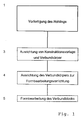
- Fig. 1 shows the process steps in the production of the blank and its subsequent processing for dental reconstruction.
- step 1 the blank is manufactured industrially. It is about in the composite body of the blank To provide an area with optimal chewing properties, an area of great breaking strength and an area made of more resilient, easily workable material. In the finished restoration, material of the reinforcement area will form a reinforcement structure that gives the restoration the necessary mechanical strength.
- the blank can be produced in various ways. Two possible methods are briefly described below.
- a blank is built up in layers from prefabricated, planar layers or laminates made of composite and / or ceramic or glass, carbon or other suitable materials.
- the layers can either be adhesively bonded, for example using composite as an adhesive, or ceramic laminates can also be bonded to one another by composite firing or built up using the coating method.
- Layers made of open-pore ceramic with the same or different pore structure can also be connected to one another with the aid of polymers.
- the polymer is embedded in the pores, on the other hand, it forms a connection between the individual layers.
- the layer thickness is chosen arbitrarily according to the mechanical, stress-related and optical properties and lies between the submicron range (less than 1 micron) and a few millimeters.
- half of the body of the blank thus produced consists of a ceramic and a composite layer, one of the layers forming the reinforcement area.
- layers of composite or ceramic of different construction and composition are formed, the reinforcement being achieved by the special material properties is guaranteed, or the reinforcement of the blank is achieved by the type of layer arrangement, the laminate thickness, the laminate combination, the laminate composite or with combinations of these elements.
- ceramics with different coefficients of thermal expansion are used to produce the blank. The mechanical tension generated thereby strengthens the layers and in particular increases the breaking strength.
- This manufacturing process enables the prefabrication of material layers or material layers, which compared to the monophase production of crown blanks with dimensions of e.g. 12 x 14 x 18 mm made of composite or ceramic allows better quality control.
- the difficulty of producing large material bodies without voids or pores without weak points is avoided with the laminated composite blank.
- a blank is produced in at least two prefabrication steps, namely a first step for prefabricating the reinforcement area from material with high breaking strength and the second step for completing the shape to form the composite body with dental veneering material or Machining material.
- the reinforcement area is prefabricated by casting, slurrying, hot pressing or dry pressing and sintering, extruding or ablation.
- the dimensions of the reinforcement area can be adapted to a typical restoration size.
- densely sintered ceramics made of aluminum oxide, zirconium oxide, magnesium oxide, silicon dioxide or combinations thereof or high-strength polymer material are suitable as reinforcing materials.
- Metal can be used if the reinforcement area does not appear on the surface in the finished reconstruction. In this case titanium is preferred among the metals.
- Shaping of the reinforcement area is supplemented to form the blank body, either without special pretreatment or with preparation of the reinforcement area by applying or forming an adhesion-promoting intermediate layer.
- the inseparable addition to the shape of the reinforcement area with a material of the processing area to form a composite body takes place through heat and pressure polymerization, hot pressing or dry pressing and sintering or firing to a material block adapted to a typical restoration size, which can be machined in all parts. It is also possible to form different areas in parallel, for example by co-extruding different ceramic materials, and with subsequent firing. It is also conceivable to apply ceramic layers using the immersion method or plasma spraying.
- the reinforcement area is preferably arranged in the blank in such a way that its section assigned to the inner portion of the occlusal surface of the restoration with its mesio-distal spatial axis approximately coincides with the central grinding axis of the reconstruction in a subsequent shape grinding process.
- the blank must be equipped with suitable fastening or orientation means that allow it to be clamped in a processing tool in such a way that the position of the reinforcement area is known.
- the orientation means can be connected directly to the reinforcement part or arranged on the finished composite body.
- step 1 of FIG. 1 the finished blank is available.
- the remaining process steps 3-5 according to FIG. 1 can be carried out in dental practice.
- the dentist will first prepare the tooth so that the shape of the desired reconstruction as a design template is established.
- the shape of the composite body is finally carried out using known, ablative devices, in particular by shape grinding.
- the removal of material occurs primarily in the processing area, but in some cases also in the reinforcement area and / or purchase function area.
- the blank is preferably arranged in such a way that the distal reconstruction surface comes to lie on the workpiece holder side, as a result of which it is moved to the reinforcement area that may be apparent on this side to the side of the reconstruction that is not directly visible from the mouth opening.
- the reinforcement material in the inner occlusal area of the reconstruction should at least partially not be less than 0.5 mm thick.
- the reinforcement area 11 is in the form of a flat plate. This plate is connected to a fastener consisting of reference and calibration part 12 and holder part 13.
- the reinforcement area 11 preferably has a shape such that the subsequent material removal from the reinforcement material can be limited to a minimum, which is achieved in FIG. 2 by the plate shape with a wall thickness of approximately 0.5 to 3.0 millimeters.
- the reinforcement area is in the purchase area part (e.g. a crown). It is preferably arranged close to the blank axis 17 but somewhat outside the center.
- the reinforcement region 11 can e.g. B. can also be designed as a substantially U-shaped profile, with a longitudinal axis parallel to the blank axis 17 and an opening angle of the side legs of approximately 10 °.
- the legs 15, 15 'of such a profile are indicated by dashed lines in FIG. 2.
- the u-shape is similar to that of a crown stump preparation and enables additional reinforcement of the sides of the reconstruction, but at the same time a saving of reinforcement material and protection of the tools.
- the reinforcement area can also be curved and / or have the shape of an L-profile.
- the reference and calibration part 12 of the fastening part has a rotationally symmetrical cylindrical design and is closely tolerated. It serves with its cylinder outer surface 18 as a reference and calibration surface that can be approached with the processing tools for calibration.
- the recess 19 ensures that the reinforcement area can only be inserted into the processing device in one position.
- the cylinder outer surface 18 and the recess 19 thus form the orientation means with which the reinforcement region 11 can be brought into a position defined in relation to the machining tool.
- the holder part 13 has an essentially rotationally symmetrical shape which, in the case of a rotary machining, serves as a center of rotation and for fixing the holder part in the processing machine, which is accomplished by means of an adjusting screw or collet.
- the holder part 13 can also be used as a holder e.g. serve in a press mold.
- the holder part 13 or the reference and calibration part 12 and the reinforcement region 11 are directly connected to one another in this embodiment.
- the relative position of the reference and calibration part 12 and the reinforcement area 11 should always be the same for all blanks of one type, so that the position of the reinforcement area can be determined on the basis of the reference surface 18 and the recess 19.
- FIG. 3 shows a first variant of a complete blank 20 with reinforcement area 11 according to FIG. 2. Together, the machining area 9 and the reinforcement area 11 form the body or composite body of the blank that can be formed by ablation.
- the contours 22 seen from the occlusal side of the internal reinforcement region 11 are recorded, and on the side surface 23 the contours viewed from the side 24. These contours serve for orientation about the inner position of the Reinforcement area 11 in the blank 20.
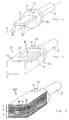
- FIG. 4 A perspective view of a second, currently preferred variant of a complete blank 20 is shown in FIG. 4.
- the blank consists of a variety of flat laminate layers, which, for. B. were assembled by means of composite and / or polymer.
- layers 30 are arranged made of a material which has the highest possible resistance to chewing abrasion, preferably a hard material.
- layers 31 made of a ceramic material with high breaking strength, in a lower region layers 32 of lower hardness and strength, e.g. B. made of composite.
- Composite is easier to machine than ceramics, so that the blank can be optimized with regard to its machinable and manual machinability.
- Area A forms a purchase function area, from which the occlusal surface of the reconstruction is formed, area B forms the reinforcement area, area C the processing area.
- the laminate layers are flat. This is particularly simple in terms of manufacturing technology. However, it is also conceivable for the layers to be curved and, in particular, to be arranged spherically or cylindrically. Such geometries achieve greater strength. Furthermore, the course of the reinforcement area can be better adapted to the respective course of force.
- FIG. 5 illustrates the orientation of a blank for processing.
- a blank according to FIG. 2 with the U-shaped reinforcement area indicated by dashed lines is shown - however, a corresponding alignment also applies to a blank with a flat reinforcement area (such as in the blank according to FIG. 4), in which case the lateral and longitudinal alignment however, is less critical.
- FIG. 5 also shows the arrangement of a three-dimensional oral camera with its shaft 41 and the receiving window 42 to a row of teeth with the teeth 34, 35, 36 and part of the tooth 37.
- a corresponding mouth camera is described, for example, in the above-mentioned document by H. Mörmann and M. Brandestini, The CEREC Computer Reconstruction " , 1989, Quintessenz Verlags-GmbH, Berlin, ISBN 3-87652-550-0, is described.
- the tooth 36 is provided with a crown stump preparation 43.
- the receiving window corresponds to the one in the drawing plane With the help of contours of the reinforcement area 11 as shown in Fig.
- FIGS. 6 and 7 A finished crown of a molar tooth made from the blank according to FIG. 3 is shown in FIGS. 6 and 7.
- the crown has the shape known to the person skilled in the art with a frustoconical recess 50 for receiving the crown stump of the tooth.
- the blank was ground so that the reinforcement area forms an inner reinforcement plate 52 in the occlusal area, where the greatest loads occur. This plate has a thickness of at least 0.5 mm.
- the legs 15, 15 'form internal reinforcements of the buccal and oral crown walls 55, 56 are used, the legs 15, 15 'form internal reinforcements of the buccal and oral crown walls 55, 56.
- the distal crown wall 53 partially consists of reinforcement material from the area of the reinforcement area on the workpiece holder side, while the mesial wall only through the end of the reinforcement area is reinforced.
- the outside of the mesial, oral, buccal and occlusal crown walls 54, 55, 56, 57 are formed by the processing area of the blank.
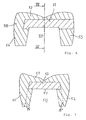
- Figures 8 and 9 show a finished crown made of a laminated blank, as shown in Fig. 4, the outlines of the blank 20 and the fastener 12, 13 are indicated by dashed lines.
- the layers 31 of the reinforcement area form a reinforcement plate in the occlusal part of the reconstruction.
- the naturally very hard occlusal tooth surface is formed by the layers 30 of the purchase function area.
- the crown walls were formed from layers 32 of the machining area. Since all laminate layers come to the surface of the crown, they should be made of tooth-colored material.
- the body of the blank consisted of two to three material areas, the reinforcement area, the processing area and possibly the purchase function area.
- the composite body could be formed of two to three material areas, the reinforcement area, the processing area and possibly the purchase function area.
- the individual laminate layers can, for example, become increasingly harder, stronger, more elastic or softer.
- the toughest Laminate layers will preferably be arranged in the upper area of the blank. Under these hardest layers, layers with increasingly greater breaking strength are used, which form the reinforcement area. These then pass into increasingly softer layers in the machining part.
- abrasion-resistant, rigid material e.g. ceramic
- more resilient material e.g. composite
- antagonist-friendly and abrasion-resistant material is arranged in the area of the cusps. In the area of the occlusal plateau, the most break-resistant material possible is used to form the reinforcement area.
- the middle and cervical areas are formed from material that can be machined with little effort.
- the optical and / or X-ray optical properties of the composite body layers can be adapted to the appearance of the natural tooth in terms of translucency or opacity.
Landscapes
- Health & Medical Sciences (AREA)
- Oral & Maxillofacial Surgery (AREA)
- Dentistry (AREA)
- Epidemiology (AREA)
- Life Sciences & Earth Sciences (AREA)
- Animal Behavior & Ethology (AREA)
- General Health & Medical Sciences (AREA)
- Public Health (AREA)
- Veterinary Medicine (AREA)
- Dental Prosthetics (AREA)
Applications Claiming Priority (3)
| Application Number | Priority Date | Filing Date | Title |
|---|---|---|---|
| CH1251/96 | 1996-05-17 | ||
| CH125196 | 1996-05-17 | ||
| CH125196 | 1996-05-17 |
Publications (2)
| Publication Number | Publication Date |
|---|---|
| EP0807422A1 true EP0807422A1 (fr) | 1997-11-19 |
| EP0807422B1 EP0807422B1 (fr) | 2004-11-03 |
Family
ID=4206029
Family Applications (1)
| Application Number | Title | Priority Date | Filing Date |
|---|---|---|---|
| EP97106979A Expired - Lifetime EP0807422B1 (fr) | 1996-05-17 | 1997-04-27 | Procédé pour la production de reconstructions dentaires et ébauche pour la mise en oeuvre du procédé |
Country Status (5)
| Country | Link |
|---|---|
| US (1) | US5939211A (fr) |
| EP (1) | EP0807422B1 (fr) |
| JP (1) | JPH1094551A (fr) |
| AT (1) | ATE281126T1 (fr) |
| DE (1) | DE59712052D1 (fr) |
Cited By (12)
| Publication number | Priority date | Publication date | Assignee | Title |
|---|---|---|---|---|
| JP2000070289A (ja) * | 1998-08-28 | 2000-03-07 | Espe Dental Ag | 歯科整復部品を製作する装置 |
| DE19944130A1 (de) * | 1999-09-15 | 2001-04-12 | Paul Weigl | Verfahren zur automatischen Herstellung von ästhetischem Zahnersatz unter Verwendung von in Farbe, Transluzenz, Helligkeit und/oder Transparenz graduierten Materialblöcken |
| WO2002045614A1 (fr) * | 2000-12-07 | 2002-06-13 | Eidgenössische Technische Hochschule Zürich Nichtmetallische Werkstoffe | Dispositif de retenue pour une ebauche en ceramique |
| DE202006006286U1 (de) * | 2006-04-19 | 2007-08-30 | Merz Dental Gmbh | Maschinenbearbeitbarer Rohling für Zahnersatz |
| WO2010057584A1 (fr) * | 2008-11-18 | 2010-05-27 | Heraeus Kulzer Gmbh | Bloc à fraiser pour fabriquer des prothèses partielles ou totales avec le procédé de cao/fao |
| US8251254B2 (en) | 2007-08-02 | 2012-08-28 | 3M Innovatives Properties Company | Device and system for handling of dental workpieces |
| US8425812B2 (en) | 2007-10-11 | 2013-04-23 | 3M Innovative Properties Company | Dental blank and method of making a dental ceramic blank |
| US9060831B2 (en) | 2007-02-06 | 2015-06-23 | 3M Innovative Properties Company | Device for producing a dental workpiece |
| WO2017182461A1 (fr) | 2016-04-18 | 2017-10-26 | Ivoclar Vivadent Ag | Prothèse dentaire partielle et procédé de fabrication d'une prothèse dentaire partielle |
| CN110312490A (zh) * | 2017-02-28 | 2019-10-08 | 三井化学株式会社 | 义齿基托及其制造方法、人造牙齿及其制造方法以及有基托义齿及其制造方法 |
| EP3981361A1 (fr) * | 2017-09-12 | 2022-04-13 | DENTSPLY SIRONA Inc. | Ébauche et procédé pour la fabrication d'au moins une pièce moulée |
| US12268564B2 (en) | 2017-09-12 | 2025-04-08 | Dentsply Sirona Inc. | Blanks and methods for the manufacture of at least one molded blank |
Families Citing this family (60)
| Publication number | Priority date | Publication date | Assignee | Title |
|---|---|---|---|---|
| US6345984B2 (en) * | 1998-04-13 | 2002-02-12 | Jeneric/Pentron, Inc. | Prefabricated components for dental appliances |
| US20040241614A1 (en) * | 1998-04-13 | 2004-12-02 | Goldberg A. Jon | Prefabricated components for dental appliances |
| BR9805906A (pt) * | 1998-12-29 | 2000-09-05 | Silvio De Luca | Dispositivo de suporte para confecção de componentes protéticos dentários |
| CA2357000A1 (fr) * | 1999-01-08 | 2000-07-13 | 3M Innovative Properties Company | Ebauches pour protheses dentaires |
| US6077075A (en) * | 1999-01-09 | 2000-06-20 | Bedard; John Arthur | Dental appliance and process |
| DE19932877B4 (de) * | 1999-07-16 | 2006-10-26 | Hint-Els Gmbh | Dentalprothesen-Rohling |
| WO2001032093A1 (fr) | 1999-11-02 | 2001-05-10 | Jeneric/Pentron Incorporated | Blocs pour cfao destinés à la fabrication de matériaux dentaires |
| AU2001280909A1 (en) * | 2000-07-31 | 2002-02-13 | O'brien Dental Lab, Inc. | Millable blocks for making dental prostheses, associated dental prostheses and methods of making |
| US6627248B1 (en) | 2000-11-10 | 2003-09-30 | Jeneric/Pentron Incorporated | Metallization of ceramic restorations |
| SE522958C2 (sv) | 2000-12-29 | 2004-03-16 | Nobel Biocare Ab | Förfarande, arrangemang (anordning) och program vid eller för protetisk installation |
| SE520765C2 (sv) * | 2001-12-28 | 2003-08-19 | Nobel Biocare Ab | Anordning och arrangemang för att medelst mall ta upp hål till implantat i ben, företrädesvis käkben |
| SE526665C2 (sv) * | 2002-12-30 | 2005-10-25 | Nobel Biocare Ab | Anordning vid dentalt fastskruvningsarrangemang |
| SE526666C2 (sv) * | 2002-12-30 | 2005-10-25 | Nobel Biocare Ab | Anordning och arrangemang för fixturinstallation |
| DE10322762B4 (de) * | 2003-05-19 | 2013-12-05 | Sirona Dental Systems Gmbh | Halter für einen Rohling und Verfahren zur Vermessung der Lage und Orientierung des Halters |
| EP1582172A1 (fr) * | 2004-03-29 | 2005-10-05 | Merz Dental GmbH | Méthode de fabrication d'une couronne dentaire |
| DE102004033248A1 (de) * | 2004-07-08 | 2006-02-16 | Sirona Dental Systems Gmbh | Verfahren zur Herstellung eines dentalen Zahnersatzteils |
| SE527503C2 (sv) * | 2004-08-05 | 2006-03-21 | Nobel Biocare Ab | Anordning och förfarande för att underlätta applicering till rätt läge av tand- eller tandrestmall |
| SE530087C2 (sv) * | 2004-09-01 | 2008-02-26 | Nobel Biocare Ab | Förfarande och anordning för att tillhandahålla dental produkt |
| JP4975741B2 (ja) * | 2005-05-26 | 2012-07-11 | ジマー デンタル, インコーポレイテッド | 人工歯科補装具 |
| US8814567B2 (en) | 2005-05-26 | 2014-08-26 | Zimmer Dental, Inc. | Dental implant prosthetic device with improved osseointegration and esthetic features |
| US20070003908A1 (en) * | 2005-07-01 | 2007-01-04 | Sequoia Dental Studio, Llc | Dental crown composed of anodized titanium |
| JP5438967B2 (ja) | 2005-08-30 | 2014-03-12 | ジマー デンタル, インコーポレイテッド | 改良されたオッセオインテグレーションの特徴を有する歯科用インプラント |
| US8562346B2 (en) | 2005-08-30 | 2013-10-22 | Zimmer Dental, Inc. | Dental implant for a jaw with reduced bone volume and improved osseointegration features |
| BRPI0708173A2 (pt) * | 2006-02-21 | 2011-05-17 | Nusmile Ltd | coroa dentária pré-fabricada |
| US20090286205A1 (en) * | 2006-02-21 | 2009-11-19 | Johnson Jason K | Prefabricated Dental Crowns |
| ES2666492T3 (es) | 2006-05-04 | 2018-05-04 | Nobel Biocare Services Ag | Un dispositivo para fijar un implante dental en tejido óseo, un procedimiento para fabricar una plantilla quirúrgica y un procedimiento de fijación de un implante dental en tejido óseo |
| CN101578076B (zh) * | 2007-01-10 | 2013-10-23 | 诺贝尔生物服务公司 | 用于牙设计和制备的方法和系统 |
| US20090061389A1 (en) | 2007-08-30 | 2009-03-05 | Matthew Lomicka | Dental implant prosthetic device with improved osseointegration and shape for resisting rotation |
| WO2009154301A1 (fr) * | 2008-06-18 | 2009-12-23 | 株式会社アドバンス | Bloc pour le traitement de prothèses dentaires, et son procédé de fabrication |
| US8231387B2 (en) | 2008-07-02 | 2012-07-31 | Zimmer, Inc. | Porous implant with non-porous threads |
| US9095396B2 (en) | 2008-07-02 | 2015-08-04 | Zimmer Dental, Inc. | Porous implant with non-porous threads |
| US8562348B2 (en) | 2008-07-02 | 2013-10-22 | Zimmer Dental, Inc. | Modular implant with secured porous portion |
| US8899982B2 (en) | 2008-07-02 | 2014-12-02 | Zimmer Dental, Inc. | Implant with structure for securing a porous portion |
| GB0820017D0 (en) * | 2008-11-03 | 2008-12-10 | 3M Innovative Properties Co | A method and device for making a dental workpiece |
| GB0820018D0 (en) | 2008-11-03 | 2008-12-10 | 3M Innovative Properties Co | A system for making a dental restoration providing ventilation of a control unit of the system, and a corresponding method |
| US20100114314A1 (en) | 2008-11-06 | 2010-05-06 | Matthew Lomicka | Expandable bone implant |
| DE102009019447A1 (de) * | 2009-04-29 | 2010-11-04 | Merz Dental Gmbh | Verfahren zur Herstellung eines Zahnsortiments sowie einen Zahnsatzblock und ein hierfür geeignetes Zahnsortiment |
| EP2254068B1 (fr) | 2009-05-18 | 2020-08-19 | Nobel Biocare Services AG | Procédé et système fournissant une correspondance de données améliorée pour une planification virtuelle |
| US9707058B2 (en) | 2009-07-10 | 2017-07-18 | Zimmer Dental, Inc. | Patient-specific implants with improved osseointegration |
| US8602782B2 (en) | 2009-11-24 | 2013-12-10 | Zimmer Dental, Inc. | Porous implant device with improved core |
| WO2012143137A1 (fr) | 2011-04-20 | 2012-10-26 | Straumann Holding Ag | Procédé de préparation d'un corps en verre céramique |
| US9700391B2 (en) | 2012-01-20 | 2017-07-11 | Straumann Holding Ag | Method of manufacturing a prosthetic element |
| USD716456S1 (en) * | 2013-01-18 | 2014-10-28 | 3M Innovative Properties Company | Platform for dental CAD/CAM mandrel |
| USD716455S1 (en) * | 2013-01-18 | 2014-10-28 | 3M Innovative Properties Company | Dental CAD/CAM mandrel |
| USD736389S1 (en) * | 2013-05-14 | 2015-08-11 | Ivoclar Vivadent Ag | Milling blank |
| ITMI20132131A1 (it) * | 2013-12-19 | 2015-06-20 | Heraeus Kulzer Gmbh | Procedimento di stratificazione sopra un'interfaccia sagomata per la realizzazione di sovrastrutture di tipo migliorato per protesi e sovrastruttura per protesi dentale realizzata con questo procedimento |
| DE102014004435A1 (de) * | 2014-03-28 | 2015-10-01 | Vfm Dentallabor Gmbh | Verfahren zur Herstellung einer künstlichen Zahnkrone sowie spezielle Verwendung einer Zahnkrone |
| JP1517165S (fr) * | 2014-07-31 | 2015-02-09 | ||
| US20150024345A1 (en) * | 2014-10-09 | 2015-01-22 | Reza Eftekhar Ashtiani | A milling blank and a method for fabricating dental bridgework using milling blank |
| DE102014015423A1 (de) * | 2014-10-20 | 2016-04-21 | Amann Girrbach Ag | Fräsmaschine und Rohling eines zahntechnischen Bauteils |
| USD775359S1 (en) * | 2014-12-04 | 2016-12-27 | Ivoclar Vivadent Ag | Dental blank holder |
| DE102015201401B4 (de) * | 2015-01-28 | 2021-06-17 | MTU Aero Engines AG | Vorrichtung und Verfahren zur Befestigung von Dichtungselementen |
| CN107405186B (zh) * | 2015-03-19 | 2021-06-18 | 可乐丽则武齿科株式会社 | 被加工单元及其制造方法 |
| EP3108849B2 (fr) | 2016-04-25 | 2025-03-12 | Solventum Intellectual Properties Company | Ébauche pour fraisage dentaire à zircone multicouche et procédé de production |
| WO2018009518A1 (fr) * | 2016-07-05 | 2018-01-11 | Dentsply Sirona Inc. | Bloc et/ou disque à plusieurs couches pour prothèse dentaire |
| JP7130641B2 (ja) * | 2017-06-14 | 2022-09-05 | クラレノリタケデンタル株式会社 | 歯科用ミルブランク |
| US11120179B2 (en) * | 2018-03-22 | 2021-09-14 | James R. Glidewell Dental Ceramics, Inc. | System and method for performing quality control |
| US11334977B2 (en) * | 2018-03-22 | 2022-05-17 | James R. Glidewell Dental Ceramics, Inc. | System and method for performing quality control of manufactured models |
| US11210788B2 (en) * | 2018-03-22 | 2021-12-28 | James R. Glidewell Dental Ceramics, Inc. | System and method for performing quality control |
| ES3034141T3 (en) * | 2021-08-10 | 2025-08-13 | Ivoclar Vivadent Ag | Dental blank and fabrication of a dental partial denture from a dental blank |
Citations (4)
| Publication number | Priority date | Publication date | Assignee | Title |
|---|---|---|---|---|
| EP0160797A1 (fr) * | 1984-03-06 | 1985-11-13 | Werner H. Dr.med.dent. Mörmann | Ebauche pour la fabrication de pièces façonnées en technique dentaire et utilisation de celle-ci |
| EP0455854A1 (fr) * | 1990-05-09 | 1991-11-13 | Siemens Aktiengesellschaft | Ebauche pour la fabrication de prothèses dentaires |
| EP0480209A1 (fr) * | 1990-10-10 | 1992-04-15 | Mikrona Technologie Ag | Ebauche destinée à la fabrication d'une pièce dentaire et dispositif de préhension y associé |
| EP0482000A1 (fr) * | 1989-05-12 | 1992-04-29 | Henri L Rotsaert | Fabrication de dents artificielles et de couronnes. |
Family Cites Families (2)
| Publication number | Priority date | Publication date | Assignee | Title |
|---|---|---|---|---|
| US3004343A (en) * | 1957-05-10 | 1961-10-17 | Rydin Anders Folke | Artificial tooth making |
| US5151044A (en) * | 1989-05-12 | 1992-09-29 | Rotsaert Henri L | Blanks for the manufacture of artificial teeth and crowns |
-
1997
- 1997-04-27 EP EP97106979A patent/EP0807422B1/fr not_active Expired - Lifetime
- 1997-04-27 AT AT97106979T patent/ATE281126T1/de active
- 1997-04-27 DE DE59712052T patent/DE59712052D1/de not_active Expired - Lifetime
- 1997-05-07 US US08/852,742 patent/US5939211A/en not_active Expired - Lifetime
- 1997-05-16 JP JP9127408A patent/JPH1094551A/ja active Pending
Patent Citations (4)
| Publication number | Priority date | Publication date | Assignee | Title |
|---|---|---|---|---|
| EP0160797A1 (fr) * | 1984-03-06 | 1985-11-13 | Werner H. Dr.med.dent. Mörmann | Ebauche pour la fabrication de pièces façonnées en technique dentaire et utilisation de celle-ci |
| EP0482000A1 (fr) * | 1989-05-12 | 1992-04-29 | Henri L Rotsaert | Fabrication de dents artificielles et de couronnes. |
| EP0455854A1 (fr) * | 1990-05-09 | 1991-11-13 | Siemens Aktiengesellschaft | Ebauche pour la fabrication de prothèses dentaires |
| EP0480209A1 (fr) * | 1990-10-10 | 1992-04-15 | Mikrona Technologie Ag | Ebauche destinée à la fabrication d'une pièce dentaire et dispositif de préhension y associé |
Cited By (20)
| Publication number | Priority date | Publication date | Assignee | Title |
|---|---|---|---|---|
| US6769912B2 (en) | 1998-08-28 | 2004-08-03 | 3M Espe Ag | Device for producing a dental replacement part |
| EP0982009A3 (fr) * | 1998-08-28 | 2002-04-24 | 3M Espe Ag | Dispositif pour la fabrication d'une prothèse dentaire |
| JP2000070289A (ja) * | 1998-08-28 | 2000-03-07 | Espe Dental Ag | 歯科整復部品を製作する装置 |
| US6454568B1 (en) | 1998-08-28 | 2002-09-24 | Espe Dental Ag | Device for producing a dental replacement part |
| DE19944130A1 (de) * | 1999-09-15 | 2001-04-12 | Paul Weigl | Verfahren zur automatischen Herstellung von ästhetischem Zahnersatz unter Verwendung von in Farbe, Transluzenz, Helligkeit und/oder Transparenz graduierten Materialblöcken |
| AU2002223358B2 (en) * | 2000-12-07 | 2004-10-28 | Eidgenossische Technische Hochschule Zurich Nichtmetallische Werkstoffe | Holding device for a ceramic blank |
| US7077391B2 (en) | 2000-12-07 | 2006-07-18 | Eidgenossische Technische Hochschule Zurich Nichtmetallische Werkstoffe | Holding device for a ceramic blank |
| KR100917303B1 (ko) * | 2000-12-07 | 2009-09-14 | 아이트게뇌시셰 테히니셰 호흐슐레 쮜리히 니히트메탈리셰 베르크슈토페 | 세라믹 블랭크용 고정장치 |
| WO2002045614A1 (fr) * | 2000-12-07 | 2002-06-13 | Eidgenössische Technische Hochschule Zürich Nichtmetallische Werkstoffe | Dispositif de retenue pour une ebauche en ceramique |
| DE202006006286U1 (de) * | 2006-04-19 | 2007-08-30 | Merz Dental Gmbh | Maschinenbearbeitbarer Rohling für Zahnersatz |
| US9060831B2 (en) | 2007-02-06 | 2015-06-23 | 3M Innovative Properties Company | Device for producing a dental workpiece |
| US8251254B2 (en) | 2007-08-02 | 2012-08-28 | 3M Innovatives Properties Company | Device and system for handling of dental workpieces |
| US8425812B2 (en) | 2007-10-11 | 2013-04-23 | 3M Innovative Properties Company | Dental blank and method of making a dental ceramic blank |
| WO2010057584A1 (fr) * | 2008-11-18 | 2010-05-27 | Heraeus Kulzer Gmbh | Bloc à fraiser pour fabriquer des prothèses partielles ou totales avec le procédé de cao/fao |
| WO2017182461A1 (fr) | 2016-04-18 | 2017-10-26 | Ivoclar Vivadent Ag | Prothèse dentaire partielle et procédé de fabrication d'une prothèse dentaire partielle |
| CN110312490A (zh) * | 2017-02-28 | 2019-10-08 | 三井化学株式会社 | 义齿基托及其制造方法、人造牙齿及其制造方法以及有基托义齿及其制造方法 |
| CN110312490B (zh) * | 2017-02-28 | 2021-11-09 | 三井化学株式会社 | 义齿基托、人造牙齿、有基托义齿及其制造方法 |
| EP3981361A1 (fr) * | 2017-09-12 | 2022-04-13 | DENTSPLY SIRONA Inc. | Ébauche et procédé pour la fabrication d'au moins une pièce moulée |
| EP3681432B1 (fr) * | 2017-09-12 | 2024-07-31 | DeguDent GmbH | Ébauche et procédé de production d'au moins une pièce moulée |
| US12268564B2 (en) | 2017-09-12 | 2025-04-08 | Dentsply Sirona Inc. | Blanks and methods for the manufacture of at least one molded blank |
Also Published As
| Publication number | Publication date |
|---|---|
| JPH1094551A (ja) | 1998-04-14 |
| EP0807422B1 (fr) | 2004-11-03 |
| DE59712052D1 (de) | 2004-12-09 |
| US5939211A (en) | 1999-08-17 |
| ATE281126T1 (de) | 2004-11-15 |
Similar Documents
| Publication | Publication Date | Title |
|---|---|---|
| EP0807422B1 (fr) | Procédé pour la production de reconstructions dentaires et ébauche pour la mise en oeuvre du procédé | |
| EP1235532B2 (fr) | Procede de fabrication d'une prothese dentaire ceramique | |
| EP1067880B1 (fr) | Couronnes dentaires et/ou bridges dentaires | |
| DE19654055C2 (de) | Halbzeug als Formkörper zur Herstellung von Zahnersatzteilen | |
| EP1087720B1 (fr) | Procede de production d'elements ceramique medicaux, medico-dentaires, prothetiques dentaires et techniques | |
| DE102016114251A1 (de) | Zahnrestaurationsvorform und Verfahren zum Anfertigen derselben | |
| CH694571A5 (de) | Verfahren zur Herstellung eines Zahnersatzes und eines Zahnersatzteiles, Material für ein Zahnersatzteil und Zahnersatzteil. | |
| DE102005023106A1 (de) | Verfahren zur Herstellung eines Zahnersatzteils, Zahnersatzteil, Bauteil und Rohling hierzu | |
| EP2821028B1 (fr) | Procédé de fabrication d'un dentier | |
| EP3930625B1 (fr) | Procédé de fabrication d'un corps moulé et corps moulé multicouches | |
| EP1832245B1 (fr) | Fabrication de prothèse dentaire | |
| EP0444182B1 (fr) | Procede de preparation d'une restauration dentaire au moyen de deux sonotrodes | |
| EP1523952B1 (fr) | Elément de restauration dentaire | |
| DE102009028666B3 (de) | Vollkeramischer Zahnersatz und Verfahren zu dessen Herstellung sowie Verfahren zur Herstellung von Körperersatzteilen | |
| DE102016107935A1 (de) | Verfahren zum Herstellen einer realen Verblendung sowie Verblendung und Brücke erhältlich nach dem Verfahren | |
| DE102005042091A1 (de) | Keramischer Zahnersatz und Verfahren zu dessen Herstellung | |
| DE10065971A1 (de) | Verfahren zur Herstellung keramischen Zahnersatzes und danach hergestellter hochfester keramischer Zahnersatz | |
| DE102016203055B4 (de) | Verfahren und System zum Erzeugen einer Dentalrestauration | |
| EP1898829A2 (fr) | Procede pour realiser un element de prothese dentaire, element de prothese dentaire ainsi obtenu, et ebauche pour realiser un element de prothese dentaire | |
| EP0943295A1 (fr) | Méthode pour la fabrication de couronnes et/ou ponts dentaires | |
| WO2016138994A1 (fr) | Ébauche pour fabriquer des prothèses dentaires qui comporte une zone dentinaire qui est incorporée dans une zone de fusion | |
| EP3125819B1 (fr) | Procédé de fabrication d'une couronne dentaire prothétique, couronne dentaire et couverture dentaire utilisant cette couronne | |
| WO2020182816A1 (fr) | Ébauche servant à la fabrication d'une restauration dentaire, et procédé pour sa fabrication | |
| DE2115682A1 (de) | In einen teilbezahnten oder unbezahnten Kiefer einsetzbares Implantat, auf das Implantat aufsetzbare Kappe, in die Kappe einsetzbarer Übertragungsstift, sowie Verfahren zur Herstellung eines Arbeitsmodells eines mit einem Implantat versehenen Kiefers unter Verwendung der Kappe und des Übertragungsstiftes | |
| DE29923370U1 (de) | Künstliche Zahnkrone |
Legal Events
| Date | Code | Title | Description |
|---|---|---|---|
| PUAI | Public reference made under article 153(3) epc to a published international application that has entered the european phase |
Free format text: ORIGINAL CODE: 0009012 |
|
| AK | Designated contracting states |
Kind code of ref document: A1 Designated state(s): AT BE CH DE FR GB IT LI NL SE |
|
| 17P | Request for examination filed |
Effective date: 19980508 |
|
| 17Q | First examination report despatched |
Effective date: 20030408 |
|
| GRAP | Despatch of communication of intention to grant a patent |
Free format text: ORIGINAL CODE: EPIDOSNIGR1 |
|
| GRAS | Grant fee paid |
Free format text: ORIGINAL CODE: EPIDOSNIGR3 |
|
| GRAA | (expected) grant |
Free format text: ORIGINAL CODE: 0009210 |
|
| AK | Designated contracting states |
Kind code of ref document: B1 Designated state(s): AT BE CH DE FR GB IT LI NL SE |
|
| REG | Reference to a national code |
Ref country code: GB Ref legal event code: FG4D Free format text: NOT ENGLISH |
|
| REG | Reference to a national code |
Ref country code: CH Ref legal event code: NV Representative=s name: E. BLUM & CO. PATENTANWAELTE Ref country code: CH Ref legal event code: EP |
|
| GBT | Gb: translation of ep patent filed (gb section 77(6)(a)/1977) | ||
| REF | Corresponds to: |
Ref document number: 59712052 Country of ref document: DE Date of ref document: 20041209 Kind code of ref document: P |
|
| ET | Fr: translation filed | ||
| PLBE | No opposition filed within time limit |
Free format text: ORIGINAL CODE: 0009261 |
|
| STAA | Information on the status of an ep patent application or granted ep patent |
Free format text: STATUS: NO OPPOSITION FILED WITHIN TIME LIMIT |
|
| 26N | No opposition filed |
Effective date: 20050804 |
|
| REG | Reference to a national code |
Ref country code: CH Ref legal event code: PFA Owner name: BRANDESTINI, MARCO, DR. Free format text: BRANDESTINI, MARCO, DR.#VIA MINIGERA 22#6926 MONTAGNOLA (CH) $ MOERMANN, JEANETTE#ZWEIACKERSTRASSE 51#8053 ZUERICH (CH) -TRANSFER TO- BRANDESTINI, MARCO, DR.#VIA MINIGERA 22#6926 MONTAGNOLA (CH) $ MOERMANN, JEANETTE#ZWEIACKERSTRASSE 51#8053 ZUERICH (CH) |
|
| PGFP | Annual fee paid to national office [announced via postgrant information from national office to epo] |
Ref country code: IT Payment date: 20080424 Year of fee payment: 12 |
|
| PG25 | Lapsed in a contracting state [announced via postgrant information from national office to epo] |
Ref country code: IT Free format text: LAPSE BECAUSE OF NON-PAYMENT OF DUE FEES Effective date: 20090427 |
|
| PGFP | Annual fee paid to national office [announced via postgrant information from national office to epo] |
Ref country code: FR Payment date: 20110427 Year of fee payment: 15 |
|
| PGFP | Annual fee paid to national office [announced via postgrant information from national office to epo] |
Ref country code: BE Payment date: 20110419 Year of fee payment: 15 |
|
| PGFP | Annual fee paid to national office [announced via postgrant information from national office to epo] |
Ref country code: DE Payment date: 20120425 Year of fee payment: 16 Ref country code: NL Payment date: 20120503 Year of fee payment: 16 Ref country code: CH Payment date: 20120426 Year of fee payment: 16 |
|
| PGFP | Annual fee paid to national office [announced via postgrant information from national office to epo] |
Ref country code: GB Payment date: 20120426 Year of fee payment: 16 Ref country code: SE Payment date: 20120426 Year of fee payment: 16 |
|
| BERE | Be: lapsed |
Owner name: *BRANDESTINI MARCO Effective date: 20120430 Owner name: *MORMANN JEANETTE Effective date: 20120430 |
|
| REG | Reference to a national code |
Ref country code: FR Ref legal event code: ST Effective date: 20121228 |
|
| PG25 | Lapsed in a contracting state [announced via postgrant information from national office to epo] |
Ref country code: BE Free format text: LAPSE BECAUSE OF NON-PAYMENT OF DUE FEES Effective date: 20120430 |
|
| PG25 | Lapsed in a contracting state [announced via postgrant information from national office to epo] |
Ref country code: FR Free format text: LAPSE BECAUSE OF NON-PAYMENT OF DUE FEES Effective date: 20120430 |
|
| PGFP | Annual fee paid to national office [announced via postgrant information from national office to epo] |
Ref country code: AT Payment date: 20120426 Year of fee payment: 16 |
|
| REG | Reference to a national code |
Ref country code: NL Ref legal event code: V1 Effective date: 20131101 |
|
| REG | Reference to a national code |
Ref country code: CH Ref legal event code: PL |
|
| REG | Reference to a national code |
Ref country code: SE Ref legal event code: EUG |
|
| REG | Reference to a national code |
Ref country code: AT Ref legal event code: MM01 Ref document number: 281126 Country of ref document: AT Kind code of ref document: T Effective date: 20130430 |
|
| GBPC | Gb: european patent ceased through non-payment of renewal fee |
Effective date: 20130427 |
|
| PG25 | Lapsed in a contracting state [announced via postgrant information from national office to epo] |
Ref country code: LI Free format text: LAPSE BECAUSE OF NON-PAYMENT OF DUE FEES Effective date: 20130430 Ref country code: CH Free format text: LAPSE BECAUSE OF NON-PAYMENT OF DUE FEES Effective date: 20130430 Ref country code: AT Free format text: LAPSE BECAUSE OF NON-PAYMENT OF DUE FEES Effective date: 20130430 Ref country code: SE Free format text: LAPSE BECAUSE OF NON-PAYMENT OF DUE FEES Effective date: 20130428 Ref country code: DE Free format text: LAPSE BECAUSE OF NON-PAYMENT OF DUE FEES Effective date: 20131101 Ref country code: GB Free format text: LAPSE BECAUSE OF NON-PAYMENT OF DUE FEES Effective date: 20130427 |
|
| REG | Reference to a national code |
Ref country code: DE Ref legal event code: R119 Ref document number: 59712052 Country of ref document: DE Effective date: 20131101 |
|
| PG25 | Lapsed in a contracting state [announced via postgrant information from national office to epo] |
Ref country code: NL Free format text: LAPSE BECAUSE OF NON-PAYMENT OF DUE FEES Effective date: 20131101 |