US12268564B2 - Blanks and methods for the manufacture of at least one molded blank - Google Patents
Blanks and methods for the manufacture of at least one molded blank Download PDFInfo
- Publication number
- US12268564B2 US12268564B2 US15/701,522 US201715701522A US12268564B2 US 12268564 B2 US12268564 B2 US 12268564B2 US 201715701522 A US201715701522 A US 201715701522A US 12268564 B2 US12268564 B2 US 12268564B2
- Authority
- US
- United States
- Prior art keywords
- regions
- carrier base
- blank
- thickness
- blank according
- Prior art date
- Legal status (The legal status is an assumption and is not a legal conclusion. Google has not performed a legal analysis and makes no representation as to the accuracy of the status listed.)
- Active
Links
Images


Classifications
-
- A—HUMAN NECESSITIES
- A61—MEDICAL OR VETERINARY SCIENCE; HYGIENE
- A61C—DENTISTRY; APPARATUS OR METHODS FOR ORAL OR DENTAL HYGIENE
- A61C13/00—Dental prostheses; Making same
- A61C13/08—Artificial teeth; Making same
- A61C13/081—Making teeth by casting or moulding
-
- A—HUMAN NECESSITIES
- A61—MEDICAL OR VETERINARY SCIENCE; HYGIENE
- A61C—DENTISTRY; APPARATUS OR METHODS FOR ORAL OR DENTAL HYGIENE
- A61C13/00—Dental prostheses; Making same
- A61C13/0003—Making bridge-work, inlays, implants or the like
-
- A—HUMAN NECESSITIES
- A61—MEDICAL OR VETERINARY SCIENCE; HYGIENE
- A61C—DENTISTRY; APPARATUS OR METHODS FOR ORAL OR DENTAL HYGIENE
- A61C13/00—Dental prostheses; Making same
- A61C13/0003—Making bridge-work, inlays, implants or the like
- A61C13/0022—Blanks or green, unfinished dental restoration parts
-
- A—HUMAN NECESSITIES
- A61—MEDICAL OR VETERINARY SCIENCE; HYGIENE
- A61C—DENTISTRY; APPARATUS OR METHODS FOR ORAL OR DENTAL HYGIENE
- A61C13/00—Dental prostheses; Making same
- A61C13/20—Methods or devices for soldering, casting, moulding or melting
- A61C13/206—Injection moulding
-
- C—CHEMISTRY; METALLURGY
- C04—CEMENTS; CONCRETE; ARTIFICIAL STONE; CERAMICS; REFRACTORIES
- C04B—LIME, MAGNESIA; SLAG; CEMENTS; COMPOSITIONS THEREOF, e.g. MORTARS, CONCRETE OR LIKE BUILDING MATERIALS; ARTIFICIAL STONE; CERAMICS; REFRACTORIES; TREATMENT OF NATURAL STONE
- C04B35/00—Shaped ceramic products characterised by their composition; Ceramics compositions; Processing powders of inorganic compounds preparatory to the manufacturing of ceramic products
- C04B35/01—Shaped ceramic products characterised by their composition; Ceramics compositions; Processing powders of inorganic compounds preparatory to the manufacturing of ceramic products based on oxide ceramics
- C04B35/48—Shaped ceramic products characterised by their composition; Ceramics compositions; Processing powders of inorganic compounds preparatory to the manufacturing of ceramic products based on oxide ceramics based on zirconium or hafnium oxides, zirconates, zircon or hafnates
- C04B35/486—Fine ceramics
- C04B35/488—Composites
-
- A—HUMAN NECESSITIES
- A61—MEDICAL OR VETERINARY SCIENCE; HYGIENE
- A61C—DENTISTRY; APPARATUS OR METHODS FOR ORAL OR DENTAL HYGIENE
- A61C13/00—Dental prostheses; Making same
- A61C13/08—Artificial teeth; Making same
- A61C13/083—Porcelain or ceramic teeth
-
- A—HUMAN NECESSITIES
- A61—MEDICAL OR VETERINARY SCIENCE; HYGIENE
- A61C—DENTISTRY; APPARATUS OR METHODS FOR ORAL OR DENTAL HYGIENE
- A61C13/00—Dental prostheses; Making same
- A61C13/08—Artificial teeth; Making same
- A61C13/087—Artificial resin teeth
-
- A—HUMAN NECESSITIES
- A61—MEDICAL OR VETERINARY SCIENCE; HYGIENE
- A61C—DENTISTRY; APPARATUS OR METHODS FOR ORAL OR DENTAL HYGIENE
- A61C13/00—Dental prostheses; Making same
- A61C13/08—Artificial teeth; Making same
- A61C13/09—Composite teeth, e.g. front and back section; Multilayer teeth
-
- C—CHEMISTRY; METALLURGY
- C04—CEMENTS; CONCRETE; ARTIFICIAL STONE; CERAMICS; REFRACTORIES
- C04B—LIME, MAGNESIA; SLAG; CEMENTS; COMPOSITIONS THEREOF, e.g. MORTARS, CONCRETE OR LIKE BUILDING MATERIALS; ARTIFICIAL STONE; CERAMICS; REFRACTORIES; TREATMENT OF NATURAL STONE
- C04B2235/00—Aspects relating to ceramic starting mixtures or sintered ceramic products
- C04B2235/02—Composition of constituents of the starting material or of secondary phases of the final product
- C04B2235/30—Constituents and secondary phases not being of a fibrous nature
- C04B2235/34—Non-metal oxides, non-metal mixed oxides, or salts thereof that form the non-metal oxides upon heating, e.g. carbonates, nitrates, (oxy)hydroxides, chlorides
- C04B2235/3427—Silicates other than clay, e.g. water glass
- C04B2235/3463—Alumino-silicates other than clay, e.g. mullite
-
- C—CHEMISTRY; METALLURGY
- C04—CEMENTS; CONCRETE; ARTIFICIAL STONE; CERAMICS; REFRACTORIES
- C04B—LIME, MAGNESIA; SLAG; CEMENTS; COMPOSITIONS THEREOF, e.g. MORTARS, CONCRETE OR LIKE BUILDING MATERIALS; ARTIFICIAL STONE; CERAMICS; REFRACTORIES; TREATMENT OF NATURAL STONE
- C04B2237/00—Aspects relating to ceramic laminates or to joining of ceramic articles with other articles by heating
- C04B2237/30—Composition of layers of ceramic laminates or of ceramic or metallic articles to be joined by heating, e.g. Si substrates
- C04B2237/32—Ceramic
- C04B2237/34—Oxidic
- C04B2237/345—Refractory metal oxides
- C04B2237/348—Zirconia, hafnia, zirconates or hafnates
-
- C—CHEMISTRY; METALLURGY
- C04—CEMENTS; CONCRETE; ARTIFICIAL STONE; CERAMICS; REFRACTORIES
- C04B—LIME, MAGNESIA; SLAG; CEMENTS; COMPOSITIONS THEREOF, e.g. MORTARS, CONCRETE OR LIKE BUILDING MATERIALS; ARTIFICIAL STONE; CERAMICS; REFRACTORIES; TREATMENT OF NATURAL STONE
- C04B2237/00—Aspects relating to ceramic laminates or to joining of ceramic articles with other articles by heating
- C04B2237/30—Composition of layers of ceramic laminates or of ceramic or metallic articles to be joined by heating, e.g. Si substrates
- C04B2237/40—Metallic
- C04B2237/405—Iron metal group, e.g. Co or Ni
Definitions
- the invention relates to a blank for the manufacture of at least one molded body, in particular a dental reconstruction.
- the invention also embraces a method for the production of at least one molded part, in particular a dental restoration, or a section thereof through material-removing processing.
- Blanks made of ceramic materials have been successfully applied for manufacturing molded bodies, in particular dental restorations through material-removing machining using multi-axis machine tools such as milling machines. Blanks consisting of other materials, such as plastics, composites or metals, are also used for that purpose.
- An object of the present invention is to provide a blank that allows the wear on the tool to be reduced when the blank is machined.
- a further object is to enable optimal usage of the material considering the shape of the desired molded part.
- a blank which consists essentially of a base and at least one region that emanates therefrom and projects above the base, from which the molded body or at least a part of it can be obtained.
- the blank comprises a plurality of regions projecting either above one side of the base or above both sides of the base.
- the blank does not have a disc geometry or cuboid geometry with uniform thickness that does not vary, but rather comprises a carrier layer that forms the base and regions that emanate and project therefrom, to yield the advantage that the material requirement for the blank is reduced so that molded parts can be produced at lower cost, in particular dental reconstructions such as bridges, frameworks, crowns, caps, veneers, inlays or onlays.
- the at least one region projecting above the base has preferably one of the following geometries—cuboid, cylindrical, conical or curved shape.
- the different geometries enable an optimal adaptation to the shape or geometries of the molded bodies to be produced.
- regions can project from the base that are different in terms of area to such an extent that from a single blank, molded bodies of different geometries can be derived through material-removing working, with optimal material usage.
- the base has a thickness B where B ⁇ 10 mm, preferably B ⁇ 5 mm, in particular 1.5 mm ⁇ B ⁇ 4 mm.
- the ratio of the thickness B of the base to the thickness H of the region projecting above the base is 1:15 ⁇ B:H ⁇ 1:1, in particular 1:10 ⁇ B:H ⁇ 1:6.
- the regions have dimensions that enable the production of a dental framework, a crown, a partial crown, a bridge, a dental arch, a cap, a veneer, an abutment, a pin construction, an inlay and/or an onlay.
- the blank or at least a region of it comprises or contains at least one material from the group of ceramic materials such as zirconium dioxide, glass ceramic, feldspar ceramic, metallic materials such as titanium, CoCr alloy, organic materials such as thermoplastic material, in particular PMMA or PEEK, composite materials, glass fiber-reinforced plastic.
- ceramic materials such as zirconium dioxide, glass ceramic, feldspar ceramic, metallic materials such as titanium, CoCr alloy, organic materials such as thermoplastic material, in particular PMMA or PEEK, composite materials, glass fiber-reinforced plastic.
- the blank is preferably made from zirconium dioxide to which yttrium oxide (Y 2 O 3 ), calcium oxide (CaO), magnesium oxide (MgO) and/or cerium oxide (CeO 2 ), in particular yttrium oxide, has been added.
- Y 2 O 3 yttrium oxide
- CaO calcium oxide
- MgO magnesium oxide
- CeO 2 cerium oxide
- the at least one region projecting above the base, optionally incorporating the materials of the base comprises sections that differ in terms of their material properties, such as strength and/or translucency and/or coloration and/or fluorescence.
- the base is made from a material that is different from that of the regions from which the molded bodies are derived. So, for example, the base material may be a plastic.
- the base can have openings in which the regions, for instance, are glued in.
- the regions are surrounded by the base material during manufacturing of the base by e.g. injection molding.
- the regions are lamellar enclosed by the base material.
- the invention relates also to a method for the production of at least one molded body, in particular a dental restoration, or a section thereof through machining by material-removing from a region of a blank that projects from a base, wherein the machining commences through removal of material from the circumferential surface of the region.
- machining it is thereby in particular provided for the machining to be carried out using a milling tool that has an axis of rotation and that at least at the beginning of material removal there is a relative movement between the milling tool and the region transverse, preferably perpendicular, to the axis of rotation.
- the blank itself can be produced through pressing, casting, additive methods, forming or mechanical working methods.
- a blank with a base from which a number of regions emanate, wherein the regions are separated by a section of the base.
- FIG. 1 A top view of a first embodiment of a blank
- FIG. 2 A section along the line D-D in FIG. 1 ,
- FIG. 3 The blank according to FIG. 1 viewed from the bottom
- FIG. 4 A top view of a second embodiment of a blank
- FIG. 5 A section along the line A-A in FIG. 4 ,
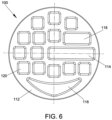
- FIG. 6 The blank according to FIG. 4 viewed from the bottom
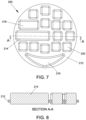
- FIG. 7 A further embodiment of a blank
- FIG. 8 A section along the line A-A in FIG. 7 .
- the blanks can preferably comprise ceramic materials such as zirconium dioxide, glass ceramic, feldspar ceramic, to name just a few ceramic materials.
- the blanks may in particular be of zirconium dioxide to which yttrium oxide, calcium oxide, magnesium oxide and/or cerium oxide is added, but in particular yttrium oxide stabilized zirconia.
- Suitable materials also include metallic materials such as titanium or CoCr alloys.
- the blanks may also be made from organic materials, optionally filled, in particular thermoplastic materials such as polymethylmethacrylate (PMMA) or polyetheretherketone (PEEK).
- thermoplastic materials such as polymethylmethacrylate (PMMA) or polyetheretherketone (PEEK).
- Disc-shaped blanks are generally used to manufacture dental molded bodies/reconstructions through material-removing working.
- the dental restorations can be in the form of dental frameworks, crowns, partial crowns, bridges, caps, veneers, abutments, pin constructions, inlays and/or onlays or dental arches, but this is by no means an exhaustive list.
- a plurality of corresponding molded bodies may be obtained, depending on the diameter of the blanks.
- Previously known blanks exhibit a uniform thickness across the regions from which the molded bodies are obtained through machining.
- a disadvantage here is that there are relatively high material losses since the material between the individual molded bodies is not utilized.
- a further particular disadvantage here is that the milling tool rotating about an axis of rotation and moving in the direction of the axis of rotation at least at the start of the processing of a molded part removes material from the blank with only a small part of the tool surface so that there is a high load on the tool. The wear is consequently relatively high.
- FIGS. 1 to 3 thus show a first embodiment of a disc-shaped blank 10 that in the diagrams has a circular geometry, which has regions of different thickness.
- the blank 10 in principle comprises a base 12 and regions that emanate therefrom, indicated by way of example by the reference numbers 14 , 16 and 18 .
- the regions 14 , 16 , 18 do not just project above one side of the base 12 , but rather extend on both sides, as clearly shown in the sectional view in FIG. 2 . This, however, is not a required characteristic. Rather, the invention relates also to a blank wherein regions project only from one side of the base.
- the height of the regions 14 , 16 , 18 is aligned with the molded bodies to be produced.
- a machining tool acts from the side on the elevated regions 14 , 16 , 18 , i.e., a relative movement to the elevation 14 , 16 , 18 substantially perpendicular to the axis of rotation of the tool is achieved.
- This possibility relates not just to the regions 14 , 16 , 18 , that are arranged in the perimeter of the blank 10 , but also to the regions surrounded by a plurality of projecting regions, as there is a distance between these, as can be seen in the sectional view of FIG. 2 .
- a corresponding distance is indicated by way of example by the reference number 20 .
- the invention provides for the elevated regions 14 , 16 , 18 emanating from the base to extend non-symmetrically on both sides of the base, so that without change to holders, that normally accommodate blanks with the usual milling machines, blanks according to the invention can be fixed in a processing machine.
- a circumferential border 22 is provided in the exemplary embodiment which limits the blank 10 peripherally.
- the edge 22 has an L-shaped cross-section and may be an integral part of the blank 10 .
- the edge 22 can of course also be a separately-produced element that is connected to the blank, i.e., in particular with the base 12 , for instance through gluing.
- the base 12 has a thickness B that is preferred in the range 1 to 10 mm, in particular between 1 mm and 5 mm, and especially preferred in the range 1.5 mm to 3 mm.
- the region 14 , 16 , 18 projecting above the upper side of the base 12 has a thickness V 1 and the region projecting from the underside of the base 12 has a thickness V 2 .
- V 1 +V 2 +B should preferably lie between 15 mm and 25 mm.
- FIGS. 4 to 6 differs from that in FIGS. 1 to 3 in that the blank 100 , which also has a circular geometry, has regions that extend differently in terms of area.
- the blank 100 which also has a circular geometry, has regions that extend differently in terms of area.
- four regions 114 , 116 , 118 and 120 are indicated.
- the regions 114 , 116 , 118 , 120 extend—as with the embodiment illustrated by FIGS. 1 to 3 —on both sides of a base 112 , as can be seen in the sectional view A-A ( FIG. 5 ).
- the blank 100 and thus the base 112 are also delimited by a circumferential edge 122 .
- the description for FIGS. 1 to 3 applies here too.
- regions of different area extend from the base 112 , it follows that molded bodies of different geometries and sizes can be obtained. For example, a four to five unit bridge can be machined from the region 114 , a front dental arch from the region 116 , a three unit bridge from the region 118 and from the other equally dimensioned regions 120 single tooth restorations such as inlays, onlays, crowns etc. can be machined.
- the teaching according to the invention enables material to be spared. This saving may be up to 40% if, for example, the base 12 , 112 has a thickness of 2 mm and the total thickness of the blank, in the regions from which the projections 14 , 16 , 18 , 114 , 116 , 118 , 120 emanate from the base 12 , 112 , is 18 mm.
- the blanks 10 , 100 according to the invention can be held in the usual holders since it is not necessary to change the profile and the dimensions of the edge 22 , 122 .
- the limb 23 , 123 of the edge 22 , 122 which extends parallel to the plane defined by the blank 10 , 100 and which in the sectional views extends horizontally, is an extension of the base 12 , 112 , as can be seen in the sectional views.
- the blanks 10 , 100 can be produced, for example, through additive methods by pressing, casting, forming or mechanical manufacturing methods.
- the material of the blank at least in the region of the elevations 14 , 16 , 18 , 114 , 116 , 118 , 120 in particular over its height to have a different composition/different material characteristics to, for instance, obtain a color gradation that corresponds to that of natural teeth for the crowns or bridges. produced.
- the exemplary embodiment according to FIGS. 7 and 8 differs from that of FIGS. 1 to 6 in that the elevated regions to be worked 214 , 216 , 218 , 220 emanate from a base 212 that is made from a material different from that of the regions 214 , 216 , 218 , 220 .
- the base 212 virtually forms a carrier that has recesses in which the elevated regions to be worked 214 , 216 , 218 , 220 are fixed, for instance through gluing. It is also possible for the base to be produced through injection molding, wherein the elevated regions 214 , 216 , 218 , 220 are surrounded by a base material layer corresponding to the thickness of the base 212 .
- Plastics in particular are suitable materials for the base 112 , i.e., the carrier.
Landscapes
- Health & Medical Sciences (AREA)
- Chemical & Material Sciences (AREA)
- Life Sciences & Earth Sciences (AREA)
- Public Health (AREA)
- Veterinary Medicine (AREA)
- General Health & Medical Sciences (AREA)
- Animal Behavior & Ethology (AREA)
- Epidemiology (AREA)
- Dentistry (AREA)
- Oral & Maxillofacial Surgery (AREA)
- Engineering & Computer Science (AREA)
- Ceramic Engineering (AREA)
- Composite Materials (AREA)
- Manufacturing & Machinery (AREA)
- Organic Chemistry (AREA)
- Structural Engineering (AREA)
- Materials Engineering (AREA)
- Dental Preparations (AREA)
- Dental Prosthetics (AREA)
Abstract
Description
Claims (21)
Priority Applications (1)
| Application Number | Priority Date | Filing Date | Title |
|---|---|---|---|
| US15/701,522 US12268564B2 (en) | 2017-09-12 | 2017-09-12 | Blanks and methods for the manufacture of at least one molded blank |
Applications Claiming Priority (1)
| Application Number | Priority Date | Filing Date | Title |
|---|---|---|---|
| US15/701,522 US12268564B2 (en) | 2017-09-12 | 2017-09-12 | Blanks and methods for the manufacture of at least one molded blank |
Publications (2)
| Publication Number | Publication Date |
|---|---|
| US20190076222A1 US20190076222A1 (en) | 2019-03-14 |
| US12268564B2 true US12268564B2 (en) | 2025-04-08 |
Family
ID=65630174
Family Applications (1)
| Application Number | Title | Priority Date | Filing Date |
|---|---|---|---|
| US15/701,522 Active US12268564B2 (en) | 2017-09-12 | 2017-09-12 | Blanks and methods for the manufacture of at least one molded blank |
Country Status (1)
| Country | Link |
|---|---|
| US (1) | US12268564B2 (en) |
Families Citing this family (1)
| Publication number | Priority date | Publication date | Assignee | Title |
|---|---|---|---|---|
| US12268564B2 (en) | 2017-09-12 | 2025-04-08 | Dentsply Sirona Inc. | Blanks and methods for the manufacture of at least one molded blank |
Citations (44)
| Publication number | Priority date | Publication date | Assignee | Title |
|---|---|---|---|---|
| US5080589A (en) * | 1988-12-20 | 1992-01-14 | Sandvik Ab | Artificial tooth crowns |
| EP0807422A1 (en) | 1996-05-17 | 1997-11-19 | Brandestini, Marco, Dr. | Method for manufacturing dental reconstructions and blank for carrying out the method |
| US20010036617A1 (en) * | 1998-04-13 | 2001-11-01 | Ann M. Knab | Prefabricated components for dental appliances |
| US20030031984A1 (en) | 1999-08-26 | 2003-02-13 | Richard P. Rusin | Ceramic dental mill blanks |
| US20030073563A1 (en) * | 1998-12-11 | 2003-04-17 | Dmitri Brodkin | Lithium disilicate glass-ceramics |
| WO2004058087A2 (en) * | 2002-12-23 | 2004-07-15 | Nano-Write Corporation | Vapor deposited titanium and titanium-nitride layers for dental devices |
| US20040146833A1 (en) * | 2002-11-06 | 2004-07-29 | Dyer Scott R. | Construction of a dental prosthesis using bilaminar fiber reinforcement |
| US20040197729A1 (en) * | 2003-02-26 | 2004-10-07 | Honstein Jerry P. | Dental prostheses modeling system with symmetric double-well trays slidably mountable to articulator |
| US20050186540A1 (en) * | 2004-02-24 | 2005-08-25 | Eldad Taub | Method and system for designing and producing dental prostheses and appliances |
| US20060257824A1 (en) * | 2005-05-13 | 2006-11-16 | Sirona Dental Systems Gmbh | Method of producing a dental prosthetic item, and a dental prosthetic item, a component therefor, and a blank therefor |
| US20080034614A1 (en) * | 2005-12-23 | 2008-02-14 | Fox Richard B | Methods of making polymeric articles and polymeric articles formed thereby |
| US20080208351A1 (en) * | 2005-04-26 | 2008-08-28 | Aarhus Universitet | Biocompatible Material for Surgical Implants and Cell Guiding Tissue Culture Surfaces |
| US20080254414A1 (en) * | 2007-04-10 | 2008-10-16 | Mcguire James A | Dental abutment blank with preformed passage |
| EP2016922A2 (en) | 2007-07-20 | 2009-01-21 | Ivoclar Vivadent AG | Adressable matrices/cluster blanks for dental CAD/CAM systems and optimization thereof |
| US20090291414A1 (en) * | 2008-05-23 | 2009-11-26 | Bioinfera, Inc. | Method for forming a dental implant |
| US20100248189A1 (en) * | 2007-05-15 | 2010-09-30 | Burger Bernd K | Method of making a facing for a dental restoration, facing for a dental restoration, and method of making a dental restoration |
| US7856286B2 (en) * | 2003-03-26 | 2010-12-21 | 3M Innovative Properties Company | Processing of shape data of a dental prosthesis |
| JP2011041809A (en) * | 2009-08-20 | 2011-03-03 | Ivoclar Vivadent Ag | Holder for cad/cam blank |
| US20110081830A1 (en) * | 2009-10-07 | 2011-04-07 | Anthony David Pollasky | Method for finishing and fitting dental restorations and an abrasive material for doing same |
| US20120114516A1 (en) * | 2010-11-09 | 2012-05-10 | Degudent Gmbh | Method for the manufacture of a shaped body as well as green compact |
| US20130059272A1 (en) * | 2010-05-21 | 2013-03-07 | 3M Innovative Properties Company | Dental ceramic article, process for production and use thereof |
| DE102011055393A1 (en) | 2011-11-15 | 2013-05-16 | Ralph Gerschütz-Rüth | Method for manufacturing different color layers on pointing blank for artificial teeth to provide subsequent treatment to e.g. implant structures, involves bringing plastic layer with bright pigmentation into cavity in injection mold |
| US20130171410A1 (en) * | 2011-12-28 | 2013-07-04 | Synthes Usa, Llc | Films and methods of manufacture |
| US20130221554A1 (en) * | 2012-02-23 | 2013-08-29 | Yunoh Jung | Non-Pre-Colored Multi-Layer Zirconia Dental Blank that has a Gradual Change in Translucency through a Thickness After Sintering |
| US20130277874A1 (en) * | 2010-12-22 | 2013-10-24 | 3M Innovative Properties Company | Methods of making multilayer anatomical all-ceramic dental appliances |
| WO2013167903A1 (en) | 2012-05-10 | 2013-11-14 | Renishaw Plc | Method of manufacturing an article |
| US20130309035A1 (en) * | 2012-05-16 | 2013-11-21 | Iscar, Ltd. | Milling Collet Having Pull-Out Preventer for Retaining a Fluted Milling Tool |
| US20140212845A1 (en) * | 2013-01-28 | 2014-07-31 | Chandur Prem Karl Wadhwani | System and method for improving cement retention in implant-supported abutment |
| US20140300014A1 (en) * | 2010-06-09 | 2014-10-09 | Tanaka Dental Products | Dental Block |
| US20150037757A1 (en) * | 2013-08-05 | 2015-02-05 | Norman Kwan | Method for attaching a dental prosthesis having multiple abutments |
| US20150066181A1 (en) * | 2012-04-19 | 2015-03-05 | Heraeus Kulzer Gmbh | Method for producing dentures |
| US20150366641A1 (en) * | 2014-06-19 | 2015-12-24 | Theodore Malinin | Compressed decalcified trabecular bone grafts and tooth socket repair |
| CN105283148A (en) * | 2013-03-11 | 2016-01-27 | 布鲁诺·斯宾德勒 | Milled blanks for abutment attachments |
| US20160113845A1 (en) * | 2013-05-03 | 2016-04-28 | Dentsply International Inc. | Process for producing a blank, and a blank |
| US20170027672A1 (en) * | 2014-04-11 | 2017-02-02 | Heraeus Kulzer Gmbh | Preformed Prosthesis-Base Blank |
| US20170181818A1 (en) * | 2015-12-28 | 2017-06-29 | Dentsply Sirona Inc. | Method for producing a blank and dental restoration |
| US20170189146A1 (en) * | 2015-12-28 | 2017-07-06 | Dentsply Sirona Inc. | Method for producing a dental restoration |
| US20170189143A1 (en) * | 2015-12-07 | 2017-07-06 | Wdt-Wolz-Dental-Technik Gmbh | Process For The Production Of A Ceramic Body, In Particular Of A Dental Ceramic Blank, With Spatially Selectively Adjustable Degrees Of Physical Properties |
| US20170202651A1 (en) * | 2014-06-27 | 2017-07-20 | Heraeus Kulzer Gmbh | Dental prosthesis modified with film and having improved properties |
| US20170231730A1 (en) * | 2014-08-12 | 2017-08-17 | Hangzhou Erran Technology Co., Ltd. | Dental all-ceramic restoration and manufacturing method thereof |
| US20170273764A1 (en) * | 2016-03-23 | 2017-09-28 | Dentsply Sirona Inc. | Method to manufacture a colored blank, and blank |
| US20180104031A1 (en) * | 2016-10-19 | 2018-04-19 | Dentsply Sirona Inc. | Method for the production of a dental restoration |
| US20180279606A1 (en) * | 2017-04-03 | 2018-10-04 | Dai Nippon Printing Co., Ltd. | Antibacterial and antifungal articles, antibacterial and antifungal agricultural materials, and antibacterial and antifungal medical devices |
| US20190076222A1 (en) | 2017-09-12 | 2019-03-14 | Dentsply Sirona Inc. | Blank and method for the manufacture of at least one molded part |
Family Cites Families (1)
| Publication number | Priority date | Publication date | Assignee | Title |
|---|---|---|---|---|
| US20080070191A1 (en) * | 2006-09-01 | 2008-03-20 | Den-Mat Corporation | Method for Forming Polychromatic Pressable Porcelain Dental Restoration |
-
2017
- 2017-09-12 US US15/701,522 patent/US12268564B2/en active Active
Patent Citations (50)
| Publication number | Priority date | Publication date | Assignee | Title |
|---|---|---|---|---|
| US5080589A (en) * | 1988-12-20 | 1992-01-14 | Sandvik Ab | Artificial tooth crowns |
| EP0807422A1 (en) | 1996-05-17 | 1997-11-19 | Brandestini, Marco, Dr. | Method for manufacturing dental reconstructions and blank for carrying out the method |
| US6846181B2 (en) * | 1997-12-29 | 2005-01-25 | Pentron Corporation | Prefabricated components for dental appliances |
| US6345984B2 (en) * | 1998-04-13 | 2002-02-12 | Jeneric/Pentron, Inc. | Prefabricated components for dental appliances |
| US20010036617A1 (en) * | 1998-04-13 | 2001-11-01 | Ann M. Knab | Prefabricated components for dental appliances |
| US20030073563A1 (en) * | 1998-12-11 | 2003-04-17 | Dmitri Brodkin | Lithium disilicate glass-ceramics |
| US20030031984A1 (en) | 1999-08-26 | 2003-02-13 | Richard P. Rusin | Ceramic dental mill blanks |
| US20040146833A1 (en) * | 2002-11-06 | 2004-07-29 | Dyer Scott R. | Construction of a dental prosthesis using bilaminar fiber reinforcement |
| WO2004058087A2 (en) * | 2002-12-23 | 2004-07-15 | Nano-Write Corporation | Vapor deposited titanium and titanium-nitride layers for dental devices |
| US20040197729A1 (en) * | 2003-02-26 | 2004-10-07 | Honstein Jerry P. | Dental prostheses modeling system with symmetric double-well trays slidably mountable to articulator |
| US7856286B2 (en) * | 2003-03-26 | 2010-12-21 | 3M Innovative Properties Company | Processing of shape data of a dental prosthesis |
| US20050186540A1 (en) * | 2004-02-24 | 2005-08-25 | Eldad Taub | Method and system for designing and producing dental prostheses and appliances |
| US20080208351A1 (en) * | 2005-04-26 | 2008-08-28 | Aarhus Universitet | Biocompatible Material for Surgical Implants and Cell Guiding Tissue Culture Surfaces |
| US20060257824A1 (en) * | 2005-05-13 | 2006-11-16 | Sirona Dental Systems Gmbh | Method of producing a dental prosthetic item, and a dental prosthetic item, a component therefor, and a blank therefor |
| US20080034614A1 (en) * | 2005-12-23 | 2008-02-14 | Fox Richard B | Methods of making polymeric articles and polymeric articles formed thereby |
| US20080254414A1 (en) * | 2007-04-10 | 2008-10-16 | Mcguire James A | Dental abutment blank with preformed passage |
| US20100248189A1 (en) * | 2007-05-15 | 2010-09-30 | Burger Bernd K | Method of making a facing for a dental restoration, facing for a dental restoration, and method of making a dental restoration |
| EP2016922A2 (en) | 2007-07-20 | 2009-01-21 | Ivoclar Vivadent AG | Adressable matrices/cluster blanks for dental CAD/CAM systems and optimization thereof |
| US20090023112A1 (en) * | 2007-07-20 | 2009-01-22 | Ivoclar Vivadent Ag | Addressable Matrices/Cluster Blanks for Dental CAD/CAM Systems and Optimization Thereof |
| US20090291414A1 (en) * | 2008-05-23 | 2009-11-26 | Bioinfera, Inc. | Method for forming a dental implant |
| JP2011041809A (en) * | 2009-08-20 | 2011-03-03 | Ivoclar Vivadent Ag | Holder for cad/cam blank |
| US20110081830A1 (en) * | 2009-10-07 | 2011-04-07 | Anthony David Pollasky | Method for finishing and fitting dental restorations and an abrasive material for doing same |
| US20130059272A1 (en) * | 2010-05-21 | 2013-03-07 | 3M Innovative Properties Company | Dental ceramic article, process for production and use thereof |
| US20140300014A1 (en) * | 2010-06-09 | 2014-10-09 | Tanaka Dental Products | Dental Block |
| US20120114516A1 (en) * | 2010-11-09 | 2012-05-10 | Degudent Gmbh | Method for the manufacture of a shaped body as well as green compact |
| US20130277874A1 (en) * | 2010-12-22 | 2013-10-24 | 3M Innovative Properties Company | Methods of making multilayer anatomical all-ceramic dental appliances |
| DE102011055393A1 (en) | 2011-11-15 | 2013-05-16 | Ralph Gerschütz-Rüth | Method for manufacturing different color layers on pointing blank for artificial teeth to provide subsequent treatment to e.g. implant structures, involves bringing plastic layer with bright pigmentation into cavity in injection mold |
| US20130171410A1 (en) * | 2011-12-28 | 2013-07-04 | Synthes Usa, Llc | Films and methods of manufacture |
| US20130221554A1 (en) * | 2012-02-23 | 2013-08-29 | Yunoh Jung | Non-Pre-Colored Multi-Layer Zirconia Dental Blank that has a Gradual Change in Translucency through a Thickness After Sintering |
| US20150066181A1 (en) * | 2012-04-19 | 2015-03-05 | Heraeus Kulzer Gmbh | Method for producing dentures |
| WO2013167903A1 (en) | 2012-05-10 | 2013-11-14 | Renishaw Plc | Method of manufacturing an article |
| US20130309035A1 (en) * | 2012-05-16 | 2013-11-21 | Iscar, Ltd. | Milling Collet Having Pull-Out Preventer for Retaining a Fluted Milling Tool |
| US20140212845A1 (en) * | 2013-01-28 | 2014-07-31 | Chandur Prem Karl Wadhwani | System and method for improving cement retention in implant-supported abutment |
| CN105283148A (en) * | 2013-03-11 | 2016-01-27 | 布鲁诺·斯宾德勒 | Milled blanks for abutment attachments |
| US20160113845A1 (en) * | 2013-05-03 | 2016-04-28 | Dentsply International Inc. | Process for producing a blank, and a blank |
| US20150037757A1 (en) * | 2013-08-05 | 2015-02-05 | Norman Kwan | Method for attaching a dental prosthesis having multiple abutments |
| US20170027672A1 (en) * | 2014-04-11 | 2017-02-02 | Heraeus Kulzer Gmbh | Preformed Prosthesis-Base Blank |
| US20150366641A1 (en) * | 2014-06-19 | 2015-12-24 | Theodore Malinin | Compressed decalcified trabecular bone grafts and tooth socket repair |
| US20170202651A1 (en) * | 2014-06-27 | 2017-07-20 | Heraeus Kulzer Gmbh | Dental prosthesis modified with film and having improved properties |
| US20170231730A1 (en) * | 2014-08-12 | 2017-08-17 | Hangzhou Erran Technology Co., Ltd. | Dental all-ceramic restoration and manufacturing method thereof |
| US20170189143A1 (en) * | 2015-12-07 | 2017-07-06 | Wdt-Wolz-Dental-Technik Gmbh | Process For The Production Of A Ceramic Body, In Particular Of A Dental Ceramic Blank, With Spatially Selectively Adjustable Degrees Of Physical Properties |
| US11090142B2 (en) * | 2015-12-28 | 2021-08-17 | Dentsply Sirona Inc. | Method for producing a blank and dental restoration |
| US20170181818A1 (en) * | 2015-12-28 | 2017-06-29 | Dentsply Sirona Inc. | Method for producing a blank and dental restoration |
| US20170189146A1 (en) * | 2015-12-28 | 2017-07-06 | Dentsply Sirona Inc. | Method for producing a dental restoration |
| US20170273764A1 (en) * | 2016-03-23 | 2017-09-28 | Dentsply Sirona Inc. | Method to manufacture a colored blank, and blank |
| US10441391B2 (en) * | 2016-03-23 | 2019-10-15 | Dentsply Sirona Inc. | Method to manufacture a colored blank, and blank |
| US10531938B2 (en) * | 2016-10-19 | 2020-01-14 | Dentsply Sirona Inc. | Method for the production of a dental restoration |
| US20180104031A1 (en) * | 2016-10-19 | 2018-04-19 | Dentsply Sirona Inc. | Method for the production of a dental restoration |
| US20180279606A1 (en) * | 2017-04-03 | 2018-10-04 | Dai Nippon Printing Co., Ltd. | Antibacterial and antifungal articles, antibacterial and antifungal agricultural materials, and antibacterial and antifungal medical devices |
| US20190076222A1 (en) | 2017-09-12 | 2019-03-14 | Dentsply Sirona Inc. | Blank and method for the manufacture of at least one molded part |
Non-Patent Citations (5)
| Title |
|---|
| "Proposed American National Standard/American Dental Association Standard No. 187 for Dentistry—Dental CAD/CAM Machinable Ceramic Blanks"; American Dental Association, Standards Committee on Dental Products, 2023. |
| CN-105283148-A translation (Year: 2023). * |
| International Preliminary Report on Patentability; PCT/EP2017/072845; Apr. 30, 2018 (completed); May 14, 2018 (mailed). |
| International Search Report; PCT/EP2017/072845; Apr. 30, 2018 (completed); May 14, 2018 (mailed). |
| Written Opinion of the International Searching Authority; PCT/EP2017/072845; Apr. 30, 2018 (completed); May 14, 2018 (mailed). |
Also Published As
| Publication number | Publication date |
|---|---|
| US20190076222A1 (en) | 2019-03-14 |
Similar Documents
| Publication | Publication Date | Title |
|---|---|---|
| US10842599B2 (en) | Method for producing a dental restoration | |
| US8235722B2 (en) | Method of producing a dental prosthetic item, and dental prosthetic item thus produced | |
| JP6509788B2 (en) | Dental restoration preform and method for producing the same | |
| US5939211A (en) | Method for the manufacture of dental reconstructions and blank for carrying out this method | |
| US20090275000A1 (en) | System and Method for Securing Multiple Ceramic Dental Blocks for Milling | |
| KR20210039333A (en) | Dental multicolored blanks | |
| US10299888B2 (en) | Pedodontic/veterinary dental crown system | |
| US11850110B2 (en) | Method of making anterior dental restorations from sintered preforms | |
| EP2821028B1 (en) | Method for producing a denture | |
| US10040134B2 (en) | Method of producing a dental restoration | |
| US20070290385A1 (en) | Blank for a Tooth Replacement Part and Method of Producing a Tooth Replacement Part | |
| US20190076222A1 (en) | Blank and method for the manufacture of at least one molded part | |
| CA3072645C (en) | Blank and method for the manufacture of at least one molded part | |
| HK40025693B (en) | Blank for the manufacture of dental molded body | |
| US20250152315A1 (en) | Methods of Making Dental Restorations from Sintered Preforms | |
| HK40025693A (en) | Blank for the manufacture of dental molded body | |
| KR20190011758A (en) | Dental prosthesis | |
| CA2978514C (en) | Dental prosthesis |
Legal Events
| Date | Code | Title | Description |
|---|---|---|---|
| FEPP | Fee payment procedure |
Free format text: ENTITY STATUS SET TO UNDISCOUNTED (ORIGINAL EVENT CODE: BIG.); ENTITY STATUS OF PATENT OWNER: LARGE ENTITY |
|
| STPP | Information on status: patent application and granting procedure in general |
Free format text: DOCKETED NEW CASE - READY FOR EXAMINATION |
|
| STPP | Information on status: patent application and granting procedure in general |
Free format text: NON FINAL ACTION MAILED |
|
| STPP | Information on status: patent application and granting procedure in general |
Free format text: RESPONSE TO NON-FINAL OFFICE ACTION ENTERED AND FORWARDED TO EXAMINER |
|
| STPP | Information on status: patent application and granting procedure in general |
Free format text: FINAL REJECTION MAILED |
|
| STPP | Information on status: patent application and granting procedure in general |
Free format text: DOCKETED NEW CASE - READY FOR EXAMINATION |
|
| STPP | Information on status: patent application and granting procedure in general |
Free format text: NON FINAL ACTION MAILED |
|
| STPP | Information on status: patent application and granting procedure in general |
Free format text: RESPONSE TO NON-FINAL OFFICE ACTION ENTERED AND FORWARDED TO EXAMINER |
|
| STPP | Information on status: patent application and granting procedure in general |
Free format text: FINAL REJECTION MAILED |
|
| STPP | Information on status: patent application and granting procedure in general |
Free format text: DOCKETED NEW CASE - READY FOR EXAMINATION |
|
| AS | Assignment |
Owner name: DENTSPLY SIRONA INC., PENNSYLVANIA Free format text: ASSIGNMENT OF ASSIGNORS INTEREST;ASSIGNORS:FECHER, STEFAN;GEBHARDT, ANDREAS;VOLKL, LOTHAR;SIGNING DATES FROM 20170928 TO 20171005;REEL/FRAME:060704/0343 |
|
| STPP | Information on status: patent application and granting procedure in general |
Free format text: NON FINAL ACTION MAILED |
|
| STPP | Information on status: patent application and granting procedure in general |
Free format text: RESPONSE TO NON-FINAL OFFICE ACTION ENTERED AND FORWARDED TO EXAMINER |
|
| STPP | Information on status: patent application and granting procedure in general |
Free format text: DOCKETED NEW CASE - READY FOR EXAMINATION |
|
| STPP | Information on status: patent application and granting procedure in general |
Free format text: NON FINAL ACTION MAILED |
|
| STPP | Information on status: patent application and granting procedure in general |
Free format text: RESPONSE TO NON-FINAL OFFICE ACTION ENTERED AND FORWARDED TO EXAMINER |
|
| STPP | Information on status: patent application and granting procedure in general |
Free format text: FINAL REJECTION MAILED |
|
| STPP | Information on status: patent application and granting procedure in general |
Free format text: DOCKETED NEW CASE - READY FOR EXAMINATION |
|
| STPP | Information on status: patent application and granting procedure in general |
Free format text: NON FINAL ACTION MAILED |
|
| STPP | Information on status: patent application and granting procedure in general |
Free format text: RESPONSE TO NON-FINAL OFFICE ACTION ENTERED AND FORWARDED TO EXAMINER |
|
| STPP | Information on status: patent application and granting procedure in general |
Free format text: NOTICE OF ALLOWANCE MAILED -- APPLICATION RECEIVED IN OFFICE OF PUBLICATIONS |
|
| STPP | Information on status: patent application and granting procedure in general |
Free format text: NOTICE OF ALLOWANCE MAILED -- APPLICATION RECEIVED IN OFFICE OF PUBLICATIONS |
|
| STPP | Information on status: patent application and granting procedure in general |
Free format text: PUBLICATIONS -- ISSUE FEE PAYMENT RECEIVED |
|
| STPP | Information on status: patent application and granting procedure in general |
Free format text: PUBLICATIONS -- ISSUE FEE PAYMENT VERIFIED |
|
| STCF | Information on status: patent grant |
Free format text: PATENTED CASE |