EP0806925B1 - Absorbent article - Google Patents
Absorbent article Download PDFInfo
- Publication number
- EP0806925B1 EP0806925B1 EP96903622A EP96903622A EP0806925B1 EP 0806925 B1 EP0806925 B1 EP 0806925B1 EP 96903622 A EP96903622 A EP 96903622A EP 96903622 A EP96903622 A EP 96903622A EP 0806925 B1 EP0806925 B1 EP 0806925B1
- Authority
- EP
- European Patent Office
- Prior art keywords
- elastic pieces
- topsheet
- portions
- backsheet
- absorbent article
- Prior art date
- Legal status (The legal status is an assumption and is not a legal conclusion. Google has not performed a legal analysis and makes no representation as to the accuracy of the status listed.)
- Expired - Lifetime
Links
Images








Classifications
-
- A—HUMAN NECESSITIES
- A61—MEDICAL OR VETERINARY SCIENCE; HYGIENE
- A61F—FILTERS IMPLANTABLE INTO BLOOD VESSELS; PROSTHESES; DEVICES PROVIDING PATENCY TO, OR PREVENTING COLLAPSING OF, TUBULAR STRUCTURES OF THE BODY, e.g. STENTS; ORTHOPAEDIC, NURSING OR CONTRACEPTIVE DEVICES; FOMENTATION; TREATMENT OR PROTECTION OF EYES OR EARS; BANDAGES, DRESSINGS OR ABSORBENT PADS; FIRST-AID KITS
- A61F13/00—Bandages or dressings; Absorbent pads
- A61F13/15—Absorbent pads, e.g. sanitary towels, swabs or tampons for external or internal application to the body; Supporting or fastening means therefor; Tampon applicators
- A61F13/45—Absorbent pads, e.g. sanitary towels, swabs or tampons for external or internal application to the body; Supporting or fastening means therefor; Tampon applicators characterised by the shape
- A61F13/47—Sanitary towels, incontinence pads or napkins
- A61F13/472—Sanitary towels, incontinence pads or napkins specially adapted for female use
- A61F13/47272—Sanitary towels, incontinence pads or napkins specially adapted for female use with a longitudinal raised end, e.g. cup-shaped gluteal groove
-
- A—HUMAN NECESSITIES
- A61—MEDICAL OR VETERINARY SCIENCE; HYGIENE
- A61F—FILTERS IMPLANTABLE INTO BLOOD VESSELS; PROSTHESES; DEVICES PROVIDING PATENCY TO, OR PREVENTING COLLAPSING OF, TUBULAR STRUCTURES OF THE BODY, e.g. STENTS; ORTHOPAEDIC, NURSING OR CONTRACEPTIVE DEVICES; FOMENTATION; TREATMENT OR PROTECTION OF EYES OR EARS; BANDAGES, DRESSINGS OR ABSORBENT PADS; FIRST-AID KITS
- A61F13/00—Bandages or dressings; Absorbent pads
- A61F13/15—Absorbent pads, e.g. sanitary towels, swabs or tampons for external or internal application to the body; Supporting or fastening means therefor; Tampon applicators
- A61F13/15577—Apparatus or processes for manufacturing
- A61F13/15707—Mechanical treatment, e.g. notching, twisting, compressing, shaping
-
- A—HUMAN NECESSITIES
- A61—MEDICAL OR VETERINARY SCIENCE; HYGIENE
- A61F—FILTERS IMPLANTABLE INTO BLOOD VESSELS; PROSTHESES; DEVICES PROVIDING PATENCY TO, OR PREVENTING COLLAPSING OF, TUBULAR STRUCTURES OF THE BODY, e.g. STENTS; ORTHOPAEDIC, NURSING OR CONTRACEPTIVE DEVICES; FOMENTATION; TREATMENT OR PROTECTION OF EYES OR EARS; BANDAGES, DRESSINGS OR ABSORBENT PADS; FIRST-AID KITS
- A61F13/00—Bandages or dressings; Absorbent pads
- A61F13/15—Absorbent pads, e.g. sanitary towels, swabs or tampons for external or internal application to the body; Supporting or fastening means therefor; Tampon applicators
- A61F13/45—Absorbent pads, e.g. sanitary towels, swabs or tampons for external or internal application to the body; Supporting or fastening means therefor; Tampon applicators characterised by the shape
- A61F13/47—Sanitary towels, incontinence pads or napkins
- A61F13/475—Sanitary towels, incontinence pads or napkins characterised by edge leakage prevention means
- A61F13/4751—Sanitary towels, incontinence pads or napkins characterised by edge leakage prevention means the means preventing fluid flow in a transversal direction
- A61F13/4752—Sanitary towels, incontinence pads or napkins characterised by edge leakage prevention means the means preventing fluid flow in a transversal direction the means being an upstanding barrier
- A61F13/4753—Sanitary towels, incontinence pads or napkins characterised by edge leakage prevention means the means preventing fluid flow in a transversal direction the means being an upstanding barrier the barrier being not integral with the topsheet or backsheet
-
- A—HUMAN NECESSITIES
- A61—MEDICAL OR VETERINARY SCIENCE; HYGIENE
- A61F—FILTERS IMPLANTABLE INTO BLOOD VESSELS; PROSTHESES; DEVICES PROVIDING PATENCY TO, OR PREVENTING COLLAPSING OF, TUBULAR STRUCTURES OF THE BODY, e.g. STENTS; ORTHOPAEDIC, NURSING OR CONTRACEPTIVE DEVICES; FOMENTATION; TREATMENT OR PROTECTION OF EYES OR EARS; BANDAGES, DRESSINGS OR ABSORBENT PADS; FIRST-AID KITS
- A61F13/00—Bandages or dressings; Absorbent pads
- A61F13/15—Absorbent pads, e.g. sanitary towels, swabs or tampons for external or internal application to the body; Supporting or fastening means therefor; Tampon applicators
- A61F13/45—Absorbent pads, e.g. sanitary towels, swabs or tampons for external or internal application to the body; Supporting or fastening means therefor; Tampon applicators characterised by the shape
- A61F13/47—Sanitary towels, incontinence pads or napkins
- A61F13/476—Sanitary towels, incontinence pads or napkins characterised by encircling the crotch region of the undergarment, e.g. with flaps
-
- A—HUMAN NECESSITIES
- A61—MEDICAL OR VETERINARY SCIENCE; HYGIENE
- A61F—FILTERS IMPLANTABLE INTO BLOOD VESSELS; PROSTHESES; DEVICES PROVIDING PATENCY TO, OR PREVENTING COLLAPSING OF, TUBULAR STRUCTURES OF THE BODY, e.g. STENTS; ORTHOPAEDIC, NURSING OR CONTRACEPTIVE DEVICES; FOMENTATION; TREATMENT OR PROTECTION OF EYES OR EARS; BANDAGES, DRESSINGS OR ABSORBENT PADS; FIRST-AID KITS
- A61F13/00—Bandages or dressings; Absorbent pads
- A61F13/15—Absorbent pads, e.g. sanitary towels, swabs or tampons for external or internal application to the body; Supporting or fastening means therefor; Tampon applicators
- A61F13/45—Absorbent pads, e.g. sanitary towels, swabs or tampons for external or internal application to the body; Supporting or fastening means therefor; Tampon applicators characterised by the shape
- A61F2013/4512—Absorbent pads, e.g. sanitary towels, swabs or tampons for external or internal application to the body; Supporting or fastening means therefor; Tampon applicators characterised by the shape folded in special shape during use
- A61F2013/4543—Absorbent pads, e.g. sanitary towels, swabs or tampons for external or internal application to the body; Supporting or fastening means therefor; Tampon applicators characterised by the shape folded in special shape during use with a special transverse section
- A61F2013/4562—Absorbent pads, e.g. sanitary towels, swabs or tampons for external or internal application to the body; Supporting or fastening means therefor; Tampon applicators characterised by the shape folded in special shape during use with a special transverse section cup-shaped
Definitions
- absorbent articles refers to sanitary napkins, pantiliners, and incontinence pads designed to absorb and retain body fluids, such as menses and urine, discharged from the human body when they are worn so as to cover the urogenital region.
- the absorbent article is desired to be such that the topsheet, the core, and the backsheet extend upwardly inclinedly toward the longitudinal ends of the absorbent article at each of the longitudinally opposite end portions thereof, thereby assuming the shape of a cup as a whole, and that so-called cuffs extending upwardly inclinedly in a widthwise inwardly or outwardly are formed on both sides of the longitudinally central portion of the absorbent article.
- widthwise refers to a direction extending on the right and left of the body along the absorbent article worn in a required state covering the wearer's urogenital region (a direction extending substantially horizontally in the right-and-left direction of the body when the absorbent article is laid, in a flat form, substantially horizontally below the crotch region of the body standing upright).
- a first proposal in the prior art for making the absorbent article cup-shaped and forming cuffs is to shape the topsheet, the core and the backsheet themselves such that the absorbent article takes the cup-like form, and the topsheet and/or the backsheet forms the cuffs on both sides of the longitudinally central portion of the absorbent article, rather than shaping the topsheet, the core and the backsheet to an originally flat form.
- this first proposal can be cited the specification and drawings of U.S. Patent 3,575,174, the specification and drawings of U.S Patent 4,678,527 (Japanese Laid-Open Patent Publication No 76156/86), and the specification and drawings of U.S. Patent 4,834,739 (Japanese Laid-Open Patent Publication No. 4371/90)
- the absorbent article constructed in accordance with the first proposal in the prior art involves the following problems: (1) The cost of manufacturing considerably increases, because the topsheet, the core and the backsheet have to be shaped to a required form. (2) The free end of the cuff is contacted with the wearer's skin. Since the portion constituting the cuff has no stretching properties, it is highly likely to cause discomfort to the wearer, leading to a poor feeling when worn.
- a second proposal in the prior art for making the absorbent article cup-shaped, as stated above, and forming the cuffs is to join elastically expansile and contractile band-like elastic pieces, in an elastically elongated state, to the topsheet and/or the backsheet on both sides in the widthwise direction of the absorbent article.
- the band-like elastic piece the use of a rubber strip or a thermoplastic elastomer strip has been proposed.
- the topsheet, core and backsheet are shaped like the cup, and the topsheet and/or the backsheet forms the cuffs, owing to the contracting action of the band-like elastic pieces
- this second proposal can be cited the specification and drawings of U.S.
- Patent 4,579,556 the specification and drawings of U.S. Patent 4,701,177, the specification and drawings of U S Patent 4,758,241, the specification and drawings of U.S. Patent 4,770,657, the specification and drawings of U.S Patent 4,944,735 (Japanese Laid-Open Patent Publication No. 193461/85), the specification and drawings of U.S. Patent 5,032,121, the specification and drawings of U.S. Patent 5,074,856, the specification and drawings of U.S. Patent 5,234,422, the specification and drawings of U.S. Patent 5,308,346, the specification and drawings of U.S. Patent 5,312,386 (Japanese Laid-Open Patent Publication No.
- the absorbent article constructed in accordance with the second proposal in the prior art elastic stretching properties are imparted to the absorbent article, because of the presence of the band-like elastic pieces formed of a rubber strip or a thermoplastic elastomer. This results in a better feeling when worn than that of the absorbent article constructed in accordance with the first proposal.
- the absorbent article following the second proposal poses the following problems: (1) The cost of manufacturing considerably increases, because the use of the band-like elastic piece made of a relatively expensive rubber strip or thermoplastic elastomer strip is required. (2) It is necessary to create in the topsheet a space for accommodating the band-like elastic pieces, and/or additionally dispose a means for joining the elastic pieces to the topsheet and/or the backsheet, as required. This adds to the cost of manufacturing.
- a third proposal in the prior art for making the absorbent article cup-shaped, as stated above, and forming the cuffs is to thermally bond the longitudinally opposite ends and the widthwise outward portion of a thermoplastic elastic piece, in an elastically elongated state, to required sites on the upper surface of the topsheet joined, as required, to the core and the backsheet on each of both sides of the absorbent article.
- the topsheet, core and backsheet are shaped like the cup owing to the contracting action of the elastic pieces.
- the elastic pieces are caused to extend upwardly inclinedly in a widthwise inward direction, forming the cuffs.
- thermoplastic elastic pieces themselves which are thermally bonded to the topsheet form cuffs on both sides of the longitudinally central portion. Moreover, thermal bonding can be carried out relatively simply. Thus, some improvement is achieved on the aforementioned problems facing the absorbent articles constructed in accordance with the first and second proposals.
- the absorbent article following the third proposal presents with the following problems: (1) The elastic piece is in the form of an ordinary film, with its front and back being planar. Thus, it has a relatively large area of contact with the wearer's skin, and the feeling of the absorbent article when worn is still not satisfactory.
- thermoplastic elastic piece needs to be formed of a material having sufficient elasticity, and is thus relatively expensive, adding considerably to the cost of manufacturing
- the thermoplastic elastic piece needs to be formed of a material having sufficient elasticity, which usually is considerably different from the material of the topsheet in terms of the molecular structure. Hence, it is difficult to thermally bond the thermoplastic elastic piece to the topsheet fully satisfactorily.
- the core and the backsheet are joined to the topsheet to form the body of the absorbent article.
- the present invention has been accomplished in the light of the above-mentioned facts.
- the first objective for the invention is to provide an absorbent article which takes the form of a cup as a whole, forms upwardly extending cuffs on both sides of the longitudinally central portion thereof, and yet produces a fully satisfactory feeling when worn.
- elastic pieces to be joined to at least one of the topsheet and the backsheet are formed from a web deformed at least partially in a non-planar configuration by machining.
- an absorbent article comprising a liquid pervious topsheet, a liquid impervious backsheet, an absorbent core disposed intermediate the topsheet and the backsheet, and a pair of band-like elastic pieces arranged on both sides of the absorbent article and joined to at least one of the topsheet and the backsheet in a longitudinally elastically elongated state; the topsheet, the backsheet, and the core being caused to extend upwardly inclinedly toward the longitudinal ends of the absorbent article at each of the longitudinally opposite end portions thereof, and the elastic pieces being caused to extend upwardly on both sides of the longitudinally central portion of the absorbent article, owing to the contracting action of the elastic pieces; wherein each of the elastic pieces is formed from a web deformed at least partially in a non-planar configuration by machining.
- thermoplastic polyolefin film lacking required elasticity prior to machining preferably a polyethylene or polyethylene blended film
- the machined synthetic resin film includes deformed portions deformed in a non-planar configuration by machining, and undeformed portions retained in a planar configuration. Furthermore, the undeformed portions are caused to extend longitudinally, and the contracting action of each of the elastic pieces is generated mainly by the undeformed portions.
- the undeformed portions undergo a substantially molecular-level deformation and the deformed portions undergo a substantially geometric deformation.
- the area rate of the undeformed portions of each of the elastic pieces is 1 to 30%, preferably 3 to 20%, more preferably 5 to 12%. If the area rate of the undeformed portions is too large, discomfort the wearer feels upon contact with the skin increases. If the area rate of the undeformed portions is too small, by contrast, the contracting action for shaping the absorbent article like a cup tends to be diminished markedly.
- each of the elastic pieces is folded back along a longitudinally extending fold-back line to have a two-layer configuration, and the fold-back lines define the upper edges on both sides of the longitudinal central portion of the absorbent article.
- the fold-back line can be situated at the undeformed portion or the deformed portion.
- the upper edge of the elastic piece becomes relatively sharp, providing a good contact with the wearers skin.
- the fold-back line is situated at the deformed portion, the upper edge of the elastic piece (the fold-back line) becomes dull, giving the wearer a gentle feeling when wearing the absorbent article.
- each of the elastic pieces is disposed above the topsheet such that the fold-back line defines the widthwise inward edge, each of the elastic pieces is joined to the topsheet at the widthwise outward edge and the longitudinally opposite ends of each of the elastic pieces, and the elastic pieces are caused to extend upwardly inclinedly in a widthwise inward direction at the longitudinally central portion of the absorbent article, owing to the contracting action of the elastic pieces.
- Each of the elastic pieces in an elastically elongated configuration includes. in the longitudinally central portion, an additional portion which extends further widthwise outwardly from the widthwise outward edge of the elastic piece joined to the topsheet, and which is then folded back to extend widthwise inwardly.
- the additional portion of the elastic piece may also be caused to extend upwardly inclinedly in a widthwise outward direction owing to the contracting action of the elastic pieces.
- the widthwise outward region of the additional portion of each of the elastic pieces can constitute a wing to be folded back onto the outside surface of panties,
- each of the elastic pieces is disposed such that the fold-back line defines the widthwise outward edge, each of the elastic pieces in an elastically elongated configuration is caused to extend widthwise outwardly beyond both side edges of the top sheet in the longitudinally central portion, each of the elastic pieces is joined to at least one of the topsheet and the backsheet at the widthwise outward edges and the longitudinally opposite ends of at least one of the topsheet and the backsheet. and the elastic pieces are caused to extend upwardly inclinedly in a widthwise outward direction in the longitudinally central portion, owing to the contracting action of the elastic pieces.
- the cost of the elastic piece as the material is sufficiently low.
- the molecular structure of the topsheet and/or the backsheet and that of the elastic piece are rendered substantially the same or similar to each other, thereby enabling the thermal bonding of the elastic piece to the topsheet and/or the backsheet to be performed with ease.
- Figs. 1 to 3 show a sanitary napkin, an embodiment of an absorbent article constructed in accordance with the present invention.
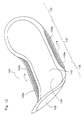
- the napkin shown entirely at the numeral 2 is not in a substantial flat form, but is cup-shaped as illustrated in Fig. 1. owing to the contracting action of elastic pieces.
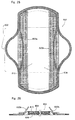
- Fig. 2 the entire napkin 2 is shown in a substantially flat state with its elastic pieces elongated elastically.
- the napkin 2 indicated in Figs. 1 to 3 has a liquid pervious topsheet 4, a liquid impervious backsheet 6, and an absorbent core 8 disposed intermediate the topsheet 4 and the backsheet 6.
- the topsheet 4 importantly should permit bodily discharges from the wearer to rapidly penetrate the absorbent core 8, and should not cause excessive discomfort to the wearer when it is contacted with the wearer's skin.
- the topsheet 4 can be formed advantageously from materials, such as woven or nonwoven fabrics of natural or synthetic fibers; apertured thermoplastic films; porous foams; reticulated foams; reticulated thermoplastic films; and thermoplastic scrims.
- the topsheet 4 comprises a primary topsheet layer 10 and a secondary topsheet layer 12. In the state shown in Fig. 2, the primary topsheet layer 10 is nearly rectangular overall, with its longitudinally (up-and-down in Fig.
- Such primary topsheet layer 10 can be preferably formed from an apertured polyolefinic film as disclosed in the specification and drawings of U.S. Patents 3,929,135, 4,324,246, 4,342,314, 4,463,045 and 5,006,394.
- the secondary topsheet layer 12 is joined to the inner surface, i.e., undersurface, of the primary topsheet layer 10.
- the secondary topsheet layer 12 is rectangular, and its longitudinal and widthwise dimensions are smaller than the longitudinal and widthwise dimensions of the primary topsheet layer 10, with the peripheral edge portion of the primary topsheet layer 10 extending beyond the peripheral edge portion of the secondary topsheet layer 12.
- the secondary topsheet layer 12 desirably has the function to disperse a body fluid, which has passed through the primary topsheet layer 10, mainly in the longitudinal direction and cause it to flow into the absorbent core 8.
- Such secondary topsheet layer 12 can be formed preferably from a natural or synthetic nonwoven fabric.
- Particularly preferred nonwovens for forming the secondary topsheet layer 12 include a nonwoven fabric of spunbond polypropylene fibers designated P-9 available from the Fiberweb Corporation of Simpsonville, South Carolina, USA, under the tradename CELESTRA; and a nonwoven fabric formed of bicomponent fibers which have a polyethylene sheath and a polyestere core/a polyethylene sheath and a polypropylene core, the fabric available from the Havix Company, of Japan, as S2146.
- the primary topsheet layer 10 and the secondary topsheet layer 12 are advantageously joined together by adhesive bonding via a suitable adhesive, ultrasonic welding, or thermal bonding which is carried out in a multiplicity of discrete areas.
- the areas of bonding, welding or thermal bonding between the primary topsheet layer 10 and the secondary topsheet layer 12 are indicated by heavy solid lines for convenience of illustration.
- the backsheet 6 importantly has the function to prevent body fluids absorbed to the absorbent core 8 from flowing out of the napkin and soiling the wearer and/or the wearer's clothing.
- the backsheet 6 can be advantageously formed from a flexible liquid impervious thermoplastic film such as a polyolefinic film.
- Particularly preferred films for forming the backsheet 6 include a low density polyethylene film 0.01 to 0.05 mm, particularly, about 0.025 mm, in thickness.
- Such a polyethylene film is sold by the Ethyl Corp., Visqueen Division, as Model XP-39385 and by the Clopay Corp. of Cincinnati, Ohio, USA, as SOFLEXX 1401.
- the backsheet 6 has a shape and dimensions which are substantially the same as the shape and dimensions of the primary topsheet layer 10 of the topsheet 4.
- the primary topsheet layer 10 of the topsheet 4 and the backsheet 6 are thermally bonded uninterruptedly throughout their peripheral edges.
- the area 16 of thermal bonding between the primary topsheet layer 10 and the backsheet 6 is represented by intersecting diagonal lines in Fig. 2, and heavy solid lines in Fig. 3. If desired, the primary topsheet layer 10 and the backsheet 6 may be joined together in other suitable manner, such as bonding with an adhesive.
- a pressure sensitive adhesive for detachably securing the napkin 2 to required sites on the inner surface of the undergarment of the wearer can be applied to the outside surface, i.e., the undersurface, of the backsheet 6 in one or more longitudinally extending bands.
- a suitable pressure sensitive adhesive is Century Adhesive A-305-IV sold by Century Adhesive Corp. of Columbus, Ohio, USA.
- the absorbent core 8 disposed between the topsheet 4 and the backsheet 6 importantly functions to absorb and retain body fluids that have penetrated the topsheet 4 after discharge from the wearer.
- Such absorbent core 8 can be advantageously formed from materials, such as comminuted wood pulp called airfelt; creped cellulose wadding; meltblown polymers; chemically stiffened, modified, or crosslinked cellulosic fibers, absorbent foams; layers of tissue paper; absorbent gelling materials (materials gelling when absorbing liquids); or any suitable combinations of these.
- the joining of the core 8 and the secondary topsheet layer 12 and the joining of the core 8 and the backsheet 6 are advantageously achieved by bonding via a suitable adhesive which is carried out in a multiplicity of discrete areas.
- the core 8 may be joined to the secondary topsheet layer 12 and/or the backsheet 6 in other suitable manner, such as ultrasonic welding or thermal bonding.
- the discrete areas 18 of bonding, welding or thermal bonding between the core 8 and the secondary topsheet layer 12, and the discrete areas 19 of bonding, welding or thermal bonding between the core 8 and the backsheet 6 are indicated by heavy solid lines for convenience of illustration.
- the widthwise inward edges of the elastic pieces 20a and 20b extend substantially straightly in the longitudinal direction.
- the widthwise outward edge and longitudinally opposite edges of each of the elastic pieces 22a and 22b are rendered consistent with the widthwise outward edge and opposite edges of the topsheet 4.
- Each of the elastic pieces 20a and 20b has the respective layers of the two-layer structure thereof thermally bonded together, and is thermally bonded to the primary topsheet layer 10 of the topsheet 4, at the widthwise outward edge and longitudinally opposite edges thereof.
- Such areas 26a and 26b of thermal bonding are represented by intersecting diagonal lines in Fig. 2, and heavy solid lines in Fig. 3, for convenience of illustration.
- the areas 26a and 26b of thermal bonding are substantially conformed to the main part of the above-mentioned area 16 of thermal bonding between the primary topsheet layer 10 of the topsheet 4 and the backsheet 6 (i.e., that part in the area 16 of heating which excludes the widthwise central area of the longitudinally opposite edges where the elastic pieces 20a and 20b are not present).
- each of the elastic pieces 20a and 20b has the respective layers of the two-layer structure thereof thermally bonded together, and is thermally bonded to the primary topsheet layer 10 of the topsheet 4, at a plurality of longitudinally spaced apart sites in each of the longitudinally opposite end portions, and more specifically, at three sites 28a and 28b of thermal bonding delineated in solid lines in Figs. 1 and 2, by operating a thermal bonding tool (not shown) there.
- at least part of the plurality of thermal bonding sites 28a and 28b is present within the region where the longitudinally opposite end portions of the core 8 are located below the primary topsheet layer 10 of the topsheet 4.
- thermal bonding other suitable method may be employed to join the elastic pieces 20a and 20b to the primary topsheet layer 10 of the topsheet 4 (where necessary, while joining the respective layers of their two-layer structure to each other).
- the elastic pieces 20a and 20b are located above the topsheet 4 in an elongated state, and are thermally bonded thereto at the areas 26a and 26b of thermal bonding as well as the sites 28a and 28b of thermal bonding. Afterwards, the force that has maintained the elastic pieces 20a and 20b in an elongated condition is released. As a result, the non-thermally bonded portions of the elastic pieces 20a and 20b elastically contract, and thus, the elastic pieces 20a and 20b try to restore their original lengths at least partially.
- the topsheet 4, the backsheet 6 and the core 8 are displaced to extend upwardly inclinedly toward the longitudinally opposite ends in each of the longitudinally opposite end portions 30, as clearly illustrated in Fig. 1.
- the napkin 2 is brought into the shape of a cup as a whole.
- each of the elastic pieces 20a and 20b is caused to extend upwardly inclinedly in a widthwise inward direction (accordingly, toward the aforementioned fold-back lines 22a and 22b).
- the elastic pieces 20a and 20b form cuffs which function as barriers for preventing body fluids from leaking widthwise outwardly.
- the primary topsheet layer 10 of the topsheet 4 and the backsheet 6 tend to be locally bent at the four corners of the napkin 2 owing to the contracting action of the elastic pieces 20a and 20b, since the primary topsheet layer 10 of the topsheet 4 and the backsheet 6 have relatively low stiffness.
- thermal bonding is performed at the sites 28a and 28b of thermal bonding, on the other hand, the elastically contracting action of the elastic pieces 20a and 20b is locally eliminated between the sites 28a and 28b of thermal bonding.
- the elastic pieces 20a and 20b are locally joined to the relatively highly stiff core 8 via the primary topsheet layer 10, whereby the contracting action of the elastic pieces 20a and 20b is effectively transmitted to the core 8. Consequently, the undesirable local bending of the primary topsheet layer 10 of the topsheet 4 and the backsheet 6 at the four corners of the napkin 2 is prevented, and the topsheet 4, backsheet 6 and core 8 are caused to extend upwardly inclinedly toward the longitudinally opposite ends, as desired, in each of the longitudinally opposite end portions 30.
- the contracting action of the elastic pieces 20a and 20b joined in an elastically elongated state to the topsheet 4 is generated mainly by the elastic restoring effect of the undeformed portions, as will be clearly understood from the description to be given below.
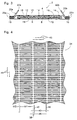
- Figs. 4 and 5 show a web 34 that can be used preferably for forming the elastic pieces 20a and 20b.
- This web 34 is composed of deformed portions 36 deformed in a non-planar configuration by machining, and undeformed portions 38 retained in a planar configuration.
- the deformed portions 36 and the undeformed portions 38 are arranged alternately in a side-by-side relationship in the widthwise direction shown by arrows 43 (in the right-and-left direction in Fig. 4), and are caused to extend uninterruptedly in the longitudinal direction shown by arrows 44 (in the up-and-down direction in Fig. 4)
- arrows 44 in the up-and-down direction in Fig. 4
- the deformed portion 36 includes a primary deformed portion 40, and secondary deformed portions 42 located on both sides in its widthwise direction.
- the primary deformed portion 40 takes a substantially uniform nearly wavy form in its longitudinal cross section, and takes a substantially horizontally extending straight form in its widthwise cross section.
- the secondary deformed portion 42 is a region of transition from the primary deformed portion 40 and the undeformed portion 38.
- the proportion of the deformed portions 36 (including the primary deformed portions 40 and the secondary deformed portions 42) in the web 34 is about 70 to 99%, preferably 80 to 97%, more preferably 88 to 95%, when calculated as the rate of area on the assumption that the web 34 is in a non-elongated state and the deformed portions 36 (including the primary deformed portions 40 and the secondary deformed portions 42) are in an undeformed planar configuration, that is, the state illustrated as such in Fig. 4 (a non-elongated plan view). If the proportion of the undeformed portions 38 in the web 36 is too high, the elastic elongation of the elastic pieces 20a and 20b tends to become relatively difficult.
- the proportion of the undeformed portions 38 in the web 36 is too low, the contracting action of the elastic pieces 20a and 20b joined in an elastically elongated state to the topsheet 4 is minimal, making it difficult to shape the napkin 2 into a desired cup-like form. Furthermore, the following fact should also be noticed in regard to the proportion of the undeformed portions 38 in the web 36: Since the deformed portions 36 are in a non-planar configuration, they touch the skin of the napkin 2 wearer only locally at a plurality of small spaced apart regions.
- the width W1 of the deformed portion 36 is 0.25 to 50.80 mm (0.01 to 2.00 inches), preferably, 3.18 to 25.40 mm (0.13 to 1.00 inch), while the width W2 of the undeformed portion 38 is 0.25 to 12.70 mm (0.01 to 0.50 inch), preferably, 0.76 to 6.35 mm (0.03 to 0.25 inch).
- the web 34 shown in Figs. 4 and 5 exhibits desired elasticity as the elastic pieces 20a and 20b in the longitudinal direction indicated by arrows 44.
- a longitudinal tensile force is exerted on the web 34 to elongate it, its cross sectional configuration is geometrically changed as illustrated in Fig. 6, with its wavy ups and downs being gradually decreased.
- the wavy configuration substantially vanishes as shown in Fig. 7.
- the resistive force of the deformed portions 36 to the elongation is markedly low.
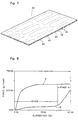
- Fig. 8 shows the relationship between a longitudinally exerted tensile force and elongation in a specific web.
- Curve A depicts the results of measurements of a longitudinally exerted tensile force and elongation in an ordinary web consisting entirely of the undeformed portions
- Curve B reveals the measurement results on the relation between a longitudinally exerted tensile force and elongation in a web machined to have the form illustrated in Figs. 4 and 5.
- the web comprised entirely of the undeformed web was a linear low density polyethylene film, approximately 0.025 mm in thickness, designated sample 1401 available from Clopay Corp., Cincinnati, Ohio, U.S.A.
- a web comprising the same linear low density polyethylene film subjected to predetermined machining was used as will be understood from curve B, the web 34 made into the form of Figs. 4 and 5 by machining has a stage I with a relatively low tensile force for a relatively high elongation, and a stage II with a sharply increased tensile force for elongation.
- Fig. 9 shows a processing means 44 for preferable use in applying desired machining.
- the processing means 44 includes a pair of rotationally processing rollers 46 and 48 acting cooperatively.
- the processing roller 46 has processing regions 50 and non-processing regions 52 arranged alternately in the widthwise direction, the processing region 50 having a multiplicity of processing projections 54 all over its circumference.
- the processing roller 48 has processing regions 56 and non-processing regions 58 arranged alternately in the widthwise direction, the processing region 56 having a multiplicity of processing projections 60 all over its circumference.
- the processing regions 50 of the processing roller 46 and the processing regions 56 of the processing roller 48 are located at corresponding positions, and the processing projections 54 and the processing projections 60 work cooperatively.
- the non-processing regions 52 of the processing roller 46 are positioned in correspondence with the non-processing regions 58 of the processing roller 48.
- an ordinary unprocessed web is fed between the processing rollers 46 and 48 continuously rotated in the directions shown by arrows 62, the portions of the web passing between the processing regions 50 and 56 of the processing rollers 46 and 48 are machined, producing the deformed portions 36.
- the portions of the web passing between the non-processing regions 52 and 58 of the processing rollers 46 and 48 are not machined, but left in a substantially planar configuration, constituting the undeformed portions 38.
- Suitable web materials to be partially machined for making a web including the deformed portions 36 and the undeformed portions 38 are polyolefin thermoplastic films including linear low density polyethylene (LLDPE), low density polyethylene (LDPE), ultra low density polyethylene (ULDPE), high density polyethylene (HDPE), polypropylene, or blends of these.
- web materials to be partially machined for making a web including the deformed portions 36 and the undeformed portions 38 may be polyester, polyurethane, compostable or biodegradable polymers, heat shrink polymers, thermoplastic elastomers, metallocene catalyst-based polymers (e.g, INSITE available from Dow Chemical Company, and Exxact available from Exxon), and breathable polymers.
- the deformed portions 36 and the undeformed portions 38 are caused to extend longitudinally continuously. If desired, the undeformed portions extending longitudinally over a predetermined length may be suitably arranged discretely at suitably spaced apart locations. Also, instead of causing the deformed portions and/or undeformed portions to extend substantially straightly in the longitudinal direction, it is possible to cause these portions to extend inclinedly in a suitable direction, or with suitable curvature.
- the elastic pieces 20a and 20b are folded back along the fold-back lines 22a and 22b to have a two-layer configuration.
- the fold-back lines 22a and 22b can be caused to extend along the undeformed portion 38 as shown in Fig. 10, or the fold-back lines 22a and 22b can be caused to extend along the deformed portion 36 as shown in Fig. 11.
- the fold-back lines 22a and 22b are caused to extend along the undeformed portion 38, the upper edge of the fold becomes relatively sharp, providing a good contact with the wearer's skin.
- the fold-back lines 22a and 22b are caused to extend along the deformed portion 36, the fold-back line becomes relatively dull, improving the feeling of the napkin when worn.
- the elastic pieces 20a and 20b are thermally bonded to the topsheet 4 at the plurality of sites 28a and 28b of thermal bonding as well as the regions 26a and 26b of thermal bonding. Since the contracting action of the elastic pieces 20a and 20b is generated mainly by the undeformed portions 38 as aforementioned, it is important that the sites 28a and 28b of thermal bonding include the undeformed portions 38. If thermal bonding is not limited to the undeformed portions 38, but partially extends to the deformed portions 36 as well, the mechanical deformation of the deformed portions 36 is destroyed by the thermal bonding.
- the areas of the sites 28a and 28b of thermal bonding should preferably be minimized. It is also preferred that a plurality of the sites 28a and 28b of thermal bonding of a relatively small area be disposed at spaced apart locations instead of providing one site 28a and one site 28b of thermal bonding of a relatively large area.
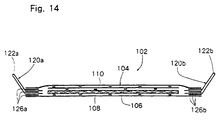
- Figs. 12 to 14 show a sanitary napkin, another embodiment of the absorbent article constituted in accordance with the present invention.
- the radius of curvature of a convex arc defined by each of the longitudinally opposite edges is set to be relatively small, and the longitudinally opposite edges each take a nearly semicircular form.
- a pair of band-like elastic pieces 120a and 120b in the napkin 102 are each folded back along longitudinally extending fold-back edges 122a and 122b to have a two-layer configuration.
- These elastic pieces 120a and 120b are arranged on both sides of the napkin 102 such that the fold-back edges 122a and 122b are located widthwise outwardly, in other words, such that the fold-back edges 122a and 122b define the widthwise outward edges.
- the side edges of a topsheet 104 and a backsheet 106 in a longitudinally central portion 132 extend in a concavely arcuate form.
- the widthwise outward edges 122a and 122b of the elastic pieces 122a and 122b are caused to extend substantially straightly even in the longitudinally central portion 132.
- the elastic pieces 122a and 122b are caused to extend widthwise outwardly beyond the topsheet 104 and the backsheet 106.
- each of the elastic pieces 122a and 122b is disposed between the topsheet 104 and the backsheet 106 on both sides of the napkin 102.
- the areas 126a and 126b of thermal bonding represented by intersecting diagonal lines in Fig. 13, and heavy solid lines in Fig.
- the elastic pieces 120a and 120b each have the respective layers of their two-layer structure thermally bonded together, and are thermally bonded to the primary topsheet layer 110 of the topsheet 104 and the backsheet 106.
- the elastic pieces 120a and 120b are thermally bonded, in an elongated state as illustrated in Fig. 13, to the topsheet 104 (more specifically its primary topsheet layer 110) and the backsheet 106. After the thermal bonding, the force that has kept the elastic pieces 120a and 120b in an elongated condition is released.
- the non-thermally bonded portions of the elastic pieces 120a and 120b i.e., the portions caused to extend widthwise outwardly beyond the side edges of the topsheet 104 and the backsheet 106 in the longitudinally central portion 132, and the portions situated inwardly of the areas 126a and 126b of thermal bonding in the widthwise and the longitudinal direction, elastically contract, and the elastic pieces 120a and 120b try to restore their original lengths at least partially.
- the topsheet 104, the backsheet 106 and the core 108 are displaced to extend upwardly inclinedly toward the longitudinally opposite ends in each of the longitudinally opposite end portions 130, as clearly illustrated in Fig. 12.
- each of the elastic pieces 120a and 120b is caused to extend upwardly inclinedly in a widthwise outward direction (accordingly, toward the aforementioned fold-back lines 122a and 122b).
- the elastic pieces 120a and 120b form cuffs which function as barriers for preventing body fluids from leaking widthwise outwardly.
- That constitution of the napkin 102 illustrated in Figs. 12 to 14 which is other than that described above may be substantially the same as the constitution of the napkin 2 shown in Figs. 1 to 3. Its explanation will be omitted herein to avoid overlapping.
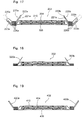
- Figs. 15 to 17 show a sanitary napkin, still another embodiment of the absorbent article constituted in accordance with the present invention.
- the radius of curvature of a convex arc defined by each of the longitudinally opposite edges is set to be relatively small, and the longitudinally opposite edges each take a nearly semicircular form.
- the napkin 202 includes a pair of band-like elastic pieces 220a and 220b.
- Each of the pair of band-like elastic pieces 220a and 220b has main portions 221 a and 221 b and additional portions 223a and 223b.
- the main portions 221 a and 221 b of the elastic pieces 220a and 220b are substantially the same as the elastic pieces 20a and 20b in the napkin 2 illustrated in Figs. 1 to 3, and are folded back along fold-back lines 222a and 222 to have a two-layer configuration. These main portions 221 a and 221 b are arranged on both sides of the topsheet 4, with the fold-back lines 222a and 222 being located widthwise inwardly. In the state illustrated in Fig.
- the widthwise inward edges of the respective main portions 221a and 221b of the elastic pieces 220a and 220b, i.e , the fold-back lines 222a and 222b, extend substantially straightly in the longitudinal direction.
- the respective additional portions 223a and 223b of the elastic pieces 220a and 220b are caused to extend as a continuation from the widthwise outward edge of the upper layer of the main portions 221a and 221 b, and are folded back along additional fold-back lines 225a and 225b to have a two-layer configuration.
- the additional fold-back lines 225a and 225b each defining the widthwise outward edge of the elastic pieces 221 a and 221 b extend substantially straightly in the state illustrated in Fig. 16 in which the elastic pieces 220a and 220b are elongated to make the entire napkin 202 flat.
- the widthwise inward portion of the lower layer of each of the respective additional portions 223a and 223b of the elastic pieces 220a and 220b is located downwardly of backsheet 206.
- the elastic pieces 220a and 220b having the main portions 221a and 221 b and the additional portions 223a and 223b each have the respective layers of their two-layer structure thermally bonded together directly and/or via the topsheet 204 (more specifically, its primary topsheet layer 210) and the backsheet 206, and are thermally bonded to the topsheet 204 and the backsheet 206, at the areas 226a and 226b of thermal bonding (represented by intersecting diagonal lines in Fig. 16, and heavy lines in Fig. 17).
- the primary topsheet layer 210 of the topsheet 204 and the backsheet 206 are caused to extend widthwise outwardly beyond the areas 226a and 226b of thermal bonding, and are thereby located between the two layers of the additional portions 223a and 223b of the elastic pieces 220a and 220b.
- both side edges of the primary topsheet layer 210 of the topsheet 204 and the backsheet 206 may, if desired, be substantially conformed to, or slightly inward of, the outward edges of the areas 226a and 226b of thermal bonding.
- each of the main portions 221 a and 221 b of the elastic pieces 220a and 220b has the respective layers of the two-layer structure thereof thermally bonded together, and is thermally bonded to the primary topsheet layer 210 of the topsheet 204, at a plurality of spaced apart sites, and more specifically at three sites 228a and 228b of thermal bonding delineated in solid lines in Figs. 15 and 16, by operating a thermal bonding tool (not shown) there.
- the elastic pieces 220a and 220b are thermally bonded, in an elongated state as illustrated in Fig. 16, to the topsheet 204 (more specifically its primary topsheet layer 210) and the backsheet 206 After such thermal bonding, the force that has kept the elastic pieces 220a and 220b elongated is released.
- the non-thermally bonded portions of the elastic pieces 220a and 220b i.e., the portions situated inwardly and outwardly of the areas 226a and 226b of thermal bonding (excluding the sites 228a and 228b of thermal bonding), elastically contract, and the elastic pieces 220a and 220b try to restore their original lengths at least partially.
- the topsheet 204, the backsheet 206 and the core 208 are displaced to extend upwardly inclinedly toward the longitudinally opposite ends in each of the longitudinally opposite end portions 230, as clearly illustrated in Fig. 15.
- the napkin 202 is brought into the shape of a cup as a whole.
- the respective main portions 221a and 221b of the elastic pieces 220a and 220b are caused to extend upwardly inclinedly in a widthwise inward direction (accordingly, toward the aforementioned fold-back lines 222a and 122b).
- the main portions 221a and 221b of the elastic pieces 220a and 220b form cuffs which function as barriers for preventing body fluids from leaking widthwise outwardly.
- the additional portions 223a and 223b of the elastic pieces 220a and 220b are also caused to extend upwardly inclinedly in a widthwise outward direction (accordingly, toward the aforementioned additional fold-back lines 225a and 225b).
- the additional portions 223a and 223b of the elastic pieces 220a and 220b form cuffs which function as barriers for preventing body fluids from leaking widthwise outwardly.
- That constitution of the napkin 202 illustrated in Figs. 15 to 17 which is other than that described above may be substantially the same as the constitution of the napkin 2 shown in Figs. 1 to 3 and/or the napkin 102 shown in Figs. 12 to 14. Its explanation will be omitted herein to avoid overlapping.
- the widthwise outwardly protruding lengths of the additional portions 223a and 223b of the elastic pieces 220a and 220b, particularly, in the longitudinal central portion 232 of the napkin 202, may, if desired, be made relatively large as illustrated by two-dot chain lines in Figs. 16 and 17 so that the widthwise outward regions of the additional portions 223a and 223b can be used as wings to be folded back onto the outside surface of panties.
- a pressure sensitive adhesive may be applied, where necessary, to the undersurface of the widthwise outward regions of the additional portions 223a and 223b (the surface to be contacted with the outside surface of panties when these regions are folded back). Even without a pressure sensitive adhesive applied, when the additional portions 223a and 223b are folded back onto the outside surface of panties, these portions 223a and 223b are kept in fully intimate contact with the outside surface of the panties because of the elasticity of these portions 223a and 223b, whereby the napkin 202 can be set in place relative to the panties.
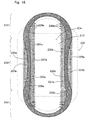
- Fig. 18 shows a modified example of the napkin 2 illustrated in Figs. 1 to 3.
- a napkin 302 as shown in Fig. 18 each of a pair of elastic pieces 320a and 320b is formed in a single-layer configuration rather than a two-layer configuration.
- the other points of constitution for the napkin 302 are substantially the same as the constitution of the napkin 2 depicted in Figs. 1 to 3.
- Fig 19 shows a modified example of the napkin 102 illustrated in Figs. 12 to 14
- a napkin 402 as shown in Fig. 19, widthwise inward portions of each of a pair of elastic pieces 420a and 420b are positioned not between a primary topsheet layer 410 of a topsheet 404 and a backsheet 406, but above the primary topsheet layer 410 of the topsheet 404.
- the other points of constitution for the napkin 402 are substantially the same as the constitution of the napkin 2 depicted in Figs. 1 to 3
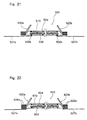
- Figs. 20 and 21 show a modified example of the napkin 2 illustrated in Figs. 1 to 3.
- a napkin 502 as shown in Figs. 20 and 21 a pair of wing pieces 507a and 507b are disposed under the undersurface of a backsheet 506, i.e., its outer surface.
- a backsheet 506 i.e., its outer surface.
- each of the pair of wing pieces 507a and 507b has a widthwise inward edge extending longitudinally straightly, and is joined to the backsheet 506 at areas 509a and 509b of thermal bonding extending along the inward edge
- the areas 509a and 509b of thermal bonding are delineated by solid lines in Fig. 20, and indicated by heavy solid lines in Fig. 21, for convenience's sake.
- Each of the pair of wing pieces 507a and 507b may be formed of a suitable material, such as the same material as for a primary topsheet layer 510 of a topsheet 504 or the backsheet 506.
- the wing pieces 507a and 507b may be formed of an elastic material as are the elastic pieces 520a and 520b. In this case, they may be thermally bonded to the backsheet 506 in a non-elongated state or in a longitudinally slightly elongated state. If desired, the wing pieces 507a and 507b can be joined to the backsheet 506 by ultrasonic welding or adhesive bonding, instead of thermal bonding. In a longitudinally central portion 532 of the napkin 502, the pair of wing pieces 507a and 507b are caused to extend widthwise outwardly beyond the topsheet 504 and the backsheet 506, and their widthwise outward regions are used as wings to be folded back onto the outside surface of panties.
- a pressure sensitive adhesive may be applied to the undersurface of the widthwise outward regions of the wing pieces 507a and 507b (the surface to be contacted with the outside surface of panties when these regions are folded back), and the pressure sensitive adhesive may be covered with a silicone-coated paper (not shown).
- the other points of constitution for the napkin 502 illustrated in Figs. 20 and 21 are substantially the same as the constitution of the napkin 2 depicted in Figs 1 to 3.
- the widthwise inward edge of a pair of wing pieces 607a and 607b extend along the areas 626a and 626b of thermal bonding between a primary topsheet layer 610 of a topsheet 604 and elastic pieces 620a and 620b, and are thermally bonded to a backsheet 606 at areas consistent with the areas 626a and 626b of thermal bonding.
- the other constitution for the napkin 602 is substantially the same as that for the napkin 502 illustrated in Figs. 20 and 21.
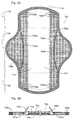
- Figs. 23 and 24 show still another modified example of the napkin 2 illustrated in Figs. 1 to 3.
- a napkin 702 shown in Figs. 23 and 24 a primary topsheet layer 710 of a topsheet 704, a backsheet 706, and elastic pieces 720a and 720b are caused to extend widthwise outwardly on both sides of a longitudinal central portion 732 of the napkin 702, and such extensions are in a nearly semicircular form.
- the primary topsheet layer 710 of the topsheet 704 and the backsheet 706 are substantially the same in shape, and are joined together at the area 716 of thermal bonding extending along their entire peripheral edges.
- Each of the elastic pieces 720a and 720b has the respective layers of the two-layer structure thereof thermally bonded together, and is thermally bonded to the primary topsheet layer 710 of the topsheet 704, at the areas 726a and 726b of thermal bonding extending along the widthwise outward edges and longitudinally opposite edges thereof.
- the areas 726a and 726b of thermal bonding are substantially conformed to the main part of the above-mentioned area 716 of thermal bonding between the primary topsheet layer 710 of the topsheet 704 and the backsheet 706 (i.e., that part in the area 716 of heating which excludes the widthwise central area of the longitudinally opposite edges where the elastic pieces 720a and 720b are not present) Furthermore, each of the elastic pieces 720a and 720b is thermally bonded to the primary topsheet layer 710 of the topsheet 704 at additional areas 727a and 727b of thermal bonding extending arcuately in the widthwise central portion of each of the elastic pieces 720a and 720b in the longitudinally central portion 732.
- each of the elastic pieces 720a and 720b has the respective layers of the two-layer structure thereof thermally bonded together, and is thermally bonded to the primary topsheet layer 710 of the topsheet 704, at three sites 728a and 728b of thermal bonding delineated in solid lines in Figs. 23, in each of the longitudinally opposite end portions 730, by operating a thermal bonding tool (not shown) at these sites.
- the elastic pieces 720a and 720b are situated on the topsheet 704 and thermally bonded, in an elongated state, to the topsheet 704 at the areas 726a and 726b of thermal bonding, the additional areas 727a and 727b of thermal bonding and the sites 728a and 728b of thermal bonding. After such thermal bonding, the force that has kept the elastic pieces 720a and 720b elongated is released.
- the non-thermally bonded portions of the elastic pieces 720a and 720b elastically contract, and the elastic pieces 720a and 720b try to restore their original lengths at least partially Owing to this contracting action generated in the elastic pieces 720a and 720b, the topsheet 704, the backsheet 706 and the core 708 are displaced to extend upwardly Inclinedly toward the longitudinally opposite ends in each of the longitudinally opposite end portions 730.
- the napkin 702 is brought into the shape of a cup as a whole.
- the longitudinally central portion 732 as illustrated in Fig.
- those portions of the elastic pieces 720a and 720b which are widthwise inward of the additional areas 727a and 727b of thermal bonding are caused to extend upwardly inclinedly in a widthwise inward direction (accordingly, toward the aforementioned fold-back lines 722a and 722b).
- cuffs which function as barriers for preventing body fluids from leaking widthwise outwardly are formed on both sides of the longitudinally central portion 732 of the napkin 702.
- Those portions of the primary topsheet layer 710 of the topsheet 704, the backsheet 706 and the elastic pieces 720a and 720b which are present widthwise outwardly of the additional areas 727a and 727b of thermal bonding are used as wings to be folded back onto the outside surface of panties.
- a pressure sensitive adhesive may be applied to the undersurface of the widthwise outward regions of the backsheet 706 (the surface to be contacted with the outside surface of panties when these regions are folded back), and the pressure sensitive adhesive may be covered with a silicone-coated paper (not shown).
- the elastic pieces 720a and 720b and the backsheet 706 may be caused to extend widthwise outwardly (in other words, in the longitudinally central portion 732 of the napkin 702, the primary topsheet layer 710 of the topsheet 704 is not caused to extend widthwise outwardly, while both side edges of the primary topsheet layer 710 are situated inwardly of both side edges of the elastic pieces 720a and 720b as well as the backsheet 706).
- the wings to be folded back onto the outside surface of panties are formed from the widthwise outward regions of the elastic pieces 720a and 720b as well as the backsheet 706.
- That constitution of the napkin 702 illustrated in Figs. 23 to 24 which is other than that described above may be substantially the same as the constitution of the napkin 2 shown in Figs. 1 to 3. Its explanation will be omitted herein to avoid overlapping.
- Figs. 25 and 26 show a modified example of the napkin 702 illustrated in Figs. 23 and 24.
- a napkin 802 as shown in Figs. 25 and 26 in a longitudinally central portion 832 of the napkin 802, a primary topsheet layer 810 of a topsheet 804 and a backsheet 806 are caused to extend widthwise outwardly, while each of a pair of elastic pieces 820a and 820b is not caused to extend widthwise outwardly. Therefore, the portions for use as the wings to be folded back onto the outside surface of panties are formed from two layers, the primary topsheet layer 810 of the topsheet 804 and the backsheet 806. Except these points, the napkin 802 shown in Figs. 25 and 26 is substantially the same as the napkin 702 depicted in Figs. 23 and 24.
- the above-described napkins 2, 102, 202, 302, 402, 502, 602, 702, 802 can be produced by, although not limited to, an arbitrary method.
- the absorbent core is thicker than the topsheet and the backsheet.
- the napkin is relatively thick at the portions where the core is present, and relatively thin at the portions where the core is not present, thereby creating considerable differences in thickness between these two types of portions.
- the elastic pieces elongated as required are joined after joining of the core to the topsheet and/or the backsheet, fully satisfactory joining tends to be hampered due to the above differences in thickness.
- a pair of second webs for forming a pair of elastic pieces are joined at predetermined sites to a first web for forming the topsheet (if the topsheet is composed of a primary topsheet layer and a secondary topsheet layer, only the primary topsheet layer, or both the primary topsheet layer and the secondary topsheet layer joined thereto) or the backsheet before the core is joined
- Such joining can be performed by conveying the first web, fed by a roll, by a plurality of roller pairs along a required path, and simultaneously conveying the second webs, fed by a roll, by a plurality of roller pairs along a required path, positioning all these webs as required, and joining them at predetermined sites.
- the second webs need to be joined in an elongated state to the first web.
- the peripheral speed of the roller pair upstream of the predetermined sites is set to be lower than the peripheral speed of the roller pair downstream of the predetermined sites. Because of this difference in the peripheral speeds of the roller pairs, the second webs are elastically elongated. Then, the second webs are positioned in a required relationship with the first web. These are measures of importance. If both the first web and the second webs are composed of a thermoplastic film, the joining of the first web and the second webs can be performed by thermal bonding while causing a thermal bonding tool to act on the first and second webs at required sites of joining.
- the topsheet includes not only a primary topsheet layer but a secondary topsheet layer, it would be convenient to join the secondary topsheet layer to the primary topsheet layer beforehand, for example, via an adhesive. Then, a third web for forming the backsheet or the topsheet which third web has the core joined thereto beforehand at predetermined spaced apart locations is joined to the first web and/or the second webs joined in an elongated state to the first web. Such joining can also be carried out advantageously by conveying the third web, fed by a roll, by a plurality of roller pairs along a required path, and positioning it relative to the first and second webs as required.
- the third web is also composed of a thermoplastic film
- its joining to the first web and/or the second webs can be performed by thermal bonding while causing a thermal bonding tool to act at required sites of joining.
- the required shapes are cut out of the first, second and third webs, whereby the napkin can be produced.
- Such cutting results in the release of the tensile force exerted on the second webs.
- the napkin is changed from the flat form to the required form of a cup as a whole owing to the contracting action generated by the elastic pieces.
- required cuffs are formed in the longitudinally central portion of the napkin.
- An absorbent article constituted in accordance with the first aspect of the present invention takes the form of a cup as a whole. forms upwardly extending cuffs on both sides of the longitudinally central portion thereof, and yet produces a fully satisfactory feeling when worn.
- An absorbent article constituted in accordance with the second aspect of the present invention takes the form of a cup as a whole, forms upwardly extending cuffs on both sides of the longitudinally central portion thereof, and yet produces a fully satisfactory feeling when worn, and additionally can be manufactured for a sufficiently low cost.
Landscapes
- Health & Medical Sciences (AREA)
- Epidemiology (AREA)
- Engineering & Computer Science (AREA)
- Life Sciences & Earth Sciences (AREA)
- General Health & Medical Sciences (AREA)
- Biomedical Technology (AREA)
- Heart & Thoracic Surgery (AREA)
- Vascular Medicine (AREA)
- Veterinary Medicine (AREA)
- Animal Behavior & Ethology (AREA)
- Public Health (AREA)
- Manufacturing & Machinery (AREA)
- Mechanical Engineering (AREA)
- Physics & Mathematics (AREA)
- Fluid Mechanics (AREA)
- Absorbent Articles And Supports Therefor (AREA)
- Orthopedics, Nursing, And Contraception (AREA)
- Laminated Bodies (AREA)
Applications Claiming Priority (4)
| Application Number | Priority Date | Filing Date | Title |
|---|---|---|---|
| JP735921/95 | 1995-02-02 | ||
| JP7035921A JP2909877B2 (ja) | 1995-02-02 | 1995-02-02 | 吸収性物品 |
| JP73592195 | 1995-02-02 | ||
| PCT/US1996/000864 WO1996023471A1 (en) | 1995-02-02 | 1996-01-24 | Absorbent article |
Publications (3)
| Publication Number | Publication Date |
|---|---|
| EP0806925A1 EP0806925A1 (en) | 1997-11-19 |
| EP0806925A4 EP0806925A4 (en) | 2000-02-02 |
| EP0806925B1 true EP0806925B1 (en) | 2004-08-11 |
Family
ID=12455506
Family Applications (1)
| Application Number | Title | Priority Date | Filing Date |
|---|---|---|---|
| EP96903622A Expired - Lifetime EP0806925B1 (en) | 1995-02-02 | 1996-01-24 | Absorbent article |
Country Status (9)
| Country | Link |
|---|---|
| EP (1) | EP0806925B1 (es) |
| JP (1) | JP2909877B2 (es) |
| KR (1) | KR19980701907A (es) |
| AU (1) | AU711610B2 (es) |
| CA (1) | CA2211745C (es) |
| MX (1) | MX9705884A (es) |
| TW (1) | TW302282B (es) |
| WO (1) | WO1996023471A1 (es) |
| ZA (1) | ZA96798B (es) |
Cited By (1)
| Publication number | Priority date | Publication date | Assignee | Title |
|---|---|---|---|---|
| EP3777801A4 (en) * | 2018-03-28 | 2022-01-05 | Daio Paper Corporation | ABSORBENT ARTICLE |
Families Citing this family (21)
| Publication number | Priority date | Publication date | Assignee | Title |
|---|---|---|---|---|
| US5730738A (en) * | 1995-12-04 | 1998-03-24 | The Procter & Gamble Company | Absorbent article with angled band structural elastic-like film cuffs |
| US5667609A (en) * | 1996-02-14 | 1997-09-16 | The Procter & Gamble Company | Method for attaching barrier cuffs to disposable absorbent article |
| US5810800A (en) * | 1996-06-27 | 1998-09-22 | The Procter & Gamble Company | Absorbent article having flexure resistant elasticized cuffs |
| US5885268A (en) * | 1996-12-18 | 1999-03-23 | The Procter & Gamble Company | Absorbent structures having decoupled topsheet and topsheet support strip |
| US6315765B1 (en) | 1997-01-17 | 2001-11-13 | Kimberly-Clark Worldwide, Inc. | Elasticized absorbent pad |
| US6171290B1 (en) | 1998-06-30 | 2001-01-09 | Mcneil-Ppc, Inc. | Absorbent article having double side cuffs |
| JP2000254173A (ja) * | 1999-03-11 | 2000-09-19 | Uni Charm Corp | 生理用ナプキン |
| JP3859420B2 (ja) * | 2000-03-13 | 2006-12-20 | ユニ・チャーム株式会社 | 吸収性物品 |
| JP3862469B2 (ja) * | 2000-03-13 | 2006-12-27 | ユニ・チャーム株式会社 | 吸収性物品 |
| JP3922897B2 (ja) * | 2001-07-12 | 2007-05-30 | ユニ・チャーム株式会社 | 生理用ナプキン |
| US6730068B2 (en) | 2001-07-12 | 2004-05-04 | Uni-Charm Corporation | Sanitary napkin |
| JP4632779B2 (ja) * | 2004-12-28 | 2011-02-16 | 花王株式会社 | 吸収性物品 |
| JP2007159943A (ja) * | 2005-12-15 | 2007-06-28 | Kao Corp | 使い捨ておむつ |
| JP4597085B2 (ja) * | 2006-03-28 | 2010-12-15 | 花王株式会社 | 吸収性物品 |
| JP4484841B2 (ja) * | 2006-04-14 | 2010-06-16 | ユニ・チャーム株式会社 | 吸収性物品 |
| JP5475323B2 (ja) | 2009-05-18 | 2014-04-16 | ユニ・チャーム株式会社 | 吸収性物品 |
| JP2013059533A (ja) * | 2011-09-14 | 2013-04-04 | Kao Corp | 吸収性物品 |
| EP3337435B1 (en) * | 2015-08-21 | 2025-01-22 | The Procter & Gamble Company | Feminine pad with barrier cuffs |
| JP6607778B2 (ja) * | 2015-12-28 | 2019-11-20 | 花王株式会社 | 吸収性物品 |
| JP7357440B2 (ja) * | 2018-05-18 | 2023-10-06 | ユニ・チャーム株式会社 | 吸収性物品 |
| JP7209600B2 (ja) * | 2019-07-30 | 2023-01-20 | 大王製紙株式会社 | 吸収性物品 |
Family Cites Families (14)
| Publication number | Priority date | Publication date | Assignee | Title |
|---|---|---|---|---|
| US3575174A (en) | 1969-07-11 | 1971-04-20 | Personal Products Co | Sanitary napkin |
| US4944735A (en) | 1984-02-21 | 1990-07-31 | Kimberly-Clark Corporation | Shaped napkin with elasticized edges |
| US4678527A (en) | 1984-09-17 | 1987-07-07 | Personal Products Company | Method for making nonplanar absorbent products |
| US4579556A (en) | 1984-11-16 | 1986-04-01 | Kimberly-Clark Corporation | Elasticized bow-shaped dual baffle pad |
| US5074856A (en) | 1986-01-13 | 1991-12-24 | Kimberly-Clark Corporation | Three-dimensional shaped absorbent article with a bicomponent baffle |
| US4701177A (en) * | 1986-01-13 | 1987-10-20 | Kimberly-Clark Corporation | Three-dimensional shaped feminine pad with narrow, absorbent center and winged edges |
| US4770657A (en) | 1986-05-28 | 1988-09-13 | Kimberly-Clark Corporation | Three-dimensional shaped feminine pad with absorbent in the elasticized edges |
| US4758241A (en) | 1987-06-18 | 1988-07-19 | Papajohn Elissa D | Menstrual and incontinence pad |
| US4834739A (en) | 1987-12-17 | 1989-05-30 | Kimberly-Clark Corporation | External feminine protection device with skid-resistant coating for holding the device in place |
| DK0426235T3 (da) * | 1989-11-01 | 1996-08-26 | Procter & Gamble | Hygiejnebind med tværstrækbare organer til fastgørelse på bærerens underbeklædning |
| US5234422A (en) * | 1991-12-20 | 1993-08-10 | The Procter & Gamble Company | Elasticized sanitary napkin |
| EP0575611B1 (de) * | 1992-01-13 | 1998-12-09 | Uni-Charm Company Limited | Monatsbinde |
| JP2559755Y2 (ja) * | 1992-11-17 | 1998-01-19 | ユニ・チャーム株式会社 | 生理用ナプキン |
| BR9204863A (pt) * | 1992-11-25 | 1994-03-01 | Johnson & Johnson Ind Com | Absorvente intimo feminino descartavel |
-
1995
- 1995-02-02 JP JP7035921A patent/JP2909877B2/ja not_active Expired - Fee Related
-
1996
- 1996-01-24 CA CA002211745A patent/CA2211745C/en not_active Expired - Fee Related
- 1996-01-24 AU AU47641/96A patent/AU711610B2/en not_active Ceased
- 1996-01-24 KR KR1019970705304A patent/KR19980701907A/ko not_active Ceased
- 1996-01-24 EP EP96903622A patent/EP0806925B1/en not_active Expired - Lifetime
- 1996-01-24 WO PCT/US1996/000864 patent/WO1996023471A1/en not_active Ceased
- 1996-01-24 MX MX9705884A patent/MX9705884A/es not_active IP Right Cessation
- 1996-02-01 ZA ZA96798A patent/ZA96798B/xx unknown
- 1996-03-21 TW TW085103418A patent/TW302282B/zh active
Cited By (1)
| Publication number | Priority date | Publication date | Assignee | Title |
|---|---|---|---|---|
| EP3777801A4 (en) * | 2018-03-28 | 2022-01-05 | Daio Paper Corporation | ABSORBENT ARTICLE |
Also Published As
| Publication number | Publication date |
|---|---|
| JP2909877B2 (ja) | 1999-06-23 |
| TW302282B (es) | 1997-04-11 |
| CA2211745C (en) | 2001-10-02 |
| ZA96798B (en) | 1996-08-12 |
| CA2211745A1 (en) | 1996-08-08 |
| AU711610B2 (en) | 1999-10-14 |
| KR19980701907A (ko) | 1998-06-25 |
| WO1996023471A1 (en) | 1996-08-08 |
| JPH08215244A (ja) | 1996-08-27 |
| MX9705884A (es) | 1997-10-31 |
| EP0806925A1 (en) | 1997-11-19 |
| AU4764196A (en) | 1996-08-21 |
| EP0806925A4 (en) | 2000-02-02 |
Similar Documents
| Publication | Publication Date | Title |
|---|---|---|
| AU711610B2 (en) | Absorbent article | |
| EP0555332B1 (en) | A sanitary napkin or an incontinence guard having flexible side-flaps | |
| EP0681820B2 (en) | Disposable absorbent article | |
| JP3640475B2 (ja) | 吸収性物品 | |
| EP1275358B1 (en) | Absorbent article | |
| EP1055403B1 (en) | Absorbent article with surface structure | |
| CN100356899C (zh) | 锥形复合卫生巾 | |
| EP1011579B1 (en) | Shape-stable absorbent article | |
| HU215632B (hu) | Hajlított formájú abszorbens cikk | |
| MXPA01009220A (es) | Articulo absorbente sanitario. | |
| CA2340603C (en) | Absorbent article | |
| CN1300584A (zh) | 复合卫生巾 | |
| GB2244653A (en) | Absorbent article | |
| RU2277403C2 (ru) | Абсорбирующее изделие, такое как гигиеническая прокладка, подгузник, защитное приспособление, используемое при недержании, или прокладка для трусов | |
| US20030040731A1 (en) | Absorbent article | |
| CA2340561C (en) | Absorbent article | |
| CN114040738A (zh) | 吸收性物品 | |
| JP7091101B2 (ja) | 吸収性物品 | |
| AU732855B2 (en) | Disposable absorbent article with wings predisposed towards their in-use-position | |
| JP2013121462A5 (es) | ||
| JP2013121462A (ja) | 吸収性物品 | |
| KR20240150502A (ko) | 일회용 흡수성 위생용품용 흡수성 코어를 제조하는 방법, 흡수성 코어 및 흡수성 물품 | |
| JP4024218B2 (ja) | 吸収性物品 | |
| JP5887442B2 (ja) | 吸収性物品の製造方法 | |
| JP4145692B2 (ja) | 吸収性物品 |
Legal Events
| Date | Code | Title | Description |
|---|---|---|---|
| PUAI | Public reference made under article 153(3) epc to a published international application that has entered the european phase |
Free format text: ORIGINAL CODE: 0009012 |
|
| 17P | Request for examination filed |
Effective date: 19970725 |
|
| AK | Designated contracting states |
Kind code of ref document: A1 Designated state(s): AT BE CH DE DK ES FR GB GR IE IT LI LU NL PT SE |
|
| A4 | Supplementary search report drawn up and despatched |
Effective date: 19991217 |
|
| AK | Designated contracting states |
Kind code of ref document: A4 Designated state(s): AT BE CH DE DK ES FR GB GR IE IT LI LU NL PT SE |
|
| 17Q | First examination report despatched |
Effective date: 20000907 |
|
| GRAP | Despatch of communication of intention to grant a patent |
Free format text: ORIGINAL CODE: EPIDOSNIGR1 |
|
| GRAS | Grant fee paid |
Free format text: ORIGINAL CODE: EPIDOSNIGR3 |
|
| RBV | Designated contracting states (corrected) |
Designated state(s): BE GB |
|
| REG | Reference to a national code |
Ref country code: DE Ref legal event code: 8566 |
|
| GRAA | (expected) grant |
Free format text: ORIGINAL CODE: 0009210 |
|
| AK | Designated contracting states |
Kind code of ref document: B1 Designated state(s): BE GB |
|
| REG | Reference to a national code |
Ref country code: GB Ref legal event code: FG4D |
|
| REG | Reference to a national code |
Ref country code: HK Ref legal event code: WD Ref document number: 1004654 Country of ref document: HK |
|
| REG | Reference to a national code |
Ref country code: IE Ref legal event code: FG4D |
|
| PLBE | No opposition filed within time limit |
Free format text: ORIGINAL CODE: 0009261 |
|
| STAA | Information on the status of an ep patent application or granted ep patent |
Free format text: STATUS: NO OPPOSITION FILED WITHIN TIME LIMIT |
|
| 26N | No opposition filed |
Effective date: 20050512 |
|
| PGFP | Annual fee paid to national office [announced via postgrant information from national office to epo] |
Ref country code: BE Payment date: 20080201 Year of fee payment: 13 |
|
| PG25 | Lapsed in a contracting state [announced via postgrant information from national office to epo] |
Ref country code: BE Free format text: LAPSE BECAUSE OF NON-PAYMENT OF DUE FEES Effective date: 20090131 |
|
| PGFP | Annual fee paid to national office [announced via postgrant information from national office to epo] |
Ref country code: GB Payment date: 20101215 Year of fee payment: 16 |
|
| GBPC | Gb: european patent ceased through non-payment of renewal fee |
Effective date: 20130124 |
|
| PG25 | Lapsed in a contracting state [announced via postgrant information from national office to epo] |
Ref country code: GB Free format text: LAPSE BECAUSE OF NON-PAYMENT OF DUE FEES Effective date: 20130124 |