EP0806578A1 - Dichtkopf zum Transport eines Wärmeträgermediums zu einem rotierenden Drucksystem - Google Patents
Dichtkopf zum Transport eines Wärmeträgermediums zu einem rotierenden Drucksystem Download PDFInfo
- Publication number
- EP0806578A1 EP0806578A1 EP97104456A EP97104456A EP0806578A1 EP 0806578 A1 EP0806578 A1 EP 0806578A1 EP 97104456 A EP97104456 A EP 97104456A EP 97104456 A EP97104456 A EP 97104456A EP 0806578 A1 EP0806578 A1 EP 0806578A1
- Authority
- EP
- European Patent Office
- Prior art keywords
- sealing head
- rotor
- condensate
- head according
- sealing
- Prior art date
- Legal status (The legal status is an assumption and is not a legal conclusion. Google has not performed a legal analysis and makes no representation as to the accuracy of the status listed.)
- Granted
Links
Images


Classifications
-
- F—MECHANICAL ENGINEERING; LIGHTING; HEATING; WEAPONS; BLASTING
- F16—ENGINEERING ELEMENTS AND UNITS; GENERAL MEASURES FOR PRODUCING AND MAINTAINING EFFECTIVE FUNCTIONING OF MACHINES OR INSTALLATIONS; THERMAL INSULATION IN GENERAL
- F16C—SHAFTS; FLEXIBLE SHAFTS; ELEMENTS OR CRANKSHAFT MECHANISMS; ROTARY BODIES OTHER THAN GEARING ELEMENTS; BEARINGS
- F16C13/00—Rolls, drums, discs, or the like; Bearings or mountings therefor
-
- F—MECHANICAL ENGINEERING; LIGHTING; HEATING; WEAPONS; BLASTING
- F16—ENGINEERING ELEMENTS AND UNITS; GENERAL MEASURES FOR PRODUCING AND MAINTAINING EFFECTIVE FUNCTIONING OF MACHINES OR INSTALLATIONS; THERMAL INSULATION IN GENERAL
- F16C—SHAFTS; FLEXIBLE SHAFTS; ELEMENTS OR CRANKSHAFT MECHANISMS; ROTARY BODIES OTHER THAN GEARING ELEMENTS; BEARINGS
- F16C13/00—Rolls, drums, discs, or the like; Bearings or mountings therefor
- F16C13/02—Bearings
-
- F—MECHANICAL ENGINEERING; LIGHTING; HEATING; WEAPONS; BLASTING
- F16—ENGINEERING ELEMENTS AND UNITS; GENERAL MEASURES FOR PRODUCING AND MAINTAINING EFFECTIVE FUNCTIONING OF MACHINES OR INSTALLATIONS; THERMAL INSULATION IN GENERAL
- F16L—PIPES; JOINTS OR FITTINGS FOR PIPES; SUPPORTS FOR PIPES, CABLES OR PROTECTIVE TUBING; MEANS FOR THERMAL INSULATION IN GENERAL
- F16L27/00—Adjustable joints; Joints allowing movement
- F16L27/08—Adjustable joints; Joints allowing movement allowing adjustment or movement only about the axis of one pipe
- F16L27/0804—Adjustable joints; Joints allowing movement allowing adjustment or movement only about the axis of one pipe the fluid passing axially from one joint element to another
- F16L27/0808—Adjustable joints; Joints allowing movement allowing adjustment or movement only about the axis of one pipe the fluid passing axially from one joint element to another the joint elements extending coaxially for some distance from their point of separation
- F16L27/0824—Adjustable joints; Joints allowing movement allowing adjustment or movement only about the axis of one pipe the fluid passing axially from one joint element to another the joint elements extending coaxially for some distance from their point of separation with ball or roller bearings
- F16L27/0828—Adjustable joints; Joints allowing movement allowing adjustment or movement only about the axis of one pipe the fluid passing axially from one joint element to another the joint elements extending coaxially for some distance from their point of separation with ball or roller bearings having radial bearings
-
- F—MECHANICAL ENGINEERING; LIGHTING; HEATING; WEAPONS; BLASTING
- F16—ENGINEERING ELEMENTS AND UNITS; GENERAL MEASURES FOR PRODUCING AND MAINTAINING EFFECTIVE FUNCTIONING OF MACHINES OR INSTALLATIONS; THERMAL INSULATION IN GENERAL
- F16C—SHAFTS; FLEXIBLE SHAFTS; ELEMENTS OR CRANKSHAFT MECHANISMS; ROTARY BODIES OTHER THAN GEARING ELEMENTS; BEARINGS
- F16C2361/00—Apparatus or articles in engineering in general
-
- Y—GENERAL TAGGING OF NEW TECHNOLOGICAL DEVELOPMENTS; GENERAL TAGGING OF CROSS-SECTIONAL TECHNOLOGIES SPANNING OVER SEVERAL SECTIONS OF THE IPC; TECHNICAL SUBJECTS COVERED BY FORMER USPC CROSS-REFERENCE ART COLLECTIONS [XRACs] AND DIGESTS
- Y10—TECHNICAL SUBJECTS COVERED BY FORMER USPC
- Y10T—TECHNICAL SUBJECTS COVERED BY FORMER US CLASSIFICATION
- Y10T137/00—Fluid handling
- Y10T137/6416—With heating or cooling of the system
- Y10T137/6579—Circulating fluid in heat exchange relationship
-
- Y—GENERAL TAGGING OF NEW TECHNOLOGICAL DEVELOPMENTS; GENERAL TAGGING OF CROSS-SECTIONAL TECHNOLOGIES SPANNING OVER SEVERAL SECTIONS OF THE IPC; TECHNICAL SUBJECTS COVERED BY FORMER USPC CROSS-REFERENCE ART COLLECTIONS [XRACs] AND DIGESTS
- Y10—TECHNICAL SUBJECTS COVERED BY FORMER USPC
- Y10T—TECHNICAL SUBJECTS COVERED BY FORMER US CLASSIFICATION
- Y10T137/00—Fluid handling
- Y10T137/8593—Systems
- Y10T137/86268—With running joint between movable parts of system
Definitions
- the invention relates to a sealing head for transporting a heat transfer medium, in particular for supplying steam to a rotating pressure system, such as a drying drum, heating roller or the like, and then removing the condensate, consisting of a tubular rotor connected to the pressure system and a roller bearing on the Rotor arranged stationary sealing head housing with at least one connecting piece for a connecting line carrying the heat transfer medium, the rotor being in open connection with the connecting piece via the interior of the sealing head housing acted upon by the heat transfer medium and axially between the connecting piece and the roller bearings against the rotor the wall of the sealing head housing sealing primary sealing element is arranged, a secondary seal between the rotor and the wall of the sealing head housing is connected on the atmosphere side axially towards the rolling bearings.
- a rotating pressure system such as a drying drum, heating roller or the like
- Sealing heads of this type when using liquid heat transfer media are known from practice.
- the heat transfer medium ensures lubrication in the area of the primary sealing element, so that despite the usually high speeds of the printing system and the high temperatures of the heat transfer medium, the wear is kept low and the sealing function of the sealing element is impaired as little as possible.
- the invention is therefore based on the object of designing a sealing head of the type mentioned in such a way that an adequate lubricating effect is ensured in the region of the primary sealing element even when steam is used as the heat transfer medium.
- annularly extending condensate space is arranged around the rotor, which is connected via at least one overflow channel with that of the heat transfer medium pressurized interior is in connection and which is in heat-conducting contact with a cooling system.
- the advantage achieved by the invention consists essentially in the fact that a condensate is formed directly from the steam serving as the heat transfer medium, which acts on the primary sealing element from the side facing away from the interior of the sealing head housing. Due to the direct connection between the interior and the condensate chamber, a pressure equilibrium is set, whereby no one-sided force loads due to different pressure loads act on the primary sealing element. In this way, sufficient lubrication of the primary sealing element, which is otherwise particularly stressed, is ensured despite the use of steam as the heat transfer medium.
- the primary sealing element is designed as an annular lip seal or as a mechanical seal and the secondary seal as a mechanical seal.
- the ring lip seal expediently has a plurality of ring lips arranged axially one behind the other.
- the invention provides that the primary sealing element is enclosed on its side facing the interior by an insulating washer.
- the sealing element is advantageously in one Ring rebate of the insulating washer inserted.
- the rotor in an expedient embodiment of the invention has a double-walled design in the region extending over the two seals.
- a sleeve part is arranged in the condensate space that divides the condensate space into a radially inner one and the outer, axially extending flow channel, the inner and outer flow channels each being axially connected to one another at the ends.
- the sleeve part can advantageously be provided with radially outwardly directed, axially extending and evenly distributed separating webs, which form the outer flow channels between them.
- the invention provides that fixed delivery devices for the condensate circulate within the sleeve part on the rotor and generate a delivery pressure for the circulation of the condensate in the flow channels.
- these conveying members can be moved from one to the lateral surface of the Mechanical bearing bearing ring arranged conveying thread can be formed.
- the cooling system is expediently formed by an annular chamber which surrounds the condensate space and through which cooling water flows and which is connected to the cooling water circuit for the counter ring cooling of the slide ring bearing.
- the annular chamber is advantageously provided with annular grooves extending in the direction of the condensate space.
- the overflow channels be opened or blocked by nipples that can be inserted radially into the sealing head housing, whereby only the topmost vertical overflow channel in the installed position is open.
- the sealing head 1 shown in the drawing is used to supply a heat transfer medium, in particular in the form of steam, to a rotating pressure system 2, for example a drying drum, heating roller or the like, which is only indicated in the drawing with its connecting device.
- a rotating pressure system 2 for example a drying drum, heating roller or the like
- the sealing head 1 consists of a tubular rotor 3 connected to the pressure system 2 and a stationary sealing head housing 5 arranged on roller bearings 4 on the rotor 3.
- the sealing head housing 5 has at least one connecting piece 5 'for a connecting line which carries the heat transfer medium and is not shown in the drawing .
- the rotor 3 is in open connection with the connecting piece 5 'via the interior 8 of the sealing head housing 5 acted upon by the heat transfer medium. As a result, the heat transfer medium can reach the pressure system 2 through the connection piece 5 'and the rotor 3.
- a primary sealing element 6, which seals the rotor 3 against the wall of the sealing head housing 5, is arranged axially between the connecting piece 5 'and the roller bearings 4, axially in the direction a secondary seal 7 between the rotor 3 and the wall of the sealing head housing 5 is connected downstream to the rolling bearings 4 on the atmosphere side.
- a condensate space 9 extending in a ring around the rotor 3 is arranged axially between the secondary seal 7 and the primary sealing element 6.
- the condensate chamber 9 is connected to the interior 8 via at least one, preferably via four overflow channels 10.
- the condensate chamber 9 is in heat-conducting contact with a cooling system 11.
- the vaporous heat transfer medium can enter the condensate chamber 9 through the overflow channel 10 and condense there under the influence of the cooling system 11.
- the condensate which thus also comes into contact with the primary sealing element 6, prevents this sealing element 6 from running dry, and thus acts as a lubricant.
- the primary sealing element 6 can be designed as an annular lip seal, wherein, as can also be seen from FIGS. 1 and 2, the annular lip seal is expediently constructed from a plurality of axially arranged annular lips.
- the secondary seal 7 is designed as a conventional mechanical seal.
- the primary sealing element 6 is enclosed on its side facing the interior 8 by an insulating washer 12 which prevents heat flow from the interior 8 to the condensate space 9.
- the sealing element 6 is inserted into an annular fold of the insulating washer 12.
- the rotor 3 is double-walled in the region extending over the two seals 6, 7.
- a sleeve part 13 Arranged in the condensate space 9 is a sleeve part 13 shown in FIGS. 4 and 5, which divides the condensate space 9 into a radially inner 14 'and outer 14'', each axially extending flow channel.
- the inner and outer flow channels 14 ', 14'' are in each case axially connected to one another. A circulating flow is therefore basically possible.
- the sleeve part 13 is provided with radially outwardly directed, axially extending and evenly distributed dividers 13 '. These form the outer flow channels 14 ′′ between them on the outer peripheral surface.
- conveying elements for the condensate are provided on the rotor 3, which rotate with the rotor 3 and generate a conveying pressure for the circulation of the condensate in the flow channels 14 ', 14''.
- These conveying members are formed by a conveying thread, which is only indicated as a line 15 in the usual representation in FIG. 1, the conveying thread on the lateral surface of the mechanical seal 7 bearing ring 16 is arranged.
- the cooling system 11 is formed by an annular chamber 17 which surrounds the condensate chamber 9 and through which cooling water flows.
- This annular chamber 17 is also connected to the cooling water circuit, which is used for cooling the counter ring of the slide ring bearing 7.
- This annular chamber can, as shown in the drawing in FIG. 2, be provided with annular grooves 18 extending in the direction of the condensate chamber 9, as a result of which the inner surface is enlarged, thus achieving a better cooling effect.
- the overflow channels 10 are to be opened or shut off by means of radially into the sealing head housing 5, which can be used alternatively and are designed differently.
- the nipples 19 are therefore only inserted after the final assembly of the sealing head 1 in such a way that only the uppermost overflow channel 10, which is vertical in the installed position, is opened, while the others are closed.
Landscapes
- Engineering & Computer Science (AREA)
- General Engineering & Computer Science (AREA)
- Mechanical Engineering (AREA)
- Mechanical Sealing (AREA)
- Turbine Rotor Nozzle Sealing (AREA)
- Drying Of Solid Materials (AREA)
- Rolls And Other Rotary Bodies (AREA)
Abstract
Description
- Die Erfindung betrifft einen Dichtkopf zum Transport eines Wärmeträgermediums, insbes. zum Zuführen von Dampf zu einem rotierenden Drucksystem, wie einer Trockentrommel, Heizwalze oder dergleichen, und anschließendem Abführen des Kondensats, bestehend aus einem an das Drucksystem angeschlossenen rohrförmigen Rotor und einem über Wälzlager auf dem Rotor angeordneten stillstehenden Dichtkopfgehäuse mit mindestens einem Anschlußstutzen für eine das Wärmeträgermedium führende Anschlußleitung, wobei der Rotor über den vom Wärmeträgermedium beaufschlagten Innenraum des Dichtkopfgehäuses in offener Verbindung mit dem Anschlußstutzen steht und axial zwischen dem Anschlußstutzen und den Wälzlagern ein den Rotor gegen die Wand des Dichtkopfgehäuses abdichtendes primäres Dichtungselement angeordnet ist, dem axial in Richtung zu den Wälzlagern hin atmosphärenseitig eine sekundäre Dichtung zwischen dem Rotor und der Wand des Dichtkopfgehäuses nachgeschaltet ist.
- Dichtköpfe dieser Art bei Verwendung von flüssigen Wärmeträgermedien sind aus der Praxis bekannt. Das Wärmeträgermedium sorgt dabei für eine Schmierung im Bereich des primären Dichtungselements, so daß trotz der üblicherweise hohen Drehzahlen des Drucksystems und der hohen Temperaturen des Wärmeträgermediums der Verschleiß gering gehalten und somit die Dichtfunktion des Dichtungselements möglichst wenig beeinträchtigt wird.
- Kommt als Wärmeträgermedium jedoch Dampf zur Anwendung, so ist die angestrebte Schmierwirkung nicht mehr gegeben.
- Der Erfindung liegt daher die Aufgabe zugrunde, einen Dichtkopf der eingangs genannten Art so auszubilden, daß auch bei der Verwendung von Dampf als Wärmeträgermedium eine hinreichende Schmierwirkung im Bereich des primären Dichtungselements sichergestellt ist.
- Diese Aufgabe wird nach der Erfindung dadurch gelöst, daß im Dichtkopfgehäuse axial zwischen der sekundären Dichtung und dem primären Dichtungselement ein sich ringförmig um den Rotor erstreckender Kondensatraum angeordnet ist, der über wenigstens einen Überströmkanal mit dem vom Wärmeträgermedium beaufschlagten Innenraum in Verbindung steht und der in wärmeleitendem Kontakt mit einem Kühlsystem steht.
- Der durch die Erfindung erreichte Vorteil besteht im wesentlichen darin, daß unmittelbar aus dem als Wärmeträgermedium dienenden Dampf ein Kondensat gebildet wird, das von der dem Innenraum des Dichtkopfgehäuses abgewandten Seite her auf das primäre Dichtungselement einwirkt. Durch die direkte Verbindung zwischen dem Innenraum und dem Kondensatraum wird ein Druckgleichgewicht eingestellt, wodurch auf das primäre Dichtungselement keine einseitigen Kraftbeanspruchungen durch unterschiedliche Druckbelastung einwirken. Auf diese Weise ist trotz der Verwendung von Dampf als Wärmeträgermedium eine ausreichende Schmierung des im übrigen besonders beanspruchten primären Dichtungselementes sichergestellt.
- In bevorzugter Ausführungsform sind das primäre Dichtungselement als Ringlippendichtung oder als Gleitringdichtung und die sekundäre Dichtung als Gleitringdichtung ausgebildet. Die Ringlippendichtung weist dabei zur Erhöhung der Dichtwirkung Zweckmäßigerweise mehrere, axial hintereinander angeordnete Ringlippen auf.
- Um einen unerwünschten Wärmetransport vom Innenraum des Dichtkopfgehäuses zum Kondensatraum hin zu verhindern, sieht die Erfindung vor, daß das primäre Dichtungselement auf seiner dem Innenraum zugewandten Seite von einer Isolierscheibe umschlossen ist. Das Dichtungselement ist dabei vorteilhafterweise in einen Ringfalz der Isolierscheibe eingelegt.
- Um weiter einen unerwünschten Wärmetransport vom Rotor zu den Dichtungen bzw. zum Kondensatraum zu unterbinden, ist der Rotor in zweckmäßiger Ausgestaltung der Erfindung in dem sich über die beiden Dichtungen erstreckenden Bereich doppelwandig ausgebildet.
- Um einerseits eine ausreichende Menge an Kondensat zum Dichtungselement hin zu befördern, andererseits eine hinreichende Kondensatbildung durch Abkühlung des Dampfes an der durch das Kühlsystem gekühlten Wand zu erreichen, ist vorgesehen, daß in dem Kondensatraum ein Hülsenteil angeordnet ist, das den Kondensatraum in einen radial inneren und äußeren, axial verlaufenden Strömungskanal unterteilt, wobei der innere und äußere Strömungskanal jeweils axial endseitig miteinander in Verbindung stehen.
- Das Hülsenteil kann dabei vorteilhafterweise mit radial auswärts gerichteten, axial verlaufenden und gleichmäßig über den Umfang verteilt angeordneten Trennstegen versehen sein, die zwischen sich die äußeren Strömungskanäle bilden.
- Um eine ausreichende Strömung zu erzielen, sieht die Erfindung vor, daß innerhalb des Hülsenteils am Rotor fest angeordnete Förderorgane für das Kondensat umlaufen und einen Förderdruck für die Zirkulation des Kondensats in den Strömungskanälen erzeugen. Diese Förderorgane können in bevorzugter Ausführungsform der Erfindung von einem auf der Mantelfläche des die Gleitringdichtung tragenden Lagerings angeordneten Fördergewinde gebildet sein.
- Das Kühlsystem ist zweckmäßigerweise von einer den Kondensatraum umschließenden, von Kühlwasser durchströmten Ringkammer gebildet, die an den Kühlwasserkreislauf für die Gegenringkühlung des Gleitringlagers angeschlossen ist. Um einen besseren Wärmeübergang zu erzielen, ist die Ringkammer vorteilhafterweise mit in Richtung zum Kondensatraum sich erstreckenden Ringnuten versehen.
- Um schließlich ein Abfließen des Kondensats durch eine oder mehrere der in Einbaulage des Dichtkopfes unten angeordneten Überströmkanäle zu verhindern, empfiehlt es sich, daß die Überströmkanäle durch radial in das Dichtkopfgehäuse wahlweise einsetzbare Nippel zu öffnen oder absperrbar sind, wobei nur der in Einbaulage vertikal oberste Überströmkanal geöffnet ist.
- Im folgenden wird die Erfindung an einem in der Zeichnung dargestellten Ausführungsbeispiel näher erläutert; es zeigen:
- Fig. 1
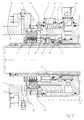
- den Dichtkopf nach der Erfindung im Axialschnitt,
- Fig. 2
- eine nur teilweise Darstellung des Gegenstands nach Fig. 1,
- Fig. 3
- den Gegenstand nach Fig. 1 im Querschnitt,
- Fig. 4
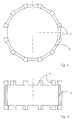
- das Hülsenteil in Stirnansicht und
- Fig. 5
- das Hülsenteil im Querschnitt.
- Der in der Zeichnung dargestellte Dichtkopf 1 dient zum Zuführen eines Wärmeträgermediums insbesondere in Form von Dampf zu einem rotierenden Drucksystem 2, beispielsweise einer Trockentrommel, Heizwalze oder dergleichen, das in der Zeichnung nur mit seiner Anschlußeinrichtung angedeutet ist.
- Dazu besteht der Dichtkopf 1 aus einem an das Drucksystem 2 angeschlossenen rohrförmigen Rotor 3 und einem über Wälzlager 4 auf dem Rotor 3 angeordneten stillstehenden Dichtkopfgehäuse 5. Das Dichtkopfgehäuse 5 besitzt mindestens einen Anschlußstutzen 5' für eine das Wärmeträgermedium führende, in der Zeichnung nicht dargestellte Anschlußleitung.
- Der Rotor 3 steht über den vom Wärmeträgermedium beaufschlagten Innenraum 8 des Dichtkopfgehäuses 5 in offener Verbindung mit dem Anschlußstutzen 5'. Dadurch kann das Wärmeträgermedium durch den Anschlußstutzen 5' und den Rotor 3 in das Drucksystem 2 gelangen.
- Axial zwischen dem Anschlußstutzen 5' und den Wälzlagern 4 ist ein den Rotor 3 gegen die Wand des Dichtkopfgehäuses 5 abdichtendes primäres Dichtungselement 6 angeordnet, dem axial in Richtung zu den Wälzlagern 4 hin atmosphärenseitig eine sekundäre Dichtung 7 zwischen dem Rotor 3 und der Wand des Dichtkopfgehäuses 5 nachgeschaltet ist.
- Im Dichtkopfgehäuse 5 ist axial zwischen der sekundären Dichtung 7 und dem primären Dichtungselement 6 ein sich ringförmig um den Rotor 3 erstreckender Kondensatraum 9 angeordnet. Der Kondensatraum 9 steht über wenigstens einen, vorzugsweise über vier Überströmkanäle 10 mit dem Innenraum 8 in Verbindung. Außerdem befindet sich der Kondensatraum 9 in wärmeleitendem Kontakt mit einem Kühlsystem 11. Hierdurch kann das dampfförmige Wärmeträgermedium durch den Überströmkanal 10 in den Kondensatraum 9 eintreten und dort unter dem Einfluß des Kühlsystems 11 kondensieren. Das Kondensat, das damit auch in Kontakt mit dem primären Dichtungselement 6 kommt, verhindert ein Trockenlaufen dieses Dichtungselementes 6, wirkt also als Schmiermittel. Da der Kondensatraum 9 in Verbindung mit dem Innenraum 8 des Dichtkopfgehäuses 5 steht, bestehen zwischen den axial beiden Seiten des primären Dichtungselementes 6 keine Druckunterschiede, so daß jedenfalls keine axiale Kraftbeaufschlagung vorliegt. Dadurch kann das primäre Dichtungselement 6 als Ringlippendichtung ausgebildet sein, wobei, wie sich dies auch aus den Fig. 1 und 2 ergibt, die Ringlippendichtung zweckmäßigerweise aus mehreren, axial hintereinander angeordneten Ringlippen aufgebaut ist. Die sekundäre Dichtung 7 ist dagegen als übliche Gleitringdichtung ausgebildet.
- Das primäre Dichtungselement 6 ist auf seiner dem Innenraum 8 zugewandten Seite von einer Isolierscheibe 12 umschlossen, die einen Wärmefluß vom Innenraum 8 her zum Kondensatraum 9 verhindert. Das Dichtungselement 6 ist dabei in einen Ringfalz der Isolierscheibe 12 eingelegt.
- Um weiter einen Wärmefluß vom Innern des Rotors 3 her zum Kondensatraum 9 zu mindern, ist der Rotor 3 in dem sich über die beiden Dichtungen 6, 7 erstreckenden Bereich doppelwandig ausgebildet.
- In dem Kondensatraum 9 ist ein in den Fig. 4 und 5 im einzelnen dargestelltes Hülsenteil 13 angeordnet, das den Kondensatraum 9 in einen radial inneren 14' und äußeren 14'', jeweils axial verlaufenden Strömungskanal unterteilt. Der innere und äußere Strömungskanal 14', 14'' stehen dabei jeweils axial endseitig miteinander in Verbindung. Dadurch ist grundsätzlich eine umlaufende Strömung möglich. Das Hülsenteil 13 ist mit radial auswärts gerichteten, axial verlaufenden und gleichmäßig über den Umfang verteilt angeordneten Trennstegen 13' versehen. Diese bilden zwischen sich an der äußeren Umfangsfläche die äußeren Strömungskanäle 14''. Innerhalb des Hülsenteils 13 sind am Rotor 3 fest angeordnete Förderorgane für das Kondensat vorgesehen, die mit dem Rotor 3 umlaufen und einen Förderdruck für die Zirkulation des Kondensats in den Strömungskanälen 14', 14'' erzeugen. Diese Förderorgane sind von einem Fördergewinde gebildet, das in der Fig. 1 in üblicher Darstellung lediglich als Strich 15 angedeutet ist, wobei das Fördergewinde auf der Mantelfläche des die Gleitringdichtung 7 tragenden Lagerings 16 angeordnet ist.
- Das Kühlsystem 11 ist von einer den Kondensatraum 9 umschließenden Ringkammer 17 gebildet, die von Kühlwasser durchströmt wird. Diese Ringkammer 17 ist mit an den Kühlwasserkreislauf angeschlossen, der der Gegenringkühlung des Gleitringlagers 7 dient. Diese Ringkammer kann dabei, wie in der Zeichnung in Fig. 2 dargestellt, mit in Richtung zum Kondensatraum 9 sich erstreckenden Ringnuten 18 versehen sein, wodurch die innere Oberfläche vergrößert, somit eine bessere Kühlwirkung erzielt wird.
- Um zu verhindern, daß das Kondensat durch einen der unteren Überströmkanäle 10 zurück in den Innenraum 8 des Dichtkopfgehäuses 5 fließen kann, sind die Überströmkanäle 10 durch radial in das Dichtkopfgehäuse 5 wahlweise einsetzbare, entsprechend unterschiedlich ausgebildete Nippel 19 zu öffnen oder abzusperren. Das Einsetzen der Nippel 19 erfolgt daher erst nach endgültiger Montage des Dichtkopfes 1 in der Weise, daß nur der in Einbaulage vertikal oberste Überströmkanal 10 geöffnet, die übrigen dagegen geschlossen sind.
Claims (13)
- Dichtkopf zum Transport eines Wärmeträgermediums, insbes. zum Zuführen von Dampf zu einem rotierenden Drucksystem (2), wie einer Trockentrommel, Heizwalze oder dergleichen, und anschließendem Abführen des Kondensats, bestehend aus einem an das Drucksystem (2) angeschlossenen rohrförmigen Rotor (3) und einem über Wälzlager (4) auf dem Rotor (3) angeordneten stillstehenden Dichtkopfgehäuse (5) mit mindestens einem Anschlußstutzen (5') für eine das Wärmeträgermedium führende Anschlußleitung, wobei der Rotor (3) über den vom Wärmeträgermedium beaufschlagten Innenraum (8) des Dichtkopfgehäuses (5) in offener Verbindung mit dem Anschlußstutzen (5') steht und axial zwischen dem Anschlußstutzen (5') und den Wälzlagern (4) ein den Rotor (3) gegen die Wand des Dichtkopfgehäuses (5) abdichtendes primäres Dichtungselement (6) angeordnet ist, dem axial in Richtung zu den Wälzlagern (4) hin atmosphärenseitig eine sekundäre Dichtung (7) zwischen dem Rotor (3) und der Wand des Dichtkopfgehäuses (5) nachgeschaltet ist, dadurch gekennzeichnet, daß im Dichtkopfgehäuse (5) axial zwischen der sekundären Dichtung (7) und dem primären Dichtungselement (6) ein sich ringförmig um den Rotor (3) erstreckender Kondensatraum (9) angeordnet ist, der über wenigstens einen Überströmkanal (10) mit dem vom Wärmeträgermedium beaufschlagten Innenraum (8) in Verbindung steht und der in wärmeleitendem Kontakt mit einem Kühlsystem (11) steht.
- Dichtkopf nach Anspruch 1, dadurch gekennzeichnet, daß das primäre Dichtungselement (6) als Ringlippendichtung oder als Gleitringdichtung und die sekundäre Dichtung (7) als Gleitringdichtung ausgebildet sind.
- Dichtkopf nach Anspruch 2, dadurch gekennzeichnet, daß die Ringlippendichtung mehrere, axial hintereinander angeordnete Ringlippen aufweist.
- Dichtkopf nach einem der Ansprüche 1 bis 3, dadurch gekennzeichnet, daß das primäre Dichtungselement (6) auf seiner dem Innenraum (8) zugewandten Seite von einer Isolierscheibe (12) umschlossen ist.
- Dichtkopf nach Anspruch 4, dadurch gekennzeichnet, daß das Dichtungselement (6) in einen Ringfalz der Isolierscheibe (12) eingelegt ist.
- Dichtkopf nach einem der Ansprüche 1 bis 5, dadurch gekennzeichnet, daß der Rotor (3) in dem sich über die beiden Dichtungen (6, 7) erstreckenden Bereich doppelwandig ausgebildet ist.
- Dichtkopf nach einem der Ansprüche 1 bis 6, dadurch gekennzeichnet, daß in dem Kondensatraum (9) ein Hülsenteil (13) angeordnet ist, das den Kondensatraum (9) in einen radial inneren (14') und äußeren (14''), axial verlaufenden Strömungskanal unterteilt, wobei der innere und äußere Srömungskanal (14', 14'') jeweils axial endseitig miteinander in Verbindung stehen.
- Dichtkopf nach Anspruch 7, dadurch gekennzeichnet, daß das Hülsenteil (13) mit radial auswärts gerichteten, axial verlaufenden und gleichmäßig über den Umfang verteilt angeordneten Trennstegen (13') versehen ist, die zwischen sich die äußeren Strömungskanäle (14'') bilden.
- Dichtkopf nach Anspruch 7 oder 8, dadurch gekennzeichnet, daß innerhalb des Hülsenteils (13) am Rotor (3) fest angeordnete Förderorgane für das Kondensat umlaufen und einen Förderdruck für die Zirkulation des Kondensats in den Strömungskanälen (14', 14'') erzeugen.
- Dichtkopf nach Anspruch 9, dadurch gekennzeichnet, daß die Förderorgane von einem auf der Mantelfläche des die Gleitringdichtung (7) tragenden Lagerrings (16) angeordneten Fördergewinde (15) gebildet sind.
- Dichtkopf nach einem der Ansprüche 1 bis 10, dadurch gekennzeichnet, daß das Kühlsystem (11) von einer den Kondensatraum (9) umschließenden, von Kühlwasser durchströmten Ringkammer (17) gebildet ist, die an den Kühlwasserkreislauf für die Gegenringkühlung des Gleitringlagers (7) angeschlossen ist.
- Dichtkopf nach Anspruch 11, dadurch gekennzeichnet, daß die Ringkammer (17) mit in Richtung zum Kondensatraum (9) sich erstreckenden Ringnuten (18) versehen ist.
- Dichtkopf nach einem der Ansprüche 1 bis 12, dadurch gekennzeichnet, daß die Überströmkanäle (10) durch radial in das Dichtkopfgehäuse (5) wahlweise einsetzbare Nippel (19) zu öffnen oder absperrbar sind, wobei nur der in Einbaulage vertikal oberste Überströmkanal (10) geöffnet ist.
Applications Claiming Priority (2)
| Application Number | Priority Date | Filing Date | Title |
|---|---|---|---|
| DE19618661A DE19618661C1 (de) | 1996-05-09 | 1996-05-09 | Dichtkopf zum Transport eines Wärmeträgermediums zu einem rotierenden Drucksystem |
| DE19618661 | 1996-05-09 |
Publications (2)
| Publication Number | Publication Date |
|---|---|
| EP0806578A1 true EP0806578A1 (de) | 1997-11-12 |
| EP0806578B1 EP0806578B1 (de) | 2003-09-24 |
Family
ID=7793823
Family Applications (1)
| Application Number | Title | Priority Date | Filing Date |
|---|---|---|---|
| EP97104456A Expired - Lifetime EP0806578B1 (de) | 1996-05-09 | 1997-03-15 | Dichtkopf zum Transport eines Wärmeträgermediums zu einem rotierenden Drucksystem |
Country Status (4)
| Country | Link |
|---|---|
| US (1) | US5778971A (de) |
| EP (1) | EP0806578B1 (de) |
| DE (1) | DE19618661C1 (de) |
| ES (1) | ES2202505T3 (de) |
Cited By (2)
| Publication number | Priority date | Publication date | Assignee | Title |
|---|---|---|---|---|
| CN102410415A (zh) * | 2011-08-25 | 2012-04-11 | 江苏腾旋科技股份有限公司 | 高温高速旋转接头 |
| EP3828431A1 (de) * | 2019-11-26 | 2021-06-02 | Christian Maier GmbH & Co. KG Maschinenfabrik | Drehdurchführung |
Families Citing this family (15)
| Publication number | Priority date | Publication date | Assignee | Title |
|---|---|---|---|---|
| DE19707876C2 (de) * | 1997-02-27 | 2002-09-26 | Voith Paper Patent Gmbh | Walzenanordnung |
| DE19747555A1 (de) * | 1997-10-28 | 1999-04-29 | Voith Sulzer Papiertech Patent | Heiz- und/oder kühlbarer Zylinder |
| SE515396C2 (sv) * | 1999-05-12 | 2001-07-30 | Abb Ab | En svivel för flexibel transport av en fluid |
| US6164316A (en) * | 1999-12-23 | 2000-12-26 | Deublin Company | High temperature rotating union |
| TW427449U (en) * | 2000-01-28 | 2001-03-21 | Ind Tech Res Inst | Cooling device for hollow screw |
| DE10205790A1 (de) * | 2002-02-13 | 2003-08-28 | Maier Christian Masch | Dichtkopf zum Zuführen eines Wärmeträgermediums |
| NO20022196L (no) * | 2002-05-08 | 2009-11-16 | Advanced Prod & Loading As | Anordning for sammenkopling av rörledninger som förer fluid under trykk |
| US20040163709A1 (en) * | 2003-02-24 | 2004-08-26 | Baugh Benton F. | Fluid swivel with cooling porting |
| ITUD20030167A1 (it) * | 2003-08-08 | 2005-02-09 | De Longhi Spa | Raccordo coassiale a giunto. |
| CN100387368C (zh) * | 2005-11-17 | 2008-05-14 | 王溥岚 | 水循环交换器 |
| WO2007084480A2 (en) * | 2006-01-18 | 2007-07-26 | 3M Innovative Properties Company | Dead-shaft roller with aerostatic rotary union |
| ITPR20060062A1 (it) * | 2006-07-03 | 2008-01-04 | Cft Spa | Sistema per creare una barriera sterile e lubrificare e/o refrigerare parti mobili in impianti di sterilizzazione uht. |
| US10947992B2 (en) * | 2015-08-17 | 2021-03-16 | Pedro Arnulfo Sarmiento | Convectors |
| US11953126B1 (en) * | 2023-04-21 | 2024-04-09 | Princetel, Inc. | Fluid rotary joint assembly suitable for high rotational speed |
| US20250305607A1 (en) * | 2024-04-02 | 2025-10-02 | Kadant Johnson Llc | Rotary Joint with Adjustable Syphon for Rotating Cylinder |
Citations (2)
| Publication number | Priority date | Publication date | Assignee | Title |
|---|---|---|---|---|
| US4965920A (en) * | 1989-07-07 | 1990-10-30 | Phillips Petroleum Company | Fluid heated roll apparatus and method |
| EP0448730A1 (de) * | 1990-02-23 | 1991-10-02 | Christian Maier GmbH & Co. Maschinenfabrik | Dichtkopf zum Zuführen eines Wärmeträgermediums zu einem rotierenden Drucksystem |
Family Cites Families (7)
| Publication number | Priority date | Publication date | Assignee | Title |
|---|---|---|---|---|
| US1953525A (en) * | 1931-06-13 | 1934-04-03 | Young George Harold | Siphon exhaust for drier rolls |
| US2331615A (en) * | 1942-06-22 | 1943-10-12 | Rotary Seal Company | Sealed coupling |
| US3638606A (en) * | 1969-11-21 | 1972-02-01 | Gen Electric | Apparatus for controlling the coating of selected surfaces of an article of manufacture |
| US3704669A (en) * | 1970-07-15 | 1972-12-05 | Stevens Corp | Vibrating roller with means for circulating a cooling fluid for use in bearing and drive gear lubrication |
| US4230928A (en) * | 1978-12-18 | 1980-10-28 | Wolff Manufacturing Company | Method and machine for rebuilding track roller assemblies |
| DE3417093A1 (de) * | 1984-05-09 | 1985-11-14 | Küsters, Eduard, 4150 Krefeld | Drehanschlusskopf fuer heizbare bzw. kuehlbare walzen |
| DE3812533A1 (de) * | 1988-04-15 | 1989-10-26 | Josef Seelen | Abdichtung fuer blasrohr oder welle |
-
1996
- 1996-05-09 DE DE19618661A patent/DE19618661C1/de not_active Expired - Lifetime
-
1997
- 1997-03-15 EP EP97104456A patent/EP0806578B1/de not_active Expired - Lifetime
- 1997-03-15 ES ES97104456T patent/ES2202505T3/es not_active Expired - Lifetime
- 1997-05-09 US US08/853,644 patent/US5778971A/en not_active Expired - Lifetime
Patent Citations (2)
| Publication number | Priority date | Publication date | Assignee | Title |
|---|---|---|---|---|
| US4965920A (en) * | 1989-07-07 | 1990-10-30 | Phillips Petroleum Company | Fluid heated roll apparatus and method |
| EP0448730A1 (de) * | 1990-02-23 | 1991-10-02 | Christian Maier GmbH & Co. Maschinenfabrik | Dichtkopf zum Zuführen eines Wärmeträgermediums zu einem rotierenden Drucksystem |
Cited By (2)
| Publication number | Priority date | Publication date | Assignee | Title |
|---|---|---|---|---|
| CN102410415A (zh) * | 2011-08-25 | 2012-04-11 | 江苏腾旋科技股份有限公司 | 高温高速旋转接头 |
| EP3828431A1 (de) * | 2019-11-26 | 2021-06-02 | Christian Maier GmbH & Co. KG Maschinenfabrik | Drehdurchführung |
Also Published As
| Publication number | Publication date |
|---|---|
| DE19618661C1 (de) | 1997-10-09 |
| US5778971A (en) | 1998-07-14 |
| ES2202505T3 (es) | 2004-04-01 |
| EP0806578B1 (de) | 2003-09-24 |
Similar Documents
| Publication | Publication Date | Title |
|---|---|---|
| DE19618661C1 (de) | Dichtkopf zum Transport eines Wärmeträgermediums zu einem rotierenden Drucksystem | |
| EP0340503B1 (de) | Beheizbare Walze | |
| DE19613609C2 (de) | Axialkolbenmaschine mit internem Spülkreislauf | |
| DE3587837T2 (de) | Lager. | |
| DE4238147C2 (de) | Radial-Nadellager-Baueinheit mit integrierter Radial-Axialabdichtung und ggf. Axialabstützung | |
| EP1069362B1 (de) | Drehdurchführung für wechselnde Medien | |
| CH648641A5 (de) | Ring-keilflaechen-drucklager. | |
| EP1327802B1 (de) | Hydraulische Dichtungsanordnung | |
| DE2037387A1 (de) | Lageranordnung mit flexiblen Laby nnthdichtungen | |
| DE1475601A1 (de) | Mechanische Druckstufendichtung | |
| DE3127122C2 (de) | Flüssigkeitsgekühlter Ventilsitz für ein Auslassventil einer Kolbenbrennkraftmaschine | |
| DE1260249B (de) | Stopfbuechse zur Abdichtung gegen gasfoermige Medien | |
| DE102016124283A1 (de) | Hydrodynamische Kupplung | |
| DE3907154A1 (de) | Oelschmiersystem fuer die lagerung eines wellenzapfens in einer rotierenden welle | |
| EP0220558A2 (de) | Druckmittelverteiler für umlaufende Spannzylinder | |
| DE2138362A1 (de) | Wellendichtung für Druckmittelbehandlungsmaschinen | |
| DE1600651A1 (de) | Wellendichtung | |
| DE102017106942A1 (de) | Hydrodynamische Kupplung | |
| EP1336807B1 (de) | Dichtkopf zum Zuführen eines Wärmeträgermediums | |
| DE3115193C2 (de) | Radial-Wälzlager mit Ölbadschmierung | |
| DE2817878B1 (de) | Einoelwalze | |
| DE2655247A1 (de) | Einrichtung zur uebertragung eines unter druck stehenden fluessigen mediums zwischen zwei relativ zueinander rotierenden teilen | |
| DE102010017620B4 (de) | Dichtungsanordnung und Walze | |
| DE102021125138A1 (de) | Dichtungsanordnung und Walze | |
| DE2911000A1 (de) | Drehdurchfuehrung fuer die einleitung stroemungsfaehiger medien in ein rotierendes maschinenteil |
Legal Events
| Date | Code | Title | Description |
|---|---|---|---|
| PUAI | Public reference made under article 153(3) epc to a published international application that has entered the european phase |
Free format text: ORIGINAL CODE: 0009012 |
|
| 17P | Request for examination filed |
Effective date: 19970910 |
|
| AK | Designated contracting states |
Kind code of ref document: A1 Designated state(s): ES FI FR GB IT NL |
|
| RBV | Designated contracting states (corrected) |
Designated state(s): ES FI FR GB IT NL |
|
| REG | Reference to a national code |
Ref country code: DE Ref legal event code: 8566 |
|
| 17Q | First examination report despatched |
Effective date: 20000306 |
|
| RIC1 | Information provided on ipc code assigned before grant |
Ipc: 7F 16L 27/08 B Ipc: 7F 16C 13/00 A |
|
| GRAH | Despatch of communication of intention to grant a patent |
Free format text: ORIGINAL CODE: EPIDOS IGRA |
|
| GRAS | Grant fee paid |
Free format text: ORIGINAL CODE: EPIDOSNIGR3 |
|
| GRAA | (expected) grant |
Free format text: ORIGINAL CODE: 0009210 |
|
| AK | Designated contracting states |
Kind code of ref document: B1 Designated state(s): ES FI FR GB IT NL |
|
| REG | Reference to a national code |
Ref country code: GB Ref legal event code: FG4D Free format text: NOT ENGLISH |
|
| GBT | Gb: translation of ep patent filed (gb section 77(6)(a)/1977) | ||
| REG | Reference to a national code |
Ref country code: ES Ref legal event code: FG2A Ref document number: 2202505 Country of ref document: ES Kind code of ref document: T3 |
|
| ET | Fr: translation filed | ||
| PLBE | No opposition filed within time limit |
Free format text: ORIGINAL CODE: 0009261 |
|
| STAA | Information on the status of an ep patent application or granted ep patent |
Free format text: STATUS: NO OPPOSITION FILED WITHIN TIME LIMIT |
|
| 26N | No opposition filed |
Effective date: 20040625 |
|
| REG | Reference to a national code |
Ref country code: FR Ref legal event code: PLFP Year of fee payment: 20 |
|
| PGFP | Annual fee paid to national office [announced via postgrant information from national office to epo] |
Ref country code: FR Payment date: 20151209 Year of fee payment: 20 |
|
| PGFP | Annual fee paid to national office [announced via postgrant information from national office to epo] |
Ref country code: NL Payment date: 20160324 Year of fee payment: 20 Ref country code: ES Payment date: 20160125 Year of fee payment: 20 |
|
| PGFP | Annual fee paid to national office [announced via postgrant information from national office to epo] |
Ref country code: GB Payment date: 20160322 Year of fee payment: 20 Ref country code: FI Payment date: 20160316 Year of fee payment: 20 |
|
| PGFP | Annual fee paid to national office [announced via postgrant information from national office to epo] |
Ref country code: IT Payment date: 20160330 Year of fee payment: 20 |
|
| REG | Reference to a national code |
Ref country code: NL Ref legal event code: MK Effective date: 20170314 |
|
| REG | Reference to a national code |
Ref country code: GB Ref legal event code: PE20 Expiry date: 20170314 |
|
| PG25 | Lapsed in a contracting state [announced via postgrant information from national office to epo] |
Ref country code: GB Free format text: LAPSE BECAUSE OF EXPIRATION OF PROTECTION Effective date: 20170314 |
|
| REG | Reference to a national code |
Ref country code: ES Ref legal event code: FD2A Effective date: 20180508 |
|
| PG25 | Lapsed in a contracting state [announced via postgrant information from national office to epo] |
Ref country code: ES Free format text: LAPSE BECAUSE OF EXPIRATION OF PROTECTION Effective date: 20170316 |