EP0804876A1 - Desinfizierendes Jod-Harz und Verfahren zu seiner Herstellng - Google Patents
Desinfizierendes Jod-Harz und Verfahren zu seiner Herstellng Download PDFInfo
- Publication number
- EP0804876A1 EP0804876A1 EP97109103A EP97109103A EP0804876A1 EP 0804876 A1 EP0804876 A1 EP 0804876A1 EP 97109103 A EP97109103 A EP 97109103A EP 97109103 A EP97109103 A EP 97109103A EP 0804876 A1 EP0804876 A1 EP 0804876A1
- Authority
- EP
- European Patent Office
- Prior art keywords
- anion exchange
- resin
- exchange resin
- iodine
- strong base
- Prior art date
- Legal status (The legal status is an assumption and is not a legal conclusion. Google has not performed a legal analysis and makes no representation as to the accuracy of the status listed.)
- Granted
Links
Images




Classifications
-
- A—HUMAN NECESSITIES
- A61—MEDICAL OR VETERINARY SCIENCE; HYGIENE
- A61L—METHODS OR APPARATUS FOR STERILISING MATERIALS OR OBJECTS IN GENERAL; DISINFECTION, STERILISATION OR DEODORISATION OF AIR; CHEMICAL ASPECTS OF BANDAGES, DRESSINGS, ABSORBENT PADS OR SURGICAL ARTICLES; MATERIALS FOR BANDAGES, DRESSINGS, ABSORBENT PADS OR SURGICAL ARTICLES
- A61L2/00—Disinfection or sterilisation of materials or objects, in general; Accessories therefor
- A61L2/16—Disinfection or sterilisation of materials or objects, in general; Accessories therefor using chemical substances
- A61L2/23—Solid materials, e.g. granules, powders, blocks or tablets
-
- A—HUMAN NECESSITIES
- A01—AGRICULTURE; FORESTRY; ANIMAL HUSBANDRY; HUNTING; TRAPPING; FISHING
- A01N—PRESERVATION OF BODIES OF HUMANS OR ANIMALS OR PLANTS OR PARTS THEREOF; BIOCIDES, e.g. AS DISINFECTANTS, AS PESTICIDES OR AS HERBICIDES; PEST REPELLANTS OR ATTRACTANTS; PLANT GROWTH REGULATORS
- A01N59/00—Biocides, pest repellants or attractants, or plant growth regulators containing elements or inorganic compounds
- A01N59/12—Iodine, e.g. iodophors; Compounds thereof
-
- A—HUMAN NECESSITIES
- A61—MEDICAL OR VETERINARY SCIENCE; HYGIENE
- A61L—METHODS OR APPARATUS FOR STERILISING MATERIALS OR OBJECTS IN GENERAL; DISINFECTION, STERILISATION OR DEODORISATION OF AIR; CHEMICAL ASPECTS OF BANDAGES, DRESSINGS, ABSORBENT PADS OR SURGICAL ARTICLES; MATERIALS FOR BANDAGES, DRESSINGS, ABSORBENT PADS OR SURGICAL ARTICLES
- A61L15/00—Chemical aspects of, or use of materials for, bandages, dressings or absorbent pads
- A61L15/16—Bandages, dressings or absorbent pads for physiological fluids such as urine or blood, e.g. sanitary towels, tampons
- A61L15/42—Use of materials characterised by their function or physical properties
- A61L15/425—Porous materials, e.g. foams or sponges
-
- A—HUMAN NECESSITIES
- A61—MEDICAL OR VETERINARY SCIENCE; HYGIENE
- A61L—METHODS OR APPARATUS FOR STERILISING MATERIALS OR OBJECTS IN GENERAL; DISINFECTION, STERILISATION OR DEODORISATION OF AIR; CHEMICAL ASPECTS OF BANDAGES, DRESSINGS, ABSORBENT PADS OR SURGICAL ARTICLES; MATERIALS FOR BANDAGES, DRESSINGS, ABSORBENT PADS OR SURGICAL ARTICLES
- A61L15/00—Chemical aspects of, or use of materials for, bandages, dressings or absorbent pads
- A61L15/16—Bandages, dressings or absorbent pads for physiological fluids such as urine or blood, e.g. sanitary towels, tampons
- A61L15/42—Use of materials characterised by their function or physical properties
- A61L15/46—Deodorants or malodour counteractants, e.g. to inhibit the formation of ammonia or bacteria
-
- A—HUMAN NECESSITIES
- A61—MEDICAL OR VETERINARY SCIENCE; HYGIENE
- A61L—METHODS OR APPARATUS FOR STERILISING MATERIALS OR OBJECTS IN GENERAL; DISINFECTION, STERILISATION OR DEODORISATION OF AIR; CHEMICAL ASPECTS OF BANDAGES, DRESSINGS, ABSORBENT PADS OR SURGICAL ARTICLES; MATERIALS FOR BANDAGES, DRESSINGS, ABSORBENT PADS OR SURGICAL ARTICLES
- A61L2/00—Disinfection or sterilisation of materials or objects, in general; Accessories therefor
- A61L2/16—Disinfection or sterilisation of materials or objects, in general; Accessories therefor using chemical substances
-
- A—HUMAN NECESSITIES
- A61—MEDICAL OR VETERINARY SCIENCE; HYGIENE
- A61L—METHODS OR APPARATUS FOR STERILISING MATERIALS OR OBJECTS IN GENERAL; DISINFECTION, STERILISATION OR DEODORISATION OF AIR; CHEMICAL ASPECTS OF BANDAGES, DRESSINGS, ABSORBENT PADS OR SURGICAL ARTICLES; MATERIALS FOR BANDAGES, DRESSINGS, ABSORBENT PADS OR SURGICAL ARTICLES
- A61L26/00—Chemical aspects of, or use of materials for, wound dressings or bandages in liquid, gel or powder form
- A61L26/0061—Use of materials characterised by their function or physical properties
- A61L26/0066—Medicaments; Biocides
-
- A—HUMAN NECESSITIES
- A61—MEDICAL OR VETERINARY SCIENCE; HYGIENE
- A61L—METHODS OR APPARATUS FOR STERILISING MATERIALS OR OBJECTS IN GENERAL; DISINFECTION, STERILISATION OR DEODORISATION OF AIR; CHEMICAL ASPECTS OF BANDAGES, DRESSINGS, ABSORBENT PADS OR SURGICAL ARTICLES; MATERIALS FOR BANDAGES, DRESSINGS, ABSORBENT PADS OR SURGICAL ARTICLES
- A61L26/00—Chemical aspects of, or use of materials for, wound dressings or bandages in liquid, gel or powder form
- A61L26/0061—Use of materials characterised by their function or physical properties
- A61L26/0085—Porous materials, e.g. foams or sponges
-
- A—HUMAN NECESSITIES
- A61—MEDICAL OR VETERINARY SCIENCE; HYGIENE
- A61L—METHODS OR APPARATUS FOR STERILISING MATERIALS OR OBJECTS IN GENERAL; DISINFECTION, STERILISATION OR DEODORISATION OF AIR; CHEMICAL ASPECTS OF BANDAGES, DRESSINGS, ABSORBENT PADS OR SURGICAL ARTICLES; MATERIALS FOR BANDAGES, DRESSINGS, ABSORBENT PADS OR SURGICAL ARTICLES
- A61L9/00—Disinfection, sterilisation or deodorisation of air
-
- A—HUMAN NECESSITIES
- A61—MEDICAL OR VETERINARY SCIENCE; HYGIENE
- A61L—METHODS OR APPARATUS FOR STERILISING MATERIALS OR OBJECTS IN GENERAL; DISINFECTION, STERILISATION OR DEODORISATION OF AIR; CHEMICAL ASPECTS OF BANDAGES, DRESSINGS, ABSORBENT PADS OR SURGICAL ARTICLES; MATERIALS FOR BANDAGES, DRESSINGS, ABSORBENT PADS OR SURGICAL ARTICLES
- A61L9/00—Disinfection, sterilisation or deodorisation of air
- A61L9/015—Disinfection, sterilisation or deodorisation of air using gaseous or vaporous substances, e.g. ozone
- A61L9/04—Disinfection, sterilisation or deodorisation of air using gaseous or vaporous substances, e.g. ozone using substances evaporated in the air without heating
- A61L9/12—Apparatus, e.g. holders, therefor
-
- A—HUMAN NECESSITIES
- A61—MEDICAL OR VETERINARY SCIENCE; HYGIENE
- A61P—SPECIFIC THERAPEUTIC ACTIVITY OF CHEMICAL COMPOUNDS OR MEDICINAL PREPARATIONS
- A61P31/00—Antiinfectives, i.e. antibiotics, antiseptics, chemotherapeutics
- A61P31/04—Antibacterial agents
-
- A—HUMAN NECESSITIES
- A61—MEDICAL OR VETERINARY SCIENCE; HYGIENE
- A61P—SPECIFIC THERAPEUTIC ACTIVITY OF CHEMICAL COMPOUNDS OR MEDICINAL PREPARATIONS
- A61P31/00—Antiinfectives, i.e. antibiotics, antiseptics, chemotherapeutics
- A61P31/12—Antivirals
-
- C—CHEMISTRY; METALLURGY
- C02—TREATMENT OF WATER, WASTE WATER, SEWAGE, OR SLUDGE
- C02F—TREATMENT OF WATER, WASTE WATER, SEWAGE, OR SLUDGE
- C02F1/00—Treatment of water, waste water, or sewage
- C02F1/50—Treatment of water, waste water, or sewage by addition or application of a germicide or by oligodynamic treatment
-
- A—HUMAN NECESSITIES
- A61—MEDICAL OR VETERINARY SCIENCE; HYGIENE
- A61L—METHODS OR APPARATUS FOR STERILISING MATERIALS OR OBJECTS IN GENERAL; DISINFECTION, STERILISATION OR DEODORISATION OF AIR; CHEMICAL ASPECTS OF BANDAGES, DRESSINGS, ABSORBENT PADS OR SURGICAL ARTICLES; MATERIALS FOR BANDAGES, DRESSINGS, ABSORBENT PADS OR SURGICAL ARTICLES
- A61L2300/00—Biologically active materials used in bandages, wound dressings, absorbent pads or medical devices
- A61L2300/10—Biologically active materials used in bandages, wound dressings, absorbent pads or medical devices containing or releasing inorganic materials
- A61L2300/106—Halogens or compounds thereof, e.g. iodine, chlorite
-
- A—HUMAN NECESSITIES
- A61—MEDICAL OR VETERINARY SCIENCE; HYGIENE
- A61L—METHODS OR APPARATUS FOR STERILISING MATERIALS OR OBJECTS IN GENERAL; DISINFECTION, STERILISATION OR DEODORISATION OF AIR; CHEMICAL ASPECTS OF BANDAGES, DRESSINGS, ABSORBENT PADS OR SURGICAL ARTICLES; MATERIALS FOR BANDAGES, DRESSINGS, ABSORBENT PADS OR SURGICAL ARTICLES
- A61L2300/00—Biologically active materials used in bandages, wound dressings, absorbent pads or medical devices
- A61L2300/40—Biologically active materials used in bandages, wound dressings, absorbent pads or medical devices characterised by a specific therapeutic activity or mode of action
- A61L2300/404—Biocides, antimicrobial agents, antiseptic agents
-
- F—MECHANICAL ENGINEERING; LIGHTING; HEATING; WEAPONS; BLASTING
- F24—HEATING; RANGES; VENTILATING
- F24F—AIR-CONDITIONING; AIR-HUMIDIFICATION; VENTILATION; USE OF AIR CURRENTS FOR SCREENING
- F24F8/00—Treatment, e.g. purification, of air supplied to human living or working spaces otherwise than by heating, cooling, humidifying or drying
- F24F8/50—Treatment, e.g. purification, of air supplied to human living or working spaces otherwise than by heating, cooling, humidifying or drying by odorisation
-
- Y—GENERAL TAGGING OF NEW TECHNOLOGICAL DEVELOPMENTS; GENERAL TAGGING OF CROSS-SECTIONAL TECHNOLOGIES SPANNING OVER SEVERAL SECTIONS OF THE IPC; TECHNICAL SUBJECTS COVERED BY FORMER USPC CROSS-REFERENCE ART COLLECTIONS [XRACs] AND DIGESTS
- Y02—TECHNOLOGIES OR APPLICATIONS FOR MITIGATION OR ADAPTATION AGAINST CLIMATE CHANGE
- Y02A—TECHNOLOGIES FOR ADAPTATION TO CLIMATE CHANGE
- Y02A50/00—TECHNOLOGIES FOR ADAPTATION TO CLIMATE CHANGE in human health protection, e.g. against extreme weather
- Y02A50/20—Air quality improvement or preservation, e.g. vehicle emission control or emission reduction by using catalytic converters
Definitions
- the present invention relates to a disinfectant substance comprising an iodine (impregnated) resin and to a process for the preparation thereof.
- the iodine/resin disinfectant may be used to sterilize a fluid such as, for example, water, air, as well as fluid exudate secreted at body lesions or traumas such as at cuts, burns , etc.; thus, the disinfectant may be used to devitalize microorganisms (e.g. bacteria, viruses, etc..) which may be present in the fluid (e.g. water, air, pus and the like).
- the treatment of fluid, such as water or air, with an iodine/resin disinfectant of the present invention may leave behind non-detectable (or acceptable) residual diatomic iodine in the fluid (e.g. water or air).
- the present invention in particular relates to a demand type broad spectrum resin-polyiodide (e.g. water, air, wound) disinfectant.
- Diatomic halogen such as I 2 , Cl 2 , Br 2 , etc.
- Diatomic chlorine for example, is a widely exploited disinfectant for controlling or eliminating micro-organisms which may be present in water.
- a disadvantage of a sterilization regime which exploits diatomic halogen is that the regime may leave behind unacceptable (residual) levels of halogen in the water once sterilization is complete.
- iodine/resin product has, however, been proposed for use as a demand disinfectant, namely a disinfectant wherein iodine is released almost entirely on a demand-action basis.
- United States patent nos. 3,817,860, 3,923,665, 4,238,477 and 4,420,590 teach such a demand disinfectant wherein iodine is the active disinfectant agent; the entire contents of each of these patents is incorporated herein by reference.
- the resin product may be used without fear of introducing unacceptable concentrations of diatomic iodine into the water to be sterilized.
- U.S. patent nos. 3,817,860 and 3,923,665 teach an iodine/resin demand disinfectant which is the reaction product obtained by contacting a strong base anion exchange resin with a suitable source of triiodide ions.
- the reaction product is taught as being very stable in the sense that the amount of iodine (e.g. I 2 ) released into water from the reaction product is sufficiently low that the water disinfected thereby is immediately ready for use, ie. as drinking water.
- the procedure for preparing the iodine/resin comprises forming a triiodide ion (solution or sludge) by dissolving diatomic iodine in a water solution of a suitable alkali metal halide (e.g. KI, NaI,.).
- a suitable alkali metal halide e.g. KI, NaI,.
- the triiodide solution is in particular taught as being made with a minimal (i.e. minor) water content just sufficient to avoid causing the I 2 to crystallize out; see example 1 of U.S. patent no. 3,923,665.
- the resulting (solution) containing the triiodide ion is then contacted with the starting resin (under ambient conditions with respect to temperature (i.e. 25 to 30° C) and pressure), the triiodide ions exchanging with the anion of the resin (e.g. exchange with chlorine, sulfate, etc., ..).
- the starting resin is taught as being a porous granular strong base anion exchange resin having strongly basic groups in a salt form wherein the anion thereof is exchangeable with triiodide ions.
- contacting is continued until the desired amount of triiodide has reacted with the strongly basic groups such that bacterially contaminated water is disinfected when passed through a bed of the obtained resin. After a suitable contact time the iodine/resin is (water) washed to remove water-elutable iodine from the resin product.
- U.S. patent no. 4,238,477 teaches an alternate process whereby the iodine/resin may be produced.
- a suitable resin in the iodide form (I - ) is contacted with water comprising diatomic iodine (I 2 ) in solution, the water being recycled between a source of a predetermined amount of diatomic iodine and the resin.
- the process as taught by this latter patent is a relatively complicated system of pumps, vessels, heaters, etc.; by exploiting a fluidized bed, it in particular may lead to a significant degree of resin bead attrition, i.e. particle breakup.
- iodine tincture for sterilising wounds.
- the sterilization effect of iodine tincture is short-lived; this means that the tincture must be reapplied on a regular basis to maintain the sterilization effect.
- such solutions may also damage or destroy the tissue around the wound if applied too liberally and too often.
- the direct application of such solutions to a lesion or wound is usually accompanied by a painful. sensation.
- lesions such as for example wounds or burns
- a means whereby lesions may be treated in order to facilitate healing by devitalising microorganisms which may already be in the area of the lesion and further to prevent microorganisms from having access to such lesion (i.e. a dressing), i.e. to inhibit access from any outside biovectors such as for example airborne, waterborne, spiral borne, blood borne, particulate borne microorganisms and the like.
- a means for inhibiting or preventing microorganisms from contacting predetermined areas of the body such as the skin e.g. a protective textile for making protective clothing.
- the present invention provides a process for preparing a demand disinfectant resin, said disinfectant resin being an iodinated strong base anion exchange resin, (i.e. a demand disinfectant-resin comprising polyiodide ions, having a valence of -1, the ions being absorbed or impregnated into the resin as herein described),
- a demand disinfectant resin being an iodinated strong base anion exchange resin, (i.e. a demand disinfectant-resin comprising polyiodide ions, having a valence of -1, the ions being absorbed or impregnated into the resin as herein described)
- the disinfectant-resin may be one in which diatomic iodine is incorporated.
- the disinfectant polyiodide-resin may in particular be triiodide-resin.
- the iodine-substance may comprise triiodide ion of formula I 3 - , i.e. so as to form a disinfectant-resin which comprises (absorbed) triiodide ions of formula I 3 - .
- triiodide refers to or characterize a substance or a complex as containing three iodine atoms and which has a valence of -1.
- the triiodide ion herein therefore is a complex ion which may be considered as comprising molecular iodine (i.e. iodine as I 2 ) and an iodine ion (i.e. I - ).
- polyiodide refers to or characterize a substance or a complex as containing three iodine atoms and which has a valence of -1.
- the triiodide ion herein therefore is a complex ion which may be considered as comprising molecular iodine (i.e. iodine as I 2 ) and an iodine ion (i.e. I - ).
- polyiodide refers to or characterize a substance or a complex as containing three i
- polyiodide ions and the like, refer to or characterize a substance or a complex as having three or more iodine atoms and which may be formed if more of the molecular iodine combines with the monovalent triiodide ion. These terms are more particularly described in the above referred to U.S. patents.
- the present invention provides a process for preparing a demand disinfectant resin, said disinfectant resin being an iodinated strong base anion exchange resin, (i.e. a demand disinfectant-resin comprising polyiodide ions, having a valence of -1, the ions being absorbed or impregnated into the resin as herein described),
- a demand disinfectant resin being an iodinated strong base anion exchange resin, (i.e. a demand disinfectant-resin comprising polyiodide ions, having a valence of -1, the ions being absorbed or impregnated into the resin as herein described)
- the strong base anion exchange resin may be in a salt form such as for example a chloride or hydroxyl form.
- the conversion in accordance with the present invention may essentially or at least partially be effected at said elevated temperature and elevated pressure.
- the conversion, in accordance with the present invention may, thus for example, be effected in one, two or more stages.
- the elevated pressure/temperature conditions may be divided between two different pairs of elevated pressure/temperature conditions, e.g. an initial pressure of 15 psig and a temperature of 121° C and a subsequent pressure of 5 psig and a temperature of 115° C.
- the conversion may for example, comprise a first stage followed by a second stage.
- the first stage may, for example, be effected at low temperature conditions (e.g. at ambient temperature and ambient pressure conditions) whereas the second stage may be effected at elevated conditions such as described herein.
- the present invention in accordance with another aspect provides a process for preparing a demand disinfectant resin, said disinfectant resin being an iodinated strong base anion exchange resin, (i.e. a demand disinfectant-resin comprising polyiodide ions, having a valence of -1, the ions being absorbed or impregnated into the resin as herein described),
- a demand disinfectant resin being an iodinated strong base anion exchange resin, (i.e. a demand disinfectant-resin comprising polyiodide ions, having a valence of -1, the ions being absorbed or impregnated into the resin as herein described),
- the present invention provides a process for preparing a demand disinfectant resin, said disinfectant resin being an iodinated strong base anion exchange resin, (i.e. a demand disinfectant-resin comprising polyiodide ions, having a valence of -1, the ions being absorbed or impregnated into the resin as herein described),
- a demand disinfectant resin being an iodinated strong base anion exchange resin, (i.e. a demand disinfectant-resin comprising polyiodide ions, having a valence of -1, the ions being absorbed or impregnated into the resin as herein described)
- the low temperature may, for example, be a non-boiling temperature of not more than 95° C; e.g. 15 to 60° C; e.g. ambient temperature or room temperature such as a temperature of from about 15° C to about 40° C, e.g. 20 to 30° C.
- the pressure associated with the low temperature condition of the first stage may, for example, be a pressure of from 0 (zero) to less than 2 psig; the pressure may in particular be essentially ambient pressure (i.e. a pressure of less than 1 psig to 0 (zero) psig; 0 psig reflecting barometric or atmospheric pressure).
- the elevated temperature may, for example, be: a temperature of 102° C or higher; e.g. 105° C or higher; e.g. 110° C or higher; e.g. 115° C or higher; e.g. up to 150° C to 210° C; e.g. 115° C to 135° C.
- the elevated pressure associated with the elevated temperature condition of the second stage may, for example, be: a pressure of 2 psig or greater; e.g. 5 psig or greater; e.g. 15 psig to 35 psig; e.g. up to 100 psig.
- the present invention further relates to any demand disinfectant resin, the disinfectant resin being an iodinated strong base anion exchange resin which is the same as an iodinated strong base anion exchange resin prepared in accordance with a process as defined herein; an iodinated resin the same as a resin prepared in accordance with the (particular) process described herein is one which has the same low iodine bleed characteristic, i.e. the iodine is (more) tenaciously associated with the resin than for previously known iodinated resins. It in particular relates to a demand disinfectant resin, the disinfectant resin being an iodinated strong base anion exchange resin whenever prepared in accordance with a process as defined herein.
- the present invention also relates to the use of iodinated resins to disinfect fluids containing microorganisms, such fluids including air, water, pus, and the like.
- the iodinated resin may for example be a known resin such as discussed herein, a resin in accordance with the present invention, nylon based resin beads impregnated with iodine (such as MCV resin from MCV Tech. Intn'l Inc.), and the like.
- the present invention also provides a method for disinfecting air containing airborne microorganisms, said method comprising passing said air over a disinfectant resin such that airborne microorganisms contact said resin and are devitalized thereby, said disinfectant resin comprising an iodinated resin.
- the disinfectant resin may, for example, be a demand disinfectant resin.
- the disinfectant resin may, for example, comprise an iodinated strong base anion exchange resin.
- the present invention further provides a system for disinfecting air containing airborne microorganisms, said system comprising
- the present invention additionally provides a combination comprising
- the present invention in a more particular aspect provides a sterilisation dressing, for being applied to a lesion, (such as a sore, a wound (e.g. cut), an ulcer, a boil, an abrasion, a burn or other lesion of the skin or internal organ), said dressing comprising
- the demand disinfectant for the above mentioned method and system for treating air as well as for the combination and the dressing may be an iodinated resin produced in accordance with the present invention or it may be a known demand disinfectant iodinated resin such as for example as mentioned herein.
- the demand disinfectant depending on the intended use may take on any desired form; it may be bulk form; it may be in sheet form; it may be in particulate or granular form (e.g. particles of resin of from 0.2 mm to 1 cm in size), etc..
- any specified range or group is to be understood as a shorthand way of referring to each and every member of a range or group individually as well as each and every possible sub-ranges or sub-groups encompassed therein; and similarly with respect to any sub-ranges or sub-groups therein.
- g or "gm” is a reference to the gram weight unit; that "C” is a reference to the celsius temperature unit; and “psig” is a reference to “pounds per square inch guage”.
- the elevated temperature may as mentioned above, for example, be in the range of from 105° C to 150° C; the elevated pressure may be 5 psig and up.
- the anion exchange resin may, for example, as described below, be a quaternary ammonium anion exchange resin; the anion exchange resin may be in the chloride form Cl - , in the hydroxyl form OH - ; etc.
- the obtained iodide-resin may be treated prior to use to remove any water-elutable iodine from the iodide-resin.
- the treatment e.g. washing
- the treatment may be continued until no detectable iodine is found in wash water (the wash water initially being ion free water).
- Any suitable (known) iodine test procedure may be used for iodine detection purposes (see for example the above mentioned U.S. patents.
- the absorbable iodine substance may, for example, be provided by a composition consisting of mixture of KI, I 2 and a minor amount of water, the mole ratio of KI to I 2 initially being about 1; the expression "minor amount of water” as used herein shall be understood as characterizing the amount of water as being sufficient to avoid I 2 crystallization.
- the present invention in a further aspect provides an enhanced iodine/resin demand disinfectant product in which more iodine may be distributed throughout and be more tenaciously associated with the resin (e.g. beads) than with the previously known or commercially available techniques, the disinfectant being produced by a process as described herein.
- the invention more particularly provides an enhanced triiodide-resin disinfectant.
- the present invention can be practised with any (known) strong base anion exchange resin (for example, with those such as are described in more detail in the above-mentioned United States patents such as United States patent no 3,923,665).
- a quaternary ammonium anion exchange resin is, however, preferred.
- strong base anion exchange resin designates a class of resins which either contain strongly basic "cationic” groups, such as quaternary ammonium groups or which have strongly basic properties which are substantially equivalent to quaternary ammonium exchange resins.
- 3,923,665 and 3,817,860 identify a number of commercially available quaternary ammonium resins, as well as other strong base resins including tertiary sulphonium resins, quaternary phosphonium resins, alkyl pyridinium resins and the like.
- quaternary ammonium anion exchange resins which can be used in accordance with the present invention include in particular, Amberlite IRA-401 S, Amberlite IR-400 (Cl - ), Amberlite IR-400 (OH - ), Amberlite IR-402 (Cl - ), etc., (from Rohm & Hass) which may be obtained in granular form.
- These resins may for example, contain quaternary ammonium exchange groups which are bonded to styrene-divinyl benzene polymer chains.
- the resins which may be used herein may be in a hydroxyl form, a chloride form or in another salt (e.g. sulphate) form provided that the anion is exchangeable with the iodine member (e.g. with triiodide ion).
- the starting resin may, for example, be granular (i.e. comprise a plurality of particles) such that the final product wall likewise have a granular or particulate character; the granular form is advantageous due to the high surface area provided for contact with microorganisms.
- the starting resin may, for example, comprise granules having a size in the range of from 0.2 mm to 0.8 cm (e.g. of from 0.35 mm to 56 mm).
- resins such as those mentioned above are available in the salt form (e.g. as the chloride) and in the form of porous granular beads of various mesh sizes; the resin may of course be used in a bulk or massive form such as a plate, sheet, etc..
- a resin may be converted from a non-iodide form (e.g. a chloride form, a sulphate form) to the I 3 - form.
- Suitable halide salts include alkali metal halides (such as KI, NaI,...); potassium iodide is preferred.
- an iodide form of the resin may be used and the resin contacted with a source of diatomic iodine.
- any material or substance capable of donating an iodine-member absorbable by the anion exchange resin so as to convert the anion exchange resin to the desired polyiodide-resin may be used, as long as the denotable iodine-member thereof is a polyiodide ion having a valence of -1 and/or diatomic iodine.
- Examples of such materials in relation to iodine are shown in the above mentioned U.S. patents; e.g. compositions comprising iodine (I 2 ) and alkali metal halide (KI, NaI, etc.., KI being preferred) in association with water.
- the resin is in an iodide salt form (I -1 )
- the material may comprise the corresponding iodine in gaseous form.
- the resin may be contacted with an alkali metal iodide/I 2 mix wherein the iodide and the diatomic iodine are present in more or less stoichiometric amounts (i.e. a mole ratio of 1); see the previously mentioned U.S. patents.
- stoichiometric amounts of the iodine ion and iodine molecule i.e. one mole of I 2 per mole of I -1
- the iodide sludge will comprise substantially only the triiodide ions.
- stoichiometric excess quantities of I 2 are used some of the higher polyiodide ions may be formed.
- no more than the stoichiometric proportions of I - and I 2 are used in the initial aqueous starting sludge so that substantially only triiodided attaches to the resin.
- iodine may be combined with sodium, potassium or ammonium iodide and some water.
- the composition will contain monovalent iodine ion which will combine with diatomic iodine (I 2 ) to form polyiodide ion.
- I 2 diatomic iodine
- the molar ratio of iodine ion to diatomic iodine will dictate the nature of the polyiodide ion present , i.e. triiodide ion, mixtures of triiodide ion and other higher polyiodides ions, pentaiodide ion, etc....
- the determination of the (total) amount of iodine to be contacted with the resin, residence times etc.., will depend upon such factors as the nature of the polyiodide it is desired to introduce into the structure of a resin; the nature of the starting resin (i.e. porosity, grain size, equivalent exchange capacity of the resin, etc.), etc..
- the equivalent exchange capacity of the resin needs to be known. If necessary, this can be readily determined for example by the procedure described in U.S. patent no. 3,817,860 (column 9, lines 15 to 28).
- the components of the process may be chosen such that the obtained iodinated strong base anion exchange resin may comprise a strong base anion exchange resin component which represents from 25 to 90 (preferably 45 to 65) percent by weight of the total weight of the obtained iodinated resin.
- the conversion at elevated conditions may be effected in a reactor which is pressure sealable during conversion but which may be opened for recovery of the resin product after a predetermined reaction time.
- the process may thus be a batch process wherein conversion at elevated temperature and pressure is effected once the reactor is sealed.
- the reactor may be sized and the amount of reactants determined so as to provide a void space in the reactor during reaction.
- the weight ratio of sludge to resin may be 1:1 or higher, eg. 1:1 to 5:1; a weight ratio of 1:1 (if Amberlite 401-S is used as the resin) is preferred so as to minimize the amount of unabsorbed iodine which must be washed from the iodine/resin product.
- the high temperature/pressure contact conditions may as mentioned above be chosen with a view to maximizing the iodine content of the obtained iodine (e.g. iodine) demand resin.
- conversion of the resin to a polyhalide (e.g. I 3 - ) form may be effected at elevated temperature greater than 100° C, for example in the range of 105° C to 150° C (e.g. 110-115° C to 150° C); the upper limit of the temperature used will, for example, depend on the characteristics of the resin being used, i.e. the temperature should not be so high as to degrade the resin.
- the conversion may take place in a closed vessel or reactor.
- the temperature of the system may therefore be used as a means of achieving or controlling the (desired) pressure in the vessel depending upon the makeup of the Iodine mix in the reactor.
- a reaction mix disposed in a pressure sealed reactor may be, for example, subjected to a temperature of 105° C and a pressure of 200 mmHg, the pressure being induced by steam.
- a relatively inert gas may be used to induce and ⁇ or augment the pressure in the reactor.
- a pressurized relatively inert gas may be injected into a sealed reactor.
- the chosen gas must not unduly interfer with the production of a suitable iodinated resin.
- the high temperature/pressure treatment may be conducted in a closed reactor in the presence of (trapped air), a non-interfering gas such as iodine itself or of some other relatively inert (noble) gas; the pressure as mentioned above may be augmented by the pressuring gas.
- Air, carbon dioxide, nitrogen or the like may also be used as a pressuring gas, if desired, keeping in mind, however, that the use thereof must not unduly interfer with the production of a suitable iodinated resin. If pressure is to be induced by steam then as mentioned below steps should be taken to isolate the reaction mix from (excess) water.
- the elevated pressure is any pressure above ambient.
- the pressure may, for example, be 1 psig or higher, e.g in the range from 5 to 50 psig; the upper limit of the pressure used will also, for example, depend on the characteristics of the resin being used, i.e. the pressure should not be so high as to degrade the resin.
- the residence or contact time at the elevated conditions is variable depending upon the starting materials, contact conditions and amount of (tenaciously held) iodine it is desired to be absorbed by the anion exchange resin.
- the contact time may thus take on any value; usually, however, it is to be expected that it will be desired that the contact time (under the conditions used) be sufficient to maximize the amount of (tenaciously held) iodine absorbed from the material containing the absorbable iodine moiety.
- the residence time may for example be as little as 5 to 15 minutes (in the case where a preimpregnation step is used as shall be described below) or several hours or more ( up to 8 or 9 hours or more).
- the residence time exploited for elevated the conditions will as mentioned above depend on the starting material, temperature and pressure conditions, etc...; it may vary from several minutes to 8 or 9 hours or more; the upper time limit will in any event also, for example, depend on the characteristics of the resin being used, i.e. the residence time should not be so high as to degrade the resin.
- the contact at high temperature/pressure is preceded by an initial impregnation or absorption step (first stage).
- first stage may be carried out for only a few minutes (e.g. for from 1 to 10 minutes or more) or for up to 24 hours or more (e.g. for from one hour or more i.e. for from three to twenty-four hours).
- the time period of the initial stage may be relatively short.
- the time period for example, may be a few minutes or so and may correpond to the time necessary to just mix the reactants together; in this case the conversion may be considered to be essentially carried out in a single stage at elevated conditions.
- the residence time of the first stage will also be predetermined with a view to the end product resin desired.
- a water containing sludge of triiodide ions can be contacted with a salt form of the starting resin at ambient (i.e. room) temperature and pressure conditions to obtain an intermediate iodide-resin reaction product including residual iodine-substance.
- This step is preferably carried out in a batch reactor; the obtained intermediate composition comprising an intermediate iodide-resin may then be subjected to the higher temperature and pressure in accordance with the present invention in batch fashion as well.
- Such a first stage may be used to initiate buildup of iodine within the resin matrix.
- an iodide-resin demand disinfectant may, for example, be obtained by
- iodide/resin demand disinfectant may be obtained using the following sequence of steps:
- a small hole is necessary when a container such as a glass flask is used in order to avoid a too great pressure difference being built up between the interior of the flask and the interior of the autoclave which might cause the flask to collapse.
- the hole in any event is just large enough to more or less allow for the equalization of pressure and to maintain a positive pressure in the flask relative to the interior of the autoclave such that any foreign material such as water vapour is inhibited from flowing into the flask.
- a more sturdy pressure resistant container could of course be used such that, depending on the construction of the container and the temperature/pressure conditions prevailing in the autoclave, the hole may be avoided.
- a single autoclave/container may be used serving to hold and heat the reaction mix under pressure; such a container must of course be constructed so as to be able to resist the predetermined reaction conditions.
- the iodide-resin compound formed as described herein can be used as a demand disinfectant to disinfect water by batch contacting the contaminated water with the resin; continuous processing as mentioned in United States patent no 3,923,665 is also possible.
- water containing viable bacteria to be killed
- the maximum permissible flow rates for total bacterial sterilization may vary with the concentration of the polyiodide (e.g. triiodide) groups in the resin, bed depth, bacterial count, etc...
- the disinfection process may be monitored by taking samples of water after passage through the bed.
- Potable innocuous water may thus be readily produced in accordance with the present invention without the incorporation of objectionable amounts of free iodine therein as a result.
- the resin may be used with any (known) water treating devices such as for example those shown in U.S. patent nos. 4,749,484 and 4,978,449.
- the present invention also provides a method for disinfecting air containing airborne microorganisms.
- the method may comprise passing the air over a demand disinfectant resin such that airborne microorganisms contact said resin and are devitalized thereby, the demand disinfectant resin comprising an iodinated strong base anion exchange resin.
- the method may, for example, include passing the air through a bed of granules of iodinated resin so that the air courses over the granules (in a serpentine manner) as the air makes its way through the bed.
- the maximum permissible flow rates for total bacterial sterilization may vary with the concentration of the polyiodide groups in the resin, bed depth, bacterial count, etc...
- the iodinated strong base anion exchange resin may comprise a strong base anion exchange resin component which represents from 25 to 90 (preferably 45 to 65) percent by weight of the total weight of the iodinated resin.
- the present invention provides a system for disinfecting air containing airborne microorganisms, said system, for example, comprising
- An air path means may define an air inlet and an air outlet.
- the resin may be disposed between said inlet and outlet or be disposed at the inlet or outlet.
- the air path means may take any form. It may take the form of ductwork in a forced air ventilation system with the demand disinfectant comprising a bed of resin granules through which the air is made to pass, the bed otherwise blocking off the air path.
- the air path means may be defined by a cartridge used for a gas mask, the cartridge having inlet and an outlet for air; the iodinated resin for the cartridge may, if desired, be present as a bed of granules, granules incorporated into a (fluid) porous carrier (e.g.
- tissue, polyurethane foam, etc. or alternatively take a more massive form such as a plate(s), a tube(s), a block(s), etc.
- Cartridge type gas masks are known; such gas masks may be obtained for example from Eastern Safety Equipment Co., Mosport, New York, USA.
- the C-50 cartridge from a gas mask may for example be adapted to hold a bed of resin of granules of the present invention.
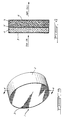
- the cartridge 1 comprises an a hollow, open ended, thi-walled, tubular body of circular cross section.
- the wall 2 may for example be of nylon.
- the open ends of the cartridge are each blocked off by some suitable mesh like support material 3 (e.g. 10 micron polypropylene mesh) which is held in place in any suitable known manner such as by glues, spring clip, etc.
- the iodinated granular resin bed 4 occupies the entire space between the mesh supports 3 and 3'; although the granular resin is more or less tightly packed between the mesh supports 3 and 3', there are still air spaces between the granules for the passage of air through the granular bed.
- the mesh supports each have openings small enough to retain the iodinated resin in place while allowing air to pass therethrough into the and through the supported resin bed 4.
- the cartridge as shown in figure 4 may include a downstream bed 5 of granules of activated carbon, catalyst, or iodine absorbent resins, to scavenge any iodine liberated from the iodinated resin 4.
- the activated carbon bed 5 is held in place by a mesh support 3' and an additional mesh 6.
- the bed depth of the resin and carbon is shown as about 2.5 cm; wheras the bed diameter is about 8 cm.
- the carbon bed may be omitted, i.e. only the iodinated resin bed 4 may be present in the cartridge as the active component (in the examples below, unless the contrary is indicated, the cartridges do not include any carbon bed); in this case the bed depth may, for example, be less 2.5 cm, e.g. 0.1 cm, 0.25 cm, 0.5 cm, 0.85 cm, 1.15 cm, etc..
- Such a cartridge may be disposed in an air path as shown for example in figures 5 and 6 which will be discussed below.
- the resin disposed in the air path could of course take on any form other than granules such as blocks, plates, tubes etc..
- the iodinated demand disinfectant resin for air treatment may be any (known) iodinated resin so long as the iodinated resin is capable of devitalizing airborne microorganisms (i.e. microorganisms transported by air) coming into contact therewith. It may, for example, be a resin as proposed in U.S. patent nos. 3,923,665 and 4,238,477; in this case, however, it may be necessary to use the resin in conjunction with an iodine scavenging material if the resin gives up too much iodine to the air.
- the iodine scavenging material may be an activated carbon material or an un-iodinated strong base anion exchange resin as described herein.
- iodinated resin may advantageously be a resin made in accordance with the present invention; in this case the resin need not be used in conjunction with an iodine scavenging material such as a (known) exchange resin, activated carbon, catalyst, etc., since an iodinated resin made in accordance with the process of the present invention may liberate iodine into the air in an amount below acceptable threshold limits for breathing by human beings.
- an iodinated resin made in accordance with the process of the present invention may liberate iodine into the air in an amount below acceptable threshold limits for breathing by human beings.
- the iodinated resin for the treatment of air or water may be some type of mixture of iodinated resins, e.g. a mixture of a known iodinated resin and an iodinated resin prepared in accordance herewith.
- the present invention in a further aspect provides a combination which may act as a sterilization barrier with respect to microorganisms.
- the sterilization combination may, for example, be incorporated into protective wearing apparel or be configured as a sterilization dressing for lesions such as for example, wounds and burns; the sterilisation barrier combination can be configured to be or not to be air breathable.
- a sterilization dressing of the present invention advantageously may take the form of a flexible porous cellular polymeric foam sheet having a spongy aspect and having dispersed within the polymeric matrix thereof particles of a demand disinfectant comprising a (known) iodinated resin or an iodinated resin as described herein.
- the sterilization sheet may be placed over a burn area to maintain the burn area in a sterilized state during the healing process.
- the disinfectant particles are distributed throughout the polymeric matrix and have surfaces projecting into the open pores of the spongy matrix; the spongy matrix acts as a sponge so that on the body side thereof it can soak up fluid such as pus which exude from the burn lesion.
- any microorganisms in the fluid or pus can contact the disinfectant resin particles and become devitalized as a result.
- any microorganisms on the opposite side of the sterilization barrier which attempt to pass through the barrier are also subject to being contacted with the disinfectant and are also devitalised.
- a (flexible) phamaceutically acceptable hydrophilic foam matrix may be obtained by reacting water with HYPOL foamable hydrophilic polyurethane polymer; the HYPOL polymer starting material may be obtained from W.R. Grace & Co. Lexintington Mass. U.S.A.. Water reacts to cross link the HYPOL polymer; if water is added quickly or at relatively high temperature foaming occurs and a foam product is obtained.
- the carrier component may, as necessary, also be oil or fat loving, e.g. for dealing with individuals with high cholesterol levels.
- the iodinated resin for the sterilisation combination may be some type known iodinated resin, a resin prepared in accordance herewith, or a mixture of iodinated resins, e.g. a mixture of a known iodinated resin and an iodinated resin prepared in accordance herewith.
- the starting materials may have to be treated to remove components which may interfer with the absorption of the halide into the resin.
- Water if present in the initial reaction mix should be free of interfering elements such as interfering ions. Distilled or ion free water is preferably used for washing.
- a resin cramed with triiodide i.e. a triiodide jam-backed resin
- a resin cramed with triiodide i.e. a triiodide jam-backed resin
- the resins were examined in a drip dried state, i.e. the resins were used after being drip dried using wathman filter paper and a funnel (for a 5 minute dry period). 25 ml and 100 ml flasks were used for the study. The flaskes were weighed empty. The flasks were then filled with resin and were then subjected to a manual vibration sequence (approximately 2 impulses per second for two minutes) in order to settle the resin, the volume of the settled resin was then noted. The density was obtained by weighing a filled flask and subtracting the weight of the empty flask so as to obtain the weight (grams) per unit volume (ml) of the resin. The results are shown in Table 1 below. Table 1 Resin density I-A 1.720 gm/ml I-B 1.480 gm/ml I-D 1.600 gm/ml
- test solutions were allowed to pass downwardly through each of the resins in the same fashion and at the same flow rate (i.e. the test conditions were the same for each resin).
- the tests were carried out at ambient conditions of temperature and pressure.
- PBS phosphate-buffered saline
- the bacterial solution was then diluted in water to provide the test batch solution at an initial concentration of 4.8 X 10 7 cfu per 100 ml.
- Microbiological monitoring of the test water was done throughout the experiment. Sampling of the filtered water was done at intervals prescribed by the: U.S.E.P.A. (protocol section 3.5.1 d 1(b)) with the membrane-filter technique for KLEBSIELLA described in: 17th edition of Standard Methods for the examination of water and wastewater, pp. 9-97 to 9-99.
- a test solution containing KLEBSIELLA TERRIGENA (A.T.C.C.
- Table 6a Total % of test solution passed through the resin Microorganism concentration in test effluent for each resin type (cfu/ml) Resin I-D Resin I-A 0% 0/0/0 0/0/0 25% 0/0/0 0/0/0 50% 0/0/0 0/0/0 60% 0/0/0 0/0/0 75% 0/0/0 0/0/0 90% 0/0/0 0/0 100% 0/0/0 0/0/0/0 As may be seen from table 6a the destruction of the bacteria was total in the case of each resin.
- the assay technique consisted of inoculating healthy BGM cells with a small amount of filtered water at regular intervals.
- a test solution containing Poliovirus 1 (A.T.C.C VR-59) at an initial concentration of 1 X 10 7 pfu per liter was passed through the fixed bed of each resin at a flow rate of 125 ml/min to 200 ml/min.
- the treated volume of solution for each resin was 150 liters in total. Sampling of the effluent or treated solution was effected at intervals corresponding with a predetermined percentage of the test portions having passed through the resins.
- Table 6b Total % of test solution passed through the resin Virus concentration in test effluent for each resin type (pfu/l) Resin I-D Resin I-A 0% 0/0/0 0/0/0 25% 0/0/0 0/0/0 50% 0/0/0 0/0/0 60% 0/0/0 0/0/0 75% 0/0/0 0/0/0 90% 0/0/0 0/0 100% 0/0/0 0/0/0/0 As may be seen from table 6b the destruction of the Poliovirus was total in the case of each resin.
- Rotavirus (A.T.C.C VR-899) was obtained , rehydrated in PBS, and grown on A-104 cells obtained from IAF. The method used to obtain the diluted poliovirus above was used with respect to the rotavirus . The yield for rotavirus grown on MA-104 cells was 2x10 6 pfu/ml. After dilution in the holding tank the concentration of the virus was 1 X 10 7 pfu per liter. The assay techniques were similar to those used for poliovirus, only the cell type and vital stain changed since they are specific for each type of virus. The same sampling strategy was applied.
- a test solution containing Rotavirus (A.T.C.C VR-59) at an initial concentration of 1 X 10 7 per 100 ml was passed through the fixed bed of each resin at a flow rate of 125 ml/min to 200 ml/min.
- the treated volume of solution for each resin was 150 liters in total. Sampling of the effluent or treated solution was effected at intervals corresponding with a predetermined percentage of the test portions having passed through the resins.
- Table 6c Total % of test solution passed through the resin Virus concentration in test effluent for each resin type (cfu/ml) Resin I-D Resin I-A 0% 0/0/0 0/0/0 25% 0/0/0 0/0/0 50% 0/0/0 0/0/0 60% 0/0/0 0/0/0 75% 0/0/0 0/0/0 90% 0/0/0 0/0 100% 0/0/0 0/0/0/0 As may be seen from table 6c the destruction of the Rotavirus was total in the case of each resin.
- the bacteriocidal longevity of the Resin I-A and Resin I-D were determined for purposes of comparison.
- Two fixed resin bed devices were provided, one device loaded with one of the resins and the other device loaded with the other resin; each device was loaded with 75.00 grams of a respective resin.
- the tests for each resin bed were conducted simultaneously.
- the solution to be treated was passed therethrough at a flow rate of 2.0 litres per minute, with an initial concentration of Klebsiella Terrigena 1 X 10 7 cfu/100 ml.
- the effluent was tested at intervals for the presence of viable bacteria.
- the volume of contaminated solution at which bacteria start to pass through the prior art resin i.e.
- Resin I-D is significantly less than the breakthrough volume for the resin of the present invention (i.e. Resin I-A). From figure 2 it may be seen that the bacteriocidal activity of the disinfectant resin of the present invention (Resin I-A) is superior to that of the known resin (Resin I-D), i.e. the Resin I-A has about a 16% superior antimicrobial activity in relation to the amount of water treatable by a given amount of disinfectant resin.
- Resin I-A' An iodinated resin (Resin I-A') was prepared following the procedures of examples 1 to 4 except that for the resin, Amberlite IR-400 (OH - ) (was used and for the procedure of example 3 the elevated temperature and pressure conditions were set at 121° C and 15 psig respectively. Resin I-A' was used in the following examples.
- EXAMPLE 10 COMPARATIVE IODINE CONTENT IN EFFLUENT AIR
- Each cartridge contained 50.0 grammes of dry (granular) resin (i.e. and no activated carbon bed).
- One cartridge contained Resin I-A' and the other contained Resin I-D.
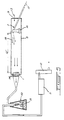
- the cartridges were each disposed in a system as illustrated in figure 5 but which did not contain any atomizer indicated generally by the reference number 7.
- the system included a housing 8 for defining an air path and had an air inlet 9.
- the resin cartridge 1 was disposed at the outlet of the air path.
- the air leaving the cartridge 1 was directed by appropriate tubing to a collector station 10.
- the system included a vacuum pump 11 (but not the air sterilizer system 12) for drawing air from inlet 9 through the system.
- a cartridge 1 was releasably placed in position (e.g. snap fit, etc.) and the vacuum pump activated so as to draw outside air (indicated by the arrow 13) into the housing 8.
- the air passed through the cartridge 1 as shown by the arrows 14.
- the air leaving the cartridge 1 was then directed to the collector station 10.
- the air entering the collector station 10 impinged upon a iodine collector solution 15 (comprising double reverse osmosis water, i.e. R/O water) in the collector station 10. Air leaving the collector station 10 thereafter passed through the pump 11 and was exhausted to the outside air.
- iodine collector solution 15 comprising double reverse osmosis water, i.e. R/O water
- each, cartridge was submitted to an air velocity therethrough of 0.7 Liter/per minute for a period of 50 minutes.
- the collector station 10 included 50 ml purified R/O water (the water was then subjected to standard optical coloration techniques (i.e. the Leuco violet technique as referred to in example 5.4 above), to determine the total iodine content).
- the iodine T.L.V. is 1.0 Mg/m 3 for air analysis for human breathing during a period of 8 hrs.
- the Resin I-A' (of the present invention) releases iodine at a level well below the T.L.V.
- the Resin I-A' could thus be used without an iodine scavenger; this would, for example, simplify the construction of a gas mask cartridge.
- the known Resin I-D on the other hand could also be used but it would require some sort of iodine scavenger (e.g. activated carbon) to obtain the necessary iodine T.V.L. level.
- EXAMPLE 11 The Resin I-A' was tested with different micro-organisms under different conditions for the sterilization of air.
- Resin I-A' was evaluated for its biocidal capacity on direct contact with Klebsiella Terrigena in relation to a time reference and a humidity content variation; namely water content variations of 110%, 50% & 0% (relative to the weight of dry resin) and time variations of 2, 5, 10, and 15 seconds.
- the testing proceeded as follows with respect to the dry resin.
- a glass rod was immersed in the inoculum and then immersed in the dry resin for 2 seconds.
- the glass rod was then washed in 100 ml phosphate buffer to wash out the microorganisms.
- the collected sample was then plated and incubated.
- the Resin I-A' whether wet, humid or dry destroys large quantities of resistant bacteria in direct contact, and this destruction occurs on a relatively rapid time base as demonstrated above.
- EXAMPLE 11.2 KLEBSIELLA TERRIGENA ERADICATION STUDY : AIR FLOW.
- the system used was the system illustrated in figure 5.
- the system included an atomizer 7 (of known construction) disposed in a housing 8 provided with an air opening 9.
- the system had a vacuum pump 11 for the displacement of air through the system.
- the system included an air sterilizer 12 comprising a hollow housing 10 inches high by about 2.5 inches in inner diameter and filled with about 1.5 kilograms of Resin I-A'; the sterilizer has an air inlet and outlet.
- the air path through the cartridge 1 is designated by teh arrows 14.
- the atomizer 7 contained an inoculum 16 ( Klebsiella Terrigena : 10 7 x 100 ml).
- the air flow at arrow 13 was set at 30 liters per minute and the air inflow at arrow 17 for the atomizer was set at 8 liters per minute; the atomizer 7 injected mist or spray 18 of inoculum into the air in the air path and the inoculated air then passed through cartridge 1 as shown by the arrows 14.
- a cartridge 1 as illustrated in figures 3 and 4 was prepared using dry Resin I-A' (65.0 gm giving a bed depth of 1.15 cm). The cartridge 1 was submitted to an injection of a total of 10 ml of inoculum over a time period of 15 minute. Sampling was done at 0 minutes, 7.5 minutes and at 15 minutes. The samples were collected in a standard impinger as shown in figure 5. After, processing 100 ml of the water from the impinger on microbiological paper filter and incubation, the results show total eradication of Klebsiella Terrigena .
- EXAMPLE 11.3 BACILLUS PUMILUS ERADICATION: AIR CONTACT.
- thermophilic bacteria Bacillus Pumilus was prepared and injected at a concentration of 10 3 /litre of influent air.
- a cartridge mask containing 65.00 gm of Resin I-A' was prepared as for the previous example. The test ran for 30 minutes.
- EXAMPLE 11.4 BACILLUS SUBTILIS STERILIZATION IN AIR FLOW.
- the millepore filter paper was collected, lain on T.S.A. (after neutralisation of potential iodine with sodium thiosulfate 5%) and incubated for 48 hours at 37 degree celsius. The results show a total eradication of micro-organisms.
- EXAMPLE 11.5 BACILLUS SUBTILIS: Resin I-A' versus glass beads in air flow.
- the two cartridges were, once inserted in their respective testing chamber, submitted to a velocity of 23 litre per minutes for 40 minutes with a microbiological load of 40 bacteria per litre in the influent.
- the Resin I-A' eradicated all bacteria and no living micro-organism can live in the resin bed.
- the Glass beads have a mechanical filtering capacity in regards to the biological vector but migration occurs rapidly thus obtaining "tnc" results (too numerous to count) on the upstream mesh and the beads themselves. The migration keeps on going through the filter until it reaches the microbiological paper filter in large number. Also, the glass beads filter becomes severely contaminated, causing a disposal problem.
- a positive control yielded a concentration of 275 cfu/litre of air at the microbiological sampling site.
- EXAMPLE 11.7 BACILLUS SUBTILIS: LONGEVITY STUDY IN AIR FLOW.
- a cartridge of figure 3 and 4 containing 30.00 gr (bed depth: 0.5 cm) of Resin I-A' was submitted to an air flow velocity of 25 litre/ minute containing a concentration of Bacillus Subtilis of 112 cpu/litre (positive control for correlation) for a period of 3 hrs.
- the test was done using the impinger technique (of figure 5), with 300 ml of sterile water. Once the 3 hours completed the water from the impinger was filtered on a microbiological membrane as referred in standard method for analysis of water and waste water 17 th edition, pp.9-97 To 9-99. The growth media was trypticase soy agar. The results after incubation for 48 hours at 37.5 degree celsius was total eradication.
- EXAMPLE 12 Studies of the fixation of iodine at different iodine concentrations
- Resin I-A', Resin I-B', Resin I-B'' and Resin I-A' were prepared as follows:
- Resin 1A, Resin 2B, Resin 3A and Resin 4B were prepared as follows:
- EXAMPLE 15 Sterilization barrier combinations for use as wound (sterilization) dressings
- the sterilisation foam barrier was prepared as follows:
- the sterilization strip barrier was prepared as follows:
- example 15.3 The same studies as described in example 15.3 were carried out except that the lesion was a burn created with a 1.0 cm red hot rod; the hot rod was firmly held against the skin for about 3 to 4 seconds.
- the same Inoculum as in example 15.3 was injected beneath the burn area and also dabbed onto the surface of the burned skin. Exactly the same results were obtained for the two types of dressings as were obtained for the tests of example 15.3.
- example 15.5 The same procedure as for example 15.5 was used except that instead of being maintained in a bath of inoculum, the inoculum was applied using an atomiser the same as that used for example 11.2 for artificial creation of airborne infection of a wound; the inoculum used also had 10 9 cfu/ml rather than 10 7 cfu/100ml as in example 15.6. 4 ml of the inoculum was sprayed directly on the wound of the control animals and on the dressing covering the wound of the test animals; the inoculum was so applied every hour for 8 hours with 72 hours of incubation. The same results as in example 15.5 were obtained.
- FIGS 7 to 11 illustrate a number of example embodiements of sterilization barrier combinations of the present invention; some of these combinations are also described in example 15 above.
- Figure 7 shows a partially cut away perspective view of a sterilisation barrier dressing of tea-bag type construction wherein the iodinated resin particles or beads (one of which is designated by the reference numeral 30) are free flowing but are held together by being enveloped by a fluid (e.g. air-liquid) permeable envelope 31 of (known) pharmaceutically acceptable paper or gauze (e.g. a suitable sterile gauze from Johnson & Johnson, Canada).
- the paper or gauze is permeable to fluids such as air and water but is able to hold onto the particles of iodinated resin enveloped thereby since any holes in the paper gauze are sized to be smaller than the particles of resin.
- This type of dressing may be made relatively small or relatively large keeping in mind the size of the lesion that it is intended to cover.
- the dressing may be made by providing a sheet of paper or gauze, placing the desired amount of resin particles thereon and then folding one side edge of the paper or gauze over the resin particles 30 so as to overlay and abut the opposite side; these abuting side edges 32 and 33 as well as each of the respective side edges of the two pairs of adjacent side edges indicated generally at 34 and 35 may be fixed together in any known manner, for example by compression, stitching or by the use of any known phamaceutically acceptable adhesive.
- the fixation of the sides is such that they will tend to maintain their integrity in the face of water , body fluids or body exudates (e.g. pus).
- the embodiment shown in figure 7 is shown may be considered as essentially having a plurality of resin bead layers; it could of course have only a single such layer.
- the sterilisation barrier may take on a band-aid type aspect as shown in figure 8.
- the combination shown has a flexible carrier component 36.
- a central portion of one side of the carrier component 36 has fixed thereto a plurality of beads or particles (one of which is designated by the reference numeral 37) of demand disinfectant iodinated resin.
- the resin beads 37 are fixed to the surface by a suitable adhesive which is pharmacetically acceptable and which will maintain the beads on the carrier component even if exposed to water or body fluids or exudates.
- the portion of the band surface 38 which surrounds the centrally disposed beads 36 may also be provided with any (known) adhesive which may for example be able to releasably stick the combination to the skin (e.g. a latex based adhesive).
- the carrier component 36 may, as desired be permeable or impermeable to fluids such as air, water, pus; prefereably, the carrier is permeable to gas such as air, water vapour, etc. at least in the region of the resin beads fixed thereto, i.e. this region is air breathable.
- the carrier component 36 may be of any suitable pharmaceutically acceptable (plastics) material (e.g. the carrier component may be a porous hydrophobic material permeable to air and water vapour such as described in U.S. patent nos. 3,953,566 and 4,194,041 - Gore-Tex).
- the carrier component complete with an adhesive face may be obtained from Peco Marketing ltd., Montreal, Quebec under the name "Compeed".
- Figures 9, 10 and 11 show a number of further embodiments of the sterilisation barrier combination.
- FIG. 9 shows a flexible sterilisation foam or sponge type dressing 39 for wounds.
- the dressing comprises a flexible pharmaceutically acceptable foam matrix 40 having iodinated resin particles (one of which is designated with the reference numeral 41) dispersed therein.
- the foam matrix 40 has a porous open cell structure such that it is permeable to fluids such as air and water and can absorb body liquids in the manner of a sponge (e.g. the foam is hydrophilic and/or oil loving); the foam barrier is air breathable.
- the foam matrix 40 as shown has cells of relatively small size so as to facilitate the absorption of liquids such as pus.
- the resin particles 41 making up the resin disinfectant component are distributed throughout and held or fixed in place by the polymeric matrix 40 such that surface portions of the resin particles are exposed within the cells of the matrix 40.
- the exposed surfaces of the resin are available for contact with any microorganisms which may find their way into the cells of the body of the barrier combination; contact with the resin devitalises the microorganisms.
- the foam sterilisation barrier or dressing 39 as shown in figure 9 has a semi-spherical like shape.
- the flat surface 42 may be applied to a wound or cut.
- the dressing may be held in place by any suitable means such as for example any suitable strapping or by adhesive tape means.
- the sterilisation foam dressing 39 is held in place such that at least a portion of it is exposed (e.g. exposed to the air); thus the means for holding the foam in place may be an adhesive strip which has a central opening exposing at least a portion of the foam when the foam is held in place.
- the flexible foam sterilisation barrier will sterilize the immediate area of the wound which it covers and also prevent other infectious microorganisms from contacting the wound from outside the body.
- the sterilisation barrier is also effective not only against microorganisms at the immediate surface of a wound but also against those deeper within the body in the area of a cut.
- Figure 10 illustrates another type of flexible foam sterilisation barrier 43. It differs from the sterilisation barrier shown in figure 9 in that the size of the cells (one of which is designated with the reference numeral 44) is significantly larger than those for the foam shown in figure 9; this type of foam may be used as a liner material for wearing apparel to provide the apparel with the ability to protect the wearer from (skin) contact with viable microorganisms.
- the resin beads, spheres or particles are, as in the case of the resin spheres 41 for the foam barrier 39 of figure 9, dispersed in the foam matrix and are held or fixed in place thereby such that exposed surfaces of the resin are available for contact with any microorganisms which may find their way into the cells of the body of the barrier combination; contact with the resin devitalises the microorganisms.
- the foam matrix for the sterilisation barriers of figures 9 and 10 may be made by admixing (known) starting reactants in (known) manner to make (known) foams which are pharmaceutically acceptable.
- known polyurethane foams may for example be used.
- the disinfectant resin particles may be admixed with and dispersed (e.g. more or less homogeneously) in the starting reactants at the beginning of the foam producing reaction.
- the foam barrier may be set in molds or else cut to the desired shape.
- the foam sterilisation barrier may take any desired form such as sheets, films, plugs, and the like; it may, for example, be molded so as to conform to the shape of portion of the body to which it is to be applied.
- a (flexible) phamaceutically acceptable hydrophilic foam matrix may be obtained using water and HYPOL foamable hydrophilic polyurethane polymer starting material from W.R. Grace & Co. Lexintington Mass. U.S.A..
- the pore or cell size of the foam barrier may be adjusted in known manner; for example by altering the reaction temperature.
- a temperature of about 50 to 70° C may be used to obtain small pore sizes and a lower temperature of about 35 to 45° C may be used to obtainer larger sized pores.
- Figure 11 shows a cross sectional portion of a sandwich type textile material 46 which incorporates a flexible large cell size sterilization foam layer 47.
- the sandwich comprises two outer flexible clothe type layers 48 and 49 which are fixed to the central sterilization foam barrier 46 in any suitable manner (e.g. by an adhesive, melt fusion, etc.).
- the two outer layers 48 and 49 may be of any desired material; they may be permeable or impermeable to fluids such as air, water vapour, water and the like. They may for example be of cotton, polypropylene, etc.; or a Gore-tex type material mentioned above.
- a sheet of textile material as shown may cut into pieces of various shapes needed to form such protective wearing apparel as may be desired, e.g. coats, pants, socks, face masks (e.g. full face masks or masks covering only the mouth and nose) and the like.
- the flexible foam layer 47 can be made in any known manner provided that disinfectant resin particles are dispersed in the reaction mixture during the reaction such that the end product foam also has the resin particles dispersed in the foam matrix and any microorganism able to penetrate into an interior cell of the foam may be able to contact a resin particle exposed into the cell and be devitalised thereby.
- the foam barrier as in the case of the foam dressings mentioned may be configured to be permeable to fluids such as air, water, etc..
- the textile material 46 may be formed by first forming a sheet of the sterilisation foam; by providing sheets of the desired outer layers; and then gluing the elements together such that the foam is sandwiched between the two other outer layers.
- a mold may be used wherein opposed surfaces of the mold are provided with a respective outer layer; the foam starting materials are introduced between the layers; and foaming activated such that the foam layer is produced in situ.
- figure 11 may of course have only one such clothe like layer. Additionally if the outer layer or layers are permeable to fluids such as air, water, pus and the like, the wearing apparel made therefrom could as needed double as a kind of sterilisation dressing; the textile may thus for example be air breathable.
- foam sterilisation barrier has been described in relation to a flexible foam it may be a stiff foam depending upon the application; again the stiff foam matrix may be prepared in known manner.
- An alternate embodiement of the sandwich type textile may be made wherein the foam matrix is omitted; in this case the beads may be placed between the outer layers and the beads may be fixed in place for example by an adhesive or by melt fusion depending on the nature of the layers (e.g. melt fusion may be considered if the layers are of thermoplastics material; the textile may of course be so made as to preserve the flexibility of the combination.
Landscapes
- Health & Medical Sciences (AREA)
- Life Sciences & Earth Sciences (AREA)
- Chemical & Material Sciences (AREA)
- General Health & Medical Sciences (AREA)
- Veterinary Medicine (AREA)
- Public Health (AREA)
- Animal Behavior & Ethology (AREA)
- Epidemiology (AREA)
- Engineering & Computer Science (AREA)
- Materials Engineering (AREA)
- General Chemical & Material Sciences (AREA)
- Chemical Kinetics & Catalysis (AREA)
- Hematology (AREA)
- Organic Chemistry (AREA)
- Medicinal Chemistry (AREA)
- Agronomy & Crop Science (AREA)
- Dispersion Chemistry (AREA)
- Environmental Sciences (AREA)
- Zoology (AREA)
- Hydrology & Water Resources (AREA)
- Environmental & Geological Engineering (AREA)
- Water Supply & Treatment (AREA)
- Wood Science & Technology (AREA)
- Inorganic Chemistry (AREA)
- Pest Control & Pesticides (AREA)
- Plant Pathology (AREA)
- Dentistry (AREA)
- Nuclear Medicine, Radiotherapy & Molecular Imaging (AREA)
- Pharmacology & Pharmacy (AREA)
- Communicable Diseases (AREA)
- Oncology (AREA)
- Virology (AREA)
- Combustion & Propulsion (AREA)
- Mechanical Engineering (AREA)
- General Engineering & Computer Science (AREA)
- Agricultural Chemicals And Associated Chemicals (AREA)
- Pharmaceuticals Containing Other Organic And Inorganic Compounds (AREA)
- Disinfection, Sterilisation Or Deodorisation Of Air (AREA)
- Apparatus For Disinfection Or Sterilisation (AREA)
- Materials For Medical Uses (AREA)
Applications Claiming Priority (5)
| Application Number | Priority Date | Filing Date | Title |
|---|---|---|---|
| US95730792A | 1992-09-16 | 1992-09-16 | |
| US957307 | 1992-09-16 | ||
| US4753593A | 1993-04-19 | 1993-04-19 | |
| US47535 | 1993-04-19 | ||
| EP93918858A EP0660668B1 (de) | 1992-09-16 | 1993-09-15 | Desinfizierendes jod-harz und verfahren zur seiner herstellung |
Related Parent Applications (2)
| Application Number | Title | Priority Date | Filing Date |
|---|---|---|---|
| EP93918858A Division EP0660668B1 (de) | 1992-09-16 | 1993-09-15 | Desinfizierendes jod-harz und verfahren zur seiner herstellung |
| EP93918858.7 Division | 1994-03-31 |
Publications (2)
| Publication Number | Publication Date |
|---|---|
| EP0804876A1 true EP0804876A1 (de) | 1997-11-05 |
| EP0804876B1 EP0804876B1 (de) | 2006-11-15 |
Family
ID=26725146
Family Applications (3)
| Application Number | Title | Priority Date | Filing Date |
|---|---|---|---|
| EP97109103A Expired - Lifetime EP0804876B1 (de) | 1992-09-16 | 1993-09-15 | Desinfizierendes Jod-Harz, Verfahren zu seiner Herstellung und Verwendung in textilen Kombinationen |
| EP97108792A Expired - Lifetime EP0797917B1 (de) | 1992-09-16 | 1993-09-15 | Verfahren zur Desinfizierung von Luft mittels desinfizierendem Jod-Harz und Systeme zur Desinfektion von in Luft enthaltenen Mikrooorganismen |
| EP93918858A Expired - Lifetime EP0660668B1 (de) | 1992-09-16 | 1993-09-15 | Desinfizierendes jod-harz und verfahren zur seiner herstellung |
Family Applications After (2)
| Application Number | Title | Priority Date | Filing Date |
|---|---|---|---|
| EP97108792A Expired - Lifetime EP0797917B1 (de) | 1992-09-16 | 1993-09-15 | Verfahren zur Desinfizierung von Luft mittels desinfizierendem Jod-Harz und Systeme zur Desinfektion von in Luft enthaltenen Mikrooorganismen |
| EP93918858A Expired - Lifetime EP0660668B1 (de) | 1992-09-16 | 1993-09-15 | Desinfizierendes jod-harz und verfahren zur seiner herstellung |
Country Status (13)
| Country | Link |
|---|---|
| US (6) | US5639452A (de) |
| EP (3) | EP0804876B1 (de) |
| JP (6) | JP3289831B2 (de) |
| KR (5) | KR100316168B1 (de) |
| AT (3) | ATE345045T1 (de) |
| AU (2) | AU688276B2 (de) |
| CA (1) | CA2140639C (de) |
| DE (3) | DE69334082T2 (de) |
| DK (2) | DK0797917T3 (de) |
| ES (1) | ES2124320T3 (de) |
| NZ (1) | NZ255299A (de) |
| SG (1) | SG47367A1 (de) |
| WO (1) | WO1994006296A1 (de) |
Cited By (1)
| Publication number | Priority date | Publication date | Assignee | Title |
|---|---|---|---|---|
| WO2010124130A3 (en) * | 2009-04-22 | 2012-08-30 | Triomed Innovations Corp. | Method for coating an elastomeric material with a layer of antitoxic material |
Families Citing this family (89)
| Publication number | Priority date | Publication date | Assignee | Title |
|---|---|---|---|---|
| US7261879B2 (en) * | 1992-09-16 | 2007-08-28 | Triosyn Holding Inc. | Iodinated anion exchange resin and process for preparing same |
| DK0797917T3 (da) * | 1992-09-16 | 2007-04-23 | Triosyn Holding Inc | Fremgangsmåde til desinfektion af luft med iod/harpiksbaseret desinfektionsmiddel og systemer til desinfektion af luftbårne mikroorganismer |
| US6680050B1 (en) * | 1992-09-16 | 2004-01-20 | Triosyn Holdings, Inc. | Iodine/resin disinfectant and a procedure for the preparation thereof |
| US6096216A (en) * | 1994-06-09 | 2000-08-01 | American National Red Cross | Iodinated matrices for disinfecting biological fluids |
| US5814225A (en) * | 1994-06-09 | 1998-09-29 | Shanbrom Technologies Llc | Iodinated gel filtration media for disinfecting protein solutions |
| US5662991A (en) | 1994-12-23 | 1997-09-02 | Gentex Corporation | Laminated biocidal fabric |
| WO1997015332A1 (en) * | 1995-10-26 | 1997-05-01 | Purepulse Technologies, Inc. | Improved deactivation of organisms using high-intensity pulsed polychromatic light |
| GB9706713D0 (en) * | 1997-04-02 | 1997-05-21 | Reckitt & Colman Inc | Improvements in or relating to organic compositions |
| US6562885B1 (en) * | 1998-03-19 | 2003-05-13 | Battelle Memorial Institute | Composition for deactivating chemically and biologically active agents and method of making the same |
| US6565803B1 (en) | 1998-05-13 | 2003-05-20 | Calgon Carbon Corporation | Method for the inactivation of cryptosporidium parvum using ultraviolet light |
| JP2002518351A (ja) | 1998-06-19 | 2002-06-25 | オキシバイオ・インコーポレイテッド | 抗感染および避妊特性を有する医療装置 |
| US6106773A (en) * | 1998-09-24 | 2000-08-22 | American National Red Cross | Pathogen inactivating compositions for disinfecting biological fluids |
| US6224655B1 (en) * | 1998-11-03 | 2001-05-01 | Pierre Messier | Biostatic air filter |
| JP4003333B2 (ja) * | 1999-02-02 | 2007-11-07 | 三菱電機株式会社 | 貯蔵庫、ファン装置 |
| US6727400B2 (en) | 1999-06-08 | 2004-04-27 | Triosyn Holdings, Inc. | Deactivation of toxic chemical agents |
| DE19931371A1 (de) * | 1999-07-08 | 2001-01-11 | Mhb Filtration Gmbh & Co Kg | Filtermaterial für die Gasfiltration mit bioziden Eigenschaften |
| WO2001010219A1 (en) * | 1999-08-05 | 2001-02-15 | Pierre Jean Messier | Topical antiseptic composition |
| CA2279683A1 (en) * | 1999-08-05 | 2001-02-05 | Hemo-Biotech Inc. | Deactivation of toxic biological agents in biological fluids such as blood |
| JP2001205023A (ja) * | 2000-01-21 | 2001-07-31 | Ricoh Elemex Corp | エアフィルタ |
| JP3275000B2 (ja) * | 2000-03-07 | 2002-04-15 | 國新産業株式会社 | 通気性被膜の形成方法 |
| US6506737B1 (en) | 2000-04-05 | 2003-01-14 | Ecolab, Inc. | Antimicrobial phosphonium and sulfonium polyhalide compositions |
| US8034092B2 (en) * | 2000-09-15 | 2011-10-11 | Bruder Healthcare Company | Wound and therapy compress and dressing |
| US8524973B2 (en) * | 2000-09-15 | 2013-09-03 | Bruder Healthcare Company | Wound and therapy compress and dressing |
| US9925087B2 (en) | 2000-09-15 | 2018-03-27 | Bruder Healthcare Company, Llc | Wound and therapy compress and dressing |
| US10105259B2 (en) | 2000-09-15 | 2018-10-23 | Bruder Healthcare Company, Llc | Wound and therapy compress and dressing |
| US6695824B2 (en) | 2001-04-16 | 2004-02-24 | The United States Of America As Represented By The Secretary Of The Army | Wound dressing system |
| US6770250B2 (en) * | 2001-09-24 | 2004-08-03 | Cooper Environmental Services | Apparatus and methods for removing mercury from fluid streams |
| US20030075047A1 (en) * | 2001-10-22 | 2003-04-24 | Normand Bolduc | Bactericidal after-filter device |
| AU2003299455A1 (en) * | 2002-02-25 | 2004-05-25 | Gentex Corporation | Multu-functional protective textiles and methods for decontamination |
| EP1493820B1 (de) * | 2002-04-05 | 2013-05-22 | Sharp Kabushiki Kaisha | Verfahren zur abschätzung der eliminierung von mikroorganismen und vorrichtung zur abschätzung der eliminierung von mikroorganismen |
| ATE554842T1 (de) * | 2002-09-16 | 2012-05-15 | Triomed Innovations Corp | Elektrostatisch geladenes filtermedium mit eingearbeitetem wirkstoff |
| RU2213063C1 (ru) * | 2002-09-24 | 2003-09-27 | Открытое акционерное общество Научно-производственное предприятие "Лисскон" | Способ приготовления бактерицида |
| US20040121681A1 (en) * | 2002-12-23 | 2004-06-24 | Kimberly-Clark Worldwide, Inc. | Absorbent articles containing an activated carbon substrate |
| US20040122387A1 (en) * | 2002-12-23 | 2004-06-24 | Kimberly-Clark Worldwide, Inc. | Absorbent articles that include a stretchable substrate having odor control properties |
| US20040121688A1 (en) * | 2002-12-23 | 2004-06-24 | Kimberly-Clark Worldwide, Inc. | Flexible activated carbon substrates |
| US20040121682A1 (en) * | 2002-12-23 | 2004-06-24 | Kimberly-Clark Worldwide, Inc. | Antimicrobial fibrous substrates |
| CA2535729A1 (en) * | 2003-07-30 | 2005-02-10 | Triosyn Holding, Inc. | Method and system for control of microorganisms in metalworking fluid |
| US7625351B2 (en) * | 2003-09-10 | 2009-12-01 | Triosyn Holding, Inc. | System, method and apparatus for purifying biological fluids such as blood and constituents thereof |
| RU2266927C2 (ru) * | 2004-03-25 | 2005-12-27 | Открытое акционерное общество "Институт пластмасс имени Г.С.Петрова" (ОАО "Институт пластмасс") | Способ получения полигалоидных анионообменных смол |
| GB2414474A (en) * | 2004-05-24 | 2005-11-30 | Bw Technologies Ltd | Device for purifying fluids, in particular water |
| US7329385B1 (en) * | 2004-07-08 | 2008-02-12 | Radicone Michael C | Device and method for air stream, fluid and vessel decontamination |
| WO2006135406A2 (en) * | 2004-08-31 | 2006-12-21 | Triton Systems, Inc. | Functionalized dendritic polymers for the capture and neutralization of biological and chemical agents |
| US8097343B2 (en) * | 2004-08-31 | 2012-01-17 | Triton Systems, Inc. | Functionalized dendritic polymers for the capture and neutralization of biological and chemical agents |
| KR100664879B1 (ko) | 2005-02-18 | 2007-01-04 | 신호상 | 요오드 소독수 제조장치 |
| US20060266731A1 (en) * | 2005-05-31 | 2006-11-30 | Yu Steven Y | Etchant rinse method |
| US20060282028A1 (en) * | 2005-06-10 | 2006-12-14 | Howard Pamela A | Wound Management System |
| US8834687B2 (en) | 2005-09-30 | 2014-09-16 | Teledyne Licensing, Llc | Multilayer self-decontaminating coatings |
| US9266733B2 (en) * | 2005-09-30 | 2016-02-23 | Teledyne Scientific & Imaging, Llc | Multilayer self-decontaminating coatings |
| JP2006289078A (ja) * | 2006-03-29 | 2006-10-26 | Ricoh Elemex Corp | マスク |
| JP2006239687A (ja) * | 2006-03-29 | 2006-09-14 | Ricoh Elemex Corp | エアフィルタ |
| JP2006247403A (ja) * | 2006-03-29 | 2006-09-21 | Ricoh Elemex Corp | エアフィルタ |
| MX2008013004A (es) * | 2006-04-20 | 2009-01-23 | Water Security Corp | Composiciones y metodos para purificacion de fluido. |
| US20080011662A1 (en) * | 2006-04-20 | 2008-01-17 | Emil Milosavljevic | Compositions and methods for fluid purification |
| US8685421B2 (en) | 2006-07-07 | 2014-04-01 | Surmodics, Inc. | Beaded wound spacer device |
| US20080045440A1 (en) * | 2006-08-16 | 2008-02-21 | Conopco, Inc. D/B/A Unilever | Anti-Malodour Composition |
| US20080063560A1 (en) * | 2006-09-07 | 2008-03-13 | Biolargo Life Technologies, Incorporated | Ground treatment for reducing microbial content |
| US8226964B2 (en) * | 2006-09-07 | 2012-07-24 | Biolargo Life Technologies, Inc. | Systems and methods for cleaning liquid carriers related applications data |
| US7943158B2 (en) * | 2006-09-07 | 2011-05-17 | BioLargo Life Technologies, Inc | Absorbent systems providing antimicrobial activity |
| US9414601B2 (en) * | 2006-09-07 | 2016-08-16 | Biolargo Life Technologies, Incorporated | Material having antimicrobial activity when wet |
| US8257749B2 (en) * | 2007-02-08 | 2012-09-04 | Biolargo Life Technologies, Incorporated | Systems providing at least pesticidal activity |
| US7520923B2 (en) * | 2007-03-22 | 2009-04-21 | Mvp Textiles & Apparel, Inc. | Antimicrobial filtration article |
| WO2009076611A1 (en) * | 2007-12-12 | 2009-06-18 | Engle George M | Delivery of iodine gas |
| WO2009132213A2 (en) * | 2008-04-23 | 2009-10-29 | Water Security Corporation | Improved halogenated resin beds |
| EP2303770B1 (de) * | 2008-06-30 | 2014-07-09 | 3M Innovative Properties Company | Verfahren zur in-situ-bildung von metallnanoclustern in einem porösen substrat |
| US20100006505A1 (en) * | 2008-07-10 | 2010-01-14 | Terryll Riley Smith | Filter with iodinated resin and filter life indicator |
| CA2738136A1 (en) * | 2008-09-22 | 2010-03-25 | Triosyn Holding, Inc. | A novel iodinated resin manufacturing process and product |
| CN102333883A (zh) * | 2008-10-23 | 2012-01-25 | 安全生活/特莱奥辛公司 | 快速、安全地进行pcr扩增的技术 |
| US20100133194A1 (en) * | 2008-11-05 | 2010-06-03 | Water Security Corporation | Water treatment systems with dual purpose ion exchange resin |
| WO2011119580A1 (en) * | 2010-03-22 | 2011-09-29 | Safelife/Triosyn Corp. | Coatings for elastomeric products |
| FR2962348B1 (fr) * | 2010-07-12 | 2012-09-07 | Ind Du Ponant L | Filtre microbicide et cartouche filtrante incorporant un tel filtre |
| EP2601250A4 (de) * | 2010-08-02 | 2014-01-01 | Triomed Innovations Corp | Polymerfilme mit eingebettetem iodiertem harz und verfahren zu ihrer herstellung |
| LT5802B (lt) | 2011-05-20 | 2012-01-25 | Kauno technologijos universitetas, , | Katijoninio krakmolo-trijodido baktericidas |
| JP2015528520A (ja) | 2012-08-13 | 2015-09-28 | ユニバーシティ オブ フロリダ リサーチ ファンデーション インコーポレーティッド | 三ハロゲン化物陰イオン交換樹脂の調製方法、イオン交換樹脂を用いた可逆的な吸着反応および塩素化反応の方法 |
| JP6298468B2 (ja) | 2012-10-16 | 2018-03-20 | サーモディクス,インコーポレイテッド | 創傷充填デバイスおよび方法 |
| USD696745S1 (en) | 2012-10-23 | 2013-12-31 | Mrlb International, Inc. | Water purification filter |
| US20140154297A1 (en) * | 2012-10-30 | 2014-06-05 | Baxter Healthcare S.A. | Antimicrobial substrates and methods for processing the same |
| WO2014143139A1 (en) | 2013-03-15 | 2014-09-18 | Bruder Healthcare Company | Wound and therapy compress and dressing |
| US10201457B2 (en) | 2014-08-01 | 2019-02-12 | Surmodics, Inc. | Wound packing device with nanotextured surface |
| US12029681B2 (en) | 2016-03-01 | 2024-07-09 | The Hilsinger Company Parent, Llc | Therapeutic eye mask system |
| US12156831B2 (en) | 2016-03-01 | 2024-12-03 | The Hilsinger Company Parent, Llc | Therapeutic eye compress system |
| US12011388B2 (en) | 2016-03-01 | 2024-06-18 | The Hilsinger Company Parent, Llc | Therapeutic thermal compress with phase-change material |
| KR101974633B1 (ko) * | 2016-07-28 | 2019-05-02 | 스마트비젼(주) | 정화시스템의 블록형 교차 살균 및 악취제거장치 |
| USD844795S1 (en) | 2016-11-30 | 2019-04-02 | Bruder Healthcare Company, Llc | Therapeutic eye mask |
| USD871598S1 (en) | 2016-11-30 | 2019-12-31 | Bruder Healthcare Company, Llc | Therapeutic eye mask |
| KR102041516B1 (ko) | 2018-06-22 | 2019-11-06 | 경상대학교 산학협력단 | 녹말을 이용한 트리이오다이드 수지(Triiodide resin)의 제조방법 |
| DE102021101099A1 (de) * | 2020-03-24 | 2021-09-30 | Mecadi GmbH - Chemicals/ Processing | Verwendung und Verfahren zur Reduktion der Virus-, Bakterien- und/oder Pilzsporenbelastung oder anderen biologischen Kontaminationen in Gasen |
| US12485217B2 (en) | 2020-09-23 | 2025-12-02 | Alberto Haces | Contactless wound treatment barrier and method of contactless wound treatment |
| DE102020125922B4 (de) | 2020-10-04 | 2022-06-02 | Elke Münch | Mobile Vorrichtung zur Reinigung und Desinfizierung von Raumluft |
| US12529665B2 (en) | 2021-05-25 | 2026-01-20 | Solventum Intellectual Properties Company | Hydrogen peroxide sterilization sensor including thermal indicator component and reactant-functional sorbent, and method of use |
Citations (6)
| Publication number | Priority date | Publication date | Assignee | Title |
|---|---|---|---|---|
| US4113851A (en) * | 1976-04-15 | 1978-09-12 | Leveen Harry H | Microbiocidal composition and articles prepared therefrom |
| US4187183A (en) * | 1975-03-28 | 1980-02-05 | Aqua-Chem, Inc. | Mixed-form polyhalide resins for disinfecting water |
| US4238477A (en) * | 1979-04-20 | 1980-12-09 | Kansas State University Research Foundation | Process of preparing homogeneous resin-polyiodide disinfectants |
| US4381380A (en) * | 1980-11-03 | 1983-04-26 | Leveen Harry H | Thermoplastic polyurethane article treated with iodine for antibacterial use |
| EP0402865A1 (de) * | 1989-06-13 | 1990-12-19 | Kansas State University Research Foundation | Herstellung von I5-polyiodid-desinfizierenden Harzen |
| US5051256A (en) * | 1988-02-16 | 1991-09-24 | Barnes Carl E | Biocidal complex and dressing formed therefrom |
Family Cites Families (62)
| Publication number | Priority date | Publication date | Assignee | Title |
|---|---|---|---|---|
| GB853566A (en) * | 1958-09-15 | 1960-11-09 | Vickers Electrical Co Ltd | Improvements relating to the stress-relief of large metal vessels by electrical heating |
| US3316173A (en) * | 1963-05-27 | 1967-04-25 | Dow Chemical Co | Process for treating water with bromine |
| US3462363A (en) * | 1967-07-14 | 1969-08-19 | Dow Chemical Co | Control of microorganisms with polyhalide resins |
| US3817860A (en) * | 1969-12-03 | 1974-06-18 | Univ Kansas State | Method of disinfecting water and demand bactericide for use therein |
| GB1331648A (en) * | 1969-12-03 | 1973-09-26 | Univ Kansas State | Method of disinfecting water and ion exchange resin compounds for use therein |
| US3923665A (en) * | 1969-12-03 | 1975-12-02 | Univ Kansas State | Demand bactericide for disinfecting water and process of preparation |
| US3715972A (en) * | 1971-05-28 | 1973-02-13 | Integrated Air Syst Inc | Clean work station |
| US4190529A (en) * | 1975-03-28 | 1980-02-26 | Aqua-Chem, Inc. | Mixed-form polyhalide resins for disinfecting water |
| US3987038A (en) * | 1975-05-21 | 1976-10-19 | Warner-Lambert Company | Process for the preparation of {1-[5-(4-hydroxy-2H-1,2-benzothiazin-3-yl)-1,2,4-oxadiazol-3-yl]methyl}ethanone S,S-dioxide |
| US4076622A (en) * | 1976-06-22 | 1978-02-28 | Rohm And Haas Company | Microbiocidal macroreticular ion exchange resins, their method of preparation and use |
| BE863566A (fr) * | 1977-02-03 | 1978-08-02 | Ciba Geigy | Melange de diesters dithiophosphoriques ou trithiophosphoriques utilisable comme stabilisant de lubrifiants. |
| BE853566A (fr) * | 1977-04-13 | 1977-08-01 | Hoeschler Frank A | Procede et appareil de desinfection pour le traitement de l'eau |
| US4298475A (en) * | 1980-07-18 | 1981-11-03 | Gartner William J | Water purification system |
| US4343765A (en) * | 1980-12-11 | 1982-08-10 | Georgia Tech Research Institute | Method for deodorizing and disinfecting air |
| US4420590A (en) * | 1981-04-06 | 1983-12-13 | Halex, Inc. | Bacteriocidal resins and disinfection of water therewith |
| DE3200959A1 (de) * | 1982-01-14 | 1983-07-21 | Hasso von 4000 Düsseldorf Blücher | Textiler flaechenfilter |
| DE3211322A1 (de) * | 1982-03-27 | 1983-09-29 | Hasso von 4000 Düsseldorf Blücher | Flaechenfilter und verfahren zu seiner herstellung |
| DE3304349C3 (de) * | 1983-02-09 | 1995-10-26 | Bluecher Hubert | Flächenfilter und Verfahren zu seiner Herstellung |
| US4469826A (en) * | 1983-06-02 | 1984-09-04 | Sun Chemical Corporation | Process for the production of dispersions of polymers in non-aqueous vehicles |
| US4483771A (en) * | 1983-08-08 | 1984-11-20 | Elizabeth Koch | Multi-layer filter |
| US4526751A (en) * | 1983-12-09 | 1985-07-02 | Gartner William J | Germicidal solutions effective for solid surface disinfection |
| JPS60243003A (ja) * | 1984-05-18 | 1985-12-03 | Tokyo Organ Chem Ind Ltd | 表面被覆組成物の有害生物防除方法 |
| JPS6365923A (ja) * | 1986-09-05 | 1988-03-24 | Ebara Corp | プレコ−ト式ろ過方法 |
| US4749484A (en) * | 1986-10-07 | 1988-06-07 | Shapiro/Devine | Home water filter |
| US4891227A (en) * | 1988-02-02 | 1990-01-02 | Richardson-Vicks Inc. | Medicated cleansing pads |
| US5856245A (en) * | 1988-03-14 | 1999-01-05 | Nextec Applications, Inc. | Articles of barrier webs |
| US5019062A (en) * | 1988-06-23 | 1991-05-28 | The Procter & Gamble Company | Bicomponent material |
| US4925517A (en) * | 1988-06-27 | 1990-05-15 | Minnesota Mining And Manufacturing Company | Method of forming fragrance releasing pull-apart sheets |
| US5626820A (en) * | 1988-12-12 | 1997-05-06 | Kinkead; Devon A. | Clean room air filtering |
| EP0376126B1 (de) * | 1988-12-30 | 1996-10-09 | Purotech Ltd. | Wasserreinigungssystem |
| US5156843A (en) * | 1989-03-20 | 1992-10-20 | Advanced Polymer Systems, Inc. | Fabric impregnated with functional substances for controlled release |
| DE3918561C2 (de) * | 1989-06-07 | 1997-09-11 | Brita Wasserfilter | Vorrichtung zur Wasserbehandlung |
| US4988557A (en) * | 1989-12-08 | 1991-01-29 | Minnesota Mining And Manufacturing Company | Fragrance sampling device |
| US4978449A (en) * | 1990-02-12 | 1990-12-18 | Devine Frank M | Water purifier with air-passing retainer above water inlet |
| US4995976A (en) * | 1990-05-31 | 1991-02-26 | Water Technologies Corporation | Water purification straw |
| WO1992004921A1 (en) * | 1990-09-25 | 1992-04-02 | Allergan, Inc. | Apparatus and method for disinfecting a contact lens and detecting the presence of an oxidative disinfectant |
| TW200394B (de) * | 1991-01-25 | 1993-02-21 | Kao Corp | |
| FR2672790B1 (fr) * | 1991-02-19 | 1994-10-28 | Elysees Balzac Financiere | Combine de nettoyage et procedes de fabrication. |
| US5176836A (en) * | 1991-03-18 | 1993-01-05 | The United States Of America As Represented By The Administrator Of The National Aeronautics And Space Administration | Regenerable biocide delivery unit |
| AU2554892A (en) * | 1991-09-09 | 1993-04-05 | Novapharm Research (Australia) Pty. Limited | Antibacterial treatment of bulk water |
| AU2685892A (en) * | 1991-10-08 | 1993-05-03 | Isp Investments Inc. | Method of treating blood |
| US5383236A (en) * | 1991-11-25 | 1995-01-24 | Als Enterprises, Inc. | Odor absorbing clothing |
| DE4243232A1 (de) * | 1992-02-25 | 1994-06-23 | Hasso Von Bluecher | Schutzmaterial |
| IL101109A (en) * | 1992-02-28 | 1996-12-05 | Purotech Ltd | Disinfecting resin |
| IT1257251B (it) * | 1992-07-03 | 1996-01-10 | Gianfranco Palumbo | Struttura assorbente sottile stratificata, articolo assorbente comprendente tale struttura e relativo procedimento di fabbricazione |
| DE4310110A1 (de) * | 1992-07-07 | 1994-01-13 | Kaercher Gmbh & Co Alfred | Mehrlagiges, textiles, gasdurchlässiges Filtermaterial gegen chemische Schadstoffe |
| DK0797917T3 (da) * | 1992-09-16 | 2007-04-23 | Triosyn Holding Inc | Fremgangsmåde til desinfektion af luft med iod/harpiksbaseret desinfektionsmiddel og systemer til desinfektion af luftbårne mikroorganismer |
| AU762071B2 (en) * | 1992-09-16 | 2003-06-19 | Triosyn Holding Inc. | Use of iodinated resins to disinfect body fluids and liquids containing microorganisms |
| US6680050B1 (en) * | 1992-09-16 | 2004-01-20 | Triosyn Holdings, Inc. | Iodine/resin disinfectant and a procedure for the preparation thereof |
| GR1002550B (el) * | 1992-10-09 | 1997-01-28 | Mcneil-Ppc Inc. | Καταμηνιακη διαταξη με ελεγχον οσμης. |
| US5370534A (en) * | 1992-11-09 | 1994-12-06 | Time Motion Systems Company | Water purification system for dental instrument |
| US6294185B1 (en) * | 1993-03-12 | 2001-09-25 | Auburn University | Monomeric and polymeric cyclic amine and N-halamine compounds |
| EP0748223B1 (de) * | 1993-03-12 | 2002-02-06 | Auburn University | Biozide polymere zyklische n-halamine |
| US5431908A (en) * | 1993-03-17 | 1995-07-11 | Recovery Engineering, Inc. | Method for preparing polyhalide resin disinfectants |
| US5350625A (en) * | 1993-07-09 | 1994-09-27 | E. I. Du Pont De Nemours And Company | Absorbent acrylic spunlaced fabric |
| US5772738A (en) * | 1993-11-30 | 1998-06-30 | Purex Co., Ltd. | Multifunctional air filter and air-circulating clean unit with the same incorporated therein |
| US5474451A (en) * | 1994-02-02 | 1995-12-12 | Regents Of The University Of Minnesota | Dental water and air purification equipment |
| DE4410920C1 (de) * | 1994-03-29 | 1995-08-24 | Sandler Helmut Helsa Werke | Verfahren zur Herstellung von flexiblem Flächenfiltermaterial gegen Schadstoffe und Verwendung derartigen Flächenfiltermaterials |
| US5662991A (en) * | 1994-12-23 | 1997-09-02 | Gentex Corporation | Laminated biocidal fabric |
| US5614301A (en) * | 1995-04-15 | 1997-03-25 | The United States Of America As Represented By The Secretary Of The Army | Chemical protective fabric |
| DE19649237A1 (de) * | 1996-11-28 | 1998-06-04 | Bluecher Gmbh | Material mit antiseptischen Eigenschaften |
| JPH10317529A (ja) * | 1997-05-16 | 1998-12-02 | Suzuki Sakan Tairukouten:Kk | 除菌壁材 |
-
1993
- 1993-09-15 DK DK97108792T patent/DK0797917T3/da active
- 1993-09-15 DE DE69334082T patent/DE69334082T2/de not_active Expired - Lifetime
- 1993-09-15 KR KR1020007014956A patent/KR100316168B1/ko not_active Expired - Fee Related
- 1993-09-15 US US08/256,425 patent/US5639452A/en not_active Expired - Lifetime
- 1993-09-15 ES ES93918858T patent/ES2124320T3/es not_active Expired - Lifetime
- 1993-09-15 CA CA002140639A patent/CA2140639C/en not_active Expired - Lifetime
- 1993-09-15 KR KR1019950701017A patent/KR100306886B1/ko not_active Expired - Fee Related
- 1993-09-15 KR KR1020007014955A patent/KR100316167B1/ko not_active Expired - Fee Related
- 1993-09-15 AT AT97109103T patent/ATE345045T1/de not_active IP Right Cessation
- 1993-09-15 AU AU49401/93A patent/AU688276B2/en not_active Ceased
- 1993-09-15 SG SG1995002057A patent/SG47367A1/en unknown
- 1993-09-15 WO PCT/CA1993/000378 patent/WO1994006296A1/en not_active Ceased
- 1993-09-15 KR KR1020007014954A patent/KR100316166B1/ko not_active Expired - Fee Related
- 1993-09-15 AT AT93918858T patent/ATE169798T1/de active
- 1993-09-15 AT AT97108792T patent/ATE347807T1/de not_active IP Right Cessation
- 1993-09-15 KR KR1020007014953A patent/KR100316165B1/ko not_active Expired - Fee Related
- 1993-09-15 NZ NZ255299A patent/NZ255299A/en not_active IP Right Cessation
- 1993-09-15 DE DE69334096T patent/DE69334096T2/de not_active Expired - Lifetime
- 1993-09-15 EP EP97109103A patent/EP0804876B1/de not_active Expired - Lifetime
- 1993-09-15 DE DE69320483T patent/DE69320483T2/de not_active Expired - Lifetime
- 1993-09-15 EP EP97108792A patent/EP0797917B1/de not_active Expired - Lifetime
- 1993-09-15 DK DK93918858T patent/DK0660668T3/da active
- 1993-09-15 EP EP93918858A patent/EP0660668B1/de not_active Expired - Lifetime
- 1993-09-15 JP JP50762894A patent/JP3289831B2/ja not_active Expired - Fee Related
-
1997
- 1997-02-24 US US08/806,529 patent/US5980827A/en not_active Expired - Lifetime
- 1997-02-24 US US08/803,869 patent/US6045820A/en not_active Expired - Fee Related
-
2001
- 2001-02-15 US US09/735,125 patent/US20010009661A1/en not_active Abandoned
- 2001-08-31 JP JP2001263216A patent/JP3708852B2/ja not_active Expired - Fee Related
- 2001-08-31 JP JP2001263177A patent/JP3706320B2/ja not_active Expired - Fee Related
- 2001-08-31 JP JP2001263291A patent/JP3577019B2/ja not_active Expired - Fee Related
- 2001-08-31 JP JP2001263417A patent/JP3696818B2/ja not_active Expired - Fee Related
- 2001-08-31 JP JP2001263307A patent/JP3682008B2/ja not_active Expired - Fee Related
-
2002
- 2002-05-31 US US10/161,102 patent/US6899868B2/en not_active Expired - Fee Related
- 2002-06-10 US US10/166,465 patent/US6696055B2/en not_active Expired - Fee Related
- 2002-11-19 AU AU2002302053A patent/AU2002302053B2/en not_active Ceased
Patent Citations (6)
| Publication number | Priority date | Publication date | Assignee | Title |
|---|---|---|---|---|
| US4187183A (en) * | 1975-03-28 | 1980-02-05 | Aqua-Chem, Inc. | Mixed-form polyhalide resins for disinfecting water |
| US4113851A (en) * | 1976-04-15 | 1978-09-12 | Leveen Harry H | Microbiocidal composition and articles prepared therefrom |
| US4238477A (en) * | 1979-04-20 | 1980-12-09 | Kansas State University Research Foundation | Process of preparing homogeneous resin-polyiodide disinfectants |
| US4381380A (en) * | 1980-11-03 | 1983-04-26 | Leveen Harry H | Thermoplastic polyurethane article treated with iodine for antibacterial use |
| US5051256A (en) * | 1988-02-16 | 1991-09-24 | Barnes Carl E | Biocidal complex and dressing formed therefrom |
| EP0402865A1 (de) * | 1989-06-13 | 1990-12-19 | Kansas State University Research Foundation | Herstellung von I5-polyiodid-desinfizierenden Harzen |
Cited By (1)
| Publication number | Priority date | Publication date | Assignee | Title |
|---|---|---|---|---|
| WO2010124130A3 (en) * | 2009-04-22 | 2012-08-30 | Triomed Innovations Corp. | Method for coating an elastomeric material with a layer of antitoxic material |
Also Published As
Similar Documents
| Publication | Publication Date | Title |
|---|---|---|
| EP0660668B1 (de) | Desinfizierendes jod-harz und verfahren zur seiner herstellung | |
| US7699906B2 (en) | Iodinated anion exchange resin and process for preparing same | |
| US6680050B1 (en) | Iodine/resin disinfectant and a procedure for the preparation thereof | |
| AU762071B2 (en) | Use of iodinated resins to disinfect body fluids and liquids containing microorganisms | |
| AU719355B2 (en) | Use of iodinated resins to disinfect air and liquids containing microorganisms | |
| HK1011259B (en) | Iodine/resin disinfectant and a procedure for the preparation thereof | |
| HK1021111B (en) | Iodine/resin disinfectant, process for the preparation thereof and use in textile combinations | |
| HK1021111A1 (en) | Iodine/resin disinfectant, process for the preparation thereof and use in textile combinations | |
| NZ299530A (en) | Disinfecting air containing microorganisms by passing over an iodinated resin |
Legal Events
| Date | Code | Title | Description |
|---|---|---|---|
| PUAI | Public reference made under article 153(3) epc to a published international application that has entered the european phase |
Free format text: ORIGINAL CODE: 0009012 |
|
| AC | Divisional application: reference to earlier application |
Ref document number: 660668 Country of ref document: EP |
|
| AK | Designated contracting states |
Kind code of ref document: A1 Designated state(s): AT BE CH DE DK ES FR GB GR IE IT LI LU MC NL PT SE |
|
| 17P | Request for examination filed |
Effective date: 19980424 |
|
| RAP1 | Party data changed (applicant data changed or rights of an application transferred) |
Owner name: TRIOSYN CORPORATION |
|
| RIN1 | Information on inventor provided before grant (corrected) |
Inventor name: MESSIER, PIERRE JEAN |
|
| RAP1 | Party data changed (applicant data changed or rights of an application transferred) |
Owner name: TRIOSYN HOLDING INC. |
|
| 17Q | First examination report despatched |
Effective date: 20040906 |
|
| GRAP | Despatch of communication of intention to grant a patent |
Free format text: ORIGINAL CODE: EPIDOSNIGR1 |
|
| RTI1 | Title (correction) |
Free format text: IODINE/RESIN DISINFECTANT, PROCESS FOR THE PREPARATION THEREOF AND USE IN TEXTILE COMBINATIONS |
|
| GRAS | Grant fee paid |
Free format text: ORIGINAL CODE: EPIDOSNIGR3 |
|
| RAP1 | Party data changed (applicant data changed or rights of an application transferred) |
Owner name: TRIOSYN HOLDING INC. |
|
| GRAA | (expected) grant |
Free format text: ORIGINAL CODE: 0009210 |
|
| AC | Divisional application: reference to earlier application |
Ref document number: 0660668 Country of ref document: EP Kind code of ref document: P |
|
| AK | Designated contracting states |
Kind code of ref document: B1 Designated state(s): AT BE CH DE DK ES FR GB GR IE IT LI LU MC NL PT SE |
|
| PG25 | Lapsed in a contracting state [announced via postgrant information from national office to epo] |
Ref country code: BE Free format text: LAPSE BECAUSE OF FAILURE TO SUBMIT A TRANSLATION OF THE DESCRIPTION OR TO PAY THE FEE WITHIN THE PRESCRIBED TIME-LIMIT Effective date: 20061115 Ref country code: AT Free format text: LAPSE BECAUSE OF FAILURE TO SUBMIT A TRANSLATION OF THE DESCRIPTION OR TO PAY THE FEE WITHIN THE PRESCRIBED TIME-LIMIT Effective date: 20061115 |
|
| REG | Reference to a national code |
Ref country code: GB Ref legal event code: FG4D |
|
| REG | Reference to a national code |
Ref country code: CH Ref legal event code: EP |
|
| REF | Corresponds to: |
Ref document number: 69334082 Country of ref document: DE Date of ref document: 20061228 Kind code of ref document: P |
|
| REG | Reference to a national code |
Ref country code: IE Ref legal event code: FG4D |
|
| PG25 | Lapsed in a contracting state [announced via postgrant information from national office to epo] |
Ref country code: DK Free format text: LAPSE BECAUSE OF FAILURE TO SUBMIT A TRANSLATION OF THE DESCRIPTION OR TO PAY THE FEE WITHIN THE PRESCRIBED TIME-LIMIT Effective date: 20070215 |
|
| REG | Reference to a national code |
Ref country code: CH Ref legal event code: NV Representative=s name: ISLER & PEDRAZZINI AG |
|
| PG25 | Lapsed in a contracting state [announced via postgrant information from national office to epo] |
Ref country code: ES Free format text: LAPSE BECAUSE OF FAILURE TO SUBMIT A TRANSLATION OF THE DESCRIPTION OR TO PAY THE FEE WITHIN THE PRESCRIBED TIME-LIMIT Effective date: 20070226 |
|
| REG | Reference to a national code |
Ref country code: SE Ref legal event code: TRGR |
|
| PG25 | Lapsed in a contracting state [announced via postgrant information from national office to epo] |
Ref country code: PT Free format text: LAPSE BECAUSE OF FAILURE TO SUBMIT A TRANSLATION OF THE DESCRIPTION OR TO PAY THE FEE WITHIN THE PRESCRIBED TIME-LIMIT Effective date: 20070416 |
|
| REG | Reference to a national code |
Ref country code: HK Ref legal event code: GR Ref document number: 1021111 Country of ref document: HK |
|
| ET | Fr: translation filed | ||
| PLBE | No opposition filed within time limit |
Free format text: ORIGINAL CODE: 0009261 |
|
| STAA | Information on the status of an ep patent application or granted ep patent |
Free format text: STATUS: NO OPPOSITION FILED WITHIN TIME LIMIT |
|
| REG | Reference to a national code |
Ref country code: CH Ref legal event code: PCAR Free format text: ISLER & PEDRAZZINI AG;POSTFACH 1772;8027 ZUERICH (CH) |
|
| 26N | No opposition filed |
Effective date: 20070817 |
|
| PG25 | Lapsed in a contracting state [announced via postgrant information from national office to epo] |
Ref country code: MC Free format text: LAPSE BECAUSE OF NON-PAYMENT OF DUE FEES Effective date: 20070930 Ref country code: GR Free format text: LAPSE BECAUSE OF FAILURE TO SUBMIT A TRANSLATION OF THE DESCRIPTION OR TO PAY THE FEE WITHIN THE PRESCRIBED TIME-LIMIT Effective date: 20070216 |
|
| PG25 | Lapsed in a contracting state [announced via postgrant information from national office to epo] |
Ref country code: LU Free format text: LAPSE BECAUSE OF NON-PAYMENT OF DUE FEES Effective date: 20070915 |
|
| PGFP | Annual fee paid to national office [announced via postgrant information from national office to epo] |
Ref country code: IE Payment date: 20100927 Year of fee payment: 18 Ref country code: CH Payment date: 20100930 Year of fee payment: 18 |
|
| PGFP | Annual fee paid to national office [announced via postgrant information from national office to epo] |
Ref country code: FR Payment date: 20100930 Year of fee payment: 18 |
|
| PGFP | Annual fee paid to national office [announced via postgrant information from national office to epo] |
Ref country code: GB Payment date: 20100927 Year of fee payment: 18 |
|
| PGFP | Annual fee paid to national office [announced via postgrant information from national office to epo] |
Ref country code: NL Payment date: 20100924 Year of fee payment: 18 |
|
| PGFP | Annual fee paid to national office [announced via postgrant information from national office to epo] |
Ref country code: DE Payment date: 20100929 Year of fee payment: 18 |
|
| PGFP | Annual fee paid to national office [announced via postgrant information from national office to epo] |
Ref country code: SE Payment date: 20100929 Year of fee payment: 18 Ref country code: IT Payment date: 20100928 Year of fee payment: 18 |
|
| REG | Reference to a national code |
Ref country code: NL Ref legal event code: V1 Effective date: 20120401 |
|
| REG | Reference to a national code |
Ref country code: CH Ref legal event code: PL |
|
| GBPC | Gb: european patent ceased through non-payment of renewal fee |
Effective date: 20110915 |
|
| PG25 | Lapsed in a contracting state [announced via postgrant information from national office to epo] |
Ref country code: IT Free format text: LAPSE BECAUSE OF NON-PAYMENT OF DUE FEES Effective date: 20110915 |
|
| REG | Reference to a national code |
Ref country code: IE Ref legal event code: MM4A |
|
| REG | Reference to a national code |
Ref country code: FR Ref legal event code: ST Effective date: 20120531 |
|
| REG | Reference to a national code |
Ref country code: SE Ref legal event code: EUG |
|
| REG | Reference to a national code |
Ref country code: DE Ref legal event code: R119 Ref document number: 69334082 Country of ref document: DE Effective date: 20120403 |
|
| PG25 | Lapsed in a contracting state [announced via postgrant information from national office to epo] |
Ref country code: DE Free format text: LAPSE BECAUSE OF NON-PAYMENT OF DUE FEES Effective date: 20120403 Ref country code: LI Free format text: LAPSE BECAUSE OF NON-PAYMENT OF DUE FEES Effective date: 20110930 Ref country code: NL Free format text: LAPSE BECAUSE OF NON-PAYMENT OF DUE FEES Effective date: 20120401 Ref country code: CH Free format text: LAPSE BECAUSE OF NON-PAYMENT OF DUE FEES Effective date: 20110930 Ref country code: IE Free format text: LAPSE BECAUSE OF NON-PAYMENT OF DUE FEES Effective date: 20110915 |
|
| PG25 | Lapsed in a contracting state [announced via postgrant information from national office to epo] |
Ref country code: GB Free format text: LAPSE BECAUSE OF NON-PAYMENT OF DUE FEES Effective date: 20110915 Ref country code: FR Free format text: LAPSE BECAUSE OF NON-PAYMENT OF DUE FEES Effective date: 20110930 |
|
| PG25 | Lapsed in a contracting state [announced via postgrant information from national office to epo] |
Ref country code: SE Free format text: LAPSE BECAUSE OF NON-PAYMENT OF DUE FEES Effective date: 20110916 |