EP0802287A2 - Höhenverstellbarer Drainagerost - Google Patents
Höhenverstellbarer Drainagerost Download PDFInfo
- Publication number
- EP0802287A2 EP0802287A2 EP97104958A EP97104958A EP0802287A2 EP 0802287 A2 EP0802287 A2 EP 0802287A2 EP 97104958 A EP97104958 A EP 97104958A EP 97104958 A EP97104958 A EP 97104958A EP 0802287 A2 EP0802287 A2 EP 0802287A2
- Authority
- EP
- European Patent Office
- Prior art keywords
- profile
- height
- support
- receptacles
- drainage grate
- Prior art date
- Legal status (The legal status is an assumption and is not a legal conclusion. Google has not performed a legal analysis and makes no representation as to the accuracy of the status listed.)
- Granted
Links
Images

Classifications
-
- E—FIXED CONSTRUCTIONS
- E04—BUILDING
- E04D—ROOF COVERINGS; SKY-LIGHTS; GUTTERS; ROOF-WORKING TOOLS
- E04D13/00—Special arrangements or devices in connection with roof coverings; Protection against birds; Roof drainage ; Sky-lights
- E04D13/04—Roof drainage; Drainage fittings in flat roofs, balconies or the like
- E04D13/0404—Drainage on the roof surface
- E04D13/0445—Drainage channels
Definitions
- the invention relates to a height-adjustable drainage grate for balconies, patios and the like. with a walk-on, with a plurality of drainage openings web part and a two elongated, mutually facing and essentially parallel to each other supporting profiles for vertical support of the web part having supporting structure, on the bottom facing bottom a number of each provided with a threaded shaft and guided in corresponding threaded receptacles Feet is provided.
- Such height-adjustable drainage grates are known. They are used in particular in the door area of balconies, patios and the like. to create a drainage facility so that it can deviate from DIN 18 195 (part 5, item 7.1.6), according to which seals in the door and wall connection area must be raised at least up to 15 cm above the upper edge of the respective floor covering, which is high and dangerous Trip hazards in the door area of the respective balcony, the terrace or the like. conditionally. According to the flat roof guidelines, 10.3. (4), it is allowed to deviate from the mentioned DIN standard if "... there are drainage possibilities in the immediate door area", as they do can be created, for example, by means of the drainage grids mentioned.
- the known drainage grates have a support and frame construction made of support profiles and cross struts, into which a grating forming the walkable web part can be inserted and on the underside of which a plurality of feet, each provided with a threaded shaft, are provided, each of which is more or less far in corresponding threaded receptacles for height adjustment can be screwed in.
- the well-known drainage grates have proven their worth in practice and have therefore been used more and more in recent years, especially since they can also be used to implement solutions that are suitable for the disabled and elderly and without tripping edges. There is therefore an increased demand for such drainage grates, which have so far only been available in certain standard widths and lengths.
- drainage grids Since the drainage grids must be supported by the feet in their respective corner areas so that the corner areas of the web part can still be walked on, and since the threaded receptacles are each rigidly connected to the support structure, drainage grids deviating from the standard sizes cannot be produced simply by cutting a standard grate to length .
- the object of the invention is to provide a height-adjustable drainage grate of the type mentioned at the outset, which can be shortened to any lengths required in each case without this resulting in problems with the support of the corner regions by the feet.
- a drainage grate in which a sliding part which can be pushed onto a respective profile section of the two support profiles is provided, which has a transverse web and two receptacles arranged on opposite edges of the transverse web, each for one the profile sections of the two support profiles, at least one, preferably two threaded receptacles for the threaded shafts of the feet being provided on the crosspiece.
- Such a configuration allows a drainage grate to be shortened to the required length and then to be pushed on the sliding part and to support the corner area, at which the cut was made, by means of feet fastened to the sliding part.
- a sliding part can also be used at the joint of two drainage grids placed one on the other in such a way that half of it is pushed onto the support profiles of one and the other drainage grate, in which case it then advantageously aligns the drainage grids flush with one another and, in addition, the number of the joint required to support the two drainage grids is reduced, usually by 50%.
- At least two sliding parts are provided. This makes it possible to dispense entirely with feet provided at specific, predetermined positions along the support structure, and thus to simplify the entire support structure and the manufacture and installation of the drainage grate.
- the support structure and the walk-on web part can then be made in any desired, even very large lengths, which the processor can shorten on site to the size he needs, after which he slides on at least two and possibly further sliding parts depending on the length of the drainage grate and positioned in the desired places.
- the invention can advantageously be further developed in that at least one, preferably both receptacles of each sliding part are provided with means for fixing, preferably with means for clamping a profile section inserted into the receptacle. This can be done, for example, through the side walls of the Receptacles grub screws are screwed, which are then tightened by the processor as soon as the respective sliding part is in the desired position relative to the support structure, and thus clamp the inserted profile sections.
- the support profiles can have different cross-sectional shapes. So it is e.g. possible to use support profiles with a T-shaped cross-section and to arrange the receptacles on the crossbar of the sliding part in such a way that in the intended installation position of the sliding parts a vertically downward-pointing profile section of the cross-sectionally T-shaped support profiles can be inserted into the receptacles from above is. In this way it is possible to first slide the sliding parts into a corresponding installation position on the respective balcony, terrace or the like. to put and then put the support profiles from above onto the sliding parts.
- the support profiles can also be designed in such a way that an elongated, essentially horizontal profile section is provided on each of the two support profiles below the web part, the elongated free edge of which faces the opposite support profile, the two receptacles then be arranged on the crossbar of the sliding part in such a way that a receptacle can be pushed onto one of the horizontal profile sections of the support profiles.
- the web part and the two support profiles can be integrally connected to one another, it also possible to form the web part and support profiles in one piece.
- the web part and support profiles can be produced in a single operation using the extrusion process, or the support profiles can be produced by folding an originally flat web part.
- Such a design of the web part has various advantages over the design of the web part as a separately produced grating. This means that the processor only has to cut a single part to length on site. Processing, but also processing, such as painting, is easier overall. In addition, the production can be realized more cost-effectively. Nevertheless, depending on the place of use, it will not be possible to do without web parts designed as known and proven gratings.
- support profiles with an F-shaped cross section with two profile sections parallel to one another and a profile section perpendicular to it, with one of the two profile sections of each support profile parallel to each other then the web part, i.e. the grating, when the drainage grate is installed as intended , carries while the other profile section is inserted into one of the two receptacles of a sliding part.
- the support profiles are installed in such a way that their cross-sectional shape is reminiscent of the shape of an F turned upside down by 180 °.
- Such a support profile with an F-shaped cross section can e.g. be composed of two suitably connected L-shaped profiles, but it can also be made of a single, multi-folded profile sheet.
- the threaded receptacles provided on the transverse webs of the sliding parts are formed by means of threaded sleeves provided on the transverse webs.
- Each crossbar can then be pierced at the locations of the threaded sleeves attached to the crossbar in such a way that the threaded shafts of the feet screwed into the threaded sleeve can penetrate the crossbar. Since the free ends of the threaded shafts of the feet are usually fitted with a receptacle, e.g.
- the feet can then be slid on the support structure and insert the drainage grate in the for the drainage grate on the respective balcony, terrace or the like.
- the intended receptacle can be adjusted by means of a corresponding tool, the drainage openings provided in the web part, of course, having to have a size that allows the tool to be inserted.
- the threaded sleeves can advantageously be arranged on the sliding parts such that all threaded sleeves of a sliding part or the like either on the web part of the drainage grate or on the floor of the balcony, the terrace. Pointing flat side of the crossbar are arranged, and the web part can be designed such that it can be pushed onto the corresponding profile sections of the support profiles both with the web part and with the threaded sleeves pointing to the bottom, and that there are different distances between the mouth closest to the bottom of each Thread sleeve and the bottom result. In this way, two different height adjustment ranges, within which a height adjustment of the drainage grate is possible by turning the feet more or less far into the threaded sleeves, can be realized by simply turning the sliding parts.
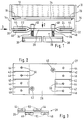
- FIG. 1 shows a side view of a height-adjustable drainage grate, in its entirety designated 10, in which a walkable web part formed here by a grating 12 is carried by a two elongated support structure 14 and 16 with an F-shaped cross section.
- the two support profiles 14 and 16 each have an upper horizontal profile section 18 or 20, the upper side of which supports the grating 12, and each have a lower horizontal profile section 22 or 24, which in one on the opposite longitudinal sides of the crossbar 26 in its entirety 28 designated sliding part provided receptacles 30 and 32 are introduced.
- Cross struts 34 and support profiles 14 and 16 thus form a stable support structure for the walkable web part 12, which - as in the exemplary embodiment shown here - can simply be inserted into the support structure, the outer vertical sections of the two support profiles 14 and 16 having an F-shaped cross section each form a lateral guide for the web part 12, but it can also be a known dirt filter made of a suitable material, for example, before inserting the web part a textile fleece.
- each threaded shaft 36 is guided in one of the threaded receptacles 40 formed here as a threaded sleeve 40 attached to the crosspiece 26 such that each foot 38 can be approximated to a greater or lesser extent to the sliding part 28 by simply rotating it.
- the sliding part 28 is shown in FIGS. 2 and 3 as viewed in the direction of arrows 2 and 3 of FIG. 1, respectively.
- each of the receptacles 30 and 32 provided on opposite longitudinal sides of the crossbar 26 is formed in that profile strips 44 and 46 formed by parallel incisions 42 in the crossbar 26 alternately upwards (profile strips 44) and downwards (profile strips 46 ) are bent off from the crosspiece 26, the free ends of the profile strips then being bent back into a position essentially parallel to the crosspiece 26.
- a threaded bore 50 is provided in each profile strip 44 and 46, through which a screw, not shown here, e.g. a grub screw can be guided so that it becomes possible to fix the sliding part 28 in a desired slide-on position relative to the support structure by tightening the screws and clamping the lower horizontal profile sections 22 and 24 of the cross-sectionally F-shaped support profiles 14 and 16.
- the thread in the bores 50 can also be omitted when using self-tapping screws.
- the sliding part can both be pushed on in such a way that the threaded sleeves 40 provided on the transverse web - as in Fig. 1 shown - point to the walkable web part 12, as well as that the threaded sleeves 40 or the like to the floor of the respective balcony, the terrace. point out so that with a single web part two different height adjustment ranges within which a height adjustment of the drainage grate is possible by turning the threaded shafts 36 of the feet 40 more or less.
- FIG. 4 shows the cross-braces 34 consisting of the two cross-sections F-shaped in cross-section and the two supporting profiles connecting these, only one of which is visible here, along with an inserted grating 12 in a perspective view.
- the two support profiles 14 and 16, which are F-shaped in cross section, are each formed in one piece in this embodiment by multiple edging of an originally flat elongated profile strip.
- each support profile 14 and 16 has a profile section 18 or 20 carrying the respective walkable web part, that is to say the grating 12 here, and a free profile section 22 or 24 such that a sliding part pushed onto the free profile sections 22 and 24 has along this profile strip can be pushed into any desired position, in which it is then fixed using the screws described, for example.
- the cross struts 34 each have only a small width in the direction of the longitudinal extension of the support profiles 14 and 16, so that they have a plurality of drainage openings 52 (of which only a few have been provided with reference numerals for reasons of clarity) on the respectively inserted one. provided web part 12 do not hinder impinging moisture.
- the cross struts 34 are connected to the horizontal profile sections 18 and 20 of the support profiles 14 and 16 by welding.
- FIG. 5 shows a possibility of constructing a walk-in web part 512 and support structure in a cost-effective one-piece manner in that the two support profiles 514 and 516, which enclose the web part 512 between them, are bent from an originally flat elongated perforated plate on opposite longitudinal sides of the perforated plate.
- the free ends of the two support profiles 514 and 516 are then again to form sliding guides for the recordings of a corresponding sliding part, for example a sliding part 28 according to FIG. 1, folded into a position parallel to the walkable web part 512 such that the free ends of the horizontal profile sections 522 and 524 thus formed point towards one another.
- This one-piece design of walkable web part 512 and support structure can - as mentioned - be done by folding over a perforated plate, that is, an already perforated plate; However, it is also possible to produce such a profile in the extrusion process and then to provide it with appropriate drainage openings or to punch drainage openings into an originally flat sheet metal blank and then to fold the metal blank several times in the manner described.
- FIG. 6 shows a support structure together with a sliding part, the two support profiles 614 and 616 each having a T-shaped cross section and being connected to one another via a number of cross struts 634, only one of which is visible here.
- the cross struts 634 each engage on the underside of a horizontal profile section 618 and 620 provided on each support profile 614 and 616, the upper side of which forms a support for a walk-in web part, not shown here, for example a grating 12 according to FIG. 1.
- the two receptacles 630 and 632 provided on opposite ends of the crossbar 626 of the sliding part 628 are opened upwards in this embodiment such that the support structure consisting of the two T-shaped support profiles 614 and 616 and the cross struts 634 are inserted into the corresponding receptacles from above can be, wherein then a vertical profile section 622 and 624 of the two cross-sectionally T-shaped support profiles 614 and 616 each engage in one of the receptacles 630 and 632.
- the receptacles are each formed by an inner profile strip 644 and an outer profile strip 646.
- Threaded bores can be made in the inner and / or the outer profile strips 644 and 646, through which holes Screws for clamping the sliding part can be inserted in a certain position relative to the support structure.
- Threaded sleeves 640 are again provided on the upper side of the crossbar 626 of the sliding part 628 facing the cross strut 634, into which corresponding threaded shafts 636 of the feet 640 engage, which can then be screwed more or less far into the threaded sleeves 640 for height adjustment.
Landscapes
- Engineering & Computer Science (AREA)
- Architecture (AREA)
- Civil Engineering (AREA)
- Structural Engineering (AREA)
- Floor Finish (AREA)
- Paper (AREA)
- Housing For Livestock And Birds (AREA)
- Fertilizers (AREA)
- Road Paving Structures (AREA)
- Sewage (AREA)
Abstract
Description
- Die Erfindung betrifft einen höhenverstellbaren Drainagerost für Balkone, Terrassen u.dgl. mit einem begehbaren, mit einer Vielzahl von Drainageöffnungen versehenen Stegteil und einer zwei langgestreckte, einander zugewandte und im wesentlichen parallel zueinander verlaufende Stützprofile zur vertikalen Abstützung des Stegteils aufweisenden Stützkonstruktion, an deren bodenzugewandter Unterseite eine Anzahl von mit jeweils einem Gewindeschaft versehenen und in entsprechenden Gewindeaufnahmen geführten Füßen vorgesehen ist.
- Solche höhenverstellbaren Drainageroste sind bekannt. Sie dienen insbesondere dazu, im Türbereich von Balkonen, Terrassen u.dgl. eine Entwässerungsmöglichkeit zu schaffen, damit von der DIN 18 195 (Teil 5, Punkt 7.1.6) abgewichen werden kann, wonach Abdichtungen im Tür- und Wandanschlußbereich wenigstens bis auf 15 cm über die Oberkante des jeweiligen Bodenbelages hochgeführt werden müssen, was hohe und gefährliche Stolperschwellen im Türbereich des jeweiligen Balkones, der Terrasse o.dgl. bedingt. Nach den Flachdach-Richtlinien, 10.3.(4) darf von der genannten DIN-Norm abgewichen werden, wenn "... sich im unmittelbaren Türbereich ... Entwässerungsmöglichkeiten befinden", wie sie z.B. mittels der genannten Drainageroste geschaffen werden können.
- Die bekannten Drainageroste weisen eine Stütz- und Rahmenkonstruktion aus Stützprofilen und Querverstrebungen auf, in die ein das begehbare Stegteil bildender Gitterrost einlegbar ist und an deren Unterseite mehrere mit jeweils einem Gewindeschaft versehene Füße vorgesehen sind, die zur Höhenverstellung jeweils mehr oder weniger weit in entsprechende Gewindeaufnahmen hineingedreht werden können. Die bekannten Drainageroste haben sich in der Praxis überaus bewährt und werden deshalb in den letzten Jahren verstärkt eingesetzt, zumal sich mit ihnen auch behinderten- und altengerechte, stolperkantenfreie Lösungen realisieren lassen. Es besteht daher eine verstärkte Nachfrage nach solchen Drainagerosten, die aber bislang nur in bestimmten Standardbreiten und -längen lieferbar sind. Da die Drainageroste in ihren jeweiligen Eckbereichen von den Füßen unterstützt werden müssen, damit auch die Eckbereiche des Stegteils begehbar bleiben, und da die Gewindeaufnahmen jeweils starr mit der Stützkonstruktion verbunden sind, können von den Standardgrößen abweichende Drainageroste auch nicht einfach durch Ablängen eines Standardrostes hergestellt werden.
- Davon ausgehend liegt der Erfindung die Aufgabe zugrunde, einen höhenverstellbaren Drainagerost der eingangs genannten Art anzugeben, welcher auf beliebige, jeweils benötigte Längen gekürzt werden kann, ohne daß sich dadurch Probleme bei der Unterstützung der Eckbereiche durch die Füße ergäben.
- Die Aufgabe wird von einem Drainagerost gelöst, bei welchem ein gleichzeitig auf jeweils einen Profilabschnitt der beiden Stützprofile aufschiebbares Schiebeteil vorgesehen ist, welches einen Quersteg und zwei an gegenüberliegenden Rändern des Querstegs angeordnete Aufnahmen für jeweils einen der Profilabschnitte der beiden Stützprofile aufweist, wobei an dem Quersteg wenigstens eine, vorzugsweise zwei Gewindeaufnahmen für die Gewindeschäfte der Füße vorgesehen sind.
- Eine solche Ausgestaltung erlaubt es, einen Drainagerost auf eine benötigte Länge zu kürzen und sodann das Schiebeteil aufzuschieben und den Eckbereich, an welchem gekürzt wurde, mittels an dem Schiebeteil befestigter Füße zu unterstützen. Darüber hinaus kann ein solches Schiebeteil auch an der Stoßstelle zweier aneinandergesetzter Drainageroste derart eingesetzt werden, daß es jeweils zur Hälfte auf die Stützprofile des einen und des anderen Drainagerostes aufgeschoben wird, wobei es dann die Drainageroste vorteilhaft fluchtend miteinander ausrichtet und darüber hinaus die Anzahl der an der Stoßstelle zur Unterstützung der beiden Drainageroste benötigten Füße reduziert, und zwar in der Regel um 50 %.
- In vorteilhafter Weiterbildung der Erfindung sind wenigstens zwei Schiebeteile vorgesehen. Dies ermöglicht es, auf an bestimmten, fest vorgegebenen Positionen entlang der Stützkonstruktion vorgesehene Füße gänzlich zu verzichten und damit die gesamte Stützkonstruktion und die Herstellung und den Einbau des Drainagerostes zu vereinfachen. Die Stützkonstruktion und das begehbare Stegteil können dann nämlich in beliebigen, auch sehr großen Längen hergestellt werden, welche sich der Verarbeiter vor Ort auf das von ihm benötigte Maß kürzen kann, worauf er dann je nach Länge des Drainagerostes wenigstens zwei und ggf. weitere Schiebeteile aufschiebt und an den gewünschten Stellen positioniert. Dabei kann die Erfindung vorteilhaft dadurch weitergebildet werden, daß wenigstens eine, vorzugsweise beide Aufnahmen eines jeden Schiebeteils mit Mitteln zum Fixieren, vorzugsweise mit Mitteln zum Einklemmen eines in die Aufnahme eingeführten Profilabschnitts versehen werden. Dazu können z.B. durch die seitlichen Begrenzungswände der Aufnahmen Madenschrauben geschraubt werden, welche dann vom Verarbeiter, sobald sich das jeweilige Schiebeteil an der gewünschten Position relativ zu der Stützkonstruktion befindet, festgezogen werden und so die eingeführten Profilabschnitte einklemmen.
- Die Stütztprofile können verschiedene Querschnittsformen besitzen. So ist es z.B. möglich, Stützprofile mit einem T-förmigen Querschnitt zu verwenden und dabei die Aufnahmen derart an den Quersteg des Schiebeteils anzuordnen, daß in der bestimmungsgemäßen Einbaulage der Schiebeteile jeweils ein senkrecht nach unten weisender Profilabschnitt der im Querschnitt T-förmigen Stützprofile von oben in die Aufnahmen einführbar ist. Auf diese Weise ist es möglich, die Schiebeteile zunächst in eine entsprechende Einbauposition auf dem jeweiligen Balkon, der Terrasse o.dgl. zu setzen und sodann die Stützprofile von oben auf die Schiebeteile aufzusetzen.
- Alternativ können die Stützprofile auch derart ausgebildet sein, daß an jedem der beiden Stützprofile unterhalb des Stegteils jeweils ein das Stegteil nicht berührender, langgestreckter, im wesentlichen waagerecht verlaufender Profilabschnitt vorgesehen ist, dessen langgestreckter freier Rand zum jeweils gegenüberliegenden Stützprofil weist, wobei dann die beiden Aufnahmen derart an dem Quersteg des Schiebeteils angeordnet werden, daß jeweils eine Aufnahme auf jeweils einen der waagerechten Profilabschnitte der Stützprofile aufschiebbar ist.
- Das Stegteil und die beiden Stützprofile können integral miteinander verbunden sein, wobei es auch möglich ist, Stegteil und Stützprofile einstückig miteinander auszubilden. Dabei können Stegteil und Stützprofile in einem einzigen Arbeitsgang im Strang-Preßverfahren hergestellt werden, oder aber die Stützprofile können durch Abkanten von einem ursprünglich ebenflächigen Stegteil hergestellt werden. Dabei hat eine solche Ausbildung des Stegteils gegenüber der Ausbildung des Stegteils als gesondert hergestellter Gitterrost verschiedene Vorteile. So braucht der Verarbeiter vor Ort nur ein einziges Teil abzulängen. Die Verarbeitung, aber auch die Bearbeitung, z.B. das Lackieren, gestaltet sich im Ganzen einfacher. Zudem ist die Herstellung kostengünstiger realisierbar. Trotzdem wird man je nach Einsatzort nicht auf als bekannte und bewährte Gitterroste ausgebildete Stegteile verzichten können. In diesem Fall ist es dann vorteilhaft, Stützprofile mit F-förmigem Querschnitt mit zwei zueinander parallelen Profilabschnitten und einem dazu senkrechten Profilabschnitt zu verwenden, wobei dann im bestimmungsgemäßen Montagezustand des Drainagerostes jeweils einer der beiden zueinander parallelen Profilabschnitte eines jeden Stützprofils das Stegteil, also den Gitterrost, trägt, während der andere Profilabschnitt in eine der beiden Aufnahmen eines Schiebeteils eingeführt ist. Dabei sind die Stützprofile derart eingebaut, daß ihre Querschnittsform an die Form eines um 180° gedrehten, auf den Kopf gestellten F erinnert.
- Ein solches Stützprofil mit F-förmigem Querschnitt kann z.B. aus zwei in geeigneter Weise miteinander verbundenen L-förmigen Profilen zusammengesetzt sein, es kann aber auch aus einem einzigen, mehrfach umgekanteten Profilblech hergestellt sein.
- Bei einer bevorzugten Ausführungsform der Erfindung sind die an den Querstegen der Schiebeteile vorgesehenen Gewindeaufnahmen mittels an den Querstegen vorgesehener Gewindehülsen gebildet. Dabei kann dann jeder Quersteg an den Stellen der jeweils an dem Quersteg befestigten Gewindehülsen derart durchbohrt sein, daß die Gewindeschäfte der in die Gewindehülse eingeschraubten Füße den Quersteg durchsetzen können. Da die freien Enden der Gewindeschäfte der Füße in der Regel mit einer Aufnahme, z.B. einem Schlitz oder einem Kreutzschlitz, für einen entsprechenden Schraubendreher versehen sind, können die Füße dann auch nach dem Aufschieben auf die Stützkonstruktion und Einsetzen des Drainagerostes in die für den Drainagerost auf dem jeweiligen Balkon, der Terrasse o.dgl. vorgesehene Aufnahme mittels eines entsprechenden Werkzeuges verstellt werden, wobei selbstverständlich die im Stegteil vorgesehenen Drainageöffnungen eine das Einführen des Werkzeuges erlaubende Größe besitzen müssen.
- Die Gewindehülsen können vorteilhaft derart auf den Schiebeteilen angeordnet werden, daß alle Gewindehülsen eines Schiebeteils entweder auf der zum Stegteil des Drainagerostes oder zum Boden des Balkons, der Terrasse o.dgl. weisenden Flachseite des Querstegs angeordnet sind, und das Stegteil kann derart ausgebildet sein, daß es sowohl mit zum Stegteil als auch mit zum Boden weisenden Gewindehülsen auf die entsprechenden Profilabschnitte der Stützprofile aufgeschoben werden kann und daß sich jeweils unterschiedliche Abstände zwischen der jeweils bodennächsten Mündung einer jeden Gewindehülse und dem Boden ergeben. Auf diese Weise können durch einfaches Umdrehen der Schiebeteile zwei verschiedene Höhenverstellbereiche, innerhalb deren eine Höhenverstellung des Drainagerostes durch mehr oder weniger weites Hineindrehen der Füße in die Gewindehülsen möglich ist, realisiert werden.
- Weitere Einzelheiten und Vorteile der Erfindung ergeben sich aus den rein beispielhaft und nicht beschränkend verschiedene Ausführungsformen der Erfindung zeigenden Zeichnungen und der nachfolgenden Beschreibung. Im einzelnen zeigen:
- Fig. 1
- einen höhenverstellbaren Drainagerost mit begehbaren Stegteil, Stützkonstruktion und aufgeschobenem Schiebeteil einschließlich montierter Füße in Seitenansicht;
- Fig. 2
- das Schiebeteil gemäß Fig. 1 in Draufsicht;
- Fig. 3
- dasselbe Schiebeteil, gesehen in Richtung des Pfeiles 3 in Fig. 1;
- Fig. 4
- eine perspektivische Darstellung der Stützkonstruktion gemäß Fig. 1 mit im Querschnitt F-förmigen Stützprofilen und in diese Stützkonstruktion eingelegtem Gitterrost;
- Fig. 5
- eine perspektivische Darstellung einer einstückigen Ausbildung von Stützprofilen und begehbarem Stegteil;
- Fig. 6
- einen Teil eines erfindungsgemäßen Drainagerostes mit im Querschnitt T-förmigen Stützprofilen und einem entsprechenden Schiebeteil in Seitenansicht.
- In den Figuren 1 ist ein in seiner Gesamtheit mit 10 bezeichneter höhenverstellbarer Drainagerost in Seitenansicht gezeigt, bei dem ein hier von einem Gitterrost 12 gebildetes begehbares Stegteil von einer zwei langgestreckte, im Querschnitt F-förmige Stützprofile 14 und 16 aufweisenden Stützkonstruktion getragen wird. Die beiden Stützprofile 14 und 16 weisen jeweils einen oberen waagerechten Profilabschnitt 18 bzw. 20, dessen Oberseite den Gitterrost 12 trägt, und jeweils einen unteren waagerechten Profilabschnitt 22 bzw. 24 auf, die in an einander gegenüberliegenden Längsseiten des Quersteges 26 eines in seiner Gesamtheit mit 28 bezeichneten Schiebeteils vorgesehene Aufnahmen 30 und 32 eingeführt sind.
- Die beiden langgestreckten, im Querschnitt F-förmigen Stützprofile 14 und 16 sind über eine Anzahl von Querverstrebungen 34, von denen hier nur eine sichtbar ist, miteinander verbunden, wobei jede Querverstrebung jeweils an der Unterseite der beiden oberen waagerechten Profilabschnitte 18 und 20 der beiden Stützprofile angesetzt und z.B. durch Nieten oder Verschweißen mit den Profilabschnitten verbunden ist. Querverstrebungen 34 und Stützprofile 14 und 16 bilden so eine stabile Stützkonstruktion für das begehbare Stegteil 12, das - wie im hier gezeigten Ausführungsbeispiel - einfach in die Stützkonstruktion eingelegt werden kann, wobei die äußeren senkrechten Abschnitte der beiden im Querschnitt F-förmigen Stützprofile 14 und 16 jeweils eine seitliche Führung für das Stegteil 12 bilden, es kann aber auch vor dem Einlegen des Stegteils noch ein an sich bekannter Schmutzfilter aus geeignetem Material, z.B. einem textilen Vlies, eingelegt werden.
- Die Stützkonstruktion selbst wird von mehreren an dem Schiebeteil 28 vorgesehenen und jeweils einen Gewindeschaft 36 aufweisenden Füßen 38 getragen. Zur Gewährleistung der Höhenverstellbarkeit des Drainagerostes 10 ist jeder Gewindeschaft 36 in jeweils eine der hier als an dem Quersteg 26 angesetzte Gewindehülsen 40 ausgebildeten Gewindeaufnahmen derart geführt, daß jeder Fuß 38 durch einfaches Drehen mehr oder weniger weit an das Schiebeteil 28 angenähert werden kann. Das Schiebeteil 28 ist in den Figuren 2 und 3 jeweils gesehen in Richtung der Pfeile 2 bzw. 3 der Fig. 1 gezeigt. Deutlich zu erkennen ist, daß jede der an gegenüberliegenden Längsseiten des Querstegs 26 vorgesehenen Aufnahmen 30 und 32 dadurch gebildet ist, daß durch parallele Einschnitte 42 in den Quersteg 26 gebildete Profilstreifen 44 und 46 abwechselnd nach oben (Profilstreifen 44) und nach unten (Profilstreifen 46) vom Quersteg 26 abgebogen sind, wobei die freien Enden der Profilstreifen dann wieder in eine im wesentlichen zu dem Quersteg 26 parallele Lage zurückgebogen sind.
- Bei diesem Ausführungsbeispiel ist in jedem Profilstreifen 44 und 46 eine Gewindebohrung 50 vorgesehen, durch welche eine hier nicht gezeigte Schraube, z.B. eine Madenschraube, geführt werden kann, so daß es möglich wird, das Schiebeteil 28 in einer gewünschten Aufschiebeposition relativ zu der Stützkonstruktion durch Anziehen der Schrauben und Einklemmen der unteren waagerechten Profilabschnitte 22 und 24 der im Querschnitt F-förmigen Stützprofile 14 und 16 zu fixieren. Das Gewinde in den Bohrungen 50 kann bei Verwendung selbstschneidender Schrauben auch entfallen. Man beachte, daß durch die relativ zu der zur Längserstreckung der Profilabschnitte 22 und 24 parallelen Mittelachse des Querstegs 26 symmetrische Ausbildung von Quersteg 26 und Aufnahmen 30 und 32 das Schiebeteil sowohl derart aufgeschoben werden kann, daß die auf dem Quersteg vorgesehenen Gewindehülsen 40 - wie in Fig. 1 gezeigt - zum begehbaren Stegteil 12 hin weisen, als auch so, daß die Gewindehülsen 40 zum Boden des jeweiligen Balkons, der Terrasse o.dgl. hin weisen, so daß mit einem einzigen Stegteil zwei unterschiedliche Höhenverstellbereiche innerhalb deren eine Höhenverstellung des Drainagerostes durch mehr oder weniger weites Hineindrehen der Gewindeschäfte 36 der Füße 40 möglich ist, realisiert werden können.
- Die Figur 4 zeigt die aus den beiden im Querschnitt F-förmigen Stützprofilen 14 und 16 sowie den diese beiden Stützprofile verbindenden Querverstrebungen 34, von denen hier nur eine sichtbar ist, bestehende Stützkonstruktion nebst eines eingelegten Gitterrostes 12 in perpektivischer Darstellung. Die beiden im Querschnitt F-förmigen Stützprofile 14 und 16 sind bei diesem Ausführungsbeispiel jeweils einstückig durch mehrfaches Umkanten eines ursprünglich flachen langgestreckten Profilstreifens gebildet. Grundsätzlich ist es aber auch möglich, die im Querschnitt F-förmigen Stützprofile einstückig im Strang-Preß-Verfahren herzustellen, oder aber jedes Stützprofil aus zwei L-förmigen und z.B. durch Nieten oder Verschweißen miteinander verbundenen Profilen zu bilden. Wesentlich ist jedenfalls, daß jedes Stützprofil 14 und 16 einen das jeweilige begehbare Stegteil, also hier den Gitterrost 12 tragenden Profilabschnitt 18 bzw. 20 und einen freien Profilabschnitt 22 bzw. 24 derart aufweist, daß ein auf die freien Profilabschnitte 22 und 24 aufgeschobenes Schiebeteil entlang dieser Profilstreifen in jede gewünschte Position geschoben werden kann, in welcher es dann z.B. mittels der beschriebenen Schrauben fixiert wird.
- Die Querverstrebungen 34 besitzen in Richtung der Längserstreckung der Stützprofile 14 und 16 jeweils nur eine geringe Breite, so daß sie den Durchtritt von auf dem jeweils eingelegten, mit einer Vielzahl von Drainageöffnungen 52 (von denen aus Günden der Übersichtlichkeit nur einige mit Bezugszeichen versehen wurden) versehenen Stegteil 12 auftreffender Feuchtigkeit nicht behindern. Die Querverstrebungen 34 sind bei diesem Ausführungsbeispiel mit den waagerechten Profilabschnitten 18 und 20 der Stützprofile 14 und 16 durch Verschweißen verbunden. Grundsätzlich ist es aber auch möglich, die Querverstrebungen 34 an entsprechenden waagerechten Profilabschnitten der jeweiligen Stützprofile anzuschrauben, so daß ein leichter Austausch der jeweiligen Querverstrebungen gegen breitere oder schmalere und damit auch eine breitenmäßige Anpassung der Stützkonstruktion an die jeweilige Einbausituation möglich wird, wobei dann natürlich Schiebeteile verschiedener Breite vorgesehen werden müssen.
Die Figur 5 zeigt eine Möglichkeit, begehbares Stegteil 512 und Stützkonstruktion kostengünstig einteilig dadurch auszubilden, daß von einem ursprünglich flachen langgestreckten Lochblech die beiden Stützprofile 514 und 516 an gegenüberliegenden Längsseiten des Lochblechs abgekantet sind, die zwischen sich das Stegteil 512 einschließen. Die freien Enden der beiden Stützprofile 514 und 516 sind dann noch einmal zur Bildung von Schiebeführungen für die Aufnahmen eines entsprechenden Schiebeteils, z.B. eines Schiebeteils 28 gemäß Fig. 1, in eine zu dem begehbaren Stegteil 512 parallele Lage derart umgekantet, daß die freien Enden der so gebildeten waagerechten Profilabschnitte 522 und 524 zueinander weisen. Diese einteilige Ausbildung von begehbarem Stegteil 512 und Stützkonstruktion kann - wie gesagt - durch Umkanten eines Lochblechs, also eines bereits gelochten Blechs erfolgen; es ist aber auch möglich, ein solches Profil im Strang-Preß-Verfahren herzustellen und dieses dann mit entsprechenden Drainageöffnungen zu versehen oder in einen ursprünglich flachen Metallblechzuschnitt Drainageöffnungen einzustanzen und den Metallzuschnitt dann mehrfach in der beschriebenen Weise umzukanten. - In der Figur 6 ist eine Stützkonstruktion nebst Schiebeteil gezeigt, wobei die beiden Stützprofile 614 und 616 jeweils einen T-förmigen Querschnitt besitzen und über eine Anzahl von Querverstrebungen 634, von denen hier nur eine sichtbar ist, miteinander verbunden sind. Die Querverstrebungen 634 greifen jeweils an der Unterseite eines an jedem Stützprofil 614 und 616 vorgesehenen waagerechten Profilabschnitts 618 und 620 an, dessen Oberseite eine Auflage für ein hier nicht gezeigtes einzulegendes begehbares Stegteil, z.B. einen Gitterrost 12 gemäß Fig. 1, bilden. Die beiden an gegenüberliegenden Enden des Querstegs 626 des Schiebeteils 628 vorgesehenen Aufnahmen 630 und 632 sind bei diesem Ausführungsbeispiel derart nach oben geöffnet, daß die aus den beiden T-förmigen Stützprofilen 614 und 616 und den Querverstrebungen 634 bestehende Stützkonstruktion von oben in die entsprechenden Aufnahmen gesetzt werden kann, wobei dann jeweils ein senkrechter Profilabschnitt 622 bzw. 624 der beiden im Querschnitt T-förmigen Stützprofile 614 und 616 in jeweils eine der Aufnahmen 630 und 632 eingreift. Die Aufnahmen sind von jeweils einem inneren Profilstreifen 644 und einem äußeren Profilstreifen 646 gebildet. In den inneren und/oder den äußeren Profilstreifen 644 bzw. 646 können Gewindebohrungen eingebracht sein, durch welche Schrauben zum Festklemmen des Schiebeteils in einer bestimmten Position relativ zu der Stützkonstruktion eingebracht werden können. Auf der der Querverstrebung 634 zugewandten Oberseite des Querstegs 626 des Schiebeteils 628 sind wiederum Gewindehülsen 640 vorgesehen, in welche entsprechende Gewindeschäfte 636 der Füße 640 eingreifen, die dann zur Höhenverstellung mehr oder weniger weit in die Gewindehülsen 640 hineingedreht werden können.
Claims (12)
- Höhenverstellbarer Drainagerost für Balkone, Terrassen u.dgl. mit einem begehbaren, mit einer Vielzahl von Drainageöffnungen (52; 552) versehenen Stegteil (12; 512) und einer zwei langgestreckte, einander zugewandte und im wesentlichen parallel zueinander verlaufende Stützprofile (14, 16; 514, 516; 614, 616) zur vertikalen Abstützung des Stegteils (12; 512) aufweisenden Stützkonstruktion, an deren bodenzugewandter Unterseite eine Anzahl von mit jeweils einem Gewindeschaft (36; 636) versehenen und in entsprechenden Gewindeaufnahmen (40; 640) geführten Füßen (38; 638) vorgesehen ist,
dadurch gekennzeichnet,
daß ein gleichzeitig auf jeweils einen Profilabschnitt (22, 24; 522, 524; 622, 624) der beiden Stützprofile (14, 16; 514, 516; 614, 616) aufschiebbares Schiebeteil (28; 628) vorgesehen ist, welches einen Quersteg (26; 626) und zwei an gegenüberliegenden Rändern des Querstegs angeordnete Aufnahmen (30, 32; 630, 632) für jeweils einen der Profilabschnitte der beiden Stützprofile aufweist, wobei an dem Quersteg (26; 626) wenigstens eine, vorzugsweise zwei Gewindeaufnahmen (40; 640) für die Gewindeschäfte (36; 636) der Füße vorgesehen sind. - Höhenverstellbarer Drainagerost nach Anspruch 1, dadurch gekennzeichnet, daß wenigstens zwei Schiebeteile (28; 628) vorgesehen sind.
- Höhenverstellbarer Drainagerost nach Anspruch 1 oder 2, dadurch gekennzeichnet, daß wenigstens eine, vorzugsweise beide Aufnahmen (30, 32; 630, 632) eines jeden Schiebeteils mit Mitteln zum Fixieren, vorzugsweise mit Mitteln (50) zum Einklemmen eines in die Aufnahme eingeführten Profilabschnitts versehen sind.
- Höhenverstellbarer Drainagerost nach einem der Ansprüche 1 bis 3, dadurch gekennzeichnet, daß die Stützprofile (614, 616) jeweils einen T-förmigen Querschnitt besitzen, und daß die Aufnahmen (630, 632) derart an dem Quersteg (626) des Schiebeteils (628) angeordnet sind, daß in der bestimmungsgemäßen Einbaulage jeweils ein senkrecht nach unten weisender Profilabschnitt (622, 624) der Stützprofile (614, 616) von oben in die Aufnahmen (630, 632) einführbar ist.
- Höhenverstellbarer Drainagerost nach einem der Ansprüche 1 bis 3, dadurch gekennzeichnet, daß an jedem der beiden Stützprofile (14, 16; 514, 516) unterhalb des Stegteils (12; 512) jeweils ein das Stegteil nicht berührender, langgestreckter, im wesentlichen waagerecht verlaufender Profilabschnitt (22, 24; 522, 524) vorgesehen ist, dessen langgestreckter freier Rand zum jeweils gegenüberliegenden Stützprofil weist, und daß die beiden Aufnahmen (30, 32) derart an dem Quersteg (26) des Schiebeteils (28) angeordnet sind, daß jeweils eine Aufnahme (30, 32) auf jeweils einen der waagerechten Profilabschnitte (22, 24; 522, 524) der Stützprofile (14, 16; 514, 516) aufschiebbar ist.
- Höhenverstellbarer Drainagerost nach einem der Ansprüche 1 bis 5, dadurch gekennzeichnet, daß das Stegteil (512) und die beiden Stützprofile (514, 516) integral miteinander verbunden, vorzugsweise einstückig miteinander ausgebildet sind.
- Höhenverstellbarer Drainagerost nach Anspruch 5, dadurch gekennzeichnet, daß jedes Stützprofil (14, 16) einen F-förmigen Querschnitt mit zwei zueinander parallelen Profilabschnitten (18, 22; 20, 24) und einem dazu senkrechten Profilabschnitt besitzt, wobei im bestimmungsgemäßen Montagezustand des Drainagerostes (10) jeweils einer der beiden zueinander parallelen Profilabschnitte (18, 20) eines jeden Stützprofils (14, 16) das begehbare Stegteil (12) trägt, während der andere Profilabschnitt (22, 24) in eine der beiden Aufnahmen (30, 32) eines Schiebeteils (28) eingeführt ist.
- Höhenverstellbarer Drainagerost nach Anspruch 7, dadurch gekennzeichnet, daß jedes Stützprofil aus jeweils zwei in geeigneter Weise miteinander verbundenen L-förmigen Profilen zusammengesetzt ist.
- Höhenverstellbarer Drainagerost nach Anspruch 7, dadurch gekennzeichnet, daß jedes Stützprofil (14, 16) ein einziges, zur Bildung des F-förmigen Querschnitts mehrfach umgekantetes Profilblech ist.
- Höhenverstellbarer Drainagerost nach einem der Ansprüche 1 bis 9, dadurch gekennzeichnet, daß die an den Querstegen vorgesehenen Gewindeaufnahmen mittels an den Querstegen (26; 626) vorgesehener Gewindehülsen (40; 640) gebildet sind.
- Höhenverstellbarer Drainagerost nach Anspruch 10, dadurch gekennzeichnet, daß jeder Quersteg (26; 626) an den Stellen der jeweils an dem Quersteg befestigten Gewindehülsen (40; 640) derart durchbohrt ist, daß die Gewindeschäfte (36; 636) der in die Gewindehülsen (40; 640) einschraubbaren Füße (38; 638) den Quersteg (26; 626) durchsetzen können.
- Höhenverstellbarer Drainagerost nach Anspruch 5 und einem der Ansprüche 10 oder 11, dadurch gekennzeichnet, daß alle Gewindehülsen (40) eines Schiebeteiles (28) entweder auf der zum Stegteil des Drainagerostes (10) oder zum Boden des Balkons, der Terrasse o.dgl. weisenden Seite des Querstegs (26) angeordnet sind und daß das Schiebeteil (28) derart ausgebildet ist, daß es sowohl mit zum Stegteil (12) als auch mit zum Boden weisenden Gewindehülsen (40) auf die entsprechenden Profilabschnitte (22, 24) der Stützprofile (14, 16) aufgeschoben werden kann und daß sich jeweils unterschiedliche Abstände zwischen der jeweils bodennächsten Mündung einer jeden Gewindehülse (40) und dem Boden ergeben.
Applications Claiming Priority (2)
| Application Number | Priority Date | Filing Date | Title |
|---|---|---|---|
| DE29607127U | 1996-04-19 | ||
| DE29607127U DE29607127U1 (de) | 1996-04-19 | 1996-04-19 | Höhenverstellbarer Drainagerost |
Publications (3)
| Publication Number | Publication Date |
|---|---|
| EP0802287A2 true EP0802287A2 (de) | 1997-10-22 |
| EP0802287A3 EP0802287A3 (de) | 1998-08-19 |
| EP0802287B1 EP0802287B1 (de) | 2002-09-04 |
Family
ID=8022827
Family Applications (1)
| Application Number | Title | Priority Date | Filing Date |
|---|---|---|---|
| EP97104958A Expired - Lifetime EP0802287B1 (de) | 1996-04-19 | 1997-03-24 | Höhenverstellbarer Drainagerost |
Country Status (3)
| Country | Link |
|---|---|
| EP (1) | EP0802287B1 (de) |
| AT (1) | ATE223543T1 (de) |
| DE (2) | DE29607127U1 (de) |
Cited By (8)
| Publication number | Priority date | Publication date | Assignee | Title |
|---|---|---|---|---|
| EP1191160A1 (de) * | 2000-09-23 | 2002-03-27 | Wilhelm Wiehe | Entwässerungsrost und Ablaufeinheit |
| EP1195476A3 (de) * | 2000-10-04 | 2003-01-08 | Walter Gutjahr | Verstellbare Drainagerost-Halterung |
| WO2005095725A1 (en) * | 2004-04-01 | 2005-10-13 | Petrus Johannes Kuijper | Method for the installation of a line system, line system and supporting element suitable for the application of the method |
| DE202006009404U1 (de) * | 2006-06-16 | 2007-08-23 | Sita Bauelemente Gmbh | Höhenverstellbare Entwässerungsrinne für Terrassen, Balkone u.dgl. |
| DE202010002763U1 (de) * | 2010-02-24 | 2011-07-27 | Schlüter-Systems Kg | Bodenablauf |
| CN114592576A (zh) * | 2020-12-04 | 2022-06-07 | 亚科阿尔曼欧洲两合公司 | 高度调节器 |
| AT518747A3 (de) * | 2016-05-30 | 2023-09-15 | Regenfelder Dipl Ing Jochen | Bodenablaufrinne |
| US11773580B2 (en) | 2019-12-18 | 2023-10-03 | Schluter Systems L.P. | Frame for a floor drain |
Families Citing this family (9)
| Publication number | Priority date | Publication date | Assignee | Title |
|---|---|---|---|---|
| DE29817430U1 (de) * | 1997-09-29 | 2000-02-17 | SITA-Bauelemente GmbH, 33442 Herzebrock-Clarholz | Abdeckung für Entwässerungsrinnen |
| DE20014258U1 (de) * | 2000-08-18 | 2002-01-10 | Gutjahr, Walter, 64404 Bickenbach | Entwässerungsrinne |
| FR2823777B1 (fr) * | 2001-04-24 | 2003-06-20 | Norinco | Equipement de voirie pret a l'installation, et procede d'installation correspondant |
| DE20119441U1 (de) | 2001-11-29 | 2002-04-25 | Gehring, Manfred, Dr., 72250 Freudenstadt | Entwässerungseinrichtung zur Bildung einer Rinne zwischen einer Wand und einem auf einer Schüttung verlegten Plattenbelag |
| DE20312564U1 (de) * | 2003-08-14 | 2004-12-16 | Reichlmeier Metallprofile Gmbh | Entwässerungsrinne o.dgl. |
| DE202006004904U1 (de) * | 2006-03-24 | 2007-07-26 | Reichlmeier Metallprofile Gmbh | Entwässerungsrinne für Flachdächer |
| DE202006017590U1 (de) * | 2006-11-17 | 2008-03-27 | Gutjahr, Walter | Verstellbare Drainagerost-Halterung |
| EP3216930B1 (de) * | 2016-02-24 | 2022-11-09 | Monsun GmbH | Entwässerungsrinne |
| CN115369985A (zh) * | 2022-09-30 | 2022-11-22 | 中国二十二冶集团有限公司 | 工业用大型地漏安装工具及安装方法 |
Family Cites Families (6)
| Publication number | Priority date | Publication date | Assignee | Title |
|---|---|---|---|---|
| DE8531810U1 (de) * | 1985-11-11 | 1986-02-27 | Kotzott, Günter, Dipl.-Ing., 4300 Essen | Sonderprofil, dessen Verschraubung und Abstützung mittels höhen-verstellbarer Stütz-Füße als Rasterrahmen-Unterkonstruktion für sogenannte Doppel- (bzw. Kabel- oder Versorgungs-) Böden |
| DE8810154U1 (de) * | 1988-08-10 | 1988-09-22 | Hauraton Betonwarenfabrik GmbH & Co KG, 7550 Rastatt | Abdeckrost für eine Entwässerungsrinne und Klemmbügel hierzu |
| DE9101016U1 (de) * | 1991-01-30 | 1991-05-23 | ACO Severin Ahlmann GmbH & Co KG, 2370 Rendsburg | Einbauhilfe |
| DE9313697U1 (de) * | 1993-09-10 | 1993-10-21 | Hauraton Betonwarenfabrik GmbH & Co KG, 76437 Rastatt | Rinnenkörper |
| DE19511206C2 (de) * | 1994-06-16 | 1999-12-30 | Ahlmann Aco Severin | Hochbauentwässerungsrinne |
| DE9411477U1 (de) * | 1994-07-15 | 1994-11-03 | Wilhelm Hafner GmbH, 78479 Reichenau | Rinne zum Verlegen in einem Fußboden |
-
1996
- 1996-04-19 DE DE29607127U patent/DE29607127U1/de not_active Expired - Lifetime
-
1997
- 1997-03-24 AT AT97104958T patent/ATE223543T1/de active
- 1997-03-24 DE DE59708098T patent/DE59708098D1/de not_active Expired - Lifetime
- 1997-03-24 EP EP97104958A patent/EP0802287B1/de not_active Expired - Lifetime
Cited By (14)
| Publication number | Priority date | Publication date | Assignee | Title |
|---|---|---|---|---|
| EP1191160A1 (de) * | 2000-09-23 | 2002-03-27 | Wilhelm Wiehe | Entwässerungsrost und Ablaufeinheit |
| EP1195476A3 (de) * | 2000-10-04 | 2003-01-08 | Walter Gutjahr | Verstellbare Drainagerost-Halterung |
| WO2005095725A1 (en) * | 2004-04-01 | 2005-10-13 | Petrus Johannes Kuijper | Method for the installation of a line system, line system and supporting element suitable for the application of the method |
| DE202006009404U1 (de) * | 2006-06-16 | 2007-08-23 | Sita Bauelemente Gmbh | Höhenverstellbare Entwässerungsrinne für Terrassen, Balkone u.dgl. |
| EP1867802A2 (de) | 2006-06-16 | 2007-12-19 | Sita Bauelemente Gmbh | Höhenverstellbare Entwässerungsrinne für Terrassen, Balkone und dergleichen |
| US9127446B2 (en) | 2010-02-24 | 2015-09-08 | Schluter Systems L.P. | Floor drain |
| DE202010002763U1 (de) * | 2010-02-24 | 2011-07-27 | Schlüter-Systems Kg | Bodenablauf |
| US9567738B2 (en) | 2010-02-24 | 2017-02-14 | Schluter Systems L.P. | Floor drain |
| AT518747A3 (de) * | 2016-05-30 | 2023-09-15 | Regenfelder Dipl Ing Jochen | Bodenablaufrinne |
| AT518747B1 (de) * | 2016-05-30 | 2024-07-15 | Regenfelder Dipl Ing Jochen | Bodenablaufrinne |
| US11773580B2 (en) | 2019-12-18 | 2023-10-03 | Schluter Systems L.P. | Frame for a floor drain |
| CN114592576A (zh) * | 2020-12-04 | 2022-06-07 | 亚科阿尔曼欧洲两合公司 | 高度调节器 |
| EP4008845A1 (de) * | 2020-12-04 | 2022-06-08 | ACO Ahlmann SE & Co. KG | Höhenversteller |
| CN114592576B (zh) * | 2020-12-04 | 2025-01-28 | 亚科阿尔曼欧洲两合公司 | 高度调节器 |
Also Published As
| Publication number | Publication date |
|---|---|
| ATE223543T1 (de) | 2002-09-15 |
| EP0802287A3 (de) | 1998-08-19 |
| DE29607127U1 (de) | 1997-08-21 |
| DE59708098D1 (de) | 2002-10-10 |
| EP0802287B1 (de) | 2002-09-04 |
Similar Documents
| Publication | Publication Date | Title |
|---|---|---|
| DE102007032885B4 (de) | Paneel, insbesondere Bodenpaneel und Einrichtung zum Verriegeln miteinander verbundener Paneele | |
| EP0802287B1 (de) | Höhenverstellbarer Drainagerost | |
| DE19511206C2 (de) | Hochbauentwässerungsrinne | |
| DE2814713A1 (de) | Zerlegbare trennwand | |
| DE602005003313T2 (de) | Vorrichtung zum Verbinden von Rahmenteilen | |
| DE3005315A1 (de) | Befestigungsteil zur befestigung eines horizontal erstreckten tragelementes einer fassadenkonstruktion an einer senkrechten wand | |
| DE9203467U1 (de) | Bauelementsatz und daraus hergestellte Zellenanordnung | |
| EP1430579A1 (de) | Sockel für einen schaltschrank | |
| CH691186A5 (de) | Doppelboden. | |
| DE2923903A1 (de) | Wandbefestigungselement fuer plattenheizkoerper | |
| DE3509703C2 (de) | ||
| EP0607462B1 (de) | Doppelboden | |
| EP3296486B1 (de) | Gebäudeverkleidung mit einem beschlagverbund für das verbinden von länglichen deckelementen | |
| EP4166054A1 (de) | Wannenträger | |
| DE29516040U1 (de) | Tragstütze sowie Tragvorrichtung mit wenigstens vier im Abstand zueinander angeordneten Tragstützen | |
| DE2926780A1 (de) | Schalungssystem mit rechteckigen tafeln | |
| DE20014258U1 (de) | Entwässerungsrinne | |
| EP2425069B1 (de) | Nivellierhilfe für holz-/balken-unterkonstruktionen insbesondere von balkon- und terrassenabdeckungen | |
| DE202010000963U1 (de) | Duschablaufanordnung | |
| EP0905332B1 (de) | Abdeckung für Entwässerungsrinnen | |
| AT520870B1 (de) | Modulare Abdeckung für Lichtschächte, mit der Möglichkeit unterschiedliche Designs darzustellen | |
| EP3296475A1 (de) | Balkon und verfahren zur herstellung eines solchen balkons | |
| DE9116144U1 (de) | Installationsblock | |
| DE2058167C3 (de) | Vorrichtung zum Abstützen von die äußere Schale eines zweischaligen Flachdaches bildenden Dacheindeckungsplatten | |
| DE29821761U1 (de) | Verkleidungssystem für eine Wanne, vorzugsweise Badewanne |
Legal Events
| Date | Code | Title | Description |
|---|---|---|---|
| PUAI | Public reference made under article 153(3) epc to a published international application that has entered the european phase |
Free format text: ORIGINAL CODE: 0009012 |
|
| AK | Designated contracting states |
Kind code of ref document: A2 Designated state(s): AT BE CH DE DK ES FR GB IT LI LU NL SE |
|
| PUAL | Search report despatched |
Free format text: ORIGINAL CODE: 0009013 |
|
| AK | Designated contracting states |
Kind code of ref document: A3 Designated state(s): AT BE CH DE DK ES FR GB IT LI LU NL SE |
|
| 17P | Request for examination filed |
Effective date: 19980909 |
|
| RAP3 | Party data changed (applicant data changed or rights of an application transferred) |
Owner name: GUTJAHR, WALTER |
|
| RIN1 | Information on inventor provided before grant (corrected) |
Inventor name: GUTJAHR, WALTER |
|
| 17Q | First examination report despatched |
Effective date: 20010921 |
|
| GRAG | Despatch of communication of intention to grant |
Free format text: ORIGINAL CODE: EPIDOS AGRA |
|
| GRAG | Despatch of communication of intention to grant |
Free format text: ORIGINAL CODE: EPIDOS AGRA |
|
| GRAH | Despatch of communication of intention to grant a patent |
Free format text: ORIGINAL CODE: EPIDOS IGRA |
|
| GRAH | Despatch of communication of intention to grant a patent |
Free format text: ORIGINAL CODE: EPIDOS IGRA |
|
| GRAA | (expected) grant |
Free format text: ORIGINAL CODE: 0009210 |
|
| AK | Designated contracting states |
Kind code of ref document: B1 Designated state(s): AT BE CH DE DK ES FR GB IT LI LU NL SE |
|
| PG25 | Lapsed in a contracting state [announced via postgrant information from national office to epo] |
Ref country code: IT Free format text: LAPSE BECAUSE OF FAILURE TO SUBMIT A TRANSLATION OF THE DESCRIPTION OR TO PAY THE FEE WITHIN THE PRESCRIBED TIME-LIMIT;WARNING: LAPSES OF ITALIAN PATENTS WITH EFFECTIVE DATE BEFORE 2007 MAY HAVE OCCURRED AT ANY TIME BEFORE 2007. THE CORRECT EFFECTIVE DATE MAY BE DIFFERENT FROM THE ONE RECORDED. Effective date: 20020904 |
|
| REF | Corresponds to: |
Ref document number: 223543 Country of ref document: AT Date of ref document: 20020915 Kind code of ref document: T |
|
| REG | Reference to a national code |
Ref country code: GB Ref legal event code: FG4D Free format text: NOT ENGLISH |
|
| REG | Reference to a national code |
Ref country code: CH Ref legal event code: EP |
|
| GBT | Gb: translation of ep patent filed (gb section 77(6)(a)/1977) |
Effective date: 20020904 |
|
| REF | Corresponds to: |
Ref document number: 59708098 Country of ref document: DE Date of ref document: 20021010 |
|
| PG25 | Lapsed in a contracting state [announced via postgrant information from national office to epo] |
Ref country code: DK Free format text: LAPSE BECAUSE OF FAILURE TO SUBMIT A TRANSLATION OF THE DESCRIPTION OR TO PAY THE FEE WITHIN THE PRESCRIBED TIME-LIMIT Effective date: 20021204 |
|
| PGFP | Annual fee paid to national office [announced via postgrant information from national office to epo] |
Ref country code: SE Payment date: 20030225 Year of fee payment: 7 |
|
| PGFP | Annual fee paid to national office [announced via postgrant information from national office to epo] |
Ref country code: BE Payment date: 20030312 Year of fee payment: 7 |
|
| PGFP | Annual fee paid to national office [announced via postgrant information from national office to epo] |
Ref country code: GB Payment date: 20030319 Year of fee payment: 7 |
|
| PG25 | Lapsed in a contracting state [announced via postgrant information from national office to epo] |
Ref country code: LU Free format text: LAPSE BECAUSE OF NON-PAYMENT OF DUE FEES Effective date: 20030324 |
|
| PGFP | Annual fee paid to national office [announced via postgrant information from national office to epo] |
Ref country code: FR Payment date: 20030326 Year of fee payment: 7 |
|
| ET | Fr: translation filed | ||
| PG25 | Lapsed in a contracting state [announced via postgrant information from national office to epo] |
Ref country code: ES Free format text: LAPSE BECAUSE OF FAILURE TO SUBMIT A TRANSLATION OF THE DESCRIPTION OR TO PAY THE FEE WITHIN THE PRESCRIBED TIME-LIMIT Effective date: 20030328 |
|
| REG | Reference to a national code |
Ref country code: CH Ref legal event code: NV Representative=s name: BOVARD AG PATENTANWAELTE |
|
| PLBE | No opposition filed within time limit |
Free format text: ORIGINAL CODE: 0009261 |
|
| STAA | Information on the status of an ep patent application or granted ep patent |
Free format text: STATUS: NO OPPOSITION FILED WITHIN TIME LIMIT |
|
| 26N | No opposition filed |
Effective date: 20030605 |
|
| PG25 | Lapsed in a contracting state [announced via postgrant information from national office to epo] |
Ref country code: GB Free format text: LAPSE BECAUSE OF NON-PAYMENT OF DUE FEES Effective date: 20040324 |
|
| PG25 | Lapsed in a contracting state [announced via postgrant information from national office to epo] |
Ref country code: SE Free format text: LAPSE BECAUSE OF NON-PAYMENT OF DUE FEES Effective date: 20040325 |
|
| PG25 | Lapsed in a contracting state [announced via postgrant information from national office to epo] |
Ref country code: BE Free format text: LAPSE BECAUSE OF NON-PAYMENT OF DUE FEES Effective date: 20040331 |
|
| BERE | Be: lapsed |
Owner name: *GUTJAHR WALTER Effective date: 20040331 |
|
| EUG | Se: european patent has lapsed | ||
| GBPC | Gb: european patent ceased through non-payment of renewal fee |
Effective date: 20040324 |
|
| PG25 | Lapsed in a contracting state [announced via postgrant information from national office to epo] |
Ref country code: FR Free format text: LAPSE BECAUSE OF NON-PAYMENT OF DUE FEES Effective date: 20041130 |
|
| REG | Reference to a national code |
Ref country code: FR Ref legal event code: ST |
|
| REG | Reference to a national code |
Ref country code: CH Ref legal event code: PFA Owner name: GUTJAHR, WALTER Free format text: GUTJAHR, WALTER#ERNST-LUDWIG-WEG 29#64404 BICKENBACH (DE) -TRANSFER TO- GUTJAHR, WALTER#ERNST-LUDWIG-WEG 29#64404 BICKENBACH (DE) |
|
| PGFP | Annual fee paid to national office [announced via postgrant information from national office to epo] |
Ref country code: NL Payment date: 20150323 Year of fee payment: 19 |
|
| REG | Reference to a national code |
Ref country code: CH Ref legal event code: PUE Owner name: ARDEX ANLAGEN GMBH, DE Free format text: FORMER OWNER: GUTJAHR, WALTER, DE |
|
| REG | Reference to a national code |
Ref country code: DE Ref legal event code: R082 Ref document number: 59708098 Country of ref document: DE Representative=s name: PATENTANWAELTE KATSCHER HABERMANN, DE Ref country code: DE Ref legal event code: R081 Ref document number: 59708098 Country of ref document: DE Owner name: ARDEX ANLAGEN GMBH, DE Free format text: FORMER OWNER: GUTJAHR, WALTER, 64404 BICKENBACH, DE |
|
| REG | Reference to a national code |
Ref country code: NL Ref legal event code: PD Owner name: ARDEX ANLAGEN GMBH; DE Free format text: DETAILS ASSIGNMENT: VERANDERING VAN EIGENAAR(S), OVERDRACHT; FORMER OWNER NAME: WALTER GUTJAHR Effective date: 20151022 |
|
| PGFP | Annual fee paid to national office [announced via postgrant information from national office to epo] |
Ref country code: DE Payment date: 20160208 Year of fee payment: 20 Ref country code: CH Payment date: 20160322 Year of fee payment: 20 |
|
| PGFP | Annual fee paid to national office [announced via postgrant information from national office to epo] |
Ref country code: AT Payment date: 20160318 Year of fee payment: 20 |
|
| REG | Reference to a national code |
Ref country code: NL Ref legal event code: MM Effective date: 20160401 |
|
| PG25 | Lapsed in a contracting state [announced via postgrant information from national office to epo] |
Ref country code: NL Free format text: LAPSE BECAUSE OF NON-PAYMENT OF DUE FEES Effective date: 20160401 |
|
| REG | Reference to a national code |
Ref country code: AT Ref legal event code: PC Ref document number: 223543 Country of ref document: AT Kind code of ref document: T Owner name: ARDEX ANLAGEN GMBH, DE Effective date: 20170202 |
|
| REG | Reference to a national code |
Ref country code: DE Ref legal event code: R071 Ref document number: 59708098 Country of ref document: DE |
|
| REG | Reference to a national code |
Ref country code: CH Ref legal event code: PL |
|
| REG | Reference to a national code |
Ref country code: AT Ref legal event code: MK07 Ref document number: 223543 Country of ref document: AT Kind code of ref document: T Effective date: 20170324 |