EP0797098B1 - Stabilisierung von Bilirubin in Kontrollseren und Kalibratoren - Google Patents
Stabilisierung von Bilirubin in Kontrollseren und Kalibratoren Download PDFInfo
- Publication number
- EP0797098B1 EP0797098B1 EP97104679A EP97104679A EP0797098B1 EP 0797098 B1 EP0797098 B1 EP 0797098B1 EP 97104679 A EP97104679 A EP 97104679A EP 97104679 A EP97104679 A EP 97104679A EP 0797098 B1 EP0797098 B1 EP 0797098B1
- Authority
- EP
- European Patent Office
- Prior art keywords
- bilirubin
- control
- calibration
- serum
- calibration serum
- Prior art date
- Legal status (The legal status is an assumption and is not a legal conclusion. Google has not performed a legal analysis and makes no representation as to the accuracy of the status listed.)
- Expired - Lifetime
Links
- 0 *c1c([*-])c(*)c(*)c(O)c1 Chemical compound *c1c([*-])c(*)c(*)c(O)c1 0.000 description 1
Classifications
-
- G—PHYSICS
- G01—MEASURING; TESTING
- G01N—INVESTIGATING OR ANALYSING MATERIALS BY DETERMINING THEIR CHEMICAL OR PHYSICAL PROPERTIES
- G01N33/00—Investigating or analysing materials by specific methods not covered by groups G01N1/00 - G01N31/00
- G01N33/48—Biological material, e.g. blood, urine; Haemocytometers
- G01N33/50—Chemical analysis of biological material, e.g. blood, urine; Testing involving biospecific ligand binding methods; Immunological testing
- G01N33/72—Chemical analysis of biological material, e.g. blood, urine; Testing involving biospecific ligand binding methods; Immunological testing involving blood pigments, e.g. haemoglobin, bilirubin or other porphyrins; involving occult blood
- G01N33/728—Bilirubin; including biliverdin
-
- G—PHYSICS
- G01—MEASURING; TESTING
- G01N—INVESTIGATING OR ANALYSING MATERIALS BY DETERMINING THEIR CHEMICAL OR PHYSICAL PROPERTIES
- G01N33/00—Investigating or analysing materials by specific methods not covered by groups G01N1/00 - G01N31/00
- G01N33/48—Biological material, e.g. blood, urine; Haemocytometers
- G01N33/50—Chemical analysis of biological material, e.g. blood, urine; Testing involving biospecific ligand binding methods; Immunological testing
- G01N33/96—Chemical analysis of biological material, e.g. blood, urine; Testing involving biospecific ligand binding methods; Immunological testing involving blood or serum control standard
-
- Y—GENERAL TAGGING OF NEW TECHNOLOGICAL DEVELOPMENTS; GENERAL TAGGING OF CROSS-SECTIONAL TECHNOLOGIES SPANNING OVER SEVERAL SECTIONS OF THE IPC; TECHNICAL SUBJECTS COVERED BY FORMER USPC CROSS-REFERENCE ART COLLECTIONS [XRACs] AND DIGESTS
- Y10—TECHNICAL SUBJECTS COVERED BY FORMER USPC
- Y10T—TECHNICAL SUBJECTS COVERED BY FORMER US CLASSIFICATION
- Y10T428/00—Stock material or miscellaneous articles
- Y10T428/31504—Composite [nonstructural laminate]
- Y10T428/31942—Of aldehyde or ketone condensation product
- Y10T428/31949—Next to cellulosic
- Y10T428/31957—Wood
-
- Y—GENERAL TAGGING OF NEW TECHNOLOGICAL DEVELOPMENTS; GENERAL TAGGING OF CROSS-SECTIONAL TECHNOLOGIES SPANNING OVER SEVERAL SECTIONS OF THE IPC; TECHNICAL SUBJECTS COVERED BY FORMER USPC CROSS-REFERENCE ART COLLECTIONS [XRACs] AND DIGESTS
- Y10—TECHNICAL SUBJECTS COVERED BY FORMER USPC
- Y10T—TECHNICAL SUBJECTS COVERED BY FORMER US CLASSIFICATION
- Y10T436/00—Chemistry: analytical and immunological testing
- Y10T436/10—Composition for standardization, calibration, simulation, stabilization, preparation or preservation; processes of use in preparation for chemical testing
-
- Y—GENERAL TAGGING OF NEW TECHNOLOGICAL DEVELOPMENTS; GENERAL TAGGING OF CROSS-SECTIONAL TECHNOLOGIES SPANNING OVER SEVERAL SECTIONS OF THE IPC; TECHNICAL SUBJECTS COVERED BY FORMER USPC CROSS-REFERENCE ART COLLECTIONS [XRACs] AND DIGESTS
- Y10—TECHNICAL SUBJECTS COVERED BY FORMER USPC
- Y10T—TECHNICAL SUBJECTS COVERED BY FORMER US CLASSIFICATION
- Y10T436/00—Chemistry: analytical and immunological testing
- Y10T436/10—Composition for standardization, calibration, simulation, stabilization, preparation or preservation; processes of use in preparation for chemical testing
- Y10T436/103332—Bilirubin or uric acid standard or control
-
- Y—GENERAL TAGGING OF NEW TECHNOLOGICAL DEVELOPMENTS; GENERAL TAGGING OF CROSS-SECTIONAL TECHNOLOGIES SPANNING OVER SEVERAL SECTIONS OF THE IPC; TECHNICAL SUBJECTS COVERED BY FORMER USPC CROSS-REFERENCE ART COLLECTIONS [XRACs] AND DIGESTS
- Y10—TECHNICAL SUBJECTS COVERED BY FORMER USPC
- Y10T—TECHNICAL SUBJECTS COVERED BY FORMER US CLASSIFICATION
- Y10T436/00—Chemistry: analytical and immunological testing
- Y10T436/10—Composition for standardization, calibration, simulation, stabilization, preparation or preservation; processes of use in preparation for chemical testing
- Y10T436/106664—Blood serum or blood plasma standard or control
-
- Y—GENERAL TAGGING OF NEW TECHNOLOGICAL DEVELOPMENTS; GENERAL TAGGING OF CROSS-SECTIONAL TECHNOLOGIES SPANNING OVER SEVERAL SECTIONS OF THE IPC; TECHNICAL SUBJECTS COVERED BY FORMER USPC CROSS-REFERENCE ART COLLECTIONS [XRACs] AND DIGESTS
- Y10—TECHNICAL SUBJECTS COVERED BY FORMER USPC
- Y10T—TECHNICAL SUBJECTS COVERED BY FORMER US CLASSIFICATION
- Y10T436/00—Chemistry: analytical and immunological testing
- Y10T436/14—Heterocyclic carbon compound [i.e., O, S, N, Se, Te, as only ring hetero atom]
- Y10T436/145555—Hetero-N
- Y10T436/146666—Bile pigment
-
- Y—GENERAL TAGGING OF NEW TECHNOLOGICAL DEVELOPMENTS; GENERAL TAGGING OF CROSS-SECTIONAL TECHNOLOGIES SPANNING OVER SEVERAL SECTIONS OF THE IPC; TECHNICAL SUBJECTS COVERED BY FORMER USPC CROSS-REFERENCE ART COLLECTIONS [XRACs] AND DIGESTS
- Y10—TECHNICAL SUBJECTS COVERED BY FORMER USPC
- Y10T—TECHNICAL SUBJECTS COVERED BY FORMER US CLASSIFICATION
- Y10T436/00—Chemistry: analytical and immunological testing
- Y10T436/25—Chemistry: analytical and immunological testing including sample preparation
- Y10T436/2525—Stabilizing or preserving
Definitions
- the invention relates to a stable, bilirubin-containing control or Calibration serum.
- control liquids of serum-like composition are used by patients, the parameters to be determined in known, precisely defined concentrations contain.
- Bilirubin will measured in the diagnosis, differential diagnosis and course assessment of jaundice. While in freshly prepared sera of human or animal origin or in lyophilisates the bilirubin concentration - exposure to light excluded - even at temperatures around 25 ° C remains constant for a relatively long time, this substance is subject in serum pools or for longer stored serums even at temperatures around 4 ° C rapid degradation and thus one Concentration change. When using calibration sera with reduced measurable Bilirubin concentration would result in incorrect bilirubin levels in the serum samples from Lead patients and thus to changed therapy conclusions.
- WO 92/07088 the stabilization of bilirubin is achieved by using an oxygen-labile reagent, glucose, glucose oxidase, a hydrogen donor, sterile membrane fragments of bacteria and a reagent-binding agent.
- an oxygen-labile reagent glucose, glucose oxidase, a hydrogen donor, sterile membrane fragments of bacteria and a reagent-binding agent.
- This process is obviously too complex, too complex and too expensive to ensure industrial usability.
- the stabilization of bilirubin by polyols in high concentrations, for example ethylene glycol is also described (Louderback A., Jendrzejezak B., Doumas BT, Foley Th., (1980) Fresenius Z. Anal. Chem. 301 , 145).
- the control or calibration sera can become viscous by adding such high concentrations of polyols.
- the main disadvantage of all the methods mentioned is the need to use high concentrations of the aforementioned reagents.
- a stabilizer for a certain parameter can often have a disruptive effect when determining other parameters.
- Reducing SH compounds can, for example, interfere with the subsequent enzymatic conversion.
- the negative effect on PAP tests, for example creatinine-PAP or uric acid-PAP, is particularly critical.
- the PAP test involves an indicator reaction in which H 2 O 2 reacts with phenol-aminophenazone (PAP) to form a red dye, the absorption of which is proportional to the creatinine / uric acid concentration.
- the object of the invention was a control and To provide calibration serum containing bilirubin in a stabilized form, the Concentration lies in the medically relevant measuring range, the handling of which is simple and that has a long shelf life.
- the task is described in more detail in the claims characterized invention solved, which essentially in the stabilization of bilirubin in Control and calibration sera exist. These include those characterized in more detail in the claims chemical compounds, their use, manufacturing processes and methods for the detection of bilirubin, which protect bilirubin and other tests, especially the PAP test, do not bother.
- the compounds of the general formula (I) or (II) are used in the control or calibration serum in a concentration of 0.001 to 1.5 mmol / l, preferably 0.001 to 0.1 mmol / l (Progallin®) or 0.01 to 1 , 5 mmol / l (1- (4-methoxyphenyl) -semicarbazide, 2,4,5-trihydroxybutyrophenone, 1- (4-methylphenyl) -semicarbazide, 1-phenylsemicarbazide and 1- (3-chlorophenyl) -semicarbazide) were used.
- the compounds of the general formula (I) or (II) are particularly preferred in a concentration of 0.03 to 0.05 mmol / l (Progallin®), 0.03 to 0.25 mmol / l (1- (4- Methoxyphenyl) semicarbazide) 0.05 to 0.25 mmol / l (1- (4-methylphenyl) semicarbazide), 0.15 to 0.25 mmol / l (2,4,5-trihydroxybutyrophenone and 1-phenylsemicarbazide) or 0.15 to 0.3 mmol / l (1- (3-chlorophenyl) semicarbazide) used.
- control or calibration serum according to the invention can, in addition to the analyte parameters additional auxiliary substances, for example further analyte stabilizers, Contain detergents and preservatives. It is with the addition of these auxiliaries always make sure that the measurement of certain parameters is not affected.
- additional auxiliary substances for example further analyte stabilizers, Contain detergents and preservatives. It is with the addition of these auxiliaries always make sure that the measurement of certain parameters is not affected.
- the protective gas atmosphere has a very favorable effect on the stability of other parameters, such as uric acid.
- the bicarbonate value is stabilized by adding approx. 0.3 vol.% CO 2 to the N 2 inert gas.
- further individual analyte-stabilizing auxiliaries can be added.
- the addition of EDTA has a stabilizing effect on the iron value.
- creatine has a positive effect on the stability of the parameter creatinine, because this prevents or at least greatly reduces creatinine hydrolysis.
- control or calibration sera that have been used up to now are used an egg yolk fraction used. With such a composition, there is no clouding excluded. By replacing this egg yolk fraction with glycerin as the triglyceride this potential disturbance can be avoided entirely. Glycerin also shows up for longer Storage has no tendency to form turbidity and is therefore for use in the invention Control or calibration serum is particularly suitable.
- the pH of the control or calibration serum is determined by using a buffer adjusted to a pH of preferably 6.0 to 8.6.
- control or calibration serum according to the invention is in the unopened state at 4 ° C stable beyond 12 months. Storage at -20 ° C can reduce this stability can still be increased significantly. Even when open at 10 ° C, the product is several Lasts for days. It is ideal as a quality control and calibration serum for parameters clinical diagnostics, especially considering bilirubin. Especially the control or calibration serum according to the invention is preferred in the automatic clinical diagnostics.
- Another subject is a process for the production of the control or control method according to the invention Calibration serum, assuming a bovine serum albumin solution, which is mixed with the desired parameters up to the desired parameter concentration is, the specified and optionally other aids are added.
- Another subject is the use of the compounds of the general formulas (I) and / or (II) for stabilizing bilirubin in solutions.
- Another subject is a method for increasing the storage stability of bilirubin-containing Calibration and control sera, which is achieved in that compounds of the general Formulas (I) and / or (II) for stabilizing bilirubin in solutions can be added.
- the invention further relates to a method for the detection of bilirubin which is characterized by measuring the bilirubin content in the sample, measuring bilirubin in a control or calibration serum according to the invention and then determination of the Bilirubin content of the sample by comparing the two measurements.
- the bilirubin determination in the sample or in the control or calibration serum takes place according to the expert known methods.
- the invention also relates to a kit for measuring bilirubin in samples, which the contains control and calibration serum according to the invention and in which additionally for measurement necessary reagents are included.
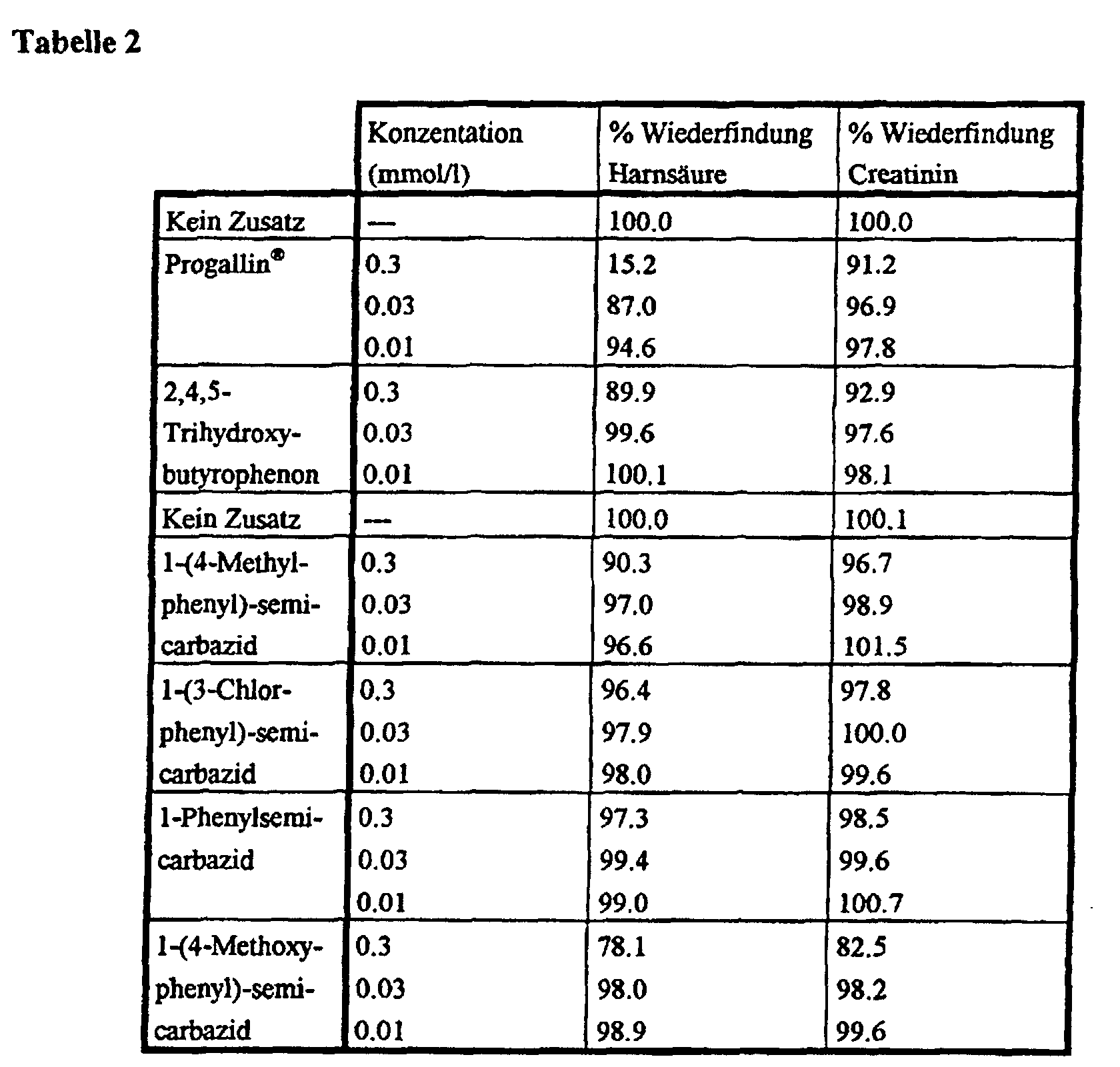
- Table 1 shows the results of the screening.
- the claimed substances show a positive influence on the stability of D- and T-bilirubin.
- Tables 1 and 2 show the results of the fine optimization of the concentrations of these substances.
- the invention substances used show a stabilization of bilirubin.
Landscapes
- Health & Medical Sciences (AREA)
- Life Sciences & Earth Sciences (AREA)
- Hematology (AREA)
- Engineering & Computer Science (AREA)
- Molecular Biology (AREA)
- Biomedical Technology (AREA)
- Chemical & Material Sciences (AREA)
- Immunology (AREA)
- Urology & Nephrology (AREA)
- Biotechnology (AREA)
- Biochemistry (AREA)
- Cell Biology (AREA)
- Food Science & Technology (AREA)
- Medicinal Chemistry (AREA)
- Physics & Mathematics (AREA)
- Analytical Chemistry (AREA)
- Microbiology (AREA)
- General Health & Medical Sciences (AREA)
- General Physics & Mathematics (AREA)
- Pathology (AREA)
- Investigating Or Analysing Biological Materials (AREA)
- Diaphragms For Electromechanical Transducers (AREA)
- Electrotherapy Devices (AREA)
Description
- eine genau bekannte Konzentration der Meßparameter muß eingehalten werden;
- die Konzentrationen müssen im medizinisch relevanten Meßbereich (normal beziehungsweise pathologisch) liegen;
- die Handhabung der Kontroll- beziehungsweise Eichseren muß einfach sein;
- die Kontroll- beziehungsweise Eichseren müssen eine möglichst lange Haltbarkeit besitzen.

und/oder eine chemische Verbindung der allgemeinen Formel (II)
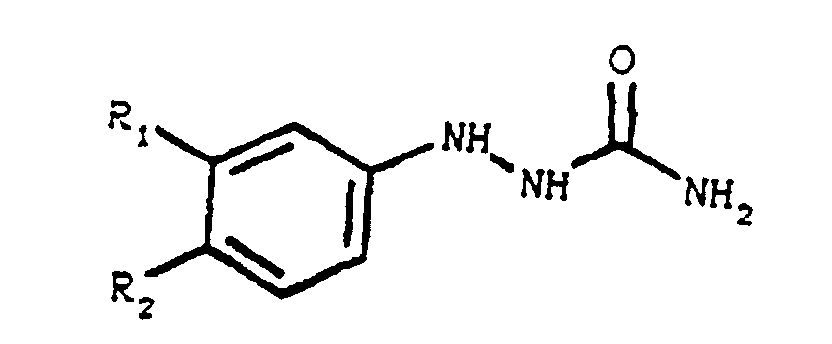
- R1 = H, Halogen: Cl, Br, F oder Alkyl: 1 - 6 C-Atome
- R2 = H, Alkyl: C1 - C6 oder Alkoxy: 1 - 6 C-Atome
- R1 = H; R2 = CH3 (= 1-(4-Methylphenyl)-semicarbazid)
Besonders bevorzugt werden die Verbindungen der allgemeinen Formel (I) beziehungsweise (II) in einer Konzentration von 0,03 bis 0,05 mmol/l (Progallin®), 0,03 bis 0,25 mmol/l (1-(4-Methoxyphenyl)-semicarbazid) 0,05 bis 0,25 mmol/l (1-(4-Methylphenyl)-semicarbazid), 0,15 bis 0,25 mmol/l (2,4,5-Trihydroxybutyrophenon und 1-Phenylsemicarbazid) beziehungsweise 0,15 bis 0,3 mmol/l (1-(3-Chlorphenyl)-semicarbazid) eingesetzt.

| Progallin® | 0,001 - 0,1 mmol/l |
| 2,4,5-Trihydroxybutyrophenon | 0,01 - 1,5 mmol/l |
| 1-(4-Methylphenyl)-semicarbazid | 0,01 - 1,5 mmol/l |
| 1-Phenylsemicarbazid | 0,01 - 1,5 mmol/l |
| 1-(3-Chlorphenyl)-senucarbazid | 0,01 - 1,5 mmol/l |
| 1-(4-Methoxyphenyl)-semicarbazid | 0,01 - 1,5 mmol/l |
| Progallin® | 0,03 - 0,05 mmol/l |
| 2,4,5-Trihydroxybutyrophenon | 0,15 - 0,25 mmol/l |
| 1-(4-Methylphenyl)-semicarbazid | 0,05 - 0,25 mmol/l |
| 1-Phenylsemicarbazid | 0,15 - 0,25 mmol/l |
| 1-(3-Chlorphenyl)-semicarbazid | 0,15 - 0,30 mmol/l |
| 1-(4-Methoxyphenyl)-semicarbazid | 0,03 - 0,25 mmol/l |
Claims (12)
- Bilirubin-haltiges Kontroll- beziehungsweise Eichserum, dadurch gekennzeichnet, daß eine chemische Verbindung der allgemeinen Formel (I):wobei
 bedeutetR1 = H, OH-Alkylrest mit 1 - 8 C-Atomen, COOR5 oder SO3R5R2 = H, OH, Alkylrest mit 1 - 8 C-Atomen, COOR5 oder SO3R5R3 = H oder OHR4 = H, COOR5, COR5 oder SO3R5R5 = H oder Alkylrest mit 1 - 6 C-Atomen
und/oder eine chemische Verbindungen der allgemeinen Formel (II):wobei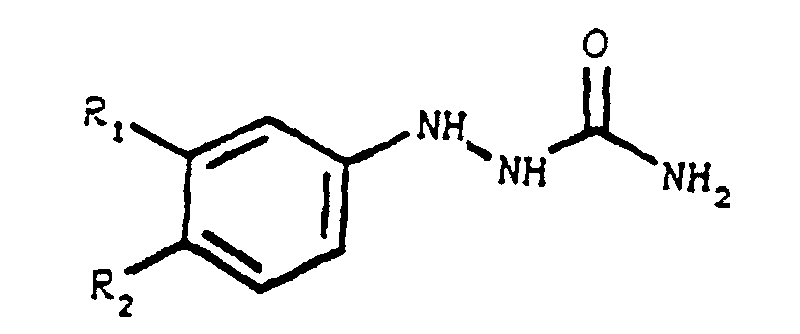 bedeutet,R1 = H, Halogen oder Alkylrest mit 1 - 6 C-AtomenR2 = H, Alkylrest mit 1 - 6 C-Atomen, Alkoxyrest mit 1 - 6 C-Atomen,
enthalten ist. - Kontroll- beziehungsweise Eichserum gemäß Anspruch 1, dadurch gekennzeichnet, daß die chemische Verbindung der allgemeinen Formel (I)
- Ein Kontroll- beziehungsweise Eichserum gemäß Anspruch 1 und 2, dadurch gekennzeichnet, daß die chemische Verbindung der allgemeinen Formel (II)
- Ein Kontroll- beziehungsweise Eichserum gemäß einem der Ansprüche 1 bis 3, das zusätzliche Konservierungsmittel oder/und Analytstabilisatoren enthält.
- Ein Kontroll- beziehungsweise Eichserum gemäß Anspruch 1, das unter Schutzgas aufbewahrt wird.
- Ein Kontroll- beziehungsweise Eichserum gemäß einem der Ansprüche 1 - 5, bei dem die Einsatzkonzentrationen der chemischen Verbindungen der Formeln (I) und/oder (II) zwischen 0,001 und 1,5 mmol/l liegen.
- Verwendung chemischer Verbindungen der Formeln (I) und/oder (II) zur Stabilisierung von Bilirubin in Lösungen.
- Verfahren zur Stabilisierung von Bilirubin in einer Lösung, dadurch gekennzeichnet, daß eine Verbindung der Formel (I) und/oder (II) der bilirubin-haltigen Lösung zugegeben wird.
- Verfahren zur Herstellung eines Kontroll- beziehungsweise Eichserums dadurch gekennzeichnet, daß eine Verbindung der Formel (I) und/oder eine Verbindung der Formel (II) einer bilirubin-haltigen Kontroll- bzw. Eichserum zugesetzt wird.
- Eine Methode zum Nachweis von Bilirubin durcha) Messung von Bilirubin in der Probeb) Messung von Bilirubin in einem Kontroll- oder Eichserum mit einem definierten Bilirubingehaltc) Bestimmung des Bilirubingehaltes durch Vergleich der Messung a) mit der Messung b), dadurch gekennzeichnet, daß ein Kontroll- oder Eichserum gemäß einem der Ansprüche 1 bis 6 verwendet wird.
- Eine Methode zur Erhöhung der Lagerstabilität von bilirubin-haltigen Eichbeziehungsweise Kontrollseren, dadurch gekennzeichnet, daß eine chemische Verbindung der Formel (I) und/oder (II) gemäß Anspruch 1 zugegeben wird.
- Kit zur Messung von Bilirubin in Proben, dadurch gekennzeichnet, daß ein bilirubin-haltiges Kontroll- beziehungsweise Eichserum gemäß einem der Ansprüche 1 bis 6 und zusätzliche zur Messung erforderliche Reagenzien enthalten sind.
Applications Claiming Priority (4)
| Application Number | Priority Date | Filing Date | Title |
|---|---|---|---|
| DE19611458 | 1996-03-22 | ||
| DE1996111458 DE19611458A1 (de) | 1996-03-22 | 1996-03-22 | Stabilisierung von Bilirubin in Kontrollseren und Kalibratoren |
| DE19623955 | 1996-06-15 | ||
| DE1996123955 DE19623955A1 (de) | 1996-06-15 | 1996-06-15 | Stabilisierung von Bilirubin in Kontrollseren und Kalibratoren |
Publications (3)
| Publication Number | Publication Date |
|---|---|
| EP0797098A2 EP0797098A2 (de) | 1997-09-24 |
| EP0797098A3 EP0797098A3 (de) | 1998-10-14 |
| EP0797098B1 true EP0797098B1 (de) | 2002-10-02 |
Family
ID=26024054
Family Applications (1)
| Application Number | Title | Priority Date | Filing Date |
|---|---|---|---|
| EP97104679A Expired - Lifetime EP0797098B1 (de) | 1996-03-22 | 1997-03-19 | Stabilisierung von Bilirubin in Kontrollseren und Kalibratoren |
Country Status (6)
| Country | Link |
|---|---|
| US (1) | US5854073A (de) |
| EP (1) | EP0797098B1 (de) |
| JP (1) | JP3165654B2 (de) |
| AT (1) | ATE225515T1 (de) |
| DE (1) | DE59708347D1 (de) |
| ES (1) | ES2183999T3 (de) |
Cited By (1)
| Publication number | Priority date | Publication date | Assignee | Title |
|---|---|---|---|---|
| EP1762364A2 (de) | 2005-09-10 | 2007-03-14 | Kreyenborg Verwaltungen und Beteiligungen GmbH & Co. KG | Vorrichtung zum Filtrieren eines Fluids, insbesondere für kunststoffverarbeitende Anlagen |
Families Citing this family (4)
| Publication number | Priority date | Publication date | Assignee | Title |
|---|---|---|---|---|
| US6696297B2 (en) * | 2001-02-13 | 2004-02-24 | Medical Analysis Systems, Inc. | Non-oxidizable bilirubin substitutes and uses therefor |
| CA2579001C (en) * | 2004-09-01 | 2014-07-08 | Maine Standards Company, Llc | Novel stable lipid standards |
| CN100430091C (zh) * | 2005-03-04 | 2008-11-05 | 江西特康科技有限公司 | 胆红素标准液及其制备方法和保存方法 |
| GB0526515D0 (en) * | 2005-12-28 | 2006-02-08 | Merck Sharp & Dohme | Modulation of signalling pathways |
Family Cites Families (10)
| Publication number | Priority date | Publication date | Assignee | Title |
|---|---|---|---|---|
| DE2716060C3 (de) * | 1977-04-09 | 1980-06-12 | Boehringer Mannheim Gmbh, 6800 Mannheim | Stabilisierte Schnelldiagnostica mit Oxydationsindikatoren |
| US4288343A (en) * | 1978-07-17 | 1981-09-08 | Beckman Instruments, Inc. | Method for increasing shelf-life of a serum bilirubin reference composition and composition produced thereby |
| US4250051A (en) * | 1978-12-26 | 1981-02-10 | Coulter Electronics, Inc. | Preservative for use in calibrator compositions for blood analysis |
| US4344864A (en) * | 1980-10-30 | 1982-08-17 | Beckman Instruments, Inc. | Method for increasing shelf-life of a serum conjugated bilirubin reference composition and composition produced thereby |
| DE3225331A1 (de) * | 1982-07-07 | 1984-01-12 | Boehringer Mannheim Gmbh, 6800 Mannheim | Verfahren zur bestimmung von direktem und gesamt-bilirubin sowie hierfuer geeignetes reagens |
| JPS59125899A (ja) * | 1982-12-29 | 1984-07-20 | Nippon Shoji Kk | 酵素法による直接ビリルビン測定用試薬および測定法 |
| AU8874591A (en) * | 1990-10-22 | 1992-05-20 | Abbott Laboratories | Stabilized anoxic diagnostic reagent solution |
| US5278073A (en) * | 1991-05-08 | 1994-01-11 | Streck Laboratories, Inc. | Method of bilirubin assay |
| DE4135404A1 (de) * | 1991-10-26 | 1993-04-29 | Boehringer Mannheim Gmbh | Stabiles fluessiges kontroll- bzw. eichserum fuer die klinische diagnostik |
| US5296377A (en) * | 1992-12-15 | 1994-03-22 | Boehringer Mannheim Corporation | Control reagent containing a hydroxylamine or an antioxidant |
-
1997
- 1997-03-19 EP EP97104679A patent/EP0797098B1/de not_active Expired - Lifetime
- 1997-03-19 JP JP6658497A patent/JP3165654B2/ja not_active Expired - Lifetime
- 1997-03-19 DE DE59708347T patent/DE59708347D1/de not_active Expired - Lifetime
- 1997-03-19 AT AT97104679T patent/ATE225515T1/de not_active IP Right Cessation
- 1997-03-19 ES ES97104679T patent/ES2183999T3/es not_active Expired - Lifetime
- 1997-03-21 US US08/822,950 patent/US5854073A/en not_active Expired - Lifetime
Cited By (1)
| Publication number | Priority date | Publication date | Assignee | Title |
|---|---|---|---|---|
| EP1762364A2 (de) | 2005-09-10 | 2007-03-14 | Kreyenborg Verwaltungen und Beteiligungen GmbH & Co. KG | Vorrichtung zum Filtrieren eines Fluids, insbesondere für kunststoffverarbeitende Anlagen |
Also Published As
| Publication number | Publication date |
|---|---|
| JP3165654B2 (ja) | 2001-05-14 |
| EP0797098A2 (de) | 1997-09-24 |
| EP0797098A3 (de) | 1998-10-14 |
| JPH102901A (ja) | 1998-01-06 |
| US5854073A (en) | 1998-12-29 |
| ATE225515T1 (de) | 2002-10-15 |
| DE59708347D1 (de) | 2002-11-07 |
| ES2183999T3 (es) | 2003-04-01 |
Similar Documents
| Publication | Publication Date | Title |
|---|---|---|
| DE69822429T2 (de) | Verfahren und Vorrichtung zur Bestimmung einer mit einer anderen Substanz koexistierenden Substanz | |
| DE69522576T2 (de) | Verfahren zur Stabilisierung der Reaktion eines Biosensors | |
| DE69016415T2 (de) | Stabile hämoglobinreferenzlösung. | |
| DE69615909T2 (de) | Verfahren und Vorrichtung zur Verringerung asymetrischer Fehler in amperometrischen Sensoren | |
| DE69718092T2 (de) | Kontrolllösung und Verfahren um die Leistung einer elektrochemischen Vorrichtung zur Bestimmung der Konzentration eines Analyten im Blut zu testen | |
| EP0037056B1 (de) | Verfahren und diagnostische Mittel zum Nachweis von Redox-Reaktionen | |
| DE69032422T2 (de) | Reagenzzusammensetzung, Verfahren und Kits zur Quantifizierung von Magnesium oder Calcium und Magnesium | |
| EP0250991B1 (de) | Verfahren zur spezifischen Bestimmung des Serumfructosamingehalts sowie hierfür geeignetes Reagenzgemisch | |
| CH622351A5 (de) | ||
| DE3788828T2 (de) | Stabilisierte flüssige Enzymzusammensetzung zur Bestimmung von Glucose. | |
| AT409040B (de) | Creatininsensor-kalibration | |
| DE2262781B2 (de) | Verfahren zur bestimmung von anorganischem phosphat in koerperfluessigkeiten | |
| CH632092A5 (de) | Verfahren und mittel zur bestimmung von hydroperoxiden. | |
| DE7917122U1 (de) | Messgeraet fuer polarographische oder voltametermessungen | |
| EP0797098A2 (de) | Stabilisierung von Bilirubin in Kontrollseren und Kalibratoren | |
| DE69119399T2 (de) | Reagens und verfahren für serum eisenproben | |
| DE69432430T2 (de) | Glucosekalibrator und kontrollmaterial für teststreifen | |
| DE2748857C2 (de) | Verfahren zur quantitativen Bestimmung von Harnstoff | |
| EP0309882A2 (de) | Verfahren zur spezifischen Bestimmung des Serumfructosamingehalts sowie hierfür geeignetes Reagenzgemisch | |
| DE3129029A1 (de) | Kompensierte referenzfluessigkeit zur verwendung in einem chemischen analysegeraet | |
| DE69332764T2 (de) | Hydroxylamin enthaltendes kontrollreagenz | |
| EP0262582A2 (de) | Verfahren zur Bestimmung des Konzentrationsverhältnisses von Lithiumionen zu Natriumionen und Vorrichtung zur Durchführung dieses Verfahrens | |
| AT401111B (de) | Verfahren zur kalibrierung eines ph-messelementes | |
| DE19611458A1 (de) | Stabilisierung von Bilirubin in Kontrollseren und Kalibratoren | |
| DE19623955A1 (de) | Stabilisierung von Bilirubin in Kontrollseren und Kalibratoren |
Legal Events
| Date | Code | Title | Description |
|---|---|---|---|
| PUAI | Public reference made under article 153(3) epc to a published international application that has entered the european phase |
Free format text: ORIGINAL CODE: 0009012 |
|
| AK | Designated contracting states |
Kind code of ref document: A2 Designated state(s): AT BE CH DE DK ES FR GB IE IT LI NL SE |
|
| PUAL | Search report despatched |
Free format text: ORIGINAL CODE: 0009013 |
|
| AK | Designated contracting states |
Kind code of ref document: A3 Designated state(s): AT BE CH DE DK ES FR GB IE IT LI NL SE |
|
| RAP3 | Party data changed (applicant data changed or rights of an application transferred) |
Owner name: ROCHE DIAGNOSTICS GMBH |
|
| 17P | Request for examination filed |
Effective date: 19990414 |
|
| GRAG | Despatch of communication of intention to grant |
Free format text: ORIGINAL CODE: EPIDOS AGRA |
|
| 17Q | First examination report despatched |
Effective date: 20011023 |
|
| GRAG | Despatch of communication of intention to grant |
Free format text: ORIGINAL CODE: EPIDOS AGRA |
|
| GRAH | Despatch of communication of intention to grant a patent |
Free format text: ORIGINAL CODE: EPIDOS IGRA |
|
| GRAH | Despatch of communication of intention to grant a patent |
Free format text: ORIGINAL CODE: EPIDOS IGRA |
|
| GRAA | (expected) grant |
Free format text: ORIGINAL CODE: 0009210 |
|
| AK | Designated contracting states |
Kind code of ref document: B1 Designated state(s): AT BE CH DE DK ES FR GB IE IT LI NL SE |
|
| PG25 | Lapsed in a contracting state [announced via postgrant information from national office to epo] |
Ref country code: NL Free format text: LAPSE BECAUSE OF FAILURE TO SUBMIT A TRANSLATION OF THE DESCRIPTION OR TO PAY THE FEE WITHIN THE PRESCRIBED TIME-LIMIT Effective date: 20021002 Ref country code: IE Free format text: LAPSE BECAUSE OF FAILURE TO SUBMIT A TRANSLATION OF THE DESCRIPTION OR TO PAY THE FEE WITHIN THE PRESCRIBED TIME-LIMIT Effective date: 20021002 Ref country code: GB Free format text: LAPSE BECAUSE OF FAILURE TO SUBMIT A TRANSLATION OF THE DESCRIPTION OR TO PAY THE FEE WITHIN THE PRESCRIBED TIME-LIMIT Effective date: 20021002 |
|
| REF | Corresponds to: |
Ref document number: 225515 Country of ref document: AT Date of ref document: 20021015 Kind code of ref document: T |
|
| REG | Reference to a national code |
Ref country code: GB Ref legal event code: FG4D Free format text: NOT ENGLISH |
|
| REG | Reference to a national code |
Ref country code: CH Ref legal event code: EP |
|
| REG | Reference to a national code |
Ref country code: IE Ref legal event code: FG4D Free format text: GERMAN |
|
| REF | Corresponds to: |
Ref document number: 59708347 Country of ref document: DE Date of ref document: 20021107 |
|
| PG25 | Lapsed in a contracting state [announced via postgrant information from national office to epo] |
Ref country code: SE Free format text: LAPSE BECAUSE OF FAILURE TO SUBMIT A TRANSLATION OF THE DESCRIPTION OR TO PAY THE FEE WITHIN THE PRESCRIBED TIME-LIMIT Effective date: 20030102 Ref country code: DK Free format text: LAPSE BECAUSE OF FAILURE TO SUBMIT A TRANSLATION OF THE DESCRIPTION OR TO PAY THE FEE WITHIN THE PRESCRIBED TIME-LIMIT Effective date: 20030102 |
|
| NLV1 | Nl: lapsed or annulled due to failure to fulfill the requirements of art. 29p and 29m of the patents act | ||
| PG25 | Lapsed in a contracting state [announced via postgrant information from national office to epo] |
Ref country code: AT Free format text: LAPSE BECAUSE OF NON-PAYMENT OF DUE FEES Effective date: 20030319 |
|
| PG25 | Lapsed in a contracting state [announced via postgrant information from national office to epo] |
Ref country code: LI Free format text: LAPSE BECAUSE OF NON-PAYMENT OF DUE FEES Effective date: 20030331 Ref country code: CH Free format text: LAPSE BECAUSE OF NON-PAYMENT OF DUE FEES Effective date: 20030331 Ref country code: BE Free format text: LAPSE BECAUSE OF NON-PAYMENT OF DUE FEES Effective date: 20030331 |
|
| REG | Reference to a national code |
Ref country code: ES Ref legal event code: FG2A Ref document number: 2183999 Country of ref document: ES Kind code of ref document: T3 |
|
| GBV | Gb: ep patent (uk) treated as always having been void in accordance with gb section 77(7)/1977 [no translation filed] |
Effective date: 20021002 |
|
| ET | Fr: translation filed | ||
| REG | Reference to a national code |
Ref country code: IE Ref legal event code: FD4D Ref document number: 0797098E Country of ref document: IE |
|
| PLBE | No opposition filed within time limit |
Free format text: ORIGINAL CODE: 0009261 |
|
| STAA | Information on the status of an ep patent application or granted ep patent |
Free format text: STATUS: NO OPPOSITION FILED WITHIN TIME LIMIT |
|
| 26N | No opposition filed |
Effective date: 20030703 |
|
| BERE | Be: lapsed |
Owner name: *ROCHE DIAGNOSTICS G.M.B.H. Effective date: 20030331 |
|
| REG | Reference to a national code |
Ref country code: CH Ref legal event code: PL |
|
| REG | Reference to a national code |
Ref country code: FR Ref legal event code: PLFP Year of fee payment: 20 |
|
| PGFP | Annual fee paid to national office [announced via postgrant information from national office to epo] |
Ref country code: ES Payment date: 20160315 Year of fee payment: 20 Ref country code: IT Payment date: 20160311 Year of fee payment: 20 |
|
| PGFP | Annual fee paid to national office [announced via postgrant information from national office to epo] |
Ref country code: FR Payment date: 20160223 Year of fee payment: 20 |
|
| PGFP | Annual fee paid to national office [announced via postgrant information from national office to epo] |
Ref country code: DE Payment date: 20160324 Year of fee payment: 20 |
|
| REG | Reference to a national code |
Ref country code: DE Ref legal event code: R071 Ref document number: 59708347 Country of ref document: DE |
|
| REG | Reference to a national code |
Ref country code: ES Ref legal event code: FD2A Effective date: 20170626 |
|
| PG25 | Lapsed in a contracting state [announced via postgrant information from national office to epo] |
Ref country code: ES Free format text: LAPSE BECAUSE OF EXPIRATION OF PROTECTION Effective date: 20170320 |