EP0790967B1 - Conversion of methanol to gasoline - Google Patents
Conversion of methanol to gasoline Download PDFInfo
- Publication number
- EP0790967B1 EP0790967B1 EP95941364A EP95941364A EP0790967B1 EP 0790967 B1 EP0790967 B1 EP 0790967B1 EP 95941364 A EP95941364 A EP 95941364A EP 95941364 A EP95941364 A EP 95941364A EP 0790967 B1 EP0790967 B1 EP 0790967B1
- Authority
- EP
- European Patent Office
- Prior art keywords
- gas
- temperature
- mtg
- reactor
- product
- Prior art date
- Legal status (The legal status is an assumption and is not a legal conclusion. Google has not performed a legal analysis and makes no representation as to the accuracy of the status listed.)
- Expired - Lifetime
Links
- OKKJLVBELUTLKV-UHFFFAOYSA-N Methanol Chemical compound OC OKKJLVBELUTLKV-UHFFFAOYSA-N 0.000 title claims description 294
- 238000006243 chemical reaction Methods 0.000 title claims description 184
- 239000003502 gasoline Substances 0.000 title claims description 27
- 239000007789 gas Substances 0.000 claims description 498
- 150000002430 hydrocarbons Chemical class 0.000 claims description 92
- 239000000203 mixture Substances 0.000 claims description 91
- 239000003054 catalyst Substances 0.000 claims description 89
- 238000000034 method Methods 0.000 claims description 86
- XLYOFNOQVPJJNP-UHFFFAOYSA-N water Substances O XLYOFNOQVPJJNP-UHFFFAOYSA-N 0.000 claims description 86
- 239000003085 diluting agent Substances 0.000 claims description 84
- 230000008569 process Effects 0.000 claims description 76
- -1 alkoxy compound Chemical class 0.000 claims description 62
- 125000003545 alkoxy group Chemical group 0.000 claims description 45
- 230000036961 partial effect Effects 0.000 claims description 38
- 239000001257 hydrogen Substances 0.000 claims description 12
- 229910052739 hydrogen Inorganic materials 0.000 claims description 12
- UFHFLCQGNIYNRP-UHFFFAOYSA-N Hydrogen Chemical compound [H][H] UFHFLCQGNIYNRP-UHFFFAOYSA-N 0.000 claims description 7
- 150000002431 hydrogen Chemical class 0.000 claims description 5
- 239000000047 product Substances 0.000 description 148
- LCGLNKUTAGEVQW-UHFFFAOYSA-N Dimethyl ether Chemical compound COC LCGLNKUTAGEVQW-UHFFFAOYSA-N 0.000 description 101
- 229930195733 hydrocarbon Natural products 0.000 description 83
- 239000004215 Carbon black (E152) Substances 0.000 description 77
- 125000000956 methoxy group Chemical group [H]C([H])([H])O* 0.000 description 48
- 239000006227 byproduct Substances 0.000 description 19
- 238000004519 manufacturing process Methods 0.000 description 18
- 230000000694 effects Effects 0.000 description 15
- VNWKTOKETHGBQD-UHFFFAOYSA-N methane Chemical compound C VNWKTOKETHGBQD-UHFFFAOYSA-N 0.000 description 14
- 239000012467 final product Substances 0.000 description 13
- SQNZJJAZBFDUTD-UHFFFAOYSA-N durene Chemical compound CC1=CC(C)=C(C)C=C1C SQNZJJAZBFDUTD-UHFFFAOYSA-N 0.000 description 12
- 239000007788 liquid Substances 0.000 description 11
- 230000009467 reduction Effects 0.000 description 11
- 230000032683 aging Effects 0.000 description 7
- 230000008901 benefit Effects 0.000 description 7
- 239000003345 natural gas Substances 0.000 description 7
- 238000012546 transfer Methods 0.000 description 7
- 239000007795 chemical reaction product Substances 0.000 description 6
- 238000009826 distribution Methods 0.000 description 6
- 238000012545 processing Methods 0.000 description 6
- 239000012495 reaction gas Substances 0.000 description 6
- 239000010779 crude oil Substances 0.000 description 5
- 238000011084 recovery Methods 0.000 description 5
- 239000007858 starting material Substances 0.000 description 5
- 238000013459 approach Methods 0.000 description 4
- 229910052799 carbon Inorganic materials 0.000 description 4
- 238000001816 cooling Methods 0.000 description 4
- 230000018044 dehydration Effects 0.000 description 4
- 238000006297 dehydration reaction Methods 0.000 description 4
- 239000000446 fuel Substances 0.000 description 4
- 238000010438 heat treatment Methods 0.000 description 4
- 238000002156 mixing Methods 0.000 description 4
- 238000011027 product recovery Methods 0.000 description 4
- YXFVVABEGXRONW-UHFFFAOYSA-N Toluene Chemical compound CC1=CC=CC=C1 YXFVVABEGXRONW-UHFFFAOYSA-N 0.000 description 3
- 230000015572 biosynthetic process Effects 0.000 description 3
- 238000009835 boiling Methods 0.000 description 3
- 125000004432 carbon atom Chemical group C* 0.000 description 3
- 230000003197 catalytic effect Effects 0.000 description 3
- 230000008859 change Effects 0.000 description 3
- 150000001875 compounds Chemical class 0.000 description 3
- 238000009434 installation Methods 0.000 description 3
- GBMDVOWEEQVZKZ-UHFFFAOYSA-N methanol;hydrate Chemical compound O.OC GBMDVOWEEQVZKZ-UHFFFAOYSA-N 0.000 description 3
- 239000003921 oil Substances 0.000 description 3
- 230000035945 sensitivity Effects 0.000 description 3
- FYGHSUNMUKGBRK-UHFFFAOYSA-N 1,2,3-trimethylbenzene Chemical compound CC1=CC=CC(C)=C1C FYGHSUNMUKGBRK-UHFFFAOYSA-N 0.000 description 2
- 150000001336 alkenes Chemical class 0.000 description 2
- 150000004945 aromatic hydrocarbons Chemical class 0.000 description 2
- 230000033228 biological regulation Effects 0.000 description 2
- 150000001721 carbon Chemical group 0.000 description 2
- 230000000052 comparative effect Effects 0.000 description 2
- 239000000470 constituent Substances 0.000 description 2
- 230000001276 controlling effect Effects 0.000 description 2
- 230000006378 damage Effects 0.000 description 2
- 230000007423 decrease Effects 0.000 description 2
- 238000002347 injection Methods 0.000 description 2
- 239000007924 injection Substances 0.000 description 2
- 239000000463 material Substances 0.000 description 2
- TVMXDCGIABBOFY-UHFFFAOYSA-N octane Chemical compound CCCCCCCC TVMXDCGIABBOFY-UHFFFAOYSA-N 0.000 description 2
- 238000000926 separation method Methods 0.000 description 2
- WGSMMQXDEYYZTB-UHFFFAOYSA-N 1,2,4,5-tetramethylbenzene Chemical compound CC1=CC(C)=C(C)C=C1C.CC1=CC(C)=C(C)C=C1C WGSMMQXDEYYZTB-UHFFFAOYSA-N 0.000 description 1
- BVOBEKTUNHUKRO-UHFFFAOYSA-N 1,2-dimethoxyethane;methanol Chemical compound OC.COCCOC BVOBEKTUNHUKRO-UHFFFAOYSA-N 0.000 description 1
- 238000012935 Averaging Methods 0.000 description 1
- OKTJSMMVPCPJKN-UHFFFAOYSA-N Carbon Chemical compound [C] OKTJSMMVPCPJKN-UHFFFAOYSA-N 0.000 description 1
- CTQNGGLPUBDAKN-UHFFFAOYSA-N O-Xylene Chemical compound CC1=CC=CC=C1C CTQNGGLPUBDAKN-UHFFFAOYSA-N 0.000 description 1
- 206010063493 Premature ageing Diseases 0.000 description 1
- 208000032038 Premature aging Diseases 0.000 description 1
- 238000009825 accumulation Methods 0.000 description 1
- 239000003377 acid catalyst Substances 0.000 description 1
- 150000005215 alkyl ethers Chemical class 0.000 description 1
- 230000004075 alteration Effects 0.000 description 1
- PNEYBMLMFCGWSK-UHFFFAOYSA-N aluminium oxide Inorganic materials [O-2].[O-2].[O-2].[Al+3].[Al+3] PNEYBMLMFCGWSK-UHFFFAOYSA-N 0.000 description 1
- 125000003118 aryl group Chemical group 0.000 description 1
- 150000001555 benzenes Chemical class 0.000 description 1
- 239000003245 coal Substances 0.000 description 1
- 239000003034 coal gas Substances 0.000 description 1
- 239000000571 coke Substances 0.000 description 1
- 230000002860 competitive effect Effects 0.000 description 1
- 230000001143 conditioned effect Effects 0.000 description 1
- 239000000498 cooling water Substances 0.000 description 1
- 230000003247 decreasing effect Effects 0.000 description 1
- 238000013461 design Methods 0.000 description 1
- 238000009792 diffusion process Methods 0.000 description 1
- 230000003467 diminishing effect Effects 0.000 description 1
- 238000004821 distillation Methods 0.000 description 1
- 230000002349 favourable effect Effects 0.000 description 1
- 239000008246 gaseous mixture Substances 0.000 description 1
- 230000002779 inactivation Effects 0.000 description 1
- 230000000977 initiatory effect Effects 0.000 description 1
- 239000013627 low molecular weight specie Substances 0.000 description 1
- 239000012528 membrane Substances 0.000 description 1
- 230000011987 methylation Effects 0.000 description 1
- 238000007069 methylation reaction Methods 0.000 description 1
- JRZJOMJEPLMPRA-UHFFFAOYSA-N olefin Natural products CCCCCCCC=C JRZJOMJEPLMPRA-UHFFFAOYSA-N 0.000 description 1
- 230000002028 premature Effects 0.000 description 1
- 238000002360 preparation method Methods 0.000 description 1
- 238000003672 processing method Methods 0.000 description 1
- 238000010791 quenching Methods 0.000 description 1
- 239000000376 reactant Substances 0.000 description 1
- 239000003507 refrigerant Substances 0.000 description 1
- 230000008929 regeneration Effects 0.000 description 1
- 238000011069 regeneration method Methods 0.000 description 1
- 230000001105 regulatory effect Effects 0.000 description 1
- 238000004513 sizing Methods 0.000 description 1
- 239000000243 solution Substances 0.000 description 1
- 238000010792 warming Methods 0.000 description 1
- 239000008096 xylene Substances 0.000 description 1
Images
Classifications
-
- C—CHEMISTRY; METALLURGY
- C07—ORGANIC CHEMISTRY
- C07C—ACYCLIC OR CARBOCYCLIC COMPOUNDS
- C07C1/00—Preparation of hydrocarbons from one or more compounds, none of them being a hydrocarbon
- C07C1/20—Preparation of hydrocarbons from one or more compounds, none of them being a hydrocarbon starting from organic compounds containing only oxygen atoms as heteroatoms
-
- Y—GENERAL TAGGING OF NEW TECHNOLOGICAL DEVELOPMENTS; GENERAL TAGGING OF CROSS-SECTIONAL TECHNOLOGIES SPANNING OVER SEVERAL SECTIONS OF THE IPC; TECHNICAL SUBJECTS COVERED BY FORMER USPC CROSS-REFERENCE ART COLLECTIONS [XRACs] AND DIGESTS
- Y02—TECHNOLOGIES OR APPLICATIONS FOR MITIGATION OR ADAPTATION AGAINST CLIMATE CHANGE
- Y02P—CLIMATE CHANGE MITIGATION TECHNOLOGIES IN THE PRODUCTION OR PROCESSING OF GOODS
- Y02P30/00—Technologies relating to oil refining and petrochemical industry
- Y02P30/20—Technologies relating to oil refining and petrochemical industry using bio-feedstock
Definitions
- This invention relates to a process for converting alkoxy compounds into hydrocarbon compounds, mostly in the gasoline boiling range.
- Catalysts for the conversion of alkoxy compounds, such as methanol and/or dimethyl ether, to gasoline grade hydrocarbon products have been known since the 1970's. Processes for the conversion of natural gas and/or coal to methanol have been known for a much longer period.
- the New Zealand facility is basically a natural gas to methanol plant (as the front end) coupled to a methanol to gasoline plant operating with an MTG catalyst in a plurality of fixed catalytic bed reactors arranged in parallel, each for single pass gas flow.
- the arrangement comprises five MTG reaction vessels, four of which operate at any given time and one is off stream for MTG catalyst regeneration or replacement.
- MTG catalyst Mobil-type methanol to gasoline catalyst
- the New Zealand facility effectuates product gas temperature control within the MTG catalyst vessels by recycle of the C 2 _and C 3+ hydrocarbon byproduct gases remaining after the reactor product gases are cooled down from their reaction temperature of about 427°C (800°F) to about 38°C (100°F) for removal of their gasoline grade hydrocarbon product content.
- this recycle diluent gas is added in an amount compared to the methoxy feed gas (methanol, dimethyl ether, etc.) of about 12.4 moles diluent recycle/mole methoxy equivalent.
- reactor effluent gas cool down (427°C to 38°C) (800°F to 100°F) for gasoline product recovery and recycle gas (C 2- /C 3+ ) reheat (from 38°C (100°F) to at least 344°C (650°F), and preferably to 371°C (700°F)).
- C 2- /C 3+ gasoline product recovery and recycle gas
- reheat from 38°C (100°F) to at least 344°C (650°F), and preferably to 371°C (700°F)
- the methoxy compound In the New Zealand operation the methoxy compound, generally in the form of an equilibrium mixture of methanol, dimethyl ether and water vapor, is combined with a recycle gas comprising C 2 _and C 3+ hydrocarbons and the methoxy content is reacted in a single pass over an MTG catalyst to produce a product gas of about 427°C (800°F) with a partial pressure of water (as steam) of about 200 kPa (2 atmospheres) absolute (ata) at a product gas pressure of about 2250 kPa (22.3 ata).
- a partial pressure of water (as steam) of about 200 kPa (2 atmospheres) absolute (ata) at a product gas pressure of about 2250 kPa (22.3 ata
- heat exchange operations to heat up feed gases and/or cool down product gas are carried out on gas streams at a pressure of about 2250 kPa (22.3 ata).
- the MTG reaction gases are cooled from their reaction temperature, T R , to their final cooldown temperature, T O , in two heat exchange operations.
- the reaction gases are indirectly heat exchanged with feed gases through adiabatic heat exchangers to cause the feed gases to warm up from their unit available temperature of about T O to their reactor inlet temperature T I by transferring thereto of a quantity of heat Q from the reaction gases which thus causes the reaction gases to cool down from their reaction temperature T R to their first cooldown temperature T X .
- the reaction gases are finally cooled from their first cooldown temperature T X to the liquid hydrocarbon recovery temperature, T O , either by direct or indirect heat exchange contact with chill water.
- the adiabatic heat exchangers through which feed gas is heated up while reaction product gas is cooled down are on the order of 3-4 times as expensive as those heat exchange units by which the product gas is finally cooled down by heat exchange with chill water.
- the sizing of each of these heat exchange units which bears very significantly on their cost, is directly effected by the difference in temperature to which the feed gases are to be heated and the temperature from which the product gas is to be cooled ( ⁇ T) and the pressure (P) of the gases to be heated and cooled.
- Mobil Oil Corporation's U.S. Patent 4,035,430 to Dwyer et al. describes an MTG process wherein a number of spaced apart MTG catalyst beds are employed and hydrocarbon recycle gas may be injected between the successive beds to control the exotherm. Also described is the possibility of interbed injection of methanol or DME as a quench to maintain the temperature rise in each MTG catalyst bed to about 28°C (50°F) with a total temperature rise over all beds to about 110°C (200°F). This however, as Mobil's later U.S. Patent 4,404,414 to Penick et al.
- the total quantity of temperature-control diluent gases used in the process is passed through the first MTG reactor and hence into the succeeding MTG reactor without the need for cooldown heat exchange of the diluent gas from the reaction gas temperature (about 427°C (800°F)) to about 38°C (100°F) for purposes of product recovery and thereafter reheat from about 38°C (100°F) to an inlet reaction temperature (about 371°C (700°F)) for recycle use with the new alkoxy charge.
- a method of making hydrocarbon compounds by contacting an alkoxy compound with an MTG catalyst in a plurality of MTG reaction zones arranged in series flow comprising, for a zone having a preceding zone, the steps of: combining an effluent gas product from a preceding MTG reaction zone which is at a temperature T R with
- the invention proposes a method for operation of an MTG process wherein:
- This target can be achieved even though substantial pressure drops exist between reactor zones. Again, it is easier to explain the invention if the simplifying assumption is made that the pressure drop between reactors is so small that it can be ignored.
- Such a starter gas stream could be of any composition, but could conveniently be made from the same alkoxy compound in admixture with a similar diluent recycle composition, but in a larger recycle amount, so that that the starter stream could be warmed up to 571°C (700°F) and contacted with MTG catalyst to react to a product gas having a temperature of 427°C (800°F).
- the product gas stream at 427°C (800°F), thus obtained, serves in its own turn as a hot gas source for admixture with a new portion of the 316°C (600°F) gas mixture containing new alkoxy compound to arrive at a still larger volume 371°C (700°F) combined gas stream which again can be contacted with an MTG catalyst to form a product gas stream at 427°C (800°F).
- This alternating mixing and reaction is continued until all the alkoxy containing gas mixture of 316°C (600°F) has been reacted.
- a further advantage is that the temperature zone of reaction can be varied at will from reactor to reactor by changing the amount added of the new alkoxy-recycle charge and its preheat temperature.
- this invention provides a feasible method to have the MTG reaction proceed within desired limits of temperature and also attain the desired water vapor partial pressure levels in the exit of each of the reactors.
- the total amount of alkoxy equivalent processed to hydrocarbon products is proportioned among a plurality of MTG reaction zones and the alkoxy equivalent quantity provided to each MTG reaction zone generally increases in progression from the first to the last or final MTG reaction zone.
- This method of operation provides for great flexibility in the operational conditions of temperature and pressure at which a given MTG reaction zone may be operated relative to another in order to achieve a variety of desirable objectives, all attendant with a significant reduction in the heat exchange duties otherwise required to process the same total amount of methoxy equivalent to hydrocarbon products by prior MTG processing methods.
- each desirably is operated at approximately the same pressure, the same inlet and outlet temperatures (i.e., each zone has the same ⁇ T R ), and each reaction zone, at least after the first, has about the same partial pressure H 2 O at the outlet of the reaction zone.
- the same inlet and outlet temperatures i.e., each zone has the same ⁇ T R
- each reaction zone at least after the first, has about the same partial pressure H 2 O at the outlet of the reaction zone.
- T P temperature
- T I temperature at which it is desired to contact the methoxy compound with an MTG catalyst.
- This is achieved by admixing the methoxy-recycle feed with hot product gases from a preceding MTG reaction (at T R ) which heats up the added methoxy-recycle feed to the desired reaction inlet temperature, while cooling down the hot reaction gases to the desired reaction inlet temperatures.
- this aspect of the feed gas heatup/product gas cool down is performed by direct gas-gas contact, thus eliminating this portion of need for adiabatic heat exchange equipment.
- operations in accordance with this invention permit a selection of conditions in terms of (a) the nature of the methoxy feed, (b) the nature of the diluent gas composition, and (c) the temperature to which the feed gases are preheated before being mixed with reaction gases from a preceding MTG reaction; such that the MTG conversion can be achieved with the maximum of economy in terms of the capital and/or operational cost associated therewith.
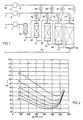
- Figure 1 is a schematic illustration of a five reactor series with interstage feed of feed charges of alkoxy-recycle feedstock gases between the reactors in accordance with the present invention.
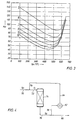
- Figures 2 and 3 plot the effect on the required relative heat exchanger surface area (Ar) required for performing feed gas warmup by product gas cooldown heat exchange operations in adiabatic heat exchange units in accordance with the process of the invention for different preheat temperatures T P as employed in a series of from five to ten MTG reactors, wherein a pressure drop of 35 kPa (0.35 ata) occurs across each reactor.
- the alkoxy feed for Figure 2A is dimethyl ether (DME) and for Fig. 3 is a DME containing equilibrium mixture formed from a crude methanol containing 16.4 wt.% water.
- DME dimethyl ether
- Fig. 3 is a DME containing equilibrium mixture formed from a crude methanol containing 16.4 wt.% water.
- For comparison treatment of the same quantity of an equilibrium mixture formed from methanol-water in a single reactor requires a relative heat exchange surface area of about 325.4 relative units when operated at a pressure of 232 kPa (22.06 ata) to provide for the same partial pressure of steam in the product gas as that provided by the process as illustrated in Figure 3.
- Figure 4 is a schematic illustration of an alternative embodiment of the process wherein the first of a series of five MTG reactors recycles a portion of its product gas back to the inlet of this first MTG reactor to provide a gas-to-gas exchange of heat with fresh alkoxy feed to this reactor to achieve its final warmup from its T P temperature to the T I temperature desired for contact with the MTG catalyst therein.
- alkoxy feedstock generally a methanol (MeOH) and/or dimethylether (DME) feedstock
- MeOH methanol
- DME dimethylether
- the MeOH may be formed from a coal or natural gas starting material by any of the methods well known to those skilled in art.
- the methanol is produced by methods as described in U.S. Patent Nos. 5,117,144 and 5,245,110.
- the MeOH Prior to the MTG reaction, and preferably so, the MeOH may be subject to contact with a dehydration catalyst as is well known in the art to convert it to an equilibrium mixture of MeOH, DME and H 2 O and this gaseous mixture of oxygenated organic components which is a preferred alkoxy feed component for an MTG catalyst contact for conversion to a hydrocarbon product with production of by-product water.
- a dehydration catalyst as is well known in the art to convert it to an equilibrium mixture of MeOH, DME and H 2 O and this gaseous mixture of oxygenated organic components which is a preferred alkoxy feed component for an MTG catalyst contact for conversion to a hydrocarbon product with production of by-product water.
- DME alone as the alkoxy feed component.
- DME can easily be isolated
- MeOH and/or DME components are, in the process of this invention, brought into contact with an MTG catalyst composition, as described in U.S. Patent Nos. 4,404,414; 4,788,369 to Penick and Marsh as earlier discussed and in other Mobil U.S. patents, to catalyze their conversion into a hydrocarbon product, a significant portion of which is within the gasoline boiling point range.
- an MTG catalyst composition as described in U.S. Patent Nos. 4,404,414; 4,788,369 to Penick and Marsh as earlier discussed and in other Mobil U.S. patents, to catalyze their conversion into a hydrocarbon product, a significant portion of which is within the gasoline boiling point range.
- the carbon atoms supplied by the methoxy content of the DME/MeOH feed gas composition are converted to a hydrocarbon product averaging a carbon atom content of about 5.8 -- i.e., C 5.8 H 13.6 .
- This hydrocarbon product is, of course, comprised of a mixture of hydrocarbons which vary in carbon atom numbers from one up.
- the C 1-5 carbon atoms products of this reaction are normally gaseous compounds and are recovered and at least a portion thereof is recycled as a diluent gas to become a part of a fresh alkoxy feedstock to an MTG reactor, together with traces of higher hydrocarbons.
- Most of the C 5+ carbon atom hydrocarbon products are recovered as a "gasoline" or fuel grade product.
- the C 2- /C 3+ hydrocarbon gas by-products of the MTG reaction which are recovered may be separated into separate C 2- and C 3+ steams, and either alone or in desired combinations thereof recycled to the MTG process for purposes of temperature control.
- the process of this invention utilizes a plurality of MTG catalyst zones or reaction vessels in series flow whereby the product effluent gas from any preceding MTG zone or reactor is combined with a fresh charge of alkoxy compound together with a recycle diluent gas and/or water (stream) to form a combined gas steam of a temperature and specific heat content suitable as an alkoxy-containing feed gas to a succeeding MTG zone or reactor wherein its alkoxy compound content is reacted in contact with an MTG catalyst to hydrocarbon compounds.
- the alkoxy equivalent of the alkoxy compound added to the product effluent gas of a preceding MTG reaction exceeds the alkoxy equivalent content of the feed gas stream to the preceding reactor from which the product effluent gas was produced.
- MTG reaction zones or reactors Any number of MTG reaction zones or reactors may be utilized, though generally no further practical advantage is realized in excess of ten, and more preferably five to eight MTG reaction zones or reactors in series.
- the product effluent gas from the final MTG reaction of the series is cooled from its final reaction temperature to about 38°C (100°F) to recover its liquid hydrocarbon content separate from its C 2- and C 3+ gaseous hydrocarbon content.
- At least a portion of C 2- and/or C 3+ gaseous hydrocarbon by-product is recycled for use as a temperature moderating diluent gas for combination with fresh charges of alkoxy compound and the recovered liquid hydrocarbon is further refined into its various boiling point fractions for use as fuels or other purposes.
- the combination of a fresh charge of alkoxy compound and C 2- and/or C 3+ recycle gas with the product effluent gas from a preceding MTG reaction to form a combined gas of suitable inlet temperature (T I ) and specific heat content as feed to a succeeding MTG reaction reduces the overall heat exchange duties with respect to the total make of hydrocarbon product by reducing the size of the heat exchangers needed for heating the fresh charge to the temperature to which the fresh charge of alkoxy compound and recycle gas must be preheated to condition it for admission to the succeeding MTG reactor, which mixture in line with its alkoxy content and its total specific heat content will react in contact with an MTG catalyst from a temperature of T I to the desired temperature T R for the new reactor.
- recycle diluent gas is combined with this methanol in an amount to provide a total feed gas of this specific heat content.
- the quantity of heat exchange required for warmup of the feed gas is significantly reduced because the quantity of recycle diluent gas is reduced, but the methanol is still converted in the same temperature zone, i.e., 377-418°C (710-785°F). Further, the efficiency with which the feed gas warm-up heat exchange is accomplished is significantly enhanced by reason of the increase in the differential temperature ( ⁇ T) at which the heat exchangers performing this duty operate.
- the heat exchange duty that this reactor contributes to the total heat exchange duty of the overall process is significantly greater in comparison to the quantity of methoxy equivalent converted therein than is that contributed to the total by the subsequent MTG reactors of the series.
- the number of reactors utilized together with the conditions chosen for their operation is preferably such that no more than 20% of all alkoxy compound converted by the process is converted in the first reactor of the series, preferably no more than 10%.
- the reduction of the total heat exchange duties in comparison to that for a single reaction stage processing of the same quantity of methoxy equivalent is substantial and can be as much as a reduction by about an order of magnitude of.
- the heat exchange is further facilitated by using an alkoxy feed which will make a lower steam fraction and can therefore be used at higher pressure, which facilitates the heat exchange.
- Such feeds may be obtained by removing water from the alkoxy feed. Removing water from methanol is possible by distillation but that is a rather difficult operation. It is easier to remove steam from dimethyl ether, which can easily be made from methanol by contact at high temperature over an acid catalyst like alumina. The then unconverted methanol and most of the water present can easily be separated from the DME and recycled back to the DME conversion reactor.
- a diluent gas composition containing low molecular weight species, like hydrogen, and/or species of a low specific heat value is to employe a diluent gas composition containing low molecular weight species, like hydrogen, and/or species of a low specific heat value.
- Hydrogen for addition to the C 2- and/or C 3+ diluent recycle gas can be provided out the methanol production unit by diffusion of the tail gas therefrom through a membrane preferential for permeation of H 2 relative to other gas species.
- use as a diluent gas of a recycle which is rich in the C 2- hydrocarbon by-product allows operations at a higher total pressure while providing for the same partial pressure of steam in the product gas than does a diluent gas rich in the C 3+ hydrocarbon by-production.
- the higher operational pressure provided by use of a C 2- rich recycle provides for more efficient heat exchange of the feed and product gases by a factor of (1/P) 0.6 .
- each MTG reactor in the series at the same inlet and outlet temperatures and at about the same partial pressure of steam at the outlet without significant changes of pressure therebetween becomes possible (i.e., allowing only for the pressure drop across each reactor needed for gas flow) -- thus providing for uniformity of product distribution production in each of the reactors.
- dry methanol as the fresh alkoxy feed for each MTG stage, wherein the quantity of methanol feed doubles with each succeeding stage, when dry methanol is used as the first stage feed the partial pressure of water in the product gases of the early MTG stages is significantly lower than that of the later MTG stages.
- the first MTG stage operates at an outlet pressure that provides a partial pressure of water of about 1.015 ata.
- water steam
- an MTG catalyst is active for production of hydrocarbon products with respect to any alkoxy compound -- i.e., alkanols, alkylethers, and combinations thereof -- and the process of this invention is applicable to the use of any suitable alkoxy compound; conventionally the alkoxy compound used is methanol, dimethylether, or equilibrium mixtures thereof produced by the catalytic dehydration of methanol.
- methoxy compounds i.e., methanol (MeOH), dimethylether (DME), and mixtures thereof (MeOH + DME).
- the methoxy compound employed as feed may be methanol only, dimethyl ether only, or mixtures thereof together with such water vapor content as is normal to their production or, preferably, after water that is condensable at about 38°C (100°F) has been separated therefrom.
- the nature of the methoxy composition selected as fresh feed to an MTG reactor affects the nature and/or quantity of diluent gas with which it must be combined for proper moderation of the temperature rise and water concentration control within an MTG reactor.
- each mole of MeOH releases a greater quantity of heat 55718 J/gmol (24,000 BTU/lb-mole) and H 2 O by-product (1 mole H 2 O/gmole) than does DME (1/2 mole H 2 O/mole and 81720 J/gmol (35,200 BTU/lb-mole).
- the composition of the methoxy feed selected influences the degree to which the methoxy + recycle diluent gas composition must be preheated before its admixture with the product effluent gas from a preceding MTG reactor to yield a combined gas stream of suitable temperature and specific heat content for feeding to a succeeding MTG reactor.
- compositions have been disclosed as suitable catalysts for the conversion of methoxy compounds to hydrocarbon compounds, as for instance in U.S. Patent Nos. 3,702,886; 3,709,979; 3,832,449; 3,998,889, 4,076,842; 4,016,245 and 4,046,859, the disclosures of which are herein incorporated by reference. Further, this invention is applicable to any composition now existing or which may be developed which catalyzes the conversion of alkoxy compounds to hydrocarbon products, especially wherein the catalyst composition exhibits a similar sensitivity to temperature and water concentration in terms of its activity and aging characteristics as now existing MTG catalyst compositions do.
- the methoxy containing feed gas must first be conditioned to have about at least a minimum inlet temperature (T I ) of about 343°C (650°F), and preferably about 371°C (700°F). Further, the feed gas should have a specific heat content that limits the temperature increase ( ⁇ T R ) between the inlet temperature (T I ) and outlet temperature (T R ) of the MTG reactor to less than 56°C (100°F), preferably 47°C (85°F) or less.
- the inlet gas temperature may range from about 393 to 382°C (650 to 720°F) to insure complete conversion, while the outlet temperature should be limited to a range of from about 388 - 427°C (730-800°F). To prevent premature aging or damage of the MTG catalyst a temperature of 427°C (800°F) should not be exceeded.
- the partial pressure of steam at the outlet should be limited to a range of 186 to 223 kPa (1.85 to 2.2 ata), and preferably 197 to 217 kPa (1.95 to 2.15 ata).
- inlet and outlet temperature various narrower ranges are preferred for purposes of product composition and distribution.
- the amount of durene -- an undesirable hydrocarbon component for purposes of fuel uses -- has been found to vary with the reaction temperature, increasing with lower reaction temperatures and decreasing with higher temperatures. Accordingly, to minimize durene content while maximizing the fraction of liquid hydrocarbon and the octane value of the liquid hydrocarbon fraction an inlet temperature of at least about 371°C (700°F) is preferred.
- a temperature of 418°C (785°F) and partial pressure of steam of 223 kPa (2.2 ata) at the reactor outlet is preferably not exceeded.
- the improved process is based on adiabatic reaction in a multiple reactor system with intermediate injection of colder feed. While the different reactors can easily operate under different conditions, it is easier to explain the new process and its advantages by discussing the special case of all reactor steps operating under similar conditions as to the temperature zone for the contact with the catalyst and the final steam vapor pressure of the reactants in each reactor.
- a gas stream inlet temperature of 377°C (710°F) is used and the gas composition for feed thereto is chosen to provide for a ⁇ T R of 42°C (75°F) for an outlet gas of 418°C (785°F) at an outlet pressure that provides for a partial pressure of steam of approximately 202 kPa (2 ata).
- the methoxy feed for each is MeOH, DME, or a mixture thereof as indicated and is as available for use at a temperature of 38°C (100°F).
- the diluent recycle gas is a C 2- and C 3+ gaseous hydrocarbon product of the MTG process or a mixture thereof in a molar ratio that provides a g-mole (lb-mole) quantity thereof to have a specific heat content as indicated.
- specific heat values of the various components of the involved gas streams are utilized for calculations of the specific heat contents of these gas streams as given in the text which follows. The precise numerical values of these specific heat values may vary somewhat in actual practice with variations in the precise compositions of the components and/or the temperature and pressures to which they are actually subjected, as will be appreciated by those skilled in the art.
- the composition of fresh feed to be added to a product effluent gas from a preceding MTG reaction to form a combined gas to be fed to a succeeding MTG reaction may be conceptually viewed as comprising two components which in sum equal the fresh feed composition.
- the first component of the fresh feed is that amount of alkoxy compound that is required to heat up the product effluent gas composition by the delta ( ⁇ ) between T R and T I ( ⁇ T R ) desired to be achieved in the succeeding MTG reaction.
- the second component is that quantity of alkoxy plus recycle diluent composition which by itself would react with a ⁇ T R desired for the succeeding MTG reaction (hereafter this component is referred to as the " ⁇ T R balanced alkoxy-recycle diluent composition").
- the first and second components provide for a total fresh feed having a total specific heat content that will cool down the effluent gas by heating up the fresh feed to form a combined gas of the temperature desired as the inlet temperature (T I ) for admission to the succeeding MTG reaction.
- T I inlet temperature
- T p temperature to which the fresh feed must itself be preheated
- T R reaction temperature
- the temperature T I that is obtained upon mixing of the two gas streams is related to the specific heat content of each, which in turn is related to the composition and quantity of each.
- Each molecular species comprising either gas stream has a specific heat value in terms of the heat (J) (BTU) required to-elevate its temperature °C (°F) per a unit quantity (g-mole) (lb-mole) of that species.
- J heat
- BTU specific heat values
- specific heat values are given in terms of J/°C/gmol (BTU/°F/lb-mole), meaning the number of Js (BTUs) required to elevate one gmole (lb-mole) of that material by one °C (°F).
- the specific heat content of a gas stream is then the number of Js (BTUs) required to elevate that gas stream by one °C (°F), and this specific heat content is the sum of the specific heat value of a species times its quantity for each species contained in the gas stream.
- the one g-mol (lb-mole) of methanol itself contributes 70.9 J/°C (16.94 BTU/°F) of this specific heat content, leaving 1291.1 J/°C (303.06 BTU/°F) of this content to be satisfied by other components, namely the diluent recycle gas comprising C 2- , C 3+ , steam, hydrogen or mixtures thereof.
- This hot product gas at 418°C (785°F) has a content of heat in excess of that at which it would otherwise have a temperature of 377°C 710°F of 25,320,000 J (24,000 BTU), which is the heat released by reaction of the methanol from which the product gas stream was formed.
- Transfer of this 25,320,000 J (24,000 BTU) of heat from this product gas stream to another medium will reduce the temperature of this product gas stream from its 418°C (785°F) temperature to a temperature of 377°C (710°F).
- the medium of transfer can be a cooler gas stream, and the transfer can be accomplished by indirect exchange as through the heat transfer surfaces of an adiabatic heat exchanger or by direct gas-to-gas contact by admixture of the two gases.
- the transfer of this excess product heat to the cooler feed gases is in part accomplished through adiabatic heat exchangers -- to preheat a fresh feed gas charges to a temperature T P -- and in part by direct gas-to-gas contact -- to finally warm up the preheated fresh feed gas charges from its T P preheat temperature to a temperature T I desired for contacting it with a MTG catalyst.
- the direct gas-to-gas heat exchange is first accomplished, and the product gas from the last of the MTG reactions in series is used for indirect heat exchange through adiabatic heat exchangers to warm up the fresh feed gases to their preheat T P temperature.
- the specific heat content of the fresh feed gas governs how much it can be warmed up by the cooling down from T R of the hot product gas with which it is mixed to a temperature T I .
- T I 371°C (700°F) and have a new product gas temperature from that reaction limited to 393°C (740°F).
- 1554006 J/°C (818.329 BTU/°F) of value remains to be filled in the new feed gas by methanol and recycle constituents and these constituents must react from a T I temperature of 371°C (700°F) to the new temperature desired of 393°C (740°F).
- T P temperature of the added feed should be significantly lower than the T I temperature of inlet to the reactor obtained after addition of the hot exit gas from the earlier reactor.
- the given examples clearly demonstrate that a reduction of about a factor of 2 can be obtained with as little as 33°C (60°F) difference between these two temperatures. It is, however, preferred to use a more optimal temperature difference of about 111°C (200°F) and a larger number of reactors, like 10, preferably 5 to 8, so that a more sizeable heat exchange duty reduction of about one order of magnitude can be obtained, especially when using DME only.
- Figure 1 illustrates one embodiment of the process which employs five MTG reactors in series flow, reactors 10, 20, 30, 40 and 50.
- a methoxy feed with an appropriate amount of water to allow initiation of reaction over the MTG catalyst together with an appropriate amount of recycle diluent gas at 38°C (100°F), is fed by line 2 to heat exchange 3 and is there preheated to 377°C (710°F) then fed by line 4 to the inlet of reactor 10 and passed into contact with an MTG catalyst.
- the product effluent gas is passed by line 11 to line 12.
- a fresh quantity of methoxy feed at 38°C (100°F) passes from line 5 through heat exchanger 6 and is preheated to a temperature T P and then passed by line 7 through metering valve 7a into admixture with the product effluent gas in line 12.
- a further quantity of recycle diluent gas 5a at 38°C (100°F) passes through heat exchanger 8 and is preheated to temperature T p then passed by line 9 through metering valve 9a into admixture with the product effluent gas and methoxy feed in line 12.
- the combined gas stream passes from line 12 into contact with the MTG catalyst in reactor 20 and the product effluent gases pass therefrom by line 13 into line 14 where the product effluent gas becomes admixed with a further quantity of methoxy feed and recycle diluent gas, each at temperature T p , as metered into line 14 through valves 7b and 9b respectively.
- the product effluent gas from reactor 30 passes by line 15 into a further quantity of methoxy and recycle gases each at T p as metered in through valves 7c and 9c respectfully, and the combined gases pass by line 16 into contact with an MTG catalyst in reactor 40.
- the product effluent gas from reactor 40 passes by line 17 into mixture with a further quantity of methoxy and recycle diluent gas at T p as metered in through valves 7d and 9d respectively and the combined gases pass by line 18 into contact with an MTG catalyst in reactor 50.
- the product effluent gas from reactor 50 passes by line 19 to subsequent processing units where it is cooled to 38°C (100°F) for separation and recovery of its various components, such as its C 2- and C 3+ hydrocarbon content for recycle use as a diluent gas, its liquid hydrocarbon content to be processed into its fuel grade fractions, and its water content.
- the product gases at T R and feedstock gases at T O are passed through adiabatic heat exchangers wherein heat content Q is exchanged between the product gases and feedstock gases through a heat exchange surface that separates these gas streams, whereby the product gases cool down in temperature to the extent they transfer a content Q of their heat to the feedstock gases which are thereby increased in temperature.
- the product gas contains a quantity of heat Q that is in excess of that quantity required to heat up the feedstock gases to T P by an amount that is equal to the heat released by the alkoxy compound that reacted to form the product gases.
- reaction gases it is necessary to cool them further from their T X temperature to about 38°C (100°F), which is typically the temperature T O at which the feedstock gases are available since a major portion of the feedstock gases are the C 2- and/or C 3+ hydrocarbon by-products recovered from the reaction gases and used as the recycle or diluent component of a feedstock.
- T X temperature at which the feedstock gases are available since a major portion of the feedstock gases are the C 2- and/or C 3+ hydrocarbon by-products recovered from the reaction gases and used as the recycle or diluent component of a feedstock.
- the reaction gases at T X are heat exchanged in an adiabatic heat exchanger operating with chill water, typically at a chill water temperature of 21°C (70°F).
- Figure 3 is for methanol containing 0.35 moles water per mole of methanol as feed
- Figure 2 is for dry DME as feed.
- Figures 2 and 3 indicate the results of a series of calculations based on assuming the maximum allowable pressure in the second reactor, reactor II, which is the first reactor with a low amount diluent recycle gas in the feed. From then on a pressure drop per reactor stage of 35 kPa (0.35 ata) is taken. The final pressure out of the last reactor is taken as guidance for the size of the relative heat exchanger surface area necessary for warmup of the feeds
- the heat exchanger for the feed of the first reactor, reactor I is separately sized from the combined heat exchanger for the combined cold feed. For all reactors in both cases a temperature of reaction is chosen, starting at 377°C (710) and ending at 418°C (785F).
- the added feed is fed in at a series of preheat temperatures T P , varying in steps of 28°C (50°F) from 38°C (100) to 343°C (650°F).
- T P preheat temperature
- a recycle diluent gas of a low specific heat content as a feedstock component is preferred to that of a diluent gas of a high specific heat content.
- the quantity of diluent recycle gas increases and constitutes a larger volume of the final product gas. This in turn means that the water by-product content of the final product gas becomes a small fraction of the total gas content and the gas can be processed at a higher pressure while still maintaining its water content at the same steam partial pressure.
- durene (1,2,4,5 tetramethyl benzene) is not a desirable hydrocarbon component of the product whereas toluene and xylene ("TX" octane boosters) are desirable hydrocarbon components.
- TX toluene and xylene
- heat exchangers operate more efficiently at higher rather than lower pressures.
- heat exchange is enhance enhanced by the factor of pressure (P) to the power 0.6.
- the relative surface area needed therefor is related to pressure by the factor (1/P) 0.6 .
- exchange is more efficient as to species of lower molecular weight than of higher molecular weight.
- a diluent gas composition one which incorporates a percentage of hydrogen (specific heat about 33 J/°C/gmoles (8 BTU/°F/lb-mole)) ranging from about 10 to about 50 mole% hydrogen and more preferably from about 15 to about 30 mole % hydrogen.
- the heat exchange duties required for conversion of alkoxyl compound to methanol may be even further reduced by operating the first MTG reactor in a mode wherein a portion of its produce effluent gas is recycled back to its inlet for combination with fresh alkoxy-diluent recycle feedstock admitted thereto.
- the alkoxy-diluent recycle feedstock would be preheated to a preheat temperature T P and upon combination with the recycle portion of the product stream at T R would form a combined gas stream of temperature T I for contact with the MTG catalyst.
- the composition of the alkoxy-diluent recycle feedstock is adjusted to provide an amount of alkoxy compound relative to the diluent recycle content of this feed that upon reaction to hydrocarbon product provides a heat of reaction that raises the temperature of the combined gas stream from T I to T R .
- the quantity of alkoxy compound relative to the diluent recycle content of the feed is that which by heat of reaction would increase the temperature of the feed alone from its preheat temperature T P to T R .
- This product recycle mode of operation for the first MTG reactor means that preheating of the feedstock gases can more efficiently be accomplished, i.e., a smaller heat exchange area is required, because the differential heat exchange temperature ⁇ T as reflected in the heat exchange factor (1/ ⁇ T) is now T R -T P rather than T R -T I .
- To accomplish this product recycle requires a slight recompression of this portion of the product gas from its reactor outlet pressure (P O ) to the gas pressure required for the reactor inlet (P I ), in other words, to compensate for the pressure drop occurring across this reactor. This may readily be accomplished with a hot fan, a conventional item of equipment.
- the volume of product recycle that can be accomplished is limited by the fan capacity and this in turn will generally set the preference for the conditions to be employed in the subsequent MTG reactors in the series. That is, for a given total of gasoline production desired, once the capacity of the first reactor product recycle is determined, the most optimum of conditions for subsequent feed preheat temperature and the number of MTG reactors may be selected for the balance of the desired gasoline production.
- Example 1 is a comparative example and illustrates the conversion of the methoxy component of the feed gas by a single pass through one reactor.
- Examples 2 to 5 illustrate the conversion of a similar quantity of methoxy component in a series of five MTG reactors operating in accordance with the process of this invention.
- This example illustrates a single pass conversion of methoxy compound, like that of the single pass process scheme employed in New Zealand.
- Three situations are presented: (a) wherein the methoxy component is methanol and water in a 1 to 0.35 mole ratio, (b) wherein the methoxy component is an equilibrium mixture made from the methanol-water composition above, and contains methanol, dimethyl ether and water; and (c) wherein the methoxy component is dry dimethyl ether.
- the recycle diluent gas for each situation comprises a mixture of C 2- and C 3+ hydrocarbon by-product gases wherein the molar ratio of C 2 - :C 3+ is 3:1.
- gMPH gmoles/hour
- Feed gMPH (MPH) (a) MeOH + H 2 O (b) Equilibrium Mix MeOH + DME (c) Dry DME MeOH 13032542 (28,706) 3213412 (7,078) - DME - 4909556 (10,814) 6516262 (14,353) H 2 O 4556843.3 (10037.
- Tp Temperature °C (°F) Fresh Feed Preheat for Reactors II-V Final Product Gas Pressure, kPa (ata) Relative A RI: Heat Exchange Surface Area, Reactor I, (x10 6 ) Relative A II-V : Heat Exchange Surface Area, Reactors II-V (x10 6 ) Total Heat Exchange Surface Area (x10 6 ) 343 (650) 1172 (11.6) 310 (0.304) 446 (3.746) 482 (4.050) 316 (600) 869 (8.6) 107 (0.902) 249 (2.098) 357 (3.000) 288 (550) 727 (7.2) 175 1.472 151 (1.266) 326 (2.739) 260 (500) 616 (6.1) 239 2.006 99 (0.828) 337 (2.834) 232 (450) 545 (5.4) 293 2.463 66 (0.556) 359 (3.018) 204 (400) 484 (4.8) 344 (2.893) 45 (0.382) 3
- Example 2 The same methoxy feed composition as in Example 2 is utilized under similar conditions except that the first MTG reactor is now operated in a mode wherein a portion of its product gas is recycled back to its inlet and mixed with feed gas thereto. Further, the feed gas to the first MTG reactor is now preheated to either 316°C (600°F) or 343°C (650°F), as indicated below, and by combining it with the portion of product recycle, a combined gas stream of 377°C (710°F) is formed for inlet to the first reactor.
- 316°C 600°F
- 343°C 650°F
- T P Reactor Feed Preheat Temp., °C (°F) Final Product Gas Pressure kPa (ata)
- a R I Relative Heat Exchange Surface Area
- Example 3 The same methoxy feed composition as in Example 3 is utilized under similar conditions except that the first MTG reactor is now operated in a mode wherein a portion of its product gas is recycled back to its inlet and mixed with feed gas thereto. Further, the feed gas to the first MTG reactor is now preheated to either 316°C (600°F) or 343°C (650°F), as indicated below, and by combining it with the portion of product recycle, a combined gas stream of 377°C (710°F) is formed for inlet to the first reactor.
- 316°C 600°F
- 343°C 650°F
- Example 2 By comparison of the data presented in Example 1-5, it is apparent that the process of this invention results in a significant reduction in the heat exchange duties required for feed gas warm-up.
- Example 3 use of a dry DME as the methoxy component of the feed gas in an amount equal in methoxy equivalent to the equilibrium methanol-DME component of Example 1 allows for conversion with only 17.67% of the heat exchange requirement of Example 1. Further as illustrated in Example 3, at the feed gas preheat temperature of 316°C (600°F) the operational pressure with respect to the dry DME used is 2081 kPa (20.6 ata), hence no concern about possible coke over of the MTG catalyst should arise.
- the heat exchange requirements for processing dry DME according to the invention may be further reduced to only about 13% of that required in Example 1 by operating the first MTG reactor in a mode wherein a portion of its effluent gas is recycled back to its inlet to assist in feed gas warm-up.
- the final cooldown of the product gas for liquid hydrocarbon recovery requires a smaller heat exchanger because the heat exchanger needed to cool this gas operates with a larger differential temperature, ⁇ T, for the needed cool down.
Landscapes
- Chemical & Material Sciences (AREA)
- Organic Chemistry (AREA)
- Organic Low-Molecular-Weight Compounds And Preparation Thereof (AREA)
- Production Of Liquid Hydrocarbon Mixture For Refining Petroleum (AREA)
- Output Control And Ontrol Of Special Type Engine (AREA)
Applications Claiming Priority (3)
| Application Number | Priority Date | Filing Date | Title |
|---|---|---|---|
| US336430 | 1994-11-09 | ||
| US08/336,430 US5602289A (en) | 1994-11-09 | 1994-11-09 | Conversion of methanol to gasoline |
| PCT/US1995/014397 WO1996015082A1 (en) | 1994-11-09 | 1995-11-07 | Conversion of methanol to gasoline |
Publications (3)
| Publication Number | Publication Date |
|---|---|
| EP0790967A4 EP0790967A4 (enExample) | 1997-08-27 |
| EP0790967A1 EP0790967A1 (en) | 1997-08-27 |
| EP0790967B1 true EP0790967B1 (en) | 2001-01-24 |
Family
ID=23316064
Family Applications (1)
| Application Number | Title | Priority Date | Filing Date |
|---|---|---|---|
| EP95941364A Expired - Lifetime EP0790967B1 (en) | 1994-11-09 | 1995-11-07 | Conversion of methanol to gasoline |
Country Status (10)
| Country | Link |
|---|---|
| US (1) | US5602289A (enExample) |
| EP (1) | EP0790967B1 (enExample) |
| JP (1) | JP3732514B2 (enExample) |
| AU (1) | AU698582B2 (enExample) |
| CA (1) | CA2204775A1 (enExample) |
| DE (1) | DE69519999T2 (enExample) |
| DK (1) | DK0790967T3 (enExample) |
| MY (1) | MY133693A (enExample) |
| NO (1) | NO972121L (enExample) |
| WO (1) | WO1996015082A1 (enExample) |
Families Citing this family (26)
| Publication number | Priority date | Publication date | Assignee | Title |
|---|---|---|---|---|
| AU2429097A (en) * | 1996-04-01 | 1997-10-22 | Starchem, Inc. | Fixed bed conversion of methoxy compounds to olefins |
| DE69820656T2 (de) | 1997-09-24 | 2004-10-14 | Van Dijk Technology L.L.C., Houston | Festbettverfahren zur umwandlung von methanol mit einem silico-aluminiumoxid-phosphat-molekularsieb als katalysator |
| US7232936B1 (en) | 2000-02-22 | 2007-06-19 | Exxonmobil Chemical Patents Inc. | Conversion of oxygenate to olefins with staged injection of oxygenate |
| US7205447B2 (en) * | 2002-12-23 | 2007-04-17 | Exxonmobil Chemical Patents Inc. | Process for removing aldehydes and/or ketones from an olefinic stream |
| US8198338B2 (en) * | 2006-03-20 | 2012-06-12 | Cri Ehf | Process for producing liquid fuel from carbon dioxide and water |
| EP2021309B1 (en) * | 2006-05-30 | 2014-05-07 | Starchem Technologies, Inc. | Methanol production process |
| SG172742A1 (en) * | 2006-08-03 | 2011-07-28 | Exxonmobil Chem Patents Inc | Production of light olefins |
| JP5688831B2 (ja) * | 2006-12-13 | 2015-03-25 | ハルドール・トプサー・アクチエゼルスカベット | ガソリンの炭化水素成分の合成方法 |
| US20080260631A1 (en) | 2007-04-18 | 2008-10-23 | H2Gen Innovations, Inc. | Hydrogen production process |
| CA2705013A1 (en) * | 2007-11-19 | 2009-05-28 | Shell Internationale Research Maatschappij B.V. | Process for the preparation of an olefinic product |
| WO2009065877A1 (en) * | 2007-11-19 | 2009-05-28 | Shell Internationale Research Maatschappij B.V. | Catalyst particles, process for the preparation of an olefinic product, and process for the preparation of an oxygenate conversion catalyst |
| US20110152593A1 (en) * | 2008-04-21 | 2011-06-23 | Karen Sue Kelly | Production of hydrocarbon liquids |
| US20110054128A1 (en) * | 2009-08-31 | 2011-03-03 | Guang Cao | Controlling Prime Olefin Ratio In An Oxygenates-To-Olefins Reaction |
| DE102009046790B9 (de) | 2009-11-17 | 2013-05-08 | Chemieanlagenbau Chemnitz Gmbh | Verfahren zur Erzeugung von Kohlenwasserstoffen, insbesondere Benzin, aus Synthesegas |
| AU2010320483A1 (en) | 2009-11-20 | 2012-07-12 | Cri Ehf | Storage of intermittent renewable energy as fuel using carbon containing feedstock |
| FR2959749B1 (fr) | 2010-05-06 | 2012-06-01 | Inst Francais Du Petrole | Procede flexible de transformation de l'ethanol en distillats moyens. |
| JP5798821B2 (ja) | 2011-07-15 | 2015-10-21 | 三菱重工業株式会社 | メタノールからガソリンを製造するともに発電する方法およびシステム |
| JP5812781B2 (ja) | 2011-09-21 | 2015-11-17 | 三菱重工業株式会社 | メタノールからガソリンと水素を製造する方法および装置 |
| DE102011114367A1 (de) | 2011-09-27 | 2013-03-28 | Lurgi Gmbh | Verfahren und Anlage zur Herstellung von Olefinen aus Dimethylether |
| GB201120399D0 (en) | 2011-11-25 | 2012-01-11 | Air Fuel Synthesis Ltd | Convertion of carbon dioxide |
| GB201120398D0 (en) * | 2011-11-25 | 2012-01-11 | Air Fuel Synthesis Ltd | Carbon dioxide convertion process |
| JP6116801B2 (ja) * | 2012-01-17 | 2017-04-19 | 三菱重工業株式会社 | ガソリンを製造するシステム又は方法 |
| DE102012104128A1 (de) | 2012-05-11 | 2013-11-14 | L'Air Liquide, Société Anonyme pour l'Etude et l'Exploitation des Procédés Georges Claude | Verfahren zur Herstellung kurzkettiger Olefine mit verlängerter Zykluszeit |
| DE102013102980A1 (de) | 2013-03-22 | 2014-09-25 | L'Air Liquide, Société Anonyme pour l'Etude et l'Exploitation des Procédés Georges Claude | Verfahren zur Herstellung kurzkettiger Olefine aus Oxygenaten |
| CA3203689A1 (en) | 2021-01-15 | 2022-07-21 | Ingi Mar JONSSON | Methanol synthesis reactor |
| US12491484B2 (en) | 2021-01-15 | 2025-12-09 | CRI, hf | Reactor for synthesis of methanol or other products |
Family Cites Families (6)
| Publication number | Priority date | Publication date | Assignee | Title |
|---|---|---|---|---|
| US3391349A (en) * | 1965-06-18 | 1968-07-02 | Forsvarets Forsknings | Microwave oscillator having a delay line surrounding the interaction chamber |
| US3931349A (en) * | 1974-09-23 | 1976-01-06 | Mobil Oil Corporation | Conversion of methanol to gasoline components |
| US4035430A (en) * | 1976-07-26 | 1977-07-12 | Mobil Oil Corporation | Conversion of methanol to gasoline product |
| US4404414A (en) * | 1982-09-28 | 1983-09-13 | Mobil Oil Corporation | Conversion of methanol to gasoline |
| US4482772A (en) * | 1983-11-03 | 1984-11-13 | Mobil Oil Corporation | Multistage process for converting oxygenates to hydrocarbons |
| US4814536A (en) * | 1987-12-15 | 1989-03-21 | Mobil Oil Corporation | Conversion of oxygenates to gasoline at variable space velocity |
-
1994
- 1994-11-09 US US08/336,430 patent/US5602289A/en not_active Expired - Fee Related
-
1995
- 1995-11-07 WO PCT/US1995/014397 patent/WO1996015082A1/en not_active Ceased
- 1995-11-07 DK DK95941364T patent/DK0790967T3/da active
- 1995-11-07 EP EP95941364A patent/EP0790967B1/en not_active Expired - Lifetime
- 1995-11-07 AU AU42811/96A patent/AU698582B2/en not_active Ceased
- 1995-11-07 MY MYPI95003376A patent/MY133693A/en unknown
- 1995-11-07 JP JP51615296A patent/JP3732514B2/ja not_active Expired - Fee Related
- 1995-11-07 DE DE69519999T patent/DE69519999T2/de not_active Expired - Fee Related
- 1995-11-07 CA CA002204775A patent/CA2204775A1/en not_active Abandoned
-
1997
- 1997-05-07 NO NO972121A patent/NO972121L/no not_active Application Discontinuation
Also Published As
| Publication number | Publication date |
|---|---|
| MY133693A (en) | 2007-11-30 |
| NO972121D0 (no) | 1997-05-07 |
| US5602289A (en) | 1997-02-11 |
| DE69519999D1 (de) | 2001-03-01 |
| JPH10506668A (ja) | 1998-06-30 |
| DE69519999T2 (de) | 2001-09-06 |
| AU4281196A (en) | 1996-06-06 |
| DK0790967T3 (da) | 2001-06-18 |
| AU698582B2 (en) | 1998-11-05 |
| WO1996015082A1 (en) | 1996-05-23 |
| CA2204775A1 (en) | 1996-05-23 |
| EP0790967A4 (enExample) | 1997-08-27 |
| EP0790967A1 (en) | 1997-08-27 |
| NO972121L (no) | 1997-07-07 |
| JP3732514B2 (ja) | 2006-01-05 |
Similar Documents
| Publication | Publication Date | Title |
|---|---|---|
| EP0790967B1 (en) | Conversion of methanol to gasoline | |
| WO1996015082A9 (en) | Conversion of methanol to gasoline | |
| US4404414A (en) | Conversion of methanol to gasoline | |
| US4788369A (en) | Conversion of methanol to gasoline | |
| US4456781A (en) | Catalytic conversion system for oligomerizing olefinic feedstock to produce heavier hydrocarbons | |
| US4621164A (en) | Hydrocarbon production | |
| US3931349A (en) | Conversion of methanol to gasoline components | |
| EP1294661B1 (en) | Process for converting oxygenates to olefins with direct product quenching for heat recovery | |
| JP5038142B2 (ja) | 移動床技術及びエーテル化工程を利用したアルコール性オキシジェネートのプロピレンへの転化 | |
| JPS59206484A (ja) | オレフインの高級炭化水素への接触転化法 | |
| JPH0689344B2 (ja) | 軽質オレフインの品質改善による潤滑油及び/または重質留出油範囲炭化水素類の製造方法 | |
| WO2007005126A1 (en) | Production of synthesis gas blends for conversion to methanol or fischer-tropsch liquids | |
| GB2191212A (en) | Integrated process for the production of liquid hydrocarbons from methane | |
| JPS6191140A (ja) | 脱水素環化二量化方法 | |
| JPH03207794A (ja) | 流動床触媒反応器で計質オレフィン燃料ガスの品質を改良する方法および触媒の再生方法 | |
| CN109336726B (zh) | 一种碳四、轻质油和甲醇耦合催化裂解制丙烯乙烯的工艺 | |
| US4788042A (en) | System for conversion of methanol to gasoline | |
| WO1997036845A1 (en) | Fixed bed conversion of methoxy compounds to olefins | |
| EP0593475A4 (en) | EXTINGUISHING THE REACTOR FOR THE CATALYTIC HYDRATION OF OLEFIN DURING THE PRODUCTION OF ETHERS. | |
| JPH0434974B2 (enExample) | ||
| EP0256707B1 (en) | Catalytic process for oligomerizing ethene | |
| CA1215398A (en) | Exothermic hydrocarbon conversion system utilizing heat exchange between reactor effluent, fractionation system and feedstock | |
| RU2708620C1 (ru) | Способ получения высокооктановых бензиновых фракций и ароматических углеводородов | |
| RU2138538C1 (ru) | Способ переработки алифатических углеводородов с2 - с12 в продукты, обогащенные ароматическими углеводородами | |
| WO2000032543A1 (en) | Method of converting methanol into an olefin mixture of controllable ethylene to propylene ratio |
Legal Events
| Date | Code | Title | Description |
|---|---|---|---|
| PUAI | Public reference made under article 153(3) epc to a published international application that has entered the european phase |
Free format text: ORIGINAL CODE: 0009012 |
|
| 17P | Request for examination filed |
Effective date: 19970425 |
|
| A4 | Supplementary search report drawn up and despatched |
Effective date: 19970701 |
|
| AK | Designated contracting states |
Kind code of ref document: A4 Designated state(s): DE DK FR GB IT NL Kind code of ref document: A1 Designated state(s): DE DK FR GB IT NL |
|
| RAP1 | Party data changed (applicant data changed or rights of an application transferred) |
Owner name: STARCHEM TECHNOLOGIES, INC. |
|
| 17Q | First examination report despatched |
Effective date: 19980122 |
|
| GRAG | Despatch of communication of intention to grant |
Free format text: ORIGINAL CODE: EPIDOS AGRA |
|
| GRAG | Despatch of communication of intention to grant |
Free format text: ORIGINAL CODE: EPIDOS AGRA |
|
| GRAH | Despatch of communication of intention to grant a patent |
Free format text: ORIGINAL CODE: EPIDOS IGRA |
|
| GRAH | Despatch of communication of intention to grant a patent |
Free format text: ORIGINAL CODE: EPIDOS IGRA |
|
| GRAA | (expected) grant |
Free format text: ORIGINAL CODE: 0009210 |
|
| AK | Designated contracting states |
Kind code of ref document: B1 Designated state(s): DE DK FR GB IT NL |
|
| REF | Corresponds to: |
Ref document number: 69519999 Country of ref document: DE Date of ref document: 20010301 |
|
| ITF | It: translation for a ep patent filed | ||
| ET | Fr: translation filed | ||
| REG | Reference to a national code |
Ref country code: DK Ref legal event code: T3 |
|
| PLBE | No opposition filed within time limit |
Free format text: ORIGINAL CODE: 0009261 |
|
| STAA | Information on the status of an ep patent application or granted ep patent |
Free format text: STATUS: NO OPPOSITION FILED WITHIN TIME LIMIT |
|
| REG | Reference to a national code |
Ref country code: GB Ref legal event code: IF02 |
|
| 26N | No opposition filed | ||
| PGFP | Annual fee paid to national office [announced via postgrant information from national office to epo] |
Ref country code: GB Payment date: 20021106 Year of fee payment: 8 |
|
| PGFP | Annual fee paid to national office [announced via postgrant information from national office to epo] |
Ref country code: DE Payment date: 20021107 Year of fee payment: 8 |
|
| PGFP | Annual fee paid to national office [announced via postgrant information from national office to epo] |
Ref country code: FR Payment date: 20021108 Year of fee payment: 8 |
|
| PGFP | Annual fee paid to national office [announced via postgrant information from national office to epo] |
Ref country code: DK Payment date: 20021113 Year of fee payment: 8 |
|
| PGFP | Annual fee paid to national office [announced via postgrant information from national office to epo] |
Ref country code: NL Payment date: 20021129 Year of fee payment: 8 |
|
| PG25 | Lapsed in a contracting state [announced via postgrant information from national office to epo] |
Ref country code: GB Free format text: LAPSE BECAUSE OF NON-PAYMENT OF DUE FEES Effective date: 20031107 |
|
| PG25 | Lapsed in a contracting state [announced via postgrant information from national office to epo] |
Ref country code: DK Free format text: LAPSE BECAUSE OF NON-PAYMENT OF DUE FEES Effective date: 20031201 |
|
| PG25 | Lapsed in a contracting state [announced via postgrant information from national office to epo] |
Ref country code: NL Free format text: LAPSE BECAUSE OF NON-PAYMENT OF DUE FEES Effective date: 20040601 |
|
| PG25 | Lapsed in a contracting state [announced via postgrant information from national office to epo] |
Ref country code: DE Free format text: LAPSE BECAUSE OF NON-PAYMENT OF DUE FEES Effective date: 20040602 |
|
| GBPC | Gb: european patent ceased through non-payment of renewal fee |
Effective date: 20031107 |
|
| REG | Reference to a national code |
Ref country code: DK Ref legal event code: EBP |
|
| PG25 | Lapsed in a contracting state [announced via postgrant information from national office to epo] |
Ref country code: FR Free format text: LAPSE BECAUSE OF NON-PAYMENT OF DUE FEES Effective date: 20040730 |
|
| NLV4 | Nl: lapsed or anulled due to non-payment of the annual fee |
Effective date: 20040601 |
|
| REG | Reference to a national code |
Ref country code: FR Ref legal event code: ST |
|
| PG25 | Lapsed in a contracting state [announced via postgrant information from national office to epo] |
Ref country code: IT Free format text: LAPSE BECAUSE OF NON-PAYMENT OF DUE FEES Effective date: 20051107 |