EP0785232B1 - Produits moulés à partir de résine thermoplastique - Google Patents
Produits moulés à partir de résine thermoplastique Download PDFInfo
- Publication number
- EP0785232B1 EP0785232B1 EP97100608A EP97100608A EP0785232B1 EP 0785232 B1 EP0785232 B1 EP 0785232B1 EP 97100608 A EP97100608 A EP 97100608A EP 97100608 A EP97100608 A EP 97100608A EP 0785232 B1 EP0785232 B1 EP 0785232B1
- Authority
- EP
- European Patent Office
- Prior art keywords
- molded product
- rubber particles
- thermoplastic resin
- resin molded
- thickness direction
- Prior art date
- Legal status (The legal status is an assumption and is not a legal conclusion. Google has not performed a legal analysis and makes no representation as to the accuracy of the status listed.)
- Expired - Lifetime
Links
Images

Classifications
-
- C—CHEMISTRY; METALLURGY
- C08—ORGANIC MACROMOLECULAR COMPOUNDS; THEIR PREPARATION OR CHEMICAL WORKING-UP; COMPOSITIONS BASED THEREON
- C08J—WORKING-UP; GENERAL PROCESSES OF COMPOUNDING; AFTER-TREATMENT NOT COVERED BY SUBCLASSES C08B, C08C, C08F, C08G or C08H
- C08J5/00—Manufacture of articles or shaped materials containing macromolecular substances
-
- C—CHEMISTRY; METALLURGY
- C08—ORGANIC MACROMOLECULAR COMPOUNDS; THEIR PREPARATION OR CHEMICAL WORKING-UP; COMPOSITIONS BASED THEREON
- C08L—COMPOSITIONS OF MACROMOLECULAR COMPOUNDS
- C08L25/00—Compositions of, homopolymers or copolymers of compounds having one or more unsaturated aliphatic radicals, each having only one carbon-to-carbon double bond, and at least one being terminated by an aromatic carbocyclic ring; Compositions of derivatives of such polymers
- C08L25/02—Homopolymers or copolymers of hydrocarbons
- C08L25/04—Homopolymers or copolymers of styrene
- C08L25/08—Copolymers of styrene
- C08L25/12—Copolymers of styrene with unsaturated nitriles
-
- C—CHEMISTRY; METALLURGY
- C08—ORGANIC MACROMOLECULAR COMPOUNDS; THEIR PREPARATION OR CHEMICAL WORKING-UP; COMPOSITIONS BASED THEREON
- C08L—COMPOSITIONS OF MACROMOLECULAR COMPOUNDS
- C08L55/00—Compositions of homopolymers or copolymers, obtained by polymerisation reactions only involving carbon-to-carbon unsaturated bonds, not provided for in groups C08L23/00 - C08L53/00
- C08L55/02—ABS [Acrylonitrile-Butadiene-Styrene] polymers
-
- C—CHEMISTRY; METALLURGY
- C08—ORGANIC MACROMOLECULAR COMPOUNDS; THEIR PREPARATION OR CHEMICAL WORKING-UP; COMPOSITIONS BASED THEREON
- C08L—COMPOSITIONS OF MACROMOLECULAR COMPOUNDS
- C08L9/00—Compositions of homopolymers or copolymers of conjugated diene hydrocarbons
-
- Y—GENERAL TAGGING OF NEW TECHNOLOGICAL DEVELOPMENTS; GENERAL TAGGING OF CROSS-SECTIONAL TECHNOLOGIES SPANNING OVER SEVERAL SECTIONS OF THE IPC; TECHNICAL SUBJECTS COVERED BY FORMER USPC CROSS-REFERENCE ART COLLECTIONS [XRACs] AND DIGESTS
- Y10—TECHNICAL SUBJECTS COVERED BY FORMER USPC
- Y10T—TECHNICAL SUBJECTS COVERED BY FORMER US CLASSIFICATION
- Y10T428/00—Stock material or miscellaneous articles
- Y10T428/25—Web or sheet containing structurally defined element or component and including a second component containing structurally defined particles
- Y10T428/254—Polymeric or resinous material
-
- Y—GENERAL TAGGING OF NEW TECHNOLOGICAL DEVELOPMENTS; GENERAL TAGGING OF CROSS-SECTIONAL TECHNOLOGIES SPANNING OVER SEVERAL SECTIONS OF THE IPC; TECHNICAL SUBJECTS COVERED BY FORMER USPC CROSS-REFERENCE ART COLLECTIONS [XRACs] AND DIGESTS
- Y10—TECHNICAL SUBJECTS COVERED BY FORMER USPC
- Y10T—TECHNICAL SUBJECTS COVERED BY FORMER US CLASSIFICATION
- Y10T428/00—Stock material or miscellaneous articles
- Y10T428/31504—Composite [nonstructural laminate]
- Y10T428/31678—Of metal
- Y10T428/31692—Next to addition polymer from unsaturated monomers
-
- Y—GENERAL TAGGING OF NEW TECHNOLOGICAL DEVELOPMENTS; GENERAL TAGGING OF CROSS-SECTIONAL TECHNOLOGIES SPANNING OVER SEVERAL SECTIONS OF THE IPC; TECHNICAL SUBJECTS COVERED BY FORMER USPC CROSS-REFERENCE ART COLLECTIONS [XRACs] AND DIGESTS
- Y10—TECHNICAL SUBJECTS COVERED BY FORMER USPC
- Y10T—TECHNICAL SUBJECTS COVERED BY FORMER US CLASSIFICATION
- Y10T428/00—Stock material or miscellaneous articles
- Y10T428/31504—Composite [nonstructural laminate]
- Y10T428/31678—Of metal
- Y10T428/31692—Next to addition polymer from unsaturated monomers
- Y10T428/31696—Including polyene monomers [e.g., butadiene, etc.]
-
- Y—GENERAL TAGGING OF NEW TECHNOLOGICAL DEVELOPMENTS; GENERAL TAGGING OF CROSS-SECTIONAL TECHNOLOGIES SPANNING OVER SEVERAL SECTIONS OF THE IPC; TECHNICAL SUBJECTS COVERED BY FORMER USPC CROSS-REFERENCE ART COLLECTIONS [XRACs] AND DIGESTS
- Y10—TECHNICAL SUBJECTS COVERED BY FORMER USPC
- Y10T—TECHNICAL SUBJECTS COVERED BY FORMER US CLASSIFICATION
- Y10T428/00—Stock material or miscellaneous articles
- Y10T428/31504—Composite [nonstructural laminate]
- Y10T428/31678—Of metal
- Y10T428/31692—Next to addition polymer from unsaturated monomers
- Y10T428/31699—Ester, halide or nitrile of addition polymer
Definitions
- This invention relates to a molded product of a thermoplastic resin containing rubber particles.
- thermoplastic resins containing rubber particles for parts of automobiles, thereby improving their impact resistance and flexibility.
- thermoplastic resin molded products produced by molding such thermoplastic resins containing rubber particles have been apt to deform and crack.
- thermoplastic resin molded products using acrylonitrile-butadiene-styrene copolymer which is a thermoplastic resin containing rubber particles have a metal plating layer that has been applied to the surface of the molded product for increased weatherability and mechanical strength
- ABS resin acrylonitrile-butadiene-styrene copolymer
- a thermoplastic resin molded product of the invention is a molded product comprising a thermoplastic resin containing 5 to 40% by weight of rubber particles, wherein the rubber particles present near the surface of the molded product fulfill conditions of the equations (1) to (4): (b/a) ⁇ 2 where a and b denote the average minor axis length and the average major axis length, respectively, of the rubber particles in a section in the thickness direction of the molded product, 1 ⁇ ⁇ (b/a)max. ⁇ / ⁇ (b/a)min. ⁇ ⁇ 1.5 where ⁇ (b/a)max. ⁇ and ⁇ (b/a)min. ⁇ stand for the maximum value and minimum value, respectively, of the ratios of b to a (b/a) in a plurality of sections in the thickness direction of the molded product, and 0 ⁇ (Amax.-A)/A ⁇ 0.2 0 ⁇ (A-Amin.)/A ⁇ 0.2 where Amax.
- thermoplastic resin A molded product of thermoplastic resin according to the present invention will now be described in more detail with reference to the accompanying drawings.
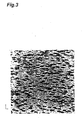
- Fig. 1 is an electron micrograph (10,000X) of a section in the thickness direction of a portion within 10 ⁇ m from the surface of an example of the claimed thermoplastic resin molded product.
- rubber particles 1 portion shown as black dots in the micrograph
- a matrix resin 2 portion other than black dots in the micrograph
- the composition for the rubber component constituting the rubber particles and the thermoplastic resin as the matrix resin in the invention is not restricted.
- the rubber particles may be formed of any rubber component which is present in the form of particles without intimately mixing with the matrix resin.
- Preferred examples of such a rubber component are graft copolymers comprising diene rubbery polymers and vinyl monomers (e.g. aromatic vinyl monomers and/or vinyl cyanide monomers) grafted thereto, the vinyl monomers being copolymerizable with the polymers; and ethylene- ⁇ -olefin copolymers.
- diene rubbery polymers examples include polybutadiene, styrenebutadiene copolymer, acrylonitrile-butadiene copolymer, and polyisoprene, two or more of which may be combined for use in the rubber component.
- the matrix resin examples include copolymers of aromatic vinyl monomers with vinyl cyanide monomer, copolymers of aromatic vinyl monomers with vinyl cyanide monomer and further with other vinyl monomers, and thermoplastic resins such as polystyrene resins and polypropylene resins.
- Preferred combinations of the rubber component and the matrix resin are exemplified by i) a combination of the rubber component that is a graft copolymer having a vinyl monomer grafted to a diene rubbery polymer, and the matrix resin that is a copolymer of an aromatic vinyl monomer with vinyl cyanide monomer or a copolymer of an aromatic vinyl monomer with vinyl cyanide monomer and further with another vinyl monomer, and ii) a combination of the rubber component that is an ethylene- ⁇ -olefin copolymer, and the matrix resin that is a polypropylene resin. More specifically, ABS resin containing rubber particles comprising the above-mentioned rubber component, and polypropylene resin containing rubber particles comprising ethylenepropylene copolymer are taken as examples of the rubber particles-containing thermoplastic resins preferred for the present invention.
- the content of the rubber particles needs to be in the range of from 5 to 40% by weight in the resulting molded product. If the rubber particles content is outside this range, the impact resistance and flexibility of the molded product will be impaired.
- the particle diameters of the rubber particles vary with the required properties, such as impact strength. They need not necessarily be uniform, but preferably, their number average particle diameter falls within the range of from 0.05 to 3 ⁇ m. If the number average particle diameter of the rubber particles is smaller than 0.05 ⁇ m, the rubber particles tend to be insufficiently dispersed and the impact resistance of the molded product tends to be insufficient. If it is larger than 3 ⁇ m, on the other hand, the surface of the molded product tends to lose luster.
- the particle diameter referred to herein means the largest diameter that the rubber particles have, a value measured in a section in the thickness direction at an arbitrary place of the resulting molded product.
- the rubber particles present near the surface of the molded product should fulfill conditions of the equations (1) to (4): (b/a) ⁇ 2 where a and b denote the average minor axis length and the average major axis length, respectively, of the rubber particles in a section in the thickness direction of the molded product, 1 ⁇ ⁇ (b/a)max. ⁇ / ⁇ (b/a)min. ⁇ ⁇ 1.5 where ⁇ (b/a)max. ⁇ and ⁇ (b/a)min. ⁇ stand for the maximum value and minimum value, respectively, of the ratios of b to a (b/a) in a plurality of sections in the thickness direction of the molded product, and 0 ⁇ (Amax.-A)/A ⁇ 0.2 0 ⁇ (A-Amin.)/A ⁇ 0.2 where Amax.
- the portion near the surface of the molded product (especially, the portion within 30 ⁇ m from the surface) is generally called a skin or skin layer, a region where the molten resin undergoes the greatest shearing force during molding.
- the skin is highly susceptible to the molding conditions such as the mold temperature and the feed pressure of the molten resin.
- the aforesaid definitions in the present invention are relevant to a section in the thickness direction of the skin.
- the methods of measuring the aforementioned parameters concerned with the rubber particles in the vicinity of the surface of the thermoplastic resin molded product of the present invention are, for example, as follows:
- the molded product is cut in the thickness direction, and the cut portion is then sliced parallel to the cut surface by means of an ultramicrotome (e.g., Ultracut N, a product of Schuldt ) to obtain thin samples 700 to 800 angstroms thick.
- an ultramicrotome e.g., Ultracut N, a product of critiqueldt
- This procedure is performed for arbitrary parts, preferably different parts, of the molded product, preferably at a plurality of (n) sites, normally 5 or more sites, more preferably, 10 or more sites, to avoid a bias in terms of the site of measurement.
- n a plurality of (n) sites, normally 5 or more sites, more preferably, 10 or more sites, to avoid a bias in terms of the site of measurement.
- the value of (b/a) is obtained by measuring the major axis lengths and minor axis lengths of all the rubber particles noted in the sections based on the electron micrographs shot (Fig. 1 is an example), calculating the average major axis length b and the average minor axis length a as the averages of the respective lengths for the respective sections, and determining the value (b/a) by the results.
- the values (b/a) obtained for the respective sections are compared, and the maximum of the values is designated as (b/a)max., while the minimum of the values is designated as (b/a)min.
- the rubber-occupied area ratio A is determined by subjecting the above-mentioned electron micrographs of the sections to ordinary image analysis, for example, using an image analyzer (LA-555D, a product of Pierce) incorporating basic image processing software (LA-555, a product of Pierce) and image analysis/calculation software (LA-555, a product of Pierce) to convert the sum of the sectional areas of the rubber particles (the rubber component portion) and the sum of the sectional areas of the matrix resin (the matrix portion) into binary digits as the area value; calculating the rubber-occupied area ratios for the respective sections; and further calculating the average of these ratios.
- the rubber-occupied area ratios obtained for the respective sections are compared, and the maximum of the values is designated as Amax., while the minimum of the values is designated as Amin.
- the value (b/a) is 2 or less for all the sections measured in the above manner ⁇ equation (1) ⁇ . This fact means that the flatness (degree of deformation) of the rubber particles is small in the skin portion near the surface (especially, the portion within 30 ⁇ m from the surface) of the molded product.
- the maximum value Amax. and the minimum value Amin. fulfill the conditions of the equations (3) and (4), respectively: 0 ⁇ (Amax.-A)/A ⁇ 0.2 0 ⁇ (A-Amin.)/A ⁇ 0.2
- 0 ⁇ (A-Amin.)/A ⁇ 0.2 When those values go beyond the defined ranges, this means that unbalanced presence of the rubber component takes place depending on the site of the molded product, thereby similarly causing the tendency toward the deformation or cracking of the molded product.
- thermoplastic resin containing rubber particles is ABS resin
- the failure to fulfill the aforementioned conditions would result in the tendency toward deformation or cracking of the molded product.
- the metal layer plated on its surface may be poor in durability or may be uneven.
- the metal used is not restricted, and its examples include copper, nickel and chromium.
- the method of metal plating restricted For example, wet plating methods such as electroplating, and dry plating methods such as vacuum deposition and sputtering may be used.
- the molded product may have mono plating layer or two or more plating layers. Nor is there restriction on the thickness of the metal plating layer, but about 0.05 to 30 ⁇ m per one layer is preferred.
- the molded product comprising a thermoplastic resin containing rubber particles according to the present invention is obtained by molding a rubber particles-containing thermoplastic resin by a method of molding known as one for thermoplastic resins, such as injection molding, injection compression molding, injection press molding, or compression molding.
- a molten thermoplastic resin containing rubber particles undergoes force within a mold to have a desired shape, and the shaped resin is cooled and solidified to obtain a molded product.
- thermoplastic resin molded product according to the present invention should itself fulfill the aforesaid conditions ⁇ the conditions of equations (1) to (4) ⁇ at the same time, and the process for preparing the molded product has no restriction. That is, the molded product of the present invention can be produced by the above-mentioned molding method (e.g. injection press molding) using as a molding material a thermoplastic resin containing 5 to 40% by weight of rubber particles.
- injection press molding e.g. injection press molding
- a preferred method for producing the thermoplastic resin molded product according to the present invention is, for instance, the following injection press molding:
- a pair of male and female molds are used which have cavity surfaces designed to correspond with a molded product having a predetermined shape.
- a thermoplastic resin containing rubber particles that has been heated above the melting temperature of a matrix resin by a plasticator is fed between both molds, put in a non-closed state, through a molten resin passageway provided in the molds. After or during this feeding, the molds are closed until the cavity clearance between the molds reaches a predetermined value. After pressing and cooling, the resulting molded product is withdrawn.
- the production method for the molded product may itself be an arbitrary method.
- the molding conditions such as the melting temperature of the resin, the mold temperature, the closing pressure and the closing speed during closing, should be selected so that the molded product prepared by the method will satisfy all of the aforementioned conditions concerned with the invention ⁇ the conditions of equations (1) to (4) ⁇ .
- the molding conditions such as the melting temperature of the resin, the mold temperature, the closing pressure and the closing speed during closing, are selected so that a shearing force on a portion near the surface of the thermoplastic resin containing rubber particles will be sufficiently small.
- thermoplastic resin molded product of the present invention that fulfills all the specific conditions is minimally deformed, and faces little cracking. Because of these excellent characteristics, this molded product is applicable to a wide variety of uses, including household appliances and automobile parts.
- the thermoplastic resin molded product of the invention also involves minimal deformation and is easy to handle during use. Thus, it is used particularly preferably as car parts (e.g. front grills and door knobs) which are frequently mounted together with other parts.
- the present invention can reliably provide a thermoplastic resin molded product containing rubber particles which possesses the excellent properties of being fully prevented from deformation or cracking, and giving a sufficiently highly durable metal plating layer, even when using ABS resin and applying a metal plating layer on its surface.
- the molten resin was supplied between male and female molds (in a non-closed state) with a cavity clearance (the distance between the cavity surfaces of both molds) of 7 mm through a molten resin passageway provided in the male mold. Then, the molds were closed until the cavity clearance between the molds reached 3 mm, pressed and cooled to obtain a resin molded product of 340 mm in length, 270 mm in width, and 3 mm in thickness.
- the resulting molded product was evaluated for deformation and cracking by the following methods. The results are shown in Table 1.
- the molded product was allowed to stand on an evenly flat surface. Three of the four corners of the molded product were fixed to the flat surface, and the remaining corner was measured for the amount of float (mm) from the flat surface.
- the whole of the molded product was immersed in a methanol solution having varying acetic acid concentration (the solution was only acetic acid if the acetic acid concentration was 100%), and left to stand therein for 10 minutes. Then, cracking of the molded product was evaluated based on blushing that occurred on the surface of the molded product.
- the resulting molded product was cut at sites 130 mm from its widthwise opposite ends, parallel to the longitudinal direction, to form a plate-like sample 10 mm wide, 340 mm long, and 3 mm thick.
- This plate-like sample was cut at a site 30 mm from its longitudinal end, perpendicularly to the longitudinal direction, and then the cut portion was sliced parallel to the cut surface by means-of an ultramicrotome to obtain a thin specimen of 3 mm in length, 10 mm in width, and about 700 angstroms in thickness.
- each of the thin specimens was stained by the aforementioned method, and an electron micrograph was taken of a part 10 ⁇ m square in a portion within 10 ⁇ m from the surface of the molded product as the thin specimen.
- the ratios of the average major axis lengths b to the average minor axis lengths a of the rubber particles in the respective thin specimens were determined by the aforementioned method. Based on the ratios determined, the average of the ratios (b/a), the value of (b/a)max., the value of (b/a)min., and the value of ⁇ (b/a)max. ⁇ / ⁇ (b/a)min. ⁇ were calculated.
- the electron micrographs of the respective thin specimens were image-processed by the aforementioned method to determine the rubber-occupied area ratios for the respective thin specimens. Based on the results obtained, the average of the rubber-occupied area ratios A, the value of Amax., the value of Amin., the value of (Amax.-A)/A, and the value of (A-Amin.)/A were calculated. The results are shown in Table 1.
- FIG. 1 An example of the electron micrograph obtained is presented as Fig. 1.
- rubber particles 1 portion shown as black dots in the micrograph
- a matrix resin 2 portion other than black dots in the micrograph.
- the upper side of the figure corresponds to the surface side of the molded product.
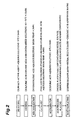
- a metal plating layer was provided by the method shown in Fig. 2 on the surface of a resin molded product prepared by the same method as described above.
- the plated product obtained (the resin molded product having the metal plating layer) was subjected to the following "heat cycle test".
- the plated product was allowed to stand for 15 minutes at room temperature and, subsequently, it was immediately put into a cooled gas-circulating type cooling apparatus which was maintained at -40 °C and then allowed to stand for 1 hour in the cooling apparatus. After the plated product was taken out from the cooling apparatus, it was allowed to stand for 15 minutes at room temperature and, subsequently, it was immediately put into an oven which was maintained at 80 °C and then allowed to stand for 1 hour in the oven. After the plated product was taken out from the oven, it was allowed to stand for 15 minutes at room temperature.
- the plated product was subjected to ten cycle-treatment each one cycle of which consists of the above-mentioned sequence for cooling and heating (room temperature: 15 min. ⁇ -40 °C: 1 hour - room temperature: 15 min. ⁇ 80 °C: 1 hour).
- the plated product was checked to ascertain whether or not some change such as blisters and cracks occurred on the metal film (plating layer) after each cycle mentioned above.
- a plated product which has no change was evaluated as passing (+), while a plated product which has some change was evaluated as failure (-).
- the result obtained by the above evaluation is shown in Table 1.
- thermoplastic resin molded product was obtained in the same manner as in Test Example 1, except that the closing speed among the molding conditions was changed to 16 mm/sec.
- a metal plating layer was provided on the surface of the molded product in the same way as in Test Example 1. Similar to Test Example 1, the durability of the metal plating layer was sufficiently high (as shown in Table 1).
Landscapes
- Chemical & Material Sciences (AREA)
- Health & Medical Sciences (AREA)
- Chemical Kinetics & Catalysis (AREA)
- Medicinal Chemistry (AREA)
- Polymers & Plastics (AREA)
- Organic Chemistry (AREA)
- Engineering & Computer Science (AREA)
- Manufacturing & Machinery (AREA)
- Materials Engineering (AREA)
- Compositions Of Macromolecular Compounds (AREA)
- Manufacture Of Macromolecular Shaped Articles (AREA)
- Graft Or Block Polymers (AREA)
- Injection Moulding Of Plastics Or The Like (AREA)
- Coating Of Shaped Articles Made Of Macromolecular Substances (AREA)
- Processing And Handling Of Plastics And Other Materials For Molding In General (AREA)
Claims (7)
- Produit moulé de résine thermoplastique qui est un produit moulé comprenant une résine thermoplastique contenant 5% à 40% en poids de particules de caoutchouc, dans lequel les particules de caoutchouc présentes près de la surface dudit produit moulé remplissent les conditions des équations (1) à (4) :
- Produit moulé de résine thermoplastique selon la revendication 1, dans lequel les particules de caoutchouc proches de la surface dudit produit moulé sont des particules de caoutchouc présentes sur 30 µm à partir de la surface dudit produit moulé.
- Produit moulé de résine thermoplastique selon la revendication 1 ou 2, dans lequel lesdites particules de caoutchouc possèdent un diamètre particulaire moyen en nombre dans la gamme de 0,05 à 3 µm.
- Produit moulé de résine thermoplastique selon l'une quelconque des revendications précédentes, dans lequel le composant de caoutchouc constituant lesdites particules de caoutchouc est un copolymère greffé comportant un monomère vinylique greffé à un polymère de caoutchouc diène.
- Produit moulé de résine thermoplastique selon l'une quelconque des revendications précédentes, dans lequel la résine thermoplastique comprenant des particules de caoutchouc est une résine ABS.
- Produit moulé de résine thermoplastique selon l'une quelconque des revendications précédentes, comprenant en outre une couche de revêtement métallique appliquée sur la surface dudit produit moulé.
- Produit moulé de résine thermoplastique selon l'une quelconque des revendications précédentes, dans lequel ledit produit moulé est une pièce automobile.
Applications Claiming Priority (3)
| Application Number | Priority Date | Filing Date | Title |
|---|---|---|---|
| JP5443/96 | 1996-01-17 | ||
| JP544396 | 1996-01-17 | ||
| JP00544396A JP3341102B2 (ja) | 1996-01-17 | 1996-01-17 | 熱可塑性樹脂成形体 |
Publications (3)
| Publication Number | Publication Date |
|---|---|
| EP0785232A2 EP0785232A2 (fr) | 1997-07-23 |
| EP0785232A3 EP0785232A3 (fr) | 1999-05-06 |
| EP0785232B1 true EP0785232B1 (fr) | 2002-08-28 |
Family
ID=11611354
Family Applications (1)
| Application Number | Title | Priority Date | Filing Date |
|---|---|---|---|
| EP97100608A Expired - Lifetime EP0785232B1 (fr) | 1996-01-17 | 1997-01-16 | Produits moulés à partir de résine thermoplastique |
Country Status (9)
| Country | Link |
|---|---|
| US (1) | US5849466A (fr) |
| EP (1) | EP0785232B1 (fr) |
| JP (1) | JP3341102B2 (fr) |
| KR (1) | KR100452035B1 (fr) |
| CN (1) | CN1121444C (fr) |
| CA (1) | CA2195251A1 (fr) |
| DE (1) | DE69714872T2 (fr) |
| MY (1) | MY121249A (fr) |
| TW (1) | TW358064B (fr) |
Families Citing this family (2)
| Publication number | Priority date | Publication date | Assignee | Title |
|---|---|---|---|---|
| US6531302B1 (en) * | 1999-04-12 | 2003-03-11 | Nanogen/Becton Dickinson Partnership | Anchored strand displacement amplification on an electronically addressable microchip |
| JP6135527B2 (ja) * | 2014-01-31 | 2017-05-31 | 豊田合成株式会社 | めっき用樹脂成形体 |
Family Cites Families (10)
| Publication number | Priority date | Publication date | Assignee | Title |
|---|---|---|---|---|
| US4312962A (en) * | 1981-02-23 | 1982-01-26 | Monsanto Company | Adhesion in metal plating |
| DE3773076D1 (de) * | 1986-07-07 | 1991-10-24 | Squibb & Sons Inc | Hydroxamsaeureabkoemmlinge und diese enthaltende pharmazeutische zusammensetzungen. |
| JPH0742384B2 (ja) * | 1987-04-21 | 1995-05-10 | 日本合成ゴム株式会社 | 熱可塑性樹脂組成物 |
| JP2683548B2 (ja) * | 1988-12-27 | 1997-12-03 | 出光石油化学株式会社 | ポリプロピレン樹脂組成物 |
| DE4025219A1 (de) * | 1990-08-09 | 1992-02-13 | Hoechst Ag | Thermoplastische polyoxymethylen-formmasse mit hoher zaehigkeit und ihre verwendung |
| DE4100581A1 (de) * | 1991-01-10 | 1992-07-16 | Kraiburg Gummi | Formkoerper aus vulkanisiertem altgummimaterial |
| JP3120314B2 (ja) * | 1993-03-05 | 2000-12-25 | 日本エイアンドエル株式会社 | 熱可塑性樹脂組成物 |
| JPH06322544A (ja) * | 1993-05-13 | 1994-11-22 | Asahi Chem Ind Co Ltd | メッキ成形品 |
| JP3213501B2 (ja) * | 1993-12-27 | 2001-10-02 | 三井化学株式会社 | Abs系樹脂の品質制御方法及びその成形物 |
| JP3325399B2 (ja) * | 1994-09-13 | 2002-09-17 | 三井化学株式会社 | 多様な表面モルフォロジーを有するabs系樹脂の製造方法 |
-
1996
- 1996-01-17 JP JP00544396A patent/JP3341102B2/ja not_active Expired - Fee Related
-
1997
- 1997-01-16 CA CA002195251A patent/CA2195251A1/fr not_active Abandoned
- 1997-01-16 EP EP97100608A patent/EP0785232B1/fr not_active Expired - Lifetime
- 1997-01-16 DE DE69714872T patent/DE69714872T2/de not_active Expired - Lifetime
- 1997-01-16 KR KR1019970001113A patent/KR100452035B1/ko not_active Expired - Fee Related
- 1997-01-16 MY MYPI97000158A patent/MY121249A/en unknown
- 1997-01-16 US US08/784,812 patent/US5849466A/en not_active Expired - Fee Related
- 1997-01-17 TW TW086100480A patent/TW358064B/zh active
- 1997-01-17 CN CN97102983A patent/CN1121444C/zh not_active Expired - Fee Related
Also Published As
| Publication number | Publication date |
|---|---|
| CN1121444C (zh) | 2003-09-17 |
| MY121249A (en) | 2006-01-28 |
| US5849466A (en) | 1998-12-15 |
| JP3341102B2 (ja) | 2002-11-05 |
| KR100452035B1 (ko) | 2004-12-03 |
| DE69714872D1 (de) | 2002-10-02 |
| EP0785232A2 (fr) | 1997-07-23 |
| CA2195251A1 (fr) | 1997-07-18 |
| JPH09194599A (ja) | 1997-07-29 |
| DE69714872T2 (de) | 2003-04-10 |
| CN1176270A (zh) | 1998-03-18 |
| EP0785232A3 (fr) | 1999-05-06 |
| KR970059205A (ko) | 1997-08-12 |
| TW358064B (en) | 1999-05-11 |
Similar Documents
| Publication | Publication Date | Title |
|---|---|---|
| US4478903A (en) | Composite plastics sheet having conductive surface | |
| US4659790A (en) | Heat-resistant copolymer of alpha-methylstyrene and acrylonitrile, process for preparing the same, and thermoplastic resin composition containing the same | |
| DE69513668T2 (de) | Gefüllte karbonatpolymermischungszusammensetzungen | |
| EP0391413B1 (fr) | Mélange de polymère chargé | |
| DE69308174T2 (de) | Polyolefin-Formmasse, Verfahren zu ihrer Herstellung und daraus hergestellte Formkörper | |
| EP3279257B1 (fr) | Composition de résine en base asa à faible brillance présentant une excellente résistance aux intempéries et à la chaleur | |
| DE68924253T2 (de) | Polypropylenzusammensetzung. | |
| EP0006521A1 (fr) | Utilisation de silicones liquides combinés avec des dérivés de l'acide stéarique comme additifs dans la préparation de polymères ABS résistant aux chocs | |
| DE69001136T2 (de) | Polymer auf der basis von styrol und verfahren zu dessen herstellung. | |
| EP0785232B1 (fr) | Produits moulés à partir de résine thermoplastique | |
| EP3686244B1 (fr) | Composition de résine résistant à la chaleur | |
| KR100643742B1 (ko) | 도금 밀착성 및 내충격성이 우수한 열가소성 수지조성물 | |
| EP0652252B1 (fr) | Composition résineuse styrénique ainsi que articles moulés par injection et extrusion | |
| US4868036A (en) | Polymeric composition with high impact strength | |
| EP4308648B1 (fr) | Composition de moulage abs présentant une qualité de surface améliorée pour des applications de placage | |
| KR102781981B1 (ko) | 비닐시안 화합물-공액디엔 고무-방향족 비닐 화합물 그라프트 공중합체의 제조방법, 이를 포함하는 열가소성 수지 조성물의 제조방법 및 열가소성 수지 조성물 | |
| EP0201099B2 (fr) | Résine thermoplastique à faible brillant | |
| KR100199246B1 (ko) | 내약품성이 우수한 열가소성 수지 조성물 | |
| DE69428059T2 (de) | Qualitätsprüfungsverfahren von ABS-Harz und Formmasse aus ABS-Harz | |
| DE60105971T2 (de) | Thermoplastische harzzusammensetzung mit hervorragenden gleiteigenschaften | |
| EP0153623B1 (fr) | Objet en résine, plaqué | |
| EP4036128A1 (fr) | Procédé de production d'un polymère à base de diène conjugué | |
| KR100717515B1 (ko) | 도금 밀착성 및 도금 표면특성이 우수한 abs 그라프트공중합체, 그 제조방법 및 이를 이용한 abs 수지 조성물 | |
| US4855404A (en) | Process and equipment for processing thermoplastic polymers | |
| KR100654932B1 (ko) | 도금 외관 특성이 우수한 열가소성 abs 수지 조성물 |
Legal Events
| Date | Code | Title | Description |
|---|---|---|---|
| PUAI | Public reference made under article 153(3) epc to a published international application that has entered the european phase |
Free format text: ORIGINAL CODE: 0009012 |
|
| AK | Designated contracting states |
Kind code of ref document: A2 Designated state(s): DE FR GB IT |
|
| PUAL | Search report despatched |
Free format text: ORIGINAL CODE: 0009013 |
|
| AK | Designated contracting states |
Kind code of ref document: A3 Designated state(s): DE FR GB IT |
|
| 17P | Request for examination filed |
Effective date: 19990602 |
|
| GRAG | Despatch of communication of intention to grant |
Free format text: ORIGINAL CODE: EPIDOS AGRA |
|
| 17Q | First examination report despatched |
Effective date: 20011024 |
|
| GRAG | Despatch of communication of intention to grant |
Free format text: ORIGINAL CODE: EPIDOS AGRA |
|
| GRAH | Despatch of communication of intention to grant a patent |
Free format text: ORIGINAL CODE: EPIDOS IGRA |
|
| GRAH | Despatch of communication of intention to grant a patent |
Free format text: ORIGINAL CODE: EPIDOS IGRA |
|
| GRAA | (expected) grant |
Free format text: ORIGINAL CODE: 0009210 |
|
| AK | Designated contracting states |
Kind code of ref document: B1 Designated state(s): DE FR GB IT |
|
| REG | Reference to a national code |
Ref country code: GB Ref legal event code: FG4D |
|
| REF | Corresponds to: |
Ref document number: 69714872 Country of ref document: DE Date of ref document: 20021002 |
|
| ET | Fr: translation filed | ||
| PLBE | No opposition filed within time limit |
Free format text: ORIGINAL CODE: 0009261 |
|
| STAA | Information on the status of an ep patent application or granted ep patent |
Free format text: STATUS: NO OPPOSITION FILED WITHIN TIME LIMIT |
|
| 26N | No opposition filed |
Effective date: 20030530 |
|
| PGFP | Annual fee paid to national office [announced via postgrant information from national office to epo] |
Ref country code: FR Payment date: 20040108 Year of fee payment: 8 |
|
| PGFP | Annual fee paid to national office [announced via postgrant information from national office to epo] |
Ref country code: GB Payment date: 20040114 Year of fee payment: 8 |
|
| PG25 | Lapsed in a contracting state [announced via postgrant information from national office to epo] |
Ref country code: IT Free format text: LAPSE BECAUSE OF NON-PAYMENT OF DUE FEES Effective date: 20050116 Ref country code: GB Free format text: LAPSE BECAUSE OF NON-PAYMENT OF DUE FEES Effective date: 20050116 |
|
| GBPC | Gb: european patent ceased through non-payment of renewal fee |
Effective date: 20050116 |
|
| PG25 | Lapsed in a contracting state [announced via postgrant information from national office to epo] |
Ref country code: FR Free format text: LAPSE BECAUSE OF NON-PAYMENT OF DUE FEES Effective date: 20050930 |
|
| REG | Reference to a national code |
Ref country code: FR Ref legal event code: ST |
|
| PGFP | Annual fee paid to national office [announced via postgrant information from national office to epo] |
Ref country code: DE Payment date: 20100114 Year of fee payment: 14 |
|
| REG | Reference to a national code |
Ref country code: DE Ref legal event code: R119 Ref document number: 69714872 Country of ref document: DE Effective date: 20110802 |
|
| PG25 | Lapsed in a contracting state [announced via postgrant information from national office to epo] |
Ref country code: DE Free format text: LAPSE BECAUSE OF NON-PAYMENT OF DUE FEES Effective date: 20110802 |