EP0768708A2 - Herstellungsverfahren von Höckern über Substraten für elektronische Vorrichtungen - Google Patents
Herstellungsverfahren von Höckern über Substraten für elektronische Vorrichtungen Download PDFInfo
- Publication number
- EP0768708A2 EP0768708A2 EP96307510A EP96307510A EP0768708A2 EP 0768708 A2 EP0768708 A2 EP 0768708A2 EP 96307510 A EP96307510 A EP 96307510A EP 96307510 A EP96307510 A EP 96307510A EP 0768708 A2 EP0768708 A2 EP 0768708A2
- Authority
- EP
- European Patent Office
- Prior art keywords
- mask
- substrate
- plasma
- substance
- bumps
- Prior art date
- Legal status (The legal status is an assumption and is not a legal conclusion. Google has not performed a legal analysis and makes no representation as to the accuracy of the status listed.)
- Withdrawn
Links
Images

Classifications
-
- H—ELECTRICITY
- H05—ELECTRIC TECHNIQUES NOT OTHERWISE PROVIDED FOR
- H05K—PRINTED CIRCUITS; CASINGS OR CONSTRUCTIONAL DETAILS OF ELECTRIC APPARATUS; MANUFACTURE OF ASSEMBLAGES OF ELECTRICAL COMPONENTS
- H05K3/00—Apparatus or processes for manufacturing printed circuits
- H05K3/40—Forming printed elements for providing electric connections to or between printed circuits
- H05K3/4007—Surface contacts, e.g. bumps
-
- H10W70/093—
-
- H10W72/012—
-
- H—ELECTRICITY
- H05—ELECTRIC TECHNIQUES NOT OTHERWISE PROVIDED FOR
- H05K—PRINTED CIRCUITS; CASINGS OR CONSTRUCTIONAL DETAILS OF ELECTRIC APPARATUS; MANUFACTURE OF ASSEMBLAGES OF ELECTRICAL COMPONENTS
- H05K2201/00—Indexing scheme relating to printed circuits covered by H05K1/00
- H05K2201/03—Conductive materials
- H05K2201/0332—Structure of the conductor
- H05K2201/0364—Conductor shape
- H05K2201/0367—Metallic bump or raised conductor not used as solder bump
-
- H—ELECTRICITY
- H05—ELECTRIC TECHNIQUES NOT OTHERWISE PROVIDED FOR
- H05K—PRINTED CIRCUITS; CASINGS OR CONSTRUCTIONAL DETAILS OF ELECTRIC APPARATUS; MANUFACTURE OF ASSEMBLAGES OF ELECTRICAL COMPONENTS
- H05K2203/00—Indexing scheme relating to apparatus or processes for manufacturing printed circuits covered by H05K3/00
- H05K2203/09—Treatments involving charged particles
- H05K2203/095—Plasma, e.g. for treating a substrate to improve adhesion with a conductor or for cleaning holes
-
- H—ELECTRICITY
- H05—ELECTRIC TECHNIQUES NOT OTHERWISE PROVIDED FOR
- H05K—PRINTED CIRCUITS; CASINGS OR CONSTRUCTIONAL DETAILS OF ELECTRIC APPARATUS; MANUFACTURE OF ASSEMBLAGES OF ELECTRICAL COMPONENTS
- H05K2203/00—Indexing scheme relating to apparatus or processes for manufacturing printed circuits covered by H05K3/00
- H05K2203/13—Moulding and encapsulation; Deposition techniques; Protective layers
- H05K2203/1333—Deposition techniques, e.g. coating
- H05K2203/1344—Spraying small metal particles or droplets of molten metal
-
- H—ELECTRICITY
- H05—ELECTRIC TECHNIQUES NOT OTHERWISE PROVIDED FOR
- H05K—PRINTED CIRCUITS; CASINGS OR CONSTRUCTIONAL DETAILS OF ELECTRIC APPARATUS; MANUFACTURE OF ASSEMBLAGES OF ELECTRICAL COMPONENTS
- H05K3/00—Apparatus or processes for manufacturing printed circuits
- H05K3/02—Apparatus or processes for manufacturing printed circuits in which the conductive material is applied to the surface of the insulating support and is thereafter removed from such areas of the surface which are not intended for current conducting or shielding
- H05K3/04—Apparatus or processes for manufacturing printed circuits in which the conductive material is applied to the surface of the insulating support and is thereafter removed from such areas of the surface which are not intended for current conducting or shielding the conductive material being removed mechanically, e.g. by punching
- H05K3/046—Apparatus or processes for manufacturing printed circuits in which the conductive material is applied to the surface of the insulating support and is thereafter removed from such areas of the surface which are not intended for current conducting or shielding the conductive material being removed mechanically, e.g. by punching by selective transfer or selective detachment of a conductive layer
- H05K3/048—Apparatus or processes for manufacturing printed circuits in which the conductive material is applied to the surface of the insulating support and is thereafter removed from such areas of the surface which are not intended for current conducting or shielding the conductive material being removed mechanically, e.g. by punching by selective transfer or selective detachment of a conductive layer using a lift-off resist pattern or a release layer pattern
-
- H10W72/251—
-
- H10W72/9445—
Definitions
- This invention relates to improvements in electronic component manufacturing processes, and more particularly to improvements in methods for forming bumps on substrates, such as lead frames, circuit boards, semiconductor chips, glass substrates, or the like.
- bumps or protuberances are formed at predetermined locations on a substrate, usually to provide structures to which electrical connections can be made.
- electrical connections can be made.
- microminiature integrated circuits are formed on a chip or wafer of semiconductor material.
- bumps often are formed to which wires or other larger sized structures can be connected.
- the process of forming bumps to enable electrical contacts to be established may be used.
- structures may be formed on glass substrates to which electrical contact is needed.
- Many other applications also exist in which the formation of bumps on a substrate exist.
- an object of the invention to provide an improved method for forming bumps on a substrate.
- a method for forming a bump on a substrate includes locating over the substrate a mask having one or more openings to expose the substrate at a location desired for forming the bump.
- a plasma is generated, and a material for forming the bump is introduced into the plasma.
- the substrate is exposed to the plasma through the openings in the mask, and the powder in the plasma is allowed to coalesce in the opening to form the bump.
- the mask is then removed.
- a method for depositing bumps on a substrate which may be a semiconductor, glass, lead frame, printed circuit board, or other suitable material.
- the method includes aligning a mask with respect to the substrate to bring apertures in the mask into alignment with exposed regions of the substrate on which bumps are to be formed.
- the mask is attached or affixed by a jig or other means to the substrate to form a target fixture, and a plasma of a gas is directed toward the target fixture.
- a substance is introduced into the plasma, which transforms the substance into a material to be deposited.
- the substance may be, for example, particles of a conductor in a solid phase, and the transformed material may be the conductor in a liquid phase.
- the substance is substantially the same substance in a different phase after being transformed by the plasma, and in another embodiment, the substance at least partially combines with the gas of the plasma to form a different material for deposit.
- the substance may be, for example, a conductor, selected, for instance from the group comprising silver, copper, gold, aluminum, zinc, platinum, palladium, and solder, such as tin-lead solder.
- the substance can be a semiconductor, or virtually any other material that can be transformed by the plasma into a desired bump forming material.
- the target fixture and the plasma are then moved relative to each other so that the material is sprayed over the mask and onto the exposed regions of the substrate.
- the conductor in a liquid phase then coalesces or becomes restored to a solid phase after it has been deposited on the mask and the exposed regions of the substrate.
- the mask is removed from the substrate to leave the restored material remaining to form the desired bumps.
- the material sprayed onto the mask is controlled to a deposit thickness less than a thickness of the mask.
- One way by which the thickness of the material sprayed can be controlled is by controlling a feed rate of introduction of the substance into the plasma.
- Another way is to move the target fixture and the plasma relative to each other by controlling a rate of relative rotational or linear movement between the target fixture and the plasma.
- the over spray material can be recovered by removing the deposited material from the mask in one embodiment, allowing the mask to be reused.
- the mask may be coated with a non-stick substance, if desired, to facilitate the over spray removal.
- the mask may be dissolved to recover the remaining over spray material.
- One of the advantages of the method of the invention is that by providing shaped apertures in the mask, bumps having similar predetermined desired sidewall shapes can be formed.
- an apparatus for depositing bumps on a substrate includes a mask that is of thickness at least as large as the height of the bumps to be formed on the substrate, and that is removably positionable adjacent the substrate to form a target fixture with the substrate.
- the mask which may be, for example, about 44 mils thick, has apertures positioned to expose regions of the substrate at which bumps are to be formed when the mask is placed in registration with the substrate.
- the mask may be of any appropriate material for the particular process being performed, for example, paper, which can be dissolved to recover any over sprayed material, metal with a non-stick coating, which allows the over sprayed material to be removed, or other suitable material.
- a plasma generator generates a plasma of a gas at a temperature, for example, of about 7000 K., and directs the plasma along a deposition path.
- An apparatus such as a jig or the like, is provided for positioning the mask and substrate in the deposition path, and an apparatus is provided for introducing a substance into the plasma.
- the substance may be a powder or pellets of a material having a grain size of between about 5 and 100 microns.
- the substance is transformed by the plasma into a deposition material, which is carried by the plasma along the deposition path to impact and deposit upon the mask and the exposed regions of the substrate.
- the deposition material may be the substance in molten or liquid form, for instance, if the gas that of which the plasma is generated is inert, such as argon, and does not combine with the substance.
- the deposition material may be a transformed form of the substance if the gas is one that may combine with the substance.
- the substance may, for example, be an electrical conductor, for instance, selected from the group comprising silver, copper, gold, aluminum, zinc, platinum, palladium, and solder, such as an appropriate tin-lead solder.
- an apparatus may be provided for producing relative movement between the fixture and the deposition path.
- one such apparatus may be an apparatus for rotating the fixture.
- Another such apparatus may also produce linear movement between the fixture and the deposition path, alone, or in combination with the rotation producing apparatus.
- FIG. 1 an exploded perspective view of a mask 12 aligned with a substrate 13 is shown.
- a plurality of bumps are to be formed on the substrate 13; accordingly, the mask 12 has a plurality of apertures 15 to expose the regions 17 of the substrate 13 at which bumps are to be formed when the mask 12 is placed adjacent the substrate 13.
- the particular aperture pattern shown in Figure 1 has been arbitrarily chosen; however, it will be appreciated that any suitable aperture pattern can be employed.
- the mask 12 may be of any appropriate material, depending upon the particular application in which the system is employed.
- the mask 12 may be paper or cardboard, in other applications, metal, plastic, or other appropriate material can be used.
- the substrate 13 also may be of any appropriate material or form, such as semiconductor chips or wafers, glass substrates, tab lead frames, printed circuit boards, or other desired material.
- the invention is particularly advantageously employed in conjunction with the formation of bumps on a semiconductor substrate that contains other semiconductor features 20, since there is no need in most cases for elevating the temperature of the substrate 13 on which the bumps are to be formed. Thus, the risk of damage to any features, integrated circuits, or other structures that may have been formed on the substrate 13 in previous processes or steps is reduced.
- a number of alignment or registration marks 22 and 22' may be formed respectively on the mask 12 and substrate 13, as shown. Once the mask 12 and substrate 13 are properly registered, they may be secured in a jig 25 or similar device to maintain their relative positional relationship to assure that the bumps that will be subsequently formed are properly located on the substrate 13.
- the jig 25 may have its own locating or indexing pins or features, not shown, to be received in corresponding holes, not shown, on the mask to facilitate the proper alignment of the mask and the substrate.)
- the registered mask 12 and substrate 13 in the jig 25 form a target fixture 30 onto which material from which the bumps will be formed is thrown or applied, as next described.
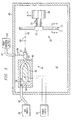
- the fixture 30 is then placed into a plasma reactor 40, which is shown schematically in a side cross-sectional view of Figure 3.
- the reactor 40 has a chamber 42 that contains a plasma gun 45, located opposite the target fixture 30.
- the plasma gun 45 has an anode 46 surrounding a cathode 47 with an annular chamber 50 defined therebetween.
- the annular chamber 50 has an opening 54 oriented toward the target 30. Voltages for the anode 46 and cathode 47 are supplied by a power supply 55 of sufficient voltage to produce a plasma 57 of the gas that is introduced into the plasma gun 45, as next described.
- the gas 58 from a gas supply 59 is introduced through a tube 60 into the annular chamber 50 between the anode 46 and cathode 47 of the plasma gun 45.
- the gas 58 is conducted through the chamber 50 and exits under pressure from the opening 54 in the direction of the target fixture 30 along a deposition path 62.
- the gas 58 is excited by the electric field between the anode 46 and cathode 47 to produce the plasma 57 from the opening 54.
- the gas 58 may be any appropriate gas that will produce a plasma and will interact with the substance to be transformed by the plasma 57 into a material for deposition onto the substrate to form the desired bumps.
- the gas is desired to be inert with respect to the substance for bump formation, argon or similar gas may be used.
- the gas is to react with the substance, for example, to form a semiconductor compound, silane, hydrogen, or other similar gas may be used.
- the temperature of the gas plasma 57 may be, for instance, about 7000 K.
- Powders, pellets, or grains of the substance material from a bump material supply 66 to be deposited are introduced into the chamber 42 through a tube 67.
- the substance that is introduced are pellets or grains 69 in a solid phase, which are transformed by the plasma 57 to droplets 64 in a molten or liquid phase.
- the substrate onto which the bumps are formed need not be heated. Thus, the risks of heat damage to other substrate structures is not significantly increased through the use of the process of the invention.
- the feed rate or rate of introduction of the bump material into the plasma 57 is directly proportional to the thickness of the deposited material onto the mask 12 and exposed regions 17 of the substrate 13.
- the rate of introduction of the bump material from the supply 66 can be adjusted to control the thickness of the bumps that are formed or deposited.
- the particular material of the substance supplied into the plasma 57 is dependent upon the final bump material desired.
- the material may be, for example, a conductor, such as a conductor selected from the group consisting essentially of silver, copper, gold, aluminum, zinc, platinum, palladium, and solder, such as an appropriate tin-lead solder.
- the material may be a material that will combine with the gas of the plasma to form a semiconductor or other desired bump material.
- the material to be deposited will be carried by the pressure of the gas and plasma leaving the opening 54 of the plasma gun 45; consequently, the relative pressures of the gas delivered via tube 43 and the particles delivered by the tube 47 should be such that the direction of the free particles within the chamber 42 will be controlled by the direction of the plasma 57. More particularly, it will be appreciated that as soon as the particles delivered through the tube 67 are injected into the plasma 57, they melt, forming droplets 64 of molten material, which are hurled by the pressure of the gas exiting the opening 54 of the plasma gun 45 onto the target fixture 30. Consequently, the gas should be introduced under sufficient pressure to propel the transformed material along the deposition path 62 to impact the target fixture 30.
- the gas pressure can be adjusted as needed to vary or modify the bump thickness. Since a number of other factors also affect the bump deposition thickness, some experimentation may be necessary to derive the optimum desired gas pressure for particular bump materials, in conjunction with the other factors, described below.
- the target fixture 30 may be moved relative to the deposition path 62.
- a motor or similar apparatus 68 may be provided to rotate the jig 25 along a rotational path 70, whereby the droplets 64 can be sprayed uniformly around the target fixture 30.
- the apparatus 68 can provide linear movement along path 71, so that the droplets coat the mask 12 and exposed regions 17 of the substrate 13 in a radial direction of the fixture 30. It can be seen that in addition to providing the ability to form a uniform material coating on the exposed portions of the substrate 13, the invention also enables the bump deposition to be relatively rapidly performed.
- the thickness of the deposited material will vary inversely with the relative velocity between the fixture 30 and the deposition path.
- the relative velocity can be adjusted to control the thickness of the bumps deposited.
- some experimentation may be necessary to control the precise bump thickness; however, once the parameters for a particular process are established, the process can be repeated with consistently uniform results.
- the mask 12 and substrate 13 may be removed from the jig 25, and the mask 12 separated from the substrate 13. This will leave the bumps 73 on the substrate 13, as shown in Figure 2, in the desired pattern.
- the resulting sidewall cross-sectional shape of the resulting bumps 73 can be made to any desired pattern.
- the bumps 73 have a circular cross-sectional shape, resulting in cylindrically shaped bumps.
- Other bump shapes such as cubic, elliptical, or other shape, can easily be achieved by appropriate modification of the mask apertures.
- the deposited bump material be discontinuous at the mask surface and the exposed substrate regions.
- the thickness, t, of the mask 12 is preferably at least as thick as the thickness of the deposited material 74, and therefore of the height, of the bumps 73.
- the thickness of the material 74 that is deposited should be controlled as herein described to be equal to or less than the thickness, t, of the mask 12.
- the mask thickness may be less than the desired bump thickness, by providing a mask thickness greater than the final bump thickness, the quality of the bumps remaining after the mask has been removed can be assured.
- the method described results in over spray of the bump material onto the surface of the mask 12, it may be desirable to recover the over sprayed material, depending upon the deposited material.
- the bump material is a precious metal such as gold or platinum, such over spray recovery would be highly desirable.
- This consideration can be addressed in the selection of the material of which mask is constituted. For example, if the mask were to be of paper or cardboard, if the particular application would permit such selection, after use the paper or cardboard might be dissolved to recover the over sprayed bump material. Other materials also may be dissolved by solvents that selectively attack the particular mask material, but not the over sprayed bump material.
- the bump material may be of such character that it can easily be physically peeled or mechanically removed from the mask.
- a non-stick coating may be applied to the mask to facilitate such mechanical removal of the over sprayed bump material.
Landscapes
- Engineering & Computer Science (AREA)
- Manufacturing & Machinery (AREA)
- Microelectronics & Electronic Packaging (AREA)
- Wire Bonding (AREA)
- Devices For Indicating Variable Information By Combining Individual Elements (AREA)
- Electric Connection Of Electric Components To Printed Circuits (AREA)
- Manufacturing Of Printed Wiring (AREA)
Applications Claiming Priority (2)
| Application Number | Priority Date | Filing Date | Title |
|---|---|---|---|
| US54378495A | 1995-10-16 | 1995-10-16 | |
| US543784 | 1995-10-16 |
Publications (2)
| Publication Number | Publication Date |
|---|---|
| EP0768708A2 true EP0768708A2 (de) | 1997-04-16 |
| EP0768708A3 EP0768708A3 (de) | 1998-04-08 |
Family
ID=24169547
Family Applications (1)
| Application Number | Title | Priority Date | Filing Date |
|---|---|---|---|
| EP96307510A Withdrawn EP0768708A3 (de) | 1995-10-16 | 1996-10-16 | Herstellungsverfahren von Höckern über Substraten für elektronische Vorrichtungen |
Country Status (4)
| Country | Link |
|---|---|
| EP (1) | EP0768708A3 (de) |
| JP (1) | JPH09129650A (de) |
| SG (1) | SG47183A1 (de) |
| TW (1) | TW359013B (de) |
Cited By (2)
| Publication number | Priority date | Publication date | Assignee | Title |
|---|---|---|---|---|
| EP0797247A1 (de) * | 1996-03-21 | 1997-09-24 | Matsushita Electric Industrial Co., Ltd | Substrat, auf dem Kontakthöcker aufgebildet sind und Herstellungsverfahren |
| WO2008017619A1 (de) | 2006-08-10 | 2008-02-14 | Siemens Aktiengesellschaft | Verfahren zur erzeugung einer elektrischen funktionsschicht auf einer oberfläche eines substrats |
Family Cites Families (3)
| Publication number | Priority date | Publication date | Assignee | Title |
|---|---|---|---|---|
| JPS5567133A (en) * | 1978-11-14 | 1980-05-21 | Toshiba Corp | Method for manufacturing electrode of semiconductor device |
| DE3304672C3 (de) * | 1983-02-11 | 1993-12-02 | Ant Nachrichtentech | Verfahren zur Kontaktierung von Körpern und seine Anwendung |
| ATE138225T1 (de) * | 1989-08-17 | 1996-06-15 | Canon Kk | Prozess zur gegenseitigen konnektion von elektrodenanschlüssen |
-
1996
- 1996-10-14 SG SG1996010847A patent/SG47183A1/en unknown
- 1996-10-16 JP JP8273694A patent/JPH09129650A/ja active Pending
- 1996-10-16 EP EP96307510A patent/EP0768708A3/de not_active Withdrawn
-
1997
- 1997-05-07 TW TW086106033A patent/TW359013B/zh active
Non-Patent Citations (1)
| Title |
|---|
| None |
Cited By (5)
| Publication number | Priority date | Publication date | Assignee | Title |
|---|---|---|---|---|
| EP0797247A1 (de) * | 1996-03-21 | 1997-09-24 | Matsushita Electric Industrial Co., Ltd | Substrat, auf dem Kontakthöcker aufgebildet sind und Herstellungsverfahren |
| US5914274A (en) * | 1996-03-21 | 1999-06-22 | Matsushita Electric Industrial Co., Ltd. | Substrate on which bumps are formed and method of forming the same |
| US6042953A (en) * | 1996-03-21 | 2000-03-28 | Matsushita Electric Industrial Co., Ltd. | Substrate on which bumps are formed and method of forming the same |
| WO2008017619A1 (de) | 2006-08-10 | 2008-02-14 | Siemens Aktiengesellschaft | Verfahren zur erzeugung einer elektrischen funktionsschicht auf einer oberfläche eines substrats |
| US8395257B2 (en) | 2006-08-10 | 2013-03-12 | Siemens Aktiengesellschaft | Electronic module and method for producing an electric functional layer on a substrate by blowing powder particles of an electrically conductive material |
Also Published As
| Publication number | Publication date |
|---|---|
| EP0768708A3 (de) | 1998-04-08 |
| SG47183A1 (en) | 1998-03-20 |
| TW359013B (en) | 1999-05-21 |
| JPH09129650A (ja) | 1997-05-16 |
Similar Documents
| Publication | Publication Date | Title |
|---|---|---|
| US8021715B2 (en) | Cold gas spraying method | |
| JP3469686B2 (ja) | プリント回路基板上にはんだを付着させる方法およびプリント回路基板 | |
| US6033540A (en) | Plating apparatus for plating a wafer | |
| US4097266A (en) | Microsphere of solder having a metallic core and production thereof | |
| US6076723A (en) | Metal jet deposition system | |
| US5672260A (en) | Process for selective application of solder to circuit packages | |
| US6015083A (en) | Direct solder bumping of hard to solder substrate | |
| JP4637819B2 (ja) | スパッタリングターゲットを製造するための方法および装置 | |
| US20080196834A1 (en) | Liquid phase etching method and liquid phase etching apparatus | |
| KR20080078067A (ko) | 저온 플라즈마 소결 장치 및 방법 | |
| US3625837A (en) | Electroplating solder-bump connectors on microcircuits | |
| KR20140104395A (ko) | 쓰루 레지스트 금속 도금을 위한 웨팅 사전 처리용 장치 및 방법 | |
| EP0768708A2 (de) | Herstellungsverfahren von Höckern über Substraten für elektronische Vorrichtungen | |
| US20080026593A1 (en) | Method and Apparatus for the Manufacture of Electric Circuits | |
| CN1154577A (zh) | 在基片上形成突出部的方法和装置 | |
| US12388004B2 (en) | Lithographically defined electrical interconnects from conductive pastes | |
| US20100260940A1 (en) | System and method for depositing metallic coatings on substrates using removable masking materials | |
| US20060071303A1 (en) | Film substrate of a semiconductor package and a manufacturing method | |
| JPH02172230A (ja) | 接続用電極バンプの形成方法 | |
| JPH09306918A (ja) | はんだボールバンプ形成工程におけるバリアメタル形成方法 | |
| KR970024126A (ko) | 기판 위에 범프를 형성하는 방법 및 장치(Method and Apparatus for Forming Bumps on Substrates) | |
| JP3381454B2 (ja) | 蒸着装置及びボールバンプの形成方法 | |
| JPH04279088A (ja) | 回路パターンの被覆方法 | |
| JPH10135604A (ja) | 105乃至400ミクロン膜厚並びに17乃至105ミクロン膜厚のハイブリットプリント回路の製造方法 | |
| JP2025077156A (ja) | はんだバンプ付き回路部材の製造方法及びはんだバンプ付き回路部材 |
Legal Events
| Date | Code | Title | Description |
|---|---|---|---|
| PUAI | Public reference made under article 153(3) epc to a published international application that has entered the european phase |
Free format text: ORIGINAL CODE: 0009012 |
|
| AK | Designated contracting states |
Kind code of ref document: A2 Designated state(s): DE FR GB IT NL |
|
| PUAL | Search report despatched |
Free format text: ORIGINAL CODE: 0009013 |
|
| AK | Designated contracting states |
Kind code of ref document: A3 Designated state(s): DE FR GB IT NL |
|
| 17P | Request for examination filed |
Effective date: 19981001 |
|
| STAA | Information on the status of an ep patent application or granted ep patent |
Free format text: STATUS: THE APPLICATION IS DEEMED TO BE WITHDRAWN |
|
| 18D | Application deemed to be withdrawn |
Effective date: 20030502 |