EP0765619B1 - Method of manufacturing a brush seal - Google Patents
Method of manufacturing a brush seal Download PDFInfo
- Publication number
- EP0765619B1 EP0765619B1 EP96306786A EP96306786A EP0765619B1 EP 0765619 B1 EP0765619 B1 EP 0765619B1 EP 96306786 A EP96306786 A EP 96306786A EP 96306786 A EP96306786 A EP 96306786A EP 0765619 B1 EP0765619 B1 EP 0765619B1
- Authority
- EP
- European Patent Office
- Prior art keywords
- packing material
- fiber
- manufacturing
- brush seal
- ceramic
- Prior art date
- Legal status (The legal status is an assumption and is not a legal conclusion. Google has not performed a legal analysis and makes no representation as to the accuracy of the status listed.)
- Expired - Lifetime
Links
- 238000004519 manufacturing process Methods 0.000 title claims description 22
- 239000000835 fiber Substances 0.000 claims description 49
- 239000000463 material Substances 0.000 claims description 45
- 238000012856 packing Methods 0.000 claims description 44
- 239000000919 ceramic Substances 0.000 claims description 33
- 238000000034 method Methods 0.000 claims description 20
- HBMJWWWQQXIZIP-UHFFFAOYSA-N silicon carbide Chemical compound [Si+]#[C-] HBMJWWWQQXIZIP-UHFFFAOYSA-N 0.000 claims description 12
- 229910010271 silicon carbide Inorganic materials 0.000 claims description 11
- TWNQGVIAIRXVLR-UHFFFAOYSA-N oxo(oxoalumanyloxy)alumane Chemical compound O=[Al]O[Al]=O TWNQGVIAIRXVLR-UHFFFAOYSA-N 0.000 claims description 10
- 239000011230 binding agent Substances 0.000 claims description 9
- 239000011159 matrix material Substances 0.000 claims description 9
- 230000000873 masking effect Effects 0.000 claims description 8
- 239000002002 slurry Substances 0.000 claims description 8
- 229920000642 polymer Polymers 0.000 claims description 7
- ZOXJGFHDIHLPTG-UHFFFAOYSA-N Boron Chemical compound [B] ZOXJGFHDIHLPTG-UHFFFAOYSA-N 0.000 claims description 6
- 229910052796 boron Inorganic materials 0.000 claims description 6
- 239000011521 glass Substances 0.000 claims description 6
- 229910052751 metal Inorganic materials 0.000 claims description 5
- 239000002184 metal Substances 0.000 claims description 5
- 239000003795 chemical substances by application Substances 0.000 claims description 4
- 239000000843 powder Substances 0.000 claims description 4
- 229920000049 Carbon (fiber) Polymers 0.000 claims description 3
- 239000004917 carbon fiber Substances 0.000 claims description 3
- VNWKTOKETHGBQD-UHFFFAOYSA-N methane Chemical compound C VNWKTOKETHGBQD-UHFFFAOYSA-N 0.000 claims description 3
- OKTJSMMVPCPJKN-UHFFFAOYSA-N Carbon Chemical compound [C] OKTJSMMVPCPJKN-UHFFFAOYSA-N 0.000 claims description 2
- 229910052799 carbon Inorganic materials 0.000 claims description 2
- 238000004804 winding Methods 0.000 claims description 2
- PXHVJJICTQNCMI-UHFFFAOYSA-N Nickel Chemical compound [Ni] PXHVJJICTQNCMI-UHFFFAOYSA-N 0.000 description 4
- 239000002131 composite material Substances 0.000 description 3
- 238000007789 sealing Methods 0.000 description 3
- 229920001169 thermoplastic Polymers 0.000 description 3
- 239000004416 thermosoftening plastic Substances 0.000 description 3
- 238000011144 upstream manufacturing Methods 0.000 description 3
- XAGFODPZIPBFFR-UHFFFAOYSA-N aluminium Chemical compound [Al] XAGFODPZIPBFFR-UHFFFAOYSA-N 0.000 description 2
- 238000007596 consolidation process Methods 0.000 description 2
- 230000007423 decrease Effects 0.000 description 2
- 239000012530 fluid Substances 0.000 description 2
- 238000010438 heat treatment Methods 0.000 description 2
- 239000000203 mixture Substances 0.000 description 2
- 229910052759 nickel Inorganic materials 0.000 description 2
- 229920013657 polymer matrix composite Polymers 0.000 description 2
- 238000012545 processing Methods 0.000 description 2
- 239000007787 solid Substances 0.000 description 2
- 239000007921 spray Substances 0.000 description 2
- 229910000601 superalloy Inorganic materials 0.000 description 2
- 229920001187 thermosetting polymer Polymers 0.000 description 2
- 229910000838 Al alloy Inorganic materials 0.000 description 1
- 229910052582 BN Inorganic materials 0.000 description 1
- PZNSFCLAULLKQX-UHFFFAOYSA-N Boron nitride Chemical compound N#B PZNSFCLAULLKQX-UHFFFAOYSA-N 0.000 description 1
- 239000004593 Epoxy Substances 0.000 description 1
- 229910001111 Fine metal Inorganic materials 0.000 description 1
- 229910001069 Ti alloy Inorganic materials 0.000 description 1
- 230000002411 adverse Effects 0.000 description 1
- 229910045601 alloy Inorganic materials 0.000 description 1
- 239000000956 alloy Substances 0.000 description 1
- 229910052782 aluminium Inorganic materials 0.000 description 1
- 238000013459 approach Methods 0.000 description 1
- -1 barium magnesium aluminum Chemical compound 0.000 description 1
- 239000011324 bead Substances 0.000 description 1
- 239000011153 ceramic matrix composite Substances 0.000 description 1
- 238000000280 densification Methods 0.000 description 1
- 238000009826 distribution Methods 0.000 description 1
- 230000000694 effects Effects 0.000 description 1
- 239000007788 liquid Substances 0.000 description 1
- 238000005065 mining Methods 0.000 description 1
- 239000011224 oxide ceramic Substances 0.000 description 1
- 229910052574 oxide ceramic Inorganic materials 0.000 description 1
- 239000011160 polymer matrix composite Substances 0.000 description 1
- 238000003825 pressing Methods 0.000 description 1
- 239000002904 solvent Substances 0.000 description 1
- 229920006259 thermoplastic polyimide Polymers 0.000 description 1
- XLYOFNOQVPJJNP-UHFFFAOYSA-N water Substances O XLYOFNOQVPJJNP-UHFFFAOYSA-N 0.000 description 1
- 238000003466 welding Methods 0.000 description 1
Images
Classifications
-
- B—PERFORMING OPERATIONS; TRANSPORTING
- B32—LAYERED PRODUCTS
- B32B—LAYERED PRODUCTS, i.e. PRODUCTS BUILT-UP OF STRATA OF FLAT OR NON-FLAT, e.g. CELLULAR OR HONEYCOMB, FORM
- B32B33/00—Layered products characterised by particular properties or particular surface features, e.g. particular surface coatings; Layered products designed for particular purposes not covered by another single class
-
- F—MECHANICAL ENGINEERING; LIGHTING; HEATING; WEAPONS; BLASTING
- F16—ENGINEERING ELEMENTS AND UNITS; GENERAL MEASURES FOR PRODUCING AND MAINTAINING EFFECTIVE FUNCTIONING OF MACHINES OR INSTALLATIONS; THERMAL INSULATION IN GENERAL
- F16J—PISTONS; CYLINDERS; SEALINGS
- F16J15/00—Sealings
- F16J15/16—Sealings between relatively-moving surfaces
- F16J15/32—Sealings between relatively-moving surfaces with elastic sealings, e.g. O-rings
- F16J15/3284—Sealings between relatively-moving surfaces with elastic sealings, e.g. O-rings characterised by their structure; Selection of materials
- F16J15/3288—Filamentary structures, e.g. brush seals
-
- A—HUMAN NECESSITIES
- A46—BRUSHWARE
- A46B—BRUSHES
- A46B3/00—Brushes characterised by the way in which the bristles are fixed or joined in or on the brush body or carrier
- A46B3/06—Brushes characterised by the way in which the bristles are fixed or joined in or on the brush body or carrier by welding together bristles made of metal wires or plastic materials
-
- F—MECHANICAL ENGINEERING; LIGHTING; HEATING; WEAPONS; BLASTING
- F16—ENGINEERING ELEMENTS AND UNITS; GENERAL MEASURES FOR PRODUCING AND MAINTAINING EFFECTIVE FUNCTIONING OF MACHINES OR INSTALLATIONS; THERMAL INSULATION IN GENERAL
- F16J—PISTONS; CYLINDERS; SEALINGS
- F16J15/00—Sealings
- F16J15/16—Sealings between relatively-moving surfaces
- F16J15/32—Sealings between relatively-moving surfaces with elastic sealings, e.g. O-rings
-
- Y—GENERAL TAGGING OF NEW TECHNOLOGICAL DEVELOPMENTS; GENERAL TAGGING OF CROSS-SECTIONAL TECHNOLOGIES SPANNING OVER SEVERAL SECTIONS OF THE IPC; TECHNICAL SUBJECTS COVERED BY FORMER USPC CROSS-REFERENCE ART COLLECTIONS [XRACs] AND DIGESTS
- Y10—TECHNICAL SUBJECTS COVERED BY FORMER USPC
- Y10T—TECHNICAL SUBJECTS COVERED BY FORMER US CLASSIFICATION
- Y10T29/00—Metal working
- Y10T29/49—Method of mechanical manufacture
- Y10T29/49229—Prime mover or fluid pump making
- Y10T29/49297—Seal or packing making
Definitions
- This invention pertains to gas or liquid seals in general, and to brush seals in particular.
- Brush seals consisting of a plurality of bristles sandwiched between a pair of backing plates, are a known means for sealing between a stationary element and a rotating element.
- the seal backing plates are attached to one of the stationary or rotating element and the bristles extend outwardly toward the other of the stationary or rotating element.
- the bristles are typically arranged in parallel rows with one end of the bristles captured between the backing plates and the other end extending outwardly.
- the backing plates are centered on the bristles, and the ends of the bristles extend outwardly in opposite directions.
- the bristles extending between the two elements inhibit or prevent gas/fluid flow between the two elements.
- bristles of varying stiffness can be used in the same seal to decrease the leakage rate through the seal; e.g., larger diameter bristles can be dispersed amongst smaller diameter bristles.
- the larger diameter bristles increase the aggregate bristle stiffness, and the intermingled smaller diameter bristles "fill in” the area between the larger bristles and minimize or prevent leakage.
- Bristles may also be skewed from one surface to accommodate disparate growth between the two surfaces. Skewing the bristles sometimes allows bristles to elastically deflect, rather than plastically deform, as one surface draws near the other.
- Brush seals within gas turbine engines are most often manufactured from metallic bristles and backing plates.
- Metallic bristles are attractive because they provide a relatively effective seal in a cost effective manner that can be used in moderately high temperature environments.
- metallic bristles may be susceptible to excessive wear.
- the temperature environment may be above that allowable for metallic bristles.
- EP-A-0192477 discloses a method for manufacturing brush seals having the features of the preamble of claim 1.
- the present invention is characterised over this disclosure by the further step of bonding said backing plates and said bristle sections together with said packing material.
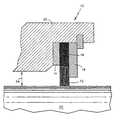
- FIG. 1 is a diagrammatic cross-sectional view of a brush seal attached to a first element, acting against another element.
- the brush seal 10 includes a plurality of bristles 12 formed from ceramic fibers, an upstream 14 and downstream 16 backing plate, and packing material 18.
- one end of the bristle 12 and the packing material 18 are positioned between the upstream 14 and downstream 16 backing plates, which are substantially parallel one another.
- the packing material 18, bristles 12, and backing plates 14,16 are bonded to one another to form the brush seal 10.
- the brush seal 10 is attached to a first element 20 and extends outwardly toward a second element 22, sealing the gap 24 therebetween.
- the brush seal bristles are formed by first winding a ceramic, or a ceramic like, fiber around a cylindrical drum.
- a plurality of fibers may be biased against an arcuate form in a manner approximating a fiber wound on a drum.
- the relative distribution of the fibers is selected based upon the seal characteristics of the particular seal being made; i.e., the closer the fibers are packed, the less fluid will leak through the seal, and the greater the stiffness of the seal.
- zones where packing material is to be applied to the fibers are defined prior to the application of packing material.
- areas of the wound or otherwise arranged fibers where packing material is to be applied are referred to as applied zones.
- Areas where packing material should not be applied, i.e., the remaining areas of the arranged fibers, are referred to as free zones.
- the applied zones are defined by attaching a masking agent at the border between the free zones and the applied zones.
- the free zones are masked to prevent bonding between the packing material and the bristles within the free zones during later steps.
- the backing material is best applied by spray, masking the free zones allows the applied zones to be sprayed without the adverse effects caused by overspray. Which approach is preferable depends on the packing material itself and how the packing material is applied to the intended zones.
- the packing material is applied and allowed to dry.
- the packing material which will be described in more detail infra, binds the wound fibers together and enables them to be removed from the drum.
- the fibers are cut into bristle sections.
- Each bristle section includes a segment of applied packing material and cut fibers (i.e., "bristles") extending out from the packing material.
- the bristle sections are subsequently stacked on top of one another such that the bristles from the sections align in a pattern and the packing material sections align with one another. The particular pattern chosen depends upon the seal characteristics of the brush seal being manufactured.
- the next step in the manufacturing process is the bonding step where the upstream and downstream backing plates are assembled with the bristle sections and the assembly is bonded into a single piece.
- the bonding process for a particular seal depends upon the composition of the bristles, the packing material, and the backing plates as will be discussed infra.
- fibers comprised of, but not limited to, glass, boron, carbon, silicon carbide, or aluminum oxide are used with a polymer matrix (or polymer matrix composite) packing material, and backing plates consisting of a polymer matrix similar to that used to bind the fibers together, reinforced with carbon fiber to provide stiffness.
- the polymer matrix may be a thermoset (high temperature epoxy) or a high temperature thermoplastic (polyimide) having a low maximum use temperature 177°C to 260°C (350 to 500°F) and a very low density ( ⁇ (1384 kg m -3 ) (0.05 lbs/in 3 ).
- a suitable thermoset for example would be SCOTCHPLY PR500TM which is marketed by Minnesota Mining and Manufacturing.
- Suitable thermoplastics include AVIMID NTM marketed by E.I. Du Pont de Nemours & Co.
- the wound fibers can be cut into appropriate sized bristle sections and removed from the drum. The sections are then stacked between the backing plates.
- the curing or densification step in which the bristles and the backing plate bond to one another varies depending upon the polymer matrix or matrix composite chosen.
- the elements may be formed into a solid part by heating the seal to approximately 135°C (275°F) for a period of two (2) hours at a pressure of approximately 20.7 MPa (3000 psi), and subsequently heating the seal to approximately 399°C (750°F) for a period of one (1) hour at the same pressure.
- fibers comprising, but not limited to, boron, silicon carbide or aluminum oxide
- a packing material in the form of a slurry, and metallic backing plates.
- the slurry consists of a fugitive organic binder, solvent or water, and fine metal powder (-325 mesh).
- a suitable fugitive organic binder is RHOPLEXTM marketed by the Rohm and Haas Company.
- the type of metal chosen for the backing plates must be compatible with the fiber type at processing and operating temperature.
- boron (or SiC coated boron) and silicon carbide fibers may be used with aluminum and titanium alloys
- aluminum oxide fibers may be used with aluminum and many superalloys.
- Some combinations of metal and fiber may detrimentally react at processing and use temperatures and therefore must be avoided.
- the zones where slurry is to be applied to the wound fiber are defined and masked.
- a release agent containing boron nitride may be used for masking purposes.
- bristle sections are cut and stacked to the desired geometry and thickness.
- the metal backing plates are subsequently added to the stacked bristle sections and the assembly is first heated to remove the fugitive binder, and second vacuum hot pressed to consolidate the assembly.
- Typical consolidation conditions for a seal having fiber bristle sections made from SAPHIKONTM, backing plates made from HAYNES 230TM, and a slurry including RHOPLEXTM, would be pressing at approximately 48.3 MPa (7,000 psi) at 1150°C (2100°F) for 1 hour.
- HAYNES 230TM is a nickel based super alloy marketed by Haynes International, Inc.
- SAPHIKONTM is an aluminum oxide ceramic fiber marketed by Saphikon Incorporated.
- fibers consisting of, but not limited to, aluminum oxide or silicon carbide may be used with a ceramic or ceramic matrix composite backing plate.
- Typical ceramic matrices that may be used for the backing plates includes glass or glass matrix composites, aluminum oxide, or silicon carbide and silicon carbide composites.
- a slurry containing a fugitive binder and glass or ceramic powder is applied to the intended zones of the wound fiber. After the slurry dries, the bristle sections are cut, removed from the drum, and positioned between ceramic or ceramic composite backing plates. The seal is subsequently consolidated into a solid assembly by subjecting the seal to an elevated temperature and pressure for a period of time.
- typical consolidation conditions for a seal having backing plates consisting of barium magnesium aluminum silicate (BMAS) glass and bristle sections consisting of aluminum oxide fibers are approximately 3.45 MPa (500 psi) at 1430°C for 5 minutes.
- the invention provides a method for manufacturing a brush seal that can withstand high temperatures. As gas turbine engine performance and efficiency rise, so does the temperature of the core gas flow passing through the engine. Providing seals that can accommodate the elevated temperatures is a distinct advantage.
- a method for manufacturing a brush seal having ceramic, or ceramic like, bristles Brush seals having ceramic type bristles require different manufacturing steps than those required for metallic brush seals. Accordingly, it is an advantage to provide a simple cost-effective method for assembling brush seals having ceramic type bristles. Further, using a ceramic or ceramic like fiber, a polymer packing material, and reinforced polymer backing plates decreases the weight of the seal relative to most metallic brush seals of similar dimensions, to provide a lightweight bristle seal. Also ceramic or ceramic like fibers are more wear resistant than many metallic brush seals, so as to provide a bristle seal having increased wear resistance.
Landscapes
- Engineering & Computer Science (AREA)
- General Engineering & Computer Science (AREA)
- Mechanical Engineering (AREA)
- Sealing Devices (AREA)
- Gasket Seals (AREA)
- Sealing Using Fluids, Sealing Without Contact, And Removal Of Oil (AREA)
Applications Claiming Priority (2)
| Application Number | Priority Date | Filing Date | Title |
|---|---|---|---|
| US535501 | 1995-09-28 | ||
| US08/535,501 US7181843B1 (en) | 1995-09-28 | 1995-09-28 | Method of manufacturing a brush seal |
Publications (2)
| Publication Number | Publication Date |
|---|---|
| EP0765619A1 EP0765619A1 (en) | 1997-04-02 |
| EP0765619B1 true EP0765619B1 (en) | 2002-05-22 |
Family
ID=24134511
Family Applications (1)
| Application Number | Title | Priority Date | Filing Date |
|---|---|---|---|
| EP96306786A Expired - Lifetime EP0765619B1 (en) | 1995-09-28 | 1996-09-18 | Method of manufacturing a brush seal |
Country Status (5)
| Country | Link |
|---|---|
| US (1) | US7181843B1 (enExample) |
| EP (1) | EP0765619B1 (enExample) |
| JP (1) | JP3947937B2 (enExample) |
| KR (1) | KR100405880B1 (enExample) |
| DE (1) | DE69621300T2 (enExample) |
Families Citing this family (17)
| Publication number | Priority date | Publication date | Assignee | Title |
|---|---|---|---|---|
| JP3692300B2 (ja) | 1998-07-13 | 2005-09-07 | 三菱重工業株式会社 | 軸シールおよびそれを用いたタービン |
| DE10009432C1 (de) | 2000-02-28 | 2001-12-06 | Mtu Aero Engines Gmbh | Bürste für eine Bürstendichtung |
| DE10257015A1 (de) * | 2002-12-06 | 2004-06-17 | Voith Paper Patent Gmbh | Saug- oder Blaswalze |
| US20080284107A1 (en) * | 2004-05-04 | 2008-11-20 | Flaherty Andrew L | Ceramic Brush Seals |
| US7565729B2 (en) * | 2006-03-17 | 2009-07-28 | General Electric Company | Methods of manufacturing a segmented brush seal for sealing between stationary and rotary components |
| US7798769B2 (en) * | 2007-02-15 | 2010-09-21 | Siemens Energy, Inc. | Flexible, high-temperature ceramic seal element |
| US8974891B2 (en) * | 2007-10-26 | 2015-03-10 | Coi Ceramics, Inc. | Thermal protection systems comprising flexible regions of inter-bonded lamina of ceramic matrix composite material and methods of forming the same |
| US8414254B2 (en) * | 2008-02-18 | 2013-04-09 | United Technologies Corporation | Sealing assembly for a turbine engine |
| US8528178B2 (en) * | 2008-03-03 | 2013-09-10 | United Technologies Corporation | Bristle and plate subassembly fixture and manufacturing method |
| DE102008060371A1 (de) * | 2008-12-03 | 2010-06-10 | Mtu Aero Engines Gmbh | Bürstendichtung |
| WO2014014426A2 (en) | 2012-06-28 | 2014-01-23 | Sdm Siradişi Arge Ve Mühendi̇sli̇k Sanayi̇ Ti̇caret Li̇mi̇ted Şi̇rketi̇ | Brush seal for high pressure applications |
| WO2014163676A1 (en) | 2013-03-13 | 2014-10-09 | Lazur Andrew J | Compliant composite component and method of manufacture |
| DE102013219832B3 (de) * | 2013-09-30 | 2015-03-12 | MTU Aero Engines AG | Bürstendichtung für eine Turbomaschine |
| EP3336394A1 (de) * | 2016-12-19 | 2018-06-20 | Siemens Aktiengesellschaft | Dichtung aus keramischen faserverbundwerkstoff und verfahren |
| US10794205B2 (en) | 2017-02-27 | 2020-10-06 | Rolls-Royce North American Technologies Inc. | Ceramic seal component for gas turbine engine and process of making the same |
| US11255432B2 (en) * | 2019-04-05 | 2022-02-22 | Raytheon Technologies Corporation | Low friction, wear resistant piston seal |
| US20240183445A1 (en) * | 2022-12-01 | 2024-06-06 | Ut-Battelle, Llc | High-efficiency seal composed of carbon nanotubes |
Family Cites Families (22)
| Publication number | Priority date | Publication date | Assignee | Title |
|---|---|---|---|---|
| GB1335969A (en) * | 1970-03-17 | 1973-10-31 | Norwood Mills | Fabric manufacture |
| US3947306A (en) * | 1974-02-20 | 1976-03-30 | Congoleum Industries, Inc. | Method for producing bonded carpeting |
| US4015036A (en) * | 1974-02-20 | 1977-03-29 | Congoleum Corporation | Bonded carpeting |
| GB2001400B (en) * | 1977-07-20 | 1982-01-20 | Rolls Royce | Brush seal and a method of manufacture |
| DE2921512A1 (de) | 1978-05-31 | 1979-12-13 | Cross Mfg Co 1938 Ltd | Verfahren zur herstellung einer buerstendichtung |
| GB2022197B (en) * | 1978-05-31 | 1982-07-21 | Cross Mfg Co | Brush seals and methods of manufacutre thereof |
| GB2076935B (en) | 1980-05-31 | 1984-07-25 | Rolls Royce | Seals |
| GB8504331D0 (en) * | 1985-02-20 | 1985-03-20 | Rolls Royce | Brush seals |
| DE3606284A1 (de) * | 1985-07-31 | 1987-02-12 | Mtu Muenchen Gmbh | Verfahren zur herstellung einer buerstendichtung und vorrichtung zur durchfuehrung des verfahrens |
| DE3606283A1 (de) | 1985-07-31 | 1987-02-12 | Mtu Muenchen Gmbh | Buerstendichtung |
| GB2198195B (en) * | 1986-12-06 | 1990-05-16 | Rolls Royce Plc | Brush seal |
| GB8712681D0 (en) | 1987-05-29 | 1987-07-01 | Cross Mfg Co 1938 Ltd | Brush seals |
| GB8907695D0 (en) | 1989-04-05 | 1989-05-17 | Cross Mfg Co | Seals |
| GB9008917D0 (en) | 1990-04-20 | 1990-06-20 | Cross Mfg Co | Brush seals |
| US5106104A (en) * | 1990-10-11 | 1992-04-21 | General Electric Company | Constant pressure drop multiple stage brush seal |
| US5183197A (en) | 1991-08-07 | 1993-02-02 | Technetics Corp. | Bundle and place method for the manufacture of brush seals |
| US5201530A (en) * | 1991-10-18 | 1993-04-13 | United Technologies Corporation | Multi-layered brush seal |
| US5308088A (en) | 1992-08-20 | 1994-05-03 | General Electric Company | Brush seal with flexible backing plate |
| US5335920A (en) * | 1992-08-20 | 1994-08-09 | General Electric Company | Brush seal |
| US5474306A (en) * | 1992-11-19 | 1995-12-12 | General Electric Co. | Woven seal and hybrid cloth-brush seals for turbine applications |
| US5351971A (en) | 1993-05-21 | 1994-10-04 | Eg&G Sealol, Inc. | Brush seal device having a floating backplate |
| GB9317083D0 (en) * | 1993-08-17 | 1993-09-29 | Rolls Royce Plc | A brush seal |
-
1995
- 1995-09-28 US US08/535,501 patent/US7181843B1/en not_active Expired - Fee Related
-
1996
- 1996-09-18 EP EP96306786A patent/EP0765619B1/en not_active Expired - Lifetime
- 1996-09-18 DE DE69621300T patent/DE69621300T2/de not_active Expired - Lifetime
- 1996-09-25 KR KR1019960042507A patent/KR100405880B1/ko not_active Expired - Fee Related
- 1996-09-27 JP JP27524996A patent/JP3947937B2/ja not_active Expired - Fee Related
Also Published As
| Publication number | Publication date |
|---|---|
| JP3947937B2 (ja) | 2007-07-25 |
| KR970015022A (ko) | 1997-04-28 |
| EP0765619A1 (en) | 1997-04-02 |
| JPH09119526A (ja) | 1997-05-06 |
| US7181843B1 (en) | 2007-02-27 |
| DE69621300T2 (de) | 2002-12-19 |
| KR100405880B1 (ko) | 2004-05-14 |
| DE69621300D1 (de) | 2002-06-27 |
Similar Documents
| Publication | Publication Date | Title |
|---|---|---|
| US7181843B1 (en) | Method of manufacturing a brush seal | |
| KR830001651B1 (ko) | 세라믹으로 표면처리한 제품의 제조방법 | |
| US5447411A (en) | Light weight fan blade containment system | |
| US6736401B2 (en) | Laminated finger seal with ceramic composition | |
| US3871934A (en) | Resurfacing brake discs | |
| US5733452A (en) | Filter and end cap assembly including a porous layer for sealing with a potting material and method for making the assembly | |
| US5775878A (en) | Turbine of thermostructural composite material, in particular of small diameter, and a method of manufacturing it | |
| EP0570466A1 (en) | BRAKE DISC MADE FROM CARBON COMPOSITE WITH POSITIVE VIBRATION DAMPING. | |
| JPH0116321B2 (enExample) | ||
| EP3925942B1 (en) | Method of forming composites having an increased volume of ceramic particles | |
| JPH04217464A (ja) | 研磨シート及びその製造法 | |
| US6688606B2 (en) | Gasket and a method for the manufacture thereof | |
| GB2167821A (en) | A disc for a clutch or brake | |
| GB2399164A (en) | A method of manufacturing a cooling panel made of thermostructural composite material | |
| US5622474A (en) | Blade tip seal insert | |
| EP4361031A1 (en) | High temperature brazing of metals and ceramics to carbon substrates | |
| JP4212669B2 (ja) | 積層体及びその製造方法 | |
| WO2007077675A1 (ja) | セグメント砥石およびその製造方法 | |
| CA1053085A (en) | Resin bonded composite articles and process for fabrication thereof | |
| US4758112A (en) | Rotary shaft assembly | |
| EP3216772A1 (en) | Ceramic matrix composite component,gas turbine seal assembly, and method of forming ceramic matrix composite component | |
| US5624516A (en) | Methods of making preforms for composite material manufacture | |
| WO1996019618A9 (en) | Preforms for composite material manufacture and methods of making | |
| EP4361120A1 (en) | High temperature brazing of metals and ceramics to carbon substrates | |
| JP4588846B2 (ja) | 金属リングと摩擦材の接着構造 |
Legal Events
| Date | Code | Title | Description |
|---|---|---|---|
| PUAI | Public reference made under article 153(3) epc to a published international application that has entered the european phase |
Free format text: ORIGINAL CODE: 0009012 |
|
| AK | Designated contracting states |
Kind code of ref document: A1 Designated state(s): DE FR GB |
|
| 17P | Request for examination filed |
Effective date: 19970920 |
|
| 17Q | First examination report despatched |
Effective date: 20000719 |
|
| GRAG | Despatch of communication of intention to grant |
Free format text: ORIGINAL CODE: EPIDOS AGRA |
|
| GRAG | Despatch of communication of intention to grant |
Free format text: ORIGINAL CODE: EPIDOS AGRA |
|
| GRAH | Despatch of communication of intention to grant a patent |
Free format text: ORIGINAL CODE: EPIDOS IGRA |
|
| GRAH | Despatch of communication of intention to grant a patent |
Free format text: ORIGINAL CODE: EPIDOS IGRA |
|
| GRAA | (expected) grant |
Free format text: ORIGINAL CODE: 0009210 |
|
| REG | Reference to a national code |
Ref country code: GB Ref legal event code: FG4D |
|
| REF | Corresponds to: |
Ref document number: 69621300 Country of ref document: DE Date of ref document: 20020627 |
|
| ET | Fr: translation filed | ||
| PLBE | No opposition filed within time limit |
Free format text: ORIGINAL CODE: 0009261 |
|
| STAA | Information on the status of an ep patent application or granted ep patent |
Free format text: STATUS: NO OPPOSITION FILED WITHIN TIME LIMIT |
|
| 26N | No opposition filed |
Effective date: 20030225 |
|
| PGFP | Annual fee paid to national office [announced via postgrant information from national office to epo] |
Ref country code: FR Payment date: 20100921 Year of fee payment: 15 |
|
| REG | Reference to a national code |
Ref country code: FR Ref legal event code: ST Effective date: 20120531 |
|
| PG25 | Lapsed in a contracting state [announced via postgrant information from national office to epo] |
Ref country code: FR Free format text: LAPSE BECAUSE OF NON-PAYMENT OF DUE FEES Effective date: 20110930 |
|
| PGFP | Annual fee paid to national office [announced via postgrant information from national office to epo] |
Ref country code: GB Payment date: 20120912 Year of fee payment: 17 |
|
| PGFP | Annual fee paid to national office [announced via postgrant information from national office to epo] |
Ref country code: DE Payment date: 20120912 Year of fee payment: 17 |
|
| GBPC | Gb: european patent ceased through non-payment of renewal fee |
Effective date: 20130918 |
|
| REG | Reference to a national code |
Ref country code: DE Ref legal event code: R119 Ref document number: 69621300 Country of ref document: DE Effective date: 20140401 |
|
| PG25 | Lapsed in a contracting state [announced via postgrant information from national office to epo] |
Ref country code: GB Free format text: LAPSE BECAUSE OF NON-PAYMENT OF DUE FEES Effective date: 20130918 |
|
| PG25 | Lapsed in a contracting state [announced via postgrant information from national office to epo] |
Ref country code: DE Free format text: LAPSE BECAUSE OF NON-PAYMENT OF DUE FEES Effective date: 20140401 |