EP0761633A2 - Verfahren zur Herstellung von (4-Bromphenyl-)alkylethern - Google Patents
Verfahren zur Herstellung von (4-Bromphenyl-)alkylethern Download PDFInfo
- Publication number
- EP0761633A2 EP0761633A2 EP96710013A EP96710013A EP0761633A2 EP 0761633 A2 EP0761633 A2 EP 0761633A2 EP 96710013 A EP96710013 A EP 96710013A EP 96710013 A EP96710013 A EP 96710013A EP 0761633 A2 EP0761633 A2 EP 0761633A2
- Authority
- EP
- European Patent Office
- Prior art keywords
- bromine
- general formula
- process according
- oxidizing agent
- compound
- Prior art date
- Legal status (The legal status is an assumption and is not a legal conclusion. Google has not performed a legal analysis and makes no representation as to the accuracy of the status listed.)
- Granted
Links
Classifications
-
- C—CHEMISTRY; METALLURGY
- C07—ORGANIC CHEMISTRY
- C07C—ACYCLIC OR CARBOCYCLIC COMPOUNDS
- C07C41/00—Preparation of ethers; Preparation of compounds having groups, groups or groups
- C07C41/01—Preparation of ethers
- C07C41/18—Preparation of ethers by reactions not forming ether-oxygen bonds
- C07C41/22—Preparation of ethers by reactions not forming ether-oxygen bonds by introduction of halogens; by substitution of halogen atoms by other halogen atoms
Definitions
- the present invention relates to a process for the preparation of (4-bromophenyl) alkyl ethers by bromination of the corresponding alkylphenyl ether with bromine in the presence of an oxidizing agent.
- (4-bromophenyl) alkyl ethers are widely used as valuable synthetic building blocks, e.g. B. as intermediates for insecticides, for the manufacture of medicinal substances and as additives in the plastics and rubber sector.
- Preferred solvents in the bromination of alkylphenyl ethers are often inert chlorinated hydrocarbons, such as u. a. Dichloroethane, methylene chloride and carbon tetrachloride or carbon disulfide, which are harmful to health, toxic or even carcinogenic and the use of which is questionable in an industrial-scale synthesis from an ecological and occupational hygiene point of view.
- Brominations of anisole or phenetol in acetic acid are also known, but so far they have received only minor attention because, among other things, to suppress side reactions such as ether cleavage, the bromination of phenol ethers often involves the addition of a bromine-binding agent such as sodium acetate or calcium carbonate or the expulsion of the formed HBr is required (see A. Roedig in Houben-Weyl-Müller, Methods of Organic Chemistry, Volume V / 4 p. 246, p. 269, Stuttgart 1960). For example, A.
- Roedig describes the bromination of anisole in glacial acetic acid in a stream of air with vaporous bromine, 1.05 mol of bromine (Br 2 ) being used per mole of anisole. The yield achieved is 83% of theory. Th. In this process, 1 mole of hydrogen bromide is necessarily obtained per mole of bromophenyl alkyl ether formed, which is dissolved in the filtrate or must be washed out of the exhaust air. Further described processes for the bromination of anisole in glacial acetic acid (cf. Chem. Ber., 63 (1930) 3029 and CR Hebd. Seances Acad. Sci., 136 (1903) 378) or of phenetol in glacial acetic acid (ibid. 136 (1903 ) 378) do not represent an improvement with regard to the hydrogen bromide accumulation, since significantly less than half of the bromine used is used in these production processes.
- EP-B1 429 975 describes the preparation of dibrominated diphenyl ethers with bromine in the presence of oxidizing agents in a two-phase system, the reaction being carried out in water-immiscible organic solvents.
- Preferred solvents are 1,2-dichloroethane, methylene chloride or methylene bromide, the use of which, as already mentioned, is questionable from an ecological and occupational hygiene point of view.
- the present invention thus relates to a process for the preparation of compounds of the general formula I. wherein R represents an alkyl group, by reacting a compound of general formula II wherein R is as defined above, with bromine in a water-miscible solvent, characterized in that it is carried out in the presence of an oxidizing agent which is capable of oxidizing hydrogen bromide to bromine.
- Alkyl groups representing R can be straight-chain or branched and preferably have one to six carbon atoms. Examples are methyl, ethyl, n-propyl, i-propyl, n-butyl, i-butyl, sec. Butyl and tert. Butyl. R particularly preferably represents methyl and ethyl.
- Suitable oxidizing agents which are capable of oxidizing hydrogen bromide to bromine are, in particular, those which do not undergo side reactions with either the compounds of the general formula I or the compounds of the general formula II.
- Preferred oxidizing agents are manganese dioxide, cerium (IV) salts, alkali metal bromates and peroxy compounds.
- Particularly preferred oxidizing agents are peroxy compounds, which include hydrogen peroxide and its inorganic and organic derivatives, in which one or both hydrogen atoms are replaced by covalently bound radicals or by ionically bound cations.
- Suitable peroxy compounds are, for example, sodium peroxide and barium peroxide and their hydrates; Butyl hydroperoxide; Peroxy formic acid, peroxyacetic acid, peroxypropionic acid, peroxylauric acid, peroxybenzoic acid, m-chloroperoxybenzoic acid and their alkali and alkaline earth metal salts; the so-called alkali metal perborates and percarbonates such as sodium perborate and sodium percarbonate; and peroxmonosulfuric acid, peroxodisulfuric acid and their alkali and ammonium salts.
- a particularly preferred oxidizing agent is hydrogen peroxide, which is advantageously used in the form of commercially available aqueous solutions in the concentration range from 20 to 50% by weight.
- the amount of oxidizing agent required depends in particular on the reaction procedure.
- oxidizing agent An excess of the oxidizing agent is often used in order to achieve complete and rapid reoxidation. If hydrogen peroxide is used as the oxidizing agent, a 0.5 times to equimolar molar amount, based on the compound of the general formula II, may be expedient, 0.62 to 0.72 mol of hydrogen peroxide, based on the compound of the general formula II, being particularly preferred .
- bromine is generally used in amounts of 0.5 to 0.6 mol (Br 2 ) per mol of compound of the general formula II.
- 0.52 to 0.56 mol per mol of compound of the general formula II are particularly preferred.
- the process according to the invention is carried out in a water-miscible solvent or in mixtures of water-miscible solvents.
- a water-miscible solvent or in mixtures of water-miscible solvents.
- examples are water-miscible carboxylic acids or water itself.
- the oxidizing agent is used in the form of an aqueous solution, the use of water-miscible carboxylic acids as a solvent is preferred.
- carboxylic acids are formic acid, acetic acid and propionic acid.
- a very particularly preferred solvent is acetic acid.
- the process according to the invention is carried out in particular at temperatures between 0 ° C. and the boiling point of the reaction mixture.
- Preferred temperatures are 20 to 50 ° C, particularly preferred temperatures are 30 to 40 ° C.
- the compound of the general formula II is introduced together with the solvent and the oxidizing agent and the bromine is metered in. But it can also connect the general Formula II submitted together with the solvent and then first bromine and then oxidizing agent are added. Bromine and oxidizing agent can, however, also be metered in together.
- the compound of the general formula I can be isolated by customary work-up methods which depend on the solubility of the product in the solvent used and its fixed point.
- the usual work-up methods are chromatography, filtration, phase separation, centrifugation or distillation at normal pressure or in vacuo.
- working up by distillation is the method of choice for lower (4-bromophenyl) alkyl ethers.
- the distilled off aqueous acetic acid contains 8 g of 4-bromophenetol, corresponding to 4% of theory. Th.
- the product is distilled i. Vac. at 40 - 45 mbar, with 4-bromophenetol boiling constantly at 124 - 127 ° C.
- bromine 0.525 mol of Br 2
- stirring is continued for 30 min and then the acetic acid is passed over a distillation bridge with a packed column (height: 20 cm, 6 mm Raschig rings) i. Vac. distilled off at 157-167 mbar.
- the distilled acetic acid contains 6.3 g of 4-bromoanisole, corresponding to 3.5% of theory. Th.
- the product is distilled i. Vac. at 48 - 53 mbar, with 4-bromoanisole boiling constantly at 117 - 119 ° C.
Landscapes
- Chemical & Material Sciences (AREA)
- Organic Chemistry (AREA)
- Chemical Kinetics & Catalysis (AREA)
- Organic Low-Molecular-Weight Compounds And Preparation Thereof (AREA)
Abstract
Description
- Die vorliegende Erfindung betrifft ein Verfahren zur Herstellung von (4-Bromphenyl-)alkylethern durch Bromierung der entsprechenden Alkylphenylether mit Brom in Gegenwart eines Oxidationsmittels.
- (4-Bromphenyl-)alkylether finden als wertvolle Synthesebausteine eine weit verbreitete Anwendung, z. B. als Zwischenprodukte für Insektizide, zur Herstellung von Arzneistoffen sowie als Zusatzstoffe im Kunststoff- und Kautschuk-Bereich.
- Bekanntlich werden diese Verbindungen durch Bromierung der entsprechenden Alkylphenylether hergestellt, wobei Alternativ-Synthesen, wie z. B. Brom-Sandmeyer-Reaktionen der entsprechend substituierten Aniline von untergeordneter Bedeutung sind (siehe z. B. Chem. Ber., 32 (1899) 160).
- Bevorzugte Lösungsmittel bei der Bromierung von Alkylphenylethern sind oftmals inerte chlorierte Kohlenwasserstoffe, wie u. a. Dichlorethan, Methylenchlorid und Tetrachlorkohlenstoff oder Kohlenstoffdisulfid, welche gesundheitsschädlich, giftig oder gar cancerogen sind und deren Verwendung bei einer im technischen Maßstab erfolgenden Synthese unter ökologisch und arbeitshygienischen Aspekten bedenklich ist.
- So beschreibt G. A. Olah et al. (Synthesis 1986, S. 868 - 870) Bromierungen von Anisol und Phenetol mit Bromodimethylsulfonium-Bromiden in Methylenchlorid als Lösungsmittel. Verfahren zur Herstellung von Bromphenolen und seinen Derivaten in Gegenwart flüssiger organischer Ester als Lösungsmittel, wie in der DE-A 37 42 515 erwähnt, erfordern bei einer Übertragung in den technischen Maßstab aus Sicherheitsgründen ebenfalls aufwendige apparative Maßnahmen, insbesondere für den Brand- und Explosionsschutz einer Anlage.
- Bromierungen von Anisol bzw. Phenetol in Essigsäure sind ebenfalls bekannt, finden bislang aber nur untergeordnete Beachtung, da u. a. zur Zurückdrängung von Nebenreaktionen, wie Etherspaltung, bei der Bromierung von Phenolethern oft der Zusatz eines bromwasserstoffbindenden Mittels, wie Natriumacetat oder Calciumcarbonat oder das Austreiben der gebildeten HBr erforderlich ist (vgl. A. Roedig in Houben-Weyl-Müller, Methoden der Organischen Chemie, Band V/4 S. 246, S. 269, Stuttgart 1960). So beschreibt A. Roedig die Bromierung von Anisol in Eisessig im Luftstrom mit dampfförmigen Brom, wobei pro Mol Anisol 1.05 Mol Brom (Br2) eingesetzt wird. Die erzielte Ausbeute beträgt 83 % d. Th. Bei diesen Verfahren fällt zwangsweise 1 Mol Bromwasserstoff pro Mol entstandenem Bromphenylalkylether an, der im Filtrat gelöst ist oder aus der Abluft herausgewaschen werden muß. Weitere beschriebene Verfahren zur Bromierung von Anisol in Eisessig (vgl. Chem. Ber., 63 (1930) 3029 und C. R. Hebd. Seances Acad. Sci., 136 (1903) 378) bzw. von Phenetol in Eisessig (ibd. 136 (1903) 378) stellen bzgl. des Bromwasserstoffanfalls keine Verbesserung dar, da bei diesen Herstellungsverfahren deutlich weniger als die Hälfte des eingesetzten Broms ausgenutzt wird.
- Bromierungsreaktionen an Aromaten, bei denen der aus dem Brom entstehende Bromwasserstoff durch Zusatz eines Oxidationsmittels wieder in Brom übergeführt wird, sind bekannt. So beschreibt die EP-B1 429 975 die Herstellung von dibromierten Diphenylethern mit Brom in Gegenwart von Oxidationsmittel im 2-Phasen-System, wobei die Reaktion in Wasser nicht-mischbaren organischen Lösungsmitteln durchgeführt wird. Bevorzugte Lösungsmittel sind hierbei 1,2-Dichlorethan, Methylenchlorid oder Methylenbromid, deren Verwendung, wie bereits angeführt, unter ökologischen und arbeitshygienischen Aspekten bedenklich ist.
- Weiterhin ist von B. M. Choudary et al. (Synlett 1994, S. 450) die regioselektive Oxybromierung u. a. von Anisol in Gegenwart von Ammoniummolybdat-Katalysatoren beschrieben. Verwendetes Lösungsmittel ist hierbei zwar ökologisch unbedenkliche Essigsäure, aber durch den Einsatz eines Schwermetall-Katalysators bedingt dieses Verfahren bei Übertragung in den technischen Maßstab erhebliche Entsorgungsprobleme, zudem die Verwendung eines nicht regenerierbaren Katalysators einen nicht unbedeutenden Preisnachteil darstellt. Durch den Einsatz von Kaliumbromid fallen zusätzlich bei diesem Verfahren große Mengen an anorganischen Salzen an, die aus Prozeßabwässern arbeits- und energieaufwendig enffernt werden müssen.
- Aufgabe der vorliegenden Erfindung ist es daher, ein unter ökologisch und arbeitshygienischen Aspekten verbessertes, die Abwasserbelastung verringerndes und die Verwendung von chlorierten Kohlenwasserstoffen vermeidendes Verfahren zur Herstellung von (4-Bromphenyl-)alkylethern bereitzustellen, das in technisch einfacher Weise in hoher Ausbeute hochreine Produkte liefert.
- Die vorliegende Erfindung betrifft somit ein Verfahren zur Herstellung von Verbindungen der allgemeinen Formel I

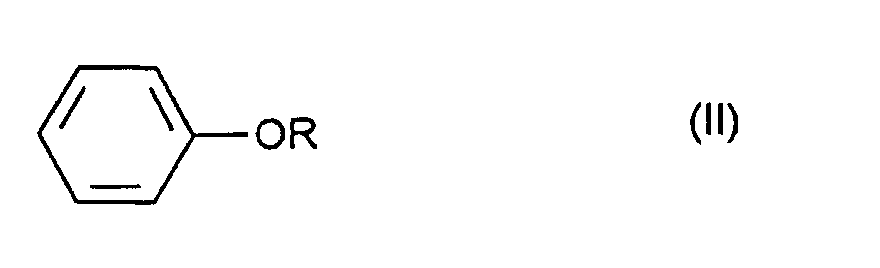
- Für R stehende Alkylgruppen können geradkettig oder verzweigt sein und haben bevorzugt ein bis sechs Kohlenstoffatome. Beispiele sind Methyl, Ethyl, n-Propyl, i-Propyl, n-Butyl, i-Butyl, sek. Butyl und tert. Butyl. Besonders bevorzugt steht R für Methyl und Ethyl.
- Geeignete Oxidationsmittel, die Bromwasserstoff zu Brom zu oxidieren vermögen, sind insbesondere solche, die weder mit den Verbindungen der allgemeinen Formel I noch mit den Verbindungen der allgemeinen Formel II Nebenreaktionen eingehen. Bevorzugte Oxidationsmittel sind Braunstein, Cer(lV)-Salze, Alkalimetallbromate und Peroxyverbindungen. Besonders bevorzugte Oxidationsmittel sind Peroxyverbindungen, worunter Wasserstoffperoxid und seine anorganischen und organischen Derivate, in denen eines oder beide Wasserstoffatome durch kovalent gebundene Reste oder durch ionisch gebundene Kationen ersetzt sind, zu verstehen sind.
- Geeignete Peroxyverbindungen sind beispielsweise Natriumperoxid und Bariumperoxid sowie deren Hydrate; Butylhydroperoxid; Peroxyameisensäure, Peroxyessigsäure, Peroxypropionsäure, Peroxylaurinsäure, Peroxybenzoesäure, m-Chlorperoxybenzoesäure sowie deren Alkali- und Erdalkalisalze; die sogenannten Alkalimetallperborate und -percarbonate wie Natriumperborat und Natriumpercarbonat; sowie Peroxmonoschwefelsäure, Peroxodischwefelsäure und deren Alkali- und Ammoniumsalze.
- Ein besonders bevorzugtes Oxidationsmittel ist Wasserstoffperoxid, das vorteilhafterweise in Form handelsüblicher wäßriger Lösungen im Konzentrationsbereich von 20 bis 50 Gew% eingesetzt wird.
- Die benötigte Menge an Oxidationsmittel hängt insbesondere von der Reaktionsführung ab.
- Häufig wird ein Überschuß des Oxidationsmittels eingesetzt, um eine vollständige und schnelle Rückoxidation zu erreichen. Wird Wasserstoffperoxid als Oxidationsmittel eingesetzt, so kann eine 0,5fache bis äquimolare molare Menge, bezogen auf die Verbindung der allgemeinen Formel II zweckmäßig sein, wobei 0,62 bis 0,72 Mol Wasserstoffperoxid, bezogen auf die Verbindung der allgemeinen Formel II besonders bevorzugt ist.
- Im erfindungsgemäßen Verfahren wird Brom in der Regel in Mengen von 0,5 bis 0,6 Mol (Br2) pro Mol Verbindung der allgemeinen Formel II eingesetzt. Besonders bevorzugt sind, je nach Ausführung des erfindungsgemäßen Verfahrens, 0,52 bis 0,56 Mol pro Mol Verbindung der allgemeinen Formel II.
- Das erfindungsgemäße Verfahren wird in einem wassermischbaren Lösungsmittel oder in Mischungen wassermischbarer Lösungsmittel durchgeführt. Beispiele sind wassermischbare Carbonsäuren oder Wasser selbst. Insbesondere wenn das Oxidationsmittel in Form einer wäßrigen Lösung eingesetzt wird, ist die Verwendung wassermischbarer Carbonsäuren als Lösungsmittel bevorzugt. Beispiele für solche Carbonsäuren sind Ameisensäure, Essigsäure und Propionsäure. Ein ganz besonders bevorzugtes Lösungsmittel ist Essigsäure.
- Das erfindungsgemäße Verfahren wird insbesondere bei Temperaturen zwischen 0 °C und dem Siedepunkt des Reaktionsgemisches durchgeführt. Bevorzugte Temperaturen sind 20 bis 50 °C, besonders bevorzugte Temperaturen sind 30 bis 40 °C.
- In einer Ausführungsform des erfindungsgemäßen Verfahrens wird die Verbindung der allgemeinen Formel II zusammen mit dem Lösungsmittel und dem Oxidationsmittel vorgelegt und das Brom zudosiert. Es kann aber auch die Verbindung der allgemeinen Formel II zusammen mit dem Lösungsmittel vorgelegt und dann zuerst Brom und dann Oxidationsmittel zudosiert werden. Brom und Oxidationsmittel können aber auch gemeinsam zudosiert werden.
- Die Isolierung der Verbindung der allgmeinen Formel I kann nach üblichen Aufarbeitungsverfahren erfolgen, die von der Löslichkeit des Produktes im verwendeten Lösungsmittel und dessen Festpunkt abhängen. Übliche Aufarbeitungsverfahren sind hierbei Chromatographie, Filtration, Phasentrennung, Zentrifugation oder Destillation bei Normaldruck oder im Vakuum. Insbesondere die destillative Aufarbeitung ist bei niederen (4-Bromphenyl-)alkylethern die Methode der Wahl.
- In einem 1l-Mehrhalskolben mit Rührer werden 840 g Eisessig (800 ml) und 123 g Phenetol (99 %ig nach GC, entsprechend 1 mol) bei Raumtemperatur unter Zugabe von 65 g 35 %iger wäßriger Wasserstoffperoxid-Lösung (entsprechend 0,67 mol H2O2) miteinander vermischt. Anschließend dosiert man über einen Zeitraum von ca. 45 min 86,5 g Brom (entsprechend 0,54 mol Br2) so zu, daß die Innentemperatur 30 - 35 °C nicht übersteigt. Die Außenkühlung erfolgt dabei mit Hilfe eines Wasserbades. Nach erfolgter Bromzugabe wird 15 min nachgerührt und sodann die Essigsäure über eine Destillationsbrücke mit Füllkörperkolonne(20 cm Höhe, Füllung: 6 mm Raschig-Ringe) i. Vak. bei 165 - 150 mbar abdestilliert.
- Die abdestillierte wäßrige Essigsäure enthält 8 g 4-Bromphenetol, entsprechend 4 % d. Th.
- Nach Ausdestillieren der Essigsäure erfolgt direkt die Produktdestillation i. Vak. bei 40 - 45 mbar, wobei 4-Bromphenetol konst. bei 124 - 127 °C siedet.
- Man erhält 181 g 4-Bromphenetol als farbloses Öl, entsprechend 89,7 % d. Th.
Reingehalt (GC): 0,53 % 2-Bromphenetol 98,64 % 4-Bromphenetol 0,58 % 2,4-Dibromphenetol - Arbeitet man wie im Beispiel 1, wobei die Produktdestillation aber zusätzlich über einen Rücklaufteiler erfolgt (Rücklaufverhältnis 10 : 1), kann der Anteil an 2,4-Dibromphenetol noch deutlich verkleinert werden:
Reingehalt (GC): 0,49 % 2-Bromphenetol 98,86 % 4-Bromphenetol 0,19 % 2,4-Dibromphenetol - In einem 1l-Mehrhalskolben mit Rührer werden 525 g Essigsäure (500 ml) und 109 g Anisol (99 %ig nach GC, entsprechend 1 mol) bei Raumtemperatur mit 65 g 35 %iger wäßriger Wasserstoffperoxid-Lösung (entsprechend 0,67 mol H2O2) vermischt.
- Anschließend dosiert man über einen Zeitraum von ca. 1 h 84 g Brom (0,525 mol Br2) so zu, daß die Innentemperatur 35 °C nicht übersteigt. Nach der Bromdosierung wird 30 min nachgerührt und sodann die Essigsäure über eine Destillationsbrücke mit Füllkörperkolonne (Höhe: 20 cm, 6 mm Raschig-Ringe) i. Vak. bei 157 - 167 mbar abdestilliert.
- Die abdestillierte Essigsäure enthält 6,3 g 4-Bromanisol, entsprechend 3,5 % d. Th.
- Nach Ausdestillieren der Essigsäure erfolgt direkt die Produktdestillation i. Vak. bei 48 - 53 mbar, wobei 4-Bromanisol konst. bei 117 - 119 °C siedet.
- Man erhält so 165 g 4-Bromanisol als farbloses Öl, entsprechend 88,2 % d. Th.
Reingehalt (GC): 0 % 2-Bromanisol 99,6 % 4-Bromanisol 0,33 % 2,4-Dibromanisol
Claims (10)
- Verfahren zur Herstellung von Verbindungen der allgemeinen Formel I


- Verfahren, gemäß Anspruch 1, dadurch gekennzeichnet, daß R für (C1-C6)-Alkyl steht.
- Verfahren gemäß Anspruch 1 und/oder 2, dadurch gekennzeichnet, daß R für Methyl oder Ethyl steht.
- Verfahren gemäß einem oder mehreren der Ansprüche 1 - 3, dadurch gekennzeichnet, daß als Oxidationsmittel Braunstein, ein Cer(lV)-salz, ein Alkalimetallbromat oder eine Peroxyverbindung eingesetzt wird.
- Verfahren gemäß einem oder mehreren der Ansprüche 1 - 4, dadurch gekennzeichnet, daß als Oxidationsmittel Wasserstoffperoxid eingesetzt wird.
- Verfahren gemäß einem oder mehreren der Ansprüche 1 - 5, dadurch gekennzeichnet, daß als Oxidationsmittel Wasserstoffperoxid in Mengen von 0,62 bis 0,72 Mol pro Mol Verbindung der allgemeinen Formel II eingesetzt wird.
- Verfahren gemäß einem oder mehreren der Ansprüche 1 bis 6, dadurch gekennzeichnet, daß als Lösungsmittel eine wassermischbare Carbonsäure eingesetzt wird.
- Verfahren gemäß einem oder mehreren der Ansprüche 1 bis 7, dadurch gekennzeichnet, daß als Lösungsmittel Essigsäure eingesetzt wird.
- Verfahren gemäß einem oder mehreren der Ansprüche 1 bis 8, dadurch gekennzeichnet, daß Brom in Mengen von 0,5 bis 0,6 Mol (Br2) pro Mol Verbindung der allgemeinen Formel II eingesetzt wird.
- Verfahren gemäß einem oder mehreren der Ansprüche 1 bis 9, dadurch gekennzeichnet, daß es bei Temperaturen von 20 bis 50 °C ausgeführt wird.
Applications Claiming Priority (2)
| Application Number | Priority Date | Filing Date | Title |
|---|---|---|---|
| DE19531408 | 1995-08-26 | ||
| DE19531408A DE19531408A1 (de) | 1995-08-26 | 1995-08-26 | Verfahren zur Herstellung von (4-Bromphenyl-)alkylethern |
Publications (3)
| Publication Number | Publication Date |
|---|---|
| EP0761633A2 true EP0761633A2 (de) | 1997-03-12 |
| EP0761633A3 EP0761633A3 (de) | 1997-07-02 |
| EP0761633B1 EP0761633B1 (de) | 1999-12-15 |
Family
ID=7770451
Family Applications (1)
| Application Number | Title | Priority Date | Filing Date |
|---|---|---|---|
| EP96710013A Expired - Lifetime EP0761633B1 (de) | 1995-08-26 | 1996-08-20 | Verfahren zur Herstellung von (4-Bromphenyl-)alkylethern |
Country Status (6)
| Country | Link |
|---|---|
| US (1) | US5654493A (de) |
| EP (1) | EP0761633B1 (de) |
| JP (1) | JPH09110772A (de) |
| BR (1) | BR9603546A (de) |
| CA (1) | CA2184051A1 (de) |
| DE (2) | DE19531408A1 (de) |
Families Citing this family (10)
| Publication number | Priority date | Publication date | Assignee | Title |
|---|---|---|---|---|
| US6215402B1 (en) * | 1998-03-13 | 2001-04-10 | Intermec Ip Corp. | Radio frequency identification transponder employing patch antenna |
| US20110155950A1 (en) * | 2008-08-05 | 2011-06-30 | Basf Se | Process for the preparation of 4-bromophenyl derivatives |
| US8641885B2 (en) | 2012-07-26 | 2014-02-04 | Liquid Light, Inc. | Multiphase electrochemical reduction of CO2 |
| US20130105304A1 (en) | 2012-07-26 | 2013-05-02 | Liquid Light, Inc. | System and High Surface Area Electrodes for the Electrochemical Reduction of Carbon Dioxide |
| US9175407B2 (en) | 2012-07-26 | 2015-11-03 | Liquid Light, Inc. | Integrated process for producing carboxylic acids from carbon dioxide |
| US10329676B2 (en) | 2012-07-26 | 2019-06-25 | Avantium Knowledge Centre B.V. | Method and system for electrochemical reduction of carbon dioxide employing a gas diffusion electrode |
| US8845876B2 (en) | 2012-07-26 | 2014-09-30 | Liquid Light, Inc. | Electrochemical co-production of products with carbon-based reactant feed to anode |
| US9267212B2 (en) | 2012-07-26 | 2016-02-23 | Liquid Light, Inc. | Method and system for production of oxalic acid and oxalic acid reduction products |
| WO2014043651A2 (en) | 2012-09-14 | 2014-03-20 | Liquid Light, Inc. | High pressure electrochemical cell and process for the electrochemical reduction of carbon dioxide |
| CN111072446A (zh) * | 2019-12-31 | 2020-04-28 | 烟台坤益液晶显示材料有限公司 | 一种烷基环己基溴苯的制备方法 |
Family Cites Families (4)
| Publication number | Priority date | Publication date | Assignee | Title |
|---|---|---|---|---|
| IL81079A (en) * | 1986-12-23 | 1994-05-30 | Bromine Compounds Ltd | Process for the selective para-bromination of phenol and its derivatives |
| IL92465A (en) * | 1989-11-27 | 1994-02-27 | Bromine Compounds Ltd Beersheb | Process for the preparation of 4,4'- dibromodiphenylether |
| GB9102519D0 (en) * | 1991-02-06 | 1991-03-27 | Ici Plc | Chemical process |
| DE4443592C1 (de) * | 1994-12-07 | 1996-04-25 | Great Lakes Chem Konstanz Gmbh | Verfahren zur Herstellung von Alkyl-4-bromphenylethern |
-
1995
- 1995-08-26 DE DE19531408A patent/DE19531408A1/de not_active Withdrawn
-
1996
- 1996-08-20 EP EP96710013A patent/EP0761633B1/de not_active Expired - Lifetime
- 1996-08-20 DE DE59603911T patent/DE59603911D1/de not_active Expired - Fee Related
- 1996-08-23 JP JP8222714A patent/JPH09110772A/ja not_active Withdrawn
- 1996-08-23 BR BR9603546A patent/BR9603546A/pt not_active Application Discontinuation
- 1996-08-23 CA CA002184051A patent/CA2184051A1/en not_active Abandoned
- 1996-08-26 US US08/702,812 patent/US5654493A/en not_active Expired - Fee Related
Also Published As
| Publication number | Publication date |
|---|---|
| US5654493A (en) | 1997-08-05 |
| EP0761633A3 (de) | 1997-07-02 |
| JPH09110772A (ja) | 1997-04-28 |
| DE59603911D1 (de) | 2000-01-20 |
| BR9603546A (pt) | 1998-05-19 |
| CA2184051A1 (en) | 1997-02-27 |
| DE19531408A1 (de) | 1997-02-27 |
| EP0761633B1 (de) | 1999-12-15 |
Similar Documents
| Publication | Publication Date | Title |
|---|---|---|
| EP0761633B1 (de) | Verfahren zur Herstellung von (4-Bromphenyl-)alkylethern | |
| DE1193510B (de) | Verfahren zur Herstellung von Brom-derivaten des Diphenyls, Diphenylaethers, Diphenylphenylaethers oder Di-, Tri- bzw. Tetraphenylmethans mit 4 und mehr Bromatomen je Molkuel | |
| DE2838701A1 (de) | Verfahren zur herstellung organischer carbonate | |
| DE1618019A1 (de) | Verfahren zur Herstellung von Bi-[ss-(N.N-dimethylamino)-alkyl-aether | |
| DE60109939T2 (de) | Verfahren zur herstellung von fluorierten & chlorierten benzaldehyden | |
| EP0037960B1 (de) | Verfahren zur Herstellung von Trichlorbenzolen | |
| DE2838030A1 (de) | Verfahren zur herstellung von alkylenglykolen | |
| EP0234503B1 (de) | Verfahren zur Herstellung von 1,1,3-Trichloraceton | |
| EP0411252B1 (de) | Verfahren zur Herstellung von fluorierten Benzoesäuren | |
| EP0011208B1 (de) | Verfahren zur Herstellung von 3-Phenoxy-benzaldehyden | |
| DE3809845A1 (de) | Verfahren zur herstellung von 4-halo-3-oxo-2-alkoxyiminobuttersaeureestern | |
| DE69932578T2 (de) | Trifluoro-methylthiomethyl-benzolderivate und verfahren zu ihrer herstellung | |
| EP0048370B1 (de) | Verfahren zur Herstellung von trans-3-(Z-2-Chlor-2-aryl-vinyl)-2,2-dimethyl-cyclopropan-1-carbon-säure-derivaten, neue Zwischenprodukte hierfür, Verfahren zu deren Herstellung und Verwendung von Zwischenprodukten in Schädlingsbekämpfungsmitteln | |
| EP0608714B1 (de) | Verfahren zur Herstellung chlorierter 4,5-Difluorbenzoesäuren, -benzoesäurederivate und -benzaldehyde | |
| DE4233199A1 (de) | Verfahren zur Herstellung von Difluor- und Chlorfluorbenzodioxolen | |
| EP0692479B1 (de) | 1,2,3-Oxathiazin-4(3F)-on-2,2-dioxide, ein Verfahren zu ihrer Herstellung und ihre Verwendung als elektrophile Fluorierungsmittel | |
| DE4123322C2 (de) | 2-Chlor-3,4,5-trifluorbenzoesäure 2,2'-Dichlor-3,4,5-trifluoracetophenon, 2,2',2'-Trichlor-3,4,5-trifluoracetophenon, 5,2'-Dichlor-2,3,4-trifluoracetophenon und 5,2',2'-Trichlor-2,3,4-trifluoracetophenon und Verfahren zur Herstellung dieser Verbindungen und der isomeren 5-Chlor-2,3,4-trifluorbenzoesäure | |
| EP0388870A1 (de) | Verfahren zur Herstellung von aliphatischen substituierten Fluorbenzolen | |
| EP0306804B1 (de) | Herstellung von substituierten Benzotrichloriden | |
| EP0153656A1 (de) | Verfahren zur Herstellung von 2,6-Dichlorbenzoxazol | |
| DE69611493T2 (de) | Verfahren zur Herstellung von Benzolhalogenid | |
| EP0421225A2 (de) | Verfahren zur Herstellung von alpha-Chlor-phosphoryliden | |
| EP0347692B1 (de) | Verfahren zur Herstellung von fluorsubstituierten Benzaldehyden | |
| EP0504662B1 (de) | Katalytisch wirksame Salzmischungen enthaltend ein quaternäres Alkylammoniumalkylcarbonat | |
| DE3133577C2 (de) | Verfahren zur Herstellung von bromhaltigen aliphatischen Alkendiolen |
Legal Events
| Date | Code | Title | Description |
|---|---|---|---|
| PUAI | Public reference made under article 153(3) epc to a published international application that has entered the european phase |
Free format text: ORIGINAL CODE: 0009012 |
|
| AK | Designated contracting states |
Kind code of ref document: A2 Designated state(s): CH DE FR GB LI |
|
| PUAL | Search report despatched |
Free format text: ORIGINAL CODE: 0009013 |
|
| AK | Designated contracting states |
Kind code of ref document: A3 Designated state(s): AT BE CH DE FR GB IT LI NL |
|
| RAP1 | Party data changed (applicant data changed or rights of an application transferred) |
Owner name: CLARIANT GMBH |
|
| RBV | Designated contracting states (corrected) |
Designated state(s): CH DE FR GB LI |
|
| 17P | Request for examination filed |
Effective date: 19980102 |
|
| 17Q | First examination report despatched |
Effective date: 19981028 |
|
| GRAG | Despatch of communication of intention to grant |
Free format text: ORIGINAL CODE: EPIDOS AGRA |
|
| GRAG | Despatch of communication of intention to grant |
Free format text: ORIGINAL CODE: EPIDOS AGRA |
|
| GRAH | Despatch of communication of intention to grant a patent |
Free format text: ORIGINAL CODE: EPIDOS IGRA |
|
| GRAH | Despatch of communication of intention to grant a patent |
Free format text: ORIGINAL CODE: EPIDOS IGRA |
|
| GRAA | (expected) grant |
Free format text: ORIGINAL CODE: 0009210 |
|
| AK | Designated contracting states |
Kind code of ref document: B1 Designated state(s): CH DE FR GB LI |
|
| REG | Reference to a national code |
Ref country code: CH Ref legal event code: EP |
|
| RTI1 | Title (correction) |
Free format text: PROCESS FOR THE PREPARATION OF (4-BROMOPHENYL) ALKYL ETHERS |
|
| REF | Corresponds to: |
Ref document number: 59603911 Country of ref document: DE Date of ref document: 20000120 |
|
| GBT | Gb: translation of ep patent filed (gb section 77(6)(a)/1977) |
Effective date: 20000222 |
|
| ET | Fr: translation filed | ||
| PGFP | Annual fee paid to national office [announced via postgrant information from national office to epo] |
Ref country code: DE Payment date: 20000713 Year of fee payment: 5 |
|
| PGFP | Annual fee paid to national office [announced via postgrant information from national office to epo] |
Ref country code: FR Payment date: 20000720 Year of fee payment: 5 Ref country code: CH Payment date: 20000720 Year of fee payment: 5 |
|
| PGFP | Annual fee paid to national office [announced via postgrant information from national office to epo] |
Ref country code: GB Payment date: 20000721 Year of fee payment: 5 |
|
| PLBE | No opposition filed within time limit |
Free format text: ORIGINAL CODE: 0009261 |
|
| STAA | Information on the status of an ep patent application or granted ep patent |
Free format text: STATUS: NO OPPOSITION FILED WITHIN TIME LIMIT |
|
| 26N | No opposition filed | ||
| PG25 | Lapsed in a contracting state [announced via postgrant information from national office to epo] |
Ref country code: GB Free format text: LAPSE BECAUSE OF NON-PAYMENT OF DUE FEES Effective date: 20010820 |
|
| PG25 | Lapsed in a contracting state [announced via postgrant information from national office to epo] |
Ref country code: LI Free format text: LAPSE BECAUSE OF NON-PAYMENT OF DUE FEES Effective date: 20010831 Ref country code: CH Free format text: LAPSE BECAUSE OF NON-PAYMENT OF DUE FEES Effective date: 20010831 |
|
| GBPC | Gb: european patent ceased through non-payment of renewal fee |
Effective date: 20010820 |
|
| REG | Reference to a national code |
Ref country code: CH Ref legal event code: PL |
|
| PG25 | Lapsed in a contracting state [announced via postgrant information from national office to epo] |
Ref country code: FR Free format text: LAPSE BECAUSE OF NON-PAYMENT OF DUE FEES Effective date: 20020430 |
|
| PG25 | Lapsed in a contracting state [announced via postgrant information from national office to epo] |
Ref country code: DE Free format text: LAPSE BECAUSE OF NON-PAYMENT OF DUE FEES Effective date: 20020501 |
|
| REG | Reference to a national code |
Ref country code: FR Ref legal event code: ST |