EP0755770B1 - Verfahren zur Herstellung von Formteilen - Google Patents
Verfahren zur Herstellung von Formteilen Download PDFInfo
- Publication number
- EP0755770B1 EP0755770B1 EP95119379A EP95119379A EP0755770B1 EP 0755770 B1 EP0755770 B1 EP 0755770B1 EP 95119379 A EP95119379 A EP 95119379A EP 95119379 A EP95119379 A EP 95119379A EP 0755770 B1 EP0755770 B1 EP 0755770B1
- Authority
- EP
- European Patent Office
- Prior art keywords
- film
- mould
- sheet
- mold
- thermally softened
- Prior art date
- Legal status (The legal status is an assumption and is not a legal conclusion. Google has not performed a legal analysis and makes no representation as to the accuracy of the status listed.)
- Expired - Lifetime
Links
- 238000004519 manufacturing process Methods 0.000 title description 12
- 238000000034 method Methods 0.000 claims abstract description 52
- 238000010438 heat treatment Methods 0.000 claims abstract description 15
- 229920001169 thermoplastic Polymers 0.000 claims abstract description 6
- 239000004416 thermosoftening plastic Substances 0.000 claims abstract description 5
- 238000000465 moulding Methods 0.000 claims description 39
- 230000033001 locomotion Effects 0.000 claims description 30
- 239000000463 material Substances 0.000 abstract description 7
- 238000001816 cooling Methods 0.000 abstract 1
- 239000011265 semifinished product Substances 0.000 description 39
- 239000004033 plastic Substances 0.000 description 15
- 239000002985 plastic film Substances 0.000 description 12
- 238000003856 thermoforming Methods 0.000 description 5
- 229920006255 plastic film Polymers 0.000 description 4
- 238000005452 bending Methods 0.000 description 3
- 239000011888 foil Substances 0.000 description 3
- 239000000047 product Substances 0.000 description 3
- 238000005516 engineering process Methods 0.000 description 2
- 238000007493 shaping process Methods 0.000 description 2
- 239000012815 thermoplastic material Substances 0.000 description 2
- 238000013459 approach Methods 0.000 description 1
- 230000015572 biosynthetic process Effects 0.000 description 1
- 239000007795 chemical reaction product Substances 0.000 description 1
- 230000000295 complement effect Effects 0.000 description 1
- 238000005520 cutting process Methods 0.000 description 1
- 230000001419 dependent effect Effects 0.000 description 1
- 238000011161 development Methods 0.000 description 1
- 230000018109 developmental process Effects 0.000 description 1
- 238000004512 die casting Methods 0.000 description 1
- 238000006073 displacement reaction Methods 0.000 description 1
- 239000000835 fiber Substances 0.000 description 1
- 230000017525 heat dissipation Effects 0.000 description 1
- 239000002184 metal Substances 0.000 description 1
- 239000007769 metal material Substances 0.000 description 1
- 230000007935 neutral effect Effects 0.000 description 1
- 238000003825 pressing Methods 0.000 description 1
- 230000000284 resting effect Effects 0.000 description 1
- 238000007789 sealing Methods 0.000 description 1
- 230000001360 synchronised effect Effects 0.000 description 1
- 229920002994 synthetic fiber Polymers 0.000 description 1
Images
Classifications
-
- B—PERFORMING OPERATIONS; TRANSPORTING
- B29—WORKING OF PLASTICS; WORKING OF SUBSTANCES IN A PLASTIC STATE IN GENERAL
- B29C—SHAPING OR JOINING OF PLASTICS; SHAPING OF MATERIAL IN A PLASTIC STATE, NOT OTHERWISE PROVIDED FOR; AFTER-TREATMENT OF THE SHAPED PRODUCTS, e.g. REPAIRING
- B29C51/00—Shaping by thermoforming, i.e. shaping sheets or sheet like preforms after heating, e.g. shaping sheets in matched moulds or by deep-drawing; Apparatus therefor
- B29C51/26—Component parts, details or accessories; Auxiliary operations
- B29C51/261—Handling means, e.g. transfer means, feeding means
-
- B—PERFORMING OPERATIONS; TRANSPORTING
- B29—WORKING OF PLASTICS; WORKING OF SUBSTANCES IN A PLASTIC STATE IN GENERAL
- B29C—SHAPING OR JOINING OF PLASTICS; SHAPING OF MATERIAL IN A PLASTIC STATE, NOT OTHERWISE PROVIDED FOR; AFTER-TREATMENT OF THE SHAPED PRODUCTS, e.g. REPAIRING
- B29C48/00—Extrusion moulding, i.e. expressing the moulding material through a die or nozzle which imparts the desired form; Apparatus therefor
- B29C48/03—Extrusion moulding, i.e. expressing the moulding material through a die or nozzle which imparts the desired form; Apparatus therefor characterised by the shape of the extruded material at extrusion
- B29C48/07—Flat, e.g. panels
-
- B—PERFORMING OPERATIONS; TRANSPORTING
- B29—WORKING OF PLASTICS; WORKING OF SUBSTANCES IN A PLASTIC STATE IN GENERAL
- B29C—SHAPING OR JOINING OF PLASTICS; SHAPING OF MATERIAL IN A PLASTIC STATE, NOT OTHERWISE PROVIDED FOR; AFTER-TREATMENT OF THE SHAPED PRODUCTS, e.g. REPAIRING
- B29C2791/00—Shaping characteristics in general
- B29C2791/004—Shaping under special conditions
- B29C2791/006—Using vacuum
-
- B—PERFORMING OPERATIONS; TRANSPORTING
- B29—WORKING OF PLASTICS; WORKING OF SUBSTANCES IN A PLASTIC STATE IN GENERAL
- B29C—SHAPING OR JOINING OF PLASTICS; SHAPING OF MATERIAL IN A PLASTIC STATE, NOT OTHERWISE PROVIDED FOR; AFTER-TREATMENT OF THE SHAPED PRODUCTS, e.g. REPAIRING
- B29C48/00—Extrusion moulding, i.e. expressing the moulding material through a die or nozzle which imparts the desired form; Apparatus therefor
-
- B—PERFORMING OPERATIONS; TRANSPORTING
- B29—WORKING OF PLASTICS; WORKING OF SUBSTANCES IN A PLASTIC STATE IN GENERAL
- B29C—SHAPING OR JOINING OF PLASTICS; SHAPING OF MATERIAL IN A PLASTIC STATE, NOT OTHERWISE PROVIDED FOR; AFTER-TREATMENT OF THE SHAPED PRODUCTS, e.g. REPAIRING
- B29C51/00—Shaping by thermoforming, i.e. shaping sheets or sheet like preforms after heating, e.g. shaping sheets in matched moulds or by deep-drawing; Apparatus therefor
- B29C51/08—Deep drawing or matched-mould forming, i.e. using mechanical means only
- B29C51/082—Deep drawing or matched-mould forming, i.e. using mechanical means only by shaping between complementary mould parts
-
- B—PERFORMING OPERATIONS; TRANSPORTING
- B29—WORKING OF PLASTICS; WORKING OF SUBSTANCES IN A PLASTIC STATE IN GENERAL
- B29C—SHAPING OR JOINING OF PLASTICS; SHAPING OF MATERIAL IN A PLASTIC STATE, NOT OTHERWISE PROVIDED FOR; AFTER-TREATMENT OF THE SHAPED PRODUCTS, e.g. REPAIRING
- B29C51/00—Shaping by thermoforming, i.e. shaping sheets or sheet like preforms after heating, e.g. shaping sheets in matched moulds or by deep-drawing; Apparatus therefor
- B29C51/10—Forming by pressure difference, e.g. vacuum
Definitions
- the invention relates to a method for producing molded parts from thermoplastic sheets or foils according to the preamble of patent claim 1.
- the prior art includes thermoforming or deep-drawing processes Information in the "Lexicon of technology” Lueger, Volume 9, keyword “thermoforming” and in the “Plastic Lexicon", published by Dr. K.Steckert, 7th edition, page 550 ff.
- the method described there Deep drawing of previously produced plastic strip sections has the central disadvantage of extreme wall thickness differences caused by the manufacturing process are conditional. Starting from the clamping areas on the edge the semi-finished plastic product over the contours of the actual mold pulled, the cross section of the semi-finished product especially extreme over elevations or in valleys of the form is reduced. Around such extreme thin spots in the molded part To avoid this process plastic semi-finished products can be used with relatively high wall thicknesses, which one high material consumption and at the same time increased costs brings. This process also results in long cycle times, because the thick sections of material exceed the input temperature in the thermoforming machine are still heated to the forming temperature before the actual deformation can take place.
- DE 32 20 954 C2 describes a process for continuous press molding known from thin plastic plates.
- a melted Plastic continuously extruded and synchronized with the extruder molded a plastic sheet.
- the plastic sheet is then divided into sections cut certain lengths and the still tempered sections are gradually fed to a press molding machine.
- the stenter Since the stenter is generally made of a metallic material, goes a part of the heat to be introduced into the plastic plate or film, caused by the good thermal conductivity of the metal, into the stenter and leads to Temperature gradients in the plastic sheet or film to be deformed.
- the stenter is still cooled separately during manufacture, so that the heat dissipation from the plastic sheet or film to be deformed is increased.
- EP-A-0 283 378 describes a further method for producing articles known synthetic materials by means of die casting.
- unrolled a tape that is driven by an endless belt and on the the blanks to be machined are stored. These become one after the other Mold part supplied, which interacts with a complementary mold part.
- the manufactured article still firmly attached to the belt, is supported by one arm gripped, which is provided with a gripping arrangement around a portion of the belt unroll and transport the item up to a bracket. So at the same time new blank can be fed to the mold while a knife pulls the tape after the Cutting mold.
- DE-A-31 03 584 describes a method for molding thermoplastic sheets or Slides known. With the help of this method it is possible to change the working cycle of a thermoforming machine to shorten and make better use of the existing heating output without an increased effort for the transport of the material to be processed would be required. For this purpose, it is proposed that during the deformation of a plate or film subsequent plate or film preheated and only immediately before deformation in a Molding device is heated to the mold temperature. The advantage is seen in that a further plate or film is already preheated during the molding process, so that the existing heating power is also used during the molding process. This Preheating can also take place during the transport of the sheet or film to be deformed respectively.
- a disadvantage of this method is that the heating device has to move into the mold during the transport of the plate or film to be heated and deformed in order to bring it to the final mold temperature there.
- the plate or film to be deformed must be heated with the heating device both from above and from below.
- the deformation tool in the molding station must open very wide, so that the molding station must be dimensioned considerably larger and more complex.
- Another decisive disadvantage is seen in the fact that the molding tool used in this method also requires a fully shaped die and a similar male.
- the temperature is softened Semi-finished product in a planar extension over a form with a promoted height-adjustable and / or pivotable mold.
- the folding frame can be formed, fixed.
- This snap frame has over one or more folding axles, the elements of the Move the folding frame around the folding axles and thereby the semi-finished product Contour of the mold approximates.
- the mold can be in an overlaid lifting and / or swiveling movement are moved that the semi-finished product is initially at individual points on the mold is present.
- the semi-finished product itself is covered increasingly and without tension the molding tool.
- the shape of the Semi-finished product on the contour of the mold using vacuum forces and / or gas pressure to support the molding process.
- the molded part is then cooled and removed from the mold.
- the linear movement can of the conveyor belt.
- the semi-finished product is folded roughly around the mold, can also the superimposed lifting and / or pivoting movement of the mold be reduced or discontinued entirely.
- the usage of the snap frame for performing the method according to the invention represents a simplification of the manufacturing process.
- the semi-finished product is continuous thanks to a continuous heating and also during the conveying process via the molding tool and / or also while laying on the mold is kept in the temperature-softened state.
- the molded part After retracting the conveyor element and the invention To produce the molded part, the molded part is cooled on the mold, gripped and removed from a three-dimensional upper shape.
- the device according to the invention for producing the molded parts thermoplastic material consists of a conveying element, one Heating device and a mold for deforming the semi-finished product.
- the conveyor element and the heating device are under formation of an adjustable height distance each axially movable, wherein the axial movements synchronously or in the opposite direction to the direction of movement of the conveyor element.
- Another feature of the device according to the invention is that the mold is coupled to the movements of the conveyor element and closes against the upper mold as soon as the conveyor element the space above the mold is released and the mold reached the uppermost point of the displacement path with the molded part Has.
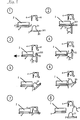
- Fig. 1 shows the conveying element 1 and the synchronously running Heating device 2. Both device parts 1, 2 form each other an adjustable height distance A, which is an unobstructed Pass through the extruded from the extruder unit, not shown Plate or slide 5 allowed.
- the tool 3 and the unit of the conveying element 1 and heater 2 are horizontally movable relative to each other. In addition, the tool 3 is horizontal compared to this Movement axis also arranged vertically and swiveling.
- a locking element 301 which is in contact with the free leg 30 can be moved.
- the upper shape 4 is indicated, the contour 41 of the contour 31 of the mold 3 corresponds.
- the semifinished product 5 is indicated, which in the illustration shown a slight protrusion in the direction on the mold 3.
- the molding tool 3 is at right angles under that Conveying element 1 pivots that the free leg 30 the protruding End of the semi-finished product 5 can accommodate.
- the locking element 301 is not yet closed in this position.
- Item 3 shows the closed locking element 301, which in this position on the free leg 30 of the molding tool 3 is opened and there defines the free end of the semi-finished product 5.
- Conveyor element 1 and heater 2 are after this attachment the free end of the semi-finished product 5 in the direction of the arrow to the left process and the molding tool 3 moves synchronously in Up arrow direction.
- the conveying element 1 retains the opposite direction during this movement process Funding movement at. With the help of this opposing funding movement of the conveying element 1 is the placement of the semi-finished product 5th supported on the contour 31 of the mold 3. With the beginning of declining movement of conveyor element 1 and heating device 2 at the same time the opposite conveying movement of the conveying element 1 3 begins the height shift of the mold 3, the in pos. 4 has reached its final state. This ends the lateral movement of conveyor element 1 and heating device 2, such as described for item 3. With this motion sequence is the molding tool 3 accommodated the deposit movement of the semi-finished product 5. That in temperature-softened state of the semifinished product 5 the contour in the front area of the mold 3 has already been adjusted.
- the semi-finished product 5 is the beginning of the swiveling movement of the molding tool 3 shown, which follows the movement of item 4.
- the semi-finished product 5 is increasingly in line with the previously free ones Circumferential surfaces of the contour 31 of the mold 3 are further applied.
- the conveying element 1 further promotes the semi-finished product 5 in the direction on the mold 3.
- the movement is lowered after the movement has been completed of the mold 3 now the upper mold 4 on the Shape tool 3 from.
- the contour 41 of the upper mold 4 is of the same contour designed to contour 31 of the mold 3.
- the upper form 4 takes 8, the molded part 6 from the contour 31 of the mold 3 and then releases this molded part 6 for further processing.
- the upper mold 4 and the molding tool 3 then move into the position 1 back and the process described can then again deploy.
- the molded part 6 can with this method with high performance and especially with almost uniform wall thicknesses. This reduces the material consumption in the manufacture of molded parts crucial. Decisive for the advantageous Production of the molded part 6 using the method according to the invention however, the slight stretching of the semi-finished product 5 by the one described Process flow.
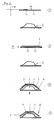
- item 1 shows the temperature-softened semi-finished product 5, which in the conveying direction of the arrow on the folding frame 10 with its folding axes 11 is moved.
- the tool is below the snap frame 10 3 parked in waiting position.
- the number of folding axes 11 can If necessary, be increased as required.
- Pos. 2 shows the semi-finished product 5 on the folding frame 10 with its folding axes 11, the tool 3 still in the waiting position below this combination persists.
- the tool 3 has a tool that runs in the direction of the arrow Lifting movement against the snap frame 10, which corresponds to the Tool contour in its folding axes 11 is folded down and the temperature softened Semi-finished product 5 on the folding axes 11 in the course of the bend preformed.
- the temperature-softened semi-finished product is ready for final shaping the contour of the mold 3 has been stored.
- the snap frame 10 with its folding axes 11 are then moved back to the starting position 1 and is used to hold a new strip of semi-finished products.
- the temperature-softened semi-finished product 5 is attached to the surface contour of the mold 3 Same shape by vacuum attack from inside or gas pressure from outside customized.
- the semi-finished product 5 is then described as for FIG. 1, removed from the mold 3 and further processing fed.
- the use of the folding frame according to the invention with its folding axes enables easy and inexpensive production of three-dimensional Moldings with approximately the same wall thickness, based on the entire molding. This molding production takes place in the described Variant without complex machine technology for swiveling and Axis shift of tool parts.
Landscapes
- Engineering & Computer Science (AREA)
- Mechanical Engineering (AREA)
- Blow-Moulding Or Thermoforming Of Plastics Or The Like (AREA)
Description
Hier wird ein Verfahren zur Herstellung eines strahlenförmigen Formlings mit in unterschiedlichen Ebenen verlaufenden Randbegrenzungen aus einer thermoplastischen Kunststoffplatte vorgestellt, bei dem der für die Herstellung des Formlings mit in unterschiedlichen Ebenen verlaufenden Randbegrenzungen notwendige Materialaufwand bei gleichzeitiger Verringerung der Verformungsarbeit herabgesetzt wird.
Dies soll dadurch erreicht werden, daß zum Abknicken nach unten einandergegenüberliegender Leisten des Spannrahmens, an in der Mitte tiefer als am Rand liegenden Stellen, abgestützt sind, ehe die Modellform nach oben in den Bereich der erwärmten Kunststofffolie gefahren wird. Gleichzeitig dazu werden die Enden der abknickbaren Leisten des Spannrahmens angehoben und im letzten Abschnitt des Anhebens ein Vakuum eingeschalten, das die Kunststoffolie vollständig an die Modellform ansaugt.
Dadurch muß das Verformungswerkzeug in der Formstation sehr weit öffnen, so daß die Formstation erheblich größer und aufwendiger dimensioniert werden muß. Ein weiterer entscheidender Nachteil wird darin gesehen, daß bei dem in diesem Verfahren verwendeten Formwerkzeug ebenfalls eine voll ausgeformte Matrize und eine ebensolche Patrize erforderlich sind.
- die temperaturerweichte Platte oder Folie wird über ein Förderelement in planer Erstreckung über ein höhenverstellbares und/oder schwenkbares Formwerkzeug gefördert;
- danach wird ein über das Förderelement hinausragendes freies Ende der temperaturerweichten Platte oder Folie durch ein Verriegelungselement auf dem freien Schenkel des Formwerkzeuges fixiert;
- die temperaturerweichte und so fixierte Platte oder Folie wird dann von dem Förderelement unter Beibehaltung der Förderbewegung bei kontinuierlich zurückfahrendem Förderelement abgegeben und auf dem Formwerkzeug abgelegt;
- das Formwerkzeug wird synchron dazu in einer überlagerten Hub- und Schwenkbewegung so bewegt, daß die temperaturerweichte Platte oder Folie bis zur Kontur des Formwerkzeuges geführt wird;
- die temperaturerweichte Platte oder Folie bedeckt dabei zunehmend und spannungsarm die Kontur des Formwerkzeuges;
- das Anlegen wird über Vakuum- und/oder Gasdruckkräfte unterstützt, die aus Öffnungen des Formwerkzeuges auf die temperaturerweichte Platte oder Folie einwirken.
- nach Abschluß des Formvorganges wird das Formteil abgekühlt und von dem Formwerkzeug abgenommen.
Claims (3)
- Verfahren zur Herstellung von Formteilen (6) aus thermoplastischen Platten oder Folien, wobei die Platten oder Folien aufgeheizt werden, wobei das Aufheizen der Platten oder Folien während des Transportes zum Formwerkzeug (3) erfolgt und durch das Formwerkzeug (3) die temperaturerweichten Platten oder Folien (5) verformt werden, gekennzeichnet durch die nachfolgenden Verfahrensschritte:die temperaturerweichte Platte oder Folie (5) wird über ein Förderelement (1) in planer Erstreckung über ein höhenverstellbares und/oder schwenkbares Formwerkzeug (3) gefördert;danach wird ein über das Förderelement 1 hinausragendes freies Ende der temperaturerweichten Platte oder Folie (5) durch ein Verriegelungselement (301) auf dem freien Schenkel (30) des Formwerkzeuges (3) fixiert;die temperaturerweichte und so fixierte Platte oder Folie (5) wird dann von dem Förderelement (1) unter Beibehaltung der Förderbewegung bei kontinuierlich zurückfahrendem Förderelement (1) abgegeben und auf dem Formwerkzeug (3) abgelegt;das Formwerkzeug (3) wird synchron dazu in einer überlagerten Hub- und Schwenkbewegung so bewegt, daß die temperaturerweichte Platte oder Folie (5) bis zur Kontur (31) des Formwerkzeuges (3) geführt wird;die temperaturerweichte Platte oder Folie (5) bedeckt dadurch zunehmend und spannungsarm die Kontur (31) des Formwerkzeuges (3);das Anlegen wird über Vakuum und/oder Gasdruckkräfte unterstützt, die aus Öffnungen des Formwerkzeuges (3) auf die temperaturerweichte Platte oder Folie (5) einwirken,nach Abschluß des Formvorganges wird das Formteil (6) abgekühlt und von dem Formwerkzeug (3) abgenommen.
- Verfahren nach Anspruch 1, dadurch gekennzeichnet, daß die Platte oder Folie (5) kontinuierlich auf das Förderelement (1) aufgebracht und durch eine mitlaufende Heizeinrichtung (2) auch noch während des Fördervorganges über das Formwerkzeug (3) und/oder auch während des Auflegens auf das Formwerkzeug (3), in dem temperaturerweichten Zustand gehalten wird.
- Verfahren nach Anspruch 1, dadurch gekennzeichnet, daß das abgekühlte Formteil (6) auf dem Formwerkzeug (3) von einer dreidimensionalen Oberform (4) übergriffen und abgenommen wird.
Applications Claiming Priority (2)
| Application Number | Priority Date | Filing Date | Title |
|---|---|---|---|
| DE19527691A DE19527691C2 (de) | 1994-11-25 | 1995-07-28 | Verfahren zur Herstellung von Formteilen |
| DE19527691 | 1995-07-28 |
Publications (2)
| Publication Number | Publication Date |
|---|---|
| EP0755770A1 EP0755770A1 (de) | 1997-01-29 |
| EP0755770B1 true EP0755770B1 (de) | 2000-01-26 |
Family
ID=7768068
Family Applications (1)
| Application Number | Title | Priority Date | Filing Date |
|---|---|---|---|
| EP95119379A Expired - Lifetime EP0755770B1 (de) | 1995-07-28 | 1995-12-08 | Verfahren zur Herstellung von Formteilen |
Country Status (2)
| Country | Link |
|---|---|
| EP (1) | EP0755770B1 (de) |
| AT (1) | ATE189158T1 (de) |
Family Cites Families (8)
| Publication number | Priority date | Publication date | Assignee | Title |
|---|---|---|---|---|
| FR1391998A (fr) * | 1964-01-31 | 1965-03-12 | Wilson Edward & Son | Perfectionnement aux dispositifs pour empiler ou transporter |
| DE2138112A1 (de) * | 1971-07-30 | 1973-02-08 | Siemag Siegener Masch Bau | Verfahren und vorrichtung zum verformen von platten aus thermoplastischem kunststoff |
| DE2418445C3 (de) * | 1974-04-17 | 1978-03-30 | Daimler-Benz Ag, 7000 Stuttgart | Verfahren und Vorrichtung zum schrittweise fortlaufenden Tiefziehen von in einem Spannrahmen gehaltenen und in diesem erwärmten Kunststoff-Folien |
| DE3103584A1 (de) * | 1981-02-03 | 1982-08-12 | Paul Kiefel Gmbh, 8228 Freilassing | Verfahren und thermoformmaschine zum formen von thermoplastischen platten, folien o.dgl. |
| CH671184A5 (de) * | 1986-11-19 | 1989-08-15 | Bucher Guyer Ag Masch | |
| FR2611577B1 (fr) * | 1987-03-06 | 1989-08-18 | Renault | Procede de conformation d'elements en matiere synthetique tels que des pieces de carrosserie pour vehicule automobile |
| IT1270562B (it) * | 1993-01-28 | 1997-05-06 | Cartigliano Off Spa | Metodo ed apparato per impilare pelli ed altri prodotti laminari flessibili |
| IT1261071B (it) * | 1993-07-02 | 1996-05-08 | Giorgio Ravera | Procedimento per depositare due strati sovrapposti di materiale temoplastico su un semistampo |
-
1995
- 1995-12-08 EP EP95119379A patent/EP0755770B1/de not_active Expired - Lifetime
- 1995-12-08 AT AT95119379T patent/ATE189158T1/de not_active IP Right Cessation
Also Published As
| Publication number | Publication date |
|---|---|
| EP0755770A1 (de) | 1997-01-29 |
| ATE189158T1 (de) | 2000-02-15 |
Similar Documents
| Publication | Publication Date | Title |
|---|---|---|
| DE69217870T2 (de) | Verfahren und Vorrichtung zum Giessen von Kunststoffverbundmaterial | |
| DE69214268T2 (de) | Verfahren zum formen mehrschichtiger gegenstände | |
| DE69218491T2 (de) | Verfahren und Vorrichtung zum Formen von Verbundkunststoffmaterial | |
| DE69010968T2 (de) | Verfahren zum Herstellen von etikettierten Artikeln, Verfahren zum Herstellen von etikettierten Behältern nach diesem Verfahren und Vorrichtung zum Vorformen von Etiketten zur Anwendung bei der Ausführung dieses Verfahrens. | |
| DE60311292T2 (de) | Verfahren zur herstellung von polyurethangegenständen und vorrichtung dafür | |
| DE2017552C3 (de) | Vorrichtung zum Herstellen eines Hohlkörpers aus thermoplastischen Folien | |
| EP0629487A1 (de) | Verfahren und Vorrichtung zum Herstellen von laminierten Kunststoff-Formteilen | |
| EP1854614B1 (de) | Formwerkzeug zum Tiefziehen eines Behälters aus einer erwärmten thermoplastischen Kunststofffolie | |
| EP2483049B1 (de) | Imd-form, spritzgussvorrichtung mit einer solchen imd-form sowie verfahren zur herstellung eines foliendekorierten kunststoffteils | |
| DE3446650A1 (de) | Verpackungsmaschine | |
| EP0363594B1 (de) | Verfahren und Vorrichtung zur Herstellung von Formteilen oder Gegenständen aus thermoverformbaren Kunststoffen nach dem Negativtiefziehverfahren | |
| DE3505828A1 (de) | Verfahren zur herstellung geformter kunststoffelemente sowie hierzu geeignete tiefziehvorrichtung | |
| DE69030975T2 (de) | Verfahren und vorrichtung zur kontinuierlichen umwandlung mit kontinuierlicher zufuhr | |
| DE3103038C2 (de) | Vorrichtung zum Herstellen eines im wesentlichen aus zwei Halbschalen gebildeten Hohlkörpers | |
| EP4100224B1 (de) | Spritzgusswerkzeug und verfahren zur herstellung von formteilen | |
| DE4108236C1 (en) | Prodn. of highly accurate and/or polished surfaces - involves warming plastic component to plasticise and form it in press tool | |
| DE4317235C2 (de) | Verfahren zur Herstellung von Formteilen durch Hinterspritzen von flächigem Dekormaterial | |
| EP2692504B1 (de) | Integrierte Kontaktheizung für thermoplastisch gebundene Matten im Spritzgießwerkzeug | |
| DE7906115U1 (de) | Vakuumformmaschine | |
| DE102004019293A1 (de) | Verfahren zur Formung von Kunstoffplatten | |
| DE19537737C2 (de) | Verfahren zur Herstellung eines Formkörpers aus einem faserverstärkten, thermoplastischen Material | |
| EP1582333B1 (de) | Verfahren und Vorrichtung zum Tiefziehen und Ausstanzen von Behältern aus einer thermoplastischen Kunstofffolie | |
| DE102004023582A1 (de) | Fertigungseinrichtung zur Herstellung einer IMG-Tiefziehfolie mit indirektem Hinterschäumungsprozess von Trägerteilen für Komponententeile, Armaturentafeln, Türverkleidungen und Abdeckungen, jeweils mit oder ohne Hinterschnitte | |
| DE69109171T2 (de) | Verfahren zur Herstellung von geformten Kunststoffartikeln. | |
| EP4155056A1 (de) | Formstation für eine tiefziehverpackungsmaschine, tiefziehverpackungsmaschine, deren verwendung sowie verfahren zum tiefziehen einer kunststofffolie |
Legal Events
| Date | Code | Title | Description |
|---|---|---|---|
| PUAI | Public reference made under article 153(3) epc to a published international application that has entered the european phase |
Free format text: ORIGINAL CODE: 0009012 |
|
| 17P | Request for examination filed |
Effective date: 19960914 |
|
| AK | Designated contracting states |
Kind code of ref document: A1 Designated state(s): AT CH DE FR GB LI NL |
|
| 17Q | First examination report despatched |
Effective date: 19981028 |
|
| GRAG | Despatch of communication of intention to grant |
Free format text: ORIGINAL CODE: EPIDOS AGRA |
|
| GRAG | Despatch of communication of intention to grant |
Free format text: ORIGINAL CODE: EPIDOS AGRA |
|
| GRAH | Despatch of communication of intention to grant a patent |
Free format text: ORIGINAL CODE: EPIDOS IGRA |
|
| GRAH | Despatch of communication of intention to grant a patent |
Free format text: ORIGINAL CODE: EPIDOS IGRA |
|
| GRAA | (expected) grant |
Free format text: ORIGINAL CODE: 0009210 |
|
| AK | Designated contracting states |
Kind code of ref document: B1 Designated state(s): AT CH DE FR GB LI NL |
|
| PG25 | Lapsed in a contracting state [announced via postgrant information from national office to epo] |
Ref country code: NL Free format text: LAPSE BECAUSE OF FAILURE TO SUBMIT A TRANSLATION OF THE DESCRIPTION OR TO PAY THE FEE WITHIN THE PRESCRIBED TIME-LIMIT Effective date: 20000126 Ref country code: FR Free format text: LAPSE BECAUSE OF FAILURE TO SUBMIT A TRANSLATION OF THE DESCRIPTION OR TO PAY THE FEE WITHIN THE PRESCRIBED TIME-LIMIT Effective date: 20000126 |
|
| REF | Corresponds to: |
Ref document number: 189158 Country of ref document: AT Date of ref document: 20000215 Kind code of ref document: T |
|
| REG | Reference to a national code |
Ref country code: CH Ref legal event code: EP |
|
| REF | Corresponds to: |
Ref document number: 59507700 Country of ref document: DE Date of ref document: 20000302 |
|
| GBT | Gb: translation of ep patent filed (gb section 77(6)(a)/1977) |
Effective date: 20000411 |
|
| EN | Fr: translation not filed | ||
| NLV1 | Nl: lapsed or annulled due to failure to fulfill the requirements of art. 29p and 29m of the patents act | ||
| PLBE | No opposition filed within time limit |
Free format text: ORIGINAL CODE: 0009261 |
|
| STAA | Information on the status of an ep patent application or granted ep patent |
Free format text: STATUS: NO OPPOSITION FILED WITHIN TIME LIMIT |
|
| PG25 | Lapsed in a contracting state [announced via postgrant information from national office to epo] |
Ref country code: GB Free format text: LAPSE BECAUSE OF NON-PAYMENT OF DUE FEES Effective date: 20001208 Ref country code: AT Free format text: LAPSE BECAUSE OF NON-PAYMENT OF DUE FEES Effective date: 20001208 |
|
| PG25 | Lapsed in a contracting state [announced via postgrant information from national office to epo] |
Ref country code: LI Free format text: LAPSE BECAUSE OF NON-PAYMENT OF DUE FEES Effective date: 20001231 Ref country code: CH Free format text: LAPSE BECAUSE OF NON-PAYMENT OF DUE FEES Effective date: 20001231 |
|
| 26N | No opposition filed | ||
| GBPC | Gb: european patent ceased through non-payment of renewal fee |
Effective date: 20001208 |
|
| REG | Reference to a national code |
Ref country code: CH Ref legal event code: PL |
|
| PG25 | Lapsed in a contracting state [announced via postgrant information from national office to epo] |
Ref country code: DE Free format text: LAPSE BECAUSE OF NON-PAYMENT OF DUE FEES Effective date: 20011002 |