EP0752186B1 - Replay of recorded different playback modes of a video signal - Google Patents
Replay of recorded different playback modes of a video signal Download PDFInfo
- Publication number
- EP0752186B1 EP0752186B1 EP95912344A EP95912344A EP0752186B1 EP 0752186 B1 EP0752186 B1 EP 0752186B1 EP 95912344 A EP95912344 A EP 95912344A EP 95912344 A EP95912344 A EP 95912344A EP 0752186 B1 EP0752186 B1 EP 0752186B1
- Authority
- EP
- European Patent Office
- Prior art keywords
- sequential
- sequential file
- file
- played
- files
- Prior art date
- Legal status (The legal status is an assumption and is not a legal conclusion. Google has not performed a legal analysis and makes no representation as to the accuracy of the status listed.)
- Expired - Lifetime
Links
Images
Classifications
-
- H—ELECTRICITY
- H04—ELECTRIC COMMUNICATION TECHNIQUE
- H04N—PICTORIAL COMMUNICATION, e.g. TELEVISION
- H04N5/00—Details of television systems
- H04N5/76—Television signal recording
- H04N5/78—Television signal recording using magnetic recording
- H04N5/782—Television signal recording using magnetic recording on tape
- H04N5/783—Adaptations for reproducing at a rate different from the recording rate
-
- H—ELECTRICITY
- H04—ELECTRIC COMMUNICATION TECHNIQUE
- H04N—PICTORIAL COMMUNICATION, e.g. TELEVISION
- H04N19/00—Methods or arrangements for coding, decoding, compressing or decompressing digital video signals
- H04N19/50—Methods or arrangements for coding, decoding, compressing or decompressing digital video signals using predictive coding
- H04N19/587—Methods or arrangements for coding, decoding, compressing or decompressing digital video signals using predictive coding involving temporal sub-sampling or interpolation, e.g. decimation or subsequent interpolation of pictures in a video sequence
-
- H—ELECTRICITY
- H04—ELECTRIC COMMUNICATION TECHNIQUE
- H04N—PICTORIAL COMMUNICATION, e.g. TELEVISION
- H04N19/00—Methods or arrangements for coding, decoding, compressing or decompressing digital video signals
- H04N19/60—Methods or arrangements for coding, decoding, compressing or decompressing digital video signals using transform coding
- H04N19/61—Methods or arrangements for coding, decoding, compressing or decompressing digital video signals using transform coding in combination with predictive coding
-
- H—ELECTRICITY
- H04—ELECTRIC COMMUNICATION TECHNIQUE
- H04N—PICTORIAL COMMUNICATION, e.g. TELEVISION
- H04N19/00—Methods or arrangements for coding, decoding, compressing or decompressing digital video signals
- H04N19/85—Methods or arrangements for coding, decoding, compressing or decompressing digital video signals using pre-processing or post-processing specially adapted for video compression
-
- H—ELECTRICITY
- H04—ELECTRIC COMMUNICATION TECHNIQUE
- H04N—PICTORIAL COMMUNICATION, e.g. TELEVISION
- H04N7/00—Television systems
- H04N7/16—Analogue secrecy systems; Analogue subscription systems
- H04N7/173—Analogue secrecy systems; Analogue subscription systems with two-way working, e.g. subscriber sending a programme selection signal
- H04N7/17309—Transmission or handling of upstream communications
- H04N7/17336—Handling of requests in head-ends
-
- H—ELECTRICITY
- H04—ELECTRIC COMMUNICATION TECHNIQUE
- H04N—PICTORIAL COMMUNICATION, e.g. TELEVISION
- H04N9/00—Details of colour television systems
- H04N9/79—Processing of colour television signals in connection with recording
- H04N9/80—Transformation of the television signal for recording, e.g. modulation, frequency changing; Inverse transformation for playback
- H04N9/804—Transformation of the television signal for recording, e.g. modulation, frequency changing; Inverse transformation for playback involving pulse code modulation of the colour picture signal components
- H04N9/8042—Transformation of the television signal for recording, e.g. modulation, frequency changing; Inverse transformation for playback involving pulse code modulation of the colour picture signal components involving data reduction
-
- H—ELECTRICITY
- H04—ELECTRIC COMMUNICATION TECHNIQUE
- H04N—PICTORIAL COMMUNICATION, e.g. TELEVISION
- H04N9/00—Details of colour television systems
- H04N9/79—Processing of colour television signals in connection with recording
- H04N9/80—Transformation of the television signal for recording, e.g. modulation, frequency changing; Inverse transformation for playback
- H04N9/82—Transformation of the television signal for recording, e.g. modulation, frequency changing; Inverse transformation for playback the individual colour picture signal components being recorded simultaneously only
- H04N9/8205—Transformation of the television signal for recording, e.g. modulation, frequency changing; Inverse transformation for playback the individual colour picture signal components being recorded simultaneously only involving the multiplexing of an additional signal and the colour video signal
- H04N9/8227—Transformation of the television signal for recording, e.g. modulation, frequency changing; Inverse transformation for playback the individual colour picture signal components being recorded simultaneously only involving the multiplexing of an additional signal and the colour video signal the additional signal being at least another television signal
Definitions
- This invention relates to the replay of video signals and in particular to the replay of different playback modes of a moving picture recorded on a record medium.
- the time taken to access and retrieve a stored video signal can be prohibitive to the provision of interactive video services in which a consumer selects a particular service from a range of available services.
- the access time is increased dramatically if the stored video signal requires further processing before it can be output to a display device.
- a recent development in such services is the provision of home entertainment or shopping services in which a consumer selects a service from a range on offer and the relevant video signal is transmitted to the consumer's premises from a central server.
- a consumer uses a central video server in the manner of a remote video cassette player. Consumers therefore expect the same facilities as they would have on their own video cassette player e.g. the facility to play, pause, stop, fast forward and reverse.
- processors which provide these facilities.
- the coded video signal stored at the remote server is transmitted to the consumer.
- a local decoder at the consumer's premises decodes the incoming signal to produce a video image on a television set.
- a pause signal is sent to the server which, in response, sends a signal to the consumer's decoder indicating that the frame is unchanged.
- the coded signal When fast forward or reverse is selected however, the coded signal must be processed further by the video server.
- a signal When a consumer requests fast forward, a signal is sent to the server which then transmits every. say, fourth frame of the coded signal. If the video signal is in an uncompressed format. the server has to locate the beginning of every fourth frame in the video signal and transmit these to the consumer. This is very processor and time intensive and may result in a delay that would be unacceptable to consumers.
- the fifth frame of the picture may have been coded with reference to the fourth frame.
- each frame to be sent must be recoded with respect to the preceding frame to be sent. This is very processor- and time-intensive.
- intraframe coded frames intrapictures
- they could be sent in the reverse order for the fast reverse mode. Examples of such systems are described in Japanese patent application publication nos. JP-A-3-66272 and JP-A-3-85974.
- the server on receiving a fast forward request signal, have to search the coded signal for intrapictures but the bit rate of the resulting signal will be increased as compared to the play mode since the intrapictures include relatively little compression.
- the decoder at the consumer's premises therefore has to be able to manage excessive changes in the bit rate.
- European Patent Application EP-A-0 598 516 which is prior art pursuant to Article 54(3) EPC, discloses a motion picture reproducing apparatus comprising an index image store for storing a plurality of index images extracted from a series of motion pictures, including timing information relating an index image to a corresponding position on a motion picture storage medium.
- a video replay apparatus comprising reproducing means for playing, as different playback modes of a moving picture, respective separately accessible sequential data files of digital video signals comprising different sequences of frames of said moving picture recorded on a record medium, switching means for switching between one of said sequential files being played and a further one of said sequential files, a position counter for recording a current position on a sequential file being played corresponding to a current position in a moving picture and determining means responsive, on switching by the switching means from a first sequential file being played to a second sequential file, to determine from the position counter and from information stored on the record medium relating to the lengths of the files, a position on said second sequential file corresponding to the current position in the moving picture and to initiate playing by the reproduction means commencing from the determined position on said second sequential file.
- the determining means are also responsive on switching by the switching means from the second sequential file being played to the first sequential file to determine, from a current position on said second sequential file as recorded by the position counter corresponding to a current position in the moving picture and from said information stored on the record medium, a position on said first sequential file corresponding to the current position in said moving picture.
- the determining means responsive to said information stored on the record medium relating to the lengths of the sequential files, calculates the proportion of the length of the file being played that is represented by the current position in said file and calculates the position in the said other file that corresponds to the same proportion of the length of the other file.
- the file being played represents a play mode of a moving picture and the current position is 25% through the sequential file
- the corresponding position in a second sequential file representing a fast forward mode is 25% through the second file.
- the corresponding position in the reverse mode can be determined by calculating the remaining proportion of the length of the file being played and calculating the position in the said other file that corresponds to the remaining proportion of the file being played. Hence if the player is 75% of the way through the first file, the corresponding position is 25% of the way through the second file.
- the video replay apparatus may be used in an interactive video system in which the record medium is accessed in response to a signal from a remote consumer and a relevant sequence is output for reception by a decoder at the consumer's premises.
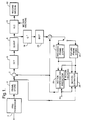
- Figure 1 shows a coder 2 for coding a digital video signal according to the MPEG-1 standard.
- This standard relates to the coding of video at bit rates around 1.5 Mbit/s.
- the MPEG-1 standard features intrapictures and predicted pictures, which may be coded with reference to a preceding intrapicture or a preceding predicted picture.
- the MPEG-1 standard also features interpolated pictures which are coded with reference to a past and/or a future intrapicture or predicted picture.
- the coder of Figure 1 is intended to generate coded sequences representing three playback modes of the input video signal: play, fast forward and fast reverse.
- To generate a fast forward or fast reverse sequence at n times normal play speed every nth frame of the input video signal is coded.
- a fast forward speed that is 3 times normal play speed corresponds to every third input frame after the first being coded and, similarly, the fast reverse speed corresponds to every third input frame, in the fast reverse order, being coded.
- a digital video signal (representing a moving picture) is input to a pre-processor 3 which selects the frames of the video signal which are to be coded.
- the pre-processor does not need to reorganise the input signal and thus the frames are passed directly to a current frame store 4.
- the pre-processor must select the frames to be coded. For instance, to generate a sequence representing a fast forward playback mode at three times the normal play mode, the pre-processor 3 outputs the first and every third frame thereafter to the current frame store 4.
- the pre-processor selects the relevant frames from the input video signal, when it is played in reverse.
- the frames selected by the pre-processor 3 are input, frame by frame, to the current frame store 4 which stores a single input frame of the video signal.
- the first input frame k of the video signal is coded as an intrapicture and thus is the only input to a subtracter 5.
- the output of the subtracter 5 is input to a DCT transformer 6 which transforms the input data into DCT coefficients which are then quantised by a quantiser 8.
- the data then passes to a variable length coder (VLC) 10 which codes the data from the quantiser.
- VLC variable length coder
- the resulting coded data for the first frame k is then stored on a record medium 12.
- Data from the quantiser 8 also passes to an inverse quantiser 18 and an inverse DCT 20 to reproduce the current frame of the input signal.
- This frame is stored in a previous frame store 22.
- a second frame store 24 stores subsequent frames which, together with the frame stored in the previous frame store 22, can be used to code a frame using bidirectional coding techniques, as is required in the MPEG-1 standard. Following frames of the input signal are coded using forward prediction, bidirectional prediction or intraframe techniques.
- every frame k, k+1, k+2... input to the pre-processor is coded.
- the output of the inverse DCT 20 is stored in the previous frame store 22.
- the contents of the previous frame store 22 and the current frame store 4 are input to a motion estimator 26 which calculates the motion vectors for the current frame k+1.
- the motion vectors are input to a motion compensation predictor 28 together with the contents of the previous frame store 22 to produce a prediction of the current frame.
- This predicted frame is subtracted from the actual current frame of the input signal by the subtracter 5 and the resulting difference signal processed by the DCT 6 and the quantiser 8.
- the signal is then coded, as described above, by the VLC 10 which also multiplexes the coded difference signal with the motion vectors, quantisation parameters and inter/intra classification necessary for subsequent decoding.
- This coded data is then stored on the record medium 12.
- the processing of the input video signal continues on a frame by frame basis until the whole video signal is coded.
- the record medium 12 will then contain a sequence of coded data representing the play mode of the video signal.
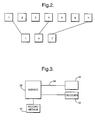
- every third frame m+3, m+6, m+9.... of the video signal after the first frame m is coded.
- the predicted frame calculated from the contents of the previous frame store 22 (i.e the first frame m) and the motion estimator 26 is subtracted by subtracter 5 from the actual fourth frame m+3 stored in current frame store 4.
- the difference signal produced is then processed by the DCT 6, the quantiser 8 and the VLC 10 and stored on the record medium 12. This coding process continues for every third frame m+6, m+9... as schematically illustrated in Figure 2. the intervening frames being ignored.
- every third frame of the reversed video signal is coded.
- frames m-3, m-6, m-9.... are coded.
- This coded sequence is also stored on the record medium 12.
- sequences of coded data are generated independently of each other: one representing the play mode, one representing the fast forward mode and one representing the fast reverse mode. All the sequences have the same constant average bit rate since they are encoded using the same coding technique.
- FIG. 3 shows a system for supplying an interactive service, for example video-on-demand.
- a server 30, for instance a mainframe computer, is connected to a number of remote decoders 32 located at consumers' premises via telecommunication links 34.
- the server 30 receives signals from the consumers and accesses a record medium 12 on which are stored files of coded data generated as described above.
- the server accesses the relevant file and transmits the data to the consumer's decoder 32 via the link 34.
- the decoder 32 at the consumer's premises decodes the coded data and displays the resulting video signal on a television set.
- the server calculates the position reached within the fast forward sequence and calculates the corresponding position within the play sequence, as described above.
- pos reverse (length play - pos play ) x length reverse /length play
Landscapes
- Engineering & Computer Science (AREA)
- Multimedia (AREA)
- Signal Processing (AREA)
- Television Signal Processing For Recording (AREA)
- Compression Or Coding Systems Of Tv Signals (AREA)
- Two-Way Televisions, Distribution Of Moving Picture Or The Like (AREA)
- Signal Processing For Digital Recording And Reproducing (AREA)
- Television Systems (AREA)
- Color Television Systems (AREA)
Applications Claiming Priority (4)
| Application Number | Priority Date | Filing Date | Title |
|---|---|---|---|
| EP94302102 | 1994-03-23 | ||
| SG1996004101A SG43131A1 (en) | 1994-03-23 | 1994-03-23 | Video signal coding |
| EP94302102 | 1994-03-23 | ||
| PCT/GB1995/000657 WO1995026108A1 (en) | 1994-03-23 | 1995-03-23 | Video signal coding |
Publications (2)
| Publication Number | Publication Date |
|---|---|
| EP0752186A1 EP0752186A1 (en) | 1997-01-08 |
| EP0752186B1 true EP0752186B1 (en) | 1999-08-11 |
Family
ID=26137001
Family Applications (1)
| Application Number | Title | Priority Date | Filing Date |
|---|---|---|---|
| EP95912344A Expired - Lifetime EP0752186B1 (en) | 1994-03-23 | 1995-03-23 | Replay of recorded different playback modes of a video signal |
Country Status (11)
| Country | Link |
|---|---|
| US (1) | US5864646A (enExample) |
| EP (1) | EP0752186B1 (enExample) |
| JP (1) | JP3866281B2 (enExample) |
| CN (1) | CN1123229C (enExample) |
| AU (1) | AU694970B2 (enExample) |
| CA (1) | CA2186027C (enExample) |
| DE (1) | DE69511386T2 (enExample) |
| ES (1) | ES2137501T3 (enExample) |
| NZ (2) | NZ329780A (enExample) |
| SG (1) | SG43131A1 (enExample) |
| WO (1) | WO1995026108A1 (enExample) |
Families Citing this family (19)
| Publication number | Priority date | Publication date | Assignee | Title |
|---|---|---|---|---|
| US7448063B2 (en) | 1991-11-25 | 2008-11-04 | Actv, Inc. | Digital interactive system for providing full interactivity with live programming events |
| US7079176B1 (en) | 1991-11-25 | 2006-07-18 | Actv, Inc. | Digital interactive system for providing full interactivity with live programming events |
| US6965724B1 (en) | 1995-03-30 | 2005-11-15 | Thomson Licensing S.A. | Trick-play modes for pre-encoded video |
| US6064794A (en) * | 1995-03-30 | 2000-05-16 | Thomson Licensing S.A. | Trick-play control for pre-encoded video |
| GB9506493D0 (en) * | 1995-03-30 | 1995-05-17 | Thomson Consumer Electronics | The implementation of trick-play modes for pre-encoded video |
| JP3934693B2 (ja) * | 1995-03-31 | 2007-06-20 | ソニー株式会社 | 映像検索装置 |
| JP3321331B2 (ja) * | 1995-04-07 | 2002-09-03 | シャープ株式会社 | 画像蓄積通信装置 |
| DE19543017A1 (de) * | 1995-11-18 | 1997-05-22 | Thomson Brandt Gmbh | Verfahren zur Erzeugung von Bildsequenzen für einen schnellen Suchvorgang bei einem Filmabspielgerät und Vorrichtung zur Durchführung des Verfahrens |
| US6065050A (en) * | 1996-06-05 | 2000-05-16 | Sun Microsystems, Inc. | System and method for indexing between trick play and normal play video streams in a video delivery system |
| EP2131586A1 (en) * | 1996-11-27 | 2009-12-09 | Sony Europe (Belgium) NV | Method and apparatus for delivering data, including pattern detection |
| WO1998026604A1 (en) * | 1996-12-10 | 1998-06-18 | British Telecommunications Public Limited Company | Video coding |
| KR100269398B1 (ko) * | 1997-08-30 | 2000-10-16 | 구자홍 | 반복재생을지원하는엠펙비디오디코딩장치및그방법 |
| EP1331816B1 (en) * | 1999-11-10 | 2004-09-22 | Thomson Licensing S.A. | Method for editing source video to fast motion on the recordable media |
| CN1273989C (zh) * | 1999-11-10 | 2006-09-06 | 汤姆森特许公司 | 在dvd录像机中实时产生菜单的方法 |
| US6434320B1 (en) * | 2000-10-13 | 2002-08-13 | Comtrak Technologies, Llc | Method of searching recorded digital video for areas of activity |
| US7305691B2 (en) | 2001-05-07 | 2007-12-04 | Actv, Inc. | System and method for providing targeted programming outside of the home |
| FR2827054B1 (fr) * | 2001-07-06 | 2003-12-12 | Nec Technologies Uk Ltd | Procede de controle et de gestion de l'etat de la batterie d'un appareil multimedia portable |
| US7020382B2 (en) * | 2001-07-12 | 2006-03-28 | Thomson Licensing | Modifying video by inserting shadow intra pictures |
| JP3825719B2 (ja) * | 2002-06-13 | 2006-09-27 | 三洋電機株式会社 | 画像再生方法、画像再生装置、および画像記録装置 |
Family Cites Families (15)
| Publication number | Priority date | Publication date | Assignee | Title |
|---|---|---|---|---|
| DE3884992T2 (de) * | 1987-04-30 | 1994-05-19 | Nippon Denki Home Electronics | Bildverarbeitungssystem für eine Folge kodierter Signale, die einer Prädiktionskodierung verschiedener Arten unterworfen sind. |
| JPH0636182B2 (ja) * | 1988-02-06 | 1994-05-11 | 大日本スクリーン製造株式会社 | 画像ファイリング・検索方法および装置 |
| JP2797404B2 (ja) * | 1989-04-20 | 1998-09-17 | ソニー株式会社 | 動画像データの記録方式 |
| JP2892696B2 (ja) * | 1989-08-05 | 1999-05-17 | 松下電器産業株式会社 | 動画像信号記録装置と動画像信号再生装置 |
| JPH0385974A (ja) * | 1989-08-30 | 1991-04-11 | Fujitsu Ltd | 動画像記録制御方式 |
| US5337199A (en) * | 1990-07-06 | 1994-08-09 | Hitachi, Ltd. | Digital transmission signal processing system and recording/reproducing system |
| CA2022302C (en) * | 1990-07-30 | 1995-02-28 | Douglas J. Ballantyne | Method and apparatus for distribution of movies |
| US5440401A (en) * | 1990-09-14 | 1995-08-08 | Eastman Kodak Company | Image database incorporating low resolution index image data |
| US5282049A (en) * | 1991-02-08 | 1994-01-25 | Olympus Optical Co., Ltd. | Moving-picture data digital recording and reproducing apparatuses |
| US5546191A (en) * | 1992-02-25 | 1996-08-13 | Mitsubishi Denki Kabushiki Kaisha | Recording and reproducing apparatus |
| EP0598516A3 (en) * | 1992-11-05 | 1996-07-03 | Sony Corp | Recording and playback of moving pictures. |
| JP2855067B2 (ja) * | 1992-11-28 | 1999-02-10 | 三星電子株式会社 | デジタルvcrの画像記録方法 |
| EP0600495B1 (en) * | 1992-12-04 | 2003-03-12 | Matsushita Electric Industrial Co., Ltd. | Apparatus for recording and reproducing digital video signal |
| US5576902A (en) * | 1993-01-13 | 1996-11-19 | Hitachi America, Ltd. | Method and apparatus directed to processing trick play video data to compensate for intentionally omitted data |
| US5543932A (en) * | 1993-05-31 | 1996-08-06 | Sony Corporation | Digital video signal recording apparatus and digital video signal reproducing apparatus |
-
1994
- 1994-03-23 SG SG1996004101A patent/SG43131A1/en unknown
-
1995
- 1995-03-23 CA CA002186027A patent/CA2186027C/en not_active Expired - Lifetime
- 1995-03-23 CN CN95192215A patent/CN1123229C/zh not_active Expired - Lifetime
- 1995-03-23 NZ NZ329780A patent/NZ329780A/xx not_active IP Right Cessation
- 1995-03-23 WO PCT/GB1995/000657 patent/WO1995026108A1/en not_active Ceased
- 1995-03-23 ES ES95912344T patent/ES2137501T3/es not_active Expired - Lifetime
- 1995-03-23 NZ NZ282452A patent/NZ282452A/xx not_active IP Right Cessation
- 1995-03-23 EP EP95912344A patent/EP0752186B1/en not_active Expired - Lifetime
- 1995-03-23 JP JP52450295A patent/JP3866281B2/ja not_active Expired - Lifetime
- 1995-03-23 AU AU19559/95A patent/AU694970B2/en not_active Expired
- 1995-03-23 DE DE69511386T patent/DE69511386T2/de not_active Expired - Lifetime
-
1997
- 1997-07-02 US US08/886,924 patent/US5864646A/en not_active Expired - Lifetime
Also Published As
| Publication number | Publication date |
|---|---|
| CA2186027A1 (en) | 1995-09-28 |
| SG43131A1 (en) | 1997-10-17 |
| DE69511386T2 (de) | 2000-02-24 |
| CA2186027C (en) | 2001-04-24 |
| NZ329780A (en) | 1999-07-29 |
| CN1123229C (zh) | 2003-10-01 |
| JPH09510590A (ja) | 1997-10-21 |
| US5864646A (en) | 1999-01-26 |
| ES2137501T3 (es) | 1999-12-16 |
| AU1955995A (en) | 1995-10-09 |
| DE69511386D1 (de) | 1999-09-16 |
| NZ282452A (en) | 1998-12-23 |
| JP3866281B2 (ja) | 2007-01-10 |
| WO1995026108A1 (en) | 1995-09-28 |
| EP0752186A1 (en) | 1997-01-08 |
| CN1144590A (zh) | 1997-03-05 |
| AU694970B2 (en) | 1998-08-06 |
Similar Documents
| Publication | Publication Date | Title |
|---|---|---|
| CA2186027C (en) | Video signal coding | |
| EP0701756B1 (en) | Audio-visual presentation system | |
| US4807053A (en) | Method and apparatus for recording and/or reproducing video information in/for a record carrier, and record carrier obtained by means of the method | |
| EP0812112B1 (en) | System and method for indexing between trick play and normal play video streams in a video delivery system | |
| USRE44091E1 (en) | Picture encoding method, picture encoding apparatus and picture recording medium | |
| US20080056369A1 (en) | Method of and system for recording image information and method of and system for encoding image information | |
| EP0596423A2 (en) | Layer encoding/decoding apparatus for input non-interlace video signal | |
| EP0627854A2 (en) | Digital video signal recording/reproducing apparatus | |
| EP0766476B1 (en) | Multi-media communication system and method therefor | |
| EP1329101A2 (en) | Trick-mode processing for digital video | |
| JPH05153577A (ja) | 動画像復号化装置 | |
| EP0643537B1 (en) | Method for transmitting, storing and playing back a plurality of television signals | |
| US5982431A (en) | Variable bit rate MPEG2 video decoder having variable speed fast playback function | |
| JP3072971B2 (ja) | ビデオ・オン・デマンドシステムとそれを構成するビデオサーバ装置及び端末装置 | |
| GB2328825A (en) | Repetitive video replay in video on demand system | |
| US6128340A (en) | Decoder system with 2.53 frame display buffer | |
| KR100337724B1 (ko) | 비디오신호부호화방법및비디오부호/복호기 | |
| JPH1198513A (ja) | 動画像符号化/復号化装置 | |
| JPH0678279A (ja) | ピクチャ生成方式 | |
| JP3176169B2 (ja) | 符号化映像データ転送装置 | |
| JP3177366B2 (ja) | 高速画像再生システム | |
| KR0136026B1 (ko) | 동화상 재생장치에서의 고속탐색구현방법(method for searching high speed in a moving picture play-back apparatus) | |
| JP3265146B2 (ja) | ビデオサーバ装置 | |
| JPH0779488B2 (ja) | 圧縮立体画像デ−タ再生システム | |
| JP2003052013A (ja) | 画像処理装置 |
Legal Events
| Date | Code | Title | Description |
|---|---|---|---|
| PUAI | Public reference made under article 153(3) epc to a published international application that has entered the european phase |
Free format text: ORIGINAL CODE: 0009012 |
|
| 17P | Request for examination filed |
Effective date: 19960919 |
|
| AK | Designated contracting states |
Kind code of ref document: A1 Designated state(s): BE CH DE DK ES FR GB IT LI NL SE |
|
| 17Q | First examination report despatched |
Effective date: 19971117 |
|
| GRAG | Despatch of communication of intention to grant |
Free format text: ORIGINAL CODE: EPIDOS AGRA |
|
| GRAG | Despatch of communication of intention to grant |
Free format text: ORIGINAL CODE: EPIDOS AGRA |
|
| GRAH | Despatch of communication of intention to grant a patent |
Free format text: ORIGINAL CODE: EPIDOS IGRA |
|
| GRAH | Despatch of communication of intention to grant a patent |
Free format text: ORIGINAL CODE: EPIDOS IGRA |
|
| GRAA | (expected) grant |
Free format text: ORIGINAL CODE: 0009210 |
|
| AK | Designated contracting states |
Kind code of ref document: B1 Designated state(s): BE CH DE DK ES FR GB IT LI NL SE |
|
| PG25 | Lapsed in a contracting state [announced via postgrant information from national office to epo] |
Ref country code: SE Free format text: THE PATENT HAS BEEN ANNULLED BY A DECISION OF A NATIONAL AUTHORITY Effective date: 19990811 |
|
| REG | Reference to a national code |
Ref country code: CH Ref legal event code: EP |
|
| REF | Corresponds to: |
Ref document number: 69511386 Country of ref document: DE Date of ref document: 19990916 |
|
| ITF | It: translation for a ep patent filed | ||
| PG25 | Lapsed in a contracting state [announced via postgrant information from national office to epo] |
Ref country code: DK Free format text: LAPSE BECAUSE OF FAILURE TO SUBMIT A TRANSLATION OF THE DESCRIPTION OR TO PAY THE FEE WITHIN THE PRESCRIBED TIME-LIMIT Effective date: 19991111 |
|
| ET | Fr: translation filed | ||
| REG | Reference to a national code |
Ref country code: CH Ref legal event code: NV Representative=s name: JACOBACCI & PERANI S.A. |
|
| REG | Reference to a national code |
Ref country code: ES Ref legal event code: FG2A Ref document number: 2137501 Country of ref document: ES Kind code of ref document: T3 |
|
| PLBE | No opposition filed within time limit |
Free format text: ORIGINAL CODE: 0009261 |
|
| STAA | Information on the status of an ep patent application or granted ep patent |
Free format text: STATUS: NO OPPOSITION FILED WITHIN TIME LIMIT |
|
| 26N | No opposition filed | ||
| REG | Reference to a national code |
Ref country code: GB Ref legal event code: IF02 |
|
| PGFP | Annual fee paid to national office [announced via postgrant information from national office to epo] |
Ref country code: ES Payment date: 20100326 Year of fee payment: 16 Ref country code: CH Payment date: 20100325 Year of fee payment: 16 |
|
| PGFP | Annual fee paid to national office [announced via postgrant information from national office to epo] |
Ref country code: IT Payment date: 20100327 Year of fee payment: 16 |
|
| PGFP | Annual fee paid to national office [announced via postgrant information from national office to epo] |
Ref country code: BE Payment date: 20100506 Year of fee payment: 16 |
|
| BERE | Be: lapsed |
Owner name: BRITISH *TELECOMMUNICATIONS P.L.C. Effective date: 20110331 |
|
| REG | Reference to a national code |
Ref country code: CH Ref legal event code: PL |
|
| PG25 | Lapsed in a contracting state [announced via postgrant information from national office to epo] |
Ref country code: BE Free format text: LAPSE BECAUSE OF NON-PAYMENT OF DUE FEES Effective date: 20110331 |
|
| PG25 | Lapsed in a contracting state [announced via postgrant information from national office to epo] |
Ref country code: LI Free format text: LAPSE BECAUSE OF NON-PAYMENT OF DUE FEES Effective date: 20110331 Ref country code: CH Free format text: LAPSE BECAUSE OF NON-PAYMENT OF DUE FEES Effective date: 20110331 |
|
| PG25 | Lapsed in a contracting state [announced via postgrant information from national office to epo] |
Ref country code: IT Free format text: LAPSE BECAUSE OF NON-PAYMENT OF DUE FEES Effective date: 20110323 |
|
| REG | Reference to a national code |
Ref country code: ES Ref legal event code: FD2A Effective date: 20120424 |
|
| PG25 | Lapsed in a contracting state [announced via postgrant information from national office to epo] |
Ref country code: ES Free format text: LAPSE BECAUSE OF NON-PAYMENT OF DUE FEES Effective date: 20110324 |
|
| PGFP | Annual fee paid to national office [announced via postgrant information from national office to epo] |
Ref country code: NL Payment date: 20140319 Year of fee payment: 20 Ref country code: DE Payment date: 20140328 Year of fee payment: 20 |
|
| PGFP | Annual fee paid to national office [announced via postgrant information from national office to epo] |
Ref country code: FR Payment date: 20140319 Year of fee payment: 20 |
|
| PGFP | Annual fee paid to national office [announced via postgrant information from national office to epo] |
Ref country code: GB Payment date: 20140319 Year of fee payment: 20 |
|
| REG | Reference to a national code |
Ref country code: DE Ref legal event code: R071 Ref document number: 69511386 Country of ref document: DE |
|
| REG | Reference to a national code |
Ref country code: DE Ref legal event code: R071 Ref document number: 69511386 Country of ref document: DE |
|
| REG | Reference to a national code |
Ref country code: NL Ref legal event code: V4 Effective date: 20150323 |
|
| REG | Reference to a national code |
Ref country code: GB Ref legal event code: PE20 Expiry date: 20150322 |
|
| PG25 | Lapsed in a contracting state [announced via postgrant information from national office to epo] |
Ref country code: GB Free format text: LAPSE BECAUSE OF EXPIRATION OF PROTECTION Effective date: 20150322 |