EP0750415B1 - Image processing method and apparatus - Google Patents
Image processing method and apparatus Download PDFInfo
- Publication number
- EP0750415B1 EP0750415B1 EP96304563A EP96304563A EP0750415B1 EP 0750415 B1 EP0750415 B1 EP 0750415B1 EP 96304563 A EP96304563 A EP 96304563A EP 96304563 A EP96304563 A EP 96304563A EP 0750415 B1 EP0750415 B1 EP 0750415B1
- Authority
- EP
- European Patent Office
- Prior art keywords
- image
- partial image
- horizontal
- image areas
- vertical
- Prior art date
- Legal status (The legal status is an assumption and is not a legal conclusion. Google has not performed a legal analysis and makes no representation as to the accuracy of the status listed.)
- Expired - Lifetime
Links
Images



Classifications
-
- G—PHYSICS
- G06—COMPUTING OR CALCULATING; COUNTING
- G06T—IMAGE DATA PROCESSING OR GENERATION, IN GENERAL
- G06T3/00—Geometric image transformations in the plane of the image
- G06T3/60—Rotation of whole images or parts thereof
-
- G—PHYSICS
- G06—COMPUTING OR CALCULATING; COUNTING
- G06V—IMAGE OR VIDEO RECOGNITION OR UNDERSTANDING
- G06V30/00—Character recognition; Recognising digital ink; Document-oriented image-based pattern recognition
- G06V30/10—Character recognition
- G06V30/14—Image acquisition
- G06V30/146—Aligning or centring of the image pick-up or image-field
- G06V30/1475—Inclination or skew detection or correction of characters or of image to be recognised
- G06V30/1478—Inclination or skew detection or correction of characters or of image to be recognised of characters or characters lines
-
- H—ELECTRICITY
- H04—ELECTRIC COMMUNICATION TECHNIQUE
- H04N—PICTORIAL COMMUNICATION, e.g. TELEVISION
- H04N1/00—Scanning, transmission or reproduction of documents or the like, e.g. facsimile transmission; Details thereof
- H04N1/00681—Detecting the presence, position or size of a sheet or correcting its position before scanning
- H04N1/00684—Object of the detection
- H04N1/00702—Position
- H04N1/00705—Position at a plurality of spaced apart locations, e.g. as a sheet is fed through the apparatus
-
- H—ELECTRICITY
- H04—ELECTRIC COMMUNICATION TECHNIQUE
- H04N—PICTORIAL COMMUNICATION, e.g. TELEVISION
- H04N1/00—Scanning, transmission or reproduction of documents or the like, e.g. facsimile transmission; Details thereof
- H04N1/00681—Detecting the presence, position or size of a sheet or correcting its position before scanning
- H04N1/00684—Object of the detection
- H04N1/00718—Skew
-
- H—ELECTRICITY
- H04—ELECTRIC COMMUNICATION TECHNIQUE
- H04N—PICTORIAL COMMUNICATION, e.g. TELEVISION
- H04N1/00—Scanning, transmission or reproduction of documents or the like, e.g. facsimile transmission; Details thereof
- H04N1/00681—Detecting the presence, position or size of a sheet or correcting its position before scanning
- H04N1/00763—Action taken as a result of detection
- H04N1/00769—Comparing, e.g. with threshold
-
- H—ELECTRICITY
- H04—ELECTRIC COMMUNICATION TECHNIQUE
- H04N—PICTORIAL COMMUNICATION, e.g. TELEVISION
- H04N1/00—Scanning, transmission or reproduction of documents or the like, e.g. facsimile transmission; Details thereof
- H04N1/04—Scanning arrangements, i.e. arrangements for the displacement of active reading or reproducing elements relative to the original or reproducing medium, or vice versa
- H04N1/047—Detection, control or error compensation of scanning velocity or position
-
- H—ELECTRICITY
- H04—ELECTRIC COMMUNICATION TECHNIQUE
- H04N—PICTORIAL COMMUNICATION, e.g. TELEVISION
- H04N1/00—Scanning, transmission or reproduction of documents or the like, e.g. facsimile transmission; Details thereof
- H04N1/387—Composing, repositioning or otherwise geometrically modifying originals
- H04N1/3877—Image rotation
- H04N1/3878—Skew detection or correction
-
- G—PHYSICS
- G06—COMPUTING OR CALCULATING; COUNTING
- G06V—IMAGE OR VIDEO RECOGNITION OR UNDERSTANDING
- G06V30/00—Character recognition; Recognising digital ink; Document-oriented image-based pattern recognition
- G06V30/10—Character recognition
-
- H—ELECTRICITY
- H04—ELECTRIC COMMUNICATION TECHNIQUE
- H04N—PICTORIAL COMMUNICATION, e.g. TELEVISION
- H04N2201/00—Indexing scheme relating to scanning, transmission or reproduction of documents or the like, and to details thereof
- H04N2201/024—Indexing scheme relating to scanning, transmission or reproduction of documents or the like, and to details thereof deleted
- H04N2201/02406—Arrangements for positioning elements within a head
- H04N2201/02425—Self-adjusting arrangements, e.g. compensating for temperature fluctuations
-
- H—ELECTRICITY
- H04—ELECTRIC COMMUNICATION TECHNIQUE
- H04N—PICTORIAL COMMUNICATION, e.g. TELEVISION
- H04N2201/00—Indexing scheme relating to scanning, transmission or reproduction of documents or the like, and to details thereof
- H04N2201/024—Indexing scheme relating to scanning, transmission or reproduction of documents or the like, and to details thereof deleted
- H04N2201/028—Indexing scheme relating to scanning, transmission or reproduction of documents or the like, and to details thereof deleted for picture information pick-up
- H04N2201/03—Indexing scheme relating to scanning, transmission or reproduction of documents or the like, and to details thereof deleted for picture information pick-up deleted
- H04N2201/031—Indexing scheme relating to scanning, transmission or reproduction of documents or the like, and to details thereof deleted for picture information pick-up deleted deleted
- H04N2201/03104—Integral pick-up heads, i.e. self-contained heads whose basic elements are a light source, a lens and a photodetector supported by a single-piece frame
- H04N2201/0315—Details of integral heads not otherwise provided for
- H04N2201/03162—Original guide plate
-
- H—ELECTRICITY
- H04—ELECTRIC COMMUNICATION TECHNIQUE
- H04N—PICTORIAL COMMUNICATION, e.g. TELEVISION
- H04N2201/00—Indexing scheme relating to scanning, transmission or reproduction of documents or the like, and to details thereof
- H04N2201/04—Scanning arrangements
- H04N2201/047—Detection, control or error compensation of scanning velocity or position
- H04N2201/04701—Detection of scanning velocity or position
- H04N2201/04703—Detection of scanning velocity or position using the scanning elements as detectors, e.g. by performing a prescan
-
- H—ELECTRICITY
- H04—ELECTRIC COMMUNICATION TECHNIQUE
- H04N—PICTORIAL COMMUNICATION, e.g. TELEVISION
- H04N2201/00—Indexing scheme relating to scanning, transmission or reproduction of documents or the like, and to details thereof
- H04N2201/04—Scanning arrangements
- H04N2201/047—Detection, control or error compensation of scanning velocity or position
- H04N2201/04701—Detection of scanning velocity or position
- H04N2201/04729—Detection of scanning velocity or position in the main-scan direction
-
- H—ELECTRICITY
- H04—ELECTRIC COMMUNICATION TECHNIQUE
- H04N—PICTORIAL COMMUNICATION, e.g. TELEVISION
- H04N2201/00—Indexing scheme relating to scanning, transmission or reproduction of documents or the like, and to details thereof
- H04N2201/04—Scanning arrangements
- H04N2201/047—Detection, control or error compensation of scanning velocity or position
- H04N2201/04701—Detection of scanning velocity or position
- H04N2201/04731—Detection of scanning velocity or position in the sub-scan direction
-
- H—ELECTRICITY
- H04—ELECTRIC COMMUNICATION TECHNIQUE
- H04N—PICTORIAL COMMUNICATION, e.g. TELEVISION
- H04N2201/00—Indexing scheme relating to scanning, transmission or reproduction of documents or the like, and to details thereof
- H04N2201/04—Scanning arrangements
- H04N2201/047—Detection, control or error compensation of scanning velocity or position
- H04N2201/04701—Detection of scanning velocity or position
- H04N2201/04743—Detection of scanning velocity or position by detecting the image directly
-
- H—ELECTRICITY
- H04—ELECTRIC COMMUNICATION TECHNIQUE
- H04N—PICTORIAL COMMUNICATION, e.g. TELEVISION
- H04N2201/00—Indexing scheme relating to scanning, transmission or reproduction of documents or the like, and to details thereof
- H04N2201/04—Scanning arrangements
- H04N2201/047—Detection, control or error compensation of scanning velocity or position
- H04N2201/04753—Control or error compensation of scanning position or velocity
- H04N2201/04758—Control or error compensation of scanning position or velocity by controlling the position of the scanned image area
- H04N2201/04787—Control or error compensation of scanning position or velocity by controlling the position of the scanned image area by changing or controlling the addresses or values of pixels, e.g. in an array, in a memory, by interpolation
-
- H—ELECTRICITY
- H04—ELECTRIC COMMUNICATION TECHNIQUE
- H04N—PICTORIAL COMMUNICATION, e.g. TELEVISION
- H04N2201/00—Indexing scheme relating to scanning, transmission or reproduction of documents or the like, and to details thereof
- H04N2201/04—Scanning arrangements
- H04N2201/047—Detection, control or error compensation of scanning velocity or position
- H04N2201/04753—Control or error compensation of scanning position or velocity
- H04N2201/04789—Control or error compensation of scanning position or velocity in the main-scan direction
-
- H—ELECTRICITY
- H04—ELECTRIC COMMUNICATION TECHNIQUE
- H04N—PICTORIAL COMMUNICATION, e.g. TELEVISION
- H04N2201/00—Indexing scheme relating to scanning, transmission or reproduction of documents or the like, and to details thereof
- H04N2201/04—Scanning arrangements
- H04N2201/047—Detection, control or error compensation of scanning velocity or position
- H04N2201/04753—Control or error compensation of scanning position or velocity
- H04N2201/04791—Control or error compensation of scanning position or velocity in the sub-scan direction
-
- H—ELECTRICITY
- H04—ELECTRIC COMMUNICATION TECHNIQUE
- H04N—PICTORIAL COMMUNICATION, e.g. TELEVISION
- H04N2201/00—Indexing scheme relating to scanning, transmission or reproduction of documents or the like, and to details thereof
- H04N2201/04—Scanning arrangements
- H04N2201/047—Detection, control or error compensation of scanning velocity or position
- H04N2201/04753—Control or error compensation of scanning position or velocity
- H04N2201/04793—Control or error compensation of scanning position or velocity using stored control or compensation data, e.g. previously measured data
Definitions
- the invention relates to image processing method and apparatus for detecting (and preferably correcting) the degree of tilt of an input document image or the like.
- the image processing method and apparatus may be used for editing an input image to make it suitable for extracting characters.
- a rotational angle is designated and the image is rotated by the designated angle.
- a straight line is drawn on a displayed image by using a mouse or the like and the image is rotated by an angle such that the straight line is horizontal or vertical.
- the rotational angle is input by the user.
- DE-A-4311172 proposes a method and apparatus for correcting the skew of a document image which is implemented as part of a document segmentation system for optical character recognition.
- Pixel data from a scanner is compressed by combining the data of four adjacent rows and in each row combining the data of four adjacent pixels, and then run length data is extracted from the compressed scan lines.
- run lengths are extracted, two-dimensional rectangles are created according to the limits of contiguous black pixels in both the horizontal and vertical directions, and the rectangles are analysed to classify each one as one of a vertical line, a horizontal line, a picture image or text.
- the text rectangles are analysed to identify text columns, and the skew angle is detected for pairs of rectangles which are in the same column and suitably far apart.
- the skew angle is the angle between the horizontal and a line joining corresponding corners (for example the bottom right corners) of a pair of rectangles.
- a histogram is made of skew angles, and the peak histogram value is used to identify the skew angle of the document.
- US-A-4251799 proposes an optical character recognition system which detects the base line of a scanned row of characters.
- the linear array of a scanner passes along a line of text with a scanner portion designated as a base line searching window positioned so that the base line of the text falls within the window.
- a series of pixel density histograms are made, for example each histogram being made from a string of ten characters along the scanned line of text.
- a pixel density peak value in the lower portion of each histogram is identified as the base line of the text in the character string used to generate the histogram. Because this base line information is available for every group of ten characters along the row of text, the base line location is available at multiple positions along the row and accordingly the skew of the base line can be determined.
- the present invention provides image processing methods as set out in claim 1 and claim 2, image processing apparatus as set out in claim 16 and claim 17, a storage medium as set out in claim 31, and a computer program set out in claim 32.
- Optional features are set out in the remaining claims.
- An embodiment of the invention allows the tilt of the input original to be accurately detected without intervention by the user.
- an image processing method and apparatus can eliminate the tilt of an image at high speed by shifting strips of a width obtained from a tilt amount.
- image information can be obtained whose tilt has been corrected in accordance with a tilt of the input image, without intervention by the user.
- An embodiment uses two partial image areas at each of a plurality of positions of the image information, allowing the tilt amount to be detected more accurately.
- the process detects the tilt amounts at the plurality of positions.
- the process to obtain a tilt amount is interrupted, so that an unnecessary process at a location which is unsuitable for detection of the tilt amount can be avoided, and the processes can be efficiently executed.
- the maximum value and the minimum value of the correlation between the projections are obtained and when the difference between the maximum and minimum values is small, interrupting the process to obtain a tilt amount is interrupted, so that an unnecessary process at a location which is unsuitable for detection of the tilt amount can be avoided, and the processes can be efficiently executed.
- a recording medium on which an image of a high quality in which the tilt had been corrected was printed can be obtained.
- an image of a high quality can be stored electronically in order to preserve the images.
- a high quality image can be provided for a recognizing process in order to obtain a high recognition ratio.
- a division width of the image is determined in accordance with the detected tilt amount, the image is divided into a plurality of small areas of the decided division width, and the image is corrected by forming images obtained by shifting each of the plurality of divided small areas, so that a correcting process of the image that is suitable for the tilt of the image can be executed.
- the image is divided in each of the horizontal and vertical directions, and as for the formation of the images, a shifting process is executed on the resulting small areas in both of the horizontal and vertical directions, so that the image whose tilt was corrected at a higher quality can be formed.
- Fig. 1 is a block diagram showing a construction of an image processing apparatus for embodying the invention.
- Reference numeral 101 denotes a CPU for controlling the whole apparatus in accordance with a control program stored in an ROM 102; 102 denotes the ROM for storing a control program or the like of the apparatus such as processes which are executed by the CPU 101 and are shown in flowcharts, which will be explained hereinlater;
- 103 denotes an RAM to store a document image or the like;
- 104 denotes an external storage such as a magnetic disk or the like;
- 105 denotes a display;
- 106 denotes a keyboard;
- 107 denotes a pointing device such as a mouse or the like; and
- 108 denotes an image scanner to read an image;
- 109 denotes a printer; and 110 denotes a communication interface.
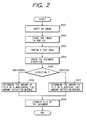
- step S201 an image which was optically read from the image scanner 108 or the like is input.
- the input image is stored into the RAM 103 in step S202.
- the input image can be also displayed on the display 105.
- step S203 in order to obtain a tilt amount of text in the input image, a test area is obtained in the input image.
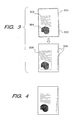
- An example of a test area obtaining process in step S203 will now be described with reference to Fig. 3.
- a rectangle 301 of a solid line shows the area of the input image.
- a rectangle 302 of a broken line shows the area of a tilted original.
- a text portion 303, a halftone portion 304, and noises 305 exist in the input image.
- a desired portion is the text portion. This exists in the left slightly lower portion of the input image.
- a reduced rectangle is initially defined, which is spaced in from the periphery of the input image 301 by a predetermined distance.
- a circumscribed rectangle of the image is obtained as a processing target, for which the reduced rectangle is the maximum size.
- an area 306 is derived shown by the rectangle of the broken line and this is identified as a test area.
- a document direction in the test area is judged (S204).
- the document direction is judged by a well-known method such as a method of using a tendency such that when the text image is thinned out or is subjected to a thickening process, pixels are coupled in the typesetting direction of the text, or the like. Even when a diagram, halftone, or the like is present with text, or vertical characters and horizontal characters are both present, the document direction is decided from a rough tendency.
- the processing routine advances to step S206.
- a tilt amount is obtained by a horizontal tilt amount detecting method.
- step S207 the processing routine advances to step S207 and the tilt amount is obtained by a vertical tilt amount detecting method.
- the details of the tilt amount detecting processes which are executed in steps S206 and S207 will now be described hereinbelow with reference to the flowchart of Fig. 5.
- step S501 check points to check the tilt amount are determined so as to be distributed over a plurality of locations in the test area obtained in step S203, e.g. so as to be distributed over as near to the whole test area as possible.
- the check points can be determined at regular intervals or can be also decided by using random numbers or the like.
- step S502 with respect to all of the decided check points, the following checks are individually executed.
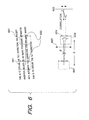
- step S503 two check windows are defined in a target test area, spaced from each other in the document typesetting direction of the test area judged in step S205 and their projections are obtained. This situation is shown in Fig. 6 in the case of a document with horizontal text as an example.
- Reference numeral 601 denotes two check windows as a pair and their projections are shown at 602. In the example of Fig. 6, since the text is horizontal, the check windows are spaced in the horizontal direction. In case of a document with vertical text, the check windows are vertically spaced.
- step S504 if either one of the two check windows does not have a projection, or its projection is not sufficient, the process at such this check point is finished and the processing routine advances to step S509. The next check point is searched.
- step S505 subsequently, while one check window is shifted in the direction normal to the document typesetting direction in a predetermined tilt amount range, a correlation of the projections of the two check windows is obtained. A point at which the correlation value is maximum and the point at which the correlation value is minimum are detected.
- a left check window 607 is fixed and a right check window 608 is shifted in the vertical direction normal to the horizontal document typesetting direction, within a range 603. The amount of coincidence is detected as a correlation, from the extent to which the projections line up in both of the check windows and the absences of projection line up in both of the check windows. A detected value of such a correlation is shown at 605.
- step S506 When the right check window is at position 604, the correlation between the projections of the two windows is maximum. When it is judged in step S506 that the difference between the maximum and minimum values of the correlation is small, it is regarded that the windows are not a part of the image of the line whose projection could correctly be extracted. The process of this check point is finished and the processing routine advances to step S509. The next check point is searched.
- step S507 the tilt angle of the text image of the original is obtained from the shift angle of the point of the maximum correlation.
- Fig. 6 the projection when the right check window is shifted downward by t shows the maximum correlation.
- step S508 the tilt angle obtained is stored into the RAM 103 or the like.
- step S509 the processing routine goes to the next check point.
- step S510 follows.
- a tilt amount of the input image is determined in accordance with the tilt angle (S511).
- S511 it is possible to use an average of the tilt angles stored in the RAM 103 in step S508, a center value of the distribution, or the like.
- step S510 it is judged that there is no tilt angle stored, it is judged that the tilt amount of the input original is not obtained.
- the tilt detecting process of the original is finished. With respect to the vertical document as well, a tilt amount can be obtained in a manner similar to the processes shown in the flowchart of Fig. 5 like a horizontal document shown in Fig. 6.
- the input image is deformed so as to eliminate the tilt of the original in step S208, As for the modification, it is sufficient to rotate the image by the tilt amount obtained in step S511 around the center of gravity of the input original as a rotational center.
- an image in which the tilt of the document portion was eliminated is obtained as shown in Fig. 4.
- the image whose tilt was eliminated and corrected in step S208 is displayed by the display 105, is printed by the printer 109, or is transmitted to an external apparatus by the communication I/F 110.
- the corrected image is used by the image processing apparatus for the subsequent processes such as registration to an electronic file in which a high quality image is required because the preservation is an object, character recognizing process in which a high quality image is required in order to obtain a high recognition ratio, and the like.
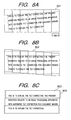
- step S701 the input image is to be cut in the direction normal to the typesetting direction and the width of the strips (shown at 801 in Fig. 8A) is determined. It is sufficient to set the width to 1/tan ⁇ pixels.
- the width determined in step S701 a plurality of strips are formed in the direction normal to the typesetting direction at regular intervals as shown in Fig. 8A (S702). In this instance, the strips are formed symmetrically with respect to the center of gravity of the input image.
- step S703 a strip 802 including the center of gravity of the input image is used as a reference and as shown in Fig. 8B, each strip other than the strip 802 is shifted by one pixel relative to its neighbours, thereby eliminating and correcting the tilt in the typesetting direction.
- Strips in the typesetting direction (805 in Fig. 8C) are formed in step S705. Those strips are each shifted by one pixel relative to its neighbours, thereby eliminating and correcting the tilt in the direction normal to the typesetting direction.
- the width of the strips can be set to 1/tan ⁇ pixels.
- the tilt of the image can be eliminated and corrected at a high speed.
Landscapes
- Engineering & Computer Science (AREA)
- Multimedia (AREA)
- Signal Processing (AREA)
- Physics & Mathematics (AREA)
- General Physics & Mathematics (AREA)
- Theoretical Computer Science (AREA)
- Computer Vision & Pattern Recognition (AREA)
- Character Input (AREA)
- Editing Of Facsimile Originals (AREA)
Applications Claiming Priority (3)
| Application Number | Priority Date | Filing Date | Title |
|---|---|---|---|
| JP15331295 | 1995-06-20 | ||
| JP153312/95 | 1995-06-20 | ||
| JP15331295A JP4114959B2 (ja) | 1995-06-20 | 1995-06-20 | 画像処理方法及び装置 |
Publications (3)
| Publication Number | Publication Date |
|---|---|
| EP0750415A2 EP0750415A2 (en) | 1996-12-27 |
| EP0750415A3 EP0750415A3 (en) | 1997-12-29 |
| EP0750415B1 true EP0750415B1 (en) | 2003-04-16 |
Family
ID=15559744
Family Applications (1)
| Application Number | Title | Priority Date | Filing Date |
|---|---|---|---|
| EP96304563A Expired - Lifetime EP0750415B1 (en) | 1995-06-20 | 1996-06-19 | Image processing method and apparatus |
Country Status (4)
| Country | Link |
|---|---|
| US (1) | US6493470B1 (enExample) |
| EP (1) | EP0750415B1 (enExample) |
| JP (1) | JP4114959B2 (enExample) |
| DE (1) | DE69627424T2 (enExample) |
Cited By (1)
| Publication number | Priority date | Publication date | Assignee | Title |
|---|---|---|---|---|
| TWI408954B (zh) * | 2008-09-02 | 2013-09-11 | 樫尾計算機股份有限公司 | 影像處理裝置及電腦程式 |
Families Citing this family (16)
| Publication number | Priority date | Publication date | Assignee | Title |
|---|---|---|---|---|
| WO2003024090A1 (en) * | 2001-09-07 | 2003-03-20 | Koninklijke Philips Electronics N.V. | Image device having camera and image perspective correction and possibly rotation and staggering correction |
| JP2004046632A (ja) * | 2002-07-12 | 2004-02-12 | Minolta Co Ltd | 画像処理装置 |
| WO2004019617A1 (ja) * | 2002-08-20 | 2004-03-04 | Olympus Corporation | 画像比較装置、画像比較方法および画像比較をコンピュータにて実行させるためのプログラム |
| US20050157170A1 (en) * | 2002-08-20 | 2005-07-21 | Olympus Corporation | Image comparison apparatus, image comparison method, and program to execute image comparison by computer |
| JP4497974B2 (ja) * | 2004-03-25 | 2010-07-07 | キヤノン株式会社 | 画像処理装置、画像処理方法、プログラム及び記憶媒体 |
| TWI238645B (en) * | 2004-06-08 | 2005-08-21 | Benq Corp | Titled angle detection for document image deskew |
| JP4310288B2 (ja) * | 2005-04-12 | 2009-08-05 | キヤノン株式会社 | 画像処理装置及びその方法、プログラム並びに記憶媒体 |
| JP4143655B2 (ja) | 2005-11-24 | 2008-09-03 | キヤノン株式会社 | 画像処理装置、画像処理方法、プログラム、記憶媒体、システム |
| US8150165B2 (en) * | 2008-04-11 | 2012-04-03 | Recognition Robotics, Inc. | System and method for visual recognition |
| US9576217B2 (en) | 2008-04-11 | 2017-02-21 | Recognition Robotics | System and method for visual recognition |
| CN101923710A (zh) * | 2010-06-30 | 2010-12-22 | 青岛海信网络科技股份有限公司 | 图像倾斜校正方法及装置 |
| JP2015012304A (ja) * | 2013-06-26 | 2015-01-19 | ソニー株式会社 | 画像処理装置、画像処理方法、及び、プログラム |
| CN106447615A (zh) * | 2016-08-02 | 2017-02-22 | 浪潮软件股份有限公司 | 一种扫描文档图像的倾斜校正方法 |
| US10531845B2 (en) * | 2017-09-29 | 2020-01-14 | General Electric Company | Systems and methods for image correction in an X-ray device |
| US10896012B2 (en) | 2018-03-13 | 2021-01-19 | Canon Kabushiki Kaisha | Image processing apparatus, image processing method, and storage medium |
| JP7094733B2 (ja) * | 2018-03-13 | 2022-07-04 | キヤノン株式会社 | 画像処理装置、プログラム、画像処理方法 |
Family Cites Families (24)
| Publication number | Priority date | Publication date | Assignee | Title |
|---|---|---|---|---|
| JPS5214112B2 (enExample) * | 1973-02-22 | 1977-04-19 | ||
| US4251799A (en) * | 1979-03-30 | 1981-02-17 | International Business Machines Corporation | Optical character recognition using baseline information |
| JPS5923467B2 (ja) * | 1979-04-16 | 1984-06-02 | 株式会社日立製作所 | 位置検出方法 |
| JPS5887652A (ja) * | 1981-11-19 | 1983-05-25 | Ricoh Co Ltd | 画像処理装置 |
| JP2531605B2 (ja) * | 1984-02-24 | 1996-09-04 | 株式会社東芝 | 画像の位置合せ装置 |
| US4876730A (en) * | 1987-02-25 | 1989-10-24 | Lundy Electronics & Systems, Inc. | Optical character reader with skew recognition |
| JPS63268081A (ja) * | 1987-04-17 | 1988-11-04 | インタ−ナショナル・ビジネス・マシ−ンズ・コ−ポレ−ション | 文書の文字を認識する方法及び装置 |
| US4985930A (en) * | 1987-09-24 | 1991-01-15 | Hitachi, Ltd. | Image data filing system and image data correcting method |
| JPS6482286A (ja) * | 1987-09-25 | 1989-03-28 | 株式会社東芝 | 画像傾斜検出装置 |
| US5001766A (en) * | 1988-05-16 | 1991-03-19 | At&T Bell Laboratories | Apparatus and method for skew control of document images |
| US5101448A (en) * | 1988-08-24 | 1992-03-31 | Hitachi, Ltd. | Method and apparatus for processing a document by utilizing an image |
| EP0363828B1 (en) * | 1988-10-11 | 1999-01-07 | Kabushiki Kaisha Ouyo Keisoku Kenkyusho | Method and apparatus for adaptive learning type general purpose image measurement and recognition |
| US5140650A (en) * | 1989-02-02 | 1992-08-18 | International Business Machines Corporation | Computer-implemented method for automatic extraction of data from printed forms |
| JP2917155B2 (ja) | 1989-12-18 | 1999-07-12 | 株式会社日立製作所 | 画像結合装置及び方法 |
| DE4012608A1 (de) * | 1990-04-20 | 1991-10-24 | Roland Man Druckmasch | Verfahren und vorrichtung zur bestimmung von passerdifferenzen an druckbildstellen eines mehrfarbenoffsetdruckes |
| JPH0488489A (ja) * | 1990-08-01 | 1992-03-23 | Internatl Business Mach Corp <Ibm> | 一般化ハフ変換を用いた文字認識装置および方法 |
| JPH04270485A (ja) * | 1991-02-26 | 1992-09-25 | Sony Corp | 印刷文字認識装置 |
| US5475766A (en) * | 1991-09-05 | 1995-12-12 | Kabushiki Kaisha Toshiba | Pattern inspection apparatus with corner rounding of reference pattern data |
| JP3320759B2 (ja) * | 1991-12-26 | 2002-09-03 | 株式会社東芝 | 文書画像傾き検出装置およびその方法 |
| US5452374A (en) | 1992-04-06 | 1995-09-19 | Ricoh Corporation | Skew detection and correction of a document image representation |
| US5594815A (en) * | 1992-10-19 | 1997-01-14 | Fast; Bruce B. | OCR image preprocessing method for image enhancement of scanned documents |
| US5539532A (en) * | 1993-08-12 | 1996-07-23 | Nec Corporation | Image reading apparatus with varied subscanning speed |
| JP3924796B2 (ja) * | 1995-04-25 | 2007-06-06 | 株式会社デンソー | パターン位置の計測方法および計測装置 |
| JP3504054B2 (ja) * | 1995-07-17 | 2004-03-08 | 株式会社東芝 | 文書処理装置および文書処理方法 |
-
1995
- 1995-06-20 JP JP15331295A patent/JP4114959B2/ja not_active Expired - Lifetime
-
1996
- 1996-06-19 US US08/665,952 patent/US6493470B1/en not_active Expired - Lifetime
- 1996-06-19 DE DE69627424T patent/DE69627424T2/de not_active Expired - Lifetime
- 1996-06-19 EP EP96304563A patent/EP0750415B1/en not_active Expired - Lifetime
Cited By (1)
| Publication number | Priority date | Publication date | Assignee | Title |
|---|---|---|---|---|
| TWI408954B (zh) * | 2008-09-02 | 2013-09-11 | 樫尾計算機股份有限公司 | 影像處理裝置及電腦程式 |
Also Published As
| Publication number | Publication date |
|---|---|
| JP4114959B2 (ja) | 2008-07-09 |
| EP0750415A3 (en) | 1997-12-29 |
| JPH096914A (ja) | 1997-01-10 |
| EP0750415A2 (en) | 1996-12-27 |
| US6493470B1 (en) | 2002-12-10 |
| DE69627424D1 (de) | 2003-05-22 |
| DE69627424T2 (de) | 2003-12-24 |
Similar Documents
| Publication | Publication Date | Title |
|---|---|---|
| US7054485B2 (en) | Image processing method, apparatus and system | |
| US5613016A (en) | Area discrimination system for text image | |
| US7062099B2 (en) | Image processing method and apparatus using self-adaptive binarization | |
| US6493470B1 (en) | Image processing method and apparatus for detecting the tilt amount of input image data | |
| EP0543593B1 (en) | Method for determining boundaries of words in text | |
| US6738154B1 (en) | Locating the position and orientation of multiple objects with a smart platen | |
| US6574375B1 (en) | Method for detecting inverted text images on a digital scanning device | |
| CN112507782B (zh) | 文本图像的识别方法及装置 | |
| JP2986383B2 (ja) | ライン走査画像のためのスキューを補正する方法及びその装置 | |
| CN106251341B (zh) | 一种印刷品质量检测方法 | |
| EP1879375A2 (en) | Halftoning method and apparatus | |
| US6268935B1 (en) | Image processor | |
| JP4140519B2 (ja) | 画像処理装置、プログラムおよび記録媒体 | |
| JP2023036833A (ja) | 情報処理装置、及びプログラム | |
| EP0766193B1 (en) | Optical character reader with skew correction | |
| JP3607753B2 (ja) | 文書画像の領域分割方法および装置、並びに段組種類判別方法および装置 | |
| US7920737B2 (en) | Code image processing method and code image processing apparatus | |
| EP0975146A1 (en) | Locating the position and orientation of multiple objects with a smart platen | |
| US7616837B2 (en) | Image processing apparatus, image processing method, program, and storage medium | |
| EP0767941B1 (en) | Automatic determination of landscape scan in binary images | |
| JPH10336428A (ja) | 画像処理装置 | |
| JPH0581475A (ja) | 文字領域抽出方法 | |
| JP2877548B2 (ja) | 文書画像の属性判別方法 | |
| JPS62200486A (ja) | 文字読取装置 | |
| JPH02278104A (ja) | 文書画像の傾き角検出方法 |
Legal Events
| Date | Code | Title | Description |
|---|---|---|---|
| PUAI | Public reference made under article 153(3) epc to a published international application that has entered the european phase |
Free format text: ORIGINAL CODE: 0009012 |
|
| AK | Designated contracting states |
Kind code of ref document: A2 Designated state(s): DE FR GB |
|
| PUAL | Search report despatched |
Free format text: ORIGINAL CODE: 0009013 |
|
| AK | Designated contracting states |
Kind code of ref document: A3 Designated state(s): DE FR GB |
|
| 17P | Request for examination filed |
Effective date: 19980514 |
|
| 17Q | First examination report despatched |
Effective date: 20000628 |
|
| RIC1 | Information provided on ipc code assigned before grant |
Free format text: 7H 04N 1/047 A, 7G 06T 3/00 B |
|
| GRAH | Despatch of communication of intention to grant a patent |
Free format text: ORIGINAL CODE: EPIDOS IGRA |
|
| GRAH | Despatch of communication of intention to grant a patent |
Free format text: ORIGINAL CODE: EPIDOS IGRA |
|
| GRAA | (expected) grant |
Free format text: ORIGINAL CODE: 0009210 |
|
| AK | Designated contracting states |
Designated state(s): DE FR GB |
|
| REG | Reference to a national code |
Ref country code: GB Ref legal event code: FG4D |
|
| REF | Corresponds to: |
Ref document number: 69627424 Country of ref document: DE Date of ref document: 20030522 Kind code of ref document: P |
|
| ET | Fr: translation filed | ||
| PLBE | No opposition filed within time limit |
Free format text: ORIGINAL CODE: 0009261 |
|
| STAA | Information on the status of an ep patent application or granted ep patent |
Free format text: STATUS: NO OPPOSITION FILED WITHIN TIME LIMIT |
|
| 26N | No opposition filed |
Effective date: 20040119 |
|
| PGFP | Annual fee paid to national office [announced via postgrant information from national office to epo] |
Ref country code: GB Payment date: 20140610 Year of fee payment: 19 |
|
| PGFP | Annual fee paid to national office [announced via postgrant information from national office to epo] |
Ref country code: DE Payment date: 20140630 Year of fee payment: 19 |
|
| PGFP | Annual fee paid to national office [announced via postgrant information from national office to epo] |
Ref country code: FR Payment date: 20140625 Year of fee payment: 19 |
|
| REG | Reference to a national code |
Ref country code: DE Ref legal event code: R119 Ref document number: 69627424 Country of ref document: DE |
|
| GBPC | Gb: european patent ceased through non-payment of renewal fee |
Effective date: 20150619 |
|
| REG | Reference to a national code |
Ref country code: FR Ref legal event code: ST Effective date: 20160229 |
|
| PG25 | Lapsed in a contracting state [announced via postgrant information from national office to epo] |
Ref country code: GB Free format text: LAPSE BECAUSE OF NON-PAYMENT OF DUE FEES Effective date: 20150619 Ref country code: DE Free format text: LAPSE BECAUSE OF NON-PAYMENT OF DUE FEES Effective date: 20160101 |
|
| PG25 | Lapsed in a contracting state [announced via postgrant information from national office to epo] |
Ref country code: FR Free format text: LAPSE BECAUSE OF NON-PAYMENT OF DUE FEES Effective date: 20150630 |