EP0750232A2 - Magnetteilchen für magnetische Toner und ihrer Herstellungsverfahren - Google Patents
Magnetteilchen für magnetische Toner und ihrer Herstellungsverfahren Download PDFInfo
- Publication number
- EP0750232A2 EP0750232A2 EP96304465A EP96304465A EP0750232A2 EP 0750232 A2 EP0750232 A2 EP 0750232A2 EP 96304465 A EP96304465 A EP 96304465A EP 96304465 A EP96304465 A EP 96304465A EP 0750232 A2 EP0750232 A2 EP 0750232A2
- Authority
- EP
- European Patent Office
- Prior art keywords
- particles
- magnetic
- fine
- iron oxide
- magnetic particles
- Prior art date
- Legal status (The legal status is an assumption and is not a legal conclusion. Google has not performed a legal analysis and makes no representation as to the accuracy of the status listed.)
- Granted
Links
Images

Classifications
-
- C—CHEMISTRY; METALLURGY
- C01—INORGANIC CHEMISTRY
- C01G—COMPOUNDS CONTAINING METALS NOT COVERED BY SUBCLASSES C01D OR C01F
- C01G49/00—Compounds of iron
- C01G49/02—Oxides; Hydroxides
- C01G49/06—Ferric oxide [Fe2O3]
-
- G—PHYSICS
- G03—PHOTOGRAPHY; CINEMATOGRAPHY; ANALOGOUS TECHNIQUES USING WAVES OTHER THAN OPTICAL WAVES; ELECTROGRAPHY; HOLOGRAPHY
- G03G—ELECTROGRAPHY; ELECTROPHOTOGRAPHY; MAGNETOGRAPHY
- G03G9/00—Developers
- G03G9/08—Developers with toner particles
- G03G9/083—Magnetic toner particles
-
- G—PHYSICS
- G03—PHOTOGRAPHY; CINEMATOGRAPHY; ANALOGOUS TECHNIQUES USING WAVES OTHER THAN OPTICAL WAVES; ELECTROGRAPHY; HOLOGRAPHY
- G03G—ELECTROGRAPHY; ELECTROPHOTOGRAPHY; MAGNETOGRAPHY
- G03G9/00—Developers
- G03G9/08—Developers with toner particles
- G03G9/083—Magnetic toner particles
- G03G9/0831—Chemical composition of the magnetic components
- G03G9/0833—Oxides
-
- G—PHYSICS
- G03—PHOTOGRAPHY; CINEMATOGRAPHY; ANALOGOUS TECHNIQUES USING WAVES OTHER THAN OPTICAL WAVES; ELECTROGRAPHY; HOLOGRAPHY
- G03G—ELECTROGRAPHY; ELECTROPHOTOGRAPHY; MAGNETOGRAPHY
- G03G9/00—Developers
- G03G9/08—Developers with toner particles
- G03G9/083—Magnetic toner particles
- G03G9/0831—Chemical composition of the magnetic components
- G03G9/0834—Non-magnetic inorganic compounds chemically incorporated in magnetic components
-
- G—PHYSICS
- G03—PHOTOGRAPHY; CINEMATOGRAPHY; ANALOGOUS TECHNIQUES USING WAVES OTHER THAN OPTICAL WAVES; ELECTROGRAPHY; HOLOGRAPHY
- G03G—ELECTROGRAPHY; ELECTROPHOTOGRAPHY; MAGNETOGRAPHY
- G03G9/00—Developers
- G03G9/08—Developers with toner particles
- G03G9/083—Magnetic toner particles
- G03G9/0835—Magnetic parameters of the magnetic components
-
- G—PHYSICS
- G03—PHOTOGRAPHY; CINEMATOGRAPHY; ANALOGOUS TECHNIQUES USING WAVES OTHER THAN OPTICAL WAVES; ELECTROGRAPHY; HOLOGRAPHY
- G03G—ELECTROGRAPHY; ELECTROPHOTOGRAPHY; MAGNETOGRAPHY
- G03G9/00—Developers
- G03G9/08—Developers with toner particles
- G03G9/083—Magnetic toner particles
- G03G9/0836—Other physical parameters of the magnetic components
-
- G—PHYSICS
- G03—PHOTOGRAPHY; CINEMATOGRAPHY; ANALOGOUS TECHNIQUES USING WAVES OTHER THAN OPTICAL WAVES; ELECTROGRAPHY; HOLOGRAPHY
- G03G—ELECTROGRAPHY; ELECTROPHOTOGRAPHY; MAGNETOGRAPHY
- G03G9/00—Developers
- G03G9/08—Developers with toner particles
- G03G9/083—Magnetic toner particles
- G03G9/0837—Structural characteristics of the magnetic components, e.g. shape, crystallographic structure
-
- G—PHYSICS
- G03—PHOTOGRAPHY; CINEMATOGRAPHY; ANALOGOUS TECHNIQUES USING WAVES OTHER THAN OPTICAL WAVES; ELECTROGRAPHY; HOLOGRAPHY
- G03G—ELECTROGRAPHY; ELECTROPHOTOGRAPHY; MAGNETOGRAPHY
- G03G9/00—Developers
- G03G9/08—Developers with toner particles
- G03G9/083—Magnetic toner particles
- G03G9/0838—Size of magnetic components
-
- G—PHYSICS
- G03—PHOTOGRAPHY; CINEMATOGRAPHY; ANALOGOUS TECHNIQUES USING WAVES OTHER THAN OPTICAL WAVES; ELECTROGRAPHY; HOLOGRAPHY
- G03G—ELECTROGRAPHY; ELECTROPHOTOGRAPHY; MAGNETOGRAPHY
- G03G9/00—Developers
- G03G9/08—Developers with toner particles
- G03G9/083—Magnetic toner particles
- G03G9/0839—Treatment of the magnetic components; Combination of the magnetic components with non-magnetic materials
-
- H—ELECTRICITY
- H01—ELECTRIC ELEMENTS
- H01F—MAGNETS; INDUCTANCES; TRANSFORMERS; SELECTION OF MATERIALS FOR THEIR MAGNETIC PROPERTIES
- H01F1/00—Magnets or magnetic bodies characterised by the magnetic materials therefor; Selection of materials for their magnetic properties
- H01F1/01—Magnets or magnetic bodies characterised by the magnetic materials therefor; Selection of materials for their magnetic properties of inorganic materials
- H01F1/03—Magnets or magnetic bodies characterised by the magnetic materials therefor; Selection of materials for their magnetic properties of inorganic materials characterised by their coercivity
- H01F1/032—Magnets or magnetic bodies characterised by the magnetic materials therefor; Selection of materials for their magnetic properties of inorganic materials characterised by their coercivity of hard-magnetic materials
- H01F1/10—Magnets or magnetic bodies characterised by the magnetic materials therefor; Selection of materials for their magnetic properties of inorganic materials characterised by their coercivity of hard-magnetic materials non-metallic substances, e.g. ferrites, e.g. [(Ba,Sr)O(Fe2O3)6] ferrites with hexagonal structure
- H01F1/11—Magnets or magnetic bodies characterised by the magnetic materials therefor; Selection of materials for their magnetic properties of inorganic materials characterised by their coercivity of hard-magnetic materials non-metallic substances, e.g. ferrites, e.g. [(Ba,Sr)O(Fe2O3)6] ferrites with hexagonal structure in the form of particles
-
- Y—GENERAL TAGGING OF NEW TECHNOLOGICAL DEVELOPMENTS; GENERAL TAGGING OF CROSS-SECTIONAL TECHNOLOGIES SPANNING OVER SEVERAL SECTIONS OF THE IPC; TECHNICAL SUBJECTS COVERED BY FORMER USPC CROSS-REFERENCE ART COLLECTIONS [XRACs] AND DIGESTS
- Y10—TECHNICAL SUBJECTS COVERED BY FORMER USPC
- Y10T—TECHNICAL SUBJECTS COVERED BY FORMER US CLASSIFICATION
- Y10T428/00—Stock material or miscellaneous articles
- Y10T428/29—Coated or structually defined flake, particle, cell, strand, strand portion, rod, filament, macroscopic fiber or mass thereof
- Y10T428/2982—Particulate matter [e.g., sphere, flake, etc.]
- Y10T428/2991—Coated
-
- Y—GENERAL TAGGING OF NEW TECHNOLOGICAL DEVELOPMENTS; GENERAL TAGGING OF CROSS-SECTIONAL TECHNOLOGIES SPANNING OVER SEVERAL SECTIONS OF THE IPC; TECHNICAL SUBJECTS COVERED BY FORMER USPC CROSS-REFERENCE ART COLLECTIONS [XRACs] AND DIGESTS
- Y10—TECHNICAL SUBJECTS COVERED BY FORMER USPC
- Y10T—TECHNICAL SUBJECTS COVERED BY FORMER US CLASSIFICATION
- Y10T428/00—Stock material or miscellaneous articles
- Y10T428/29—Coated or structually defined flake, particle, cell, strand, strand portion, rod, filament, macroscopic fiber or mass thereof
- Y10T428/2982—Particulate matter [e.g., sphere, flake, etc.]
- Y10T428/2991—Coated
- Y10T428/2993—Silicic or refractory material containing [e.g., tungsten oxide, glass, cement, etc.]
-
- Y—GENERAL TAGGING OF NEW TECHNOLOGICAL DEVELOPMENTS; GENERAL TAGGING OF CROSS-SECTIONAL TECHNOLOGIES SPANNING OVER SEVERAL SECTIONS OF THE IPC; TECHNICAL SUBJECTS COVERED BY FORMER USPC CROSS-REFERENCE ART COLLECTIONS [XRACs] AND DIGESTS
- Y10—TECHNICAL SUBJECTS COVERED BY FORMER USPC
- Y10T—TECHNICAL SUBJECTS COVERED BY FORMER US CLASSIFICATION
- Y10T428/00—Stock material or miscellaneous articles
- Y10T428/29—Coated or structually defined flake, particle, cell, strand, strand portion, rod, filament, macroscopic fiber or mass thereof
- Y10T428/2982—Particulate matter [e.g., sphere, flake, etc.]
- Y10T428/2991—Coated
- Y10T428/2993—Silicic or refractory material containing [e.g., tungsten oxide, glass, cement, etc.]
- Y10T428/2995—Silane, siloxane or silicone coating
Definitions
- the present invention relates to magnetic particles for a magnetic toner and a process for producing the same. More particularly, the present invention relates to magnetic iron oxide containing Fe 2+ particles (magnetic Fe 2+ -containing iron oxide particles) for a magnetic toner, which have an excellent fluidity and a high coercive force, which can suppress background development and, hence, produce a high resolution when the magnetic Fe 2+ -containing iron oxide particles are used for a magnetic toner, and which have a high black chromaticity due to a high Fe 2+ content. The present invention also relates to a process for producing such magnetic iron oxide particles.
- a magnetic toner composed of small-diameter particles which can suppress background development and hence, produce a high resolution is in strong demand.
- Spherical magnetic particles which have conventionally been used have a low coercive force, so that when the magnetic particles are used for a magnetic toner composed of small-diameter particles, they are suffering from the following problem. Since the magnetic attraction is lowered, the toner is difficult to stir on a sleeve and difficult to be uniformly charged. As a result, the toner which is insufficiently charged causes background development.
- Angular magnetic particles such as octahedral and hexahedral magnetic particles have a poor fluidity, and when the angular magnetic particles are produced into a magnetic toner, the toner also has a poor fluidity.
- roundish magnetic particles have a good fluidity, and when the roundish magnetic particles are produced into a magnetic toner, the toner also has a good fluidity.
- roundish magnetic particles such as spherical magnetic particles, which can produce a magnetic toner having a good fluidity, are now required as a material.
- the black chromaticity of magnetic particles is chiefly influenced by the Fe 2+ content when the magnetic particles are magnetite particles having a size of about 0.1 to 0.5 ⁇ m which are used for a magnetic toner, as described in pp. 239 to 240 of Powder and Powder Metallurgy, Vol 26, No. 7, as "The black chromaticity of a sample is influenced by the Fe(II) content and the average particle size, and powder having an average particle size of 0.2 ⁇ m is bluish black powder, and it is the most suitable as a black pigment ⁇ . Every sample containing not less than 10% of Fe(II) has a black color although there is a slight difference in black chromaticity. If the Fe(II) content is lowered to less than 10%, the color of each sample changes from black to reddish brown.”
- Fe 2+ -containing iron oxide particles having a high Fe 2+ content and a high black chromaticity are, therefore, required.
- Examples of the magnetic particles used as magnetic particles for a magnetic toner are octahedral magnetite particles (Japanese Patent Publication (KOKOKU) No. 44-668(1969)) and spherical magnetite particles (Japanese Patent Publication (KOKOKU) No. 62-51208(1987)).
- the conventional spherical and octahedral magnetite particles do not have sufficient properties, as described in Japanese Patent Application Laid-Open (KOKAI) No.
- the Fe 2+ content of octahedral magnetite particles is about 0.3 to 0.45 in a molar ratio with respect to Fe 3+ , and although they are excellent in the black chromaticity, they have such a large residual magnetization that they are apt to cause magnetic cohesion, so that they have a poor dispersibility and they do not mix well with a resin ⁇ .
- Spherical magnetite particles have such a small residual magnetization that they are reluctant to magnetic cohesion, so that they have an excellent dispersibility and they mix well with a resin.
- the Fe 2+ content is about 0.28 at most in molar ratio with respect to Fe 3+ , the particles have a slightly brownish black color, in other words, they are inferior in black chromaticity ⁇ .”
- a manufacturing process including the step of adding silicon component during the reaction for producing magnetite in order to improve the properties of magnetite particles have conventionally been investigated.
- the processes proposed are, for example, a process (Japanese Patent Application Laid-Open (KOKAI) No.
- a water-soluble silicate calculated as Si
- the improved magnetite particles are, for example, magnetite particles (Japanese Patent Application Laid-Open (KOKAI) No. 6-144840(1994)) which contain 0.10 to 5.0 wt% of a magnesium oxide (calculated as Mg) based on Fe, which have an average particle size of 0.10 to 0.25 ⁇ m, and which have a substantially hexahedral shape with each face-like ridge, and which are obtained by adding a magnesium compound to an aqueous solution of a ferrous salt, and producing magnetite by blowing an oxidizing gas in the presence of a caustic alkali and/or an alkali carbonate under a weak acidic condition; and cubical magnetite particles (Japanese Patent Publication No.
- the magnetite particles described in Japanese Patent Application Laid-Open (KOKAI) No. 5-213620(1993) are produced by adding 1.0 to 1.1 equivalents of an alkali with respect to ferrous iron in a primary reaction, so that the magnetite particles obtained have a large particle distribution and it is impossible to obtain magnetite particles having a uniform particle size.
- the magnetite particles described in Japanese Patent Application Laid-Open (KOKAI) No. 6-53574(1994) have a cubical shape with chamfered edges, but since some of them have a large particle size such as represented by the BET specific surface area as large.as 0.5 to 5 m 2 /g and they have an angular shape, they are inferior in fluidity.
- the magnetite particles described in Japanese Patent Application Laid-Open (KOKAI) No. 6-144840(1994) have a substantially hexahedral shape and each ridge of the hexahedron has a face, but since they are angular, they have a poor fluidity.
- magnetic Fe 2+ -containing iron oxide particles for a magnetic toner are now in the strongest demand, which are fine particles having a particle size of 0.05 to 0.30 ⁇ m, which have a high coercive force so that the magnetic iron oxide particles display an excellent fluidity, suppress background development and, hence, produce a high resolution when the magnetic particles are used as magnetic toner particles having a small particle size, and which have an excellent black chromaticity due to a high Fe 2+ content.
- no magnetic Fe 2+ -containing iron oxide particles which have ever been produced do not satisfy all of these conditions.
- magnetic particles for a magnetic toner comprising:
- magnetic particles for a magnetic toner comprise: the magnetic particles defined in the first aspect as core particles; and a compound having a hydrophobic group, which is existent on the surface of each of the core particles in an amount of 0.1 to 5.0 wt%.
- magnetic particles for a magnetic toner comprise: the magnetic particles defined in the first aspect as core particles; and non-magnetic fine oxides particles and/or non-magnetic fine hydrous oxides particles comprising at least one element selected from the group consisting of Fe, Ti, Zr, Si, Al, Mn and Zn, which are adhered on the surface of the core particles in an amount of 0.1 to 20 wt%.
- magnetic particles for a magnetic toner comprise: the magnetic particles defined in the first aspect as core particles; and oxides, hydroxides and/or hydrous oxides comprising at least one element selected from the group consisting of Ti, Zr, Si, Al, Mn and Zn, which are deposited on the surface of the core particles in an amount of 0.01 to 20 wt%.
- magnetic particles for a magnetic toner comprise: the magnetic particles defined in the first aspect as core particles; oxides, hydroxides and/or hydrous oxides comprising at least one element selected from the group consisting of Ti, Zr, Si, Al, Mn and Zn, which are deposited on the surface of the core particles in an amount of 0.01 to 20 wt%; and a compound having a hydrophobic group, which is existent on the oxides, hydroxides and/or hydrous oxides comprising at least one element selected from the group consisting of Ti, Zr, Si, Al, Mn and Zn in an amount of 0.1 to 5.0 wt%.
- a magnetic toner comprising: 100 parts by weight of magnetic iron oxide particles according to either of first aspect to fifth aspect; and 10 to 900 parts by weight of a resin for a toner.
- the magnetic particles for a magnetic toner according to the present invention will first be described.
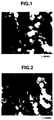
- the magnetic particles according to the present invention are Fe 2+ -containing iron oxide particles such as magnetite particles [(FeO) x ⁇ Fe 2 O 3 , wherein 0 ⁇ x ⁇ 1], and Fe 2+ -containing iron oxide particles containing at least one element other than Fe 2+ , selected from the group consisting of Al, Ti, Mn, Zn, Cu, Ni, Co and Mg, in amount of not more than 10 atm% (calculated as the element) based on the total Fe in the Fe 2+ -containing iron oxide particles, and have a basically hexahedral shape (basically cubical shape) each ridge of which has a curved surface (which is chamfered), as shown in a later-described scanning electron microphotograph shown in FIG. 1.
- Fe 2+ -containing iron oxide particles such as magnetite particles [(FeO) x ⁇ Fe 2 O 3 , wherein 0 ⁇ x ⁇ 1]
- the magnetic particles according to the present invention have an average particle size of 0.05 to 0.30 ⁇ m, preferably 0.1 to 0.30 ⁇ m. If the average particle size is less than 0.05 ⁇ m, the number of particles in a unit volume becomes so large and the number of contact points between particles increases so large that the adhesive force between powder layers becomes large and when such particles are used for a magnetic toner, the dispersibility of the particles in a resin becomes poor. On the other hand, if the average particle size exceeds 0.30 ⁇ m, the number of magnetic particles contained in one toner particle is reduced, and there becomes non-uniformity in the distribution of the magnetic particles in one toner particle, so that the toner becomes lacking in the uniformity of charge.
- the ratio ⁇ of the magnetic particles according to the present invention is more than 1.0 and less than 1.4, preferably 1.15 to 1.35, more preferably 1.20 to 1.30. If the ratio ⁇ is 1.0, the particles are spherical, and it is unfavorable because the coercive force of the particles is low, so that the BET specific surface area increases and, for example, the water content adsorbed increases. If the ratio ⁇ is 1.4, the particles have an angular hexahedral shape, so that a good fluidity may be not obtained.
- Ratio ( ⁇ ) l/w wherein l represents average maximum length of the magnetic particles and w represents average minimum length of magnetic particles.
- the average maximum length and average minimum length of the magnetic particles are values measured from a projection of electron microphotograph of the magnetic particles.
- the coercive force Hc of the magnetic particles of the present invention at 10 kOe and the average particle size d ( ⁇ m) thereof satisfy the following relationship (2): 147 - 322.7 ⁇ d ⁇ Hc (10kOe) ⁇ 207 - 322.7 ⁇ d. If the coercive force exceeds the upper limit of the above-mentioned formula, the magnetic attraction becomes so strong that the magnetic toner produced from the magnetic iron oxide particles cannot easily transfer from a sleeve onto a photosensitive drum, which makes it difficult to obtain a sufficient picture density. On the other hand, if the coercive force is less than the lower limit of the above-mentioned formula, the magnetic attraction becomes so weak that the magnetic toner produced from the magnetic iron oxide particles is to scatter onto a photosensitive drum and cause background development.
- the coercive force of the cubic-shaped magnetic Fe 2+ -containing iron oxide particles is about 130 to about 190 Oe in case of the particle size of about 0.05 ⁇ m; the coercive force of the cubic-shaped magnetic Fe 2+ -containing iron oxide particles is about 115 to about 175 Oe in case of the particle size of about 0.1 ⁇ m; the coercive force of the cubic-shaped magnetic Fe 2+ -containing iron oxide particles is about 80 to about 145 Oe in case of the particle size of about 0.2 ⁇ m; and the coercive force of the cubic-shaped magnetic Fe 2+ -containing iron oxide particles is about 50 to about 110 Oe in case of the particle size of about 0.3 ⁇ m.
- the magnetic particles of the present invention have the coercive force under an external magnetic field of 10 kOe of 50 to 191 Oe and the average particle size of 0.05 to 0.30 ⁇ m, wherein the coercive force (Hc) and the average particle size [d ( ⁇ m)] satisfy the above-mentioned formula (2).
- Hc coercive force
- B 207 - 322.7 ⁇ d.
- a 1 to a 8 in the Fig. 3 denote magnetic particles obtained in Examples 1 to 8 described later, respectively, which show the same coercive force as those of the ordinary cubic-shaped magnetic Fe 2+ -containing iron oxide particles.
- the magnetic particles of the present invention have a saturation magnetization of 80 to 92 emu/g, preferably 82 to 90 emu/g. If the saturation magnetization is less than 80 emu/g, since the Fe 2+ content in the particles reduces, the magnetic particles may be tinged with red.
- the degree of compression of the magnetic particles of the present invention which is a barometer of fluidity, is not more than 55%, preferably not more than 50%.
- the lower limit of the degree of compression is preferably about 20%. If the degree of compression exceeds 55%, the fluidity of the magnetic iron oxide particles may be inferior.
- the angle ⁇ of repose of the magnetic particles of the present invention which is another barometer of fluidity, is not more than 50°, preferably not more than 49°.
- the lower limit of the angle ⁇ of repose is preferably about 30°. If the angle ⁇ of repose exceeds 50°, the fluidity of the magnetic iron oxide particles may be inferior.
- the Fe 2+ content of the magnetic particles of the present invention is 12 to 24 wt%, preferably 17 to 24 wt% based on the total weight of the magnetic iron oxide particles. If the Fe 2+ content is less than 12 wt%, it become difficult to obtain a sufficient black chromaticity. If it exceeds 24 wt%, the magnetic iron oxide particles are easily oxidized and become environmentally unstable.
- the magnetic iron oxide particles of the present invention contain not less than 0.9 atm% and less than 1.7 atm%, preferably 0.9 to 1.5 atm% of Si based on Fe. If the Si content is less than 0.9 atm%, angular hexahedral particles which have a poor fluidity, are obtained. If the Si content is not less than 1.7 atm%, since the amount of Si deposited on the surface of the magnetic particles increases, the BET specific surface area also increases, so that the adsorbed water content sometimes increases. If a toner is produced from such magnetic iron oxide particles, the environmental stability of the toner is sometimes influenced.
- the sulfur content in the magnetic particles of the present invention is not more than 0.35 wt%, preferably not more than 0.25 wt%. If the sulfur content exceeds 0.35 wt%, it means that the magnetic particles take in much sulfur during the reaction for producing the magnetic iron oxide particles, so that the crystallomagnetic anisotropy is insufficient and the coercive force of the magnetic particles becomes low.
- the magnetic particles according to the present invention include the following magnetic particles comprising the above-described magnetic particles as the core particles and other materials on the surface of each of the core particles.
- the said magnetic particles (1), (2) and (4) according to the present invention have an average particle size of 0.05 to 0.30 ⁇ m, preferably 0.1 to 0.30 ⁇ m
- the said magnetic particles (3) according to the present. invention have an average particle size of 0.05 to 0.40 ⁇ m, preferably 0.1 to 0.40 ⁇ m.
- the upper limit of the degree of compression of each of the above-described surface-treated magnetic particles (1), (2), (3) and (4) is 55%.
- the lower limit of the degree of compression thereof is preferably about 20%.
- the upper limit of the oil absorption of each of the above-described surface-treated magnetic particles (1), (2), (3) and (4) is 24 ml/100g.
- the lower limit of the oil absorption thereof is preferably about 10 ml/100g.
- the surface-treated magnetic iron oxide particles (1), (2), (3) and (4) will be described in detailed.
- the magnetic particles have a compound having a hydrophobic group which is existent on the surface of the said magnetic iron oxide particles in the amount of the compound having a hydrophobic group of 0.1 to 5.0 % by weight, preferably 0.1 to 3.0 % by weight, more preferably 0.1 to 2.0 % by weight.
- the magnetic iron oxide particles may be made insufficiently hydrophobic. If it exceeds 5.0 % by weight, whole amount of the added compound having a hydrophobic group is not attached on the surface of the magnetic particles, so that the residual compound having a hydrophobic group which is not attached thereon is present, separately.
- silane coupling agents As a compound having a hydrophobic group, silane coupling agents, titanate coupling agents, aluminate coupling agents, zirconate coupling agents, silicones, higher fatty acids, surfactants or the like are usable.
- silane coupling agents are 3-methacryloxypropyl trimethoxysilane, 3-chloropropyl trimethoxysilane, vinyltriethoxysilane, vinyltrimethoxysilane, vinyltrichlorosilane, vinyltris( ⁇ methoxyethoxy)silane, ⁇ -(methacryloxypropyl) trimethoxysilane, ⁇ -aminopropyltrimethoxysilane, N-B-(aminoethyl) ⁇ -aminopropyltrimethoxysilane, ⁇ -(3,4 epoxycyclohexyl)ethyltrimethoxysilane, ⁇ -glycidoxypropyl trimethoxysilane and ⁇ -mercaptopropyl trimethoxysilane, which are soluble to an organic solvent as a liquid dispersion medium.
- titanate coupling agents are water-soluble coupling agents such as triethanolamine titanate chelate, lactic acid titanate chelate and isopropyltri(N-aminoethyl ⁇ aminoethyl) titanate; and coupling agents which are soluble to an organic solvent as a liquid dispersion medium, such as isopropyl tristearoyl titanate, isopropyl tridodecylbenzene sulfonyl titanate, isopropyltris(dioctylpyrophosphate) titanate, isopropyltri(N-aminoethyl ⁇ aminoethyl) titanate tetraoctylbis (ditridecyl phosphate) titanate, tetra(2-2-diallyloxymethyl-1-butyl)bis(ditridecyl) phosphate titanate, bis(dioctylpyrophosphate) oxyacetate titanate and bis (
- aluminate coupling agents examples include acetoalkoxyaluminum diisopropylate, aluminum diisopropoxymonoethyl acetoacetate, aluminum trisethyl acetoacetate and aluminum trisacetylacetonate, which are soluble to an organic solvent as a liquid dispersion medium.
- zirconate coupling agents are zirconium tetrakis acetylacetonate, zirconium dibuthoxybis acetylacetonate, zirconium tetrakisethyl acetoacetate, zirconium tributhoxymonoethyl acetoacetate and zirconium tributhoxy acetylacetonate, which are soluble to an organic solvent as a liquid dispersion medium.
- silicones silicon oil, etc. are usable.
- fatty acids having carbon atoms of not less than 8, preferably not less than 16, more preferably 18 to 50 stearic acid, isostearic acid, palmitic acid, isopalmitic acid, oleic acid, arachic acid, lignoceric acid, lacceric acid, etc. are usable.
- the magnetic particles have non-magnetic fine oxides particles and/or non-magnetic fine hydrous oxides particles comprising at least one element selected from the group consisting of Fe, Ti, Zr, Si, Al, Mn and Zn, which are adhered on the surface of the said magnetic particles as core particles in an amount of 0.1 to 20 wt%.
- non-magnetic fine oxides particles and/or non-magnetic fine hydrous oxides particles comprising an element selected from the group consisting of Fe, Ti, Zr, Si, Al, Mn and Zn, (hereinafter referred to as "non-magnetic fine oxides and/or hydrous oxides particles”) include, for instance, non-magnetic fine oxides particles such as granular, acicular (columnar), spindle, or plate-like (lamellar) hematite (a-Fe 2 O 3 ) fine particles, granular or columnar TiO 2 fine particles, granular ZrO 2 fine particles, granular SiO 2 fine particles, granular or acicular Al 2 O 3 fine particles, granular MnO or MnO 2 fine particles and granular ZnO fine particles; and non-magnetic fine hydrous oxides particles such as granular, acicular (columnar), spindle, or plate-like (lamellar) hydrous-ferric oxide
- the size of the said non-magnetic fine oxides and hydrous oxides particles is 0.01 to 0.1 ⁇ m.
- the particle size is less than 0.01 ⁇ m or exceeds 0.1 ⁇ m, the dispersibility tends to deteriorate.
- the particle size is preferably in the range of 0.02 to 0.06 ⁇ m.
- the size of the non-magnetic fine oxides particles and/or non-magnetic fine hydrous oxides particles of a specific element adhering to the surface of the magnetic iron oxide particles according to the present invention is preferably the one which satisfies the following formulae (1) to (4): 1/100 ⁇ b/a ⁇ 1/3 1/100 ⁇ c/a ⁇ 1 1/100 ⁇ d/a ⁇ 1/3 1/100 ⁇ d/c ⁇ 1 more preferably one which satisfies the following formulae (5) to (8): 1/50 ⁇ b/a ⁇ 1/5 1/50 ⁇ c/a ⁇ 1/2 1/50 ⁇ d/a ⁇ 1/5 1/10 ⁇ d/c ⁇ 1 wherein a is an average particle size of the magnetic iron oxide particles as core particles, b is an average particle size of the granular non-magnetic fine oxides particles and/or non-magnetic fine hydrous oxides particles in case of granular, c is an average maximum length
- the b/a ratio is less than 1/100, it is difficult to improve a dispersibility and fluidity of the magnetic particles, and when the b/a ratio exceeds 1/3, it is difficult to adhere the non-magnetic fine oxides particles and/or non-magnetic fine hydrous oxides particles to the magnetic particle surfaces.
- the c/a ratio is less than 1/100, it is difficult to improve a dispersibility of the magnetic iron oxide particles, and when the c/a ratio exceeds 1, it is difficult to adhere the non-magnetic fine oxides particles and/or non-magnetic fine hydrous oxides particles to the magnetic iron oxide particle surfaces.
- the d/a ratio is less than 1/100, it is difficult to improve a dispersibility of the magnetic iron oxide particles, and when the b/a ratio exceeds 1/3, it is difficult to adhere the non-magnetic fine oxides particles and/or non-magnetic fine hydrous oxides particles to the magnetic iron oxide particle surfaces.
- the non-magnetic fine oxides particles and/or non-magnetic fine hydrous oxides particles tend to break during the adhering-treatment and the produced powder can contribute deterioration of dispersibility.
- the amount of the non-magnetic fine oxides and/or hydrous oxides particles of a specific element adhering to the surface of the said magnetic iron oxide particle according to the present invention is preferably 0.1 to 10 wt% in view of the saturation magnetization.
- the magnetic particles have oxides, hydroxides and/or hydrous oxides comprising at least one element selected from the group consisting of Ti, Zr, Si, Al, Mn and Zn, which are deposited on the surface of the said magnetic particles as core particles in an amount of 0.01 to 20 wt%.
- oxides, hydroxides and/or hydrous oxides in the present invention comprising an element selected from the group consisting of Ti, Zr, Si, Al, Mn and Zn, (hereinafter referred to as "oxides, hydroxides and/or hydrous oxides”) include, for instance, oxides such as TiO 2 , ZrO 2 , SiO 2 , Al 2 O 3 , MnO, MnO 2 , ZnO, etc.; hydroxides such as Ti(OH) 2 , Ti(OH) 4 , Zr(OH) 4 , Si(OH) 4 , Al(OH) 3 , Mn(OH) 2 , Zn(OH) 2 , etc.; and hydrous oxides such as TiO(OH) 2 , AlOOH, MnOOH ,etc.
- the oxides, hydroxides and/or hydrous oxides according to the present invention include (i) coprecipitated oxides, hydroxides and/or hydrous oxides of at least one an element selected from the group consisting of Ti, Zr, Si, Al, Mn and Zn; (ii) coprecipitated hydroxides and/or hydrous oxides of at least two element selected from the group consisting of Ti, Zr, Al, Mn and Zn; and (iii) oxides of at least two element selected from the group consisting of Ti, Zr, Al, Mn and Zn, which are produced by heating the thus obtained coprecipitated hydroxides and/or hydrous oxides (ii) at 100 to 600°C.
- the amount of the oxides, hydroxides and/or hydrous oxides disposed on the surface of the magnetic particle according to the present invention is preferably 0.1 to 20 wt%, more preferably 0.1 to 10 wt% in view of the saturation magnetization.
- the magnetic particles have the said oxides, hydroxides and/or hydrous oxides comprising at least one element selected from the group consisting of Ti, Zr, Si, Al, Mn and Zn, which are deposited on the surface of the said magnetic particles in an amount of 0.01 to 20 wt% as defined in the above-mentioned (3); and further have a compound having a hydrophobic group which is existent on the said oxides, hydroxides and/or hydrous oxides comprising at least one element selected from the group consisting of Ti, Zr, Si, Al, Mn and Zn, in the amount of the compound having a hydrophobic group of 0.1 to 5.0 wt%, preferably 0.1 to 3.0 wt%, more preferably 0.1 to 2.0 wt
- a two-staged oxidation reaction which comprises carrying out a first-stage oxidation reaction for producing magnetic particles comprising blowing an oxygen containing gas, under heating to a temperature range of 70 to 100°C, into an aqueous solution of a ferrous salt containing a ferrous hydroxide colloid obtained by reacting an aqueous solution of a ferrous salt and 0.80 to 0.99 equivalent of an aqueous alkali hydroxide based on the ferrous salt carrying out a second-stage oxidation reaction for producing magnetic nuclear particles comprising after adding not less than 1.00 equivalent of an aqueous alkali hydroxide based on the residual Fe +2 to the aqueous reaction solution after the end of the first-stage reaction, blowing an oxygen-containing gas, under heating to a temperature range of 70 to 100°C into the resultant aqueous solution.
- aqueous solution of a ferrous salt usable in the present invention examples include an aqueous ferrous sulfate, and an aqueous ferrous chloride
- aqueous alkali hydroxide in the present invention are usable aqueous solutions of a hydroxide of an alkali metal such as sodium hydroxide and potassium hydroxide, aqueous solutions of a hydroxide of an alkali earth metal such as magnesium hydroxide and calcium hydroxide, aqueous solutions of an alkali carbonate such as sodium carbonate and sodium ammonium, ammonia water, etc.
- the amount of aqueous alkali hydroxide used before the adjustment of the pH in the first-stage reaction is 0.80 to 0.99 equivalent, preferably 0.90 to 0.99 equivalent based on the Fe +2 in the aqueous solution of a ferrous salt. If the aqueous alkali hydroxide is less than 0.80 equivalent, a goethite is unfavorably produced in the product, so that it is impossible to obtain the target magnetic particles in a single phase. If the aqueous alkali hydroxide exceeds 0.99 equivalent, the particle size distribution is so large that it is not possible to obtain particles having a uniform particle size.
- the reaction temperature in the first-stage reaction is 70 to 100°C. If the temperature is lower than 70°C, acicular goethite particles are unfavorably produced in the product. Although magnetic particles are produced even if the temperature exceeds 100°C, since an apparatus such as an autoclave is required, it is not industrially easy.
- Oxidization is carried out by blowing an oxygen-containing gas (e.g., air) into the solution.
- an oxygen-containing gas e.g., air
- water-soluble silicate sodium silicate, potassium silicate, etc. are usable in the present invention.
- the amount of water-soluble silicate added is not less than 0.9 atm% and less than 1.7 atm%, preferably 0.9 to 1.5 atm% (calculated as Si) based on Fe. If the amount of water-soluble silicate is less than 0.9 atm%, the particles produced are angular hexahedral particles which have an insufficient fluidity. On the other hand, if the amount of water-soluble silicate added is not less than 1.7 atm%, since the silicon deposited on the particle surface may increase, the BET specific surface area may increase and, as a result, the adsorbed water content may increase, which may influence the environmental stability of the toner produced from such magnetic particles.
- the water-soluble silicate in the present invention influences the shape of the magnetic particles produced. It is, therefore, required that the time at which the water-soluble silicate is added is before the production of magnetic particles by blowing an oxygen-containing gas into an aqueous reaction solution of a ferrous salt containing a ferrous hydroxide colloid. It is possible to add the water-soluble silicate to either of an aqueous alkali hydroxide and an aqueous reaction solution of a ferrous salt containing a ferrous hydroxide colloid.
- the pH of the suspension is adjusted to a range of 8.0 to 9.5, preferably to a range of 8.0 to 9.3 by adding an aqueous alkali hydroxide when the step of blowing of an oxygen-containing gas is started. If the pH of the suspension is less than 8.0, it is difficult to obtain the cubic-shaped magnetic particles. If the pH of the suspension exceeds 9.5, since angular octahedral particles are produced, the fluidity becomes inferior.
- the amount of aqueous alkali hydroxide used in the second-stage reaction is not less than 1.00 equivalent based on the residual Fe 2+ at the beginning of the second stage reaction. If the amount is less than 1.00 equivalent, the total amount of residual Fe 2+ is not deposited.
- the preferable amount of aqueous alkali hydroxide, which is not less than 1.00 equivalent, is industrially determined.
- the reaction temperature at the second-stage reaction is the same as that at the first-stage reaction.
- the oxidization means is also the same as that in the first-stage reaction.
- the step of adequately stirring the suspension for a necessary time may be inserted, if necessary, between the addition of the materials and the first-stage reaction and between the first-stage reaction and the second-stage reaction.
- the magnetic particles for a magnetic toner comprising: magnetic particles as core particles and a compound having a hydrophobic group which is existent on the surface of each of the core particles, are produced by compacting, shearing and spatula-stroking the magnetic iron oxide particles as the core particles and a compound having a hydrophobic group by using a wheel-type kneader or an attrition mill so as to coat the surfaces of the magnetic particles with the compound having the hydrophobic group.
- the amount of the compound having a hydrophobic group added is 0.11 to 5.3 parts by weight based on 100 parts by weight of the magnetic particles to be treated.
- wheel-type kneader there can be used Simpson mix muller, multimill, back flow mixer, Irich mill, etc., but wet pan mill, melanger, whirl mill and quick mill are inapplicable since they merely perform compression and spatula-stroking and no shearing work.
- the linear load is preferably in the range of 10 to 200 kg/cm.
- the linear load is less than 10 kg/cm, it is difficult to adhere the compound having a hydrophobic group to the core particles.
- the linear load is greater than 200 kg/cm, the particles may be broken.
- the more preferred range of the linear load is 20 to 150 kg/cm.
- the treating time is 10 to 120 minutes.
- the treating time is less than 10 minutes, it is difficult to coat the compound having a hydrophobic group to the core particles.
- the treating time exceeds 120 minutes, it is unfavorable in terms of economy although the desired coating treatment can be accomplished.
- the more preferred range of treating time is 20 to 90 minutes.
- the magnetic particles for a magnetic toner comprising: the magnetic particles as core particles, and non-magnetic fine oxides particles and/or non-magnetic fine hydrous oxides particles comprising at least one element selected from the group consisting of Fe, Ti, Zr, Si, Al, Mn and Zn, which are adhered on the surface of the magnetic particles, are produced by compacting, shearing and spatula-stroking the magnetic iron oxide particles as core particles with the non-magnetic fine oxides particles and/or non-magnetic fine hydrous oxides particles comprising at least one element selected from the group consisting of Fe, Ti, Zr, Si, Al, Mn and Zn, by using a wheel-type kneader or an attrition mill.
- a wheel-type kneader or an attrition mill can be used for the compression of the magnetic iron oxide particles.
- the wheel-type kneaders usable in the present invention include Simpson mix muller, multimill, Stotz mill, back flow mixer, Irich mill, etc.
- Wet pan mill, melanger, whirl mill and quick mill can not be used in the present invention since they merely have the functions of compression and spatula-stroking, and no shearing action.
- Deposition (attachment) of the non-magnetic fine oxides particles and/or non-magnetic fine hydrous oxides particles composed of a specific element can be accomplished (i) by adding and mixing the non-magnetic fine oxides particles and/or non-magnetic fine hydrous oxides particles in the suspension containing magnetic iron oxide particles, and then subjecting the resultant suspension to filtration, water-washing and drying; or (ii) by adding the non-magnetic fine oxides particles and/or non-magnetic fine hydrous oxides particles to the magnetic iron oxide particles which have been obtained after filtration, water-washing and drying, and then subjecting the said particles to dry-mixing.
- the amount of the non-magnetic fine oxides particles and/or non-magnetic fine hydrous oxides particles composed of a specific element is 0.11 to 25 parts by weight based on 100 parts by weight of the particles to be treated.
- Adhering-treatment according to the present invention can be conducted, for example, by compressing, shearing and spatula-stroking the magnetic iron oxide particles, and the non-magnetic fine oxides particles and/or non-magnetic fine hydrous oxides particles of a specific element by using a wheel-type kneader or an attrition mill.
- wheel-type kneader there can be used Simpson mix muller, multimill, back flow mixer, Irich mill, etc., but wet pan mill, melanger, whirl mill and quick mill are inapplicable since they merely perform compression and spatula-stroking and no shearing work.
- the linear load is preferably in the range of 10 to 200 kg/cm.
- the linear load is less than 10 kg/cm, it is difficult to adhere the non-magnetic fine oxides particles and/or non-magnetic fine hydrous oxides particles to the core particles.
- the linear load is greater than 200 kg/cm, the particles may be broken.
- the more preferred range of the linear load is 20 to 150 kg/cm.
- the treating time is 10 to 120 minutes.
- the treating time is less than 10 minutes, it is difficult to adhere the non-magnetic fine oxides particles and/or non-magnetic fine hydrous oxides particles to the core particles.
- the treating time exceeds 120 minutes, it is unfavorable in terms of economy although the desired adhering-treatment can be accomplished.
- the more preferred range of treating time is 20 to 90 minutes.
- the magnetic particles for a magnetic toner comprising: the magnetic particles as core particles; and oxides, hydroxides and/or hydrous oxides comprising at least one element selected from the group consisting of Ti, Zr, Si, Al, Mn and Zn, which are deposited on the surface of the magnetic iron oxide particles, are produced by adjusting the pH of the alkaline suspension containing produced magnetic iron oxide particles and a water-soluble salt comprising at least one element selected from the group consisting of Ti, Zr, Si, Al, Mn and Zn to the range of 2 to 12 so as to deposit the surfaces of the magnetic iron oxide particles with hydroxides or coprecipitated hydroxides comprising at least one element selected from the group consisting of Ti, Zr, Si, Al, Mn and Zn, and if necessary, subjecting to heat-treatment.
- the temperature of the alkaline suspension at the time of addition of the water-soluble salt of at least one element selected from the group consisting of Ti, Zr, Al, Mn and Zn thereto is 50 to 100°C.
- the temperature of the said alkaline suspension is less than 50°C, the magnetic particles are not well dispersed in the suspension.
- the temperature of the said alkaline solution is higher than 100°C, although it is possible to maintain uniform dispersion of the magnetic particles in the suspension, the process is not economical.
- the magnetic particles deposited with hydrous oxides comprising at least one element selected from the group consisting of Ti, Al and Mn, are produced by subjecting the resultant hydroxides-deposited particles to heat-treatment, for example, (i) allowing to stand the resultant suspension at 50 to 100°C or heating the obtained hydroxides-deposited particles at 100 to 200°C in case of using Ti as an element; (ii) heating the obtained hydroxides-deposited particles at 100 to 400°C in case of using Al as an element; and (iii) heating the obtained hydroxides-deposited particles at 10 to 50°C in case of using Mn as an element.
- heat-treatment for example, (i) allowing to stand the resultant suspension at 50 to 100°C or heating the obtained hydroxides-deposited particles at 100 to 200°C in case of using Ti as an element; (ii) heating the obtained hydroxides-deposited particles at 100 to 400°C in case of using Al as an element; and (iii) heating the obtained hydroxides-deposited particles at 10 to 50°C in case
- the magnetic particles deposited with oxides comprising at least one element selected from the group consisting of Ti, Zr, Si, Al, Mn and Zn, are produced by subjecting the resultant hydroxides-deposited particles to heat-treatment, for example, heating the obtained hydroxides-deposited particles at 200 to 600°C in a non-oxidative gas such as nitrogen gas in case of using Ti, Zr, Si, Al, Mn and Zn as an element.
- heat-treatment for example, heating the obtained hydroxides-deposited particles at 200 to 600°C in a non-oxidative gas such as nitrogen gas in case of using Ti, Zr, Si, Al, Mn and Zn as an element.
- the magnetic particles deposited with coprecipitated oxides, hydroxides and/or hydrous oxides comprising Si and at least one element selected from the group consisting of Ti, Zr, Al, Mn and Zn are produced by adjusting the pH of the alkaline suspension to the range of 5 to 9, for example, to obtain magnetic particles deposited with coprecipitated SiO 2 and hydroxides comprising at least one element selected from the group consisting of Ti, Zr, Al, Mn and Zn; and if necessary, subjecting to heat-treatment.
- the magnetic particles deposited with coprecipitated oxides, hydroxides and/or hydrous oxides comprising at least two element selected from the group consisting of Ti, Zr, Al, Mn and Zn, are produced by adjusting the pH of the alkaline suspension to the range of 2 to 12; and if necessary, subjecting to heat-treatment.
- the magnetic particles deposited with coprecipitated oxides of Si and hydrous oxides of at least one element selected from the group consisting of Ti, Zr, Al, Mn and Zn, are produced by subjecting the resultant hydroxides-deposited particles to heat-treatment, for example, (i) allowing to stand the resultant suspension at 50 to 100°C or heating the obtained Ti hydroxides-deposited particles at 100 to 200°C; (ii) heating the obtained Al hydroxides-deposited particles at 100 to 400°C; and (iii) heating the obtained Mn hydroxides-deposited particles at 10 to 50°C.
- the magnetic particles deposited with coprecipitated oxides of Si and at least one an element selected from the group consisting of Ti, Zr, Al, Mn and Zn, are produced by subjecting the resultant hydroxides-deposited particles to heat-treatment, for example, by heating the obtained hydroxides-deposited particles at 200 to 600°C in a non-oxidative gas such as nitrogen gas in case of using Ti, Zr, Al, Mn and Zn as an element.
- a non-oxidative gas such as nitrogen gas in case of using Ti, Zr, Al, Mn and Zn as an element.
- titanyl sulfate titanium tetrachloride, titanium trichloride, etc. are usable.
- zirconium salt zirconium sulfate, zirconium dichloride, zirconium, zirconium trichloride, etc. are usable.
- water-soluble silicate there can be used the sodium silicate, potassium silicate, etc.
- water-soluble aluminum salt aluminum sulfate, aluminum nitrate and aluminum chloride can be exemplified.
- water-soluble zinc salt zinc sulfate, zinc chloride, zinc nitrate, zinc phosphate etc. are usable.
- water-soluble manganate manganeous sulfate, manganic sulfate, manganeous chloride, manganic chloride, etc. are usable.
- the amount of the water-soluble salt of Ti, Zr, Al, Mn or Zn added in the process is 0.01 to 50 parts by weight, preferably 0.01 to 45 parts by weight based on 100 parts by weight of the particles to be treated.
- the magnetic iron oxide particles for a magnetic toner comprising: the magnetic iron oxide particles as core particles, oxides, hydroxides and/or hydrous oxides comprising at least one element selected from the group consisting of Ti, Zr, Si, Al, Mn and Zn, which are deposited on the surface of the core particles, and a compound having a hydrophobic group which is existent on the oxides, hydroxides and/or hydrous oxides comprising at least one element selected from the group consisting of Ti, Zr, Si, Al, Mn and Zn, are produced by the process defined in the above-mentioned (3) as to coat the surfaces of the magnetic iron oxide particles with a oxides, hydroxides and/or hydrous oxides comprising at least one element selected from the group consisting of Ti, Zr, Si
- the magnetic particles according to the present invention have a basically hexahedral shape (basically cubical shape), and since each ridge of the hexahedron has a curved surface (is chamfered), the coercive force of the magnetic particles is approximately equal to that of hexahedral magnetic particles due to the shape anisotropy. Since the edge is not angular but has a curved surface, the magnetic particles have an excellent fluidity. In addition, since the Fe 2+ content is sufficiently high, the magnetic particles are excellent in the black chromaticity.
- the BET specific surface area of the magnetic iron oxide particles of the present invention is preferably 3 to 30 m 2 /g, more preferably 3.5 to 25 m 2 /g; the coercive force thereof is 50 to 191 Oe; the saturation magnetization thereof is 80 to 92 emu/g; the ratio of maximum length to minimum length is 1.0 to 1.4, preferably 1.15 to 1.35; the degree of compression thereof is not more than 55 %, preferably not more than 50 %; and the angle of repose thereof is not more than 50°, preferably not more than 49°.
- the magnetic particles (1), (2), (3) and (4) according to the present invention have the following properties in addition to the above-described properties of the BET specific surface area, the coercive force, the ratio, and the angle of repose.
- the magnetic particles (1) according to the present invention have a saturation magnetization of 70 to 92 emu/g, a compression degree of not more than 55 %, preferably not more than 50 % and an oil absorption of not more than not more than 20 ml/100 g, preferably not more than 18 ml/100 g.
- the magnetic particles (2) according to the present invention have a saturation magnetization of 60 to 92 emu/g, a compression degree of not more than 55 %, preferably not more than 50 % and an oil absorption of not more than not more than 20 ml/100 g, preferably not more than 19 ml/100 g.
- the magnetic particles (3) according to the present invention have a saturation magnetization of 60 to 92 emu/g, a compression degree of not more than 55 %, preferably not more than 50 % and an oil absorption of not more than not more than 20 ml/100 g, preferably not more than 19 ml/100 g.
- the magnetic particles (4) according to the present invention have a saturation magnetization of 60 to 92 emu/g, a compression degree of not more than 55 %, preferably not more than 50 % and an oil absorption of not more than not more than 20 ml/100 g, preferably not more than 19 ml/100 g.
- the magnetic particles of the present invention have an average particle size of 0.05 to 0.30 ⁇ m, and the magnetic particles have an excellent fluidity and a high coercive force. Therefore, when the magnetic particles are used for a magnetic toner having a small particle size, since background development is suppressed, a high resolution is obtained. In addition, since the Fe 2+ content is high, the magnetic particles are optimum as the magnetic particles for a magnetic toner for electrophotography.
- the magnetic particles of the present invention are useful for magnetic toner.
- the magnetic particles adhered with the non-magnetic fine oxides particles and/or non-magnetic fine hydrous oxides particles comprising at least one element selected from the group consisting of Fe, Ti, Zr, Si, Al, Mn and Zn; deposited with the oxides, hydroxides and/or hydrous oxides comprising at least one element selected from the group consisting of Ti, Zr, Si, Al, Mn and Zn; or deposited with the oxides, hydroxides and/or hydrous oxides comprising at least one element selected from the group consisting of Ti, Zr, Si, Al, Mn and Zn, and having the compound having a hydrophobic group thereon (subjected to hydrophobic treatment) according to the present invention can have a high dispersibility.
- the magnetic iron oxide particles having the compound having a hydrophobic group thereon (subjected to hydrophobic treatment); or deposited with the oxides, hydroxides and/or hydrous oxides comprising at least one element selected from the group consisting of Ti, Zr, Si, Al, Mn and Zn, and having the compound having a hydrophobic group thereon (subjected to hydrophobic treatment) according to the present invention can have a smaller the monolayer adsorption capacity of H 2 O. In other words, the hydrophilic property of such magnetic particles is changed to a hydrophobic property.
- Such magnetic particles of the present invention assume a black color, and they have a high dispersibility in a vehicle or a resin due to the hydrophobic surfaces, they are suitable as materials for magnetic toners.
- Magnetic toner produced from the magnetic particles of the present invention is obtained by mixing the particles with a resin.
- the resin used in the present invention is not restricted, and known binder resins for magnetic toner are usable.
- resins are styrene-acrylate copolymer, styrene-butyl acrylate copolymer, polystyrene, polyvinyl chloride, phenol resin, epoxy resin, polyacrylate, polyester, polyethylene and polypropylene.
- the mixing ratio of the resin is 100 to 900 parts by weight, preferably 100 to 400 parts by weight, based on 100 parts by weight of the magnetic particles.
- the magnetic toner of the present invention may contain coloring agent, plasticizer, surface lubricant, antistatic agent, charge control agent, etc., in the range which does not deteriorate the dispersibility of the magnetic particles in the binder resin.
- a low-molecular resin such-as polyethylene or polypropylene may be added, if necessary, as an additive.
- the particle size of the magnetic toner of the present invention is 3 to 15 ⁇ m, preferably 5 to 12 ⁇ m.
- a suspension of a ferrous salt containing a ferrous hydroxide colloid was produced at pH 6.8 and a temperature of 90°C by adding 26.7 liter of an aqueous ferrous sulfate containing 1.5 mol/liter of Fe 2+ to 22.3 liter (equivalent to 0.95 equivalent based on Fe 2+ ) of 3.4-N aqueous sodium hydroxide which had been prepared in advance in a reaction vessel.
- 104.3 g (equivalent to 1.25 atm%, calculated as Si, based on Fe) of No. 3 water glass (SiO 2 : 28.8 wt%) was diluted with water into 1 liter of a solution, and the solution was added to the aqueous sodium hydroxide before the addition of the aqueous ferrous sulfate.
- the magnetite particles produced were washed with water, filtered, dried and pulverized by an ordinary method.
- the particle shape of the magnetic particles obtained was a basically hexahedron (basically cube) each ridge of which has a curved surface (which is chamfered), as is clear from the electron microphotograph (x 40000) shown in FIG. 1.
- the particle size was uniform, the average particle size was 0.15 ⁇ m, and the ratio ⁇ was 1.27.
- the magnetic particles contain 1.10 atm% of Si based on Fe.
- the Fe 2+ content measured by oxidation reduction titration was 19.0 wt%, and the magnetite particles had a sufficient black chromaticity.
- the sulfur content was 0.11 wt%.
- the coercive force was 112 Oe and the saturation magnetization was 88.7 emu/g.
- the amount of monolayer water vapor adsorption was 1.91 mg/g.
- Magnetic particles were obtained in the same way as in Example 1 except for varying the kind of alkali and ferrous salt, the alkali equivalent ratio, the kind and amount of Si added, reaction temperature and pH of the aqueous solution upon blowing the oxygen-containing gas.
- the magnetic particles obtained in Comparative Example 1 had a hexahedral shape with angular ridges, as is clear from the electron microphotograph (x 40000) shown in FIG. 2, and the fluidity was inferior to that of the magnetic particles produced in Example 1.
- the amount of monolayer water adsorption of the magnetic particles produced in Comparative Example 4 was 2.76 mg/g. That is, the magnetic particles in Comparative Example 4 had a higher moisture adsorption than the magnetic particles in Example 1.
- Treated magnetic particles were obtained in the same way as in Example 9 except for varying the kinds of magnetic particles as core particles to be treated, the amount of a compound having a hydrophobic group.
- the shape of the obtained magnetic particles is same as that of the core particles.
- the average particle size, coercive fore and ratio the maximum length to minimum length of the obtained magnetic particles are substantially same as those of the core particles.
- sulfur content of the obtained magnetic particles is same as that of the core particles.
- Treated magnetic particles were obtained in the same way as in Example 14 except for varying the kinds of magnetic particles as core particles to be treated, the kinds and amount of a compound having a hydrophobic group, and the kinds and the operation time of the machine.
- Example 21 10 kg of the magnetite particles obtained in Example 1 (Example 21), Example 1 (Example 22) or Example 2 (Example 23) and 20 g of isopalmitic acid (Example 21), 15 g of isopalmitic acid (Example 22) or 200 g of isostearic acid (Example 23) were charged in wheel-type kneader (trade name: Sand Mill, manufactured by Matsumoto Chuzo Co., Ltd.). By 1 hour operation of the wheel-type kneader, the surfaces of the magnetite particles were covered with isopalmitic acid.
- wheel-type kneader trade name: Sand Mill, manufactured by Matsumoto Chuzo Co., Ltd.
- the shape of the obtained magnetic particles is same as that of the core particles.
- the average particle size, coercive fore and ratio the maximum length to minimum length of the obtained magnetic particles are substantially same as those of the core particles.
- sulfur content of the obtained magnetic particles is same as that of the core particles.
- Treated magnetic particles were obtained in the same way as in Example 24 except for varying the kinds of magnetic particles as core particles to be treated, the non-magnetic fine oxides or hydrous oxides particles, and the adhering conditions.
- the shape of the obtained magnetic particles is same as that of the core particles.
- the average particle size, coercive fore and ratio the maximum length to minimum length of the obtained magnetic particles are substantially same as those of the core particles.
- sulfur content of the obtained magnetic particles is same as that of the core particles.
- Treated magnetic particles were obtained in the same way as in Example 30 except for varying the kind and amount added of the water-soluble salt.
- the magnetic iron oxide particles obtained in Examples 30 to 32 were all round to have a cubical shape each ridge cf which has a curved surface as a result of electron microscopical observation of these particles.
- the average particle size, coercive fore and ratio the maximum length to minimum length of the obtained magnetic particles are substantially same as those of the core particles. Also, sulfur content of the obtained magnetic particles is same as that of the core particles.
- Treated magnetic particles were obtained in the same way as in Example 33 except for varying the kinds of magnetic particles as core particles to be treated, and the kinds and amount of a compound having a hydrophobic group.
- the shape of the obtained magnetic particles is same as that of the core particles.
- the average particle size, coercive fore and ratio the maximum length to minimum length of the obtained magnetic particles are substantially same as those of the core particles.
- sulfur content of the obtained magnetic particles is same as that of the core particles.
- the magnetic particles obtained in Example 1 were mixed with the following components in the following mixing ratio by a mixer, and the obtained mixture was melted and kneaded for 10 minutes by a hot twin roll. After chilling the kneaded mixture, it was pulverized into coarse particles and then into fine particles (by a fine mill). The pulverized particles were classified to obtain a magnetic toner composed of the particles having a volume-average particle size of 12 to 13 ⁇ m (measured by a "Couter Counter TA-II", manufactured by Couter Electronics Corporation). 0.5 part by weight of hydrophobic fine silica particles were externally added to 100 parts by weight of the magnetic toner obtained. The flowability of the final magnetic toner was 90.
- Negative charge control agent 0.5 part by weight Mold release agent: 6 parts by weight
- Magnetic particles 60 parts by weight
- An image was produced by a laser shot LBP-B406E using the magnetic toner, and the image quality was evaluated.
- the image had a high fine line reproducibility free from background development and without any toner flown about on the image. Since the fluidity of the toner was high, the toner was coated uniformly on the sleeve, so that the rush print had a uniform blackness. The fine line producibility, and the image quality were stable for a long period.
Landscapes
- Physics & Mathematics (AREA)
- General Physics & Mathematics (AREA)
- Chemical & Material Sciences (AREA)
- Inorganic Chemistry (AREA)
- Engineering & Computer Science (AREA)
- Power Engineering (AREA)
- Organic Chemistry (AREA)
- Crystallography & Structural Chemistry (AREA)
- Developing Agents For Electrophotography (AREA)
- Compounds Of Iron (AREA)
- Hard Magnetic Materials (AREA)
Applications Claiming Priority (3)
| Application Number | Priority Date | Filing Date | Title |
|---|---|---|---|
| JP17420295 | 1995-06-15 | ||
| JP17420295 | 1995-06-15 | ||
| JP174202/95 | 1995-06-15 |
Publications (3)
| Publication Number | Publication Date |
|---|---|
| EP0750232A2 true EP0750232A2 (de) | 1996-12-27 |
| EP0750232A3 EP0750232A3 (de) | 1997-01-02 |
| EP0750232B1 EP0750232B1 (de) | 2004-01-07 |
Family
ID=15974512
Family Applications (1)
| Application Number | Title | Priority Date | Filing Date |
|---|---|---|---|
| EP96304465A Expired - Lifetime EP0750232B1 (de) | 1995-06-15 | 1996-06-14 | Magnetteilchen für magnetische Toner und ihrer Herstellungsverfahren |
Country Status (5)
| Country | Link |
|---|---|
| US (2) | US5874019A (de) |
| EP (1) | EP0750232B1 (de) |
| JP (1) | JP3584954B2 (de) |
| KR (1) | KR100407243B1 (de) |
| DE (1) | DE69631267T2 (de) |
Cited By (6)
| Publication number | Priority date | Publication date | Assignee | Title |
|---|---|---|---|---|
| EP0905568A1 (de) * | 1997-09-16 | 1999-03-31 | Canon Kabushiki Kaisha | Magnetischer Toner und Bildherstellungsverfahren |
| EP0905088A1 (de) * | 1997-09-25 | 1999-03-31 | Mitsui Mining & Smelting Co., Ltd. | Magnetit Teilchen und verfahren zu dessen Herstellung |
| EP1403725A3 (de) * | 2002-09-27 | 2005-08-24 | Canon Kabushiki Kaisha | Magnetischer Toner |
| WO2008020797A1 (en) * | 2006-08-16 | 2008-02-21 | Höganäs Ab | Use of a powder composition and a medium |
| EP1515194A3 (de) * | 2003-09-12 | 2010-07-07 | Canon Kabushiki Kaisha | Magnetischer Toner und Bildherstellungsverfahren |
| CN102253617A (zh) * | 2011-06-21 | 2011-11-23 | 天津市中环天佳电子有限公司 | 磁性防伪墨粉 |
Families Citing this family (39)
| Publication number | Priority date | Publication date | Assignee | Title |
|---|---|---|---|---|
| US6689485B2 (en) * | 1997-01-17 | 2004-02-10 | The Penn State Research Foundation | Powerful reductant for decontamination of groundwater and surface streams |
| US6007957A (en) * | 1997-09-25 | 1999-12-28 | Canon Kabushiki Kaisha | Magnetic toner, image forming method and process cartridge |
| US6251555B1 (en) * | 1998-04-17 | 2001-06-26 | Toda Kogyo Corporation | Black magnetic composite particles for black magnetic toner and black magnetic toner using the same |
| US6140001A (en) * | 1999-05-04 | 2000-10-31 | Mitsui Mining & Smelting Co., Ltd. | Iron oxide microparticles and a process for producing them |
| KR20000059007A (ko) * | 2000-07-08 | 2000-10-05 | 오성근 | 식품용 등급의 원료만으로 구성된 액체 세정제의 조성물 |
| DE10044397A1 (de) * | 2000-09-08 | 2002-03-21 | Bayer Ag | Magnetite und deren Verwendung bei der Herstellung von Tonern |
| US6670087B2 (en) | 2000-11-07 | 2003-12-30 | Canon Kabushiki Kaisha | Toner, image-forming apparatus, process cartridge and image forming method |
| SE529779C8 (sv) * | 2001-11-30 | 2008-06-17 | Magnetit-järnbaserat kompositpulver, magnetit-järnbaserad pulverblandning, metod för tillverkning av dessa, metod för sanering av förorenad jord, vatten eller gaser och elektromagnetisk vågabsorbator | |
| US7226544B2 (en) | 2002-06-10 | 2007-06-05 | Mitsui Mining & Smelting Co., Ltd. | Magnetite particles |
| GB0217899D0 (en) * | 2002-08-01 | 2002-09-11 | Int Coatings Ltd | Toner/developer compositions |
| KR20050062768A (ko) * | 2002-08-13 | 2005-06-27 | 인터캣, 인코포레이티드 | NOx 및 CO 배출물을 환원시키기 위한 배연 처리법 |
| JP3872024B2 (ja) * | 2003-02-07 | 2007-01-24 | パウダーテック株式会社 | キャリア芯材、被覆キャリア、電子写真用二成分系現像剤および画像形成方法 |
| EP1732679B1 (de) | 2003-12-05 | 2012-03-07 | Intercat, Inc. | Verfahren zur Reduktion con SOx-, NOx- und CO-Emissionen in Gasströmen |
| US7431825B2 (en) * | 2003-12-05 | 2008-10-07 | Intercat, Inc. | Gasoline sulfur reduction using hydrotalcite like compounds |
| TWI342335B (en) * | 2004-06-02 | 2011-05-21 | Intercat Inc | Mixed metal oxide additives |
| DE102004044557B3 (de) * | 2004-09-15 | 2006-06-14 | Bayer Inc., Sarnia | Mischmetallhydroxide, deren Herstellung und Verwendung |
| EP1645914B1 (de) | 2004-10-08 | 2012-06-06 | Canon Kabushiki Kaisha | Magnetischer Toner |
| JP4616137B2 (ja) * | 2004-10-08 | 2011-01-19 | 京セラミタ株式会社 | 磁性トナーとそれを用いた画像形成方法 |
| CN100492186C (zh) * | 2004-10-08 | 2009-05-27 | 京瓷美达株式会社 | 磁性调色剂及使用该磁性调色剂的图像形成方法 |
| JP4771045B2 (ja) * | 2004-10-08 | 2011-09-14 | 戸田工業株式会社 | 磁性酸化鉄粒子粉末 |
| DE602005026893D1 (de) | 2004-10-08 | 2011-04-28 | Canon Kk | Magnetischer Toner |
| US20060141379A1 (en) * | 2004-11-30 | 2006-06-29 | Kouzou Teramoto | Magnetic toner and image forming method using the same |
| JP4578295B2 (ja) | 2005-03-18 | 2010-11-10 | 京セラミタ株式会社 | 2成分現像剤用磁性トナーおよび該現像剤を用いた画像形成方法 |
| US7575839B2 (en) | 2005-03-31 | 2009-08-18 | Kyocera Mita Corporation | Magnetic toner for two-component developer and image forming method using the developer |
| JP4583996B2 (ja) * | 2005-03-31 | 2010-11-17 | 京セラミタ株式会社 | 静電潜像現像用トナー及び画像形成方法 |
| US7678524B2 (en) | 2005-05-19 | 2010-03-16 | Canon Kabushiki Kaisha | Magnetic toner |
| DE102005051587A1 (de) | 2005-10-27 | 2007-05-03 | Consortium für elektrochemische Industrie GmbH | Zwitterionische Strukturelemente aufweisende Partikel |
| US7597958B2 (en) * | 2007-02-23 | 2009-10-06 | Toda Kogyo Corporation | Black magnetic iron oxide particles having a specific dissolution of sulfur element |
| JP5310994B2 (ja) * | 2008-03-31 | 2013-10-09 | 戸田工業株式会社 | 磁性トナー用磁性酸化鉄粒子粉末及びその製造法 |
| JP5164715B2 (ja) * | 2008-07-25 | 2013-03-21 | キヤノン株式会社 | トナー |
| WO2013177302A2 (en) * | 2012-05-22 | 2013-11-28 | Utermohlen Joseph Gerard | Formulations for the synthesis of paramagnetic particles and methods that utilize the particles for biochemical applications |
| KR20160090567A (ko) | 2015-01-22 | 2016-08-01 | 주식회사 파인로보틱스 | 로봇 청소기 및 로봇 청소기 제어 방법 |
| KR20160090570A (ko) | 2015-01-22 | 2016-08-01 | 주식회사 파인로보틱스 | 로봇 청소기 및 로봇 청소기 제어 방법 |
| KR102345564B1 (ko) | 2015-01-22 | 2021-12-30 | 에브리봇 주식회사 | 로봇 청소기 및 로봇 청소기 제어 방법 |
| KR102321278B1 (ko) | 2015-01-22 | 2021-11-03 | 에브리봇 주식회사 | 로봇 청소기 및 로봇 청소기 제어 방법 |
| KR102318295B1 (ko) | 2015-01-22 | 2021-10-27 | 에브리봇 주식회사 | 로봇 청소기 및 로봇 청소기 제어 방법 |
| CN107754867B (zh) * | 2017-11-17 | 2020-09-11 | 南京大学 | 一种高机械强度磁性强碱阴离子交换树脂及其制备方法 |
| KR102306610B1 (ko) * | 2019-12-13 | 2021-09-28 | 광주여자대학교 산학협력단 | 유카 추출물을 이용한 친환경 피부 세정제와 이의 제조방법 |
| KR102728366B1 (ko) * | 2022-01-27 | 2024-11-08 | 동의대학교 산학협력단 | 인삼 추출 계면활성제를 포함하는 천연 샴푸바 및 이의 제조방법 |
Family Cites Families (10)
| Publication number | Priority date | Publication date | Assignee | Title |
|---|---|---|---|---|
| JPS61155223A (ja) * | 1984-12-27 | 1986-07-14 | Toda Kogyo Corp | 球型を呈したマグネタイト粒子粉末及びその製造法 |
| US4952617A (en) * | 1987-11-06 | 1990-08-28 | Columbian Chemicals Company | Dispersion of pigments in resins and coatings systems |
| DE3821341A1 (de) * | 1988-06-24 | 1989-12-28 | Bayer Ag | Neue hitzestabile eisenoxidschwarz-pigmente, verfahren zu ihrer herstellung sowie deren verwendung |
| JP2769882B2 (ja) * | 1989-10-05 | 1998-06-25 | キヤノン株式会社 | 静電潜像現像用磁性トナー |
| EP0423743B1 (de) * | 1989-10-17 | 1995-03-01 | Canon Kabushiki Kaisha | Magnetischer Toner |
| US5424810A (en) * | 1991-09-13 | 1995-06-13 | Canon Kabushiki Kaisha | Magnetic toner, magnetic developer, apparatus unit, image forming apparatus and facsimile apparatus |
| CA2107524C (en) * | 1992-10-06 | 1999-01-19 | Hiromitsu Misawa | Iron oxide particles and process for producing the same |
| US5599627A (en) * | 1993-10-08 | 1997-02-04 | Toda Kogyo Corporation | Magnetic particles comprising magnetite core and process for producing the same |
| US5731120A (en) * | 1994-11-30 | 1998-03-24 | Minolta Co., Ltd. | Carrier for electrophotography with surface coated with specified co-polymer resin of organopolysiloxane with radical monomer |
| US5709975A (en) * | 1996-07-23 | 1998-01-20 | Eastman Kodak Company | Coated hard ferrite carrier particles |
-
1996
- 1996-06-14 JP JP17549396A patent/JP3584954B2/ja not_active Expired - Fee Related
- 1996-06-14 KR KR1019960021345A patent/KR100407243B1/ko not_active Expired - Fee Related
- 1996-06-14 DE DE1996631267 patent/DE69631267T2/de not_active Expired - Fee Related
- 1996-06-14 EP EP96304465A patent/EP0750232B1/de not_active Expired - Lifetime
- 1996-06-14 US US08/664,088 patent/US5874019A/en not_active Expired - Lifetime
-
1997
- 1997-10-21 US US08/955,104 patent/US5843610A/en not_active Expired - Lifetime
Cited By (7)
| Publication number | Priority date | Publication date | Assignee | Title |
|---|---|---|---|---|
| EP0905568A1 (de) * | 1997-09-16 | 1999-03-31 | Canon Kabushiki Kaisha | Magnetischer Toner und Bildherstellungsverfahren |
| US6653036B1 (en) | 1997-09-16 | 2003-11-25 | Canon Kabushiki Kaisha | Magnetic toner and image forming method |
| EP0905088A1 (de) * | 1997-09-25 | 1999-03-31 | Mitsui Mining & Smelting Co., Ltd. | Magnetit Teilchen und verfahren zu dessen Herstellung |
| EP1403725A3 (de) * | 2002-09-27 | 2005-08-24 | Canon Kabushiki Kaisha | Magnetischer Toner |
| EP1515194A3 (de) * | 2003-09-12 | 2010-07-07 | Canon Kabushiki Kaisha | Magnetischer Toner und Bildherstellungsverfahren |
| WO2008020797A1 (en) * | 2006-08-16 | 2008-02-21 | Höganäs Ab | Use of a powder composition and a medium |
| CN102253617A (zh) * | 2011-06-21 | 2011-11-23 | 天津市中环天佳电子有限公司 | 磁性防伪墨粉 |
Also Published As
| Publication number | Publication date |
|---|---|
| JP3584954B2 (ja) | 2004-11-04 |
| JPH0959024A (ja) | 1997-03-04 |
| EP0750232B1 (de) | 2004-01-07 |
| DE69631267D1 (de) | 2004-02-12 |
| US5874019A (en) | 1999-02-23 |
| EP0750232A3 (de) | 1997-01-02 |
| US5843610A (en) | 1998-12-01 |
| KR970001227A (ko) | 1997-01-21 |
| DE69631267T2 (de) | 2004-11-18 |
| KR100407243B1 (ko) | 2004-05-22 |
Similar Documents
| Publication | Publication Date | Title |
|---|---|---|
| EP0750232B1 (de) | Magnetteilchen für magnetische Toner und ihrer Herstellungsverfahren | |
| EP0750233B1 (de) | Kugelförmige Magnetteilchen für magnetische Toner und Verfahren ihrer Herstellung | |
| EP0652490B1 (de) | Magnetische Teilchen und Verfahren zu ihrer Herstellung | |
| EP1225600B1 (de) | Schwarze magnetische Eisenoxidteilchen und magnetischer Toner | |
| EP0566790B1 (de) | Magnetpulver und magnetischer Toner | |
| EP0187434B2 (de) | Sphärische magnetische Teilchen | |
| EP0622426B1 (de) | Körmige, beschichtete Magnetitteilchen und deren Herstellungsverfahren | |
| US6383637B1 (en) | Black magnetic iron oxide particles for magnetic toner and process for producing the same | |
| EP0794154B1 (de) | Magnetitteilchen, magnetische Eisenoxidteilchen, Verfahren zu seiner Herstellung und diese enthaltende magnetischer Toner | |
| EP0826635B1 (de) | Magnetitteilchen und Verfahren zu ihrer Herstellung | |
| JP4026982B2 (ja) | マグネタイト粒子及びその製造方法 | |
| JPH0825747B2 (ja) | マグネタイト粒子およびその製造方法 | |
| EP1961704A1 (de) | Schwarze magnetische Eisenoxidpartikel | |
| JP3458886B2 (ja) | 磁性トナー用磁性酸化鉄粒子粉末及び該磁性酸化鉄粒子粉末を用いた磁性トナー | |
| JP4656266B2 (ja) | 磁性トナー用黒色磁性酸化鉄粒子粉末及びその製造法 | |
| JP4259830B2 (ja) | マグネタイト粒子 | |
| JP2756845B2 (ja) | 六面体を呈したマグネタイト粒子粉末及びその製造法 | |
| JP3460779B2 (ja) | 球状を呈した磁性トナー用磁性酸化鉄粒子粉末及び該磁性酸化鉄粒子粉末を用いた磁性トナー | |
| JP4121273B2 (ja) | 酸化鉄粒子 | |
| JP2001106529A (ja) | 酸化鉄粒子及びその製造方法 | |
| JP3648126B2 (ja) | 酸化鉄粒子 | |
| JPH10182163A (ja) | 磁性酸化鉄粒子、該粒子を主体としてなる磁性トナー用磁性酸化鉄粒子粉末及び該磁性酸化鉄粒子粉末を用いた磁性トナー | |
| JP3509039B2 (ja) | マグネタイト粒子の製造方法 | |
| JP2002068749A (ja) | 錫含有粒状磁性酸化物粒子およびその製造方法 | |
| JP2000351627A (ja) | 酸化鉄粒子及びその製造方法 |
Legal Events
| Date | Code | Title | Description |
|---|---|---|---|
| PUAI | Public reference made under article 153(3) epc to a published international application that has entered the european phase |
Free format text: ORIGINAL CODE: 0009012 |
|
| PUAL | Search report despatched |
Free format text: ORIGINAL CODE: 0009013 |
|
| AK | Designated contracting states |
Kind code of ref document: A2 Designated state(s): DE FR GB NL |
|
| AK | Designated contracting states |
Kind code of ref document: A3 Designated state(s): DE FR GB NL |
|
| 17P | Request for examination filed |
Effective date: 19970610 |
|
| 17Q | First examination report despatched |
Effective date: 19990630 |
|
| RAP1 | Party data changed (applicant data changed or rights of an application transferred) |
Owner name: TODA KOGYO CORPORATION |
|
| GRAH | Despatch of communication of intention to grant a patent |
Free format text: ORIGINAL CODE: EPIDOS IGRA |
|
| GRAS | Grant fee paid |
Free format text: ORIGINAL CODE: EPIDOSNIGR3 |
|
| GRAA | (expected) grant |
Free format text: ORIGINAL CODE: 0009210 |
|
| AK | Designated contracting states |
Kind code of ref document: B1 Designated state(s): DE FR GB NL |
|
| REG | Reference to a national code |
Ref country code: GB Ref legal event code: FG4D |
|
| REF | Corresponds to: |
Ref document number: 69631267 Country of ref document: DE Date of ref document: 20040212 Kind code of ref document: P |
|
| ET | Fr: translation filed | ||
| PLBE | No opposition filed within time limit |
Free format text: ORIGINAL CODE: 0009261 |
|
| STAA | Information on the status of an ep patent application or granted ep patent |
Free format text: STATUS: NO OPPOSITION FILED WITHIN TIME LIMIT |
|
| 26N | No opposition filed |
Effective date: 20041008 |
|
| PG25 | Lapsed in a contracting state [announced via postgrant information from national office to epo] |
Ref country code: NL Free format text: LAPSE BECAUSE OF NON-PAYMENT OF DUE FEES Effective date: 20050101 |
|
| NLV4 | Nl: lapsed or anulled due to non-payment of the annual fee |
Effective date: 20050101 |
|
| PGFP | Annual fee paid to national office [announced via postgrant information from national office to epo] |
Ref country code: GB Payment date: 20060614 Year of fee payment: 11 |
|
| GBPC | Gb: european patent ceased through non-payment of renewal fee |
Effective date: 20070614 |
|
| REG | Reference to a national code |
Ref country code: FR Ref legal event code: ST Effective date: 20080229 |
|
| PG25 | Lapsed in a contracting state [announced via postgrant information from national office to epo] |
Ref country code: GB Free format text: LAPSE BECAUSE OF NON-PAYMENT OF DUE FEES Effective date: 20070614 |
|
| PG25 | Lapsed in a contracting state [announced via postgrant information from national office to epo] |
Ref country code: FR Free format text: LAPSE BECAUSE OF NON-PAYMENT OF DUE FEES Effective date: 20040630 |
|
| PGFP | Annual fee paid to national office [announced via postgrant information from national office to epo] |
Ref country code: DE Payment date: 20080619 Year of fee payment: 13 |
|
| PG25 | Lapsed in a contracting state [announced via postgrant information from national office to epo] |
Ref country code: DE Free format text: LAPSE BECAUSE OF NON-PAYMENT OF DUE FEES Effective date: 20100101 |