EP0748405B1 - Porous film - Google Patents
Porous film Download PDFInfo
- Publication number
- EP0748405B1 EP0748405B1 EP95909877A EP95909877A EP0748405B1 EP 0748405 B1 EP0748405 B1 EP 0748405B1 EP 95909877 A EP95909877 A EP 95909877A EP 95909877 A EP95909877 A EP 95909877A EP 0748405 B1 EP0748405 B1 EP 0748405B1
- Authority
- EP
- European Patent Office
- Prior art keywords
- web
- porous film
- film
- pore size
- porous
- Prior art date
- Legal status (The legal status is an assumption and is not a legal conclusion. Google has not performed a legal analysis and makes no representation as to the accuracy of the status listed.)
- Expired - Lifetime
Links
Images

Classifications
-
- D—TEXTILES; PAPER
- D04—BRAIDING; LACE-MAKING; KNITTING; TRIMMINGS; NON-WOVEN FABRICS
- D04H—MAKING TEXTILE FABRICS, e.g. FROM FIBRES OR FILAMENTARY MATERIAL; FABRICS MADE BY SUCH PROCESSES OR APPARATUS, e.g. FELTS, NON-WOVEN FABRICS; COTTON-WOOL; WADDING ; NON-WOVEN FABRICS FROM STAPLE FIBRES, FILAMENTS OR YARNS, BONDED WITH AT LEAST ONE WEB-LIKE MATERIAL DURING THEIR CONSOLIDATION
- D04H1/00—Non-woven fabrics formed wholly or mainly of staple fibres or like relatively short fibres
- D04H1/40—Non-woven fabrics formed wholly or mainly of staple fibres or like relatively short fibres from fleeces or layers composed of fibres without existing or potential cohesive properties
- D04H1/54—Non-woven fabrics formed wholly or mainly of staple fibres or like relatively short fibres from fleeces or layers composed of fibres without existing or potential cohesive properties by welding together the fibres, e.g. by partially melting or dissolving
- D04H1/542—Adhesive fibres
- D04H1/544—Olefin series
-
- D—TEXTILES; PAPER
- D04—BRAIDING; LACE-MAKING; KNITTING; TRIMMINGS; NON-WOVEN FABRICS
- D04H—MAKING TEXTILE FABRICS, e.g. FROM FIBRES OR FILAMENTARY MATERIAL; FABRICS MADE BY SUCH PROCESSES OR APPARATUS, e.g. FELTS, NON-WOVEN FABRICS; COTTON-WOOL; WADDING ; NON-WOVEN FABRICS FROM STAPLE FIBRES, FILAMENTS OR YARNS, BONDED WITH AT LEAST ONE WEB-LIKE MATERIAL DURING THEIR CONSOLIDATION
- D04H1/00—Non-woven fabrics formed wholly or mainly of staple fibres or like relatively short fibres
- D04H1/40—Non-woven fabrics formed wholly or mainly of staple fibres or like relatively short fibres from fleeces or layers composed of fibres without existing or potential cohesive properties
- D04H1/54—Non-woven fabrics formed wholly or mainly of staple fibres or like relatively short fibres from fleeces or layers composed of fibres without existing or potential cohesive properties by welding together the fibres, e.g. by partially melting or dissolving
Definitions
- the present invention relates to porous films, methods of producing such film, and uses of such films. (Note: the term 'porous' is used herein, unless the context requires otherwise, to mean 'possessing through-pores'.)
- Porous webs of fibrous materials are well-known, e.g. papers and both woven and non-woven webs. Such materials have pores with wide size ranges. Some pores will be very large, so that barrier properties will be significant only if the materials are thick, so that the pores are long and convoluted. Thin webs will have poor barrier properties and are also likely to have poor mechanical strength (particularly with non-woven webs).
- an initially-produced loose web is commonly compacted by calendering. This may be carried out under conditions of temperature and pressure such that there is some bonding of fibres, thus producing a stabilised fibrous web, e.g. as described in EP-A-0116845. That document also discloses the treatment of polyethylene fibre webs under more severe conditions to convert them to impermeable films. This is not generally a useful technique. If a film of a plastics material is required, it is cheap and easy to produce it directly from a melt (by extrusion and, if necessary, stretching). It is more expensive to extrude fibres and convert these to a non-woven web, and a further conversion step would add to the expense.
- Composite webs with a film bonded to a fibrous web are also known. They may be treated so that the film becomes apertured, giving the composite some limited permeability (e.g. US-A-4,684,568: treatment by calendering; US-A-4,898,761: needling of the film). Such materials have low permeability, are quite expensive to produce, and are of limited applicability.
- porous films with controlled pore sizes particularly if they were 'breathable', i.e. of substantial permeability.
- medical and surgical items are generally supplied in a sterile state enclosed within individual packages fabricated in part from porous materials.
- porous materials are of necessity permeable to gases and vapours so as to permit sterilisation of the item (after packaging) by means of steam or a gas such as ethylene oxide.
- permeability to air is important to allow the application of a vacuum during sterilisation, to facilitate the packaging process and to limit the air volume around the packaged item.
- porous films with controlled pore sizes include filtration (e.g. of particles from liquids) and controlled release of vapours.
- a fibrous web having a wide range of pore sizes e.g. being a non-woven web with a log-normal distribution
- a film having substantially uniform pores It is not that all but the largest pores have closed up: their number is so small that such a material would be virtually non-porous.
- a large number of pores, originally of many sizes are converted to pores of what is virtually a single size.
- the result can be a true membrane filter: a thin film which has the ability to act as a filter by a sieving mechanism.
- membrane filters are, in fact, much farther from this ideal.
- a method of producing a porous film comprising subjecting a fibrous material comprised of fibres of a film forming material to conditions of heat and pressure to convert said fibrous material to a porous film, which has a ratio of a maximum pore size : mean flow pore of less than 1.2 to 1.
- the conditions may be selected by subjecting samples of the material to treatment at a range of temperatures and/or pressures, monitoring the air permeance or a related parameter of the treated samples thereby to determine conditions for forming porous films; and then carrying out the production of porous film under such conditions.
- the method of the invention results in a porous, and preferably breathable, film.
- the pores in the film are preferably of uniform pore size. Their nature depends on the conditions of treatment such as temperature, pressure and time. It also depends on the properties of the web of fibrous material, e.g. the chemical nature and physical properties such as fibre diameter and "subsbance" (i.e. the openness and/or thickness of the web, affecting the mass per unit area).
- the invention is mainly, though not exclusively, concerned with the conversion of non-woven webs, including melt-blown webs and spun-bonded webs.
- pore size' has its conventional meaning, i.e. for a given pore, it is the minimum cross-sectional size throughout the length of the pore.
- pore size distribution is represented by a differential flow distribution (percentage differential flow vs pore size) in which maximum pore size is the diameter of the pore of largest minimum cross-sectional area, minimum pore size is the diameter of the pore of smallest cross-section area, and mean flow pore is the diameter of the pore through which 50% of the cumulative gas flow passes across the sample.
- the ratio of the maximum pore size to the mean flow pore is a measure of the effective pore size range within the material. Pore size distributions can be measured by conventional fluid displacement techniques.
- the application of heat and pressure to the fibrous material is effected at a nip through which the fibrous material passes.
- a preferred method practising the invention is to calender the material.
- both rolls of the calender are heated. It is desirable that both faces of the web should be thermally and mechanically treated. Thus the method is generally to be applied to single-layer webs and not laminates.
- the conditions of temperature and pressure employed in the method of the invention are sufficient to convert the fibrous material to a porous film; this conversion is also referred to herein as 'film-forming'.
- 'film-forming' there is a critical combination of temperature and pressure above which the method of the invention becomes operative to produce the porous film.
- the conditions required to 'film-forming' porous webs will vary from web type to web type but will be readily ascertained by a person skilled in the art. We have found for example that calendering at a pressure above 250 pound per linear inch (pli) (45kg/cm) at temperature in excess of 50°C (e.g. 70-100°C) is suitable for a number of polymers.
- the final film will generally differ from the fibrous web in that the latter will generally be opaque whereas the former will have a degree of transparency.
- porous webs comprising fibres can be used in the present invention.
- the fibres are preferably of a polymeric material.
- the porous web may comprise one or more of the following polymeric fibres: polyethylene, polypropylene, polyurethane, nylon, polyester, rayon, co polymer, EVA, EMA (ethyl methacrylate) and EVOH (ethylene vinyl alcohol).
- EVA ethyl methacrylate
- EVOH ethylene vinyl alcohol
- the specific requirement is that the fibre is capable of 'film-forming'.
- the polymeric fibre may include chemical additives such as fluorochemicals, colour agents, and antimicrobial agents. Different fibre types will require different temperature/pressure conditions to effect film/forming. Use may be made of multiconstituent fibres, i.e.
- biconstituent fibres with definable phase boundaries between different constituents.
- classes of biconstituent fibres include sheath-core, side-by-side, and matrix fibril fibres.
- sheath-core or other multiconstituent fibres could be processed under conditions such that one or more constituents formed a film, in which fibres of at least one other constituent remained e.g. as reinforcement.
- Use may be made of multi-denier melt-bonded webs.
- the web may be a non-woven material or a woven material. Ideally the material has a weight in excess of 15 gm -2 . This is for very fine (sub- ⁇ m) fibres. Coarser fibres have higher minima. Other things being equal, a heavier web (thicker and/or a higher concentration of fibres) gives a film with smaller pores.
- the method of the invention allows the production of porous film having a pore structure comprising pores which are substantially uniform in size.
- the method of the invention allows the production of porous films in which the ratio of maximum pore size: mean flow pore is less than 1.2, more preferably less than 1.1.
- Our preliminary work has included the preparation of materials with a ratio as low as 1.005, and it is clear that it will be possible to better this. But in practice, for most purposes, a ratio of 1.05 (or below) represents essential uniformity of pore size.
- Such porous films are believed to be novel and therefore according to a second aspect of the present invention there is provided a porous film material wherein the pore size distribution has a ratio of maximum pore size: mean flow pore of less than 1.2.
- a particular application of the invention is to produce films having a pore structure that comprises pores which are substantially uniform in size. These uniform pore structures are characteristic of 'film-formed' webs and yield porous films with controlled barrier function.
- a 50 gm -2 malt-blown polymeric web (designated web A), fabricated from polyethylene fibres, was calendered employing the above conditions. The method was carried out at varying roller temperatures (ranging from 20 to 90°C) so as to provide different calendering conditions.
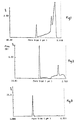
- web A Prior to calendering, web A had an air permeance of around 30,000 Bendtsen and a pore size distribution as depicted in Figure 1. The distribution is log normal and is quite wide, the minimum and maximum sizes being 7.2 and 17.3 ⁇ m and the mean flow pore size being 9.1 ⁇ m. Treatment with a nip temperature of 20°C gave a web with an air permeance of 2,050 Bendtsen.
- Figures 2 and 3 give the pore size distribution data generated for consolidated web A (nip temperature at 20°C) and 'film-formed' web A (nip temperature at 90°C) respectively.
- the consolidated web shows a log normal pore size distribution like that of the uncalendered polymeric web though compressed so that the corresponding maximum, minimum and mean values are 8.9, 2.9 and 4.9 ⁇ m.
- the film-formed web has a very narrow pore size distribution.
- the mean size (1.43) hardly differs from the maximum size (1.46).
- the minimum size is 0.57 ⁇ m.
- Percentage differential flow peaks at around 23% for the film-formed web as opposed to 8% for the consolidated web.
- FIG. 5 is a plot of the ratio of maximum pore size and mean flow pore vs nip temperature for web A. Points are mean values of five determinations. (Bars represent standard error of mean values.) For comparative purposes the maximum/mean pore ratio for the uncalendered polymeric web is also included. It is seen from Figure 5 that the maximum/mean pore ratio is around 1.75 for the uncalendered web A. Over the nip temperature range corresponding to web consolidation (up to 50°C), this ratio remains effectively constant.
- a maximum/mean pore ratio of 1.05 indicates a pore structure comprising pores substantially of the same size.
- a 40 gm -2 melt-blown polymeric web (designated web B), fabricated from polypropylene fibres, was calendered employing nip pressure of 700 pli at temperatures ranging from 20 to 110°C. Table 1 lists data generated for calendered web B at four different nip temperatures together with data for uncalendered web B. Nip Temperature (°C) Air Permeance (Bendsten) Max.
- a nip temperature of 110°C is identified to yield a 'film-formed' web comprising substantially uniform pores (a maximum/mean flow pore ratio of 1.03 as opposed to a ratio of around 1.32 for uncalendered web B and around 1.48 for web B consolidated at nip temperatures up to and including 90°C.)
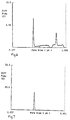
- Figures 6 and 7 show pore size distributions for web B calendered at nip temperatures of 90 and 110°C respectively. Note that the graph for treatment at 90°C (Fig. 6) shows a small peak at about 1.6 ⁇ m with almost all pores being larger. But with treatment at 110° (Fig. 7), this peak at about 1.6 ⁇ m now dominates. There is practically nothing else. All of the pores have become of this size.
Landscapes
- Engineering & Computer Science (AREA)
- Textile Engineering (AREA)
- Nonwoven Fabrics (AREA)
- Treatment Of Fiber Materials (AREA)
- Molding Of Porous Articles (AREA)
- Manufacturing Of Multi-Layer Textile Fabrics (AREA)
- Manufacture Of Porous Articles, And Recovery And Treatment Of Waste Products (AREA)
Applications Claiming Priority (3)
| Application Number | Priority Date | Filing Date | Title |
|---|---|---|---|
| GB9403911 | 1994-03-01 | ||
| GB9403911A GB9403911D0 (en) | 1994-03-01 | 1994-03-01 | Porous films |
| PCT/GB1995/000431 WO1995023888A1 (en) | 1994-03-01 | 1995-03-01 | Porous film |
Publications (2)
| Publication Number | Publication Date |
|---|---|
| EP0748405A1 EP0748405A1 (en) | 1996-12-18 |
| EP0748405B1 true EP0748405B1 (en) | 1998-12-16 |
Family
ID=10751090
Family Applications (1)
| Application Number | Title | Priority Date | Filing Date |
|---|---|---|---|
| EP95909877A Expired - Lifetime EP0748405B1 (en) | 1994-03-01 | 1995-03-01 | Porous film |
Country Status (7)
| Country | Link |
|---|---|
| US (1) | US5942179A (enExample) |
| EP (1) | EP0748405B1 (enExample) |
| JP (1) | JPH09511190A (enExample) |
| AU (1) | AU1818195A (enExample) |
| DE (1) | DE69506690T2 (enExample) |
| GB (1) | GB9403911D0 (enExample) |
| WO (1) | WO1995023888A1 (enExample) |
Families Citing this family (47)
| Publication number | Priority date | Publication date | Assignee | Title |
|---|---|---|---|---|
| US5827430A (en) * | 1995-10-24 | 1998-10-27 | Perry Equipment Corporation | Coreless and spirally wound non-woven filter element |
| KR19990071941A (ko) * | 1995-12-07 | 1999-09-27 | 스프레이그 로버트 월터 | 잉크젯 인쇄가능한 미공성 필름 |
| US20020095676A1 (en) | 1998-05-15 | 2002-07-18 | Robert A. Knee | Interactive television program guide system for determining user values for demographic categories |
| CA2313069C (en) | 1999-07-01 | 2006-05-09 | Filtertek Inc. | Semisolid product dispensing head |
| GB0204946D0 (en) * | 2002-03-04 | 2002-04-17 | Rexam Med Packaging Ltd | Polymeric films and packages produced therefrom |
| US7445735B2 (en) | 2004-12-07 | 2008-11-04 | Daramic Llc | Method of making microporous material |
| GB2449418B (en) * | 2007-05-11 | 2010-11-03 | Amcor Flexibles Winterbourne Ltd | Porous films |
| JP5759544B2 (ja) | 2010-07-02 | 2015-08-05 | ザ プロクター アンド ギャンブルカンパニー | 活性剤を送達する方法 |
| US20180163325A1 (en) | 2016-12-09 | 2018-06-14 | Robert Wayne Glenn, Jr. | Dissolvable fibrous web structure article comprising active agents |
| WO2012003316A1 (en) * | 2010-07-02 | 2012-01-05 | The Procter & Gamble Company | Process for making films from nonwoven webs |
| CN105332075B (zh) | 2010-07-02 | 2017-11-24 | 宝洁公司 | 包含活性剂的长丝、非织造纤维网和制备它们的方法 |
| CN105647715B (zh) | 2010-07-02 | 2019-10-25 | 宝洁公司 | 洗涤剂产品 |
| DE102011003186A1 (de) * | 2011-01-26 | 2012-07-26 | Evonik Degussa Gmbh | Dünne, makroporöse Polymerfolien |
| JP2014512235A (ja) | 2011-04-29 | 2014-05-22 | ザ プロクター アンド ギャンブル カンパニー | レッグガスケットカフを備える吸収性物品 |
| MX2013014783A (es) | 2011-06-21 | 2014-07-28 | Procter & Gamble | Articulo absorbente con pretina que tiene contraccion. |
| JP2014516758A (ja) | 2011-06-21 | 2014-07-17 | ザ プロクター アンド ギャンブル カンパニー | ギャザーを有するウエストバンド及びレッグカフ付きの吸収性物品 |
| CN106974771A (zh) | 2012-05-15 | 2017-07-25 | 宝洁公司 | 具有有利的拉伸和可制造性特征结构的一次性吸收裤 |
| CN105263452B (zh) | 2013-03-22 | 2019-05-28 | 宝洁公司 | 一次性吸收制品 |
| JP2018512211A (ja) | 2015-03-18 | 2018-05-17 | ザ プロクター アンド ギャンブル カンパニー | 腰部ガスケット要素及びレッグカフを備える吸収性物品 |
| US10588790B2 (en) | 2015-03-18 | 2020-03-17 | The Procter & Gamble Company | Absorbent article with leg cuffs |
| US10524963B2 (en) | 2015-03-18 | 2020-01-07 | The Procter & Gamble Company | Absorbent article with waist gasketing element and leg cuffs |
| WO2016149588A1 (en) | 2015-03-18 | 2016-09-22 | The Procter & Gamble Company | Absorbent article with leg cuffs |
| US10543130B2 (en) | 2015-03-18 | 2020-01-28 | The Procter & Gamble Company | Absorbent article with leg cuffs |
| WO2016149596A1 (en) | 2015-03-18 | 2016-09-22 | The Procter & Gamble Company | Absorbent article with waist gasketing element and leg cuffs |
| WO2016149592A1 (en) | 2015-03-18 | 2016-09-22 | The Procter & Gamble Company | Absorbent article with waist gasketing element and leg cuffs |
| US10531991B2 (en) | 2015-03-18 | 2020-01-14 | The Procter & Gamble Company | Absorbent article with waist gasketing element and leg cuffs |
| CN107427396A (zh) | 2015-03-18 | 2017-12-01 | 宝洁公司 | 带有腿箍的吸收制品 |
| US10716716B2 (en) | 2015-03-18 | 2020-07-21 | The Procter & Gamble Company | Absorbent article with leg cuffs |
| EP4245296B1 (en) | 2017-01-27 | 2024-07-17 | The Procter & Gamble Company | Compositions in the form of dissolvable solid structures |
| AT520236B1 (de) * | 2017-08-08 | 2019-08-15 | Bca Vertriebsgesellschaft Mbh | Endlosfaservlies-Folie |
| JP7110356B2 (ja) | 2018-01-26 | 2022-08-01 | ザ プロクター アンド ギャンブル カンパニー | 香料を含む水溶性単位用量物品 |
| CA3087284C (en) | 2018-01-26 | 2023-05-02 | The Procter & Gamble Company | Water-soluble unit dose articles comprising enzyme |
| US11053466B2 (en) | 2018-01-26 | 2021-07-06 | The Procter & Gamble Company | Water-soluble unit dose articles comprising perfume |
| ES3072387T3 (en) | 2018-01-26 | 2026-07-01 | The Procter & Gamble Co | Process for making water-soluble articles |
| WO2019168829A1 (en) | 2018-02-27 | 2019-09-06 | The Procter & Gamble Company | A consumer product comprising a flat package containing unit dose articles |
| US10982176B2 (en) | 2018-07-27 | 2021-04-20 | The Procter & Gamble Company | Process of laundering fabrics using a water-soluble unit dose article |
| US12234431B2 (en) | 2018-10-03 | 2025-02-25 | The Procter & Gamble Company | Water-soluble unit dose articles comprising water-soluble fibrous structures and particles |
| EP3918045A1 (en) | 2019-01-28 | 2021-12-08 | The Procter & Gamble Company | Recycleable, renewable, or biodegradable package |
| US12031254B2 (en) | 2019-03-19 | 2024-07-09 | The Procter & Gamble Company | Process of reducing malodors on fabrics |
| EP3712237A1 (en) | 2019-03-19 | 2020-09-23 | The Procter & Gamble Company | Fibrous water-soluble unit dose articles comprising water-soluble fibrous structures |
| US12655366B2 (en) | 2019-03-19 | 2026-06-16 | The Procter & Gamble Company | Process of laundering fabrics |
| EP3989913A1 (en) | 2019-06-28 | 2022-05-04 | The Procter & Gamble Company | Dissolvable solid fibrous articles containing anionic surfactants |
| JP7506249B2 (ja) | 2020-07-31 | 2024-06-25 | ザ プロクター アンド ギャンブル カンパニー | ヘアケア用プリル含有水溶性繊維パウチ |
| EP4200391A1 (en) | 2020-08-19 | 2023-06-28 | The Procter & Gamble Company | Flexible, porous, dissolvable solid sheet article containing direct-added microcapsules and process for making same |
| EP4395730A1 (en) | 2021-08-30 | 2024-07-10 | The Procter & Gamble Company | Dissolvable solid structure comprising first and second polymeric structurants |
| US12576013B2 (en) | 2021-12-17 | 2026-03-17 | The Procter & Gamble Company | Dissolvable solid fibrous shampoo articles containing salts |
| EP4489719A1 (en) | 2022-03-10 | 2025-01-15 | The Procter & Gamble Company | Dissolvable solid structure having first and second layers |
Family Cites Families (12)
| Publication number | Priority date | Publication date | Assignee | Title |
|---|---|---|---|---|
| US4147825A (en) * | 1975-09-15 | 1979-04-03 | Anselm Talalay | Polymeric foam cushioning article and method for making the same |
| JPS603842B2 (ja) * | 1976-09-03 | 1985-01-31 | 住友電気工業株式会社 | 非対称孔径薄膜材料とその製造方法 |
| US5135804A (en) * | 1983-02-18 | 1992-08-04 | Allied-Signal Inc. | Network of polyethylene fibers |
| DE3480796D1 (de) * | 1983-02-18 | 1990-01-25 | Allied Signal Inc | Verfestigung von polyaethylenfasernetzwerken. |
| DE3516425A1 (de) * | 1985-05-08 | 1986-11-13 | Bayer Ag, 5090 Leverkusen | Verfahren zur herstellung von formkoerpern und folien aus thermotropen polymeren sowie derart hergestellte formkoerper und folien |
| DE3729567A1 (de) * | 1986-09-11 | 1988-03-17 | Kendall & Co | Batteriescheider-material |
| US4987024A (en) * | 1986-09-11 | 1991-01-22 | International Paper Company | Battery separator fabric and related method of manufacture |
| GB2195266B (en) * | 1986-09-17 | 1990-06-20 | Philips Electronic Associated | Liquid chromatograph apparatus including a proportioning arrangement. |
| DE3740871A1 (de) * | 1986-12-02 | 1988-06-16 | Fuji Photo Film Co Ltd | Feinporige membran und verfahren zu ihrer herstellung |
| US5173235A (en) * | 1988-09-10 | 1992-12-22 | Ube Industries, Ltd. | Method of producing microporous film |
| US4874568A (en) * | 1988-09-26 | 1989-10-17 | The Dow Chemical Company | Process of making a porous membrane |
| US5066531A (en) * | 1989-09-05 | 1991-11-19 | Ametek | Variable thickness foam plank |
-
1994
- 1994-03-01 GB GB9403911A patent/GB9403911D0/en not_active Ceased
-
1995
- 1995-03-01 EP EP95909877A patent/EP0748405B1/en not_active Expired - Lifetime
- 1995-03-01 DE DE69506690T patent/DE69506690T2/de not_active Expired - Lifetime
- 1995-03-01 AU AU18181/95A patent/AU1818195A/en not_active Abandoned
- 1995-03-01 WO PCT/GB1995/000431 patent/WO1995023888A1/en not_active Ceased
- 1995-03-01 JP JP7522759A patent/JPH09511190A/ja not_active Ceased
- 1995-03-01 US US08/702,494 patent/US5942179A/en not_active Expired - Lifetime
Also Published As
| Publication number | Publication date |
|---|---|
| GB9403911D0 (en) | 1994-04-20 |
| DE69506690T2 (de) | 1999-06-10 |
| US5942179A (en) | 1999-08-24 |
| JPH09511190A (ja) | 1997-11-11 |
| WO1995023888A1 (en) | 1995-09-08 |
| DE69506690D1 (de) | 1999-01-28 |
| AU1818195A (en) | 1995-09-18 |
| EP0748405A1 (en) | 1996-12-18 |
Similar Documents
| Publication | Publication Date | Title |
|---|---|---|
| US5942179A (en) | Porous film | |
| CA2173327C (en) | Controlled-porosity, calendered spunbonded/melt blown laminates | |
| US4318774A (en) | Composite nonwoven web | |
| US5441550A (en) | Post-treatment of laminated nonwoven cellulosic fiber webs | |
| US8512610B2 (en) | Nonwoven fabric sheet and method for producing same | |
| US2689199A (en) | Nonwoven fabrics | |
| EP1194626B1 (en) | Improved method of making media of controlled porosity and product thereof | |
| EP0245933B2 (en) | Non-woven fabric comprising at least one spun-bonded layer | |
| US5244482A (en) | Post-treatment of nonwoven webs | |
| US5855784A (en) | High density nonwoven filter media | |
| US5503745A (en) | Filtering medium and a process for producing the same | |
| US5910225A (en) | Film and nonwoven laminate and method | |
| KR100452179B1 (ko) | 정밀도가높은실린더형필터 | |
| KR20030039364A (ko) | 열성형 가능 음향 시트 | |
| GB2449418A (en) | Porous films | |
| EP4061631B1 (en) | Nonwoven fabric having high thermal resistance and barrier properties | |
| EP0281663A2 (de) | Zweilagiger, heisssiegelfähiger Vliesstoff | |
| WO1998005502A1 (en) | Breathable film/nwf-laminates having high wvtr prepared from melt embossed polyolefin/filler precursor films | |
| HUP0002241A2 (hu) | Eljárás lélegző tulajdonságú fólia előállítására | |
| JP2010515837A (ja) | マイクロファイバースプリットフィルムのフィルターフェルトおよびこの製造方法 | |
| EP4127278A1 (en) | Transparent composite nano-fibre based multi-layer textile | |
| CA2585633A1 (en) | Composite filtration media | |
| US4904523A (en) | Polyester heat bonded product | |
| EP0695383A1 (en) | Post-treatment of nonwoven webs | |
| CA2106372C (en) | Post-treatment of non-woven webs |
Legal Events
| Date | Code | Title | Description |
|---|---|---|---|
| PUAI | Public reference made under article 153(3) epc to a published international application that has entered the european phase |
Free format text: ORIGINAL CODE: 0009012 |
|
| 17P | Request for examination filed |
Effective date: 19960925 |
|
| AK | Designated contracting states |
Kind code of ref document: A1 Designated state(s): DE FR GB IT LU |
|
| RAP1 | Party data changed (applicant data changed or rights of an application transferred) |
Owner name: REXAM MEDICAL PACKAGING LIMITED |
|
| 17Q | First examination report despatched |
Effective date: 19970917 |
|
| GRAG | Despatch of communication of intention to grant |
Free format text: ORIGINAL CODE: EPIDOS AGRA |
|
| GRAG | Despatch of communication of intention to grant |
Free format text: ORIGINAL CODE: EPIDOS AGRA |
|
| GRAG | Despatch of communication of intention to grant |
Free format text: ORIGINAL CODE: EPIDOS AGRA |
|
| GRAH | Despatch of communication of intention to grant a patent |
Free format text: ORIGINAL CODE: EPIDOS IGRA |
|
| GRAH | Despatch of communication of intention to grant a patent |
Free format text: ORIGINAL CODE: EPIDOS IGRA |
|
| RBV | Designated contracting states (corrected) |
Designated state(s): DE FR GB IT LU |
|
| GRAA | (expected) grant |
Free format text: ORIGINAL CODE: 0009210 |
|
| AK | Designated contracting states |
Kind code of ref document: B1 Designated state(s): DE FR GB IT LU |
|
| REF | Corresponds to: |
Ref document number: 69506690 Country of ref document: DE Date of ref document: 19990128 |
|
| ITF | It: translation for a ep patent filed | ||
| ET | Fr: translation filed | ||
| PLBE | No opposition filed within time limit |
Free format text: ORIGINAL CODE: 0009261 |
|
| 26N | No opposition filed | ||
| REG | Reference to a national code |
Ref country code: GB Ref legal event code: IF02 |
|
| PGFP | Annual fee paid to national office [announced via postgrant information from national office to epo] |
Ref country code: IT Payment date: 20140324 Year of fee payment: 20 Ref country code: FR Payment date: 20140317 Year of fee payment: 20 Ref country code: LU Payment date: 20140407 Year of fee payment: 20 |
|
| PGFP | Annual fee paid to national office [announced via postgrant information from national office to epo] |
Ref country code: GB Payment date: 20140327 Year of fee payment: 20 |
|
| PGFP | Annual fee paid to national office [announced via postgrant information from national office to epo] |
Ref country code: DE Payment date: 20140327 Year of fee payment: 20 |
|
| REG | Reference to a national code |
Ref country code: DE Ref legal event code: R071 Ref document number: 69506690 Country of ref document: DE |
|
| REG | Reference to a national code |
Ref country code: GB Ref legal event code: PE20 Expiry date: 20150228 |
|
| PG25 | Lapsed in a contracting state [announced via postgrant information from national office to epo] |
Ref country code: GB Free format text: LAPSE BECAUSE OF EXPIRATION OF PROTECTION Effective date: 20150228 |