EP0743366B1 - Nachweis von Listerien mittels rekombinanter Bakteriophagen - Google Patents
Nachweis von Listerien mittels rekombinanter Bakteriophagen Download PDFInfo
- Publication number
- EP0743366B1 EP0743366B1 EP96107225A EP96107225A EP0743366B1 EP 0743366 B1 EP0743366 B1 EP 0743366B1 EP 96107225 A EP96107225 A EP 96107225A EP 96107225 A EP96107225 A EP 96107225A EP 0743366 B1 EP0743366 B1 EP 0743366B1
- Authority
- EP
- European Patent Office
- Prior art keywords
- listeria
- bacteria
- dna
- proteins
- genus
- Prior art date
- Legal status (The legal status is an assumption and is not a legal conclusion. Google has not performed a legal analysis and makes no representation as to the accuracy of the status listed.)
- Expired - Lifetime
Links
- 241000186781 Listeria Species 0.000 title claims description 46
- 241001515965 unidentified phage Species 0.000 title claims description 12
- 108090000623 proteins and genes Proteins 0.000 claims description 39
- 241000894006 Bacteria Species 0.000 claims description 26
- 238000001514 detection method Methods 0.000 claims description 25
- 238000000034 method Methods 0.000 claims description 24
- 208000015181 infectious disease Diseases 0.000 claims description 20
- 102000004169 proteins and genes Human genes 0.000 claims description 17
- 108060001084 Luciferase Proteins 0.000 claims description 12
- 239000013598 vector Substances 0.000 claims description 12
- 239000005089 Luciferase Substances 0.000 claims description 11
- 230000002068 genetic effect Effects 0.000 claims description 5
- 238000006243 chemical reaction Methods 0.000 claims description 3
- 239000003153 chemical reaction reagent Substances 0.000 claims description 3
- 230000006798 recombination Effects 0.000 claims description 3
- 238000005215 recombination Methods 0.000 claims description 3
- 239000001963 growth medium Substances 0.000 claims description 2
- 230000002458 infectious effect Effects 0.000 claims description 2
- 238000002156 mixing Methods 0.000 claims description 2
- 241000907681 Morpho Species 0.000 claims 2
- BQJCRHHNABKAKU-KBQPJGBKSA-N morphine Chemical compound O([C@H]1[C@H](C=C[C@H]23)O)C4=C5[C@@]12CCN(C)[C@@H]3CC5=CC=C4O BQJCRHHNABKAKU-KBQPJGBKSA-N 0.000 claims 2
- 238000000605 extraction Methods 0.000 claims 1
- 108020004414 DNA Proteins 0.000 description 22
- 230000010354 integration Effects 0.000 description 8
- 238000005259 measurement Methods 0.000 description 8
- 241000186779 Listeria monocytogenes Species 0.000 description 7
- 241000123769 Listeria virus A511 Species 0.000 description 6
- 239000013612 plasmid Substances 0.000 description 6
- 238000003752 polymerase chain reaction Methods 0.000 description 6
- 235000013305 food Nutrition 0.000 description 5
- 239000012634 fragment Substances 0.000 description 5
- 238000012360 testing method Methods 0.000 description 5
- 241000588724 Escherichia coli Species 0.000 description 4
- 240000008415 Lactuca sativa Species 0.000 description 4
- 241000590605 Listeria monocytogenes WSLC1001 Species 0.000 description 4
- GYHFUZHODSMOHU-UHFFFAOYSA-N nonanal Chemical compound CCCCCCCCC=O GYHFUZHODSMOHU-UHFFFAOYSA-N 0.000 description 4
- 239000002773 nucleotide Substances 0.000 description 4
- 125000003729 nucleotide group Chemical group 0.000 description 4
- 239000000523 sample Substances 0.000 description 4
- 108020004705 Codon Proteins 0.000 description 3
- 241000186807 Listeria seeligeri Species 0.000 description 3
- 108091081024 Start codon Proteins 0.000 description 3
- 230000001580 bacterial effect Effects 0.000 description 3
- 238000011109 contamination Methods 0.000 description 3
- 238000010790 dilution Methods 0.000 description 3
- 239000012895 dilution Substances 0.000 description 3
- 238000011534 incubation Methods 0.000 description 3
- 238000002955 isolation Methods 0.000 description 3
- 239000000203 mixture Substances 0.000 description 3
- 235000012045 salad Nutrition 0.000 description 3
- 108010054576 Deoxyribonuclease EcoRI Proteins 0.000 description 2
- 241001302584 Escherichia coli str. K-12 substr. W3110 Species 0.000 description 2
- 241000208822 Lactuca Species 0.000 description 2
- 235000003228 Lactuca sativa Nutrition 0.000 description 2
- 241000186780 Listeria ivanovii Species 0.000 description 2
- 241000590520 Listeria ivanovii WSLC3009 Species 0.000 description 2
- 108010002747 Pfu DNA polymerase Proteins 0.000 description 2
- 108010006785 Taq Polymerase Proteins 0.000 description 2
- 108020005038 Terminator Codon Proteins 0.000 description 2
- 241000607598 Vibrio Species 0.000 description 2
- 241000607618 Vibrio harveyi Species 0.000 description 2
- 238000013459 approach Methods 0.000 description 2
- 244000052616 bacterial pathogen Species 0.000 description 2
- 238000009295 crossflow filtration Methods 0.000 description 2
- 239000000499 gel Substances 0.000 description 2
- 239000002609 medium Substances 0.000 description 2
- 239000000725 suspension Substances 0.000 description 2
- 230000009466 transformation Effects 0.000 description 2
- 241000607620 Aliivibrio fischeri Species 0.000 description 1
- 108090000565 Capsid Proteins Proteins 0.000 description 1
- 102100023321 Ceruloplasmin Human genes 0.000 description 1
- 239000003298 DNA probe Substances 0.000 description 1
- 238000001712 DNA sequencing Methods 0.000 description 1
- 241001646716 Escherichia coli K-12 Species 0.000 description 1
- 108700007698 Genetic Terminator Regions Proteins 0.000 description 1
- 244000165077 Insulata Species 0.000 description 1
- 235000010702 Insulata Nutrition 0.000 description 1
- 206010024639 Listeria infections Diseases 0.000 description 1
- 206010024641 Listeriosis Diseases 0.000 description 1
- 108010062010 N-Acetylmuramoyl-L-alanine Amidase Proteins 0.000 description 1
- 125000001429 N-terminal alpha-amino-acid group Chemical group 0.000 description 1
- 108091034117 Oligonucleotide Proteins 0.000 description 1
- 108700026244 Open Reading Frames Proteins 0.000 description 1
- 238000002105 Southern blotting Methods 0.000 description 1
- 101710172711 Structural protein Proteins 0.000 description 1
- 241000700605 Viruses Species 0.000 description 1
- JLCPHMBAVCMARE-UHFFFAOYSA-N [3-[[3-[[3-[[3-[[3-[[3-[[3-[[3-[[3-[[3-[[3-[[5-(2-amino-6-oxo-1H-purin-9-yl)-3-[[3-[[3-[[3-[[3-[[3-[[5-(2-amino-6-oxo-1H-purin-9-yl)-3-[[5-(2-amino-6-oxo-1H-purin-9-yl)-3-hydroxyoxolan-2-yl]methoxy-hydroxyphosphoryl]oxyoxolan-2-yl]methoxy-hydroxyphosphoryl]oxy-5-(5-methyl-2,4-dioxopyrimidin-1-yl)oxolan-2-yl]methoxy-hydroxyphosphoryl]oxy-5-(6-aminopurin-9-yl)oxolan-2-yl]methoxy-hydroxyphosphoryl]oxy-5-(6-aminopurin-9-yl)oxolan-2-yl]methoxy-hydroxyphosphoryl]oxy-5-(6-aminopurin-9-yl)oxolan-2-yl]methoxy-hydroxyphosphoryl]oxy-5-(6-aminopurin-9-yl)oxolan-2-yl]methoxy-hydroxyphosphoryl]oxyoxolan-2-yl]methoxy-hydroxyphosphoryl]oxy-5-(5-methyl-2,4-dioxopyrimidin-1-yl)oxolan-2-yl]methoxy-hydroxyphosphoryl]oxy-5-(4-amino-2-oxopyrimidin-1-yl)oxolan-2-yl]methoxy-hydroxyphosphoryl]oxy-5-(5-methyl-2,4-dioxopyrimidin-1-yl)oxolan-2-yl]methoxy-hydroxyphosphoryl]oxy-5-(5-methyl-2,4-dioxopyrimidin-1-yl)oxolan-2-yl]methoxy-hydroxyphosphoryl]oxy-5-(6-aminopurin-9-yl)oxolan-2-yl]methoxy-hydroxyphosphoryl]oxy-5-(6-aminopurin-9-yl)oxolan-2-yl]methoxy-hydroxyphosphoryl]oxy-5-(4-amino-2-oxopyrimidin-1-yl)oxolan-2-yl]methoxy-hydroxyphosphoryl]oxy-5-(4-amino-2-oxopyrimidin-1-yl)oxolan-2-yl]methoxy-hydroxyphosphoryl]oxy-5-(4-amino-2-oxopyrimidin-1-yl)oxolan-2-yl]methoxy-hydroxyphosphoryl]oxy-5-(6-aminopurin-9-yl)oxolan-2-yl]methoxy-hydroxyphosphoryl]oxy-5-(4-amino-2-oxopyrimidin-1-yl)oxolan-2-yl]methyl [5-(6-aminopurin-9-yl)-2-(hydroxymethyl)oxolan-3-yl] hydrogen phosphate Polymers Cc1cn(C2CC(OP(O)(=O)OCC3OC(CC3OP(O)(=O)OCC3OC(CC3O)n3cnc4c3nc(N)[nH]c4=O)n3cnc4c3nc(N)[nH]c4=O)C(COP(O)(=O)OC3CC(OC3COP(O)(=O)OC3CC(OC3COP(O)(=O)OC3CC(OC3COP(O)(=O)OC3CC(OC3COP(O)(=O)OC3CC(OC3COP(O)(=O)OC3CC(OC3COP(O)(=O)OC3CC(OC3COP(O)(=O)OC3CC(OC3COP(O)(=O)OC3CC(OC3COP(O)(=O)OC3CC(OC3COP(O)(=O)OC3CC(OC3COP(O)(=O)OC3CC(OC3COP(O)(=O)OC3CC(OC3COP(O)(=O)OC3CC(OC3COP(O)(=O)OC3CC(OC3COP(O)(=O)OC3CC(OC3COP(O)(=O)OC3CC(OC3CO)n3cnc4c(N)ncnc34)n3ccc(N)nc3=O)n3cnc4c(N)ncnc34)n3ccc(N)nc3=O)n3ccc(N)nc3=O)n3ccc(N)nc3=O)n3cnc4c(N)ncnc34)n3cnc4c(N)ncnc34)n3cc(C)c(=O)[nH]c3=O)n3cc(C)c(=O)[nH]c3=O)n3ccc(N)nc3=O)n3cc(C)c(=O)[nH]c3=O)n3cnc4c3nc(N)[nH]c4=O)n3cnc4c(N)ncnc34)n3cnc4c(N)ncnc34)n3cnc4c(N)ncnc34)n3cnc4c(N)ncnc34)O2)c(=O)[nH]c1=O JLCPHMBAVCMARE-UHFFFAOYSA-N 0.000 description 1
- 150000001413 amino acids Chemical class 0.000 description 1
- 230000003321 amplification Effects 0.000 description 1
- 238000004458 analytical method Methods 0.000 description 1
- 230000019552 anatomical structure morphogenesis Effects 0.000 description 1
- 239000000427 antigen Substances 0.000 description 1
- 102000036639 antigens Human genes 0.000 description 1
- 108091007433 antigens Proteins 0.000 description 1
- 238000005415 bioluminescence Methods 0.000 description 1
- 230000029918 bioluminescence Effects 0.000 description 1
- 210000000234 capsid Anatomy 0.000 description 1
- 239000006285 cell suspension Substances 0.000 description 1
- 235000013351 cheese Nutrition 0.000 description 1
- 230000000295 complement effect Effects 0.000 description 1
- 238000010276 construction Methods 0.000 description 1
- 235000013365 dairy product Nutrition 0.000 description 1
- 230000014670 detection of bacterium Effects 0.000 description 1
- 238000003113 dilution method Methods 0.000 description 1
- 238000001962 electrophoresis Methods 0.000 description 1
- 238000002474 experimental method Methods 0.000 description 1
- 230000004927 fusion Effects 0.000 description 1
- 230000012447 hatching Effects 0.000 description 1
- 230000006801 homologous recombination Effects 0.000 description 1
- 238000002744 homologous recombination Methods 0.000 description 1
- 238000009396 hybridization Methods 0.000 description 1
- 230000001900 immune effect Effects 0.000 description 1
- 238000000338 in vitro Methods 0.000 description 1
- 238000002347 injection Methods 0.000 description 1
- 239000007924 injection Substances 0.000 description 1
- 238000003780 insertion Methods 0.000 description 1
- 230000037431 insertion Effects 0.000 description 1
- 238000009434 installation Methods 0.000 description 1
- 238000001155 isoelectric focusing Methods 0.000 description 1
- 238000004020 luminiscence type Methods 0.000 description 1
- 239000006166 lysate Substances 0.000 description 1
- KDXKERNSBIXSRK-UHFFFAOYSA-N lysine Chemical compound NCCCCC(N)C(O)=O KDXKERNSBIXSRK-UHFFFAOYSA-N 0.000 description 1
- 230000002101 lytic effect Effects 0.000 description 1
- 239000003550 marker Substances 0.000 description 1
- 239000012528 membrane Substances 0.000 description 1
- 108020004999 messenger RNA Proteins 0.000 description 1
- 244000005700 microbiome Species 0.000 description 1
- 238000003199 nucleic acid amplification method Methods 0.000 description 1
- 108020004707 nucleic acids Proteins 0.000 description 1
- 102000039446 nucleic acids Human genes 0.000 description 1
- 150000007523 nucleic acids Chemical class 0.000 description 1
- 235000015097 nutrients Nutrition 0.000 description 1
- 239000002245 particle Substances 0.000 description 1
- 230000001717 pathogenic effect Effects 0.000 description 1
- 238000011533 pre-incubation Methods 0.000 description 1
- 238000000746 purification Methods 0.000 description 1
- 235000020185 raw untreated milk Nutrition 0.000 description 1
- 108091008146 restriction endonucleases Proteins 0.000 description 1
- 238000012163 sequencing technique Methods 0.000 description 1
- 230000000405 serological effect Effects 0.000 description 1
- 239000013605 shuttle vector Substances 0.000 description 1
- 238000013518 transcription Methods 0.000 description 1
- 230000035897 transcription Effects 0.000 description 1
- 238000013519 translation Methods 0.000 description 1
- 238000005406 washing Methods 0.000 description 1
- 238000001262 western blot Methods 0.000 description 1
Images

Classifications
-
- C—CHEMISTRY; METALLURGY
- C12—BIOCHEMISTRY; BEER; SPIRITS; WINE; VINEGAR; MICROBIOLOGY; ENZYMOLOGY; MUTATION OR GENETIC ENGINEERING
- C12N—MICROORGANISMS OR ENZYMES; COMPOSITIONS THEREOF; PROPAGATING, PRESERVING, OR MAINTAINING MICROORGANISMS; MUTATION OR GENETIC ENGINEERING; CULTURE MEDIA
- C12N15/00—Mutation or genetic engineering; DNA or RNA concerning genetic engineering, vectors, e.g. plasmids, or their isolation, preparation or purification; Use of hosts therefor
- C12N15/09—Recombinant DNA-technology
- C12N15/63—Introduction of foreign genetic material using vectors; Vectors; Use of hosts therefor; Regulation of expression
- C12N15/79—Vectors or expression systems specially adapted for eukaryotic hosts
- C12N15/85—Vectors or expression systems specially adapted for eukaryotic hosts for animal cells
- C12N15/86—Viral vectors
-
- C—CHEMISTRY; METALLURGY
- C12—BIOCHEMISTRY; BEER; SPIRITS; WINE; VINEGAR; MICROBIOLOGY; ENZYMOLOGY; MUTATION OR GENETIC ENGINEERING
- C12N—MICROORGANISMS OR ENZYMES; COMPOSITIONS THEREOF; PROPAGATING, PRESERVING, OR MAINTAINING MICROORGANISMS; MUTATION OR GENETIC ENGINEERING; CULTURE MEDIA
- C12N15/00—Mutation or genetic engineering; DNA or RNA concerning genetic engineering, vectors, e.g. plasmids, or their isolation, preparation or purification; Use of hosts therefor
- C12N15/09—Recombinant DNA-technology
- C12N15/63—Introduction of foreign genetic material using vectors; Vectors; Use of hosts therefor; Regulation of expression
- C12N15/74—Vectors or expression systems specially adapted for prokaryotic hosts other than E. coli, e.g. Lactobacillus, Micromonospora
- C12N15/77—Vectors or expression systems specially adapted for prokaryotic hosts other than E. coli, e.g. Lactobacillus, Micromonospora for Corynebacterium; for Brevibacterium
-
- C—CHEMISTRY; METALLURGY
- C12—BIOCHEMISTRY; BEER; SPIRITS; WINE; VINEGAR; MICROBIOLOGY; ENZYMOLOGY; MUTATION OR GENETIC ENGINEERING
- C12N—MICROORGANISMS OR ENZYMES; COMPOSITIONS THEREOF; PROPAGATING, PRESERVING, OR MAINTAINING MICROORGANISMS; MUTATION OR GENETIC ENGINEERING; CULTURE MEDIA
- C12N7/00—Viruses; Bacteriophages; Compositions thereof; Preparation or purification thereof
-
- C—CHEMISTRY; METALLURGY
- C12—BIOCHEMISTRY; BEER; SPIRITS; WINE; VINEGAR; MICROBIOLOGY; ENZYMOLOGY; MUTATION OR GENETIC ENGINEERING
- C12Q—MEASURING OR TESTING PROCESSES INVOLVING ENZYMES, NUCLEIC ACIDS OR MICROORGANISMS; COMPOSITIONS OR TEST PAPERS THEREFOR; PROCESSES OF PREPARING SUCH COMPOSITIONS; CONDITION-RESPONSIVE CONTROL IN MICROBIOLOGICAL OR ENZYMOLOGICAL PROCESSES
- C12Q1/00—Measuring or testing processes involving enzymes, nucleic acids or microorganisms; Compositions therefor; Processes of preparing such compositions
- C12Q1/02—Measuring or testing processes involving enzymes, nucleic acids or microorganisms; Compositions therefor; Processes of preparing such compositions involving viable microorganisms
- C12Q1/04—Determining presence or kind of microorganism; Use of selective media for testing antibiotics or bacteriocides; Compositions containing a chemical indicator therefor
-
- C—CHEMISTRY; METALLURGY
- C12—BIOCHEMISTRY; BEER; SPIRITS; WINE; VINEGAR; MICROBIOLOGY; ENZYMOLOGY; MUTATION OR GENETIC ENGINEERING
- C12N—MICROORGANISMS OR ENZYMES; COMPOSITIONS THEREOF; PROPAGATING, PRESERVING, OR MAINTAINING MICROORGANISMS; MUTATION OR GENETIC ENGINEERING; CULTURE MEDIA
- C12N2795/00—Bacteriophages
- C12N2795/00011—Details
- C12N2795/10011—Details dsDNA Bacteriophages
- C12N2795/10111—Myoviridae
- C12N2795/10141—Use of virus, viral particle or viral elements as a vector
- C12N2795/10143—Use of virus, viral particle or viral elements as a vector viral genome or elements thereof as genetic vector
Definitions
- the invention relates to a detection method for bacteria of the genus Listeria, and to reagents suitable for this detection method.
- the members of the genus Listeria are gram-positive rod-shaped bacteria that are ubiquitous.
- the species L. monocytogenes is pathogenic for humans.
- Listeria infections are often caused by contaminated food, in which the germs even at low temperatures around 4 ° C can multiply.
- Various Listeria epidemics have been reported on the Consumption of contaminated food, such as raw milk, cheese or Coleslaw, returned. Fast detection procedures for detection of listeria, especially in food or clinical samples so urgently needed.
- Listeria is detected in a known manner using methods which are based on the culture of the microorganisms.
- the int. J. Food Microbiol. 4 (1987), 249-256 described procedure takes two weeks.
- the International Dairy Foundation (IDF) recommends a slightly faster procedure; but it takes at least 6-8 days. Because of their duration, both methods are unsuitable for quick identification. Both methods are also labor-intensive, since nutrient media have to be inoculated several times in order to obtain individual colonies, and then the isolates have to be characterized using biochemical and serological examination methods.
- the polymerase chain reaction allows the in vitro multiplication of nucleic acids.
- the detection limit is 0.5 x 10 3 cells.
- a pre-culture is generally sufficient with this method to ensure, for example, statutory detection limits for the entire detection reaction.
- DNA from dead cells or even isolated DNA is also increased in this method, contamination with dead cells cannot be distinguished from contamination with living cells.
- the object of the present invention is to provide improved means and methods for the detection of bacteria of the genus Listeria .
- EP 0 168 933 discloses a detection method for Escherichia coli which is based on the use of a recombinant bacteriophage.
- This phage contains the lux gene from Vibrio fischeri and thus enables the detection of E. coli by bioluminescence with good detection limit (0.5 x 10 3 cells).
- Embodiment includes this recombinant bacteriophage Gene coding for a luciferase from bacteria, the expression the luciferase is detected by light emission.
- the invention relates to a recombinant Listeria bacteriophage from the group of myoviruses with the morphotype A1, the genome of which contains an integrated gene which encodes a luciferase from bacteria, and its DNA.
- the invention also relates to reagent compositions comprising, in addition to a growth medium for bacteria of the genus Listeria, infectious Listeria bacteriophages from the group of myoviruses with the morphotype A1, the genome of which contains an integrated gene which encodes a luciferase from bacteria.
- Figure 1 shows an overview of the genome of the Listeria bacteriophage A511 (wild type).
- Part B shows a section of this gene map.
- Part C the insertion of the LUXAB gene into the genome of the wild-type phage.
- Part D shows the resulting transcript.
- the symbols P and T mark promoter and terminator sequences, respectively; Interfaces of restriction endonucleases and genes are marked with the usual abbreviations.
- the additional arrow in part D identifies the transcript cps / lux AB.
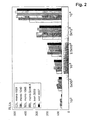
- the gray hatching from 0 to approx. 50 RLU marks the non-specific one Background of the measurement signal. At the detection limit, this exceeds Measurement signal this non-specific background.
- the Listeria bacteriophage A511 deposited with the Reference Center for Bacterial Viruses (Felix d'Herelle; University of Laval, Québec, Canada), specifically lyses bacteria of the genus Listeria (obligatory lytic). It is a complex myovirus (A1 morphotype).
- the Listeria -Page A511 differs from other known Listeria -Phagen in terms of essential features; the differences concern morphology, host range, protein profiles (electrophoresis in the SDS gel, isoelectric focusing, amino acid composition of the main structural proteins, DNA / DNA hybridization).
- the genome size of A511 is approximately 116 kbp.
- Marker genes that do not occur in the bacteria of the genus Listeria and that are inserted into phage A511 using recombination techniques are suitable for the detection. Such genes and their gene products are known, including the lux gene, which occurs in variants in various luminous bacteria, for example the Vibrio genus. The installation of the lux gene allows detection by luminescence measurement.
- the lux gene was inserted into a highly expressed gene region of the Listeria -Phagen A511.
- the main proteins of the capsid and tail shell were identified by transferring the proteins from SDS gels onto carrier membranes (Western blot).
- the determination of the N-terminal amino acid sequences made it possible to produce specific oligonucleotides with whose help (Southern hybridization) corresponding A511 DNA fragments with the genes for the proteins sought could be identified. After subcloning (in E.
- luxAB can according to the specialist known methods to isolate the DNA.
- isolated DNA can also serve as a vector.
Landscapes
- Health & Medical Sciences (AREA)
- Life Sciences & Earth Sciences (AREA)
- Chemical & Material Sciences (AREA)
- Genetics & Genomics (AREA)
- Engineering & Computer Science (AREA)
- Organic Chemistry (AREA)
- Zoology (AREA)
- Wood Science & Technology (AREA)
- Bioinformatics & Cheminformatics (AREA)
- General Engineering & Computer Science (AREA)
- Biotechnology (AREA)
- Biomedical Technology (AREA)
- General Health & Medical Sciences (AREA)
- Biochemistry (AREA)
- Microbiology (AREA)
- Biophysics (AREA)
- Molecular Biology (AREA)
- Physics & Mathematics (AREA)
- Immunology (AREA)
- Proteomics, Peptides & Aminoacids (AREA)
- Plant Pathology (AREA)
- Virology (AREA)
- Analytical Chemistry (AREA)
- Toxicology (AREA)
- Medicinal Chemistry (AREA)
- Measuring Or Testing Involving Enzymes Or Micro-Organisms (AREA)
Description
- L.mono:
- L. monocytogenes
- L.ivan:
- L. ivanovii
- L.seel:
- L. seeligeri
- Subklonieren (in E. coli) eines 2123 bp Sspl Fragmentes (F3s) von A511 (die SnaBl Schnittstelle liegt zentral) in die Smal Schnittstelle von pBluescriptll liefert pBS511-F3s.
- Amplifizieren von luxAB (vorhanden auf Promoter-Test Plasmid pSP331) mit spezifischen Primern. Der 5'-Primer (104 mer) enthält die 50 Nukleotide von SnaBl Schnittstelle in cps bis Stop-Codon, optimierte Ribosomen-Bindestelle, Start-Codon und 35 Nukleotide vom 5'-Ende von luxAB. Der 3'-Primer (39 mer) enthält (komplementär) Stop-Codon und 25 Nukleotide vom 3'-Ende von luxAB. Primäre Amplifikation in der PCR mittels Taq-Polymerase; Zusatz von Pfu-Polymerase vor dem letzten Zyklus liefert erhöhten Anteil von Produkten mit stumpfen Enden.
- Einfügen des modifizierten luxAB Fragmentes in SnaBI geschnittenen pBS511-F3s liefert pBS511-F3s-luxAB. Überprüfen der korrekten Orientierung (Restriktions-Verdaus) und Integrität des 3'-Endes von cps (DNA Sequenzierung).
- Herausschneiden der F3s-flankierten luxAB Kassette mit BamHI und EcoRI (vorhanden in MCS von pBluescript II).
- Einfügen der Kassette in den mit BamHI/EcoRI geöffneten E.coli-Listeria Shuttle Vektor pCK 1 und Transformation in E. coli W3110 liefert pCK511-F3s-luxAB.
- Isolierung und Reinigung des Plasmides; Überprüfen korrekter Struktur und Orientierung.
- Elektrotransformation von pCK511-F3s-luxAB in Listeria monocytogenes WSLC 1001 und Listeria ivanovii WSLC 3009.
- Infektion von 1001(pCKS 11-F3s-luxAB) und 3009(pCKS511-F3s-luxAB) mit A511 (Wildtyp). Durch homologe Rekombination zwischen den luxAB-flankierenden A511 Fragmenten (F3s) und während der Infektion in der Zelle gebildeter A511 DNA kommt es zu Integration (doppeltes Crossover) von luxAB in das A511 Genom (Frequenz ca. 5 x 10⁻⁴) (siehe Abbildung 1).
- Anreicherung von rekombinanten Phagen in Lysaten von 3009(pCK511-F3sluxAB) mittels Verdünnungsmethode, bei der zunächst 20 Ansätze mit jeweils 5 x 10³ Phagen separat vermehrt werden. Positive Ansätze können anhand der luxAB Expression nach Infektion von 1001 oder 3009 Wirtszellen erkannt werden. Mehrfache Wiederholung dieses Verfahrens mit entsprechend gewählten Verdünnungen (bis hin zum einzelnen Plaque) ermöglicht Isolierung von A511::luxAB.
- Vermehrung von A511::luxAB auf Wirtstamm WSLC 3009; Waschen und Konzentrieren der Phagenpartikel durch Tangential-Flow Filtration (Entfernung des während der Morphogenese gebildeten Endolysins und der Luciferase AB); Konzentrationseinstellung auf ca. 1010 Plaqueformende Einheiten/ml.
- Isolierung und Restriktionsanalyse von A511::luxAB DNA, zur Bestätigung der korrekten Integration von luxAB (doppeltes Crossover statt singulärem Crossover mit Integration des gesamten Plasmids).
- Medium für Infektion: Hirn-Herz Bouillon (halbkonzentriert);
- Listeria Zellen in Log-Phase (Vor-Inkubation bei 30-35 °C) Verdünnungen anlegen (ca. 107 Zellen/ml).
- 1 ml Zell-Suspension plus 30 µl Phagensuspension (= ca. 3 x 10⁸ Phagen/ml)
- Inkubationstemperatur: 18-20 °C (Luciferase ist Temperatur-sensitiv)
- Messung in Tube-Luminometer (LB9501, Fa. Berthold)
- Injektion von 50 µl 0,25 % Nonanal, Messung und Integration der RLUs für 5 s.
- Bester Messpunkt (maximale Lichtemission, gemessen in RLUs (Relative Light Units): ca. 120-130 min. post Infektion (bei 20 °C)
- Verdünnungen anlegen (102, 5 x 10², 103, 2,5 x 10³, 5 x 10³, 104 Zellen/ml)
- Kontrollen:
- A) Ohne A511::luxAB (Null-Kontrolle)
- B) Ohne Zellen, ohne A511::luxAB (Hintergrund Kontrolle)
- Infektion nach optimalen Parametern (s.o.), Messung der RLUs (siehe Abbildung 2)
- Nachweisgrenze bei ca. 5 x 10² Zellen; zuverlässige Positiv-Grenze bei ca. 103 Zellen.
- Künstliche Kontaminierung von Salatblättern (Eisbergsalat) mit 0 (= Kontrolle); 0,1; 1,0 und 10 Zellen L. monocytogenes ScottA/g Salat.
- Lagerung bei 4 °C für 1 und 7 Tage.
- Vermischung von je 25 g Salat mit 225 ml ANC-Bouillon oder Listeria Selektiv-Bouillon.
- Inkubation bei 30 °C für 24 Stunden.
- Kurze Sekundäranreicherung (nicht-selektiv): 1 ml Primäranreicherung plus 5 ml Hirn-Herz-Bouillon (halbkonzentriert); 3-4 Std. Inkubation bei 30-35 °C.
- Infektion von 1 ml Test-Kultur nach optimalen Parametern (s.o.); Messung der RLUs.
- Ergebnis: Der Ansatz mit 0,1 Zellen L. monocytogenes ScottA pro Gramm Salat ergibt eindeutig positives Signal nach 1 und 7 Tagen Lagerung des Salates.
Claims (5)
- Verfahren zum Nachweis von Bakterien der Gattung Listeria in einer Probe umfassend die Schritte:(a) Bereitstellen eines mittels Rekombinationstechniken hergestellten DNA-Vektors, enthaltend ein genetisches System, umfassend DNA, die die Expression eines oder mehrerer Proteine kodiert, wobei die Proteine kein Genprodukt von Bakterien der Gattung Listeria darstellen und das Vorhandensein der Proteine durch eine Nachweisreaktion festgestellt werden kann, und wobei der DNA-Vektor die Bakterien der Gattung Listeria infiziert und dabei das genetische System in die Bakterien übertragen kann, und wobei als DNA-Vektor ein rekombinanter Listeria-Bakteriophage aus der Gruppe der Myoviren mit dem Morphotyp A1 verwendet wird;(b) Vermischen der Probe mit besagtem DNA-Vektor unter Bedingungen, die eine Infektion von Bakterien der Gattung Listeria durch den DNA-Vektor erlauben;(c) Exprimieren der nachweisbaren Proteine in den Bakterien der Gattung Listeria;(d) Nachweis der nachweisbaren Proteine, wobei die Anwesenheit von Bakterien der Gattung Listeria nachgewiesen wird.
- Verfahren nach Anspruch 1, dadurch gekennzeichnet, daß das genetische System eine Luciferase als nachweisbares Protein codiert, wobei die Luciferase in den Bakterien durch Lichtemission nachgewiesen wird.
- Rekombinanter Listeria-Bakteriophage aus der Gruppe der Myoviren mit dem Morphotyp A1, dadurch gekennzeichnet, daß in dem Genom des Bakteriophagen ein Gen integriert ist, das eine Luciferase codiert.
- Isolierte DNA erhältlich durch Extraktion aus einem Bakteriophagen mit den Merkmalen des Anspruches 3.
- Reagenzzusammenstellung enthaltend neben einem Wachstumsmedium für Bakterien der Gattung Listeria infektiöse Listeria-Bakteriophagen mit den Merkmalen des Anspruches 4.
Applications Claiming Priority (2)
| Application Number | Priority Date | Filing Date | Title |
|---|---|---|---|
| DE19517940A DE19517940A1 (de) | 1995-05-18 | 1995-05-18 | Nachweis von Listerien mittels rekombinanter Bakteriophagen |
| DE19517940 | 1995-05-18 |
Publications (2)
| Publication Number | Publication Date |
|---|---|
| EP0743366A1 EP0743366A1 (de) | 1996-11-20 |
| EP0743366B1 true EP0743366B1 (de) | 2001-07-11 |
Family
ID=7762052
Family Applications (1)
| Application Number | Title | Priority Date | Filing Date |
|---|---|---|---|
| EP96107225A Expired - Lifetime EP0743366B1 (de) | 1995-05-18 | 1996-05-08 | Nachweis von Listerien mittels rekombinanter Bakteriophagen |
Country Status (5)
| Country | Link |
|---|---|
| US (1) | US5824468A (de) |
| EP (1) | EP0743366B1 (de) |
| DE (2) | DE19517940A1 (de) |
| DK (1) | DK0743366T3 (de) |
| ES (1) | ES2160191T3 (de) |
Families Citing this family (49)
| Publication number | Priority date | Publication date | Assignee | Title |
|---|---|---|---|---|
| US6217847B1 (en) | 1994-07-01 | 2001-04-17 | The Board Of Trustees Of The Leland Stanford Junior University | Non-invasive localization of a light-emitting conjugate in a mammal |
| US7255851B2 (en) | 1994-07-01 | 2007-08-14 | The Board Of Trustees Of The Leland Stanford Junior University | Non-invasive localization of a light-emitting conjugate in a mammal |
| EP1031630B1 (de) * | 1999-02-22 | 2004-10-20 | Matsushita Electric Industrial Co., Ltd. | Verfahren zum Nachweis von Bakterien |
| FI107167B (fi) * | 1999-06-07 | 2001-06-15 | Marko Virta | Menetelmä mikro-organismin kasvun ja kuolemisen määrittämiseksi |
| RU2265061C2 (ru) * | 1999-07-30 | 2005-11-27 | Профос АГ | Способ выявления бактерий и набор для его осуществления |
| US20030096315A1 (en) | 2000-05-03 | 2003-05-22 | Sanders Mitchell C. | Device for detecting bacterial contamination and method of use |
| US20020192676A1 (en) * | 2001-06-18 | 2002-12-19 | Madonna Angelo J. | Method for determining if a type of bacteria is present in a mixture |
| WO2003035889A2 (en) * | 2001-07-13 | 2003-05-01 | Investigen, Inc. | Compositions and methods for bacteria detection |
| DE60218473T2 (de) * | 2001-07-18 | 2007-11-08 | Instytut Immunologii I Terapii Doswiadczalnej - Pan | Verfahren zur herstellung polyvalenter bakteriophagenpräparationen zur behandlung bakterieller infektionen |
| WO2004041156A2 (en) * | 2002-01-23 | 2004-05-21 | The Government Of The United States Of America As Represented By The Secretary Of The Department Of Health Andhuman Services | Method for determining sensitivity to a bacteriophage |
| WO2003063693A2 (en) * | 2002-01-31 | 2003-08-07 | Expressive Constructs, Inc. | Method for detecting microorganisms |
| JP4490112B2 (ja) * | 2002-04-12 | 2010-06-23 | コロラド・スクール・オブ・マインズ | 標的細菌性細胞を感染させるためにファージを使用する低濃度の標的細菌を検出するための方法 |
| US20050003346A1 (en) * | 2002-04-12 | 2005-01-06 | Colorado School Of Mines | Apparatus and method for detecting microscopic living organisms using bacteriophage |
| US8216780B2 (en) * | 2002-04-12 | 2012-07-10 | Microphage (Tm) Incorporated | Method for enhanced sensitivity in bacteriophage-based diagnostic assays |
| AU2004225575B2 (en) * | 2003-01-31 | 2008-02-21 | Ethicon, Inc. | Method for detecting escherichia coli |
| CA2557612C (en) | 2003-11-03 | 2014-06-17 | Ethicon, Inc. | Methods, peptides and biosensors useful for detecting a broad spectrum of bacteria |
| US20050250096A1 (en) * | 2004-02-13 | 2005-11-10 | Microphage, Incorporated | Microorganism detection using bacteriophage amplification |
| US20090286225A1 (en) * | 2004-02-13 | 2009-11-19 | Microphagetm Incorporated | Method and apparatus for bacteriophage-based diagnostic assays |
| AU2005324479A1 (en) * | 2004-04-07 | 2006-07-20 | The Government Of The United States Of America, As Represented By The Secretary, Department Of Health And Human Services | Reporter plasmid phage packaging system for detection of bacteria |
| WO2006105504A1 (en) * | 2005-03-31 | 2006-10-05 | Microphage Incorporated | Apparatus and method for detecting microorganisms using flagged bacteriophage |
| US20110097702A1 (en) * | 2005-03-31 | 2011-04-28 | Voorhees Kent J | Methods and compositions for in situ detection of microorganisms on a surface |
| US20070178450A1 (en) * | 2006-01-27 | 2007-08-02 | Microphage (Tm) Incorporation | Method and apparatus for determining level of microorganisms using bacteriophage |
| JP2010508044A (ja) * | 2006-10-31 | 2010-03-18 | マイクロファージ・インコーポレーテッド | 潜在的に交差反応性の生物の選択阻害による、強化されたバクテリオファージベース診断アッセイの方法及び装置 |
| WO2009005869A2 (en) * | 2007-04-04 | 2009-01-08 | Guild Associates, Inc. | Biological detection system and method |
| US8455186B2 (en) * | 2007-06-15 | 2013-06-04 | MicroPhage™ Incorporated | Method of detection of microorganisms with enhanced bacteriophage amplification |
| US8697434B2 (en) * | 2008-01-11 | 2014-04-15 | Colorado School Of Mines | Detection of phage amplification by SERS nanoparticles |
| US9441204B2 (en) * | 2008-04-03 | 2016-09-13 | Colorado School Of Mines | Compositions and methods for detecting Yersinia pestis bacteria |
| PL215522B1 (pl) | 2008-09-29 | 2013-12-31 | Inst Immunologii I Terapii Doswiadczalnej Pan | Nowe szczepy bakteriofagów do leczenia zakazen bakteryjnych, zwlaszcza szczepami bakterii lekoopornych rodzaju Enterococcus |
| PL212258B1 (pl) | 2010-06-20 | 2012-09-28 | Inst Immunologii I Terapii Doswiadczalnej Pan | Nowe szczepy bakteriofagów do leczenia zakazen bakteryjnych, zwlaszcza szczepami bakterii lekoopornych rodzaju Stenotrophomonas |
| WO2012158041A1 (en) | 2011-05-18 | 2012-11-22 | Rna Holding B.V. | Diagnostic methods and kits for determining the presence of a microorganism in a sample |
| PL217019B1 (pl) | 2011-08-25 | 2014-06-30 | Proteon Pharmaceuticals Spółka Akcyjna | Sposób otrzymywania szczepu bakteriofaga, specyficzne szczepy bakteriofagowe oraz ich zastosowanie |
| JP2015510598A (ja) * | 2012-02-21 | 2015-04-09 | ラボラトリー コーポレイション オブ アメリカ ホールディングス | 微生物の検出のための方法およびシステム |
| US10519483B2 (en) | 2012-02-21 | 2019-12-31 | Laboratory Corporation Of America Holdings | Methods and systems for rapid detection of microorganisms using infectious agents |
| US10913934B2 (en) | 2013-02-21 | 2021-02-09 | Laboratory Corporation Of America Holdings | Methods and systems for rapid detection of microorganisms using infectious agents |
| US9481903B2 (en) | 2013-03-13 | 2016-11-01 | Roche Molecular Systems, Inc. | Systems and methods for detection of cells using engineered transduction particles |
| KR102127358B1 (ko) | 2013-03-13 | 2020-06-29 | 지니위브 바이오사이언시스, 인코포레이티드 | 비-복제 형질도입 입자 및 형질도입 입자-기반 리포터 시스템 |
| AU2014241191A1 (en) | 2013-03-27 | 2015-10-22 | Sample Technologies, Inc. | Recombinant phage and bacterial detection methods |
| AU2014281406A1 (en) | 2013-06-19 | 2016-01-21 | Sample6 Technologies, Inc. | Phage-based bacterial detection assay |
| US9540675B2 (en) | 2013-10-29 | 2017-01-10 | GeneWeave Biosciences, Inc. | Reagent cartridge and methods for detection of cells |
| CA2947441A1 (en) | 2014-05-09 | 2015-11-12 | Sample6 Technologies, Inc. | Codon-optimized recombinant phage and methods of using same |
| US10351893B2 (en) | 2015-10-05 | 2019-07-16 | GeneWeave Biosciences, Inc. | Reagent cartridge for detection of cells |
| CA3011704A1 (en) * | 2016-01-18 | 2017-07-27 | Laboratory Corporation Of America Holdings | Methods and systems for rapid detection of microorganisms using infectious agents |
| CA3048992A1 (en) | 2016-12-30 | 2018-07-05 | Quidel Corporation | Phage-mediated immunoassay and methods for determining susceptibility of bacteria to antibiotic or probiotic agents |
| CA3076516A1 (en) * | 2017-10-02 | 2019-04-11 | Quidel Corporation | Phage-based detection method for antimicrobial susceptibility testing and identification of bacterial species |
| CN118813558A (zh) | 2018-01-12 | 2024-10-22 | 美国控股实验室公司 | 使用感染因子快速检测克罗诺杆菌属的方法和系统 |
| CN110579608B (zh) * | 2018-06-11 | 2022-07-08 | 苏州若泰医药科技有限公司 | 一种筛选高表达外源蛋白的非整合减毒李斯特菌菌株的方法 |
| BR112021023617A2 (pt) | 2019-06-21 | 2022-01-04 | Laboratory Corp America Holdings | Métodos para a produção de bacteriófagos mutantes para a detecção de listeria |
| JP7781741B2 (ja) | 2019-08-26 | 2025-12-08 | ラボラトリー コーポレイション オブ アメリカ ホールディングス | 組換え繁殖欠損指標バクテリオファージを使用して微生物を検出するためのデバイスおよび方法 |
| WO2021050939A1 (en) | 2019-09-11 | 2021-03-18 | Laboratory Corporation Of America Holdings | Methods and systems for the rapid detection of microorganisms using recombinant infectious agents to express an indicator subunit |
Family Cites Families (3)
| Publication number | Priority date | Publication date | Assignee | Title |
|---|---|---|---|---|
| AU634500B2 (en) * | 1988-10-04 | 1993-02-25 | Dna Plant Technology Corporation | Bacterial detection by phage transduction of detectable phenotype |
| GB9017443D0 (en) * | 1990-08-09 | 1990-09-26 | Amersham Int Plc | Reporter bacteria for rapid microbial detection |
| EP0625191A1 (de) * | 1992-02-07 | 1994-11-23 | Albert Einstein College Of Medicine Of Yeshiva University | Für mycobakterien spezifische reporter-mycobakteriophagen |
-
1995
- 1995-05-18 DE DE19517940A patent/DE19517940A1/de not_active Withdrawn
-
1996
- 1996-05-08 EP EP96107225A patent/EP0743366B1/de not_active Expired - Lifetime
- 1996-05-08 DK DK96107225T patent/DK0743366T3/da active
- 1996-05-08 ES ES96107225T patent/ES2160191T3/es not_active Expired - Lifetime
- 1996-05-08 DE DE59607254T patent/DE59607254D1/de not_active Expired - Fee Related
- 1996-05-17 US US08/648,978 patent/US5824468A/en not_active Expired - Lifetime
Non-Patent Citations (5)
| Title |
|---|
| GERNER-SMIDT, P. ET AL.: "A new Danish Listeria monocytogenes phage typing system", APMIS, vol. 101, 1993, pages 160 - 167, XP000923063, DOI: doi:10.1111/j.1699-0463.1993.tb00096.x * |
| LOESSNER, M.: "Improved Procedure for Bacteriophage typing of Listeria strains and evaluation of new phages", APPLIED ENVIRONMENTAL MICROBIOLOGY, vol. 57, no. 3, March 1991 (1991-03-01), pages 882 - 884, XP000923064 * |
| LOESSNER. M ET AL.: "Taxonomical classification of 20 newly isolated Listeria Bacteriophages by electron microscopy and protein analysis", INTERVIROLOGY, vol. 37, 1994, pages 31 - 35, XP000923065 * |
| MCLAUCHLIN, J. ET AL.: "WHO study on subtyping Listeria monocytogenes: results of phage typing", INT. JOURNAL OF FOOD MICROBIOLOGY, vol. 32, 1996, pages 289 - 299, XP000923026, DOI: doi:10.1016/S0168-1605(96)01143-9 * |
| ROCOURT, J. ET AL.: "A multi-centre study on the phage typing of Listeria monocytogenes", ZBL. BAKT. HYG., no. A259, 1985, pages 489 - 497 * |
Also Published As
| Publication number | Publication date |
|---|---|
| DE19517940A1 (de) | 1996-11-21 |
| DK0743366T3 (da) | 2001-10-01 |
| US5824468A (en) | 1998-10-20 |
| DE59607254D1 (de) | 2001-08-16 |
| EP0743366A1 (de) | 1996-11-20 |
| ES2160191T3 (es) | 2001-11-01 |
Similar Documents
| Publication | Publication Date | Title |
|---|---|---|
| EP0743366A1 (de) | Nachweis von Listerien mittels rekombinanter Bakteriophagen | |
| Loessner et al. | Construction of luciferase reporter bacteriophage A511:: luxAB for rapid and sensitive detection of viable Listeria cells | |
| Boerrigter et al. | Plasmid-based transgenic mouse model for studying in vivo mutations. | |
| DE3587299T2 (de) | Nachweis und/oder identifizierung von mikroorganismen in einer probe mittels biolumineszenz oder anderer exogenen genetisch eingefuehrten markierungssubstanzen. | |
| AU634500B2 (en) | Bacterial detection by phage transduction of detectable phenotype | |
| EP2276852B1 (de) | Phagenvermittelte biolumineszenzerkennung von yersinia pestis | |
| CN112226489A (zh) | 一种基于磁珠靶向富集目标基因的核酸提取方法及其应用 | |
| DE60029107T2 (de) | Luziferase expressionskassetten und methoden zu ihrer verwendung | |
| Riede et al. | T-even-type bacteriophages use an adhesin for recognition of cellular receptors | |
| Kenzaka et al. | High-frequency phage-mediated gene transfer among Escherichia coli cells, determined at the single-cell level | |
| DE69121888T2 (de) | Screening nach proteinpartnern und deren verwendung | |
| EP0781349B1 (de) | Aufschluss von bakterienzellen durch phagenlysine | |
| CN113490849A (zh) | 使用感染因子快速检测李斯特菌属的方法和系统 | |
| US11674124B2 (en) | Methods for producing mutant bacteriophages for the detection of listeria | |
| US20070015169A1 (en) | Isolation of nucleic acid using colored buffers | |
| CA2285633C (en) | Bacterial plasmids | |
| EP1362125B1 (de) | Verfahren zur identifizierung biologisch aktiver strukturen mikrobieller erreger | |
| CN108660144A (zh) | 一种牛支原体多功能蛋白CDNPase | |
| CN118600111A (zh) | 一种检测II型草鱼呼肠孤病毒的RPA-CRISPR/Cas12a试剂盒及其应用 | |
| CN116287139A (zh) | 检测金黄色葡萄球菌的方法 | |
| CN119895045A (zh) | 用于转座货物核苷酸序列的系统和方法 | |
| WO2018222891A1 (en) | Phage engineering: protection by circularized intermediate | |
| EP2298879A1 (de) | Verfahren zur dna-amplifikation in der zelle | |
| Windass et al. | Aberrant immunity behaviour of hybrid λ imm 21 phages containing the DNA of ColE1-type plasmids | |
| CN116640783B (zh) | 一个新型报告基因hbpR的鉴定及其应用 |
Legal Events
| Date | Code | Title | Description |
|---|---|---|---|
| PUAI | Public reference made under article 153(3) epc to a published international application that has entered the european phase |
Free format text: ORIGINAL CODE: 0009012 |
|
| AK | Designated contracting states |
Kind code of ref document: A1 Designated state(s): DE DK ES FR GB IT NL |
|
| 17P | Request for examination filed |
Effective date: 19970417 |
|
| 17Q | First examination report despatched |
Effective date: 19970523 |
|
| RAP1 | Party data changed (applicant data changed or rights of an application transferred) |
Owner name: LOESSNER, MARTIN J. DR. Owner name: SCHERER, SIEGFRIED, PROF. DR. |
|
| RAP1 | Party data changed (applicant data changed or rights of an application transferred) |
Owner name: SCHERER, SIEGFRIED, PROF. DR. Owner name: LOESSNER, MARTIN J., DR. |
|
| RIN1 | Information on inventor provided before grant (corrected) |
Inventor name: SCHERER, SIEGFRIED, PROF. DR. Inventor name: LOESSNER, MARTIN J., DR. |
|
| GRAG | Despatch of communication of intention to grant |
Free format text: ORIGINAL CODE: EPIDOS AGRA |
|
| GRAG | Despatch of communication of intention to grant |
Free format text: ORIGINAL CODE: EPIDOS AGRA |
|
| GRAH | Despatch of communication of intention to grant a patent |
Free format text: ORIGINAL CODE: EPIDOS IGRA |
|
| RAP1 | Party data changed (applicant data changed or rights of an application transferred) |
Owner name: XENOGEN CORPORATION |
|
| RIN1 | Information on inventor provided before grant (corrected) |
Inventor name: SCHERER, SIEGFRIED, PROF. DR. Inventor name: LOESSNER, MARTIN J., DR. |
|
| GRAH | Despatch of communication of intention to grant a patent |
Free format text: ORIGINAL CODE: EPIDOS IGRA |
|
| GRAA | (expected) grant |
Free format text: ORIGINAL CODE: 0009210 |
|
| AK | Designated contracting states |
Kind code of ref document: B1 Designated state(s): DE DK ES FR GB IT NL |
|
| REF | Corresponds to: |
Ref document number: 59607254 Country of ref document: DE Date of ref document: 20010816 |
|
| ITF | It: translation for a ep patent filed | ||
| REG | Reference to a national code |
Ref country code: DK Ref legal event code: T3 |
|
| GBT | Gb: translation of ep patent filed (gb section 77(6)(a)/1977) |
Effective date: 20011009 |
|
| REG | Reference to a national code |
Ref country code: ES Ref legal event code: FG2A Ref document number: 2160191 Country of ref document: ES Kind code of ref document: T3 |
|
| ET | Fr: translation filed | ||
| REG | Reference to a national code |
Ref country code: GB Ref legal event code: IF02 |
|
| PLBE | No opposition filed within time limit |
Free format text: ORIGINAL CODE: 0009261 |
|
| STAA | Information on the status of an ep patent application or granted ep patent |
Free format text: STATUS: NO OPPOSITION FILED WITHIN TIME LIMIT |
|
| 26N | No opposition filed | ||
| PGFP | Annual fee paid to national office [announced via postgrant information from national office to epo] |
Ref country code: NL Payment date: 20070524 Year of fee payment: 12 |
|
| PGFP | Annual fee paid to national office [announced via postgrant information from national office to epo] |
Ref country code: ES Payment date: 20070528 Year of fee payment: 12 |
|
| PGFP | Annual fee paid to national office [announced via postgrant information from national office to epo] |
Ref country code: DK Payment date: 20070531 Year of fee payment: 12 |
|
| PGFP | Annual fee paid to national office [announced via postgrant information from national office to epo] |
Ref country code: IT Payment date: 20070525 Year of fee payment: 12 |
|
| PGFP | Annual fee paid to national office [announced via postgrant information from national office to epo] |
Ref country code: DE Payment date: 20080630 Year of fee payment: 13 |
|
| PGFP | Annual fee paid to national office [announced via postgrant information from national office to epo] |
Ref country code: GB Payment date: 20080529 Year of fee payment: 13 |
|
| REG | Reference to a national code |
Ref country code: DK Ref legal event code: EBP |
|
| PG25 | Lapsed in a contracting state [announced via postgrant information from national office to epo] |
Ref country code: NL Free format text: LAPSE BECAUSE OF NON-PAYMENT OF DUE FEES Effective date: 20081201 |
|
| PG25 | Lapsed in a contracting state [announced via postgrant information from national office to epo] |
Ref country code: DK Free format text: LAPSE BECAUSE OF NON-PAYMENT OF DUE FEES Effective date: 20080531 |
|
| REG | Reference to a national code |
Ref country code: ES Ref legal event code: FD2A Effective date: 20080509 |
|
| PG25 | Lapsed in a contracting state [announced via postgrant information from national office to epo] |
Ref country code: IT Free format text: LAPSE BECAUSE OF NON-PAYMENT OF DUE FEES Effective date: 20080508 |
|
| PG25 | Lapsed in a contracting state [announced via postgrant information from national office to epo] |
Ref country code: ES Free format text: LAPSE BECAUSE OF NON-PAYMENT OF DUE FEES Effective date: 20080509 |
|
| GBPC | Gb: european patent ceased through non-payment of renewal fee |
Effective date: 20090508 |
|
| REG | Reference to a national code |
Ref country code: FR Ref legal event code: ST Effective date: 20100129 |
|
| PG25 | Lapsed in a contracting state [announced via postgrant information from national office to epo] |
Ref country code: FR Free format text: LAPSE BECAUSE OF NON-PAYMENT OF DUE FEES Effective date: 20090602 |
|
| PGFP | Annual fee paid to national office [announced via postgrant information from national office to epo] |
Ref country code: FR Payment date: 20080519 Year of fee payment: 13 |
|
| PG25 | Lapsed in a contracting state [announced via postgrant information from national office to epo] |
Ref country code: GB Free format text: LAPSE BECAUSE OF NON-PAYMENT OF DUE FEES Effective date: 20090508 |
|
| PG25 | Lapsed in a contracting state [announced via postgrant information from national office to epo] |
Ref country code: DE Free format text: LAPSE BECAUSE OF NON-PAYMENT OF DUE FEES Effective date: 20091201 |