EP0742258B1 - Compatibilizing agent and method of producing the same - Google Patents
Compatibilizing agent and method of producing the same Download PDFInfo
- Publication number
- EP0742258B1 EP0742258B1 EP96107268A EP96107268A EP0742258B1 EP 0742258 B1 EP0742258 B1 EP 0742258B1 EP 96107268 A EP96107268 A EP 96107268A EP 96107268 A EP96107268 A EP 96107268A EP 0742258 B1 EP0742258 B1 EP 0742258B1
- Authority
- EP
- European Patent Office
- Prior art keywords
- group
- composition
- polymer
- compound
- carboxylic acid
- Prior art date
- Legal status (The legal status is an assumption and is not a legal conclusion. Google has not performed a legal analysis and makes no representation as to the accuracy of the status listed.)
- Expired - Lifetime
Links
- 238000000034 method Methods 0.000 title claims description 24
- 229920000642 polymer Polymers 0.000 claims abstract description 112
- 239000000203 mixture Substances 0.000 claims abstract description 67
- 150000001875 compounds Chemical class 0.000 claims abstract description 57
- 239000003795 chemical substances by application Substances 0.000 claims abstract description 46
- 125000004435 hydrogen atom Chemical group [H]* 0.000 claims abstract description 29
- 239000000956 alloy Substances 0.000 claims abstract description 28
- 229910045601 alloy Inorganic materials 0.000 claims abstract description 28
- 125000003118 aryl group Chemical group 0.000 claims abstract description 11
- 125000003178 carboxy group Chemical group [H]OC(*)=O 0.000 claims abstract description 10
- 125000000732 arylene group Chemical group 0.000 claims abstract description 6
- 125000002993 cycloalkylene group Chemical group 0.000 claims abstract description 6
- 150000001732 carboxylic acid derivatives Chemical class 0.000 claims description 39
- 125000001424 substituent group Chemical group 0.000 claims description 17
- 125000000217 alkyl group Chemical group 0.000 claims description 12
- 238000006243 chemical reaction Methods 0.000 claims description 9
- 125000004178 (C1-C4) alkyl group Chemical group 0.000 claims description 7
- 125000002947 alkylene group Chemical group 0.000 claims description 5
- 150000002148 esters Chemical class 0.000 claims description 5
- 125000000843 phenylene group Chemical group C1(=C(C=CC=C1)*)* 0.000 claims description 3
- 125000000524 functional group Chemical group 0.000 abstract description 15
- 230000002209 hydrophobic effect Effects 0.000 abstract description 9
- 235000014113 dietary fatty acids Nutrition 0.000 abstract description 7
- 229930195729 fatty acid Natural products 0.000 abstract description 7
- 239000000194 fatty acid Substances 0.000 abstract description 7
- 150000004665 fatty acids Chemical class 0.000 abstract description 7
- 125000001931 aliphatic group Chemical group 0.000 abstract description 2
- 125000000547 substituted alkyl group Chemical group 0.000 abstract description 2
- 125000005156 substituted alkylene group Chemical group 0.000 abstract description 2
- -1 aliphatic monocarboxylic acids Chemical class 0.000 description 43
- 125000004432 carbon atom Chemical group C* 0.000 description 15
- 239000004743 Polypropylene Substances 0.000 description 9
- 229920003023 plastic Polymers 0.000 description 9
- 239000004033 plastic Substances 0.000 description 9
- 229920001155 polypropylene Polymers 0.000 description 9
- 239000011369 resultant mixture Substances 0.000 description 9
- 239000002253 acid Substances 0.000 description 8
- 238000005275 alloying Methods 0.000 description 8
- POULHZVOKOAJMA-UHFFFAOYSA-N dodecanoic acid Chemical compound CCCCCCCCCCCC(O)=O POULHZVOKOAJMA-UHFFFAOYSA-N 0.000 description 8
- 229920001707 polybutylene terephthalate Polymers 0.000 description 8
- 239000000126 substance Substances 0.000 description 8
- SYJPAKDNFZLSMV-HYXAFXHYSA-N (Z)-2-methylpropanal oxime Chemical compound CC(C)\C=N/O SYJPAKDNFZLSMV-HYXAFXHYSA-N 0.000 description 7
- HMOZDINWBHMBSQ-UHFFFAOYSA-N 2-[3-(4,5-dihydro-1,3-oxazol-2-yl)phenyl]-4,5-dihydro-1,3-oxazole Chemical compound O1CCN=C1C1=CC=CC(C=2OCCN=2)=C1 HMOZDINWBHMBSQ-UHFFFAOYSA-N 0.000 description 7
- 125000003504 2-oxazolinyl group Chemical group O1C(=NCC1)* 0.000 description 7
- 239000007795 chemical reaction product Substances 0.000 description 7
- 230000000052 comparative effect Effects 0.000 description 7
- 238000000635 electron micrograph Methods 0.000 description 7
- 229920000728 polyester Polymers 0.000 description 7
- 239000002904 solvent Substances 0.000 description 7
- 125000002496 methyl group Chemical group [H]C([H])([H])* 0.000 description 6
- 238000002156 mixing Methods 0.000 description 6
- 125000001495 ethyl group Chemical group [H]C([H])([H])C([H])([H])* 0.000 description 5
- 238000004519 manufacturing process Methods 0.000 description 5
- HZAXFHJVJLSVMW-UHFFFAOYSA-N 2-Aminoethan-1-ol Chemical compound NCCO HZAXFHJVJLSVMW-UHFFFAOYSA-N 0.000 description 4
- IMSODMZESSGVBE-UHFFFAOYSA-N 2-Oxazoline Chemical compound C1CN=CO1 IMSODMZESSGVBE-UHFFFAOYSA-N 0.000 description 4
- 239000005639 Lauric acid Substances 0.000 description 4
- OFOBLEOULBTSOW-UHFFFAOYSA-N Malonic acid Chemical compound OC(=O)CC(O)=O OFOBLEOULBTSOW-UHFFFAOYSA-N 0.000 description 4
- 150000007513 acids Chemical class 0.000 description 4
- 229920001577 copolymer Polymers 0.000 description 4
- 238000005516 engineering process Methods 0.000 description 4
- IPCSVZSSVZVIGE-UHFFFAOYSA-N hexadecanoic acid Chemical compound CCCCCCCCCCCCCCCC(O)=O IPCSVZSSVZVIGE-UHFFFAOYSA-N 0.000 description 4
- 125000001449 isopropyl group Chemical group [H]C([H])([H])C([H])(*)C([H])([H])[H] 0.000 description 4
- 238000002844 melting Methods 0.000 description 4
- 230000008018 melting Effects 0.000 description 4
- 239000000178 monomer Substances 0.000 description 4
- 125000001436 propyl group Chemical group [H]C([*])([H])C([H])([H])C([H])([H])[H] 0.000 description 4
- 241000894007 species Species 0.000 description 4
- 229920002554 vinyl polymer Polymers 0.000 description 4
- ZWEHNKRNPOVVGH-UHFFFAOYSA-N 2-Butanone Chemical compound CCC(C)=O ZWEHNKRNPOVVGH-UHFFFAOYSA-N 0.000 description 3
- WEVYAHXRMPXWCK-UHFFFAOYSA-N Acetonitrile Chemical compound CC#N WEVYAHXRMPXWCK-UHFFFAOYSA-N 0.000 description 3
- IJGRMHOSHXDMSA-UHFFFAOYSA-N Atomic nitrogen Chemical compound N#N IJGRMHOSHXDMSA-UHFFFAOYSA-N 0.000 description 3
- UHOVQNZJYSORNB-UHFFFAOYSA-N Benzene Chemical compound C1=CC=CC=C1 UHOVQNZJYSORNB-UHFFFAOYSA-N 0.000 description 3
- YMWUJEATGCHHMB-UHFFFAOYSA-N Dichloromethane Chemical compound ClCCl YMWUJEATGCHHMB-UHFFFAOYSA-N 0.000 description 3
- RTZKZFJDLAIYFH-UHFFFAOYSA-N Diethyl ether Chemical compound CCOCC RTZKZFJDLAIYFH-UHFFFAOYSA-N 0.000 description 3
- XEKOWRVHYACXOJ-UHFFFAOYSA-N Ethyl acetate Chemical compound CCOC(C)=O XEKOWRVHYACXOJ-UHFFFAOYSA-N 0.000 description 3
- ZMXDDKWLCZADIW-UHFFFAOYSA-N N,N-Dimethylformamide Chemical compound CN(C)C=O ZMXDDKWLCZADIW-UHFFFAOYSA-N 0.000 description 3
- YXFVVABEGXRONW-UHFFFAOYSA-N Toluene Chemical compound CC1=CC=CC=C1 YXFVVABEGXRONW-UHFFFAOYSA-N 0.000 description 3
- 125000000484 butyl group Chemical group [H]C([*])([H])C([H])([H])C([H])([H])C([H])([H])[H] 0.000 description 3
- 150000001735 carboxylic acids Chemical class 0.000 description 3
- 125000000959 isobutyl group Chemical group [H]C([H])([H])C([H])(C([H])([H])[H])C([H])([H])* 0.000 description 3
- 230000004048 modification Effects 0.000 description 3
- 238000012986 modification Methods 0.000 description 3
- 238000000465 moulding Methods 0.000 description 3
- VLKZOEOYAKHREP-UHFFFAOYSA-N n-Hexane Chemical compound CCCCCC VLKZOEOYAKHREP-UHFFFAOYSA-N 0.000 description 3
- 238000005191 phase separation Methods 0.000 description 3
- 229920002647 polyamide Polymers 0.000 description 3
- 239000004417 polycarbonate Substances 0.000 description 3
- 229920000515 polycarbonate Polymers 0.000 description 3
- 229920005989 resin Polymers 0.000 description 3
- 239000011347 resin Substances 0.000 description 3
- 125000002914 sec-butyl group Chemical group [H]C([H])([H])C([H])([H])C([H])(*)C([H])([H])[H] 0.000 description 3
- 125000000999 tert-butyl group Chemical group [H]C([H])([H])C(*)(C([H])([H])[H])C([H])([H])[H] 0.000 description 3
- BQBSIHIZDSHADD-UHFFFAOYSA-N 2-ethenyl-4,5-dihydro-1,3-oxazole Chemical compound C=CC1=NCCO1 BQBSIHIZDSHADD-UHFFFAOYSA-N 0.000 description 2
- CSCPPACGZOOCGX-UHFFFAOYSA-N Acetone Chemical compound CC(C)=O CSCPPACGZOOCGX-UHFFFAOYSA-N 0.000 description 2
- XKRFYHLGVUSROY-UHFFFAOYSA-N Argon Chemical compound [Ar] XKRFYHLGVUSROY-UHFFFAOYSA-N 0.000 description 2
- HEDRZPFGACZZDS-UHFFFAOYSA-N Chloroform Chemical compound ClC(Cl)Cl HEDRZPFGACZZDS-UHFFFAOYSA-N 0.000 description 2
- VZCYOOQTPOCHFL-OWOJBTEDSA-N Fumaric acid Chemical compound OC(=O)\C=C\C(O)=O VZCYOOQTPOCHFL-OWOJBTEDSA-N 0.000 description 2
- ZQPPMHVWECSIRJ-UHFFFAOYSA-N Oleic acid Natural products CCCCCCCCC=CCCCCCCCC(O)=O ZQPPMHVWECSIRJ-UHFFFAOYSA-N 0.000 description 2
- 235000021314 Palmitic acid Nutrition 0.000 description 2
- OFBQJSOFQDEBGM-UHFFFAOYSA-N Pentane Chemical compound CCCCC OFBQJSOFQDEBGM-UHFFFAOYSA-N 0.000 description 2
- 239000004952 Polyamide Substances 0.000 description 2
- 239000004793 Polystyrene Substances 0.000 description 2
- 235000021355 Stearic acid Nutrition 0.000 description 2
- PPBRXRYQALVLMV-UHFFFAOYSA-N Styrene Chemical compound C=CC1=CC=CC=C1 PPBRXRYQALVLMV-UHFFFAOYSA-N 0.000 description 2
- WYURNTSHIVDZCO-UHFFFAOYSA-N Tetrahydrofuran Chemical compound C1CCOC1 WYURNTSHIVDZCO-UHFFFAOYSA-N 0.000 description 2
- WNLRTRBMVRJNCN-UHFFFAOYSA-N adipic acid Chemical compound OC(=O)CCCCC(O)=O WNLRTRBMVRJNCN-UHFFFAOYSA-N 0.000 description 2
- 125000003545 alkoxy group Chemical group 0.000 description 2
- YZXBAPSDXZZRGB-DOFZRALJSA-N arachidonic acid Chemical compound CCCCC\C=C/C\C=C/C\C=C/C\C=C/CCCC(O)=O YZXBAPSDXZZRGB-DOFZRALJSA-N 0.000 description 2
- 239000012298 atmosphere Substances 0.000 description 2
- 230000015572 biosynthetic process Effects 0.000 description 2
- 229920001400 block copolymer Polymers 0.000 description 2
- 239000003054 catalyst Substances 0.000 description 2
- GHVNFZFCNZKVNT-UHFFFAOYSA-N decanoic acid Chemical compound CCCCCCCCCC(O)=O GHVNFZFCNZKVNT-UHFFFAOYSA-N 0.000 description 2
- UKMSUNONTOPOIO-UHFFFAOYSA-N docosanoic acid Chemical compound CCCCCCCCCCCCCCCCCCCCCC(O)=O UKMSUNONTOPOIO-UHFFFAOYSA-N 0.000 description 2
- ZQPPMHVWECSIRJ-MDZDMXLPSA-N elaidic acid Chemical compound CCCCCCCC\C=C\CCCCCCCC(O)=O ZQPPMHVWECSIRJ-MDZDMXLPSA-N 0.000 description 2
- 229920006351 engineering plastic Polymers 0.000 description 2
- 125000005843 halogen group Chemical group 0.000 description 2
- 125000000623 heterocyclic group Chemical group 0.000 description 2
- FUZZWVXGSFPDMH-UHFFFAOYSA-N hexanoic acid Chemical compound CCCCCC(O)=O FUZZWVXGSFPDMH-UHFFFAOYSA-N 0.000 description 2
- QXJSBBXBKPUZAA-UHFFFAOYSA-N isooleic acid Natural products CCCCCCCC=CCCCCCCCCC(O)=O QXJSBBXBKPUZAA-UHFFFAOYSA-N 0.000 description 2
- 239000011159 matrix material Substances 0.000 description 2
- UAEPNZWRGJTJPN-UHFFFAOYSA-N methylcyclohexane Chemical compound CC1CCCCC1 UAEPNZWRGJTJPN-UHFFFAOYSA-N 0.000 description 2
- WQEPLUUGTLDZJY-UHFFFAOYSA-N n-Pentadecanoic acid Natural products CCCCCCCCCCCCCCC(O)=O WQEPLUUGTLDZJY-UHFFFAOYSA-N 0.000 description 2
- BDJRBEYXGGNYIS-UHFFFAOYSA-N nonanedioic acid Chemical compound OC(=O)CCCCCCCC(O)=O BDJRBEYXGGNYIS-UHFFFAOYSA-N 0.000 description 2
- UTOPWMOLSKOLTQ-UHFFFAOYSA-N octacosanoic acid Chemical compound CCCCCCCCCCCCCCCCCCCCCCCCCCCC(O)=O UTOPWMOLSKOLTQ-UHFFFAOYSA-N 0.000 description 2
- QIQXTHQIDYTFRH-UHFFFAOYSA-N octadecanoic acid Chemical compound CCCCCCCCCCCCCCCCCC(O)=O QIQXTHQIDYTFRH-UHFFFAOYSA-N 0.000 description 2
- OQCDKBAXFALNLD-UHFFFAOYSA-N octadecanoic acid Natural products CCCCCCCC(C)CCCCCCCCC(O)=O OQCDKBAXFALNLD-UHFFFAOYSA-N 0.000 description 2
- WWZKQHOCKIZLMA-UHFFFAOYSA-N octanoic acid Chemical compound CCCCCCCC(O)=O WWZKQHOCKIZLMA-UHFFFAOYSA-N 0.000 description 2
- 125000001037 p-tolyl group Chemical group [H]C1=C([H])C(=C([H])C([H])=C1*)C([H])([H])[H] 0.000 description 2
- 125000001997 phenyl group Chemical group [H]C1=C([H])C([H])=C(*)C([H])=C1[H] 0.000 description 2
- WLJVNTCWHIRURA-UHFFFAOYSA-N pimelic acid Chemical compound OC(=O)CCCCCC(O)=O WLJVNTCWHIRURA-UHFFFAOYSA-N 0.000 description 2
- 229920002223 polystyrene Polymers 0.000 description 2
- 239000011342 resin composition Substances 0.000 description 2
- 229920006395 saturated elastomer Polymers 0.000 description 2
- 239000008117 stearic acid Substances 0.000 description 2
- 238000003756 stirring Methods 0.000 description 2
- 229920005992 thermoplastic resin Polymers 0.000 description 2
- VZCYOOQTPOCHFL-UHFFFAOYSA-N trans-butenedioic acid Natural products OC(=O)C=CC(O)=O VZCYOOQTPOCHFL-UHFFFAOYSA-N 0.000 description 2
- CUXYLFPMQMFGPL-UHFFFAOYSA-N (9Z,11E,13E)-9,11,13-Octadecatrienoic acid Natural products CCCCC=CC=CC=CCCCCCCCC(O)=O CUXYLFPMQMFGPL-UHFFFAOYSA-N 0.000 description 1
- OYHQOLUKZRVURQ-NTGFUMLPSA-N (9Z,12Z)-9,10,12,13-tetratritiooctadeca-9,12-dienoic acid Chemical compound C(CCCCCCC\C(=C(/C\C(=C(/CCCCC)\[3H])\[3H])\[3H])\[3H])(=O)O OYHQOLUKZRVURQ-NTGFUMLPSA-N 0.000 description 1
- 125000000008 (C1-C10) alkyl group Chemical group 0.000 description 1
- WRIDQFICGBMAFQ-UHFFFAOYSA-N (E)-8-Octadecenoic acid Natural products CCCCCCCCCC=CCCCCCCC(O)=O WRIDQFICGBMAFQ-UHFFFAOYSA-N 0.000 description 1
- XVOUMQNXTGKGMA-OWOJBTEDSA-N (E)-glutaconic acid Chemical compound OC(=O)C\C=C\C(O)=O XVOUMQNXTGKGMA-OWOJBTEDSA-N 0.000 description 1
- GCORITRBZMICMI-CMDGGOBGSA-N (e)-dodec-4-enoic acid Chemical compound CCCCCCC\C=C\CCC(O)=O GCORITRBZMICMI-CMDGGOBGSA-N 0.000 description 1
- 125000005838 1,3-cyclopentylene group Chemical group [H]C1([H])C([H])([H])C([H])([*:2])C([H])([H])C1([H])[*:1] 0.000 description 1
- 125000001989 1,3-phenylene group Chemical group [H]C1=C([H])C([*:1])=C([H])C([*:2])=C1[H] 0.000 description 1
- RYHBNJHYFVUHQT-UHFFFAOYSA-N 1,4-Dioxane Chemical compound C1COCCO1 RYHBNJHYFVUHQT-UHFFFAOYSA-N 0.000 description 1
- 125000004955 1,4-cyclohexylene group Chemical group [H]C1([H])C([H])([H])C([H])([*:1])C([H])([H])C([H])([H])C1([H])[*:2] 0.000 description 1
- 125000001140 1,4-phenylene group Chemical group [H]C1=C([H])C([*:2])=C([H])C([H])=C1[*:1] 0.000 description 1
- RTBFRGCFXZNCOE-UHFFFAOYSA-N 1-methylsulfonylpiperidin-4-one Chemical compound CS(=O)(=O)N1CCC(=O)CC1 RTBFRGCFXZNCOE-UHFFFAOYSA-N 0.000 description 1
- 125000001637 1-naphthyl group Chemical group [H]C1=C([H])C([H])=C2C(*)=C([H])C([H])=C([H])C2=C1[H] 0.000 description 1
- 125000000453 2,2,2-trichloroethyl group Chemical group [H]C([H])(*)C(Cl)(Cl)Cl 0.000 description 1
- 125000004206 2,2,2-trifluoroethyl group Chemical group [H]C([H])(*)C(F)(F)F 0.000 description 1
- 125000004201 2,4-dichlorophenyl group Chemical group [H]C1=C([H])C(*)=C(Cl)C([H])=C1Cl 0.000 description 1
- JAHNSTQSQJOJLO-UHFFFAOYSA-N 2-(3-fluorophenyl)-1h-imidazole Chemical compound FC1=CC=CC(C=2NC=CN=2)=C1 JAHNSTQSQJOJLO-UHFFFAOYSA-N 0.000 description 1
- DFXSGCAQFFWURN-UHFFFAOYSA-N 2-[10-(1,3-oxazol-2-yl)decyl]-1,3-oxazole Chemical compound N=1C=COC=1CCCCCCCCCCC1=NC=CO1 DFXSGCAQFFWURN-UHFFFAOYSA-N 0.000 description 1
- VOGDKZZTBPDRBD-UHFFFAOYSA-N 2-[2-(4,5-dihydro-1,3-oxazol-2-yl)phenyl]-4,5-dihydro-1,3-oxazole Chemical compound O1CCN=C1C1=CC=CC=C1C1=NCCO1 VOGDKZZTBPDRBD-UHFFFAOYSA-N 0.000 description 1
- QZIKJORVCIYZCT-UHFFFAOYSA-N 2-[3-(1,3-oxazol-2-yl)cyclohexyl]-1,3-oxazole Chemical compound C1CCC(C=2OC=CN=2)CC1C1=NC=CO1 QZIKJORVCIYZCT-UHFFFAOYSA-N 0.000 description 1
- CCHHCKRDWGOZHH-UHFFFAOYSA-N 2-[4-(1,3-oxazol-2-yl)cyclohexyl]-1,3-oxazole Chemical compound C1CC(C=2OC=CN=2)CCC1C1=NC=CO1 CCHHCKRDWGOZHH-UHFFFAOYSA-N 0.000 description 1
- ZDNUPMSZKVCETJ-UHFFFAOYSA-N 2-[4-(4,5-dihydro-1,3-oxazol-2-yl)phenyl]-4,5-dihydro-1,3-oxazole Chemical compound O1CCN=C1C1=CC=C(C=2OCCN=2)C=C1 ZDNUPMSZKVCETJ-UHFFFAOYSA-N 0.000 description 1
- OCSIYIACGBXOIF-UHFFFAOYSA-N 2-[6-(1,3-oxazol-2-yl)hexyl]-1,3-oxazole Chemical compound N=1C=COC=1CCCCCCC1=NC=CO1 OCSIYIACGBXOIF-UHFFFAOYSA-N 0.000 description 1
- WVGXTSJNFCTUPD-UHFFFAOYSA-N 2-[8-(1,3-oxazol-2-yl)octyl]-1,3-oxazole Chemical compound N=1C=COC=1CCCCCCCCC1=NC=CO1 WVGXTSJNFCTUPD-UHFFFAOYSA-N 0.000 description 1
- HASUJDLTAYUWCO-UHFFFAOYSA-N 2-aminoundecanoic acid Chemical compound CCCCCCCCCC(N)C(O)=O HASUJDLTAYUWCO-UHFFFAOYSA-N 0.000 description 1
- 125000004182 2-chlorophenyl group Chemical group [H]C1=C([H])C(Cl)=C(*)C([H])=C1[H] 0.000 description 1
- TWJNQYPJQDRXPH-UHFFFAOYSA-N 2-cyanobenzohydrazide Chemical compound NNC(=O)C1=CC=CC=C1C#N TWJNQYPJQDRXPH-UHFFFAOYSA-N 0.000 description 1
- 125000004204 2-methoxyphenyl group Chemical group [H]C1=C([H])C(*)=C(OC([H])([H])[H])C([H])=C1[H] 0.000 description 1
- 125000001622 2-naphthyl group Chemical group [H]C1=C([H])C([H])=C2C([H])=C(*)C([H])=C([H])C2=C1[H] 0.000 description 1
- LQJBNNIYVWPHFW-UHFFFAOYSA-N 20:1omega9c fatty acid Natural products CCCCCCCCCCC=CCCCCCCCC(O)=O LQJBNNIYVWPHFW-UHFFFAOYSA-N 0.000 description 1
- 125000004179 3-chlorophenyl group Chemical group [H]C1=C([H])C(*)=C([H])C(Cl)=C1[H] 0.000 description 1
- 125000004207 3-methoxyphenyl group Chemical group [H]C1=C([H])C(*)=C([H])C(OC([H])([H])[H])=C1[H] 0.000 description 1
- LFWOWKOSGIPXEA-UHFFFAOYSA-N 4-(4-chlorophenyl)-2-[3-[4-(4-chlorophenyl)-4,5-dihydro-1,3-oxazol-2-yl]phenyl]-4,5-dihydro-1,3-oxazole Chemical compound C1=CC(Cl)=CC=C1C1N=C(C=2C=C(C=CC=2)C=2OCC(N=2)C=2C=CC(Cl)=CC=2)OC1 LFWOWKOSGIPXEA-UHFFFAOYSA-N 0.000 description 1
- VBVBJRQJZPTMPC-UHFFFAOYSA-N 4-(4-chlorophenyl)-2-[4-[4-(4-chlorophenyl)-4,5-dihydro-1,3-oxazol-2-yl]phenyl]-4,5-dihydro-1,3-oxazole Chemical compound C1=CC(Cl)=CC=C1C1N=C(C=2C=CC(=CC=2)C=2OCC(N=2)C=2C=CC(Cl)=CC=2)OC1 VBVBJRQJZPTMPC-UHFFFAOYSA-N 0.000 description 1
- DPXNKORKSNVSTP-UHFFFAOYSA-N 4-(4-methylphenyl)-2-[3-[4-(4-methylphenyl)-4,5-dihydro-1,3-oxazol-2-yl]phenyl]-4,5-dihydro-1,3-oxazole Chemical compound C1=CC(C)=CC=C1C1N=C(C=2C=C(C=CC=2)C=2OCC(N=2)C=2C=CC(C)=CC=2)OC1 DPXNKORKSNVSTP-UHFFFAOYSA-N 0.000 description 1
- KCEHVWUCNPTZEG-UHFFFAOYSA-N 4-(4-methylphenyl)-2-[4-[4-(4-methylphenyl)-4,5-dihydro-1,3-oxazol-2-yl]phenyl]-4,5-dihydro-1,3-oxazole Chemical compound C1=CC(C)=CC=C1C1N=C(C=2C=CC(=CC=2)C=2OCC(N=2)C=2C=CC(C)=CC=2)OC1 KCEHVWUCNPTZEG-UHFFFAOYSA-N 0.000 description 1
- 125000004172 4-methoxyphenyl group Chemical group [H]C1=C([H])C(OC([H])([H])[H])=C([H])C([H])=C1* 0.000 description 1
- RSCVPGQKACSLBP-UHFFFAOYSA-N 4-methyl-2-[3-(4-methyl-4,5-dihydro-1,3-oxazol-2-yl)phenyl]-4,5-dihydro-1,3-oxazole Chemical compound CC1COC(C=2C=C(C=CC=2)C=2OCC(C)N=2)=N1 RSCVPGQKACSLBP-UHFFFAOYSA-N 0.000 description 1
- FYQUELMPDYVBFY-UHFFFAOYSA-N 4-methyl-2-[4-(4-methyl-4,5-dihydro-1,3-oxazol-2-yl)phenyl]-4,5-dihydro-1,3-oxazole Chemical compound CC1COC(C=2C=CC(=CC=2)C=2OCC(C)N=2)=N1 FYQUELMPDYVBFY-UHFFFAOYSA-N 0.000 description 1
- REMDUNQHFJGFFA-UHFFFAOYSA-N 5-methyl-2-[2-(5-methyl-4,5-dihydro-1,3-oxazol-2-yl)phenyl]-4,5-dihydro-1,3-oxazole Chemical compound O1C(C)CN=C1C1=CC=CC=C1C1=NCC(C)O1 REMDUNQHFJGFFA-UHFFFAOYSA-N 0.000 description 1
- ZXJMMQWZOFQDFC-UHFFFAOYSA-N 5-methyl-2-[3-(5-methyl-4,5-dihydro-1,3-oxazol-2-yl)phenyl]-4,5-dihydro-1,3-oxazole Chemical compound O1C(C)CN=C1C1=CC=CC(C=2OC(C)CN=2)=C1 ZXJMMQWZOFQDFC-UHFFFAOYSA-N 0.000 description 1
- DEXHGMUVBNTXIN-UHFFFAOYSA-N 5-methyl-2-[4-(5-methyl-4,5-dihydro-1,3-oxazol-2-yl)phenyl]-4,5-dihydro-1,3-oxazole Chemical compound O1C(C)CN=C1C1=CC=C(C=2OC(C)CN=2)C=C1 DEXHGMUVBNTXIN-UHFFFAOYSA-N 0.000 description 1
- SLXKOJJOQWFEFD-UHFFFAOYSA-N 6-aminohexanoic acid Chemical compound NCCCCCC(O)=O SLXKOJJOQWFEFD-UHFFFAOYSA-N 0.000 description 1
- QSBYPNXLFMSGKH-UHFFFAOYSA-N 9-Heptadecensaeure Natural products CCCCCCCC=CCCCCCCCC(O)=O QSBYPNXLFMSGKH-UHFFFAOYSA-N 0.000 description 1
- 235000021357 Behenic acid Nutrition 0.000 description 1
- 239000005632 Capric acid (CAS 334-48-5) Substances 0.000 description 1
- 239000005635 Caprylic acid (CAS 124-07-2) Substances 0.000 description 1
- KXDHJXZQYSOELW-UHFFFAOYSA-N Carbamic acid Chemical class NC(O)=O KXDHJXZQYSOELW-UHFFFAOYSA-N 0.000 description 1
- ZAMOUSCENKQFHK-UHFFFAOYSA-N Chlorine atom Chemical group [Cl] ZAMOUSCENKQFHK-UHFFFAOYSA-N 0.000 description 1
- XDTMQSROBMDMFD-UHFFFAOYSA-N Cyclohexane Chemical compound C1CCCCC1 XDTMQSROBMDMFD-UHFFFAOYSA-N 0.000 description 1
- ZAFNJMIOTHYJRJ-UHFFFAOYSA-N Diisopropyl ether Chemical compound CC(C)OC(C)C ZAFNJMIOTHYJRJ-UHFFFAOYSA-N 0.000 description 1
- 235000013830 Eruca Nutrition 0.000 description 1
- 241000801434 Eruca Species 0.000 description 1
- VGGSQFUCUMXWEO-UHFFFAOYSA-N Ethene Chemical compound C=C VGGSQFUCUMXWEO-UHFFFAOYSA-N 0.000 description 1
- 239000005977 Ethylene Substances 0.000 description 1
- PXGOKWXKJXAPGV-UHFFFAOYSA-N Fluorine Chemical group FF PXGOKWXKJXAPGV-UHFFFAOYSA-N 0.000 description 1
- GCORITRBZMICMI-UHFFFAOYSA-N Linderic acid Natural products CCCCCCCC=CCCC(O)=O GCORITRBZMICMI-UHFFFAOYSA-N 0.000 description 1
- 235000021360 Myristic acid Nutrition 0.000 description 1
- TUNFSRHWOTWDNC-UHFFFAOYSA-N Myristic acid Natural products CCCCCCCCCCCCCC(O)=O TUNFSRHWOTWDNC-UHFFFAOYSA-N 0.000 description 1
- SECXISVLQFMRJM-UHFFFAOYSA-N N-Methylpyrrolidone Chemical compound CN1CCCC1=O SECXISVLQFMRJM-UHFFFAOYSA-N 0.000 description 1
- 229920001890 Novodur Polymers 0.000 description 1
- 229920002292 Nylon 6 Polymers 0.000 description 1
- 229920000305 Nylon 6,10 Polymers 0.000 description 1
- 229920002302 Nylon 6,6 Polymers 0.000 description 1
- CTQNGGLPUBDAKN-UHFFFAOYSA-N O-Xylene Chemical compound CC1=CC=CC=C1C CTQNGGLPUBDAKN-UHFFFAOYSA-N 0.000 description 1
- 239000005642 Oleic acid Substances 0.000 description 1
- 239000004696 Poly ether ether ketone Substances 0.000 description 1
- 239000004962 Polyamide-imide Substances 0.000 description 1
- 239000004698 Polyethylene Substances 0.000 description 1
- 239000004721 Polyphenylene oxide Substances 0.000 description 1
- 239000004734 Polyphenylene sulfide Substances 0.000 description 1
- 229920007962 Styrene Methyl Methacrylate Polymers 0.000 description 1
- KDYFGRWQOYBRFD-UHFFFAOYSA-N Succinic acid Natural products OC(=O)CCC(O)=O KDYFGRWQOYBRFD-UHFFFAOYSA-N 0.000 description 1
- XSTXAVWGXDQKEL-UHFFFAOYSA-N Trichloroethylene Chemical group ClC=C(Cl)Cl XSTXAVWGXDQKEL-UHFFFAOYSA-N 0.000 description 1
- XECAHXYUAAWDEL-UHFFFAOYSA-N acrylonitrile butadiene styrene Chemical compound C=CC=C.C=CC#N.C=CC1=CC=CC=C1 XECAHXYUAAWDEL-UHFFFAOYSA-N 0.000 description 1
- 239000004676 acrylonitrile butadiene styrene Substances 0.000 description 1
- 229920000122 acrylonitrile butadiene styrene Polymers 0.000 description 1
- 229920001893 acrylonitrile styrene Polymers 0.000 description 1
- 239000001361 adipic acid Substances 0.000 description 1
- 235000011037 adipic acid Nutrition 0.000 description 1
- 150000001338 aliphatic hydrocarbons Chemical class 0.000 description 1
- 125000005036 alkoxyphenyl group Chemical group 0.000 description 1
- 125000005907 alkyl ester group Chemical group 0.000 description 1
- 125000005037 alkyl phenyl group Chemical group 0.000 description 1
- CUXYLFPMQMFGPL-SUTYWZMXSA-N all-trans-octadeca-9,11,13-trienoic acid Chemical compound CCCC\C=C\C=C\C=C\CCCCCCCC(O)=O CUXYLFPMQMFGPL-SUTYWZMXSA-N 0.000 description 1
- DTOSIQBPPRVQHS-PDBXOOCHSA-N alpha-linolenic acid Chemical compound CC\C=C/C\C=C/C\C=C/CCCCCCCC(O)=O DTOSIQBPPRVQHS-PDBXOOCHSA-N 0.000 description 1
- 235000020661 alpha-linolenic acid Nutrition 0.000 description 1
- 125000003277 amino group Chemical group 0.000 description 1
- 229960002684 aminocaproic acid Drugs 0.000 description 1
- JFCQEDHGNNZCLN-UHFFFAOYSA-N anhydrous glutaric acid Natural products OC(=O)CCCC(O)=O JFCQEDHGNNZCLN-UHFFFAOYSA-N 0.000 description 1
- 229940114079 arachidonic acid Drugs 0.000 description 1
- 235000021342 arachidonic acid Nutrition 0.000 description 1
- 229910052786 argon Inorganic materials 0.000 description 1
- 150000004945 aromatic hydrocarbons Chemical class 0.000 description 1
- 229940116226 behenic acid Drugs 0.000 description 1
- GDTBXPJZTBHREO-UHFFFAOYSA-N bromine Chemical group BrBr GDTBXPJZTBHREO-UHFFFAOYSA-N 0.000 description 1
- 229910052794 bromium Chemical group 0.000 description 1
- KDYFGRWQOYBRFD-NUQCWPJISA-N butanedioic acid Chemical compound O[14C](=O)CC[14C](O)=O KDYFGRWQOYBRFD-NUQCWPJISA-N 0.000 description 1
- 239000007810 chemical reaction solvent Substances 0.000 description 1
- 239000000460 chlorine Chemical group 0.000 description 1
- 229910052801 chlorine Inorganic materials 0.000 description 1
- NEHMKBQYUWJMIP-NJFSPNSNSA-N chloro(114C)methane Chemical compound [14CH3]Cl NEHMKBQYUWJMIP-NJFSPNSNSA-N 0.000 description 1
- HNEGQIOMVPPMNR-IHWYPQMZSA-N citraconic acid Chemical compound OC(=O)C(/C)=C\C(O)=O HNEGQIOMVPPMNR-IHWYPQMZSA-N 0.000 description 1
- 229940018557 citraconic acid Drugs 0.000 description 1
- 238000009833 condensation Methods 0.000 description 1
- 230000005494 condensation Effects 0.000 description 1
- 239000000470 constituent Substances 0.000 description 1
- 238000000354 decomposition reaction Methods 0.000 description 1
- 125000004772 dichloromethyl group Chemical group [H]C(Cl)(Cl)* 0.000 description 1
- 239000000539 dimer Substances 0.000 description 1
- 229910001873 dinitrogen Inorganic materials 0.000 description 1
- 239000006185 dispersion Substances 0.000 description 1
- 230000000694 effects Effects 0.000 description 1
- 229920001971 elastomer Polymers 0.000 description 1
- 239000000806 elastomer Substances 0.000 description 1
- 150000002170 ethers Chemical class 0.000 description 1
- 238000001704 evaporation Methods 0.000 description 1
- 230000008020 evaporation Effects 0.000 description 1
- 238000001125 extrusion Methods 0.000 description 1
- 229910052731 fluorine Inorganic materials 0.000 description 1
- 239000011737 fluorine Substances 0.000 description 1
- 238000005194 fractionation Methods 0.000 description 1
- 239000001530 fumaric acid Substances 0.000 description 1
- 125000003055 glycidyl group Chemical group C(C1CO1)* 0.000 description 1
- 150000008282 halocarbons Chemical class 0.000 description 1
- 238000010438 heat treatment Methods 0.000 description 1
- 239000001307 helium Substances 0.000 description 1
- 229910052734 helium Inorganic materials 0.000 description 1
- SWQJXJOGLNCZEY-UHFFFAOYSA-N helium atom Chemical compound [He] SWQJXJOGLNCZEY-UHFFFAOYSA-N 0.000 description 1
- 125000004836 hexamethylene group Chemical group [H]C([H])([*:2])C([H])([H])C([H])([H])C([H])([H])C([H])([H])C([H])([H])[*:1] 0.000 description 1
- 125000004051 hexyl group Chemical group [H]C([H])([H])C([H])([H])C([H])([H])C([H])([H])C([H])([H])C([H])([H])* 0.000 description 1
- 229920006158 high molecular weight polymer Polymers 0.000 description 1
- 239000008240 homogeneous mixture Substances 0.000 description 1
- 229930195733 hydrocarbon Natural products 0.000 description 1
- 230000007062 hydrolysis Effects 0.000 description 1
- 238000006460 hydrolysis reaction Methods 0.000 description 1
- 125000002887 hydroxy group Chemical group [H]O* 0.000 description 1
- 239000012442 inert solvent Substances 0.000 description 1
- 238000001746 injection moulding Methods 0.000 description 1
- 238000011835 investigation Methods 0.000 description 1
- 150000002576 ketones Chemical class 0.000 description 1
- 238000004898 kneading Methods 0.000 description 1
- 229960004488 linolenic acid Drugs 0.000 description 1
- KQQKGWQCNNTQJW-UHFFFAOYSA-N linolenic acid Natural products CC=CCCC=CCC=CCCCCCCCC(O)=O KQQKGWQCNNTQJW-UHFFFAOYSA-N 0.000 description 1
- 125000000040 m-tolyl group Chemical group [H]C1=C([H])C(*)=C([H])C(=C1[H])C([H])([H])[H] 0.000 description 1
- VZCYOOQTPOCHFL-UPHRSURJSA-N maleic acid Chemical compound OC(=O)\C=C/C(O)=O VZCYOOQTPOCHFL-UPHRSURJSA-N 0.000 description 1
- 239000011976 maleic acid Substances 0.000 description 1
- FPYJFEHAWHCUMM-UHFFFAOYSA-N maleic anhydride Chemical compound O=C1OC(=O)C=C1 FPYJFEHAWHCUMM-UHFFFAOYSA-N 0.000 description 1
- ADFPJHOAARPYLP-UHFFFAOYSA-N methyl 2-methylprop-2-enoate;styrene Chemical compound COC(=O)C(C)=C.C=CC1=CC=CC=C1 ADFPJHOAARPYLP-UHFFFAOYSA-N 0.000 description 1
- 150000004702 methyl esters Chemical class 0.000 description 1
- GYNNXHKOJHMOHS-UHFFFAOYSA-N methyl-cycloheptane Natural products CC1CCCCCC1 GYNNXHKOJHMOHS-UHFFFAOYSA-N 0.000 description 1
- LVHBHZANLOWSRM-UHFFFAOYSA-N methylenebutanedioic acid Natural products OC(=O)CC(=C)C(O)=O LVHBHZANLOWSRM-UHFFFAOYSA-N 0.000 description 1
- 239000012046 mixed solvent Substances 0.000 description 1
- 229910052757 nitrogen Inorganic materials 0.000 description 1
- QJGQUHMNIGDVPM-UHFFFAOYSA-N nitrogen group Chemical group [N] QJGQUHMNIGDVPM-UHFFFAOYSA-N 0.000 description 1
- 125000003261 o-tolyl group Chemical group [H]C1=C([H])C(*)=C(C([H])=C1[H])C([H])([H])[H] 0.000 description 1
- TVMXDCGIABBOFY-UHFFFAOYSA-N octane Chemical compound CCCCCCCC TVMXDCGIABBOFY-UHFFFAOYSA-N 0.000 description 1
- 229960002446 octanoic acid Drugs 0.000 description 1
- 125000004430 oxygen atom Chemical group O* 0.000 description 1
- 125000003854 p-chlorophenyl group Chemical group [H]C1=C([H])C(*)=C([H])C([H])=C1Cl 0.000 description 1
- 125000001147 pentyl group Chemical group C(CCCC)* 0.000 description 1
- 229920003229 poly(methyl methacrylate) Polymers 0.000 description 1
- 229920002492 poly(sulfone) Polymers 0.000 description 1
- 229920000058 polyacrylate Polymers 0.000 description 1
- 229920002312 polyamide-imide Polymers 0.000 description 1
- 229920005668 polycarbonate resin Polymers 0.000 description 1
- 239000004431 polycarbonate resin Substances 0.000 description 1
- 229920006393 polyether sulfone Polymers 0.000 description 1
- 229920002530 polyetherether ketone Polymers 0.000 description 1
- 229920000573 polyethylene Polymers 0.000 description 1
- 229920000139 polyethylene terephthalate Polymers 0.000 description 1
- 239000005020 polyethylene terephthalate Substances 0.000 description 1
- 239000004926 polymethyl methacrylate Substances 0.000 description 1
- 229920000306 polymethylpentene Polymers 0.000 description 1
- 229920000098 polyolefin Polymers 0.000 description 1
- 229920006324 polyoxymethylene Polymers 0.000 description 1
- 229920006380 polyphenylene oxide Polymers 0.000 description 1
- 229920000069 polyphenylene sulfide Polymers 0.000 description 1
- SCUZVMOVTVSBLE-UHFFFAOYSA-N prop-2-enenitrile;styrene Chemical compound C=CC#N.C=CC1=CC=CC=C1 SCUZVMOVTVSBLE-UHFFFAOYSA-N 0.000 description 1
- 239000002994 raw material Substances 0.000 description 1
- 239000000376 reactant Substances 0.000 description 1
- 238000010992 reflux Methods 0.000 description 1
- 235000003441 saturated fatty acids Nutrition 0.000 description 1
- 150000004671 saturated fatty acids Chemical class 0.000 description 1
- 238000009987 spinning Methods 0.000 description 1
- 125000003107 substituted aryl group Chemical group 0.000 description 1
- 125000005649 substituted arylene group Chemical group 0.000 description 1
- 125000005717 substituted cycloalkylene group Chemical group 0.000 description 1
- 229910052717 sulfur Inorganic materials 0.000 description 1
- 125000004434 sulfur atom Chemical group 0.000 description 1
- 239000000725 suspension Substances 0.000 description 1
- TUNFSRHWOTWDNC-HKGQFRNVSA-N tetradecanoic acid Chemical compound CCCCCCCCCCCCC[14C](O)=O TUNFSRHWOTWDNC-HKGQFRNVSA-N 0.000 description 1
- YLQBMQCUIZJEEH-UHFFFAOYSA-N tetrahydrofuran Natural products C=1C=COC=1 YLQBMQCUIZJEEH-UHFFFAOYSA-N 0.000 description 1
- 229920002725 thermoplastic elastomer Polymers 0.000 description 1
- 229920001187 thermosetting polymer Polymers 0.000 description 1
- UBOXGVDOUJQMTN-UHFFFAOYSA-N trichloroethylene Natural products ClCC(Cl)Cl UBOXGVDOUJQMTN-UHFFFAOYSA-N 0.000 description 1
- 125000003866 trichloromethyl group Chemical group ClC(Cl)(Cl)* 0.000 description 1
- 125000002023 trifluoromethyl group Chemical group FC(F)(F)* 0.000 description 1
- 235000021122 unsaturated fatty acids Nutrition 0.000 description 1
- 150000004670 unsaturated fatty acids Chemical class 0.000 description 1
- 125000000391 vinyl group Chemical group [H]C([*])=C([H])[H] 0.000 description 1
- 239000008096 xylene Substances 0.000 description 1
Images

Classifications
-
- C—CHEMISTRY; METALLURGY
- C08—ORGANIC MACROMOLECULAR COMPOUNDS; THEIR PREPARATION OR CHEMICAL WORKING-UP; COMPOSITIONS BASED THEREON
- C08K—Use of inorganic or non-macromolecular organic substances as compounding ingredients
- C08K5/00—Use of organic ingredients
- C08K5/16—Nitrogen-containing compounds
- C08K5/34—Heterocyclic compounds having nitrogen in the ring
- C08K5/35—Heterocyclic compounds having nitrogen in the ring having also oxygen in the ring
- C08K5/353—Five-membered rings
-
- C—CHEMISTRY; METALLURGY
- C08—ORGANIC MACROMOLECULAR COMPOUNDS; THEIR PREPARATION OR CHEMICAL WORKING-UP; COMPOSITIONS BASED THEREON
- C08L—COMPOSITIONS OF MACROMOLECULAR COMPOUNDS
- C08L101/00—Compositions of unspecified macromolecular compounds
Definitions
- This invention relates to a compatibilizing composition or a compatibilizing agent (compatibilizer) which is useful for compatibilizing of plural polymers to obtain a polymer alloy, a method of producing the compatibilizing agent, and a method of producing a polymer alloy with the use of the compatibilizing composition or compatibilizing agent.
- JP-A-3-76743 discloses a thermoplastic resin composition containing a composition comprising a specific engineering plastic and a rubber-reinforced styrenic resin, and an oxazoline-modified copolymer as produced from vinyloxazoline, an aromatic vinyl monomer and other vinyl monomer.
- JP-A-3-172347 discloses a thermoplastic resin composition
- a thermoplastic resin composition comprising a polyester, an aromatic vinyl polymer having a functional group and a polycarbonate, while the aromatic vinyl polymer has been obtained by copolymerizing a monomer having vinyloxazoline or glycidyl group, and styrene.
- JP-A-2-255857 discloses an aromatic polycarbonate composition
- an aromatic polycarbonate resin comprising an aromatic polycarbonate resin and a functional elastic polymer.
- This functional elastic polymer contains a reaction product derived from an ethylene elastomer having a reactive group and a polystyrene functionalized by an oxazoline.
- the oxazoline-modified copolymer and the like described in these literatures are useful for alloying specific polymers.
- the use the oxazoline-modified copolymer, for example, can only be applied for alloying polymers being categorized to a narrow range, and it is difficult to alloying the polymers by using a small amount of the compound.
- JP-A-6-184224 discloses a method of producing a compatibilizing agent which comprises allowing a polymer having, in a terminal or side chain of a hydrophobic main chain, a functional group containing an active hydrogen atom, such as carboxyl group (e.g. a modified olefinic polymer), to react with an oxazoline.
- the compatibilizing agent obtained by this method is serviceable for obtaining a polymer alloy by adding the same in a small amount to a polymer composition comprising plural polymers incompatible with each other.
- scrap polymers incompatible with each other e.g. a polyester and a polyamide
- scrap resins which have been degraded in molecular weights due to time-series change or hydrolysis
- This reaction is based on the use of an ester amide bond of an oxazoline group of the bis-2-oxazoline and terminal carboxyl groups in 2 or more molecular chains to give a high molecular weight polymer ("Plastic Age", 114-118, Mar. 1995).
- 1426409 proposes a process of modifying a polyester by adding a bisoxazoline to a polyester with a high molecular weight having a carboxyl group, in order to inhibit decomposition of the polyester and decrease of its molecular weight in a melting-extruding step for spinning.
- These literatures fail to describe a process of utilizing a bis-2-oxazoline compound as a compatibilizing agent. Further, since the resin has a high molecular weight, it is difficult to alloy plural polymers incompatible with each other by adding a small amount of the reaction product.
- an object of the present invention to provide a compatibilizing composition or compatibilizing agent which is applicable to a wide range of polymers being poor in compatibility, and hence is useful for obtaining a polymer alloy which insures effective manifestation of characteristics of plural polymers even when such composition or agent is added in a small amount, and method of producing the same.
- a further object of the present invention is to provide a method of producing a polymer alloy which gives a polymer alloy in a simple and easy manner with high efficiency and economical advantages by means of adding a small amount of a compatibilizing substance.
- the inventors of the present invention made intensive investigations, and found that, to a composition comprising plural polymers being incompatible with each other,
- the compatibilizing composition of the invention represents a composition having polymer compatibilizing properties, which comprises a carboxylic acid having 6 to 30 carbon atoms, and a bisoxazoline compound of the formula wherein D represents an alkylene group, a cycloalkylene group or an arylene group each of which may have a substituent, R 1 , R 2 , R 3 and R 4 respectively represent a hydrogen atom, an alkyl group which may have a substituent or an aryl group which may have a substituent, wherein the molar amount of the bisoxazoline compound, based on 1 mol of carboxyl groups present in the carboxylic acid, is 0.1-5
- the compatibilizing agent of the invention is an agent having polymer compatibilizing properties, which is an ester of a carboxylic acid having 6 to 30 carbon atoms wherein the ester moiety has the following formula wherein X represents a COO group and R 1 , R 2 , R 3 , R 4 and D are defined as in claim 1,
- the compatibilizing agent can be prepared by allowing a carboxylic acid having 6 to 30 carbon atoms to react with a compound shown by the following formula (I) wherein D represents an optionally substituted alkylene group, an optionally substituted cycloalkylene group or an optionally substituted arylene group and R 1 , R 2 , R 3 and R 4 respectively represent a hydrogen atom, an optionally substituted alkyl group or an optionally substituted aryl group, for the formation of a compound having an oxazoline group.
- D represents an optionally substituted alkylene group, an optionally substituted cycloalkylene group or an optionally substituted arylene group
- R 1 , R 2 , R 3 and R 4 respectively represent a hydrogen atom, an optionally substituted alkyl group or an optionally substituted aryl group, for the formation of a compound having an oxazoline group.
- a polymer alloy is produced by adding the above compatibilizing composition or compatibilizing agent to a composition of polymers being incompatible with each other.
- the compatibilizing composition is composed of (1) a carboxylic acid having 6 to 30 carbon atoms and (2) a bisoxazoline compound.
- carboxylic acids each having 6 to 30 carbon atoms are caproic acid, caprylic acid, capric acid, lauric acid, myristic acid, palmitic acid, stearic acid, dioxystearic acid, behenic acid, montanic acid and other C 6-30 saturated fatty acids; linderic acid, palmitooleic acid, oleic acid, elaidic acid, linoleic acid, linolenic acid, eleostearic acid, arachidonic acid, eruca acid and other C 10-24 unsaturated fatty acids; malonic acid, succinic acid, glutaric acid, adipic acid, pimelic acid, azelaic acid, cebacic acid and other saturated polycarboxylic acids ; maleic acid, maleic anhydride, fumaric acid, citraconic acid, itaconic acid, glutaconic acid and other unsaturated polycarboxylic acids; di
- aliphatic monocarboxylic acids are generally employed among these carboxylic acid.
- higher fatty acids may practically be used.
- the higher fatty acid may preferably have, for example, about 10 to 26 carbon atoms and preferably about 12 to 24 carbon atoms.
- the higher fatty acid may be an unsaturated higher fatty acid, but a saturated higher fatty acid can advantageously be employed.
- the carboxylic acid having 6 to 30 carbon atoms includes a compound having different functional groups, such as a compound having a carboxyl group and an amino group, and a compound having a carboxyl group and a hydroxyl group, typically speaking.
- a compound having a carboxyl group and an amino group such as aminocarboxylic acids having about 6 to 18 carbon atoms, such as aminocaproic acid and aminoundecanoic acid.
- C 1-10 alkylene groups e.g. methylene, ethylene, trimethylene, propylene, tetramethylene, pentamethylene and hexamethylene groups
- the cycloalkylene group includes, for instance, C 5-10 cycloalkylene groups (e.g. 1,3-cyclopentylene, 1,3-cyclohexylene and 1,4-cyclohexylene groups).
- Examples of the arylene group include C 6-12 arylene groups (e.g. 1,3-phenylene, 1,4-phenylene, 1,5-naphthylene and 2,5-naphthylene groups).
- the alkylene group, cycloalkylene group and arylene group may have a substituent.
- substituents include halogen atoms (e.g. fluorine, chlorine and bromine atoms), alkyl groups (e.g. methyl, ethyl, propyl, isopropyl, butyl, isobutyl, s-butyl, t-butyl and other alkyl groups each having about 1 to 6 carbon atoms) and alkoxy groups (e.g. methoxy, ethoxy, propoxy, isopropoxy, butoxy and other alkoxy groups each having about 1 to 6 carbon atoms).
- halogen atoms e.g. fluorine, chlorine and bromine atoms
- alkyl groups e.g. methyl, ethyl, propyl, isopropyl, butyl, isobutyl, s-butyl, t-butyl and other alkyl groups each having about
- Preferable group D includes an aryl group which may have a substituent, in particular a phenylene group (e.g. 1,3-phenylene group or 1,4-phenylene group) which may have a substituent.
- a phenylene group e.g. 1,3-phenylene group or 1,4-phenylene group
- alkyl group shown by R 1 , R 2 , R 3 and R 4 in the formula (I) there may be mentioned methyl, ethyl, propyl, isopropyl, butyl, isobutyl, s-butyl, t-butyl, pentyl, hexyl and other C 1-10 alkyl groups, typically speaking.
- the preferred alkyl group includes lower alkyl groups each having about 1 to 6 carbon atoms, typically lower alkyl groups each having about 1 to 4 carbon atoms (specifically, methyl group, ethyl group, propyl group and isopropyl group).
- aryl group examples include phenyl, 1-naphthyl and 2-naphthyl groups.
- the alkyl group and the aryl group may have a substituent.
- the alkyl group having a substituent there may be mentioned dichloromethyl, trichloromethyl, trifluoromethyl, 2,2,2-trichloroethyl, 2,2,2-trifluoroethyl, pantafluoroethyl and other halogenated C 1-4 alkyl groups.
- the aryl group having a substituent includes, for instance, 2-chlorophenyl, 3-chlorophenyl, 4-chlorophenyl, 2,4-dichlorophenyl, 3,5-dichlorophenyl and other phenyl groups each having a halogen atom; 2-methylphenyl, 3-methylphenyl, 4-methylphenyl, 2,4-dimethylphenyl, 3,5-dimethylphenyl, 4-methylphenyl and other C 1-4 alkyl-phenyl groups; 2-methoxyphenyl, 3-methoxyphenyl, 4-methoxyphenyl, 2,4-dimethoxyphenyl, 3,5-dimethoxyphenyl, 4-ethoxyphenyl and other C 1-4 alkoxy-phenyl groups and others.
- R 1 , R 2 , R 3 and R 4 include a hydrogen atom and C 1-4 alkyl groups.
- at least one of R 1 and R 2 is preferably a hydrogen atom
- at least one of R 3 and R 4 is advantageously a hydrogen atom. More preferably, all of R 1 , R 2 , R 3 and R 4 may be hydrogen atoms.
- Preferred bisoxazoline compound includes a compound shown by the following formula (1a) wherein R 1 , R 2 , R 3 and R 4 represent, the same or different, a hydrogen atom or a C 1-4 alkyl group.
- Typical examples of the preferred compound of the formula (I) include 1,6-bis(1,3-oxazol-2-yl)hexane, 1,8-bis(1,3-oxazol-2-yl)octane, 1,10-bis(1,3-oxazol-2-yl)-decane, 1,3-bis(1,3-oxazol-2-yl)cyclohexane, 1,4-bis(1,3-oxazol-2-yl)cyclohexane, 2,2'-(1,3-phenylene)-bis(2-oxazoline), 2,2'-(1,4-phenylene)-bis(2-oxazoline), 2,2'-(1,2-phenylene)-bis(2-oxazoline), 2,2'-(1,3-phenylene)-bis(4-methyl-2-oxazoline), 2,2'-(1,4-phenylene)-bis(4-methyl-2-oxazoline), 2,2'-(1,2-phenylene)-bis
- the bisoxazoline compounds shown by the formula (I) can be used singly or in combination.
- the bisoxazoline compound (2) may be obtained by a conventional technology, such as a process which comprises allowing a dicarboxylic acid or its lower alkyl ester corresponding to X in the formula (I) to react with ethanolamine or its derivative to give a heterocyclic 5-membered compound according to the process comprising allowing a fatty acid or its methyl ester to react with ethanolamine in the presence of a catalyst to give a heterocyclic 5-membered compound ("Plastic Age", 114, Mar. 1995).
- the proportion of the bisoxazoline compound (2) relative to the C 6-30 carboxylic acid (1) in the compatibilizing composition may be selected from a range according to the species of the hydrophobic compound and its functional group, and is, 0.1 to 5 mol, preferably about 0.5 to 3 mol and more preferably about 0.7 to 2 mol relative to 1 mole of the functional group having an active hydrogen atom of the C 6-30 carboxylic acid (1).
- the bisoxazoline compound may usually be used in such an amount that the amount of oxazoline group is excess to the amount of functional group having an active hydrogen atom.
- the bisoxazoline compound (2) may be used in a proportion of 0.7 to 1.5 mol, preferably about 0.8 to 1.3 mol and more preferably about 0.9 to 1.2 mol relative to 1 mol of the functional group having an active hydrogen atom of the C 6-30 -carboxylic acid (1).
- the compatibilizing composition may only comprise a combination of the C 6-30 carboxylic acid (1) and the bisoxazoline compound (2), and may also be a homogeneous mixture of the components (1) and (2).
- compatibilizing agent results in alloying of polymers being incompatible with each other in such a simple and easy manner as merely adding the C 6-30 carboxylic acid (1) and the bisoxazoline compound (2) to a composition containing plural polymers being incompatible with each other, and melting and mixing the resultant mixture, without previously reacting the both components (1) and (2). Incidentally, compatibilization may probably occur in the melting and mixing step.
- a degree of freedom for designing the compatibilizing agent, and selectable range of raw materials can be increased and the compatibilizing agent can be designed with a high efficiency, in comparison with a case where a compatibilizing agent is prepared by a reaction of the C 6-30 carboxylic acid (1) and the bisoxazoline compound (2), in accordance with a combination of the polymers incompatible with each other.
- a reaction product obtainable by allowing the C 6-30 carboxylic acid (1) to react with the bisoxazoline compound (2) may be used as the compatibilizing agent.
- This compatibilizing agent has, in a terminal or main chain of a compound having a hydrophobic main chain, a substituent shown by the following formula (II) wherein X represents an oxygen atom, a sulfur atom, COO group, NH group, or a residue of a monomer having a functional group containing an active hydrogen atom, and R 1 , R 2 , R 3 , R 4 and D have the same meanings as defined above.
- the compatibilizing agent having the substituent shown by the formula (II) corresponds to a reaction product of the C 6-30 carboxylic acid (1) and the bisoxazoline compound (2).
- X corresponds to a COO group.
- the substituent shown by the formula (II) constitutes the terminal and/or side chain of the compound (1) .
- Preferable substituent may practically be bonded to at least the terminal in the low molecular weight (1).
- Desirable compatibilizing agent also includes a compound shown by the following formula (IV) wherein Y 2 represents an aliphatic hydrocarbon group having 6 to 30 carbon atoms, X denotes COO group, R 1 , R 2 , R 3 and R 4 independently represent a hydrogen atom or a C 1-4 alkyl group, with a proviso that at least one of R 1 and R 2 is a hydrogen atom and at least one of R 3 and R 4 is a hydrogen atom.
- formula (IV) wherein Y 2 represents an aliphatic hydrocarbon group having 6 to 30 carbon atoms, X denotes COO group, R 1 , R 2 , R 3 and R 4 independently represent a hydrogen atom or a C 1-4 alkyl group, with a proviso that at least one of R 1 and R 2 is a hydrogen atom and at least one of R 3 and R 4 is a hydrogen atom.
- the alkyl group of R 1 , R 2 , R 3 and R 4 includes methyl, ethyl, propyl, isopropyl, butyl, isobutyl, s-butyl and t-butyl groups, for instance.
- Preferred alkyl group includes methyl and ethyl groups, among them, methyl group.
- R 1 and R 3 may preferably a hydrogen atom or a C 1-4 alkyl group, respectively, and R 2 and R 4 are preferably hydrogen atoms.
- compatibilizing agent When such compatibilizing agent is added to a composition comprising plural polymers being incompatible with each other, it can be phase-dispersed in the matrix polymer by means of the hydrophobic main chain and the remained oxazoline group or amide bond and hence the polymers can effectively be compatibilized.
- the compatibilizing agent can be prepared by, for example, allowing the C 6-30 carboxylic acid (1) to react with the bisoxazoline compound (2) shown by the formula (I) for the formation of a compound having an oxazoline group.
- the amount of the bisoxazoline compound (2) may be selected from a range depending on the species of the hydrophobic compound and its functional group, and usually is such an amount that the proportion of the oxazoline group is an excess mole relative to the functional group having an active hydrogen atom of the C 6-30 carboxylic acid (1).
- the proportion of the bisoxazoline compound (2) relative to 1 mol of the functional group having an active hydrogen atom of the C 6-30 carboxylic acid (1) is about 0.7 to 10 mol (e.g. about 0.75 to 5 mol), preferably about 0.8 to 5 mol (e.g. about 0.85 to 3 mol) and more preferably about 0.9 to 3 mol (e.g. about 0.9 to 1.5 mol).
- the reactant bisoxazoline compound can also be used as a reaction solvent.
- the reaction of the C 6-30 carboxylic acid (1) and the bisoxazoline compound (2) may be conducted in the absence or in the presence of a catalyst.
- the reaction may be carried out in the absence of a solvent, or in the presence of an inert solvent in a homogeneous, suspension or dispersion system.
- the solvent there may be mentioned pentane, hexane, octane and other aliphatic hydrocarbons; cyclohexane, methylcyclohexane and other alicyclic hydrocarbons; benzene, toluene, xylene and other aromatic hydrocarbons; methyl chloride, methylene chloride, chloroform, trichloroethylene and other halogenated hydrocarbons; ethyl acetate and other esters; acetone, methyl ethyl ketone and other ketones; diethyl ether, diisopropyl ether, dioxane, tetrahydrofuran and other ethers; N-methylpyrrolidone, acetonitrile, dimethylformamide and other nitrogen-containing compounds; and mixed solvents of these solvents.
- the reaction temperature may be selected from a range of, for instance, about 50 to 150°C and preferably about 80 to 120°C, and when the solvent is employed, the reaction can be conducted at a reflux temperature of the solvent. Usually, the reaction may be carried out with stirring in an inert atmosphere such as nitrogen, helium, argon and others. After completion of the reaction, the compatibilizing agent can be obtained, if necessary by a conventional technology such as condensation, evaporation to dryness, solvent fractionation and others.
- the compatibilizing composition and compatibilizing agent can be applied to compatibilization of polymers in a broad range, and hence are useful for obtaining a polymer alloy by adding, mixing the same with a composition of polymers incompatible with each other for compatibilization.
- the polymer include a polyethylene, a polypropylene, an ethylene-propylene copolymer, a poly(4-methyl-pentene-1) and other polyolefins; a poly(methyl methacrylate) and other acrylic polymers; a polystyrene, a styrene-methyl methacrylate copolymer, an acrylonitrile-styrene copolymer, an acrylonitrile-butadiene-styrene block copolymer and other styrenic polymers; a poly(ethylene terephthalate), a poly(butylene terephthalate) and other polyesters and polyallylates; nylon 6, nylon 66, nylon 610 and other polyamides; polyace
- the compatibilizing composition and the compatibilizing agent can also be applied to polymer-alloying of engineering plastics, such as polymer-alloying of polypropylene or other olefinic polymer and a polyester or a polyamide.
- the compatibilizing composition and the compatibilizing agent of the present invention are characterized in that they insure compatibilization of plural polymers despite its addition in a small amount.
- the amounts of the compatibilizing composition and the compatibilizing agent can be selected from a range according to the species of polymers, the species of the C 6-30 carboxylic acid (1) and desired characteristics of the resultant polymer alloy, and are, for example, about 0.01 to 10 parts by weight and preferably about 0.05 to 5 parts by weight relative to 100 parts by weight of the polymer composition.
- the proportion of the compatibilizing composition is such that the amount of the C 6-30 carboxylic acid (1) is about 0.01 to 5 parts by weight (preferably about 0.05 to 3 parts by weight, and more preferably about 0.1 to 2 parts by weight), and the proportion of the bisoxazoline compound (2) is about 0.001 to 5 parts by weight (preferably about 0.01 to 3 parts by weight, and more preferably about 0.05 to 2 parts by weight), respectively relative to 100 parts by weight of the polymer composition.
- the compatibilizing agent may usually be used in a proportion of 0.01 to 10 parts by weight, preferably about 0.1 to 10 parts by weight and more preferably about 0.5 to 5 parts by weight relative to 100 parts by weight of the total amount of the polymer composition.
- the polymer alloy may be prepared by polymer-blending the plural polymers being incompatible with each other and the compatibilizing composition or the compatibilizing agent, by means of a conventional technology such as melting and kneading.
- the alloyed polymer composition may be molded or shaped into a desired shape (form) according to a conventional molding technology such as injection-molding, extrusion-molding and the like.
- the production method of a polymer alloy according to the invention can also be referred to as a compatibilizing method of a polymer composition or a modifying method of a polymer composition, since plural polymers incompatible with each other can be compatibilized by adding and mixing the compatibilizing composition or the compatibilizing agent to a polymer composition containing the plural polymers incompatible with each other and heating and melting the resultant mixture according to the method of the invention.
- the compatibilizing composition and compatibilizing agent of the invention can be applied to polymers in a broad range and provides a polymer alloy despite its addition in a small amount. Therefore, the polymer alloy as obtained by using the compatibilizing composition or the compatibilizing agent effectively exhibits characteristics of the plural polymers being poor in compatibility (miscibility). Further, mere addition of the compatibilizing composition comprising the C 6-30 carboxylic acid (1) and the bisoxazoline compound (2), without reacting the both components, to the polymer composition results in modification of the polymer composition with economical advantage and hence at low cost. Furthermore, the compatibilizing composition provides broad or large selective range and degree of freedom in compatibilization of a plural of polymers being incompatible with each other.
- the compatibilizing agent having such excellent characteristics as mentioned above can be obtained in a simple and easy manner of allowing the C 6-30 carboxylic acid to react with the bisoxazoline compound.
- the polymer composition comprising plural polymers being incompatible with each other can be modified or reformed only by adding the compatibilizing composition or compatibilizing agent to the polymer composition, and hence a polymer alloy can be produced with a high efficiency.
- the use of the compatibilizing composition insures efficient production of a polymer alloy even in such a simple and easy manner as to add the each components, without reacting the both, to the polymer composition, and hence provides economical advantages.
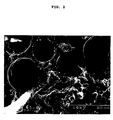
- a molded article was obtained in a similar manner to Example 1, without using the compatibilizing agent.
- the cross section of the molded article was observed with the use of an electron microscope, and as illustrated in Fig. 2, phase separation of the polymer components was found.
- Example 1 Comp. Ex. 1 Tensile elastic modulus (kgf/mm 2 ) 65.7 41.6 Tensile yield stress (kgf/mm 2 ) 1.64 1.11
- Lauric acid (Nippon Oil and Fats Co., Ltd., Japan; NAA-122; molecular weight 200.3; 1 part) was added to a mixture of 50 parts by weight of a polypropylene (Tonen Petrochemical Co., Ltd., Japan; J205) and 50 pats by weight of a poly(butylene terephthalate) (GE Plastics Japan; Valox 310), and the resultant mixture was molten and kneaded at 200 to 260°C with the use of a monoaxial screw extruder to give a molded article.
- a polypropylene Teonen Petrochemical Co., Ltd., Japan; J205
- GE Plastics Japan GE Plastics Japan; Valox 310
- a reaction product having an amide bond, in which an oxazolien group had been introduced into the terminal thereof was obtained by allowing 0.48 parts by weight of lauric acid (Nippon Oil and Fats Co., Ltd., Japan; NAA-122; molecular wieght 200.3) to react with 0.42 parts by weight of 2,2'-(1,3-phenylene)-bis(2-oxazoline) (Takeda Chemical Industries, Ltd., Japan; 1,3-BPO; molecular weight 216.2) at 150°C with stirring in a nitrogen gas atmosphere without using a solvent.
- lauric acid Natural Oil and Fats Co., Ltd., Japan
- NAA-122 molecular wieght 200.3
- 2,2'-(1,3-phenylene)-bis(2-oxazoline) Takeda Chemical Industries, Ltd., Japan; 1,3-BPO; molecular weight 216.2
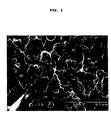
- This reaction product (0.9 part by weight) was added to a mixture of 50 parts by weight of a polypropylene (Tonen Petrochemical Co., Ltd., Japan; J205) and 50 parts by weight of a poly(butylene terephthalate) (GE Plastics Japan; Valox 310), and using the resultant mixture, a molded article was obtained in the same manner as Example 1. The cross section of this molded article was observed and a homogeneous micro phase similarly to Fig. 1 was recognized so that compatibilization of the polymer components was found.
- Palmitic acid Natural Acid (Nippon Oil and Fats Co., Ltd., Japan; NAA-160; molecular weight 256.4; 0.54 part by weight) and 2,2'-(1,3-phenylene)-bis(2-oxazoline) (Takeda Chemical Industries, Ltd., Japan; 1,3-BPO; molecular weight 216.2; 0.46 part by weight) were added to a mixture of 50 parts by weight of a polypropylene (Tonen Petrochemical Co., Ltd., Japan; J205) and 50 parts by weight of a poly(butylene terephthalate) (GE Plastics Japan; Valox 310). By molding the resultant mixture in the same manner as Example 1, a polymer alloy was obtained.
- a polypropylene Teonen Petrochemical Co., Ltd., Japan; J205
- GE Plastics Japan GE Plastics Japan; Valox 310
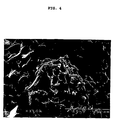
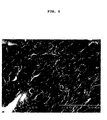
- the cross section of the molded article was observed with the use of an electron microscope, and the cross section was homogeneous and the polymer components were compatibilized as illustrated in Fig. 6.
- a polymer alloy was obtained by adding 0.57 part by weight of stearic acid (Nippon Oil and Fats Co., Ltd., Japan; NAA-180; molecular wight 284.5) and 0.43 part by weight of 2,2'-(1.3-phenylene)-bis(2-oxazoline) (Takeda Chemical Industries, Ltd., Japan; 1,3-BPO; molecular wight 216.2) to a mixture of 50 parts by weight of a polypropylene (Tonen Petrochemical Co., Ltd., Japan; J205) and 50 parts by weight of a poly(butylene terephthalate) (GE Plastics Japan; Valox 310) and molding the resultant mixture in the same manner as Example 1.
- stearic acid Nippon Oil and Fats Co., Ltd., Japan; NAA-180; molecular wight 284.5
- 2,2'-(1.3-phenylene)-bis(2-oxazoline) Takeda Chemical Industries, Ltd., Japan; 1,3-BPO; mole
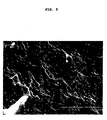
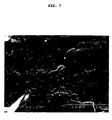
- the cross section of the obtained molded article was observed with an electron microscope, and as a result, the cross section was homogeneous as shown in Fig. 7 and the polymer components were compatibilized.
Landscapes
- Chemical & Material Sciences (AREA)
- Health & Medical Sciences (AREA)
- Chemical Kinetics & Catalysis (AREA)
- Medicinal Chemistry (AREA)
- Polymers & Plastics (AREA)
- Organic Chemistry (AREA)
- Addition Polymer Or Copolymer, Post-Treatments, Or Chemical Modifications (AREA)
- Compositions Of Macromolecular Compounds (AREA)
- Saccharide Compounds (AREA)
- Diaphragms For Electromechanical Transducers (AREA)
- Road Signs Or Road Markings (AREA)
- Treatments For Attaching Organic Compounds To Fibrous Goods (AREA)
Applications Claiming Priority (3)
| Application Number | Priority Date | Filing Date | Title |
|---|---|---|---|
| JP136012/95 | 1995-05-09 | ||
| JP13601295 | 1995-05-09 | ||
| JP13601295A JP3643621B2 (ja) | 1995-05-09 | 1995-05-09 | 相溶化剤およびその製造方法 |
Publications (3)
| Publication Number | Publication Date |
|---|---|
| EP0742258A2 EP0742258A2 (en) | 1996-11-13 |
| EP0742258A3 EP0742258A3 (en) | 1997-10-01 |
| EP0742258B1 true EP0742258B1 (en) | 2003-02-05 |
Family
ID=15165126
Family Applications (1)
| Application Number | Title | Priority Date | Filing Date |
|---|---|---|---|
| EP96107268A Expired - Lifetime EP0742258B1 (en) | 1995-05-09 | 1996-05-08 | Compatibilizing agent and method of producing the same |
Country Status (6)
| Country | Link |
|---|---|
| US (1) | US5998575A (enExample) |
| EP (1) | EP0742258B1 (enExample) |
| JP (1) | JP3643621B2 (enExample) |
| KR (1) | KR960041282A (enExample) |
| AT (1) | ATE232222T1 (enExample) |
| DE (1) | DE69626063D1 (enExample) |
Families Citing this family (4)
| Publication number | Priority date | Publication date | Assignee | Title |
|---|---|---|---|---|
| JP2002338827A (ja) * | 2001-03-15 | 2002-11-27 | Osaka Gas Co Ltd | リサイクル用樹脂組成物 |
| KR100760959B1 (ko) * | 2006-09-13 | 2007-10-04 | 한국원자력연구원 | 방사선을 이용하여 그라프트된 폴리프로필렌계 상용화제조성물의 제조방법 |
| KR100829009B1 (ko) | 2007-08-28 | 2008-05-14 | 지에스아이 루모닉스 인코퍼레이티드 | 표적 물질 처리를 위한 에너지 효율적인 레이저 기반 방법 및 시스템 |
| JP2009292860A (ja) * | 2008-06-02 | 2009-12-17 | Autonetworks Technologies Ltd | 高分子相溶化剤および高分子組成物ならびに被覆電線およびワイヤーハーネス |
Family Cites Families (11)
| Publication number | Priority date | Publication date | Assignee | Title |
|---|---|---|---|---|
| CH583308A5 (enExample) * | 1973-09-24 | 1976-12-31 | Inventa Ag | |
| FR2628115B1 (fr) * | 1988-03-04 | 1990-07-13 | Atochem | Composition permettant de rendre compatibles au moins deux polymeres thermoplastiques incompatibles, son application a la fabrication d'alliages thermoplastiques, alliages thermoplastiques obtenus |
| EP0365118A3 (en) * | 1988-08-12 | 1991-02-27 | Advanced Elastomer Systems, L.P. | Aromatic carbonate compositions |
| DE3834750A1 (de) * | 1988-10-12 | 1990-05-03 | Bayer Ag | Bindemittelkombinationen und ein verfahren zur herstellung von flaechengebilden |
| JP2669552B2 (ja) * | 1989-02-07 | 1997-10-29 | ポリプラスチックス株式会社 | ポリエステル樹脂組成物 |
| JP2908471B2 (ja) * | 1989-06-30 | 1999-06-21 | ポリプラスチックス株式会社 | ポリエステル樹脂組成物 |
| JPH0725979B2 (ja) * | 1989-08-17 | 1995-03-22 | 住友ダウ株式会社 | 熱可塑性樹脂組成物 |
| JPH0721101B2 (ja) * | 1989-12-01 | 1995-03-08 | 日本ジーイープラスチックス株式会社 | 熱可塑性樹脂組成物 |
| DE4138510A1 (de) * | 1991-11-14 | 1993-05-19 | Huels Chemische Werke Ag | Formmassen enthaltend ein polykondensat |
| JP3028164B2 (ja) * | 1992-11-27 | 2000-04-04 | 株式会社関西新技術研究所 | 相溶化剤およびその製造方法 |
| BE1009365A3 (nl) * | 1995-05-04 | 1997-02-04 | Dsm Nv | Hoogmoleculair polyamide. |
-
1995
- 1995-05-09 JP JP13601295A patent/JP3643621B2/ja not_active Expired - Fee Related
-
1996
- 1996-05-08 EP EP96107268A patent/EP0742258B1/en not_active Expired - Lifetime
- 1996-05-08 AT AT96107268T patent/ATE232222T1/de not_active IP Right Cessation
- 1996-05-08 KR KR1019960015111A patent/KR960041282A/ko not_active Withdrawn
- 1996-05-08 DE DE69626063T patent/DE69626063D1/de not_active Expired - Lifetime
- 1996-05-09 US US08/647,411 patent/US5998575A/en not_active Expired - Fee Related
Non-Patent Citations (1)
| Title |
|---|
| English translation of JP02163150 * |
Also Published As
| Publication number | Publication date |
|---|---|
| EP0742258A2 (en) | 1996-11-13 |
| ATE232222T1 (de) | 2003-02-15 |
| JPH08302217A (ja) | 1996-11-19 |
| US5998575A (en) | 1999-12-07 |
| KR960041282A (ko) | 1996-12-19 |
| EP0742258A3 (en) | 1997-10-01 |
| DE69626063D1 (de) | 2003-03-13 |
| JP3643621B2 (ja) | 2005-04-27 |
Similar Documents
| Publication | Publication Date | Title |
|---|---|---|
| KR950032459A (ko) | 폴리카보네이트/폴리올레핀계 수지 조성물, 그의 제조방법 및 용도 | |
| JPH035424B2 (enExample) | ||
| EP0637613B1 (en) | Resin composition | |
| US4543392A (en) | Polymeric materials and novel thermoplastic resin compositions | |
| KR910009824B1 (ko) | 폴리이미드 수지조성물 | |
| US5998575A (en) | Compatibilizing agent and method of producing the same | |
| US5283285A (en) | High impact polyester/polycarbonate blends | |
| CA1147881A (fr) | Compositions a base de polyamide, de fibres de verre et d'un compose a insaturation acrylique | |
| US5849820A (en) | Thermal stabilized resin compositions | |
| KR920004193B1 (ko) | 폴리이미드계 수지조성물 | |
| US5621040A (en) | High impact polyester compositions | |
| CH640549A5 (fr) | Compositions moulables a base d'un polymere thermoplastique, de fibres de verre et d'un bis-maleimide. | |
| US5124403A (en) | Thermoplastic resin composition | |
| EP0294195B1 (en) | Polyimide resin composition | |
| US5208287A (en) | Thermoplastic elastomers and method for making | |
| IE61465B1 (en) | Composition allowing at least two incompatible thermosplastic polymers to be made compatible, its application to the manufacture of thermoplastic alloys, thermoplastic alloys obtained | |
| US5070144A (en) | Reactive compatibilization of polyacetal and polypropylene blends | |
| EP0867476B1 (fr) | Mélange de polymères thermoplastiques présentant des propriétés mécaniques améliorées | |
| JPS63301252A (ja) | 熱可塑性樹脂組成物 | |
| JP3028164B2 (ja) | 相溶化剤およびその製造方法 | |
| WO1993006171A1 (en) | Polymer blends of norbornene dicarboximides | |
| KR100530913B1 (ko) | 폴리부틸렌테레프탈레이트 수지 조성물의 제조방법 | |
| KR940000633B1 (ko) | 폴리카아보네이트와 폴리아미드에 기초한 수지 조성물 | |
| JPH06136267A (ja) | ポリイミド系樹脂組成物 | |
| JPH06145516A (ja) | ポリイミド樹脂組成物 |
Legal Events
| Date | Code | Title | Description |
|---|---|---|---|
| PUAI | Public reference made under article 153(3) epc to a published international application that has entered the european phase |
Free format text: ORIGINAL CODE: 0009012 |
|
| AK | Designated contracting states |
Kind code of ref document: A2 Designated state(s): AT BE CH DE DK ES FI FR GB GR IE IT LI LU MC NL PT SE |
|
| PUAL | Search report despatched |
Free format text: ORIGINAL CODE: 0009013 |
|
| AK | Designated contracting states |
Kind code of ref document: A3 Designated state(s): AT BE CH DE DK ES FI FR GB GR IE IT LI LU MC NL PT SE |
|
| 17P | Request for examination filed |
Effective date: 19980325 |
|
| 17Q | First examination report despatched |
Effective date: 19980929 |
|
| GRAH | Despatch of communication of intention to grant a patent |
Free format text: ORIGINAL CODE: EPIDOS IGRA |
|
| GRAH | Despatch of communication of intention to grant a patent |
Free format text: ORIGINAL CODE: EPIDOS IGRA |
|
| GRAA | (expected) grant |
Free format text: ORIGINAL CODE: 0009210 |
|
| AK | Designated contracting states |
Designated state(s): AT BE CH DE DK ES FI FR GB GR IE IT LI LU MC NL PT SE |
|
| PG25 | Lapsed in a contracting state [announced via postgrant information from national office to epo] |
Ref country code: NL Free format text: LAPSE BECAUSE OF FAILURE TO SUBMIT A TRANSLATION OF THE DESCRIPTION OR TO PAY THE FEE WITHIN THE PRESCRIBED TIME-LIMIT Effective date: 20030205 Ref country code: LI Free format text: LAPSE BECAUSE OF FAILURE TO SUBMIT A TRANSLATION OF THE DESCRIPTION OR TO PAY THE FEE WITHIN THE PRESCRIBED TIME-LIMIT Effective date: 20030205 Ref country code: GR Free format text: LAPSE BECAUSE OF FAILURE TO SUBMIT A TRANSLATION OF THE DESCRIPTION OR TO PAY THE FEE WITHIN THE PRESCRIBED TIME-LIMIT Effective date: 20030205 Ref country code: FR Free format text: LAPSE BECAUSE OF FAILURE TO SUBMIT A TRANSLATION OF THE DESCRIPTION OR TO PAY THE FEE WITHIN THE PRESCRIBED TIME-LIMIT Effective date: 20030205 Ref country code: FI Free format text: LAPSE BECAUSE OF FAILURE TO SUBMIT A TRANSLATION OF THE DESCRIPTION OR TO PAY THE FEE WITHIN THE PRESCRIBED TIME-LIMIT Effective date: 20030205 Ref country code: CH Free format text: LAPSE BECAUSE OF FAILURE TO SUBMIT A TRANSLATION OF THE DESCRIPTION OR TO PAY THE FEE WITHIN THE PRESCRIBED TIME-LIMIT Effective date: 20030205 Ref country code: BE Free format text: LAPSE BECAUSE OF FAILURE TO SUBMIT A TRANSLATION OF THE DESCRIPTION OR TO PAY THE FEE WITHIN THE PRESCRIBED TIME-LIMIT Effective date: 20030205 Ref country code: AT Free format text: LAPSE BECAUSE OF FAILURE TO SUBMIT A TRANSLATION OF THE DESCRIPTION OR TO PAY THE FEE WITHIN THE PRESCRIBED TIME-LIMIT Effective date: 20030205 |
|
| REG | Reference to a national code |
Ref country code: GB Ref legal event code: FG4D |
|
| REG | Reference to a national code |
Ref country code: CH Ref legal event code: EP |
|
| REG | Reference to a national code |
Ref country code: IE Ref legal event code: FG4D |
|
| REF | Corresponds to: |
Ref document number: 69626063 Country of ref document: DE Date of ref document: 20030313 Kind code of ref document: P |
|
| PG25 | Lapsed in a contracting state [announced via postgrant information from national office to epo] |
Ref country code: SE Free format text: LAPSE BECAUSE OF FAILURE TO SUBMIT A TRANSLATION OF THE DESCRIPTION OR TO PAY THE FEE WITHIN THE PRESCRIBED TIME-LIMIT Effective date: 20030505 Ref country code: PT Free format text: LAPSE BECAUSE OF FAILURE TO SUBMIT A TRANSLATION OF THE DESCRIPTION OR TO PAY THE FEE WITHIN THE PRESCRIBED TIME-LIMIT Effective date: 20030505 Ref country code: DK Free format text: LAPSE BECAUSE OF FAILURE TO SUBMIT A TRANSLATION OF THE DESCRIPTION OR TO PAY THE FEE WITHIN THE PRESCRIBED TIME-LIMIT Effective date: 20030505 |
|
| PG25 | Lapsed in a contracting state [announced via postgrant information from national office to epo] |
Ref country code: DE Free format text: LAPSE BECAUSE OF FAILURE TO SUBMIT A TRANSLATION OF THE DESCRIPTION OR TO PAY THE FEE WITHIN THE PRESCRIBED TIME-LIMIT Effective date: 20030506 |
|
| PG25 | Lapsed in a contracting state [announced via postgrant information from national office to epo] |
Ref country code: LU Free format text: LAPSE BECAUSE OF NON-PAYMENT OF DUE FEES Effective date: 20030508 Ref country code: IE Free format text: LAPSE BECAUSE OF NON-PAYMENT OF DUE FEES Effective date: 20030508 |
|
| PG25 | Lapsed in a contracting state [announced via postgrant information from national office to epo] |
Ref country code: MC Free format text: LAPSE BECAUSE OF NON-PAYMENT OF DUE FEES Effective date: 20030531 |
|
| NLV1 | Nl: lapsed or annulled due to failure to fulfill the requirements of art. 29p and 29m of the patents act | ||
| REG | Reference to a national code |
Ref country code: CH Ref legal event code: PL |
|
| PG25 | Lapsed in a contracting state [announced via postgrant information from national office to epo] |
Ref country code: ES Free format text: LAPSE BECAUSE OF FAILURE TO SUBMIT A TRANSLATION OF THE DESCRIPTION OR TO PAY THE FEE WITHIN THE PRESCRIBED TIME-LIMIT Effective date: 20030828 |
|
| PLBE | No opposition filed within time limit |
Free format text: ORIGINAL CODE: 0009261 |
|
| STAA | Information on the status of an ep patent application or granted ep patent |
Free format text: STATUS: NO OPPOSITION FILED WITHIN TIME LIMIT |
|
| EN | Fr: translation not filed | ||
| 26N | No opposition filed |
Effective date: 20031106 |
|
| REG | Reference to a national code |
Ref country code: IE Ref legal event code: MM4A |
|
| PG25 | Lapsed in a contracting state [announced via postgrant information from national office to epo] |
Ref country code: IT Free format text: LAPSE BECAUSE OF NON-PAYMENT OF DUE FEES;WARNING: LAPSES OF ITALIAN PATENTS WITH EFFECTIVE DATE BEFORE 2007 MAY HAVE OCCURRED AT ANY TIME BEFORE 2007. THE CORRECT EFFECTIVE DATE MAY BE DIFFERENT FROM THE ONE RECORDED. Effective date: 20050508 |
|
| PGFP | Annual fee paid to national office [announced via postgrant information from national office to epo] |
Ref country code: GB Payment date: 20090429 Year of fee payment: 14 |
|
| GBPC | Gb: european patent ceased through non-payment of renewal fee |
Effective date: 20100508 |
|
| PG25 | Lapsed in a contracting state [announced via postgrant information from national office to epo] |
Ref country code: GB Free format text: LAPSE BECAUSE OF NON-PAYMENT OF DUE FEES Effective date: 20100508 |