EP0740023A1 - Bras porte-outil à double articulation latérale - Google Patents
Bras porte-outil à double articulation latérale Download PDFInfo
- Publication number
- EP0740023A1 EP0740023A1 EP96420140A EP96420140A EP0740023A1 EP 0740023 A1 EP0740023 A1 EP 0740023A1 EP 96420140 A EP96420140 A EP 96420140A EP 96420140 A EP96420140 A EP 96420140A EP 0740023 A1 EP0740023 A1 EP 0740023A1
- Authority
- EP
- European Patent Office
- Prior art keywords
- tool
- arrow
- articulation
- arm
- axis
- Prior art date
- Legal status (The legal status is an assumption and is not a legal conclusion. Google has not performed a legal analysis and makes no representation as to the accuracy of the status listed.)
- Ceased
Links
- 238000006073 displacement reaction Methods 0.000 claims description 14
- 230000008878 coupling Effects 0.000 abstract 2
- 238000010168 coupling process Methods 0.000 abstract 2
- 238000005859 coupling reaction Methods 0.000 abstract 2
- 230000006978 adaptation Effects 0.000 description 2
- 238000010586 diagram Methods 0.000 description 2
Images


Classifications
-
- E—FIXED CONSTRUCTIONS
- E02—HYDRAULIC ENGINEERING; FOUNDATIONS; SOIL SHIFTING
- E02F—DREDGING; SOIL-SHIFTING
- E02F3/00—Dredgers; Soil-shifting machines
- E02F3/04—Dredgers; Soil-shifting machines mechanically-driven
- E02F3/28—Dredgers; Soil-shifting machines mechanically-driven with digging tools mounted on a dipper- or bucket-arm, i.e. there is either one arm or a pair of arms, e.g. dippers, buckets
- E02F3/30—Dredgers; Soil-shifting machines mechanically-driven with digging tools mounted on a dipper- or bucket-arm, i.e. there is either one arm or a pair of arms, e.g. dippers, buckets with a dipper-arm pivoted on a cantilever beam, i.e. boom
- E02F3/307—Dredgers; Soil-shifting machines mechanically-driven with digging tools mounted on a dipper- or bucket-arm, i.e. there is either one arm or a pair of arms, e.g. dippers, buckets with a dipper-arm pivoted on a cantilever beam, i.e. boom the boom and the dipper-arm being connected so as to permit relative movement in more than one plane
-
- E—FIXED CONSTRUCTIONS
- E02—HYDRAULIC ENGINEERING; FOUNDATIONS; SOIL SHIFTING
- E02F—DREDGING; SOIL-SHIFTING
- E02F3/00—Dredgers; Soil-shifting machines
- E02F3/04—Dredgers; Soil-shifting machines mechanically-driven
- E02F3/28—Dredgers; Soil-shifting machines mechanically-driven with digging tools mounted on a dipper- or bucket-arm, i.e. there is either one arm or a pair of arms, e.g. dippers, buckets
- E02F3/30—Dredgers; Soil-shifting machines mechanically-driven with digging tools mounted on a dipper- or bucket-arm, i.e. there is either one arm or a pair of arms, e.g. dippers, buckets with a dipper-arm pivoted on a cantilever beam, i.e. boom
- E02F3/302—Dredgers; Soil-shifting machines mechanically-driven with digging tools mounted on a dipper- or bucket-arm, i.e. there is either one arm or a pair of arms, e.g. dippers, buckets with a dipper-arm pivoted on a cantilever beam, i.e. boom with an additional link
-
- E—FIXED CONSTRUCTIONS
- E02—HYDRAULIC ENGINEERING; FOUNDATIONS; SOIL SHIFTING
- E02F—DREDGING; SOIL-SHIFTING
- E02F3/00—Dredgers; Soil-shifting machines
- E02F3/04—Dredgers; Soil-shifting machines mechanically-driven
- E02F3/28—Dredgers; Soil-shifting machines mechanically-driven with digging tools mounted on a dipper- or bucket-arm, i.e. there is either one arm or a pair of arms, e.g. dippers, buckets
- E02F3/30—Dredgers; Soil-shifting machines mechanically-driven with digging tools mounted on a dipper- or bucket-arm, i.e. there is either one arm or a pair of arms, e.g. dippers, buckets with a dipper-arm pivoted on a cantilever beam, i.e. boom
- E02F3/301—Dredgers; Soil-shifting machines mechanically-driven with digging tools mounted on a dipper- or bucket-arm, i.e. there is either one arm or a pair of arms, e.g. dippers, buckets with a dipper-arm pivoted on a cantilever beam, i.e. boom with more than two arms (boom included), e.g. two-part boom with additional dipper-arm
-
- E—FIXED CONSTRUCTIONS
- E02—HYDRAULIC ENGINEERING; FOUNDATIONS; SOIL SHIFTING
- E02F—DREDGING; SOIL-SHIFTING
- E02F3/00—Dredgers; Soil-shifting machines
- E02F3/04—Dredgers; Soil-shifting machines mechanically-driven
- E02F3/28—Dredgers; Soil-shifting machines mechanically-driven with digging tools mounted on a dipper- or bucket-arm, i.e. there is either one arm or a pair of arms, e.g. dippers, buckets
- E02F3/30—Dredgers; Soil-shifting machines mechanically-driven with digging tools mounted on a dipper- or bucket-arm, i.e. there is either one arm or a pair of arms, e.g. dippers, buckets with a dipper-arm pivoted on a cantilever beam, i.e. boom
- E02F3/32—Dredgers; Soil-shifting machines mechanically-driven with digging tools mounted on a dipper- or bucket-arm, i.e. there is either one arm or a pair of arms, e.g. dippers, buckets with a dipper-arm pivoted on a cantilever beam, i.e. boom working downwardly and towards the machine, e.g. with backhoes
Definitions
- the present invention relates to an improvement made to public works machines comprising a self-propelled chassis on which is mounted a turret carrying work equipment.
- It relates more particularly to an improvement made to the machines of the type subject of FR-A-2 532 671 and whose work equipment has a structure such that it makes it possible to work either as a loader or excavator by simple change of work tool.
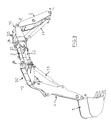
- Figure 1 attached schematically illustrates the general structure of such a machine used as an excavator.
- the work equipment designated by the general reference (1), is composed of four articulated and angularly deployable elements relative to each other, namely an arrow (2), a spout arrow (3), an arm (4) at the end of which is mounted the tool consisting of a bucket (5).
- This equipment is mounted on a turret (6) carried by a conventional vehicle preferably comprising a frame articulated in two parts, the engine being mounted on the rear chassis and the driving position and the work equipment (1) being , meanwhile, mounted side by side on the turret (6) associated with the front chassis.
- the various elements of the equipment are interconnected by an articulation allowing their angular positioning to be modified with respect to each other around horizontal pivot axes, the displacement being obtained by means of jacks.
- the boom (2) is articulated relative to the turret (6) and its position is adjusted by the boom cylinder (7) by means of two arms (8,9).
- the arrow spout (3) is connected to the other end (10) of the arrow (2) and the angular position ⁇ of these two elements (2,3) is adjusted by means of the jack (11) called “jack of arrowhead ".
- the arm (4) is articulated at the end (12) of the arrow spout (3) and the angle ⁇ between these two elements is adjusted by means of a third cylinder (13) called “cylinder of arms ".
- the bucket (5) is mounted at the end (17) of the arm (4) and its position is adjusted by a fourth cylinder (15) called "bucket cylinder".
- control of the various cylinders can be either individual, or possibly carried out in accordance with the teachings of application PCT / FR 95/01286.
- the tool (5) is therefore moved in space on the one hand by modifying the positioning of the various elements forming the work equipment (1) by pivoting about a horizontal axis of the joint. connecting the elements together and to the carrier, and, on the other hand, by rotation of the turret (6) which makes it possible to work as well in the axis of the vehicle, as on both sides of the latter at any angle.
- Such a type of machine is therefore designed to allow work to be carried out while keeping the various elements of the work equipment in line with one another, in the same vertical plane, the axes of articulation being parallel to the ground. and between them.
- a structure poses problems when it is desired to work offset, a possibility which has been obtained to date by mounting the arm jack (13) by means of cardan joints.
- the arm jack (13) poses problems, since this causes the cylinder to rotate and consequently wear out.
- the cylinder forms an angle relative to the element it controls, which results in a decrease in its efficiency.
- the device according to the invention is characterized in that at least the tool-carrying arm is connected to the element which precedes it by means of a double articulation allowing on the one hand an angular displacement around a horizontal axis , and, on the other hand, a lateral angular displacement around an axis passing in a plane orthogonal to the horizontal pivot axis, the control of this lateral displacement being obtained by means of a jack mounted laterally with respect to to the support element and which causes the pivoting of the double articulation, the jack controlling the angular movement around a horizontal axis of the tool-carrying arm, for its part, bearing on this articulation in front of the pivoting axis lateral.
- the double articulation according to the invention is at least between the arrow spout and the tool arm, the articulation between the end of the arrow and that of the arrow spout can be simple.
- the two articulations provided at each end of the arrow spout will be produced in accordance with the invention so as to be able to carry out a double offset.
- the machine according to the invention therefore comprises work equipment (1) composed of four angularly articulated elements, deployable with respect to each other, namely a boom (2), a boom spout (3), an arm (4) at the end of which is mounted the tool consisting of a bucket (5) .
- This equipment is mounted on a turret (6) carried by a conventional vehicle.
- the boom (2) is articulated with respect to the turret (6) and its position is adjusted by the boom cylinder (7) by means of two arms (8,9).
- the boom spout (3) is connected to the end (10) of the boom (2) and the angular position ⁇ of these two elements (2,3) is adjusted by means of the boom spout cylinder (11).
- the arm (4) is articulated at the end (12) of the arrow spout (3) and the angle ⁇ between these two elements is adjusted by means of a third jack (13).
- the bucket (5) is mounted at the end (14) of the arm (4) and its position is adjusted by a fourth cylinder (15) called "bucket cylinder".
- At least the arm (4) is connected to the element which precedes it, therefore in the present case to the arrow spout (3) by means of a double articulation designated by the general reference ( 20) and which allows on the one hand, the angular displacement around the horizontal axis A, and, on the other hand, a lateral angular displacement around an axis B passing in a plane orthogonal to the horizontal pivot axis AT.
- the work equipment is preferably designed as illustrated in Figures 3 to 6 so that the connection between the end (10) of the arrow (2) and the end of the arrow spout (3) is made in a similar manner.
- the control of the lateral displacement is obtained by means of a jack (22) mounted laterally with respect to the jib spout (3) and which acts on the double articulation.
- the jacks (11,13) controlling the angular displacements around the horizontal axes A take, for their part, support on the double articulation (20) in front of the lateral pivot axis B, which allows an action in line even during a work in offset.
- the solution according to the invention has very many advantages among which we can cite in particular, when the machine allows to carry out a double offset, to have an additional angular position for the tool (6) making it possible to bypass obstacles.
Landscapes
- Engineering & Computer Science (AREA)
- Mechanical Engineering (AREA)
- Mining & Mineral Resources (AREA)
- Civil Engineering (AREA)
- General Engineering & Computer Science (AREA)
- Structural Engineering (AREA)
- Operation Control Of Excavators (AREA)
- Forklifts And Lifting Vehicles (AREA)
- Shovels (AREA)
- Jib Cranes (AREA)
Abstract
Engin de travaux publics dont l'équipement de travail (1) est composé d'au moins trois éléments (3,4,5) articulés entre eux autour d'axes horizontaux (A), le dernier (5) étant constitué par un outil et les déplacements angulaires étant obtenus par l'intermédiaire de vérins. Au moins le bras porte-outil (4) est relié à l'élément (3) qui le précède par l'intermédiaire d'une double articulation (20) permettant d'une part le déplacement angulaire autour de l'axe horizontal A, et, d'autre part, un déplacement angulaire latéral autour d'un axe B passant dans un plan orthogonal à l'axe de pivotement horizontal A, la commande de ce déplacement latéral étant obtenu par l'intermédiaire d'un vérin (22) monté latéralement par rapport à l'élément support (3) et qui provoque le pivotement de la double articulation, le vérin (13) commandant le déplacement angulaire autour de l'axe horizontal A du bras porte-outil (4) prenant, quant à lui, appui sur cette articulation (20) en avant de l'axe de pivotement latéral B. <IMAGE>
Description
- La présente invention a trait à un perfectionnement apporté aux engins de travaux publics comportant un châssis automoteur sur lequel est monté une tourelle portant un équipement de travail.
- Elle a trait plus particulièrement à un perfectionnement apporté aux engins du type faisant l'objet du FR-A-2 532 671 et dont l'équipement de travail a une structure telle qu'il permet de travailler indifféremment en tant que chargeur ou excavateur par simple changement de l'outil de travail.
- Dans la suite de la description, l'invention sera décrite pour un tel type d'engin, mais il est évident que cela n'est pas limitatif et qu'elle pourrait être appliquée à tout engin dont l'outil de travail est monté à l'extrémité d'un bras articulé.
- La figure 1 annexée illustre de manière schématique la structure générale d'un tel engin utilisé en tant qu'excavateur.
- En se reportant à cette figure 1, l'équipement de travail, désigné par la référence générale (1), est composé de quatre éléments articulés et angulairement déployables les uns par rapport aux autres, à savoir une flèche (2), un bec de flèche (3), un bras (4) à l'extrémité duquel est monté l'outil constitué par un godet (5).
- Cet équipement est monté sur une tourelle (6) portée par un véhicule conventionnel comprenant, de préférence, un châssis articulé en deux parties, le moteur étant monté sur le châssis arrière et le poste de conduite et l'équipement de travail (1) étant, quant à eux, montés côte à côte sur la tourelle (6) associée au châssis avant.
- Les différents éléments de l'équipement sont reliés entre eux par une articulation permettant de modifier leur positionnement angulaire les uns par rapport aux autres autour d'axes de pivotement horizontaux, le déplacement étant obtenu par l'intermédiaire de vérins.
- Dans le mode de réalisation illustré à la figure 1, la flèche (2) est articulée par rapport à la tourelle (6) et sa position est réglée par le vérin de flèche (7) au moyen de deux bras (8,9). Le bec de flèche (3) est relié à l'autre extrémité (10) de la flèche (2) et la position angulaire α de ces deux éléments (2,3) est réglée au moyen du vérin (11) dit "vérin de bec de flèche". Le bras (4) est quant à lui articulé à l'extrémité (12) du bec de flèche (3) et l'angle β entre ces deux élements est réglé par l'intermédiaire d'un troisième vérin (13) dit "vérin de bras". Enfin, le godet (5) est monté à l'extrémité (17) du bras (4) et sa position est réglée par un quatrième vérin (15) dit "vérin de godet".
- Dans un tel système, la commande des différents vérins peut être soit individuelle, soit éventuellement réalisée conformément aux enseignements de la demande PCT/FR 95/01286.
- Dans de tels engins, l'outil (5) est donc déplacé dans l'espace d'une part en modifiant le positionnement des différents éléments formant l'équipement de travail (1) par pivotement autour d'un axe horizontal de l'articulation reliant les éléments entre eux et à l'engin porteur, et, d'autre part, par rotation de la tourelle (6) qui permet de travailler aussi bien dans l'axe du véhicule, que de part et d'autre de ce dernier en formant un angle quelconque.
- Un tel type d'engin est donc conçu pour permettre d'effectuer des travaux en maintenant les différents éléments de l'équipement de travail dans le prolongement les uns des autres, dans un même plan vertical, les axes d'articulation étant parallèles au sol et entre eux. En revanche, une telle structure pose des problèmes lorsque l'on souhaite travailler en déport, possibilité qui est obtenue à ce jour en montant le vérin de bras (13) au moyen de cardans. Une telle solution pose cependant des problèmes, car cela entraîne un mouvement de rotation du vérin et par suite une usure de celui-ci. De plus, lors du travail en déport, le vérin forme un angle par rapport à l'élément qu'il commande, ce qui entraîne une diminution de son efficacité.
- Il a été proposé depuis fort longtemps de réaliser un tel déport latéral de l'outil de travail sur les engins de travaux publics. Ainsi, l'une des solutions proposées qui ressort du FR-A-2 587 384, consiste à déplacer latéralement l'ensemble de l'équipement en le montant sur une console supportée de façon articulée par le bâti de la pelle et qui, par l'intermédiaire de deux bras de parallélogrammes placés côte à côte et latéralement, permet, au moyen d'une commande (vérin), de réaliser un déport de l'outil jusqu'au voisinage de la limite latérale de la pelle ou du prolongement de cette limite.
- Une telle solution, séduisante a priori, n'est cependant pas transposable aux engins polyvalents du type précité, car le système de relevage de la flèche ne permet pas la liaison mécanique avec le châssis.
- Or on a trouvé, et c'est ce qui fait l'objet de la présente invention, une solution simple et efficace qui permet de résoudre l'ensemble des problèmes précités.
- D'une manière générale, l'invention concerne un engin de travaux publics comportant :
- un équipement de travail composé d'au moins trois éléments articulés entre eux autour d'axes horizontaux et angulairement déployables les uns par rapport aux autres, le premier étant articulé par rapport au châssis du véhicule porteur, le dernier étant constitué par un outil;
- des vérins permettant de commander le déplacement angulaire desdits éléments les uns par rapport aux autres afin d'assurer le positionnement de l'outil en tous points compris à l'intérieur d'un contour d'un espace de travail déterminé.
- L'engin selon l'invention se caractérise ce que au moins le bras porte-outil est relié à l'élément qui le précède par l'intermédiaire d'une double articulation permettant d'une part un déplacement angulaire autour d'un axe horizontal, et, d'autre part, un déplacement angulaire latéral autour d'un axe passant dans un plan orthogonal à l'axe de pivotement horizontal, la commande de ce déplacement latéral étant obtenu par l'intermédiaire d'un vérin monté latéralement par rapport à l'élément support et qui provoque le pivotement de la double articulation, le vérin commandant le déplacement angulaire autour d'un axe horizontal du bras porte-outil prenant, quant à lui, appui sur cette articulation en avant de l'axe de pivotement latéral.
- Grâce à une telle structure, lorsque le bras porte-outils est déporté latéralement, le vérin de commande réglant son positionnement angulaire reste toujours dans la même position et agit en ligne sur l'élément qu'il déplace. En conséquence, il n'y a aucune perte d'efficacité lors d'un travail en déport.
- Dans le cas d'un engin du type faisant l'objet du FR-A-2 532 671 et dont l'équipement de travail est composé de quatre éléments articulés entre eux, la double articulation conforme à l'invention se trouve au moins entre le bec de flèche et le bras porte-outil, l'articulation entre l'extrémité de la flèche et celle du bec de flèche pouvant être simple. De préférence, dans un tel engin, les deux articulations prévues à chaque extrémité du bec de flèche seront réalisées conformément à l'invention de manière à pouvoir réaliser un double déport.
- L'invention et les avantages qu'elle apporte sera cependant mieux comprise grâce à l'exemple de réalisation qui suit donné à titre indicatif mais non limitatif, et qui est illustré par les schémas annexés dans lesquelles :
- la figure 1 illustre, comme dit précédemment, l'art antérieur constitué par le FR-A-2 532 671 ;
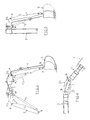
- la figure 2 illustre un chargeur excavateur réalisé conformément à l'invention, vu de côté en élévation, et dont l'équipement de travail est tel qu'il permet de réaliser un simple déport du bras porte-outil ;
- la figure 3 est une vue de détail en perspective éclatée montrant l'adaptation conformément à l'invention d'un outil de travail d'un chargeur excavateur permettant d'obtenir un double déport;
- les figures 4, 5 et 6 sont respectivement des vues en élévation de côté et de dessus d'un équipement de travail réalisé conformément à l'invention en position de double déport.
- En se reportant aux schémas annexés, pour lesquels les mêmes références sont utilisées pour désigner des éléments communs avec l'art antérieur illustré à la figure 1, l'engin conforme à l'invention comporte donc un équipement de travail (1) composé de quatre éléments articulés angulairement, déployables les uns par rapport aux autres, à savoir une flèche (2), un bec de flèche (3), un bras (4) à l'extrémité duquel est monté l'outil constitué par un godet (5).
- Cet équipement est monté sur une tourelle (6) portée par un véhicule conventionnel.
- La flèche (2) est articulée par rapport à la tourelle (6) et sa position est réglée par le vérin de flèche (7) au moyen de deux bras (8,9).
- Le bec de flèche (3) est relié à l'extrémité (10) de la flèche (2) et la position angulaire α de ces deux éléments (2,3) est réglée au moyen du vérin de bec de flèche (11). Le bras (4) est quant à lui articulé à l'extrémité (12) du bec de flèche (3) et l'angle β entre ces deux élements est réglé par l'intermédiaire d'un troisième vérin (13). Enfin, le godet (5) est monté à l'extrémité (14) du bras (4) et sa position est réglée par un quatrième vérin (15) dit "vérin de godet".
- Conformément à l'invention, au moins le bras (4) est relié à l'élément qui le précède, donc dans le cas présent au bec de flèche (3) par l'intermédiaire d'une double articulation désignée par la référence générale (20) et qui permet d'une part, le déplacement angulaire autour de l'axe horizontal A, et, d'autre part, un déplacement angulaire latéral autour d'un axe B passant dans un plan orthogonal à l'axe de pivotement horizontal A.
- S'il est possible, comme cela ressort de la figure 2, de n'avoir qu'une seule double articulation (20) entre le bec de flèche (3) et le bras porte-outil (4), l'équipement de travail est de préférence conçu de la manière illustrée aux figures 3 à 6 pour que la liaison entre l'extrémité (10) de la flèche (2) et l'extrémité du bec de flèche (3) soit réalisée d'une manière similaire.
- Conformément à l'invention, la commande du déplacement latéral est obtenue par l'intermédiaire d'un vérin (22) monté latéralement par rapport au bec de flèche (3) et qui agit sur la double articulation. Les vérins (11,13) commandant les déplacements angulaires autour des axes horizontaux A, prennent, quant à eux, appui sur la double articulation (20) en avant de l'axe de pivotement latéral B, ce qui permet une action en ligne même lors d'un travail en déport.
- Par rapport aux solutions antérieures permettant d'obtenir un déport latéral d'un outil de travail d'un engin de travaux publics, la solution conforme à l'invention présente de très nombreux avantages parmi lesquels on peut citer notamment, lorsque l'engin permet de réaliser un double déport, d'avoir une position angulaire supplémentaire pour l'outil (6) permettant de contourner les obstacles.
Claims (2)
- Engin de travaux publics comportant :- un équipement de travail (1) composé d'au moins trois éléments (3,4,5) articulés entre eux autour d'axes horizontaux (A) et angulairement déployables les uns par rapport aux autres, le premier (2) étant articulé par rapport au châssis du véhicule porteur, le dernier (5) étant constitué par un outil ;- des vérins (7,11,13) permettant la commande de ce déplacement angulaire desdits éléments les uns par rapport aux autres afin d'assurer le positionnement de l'outil (5) en tous points compris à l'intérieur d'un contour d'un espace de travail déterminé,caractérisé ce que au moins le bras porte-outil (4) est relié à l'élément (3) qui le précède par l'intermédiaire d'une double articulation (20) permettant d'une part le déplacement angulaire autour de l'axe horizontal A, et, d'autre part, un déplacement angulaire latéral autour d'un axe B passant dans un plan orthogonal à l'axe de pivotement horizontal A, la commande de ce déplacement latéral étant obtenu par l'intermédiaire d'un vérin (22) monté latéralement par rapport à l'élément support (3) et qui provoque le pivotement de la double articulation, le vérin (13) commandant le déplacement angulaire autour de l'axe horizontal A du bras porte-outil (4) prenant, quant à lui, appui sur cette articulation (20) en avant de l'axe de pivotement latéral B.
- Engin de travaux publics selon la revendication 1, du type selon lequel l'équipement de travail est constitué d'une flèche (2), d'un bec de flèche (3), d'un bras (4) à l'extrémité duquel est monté l'outil (5), caractérisé en ce que le bras porte-outil (4) et la flèche (2) sont reliés au bec de flèche (3) par l'intermédiaire d'une double articulation (20).
Applications Claiming Priority (2)
| Application Number | Priority Date | Filing Date | Title |
|---|---|---|---|
| FR9505184 | 1995-04-25 | ||
| FR9505184A FR2733525B1 (fr) | 1995-04-25 | 1995-04-25 | Engin de travaux publics dont l'outil de travail est monte a l'extremite d'un bras articule |
Publications (1)
| Publication Number | Publication Date |
|---|---|
| EP0740023A1 true EP0740023A1 (fr) | 1996-10-30 |
Family
ID=9478586
Family Applications (1)
| Application Number | Title | Priority Date | Filing Date |
|---|---|---|---|
| EP96420140A Ceased EP0740023A1 (fr) | 1995-04-25 | 1996-04-24 | Bras porte-outil à double articulation latérale |
Country Status (7)
| Country | Link |
|---|---|
| US (1) | US5661917A (fr) |
| EP (1) | EP0740023A1 (fr) |
| JP (1) | JPH08302725A (fr) |
| KR (1) | KR960037990A (fr) |
| CN (1) | CN1143139A (fr) |
| CA (1) | CA2174789A1 (fr) |
| FR (1) | FR2733525B1 (fr) |
Cited By (3)
| Publication number | Priority date | Publication date | Assignee | Title |
|---|---|---|---|---|
| EP1798344A4 (fr) * | 2004-09-29 | 2011-02-23 | Hitachi Construction Machinery | Dispositif de travail pour machine du bâtiment |
| EP2639360A2 (fr) | 2008-07-14 | 2013-09-18 | Hudson Bay Holding B.V. | Appareil mobile |
| DE102014000027A1 (de) | 2014-01-04 | 2014-10-30 | Johannes Burde | Teleskopsystem für die Integration in Monoblock- und Verstellausleger für das Verfahren des Stiel- und Hauptlagers |
Families Citing this family (15)
| Publication number | Priority date | Publication date | Assignee | Title |
|---|---|---|---|---|
| KR100240299B1 (ko) * | 1996-08-15 | 2000-06-01 | 세구치 류이치 | 3관절형 굴삭기의 조작제어장치 |
| US6729831B1 (en) | 1998-08-31 | 2004-05-04 | Yanmar Co., Ltd. | Extremely-small-swing working machine |
| US6409457B1 (en) * | 1999-10-15 | 2002-06-25 | George Korycan | Work vehicle |
| DE10321070B3 (de) * | 2003-05-10 | 2004-11-04 | O & K Orenstein & Koppel Gmbh | Geteilter Auslegearm für Bagger |
| US20080020867A1 (en) * | 2003-08-28 | 2008-01-24 | Callaway Golf Company | Golfer's impact properties during a golf swing |
| WO2005035882A2 (fr) * | 2003-10-03 | 2005-04-21 | The Charles Machine Works, Inc. | Machine de travaux a fonctions multiples |
| US7698838B1 (en) * | 2005-11-09 | 2010-04-20 | Strayhorn David W | Hoe equipped excavator having increased range |
| US9777459B2 (en) | 2012-07-31 | 2017-10-03 | Solar Foundations Usa, Inc | Attachment for a skid steer loader and method of use thereof |
| CN104563176B (zh) * | 2015-01-15 | 2017-11-28 | 王学义 | 装载机的拨料装置 |
| CN108118730A (zh) * | 2016-11-29 | 2018-06-05 | 广西大学 | 一种用于装配作业的伺服驱动三活动度连杆机构机械手臂 |
| CN106759564A (zh) * | 2016-12-30 | 2017-05-31 | 徐州徐工挖掘机械有限公司 | 一种挖掘机隧道用偏转式工作装置结构 |
| CN108702898A (zh) * | 2018-05-30 | 2018-10-26 | 泉州永春佳鼎农业机械有限公司 | 一种用于农业种植挖沟的移动设备 |
| DE102019100075B3 (de) * | 2019-01-03 | 2020-03-19 | Mecalac Baumaschinen GmbH | Radlader |
| CN111058503A (zh) * | 2019-12-13 | 2020-04-24 | 谢志坚 | 一种具有挖铲功能的水利工程清淤设备 |
| NL2024981B1 (en) * | 2020-02-24 | 2021-10-14 | Hudson I P B V | Electric drive of mobile apparatus |
Citations (3)
| Publication number | Priority date | Publication date | Assignee | Title |
|---|---|---|---|---|
| GB2086347A (en) * | 1980-11-04 | 1982-05-12 | Vema Spa | Articulated arm for excavator machines |
| JPS58135232A (ja) * | 1982-02-03 | 1983-08-11 | Ishikawajima Harima Heavy Ind Co Ltd | 掘削機 |
| GB2222998A (en) * | 1988-09-22 | 1990-03-28 | Kubota Ltd | Homing control for backhoe bucket |
Family Cites Families (11)
| Publication number | Priority date | Publication date | Assignee | Title |
|---|---|---|---|---|
| US3099358A (en) * | 1960-08-01 | 1963-07-30 | Int Harvester Co | Means for shifting the axis of boom means or the like |
| FR1546526A (fr) * | 1967-06-21 | 1968-11-22 | Poclain Sa | Perfectionnements aux engins de manutention à tourelle |
| FR2031763A5 (fr) * | 1969-02-06 | 1970-11-20 | Poclain Sa | |
| SE437050B (sv) * | 1982-06-04 | 1985-02-04 | Ingemar Eriksson | Till en lastmaskin applicerbart grevaggregat for mindre grevarbeten |
| FR2532671A1 (fr) * | 1982-09-08 | 1984-03-09 | Pingon Pierre De | Chargeur-excavateur a un seul equipement de travail |
| JPS60169352U (ja) * | 1984-04-18 | 1985-11-09 | 株式会社 竹内製作所 | 掘削作業装置 |
| DE3435981A1 (de) * | 1984-10-01 | 1986-04-17 | Macmoter S.P.A., Modigliana | Kompaktbagger |
| DE3533427A1 (de) * | 1985-09-19 | 1987-03-26 | Schaeff Karl Gmbh & Co | Seitenversatzeinrichtung fuer eine baggerkonsole |
| DE3843753A1 (de) * | 1988-12-24 | 1990-06-28 | Schaeff Karl Gmbh & Co | Baggerarm |
| JPH04254625A (ja) * | 1990-11-30 | 1992-09-09 | Hitachi Constr Mach Co Ltd | オフセットブーム式建設機械 |
| FR2707956B1 (fr) * | 1993-07-01 | 1995-10-06 | Thibault Jacques | Emballage souple à double fermeture, notamment pour la présentation et l'expédition d'objets. |
-
1995
- 1995-04-25 FR FR9505184A patent/FR2733525B1/fr not_active Expired - Fee Related
-
1996
- 1996-04-23 CA CA002174789A patent/CA2174789A1/fr not_active Abandoned
- 1996-04-24 JP JP8102938A patent/JPH08302725A/ja not_active Withdrawn
- 1996-04-24 CN CN96108977A patent/CN1143139A/zh active Pending
- 1996-04-24 EP EP96420140A patent/EP0740023A1/fr not_active Ceased
- 1996-04-25 KR KR1019960014087A patent/KR960037990A/ko not_active Withdrawn
- 1996-04-25 US US08/626,430 patent/US5661917A/en not_active Expired - Fee Related
Patent Citations (3)
| Publication number | Priority date | Publication date | Assignee | Title |
|---|---|---|---|---|
| GB2086347A (en) * | 1980-11-04 | 1982-05-12 | Vema Spa | Articulated arm for excavator machines |
| JPS58135232A (ja) * | 1982-02-03 | 1983-08-11 | Ishikawajima Harima Heavy Ind Co Ltd | 掘削機 |
| GB2222998A (en) * | 1988-09-22 | 1990-03-28 | Kubota Ltd | Homing control for backhoe bucket |
Non-Patent Citations (1)
| Title |
|---|
| PATENT ABSTRACTS OF JAPAN vol. 7, no. 250 (M - 254)<1395> 8 November 1983 (1983-11-08) * |
Cited By (3)
| Publication number | Priority date | Publication date | Assignee | Title |
|---|---|---|---|---|
| EP1798344A4 (fr) * | 2004-09-29 | 2011-02-23 | Hitachi Construction Machinery | Dispositif de travail pour machine du bâtiment |
| EP2639360A2 (fr) | 2008-07-14 | 2013-09-18 | Hudson Bay Holding B.V. | Appareil mobile |
| DE102014000027A1 (de) | 2014-01-04 | 2014-10-30 | Johannes Burde | Teleskopsystem für die Integration in Monoblock- und Verstellausleger für das Verfahren des Stiel- und Hauptlagers |
Also Published As
| Publication number | Publication date |
|---|---|
| US5661917A (en) | 1997-09-02 |
| FR2733525B1 (fr) | 1997-07-04 |
| CA2174789A1 (fr) | 1996-10-26 |
| JPH08302725A (ja) | 1996-11-19 |
| KR960037990A (ko) | 1996-11-19 |
| CN1143139A (zh) | 1997-02-19 |
| FR2733525A1 (fr) | 1996-10-31 |
Similar Documents
| Publication | Publication Date | Title |
|---|---|---|
| EP0740023A1 (fr) | Bras porte-outil à double articulation latérale | |
| FR2635130A1 (fr) | ||
| FR2615219A1 (fr) | Vehicule a pelle retrocaveuse | |
| FR2624898A1 (fr) | Appareil de bulldozer pour engin de chantier comprenant plusieurs verins de compensation des forces developpees pendant les operations de terrassement, excavation ou autres | |
| US5634523A (en) | Blade device | |
| FR2816166A1 (fr) | Machine robotisee de taille d'arbustes ou d'arbres tels que des arbres fruitiers | |
| FR2532671A1 (fr) | Chargeur-excavateur a un seul equipement de travail | |
| FR2701627A1 (fr) | Dispositif adaptable sur véhicule automoteur du genre tracteur, notamment pour l'entretien des espaces verts, talus et accotements. | |
| FR2727998A1 (fr) | Engin de travaux publics de type chargeur, dont la cabine de pilotage ainsi que l'equipement de travail sont montes sur une tourelle | |
| FR3032595A1 (fr) | Machine de coupe de vegetaux et vehicule automobile comprenant une telle machine de coupe | |
| FR2506830A1 (fr) | Tariere pendulaire | |
| FR2701047A1 (fr) | Système universel de liaison pour la solidarisation d'un accessoire, notamment d'un godet ou d'une benne, au bras articulé d'un engin de travaux publics. | |
| EP1245739B1 (fr) | Engin de travaux publics | |
| FR2494747A1 (fr) | Accessoire formant outil pour engin de terrassement et engin de terrassement equipe d'un tel accessoire | |
| FR2750411A1 (fr) | Grue de chantier a pivot inferieur comprenant un chariot | |
| FR2629114A1 (fr) | Vehicule pour travaux de terrassement | |
| EP1527671B1 (fr) | Machine de coupe ou de broyage de végétaux, adaptable sur véhicule automoteur du genre tracteur | |
| EP2959759A1 (fr) | Machine agricole munie d'un dispositif de centrage | |
| FR2569216A1 (fr) | Dispositif pour le curage, en particulier de saignees perpendiculaires a une voie routiere | |
| EP0391808A1 (fr) | Structure de levage télescopique pour un engin tel qu'une chargeuse | |
| EP1136703A1 (fr) | Dispositif pour l'entraínement en rotation d'un ensemble monté pivotant par rapport à un axe pivot fixe | |
| FR2718769A1 (fr) | Ensemble compact de deux bras articulés, dont l'extrémité libre est équipée d'un porte équipement, destiné à des véhicules de manutention, et terrassement. | |
| FR2788242A1 (fr) | Vehicule equipe d'un outil notamment d'un dispositif de broyage | |
| FR2793991A1 (fr) | Tondeuse a largeur de coupe reglable | |
| FR2883698A1 (fr) | Dispositif d'attelage permettant d'atteler un outil a un vehicule |
Legal Events
| Date | Code | Title | Description |
|---|---|---|---|
| PUAI | Public reference made under article 153(3) epc to a published international application that has entered the european phase |
Free format text: ORIGINAL CODE: 0009012 |
|
| AK | Designated contracting states |
Kind code of ref document: A1 Designated state(s): AT BE CH DE DK ES FI FR GB IT LI LU NL PT SE |
|
| 17P | Request for examination filed |
Effective date: 19961212 |
|
| GRAG | Despatch of communication of intention to grant |
Free format text: ORIGINAL CODE: EPIDOS AGRA |
|
| 17Q | First examination report despatched |
Effective date: 19990930 |
|
| STAA | Information on the status of an ep patent application or granted ep patent |
Free format text: STATUS: THE APPLICATION HAS BEEN REFUSED |
|
| 18R | Application refused |
Effective date: 20000319 |