EP0734720B1 - Particules à base de polyaminoacide(s) et susceptibles d'être utilisées comme vecteurs de principe(s) actif(s) et leurs procédés de préparation - Google Patents
Particules à base de polyaminoacide(s) et susceptibles d'être utilisées comme vecteurs de principe(s) actif(s) et leurs procédés de préparation Download PDFInfo
- Publication number
- EP0734720B1 EP0734720B1 EP96420098A EP96420098A EP0734720B1 EP 0734720 B1 EP0734720 B1 EP 0734720B1 EP 96420098 A EP96420098 A EP 96420098A EP 96420098 A EP96420098 A EP 96420098A EP 0734720 B1 EP0734720 B1 EP 0734720B1
- Authority
- EP
- European Patent Office
- Prior art keywords
- aan
- paa
- aai
- particles
- glu
- Prior art date
- Legal status (The legal status is an assumption and is not a legal conclusion. Google has not performed a legal analysis and makes no representation as to the accuracy of the status listed.)
- Expired - Lifetime
Links
Classifications
-
- A—HUMAN NECESSITIES
- A61—MEDICAL OR VETERINARY SCIENCE; HYGIENE
- A61K—PREPARATIONS FOR MEDICAL, DENTAL OR TOILETRY PURPOSES
- A61K9/00—Medicinal preparations characterised by special physical form
- A61K9/14—Particulate form, e.g. powders, Processes for size reducing of pure drugs or the resulting products, Pure drug nanoparticles
- A61K9/16—Agglomerates; Granulates; Microbeadlets ; Microspheres; Pellets; Solid products obtained by spray drying, spray freeze drying, spray congealing,(multiple) emulsion solvent evaporation or extraction
-
- A—HUMAN NECESSITIES
- A61—MEDICAL OR VETERINARY SCIENCE; HYGIENE
- A61K—PREPARATIONS FOR MEDICAL, DENTAL OR TOILETRY PURPOSES
- A61K9/00—Medicinal preparations characterised by special physical form
- A61K9/48—Preparations in capsules, e.g. of gelatin, of chocolate
- A61K9/50—Microcapsules having a gas, liquid or semi-solid filling; Solid microparticles or pellets surrounded by a distinct coating layer, e.g. coated microspheres, coated drug crystals
- A61K9/51—Nanocapsules; Nanoparticles
- A61K9/5107—Excipients; Inactive ingredients
- A61K9/513—Organic macromolecular compounds; Dendrimers
- A61K9/5146—Organic macromolecular compounds; Dendrimers obtained otherwise than by reactions only involving carbon-to-carbon unsaturated bonds, e.g. polyethylene glycol, polyamines, polyanhydrides
-
- A—HUMAN NECESSITIES
- A61—MEDICAL OR VETERINARY SCIENCE; HYGIENE
- A61K—PREPARATIONS FOR MEDICAL, DENTAL OR TOILETRY PURPOSES
- A61K8/00—Cosmetics or similar toiletry preparations
- A61K8/02—Cosmetics or similar toiletry preparations characterised by special physical form
- A61K8/11—Encapsulated compositions
-
- A—HUMAN NECESSITIES
- A61—MEDICAL OR VETERINARY SCIENCE; HYGIENE
- A61K—PREPARATIONS FOR MEDICAL, DENTAL OR TOILETRY PURPOSES
- A61K8/00—Cosmetics or similar toiletry preparations
- A61K8/18—Cosmetics or similar toiletry preparations characterised by the composition
- A61K8/72—Cosmetics or similar toiletry preparations characterised by the composition containing organic macromolecular compounds
- A61K8/84—Cosmetics or similar toiletry preparations characterised by the composition containing organic macromolecular compounds obtained by reactions otherwise than those involving only carbon-carbon unsaturated bonds
- A61K8/88—Polyamides
-
- A—HUMAN NECESSITIES
- A61—MEDICAL OR VETERINARY SCIENCE; HYGIENE
- A61K—PREPARATIONS FOR MEDICAL, DENTAL OR TOILETRY PURPOSES
- A61K9/00—Medicinal preparations characterised by special physical form
- A61K9/14—Particulate form, e.g. powders, Processes for size reducing of pure drugs or the resulting products, Pure drug nanoparticles
- A61K9/16—Agglomerates; Granulates; Microbeadlets ; Microspheres; Pellets; Solid products obtained by spray drying, spray freeze drying, spray congealing,(multiple) emulsion solvent evaporation or extraction
- A61K9/1605—Excipients; Inactive ingredients
- A61K9/1629—Organic macromolecular compounds
- A61K9/1641—Organic macromolecular compounds obtained otherwise than by reactions only involving carbon-to-carbon unsaturated bonds, e.g. polyethylene glycol, poloxamers
-
- A—HUMAN NECESSITIES
- A61—MEDICAL OR VETERINARY SCIENCE; HYGIENE
- A61K—PREPARATIONS FOR MEDICAL, DENTAL OR TOILETRY PURPOSES
- A61K9/00—Medicinal preparations characterised by special physical form
- A61K9/48—Preparations in capsules, e.g. of gelatin, of chocolate
- A61K9/50—Microcapsules having a gas, liquid or semi-solid filling; Solid microparticles or pellets surrounded by a distinct coating layer, e.g. coated microspheres, coated drug crystals
- A61K9/51—Nanocapsules; Nanoparticles
-
- A—HUMAN NECESSITIES
- A61—MEDICAL OR VETERINARY SCIENCE; HYGIENE
- A61Q—SPECIFIC USE OF COSMETICS OR SIMILAR TOILETRY PREPARATIONS
- A61Q19/00—Preparations for care of the skin
-
- A—HUMAN NECESSITIES
- A61—MEDICAL OR VETERINARY SCIENCE; HYGIENE
- A61K—PREPARATIONS FOR MEDICAL, DENTAL OR TOILETRY PURPOSES
- A61K2800/00—Properties of cosmetic compositions or active ingredients thereof or formulation aids used therein and process related aspects
- A61K2800/40—Chemical, physico-chemical or functional or structural properties of particular ingredients
- A61K2800/41—Particular ingredients further characterized by their size
- A61K2800/412—Microsized, i.e. having sizes between 0.1 and 100 microns
-
- B—PERFORMING OPERATIONS; TRANSPORTING
- B82—NANOTECHNOLOGY
- B82Y—SPECIFIC USES OR APPLICATIONS OF NANOSTRUCTURES; MEASUREMENT OR ANALYSIS OF NANOSTRUCTURES; MANUFACTURE OR TREATMENT OF NANOSTRUCTURES
- B82Y5/00—Nanobiotechnology or nanomedicine, e.g. protein engineering or drug delivery
Definitions
- the field of the present invention is that of vectors useful for the administration of active principles (AP) through cell membranes. These vectors allow the transport under protection of AP , inside an organism, to their site of action.
- the AP is preferably a drug or a nutrient for administration to an animal or human organism, see oral, nasal, vaginal, ocular, subcutaneous, intravenous, intramuscular, intradermal, intraperitoneal, intracerebral, parenteral, etc. , but it can also be a herbicide, a pesticide, an insecticide, a fungicide, etc., for the treatment of agricultural crops as a phytosanitary application.
- the PA vectors aim to improve the bioavailability of the PAs .
- These vectors can be, eg, sustained release PA systems .
- the PAs more particularly, but not limited to, concerned by the invention are, for example, proteins, glycoproteins, peptides, polysaccharides, lipopolysaccharides, oligonucleotides and polynucleotides.
- the present invention relates, more specifically, to particles - advantageously of the submicron and / or micron type - based on polyamino acids and intended to be used as AP vectors, in particular medicamentous. They are therefore Vectorization Particles (PV) , among which we will distinguish, in the rest of this presentation, on the one hand, Nano Vectorization Particles (NPV) and, on the other hand, Vectorization MicroParticles (MPV) , according to a nomenclature specific to the invention and which will be defined below.
- PV Vectorization Particles
- NPV Nano Vectorization Particles
- MPV Vectorization MicroParticles
- the present invention is aimed both at bare particles as such, and at PA vector systems, constituted by the particles charged with the PA (s) considered.
- the invention also relates to a process for the preparation of said particles.
- these avatars of transport and residence in the organism are not limited to proteins, but also affect the AP formed by genetic tools (oligonucleotides, polynucleotides, plasmids) capable of being used in gene therapy techniques. .
- AP delivery particles also known as PV.
- the advantage of these encapsulation techniques is to protect and / or transport the AP to its site of therapeutic action, by safeguarding it against the aggressions of the organism, in order to increase its bioavailability.
- polymers are used more and more, because of their intrinsic properties.
- emulsion techniques are commonly used to prepare microparticles of a few microns.
- the AP can be hydrophobic or hydrophilic but, in the latter case, the double emulsion technique is recommended.
- the size of the microparticles is approximately 100 ⁇ m and preferably between 50 nm and 100 ⁇ m.
- Patent application WO 89/08 449 also refers to emulsion encapsulation, for incorporating PAs into poly (lactic) microparticles of size less than 10 ⁇ m. And it is specified, in this document, that this size is a maximum limit for absorption through the lymphoid tissues of the mucous membranes (oral, nasal, rectal, ophthalmological administrations).
- Emulsion techniques are very attractive a priori, because they allow the implementation of most PAs in microparticles, the particle size of which can be controlled up to sizes of the order of 1 ⁇ m.
- organic solvents are used to dissolve the polymers constituting the particles. These solvents are, eg ketones, alcohols, amides or their mixtures. And unfortunately, it turns out that these solvents can be denaturing, in particular for peptide or polypeptide PAs .
- patent application WO 88/01 213 proposes a PA delivery system based on proteinoids.
- the polymer used is a mixture of artificial polypeptides obtained by thermal condensation of synthetic or natural amino acids and / or small peptide chains. The chosen mode of condensation leads to branched oligomers and therefore very poorly soluble. A selection is then made by filtration of these branched oligomers, in order to recover the water-soluble fractions. This fraction is necessarily composed of branched reticulates of very small mass.
- the microparticles according to this invention are obtained by a change in pH which creates the precipitation of the branched oligomers into proteinoids.
- Patent application WO 93/25 589 relates to the improvement of the process synthesis of protenoids by thermal condensation of amino acids.
- the proteinoids are formed by precipitation triggered by lowering the pH of the water-soluble branched oligomers.
- this precipitation takes place in the presence of water-soluble PAs , part of these is entrained in the proteininoid during its formation.
- the encapsulation rates remain modest: from 20 to 40%.
- lowering the pH can be harmful to some PAs .
- the fact of having to carry out the encapsulation at a particular pH constitutes an annoying methodological constraint and limits the use of these microparticles with a precipitation pH of the proteininoids which does not correspond necessarily at biological pH.
- the pH can vary from 2 to 7.5 in the gastrointestinal tract.
- US Patent 4,351,337 which belongs to a different domain than the vectorization of PA specific to the invention.
- This patent discloses implants fixed and located at very specific locations in the body. Such implants therefore have nothing to do with administrable forms eg per os or by injection.
- Said implants can be, inter alia, spherical microcapsules of the matrix or gangue type, the dimensions of which are of the order of 400-800 ⁇ m (fig. 8-9) and therefore much greater than the dimensions of the order of 0 , 5 ⁇ m and 10 ⁇ m required for microparticles to be internalized by the body's cells.
- These implants are made from polymeric materials of the polyamino acid type (Leu / Glu in particular). These implants are formed, eg, using solutions of polyamino acids in dioxane, which are evaporated in fine.
- Another essential objective of the invention is to provide PVs based on polyamino acids which are of a controllable and adjustable mean particle size, and this, in orders of magnitude varying from 200 ⁇ m (MPV) to a few nanometers (NPV ) .
- Another essential objective of the invention is to provide PVs which are simple to prepare (non-aggressive pH), stable at any pH between 4 and 13 and non-immunogenic.
- Another essential objective of the invention is to provide PVs based on polyamino acids which are industrially feasible and economical and which are capable of loading into PA with high loading rates.
- Another essential objective of the invention is to provide a process for the preparation of MPV and / or NPV based on polyamino acids and capable of being used as AP vectors, said process having to be economical, simple to implement , non-denaturing for PA and must, in addition, allow fine control of the average particle size of the particles obtained (maximum 200 ⁇ m).
- Another essential objective of the invention is the use of the above particles for the preparation of medicaments (eg vaccines) and / or of nutrients, in particular for oral, nasal, vaginal, ocular, subcutaneous, intravenous, intramuscular administration. , intradermal, intraperitoneal, intracerebral or parenteral, of active principles, such as proteins, glycoproteins, peptides, polysaccharides, lipopolysaccharides, oligonucleotides and polynucleotides.
- medicaments eg vaccines
- nutrients in particular for oral, nasal, vaginal, ocular, subcutaneous, intravenous, intramuscular administration.
- intradermal, intraperitoneal, intracerebral or parenteral of active principles, such as proteins, glycoproteins, peptides, polysaccharides, lipopolysaccharides, oligonucleotides and polynucleotides.
- Another essential objective of the invention is to provide a drug of the prolonged release system type of PA , which is biocompatible and which provides a high bioavailability of the PA .
- Another essential objective of the invention is to provide a system for vectorization of vaccines that is intrinsically non-immunogenic and in combination with one or more antigens.
- these polyamino acids are linear and, more preferably still, have ⁇ -peptide sequences.
- the PAAs selected as constitutive elements of the PVs of the invention, can be “block” PAAs and / or “statistical” PAAs .
- PAA "blocks” are those with an ordered, sequential and alternating structure, in which the amino acids are distributed in blocks along the polymer chains.
- the “statistical” PAAs are those having a disordered, sequential and random structure, in which the amino acids are distributed in an irregular manner along the polymer chains.
- the mass of polyamino acids selected is high.
- M w molar mass by weight
- M w molar mass by weight
- M w molar mass by weight
- M w is defined differently depending on the type of polyamino acid envisaged.
- M w ⁇ 5,500 D preferably is between 6,500 D and 200,000 D and, more preferably still, between 8,000 and 20,000 D, for "block" polyamino acids, as defined above.
- M w ⁇ 10,000 D preferably between 20,000 D and 500,000 D and, more preferably, between 20,000 D and 150,000 D.
- polyamino acids form amphiphilic polymers which can interact, both with hydrophobic substances and hydrophilic substances, which gives them remarkable properties as surfactants or as dispersants.
- these polyamino acids are distinguished by a new and completely unexpected property, the chains of polyamino acids in aqueous solution spontaneously associate and form particles which can associate with proteins.
- these particles preferably form matrices within which the PA (s) are dispersed.
- the linear structure preferred by ⁇ -peptide sequences and the high molar mass are also important characteristics of these polyamino acids.
- water-insoluble AAP stand out for a new property and totally unexpected.
- NPV nanoparticles
- MPV microparticles
- proteins in solution can spontaneously associate with these particles to form PA- charged particles.
- the preferred polyamino acids are linear synthetic polymers, advantageously composed of ⁇ -amino acids linked by peptide bonds.
- There are numerous synthetic techniques for forming block or statistical polymers, polymers with multiple chains and polymers containing a determined sequence of amino acids cf. Encyclopedia of Polymer Science and Engineering, volume 12, page 786; John Wiley & Sons ).
- Many derivatives of amino acids and peptides have been used as monomers for the preparation of polyamino acids.
- the most commonly used monomers are the anhydrides of N-carboxy- ⁇ -amino acids, the preparation of which is given, for example, in Biopolymers, 15 , 1869 (1976).
- the polymerization techniques for these monomers are known to those skilled in the art and are detailed in the work by HR KRICHELDORF " ⁇ -Aminoacid-N-Carboxy Anhydrides and Related Heterocycles" Springer Verlag (1987);
- Synthesis techniques generally involve protecting the reactive functions of amino acids with ionizable side chains, so that they do not interfere during the polymerization step. It follows that a stage of deprotection is necessary to restore the functionality of the side chains ionizable from the polymer. Mention may be made, for example, of the methods of deprotection by saponification of methyl esters (STAHMAN et al; J. Biol. Chem., 197, 771 (1952); KYOWA HAKKO, FR 2 152 582) or debenzylation [BLOUT et al. ; J. Amer. Chem. Soc., 80, 4631 (1858)].
- the PVs have an average polyamino acid concentration varying from 0.01% to 25% dry weight, preferably from 0.05 to 10% dry weight.
- the AAN (or AAN) is (are) chosen from the following list: Leu - Ile - Val - Ala-Pro - Phe - and their mixtures and the AAI (or AAI) is (are) formed by Glu and / or Asp.
- the particles of the invention are characterized in that their constituent polyamino acids comprise a single type of AAI monomers preferably corresponding to Glu and a single type of monomers preferably corresponding to Leu.
- the particle size of the selected polyamino acids is one of the fundamental elements of the present invention.
- these particles have an average size between 0.01 and 200 ⁇ m, with a distribution narrow grain size.
- One of the advantages of the invention is that it has achieved very good control the average particle size and their particle size distribution. This control involves achieving extremely small particle sizes, the order of a few nanometers and of very low polydispersity, knowing that it is possible to increase the size of these nanoparticles by aggregation. Without it is limiting, we can thus distinguish two populations of particles according to their sizes.
- the first of these populations includes NPV nanoparticle particles, with an average size of between 0.01 ⁇ m and 0.5 ⁇ m, preferably between 0.03 and 0.4 ⁇ m.
- the second population comprises particles of the MPV type, with an average size greater than 0.5 ⁇ m, preferably less than or equal to 20 ⁇ m.
- volume diameters [D4.3] established by laser diffraction in the case of MPVs
- gyration diameter measured by elastic light scattering in the case of NPV .
- the MPV microparticles are advantageously obtained from the NPV nanoparticles , eg by aggregation.
- the microparticles comprise at least one aggregating agent.
- the particles include at least one active ingredient.
- the size of the MPV and NPV is also controlled by the composition of the polyamino acids but also, for the same composition, by the ordered structure (sequential alternating, ie in blocks: S 1 ) or disordered ( random sequential, ie statistical: S 2 ).
- polyamino acids are as follows: poly AAN1 / AAN2 /.../ AAI1 / AAI2 /...- A / B / C / D ..., A, B , C, D ... being the molar percentages of amino acids.
- blocks we distinguish the ordered structure in blocks from the disordered or statistical structure by adding the term "blocks".
- the random copolymer composed of 30% leucine and 70% glutamic acid is poly Leu / Glu-30/70 and the copolymer with the same composition and block structure (leu) n - (Glu) m is poly Leu / Glu blocks-30/70.
- NPVs therefore occurs in a simple manner, in an aqueous saline solution (for example) and at a chosen pH so that at least a portion of the AAI monomers (of identical or different nature between them) is in ionized form. .
- This spontaneous generation of nanoparticles, by dispersion of copolyamino acids in a saline medium, is remarkable for its simplicity, economy and therefore industrial feasibility.
- NPV polyamino acid
- aqueous polyamino acid dispersion solutions must satisfy certain pH and ionic strength conditions.
- pH it is of course depending on the nature of the ionizable groups, of which it fixes the fraction f ionization.
- f increases with the pH.
- one of the definite advantages of the process according to the invention is that it allows the spontaneous formation of NPVs independently of the pH, in a wide pH range between 3 and 13, which largely covers the pH range. biological and thus opens up a wide range of applications.
- Polyamino acid NPVs form colloidal solutions.
- the polymers of lower molar mass do not form stable colloidal suspensions, part of the particles precipitate and the NPVs , maintained in dispersion, are not very diffusing.
- the association of polymer chains in NPV is therefore all the more favorable the higher the molecular weight of the polyamino acids.
- polyamino acids of "block” structure In the case of polyamino acids of "block” structure, the interchain association, between blocks of identical amino acids, is favored, which allows the use of polymer of lower molar mass than polyamino acids of "statistical" structure.
- the leucine fraction in the case of PAAs of leucine and glutamic acid, the leucine fraction must be sufficiently high to prevent the polymer from being completely soluble and ensuring sufficient hydrophobic interactions for the polymer chains to associate in NPV .
- These interchain interactions are favored with "block” polyamino acids and the minimum leucine fraction necessary to form NPVs is lower with “block” polymers than with "statistical” polymers. It has been shown, for example, that the critical concentration below which the polymer is soluble is between 20 and 30% for the "statistical" polymers of leucine and glutamic acid.
- the molarity of the saline solution is advantageously fixed between 10 -4 and 1 M, preferably 10 -2 M to approximately 0.5 M.
- the polymer concentrations in the solution are chosen, expressed in% w / v, greater than or equal to 10 -2 , preferably between 0.05 and 30 and, more preferably still, between 0.05 and 5.
- This dissolution of the active principle preferably takes place before introduction of the polyamino acids in the middle, so that we get, after this introduction, a solution colloidal of particles charged with active ingredient.
- One of the major essential characteristics of the invention is that the phenomenon of association of (or) PA with the particles is independent of the pH.
- the dispersion of the copolyamino acid in the liquid medium constitutes a key stage in the process for preparing particles optionally charged with PA according to the invention.
- the method according to the invention is also unique in that it comprises at least one additional step of aggregation of nanoparticles ( NPV ) into microparticles ( MPV ), preferably using a salt and / or d 'an acid and / or a polymer (advantageously a polyelectrolyte).
- salts increases the ionic strength of the medium and causes the aggregation of NPV favourable electrostatic repulsion between the particles.
- the salt can also act as a crosslinking agent for the carboxylic functions of the polyamino acids present on the surface of the particles and thus cause their aggregation by complexation of several carboxylic acids on the cation of the salt.
- polycationic salts will preferably be chosen from those forming complexes with carboxylic acids, such as the salts of Fe 2+ , Fe 3+ , Zn 2+ , Ca 2+ , Al 2+ , Al 3 + and Cu 2+ .
- the addition of acids decreases the ionization fraction f by neutralizing the carboxylic functions of the polyamino acids and thus leads to the aggregation of NPV into MPV .
- the ionization fraction at which aggregation takes place depends on the composition of the polyamino acid AAN / (AAN + AAI). The lower the proportion of AAI, the lower it is.
- the acid which is added is advantageously a strong acid with a pKa lower than that of the carboxylic functions in the polyamino acids.
- Cationic polymers act as aggregation agents by associating NPVs : they form complexes between the carboxylic functions on the surface of the particles which are thus linked together by cationic polymer molecules.
- the (nano) and (micro) particles are recovered by any means known per se and suitable. In practice one can, for example, make use of centrifugation and lyophylization.
- PAs which can be classified in the category of drugs and which are capable of being vectorized by the particles according to the invention, are vaccines.
- vitamins As an example of a nutritional product, mention may be made of vitamins, amino acids and trace elements.
- the invention also relates to the use of these NPVs and MPVs loaded with PA , for the manufacture of medicaments of the type PA controlled release systems.
- the present invention relates to drugs or pharmaceutical or nutritional specialties comprising PV loaded with PA and defined above.
- drugs it may be, for example, those administrable, preferably by oral, nasal, vaginal, ocular, subcutaneous, intravenous, intramuscular, intradermal, intraperitoneal, intracerebral or parenteral.
- the applications of the invention are not limited to vectorization, to the transport of PAs of a medicinal or nutritional nature. Indeed, it is quite conceivable that the PA , likely to be included or incorporated in the PV , is at least one cosmetic or phytosanitary product. Possible cosmetic applications are, for example, compositions that can be applied transdermally.
- the phytosanitary products concerned can be, for example, herbicides, pesticides, insecticides, fungicides, etc.
- the present invention also relates to phytosanitary and cosmetic compositions comprising PV loaded with PA of the type of those mentioned above.
- the polymers used in the examples are linear synthetic copolymers, of block or random structures, based on leucine and glutamic acid.
- the polyamino acids have molar masses by weight M w , determined by elastic light scattering in the solvent trifluoroacetic acid, of between 50,000 D and 150,000 D.
- the copolymer of leucine and methyl glutamate is obtained from the anhydrides of N-carboxy-a-amino acids (NCA) of leucine and methyl glutamate, the preparation of which is given for example in Biopolymers, 15, 1869 (1976) .
- NCA N-carboxy-a-amino acids
- the techniques used for the polymerization of NCAs into polymers of block or statistical structures are known to those skilled in the art and are detailed in the work by HR KRICHELDORF " ⁇ -amino acids-N-Carboxy Anhydrides and Related Heterocycles" , Springer Verlag (1987).
- N-carboxyanhydride 15.0 g of N-carboxyanhydride are introduced into a 1 liter reactor, fitted with a glass stirrer, a nitrogen inlet and an outlet connected to a bubbler, methyl glutamate (NCA-Glu (OMe): 0.08 mole) and 12.5 g of N-carboxyanhydride of leucine (NCA-Leu: 0.08 mole). 381 ml of dioxane are added and the reaction medium is brought to 40 ° C. After dissolution of the NCAs, 24 ml of water are introduced, followed by 0.22 ml of triethylamine (ie 1 mol% relative to the NCAs).
- the polymerization is monitored by IR by observing the disappearance of the carbonyl bands at 1 860 and 1 790 cm -1 .
- the polymerization time varies between 1.5 h and 3 h depending on the composition of the monomers.
- the reaction medium is diluted with 380 ml of dioxane, then homogenized for 3 h at room temperature.
- the copolymer is recovered by precipitation in 5 l of water with good stirring.
- the product is filtered and dried at 50 ° C under vacuum for 12 h.
- the mass of copolymer obtained is 18.4 g, ie a weight yield of 90%.
- STEP 2 HYDROLYSIS OF THE METHYL ESTER OF POLY (LEU-CO-GLU (OME)) 50/50:
- the copolymer obtained above (17.7 g) is placed in a reactor in which 354 ml of trifluoroacetic acid are added.
- the reaction medium is brought to 40 ° C. with stirring.
- 354 ml of water are added in small quantities.
- the reaction medium is kept under stirring for 48 h.
- the polymer is recovered by precipitation in 5 l of water. After filtration, it is again suspended and stirred in water for 0.5 h, then filtered and drained.
- the purification is carried out by dialysis in water. Yield 15.9g (95%).
- the second step of hydrolysis of the methyl esters is identical to that described in Example 1, step 2. Yield 95%.
- 1 H NMR trifluoroacetic acid-d: identical to the starting polymers with one exception, the signal at 3.75 (CH 3 -Glu) is greatly reduced or absent. In the present case, the level of residual esters is less than 1% relative to the glutamate monomers.
- Reduced viscosity 0.5 g / dl in trifluoroacetic acid
- 25 ° C 0.55 dl / g.
- NCA-Glu OMe
- dioxane a solution of 12.5 g of NCA-Leu (0.08 mol) is introduced into a dioxane / toluene mixture (15 ml of each). Agitation is continued for 18 h. Then, 7.5 g of NCA-Glu (OMe) (0.04 mole) are again introduced and allowed to react for 12 hours.
- the second step of hydrolysis of the methyl esters is identical to that described in Example 1, step 2.
- EXAMPLE 4 FORMATION OF POLY NANOPARTICLES (LEU / GLU) 30/70, 50/50, 75/25 OF “STATISTICAL" STRUCTURE.
- EXAMPLE 5 FORMATION OF POLY NANOPARTICLES (LEU / GLU) 20/80, 40/60, 50/50 OF "BLOCK” STRUCTURES.
- the polymer spontaneously forms a colloidal dispersion of nanoparticles which scatter light and give the solution a high turbidity.
- the polymer nanoparticles do not settle when the solution is left to stand for several hours at room temperature between 15 and 20 ° C.
- the polymer does not disperse in the solution and remains insoluble.
- a pH below 3 it is observed, in the same way as for poly (Leu / Glu) 50/50, that the polymers do not disperse and remain insoluble.
- EXAMPLE 6 SOLUBILITY OF POLY (LEU / GLU) 18/82 OF STRUCTURE "STATISTICAL".
- EXAMPLE 7 STABILITY OF COLLOIDAL SUSPENSIONS OF DIFFERENT POLY (LEU / GLU).
- 100 mg of the statistical copolyamino acids of leucine and of sodium glutamate of composition Leu / Glu 30/70, 50/50, 75/25 and of molar mass M w , equal, respectively, to 36,000 D, 60,000 D and 34 000 D, are dispersed in 10 ml, 5 ml and 2 ml of a sodium hydroxide solution of molarity 10 -2 mol / l, thus forming solutions of concentration 1%, 2% and 5% w / each of the polyamino acids.
- the dispersions are then left in a stability test at room temperature (15-25 ° C) for 4 months. At the end of this period, the nanoparticles did not settle and the diffusivity of the solutions did not change.
- EXAMPLE 8 FORMATION OF POLY NANOPARTICLES (LEU / GLU) 50/50 OF "STATISTICAL” STRUCTURE AND “BLOCK” STRUCTURE, IN AN ISOTONIC PHOSPHATE BUFFER .
- the polymer spontaneously forms a colloidal dispersion of nanoparticles which diffuses light.
- the polymer nanoparticles do not settle when the solution is left to stand for several hours at room temperature between 15 and 20 ° C.
- the polyamino acid nanoparticles form a colloidal solution. Measurements by static or quasi-elastic light scattering make it possible to measure the size and density of the polymer in the nanoparticles.
- the dimensions of the nanoparticles vary with the composition of the polyamino acids. For the same composition, they depend on the diblock or disordered structure of the polyamino acid chains.
- the diameter distributions of the polyamino acid nanoparticles are, according to analyzes by quasi-elastic light scattering, monomodal and tightened around their average value. The widths of the distributions obtained are comparable to or less than that of polystyrene with a polydispersity equal to 1.2.
- the polymer concentration in the nanoparticles is remarkably low and always less than 6% w / v. It depends on the composition and the diblock or disordered structure of the polyamino acids. Furthermore, observation by electron microscopy (TEM with negative staining) shows that the nanoparticles have a spherical or slightly elongated shape.
- EXAMPLE 9 IMMUNOGENICITY OF NANOPARTICLES POLY (LEU / GLU) 40/60, 50/50, 60/40 BLOCKS.
- the polymer concentration is 2.5 mg / ml.
- the suspensions are turbid and filtered without particular difficulty on a polysulfone membrane with a porosity of 0.2 ⁇ m, in order to sterilize them.
- the animals used are mice (lot of five mice per polymer tested) of non-consanguineous OF1 strain.
- the polymer suspensions are injected subcutaneously, up to 100 ⁇ l of suspension (250 ⁇ g of polymer) by injection.
- a first injection is made at time D0, a recall is made at time D35.
- the sample is taken at time D42, ie 7 days after the second injection.
- the blood samples are left for 24 hours at room temperature, then are centrifuged for 10 min at 3000 rpm.
- the sera are analyzed by ELISA assay. No anti-polymer antibodies were detected in the sera, including at low serum dilutions (1/10). This example shows that the 40/60, 50/50, 60/40 block poly (Leu / Glu) nanoparticles do not induce a specific immune response.
- the encapsulation process is described with, for model proteins, hemoglobin, cytochromes C of horse heart and of Saccharomyces cerevisea.
- the association between the polymer nanoparticles and the proteins is demonstrated by analytical ultracentrifugation.
- the solutions of polymers and proteins are centrifuged at high speeds and the advancement of the sedimentation fronts of the polymer and proteins is followed by the measurement of the optical density at wavelengths at 250 nm and 410 nm.
- the association between proteins and colloidal particles is characterized by the existence of a single sedimentation front corresponding to the superposition of the sedimentation fronts at the two wavelengths. Otherwise, in the absence of association, the sedimentation fronts of the protein and of the colloidal particles are distinct and do not overlap.
- EXAMPLE 10 ASSOCIATION OF POLY (LEU / GLU) 30/70 WITH THE CYTOCHROME C.
- EXAMPLE 11 ASSOCIATION OF POLY (LEU / GLU) 50/50 WITH CYTOCHROME C.
- EXAMPLE 12 ASSOCIATION OF POLY (LEU / GLU) 30/70 WITH HEMOGLOBIN.
- the first step of dissolving the protein, before dispersing the polyamino acid ensures, in the case of hemoglobin, a better yield encapsulation.
- EXAMPLE 13 ASSOCIATION OF POLY (LEU / GLU) 30/70 IN THE PRESENCE OF OVALBUMIN .
- the characteristics of the colloidal particles analyzed by light scattering are identical to those formed in the absence of protein. The protein therefore does not prevent the association of polyamino acids into nanoparticles and this for protein concentrations up to 20% w / w relative to the polyamino acid.
- EXAMPLE 14 ASSOCIATION OF POLY (LEU / GLU) 50/50 BLOCKS WITH INSULIN .
- membrane ultra-filtration 300,000 D cut-off (Millipore, Ultrafree-CI filter), separate the free insulin by solution which is assayed in the filtrate by HPLC chromatography, of insulin associated with nanoparticles.
- the amount of insulin associated with the nanoparticles equal to 0.65 mg / ml.
- the procedure is identical to those of Example 14 using the poly (Leu / Glu) 50/50 of "statistical" structure instead of poly (Leu / Glu) 50/50 blocks.
- the amount of insulin, associated with the nanoparticles, is equal to 0.60 mg / ml.
- EXAMPLE 16 AGGREGATION BY ADDITION OF AMMONIUM SULFATE.
- the lateral carboxylic functions of the polyamino acids in the nanoparticles are partially ionized. Their neutralization, by addition of an acid, leads to the aggregation of nanoparticles. Aggregation can be carried out with acids whose dissociation constant (Ka) is lower than that of the lateral carboxylic functions of polyamino acids.
- EXAMPLE 17 AGGREGATION BY ADDITION OF HYDROCHLORIC ACID.
- the random polyamino acids of composition Leu / Glu 30/70, 50/50 and 75/25 and of molar masses M w , equal respectively to 36,000 D, 60,000 D and 34,000 D, are dispersed in buffer solutions of citric acid and sodium phosphate with a molarity of 0.05 mol / l and a pH equal to 5.
- the concentrations of polyamino acids are 0.01% w / v for polyamino acids of composition Leu / Glu-30/70 and 50 / 50 and 0.005% w / v for that of composition 75/25.
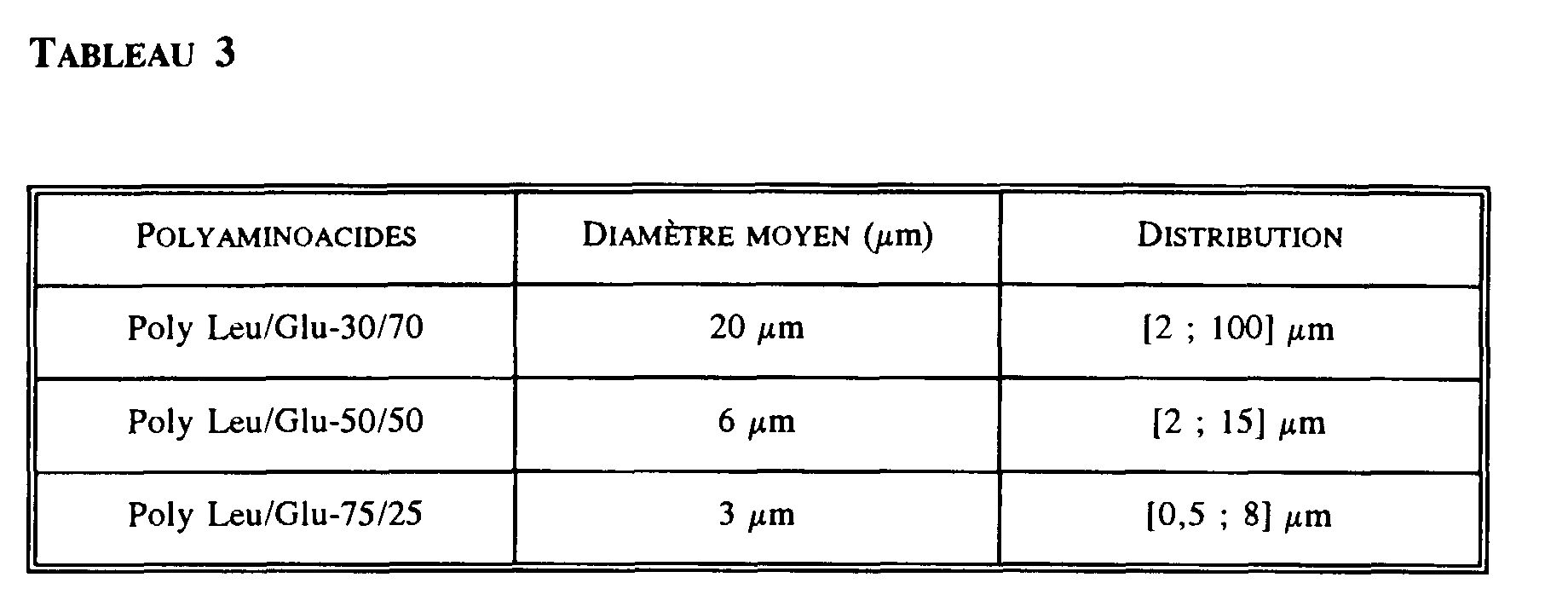
- the aggregation of nanoparticles in colloidal suspension is carried out by gradual addition of a 0.1 mol / l solution of hydrochloric acid, until NPV is aggregated into MPV .
- the results of the particle size measurements of the MPVs are collated in Table 3 below.
- EXAMPLE 18 AGGREGATION OF POLY Leu / Glu-50/50 NANOPARTICLES BY COMPLEXATION WITH POLY D, L-LYSINE .
- the lateral carboxylic functions of the polyamino acids in the nanoparticles are partially ionized. Their complexation with a cationic polymer, such as polyLysine, causes the aggregation of nanoparticles.
- the average diameter of the microparticles is between 10 and 20 ⁇ m by varying the pH between 2 and 9 by adding hydrochloric acid or sodium hydroxide.
- EXAMPLE 19 ENCAPSULATION OF CYTOCHROME C BY COMPLEXATION WITH POLY D, L-LYSINE .
- the microparticles are sedimented; the red coloration of the centrifugation pellet shows that almost all of the cytochrome has sedimented with the nanoparticles, which shows that the cytochrome is encapsulated in the microparticles.
Landscapes
- Health & Medical Sciences (AREA)
- Life Sciences & Earth Sciences (AREA)
- Engineering & Computer Science (AREA)
- Bioinformatics & Cheminformatics (AREA)
- Animal Behavior & Ethology (AREA)
- General Health & Medical Sciences (AREA)
- Public Health (AREA)
- Veterinary Medicine (AREA)
- Epidemiology (AREA)
- Chemical & Material Sciences (AREA)
- Medicinal Chemistry (AREA)
- Pharmacology & Pharmacy (AREA)
- Birds (AREA)
- Optics & Photonics (AREA)
- Physics & Mathematics (AREA)
- Nanotechnology (AREA)
- Biomedical Technology (AREA)
- Dermatology (AREA)
- Medicinal Preparation (AREA)
- Medicines That Contain Protein Lipid Enzymes And Other Medicines (AREA)
- Polyamides (AREA)
Description
Cette spécification implique un contrôle dimensionnel des PV, à la fois sur la distribution de la granulométrie des PV et sur leur diamètre moyen, qui représente une opération très délicate sur le plan technologique.
- soit une protéine hydrophobe choisie parmi le collagène, la caséine, la kératine et, de préférence, les prolamines,
- soit un polymère biocompatible et biodégradable, tel que les poly(lactiques) ou les poly(orthoesters).
- un faible taux d'encapsulation,
- un procédé de purification délicat,
- un enchaínement non régulier (non alpha peptidique) des aminoacides dû au mode de synthèse qui ne permet pas d'affirmer que les réactions de dégradation enzymatiques seront identiques à celles d'un alpha-polyaminoacide,
- enfin, l'utilisation d'un grand nombre d'aminoacides monomères différents, qui peut induire une réponse immunitaire.
- d'une part, par l'utilisation de très faibles masses (entre 250 et 2 400), ce qui correspond à des enchaínements très courts de 2 à 20 aminoacides,
- d'autre part, par le choix des aminoacides de départ.
Cette spécification implique un contrôle dimensionnel des PV, à la fois sur la distribution de la granulométrie des PV et sur leur diamètre moyen, qui représente une opération très délicate sur le plan technologique.
- en ce qu'elles ont une taille moyenne comprise entre 0,01 et 0,5 µm, de préférence entre 0,03 et 0,4 µm,
- en ce que ces NPV sont obtenues par mise en contact de polyaminoacides (PAA) avec une solution aqueuse,
- en ce que ces PAA sont linéaires à enchaínements α-peptidiques
et comprennent au moins deux types d'aminoacides récurrents
AAN et AAI :
- le type AAN correspondant à un acide aminé neutre hydrophobe,

- et le type AAI correspondant à un acide aminé à chaíne latérale ionisable, au moins une partie des aminoacides récurrents de type AAI étant sous forme ionisée,

les aminoacides récurrents de chaque type AAN et AAI étant identiques ou différents entre eux, - en ce que la masse molaire en poids Mw des PAA est supérieure ou égale à 4 000 D, de préférence à 5000 D,
- et en ce que ces PAA sont non-hydrosolubles à pH acide et à pH compris entre 3 et 13.
- ≥ 6 %, de préférence ≥ 15 % pour les PAA "blocs",
- ≥ 20 %, de préférence ≥ 25 % pour les PAA "statistiques".
C'est ainsi que Mw ≥ 5 500 D, de préférence est comprise entre 6 500 D et 200 000 D et, plus préférentiellement encore, entre 8 000 et 20 000 D, pour les polyaminoacides "blocs", tels que définis supra.
Tandis que, pour les polyaminoacides "statistiques", définis eux aussi supra, Mw ≥ 10 000 D, de préférence comprise entre 20 000 D et 500 000 D et, plus préférentiellement, entre 20 000 D et 150 000 D.
- des PAA linéaires et de masses molaires élevées (supérieures à 4 000 D), plutôt que des petits oligomères ramifiés,
- des PAA insolubles, plutôt que solubles, et il est surprenant que ces PAA insolubles forment spontanément une suspension colloïdale de NPV et que des protéines s'associent spontanément à ces NPV.
- en ce que l'on met en oeuvre des polyaminoacides (PAA) :
- comprenant au moins deux types d'aminoacides récurrents
AAN et AAI :
- le type AAN correspondant à un acide aminé neutre hydrophobe,
- et le type AAI correspondant à un acide aminé à
chaíne latérale ionisable,
les aminoacides récurrents de chaque type AAN et AAI étant identiques ou différents entre eux,
- le ratio molaire AAN / AAI + AAN étant ≥ 3 %, de préférence ≥ 5 %,
- la masse molaire en poids Mw du (ou des) polyaminoacide(s) étant supérieure ou égale à 4 000 D, de préférence à 5 000 D,
- en ce que l'on réalise une dispersion de ces polyaminoacides dans un liquide, de préférence dans une solution aqueuse saline, dont on a ajusté le pH à une valeur choisie de telle sorte qu'au moins une partie des aminoacides de type AAI soit sous forme ionisée,
- et en ce que l'on recueille ainsi une solution colloïdale de particules.
- comprenant au moins deux types d'aminoacides récurrents
AAN et AAI :
Ce procédé est l'un de ceux permettant d'obtenir les particules NPV présentées ci-avant. Ces particules peuvent donc être celles dans lesquelles l'AAN (ou les ANN) est(sont) choisi(s) dans la liste suivante : Leu - Ile - Val - Ala - Pro -Phe - et leurs mélanges et celles dans lesquelles l'AAI (ou les AAI) est(sont) formé(s) par le Glu et/ou l'Asp.
- mettre en solution aqueuse le PA à encapsuler,
- et à disperser du polyaminoacide dans une solution aqueuse, puis à mélanger la suspension colloïdale de nanoparticules ainsi formée à la solution de PA, ou bien, et de façon préférée, à disperser directement du polyaminoacide dans la solution de PA, de manière à obtenir spontanément des nanoparticules chargées en PA.
- les protéines et/ou les peptides parmi lesquels les plus préférentiellement retenus sont : les hémoglobines, les cytochromes, les albumines, les interférons, les antigènes, les anticorps, la calatonine, l'érythropoïétine, l'insuline, les hormones de croissance, le facteur IX, l'interleukine ou leurs mélanges,
- les polysaccharides, l'héparine étant plus particulièrement sélectionnée,
- les acides nucléiques et, préférablement, les oligonucléotides d'ARN et/ou d'ADN,
- et leurs mélanges.
Après dissolution des NCA, on introduit 24 ml d'eau, suivi de 0,22 ml de triéthylamine (soit 1 % molaire par rapport aux NCA). Le suivi de la polymérisation est effectué par IR en observant la disparition des bandes carbonyles à 1 860 et 1 790 cm-1. La durée de polymérisation varie entre 1,5 h et 3 h selon la composition des monomères. Après disparition totale des bandes, le milieu réactionnel est dilué par 380 ml de dioxane, puis homogénéisé pendant 3 h à température ambiante. Le copolymère est récupéré par précipitation dans 5 l d'eau sous bonne agitation. Le produit est filtré et séché à 50 °C sous vide pendant 12 h.
La masse de copolymère obtenu est de 18,4 g, soit un rendement pondéral de 90 %. RMN 1H (acide trifluoroacétique-d) : 0,85 ppm (CH3-Leu, 6H*0,5); 1,58 (CH2 et CHMe2 Leu, 3H*0,5); 2,10 et 2,22 (CH2-Glu, 2H*0,5) ; 2,58 (CH2-Glu ; 2H*0,5); 3,75 (CH3-Glu, 3H*0,5) ; 4,62 (NCHCO-Leu, 1H*0,5) ; 4,70 (NCHCO-Glu, 1H*0,5). Viscosité réduite (0,5 g/dl dans l'acide trifluoroacétique) à 25 °C = 2,2 dl/g.
Le polymère est récupéré par précipitation dans 5 1 d'eau. Après filtration, il est à nouveau mis en suspension et agité dans l'eau pendant 0,5 h, puis filtré et essoré. La purification s'effectue par dialyse dans l'eau.
Rendement 15,9g (95 %). RMN 1H (acide trifluoroacétique-d) : identique aux polymères de départ à une exception, le signal à 3,75 (CH3-Glu) est fortement diminué ou absent. Dans le cas présent, le taux d'esters résiduels est inférieur à 1 % par rapport aux monomères glutamate. Viscosité réduite (0,5 g/dl dans l'acide trifluoroacétique) à 25 °C = 0,95 dl/g.
Après une heure, on introduit une solution de 12,5 g de NCA-Leu (0,08 mole) dans un mélange dioxane/toluène (15 ml de chaque). L'agitation est poursuivie pendant 18 h (cette durée n'a pas été optimisée). Les bandes carbonyles ont alors disparu. On ajoute 100 ml de dioxane et le milieu réactionnel est homogénéisé pendant 1 h. Le copolymère est précipité dans 3 l d'éthanol absolu sous forte agitation. Il est lavé avec 1 l d'éthanol, filtré, essoré et enfin séché à 50 °C sous vide pendant une nuit. La masse de produit récupérée est de 19,5 g (rendement = 95 %). RMN 1H (acide trifluoroacétique-d) : 0,85 ppm (CH3-Leu, 6H*0,5) ; 1,58 (CH2 et CHMe2 Leu, 3H*0,5) ; 2,10 et 2,22 (CH2-Glu, 2H*0,5) ; 2.58 (CH2-Glu ; 2H*0,5) ; 3,75 (CH3-Glu, 3H*0,5) ; 4,62 (NCHCO-Leu, 1H*0,5) ; 4,70 (NCHCO-Glu, 1H*0,5). Viscosité réduite (0,5 g/dl dans l'acide trifluoroacétique) à 25 °C = 0,62 dl/g.
Après la disparition totale du monomère, on introduit une solution de 12,5 g de NCA-Leu (0,08 mole) dans un mélange dioxane/toluène (15 ml de chaque). L'agitation est poursuivie pendant 18 h. Ensuite, on introduit à nouveau 7,5 g de NCA-Glu(OMe) (0,04 mole) qu'on permet de réagir pendant 12 heures. On ajoute 100 ml de dioxane et le milieu réactionnel est homogénéisé pendant 1 h. Le copolymère est précipité dans 3 l d'éthanol absolu sous forte agitation. Il est lavé avec 1 1 d'éthanol, filtré, essoré et enfin séché à 50 °C sous vide pendant une nuit. La masse de produit récupéré est de 19,4 g (rendement = 95 %). RMN 1H (acide trifluoroacétique-d) : 0,85 ppm (CH3-Leu, 6H*0,5) ; 1,58 (CH2 et CHMe2 Leu, 3H*0,5) ; 2,10 et 2,22 (CH2-Glu, 2H*0,37) ; 2,58 (CH2-Glu; 2H*0,37) ; 3,75 (CH3-Glu, 3H*0,37) ; 4,62 (NCHCO-Leu, 1H*0,5) ; 4,70 (NCHCO-Glu, 1H*0,37). Viscosité réduite (0,5 g/dl dans l'acide trifluoroacétique) à 25 °C = 0,58 dl/g.
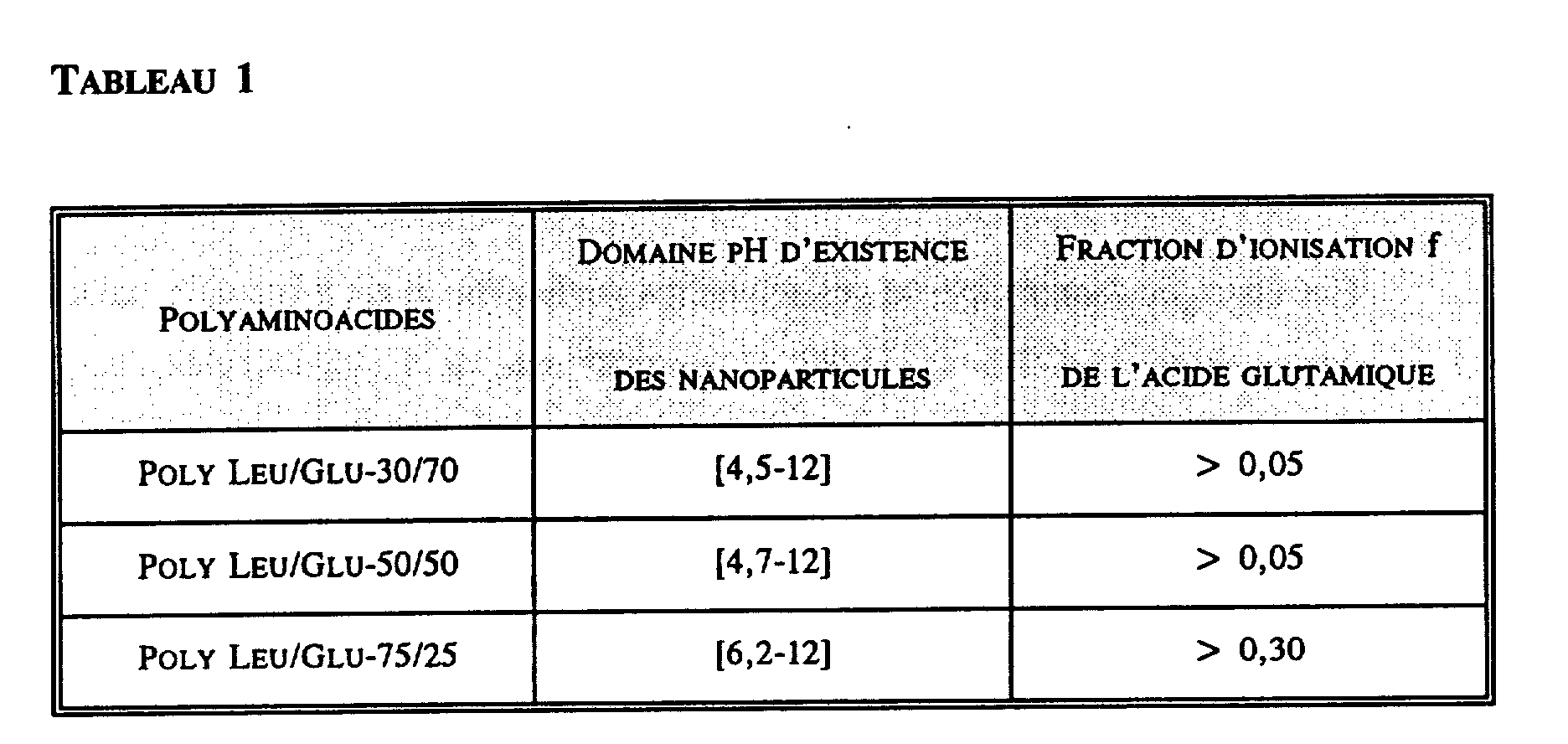
Le tableau 1 ci-dessous rassemble les observations réalisées dans les mêmes conditions de dispersion, avec les copolyaminoacides statistiques de leucine et de glutamate de sodium, de composition Leu/Glu = 50/50 et 75/25 et de masse molaire Mw égales, respectivement, à 60 000 D et 34 000 D.
Dans les mêmes conditions à pH compris entre 3 et 12, les poly(Leu/Glu) 20/80, 40/60 de structures "blocs", de masse molaire Mw respectivement égales à 11 000 D, 15 000 D, se dispersent et forment des suspensions colloïdales. Ces suspensions colloïdales diffusent d'autant plus la lumière que la proportion de leucine dans le polymère est élevée. A pH inférieur à 3, on observe, de la même façon que pour le poly(Leu/Glu) 50/50, que les polymères ne se dispersent pas et restent insolubles.
10 mg de poly Leu/Glu-18/82 lyophilisé sont dispersés dans 0,5 ml d'une solution de chlorure de sodium de molarité 10-2 mol/l. Le polymère est totalement dissous et la solution est limpide.
Il ne se forme pas de nanoparticules.
Dans les mêmes conditions, lorsque l'on disperse 100 mg de polyaminoacides poly(Leu/Glu) 50/50 blocs et de masse molaire Mw égale à 14 600 D, dans une solution tampon PBS, on obtient une suspension stable à température ambiante de nanoparticules qui diffuse la lumière avec une turbidité élevée.
Le tableau 2 ci-dessous regroupe des mesures effectuées à partir des polyaminoacides statistiques de compositions Leu/Glu = 30/70, 50/50 et de masses molaires Mw comprises entre 46 000 D et 21 000 D, ainsi que du polyaminoacide "bloc" de compositions Leu/Glu 20/80, 50/50 de masses molaires comprises entre 11 000 D et 16 300 D. Pour ces mesures, les polyaminoacides sont dispersés dans une solution de pH = 7,4 isotonique, contenant 0,01 mol/l de tampon phosphate, 0,138 mol/l de chlorure de sodium et 0,0027 mol/l de chlorure de potassium (voir catalogue SIGMA P4417).
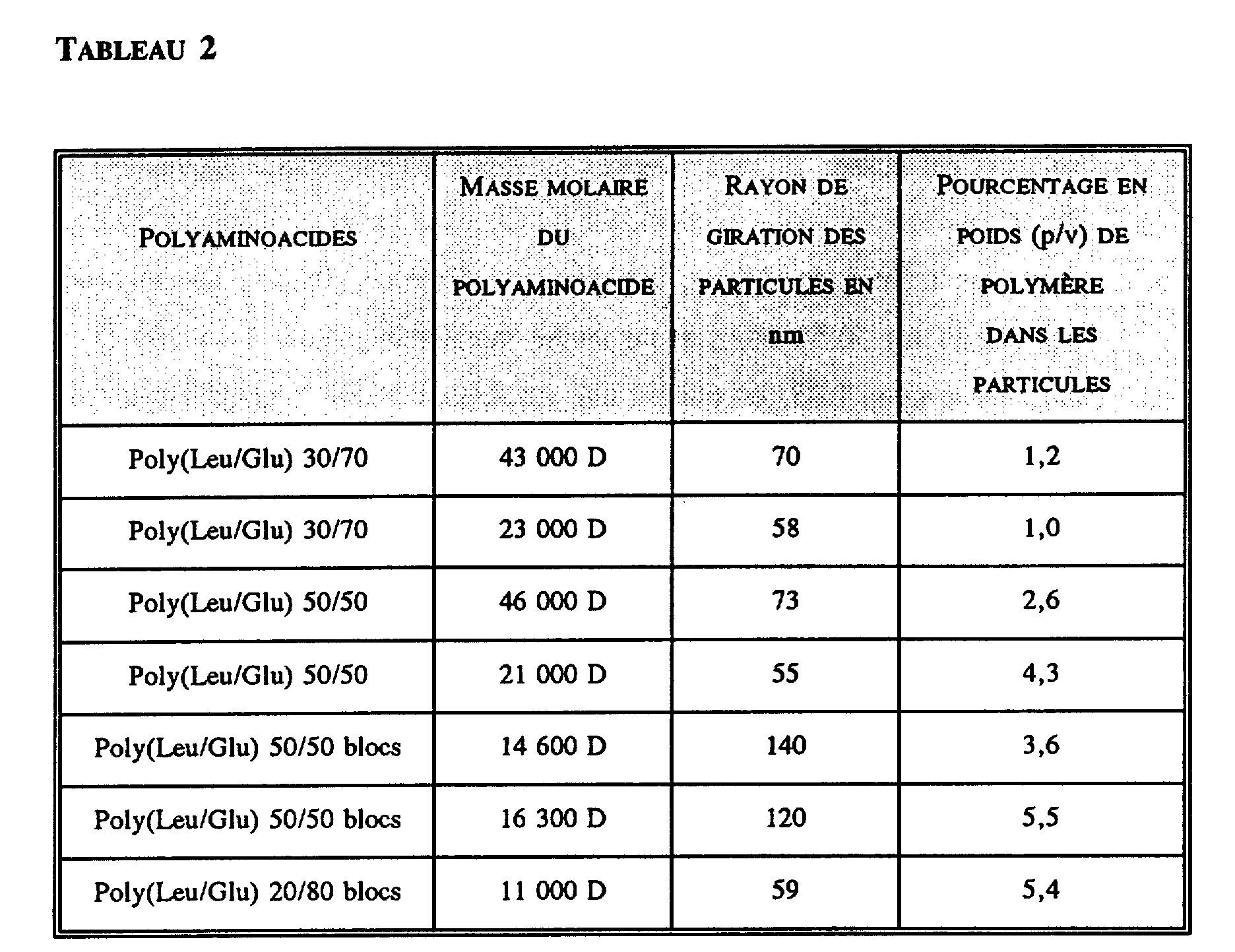
De plus, les répartitions des diamètres des nanoparticules de polyaminoacides sont, d'après les analyses par diffusion quasi élastique de la lumière, monomodales et resserrées autour de leur valeur moyenne. Les largeurs des distributions obtenues sont comparables ou inférieures à celle du polystyrène de polydispersité égale à 1,2. La concentration de polymère dans les nanoparticules est remarquablement faible et toujours inférieure à 6 % p/v. Elle dépend de la composition et de la structure dibloc ou désordonnée des polyaminoacides.
Par ailleurs, l'observation par microscopie électronique (TEM à coloration négative) montre que les nanoparticules ont une forme sphérique ou légèrement allongée.
Les animaux utilisés sont des souris (lot de cinq souris par polymère testé) de souche non consanguine OF1.
Les suspensions de polymères sont injectées par voie sous-cutanée, à hauteur de 100 µl de suspension (250 µg de polymère) par injection. Une première injection est réalisée au temps J0, un rappel est effectué au temps J35. Le prélèvement est effectué au temps J42, soit 7 jours après la deuxième injection. Les prélèvements sanguins sont laissés 24 heures à température ambiante, puis sont centrifugés 10 min à 3 000 tr/min.
Les sérums sont anlysés par dosage ELISA. Aucun anticorps anti-polymère n'a été détecté dans les sérums, y compris à des faibles dilutions en sérum (1/10). Cet exemple montre que les nanoparticules de poly(Leu/Glu) 40/60, 50/50, 60/40 blocs n'induisent pas de réponse immunitaire spécifique.
L'association entre les protéines et les particules colloïdales est caractérisée par l'existence d'un front unique de sédimentation correspondant à la superposition des fronts de sédimentation aux deux longueurs d'onde. Dans le cas contraire, en absence d'association, les fronts de sédimentation de la protéine et des particules colloïdales sont distincts et ne se superposent pas.
L'agrégation peut être réalisée avec les acides dont la constante de dissociation (Ka) est inférieure à celle des fonctions carboxyliques latérales des polyaminoacides.
L'agrégation des nanoparticules en suspension colloïdale est réalisée par addition progressive d'une solution 0,1 mol/l d'acide chlorhydrique, jusqu'à agrégation des NPV en MPV. Les résultats des mesures de granulométrie des MPV sont regroupés dans le tableau 3 suivant.
10 mg de poly Leu/Glu-50/50, de masse molaire Mw = 60 000 D, sont dispersés dans 100 ml d'une solution tampon de phosphate de sodium de molarité 0,01 mol/l et de pH égal à 6. L'addition de 15 mg de bromure d'hydrogène de poly D,L-Lysine, de masse molaire Mw = 15 000 D, permet d'agréger les nanoparticules de polymère en microparticules. Le diamètre moyen des microparticules est compris entre 10 et 20 µm en faisant varier le pH entre 2 et 9 par addition d'acide chlorhydrique ou d'hydroxyde de sodium.
Claims (17)
- Nanoparticules de vectorisation (NPV) de principe(s) actif(s), du type de celles à base de polyaminoacide(s),
caractérisées :en ce qu'elles ont une taille moyenne comprise entre 0,01 et 0,5 µm, de préférence entre 0,03 et 0,4 µm,en ce que ces NPV sont obtenues par mise en contact de polyaminoacides (PAA) avec une solution aqueuse,en ce que ces PAA sont linéaires à enchaínements α-peptidiques et comprennent au moins deux types d'aminoacides récurrents AAN et AAI :le type AAN correspondant à un acide aminé neutre hydrophobe, et le type AAI correspondant à un acide aminé à chaíne latérale ionisable, au moins une partie des aminoacides récurrents de type AAI étant sous forme ionisée,
les aminoacides récurrents de chaque type AAN et AAI étant identiques ou différents entre eux,en ce que la masse molaire en poids Mw des PAA est supérieure ou égale à 4 000 D, de préférence à 5000 D,et en ce que ces PAA sont non-hydrosolubles à pH acide et à pH compris entre 3 et 13. - Particules selon la revendication 1, caractérisées :en ce que leurs PAA constitutifs sont des PAA "blocs" et/ou des PAA "statistiques",et en ce que :pour les PAA "blocs" :
 le rapport molaire AAN / AAN + AAI est ≥ 6 %, de préférence ≥ 15 %,Mw ≥ 5 500 D, de préférence 6 500 D ≤ Mw ≤ 200 000 D et, plus préférentiellement encore, 8 000 D ≤ Mw ≤ 200 000 D,pour les PAA "statistiques" :
 le rapport molaire AAN / AAN + AAI est ≥ 20 %, de préférence ≥ 25 %,Mw ≥ 10 000 D, de préférence 20 000 D ≤ Mw ≤ 500 000 D et, plus préférentiellement encore, 200 000 D ≤ Mw ≤ 150 000 D.
 - Particules selon la revendication 1 ou 2, caractérisées :en ce que l'AAN (ou les AAN) est(sont)choisi(s) dans la liste suivante : Leu - Ile - Val - Ala - Pro - Phe - et leurs mélanges,et en ce que l'AAI (ou les AAI) est(sont) formé(s) par le Glu et/ou l'Asp.
- Particules selon la revendication 1 ou 2, caractérisées en ce que le PAA comprend un aminoacide récurrent AAN et un aminoacide récurrent AAI.
- Particules selon la revendication 1, caractérisées par une concentration moyenne en PAA variant de 0,01 à 25 % poids sec, de préférence de 0,05 à 10 % poids sec.
- Particules selon la revendication 1, caractérisées en ce que ce sont des MicroParticules de Vectorisation (MPV) de taille moyenne supérieure à 0,5 µm, de préférence inférieure ou égale à 20 µm.
- Particules selon la revendication 6, caractérisées en ce qu'elles sont obtenues à partir des particules selon la revendication 5 et en ce qu'elles comprennent, de préférence, au moins un agent d'agrégation.
- Particules selon la revendication 1, caractérisées en ce qu'elles comprennent au moins un principe actif.
- Procédé de préparation de particules à base de polyaminoacide(s) et susceptibles d'être utilisées comme vecteurs de principe(s) actif(s), caractérisé:en ce que l'on met en oeuvre des polyaminoacides (PAA):linéaires à enchaínement α-peptidiques,
 comprenant au moins deux types d'aminoacides récurrents AAN et AAI :
 les aminoacides récurrents de chaque type AAN et AAI étant identiques ou différents entre eux,le type AAN correspondant à un acide aminé neutre hydrophobe,et le type AAI correspondant à un acide aminé à chaíne latérale ionisable,le ratio molaire AAN / AAI + AAN étant ≥ 3 %, de préférence ≥ 5 % ,
 la masse molaire en poids Mw du (ou des) polyaminoacide(s) étant supérieure ou égale à 4 000 D, de préférence à 5 000 D,
 lesdits PAA étant non hydrosolubles à pH acide et à pH compris entre 3 et 13,
 en ce que l'on réalise une dispersion de ces polyaminoacides dans un liquide, de préférence dans une solution aqueuse,et en ce que l'on recueille ainsi une solution colloïdale de particules.
 - Procédé selon la revendication 9, caractérisé en ce que l'on met en oeuvre un PAA comprenant un aminoacide récurrent AAN et un aminoacide récurrent AAI.
- Procédé selon la revendication 9, caractérisé en ce qu'au moins un principe actif est dissous dans le liquide, de préférence avant introduction des polyaminoacides dans le milieu, de sorte que l'on obtienne, après cette introduction, une solution colloïdale de particules chargées en principe(s) actif(s).
- Procédé selon la revendication 9, caractérisé en ce qu'il comprend au moins une étape supplémentaire d'agrégation des particules, à l'aide d'au moins un agent d'agrégation constitué, de préférence, par un sel et/ou un acide et/ou une base et/ou un polymère éventuellement ionique.
- Procédé selon la revendication 12, caractérisé en ce que l'on choisit des concentrations en polymère dans la solution exprimées en % poids/volume, supérieures ou égales à 10-2, de préférence comprises entre 0,05 et 30 et, plus préférentiellement encore, entre 0,05 et 5.
- Particules selon la revendication 1 et/ou obtenues par le procédé selon la revendication 9,
caractérisées en ce que le principe actif est médicamenteux et, de préférence, choisi parmi:les protéines et/ou les peptides parmi lesquels les plus préférentiellement retenus sont : les hémoglobines, les cytochromes, les albumines, les interférons, les antigènes, les anticorps, la calatonine, l'érythropoïétine, l'insuline, les hormones de croissance, le facteur IX, l'interleukine ou leurs mélanges, les polysaccharides, l'héparine étant plus particulièrement sélectionnée,
 les acides nucléiques et, préférablement, les oligonucléotides d'ARN et/ou d'ADN,
 et leurs mélanges.
- Particules selon la revendication 1 et/ou obtenues par le procédé selon la revendication 9, caractérisées en ce que le principe actif est constitué par au moins un vaccin.
- Particules selon la revendication 1 et/ou obtenues par le procédé selon la revendication 9, caractérisées en ce que le PA est formé par au moins un produit phytosanitaire ou cosmétique.
- Spécialité pharmaceutique, nutritionnelle, phytosanitaire ou cosmétique,
caractérisée en ce qu'elle comporte des particules selon la revendication 1 et/ou obtenues par le procédé selon la revendication 9.
Applications Claiming Priority (2)
| Application Number | Priority Date | Filing Date | Title |
|---|---|---|---|
| FR9503978A FR2732218B1 (fr) | 1995-03-28 | 1995-03-28 | Particules a base de polyaminoacide(s) et susceptibles d'etre utilisees comme vecteurs de principe(s) actif(s) et leurs procedes de preparation |
| FR9503978 | 1995-03-28 |
Publications (2)
| Publication Number | Publication Date |
|---|---|
| EP0734720A1 EP0734720A1 (fr) | 1996-10-02 |
| EP0734720B1 true EP0734720B1 (fr) | 2000-07-12 |
Family
ID=9477740
Family Applications (1)
| Application Number | Title | Priority Date | Filing Date |
|---|---|---|---|
| EP96420098A Expired - Lifetime EP0734720B1 (fr) | 1995-03-28 | 1996-03-28 | Particules à base de polyaminoacide(s) et susceptibles d'être utilisées comme vecteurs de principe(s) actif(s) et leurs procédés de préparation |
Country Status (21)
| Country | Link |
|---|---|
| US (1) | US5904936A (fr) |
| EP (1) | EP0734720B1 (fr) |
| JP (1) | JP4112612B2 (fr) |
| KR (1) | KR100490002B1 (fr) |
| CN (1) | CN1148170C (fr) |
| AR (1) | AR001457A1 (fr) |
| AT (1) | ATE194490T1 (fr) |
| AU (1) | AU706746B2 (fr) |
| BR (1) | BR9607863A (fr) |
| CA (1) | CA2215254C (fr) |
| DE (1) | DE69609222T2 (fr) |
| DK (1) | DK0734720T3 (fr) |
| ES (1) | ES2151138T3 (fr) |
| FR (1) | FR2732218B1 (fr) |
| GR (1) | GR3034613T3 (fr) |
| IN (1) | IN185295B (fr) |
| MX (1) | MX9707392A (fr) |
| NZ (1) | NZ305392A (fr) |
| PT (1) | PT734720E (fr) |
| WO (1) | WO1996029991A1 (fr) |
| ZA (1) | ZA962446B (fr) |
Cited By (5)
| Publication number | Priority date | Publication date | Assignee | Title |
|---|---|---|---|---|
| WO2006016078A1 (fr) | 2004-07-19 | 2006-02-16 | Flamel Technologies | Formulation colloïdale d'insuline longue action et sa preparation |
| AU2004292371B2 (en) * | 2003-11-21 | 2010-09-30 | Flamel Technologies | Pharmaceutical formulations for the sustained release of interleukins and therapeutic applications thereof |
| US7906145B2 (en) | 2002-04-09 | 2011-03-15 | Flamel Technologies | Oral pharmaceutical formulation in the form of aqueous suspension for modified release of active principle(s) |
| US7910133B2 (en) | 2002-04-09 | 2011-03-22 | Flamel Technologies | Oral pharmaceutical formulation in the form of aqueous suspension of microcapsules for modified release of amoxicillin |
| US8084045B2 (en) | 2003-11-21 | 2011-12-27 | Flamel Technologies | Pharmaceutical formulations for the prolonged release of active principle(s) and their applications |
Families Citing this family (66)
| Publication number | Priority date | Publication date | Assignee | Title |
|---|---|---|---|---|
| US6051258A (en) | 1995-06-07 | 2000-04-18 | Emisphere Technologies, Inc. | Proteinoid emulsions and methods for preparation and use thereof |
| FR2746035B1 (fr) * | 1996-03-15 | 1998-06-12 | Microparticules de gel composite susceptibles d'etre utilisees comme vecteur(s) de principe(s) actif(s), l'un de leurs procedes de preparation et leurs applications | |
| US6686446B2 (en) * | 1998-03-19 | 2004-02-03 | The Regents Of The University Of California | Methods and compositions for controlled polypeptide synthesis |
| FR2786098B1 (fr) | 1998-11-20 | 2003-05-30 | Flamel Tech Sa | Particules a base de polyaminoacide(s) et susceptibles d'etre utilisees comme vecteurs de principe(s) actif(s), suspension colloidale les comprenant et leurs procedes de fabrication |
| US20040057977A1 (en) * | 1999-09-22 | 2004-03-25 | Ecolab Inc. | Water-based pest bait compositions having water-sensitive insecticides and methods of making and use thereof |
| FR2801226B1 (fr) * | 1999-11-23 | 2002-01-25 | Flamel Tech Sa | Suspension colloidale de particules submicroniques de vectorisation de principes actifs et son mode de preparation |
| IL134701A0 (en) | 2000-02-23 | 2001-04-30 | J P M E D Ltd | Homogeneous solid matrix containing vegetable proteins |
| WO2001066149A2 (fr) * | 2000-03-03 | 2001-09-13 | Valentis, Inc. | Formulations d'acide nucleique pour transfert de genes et procedes d'utilisation |
| WO2001078786A2 (fr) * | 2000-04-14 | 2001-10-25 | Alnis Biosciences, Inc. | Nanoparticules renfermant des peptides a haute affinite |
| FR2814952B1 (fr) * | 2000-10-06 | 2004-01-02 | Flamel Tech Sa | Suspension colloidale de particules submicromiques de vectorisation de principes actifs et leur mode de preparation |
| US6365706B1 (en) | 2000-06-21 | 2002-04-02 | Mississippi Chemical Corporation | Process for production of polyasparagine and the high nitrogen content polymer formed thereby |
| US20060177416A1 (en) | 2003-10-14 | 2006-08-10 | Medivas, Llc | Polymer particle delivery compositions and methods of use |
| FR2814951B1 (fr) * | 2000-10-06 | 2003-01-17 | Flamel Tech Sa | Suspension colloidale de particules submicroniques de vectorisation de principes actifs hydrophiles (insuline) et leur mode de preparation |
| WO2002077075A1 (fr) * | 2001-03-22 | 2002-10-03 | Rhodia Chimie | Procede de fabrication de particules colloidales de forme controlee avec des copolymeres a blocs hydrosolubles comprenant un bloc hydrophobe et un bloc hydrophile |
| FR2822834B1 (fr) | 2001-04-02 | 2005-02-25 | Flamel Tech Sa | Suspension colloidale de nanoparticules a base de copolymeres amphiphile pour la vectorisation de principes actifs et leur mode de preparation |
| US20040126900A1 (en) * | 2001-04-13 | 2004-07-01 | Barry Stephen E | High affinity peptide- containing nanoparticles |
| FR2830447B1 (fr) * | 2001-10-09 | 2004-04-16 | Flamel Tech Sa | Forme galenique orale microparticulaire pour la liberation retardee et controlee de principes actifs pharmaceutiques |
| US7056535B2 (en) * | 2001-12-20 | 2006-06-06 | Kimberly-Clark Worldwide, Inc. | Triggered release from proteinoid microspheres |
| US20030211976A1 (en) * | 2002-03-07 | 2003-11-13 | Andreasen Kasper Huus | Polyamino acid-based particle insulin formulation |
| US20040005999A1 (en) * | 2002-03-07 | 2004-01-08 | Andreasen Kasper Huus | Polyamino acid-based particle insulin preparation |
| FR2840614B1 (fr) | 2002-06-07 | 2004-08-27 | Flamel Tech Sa | Polyaminoacides fonctionnalises par de l'alpha-tocopherol et leurs applications notamment therapeutiques |
| US20040018495A1 (en) * | 2002-07-24 | 2004-01-29 | Xing-Xiang Li | Microparticle based signal amplification for the detection of analytes |
| FR2842736B1 (fr) * | 2002-07-26 | 2005-07-22 | Flamel Tech Sa | Formulation pharmaceutique orale sous forme d'une pluralite de microcapsules permettant la liberation prolongee de principe(s) actif(s) peu soluble(s) |
| FR2842735B1 (fr) * | 2002-07-26 | 2006-01-06 | Flamel Tech Sa | Microcapsules a liberation modifiee de principes actifs peu solubles pour l'administration per os |
| FR2843117B1 (fr) | 2002-07-30 | 2004-10-15 | Flamel Tech Sa | Polyaminoacides fonctionnalises par au moins un groupement hydrophobe et leurs applications notamment therapeutiques |
| WO2004060968A1 (fr) * | 2002-12-04 | 2004-07-22 | Flamel Technologies | Polyaminoacides fonctionnalises par au moins un groupement (oligo)aminoacide et leurs applications notamment therapeutiques |
| FR2855521B1 (fr) * | 2003-05-28 | 2005-08-05 | Flamel Tech Sa | Polyaminoacides fonctionnalises par au moins un groupement h ydrophobe et leurs applications notamment therapeutiques. |
| FR2860516B1 (fr) | 2003-10-03 | 2006-01-13 | Flamel Tech Sa | Homopolyaminoacides telecheliques fonctionnalises par des groupements hydrophobes et leurs applications notamment therapeutiques |
| FR2862541B1 (fr) * | 2003-11-21 | 2007-04-20 | Flamel Tech Sa | Formulations pharmaceutiques pour la liberation prolongee d'interferons et leurs applications therapeutiques |
| FR2873703B1 (fr) * | 2004-07-30 | 2006-12-08 | Flamel Technologies Sa | Polyaminoacides branches, fonctionnalises par des groupements hydrophobes et leurs applications notamment therapeutiques |
| FR2873704B1 (fr) * | 2004-07-30 | 2006-12-08 | Flamel Technologies Sa | Polyaminoacides fonctionnalises par des greffons hydrophobes portant une charge anionique et leurs applications notamment therapeutiques |
| EP1833958A4 (fr) * | 2005-01-04 | 2009-01-14 | Intezyne Technologies Inc | Synthese des copolymeres blocs hybrides et leurs utilisations |
| FR2881140B1 (fr) * | 2005-01-27 | 2007-04-06 | Flamel Technologies Sa | Copolyhydroxyalkylglutamines fonctionnalises par des groupements hydrophobes et leurs applications notamment therapeutiques |
| CA2597378A1 (fr) * | 2005-02-11 | 2006-08-17 | Intezyne Technologies, Incorporated | Synthese d'homopolymeres et de copolymeres sequences |
| JP2006321763A (ja) * | 2005-05-20 | 2006-11-30 | Hosokawa Funtai Gijutsu Kenkyusho:Kk | 生体適合性ナノ粒子及びその製造方法 |
| WO2007038246A2 (fr) * | 2005-09-22 | 2007-04-05 | Medivas, Llc | Compositions polymeres solides pour administration et methodes d'utilisation de celles-ci |
| CA2623198C (fr) | 2005-09-22 | 2014-08-05 | Medivas, Llc | Formules de poly(ester amide) et de poly(ester urethane) contenant des diesters de bis-(a-amino)-diol et methodes d'emploi |
| FR2892725B1 (fr) * | 2005-10-31 | 2011-03-04 | Flamel Tech Sa | Acides polyglutamiques fonctionnalises par des derives de l'histidine et des groupements hydrophobes et leurs applications notamment therapeutiques |
| EP1962894A4 (fr) * | 2005-12-07 | 2012-11-14 | Medivas Llc | Procede destine a assembler une composition d'administration polymere-agent biologique |
| FR2896164B1 (fr) * | 2006-01-18 | 2008-07-04 | Flamel Technologies Sa | Formulation colloidale d'insuline longue action et sa preparation |
| CN101046472A (zh) * | 2006-03-31 | 2007-10-03 | 成都夸常医学工业有限公司 | 一种生物芯片及其制备方法以及应用该芯片的试剂盒 |
| JP5445130B2 (ja) * | 2006-05-02 | 2014-03-19 | メディバス エルエルシー | 眼の外部または内部への眼科用薬剤の送達法 |
| EP2021141A4 (fr) * | 2006-05-09 | 2013-07-03 | Medivas Llc | Polymères hydrosolubles biodégradables |
| US8679540B2 (en) * | 2006-06-09 | 2014-03-25 | Flamel Technologies | Pharmaceutical formulations for the prolonged release of active principle(s), and their applications, especially therapeutic applications |
| FR2902007B1 (fr) * | 2006-06-09 | 2012-01-13 | Flamel Tech Sa | Formulations pharmaceutiques pour la liberation prolongee de principe(s) actif(s) ainsi que leurs applications notamment therapeutiques |
| US20080102128A1 (en) * | 2006-07-28 | 2008-05-01 | Flamel Technologies, Inc. | Modified-release microparticles based on amphiphilic copolymer and on active principles(s) and pharmaceutical formulations comprising them |
| US8124598B2 (en) | 2006-09-14 | 2012-02-28 | Sharon Sageman | 7-keto DHEA for psychiatric use |
| FR2910318B1 (fr) * | 2006-12-20 | 2009-07-03 | Flamel Technologies Sa | Dispersion de polyaminoacides dans une phase lipidique continue. |
| FR2915748B1 (fr) | 2007-05-03 | 2012-10-19 | Flamel Tech Sa | Acides polyglutamiques fonctionnalises par des groupes cationiques et des groupements hydrophobes et leurs applications, notamment therapeutiques |
| US20090029937A1 (en) * | 2007-07-24 | 2009-01-29 | Cornell University | Biodegradable cationic polymer gene transfer compositions and methods of use |
| US20100160274A1 (en) * | 2007-09-07 | 2010-06-24 | Sharon Sageman | 7-KETO DHEA for Psychiatric Use |
| US8486467B1 (en) * | 2007-09-20 | 2013-07-16 | Albert G. Prescott | Dermal filler and method of using same |
| US20100021549A1 (en) * | 2008-07-28 | 2010-01-28 | Flamel Technologies, S.A. | Microparticle oral form useful for the modified release of nanoparticles |
| EP2323671A4 (fr) * | 2008-08-13 | 2012-09-26 | Medivas Llc | Polymères biodégradables à base d aabb-poly(depsipeptides) et procédés d utilisation |
| FR2940619B1 (fr) * | 2008-12-31 | 2012-02-10 | Flamel Technologies Sa | Composition comprenant un actif de solubilite aqueuse faible ou moyenne |
| FR2968994B1 (fr) | 2010-12-17 | 2012-12-28 | Flamel Tech Sa | Procede de preparation de nanoparticules |
| FR2968993B1 (fr) | 2010-12-17 | 2012-12-28 | Flamel Tech Sa | Nanoparticules comportant au moins un actif et au moins deux polyelectrolytes |
| US9873765B2 (en) | 2011-06-23 | 2018-01-23 | Dsm Ip Assets, B.V. | Biodegradable polyesteramide copolymers for drug delivery |
| ES2558357T3 (es) | 2011-06-23 | 2016-02-03 | Dsm Ip Assets B.V. | Micro- o nanopartículas que comprenden un copolímero de poliesteramida biodegradable para uso en el suministro de agentes bioactivos |
| ITMI20111866A1 (it) | 2011-10-13 | 2013-04-14 | Bio Ker S R L | Polietilenglicoli modificati e loro complessi supramolecolari con macromolecole biologicamente attive |
| US9408419B2 (en) | 2012-03-23 | 2016-08-09 | Victoria's Secret Store Brand Management, Inc. | Moisturizing fabric material, use thereof in moisturizing bras, and method of manufacture |
| WO2015173818A1 (fr) | 2014-05-13 | 2015-11-19 | B.G. Negev Technologies And Applications Ltd. | Nanoparticules co-assemblées de peptide-polypeptide pour l'administration de médicaments |
| CN104083778B (zh) * | 2014-06-27 | 2017-01-04 | 中国科学院长春应用化学研究所 | 天门冬氨酸-苯丙氨酸共聚物修饰的顺磁性金属配合物及其制备方法和应用 |
| CN104069515B (zh) * | 2014-06-27 | 2017-01-11 | 中国科学院长春应用化学研究所 | 天门冬氨酸-亮氨酸共聚物修饰的顺磁性金属配合物及其制备方法和应用 |
| CA2969171C (fr) | 2014-12-18 | 2023-12-12 | Dsm Ip Assets B.V. | Systeme d'administration de medicament pour administration de medicaments sensibles aux acides |
| EP4058504A1 (fr) | 2019-11-12 | 2022-09-21 | DSM IP Assets B.V. | Copolymères de polyesteramides possédant une température de transition vitreuse élevée |
Family Cites Families (2)
| Publication number | Priority date | Publication date | Assignee | Title |
|---|---|---|---|---|
| US4351337A (en) * | 1973-05-17 | 1982-09-28 | Arthur D. Little, Inc. | Biodegradable, implantable drug delivery device, and process for preparing and using the same |
| US4976968A (en) * | 1989-02-24 | 1990-12-11 | Clinical Technologies Associates, Inc. | Anhydrous delivery systems for pharmacological agents |
-
1995
- 1995-03-28 FR FR9503978A patent/FR2732218B1/fr not_active Expired - Fee Related
-
1996
- 1996-03-25 US US08/621,438 patent/US5904936A/en not_active Expired - Lifetime
- 1996-03-27 IN IN679DE1996 patent/IN185295B/en unknown
- 1996-03-27 ZA ZA962446A patent/ZA962446B/xx unknown
- 1996-03-28 NZ NZ305392A patent/NZ305392A/en unknown
- 1996-03-28 JP JP52901096A patent/JP4112612B2/ja not_active Expired - Fee Related
- 1996-03-28 AR AR33595096A patent/AR001457A1/es active IP Right Grant
- 1996-03-28 PT PT96420098T patent/PT734720E/pt unknown
- 1996-03-28 AU AU53377/96A patent/AU706746B2/en not_active Ceased
- 1996-03-28 EP EP96420098A patent/EP0734720B1/fr not_active Expired - Lifetime
- 1996-03-28 KR KR1019970706790A patent/KR100490002B1/ko not_active Expired - Fee Related
- 1996-03-28 WO PCT/FR1996/000460 patent/WO1996029991A1/fr not_active Ceased
- 1996-03-28 CA CA002215254A patent/CA2215254C/fr not_active Expired - Fee Related
- 1996-03-28 MX MX9707392A patent/MX9707392A/es not_active IP Right Cessation
- 1996-03-28 ES ES96420098T patent/ES2151138T3/es not_active Expired - Lifetime
- 1996-03-28 DE DE69609222T patent/DE69609222T2/de not_active Expired - Lifetime
- 1996-03-28 CN CNB961936592A patent/CN1148170C/zh not_active Expired - Fee Related
- 1996-03-28 AT AT96420098T patent/ATE194490T1/de not_active IP Right Cessation
- 1996-03-28 BR BR9607863A patent/BR9607863A/pt not_active IP Right Cessation
- 1996-03-28 DK DK96420098T patent/DK0734720T3/da active
-
2000
- 2000-10-12 GR GR20000402298T patent/GR3034613T3/el not_active IP Right Cessation
Cited By (5)
| Publication number | Priority date | Publication date | Assignee | Title |
|---|---|---|---|---|
| US7906145B2 (en) | 2002-04-09 | 2011-03-15 | Flamel Technologies | Oral pharmaceutical formulation in the form of aqueous suspension for modified release of active principle(s) |
| US7910133B2 (en) | 2002-04-09 | 2011-03-22 | Flamel Technologies | Oral pharmaceutical formulation in the form of aqueous suspension of microcapsules for modified release of amoxicillin |
| AU2004292371B2 (en) * | 2003-11-21 | 2010-09-30 | Flamel Technologies | Pharmaceutical formulations for the sustained release of interleukins and therapeutic applications thereof |
| US8084045B2 (en) | 2003-11-21 | 2011-12-27 | Flamel Technologies | Pharmaceutical formulations for the prolonged release of active principle(s) and their applications |
| WO2006016078A1 (fr) | 2004-07-19 | 2006-02-16 | Flamel Technologies | Formulation colloïdale d'insuline longue action et sa preparation |
Also Published As
| Publication number | Publication date |
|---|---|
| JP4112612B2 (ja) | 2008-07-02 |
| FR2732218A1 (fr) | 1996-10-04 |
| FR2732218B1 (fr) | 1997-08-01 |
| AU5337796A (en) | 1996-10-16 |
| BR9607863A (pt) | 1998-06-30 |
| AU706746B2 (en) | 1999-06-24 |
| KR19980703385A (ko) | 1998-10-15 |
| ATE194490T1 (de) | 2000-07-15 |
| NZ305392A (en) | 1998-08-26 |
| DK0734720T3 (da) | 2000-11-06 |
| PT734720E (pt) | 2000-12-29 |
| DE69609222D1 (de) | 2000-08-17 |
| EP0734720A1 (fr) | 1996-10-02 |
| CN1183040A (zh) | 1998-05-27 |
| ES2151138T3 (es) | 2000-12-16 |
| CN1148170C (zh) | 2004-05-05 |
| KR100490002B1 (ko) | 2005-09-26 |
| ZA962446B (en) | 1996-08-07 |
| US5904936A (en) | 1999-05-18 |
| GR3034613T3 (en) | 2001-01-31 |
| JPH11503118A (ja) | 1999-03-23 |
| CA2215254A1 (fr) | 1996-10-03 |
| AR001457A1 (es) | 1997-10-22 |
| IN185295B (fr) | 2000-12-23 |
| CA2215254C (fr) | 2009-05-26 |
| WO1996029991A1 (fr) | 1996-10-03 |
| MX9707392A (es) | 1998-02-28 |
| DE69609222T2 (de) | 2001-03-22 |
Similar Documents
| Publication | Publication Date | Title |
|---|---|---|
| CA2215254C (fr) | Particules a base de polyaminoacide(s) et susceptibles d'etre utilisees comme vecteurs de principe(s) actif(s) et leurs procedes de preparation | |
| EP0888110B1 (fr) | Microparticules de gel composite comme vecteurs de principes actifs | |
| EP1239836B1 (fr) | Suspension colloidale de particules submicroniques de vectorisation de principes actifs et leur mode de preparation | |
| EP1131056B1 (fr) | Particules a base de polyaminoacide(s) et leurs procedes de fabrication | |
| EP1372618B1 (fr) | Suspension colloidale de nanoparticules a base d' un copolymere amphiphile | |
| EP1322411B1 (fr) | Suspension colloidale de particules submicroniques de vectorisation de principes actifs et leur mode de preparation | |
| WO2002028374A1 (fr) | Suspension colloidale de particules submicroniques de vectorisation de principes actifs hydrophiles (insuline) et leur mode de preparation | |
| EP1511471B1 (fr) | Suspension colloidale de particules submicronique de vectorisation de principes actifs et leur mode de preparation | |
| WO2001062805A1 (fr) | Polymeres et matrices cationiques bioeliminables a degradation controlee | |
| MXPA97007392A (en) | Particles based on polyaminoacido (s) for use as vectors of active principle (s) and methods for preparation | |
| WO2016005689A1 (fr) | Utilisation d'un homopolymere amine pour l'encapsulation d'ingredients, procede de synthese d'un homopolymere d'aema, et procede d'encapsulation d'ingredients | |
| FR2805269A1 (fr) | Polymeres et matrices cationiques bioeliminables a degradation controlee |
Legal Events
| Date | Code | Title | Description |
|---|---|---|---|
| PUAI | Public reference made under article 153(3) epc to a published international application that has entered the european phase |
Free format text: ORIGINAL CODE: 0009012 |
|
| AK | Designated contracting states |
Kind code of ref document: A1 Designated state(s): AT BE CH DE DK ES FI FR GB GR IE IT LI LU MC NL PT SE |
|
| AX | Request for extension of the european patent |
Free format text: LT PAYMENT 960404;LV PAYMENT 960404;SI PAYMENT 960404 |
|
| RAX | Requested extension states of the european patent have changed |
Free format text: LT PAYMENT 960404;LV PAYMENT 960404;SI PAYMENT 960404 |
|
| 17P | Request for examination filed |
Effective date: 19970312 |
|
| 17Q | First examination report despatched |
Effective date: 19981113 |
|
| GRAG | Despatch of communication of intention to grant |
Free format text: ORIGINAL CODE: EPIDOS AGRA |
|
| GRAG | Despatch of communication of intention to grant |
Free format text: ORIGINAL CODE: EPIDOS AGRA |
|
| GRAH | Despatch of communication of intention to grant a patent |
Free format text: ORIGINAL CODE: EPIDOS IGRA |
|
| GRAH | Despatch of communication of intention to grant a patent |
Free format text: ORIGINAL CODE: EPIDOS IGRA |
|
| GRAA | (expected) grant |
Free format text: ORIGINAL CODE: 0009210 |
|
| AK | Designated contracting states |
Kind code of ref document: B1 Designated state(s): AT BE CH DE DK ES FI FR GB GR IE IT LI LU MC NL PT SE |
|
| AX | Request for extension of the european patent |
Free format text: LT PAYMENT 19960404;LV PAYMENT 19960404;SI PAYMENT 19960404 |
|
| LTIE | Lt: invalidation of european patent or patent extension | ||
| REF | Corresponds to: |
Ref document number: 194490 Country of ref document: AT Date of ref document: 20000715 Kind code of ref document: T |
|
| REG | Reference to a national code |
Ref country code: CH Ref legal event code: EP |
|
| REG | Reference to a national code |
Ref country code: IE Ref legal event code: FG4D Free format text: FRENCH |
|
| REF | Corresponds to: |
Ref document number: 69609222 Country of ref document: DE Date of ref document: 20000817 |
|
| REG | Reference to a national code |
Ref country code: CH Ref legal event code: NV Representative=s name: BOVARD AG PATENTANWAELTE |
|
| ITF | It: translation for a ep patent filed | ||
| GBT | Gb: translation of ep patent filed (gb section 77(6)(a)/1977) |
Effective date: 20000918 |
|
| REG | Reference to a national code |
Ref country code: DK Ref legal event code: T3 |
|
| REG | Reference to a national code |
Ref country code: ES Ref legal event code: FG2A Ref document number: 2151138 Country of ref document: ES Kind code of ref document: T3 |
|
| REG | Reference to a national code |
Ref country code: PT Ref legal event code: SC4A Free format text: AVAILABILITY OF NATIONAL TRANSLATION Effective date: 20001011 |
|
| PG25 | Lapsed in a contracting state [announced via postgrant information from national office to epo] |
Ref country code: MC Free format text: LAPSE BECAUSE OF NON-PAYMENT OF DUE FEES Effective date: 20010331 |
|
| PLBE | No opposition filed within time limit |
Free format text: ORIGINAL CODE: 0009261 |
|
| STAA | Information on the status of an ep patent application or granted ep patent |
Free format text: STATUS: NO OPPOSITION FILED WITHIN TIME LIMIT |
|
| 26N | No opposition filed | ||
| REG | Reference to a national code |
Ref country code: GB Ref legal event code: IF02 |
|
| PGFP | Annual fee paid to national office [announced via postgrant information from national office to epo] |
Ref country code: DK Payment date: 20080222 Year of fee payment: 13 |
|
| PGFP | Annual fee paid to national office [announced via postgrant information from national office to epo] |
Ref country code: PT Payment date: 20080225 Year of fee payment: 13 Ref country code: NL Payment date: 20080221 Year of fee payment: 13 Ref country code: LU Payment date: 20080313 Year of fee payment: 13 Ref country code: SE Payment date: 20080219 Year of fee payment: 13 Ref country code: FI Payment date: 20080310 Year of fee payment: 13 |
|
| PGFP | Annual fee paid to national office [announced via postgrant information from national office to epo] |
Ref country code: AT Payment date: 20080220 Year of fee payment: 13 |
|
| PGFP | Annual fee paid to national office [announced via postgrant information from national office to epo] |
Ref country code: BE Payment date: 20080411 Year of fee payment: 13 |
|
| PGFP | Annual fee paid to national office [announced via postgrant information from national office to epo] |
Ref country code: GR Payment date: 20080222 Year of fee payment: 13 |
|
| BERE | Be: lapsed |
Owner name: *FLAMEL TECHNOLOGIES Effective date: 20090331 |
|
| REG | Reference to a national code |
Ref country code: PT Ref legal event code: MM4A Free format text: LAPSE DUE TO NON-PAYMENT OF FEES Effective date: 20090928 |
|
| PG25 | Lapsed in a contracting state [announced via postgrant information from national office to epo] |
Ref country code: PT Free format text: LAPSE BECAUSE OF NON-PAYMENT OF DUE FEES Effective date: 20090928 Ref country code: FI Free format text: LAPSE BECAUSE OF NON-PAYMENT OF DUE FEES Effective date: 20090328 Ref country code: AT Free format text: LAPSE BECAUSE OF NON-PAYMENT OF DUE FEES Effective date: 20090328 |
|
| REG | Reference to a national code |
Ref country code: DK Ref legal event code: EBP |
|
| EUG | Se: european patent has lapsed | ||
| NLV4 | Nl: lapsed or anulled due to non-payment of the annual fee |
Effective date: 20091001 |
|
| PG25 | Lapsed in a contracting state [announced via postgrant information from national office to epo] |
Ref country code: NL Free format text: LAPSE BECAUSE OF NON-PAYMENT OF DUE FEES Effective date: 20091001 Ref country code: BE Free format text: LAPSE BECAUSE OF NON-PAYMENT OF DUE FEES Effective date: 20090331 |
|
| PG25 | Lapsed in a contracting state [announced via postgrant information from national office to epo] |
Ref country code: DK Free format text: LAPSE BECAUSE OF NON-PAYMENT OF DUE FEES Effective date: 20090331 |
|
| PGFP | Annual fee paid to national office [announced via postgrant information from national office to epo] |
Ref country code: ES Payment date: 20100323 Year of fee payment: 15 |
|
| PGFP | Annual fee paid to national office [announced via postgrant information from national office to epo] |
Ref country code: IT Payment date: 20100325 Year of fee payment: 15 |
|
| PG25 | Lapsed in a contracting state [announced via postgrant information from national office to epo] |
Ref country code: GR Free format text: LAPSE BECAUSE OF NON-PAYMENT OF DUE FEES Effective date: 20091002 |
|
| REG | Reference to a national code |
Ref country code: CH Ref legal event code: PFA Owner name: FLAMEL TECHNOLOGIES Free format text: FLAMEL TECHNOLOGIES#PARC CLUB DU MOULIN A VENT 33, AVENUE DU DOCTEUR GEORGES LEVY#69693 VENISSIEUX CEDEX (FR) -TRANSFER TO- FLAMEL TECHNOLOGIES#PARC CLUB DU MOULIN A VENT 33, AVENUE DU DOCTEUR GEORGES LEVY#69693 VENISSIEUX CEDEX (FR) |
|
| PG25 | Lapsed in a contracting state [announced via postgrant information from national office to epo] |
Ref country code: LU Free format text: LAPSE BECAUSE OF NON-PAYMENT OF DUE FEES Effective date: 20090328 |
|
| PGFP | Annual fee paid to national office [announced via postgrant information from national office to epo] |
Ref country code: IE Payment date: 20110225 Year of fee payment: 16 |
|
| PG25 | Lapsed in a contracting state [announced via postgrant information from national office to epo] |
Ref country code: SE Free format text: LAPSE BECAUSE OF NON-PAYMENT OF DUE FEES Effective date: 20090329 |
|
| PG25 | Lapsed in a contracting state [announced via postgrant information from national office to epo] |
Ref country code: IT Free format text: LAPSE BECAUSE OF NON-PAYMENT OF DUE FEES Effective date: 20110328 |
|
| REG | Reference to a national code |
Ref country code: ES Ref legal event code: FD2A Effective date: 20120424 |
|
| PG25 | Lapsed in a contracting state [announced via postgrant information from national office to epo] |
Ref country code: ES Free format text: LAPSE BECAUSE OF NON-PAYMENT OF DUE FEES Effective date: 20110329 |
|
| REG | Reference to a national code |
Ref country code: IE Ref legal event code: MM4A |
|
| PG25 | Lapsed in a contracting state [announced via postgrant information from national office to epo] |
Ref country code: IE Free format text: LAPSE BECAUSE OF NON-PAYMENT OF DUE FEES Effective date: 20120328 |
|
| PGFP | Annual fee paid to national office [announced via postgrant information from national office to epo] |
Ref country code: GB Payment date: 20130315 Year of fee payment: 18 Ref country code: DE Payment date: 20130311 Year of fee payment: 18 Ref country code: CH Payment date: 20130312 Year of fee payment: 18 |
|
| PGFP | Annual fee paid to national office [announced via postgrant information from national office to epo] |
Ref country code: FR Payment date: 20130417 Year of fee payment: 18 |
|
| REG | Reference to a national code |
Ref country code: DE Ref legal event code: R119 Ref document number: 69609222 Country of ref document: DE |
|
| REG | Reference to a national code |
Ref country code: CH Ref legal event code: PL |
|
| GBPC | Gb: european patent ceased through non-payment of renewal fee |
Effective date: 20140328 |
|
| REG | Reference to a national code |
Ref country code: FR Ref legal event code: ST Effective date: 20141128 |
|
| REG | Reference to a national code |
Ref country code: DE Ref legal event code: R119 Ref document number: 69609222 Country of ref document: DE Effective date: 20141001 |
|
| PG25 | Lapsed in a contracting state [announced via postgrant information from national office to epo] |
Ref country code: DE Free format text: LAPSE BECAUSE OF NON-PAYMENT OF DUE FEES Effective date: 20141001 Ref country code: GB Free format text: LAPSE BECAUSE OF NON-PAYMENT OF DUE FEES Effective date: 20140328 Ref country code: CH Free format text: LAPSE BECAUSE OF NON-PAYMENT OF DUE FEES Effective date: 20140331 Ref country code: FR Free format text: LAPSE BECAUSE OF NON-PAYMENT OF DUE FEES Effective date: 20140331 Ref country code: LI Free format text: LAPSE BECAUSE OF NON-PAYMENT OF DUE FEES Effective date: 20140331 |