EP0732288B1 - Ceramic rollers for conveyance of photographic films and paper and polymeric webs - Google Patents
Ceramic rollers for conveyance of photographic films and paper and polymeric webs Download PDFInfo
- Publication number
- EP0732288B1 EP0732288B1 EP96420072A EP96420072A EP0732288B1 EP 0732288 B1 EP0732288 B1 EP 0732288B1 EP 96420072 A EP96420072 A EP 96420072A EP 96420072 A EP96420072 A EP 96420072A EP 0732288 B1 EP0732288 B1 EP 0732288B1
- Authority
- EP
- European Patent Office
- Prior art keywords
- rollers
- ceramic
- roller
- conveyance
- yttria
- Prior art date
- Legal status (The legal status is an assumption and is not a legal conclusion. Google has not performed a legal analysis and makes no representation as to the accuracy of the status listed.)
- Expired - Lifetime
Links
- 239000000919 ceramic Substances 0.000 title claims description 26
- 238000005245 sintering Methods 0.000 claims description 10
- RUDFQVOCFDJEEF-UHFFFAOYSA-N yttrium(III) oxide Inorganic materials [O-2].[O-2].[O-2].[Y+3].[Y+3] RUDFQVOCFDJEEF-UHFFFAOYSA-N 0.000 claims description 10
- RKTYLMNFRDHKIL-UHFFFAOYSA-N copper;5,10,15,20-tetraphenylporphyrin-22,24-diide Chemical compound [Cu+2].C1=CC(C(=C2C=CC([N-]2)=C(C=2C=CC=CC=2)C=2C=CC(N=2)=C(C=2C=CC=CC=2)C2=CC=C3[N-]2)C=2C=CC=CC=2)=NC1=C3C1=CC=CC=C1 RKTYLMNFRDHKIL-UHFFFAOYSA-N 0.000 claims description 9
- 239000013078 crystal Substances 0.000 claims description 7
- RVTZCBVAJQQJTK-UHFFFAOYSA-N oxygen(2-);zirconium(4+) Chemical compound [O-2].[O-2].[Zr+4] RVTZCBVAJQQJTK-UHFFFAOYSA-N 0.000 claims description 7
- 229910001928 zirconium oxide Inorganic materials 0.000 claims description 7
- 239000000463 material Substances 0.000 claims description 4
- MCMNRKCIXSYSNV-UHFFFAOYSA-N Zirconium dioxide Chemical compound O=[Zr]=O MCMNRKCIXSYSNV-UHFFFAOYSA-N 0.000 description 15
- VYZAMTAEIAYCRO-UHFFFAOYSA-N Chromium Chemical compound [Cr] VYZAMTAEIAYCRO-UHFFFAOYSA-N 0.000 description 12
- 239000010935 stainless steel Substances 0.000 description 9
- 229910001220 stainless steel Inorganic materials 0.000 description 9
- 238000005260 corrosion Methods 0.000 description 7
- 230000007797 corrosion Effects 0.000 description 7
- 238000000034 method Methods 0.000 description 7
- 239000000843 powder Substances 0.000 description 7
- CPLXHLVBOLITMK-UHFFFAOYSA-N Magnesium oxide Chemical compound [Mg]=O CPLXHLVBOLITMK-UHFFFAOYSA-N 0.000 description 5
- 229910000831 Steel Inorganic materials 0.000 description 4
- 238000010438 heat treatment Methods 0.000 description 4
- 238000004519 manufacturing process Methods 0.000 description 4
- 238000007747 plating Methods 0.000 description 4
- 239000010959 steel Substances 0.000 description 4
- PNEYBMLMFCGWSK-UHFFFAOYSA-N aluminium oxide Inorganic materials [O-2].[O-2].[O-2].[Al+3].[Al+3] PNEYBMLMFCGWSK-UHFFFAOYSA-N 0.000 description 3
- CETPSERCERDGAM-UHFFFAOYSA-N ceric oxide Chemical compound O=[Ce]=O CETPSERCERDGAM-UHFFFAOYSA-N 0.000 description 3
- 229910000760 Hardened steel Inorganic materials 0.000 description 2
- 238000002441 X-ray diffraction Methods 0.000 description 2
- 238000005275 alloying Methods 0.000 description 2
- 239000011230 binding agent Substances 0.000 description 2
- 229910000422 cerium(IV) oxide Inorganic materials 0.000 description 2
- 238000001816 cooling Methods 0.000 description 2
- 238000009826 distribution Methods 0.000 description 2
- 239000000395 magnesium oxide Substances 0.000 description 2
- HBMJWWWQQXIZIP-UHFFFAOYSA-N silicon carbide Chemical compound [Si+]#[C-] HBMJWWWQQXIZIP-UHFFFAOYSA-N 0.000 description 2
- 229910010271 silicon carbide Inorganic materials 0.000 description 2
- ODINCKMPIJJUCX-UHFFFAOYSA-N Calcium oxide Chemical compound [Ca]=O ODINCKMPIJJUCX-UHFFFAOYSA-N 0.000 description 1
- 239000004372 Polyvinyl alcohol Substances 0.000 description 1
- 229910045601 alloy Inorganic materials 0.000 description 1
- 239000000956 alloy Substances 0.000 description 1
- 230000004075 alteration Effects 0.000 description 1
- 238000004458 analytical method Methods 0.000 description 1
- 239000000292 calcium oxide Substances 0.000 description 1
- 235000012255 calcium oxide Nutrition 0.000 description 1
- 229910010293 ceramic material Inorganic materials 0.000 description 1
- 239000011248 coating agent Substances 0.000 description 1
- 238000000576 coating method Methods 0.000 description 1
- 239000002131 composite material Substances 0.000 description 1
- 150000001875 compounds Chemical class 0.000 description 1
- 238000011109 contamination Methods 0.000 description 1
- 230000005484 gravity Effects 0.000 description 1
- 238000001341 grazing-angle X-ray diffraction Methods 0.000 description 1
- 238000003754 machining Methods 0.000 description 1
- 238000002844 melting Methods 0.000 description 1
- 230000008018 melting Effects 0.000 description 1
- 229910052751 metal Inorganic materials 0.000 description 1
- 239000002184 metal Substances 0.000 description 1
- 238000012986 modification Methods 0.000 description 1
- 230000004048 modification Effects 0.000 description 1
- SIWVEOZUMHYXCS-UHFFFAOYSA-N oxo(oxoyttriooxy)yttrium Chemical compound O=[Y]O[Y]=O SIWVEOZUMHYXCS-UHFFFAOYSA-N 0.000 description 1
- 238000004806 packaging method and process Methods 0.000 description 1
- 239000002245 particle Substances 0.000 description 1
- 229920003023 plastic Polymers 0.000 description 1
- 239000004033 plastic Substances 0.000 description 1
- 229920002451 polyvinyl alcohol Polymers 0.000 description 1
- 239000011148 porous material Substances 0.000 description 1
- 238000004904 shortening Methods 0.000 description 1
- 229910052709 silver Inorganic materials 0.000 description 1
- 239000004332 silver Substances 0.000 description 1
- -1 silver halide salts Chemical class 0.000 description 1
- 229910002082 tetragonal zirconia polycrystal Inorganic materials 0.000 description 1
- 238000003826 uniaxial pressing Methods 0.000 description 1
Images
Classifications
-
- C—CHEMISTRY; METALLURGY
- C04—CEMENTS; CONCRETE; ARTIFICIAL STONE; CERAMICS; REFRACTORIES
- C04B—LIME, MAGNESIA; SLAG; CEMENTS; COMPOSITIONS THEREOF, e.g. MORTARS, CONCRETE OR LIKE BUILDING MATERIALS; ARTIFICIAL STONE; CERAMICS; REFRACTORIES; TREATMENT OF NATURAL STONE
- C04B35/00—Shaped ceramic products characterised by their composition; Ceramics compositions; Processing powders of inorganic compounds preparatory to the manufacturing of ceramic products
- C04B35/01—Shaped ceramic products characterised by their composition; Ceramics compositions; Processing powders of inorganic compounds preparatory to the manufacturing of ceramic products based on oxide ceramics
- C04B35/48—Shaped ceramic products characterised by their composition; Ceramics compositions; Processing powders of inorganic compounds preparatory to the manufacturing of ceramic products based on oxide ceramics based on zirconium or hafnium oxides, zirconates, zircon or hafnates
- C04B35/486—Fine ceramics
Definitions
- the present invention relates to ceramic rollers for transportation of photographic films and paper and polymeric webs into and out of a perforating or slitting/packaging machines. More particularly, the present invention relates to the net shape manufacturing of ceramic rollers.
- rollers are typically chrome plated stainless steel.
- the outer surface finish is very critical in that rollers should not scratch the photographic films.
- Thin chrome plating generally provides an adequate hard wear resistant surface which does not produce scratches on the photographic film.
- Thick chrome plating generates a rough surface and is not used for rollers transporting photographic film.
- the rollers in the perforator rotate on a hardened steel pin. Typical inside diameters of the rollers are 1.524 to 1.778 mm (60 to 70 thousandths of an inch). The small inner diameters of rollers are too narrow to provide a uniform chrome plating and that in turn limits the service life of conveyance rollers.
- photographic film contains corrosive silver halide salts which attack stainless steel through microcracks and pores in the chrome plating.
- the corrosion products along with the wear debris tend to contaminate the films and also accumulate between the pin and the inner surface of the roller, thus, reducing clearance and jamming the transportation process. Wear of the pin and roller causes excessive runout and the perforating machines need to be stopped and overhauled frequently.
- GB-A-2,269,136 describes a cylinder made of metal or plastics, the outer surface of which has been coated with a material which is zirconium oxide and/or yttrium oxide or consists of one or both of said oxides. Sintering could be used to apply said coating onto the outer cylindrical surface of the cylinder.
- the present invention replaces the chrome plated stainless steel rollers with yttria-tetragonal zirconia polycrystal (Y-TZP) ceramic which rotate on hardened steel pins.
- Y-TZP yttria-tetragonal zirconia polycrystal
- the present invention is a ceramic roller which has an outer surface and an inner surface.
- the ceramic roller consists essentially of zirconium oxide and yttria in a molar ratio of yttria to zirconium oxide of from about 3:97 to about 5:95.
- the ceramic consists essentially of a tetragonal crystal phase grain and the inner and outer surfaces have a dimensional tolerance of between 38.1 ⁇ m ( ⁇ 0.0015 inches).
- the outer surface of the ceramic roller has been modified to comprise the cubic phase crystal grain.
- the outer surface of the ceramic roller has been modified to comprise the monoclinic phase crystal grain.
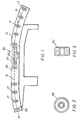
- Figure 1 is a schematic of a film conveyance arrangement in a film perforator.
- Figure 2 is a side view of a conveyance roller.
- Figure 3 is a sectional view of a conveyance roller.
- Shown in Figure 1 is the film conveyance arrangement in a film perforator. It includes a feed chute 12, wherein the film is propelled towards the perforator 20.
- the perforator includes a die top 22 and a stripper plate 23.
- the film 15 is conveyed through a shuttle chute 30 which includes a shuttle gate 34.
- the stripper plate 23 strips the film or paper from the punch and the perforations are removed by gravity.
- a series of guide rollers 17 convey the film 15 through the feed chute, the perforator 20 and the shuttle chute 34.
- chrome plated stainless steel rollers are typically used as conveyance rollers. However, the chrome plated stainless steel rollers do not have good wear resistance.
- chrome plated stainless steel rollers are prone to corrosion. Loose debris from corrosion can contaminate the photographic films. Part of the reason for the corrosion is that it is not possible to chrome plate uniformly the narrow inner diameter hole of the roller. This results in a shortening of the service life of the conveyance roller. In addition, wear of the steel pin along with the inner diameter of the roller increases the runout of the rollers and, thus, affects transportation of the film.
- the present invention solves the above identified problems.
- the present invention uses a ceramic material described in U.S. Patents 5,336,282 and 5,290,332.
- a net-shape ceramic roller for photographic film perforating machines is produced as described below.
- the ceramic roller requires essentially no machining after manufacture.
- the dimensional tolerances of the rollers are critical in a perforating machine.
- the ceramic rollers of the present invention have a dimensional tolerance of 38.1 ⁇ m ( ⁇ 0.0015 inches) for the outer diameter and 38.1 ⁇ m ( ⁇ 0.0015 inches) for the inner diameter.
- the ceramic rollers of the present invention have a concentricity of 12.7 ⁇ m ( ⁇ 0.0005) and a surface finish on the outer diameter of better than 0.1 ⁇ m (4 microinch).
- Ceramic rollers of the present invention are manufactured more cost effectively than stainless steel rollers.
- the ceramic rollers of the present invention are manufactured from yttria alloyed tetragonal zirconia polycrystals (Y-TZP) which contain from 3 to 5 mole percent of yttria in high purity zirconium oxide.
- Y-TZP yttria alloyed tetragonal zirconia polycrystals
- the ceramic has a molar ratio of yttria to zirconium oxide of from about 3:97 to about 5:95 and wherein the ceramic consists essentially of the tetragonal crystal phase grain and wherein the outer surface has a dimensional tolerance of between +38.1 and -38.1 ⁇ m (+0.0015 and -0.0015 inches) and the inner surface has a dimensional tolerance of between +6.3 and -6.3 ⁇ m (+0.00025 and -0.00025 inches).
- Other alloying compounds like ceria (CeO) or magnesia (MgO) can also be used to achieve similar properties.
- Materials like silicon carbide or composites like zirconia reinforced alumina, or silicon carbide reinforced alumina may also be used for this application.
- Pure zirconia can exist in three different crystallographic states depending on the melting and sintering temperatures.
- the monoclinic phase is formed at the lowest temperature. As the temperature increases, the monoclinic phase first transforms to a metastable tetragonal and then to a cubic phase.
- the cubic and tetragonal phases can be stabilized at room temperature by alloying with yttria, calcia, ceria and magnesia.
- the fabrication process of ceramic rollers of the present invention involves cold uniaxial pressing of 3 to 5 mole percent yttria-zirconia powders to a green shape and then sintering to yield net-shape rollers. By controlling several critical steps in the process, net-shape rollers were produced within ⁇ 0.001 percent of the targeted shape. The following are the essential steps of this process:
- Zirconia powders were alloyed with up to 5 mole percent yttria, preferably 3 mole percent, and calcined to get single phase tetragonal structure.
- the alloyed zirconia powders were cold compacted using high precision molds to form green rollers.
- the compacting pressures were varied between 68.9 kPa and 137.8 kPa (10 and 20 kpsi), preferably 103.3 kPa (15 kpsi).
- the green rollers were sintered at temperatures ranging from 1400 to 1600 degrees C for times between 1 and 3 hours, preferably at 1500 degrees C for 2 hours. During sintering, rollers were placed on flat plates such as alumina which could withstand the high temperature.
- X-ray diffraction pattern analysis shows 100% tetragonal structure of the rollers produced from the above process.
- the hardness measured by Knoop indenters was in the range of 1000 to 1300 KHN. Deviation in dimensional tolerances were as follows. The outer diameter had a tolerance of 38.1 ⁇ m ( ⁇ 0.0015 inches), the inner diameter had a dimensional tolerance of 6.3 ⁇ m ( ⁇ 0.00025 inches) and the length dimensional tolerance was 25.4 ⁇ m ( ⁇ 0.001 inches).
- the ceramic rollers produced in the above process were placed in a perforator and tested along with conventional chrome plated stainless steel rollers.
- the ceramic rollers last 5 to 15 times longer than the stainless steel rollers but the steel pins did not show any wear or corrosion and the wear debris was less in the vicinity of the ceramic rollers. As a whole, the perforating machine ran uninterrupted 5 to 15 times longer producing better quality and cleaner films.
- Monoclinic outer surfaces were produced by placing the rollers completely buried in very fine (approximately 0.3 micrometer) pure zirconia powder and sintered at 1500° C as described in Example 1. Coupled angle X-ray diffraction indicated that the core was tetragonal phase. Glancing angle X-ray diffraction demonstrated a monoclinic phase case on the surface in contact with the zirconia powder.
Landscapes
- Chemical & Material Sciences (AREA)
- Engineering & Computer Science (AREA)
- Ceramic Engineering (AREA)
- Composite Materials (AREA)
- Manufacturing & Machinery (AREA)
- Materials Engineering (AREA)
- Structural Engineering (AREA)
- Organic Chemistry (AREA)
- Compositions Of Oxide Ceramics (AREA)
- Registering, Tensioning, Guiding Webs, And Rollers Therefor (AREA)
- Photographic Processing Devices Using Wet Methods (AREA)
Applications Claiming Priority (2)
| Application Number | Priority Date | Filing Date | Title |
|---|---|---|---|
| US08/403,082 US5520601A (en) | 1995-03-13 | 1995-03-13 | Ceramic rollers for conveyance of photographic films and paper polymeric webs |
| US403082 | 1995-03-13 |
Publications (2)
| Publication Number | Publication Date |
|---|---|
| EP0732288A1 EP0732288A1 (en) | 1996-09-18 |
| EP0732288B1 true EP0732288B1 (en) | 2000-06-21 |
Family
ID=23594406
Family Applications (1)
| Application Number | Title | Priority Date | Filing Date |
|---|---|---|---|
| EP96420072A Expired - Lifetime EP0732288B1 (en) | 1995-03-13 | 1996-03-06 | Ceramic rollers for conveyance of photographic films and paper and polymeric webs |
Country Status (4)
| Country | Link |
|---|---|
| US (1) | US5520601A (enExample) |
| EP (1) | EP0732288B1 (enExample) |
| JP (1) | JPH08262680A (enExample) |
| DE (1) | DE69608923T2 (enExample) |
Families Citing this family (3)
| Publication number | Priority date | Publication date | Assignee | Title |
|---|---|---|---|---|
| DE19925418A1 (de) * | 1999-06-02 | 2000-12-07 | Voith Sulzer Papiertech Patent | Elastische Walze und Verfahren zum Herstellen einer solchen |
| JP3876168B2 (ja) * | 2002-02-14 | 2007-01-31 | 三菱重工業株式会社 | アブレイダブルコーティング及びその作製方法 |
| US8209887B2 (en) | 2009-06-17 | 2012-07-03 | Syamal Kumar Ghosh | Wear resistant support structures for utility equipment |
Family Cites Families (9)
| Publication number | Priority date | Publication date | Assignee | Title |
|---|---|---|---|---|
| JPH065363B2 (ja) * | 1981-12-21 | 1994-01-19 | コニカ株式会社 | 写真用フイルムの加工包装方法 |
| JPS60186464A (ja) * | 1984-03-01 | 1985-09-21 | ティーディーケイ株式会社 | 導電性のセラミツクス材料 |
| NL9000870A (nl) * | 1989-05-29 | 1990-12-17 | Stork Screens Bv | Ondersteunings- of geleidingswals en inrichting voorzien van een of meer van dergelijke walsen. |
| JP2508885B2 (ja) * | 1990-05-11 | 1996-06-19 | 住友金属工業株式会社 | ハ―スロ―ル |
| JPH04280755A (ja) * | 1991-03-08 | 1992-10-06 | Toray Ind Inc | シート状物用巻取装置のコンタクトロール |
| US5336282A (en) * | 1991-12-31 | 1994-08-09 | Eastman Kodak Company | Zirconia ceramics and a process of producing the same |
| US5290332A (en) * | 1992-03-05 | 1994-03-01 | Eastman Kodak Company | Ceramic articles and methods for preparing ceramic articles and for sintering |
| FR2693944B1 (fr) * | 1992-07-09 | 1996-01-12 | Heidelberger Druckmasch Ag | Cylindre de dispositif de mouillage pour impression offset. |
| EP0603818B1 (en) * | 1992-12-22 | 1996-07-31 | Eastman Kodak Company | Method of preparation of zirconia articles having tetragonal cores and monoclinic cases |
-
1995
- 1995-03-13 US US08/403,082 patent/US5520601A/en not_active Expired - Lifetime
-
1996
- 1996-03-06 DE DE69608923T patent/DE69608923T2/de not_active Expired - Lifetime
- 1996-03-06 EP EP96420072A patent/EP0732288B1/en not_active Expired - Lifetime
- 1996-03-12 JP JP8055009A patent/JPH08262680A/ja active Pending
Also Published As
| Publication number | Publication date |
|---|---|
| DE69608923D1 (de) | 2000-07-27 |
| DE69608923T2 (de) | 2001-01-11 |
| EP0732288A1 (en) | 1996-09-18 |
| JPH08262680A (ja) | 1996-10-11 |
| US5520601A (en) | 1996-05-28 |
Similar Documents
| Publication | Publication Date | Title |
|---|---|---|
| EP0603818B1 (en) | Method of preparation of zirconia articles having tetragonal cores and monoclinic cases | |
| CA2090380C (en) | Ceramic articles and methods for preparing ceramic articles and for sintering | |
| EP0824990B1 (en) | Method of engraving pre-sintered ceramic articles | |
| EP0825159A2 (en) | Method of making air lubricated hydrodynamic ceramic bearings | |
| US5520601A (en) | Ceramic rollers for conveyance of photographic films and paper polymeric webs | |
| EP0729927A1 (en) | Alumina ceramic articles having cubic spinel on surfaces and methods for preparing alumina ceramic articles and for sintering | |
| EP0847968A1 (en) | Process for preparing an electrically conductive composite of tetragonal zirconia or of zirconia-alumina, and zirconium diboride | |
| US5683481A (en) | Method of making core shell structured articles based on alumina ceramics having spinel surfaces | |
| JPH10182224A (ja) | セラミック物品の製造方法 | |
| US5738446A (en) | Air lubricated hydrodynamic ceramic bearings | |
| EP1930457A1 (en) | Sintered body and method for producing same; sliding member, film-forming material and die for hot extrusion molding each using such sintered body; and hot extrusion molding apparatus and hot extrusion molding method each using such die for hot extrusion molding | |
| JPH10158060A (ja) | 導電性セラミック物品 | |
| US6117805A (en) | Ceramic guide rails for photographic film and paper and polymeric web perforation | |
| EP0571300A1 (en) | Magnetic record/reproduce head having improved service life, and new material therefor | |
| US6164846A (en) | Apparatus and method for transporting a web | |
| US5696040A (en) | Ceramic article containing a core comprising zirconia and a shell comprising zirconium boride | |
| US6074109A (en) | Apparatus for processing photographic media | |
| US5679611A (en) | Ceramic article containing a core comprising tetragonal zirconia and a shell comprising zirconium nitride | |
| US11749432B2 (en) | Magnetic sheet, coil module having magnetic sheet, and non-contact power supply device | |
| US5702766A (en) | Process of forming a ceramic article containing a core comprising zirconia and a shell comprising zirconium boride | |
| JP2005029462A (ja) | セラミックス板の製造方法、セラミックス板及びセラミックス製セッター | |
| JPH05285883A (ja) | 紙切断用カッター | |
| Mao et al. | Properties and fracture behavior of an advanced Al sub 2 O sub 3/Co ceramic | |
| Briscoe et al. | Ceramics–the fabrication challenge | |
| JP2003200355A (ja) | セラミックグリーン成形体用切断刃とその製造方法およびそれを用いた切断装置 |
Legal Events
| Date | Code | Title | Description |
|---|---|---|---|
| PUAI | Public reference made under article 153(3) epc to a published international application that has entered the european phase |
Free format text: ORIGINAL CODE: 0009012 |
|
| AK | Designated contracting states |
Kind code of ref document: A1 Designated state(s): DE GB |
|
| 17P | Request for examination filed |
Effective date: 19970228 |
|
| 17Q | First examination report despatched |
Effective date: 19980427 |
|
| GRAG | Despatch of communication of intention to grant |
Free format text: ORIGINAL CODE: EPIDOS AGRA |
|
| GRAG | Despatch of communication of intention to grant |
Free format text: ORIGINAL CODE: EPIDOS AGRA |
|
| GRAH | Despatch of communication of intention to grant a patent |
Free format text: ORIGINAL CODE: EPIDOS IGRA |
|
| RBV | Designated contracting states (corrected) |
Designated state(s): DE GB |
|
| GRAH | Despatch of communication of intention to grant a patent |
Free format text: ORIGINAL CODE: EPIDOS IGRA |
|
| GRAA | (expected) grant |
Free format text: ORIGINAL CODE: 0009210 |
|
| AK | Designated contracting states |
Kind code of ref document: B1 Designated state(s): DE GB |
|
| REF | Corresponds to: |
Ref document number: 69608923 Country of ref document: DE Date of ref document: 20000727 |
|
| EN | Fr: translation not filed | ||
| PLBE | No opposition filed within time limit |
Free format text: ORIGINAL CODE: 0009261 |
|
| STAA | Information on the status of an ep patent application or granted ep patent |
Free format text: STATUS: NO OPPOSITION FILED WITHIN TIME LIMIT |
|
| 26N | No opposition filed | ||
| REG | Reference to a national code |
Ref country code: GB Ref legal event code: IF02 |
|
| PGFP | Annual fee paid to national office [announced via postgrant information from national office to epo] |
Ref country code: GB Payment date: 20100208 Year of fee payment: 15 |
|
| PGFP | Annual fee paid to national office [announced via postgrant information from national office to epo] |
Ref country code: DE Payment date: 20100331 Year of fee payment: 15 |
|
| GBPC | Gb: european patent ceased through non-payment of renewal fee |
Effective date: 20110306 |
|
| PG25 | Lapsed in a contracting state [announced via postgrant information from national office to epo] |
Ref country code: DE Free format text: LAPSE BECAUSE OF NON-PAYMENT OF DUE FEES Effective date: 20111001 |
|
| PG25 | Lapsed in a contracting state [announced via postgrant information from national office to epo] |
Ref country code: GB Free format text: LAPSE BECAUSE OF NON-PAYMENT OF DUE FEES Effective date: 20110306 |
|
| REG | Reference to a national code |
Ref country code: DE Ref legal event code: R119 Ref document number: 69608923 Country of ref document: DE Effective date: 20111001 |