EP0721981A1 - Novel lipase, microorganism producing the lipase, process for producing the lipase, and use of the lipase - Google Patents
Novel lipase, microorganism producing the lipase, process for producing the lipase, and use of the lipase Download PDFInfo
- Publication number
- EP0721981A1 EP0721981A1 EP94925013A EP94925013A EP0721981A1 EP 0721981 A1 EP0721981 A1 EP 0721981A1 EP 94925013 A EP94925013 A EP 94925013A EP 94925013 A EP94925013 A EP 94925013A EP 0721981 A1 EP0721981 A1 EP 0721981A1
- Authority
- EP
- European Patent Office
- Prior art keywords
- lipase
- detergent
- strain
- washing
- acid
- Prior art date
- Legal status (The legal status is an assumption and is not a legal conclusion. Google has not performed a legal analysis and makes no representation as to the accuracy of the status listed.)
- Withdrawn
Links
Images


Classifications
-
- C—CHEMISTRY; METALLURGY
- C12—BIOCHEMISTRY; BEER; SPIRITS; WINE; VINEGAR; MICROBIOLOGY; ENZYMOLOGY; MUTATION OR GENETIC ENGINEERING
- C12N—MICROORGANISMS OR ENZYMES; COMPOSITIONS THEREOF; PROPAGATING, PRESERVING, OR MAINTAINING MICROORGANISMS; MUTATION OR GENETIC ENGINEERING; CULTURE MEDIA
- C12N9/00—Enzymes; Proenzymes; Compositions thereof; Processes for preparing, activating, inhibiting, separating or purifying enzymes
- C12N9/14—Hydrolases (3)
- C12N9/16—Hydrolases (3) acting on ester bonds (3.1)
- C12N9/18—Carboxylic ester hydrolases (3.1.1)
- C12N9/20—Triglyceride splitting, e.g. by means of lipase
-
- C—CHEMISTRY; METALLURGY
- C11—ANIMAL OR VEGETABLE OILS, FATS, FATTY SUBSTANCES OR WAXES; FATTY ACIDS THEREFROM; DETERGENTS; CANDLES
- C11D—DETERGENT COMPOSITIONS; USE OF SINGLE SUBSTANCES AS DETERGENTS; SOAP OR SOAP-MAKING; RESIN SOAPS; RECOVERY OF GLYCEROL
- C11D3/00—Other compounding ingredients of detergent compositions covered in group C11D1/00
- C11D3/16—Organic compounds
- C11D3/38—Products with no well-defined composition, e.g. natural products
- C11D3/386—Preparations containing enzymes, e.g. protease or amylase
- C11D3/38627—Preparations containing enzymes, e.g. protease or amylase containing lipase
-
- Y—GENERAL TAGGING OF NEW TECHNOLOGICAL DEVELOPMENTS; GENERAL TAGGING OF CROSS-SECTIONAL TECHNOLOGIES SPANNING OVER SEVERAL SECTIONS OF THE IPC; TECHNICAL SUBJECTS COVERED BY FORMER USPC CROSS-REFERENCE ART COLLECTIONS [XRACs] AND DIGESTS
- Y10—TECHNICAL SUBJECTS COVERED BY FORMER USPC
- Y10S—TECHNICAL SUBJECTS COVERED BY FORMER USPC CROSS-REFERENCE ART COLLECTIONS [XRACs] AND DIGESTS
- Y10S435/00—Chemistry: molecular biology and microbiology
- Y10S435/8215—Microorganisms
- Y10S435/822—Microorganisms using bacteria or actinomycetales
- Y10S435/874—Pseudomonas
-
- Y—GENERAL TAGGING OF NEW TECHNOLOGICAL DEVELOPMENTS; GENERAL TAGGING OF CROSS-SECTIONAL TECHNOLOGIES SPANNING OVER SEVERAL SECTIONS OF THE IPC; TECHNICAL SUBJECTS COVERED BY FORMER USPC CROSS-REFERENCE ART COLLECTIONS [XRACs] AND DIGESTS
- Y10—TECHNICAL SUBJECTS COVERED BY FORMER USPC
- Y10S—TECHNICAL SUBJECTS COVERED BY FORMER USPC CROSS-REFERENCE ART COLLECTIONS [XRACs] AND DIGESTS
- Y10S530/00—Chemistry: natural resins or derivatives; peptides or proteins; lignins or reaction products thereof
- Y10S530/82—Proteins from microorganisms
- Y10S530/825—Bacteria
Definitions
- This invention relates to a novel lipase, to microorganisms producing the lipase, to a method of producing the lipase, and to use of the lipase. More particularly, this invention relates to the lipase which bacteria belonging to the genus Pseudomonas produce and which has activity in washing liquids (in alkaline regions), to microorganisms producing the lipase, to a method of producing the lipase, and to detergent compositions containing an enzyme or enzymes which can decompose lipids in the washing liquids.
- Preferred lipases for detergents are those which exhibit their lipase activities sufficiently in washing liquids. Under ordinary washing conditions, the pH of the washing liquid is in alkaline range and, hence, lipases are required which function in alkaline pH range. Generally, lipid dirt is known to be relatively easy to remove under the conditions of high temperature and high alkalinity while it is impossible to sufficiently remove by washing at low temperatures (not higher than 60°C). Not only in Japan where washing is being done mainly at lower temperatures but also in European countries and the United States, washing temperatures tend to be decreased. Therefore, preferred lipases for detergents must function sufficiently even at low temperatures.
- preferred lipases for detergents should exhibit their function upon washing even in the presence of detergent components such as surfactants as well as proteases and bleaching agents as contained in many detergents. Furthermore, preferred lipases for detergents, when they are stored in a state blended in detergents, should be stable against components copresent in the detergents. Accordingly, there is a desire for development of detergent compositions which contain lipases with the above-described preferred features and have high washing effect against lipid dirt.
- Lipases produced by microorganisms include those derived from microorganisms belonging to the genera Pseudomonas , Alcaligenes , Achromobacter , Mucor , Candida , Humicola , etc.
- lipases obtained from these strains have their optimum pH in the regions of from neutral to weak alkaline so that they do not function sufficiently in detergent solutions in alkaline regions and show low stability in the detergent solutions.
- the respective lipases derived from the microorganisms belonging to the genera Achromobacter , Candida , Mucor , and Humicola suffer strong inhibition of their activities in the presence of anionic surfactants.
- microorganisms belonging to the genus Pseudomonas produce lipases.
- the strains of the genus Pseudomonas include Ps . fluorescens , Ps . cepacia , Ps . frag i, Ps . alcaligenes , and Ps . pseudoalcaligenes , Ps . aeruginosa .
- the known lipases obtained from these strains do not satisfy the above-described characteristics.
- an object of this invention is to provide a lipase which functions sufficiently in washing liquids, whose activity is not inhibited substantially by components copresent in the detergent, and which shows high stability against other components of the detergent, such as a surfactant, a protease and the like, a microorganism producing such a lipase, and a method of producing such a lipase.
- Another object of this invention is to provide a detergent composition which contains the above-described lipase as a washing aid and an enzyme-containing detergent composition containing in addition to the above-described lipase one or more other enzymes such as protease.
- the present inventors isolated a number of microorganisms and cultivated for screening. As a result, the inventors found that strains belonging to the genus Pseudomonas , as represented by Pseudomonas sp. SD705 isolated from the soil in a suburb of Tokyo, produce a novel lipase useful for detergents, thus completing this invention.
- This invention relates to a novel lipase which is produced by a microorganism or variants belonging to the genus Pseudomonas , which acts over the whole active pH range measured of from pH 3.5 to 12, and which has an optimum temperature of about 55 to 65°C.
- this invention relates to a method of producing the lipase, to novel microorganisms producing the lipase, and to detergent compositions containing the lipase.
- Microorganisms which can be used for producing the lipase of this invention are not limited particularly as far as they can produce the lipase having the properties described hereinbelow and they are bacteria belonging to the genus Pseudomonas having the taxonomic properties described hereinbelow.
- Such bacteria can be selected from the stored strains or those microorganisms which are newly isolated from the nature. Spontaneous and artificial variants of these bacteria may of course be included by the microorganisms of this invention as far as they have productivity of lipases having the properties described below.
- Such bacterial strains can be isolated from soils or other sources for isolation by conventional methods.
- the objective strains can be screened by cultivating microorganisms to be tested in, for example, a conventional cultivation medium for bacteria and determining the activity of lipase in the culture broth under the conditions of high pH and normal temperature by a conventional method.
- strains which belong to the genus Pseudomonas and produce the novel lipase of this invention is the SD705 strain which the present inventors isolated from the soil of a suburb of Tokyo.
- the SD705 strain has the bacteriological properties shown in Table 1 below. In Table 1 are also described the bacteriological properties of Pseudomonas alcaligenes and of Pseudomonas pseudoalcaligenes which are relatively similar to those of the bacteria of this invention referring to Bergey's Manual of Systematic Bacteriology, 1984.
- the SD705 strain differs from Pseudomonas pseudoalcaligenes in the assimilability of ethanolamine, mesaconic acid, betaine, fructose, and glycerate and from Pseudomonas alcaligenes in the presence or absence of arginine dihydrolase, presence or absence of denitrification, the assimilability of ⁇ -hydroxybutyrate while the SD705 strain has lower GC content than both Pseudomonas alcaligenes and Pseudomonas pseudoalcaligenes strains.
- the strain of this invention was deposited at National Institute of Bioscience and Human-Technology, Agency of Industrial Science and Technology and was assigned accession number FERM P-13781, and transferred to deposition under the international deposition system according to Budapest Treaty on the International Recognition of the Deposit of Microorganisms for the Purposes of Patent Procedure and was assigned accession number FERM BP-4772.
- Variants obtained from the above-described strains as a mother strain by spontaneous or induced mutation can also be used as the lipase producing microorganisms according to this invention.
- Methods for preparing the above-described variants include, for example, conventional methods such as a method comprising spreading the mother strain cells on an agar medium containing an oil such as olive oil without artificial mutation treatment by irradiation with ultraviolet ray or with a chemical such as N-methyl-N'-nitro-N-nitrosoguanidine (NTG) or the like, or after such a treatment, screening from the growing strains those which form larger clear zones around the colonies, and cultivating the screened strains in a lipase production medium, thereby screening the most productive strain.
- conventional methods such as a method comprising spreading the mother strain cells on an agar medium containing an oil such as olive oil without artificial mutation treatment by irradiation with ultraviolet ray or with a chemical such as N-methyl-N'-nitro-N-nitrosoguanidine (NTG) or the like, or after such a treatment, screening from the growing strains those which form larger clear zones around the colonies, and cultivating the screened strains in a lipase
- the lipase producing microorganisms of this invention preferably are those strains which show 50% or more, more preferably 70% or more, homology to the SD705 strain in DNA hybridization.
- the lipase of this invention is excreted mainly out of the bacterial cells (into the culture medium) by cultivating the lipase producing microorganisms of this invention.
- Carbon sources may be assimilable hydrocarbons or materials containing them.
- Nitrogen sources may be assimilable nitrogen compounds or materials that contain them.
- ammonium salts e.g., diammonium hydrogenphosphate and dipotassium hydrogenphosphate
- magnesium salts magnesium salts, calcium salts, manganese salts, and the like may be added optionally.
- Cultivation conditions may vary more or less depending on the composition of the culture media, which conditions may be those suited for the production of the lipase of this invention. Usually, the following conditions are selected. That is, the culture temperature is in the range of from 10 to 40°C, preferably from 20 to 37°C. The culture time is from about 8 hours to 100 hours, and the cultivation may be completed when the production of the lipase of this invention reached to the maximum level.
- the pH of the culture medium may be 5 to 12, with pH of 7 to 10 being preferred for the production of the lipase of this invention. By such a cultivation, the objective lipase is produced out of the bacterial cells (into the culture medium).
- Collection of the lipase of this invention obtained in the above-described manner can be separated and purified by conventional methods for collecting lipases.
- the lipase of this invention can be obtained by using a single or a combination of a plurality of separation or purification means such as a conventional filtration or centrifugation method in which bacterial cells or solid components of the culture medium are separated from the culture broth to isolate a supernatant or filtrate, with or without concentrating such a separated liquid, a salting out method in which soluble salts are added to the separated liquid to precipitate enzymes, an organic solvent precipitation method in which a hydrophilic organic solvent is added to precipitate enzymes or contaminants, an absorption and desorption method using an ion exchange resin, a gel filtration method, a spraying and drying method with or without adding an stabilization aid, a freezing and drying method, and so on.
- separation or purification means such as a conventional filtration or centrifugation method in which bacterial cells or solid components of the culture medium are separated from the culture broth to isolate a supernatant or filtrate, with or without concentrating such a separated liquid, a salting out method in which soluble
- a buffer solution consisting of 1 mM calcium chloride, 100 mM ⁇ -aminocaproic acid, 100 mM bistris(bis[2[hydroxyethyl]iminotris[hydroxymethyl]methane) and 100 mM
- PVA polyvinyl alcohol
- the hexane layer was sampled and the amount of oleic acid was determined by the TLC-FID method (Minagawa et al., Lipids, 18, 732 (1983)).
- the unit of activity was defined such that the amount of the enzyme which produces 1 micro mole of oleic acid for 1 minute was 1 unit (1U).
- the lipase of this invention has the following properties. That is, the properties of the lipase produced by Pseudomonas sp. SD705, the strain of this invention, will be described below.
- emulsion of each glyceride-gum Arabic was used as the glyceride substrate.
- the emulsion used was a homogenized emulsion of 10 g of a glyceride, 10 g of gum Arabic, and 100 g of distilled water.
- a mixture of 5 ml of the above-described emulsion, 5 ml of 10 mM Tris buffer solution (pH 10.0) containing 100 mM sodium chloride and 25 mM calcium chloride, 4.5 ml of distilled water, and 0.5 ml of an enzyme solution was reacted at 30°C and at pH 10, and the rate of fatty acid formation was determined by a pH stat titration method with 0.05N sodium hydroxide. The rate of fatty acid formation was taken as a decomposition activity of each substrate.
- the lipase showed relative activity of 125 for tributyrin, 55 for olive oil, 70 for Soybean oil, and 66 for cotton seed oil.
- the decomposition activities of the lipase for esters were determined by colorimetry (OD405) of p-nitrophenol produced by hydrolysis reaction at pH 8.0 and at 30°C of p-nitrophenyl fatty acid ester as a substrate.
- pNPP p-nitrophenyl palmitate
- pNPL p-nitrophenyl laurate
- p-NPV p-nitrophenyl valerate
- the buffer solution used for the treatment was a mixed buffer solution consisting of 50 mM ⁇ -aminocaproic acid, 50 mM bistris(bis[2-hydroxyethyl]iminotris[hydroxymethyl]methane), and 50 mM TAPS (N-tris[hydroxymethyl]methyl-3-aminopropanesulfonic acid), with the pH of the buffer solution being adjusted to pH 7 with hydrochloric acid.
- the remaining activity was determined by the above-described titration method after being treated at different pH within the range of pH 4 to 12 at 37°C for 1 hour.
- the relation between the treating pH and remaining activity was as shown in Fig. 4.
- the buffer solution used for the treatment was mixed buffer solution consisting of 0.5mM calcium chloride, 50 mM ⁇ -aminocaproic acid, 50 mM bistris(bis[2-hydroxyethyl]iminotris[hydroxymethyl]methane), and 50 mM TAPS (N-tris[hydroxymethyl]methyl-3-aminopropanesulfonic acid), with the pH of the buffer solution being adjusted with hydrochloric acid or sodium hydroxide.
- Molecular weight obtained by SDS-polyacrylamide gel electrophoresis (molecular weight standard: cytochrome C (monomer, dimer, trimer, tetramer, hexamer)) was 31,000 ⁇ 2,000.
- Isoelectric point measured by isoelectric point polyacrylamide gel electrophoresis was 5.2 ⁇ 0.5.
- Activities were measured with toriolein emulsion as a substrate in the same manner as the above-described method for the measurement of activity except that there were added various commercially available detergents (4 kinds) in the standard concentration upon use described below and API-21 (Japanese Patent Publication (Kokoku) No. 60-55118 (1985) in a concentration of 0.3 nkat/ml, the reaction pH was 10, and the reaction time was set to 30 minutes. Assuming the activity without addition of a commercially available detergent and API-21 is 100, relative activities were as shown in Table 2. As shown, the lipase of this invention has high activity in various detergent solutions containing protease.
- the lipase having the above-described properties functions sufficiently even at low temperatures (60°C or lower) and exhibits its activity stably in detergent solutions so that it is preferable as a lipase to be blended with detergents.
- detergent compositions in which the lipase having the above-described properties is blended.
- the amount of lipase blended in the detergent compositions of this invention is not limited particularly.
- the lipase is blended in proportions of from 100 to 10,000 units, preferably from 500 to 4,000 units, per g of detergent composition. If the blending amount is too small, no sufficient increase in the washing effect can be obtained. On the contrary, if it is too large, an increase in the washing effect relative to the amount of enzyme blended is not high so that it is undesirable from economical viewpoints.
- the above-described lipase can be blended with any known detergent composition without changing the composition of the detergent composition. Therefore, no limitation is posed on the detergent composition which can be used in this invention.
- Representative example of the detergent composition which can be used in this invention includes a detergent composition which consists of 10 to 50% by weight of a surfactant, 0 to 50% by weight of builders, 1 to 50% by weight of alkali agents or inorganic electrolytes, 0.1 to 5% by weight of at least one blending component selected from the group consisting of antiredeposition agents, enzymes, bleaching agents, fluorescent whitening agents, anticaking agents, and antioxidants, the weight percents being based on the weight of the detergent composition.
- the surfactant can be used any surfactant that is usually blended with detergents as one of their components.
- soaps for example, aliphatic sulfates such as straight or branched chain alkyl or alkenyl sulfates, amide sulfates, alkyl or alkenyl ether sulfates having a straight or branched chain alkyl or alkenyl group to which one or more of ethylene oxide, propylene oxide and butylene oxide added, aliphatic sulfonates such as alkyl sulfonates, amide sulfonates, dialkyl sulfosuccinates, sulfonates of ⁇ -olefins, of vinylidene-type olefins and of internal olefins, aromatic sulfonates such as straight or branched chain alkylbenzenesulfonates, alkyl or alkenyl ether carbonates or amides having
- the builder and alkali agents or inorganic electrolytes which can be used include phosphates such as orthophosphates, pyrophosphates, tripolyphosphates, metaphosphates, hexametaphosphates, and phytates, phosphonates such as ethane-1,1-diphosphonic acid, ethane-1,1,2-triphosphonic acid, ethane-1-hydroxy-1,1-diphosphonic acid and derivatives thereof, ethanehydroxy-1,1,2-triphosphonic acid, ethane-1,2-dicarboxy-1,2-diphosphonic acid, and methanehydroxyphosphonic acid, phosphonocarboxylates such as salts of 2-phosphonobutane-1,2-dicarboxylic acid, 1-phosphonobutane-2,3,4-tricarboxylic acid, and ⁇ -methylphosphonosuccinic acid, amino acid salts such as aspartic acid and glutamic acid, aminopolyacetates such as nitrilo
- organic substances such as starch and urea and inorganic compounds such as sodium chloride and bentonite.
- organic alkali agent there can be used triethanolamine, diethanolamine, monoethanolamine, triisopropanolamine, etc.
- the detergent compositions of this invention contain as essential components surfactants, lipases, alkali agents, or inorganic electrolytes and optional components, for example, amphoteric surfactants, bleaching agents such as sodium percarbonates and sodium perborates, dyes, builders, antiredeposition agents such as polyethylene glycol, polyvinyl alcohol, polyvinyl pyrrolidone, and carboxymethylcellulose, anticaking agents, antioxidants, other enzymes such as protease as needed.
- surfactants for example, amphoteric surfactants, bleaching agents such as sodium percarbonates and sodium perborates, dyes, builders, antiredeposition agents such as polyethylene glycol, polyvinyl alcohol, polyvinyl pyrrolidone, and carboxymethylcellulose, anticaking agents, antioxidants, other enzymes such as protease as needed.
- Lipase and other enzymes such as protease may be blended with the detergent compositions of this invention in any method. However, blending them in a state of fine powder is not preferred due to dusting when detergents are handled by users and operators in detergent industries from the viewpoints of safety and hygiene. It is thus preferred that the enzymes be in the form of solutions or molded into shapes which could minimize dusting in advance.
- the molding can be performed by any of conventionally used methods such as rounding granulation, extrusion granulation, flow granulation, centrifuge granulation or the like.
- the shape of the lipases and other enzymes such as protease to be blended with the detergent compositions of this invention is not limited to those molded by these methods.
- a liquid culture medium (2 ml) containing in concentrations 2% of soybean powder, 0.1% of diammonium hydrogen phosphate, 1% of olive oil, 0.5% of dipotassium hydrogen phosphate, 0.1% of magnesium sulfate heptahydrate, and 0.3% of sodium carbonate was put into a test tube of 18 mm in diameter and sterilized with an autoclave at 121°C for 20 minutes. Then, a loopful of Pseudomonas sp. SD705 strain was inoculated in the medium and incubated at 35°C for 24 hours and at 130 rpm. After the incubation, the bacterial cells were removed by centrifugation to obtain a lipase solution. The solution had a lipase activity of 5U/ml.
- Example 2 Cultivation of lipase-producing bacteria (SD705 strain) and collection of lipase
- a liquid culture medium (2 liters) containing in concentrations 2% of soybean powder, 0.1% of diammonium hydrogen phosphate, 0.5% of dipotassium hydrogen phosphate, 0.1% of magnesium sulfate heptahydrate, 0.3% of sodium carbonate, and 1.0% of Tween 85 was put into a 5 liter jar fermenter and sterilized with an autoclave at 121°C for 20 minutes. Then, Pseudomonas sp. SD705 strain was inoculated in the medium and incubated at 35°C for 24 hours, with stirring at 1000 rpm and under aeration. After the incubation, the bacterial cells were removed by centrifugation to obtain a lipase solution. The solution had a lipase activity of 20U/ml.
- the lipase solution was subjected to a ammonium sulfate precipitation method to obtain precipitates of 20 to 40% saturation fraction.
- the precipitate were desalted and then freeze-dried to obtain powder of lipase.
- the powder of lipase obtained in Example 2 was dissolved in a 10% saturated ammonium sulfate solution and chromatographed by hydrophobic chromatography with Butyl-Toyopearl 650M (trade name, Tosoh Ltd.) to obtain active fractions.
- the active fractions were dialyzed through 10 mM Tris-hydrochloric acid buffer (pH 8) containing 0.3 mM calcium chloride and adsorbed on ion exchange chromatographic resin (DEAE-Cellulofine A-800, trade name, Seikagaku Kogyo Co., Ltd.) equilibrated with the same buffer as above, followed by elution with sodium chloride gradient to obtain active fractions. These were desalted and then freeze-dried to obtain purified enzyme.
- the freeze-dried preparation was confirmed to be unique by SDS polyacrylamide gel electrophoresis.
- Example 4 Comparison of activity in detergent solutions between the lipase of this invention and other lipases
- the activity in detergent solutions of the raw powder of lipase obtained in Example 2 were measured and the results were compared with the results of measurements of the activities in detergent solutions of the lipase SD2 produced by Pseudomonas alcaligenes SD2 strain (ATCC 53877) described in U.S. Patent 5,069,810, and the activities in detergent solutions of the lipases produced by Pseudomonas pseudoalcaligenes CBS 467.85 strain, CBS 468.85 strain, CBS 471.85 strain, and CBS 473.85 strain.
- the activities of the enzymes were measured in the same manner as the above-described method for the measurement of activities using a triolein emulsion as a substrate except that various commercial detergents (4 kinds) in a standard use concentration and API-21 (Japanese Patent Publication (Kokoku) No. 60-55118), representative alkaline protease for detergents, in a concentration of 0.3 nkat/ml were added, the reaction pH was set to 10, and the reaction time was set to 30 minutes.
- the commercially available detergents used included Attack (trade name, produced by Kao Ltd.; an anionic surfactant based detergent containing linear alkylbenzenesulfonate sodium salt, sodium alkylsulfate, and polyoxyethylene alkyl ether), Ultra Ariel (trade name, produced by Procter and Gamble Far East Co.; an anionic surfactant based detergent containing linear alkylbenzenesulfonic acid sodium salt, sodium alkylsulfate, sodium alkanoyloxybenzenesulfonate and polyoxyethylene alkyl ether), Ultra Tide (trade name, produced by Procter and Gamble Co.; an anionic surfactant based detergent), and Fresh Start (trade name, Colgate-Palmolive Co.; a nonionic surfactant based detergent).
- the detergents were added in a standard use concentration so that there were, in final concentrations, 833 ppm of Attack, 1,000 ppm of Ultra-Ariel, 1,000 ppm of Ultra Tide, and 6
- Table 2 shows that the lipase of this invention exhibits higher activity than the other lipases in the detergent solutions.
- lipases there are some which show relative activities equivalent to that of the lipase of this invention. However, their relative activities decrease significantly for different kinds of detergents (enzymes derived from CBS 467.85 and CBS 468.85). On the contrary, the lipase of this invention has the feature that it shows high relative activity regardless of the kind of detergent.
- a detergent composition containing the lipase of this invention was prepared by blending 2400 units/g of the powder of lipase obtained in Example 2 with Attack, a commercially available detergent.
- washing with the detergent containing the lipase of this invention gave rise to higher washing efficiency than washing with the detergent containing no such lipase.
- a lipase-blended detergent composition consisting of All (Lever Brothers Co., trade name) and 2,400 units/g of the powder of lipase obtained in Example 2
- protease-blended detergent composition consisting of All and 270 nkat/g of the powder of Protease API-21 (Japanese Patent Publication (Kokoku) No. 60-55448 (1985)
- lipase/protease-blended detergent composition consisting of All and 2,400 units/g of the powder of lipase obtained in Example 2 and powder of Protease API-21 in an amount of 270 nkat/g were prepared.
- washing apparatus used was Terg-O-Tometer.
- 1 liter of distilled water containing calcium chloride in a final concentration of 50 ppm were dissolved each of the above-described detergent compositions and All, commercially available detergent, each in a standard use concentration (final concentration of 1100 ppm).
- the concentration of lipase in the solution was 2.6 units/ml.
- the concentration of protease in the solution was 0.3 nkat/ml.
- the lipase of this invention retains high stability and high activity in solutions of various commercially available detergents and in copresence of detergent components such as surfactants, protease and so on and, hence, it can decompose and remove fat and oil efficiently under washing conditions so that it can enhance the washing power of detergents when blended therewith.
- Pseudomonas sp. SD705 strain and bacteriological equivalents thereof, and variants of these strains according to this invention are useful for producing the lipase of this invention efficiently.
- the method of producing the lipase having the above-described properties by the use of such bacterial strains according to this invention is advantageous in that the lipase can be produced efficiently.
- Blending the lipase of this invention with detergents provides detergent compositions having excellent washing characteristics.
- lipase of this invention together with other enzymes with detergents provides detergent compositions having excellent washing characteristics.
Landscapes
- Chemical & Material Sciences (AREA)
- Life Sciences & Earth Sciences (AREA)
- Organic Chemistry (AREA)
- Engineering & Computer Science (AREA)
- Health & Medical Sciences (AREA)
- Wood Science & Technology (AREA)
- Bioinformatics & Cheminformatics (AREA)
- Genetics & Genomics (AREA)
- Zoology (AREA)
- Biomedical Technology (AREA)
- Biochemistry (AREA)
- Oil, Petroleum & Natural Gas (AREA)
- Biotechnology (AREA)
- Molecular Biology (AREA)
- Microbiology (AREA)
- Medicinal Chemistry (AREA)
- Chemical Kinetics & Catalysis (AREA)
- General Engineering & Computer Science (AREA)
- General Health & Medical Sciences (AREA)
- Enzymes And Modification Thereof (AREA)
- Detergent Compositions (AREA)
- Peptides Or Proteins (AREA)
- Micro-Organisms Or Cultivation Processes Thereof (AREA)
Abstract
Description
- This invention relates to a novel lipase, to microorganisms producing the lipase, to a method of producing the lipase, and to use of the lipase. More particularly, this invention relates to the lipase which bacteria belonging to the genus Pseudomonas produce and which has activity in washing liquids (in alkaline regions), to microorganisms producing the lipase, to a method of producing the lipase, and to detergent compositions containing an enzyme or enzymes which can decompose lipids in the washing liquids.
- It has been known to utilize enzymes for blending them with detergents in order to improve the washing efficiency in washing. For example, it has been known to blend proteases with detergent compositions to decompose and remove proteins and other dirt on articles to be washed, to blend cellulases with detergent compositions to remove dirt on cellulose fabrics to be washed, or to blend polysaccharide decomposing enzymes such as amylase to decompose and remove polysaccharides and other dirt attached on articles to be washed. In addition, recently, it has been known that blending lipases with detergents can decompose and remove lipids on articles to be washed so that the washing efficiency can be increased. This use is described by H. Andree et al., in the report "Lipase as detergent components," Journal of Applied Biochemistry, 2, 218-229 (1980) and so on.
- Preferred lipases for detergents are those which exhibit their lipase activities sufficiently in washing liquids. Under ordinary washing conditions, the pH of the washing liquid is in alkaline range and, hence, lipases are required which function in alkaline pH range. Generally, lipid dirt is known to be relatively easy to remove under the conditions of high temperature and high alkalinity while it is impossible to sufficiently remove by washing at low temperatures (not higher than 60°C). Not only in Japan where washing is being done mainly at lower temperatures but also in European countries and the United States, washing temperatures tend to be decreased. Therefore, preferred lipases for detergents must function sufficiently even at low temperatures. In addition, preferred lipases for detergents should exhibit their function upon washing even in the presence of detergent components such as surfactants as well as proteases and bleaching agents as contained in many detergents. Furthermore, preferred lipases for detergents, when they are stored in a state blended in detergents, should be stable against components copresent in the detergents. Accordingly, there is a desire for development of detergent compositions which contain lipases with the above-described preferred features and have high washing effect against lipid dirt.
- Lipases produced by microorganisms include those derived from microorganisms belonging to the genera Pseudomonas, Alcaligenes, Achromobacter, Mucor, Candida, Humicola, etc.
- However, most lipases obtained from these strains have their optimum pH in the regions of from neutral to weak alkaline so that they do not function sufficiently in detergent solutions in alkaline regions and show low stability in the detergent solutions.
- Further, the respective lipases derived from the microorganisms belonging to the genera Achromobacter, Candida, Mucor, and Humicola suffer strong inhibition of their activities in the presence of anionic surfactants.
- It has been widely known that microorganisms belonging to the genus Pseudomonas produce lipases. The strains of the genus Pseudomonas include Ps. fluorescens, Ps. cepacia, Ps. fragi, Ps. alcaligenes, and Ps. pseudoalcaligenes, Ps. aeruginosa. The known lipases obtained from these strains do not satisfy the above-described characteristics.
- Accordingly, an object of this invention is to provide a lipase which functions sufficiently in washing liquids, whose activity is not inhibited substantially by components copresent in the detergent, and which shows high stability against other components of the detergent, such as a surfactant, a protease and the like, a microorganism producing such a lipase, and a method of producing such a lipase.
- Another object of this invention is to provide a detergent composition which contains the above-described lipase as a washing aid and an enzyme-containing detergent composition containing in addition to the above-described lipase one or more other enzymes such as protease.
- In order to obtain the lipase having the above-described characteristics, the present inventors isolated a number of microorganisms and cultivated for screening. As a result, the inventors found that strains belonging to the genus Pseudomonas, as represented by Pseudomonas sp. SD705 isolated from the soil in a suburb of Tokyo, produce a novel lipase useful for detergents, thus completing this invention.
- This invention, relates to a novel lipase which is produced by a microorganism or variants belonging to the genus Pseudomonas, which acts over the whole active pH range measured of from pH 3.5 to 12, and which has an optimum temperature of about 55 to 65°C.
- Also, this invention relates to a method of producing the lipase, to novel microorganisms producing the lipase, and to detergent compositions containing the lipase.
-
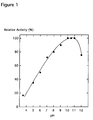
- Fig. 1 is a graph illustrating the relation between the reaction pH and relative activity of the lipase produced by the strain SD705 of this invention;
- Fig. 2 is a graph illustrating the relation between the reaction temperature and relative activity of the lipase produced by the strain SD705 of this invention;
- Fig. 3 is a graph illustrating the remaining activity of the lipase produced by the strain SD705 of this invention treated at various temperatures at
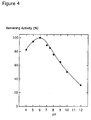
pH 7 for 1 hour; and - Fig. 4 is a graph illustrating the remaining activity of the lipase produced by the strain SD705 of this invention after 1 hour standing at various pH values at 37°C.
- Microorganisms which can be used for producing the lipase of this invention are not limited particularly as far as they can produce the lipase having the properties described hereinbelow and they are bacteria belonging to the genus Pseudomonas having the taxonomic properties described hereinbelow. Such bacteria can be selected from the stored strains or those microorganisms which are newly isolated from the nature. Spontaneous and artificial variants of these bacteria may of course be included by the microorganisms of this invention as far as they have productivity of lipases having the properties described below. Such bacterial strains can be isolated from soils or other sources for isolation by conventional methods. The objective strains can be screened by cultivating microorganisms to be tested in, for example, a conventional cultivation medium for bacteria and determining the activity of lipase in the culture broth under the conditions of high pH and normal temperature by a conventional method.
- An example of the strains which belong to the genus Pseudomonas and produce the novel lipase of this invention is the SD705 strain which the present inventors isolated from the soil of a suburb of Tokyo.
- The SD705 strain has the bacteriological properties shown in Table 1 below. In Table 1 are also described the bacteriological properties of Pseudomonas alcaligenes and of Pseudomonas pseudoalcaligenes which are relatively similar to those of the bacteria of this invention referring to Bergey's Manual of Systematic Bacteriology, 1984.


- As shown in Table 1, the SD705 strain differs from Pseudomonas pseudoalcaligenes in the assimilability of ethanolamine, mesaconic acid, betaine, fructose, and glycerate and from Pseudomonas alcaligenes in the presence or absence of arginine dihydrolase, presence or absence of denitrification, the assimilability of β-hydroxybutyrate while the SD705 strain has lower GC content than both Pseudomonas alcaligenes and Pseudomonas pseudoalcaligenes strains.
- Further, quantitative DNA hybridization was performed on ATCC 909, type strain of Pseudomonas alcaligenes, and ATCC 17440, type strain of Pseudomonas pseudoalcaligenes, according to the teaching of Nippon Saikingaku Zasshi, 45(5), 1990. The results show that the strain SD705 shows less than 30% homology to the type strains. From these results, the strain of this invention was identified to be a novel species close to Pseudomonas alcaligenes belonging to the genus Pseudomonas.
- The strain of this invention was deposited at National Institute of Bioscience and Human-Technology, Agency of Industrial Science and Technology and was assigned accession number FERM P-13781, and transferred to deposition under the international deposition system according to Budapest Treaty on the International Recognition of the Deposit of Microorganisms for the Purposes of Patent Procedure and was assigned accession number FERM BP-4772.
- Variants obtained from the above-described strains as a mother strain by spontaneous or induced mutation can also be used as the lipase producing microorganisms according to this invention.
- Methods for preparing the above-described variants include, for example, conventional methods such as a method comprising spreading the mother strain cells on an agar medium containing an oil such as olive oil without artificial mutation treatment by irradiation with ultraviolet ray or with a chemical such as N-methyl-N'-nitro-N-nitrosoguanidine (NTG) or the like, or after such a treatment, screening from the growing strains those which form larger clear zones around the colonies, and cultivating the screened strains in a lipase production medium, thereby screening the most productive strain.
- The lipase producing microorganisms of this invention preferably are those strains which show 50% or more, more preferably 70% or more, homology to the SD705 strain in DNA hybridization.
- The lipase of this invention is excreted mainly out of the bacterial cells (into the culture medium) by cultivating the lipase producing microorganisms of this invention.
- As nutrient sources for the culture medium, a wide variety of those conventionally used in cultivation can be used. Carbon sources may be assimilable hydrocarbons or materials containing them. For example, there can be used oils and fats, corn steep liquor, Tween surfactants, and so on. Nitrogen sources may be assimilable nitrogen compounds or materials that contain them. For example, there can be used ammonium salts, nitrates, soybean powder, meat extract, corn steep liquor, pharmamedia, and so on. Inorganic salts such as phosphates, e.g., diammonium hydrogenphosphate and dipotassium hydrogenphosphate, magnesium salts, calcium salts, manganese salts, and the like may be added optionally.
- Cultivation conditions may vary more or less depending on the composition of the culture media, which conditions may be those suited for the production of the lipase of this invention. Usually, the following conditions are selected. That is, the culture temperature is in the range of from 10 to 40°C, preferably from 20 to 37°C. The culture time is from about 8 hours to 100 hours, and the cultivation may be completed when the production of the lipase of this invention reached to the maximum level. The pH of the culture medium may be 5 to 12, with pH of 7 to 10 being preferred for the production of the lipase of this invention. By such a cultivation, the objective lipase is produced out of the bacterial cells (into the culture medium).
- Collection of the lipase of this invention obtained in the above-described manner can be separated and purified by conventional methods for collecting lipases.
- More specifically, the lipase of this invention can be obtained by using a single or a combination of a plurality of separation or purification means such as a conventional filtration or centrifugation method in which bacterial cells or solid components of the culture medium are separated from the culture broth to isolate a supernatant or filtrate, with or without concentrating such a separated liquid, a salting out method in which soluble salts are added to the separated liquid to precipitate enzymes, an organic solvent precipitation method in which a hydrophilic organic solvent is added to precipitate enzymes or contaminants, an absorption and desorption method using an ion exchange resin, a gel filtration method, a spraying and drying method with or without adding an stabilization aid, a freezing and drying method, and so on.
- In this invention, measurement of lipase activity was performed using a method in which triolein-polyvinyl alcohol (PVA) emulsion was used as a substrate.
- More specifically, the measurement of activity was carried out in the following manner.
- A mixture of 0.1 ml of an enzyme solution, 0.4 ml of a buffer solution consisting of 1 mM calcium chloride, 100 mM ε-aminocaproic acid, 100 mM bistris(bis[2[hydroxyethyl]iminotris[hydroxymethyl]methane) and 100 mM TAPS (N-tris[hydroxymethyl]methyl-3-aminopropanesulfonic acid), the buffer solution being adjusted to pH 10.0 with sodium hydroxide, and 0.5 ml of triolein emulsion was incubated at 37°C for 10 minutes for reaction in a test tube with a stopper, and the reaction was stopped with 0.2 ml of 1N hydrochloric acid as a reaction stopping agent. The triolein emulsion used was a homogenate of a mixture of 10 ml of an aqueous 2% polyvinyl alcohol (PVA) solution (Poval PVA117 (trade name of Kuraray Co.) : Poval PVA205 (trade name, Kuraray Co.) = 9 : 1 (W/W)) and 2.5 g of triolein. After the reaction was stopped, 2 ml of n-hexane, 2 ml of isopropyl alcohol, and 1 ml of distilled water were added to the reaction mixture and the mixture was stirred vigorously. After standing, the hexane layer was sampled and the amount of oleic acid was determined by the TLC-FID method (Minagawa et al., Lipids, 18, 732 (1983)). The unit of activity was defined such that the amount of the enzyme which produces 1 micro mole of oleic acid for 1 minute was 1 unit (1U).
- The activity of the protease blended with the detergent in the examples described hereinbelow was measured by the measurement method described in Japanese Patent Publication (Kokoku) No. 60-55118 (1985) and the unit of activity was expressed in nanokatal (nkatal = 10-9 katal, abbreviated as "nkat").
- The lipase of this invention has the following properties. That is, the properties of the lipase produced by Pseudomonas sp. SD705, the strain of this invention, will be described below.
- It acts on triglycerides and hydrolyze the esters.
- It hydrolyzes a wide variety of glycerides and esters.
- As the glyceride substrate, emulsion of each glyceride-gum Arabic was used. The emulsion used was a homogenized emulsion of 10 g of a glyceride, 10 g of gum Arabic, and 100 g of distilled water.
- A mixture of 5 ml of the above-described emulsion, 5 ml of 10 mM Tris buffer solution (pH 10.0) containing 100 mM sodium chloride and 25 mM calcium chloride, 4.5 ml of distilled water, and 0.5 ml of an enzyme solution was reacted at 30°C and at
pH 10, and the rate of fatty acid formation was determined by a pH stat titration method with 0.05N sodium hydroxide. The rate of fatty acid formation was taken as a decomposition activity of each substrate. - Assuming the decomposition activity of the lipase for triolein is 100, the lipase showed relative activity of 125 for tributyrin, 55 for olive oil, 70 for Soybean oil, and 66 for cotton seed oil.
- The decomposition activities of the lipase for esters were determined by colorimetry (OD405) of p-nitrophenol produced by hydrolysis reaction at pH 8.0 and at 30°C of p-nitrophenyl fatty acid ester as a substrate.
- Assuming the decomposition activity of pNPP (p-nitrophenyl palmitate) is 100, the lipase showed relative activity of 134 for pNPL (p-nitrophenyl laurate), and 34 for p-NPV (p-nitrophenyl valerate).
- Operating pH and optimum pH were determined by the above-described method for the measurement of activity with triolein emulsion as a substrate. These were measured at different pH values upon reaction ranging from 3.5 to 12.0. As the buffer solution was used a mixed buffer solution consisting of 1.0 mM calcium chloride, 100 mM ε-aminocaproic acid, 100 mM bistris(bis[2-hydroxyethyl]iminotris[hydroxymethyl]methane), and 100 mM TAPS (N-tris[hydroxymethyl]methyl-3-aminopropanesulfonic acid), with the pH of the buffer solution being adjusted with hydrochloric acid or sodium hydroxide. The relation between the reaction pH and relative activity was as shown in Fig. 1. When measured in the range of pH 3.5 to 12, the operating pH was in the range of 3.5 to 12 while the optimum pH was in the range of 10 to 11.
- Operating temperature and optimum temperature were measured in the same manner as the method for measurement of activity described above except that the reactions were performed at different reaction temperatures in the range of from 30°C to 80°C with triolein emulsion as a substrate. The relation between the reaction temperature and relative activity was as shown in Fig. 2. When measured at 30°C to 80°C, the operating temperature was in the range of from 30°C to 80°C while the optimum temperature was in the range of from 55°C to 65°C. At 40°C and 70°C, the relative activity was about 50% of the activity at the optimum temperature.
- Remaining activity after heat retaining treatment at different temperatures in the range of 20°C to 70°C at
pH 7 for 1 hour was measured by the above-described method for the measurement of activity. The relation between the treating temperature and remaining activity was as shown in Fig. 3. By the treatment at 60°C, 80% or more activity remained. The buffer solution used for the treatment was a mixed buffer solution consisting of 50 mM ε-aminocaproic acid, 50 mM bistris(bis[2-hydroxyethyl]iminotris[hydroxymethyl]methane), and 50 mM TAPS (N-tris[hydroxymethyl]methyl-3-aminopropanesulfonic acid), with the pH of the buffer solution being adjusted topH 7 with hydrochloric acid. - The remaining activity was determined by the above-described titration method after being treated at different pH within the range of
pH 4 to 12 at 37°C for 1 hour. The relation between the treating pH and remaining activity was as shown in Fig. 4. By the treatment atpH 4 to 10, 50% or more activity remained. The buffer solution used for the treatment was mixed buffer solution consisting of 0.5mM calcium chloride, 50 mM ε-aminocaproic acid, 50 mM bistris(bis[2-hydroxyethyl]iminotris[hydroxymethyl]methane), and 50 mM TAPS (N-tris[hydroxymethyl]methyl-3-aminopropanesulfonic acid), with the pH of the buffer solution being adjusted with hydrochloric acid or sodium hydroxide. - Molecular weight obtained by SDS-polyacrylamide gel electrophoresis (molecular weight standard: cytochrome C (monomer, dimer, trimer, tetramer, hexamer)) was 31,000 ± 2,000.
- Isoelectric point measured by isoelectric point polyacrylamide gel electrophoresis was 5.2 ± 0.5.
- Activities were measured with toriolein emulsion as a substrate in the same manner as the above-described method for the measurement of activity except that there were added various commercially available detergents (4 kinds) in the standard concentration upon use described below and API-21 (Japanese Patent Publication (Kokoku) No. 60-55118 (1985) in a concentration of 0.3 nkat/ml, the reaction pH was 10, and the reaction time was set to 30 minutes. Assuming the activity without addition of a commercially available detergent and API-21 is 100, relative activities were as shown in Table 2. As shown, the lipase of this invention has high activity in various detergent solutions containing protease.
- The lipase having the above-described properties functions sufficiently even at low temperatures (60°C or lower) and exhibits its activity stably in detergent solutions so that it is preferable as a lipase to be blended with detergents.
- According to this invention, there are provided detergent compositions in which the lipase having the above-described properties is blended. The amount of lipase blended in the detergent compositions of this invention is not limited particularly. Generally, the lipase is blended in proportions of from 100 to 10,000 units, preferably from 500 to 4,000 units, per g of detergent composition. If the blending amount is too small, no sufficient increase in the washing effect can be obtained. On the contrary, if it is too large, an increase in the washing effect relative to the amount of enzyme blended is not high so that it is undesirable from economical viewpoints.
- According to this invention, the above-described lipase can be blended with any known detergent composition without changing the composition of the detergent composition. Therefore, no limitation is posed on the detergent composition which can be used in this invention. Representative example of the detergent composition which can be used in this invention includes a detergent composition which consists of 10 to 50% by weight of a surfactant, 0 to 50% by weight of builders, 1 to 50% by weight of alkali agents or inorganic electrolytes, 0.1 to 5% by weight of at least one blending component selected from the group consisting of antiredeposition agents, enzymes, bleaching agents, fluorescent whitening agents, anticaking agents, and antioxidants, the weight percents being based on the weight of the detergent composition.
- As the surfactant can be used any surfactant that is usually blended with detergents as one of their components. Examples thereof include soaps, for example, aliphatic sulfates such as straight or branched chain alkyl or alkenyl sulfates, amide sulfates, alkyl or alkenyl ether sulfates having a straight or branched chain alkyl or alkenyl group to which one or more of ethylene oxide, propylene oxide and butylene oxide added, aliphatic sulfonates such as alkyl sulfonates, amide sulfonates, dialkyl sulfosuccinates, sulfonates of α-olefins, of vinylidene-type olefins and of internal olefins, aromatic sulfonates such as straight or branched chain alkylbenzenesulfonates, alkyl or alkenyl ether carbonates or amides having a straight or branched chain alkyl or alkenyl group to which one or more of ethylene oxide, propylene oxide and butylene oxide added, or amides, α-sulfo-fatty acid salts or esters, amino acid type surfactants, phosphate surfactants such as alkyl or alkenyl acidic phosphates, and alkyl or alkenyl phosphates, sulfonic acid type amphoteric surfactants, betaine type amphoteric surfactants, alkyl or alkenyl ethers or alcohols having a straight or branched chain alkyl or alkenyl group to which one or more of ethylene oxide, propylene oxide and butylene oxide added, polyoxyethylenealkyl phenyl ethers having a straight or branched chain alkyl group to which one or more of ethylene oxide, propylene oxide and butylene oxide added, higher fatty acid alkanolamides or alkylene oxide adducts thereof, sucrose fatty acid esters, fatty acid glycerol monoesters, alkyl- or alkenylamine oxides, tetraalkylammonium salt type cationic surfactants and so on. In the case of anionic surfactants, the counter ions are preferably sodium ions or potassium ions. These surfactants are used singly or as mixtures of two or more of them.
- The builder and alkali agents or inorganic electrolytes which can be used include phosphates such as orthophosphates, pyrophosphates, tripolyphosphates, metaphosphates, hexametaphosphates, and phytates, phosphonates such as ethane-1,1-diphosphonic acid, ethane-1,1,2-triphosphonic acid, ethane-1-hydroxy-1,1-diphosphonic acid and derivatives thereof, ethanehydroxy-1,1,2-triphosphonic acid, ethane-1,2-dicarboxy-1,2-diphosphonic acid, and methanehydroxyphosphonic acid, phosphonocarboxylates such as salts of 2-phosphonobutane-1,2-dicarboxylic acid, 1-phosphonobutane-2,3,4-tricarboxylic acid, and α-methylphosphonosuccinic acid, amino acid salts such as aspartic acid and glutamic acid, aminopolyacetates such as nitrilotriacetates, ethylenediaminetetraacetates, and diethylenetriaminepentaacetates, high molecular weight electrolytes such as polyacrylic acid, polyitaconic acid, polymaleic acid, maleic anhydride copolymers, and carboxymethylcellulose salts, nondissociated high polymer molecules such as polyethylene glycol, and polyvinyl alcohol, organic acid salts such as salts of diglycolic acid, oxydisuccinic acid, carboxymethyl-oxysuccinic acid, citric acid, lactic acid, tartaric acid, carboxymethylates of sucrose, lactose, etc., carboxymethylate of pentaerythritol, carboxymethylate of gluconate, benzenepolycarboxylic acid, oxalic acid, malic acid, oxydisuccinic acid, gluconic acid and so on, as well as inorganic acid salts such as aluminosilcates such as zeolite, alkali metal salts such as inorganic salts, e.g., carbonates, sesquicarbonates, sulfates, metasilicates, etc. Also, there can be used organic substances such as starch and urea and inorganic compounds such as sodium chloride and bentonite. Furthermore, as the organic alkali agent, there can be used triethanolamine, diethanolamine, monoethanolamine, triisopropanolamine, etc.
- As described above, the detergent compositions of this invention contain as essential components surfactants, lipases, alkali agents, or inorganic electrolytes and optional components, for example, amphoteric surfactants, bleaching agents such as sodium percarbonates and sodium perborates, dyes, builders, antiredeposition agents such as polyethylene glycol, polyvinyl alcohol, polyvinyl pyrrolidone, and carboxymethylcellulose, anticaking agents, antioxidants, other enzymes such as protease as needed.
- Lipase and other enzymes such as protease may be blended with the detergent compositions of this invention in any method. However, blending them in a state of fine powder is not preferred due to dusting when detergents are handled by users and operators in detergent industries from the viewpoints of safety and hygiene. It is thus preferred that the enzymes be in the form of solutions or molded into shapes which could minimize dusting in advance. The molding can be performed by any of conventionally used methods such as rounding granulation, extrusion granulation, flow granulation, centrifuge granulation or the like. However, the shape of the lipases and other enzymes such as protease to be blended with the detergent compositions of this invention is not limited to those molded by these methods.
- Next, this invention will be described with reference to examples. However, this invention should not be construed as being limited to the following examples. In the following description, all % are by weight unless otherwise indicated.
- A liquid culture medium (2 ml) containing in concentrations 2% of soybean powder, 0.1% of diammonium hydrogen phosphate, 1% of olive oil, 0.5% of dipotassium hydrogen phosphate, 0.1% of magnesium sulfate heptahydrate, and 0.3% of sodium carbonate was put into a test tube of 18 mm in diameter and sterilized with an autoclave at 121°C for 20 minutes. Then, a loopful of Pseudomonas sp. SD705 strain was inoculated in the medium and incubated at 35°C for 24 hours and at 130 rpm. After the incubation, the bacterial cells were removed by centrifugation to obtain a lipase solution. The solution had a lipase activity of 5U/ml.
- A liquid culture medium (2 liters) containing in concentrations 2% of soybean powder, 0.1% of diammonium hydrogen phosphate, 0.5% of dipotassium hydrogen phosphate, 0.1% of magnesium sulfate heptahydrate, 0.3% of sodium carbonate, and 1.0% of Tween 85 was put into a 5 liter jar fermenter and sterilized with an autoclave at 121°C for 20 minutes. Then, Pseudomonas sp. SD705 strain was inoculated in the medium and incubated at 35°C for 24 hours, with stirring at 1000 rpm and under aeration. After the incubation, the bacterial cells were removed by centrifugation to obtain a lipase solution. The solution had a lipase activity of 20U/ml.
- The lipase solution was subjected to a ammonium sulfate precipitation method to obtain precipitates of 20 to 40% saturation fraction. The precipitate were desalted and then freeze-dried to obtain powder of lipase.
- The powder of lipase obtained in Example 2 was dissolved in a 10% saturated ammonium sulfate solution and chromatographed by hydrophobic chromatography with Butyl-Toyopearl 650M (trade name, Tosoh Ltd.) to obtain active fractions. The active fractions were dialyzed through 10 mM Tris-hydrochloric acid buffer (pH 8) containing 0.3 mM calcium chloride and adsorbed on ion exchange chromatographic resin (DEAE-Cellulofine A-800, trade name, Seikagaku Kogyo Co., Ltd.) equilibrated with the same buffer as above, followed by elution with sodium chloride gradient to obtain active fractions. These were desalted and then freeze-dried to obtain purified enzyme.
- The freeze-dried preparation was confirmed to be unique by SDS polyacrylamide gel electrophoresis.
- The activity in detergent solutions of the raw powder of lipase obtained in Example 2 were measured and the results were compared with the results of measurements of the activities in detergent solutions of the lipase SD2 produced by Pseudomonas alcaligenes SD2 strain (ATCC 53877) described in U.S. Patent 5,069,810, and the activities in detergent solutions of the lipases produced by Pseudomonas pseudoalcaligenes CBS 467.85 strain, CBS 468.85 strain, CBS 471.85 strain, and CBS 473.85 strain. As the enzyme of Pseudomonas alcaligenes SD2 was used a supernatant of the culture broth obtained by cultivating the strain in a culture medium containing 0.5% ammonium sulfate, 0.05% dipotassium hydrogenphosphate, 0.025% of magnesium sulfate heptahydrate, 2.0% tryptone, 1.0 mM polyoxyethylene (20) cetyl ether at 30°C for 16 hours followed by centrifugation. As the enzymes of the above-described four Pseudomonas pseudoalcaligenes strains were used supernatants obtained by cultivating the respective strains in a culture medium containing 10% skimmed milk,
pH 7, at 20°C for 48 hours followed by centrifugation. - The activities of the enzymes were measured in the same manner as the above-described method for the measurement of activities using a triolein emulsion as a substrate except that various commercial detergents (4 kinds) in a standard use concentration and API-21 (Japanese Patent Publication (Kokoku) No. 60-55118), representative alkaline protease for detergents, in a concentration of 0.3 nkat/ml were added, the reaction pH was set to 10, and the reaction time was set to 30 minutes.
- The commercially available detergents used included Attack (trade name, produced by Kao Ltd.; an anionic surfactant based detergent containing linear alkylbenzenesulfonate sodium salt, sodium alkylsulfate, and polyoxyethylene alkyl ether), Ultra Ariel (trade name, produced by Procter and Gamble Far East Co.; an anionic surfactant based detergent containing linear alkylbenzenesulfonic acid sodium salt, sodium alkylsulfate, sodium alkanoyloxybenzenesulfonate and polyoxyethylene alkyl ether), Ultra Tide (trade name, produced by Procter and Gamble Co.; an anionic surfactant based detergent), and Fresh Start (trade name, Colgate-Palmolive Co.; a nonionic surfactant based detergent). The detergents were added in a standard use concentration so that there were, in final concentrations, 833 ppm of Attack, 1,000 ppm of Ultra-Ariel, 1,000 ppm of Ultra Tide, and 624 ppm of Fresh Start.
- Assuming the activity of the detergent without adding commercially available detergents and API-21 is 100, relative activities are shown in Table 2.
Table 2 Activity in detergent solutions (%) Enzyme producing strain No detergent Detergent Attack Ultra Ariel Ultra Tide Fresh Start SD705 100 78 84 57 98 ATCC 53877 100 31 29 33 80 CBS 467.85 100 17 18 29 102 CBS 468.85 100 54 50 55 62 CBS 471.85 100 20 16 35 85 CBS 473.85 100 50 49 40 95 - Table 2 shows that the lipase of this invention exhibits higher activity than the other lipases in the detergent solutions.
- Among the other lipases, there are some which show relative activities equivalent to that of the lipase of this invention. However, their relative activities decrease significantly for different kinds of detergents (enzymes derived from CBS 467.85 and CBS 468.85). On the contrary, the lipase of this invention has the feature that it shows high relative activity regardless of the kind of detergent.
- A detergent composition containing the lipase of this invention was prepared by blending 2400 units/g of the powder of lipase obtained in Example 2 with Attack, a commercially available detergent.
- Evaluation of washing was performed as follows. That is, soiled test cloths were used which were degreased cotton cloth (15 cm x 15 cm) spotted with 70 mg of triolein dissolved in benzene and dried overnight at room temperature. The washing apparatus used was Terg-O-Tometer. In 1 liter of distilled water containing calcium chloride in a final concentration of 50 ppm were dissolved the above-described lipase-blended detergent composition and Attack, commercially available detergent, each in a standard use concentration. In the case of the former, the concentration of lipase in the solution was 2 units/ml. Further, protease API-21 (Japanese Patent Publication (Kokoku) No. 60-55448 (1985)) was added in a concentration of 0.3 nkat/ml. Six pieces of the triolein-contaminated cloth per liter of the washing solution were placed in the detergent solution and washing was performed at a washing temperature of 30°C at 120 rpm for 30 minutes. After the washing, the cloth pieces were rinsed twice, each for 3 minutes with 1 liter of the above-described calcium-added distilled water, followed by drying at room temperature. The amount of triolein on unwashed and washed cloth pieces was determined by the above described TLC-FID method after extraction of triolein with n-hexane. Washing efficiencies were obtained according to the following formula.

Table 3 Evaluation of Washing Addition of lipase of this invention No addition of lipase Washing efficiency (%) 78.4 68.5 - As shown in Table 3, washing with the detergent containing the lipase of this invention gave rise to higher washing efficiency than washing with the detergent containing no such lipase.
- Three kinds of detergent compositions were prepared. That is, a lipase-blended detergent composition consisting of All (Lever Brothers Co., trade name) and 2,400 units/g of the powder of lipase obtained in Example 2, protease-blended detergent composition consisting of All and 270 nkat/g of the powder of Protease API-21 (Japanese Patent Publication (Kokoku) No. 60-55448 (1985)), and lipase/protease-blended detergent composition consisting of All and 2,400 units/g of the powder of lipase obtained in Example 2 and powder of Protease API-21 in an amount of 270 nkat/g were prepared.
- Evaluation of washing was performed as follows That is, soiled test cloths were used which were commercially available soiled test cloth EMPA 112. The washing apparatus used was Terg-O-Tometer. In 1 liter of distilled water containing calcium chloride in a final concentration of 50 ppm were dissolved each of the above-described detergent compositions and All, commercially available detergent, each in a standard use concentration (final concentration of 1100 ppm). In the case of the lipase-blended detergent composition, the concentration of lipase in the solution was 2.6 units/ml. In the case of protease-blended detergent composition, the concentration of protease in the solution was 0.3 nkat/ml. Six pieces of the described soiled test cloth per liter of the washing solution were placed in the detergent solution and washing was performed at a washing temperature of 30°C at 120 rpm for 30 minutes. After the washing, the cloth pieces were rinsed twice, each for 3 minutes with 1 liter of the above-described calcium-added distilled water, followed by drying at room temperature. The reflectivity (460 nm) of the soiled test cloth pieces was measured. Effect of addition of enzymes to washing was expressed in terms of difference between the reflectivity obtained by washing with the enzyme-blended detergent compositions and that of the detergent without addition of such an enzyme. Table 4 shows the results obtained.
Table 4 Evaluation of Washing Detergent Composition Effect of addition of enzyme Lipase-blended 8.2 Protease-blended 9.8 Lipase/protease-blended 15.6 - In washing with the detergent containing the lipase of this invention gave rise to higher washing effect than washing with the detergent containing no such lipase regardless of whether protease is added or not.
- The lipase of this invention retains high stability and high activity in solutions of various commercially available detergents and in copresence of detergent components such as surfactants, protease and so on and, hence, it can decompose and remove fat and oil efficiently under washing conditions so that it can enhance the washing power of detergents when blended therewith.
- Pseudomonas sp. SD705 strain and bacteriological equivalents thereof, and variants of these strains according to this invention are useful for producing the lipase of this invention efficiently.
- Furthermore, the method of producing the lipase having the above-described properties by the use of such bacterial strains according to this invention is advantageous in that the lipase can be produced efficiently.
- Blending the lipase of this invention with detergents provides detergent compositions having excellent washing characteristics.
- Also, blending the lipase of this invention together with other enzymes with detergents provides detergent compositions having excellent washing characteristics.
Claims (8)
- A lipase having the following properties:(1) Operating pH and optimum pH
an operating pH is in the range of from 3.5 to 12 and an optimum pH is in the range of from 10 to 11 when measured at a pH in the range of from 3.5 to 12 using a triolein emulsion as a substrate;(2) Operating temperature and optimum temperature
an operating temperature is in the range of from 30°C to 80°C and an optimum temperature is in the range of from 55°C to 65°C when measured at a temperature in the range of 30°C to 80°C using the triolein emulsion as a substrate;(3) Molecular weight
a molecular weight measured by SDS-polyacrylamide gel electrophoresis is 31,000 ± 2,000; and(4) Isoelectric point
an isoelectric point measured by isoelectric point polyacrylamide gel electrophoresis is 5.2 ± 0.5. - The lipase as claimed in claim 1, wherein said lipase is obtained from a culture broth of a bacterium belonging to the genus Pseudomonas.
- The lipase as claimed in claim 1, wherein said lipase is obtained from a culture broth of Pseudomonas sp. SD705 strain (FERM BP-4772), bacteriological equivalents thereof, or variants of the strain and bacteriological equivalents thereof.
- A bacteria belonging to the genus Pseudomonas which produces the lipase described in claim 1, bacteriological equivalents thereof, and variants of the bacteria or bacteriological equivalents thereof.
- Pseudomonas sp. SD705 strain (FERM BP-4772) which produces the lipase described in claim 1, bacteriological equivalents thereof or variants of the strain and equivalents thereof.
- A method of producing a lipase comprising the steps of:
cultivating the bacteria, bacteriological equivalents thereof or variants of the bacteria and bacteriological equivalents thereof as claimed in claim 4 or 5; and
recovering the lipase as claimed in claim 1 from a culture broth of the bacteria, the bacteriological equivalents or the variants. - A detergent composition comprising the lipase as claimed in any of claims 1 to 3.
- A detergent composition comprising the lipase as claimed in any of claims 1 to 3 and one or more other enzymes.
Applications Claiming Priority (3)
| Application Number | Priority Date | Filing Date | Title |
|---|---|---|---|
| JP5214506A JP2859520B2 (en) | 1993-08-30 | 1993-08-30 | Lipase, microorganism producing the same, method for producing lipase, and detergent composition containing lipase |
| JP214506/93 | 1993-08-30 | ||
| PCT/JP1994/001416 WO1995006720A1 (en) | 1993-08-30 | 1994-08-26 | Novel lipase, microorganism producing the lipase, process for producing the lipase, and use of the lipase |
Publications (2)
| Publication Number | Publication Date |
|---|---|
| EP0721981A1 true EP0721981A1 (en) | 1996-07-17 |
| EP0721981A4 EP0721981A4 (en) | 2002-07-31 |
Family
ID=16656848
Family Applications (1)
| Application Number | Title | Priority Date | Filing Date |
|---|---|---|---|
| EP94925013A Withdrawn EP0721981A4 (en) | 1993-08-30 | 1994-08-26 | NOVEL LIPASE, MICROORGANISM PRODUCING THE SAME, PROCESS FOR PRODUCING THE LIPASE, AND USE OF THE SAME |
Country Status (7)
| Country | Link |
|---|---|
| US (1) | US5827718A (en) |
| EP (1) | EP0721981A4 (en) |
| JP (1) | JP2859520B2 (en) |
| CN (1) | CN1072718C (en) |
| AU (1) | AU7508794A (en) |
| FI (1) | FI960949L (en) |
| WO (1) | WO1995006720A1 (en) |
Cited By (11)
| Publication number | Priority date | Publication date | Assignee | Title |
|---|---|---|---|---|
| WO2004053039A2 (en) | 2002-12-11 | 2004-06-24 | Novozymes A/S | Detergent composition comprising endo-glucanase |
| WO2004074419A3 (en) * | 2003-02-18 | 2004-11-11 | Novozymes As | Detergent compositions |
| WO2005042735A1 (en) | 2003-10-30 | 2005-05-12 | Novozymes A/S | Carbohydrate-binding modules of a new family |
| EP2113563A2 (en) | 1998-11-27 | 2009-11-04 | Novozymes A/S | Lipolytic enzyme variants |
| WO2011080267A2 (en) | 2009-12-29 | 2011-07-07 | Novozymes A/S | Polypetides having detergency enhancing effect |
| WO2011104339A1 (en) | 2010-02-25 | 2011-09-01 | Novozymes A/S | Variants of a lysozyme and polynucleotides encoding same |
| WO2012028483A1 (en) | 2010-08-30 | 2012-03-08 | Novozymes A/S | A concentrated soak wash |
| WO2012028482A1 (en) | 2010-08-30 | 2012-03-08 | Novozymes A/S | A two-soak wash |
| WO2012035103A1 (en) | 2010-09-16 | 2012-03-22 | Novozymes A/S | Lysozymes |
| US9303254B2 (en) | 2008-04-30 | 2016-04-05 | Danisco Us Inc. | Chimeric alpha-amylase variants |
| US10760036B2 (en) | 2014-12-15 | 2020-09-01 | Henkel Ag & Co. Kgaa | Detergent composition comprising subtilase variants |
Families Citing this family (732)
| Publication number | Priority date | Publication date | Assignee | Title |
|---|---|---|---|---|
| JPH08228778A (en) * | 1995-02-27 | 1996-09-10 | Showa Denko Kk | Novel lipase gene and method for producing lipase using the same |
| JPH08238088A (en) * | 1995-03-06 | 1996-09-17 | Showa Denko Kk | Lipase having high activity at high temperature |
| US6936289B2 (en) | 1995-06-07 | 2005-08-30 | Danisco A/S | Method of improving the properties of a flour dough, a flour dough improving composition and improved food products |
| JPH09275977A (en) * | 1996-04-18 | 1997-10-28 | Novo Nordisk As | Novel lipase and detergent composition |
| WO1998017790A1 (en) * | 1996-10-17 | 1998-04-30 | Novo Nordisk A/S | Lipase, process for producing the same, microorganism producing the same, and use of the lipase |
| EP1433852B1 (en) | 1997-04-09 | 2006-06-28 | Danisco A/S | Use of lipase for improving doughs and baked products |
| US6156552A (en) * | 1998-02-18 | 2000-12-05 | Novo Nordisk A/S | Lipase variants |
| DK1098988T4 (en) | 1998-07-21 | 2007-09-03 | Danisco | Food |
| ATE504651T1 (en) | 1998-12-18 | 2011-04-15 | Novozymes As | SUBTILASE ENZYMES OF THE I-S1 AND I-S2 SUBGROUPS WITH AN ADDITIONAL AMINO ACID RESIDUE IN AN ACTIVE LOOP REGION |
| ES2532606T3 (en) | 1999-03-31 | 2015-03-30 | Novozymes A/S | Polypeptides with alkaline alpha-amylase activity and nucleic acids encoding them |
| WO2000060058A2 (en) | 1999-03-31 | 2000-10-12 | Novozymes A/S | Polypeptides having alkaline alpha-amylase activity and nucleic acids encoding same |
| WO2000071691A1 (en) | 1999-05-20 | 2000-11-30 | Novozymes A/S | Subtilase enzymes of the i-s1 and i-s2 sub-groups having at least one additional amino acid residue between positions 125 and 126 |
| EP1183341B2 (en) | 1999-05-20 | 2012-05-02 | Novozymes A/S | Subtilase enzymes of the i-s1 and i-s2 sub-groups having at least one additional amino acid residue between positions 127 and 128 |
| AU4392700A (en) | 1999-05-20 | 2000-12-12 | Novozymes A/S | Subtilase enzymes of the i-s1 and i-s2 sub-groups having at least one additionalamino acid residue between positions 129 and 130 |
| EP1183337B1 (en) | 1999-05-20 | 2008-09-17 | Novozymes A/S | Subtilase enzymes of the i-s1 and i-s2 sub-groups having at least one additional amino acid residue between positions 132 and 133 |
| WO2000071690A1 (en) | 1999-05-20 | 2000-11-30 | Novozymes A/S | Subtilase enzymes of the i-s1 and i-s2 sub-groups having at least one additional amino acid residue between positions 128 and 129 |
| AU4392800A (en) | 1999-05-20 | 2000-12-12 | Novozymes A/S | Subtilase enzymes of the i-s1 and i-s2 sub-groups having at least one additionalamino acid residue between positions 126 and 127 |
| NZ517409A (en) | 1999-08-31 | 2004-05-28 | Novozymes As | RP-II properties with amino acid substitutions used in detergent compositions and additives |
| WO2002016547A2 (en) | 2000-08-21 | 2002-02-28 | Novozymes A/S | Subtilase enzymes |
| WO2002031133A1 (en) | 2000-10-13 | 2002-04-18 | Novozymes A/S | Subtilase variants |
| EP1975229A3 (en) | 2000-10-13 | 2009-03-18 | Novozymes A/S | Alpha-amylase variant with altered properties |
| US7498158B2 (en) | 2001-05-15 | 2009-03-03 | Novozymes A/S | Alpha-amylase variant with altered properties |
| NZ528260A (en) | 2001-05-18 | 2005-09-30 | Danisco | Method of improving dough and bread quality with the addition of an enzyme that hydrolyses a glycolipid and a phospholipid and incapable of hydrolysing a triglyceride or monoglyceride |
| DK2277997T3 (en) | 2001-06-26 | 2013-12-02 | Novozymes As | Polypeptides with cellobiohydrolase I activity and the same coding polynucleotides |
| DK200101090A (en) | 2001-07-12 | 2001-08-16 | Novozymes As | Subtilase variants |
| MXPA04008031A (en) * | 2002-02-19 | 2004-11-26 | Procter & Gamble | Novel fungal lipase. |
| AU2003214037A1 (en) | 2002-03-27 | 2003-10-08 | Novozymes A/S | Granules with filamentous coatings |
| ATE420161T1 (en) | 2002-07-01 | 2009-01-15 | Novozymes As | MONOPROPYLENE GLYCOL AS A FERMENTATION ADDITIVE |
| EP1549745B1 (en) | 2002-10-01 | 2011-01-05 | Novozymes A/S | Family gh 61 polypeptides |
| WO2004033482A2 (en) | 2002-10-08 | 2004-04-22 | Genencor International, Inc. | Phenolic binding peptides |
| TWI319007B (en) | 2002-11-06 | 2010-01-01 | Novozymes As | Subtilase variants |
| US7348168B2 (en) | 2002-12-20 | 2008-03-25 | Novozymes A/S | Polypeptides having cellobiohydrolase II activity and polynucleotides encoding same |
| MXPA05007654A (en) | 2003-01-17 | 2005-09-30 | Danisco | Method. |
| US20050196766A1 (en) | 2003-12-24 | 2005-09-08 | Soe Jorn B. | Proteins |
| US7955814B2 (en) | 2003-01-17 | 2011-06-07 | Danisco A/S | Method |
| DE602004026032D1 (en) | 2003-01-27 | 2010-04-29 | Novozymes As | ENZYME STABILIZATION |
| EP2853593B1 (en) | 2003-03-07 | 2017-10-04 | DSM IP Assets B.V. | Hydrolases, nucleic acids encoding them and mehods for making and using them |
| DK2228440T3 (en) | 2003-05-02 | 2013-01-02 | Novozymes Inc | Variants of beta-glucosidases |
| DE602004027376D1 (en) | 2003-06-19 | 2010-07-08 | Novozymes As | PROTEASE |
| AU2004252572B2 (en) | 2003-06-25 | 2011-09-08 | Novozymes A/S | Polypeptides having alpha-amylase activity and polypeptides encoding same |
| EP2377931B1 (en) | 2003-08-25 | 2013-05-08 | Novozymes Inc. | Variants of glycoside hydrolases |
| EP2284259A3 (en) | 2003-10-10 | 2011-06-15 | Novozymes A/S | Protease variants |
| WO2005040372A1 (en) | 2003-10-23 | 2005-05-06 | Novozymes A/S | Protease with improved stability in detergents |
| EP1682656B1 (en) | 2003-10-28 | 2013-09-18 | Novozymes Inc. | Polypeptides having beta-glucosidase activity and polynucleotides encoding same |
| US7906307B2 (en) | 2003-12-24 | 2011-03-15 | Danisco A/S | Variant lipid acyltransferases and methods of making |
| US7718408B2 (en) | 2003-12-24 | 2010-05-18 | Danisco A/S | Method |
| GB0716126D0 (en) | 2007-08-17 | 2007-09-26 | Danisco | Process |
| WO2005066339A2 (en) | 2004-01-06 | 2005-07-21 | Novozymes A/S | Polypeptides of alicyclobacillus sp. |
| ES2468366T3 (en) | 2004-01-30 | 2014-06-16 | Novozymes Inc. | Polypeptides with cellulolytic enhancement activity and polynucleotides that encode them |
| EP2305821A3 (en) | 2004-02-13 | 2011-04-13 | Novozymes A/S | Protease variants |
| GB0405637D0 (en) | 2004-03-12 | 2004-04-21 | Danisco | Protein |
| US7148404B2 (en) | 2004-05-04 | 2006-12-12 | Novozymes A/S | Antimicrobial polypeptides |
| CA2591858C (en) | 2004-06-21 | 2015-05-05 | Novozymes A/S | Proteases derived from norcardiopsis |
| EP3620523A3 (en) | 2004-07-05 | 2020-08-19 | Novozymes A/S | Alpha-amylase variants with altered properties |
| EA014985B1 (en) | 2004-07-16 | 2011-04-29 | Даниско А/С | A process of enzymatic degumming edible oils by hydration and use lipid acyltransferase for carrying out the process |
| DK1794296T3 (en) | 2004-09-21 | 2012-07-30 | Novozymes As | subtilases |
| ATE499439T1 (en) | 2004-09-21 | 2011-03-15 | Novozymes As | SUBTILATE |
| EP1794295B1 (en) | 2004-09-21 | 2011-11-16 | Novozymes A/S | Subtilases |
| EP2298872A3 (en) | 2004-09-30 | 2011-08-10 | Novozymes A/S | Polypeptides having lipase activity and polynucleotides encoding same |
| EP1877551B2 (en) | 2005-04-27 | 2014-02-26 | Novozymes, Inc. | Polypeptides having endoglucanase activity and polynucleotides encoding same |
| CN100419126C (en) * | 2005-06-16 | 2008-09-17 | 广州天至环保科技有限公司 | A kind of biological degreaser applied to the pretreatment of metal processing industry for degreasing and degreasing and its method for treating oil stains on metal surfaces |
| ATE529505T1 (en) | 2005-07-08 | 2011-11-15 | Novozymes As | SUBTLE VARIANTS |
| CN101243182B (en) | 2005-08-16 | 2014-08-06 | 诺维信公司 | Subtilases |
| WO2007019859A2 (en) | 2005-08-16 | 2007-02-22 | Novozymes A/S | Polypeptides of strain bacillus sp. p203 |
| EP2385110A3 (en) | 2005-09-30 | 2011-11-16 | Novozymes, Inc. | Methods for enhancing the degradation or conversion of cellulosic material |
| US9303256B2 (en) | 2005-09-30 | 2016-04-05 | Novozymes A/S | Immobilization of enzymes |
| WO2007053619A2 (en) * | 2005-11-01 | 2007-05-10 | Bio-Cat, Inc. | A composition with a fungal (yeast) lipase and method for treating lipid malabsorption in cystic fibrous as well as people suffering from pancreatic lipase insufficiency |
| US20070191248A1 (en) * | 2006-01-23 | 2007-08-16 | Souter Philip F | Detergent compositions |
| US20070179074A1 (en) * | 2006-01-23 | 2007-08-02 | Souter Philip F | Detergent compositions |
| EP2216403A3 (en) | 2006-02-02 | 2010-11-24 | Verenium Corporation | Esterases and related nucleic acids and methods |
| WO2007098756A1 (en) | 2006-03-02 | 2007-09-07 | Novozymes A/S | High capacity encapsulation process |
| EP1998793A1 (en) | 2006-03-22 | 2008-12-10 | Novozymes A/S | Use of polypeptides having antimicrobial activity |
| EP2383330A1 (en) | 2006-03-31 | 2011-11-02 | Novozymes A/S | A stabilized liquid enzyme composition |
| US20100029538A1 (en) | 2006-04-14 | 2010-02-04 | Anna-Liisa Auterinen | One-Step Treatment of Textiles |
| US8546106B2 (en) | 2006-07-21 | 2013-10-01 | Novozymes, Inc. | Methods of increasing secretion of polypeptides having biological activity |
| US8383097B2 (en) | 2006-08-11 | 2013-02-26 | Novozymes Biologicals, Inc | Bacteria cultures and compositions comprising bacteria cultures |
| MX2009003070A (en) | 2006-09-22 | 2009-04-02 | Danisco Us Inc Genencor Div | Novel pectate lyase and method of use for bio-scouring. |
| ES2419234T5 (en) | 2006-10-06 | 2017-05-05 | Novozymes A/S | Detergent compositions and use of enzyme combinations in them |
| BRPI0722093A2 (en) | 2006-12-21 | 2014-04-01 | Danisco Us Inc Genencor Div | COMPOSITIONS AND USES FOR A BACILLUS ALPHA AMILASE POLYPEPTIDE 195 |
| AU2007344910B2 (en) | 2007-01-25 | 2013-03-28 | Dupont Nutrition Biosciences Aps | Production of a lipid acyltransferase from transformed Bacillus licheniformis cells |
| WO2008112459A2 (en) | 2007-03-09 | 2008-09-18 | Danisco Us Inc., Genencor Division | Alkaliphilic bacillus species a-amylase variants, compositions comprising a-amylase variants, and methods of use |
| JP5427041B2 (en) | 2007-03-23 | 2014-02-26 | ノボザイムス バイオロジカルズ,インコーポレイティド | Prevention and reduction of biofilm formation and plankton-like growth |
| DE102007016139A1 (en) | 2007-03-30 | 2008-10-02 | Jenabios Gmbh | Method for regioselective oxygenation of N-heterocycles |
| US20090023624A1 (en) * | 2007-07-06 | 2009-01-22 | Xiaomei Niu | Detergent compositions |
| DE102007047433A1 (en) | 2007-10-04 | 2009-04-09 | Lanxess Deutschland Gmbh | Liquid washing and liquid cleaning agents |
| EP2215110B1 (en) | 2007-11-05 | 2025-07-16 | Danisco US Inc. | Alpha-amylase variants with altered properties |
| JP5520828B2 (en) | 2007-11-05 | 2014-06-11 | ダニスコ・ユーエス・インク | Bacillus sp. TS-23 alpha-amylase variants with altered characteristics |
| CA2713582C (en) | 2008-02-04 | 2017-02-21 | Danisco Us Inc. | Ts23 alpha-amylase variants with altered properties |
| EP2247720A2 (en) * | 2008-02-29 | 2010-11-10 | The Procter & Gamble Company | Detergent composition comprising lipase |
| BRPI0909707A2 (en) * | 2008-02-29 | 2015-08-25 | Procter & Gamble | Detergent composition comprising lipase. |
| JP5560266B2 (en) * | 2008-06-06 | 2014-07-23 | ダニスコ・ユーエス・インク | Production of glucose from starch using alpha-amylase from B. subtilis |
| WO2009149283A1 (en) | 2008-06-06 | 2009-12-10 | Danisco Us Inc. | Saccharification enzyme composition |
| WO2009149130A2 (en) | 2008-06-06 | 2009-12-10 | Danisco Us Inc. | Geobacillus stearothermophilus alpha-amylase (amys) variants with improved properties |
| WO2009149419A2 (en) * | 2008-06-06 | 2009-12-10 | Danisco Us Inc. | Variant alpha-amylases from bacillus subtilis and methods of use, thereof |
| EP2149786A1 (en) | 2008-08-01 | 2010-02-03 | Unilever PLC | Improvements relating to detergent analysis |
| US8198062B2 (en) | 2008-08-29 | 2012-06-12 | Dsm Ip Assets B.V. | Hydrolases, nucleic acids encoding them and methods for making and using them |
| US8153391B2 (en) | 2008-08-29 | 2012-04-10 | Bunge Oils, Inc. | Hydrolases, nucleic acids encoding them and methods for making and using them |
| US8357503B2 (en) | 2008-08-29 | 2013-01-22 | Bunge Oils, Inc. | Hydrolases, nucleic acids encoding them and methods for making and using them |
| CN202181298U (en) | 2008-09-12 | 2012-04-04 | 荷兰联合利华有限公司 | Dispenser and preconditioner for viscous liquids |
| EP2337837B2 (en) | 2008-09-25 | 2016-10-26 | Danisco US Inc. | Alpha-amylase blends and methods for using said blends |
| ES2667812T3 (en) | 2008-11-20 | 2018-05-14 | Novozymes Inc. | Polypeptides having amylolytic enhancing activity and polynucleotides encoding them |
| WO2010065830A1 (en) | 2008-12-04 | 2010-06-10 | Novozymes, Inc. | Polypeptides having cellulolytic enhancing activity and polynucleotides encoding same |
| US20110296557A1 (en) | 2008-12-12 | 2011-12-01 | Novozymes, Inc. | Polypeptides Having Lipase Activity And Polynucleotides Encoding Same |
| EP2202290A1 (en) | 2008-12-23 | 2010-06-30 | Unilever PLC | A flowable laundry composition and packaging therefor |
| EP2213723A1 (en) | 2009-01-30 | 2010-08-04 | Novozymes A/S | Isomaltose for fungus fermentation |
| EP2401371A1 (en) | 2009-02-27 | 2012-01-04 | Novozymes A/S | Mutant cells having reduced expression of metallopeptidase, suitable for recombinant polypeptide production |
| US20120172275A1 (en) | 2009-03-10 | 2012-07-05 | Danisco Us Inc. | Bacillus Megaterium Strain DSM90-Related Alpha-Amylases, and Methods of Use, Thereof |
| US8293697B2 (en) | 2009-03-18 | 2012-10-23 | The Procter & Gamble Company | Structured fluid detergent compositions comprising dibenzylidene sorbitol acetal derivatives |
| US8153574B2 (en) | 2009-03-18 | 2012-04-10 | The Procter & Gamble Company | Structured fluid detergent compositions comprising dibenzylidene polyol acetal derivatives and detersive enzymes |
| CA2757343A1 (en) | 2009-04-01 | 2010-10-07 | Danisco Us Inc. | Compositions and methods comprising alpha-amylase variants with altered properties |
| US8877479B2 (en) | 2009-04-08 | 2014-11-04 | Danisco Us Inc. | Halomonas strain WDG195-related alpha-amylases, and methods of use, thereof |
| BRPI1011411A2 (en) | 2009-05-05 | 2016-03-15 | Unilever Nv | fabric wash treatment composition, and domestic method of treatment of fabrics |
| EP2451919A1 (en) | 2009-07-09 | 2012-05-16 | The Procter & Gamble Company | Method of laundering fabric using a liquid laundry detergent composition |
| WO2011005917A1 (en) | 2009-07-09 | 2011-01-13 | The Procter & Gamble Company | Method of laundering fabric using a liquid laundry detergent composition |
| EP2451922A1 (en) | 2009-07-09 | 2012-05-16 | The Procter & Gamble Company | Method of laundering fabric using a compacted liquid laundry detergent composition |
| CN102471738B (en) | 2009-07-09 | 2015-11-25 | 宝洁公司 | Mildly alkaline low built solids fabric treatment detergent composition comprising phthalimidopercaproic acid |
| WO2011035027A2 (en) | 2009-09-17 | 2011-03-24 | Novozymes, Inc. | Polypeptides having cellulolytic enhancing activity and polynucleotides encoding same |
| MX339581B (en) | 2009-09-25 | 2016-06-01 | Novozymes As | Subtilase variants. |
| CN102648277B (en) | 2009-09-25 | 2015-05-20 | 诺维信公司 | Use of protease variants |
| DK2483295T3 (en) | 2009-09-29 | 2016-02-22 | Novozymes Inc | Polypeptides having cellulolytic enhancing activity and polynucleotides encoding them |
| CN108165542A (en) | 2009-09-30 | 2018-06-15 | 诺维信股份有限公司 | Polypeptide with cellulolytic enhancing activity and the polynucleotides for encoding the polypeptide |
| CN102666846A (en) | 2009-09-30 | 2012-09-12 | 诺维信公司 | Polypeptides having cellulolytic enhancing activity and polynucleotides encoding same |
| BR112012007758B1 (en) | 2009-10-08 | 2024-01-23 | Unilever Ip Holdings B.V | TREATMENT COMPOSITION FOR FABRIC WASHING AND HOUSEHOLD FABRIC TREATMENT METHOD |
| BR112012007757B1 (en) | 2009-10-13 | 2019-08-27 | Unilever Nv | fabric wash treatment composition and domestic method of fabric treatment |
| BR112012009143A2 (en) | 2009-10-21 | 2015-09-15 | Novozymes As | method for treating oil containing water soluble acids, and porous amorphous silica particles containing base |
| IN2012DN02731A (en) | 2009-10-23 | 2015-09-11 | Danisco Us Inc | |
| VN30996A1 (en) | 2009-10-23 | 2012-09-25 | Unilever Nv | Dye polymers |
| WO2011078949A1 (en) | 2009-12-21 | 2011-06-30 | Danisco Us Inc. | Surfactants that improve the cleaning of lipid-based stains treated with lipases |
| CN102753672B (en) | 2010-01-07 | 2014-11-12 | 荷兰联合利华有限公司 | natural toner |
| CA2785624A1 (en) | 2010-01-22 | 2011-07-28 | Dupont Nutrition Biosciences Aps | Methods for producing amino-substituted glycolipid compounds |
| CN102741357B (en) | 2010-02-09 | 2014-05-28 | 荷兰联合利华有限公司 | Dye polymers |
| EP2357220A1 (en) | 2010-02-10 | 2011-08-17 | The Procter & Gamble Company | Cleaning composition comprising amylase variants with high stability in the presence of a chelating agent |
| MX369096B (en) | 2010-02-10 | 2019-10-29 | Novozymes As | Variants and compositions comprising variants with high stability in presence of a chelating agent. |
| WO2011098356A1 (en) | 2010-02-12 | 2011-08-18 | Unilever Plc | Laundry treatment composition comprising bis-azo shading dyes |
| WO2011100667A1 (en) | 2010-02-14 | 2011-08-18 | Ls9, Inc. | Surfactant and cleaning compositions comprising microbially produced branched fatty alcohols |
| WO2011102933A1 (en) | 2010-02-18 | 2011-08-25 | Danisco Us Inc. | Amylase from nesterenkonia and methods of use, thereof |
| EP2380957A1 (en) | 2010-04-19 | 2011-10-26 | The Procter & Gamble Company | Solid laundry detergent composition having a dynamic in-wash ph profile |
| EP2365058A1 (en) | 2010-03-01 | 2011-09-14 | The Procter & Gamble Company | Solid laundry detergent composition having an excellent anti-encrustation profile |
| EP2363456A1 (en) | 2010-03-01 | 2011-09-07 | The Procter & Gamble Company | Solid laundry detergent composition comprising brightener in micronized particulate form |
| EP2377914B1 (en) | 2010-04-19 | 2016-11-09 | The Procter & Gamble Company | Mildly alkaline, low-built, solid fabric treatment detergent composition comprising perhydrolase |
| EP2365059A1 (en) | 2010-03-01 | 2011-09-14 | The Procter & Gamble Company | Solid laundry detergent composition comprising C.I. fluorescent brightener 260 in alpha-crystalline form |
| EP2365054A1 (en) | 2010-03-01 | 2011-09-14 | The Procter & Gamble Company | Solid laundry detergent composition comprising secondary alcohol-based detersive surfactant |
| US8889612B2 (en) | 2010-04-19 | 2014-11-18 | The Procter & Gamble Company | Method of laundering fabric using a compacted liquid laundry detergent composition |
| US20110257060A1 (en) | 2010-04-19 | 2011-10-20 | Robert Richard Dykstra | Laundry detergent composition comprising bleach particles that are suspended within a continuous liquid phase |
| US20110257062A1 (en) | 2010-04-19 | 2011-10-20 | Robert Richard Dykstra | Liquid laundry detergent composition comprising a source of peracid and having a ph profile that is controlled with respect to the pka of the source of peracid |
| US20110257069A1 (en) | 2010-04-19 | 2011-10-20 | Stephen Joseph Hodson | Detergent composition |
| WO2011134685A1 (en) | 2010-04-29 | 2011-11-03 | Unilever Plc | Bis-heterocyclic azo dyes |
| EP2395071A1 (en) | 2010-06-10 | 2011-12-14 | The Procter & Gamble Company | Solid detergent composition comprising lipase of bacterial origin |
| EP2395070A1 (en) | 2010-06-10 | 2011-12-14 | The Procter & Gamble Company | Liquid laundry detergent composition comprising lipase of bacterial origin |
| WO2011163457A1 (en) | 2010-06-23 | 2011-12-29 | The Procter & Gamble Company | Product for pre-treatment and laundering of stained fabric |
| ES2532537T3 (en) | 2010-07-22 | 2015-03-27 | Unilever N.V. | Detergent compositions comprising a biotensive and lipase |
| CN103052704A (en) | 2010-07-22 | 2013-04-17 | 荷兰联合利华有限公司 | Compositions of rhamnolipids and enzymes for enhanced cleansing |
| GB201015672D0 (en) | 2010-09-20 | 2010-10-27 | Unilever Plc | Improvements relating to fabric treatment compositions comprising targeted benefit agents |
| CN103237891B (en) | 2010-09-30 | 2017-07-14 | 诺维信股份有限公司 | Polypeptide variants having cellulolytic enhancing activity and polynucleotides encoding the same |
| WO2012044835A1 (en) | 2010-09-30 | 2012-04-05 | Novozymes, Inc. | Variants of polypeptides having cellulolytic enhancing activity and polynucleotides encoding same |
| CN103154225B (en) | 2010-10-14 | 2015-02-04 | 荷兰联合利华有限公司 | Laundry detergent particles |
| AU2011315791B2 (en) | 2010-10-14 | 2014-03-06 | Unilever Plc | Laundry detergent particles |
| EP2441820A1 (en) | 2010-10-14 | 2012-04-18 | Unilever Plc, A Company Registered In England And Wales under company no. 41424 of Unilever House | Laundry detergent particles |
| WO2012049033A1 (en) | 2010-10-14 | 2012-04-19 | Unilever Plc | Top-loading laundry vessel method |
| WO2012049034A1 (en) | 2010-10-14 | 2012-04-19 | Unilever Plc | Packaging and dispensing of detergent compositions |
| CN103180427B (en) | 2010-10-14 | 2016-02-17 | 荷兰联合利华有限公司 | The packaging of detergent composition and distribution |
| CA2813830A1 (en) | 2010-10-14 | 2012-04-19 | Uniliver Plc | Packaged particulate detergent composition |
| ES2591003T3 (en) | 2010-10-14 | 2016-11-24 | Unilever N.V. | Package comprising a composition for laundry and washing procedure using said package |
| EP2627578B1 (en) | 2010-10-14 | 2016-07-13 | Unilever PLC | Transparent packaging of detergent compositions |
| EP2441825A1 (en) | 2010-10-14 | 2012-04-18 | Unilever Plc, A Company Registered In England And Wales under company no. 41424 of Unilever House | Process for preparing laundry detergent particles |
| PL2627755T3 (en) | 2010-10-14 | 2016-03-31 | Unilever Nv | Packaged particulate detergent composition |
| ES2655979T3 (en) | 2010-10-14 | 2018-02-22 | Unilever N.V. | Detergent composition in particulate form, concentrated packaging |
| WO2012048947A1 (en) | 2010-10-14 | 2012-04-19 | Unilever Plc | Laundry detergent particles |
| ES2617553T3 (en) | 2010-10-14 | 2017-06-19 | Unilever N.V. | Laundry detergent particles |
| WO2012049032A1 (en) | 2010-10-14 | 2012-04-19 | Unilever Plc | Refill and refillable packages of concentrated particulate detergent compositions |
| EP2441822A1 (en) | 2010-10-14 | 2012-04-18 | Unilever Plc, A Company Registered In England And Wales under company no. 41424 of Unilever House | Laundry detergent particles |
| PH12013500624A1 (en) | 2010-10-14 | 2013-05-06 | Unilever Ip Holdings B V | Particulate detergent compositions comprising fluorescer |
| WO2012048950A1 (en) | 2010-10-14 | 2012-04-19 | Unilever Plc | Laundry detergent particles |
| PL2627753T3 (en) | 2010-10-14 | 2017-05-31 | Unilever N.V. | Laundry detergent particle |
| IN2013MN00618A (en) | 2010-10-22 | 2015-06-12 | Unilever Plc | |
| WO2012059363A1 (en) | 2010-11-01 | 2012-05-10 | Unilever Nv | A detergent composition having shading dyes and lipase |
| BR112013010129A2 (en) | 2010-11-18 | 2016-07-05 | Novozymes Inc | isolated chimeric gh61 polypeptide, isolated polynucleotide, host cell, methods for producing a chimeric gh61 polypeptide, for degrading or converting a cellulostic material, for synthesizing a fermentation product, for fermenting a cellulosic material and for cleaning or washing a hard surface or clothing for washing, transgenic plant, part of plant or plant cell, use of chimeric gh61 polypeptide, detergent composition, and broth formulation or whole cell culture composition |
| WO2012098046A1 (en) | 2011-01-17 | 2012-07-26 | Unilever Plc | Dye polymer for laundry treatment |
| BR112013017319A2 (en) | 2011-01-21 | 2019-09-24 | Novozymes As | process for the production of alkyl fatty acid esters |
| US9347080B2 (en) | 2011-01-31 | 2016-05-24 | Novozymes A/S | Use of browned glucose as a feed substrate |
| CN103347928B (en) | 2011-01-31 | 2016-10-12 | 荷兰联合利华有限公司 | Akaline liquid composition of detergent |
| EP2670854A1 (en) | 2011-02-04 | 2013-12-11 | Novozymes A/S | Fatty acid esterification process |
| KR102004375B1 (en) | 2011-02-15 | 2019-07-29 | 노보자임스 바이오로지컬스 인코포레이티드 | Mitigation of odor in cleaning machines and cleaning processes |
| CN103476916A (en) | 2011-02-16 | 2013-12-25 | 诺维信公司 | Detergent compositions comprising M7 or M35 metalloproteases |
| JP2014511409A (en) | 2011-02-16 | 2014-05-15 | ノボザイムス アクティーゼルスカブ | Detergent composition containing metalloprotease |
| MX2013009178A (en) | 2011-02-16 | 2013-08-29 | Novozymes As | Detergent compositions comprising metalloproteases. |
| MX2013007997A (en) | 2011-02-23 | 2013-08-21 | Novozymes Inc | Polypeptides having cellulolytic enhancing activity and polynucleotides encoding same. |
| VN36510A1 (en) | 2011-03-10 | 2014-01-27 | Unilever Plc No 41424 | Dye polymer |
| WO2012130492A1 (en) | 2011-03-25 | 2012-10-04 | Unilever Plc | Dye polymer |
| CN103459607A (en) | 2011-03-30 | 2013-12-18 | 诺维信公司 | Esterification process |
| US9410136B2 (en) | 2011-03-31 | 2016-08-09 | Novozymes, Inc. | Methods for enhancing the degradation or conversion of cellulosic material |
| EP2476743B1 (en) | 2011-04-04 | 2013-04-24 | Unilever Plc, A Company Registered In England And Wales under company no. 41424 of Unilever House | Method of laundering fabric |
| CN103797126A (en) | 2011-04-29 | 2014-05-14 | 诺维信股份有限公司 | Methods for enhancing the degradation or conversion of cellulosic material |
| CN102226173B (en) * | 2011-05-06 | 2014-02-12 | 华南理工大学 | Stabilized enzyme preparation and preparation method and application thereof |
| EP2522715A1 (en) | 2011-05-13 | 2012-11-14 | Unilever Plc, A Company Registered In England And Wales under company no. 41424 of Unilever House | Aqueous concentrated laundry detergent compositions |
| EP2522714A1 (en) | 2011-05-13 | 2012-11-14 | Unilever Plc, A Company Registered In England And Wales under company no. 41424 of Unilever House | Aqueous concentrated laundry detergent compositions |
| CN103562370B (en) | 2011-05-26 | 2016-08-17 | 荷兰联合利华有限公司 | laundry detergent composition |
| WO2012163871A1 (en) | 2011-06-01 | 2012-12-06 | Unilever Plc | Liquid detergent composition containing dye polymer |
| CN107475235B (en) | 2011-06-20 | 2022-09-13 | 诺维信公司 | Particulate composition |
| EP2537918A1 (en) | 2011-06-20 | 2012-12-26 | The Procter & Gamble Company | Consumer products with lipase comprising coated particles |
| US20120324655A1 (en) | 2011-06-23 | 2012-12-27 | Nalini Chawla | Product for pre-treatment and laundering of stained fabric |
| EP2723858B1 (en) | 2011-06-24 | 2017-04-12 | Novozymes A/S | Polypeptides having protease activity and polynucleotides encoding same |
| EP2540824A1 (en) | 2011-06-30 | 2013-01-02 | The Procter & Gamble Company | Cleaning compositions comprising amylase variants reference to a sequence listing |
| CN103703124B (en) | 2011-06-30 | 2021-01-15 | 诺维信公司 | Method for screening alpha-amylase |
| ES2834102T3 (en) | 2011-06-30 | 2021-06-16 | Novozymes As | Alpha-amylase variants |
| IN2014CN00700A (en) | 2011-07-01 | 2015-04-03 | Novozymes As | |
| WO2013004635A1 (en) | 2011-07-01 | 2013-01-10 | Novozymes A/S | Liquid detergent composition |
| EP2732018B1 (en) | 2011-07-12 | 2017-01-04 | Novozymes A/S | Storage-stable enzyme granules |
| WO2013011071A1 (en) | 2011-07-21 | 2013-01-24 | Unilever Plc | Liquid laundry composition |
| EP2551335A1 (en) | 2011-07-25 | 2013-01-30 | The Procter & Gamble Company | Enzyme stabilized liquid detergent composition |
| US9000138B2 (en) | 2011-08-15 | 2015-04-07 | Novozymes A/S | Expression constructs comprising a Terebella lapidaria nucleic acid encoding a cellulase, host cells, and methods of making the cellulase |
| EP2744882A1 (en) | 2011-08-18 | 2014-06-25 | Unilever PLC | Enzyme system |
| ES2641039T3 (en) | 2011-08-19 | 2017-11-07 | Novozymes A/S | Polypeptides with protease activity |
| EP2756063B1 (en) | 2011-09-15 | 2017-10-04 | Unilever PLC | Detergent compositions comprising surfactant and enzyme |
| ES2628190T3 (en) | 2011-09-22 | 2017-08-02 | Novozymes A/S | Polypeptides with protease activity and polynucleotides encoding them |
| CN103917642A (en) | 2011-10-28 | 2014-07-09 | 丹尼斯科美国公司 | Variant into maltohexaose alpha-amylase variant |
| EP3597736A1 (en) | 2011-11-21 | 2020-01-22 | Novozymes A/S | Gh61 polypeptide variants and polynucleotides encoding same |
| EP2782988A1 (en) | 2011-11-25 | 2014-10-01 | Novozymes A/S | Subtilase variants and polynucleotides encoding same |
| CN103957929B (en) | 2011-11-25 | 2017-06-30 | 诺维信公司 | Polypeptides having lysozyme activity and polynucleotides encoding said polypeptides |
| WO2013087027A1 (en) | 2011-12-16 | 2013-06-20 | Novozymes, Inc. | Polypeptides having laccase activity and polynucleotides encoding same |
| ES2569052T3 (en) | 2011-12-20 | 2016-05-06 | Unilever N.V. | Liquid detergents comprising lipase and bleaching catalyst |
| EP2607468A1 (en) | 2011-12-20 | 2013-06-26 | Henkel AG & Co. KGaA | Detergent compositions comprising subtilase variants |
| CN104011204A (en) | 2011-12-20 | 2014-08-27 | 诺维信公司 | Subtilase Variants And Polynucleotides Encoding Same |
| WO2013092052A1 (en) | 2011-12-20 | 2013-06-27 | Unilever Plc | Isotropic liquid detergents comprising soil release polymer |
| CN104024407A (en) | 2011-12-22 | 2014-09-03 | 丹尼斯科美国公司 | Compositions and methods comprising lipolytic enzyme variant |
| EP2794867A1 (en) | 2011-12-22 | 2014-10-29 | Danisco US Inc. | Variant alpha-amylases and methods of use, thereof |
| AU2012360992B2 (en) | 2011-12-28 | 2018-08-09 | Novozymes A/S | Polypeptides having protease activity |
| US9809787B2 (en) | 2011-12-29 | 2017-11-07 | Novozymes A/S | Detergent compositions comprising lipase |
| MX2014008764A (en) | 2012-01-26 | 2014-08-27 | Novozymes As | Use of polypeptides having protease activity in animal feed and detergents. |
| EP2814956B1 (en) | 2012-02-17 | 2017-05-10 | Novozymes A/S | Subtilisin variants and polynucleotides encoding same |
| EP2628785B1 (en) | 2012-02-17 | 2016-05-18 | Henkel AG & Co. KGaA | Detergent compositions comprising subtilase variants |
| EP2823026A1 (en) | 2012-03-07 | 2015-01-14 | Novozymes A/S | Detergent composition and substitution of optical brighteners in detergent compositions |
| EP2639291A1 (en) | 2012-03-13 | 2013-09-18 | Unilever PLC | Packaged particulate detergent composition |
| US10087401B2 (en) | 2012-03-16 | 2018-10-02 | Monosol, Llc | Water soluble compositions incorporating enzymes, and method of making same |
| WO2013139702A1 (en) | 2012-03-21 | 2013-09-26 | Unilever Plc | Laundry detergent particles |
| US20150291922A1 (en) | 2012-03-29 | 2015-10-15 | Novozymes A/S | Use of Enzymes For Preparing Water Soluble Films |
| WO2013149858A1 (en) | 2012-04-02 | 2013-10-10 | Novozymes A/S | Lipase variants and polynucleotides encoding same |
| PL2834335T3 (en) | 2012-04-03 | 2017-04-28 | Unilever N.V. | Laundry detergent particles |
| WO2013149752A1 (en) | 2012-04-03 | 2013-10-10 | Unilever Plc | Laundry detergent particles |
| MX340639B (en) | 2012-04-03 | 2016-07-19 | Unilever Nv | Laundry detergent particle. |
| MX2014011547A (en) | 2012-04-03 | 2014-11-14 | Unilever Nv | Laundry detergent particles. |
| US9394092B2 (en) | 2012-04-16 | 2016-07-19 | Monosol, Llc | Powdered pouch and method of making same |
| ES2595218T3 (en) | 2012-04-23 | 2016-12-28 | Unilever N.V. | Structured aqueous liquid detergent |
| CN119193513A (en) | 2012-04-27 | 2024-12-27 | 诺维信股份有限公司 | GH61 polypeptide variants and polynucleotides encoding the same |
| US9458441B2 (en) | 2012-05-07 | 2016-10-04 | Novozymes A/S | Polypeptides having xanthan degrading activity and polynucleotides encoding same |
| JP2015518707A (en) | 2012-05-11 | 2015-07-06 | ダニスコ・ユーエス・インク | Use of ASPERGILLUSCLAVATUS-derived alpha amylase for saccharification |
| CN104302753A (en) | 2012-05-16 | 2015-01-21 | 诺维信公司 | Compositions comprising lipase and methods of use thereof |
| DK4026902T3 (en) | 2012-06-08 | 2025-07-14 | Danisco Us Inc | VARIANT ALPHA-AMYLASES WITH INCREASED ACTIVITY ON STARCH POLYMERS |
| EP2861749A1 (en) | 2012-06-19 | 2015-04-22 | Novozymes Bioag A/S | Enzymatic reduction of hydroperoxides |
| BR112014031882A2 (en) | 2012-06-20 | 2017-08-01 | Novozymes As | use of an isolated polypeptide, polypeptide, composition, isolated polynucleotide, nucleic acid construct or expression vector, recombinant expression host cell, methods for producing a polypeptide, for enhancing the nutritional value of an animal feed, and for the treatment of protein, use of at least one polypeptide, animal feed additive, animal feed, and detergent composition |
| MX2015000312A (en) * | 2012-07-12 | 2015-04-10 | Novozymes As | Polypeptides having lipase activity and polynucleotides encoding same. |
| BR112014032865A2 (en) | 2012-07-18 | 2017-08-01 | Novozymes As | method for treating polyester textile, and, composition |
| EP2885405B1 (en) | 2012-08-16 | 2019-04-17 | Novozymes A/S | Method for treating textile with endoglucanase |
| MX2015001818A (en) | 2012-08-16 | 2015-05-07 | Danisco Inc | Process for producing glucose from starch employing the aspergillus clavatus alpha-amylase and a pullulanase. |
| CN104603265A (en) | 2012-08-22 | 2015-05-06 | 诺维信公司 | Detergent compositions comprising metalloproteases |
| MX357022B (en) | 2012-08-22 | 2018-06-25 | Novozymes As | Metalloproteases from alicyclobacillus sp. |
| EP2888361A1 (en) | 2012-08-22 | 2015-07-01 | Novozymes A/S | Metalloprotease from exiguobacterium |
| CN104662140B (en) | 2012-09-25 | 2018-07-31 | 荷兰联合利华有限公司 | laundry detergent granules |
| CN102863629A (en) * | 2012-09-28 | 2013-01-09 | 南开大学 | Preparation method of lipase microemulsion with high heat stability |
| US20150291656A1 (en) | 2012-11-01 | 2015-10-15 | Novozymes A/S | Method for removal of dna |
| EP2922951B1 (en) | 2012-11-20 | 2017-08-23 | Danisco US Inc. | Amylase with maltogenic properties |
| WO2014087011A1 (en) | 2012-12-07 | 2014-06-12 | Novozymes A/S | Preventing adhesion of bacteria |
| WO2014092960A1 (en) | 2012-12-11 | 2014-06-19 | Danisco Us Inc. | Trichoderma reesei host cells expressing a glucoamylase from aspergillus fumigatus and methods of use thereof |
| US9765374B2 (en) | 2012-12-14 | 2017-09-19 | Danisco Us Inc | Method of using α-amylase from Aspergillus fumigatus and isoamylase for saccharification |
| WO2014090940A1 (en) | 2012-12-14 | 2014-06-19 | Novozymes A/S | Removal of skin-derived body soils |
| US20160010128A1 (en) | 2012-12-20 | 2016-01-14 | Danisco Us Inc. | Method of using alpha-amylase from aspergillus terreus and pullulanase for saccharification |
| DK3354728T3 (en) | 2012-12-21 | 2020-07-27 | Danisco Us Inc | ALPHA-amylase variants |
| WO2014099525A1 (en) | 2012-12-21 | 2014-06-26 | Danisco Us Inc. | Paenibacillus curdlanolyticus amylase, and methods of use, thereof |
| US9551042B2 (en) | 2012-12-21 | 2017-01-24 | Novozymes A/S | Polypeptides having protease activity and polynucleotides encoding same |
| US9902946B2 (en) | 2013-01-03 | 2018-02-27 | Novozymes A/S | Alpha-amylase variants and polynucleotides encoding same |
| EP2767579B1 (en) | 2013-02-19 | 2018-07-18 | The Procter and Gamble Company | Method of laundering a fabric |
| HUE052331T2 (en) | 2013-02-19 | 2021-04-28 | Procter & Gamble | Method of laundering a fabric |
| EP2970931B1 (en) | 2013-03-11 | 2017-12-06 | Danisco US Inc. | Alpha-amylase combinatorial variants |
| EP2970830B1 (en) | 2013-03-14 | 2017-12-13 | Novozymes A/S | Enzyme and inhibitor contained in water-soluble films |
| MX360759B (en) | 2013-03-21 | 2018-11-15 | Novozymes As | Polypeptides with lipase activity and polynucleotides encoding same. |
| EP3569611A1 (en) | 2013-04-23 | 2019-11-20 | Novozymes A/S | Liquid automatic dish washing detergent compositions with stabilised subtilisin |
| EP2992076B1 (en) | 2013-05-03 | 2018-10-24 | Novozymes A/S | Microencapsulation of detergent enzymes |
| MY192746A (en) | 2013-05-14 | 2022-09-06 | Novozymes As | Detergent compositions |
| WO2014183921A1 (en) | 2013-05-17 | 2014-11-20 | Novozymes A/S | Polypeptides having alpha amylase activity |
| US10538751B2 (en) | 2013-06-06 | 2020-01-21 | Novozymes A/S | Alpha-amylase variants and polynucleotides encoding same |
| AU2014280111B2 (en) | 2013-06-12 | 2018-04-05 | Earth Alive Clean Technologies Inc. | Dust suppressant |
| WO2014200656A1 (en) | 2013-06-13 | 2014-12-18 | Danisco Us Inc. | Alpha-amylase from streptomyces umbrinus |
| WO2014200658A1 (en) | 2013-06-13 | 2014-12-18 | Danisco Us Inc. | Alpha-amylase from promicromonospora vindobonensis |
| WO2014200657A1 (en) | 2013-06-13 | 2014-12-18 | Danisco Us Inc. | Alpha-amylase from streptomyces xiamenensis |
| US20160130571A1 (en) | 2013-06-17 | 2016-05-12 | Danisco Us Inc. | Alpha-Amylase from Bacillaceae Family Member |
| US10378001B2 (en) | 2013-06-27 | 2019-08-13 | Novozymes A/S | Subtilase variants and compositions comprising same |
| EP3013955A1 (en) | 2013-06-27 | 2016-05-04 | Novozymes A/S | Subtilase variants and polynucleotides encoding same |
| RU2015156280A (en) | 2013-07-04 | 2017-08-09 | Новозимс А/С | POLYEPEPTIDES HAVING AN EFFECT AGAINST RESETITATION AND POLYNUCLEOTIDES CODING THEM |
| CN105339492A (en) | 2013-07-09 | 2016-02-17 | 诺维信公司 | Polypeptides having lipase activity and polynucleotides encoding them |
| EP3696264B1 (en) | 2013-07-19 | 2023-06-28 | Danisco US Inc. | Compositions and methods comprising a lipolytic enzyme variant |
| CN117904081A (en) | 2013-07-29 | 2024-04-19 | 诺维信公司 | Protease variants and polynucleotides encoding the same |
| EP2832853A1 (en) | 2013-07-29 | 2015-02-04 | Henkel AG&Co. KGAA | Detergent composition comprising protease variants |
| US9926550B2 (en) | 2013-07-29 | 2018-03-27 | Novozymes A/S | Protease variants and polynucleotides encoding same |
| CN103451013A (en) * | 2013-09-25 | 2013-12-18 | 陕西合盛生物柴油技术开发有限公司 | Pretreatment method of waste oils and fats |
| US20160186102A1 (en) | 2013-10-03 | 2016-06-30 | Danisco Us Inc. | Alpha-amylases from exiguobacterium, and methods of use, thereof |
| US20160160199A1 (en) | 2013-10-03 | 2016-06-09 | Danisco Us Inc. | Alpha-amylases from exiguobacterium, and methods of use, thereof |
| WO2015049370A1 (en) | 2013-10-03 | 2015-04-09 | Novozymes A/S | Detergent composition and use of detergent composition |
| JP6560214B2 (en) | 2013-11-20 | 2019-08-14 | ダニスコ・ユーエス・インク | Mutant α-amylase with reduced sensitivity to protease cleavage and method of use thereof |
| EP4163305B1 (en) | 2013-12-16 | 2024-07-10 | Nutrition & Biosciences USA 4, Inc. | Use of poly alpha-1,3-glucan ethers as viscosity modifiers |
| KR102410391B1 (en) | 2013-12-18 | 2022-06-16 | 뉴트리션 앤드 바이오사이언시스 유에스에이 4, 인크. | Cationic poly alpha-1,3-glucan ethers |
| WO2015094809A1 (en) | 2013-12-19 | 2015-06-25 | Danisco Us Inc. | Chimeric fungal alpha-amylases comprising carbohydrate binding module and the use thereof |
| CN105814200A (en) | 2013-12-20 | 2016-07-27 | 诺维信公司 | Polypeptides having protease activity and polynucleotides encoding same |
| WO2015109972A1 (en) | 2014-01-22 | 2015-07-30 | Novozymes A/S | Polypeptides with lipase activity and polynucleotides encoding same |
| EP3105256A1 (en) | 2014-02-14 | 2016-12-21 | E. I. du Pont de Nemours and Company | Poly-alpha-1,3-1,6-glucans for viscosity modification |
| US20160348035A1 (en) | 2014-03-05 | 2016-12-01 | Novozymes A/S | Compositions and Methods for Improving Properties of Non-Cellulosic Textile Materials with Xyloglucan Endotransglycosylase |
| EP3114272A1 (en) | 2014-03-05 | 2017-01-11 | Novozymes A/S | Compositions and methods for improving properties of cellulosic textile materials with xyloglucan endotransglycosylase |
| EP3116914B8 (en) | 2014-03-11 | 2021-04-21 | E. I. du Pont de Nemours and Company | Oxidized poly alpha-1,3-glucan as detergent builder |
| WO2015135464A1 (en) | 2014-03-12 | 2015-09-17 | Novozymes A/S | Polypeptides with lipase activity and polynucleotides encoding same |
| EP3126479A1 (en) | 2014-04-01 | 2017-02-08 | Novozymes A/S | Polypeptides having alpha amylase activity |
| RU2737535C2 (en) | 2014-04-11 | 2020-12-01 | Новозимс А/С | Detergent composition |
| EP3131921B1 (en) | 2014-04-15 | 2020-06-10 | Novozymes A/S | Polypeptides with lipase activity and polynucleotides encoding same |
| WO2015181119A2 (en) | 2014-05-27 | 2015-12-03 | Novozymes A/S | Lipase variants and polynucleotides encoding same |
| CN106459937B (en) | 2014-05-27 | 2024-09-10 | 诺维信公司 | Method for producing lipase |
| CN106414729A (en) | 2014-06-12 | 2017-02-15 | 诺维信公司 | Alpha-amylase variants and polynucleotides encoding same |
| WO2015195777A1 (en) | 2014-06-19 | 2015-12-23 | E. I. Du Pont De Nemours And Company | Compositions containing one or more poly alpha-1,3-glucan ether compounds |
| US9714403B2 (en) | 2014-06-19 | 2017-07-25 | E I Du Pont De Nemours And Company | Compositions containing one or more poly alpha-1,3-glucan ether compounds |
| WO2016001319A1 (en) | 2014-07-03 | 2016-01-07 | Novozymes A/S | Improved stabilization of non-protease enzyme |
| EP3140399B1 (en) | 2014-07-04 | 2018-03-28 | Novozymes A/S | Subtilase variants and polynucleotides encoding same |
| EP3739029A1 (en) | 2014-07-04 | 2020-11-18 | Novozymes A/S | Subtilase variants and polynucleotides encoding same |
| EP2987848A1 (en) | 2014-08-19 | 2016-02-24 | The Procter & Gamble Company | Method of laundering a fabric |
| EP2987849A1 (en) | 2014-08-19 | 2016-02-24 | The Procter and Gamble Company | Method of Laundering a Fabric |
| EP3194543B1 (en) | 2014-09-18 | 2018-04-04 | Unilever Plc. | Whitening composition |
| WO2016079110A2 (en) | 2014-11-19 | 2016-05-26 | Novozymes A/S | Use of enzyme for cleaning |
| WO2016079305A1 (en) | 2014-11-20 | 2016-05-26 | Novozymes A/S | Alicyclobacillus variants and polynucleotides encoding same |
| RU2710720C2 (en) | 2014-12-04 | 2020-01-10 | Новозимс А/С | Subtilase variants and polynucleotides encoding same |
| CN116286218A (en) | 2014-12-04 | 2023-06-23 | 诺维信公司 | Liquid cleaning compositions comprising protease variants |
| US10457921B2 (en) | 2014-12-05 | 2019-10-29 | Novozymes A/S | Lipase variants and polynucleotides encoding same |
| CN107002049A (en) | 2014-12-16 | 2017-08-01 | 诺维信公司 | Polypeptide with N acerylglucosamine oxidase actives |
| EP3234123B1 (en) | 2014-12-19 | 2020-06-03 | Novozymes A/S | Protease variants and polynucleotides encoding same |
| WO2016097352A1 (en) | 2014-12-19 | 2016-06-23 | Novozymes A/S | Protease variants and polynucleotides encoding same |
| CN108064306B (en) | 2014-12-23 | 2022-11-01 | 营养与生物科学美国4公司 | Enzymatically produced cellulose |
| EP3242925A2 (en) | 2015-01-08 | 2017-11-15 | Stepan Company | Cold-water laundry detergents |
| ES2704548T3 (en) | 2015-01-09 | 2019-03-18 | Unilever Nv | Composition of laundry treatment comprising a dye |
| BR112017016809A2 (en) | 2015-02-13 | 2018-04-03 | Unilever Nv | liquid laundry detergent formulation and home method for washing clothes |
| WO2016133734A1 (en) | 2015-02-18 | 2016-08-25 | E. I. Du Pont De Nemours And Company | Soy polysaccharide ethers |
| WO2016160407A1 (en) | 2015-03-31 | 2016-10-06 | Stepan Company | Detergents based on alpha-sulfonated fatty ester surfactants |
| WO2016155993A1 (en) | 2015-04-02 | 2016-10-06 | Unilever Plc | Composition |
| EP3280818A2 (en) | 2015-04-07 | 2018-02-14 | Novozymes A/S | Methods for selecting enzymes having lipase activity |
| CN107636134A (en) | 2015-04-10 | 2018-01-26 | 诺维信公司 | Detergent composition |
| EP3280791A1 (en) | 2015-04-10 | 2018-02-14 | Novozymes A/S | Laundry method, use of dnase and detergent composition |
| CN107835853B (en) | 2015-05-19 | 2021-04-20 | 诺维信公司 | Odor reduction |
| EP3287513A1 (en) | 2015-06-04 | 2018-02-28 | The Procter & Gamble Company | Hand dishwashing liquid detergent composition |
| ES2712459T3 (en) | 2015-06-04 | 2019-05-13 | Procter & Gamble | Liquid detergent composition for dishwashing by hand |
| BR112017026234B1 (en) | 2015-06-11 | 2022-10-04 | Unilever Ip Holdings B.V. | DETERGENT COMPOSITION FOR WASHING CLOTHES AND DOMESTIC FABRIC TREATMENT METHOD |
| EP3310908B1 (en) | 2015-06-16 | 2020-08-05 | Novozymes A/S | Polypeptides with lipase activity and polynucleotides encoding same |
| WO2016202785A1 (en) | 2015-06-17 | 2016-12-22 | Novozymes A/S | Container |
| EP3106508B1 (en) | 2015-06-18 | 2019-11-20 | Henkel AG & Co. KGaA | Detergent composition comprising subtilase variants |
| EP3310912B1 (en) | 2015-06-18 | 2021-01-27 | Novozymes A/S | Subtilase variants and polynucleotides encoding same |
| TR201815258T4 (en) | 2015-06-26 | 2018-11-21 | Unilever Nv | Laundry detergent composition. |
| BR112017027402B1 (en) | 2015-06-26 | 2022-05-10 | Unilever Ip Holdings B.V. | Detergent composition for washing clothes and method of domestic treatment of a fabric |
| US20180171271A1 (en) | 2015-06-30 | 2018-06-21 | Novozymes A/S | Laundry detergent composition, method for washing and use of composition |
| CA3175255A1 (en) | 2015-07-01 | 2017-01-05 | Novozymes A/S | Methods of reducing odor |
| EP3320089B1 (en) | 2015-07-06 | 2021-06-16 | Novozymes A/S | Lipase variants and polynucleotides encoding same |
| BR112018003766A2 (en) | 2015-08-28 | 2018-09-25 | Unilever Nv | liquid detergent composition comprising protease and non-protease enzyme |
| ES2794837T3 (en) | 2015-09-17 | 2020-11-19 | Henkel Ag & Co Kgaa | Detergent Compositions Comprising Polypeptides Having Xanthan Degrading Activity |
| WO2017046260A1 (en) | 2015-09-17 | 2017-03-23 | Novozymes A/S | Polypeptides having xanthan degrading activity and polynucleotides encoding same |
| WO2017050441A1 (en) | 2015-09-24 | 2017-03-30 | Unilever N.V. | Substrate washing device |
| WO2017060475A2 (en) | 2015-10-07 | 2017-04-13 | Novozymes A/S | Polypeptides |
| MY188051A (en) | 2015-10-09 | 2021-11-15 | Novozymes As | Enzymatic or non-enzymatic biodiesel polishing process |
| CN108367251A (en) | 2015-10-14 | 2018-08-03 | 诺维信公司 | The cleaning of water filtration membrane |
| EP3362556B1 (en) | 2015-10-14 | 2024-07-10 | Novozymes A/S | Polypeptide variants |
| CN108291215A (en) | 2015-10-14 | 2018-07-17 | 诺维信公司 | Polypeptide with proteinase activity and encode their polynucleotides |
| MX388896B (en) | 2015-10-28 | 2025-03-20 | Novozymes As | DETERGENT COMPOSITION INCLUDING VARIANTS OF AMYLASE AND PROTEASE. |
| WO2017083226A1 (en) | 2015-11-13 | 2017-05-18 | E. I. Du Pont De Nemours And Company | Glucan fiber compositions for use in laundry care and fabric care |
| WO2017083229A1 (en) | 2015-11-13 | 2017-05-18 | E. I. Du Pont De Nemours And Company | Glucan fiber compositions for use in laundry care and fabric care |
| JP7045313B2 (en) | 2015-11-13 | 2022-03-31 | ニュートリション・アンド・バイオサイエンシーズ・ユーエスエー・フォー,インコーポレイテッド | Glucan fiber composition for use in laundry care and textile care |
| EP3380608A1 (en) | 2015-11-24 | 2018-10-03 | Novozymes A/S | Polypeptides having protease activity and polynucleotides encoding same |
| WO2017093318A1 (en) | 2015-12-01 | 2017-06-08 | Novozymes A/S | Methods for producing lipases |
| WO2017097861A1 (en) | 2015-12-07 | 2017-06-15 | Henkel Ag & Co. Kgaa | Dishwashing compositions comprising polypeptides having beta-glucanase activity and uses thereof |
| BR112018011567A2 (en) | 2015-12-09 | 2018-11-27 | Basf Se | purification method of a protein of interest, and, use of a method. |
| EP3901257A1 (en) | 2015-12-09 | 2021-10-27 | Danisco US Inc. | Alpha-amylase combinatorial variants |
| WO2017117089A1 (en) | 2015-12-28 | 2017-07-06 | Novozymes Bioag A/S | Heat priming of bacterial spores |
| CN119120430A (en) | 2015-12-30 | 2024-12-13 | 诺维信公司 | Enzyme variants and polynucleotides encoding them |
| EP3190167B1 (en) | 2016-01-07 | 2018-06-06 | Unilever PLC | Bitter pill |
| WO2017121714A1 (en) | 2016-01-15 | 2017-07-20 | Unilever Plc | Dye |
| CA3007148A1 (en) | 2016-01-29 | 2017-08-03 | Novozymes A/S | Beta-glucanase variants and polynucleotides encoding same |
| WO2017133879A1 (en) | 2016-02-04 | 2017-08-10 | Unilever Plc | Detergent liquid |
| BR112018016129B1 (en) | 2016-02-17 | 2022-06-07 | Unilever Ip Holdings B.V. | Detergent composition for washing clothes and domestic method of treating a fabric |
| CN108603140B (en) | 2016-02-17 | 2020-09-08 | 荷兰联合利华有限公司 | whitening composition |
| WO2017147219A1 (en) | 2016-02-26 | 2017-08-31 | The Procter & Gamble Company | Thickened or structured liquid detergent compositions |
| BR112018068068B1 (en) | 2016-03-21 | 2023-04-18 | Unilever Ip Holdings B.V. | LIQUID AQUEOUS COMPOSITION OF DETERGENT FOR WASHING CLOTHES AND DOMESTIC METHOD OF TREATMENT OF A FABRIC |
| BR112018069220A2 (en) | 2016-03-23 | 2019-01-22 | Novozymes As | use of polypeptide that has dnase activity for tissue treatment |
| WO2017173324A2 (en) | 2016-04-01 | 2017-10-05 | Danisco Us Inc. | Alpha-amylases, compositions & methods |
| WO2017173190A2 (en) | 2016-04-01 | 2017-10-05 | Danisco Us Inc. | Alpha-amylases, compositions & methods |
| WO2017174251A1 (en) | 2016-04-08 | 2017-10-12 | Unilever Plc | Laundry detergent composition |
| CN109312270B (en) | 2016-04-08 | 2022-01-28 | 诺维信公司 | Detergent composition and use thereof |
| MX391044B (en) | 2016-04-29 | 2025-03-21 | Novozymes As | DETERGENT COMPOSITIONS AND THEIR USES. |
| CN109415421B (en) | 2016-05-03 | 2023-02-28 | 诺维信公司 | Alpha-amylase variants and polynucleotides encoding same |
| US11186833B2 (en) | 2016-05-09 | 2021-11-30 | Novozymes A/S | Variant polypeptides with improved performance and use of the same |
| EP3464538A1 (en) | 2016-05-31 | 2019-04-10 | Novozymes A/S | Stabilized liquid peroxide compositions |
| EP3464582A1 (en) | 2016-06-03 | 2019-04-10 | Novozymes A/S | Subtilase variants and polynucleotides encoding same |
| US20190136162A1 (en) | 2016-06-09 | 2019-05-09 | Conopco, Inc., D/B/A Unilever | Laundry products |
| CN114381342A (en) | 2016-06-23 | 2022-04-22 | 诺维信公司 | Uses, compositions and methods for soil removal of enzymes |
| US11203732B2 (en) | 2016-06-30 | 2021-12-21 | Novozymes A/S | Lipase variants and compositions comprising surfactant and lipase variant |
| WO2018002261A1 (en) | 2016-07-01 | 2018-01-04 | Novozymes A/S | Detergent compositions |
| CN109715794A (en) | 2016-07-05 | 2019-05-03 | 诺维信公司 | Pectin lyase enzyme variants and the polynucleotides for encoding them |
| WO2018007573A1 (en) | 2016-07-08 | 2018-01-11 | Novozymes A/S | Detergent compositions with galactanase |
| WO2018011277A1 (en) | 2016-07-13 | 2018-01-18 | Novozymes A/S | Bacillus cibi dnase variants |
| DK3484996T3 (en) | 2016-07-14 | 2020-12-07 | Basf Se | FERMENTATION MEDIUM INCLUDING A CHELATING AGENT |
| WO2018015295A1 (en) | 2016-07-18 | 2018-01-25 | Novozymes A/S | Lipase variants, polynucleotides encoding same and the use thereof |
| EP3284805B1 (en) | 2016-08-17 | 2020-02-19 | The Procter & Gamble Company | Cleaning composition comprising enzymes |
| US11072765B2 (en) | 2016-08-24 | 2021-07-27 | Novozymes A/S | GH9 endoglucanase variants and polynucleotides encoding same |
| AU2017317563B8 (en) | 2016-08-24 | 2023-03-23 | Henkel Ag & Co. Kgaa | Detergent compositions comprising xanthan lyase variants I |
| WO2018037065A1 (en) | 2016-08-24 | 2018-03-01 | Henkel Ag & Co. Kgaa | Detergent composition comprising gh9 endoglucanase variants i |
| WO2018037061A1 (en) | 2016-08-24 | 2018-03-01 | Novozymes A/S | Xanthan lyase variants and polynucleotides encoding same |
| US20190284647A1 (en) | 2016-09-29 | 2019-09-19 | Novozymes A/S | Spore Containing Granule |
| CN110023474A (en) | 2016-09-29 | 2019-07-16 | 诺维信公司 | Purposes, washing methods and utensil washing composition of the enzyme for washing |
| CN109844083B (en) | 2016-10-18 | 2021-11-09 | 联合利华知识产权控股有限公司 | Whitening composition |
| WO2018077938A1 (en) | 2016-10-25 | 2018-05-03 | Novozymes A/S | Detergent compositions |
| US11753605B2 (en) | 2016-11-01 | 2023-09-12 | Novozymes A/S | Multi-core granules |
| MX2019006425A (en) | 2016-12-01 | 2019-08-14 | Basf Se | Stabilization of enzymes in compositions. |
| EP3551740B1 (en) | 2016-12-12 | 2021-08-11 | Novozymes A/S | Use of polypeptides |
| EP3555255B1 (en) | 2016-12-15 | 2020-06-24 | Unilever PLC | Laundry detergent composition |
| EP3601551A1 (en) | 2017-03-31 | 2020-02-05 | Novozymes A/S | Polypeptides having rnase activity |
| WO2018177936A1 (en) | 2017-03-31 | 2018-10-04 | Novozymes A/S | Polypeptides having dnase activity |
| US11208639B2 (en) | 2017-03-31 | 2021-12-28 | Novozymes A/S | Polypeptides having DNase activity |
| CN110662836B (en) | 2017-03-31 | 2024-04-12 | 丹尼斯科美国公司 | Alpha-amylase combination variants |
| EP3601552A4 (en) | 2017-03-31 | 2022-01-12 | Novozymes A/S | POLYPEPTIDES EXHIBITING DNASE ACTIVITY |
| WO2018185150A1 (en) | 2017-04-04 | 2018-10-11 | Novozymes A/S | Polypeptides |
| US20200109352A1 (en) | 2017-04-04 | 2020-04-09 | Novozymes A/S | Polypeptide compositions and uses thereof |
| CN114480034A (en) | 2017-04-04 | 2022-05-13 | 诺维信公司 | Glycosyl hydrolase |
| EP3385361B1 (en) | 2017-04-05 | 2019-03-27 | Henkel AG & Co. KGaA | Detergent compositions comprising bacterial mannanases |
| EP3385362A1 (en) | 2017-04-05 | 2018-10-10 | Henkel AG & Co. KGaA | Detergent compositions comprising fungal mannanases |
| CN110662829B (en) | 2017-04-06 | 2022-03-01 | 诺维信公司 | Cleaning compositions and their uses |
| EP3607043A1 (en) | 2017-04-06 | 2020-02-12 | Novozymes A/S | Cleaning compositions and uses thereof |
| EP3607037A1 (en) | 2017-04-06 | 2020-02-12 | Novozymes A/S | Cleaning compositions and uses thereof |
| EP3607042A1 (en) | 2017-04-06 | 2020-02-12 | Novozymes A/S | Cleaning compositions and uses thereof |
| CN110651030B (en) | 2017-04-06 | 2023-10-13 | 诺维信公司 | Cleaning compositions and their uses |
| WO2018184818A1 (en) | 2017-04-06 | 2018-10-11 | Novozymes A/S | Cleaning compositions and uses thereof |
| EP3967756B1 (en) | 2017-04-06 | 2025-03-05 | Novozymes A/S | Detergent compositions and uses thereof |
| DK3478811T3 (en) | 2017-04-06 | 2020-01-27 | Novozymes As | Cleaning compositions and uses thereof |
| CN110651038B (en) | 2017-05-05 | 2025-02-18 | 诺维信公司 | Composition comprising lipase and sulfite |
| EP3622063A1 (en) | 2017-05-08 | 2020-03-18 | Novozymes A/S | Mannanase variants and polynucleotides encoding same |
| WO2018206535A1 (en) | 2017-05-08 | 2018-11-15 | Novozymes A/S | Carbohydrate-binding domain and polynucleotides encoding the same |
| EP3401385A1 (en) | 2017-05-08 | 2018-11-14 | Henkel AG & Co. KGaA | Detergent composition comprising polypeptide comprising carbohydrate-binding domain |
| EP3622064B1 (en) | 2017-05-08 | 2025-05-14 | Novozymes A/S | Mannanase variants and polynucleotides encoding same |
| WO2018224544A1 (en) | 2017-06-08 | 2018-12-13 | Novozymes A/S | Compositions comprising polypeptides having cellulase activity and amylase activity, and uses thereof in cleaning and detergent compositions |
| WO2018224379A1 (en) | 2017-06-09 | 2018-12-13 | Unilever Plc | Laundry liquid dispensing system |
| EP3642319B1 (en) | 2017-06-20 | 2020-12-30 | Unilever N.V. | Particulate detergent composition comprising perfume |
| WO2018234003A1 (en) | 2017-06-21 | 2018-12-27 | Unilever Plc | PACKAGING AND DISTRIBUTION OF DETERGENT COMPOSITIONS |
| EP3645692B1 (en) | 2017-06-30 | 2025-12-31 | Novozymes A/S | ENZYME SLUDGE COMPOSITION |
| EP3649221B8 (en) | 2017-07-07 | 2024-05-29 | Unilever IP Holdings B.V. | Laundry cleaning composition |
| WO2019008036A1 (en) | 2017-07-07 | 2019-01-10 | Unilever Plc | Whitening composition |
| EP3665267A1 (en) | 2017-08-07 | 2020-06-17 | Novozymes A/S | Use of fca control based on ph |
| MX2020001606A (en) | 2017-08-18 | 2020-08-03 | Danisco Us Inc | Alpha-amylase variants. |
| WO2019038187A1 (en) | 2017-08-24 | 2019-02-28 | Unilever Plc | Improvements relating to fabric cleaning |
| WO2019038186A1 (en) | 2017-08-24 | 2019-02-28 | Unilever Plc | Improvements relating to fabric cleaning |
| CA3071078A1 (en) | 2017-08-24 | 2019-02-28 | Novozymes A/S | Xanthan lyase variants and polynucleotides encoding same |
| US11624059B2 (en) | 2017-08-24 | 2023-04-11 | Henkel Ag & Co. Kgaa | Detergent compositions comprising GH9 endoglucanase variants II |
| WO2019038058A1 (en) | 2017-08-24 | 2019-02-28 | Novozymes A/S | Gh9 endoglucanase variants and polynucleotides encoding same |
| EP3673060A1 (en) | 2017-08-24 | 2020-07-01 | Henkel AG & Co. KGaA | Detergent composition comprising xanthan lyase variants ii |
| CN107488615B (en) * | 2017-09-18 | 2020-01-14 | 山东隆科特酶制剂有限公司 | Pseudomonas capable of producing lipase at high yield and fermentation enzyme production method thereof |
| EP3684897A1 (en) | 2017-09-20 | 2020-07-29 | Novozymes A/S | Use of enzymes for improving water absorption and/or whiteness |
| EP3684899A1 (en) | 2017-09-22 | 2020-07-29 | Novozymes A/S | Novel polypeptides |
| CA3072932C (en) | 2017-09-27 | 2023-09-26 | The Procter & Gamble Company | Detergent compositions comprising lipases |
| CA3073362A1 (en) | 2017-09-27 | 2019-04-04 | Novozymes A/S | Lipase variants and microcapsule compositions comprising such lipase variants |
| US11732221B2 (en) | 2017-10-02 | 2023-08-22 | Novozymes A/S | Polypeptides having mannanase activity and polynucleotides encoding same |
| CN111417725A (en) | 2017-10-02 | 2020-07-14 | 诺维信公司 | Polypeptides having mannanase activity and polynucleotides encoding same |
| WO2019076833A1 (en) | 2017-10-16 | 2019-04-25 | Novozymes A/S | Low dusting granules |
| CN111542589A (en) | 2017-10-16 | 2020-08-14 | 诺维信公司 | Low powdering particles |
| WO2019076800A1 (en) | 2017-10-16 | 2019-04-25 | Novozymes A/S | Cleaning compositions and uses thereof |
| US11866748B2 (en) | 2017-10-24 | 2024-01-09 | Novozymes A/S | Compositions comprising polypeptides having mannanase activity |
| CN111542604A (en) | 2017-10-27 | 2020-08-14 | 诺维信公司 | DNase variants |
| PL3476936T3 (en) | 2017-10-27 | 2022-04-11 | The Procter & Gamble Company | Detergent compositions comprising polypeptide variants |
| DE102017125560A1 (en) | 2017-11-01 | 2019-05-02 | Henkel Ag & Co. Kgaa | CLEANSING COMPOSITIONS CONTAINING DISPERSINE III |
| CN111479919A (en) | 2017-11-01 | 2020-07-31 | 诺维信公司 | Polypeptides and compositions comprising such polypeptides |
| EP3704220B1 (en) | 2017-11-01 | 2026-04-15 | Novozymes A/S | Methods for cleaning medical devices |
| BR112020008737A2 (en) | 2017-11-01 | 2020-10-13 | Novozymes A/S | polypeptides and compositions comprising such polypeptides |
| DE102017125559A1 (en) | 2017-11-01 | 2019-05-02 | Henkel Ag & Co. Kgaa | CLEANSING COMPOSITIONS CONTAINING DISPERSINE II |
| DE102017125558A1 (en) | 2017-11-01 | 2019-05-02 | Henkel Ag & Co. Kgaa | CLEANING COMPOSITIONS CONTAINING DISPERSINE I |
| WO2019091822A1 (en) | 2017-11-09 | 2019-05-16 | Basf Se | Coatings of enzyme particles comprising organic white pigments |
| WO2019092191A1 (en) | 2017-11-13 | 2019-05-16 | Unilever Plc | Method of demonstrating sebum removal from laundered garments |
| RU2020120682A (en) | 2017-11-24 | 2021-12-24 | Новозимс А/С | FINE ENZYME-BASED PARTICLES FOR TREESTERIFICATION |
| JP2021504541A (en) | 2017-11-29 | 2021-02-15 | ビーエイエスエフ・ソシエタス・エウロパエアBasf Se | Storage stability enzyme preparations, their production and methods of using them |
| EP3717616B1 (en) | 2017-11-30 | 2021-10-13 | Unilever IP Holdings B.V. | Detergent composition comprising protease |
| US11725197B2 (en) | 2017-12-04 | 2023-08-15 | Novozymes A/S | Lipase variants and polynucleotides encoding same |
| RU2020123786A (en) | 2017-12-20 | 2022-01-25 | Басф Се | LAUNDRY COMPOUND FOR REMOVING FATTY COMPOUNDS HAVING A MELTING POINT >30oC DEPOSITIONED ON TEXTILES |
| EP3749761A1 (en) | 2018-02-08 | 2020-12-16 | Novozymes A/S | Lipases, lipase variants and compositions thereof |
| CN111757930A (en) | 2018-02-08 | 2020-10-09 | 诺维信公司 | Lipase variants and compositions thereof |
| US20210102184A1 (en) | 2018-02-23 | 2021-04-08 | Henkel Ag & Co. Kgaa | Detergent composition comprising xanthan lyase and endoglucanase variants |
| US20210002588A1 (en) | 2018-03-13 | 2021-01-07 | Novozymes A/S | Microencapsulation Using Amino Sugar Oligomers |
| WO2019180111A1 (en) | 2018-03-23 | 2019-09-26 | Novozymes A/S | Subtilase variants and compositions comprising same |
| EP3775190A1 (en) | 2018-03-29 | 2021-02-17 | Novozymes A/S | Mannanase variants and polynucleotides encoding same |
| EP3781660A1 (en) | 2018-04-17 | 2021-02-24 | Novozymes A/S | Polypeptides comprising carbohydrate binding activity in detergent compositions and their use in reducing wrinkles in textile or fabric |
| CN118460512A (en) | 2018-04-19 | 2024-08-09 | 诺维信公司 | Stabilized cellulase variants |
| EP3781659B1 (en) | 2018-04-19 | 2022-08-17 | Basf Se | Compositions and polymers useful for such compositions |
| CN118530973A (en) | 2018-04-19 | 2024-08-23 | 诺维信公司 | Stabilized cellulase variants |
| EP3775127B1 (en) | 2018-05-17 | 2022-07-20 | Unilever IP Holdings B.V. | Cleaning composition |
| BR112020023123A2 (en) | 2018-05-17 | 2021-02-02 | Unilever N.V. | cleaning composition and domestic method to treat a fabric |
| WO2019238761A1 (en) | 2018-06-15 | 2019-12-19 | Basf Se | Water soluble multilayer films containing wash active chemicals and enzymes |
| EP3814472A1 (en) | 2018-06-28 | 2021-05-05 | Novozymes A/S | Detergent compositions and uses thereof |
| WO2020002608A1 (en) | 2018-06-29 | 2020-01-02 | Novozymes A/S | Detergent compositions and uses thereof |
| WO2020002255A1 (en) | 2018-06-29 | 2020-01-02 | Novozymes A/S | Subtilase variants and compositions comprising same |
| EP3818139A1 (en) | 2018-07-02 | 2021-05-12 | Novozymes A/S | Cleaning compositions and uses thereof |
| PL3818138T3 (en) | 2018-07-03 | 2025-11-03 | Henkel Ag & Co. Kgaa | Cleaning compositions and uses thereof |
| WO2020008024A1 (en) | 2018-07-06 | 2020-01-09 | Novozymes A/S | Cleaning compositions and uses thereof |
| EP3818140A1 (en) | 2018-07-06 | 2021-05-12 | Novozymes A/S | Cleaning compositions and uses thereof |
| WO2020016097A1 (en) | 2018-07-17 | 2020-01-23 | Unilever Plc | Use of a rhamnolipid in a surfactant system |
| CN112543801A (en) | 2018-07-27 | 2021-03-23 | 荷兰联合利华有限公司 | Laundry detergent |
| MX2021001213A (en) | 2018-07-31 | 2021-08-24 | Danisco Us Inc | VARIANTS OF ALPHA-AMYLASES THAT HAVE AMINO ACID SUBSTITUTIONS THAT LOWER THE PKA OF THE GENERAL ACID. |
| WO2020030623A1 (en) | 2018-08-10 | 2020-02-13 | Basf Se | Packaging unit comprising a detergent composition containing an enzyme and at least one chelating agent |
| WO2020058096A1 (en) | 2018-09-18 | 2020-03-26 | Unilever Plc | Detergent composition |
| WO2020058091A1 (en) | 2018-09-18 | 2020-03-26 | Unilever Plc | Method of chemical monitoring the fat removal from surfaces |
| US20210340466A1 (en) | 2018-10-01 | 2021-11-04 | Novozymes A/S | Detergent compositions and uses thereof |
| WO2020070014A1 (en) | 2018-10-02 | 2020-04-09 | Novozymes A/S | Cleaning composition comprising anionic surfactant and a polypeptide having rnase activity |
| WO2020070209A1 (en) | 2018-10-02 | 2020-04-09 | Novozymes A/S | Cleaning composition |
| EP3861094A1 (en) | 2018-10-02 | 2021-08-11 | Novozymes A/S | Cleaning composition |
| CN113056476A (en) | 2018-10-03 | 2021-06-29 | 诺维信公司 | Polypeptides having alpha-mannan degrading activity and polynucleotides encoding same |
| WO2020070249A1 (en) | 2018-10-03 | 2020-04-09 | Novozymes A/S | Cleaning compositions |
| EP3861115A1 (en) | 2018-10-05 | 2021-08-11 | Basf Se | Compounds stabilizing hydrolases in liquids |
| EP3677676A1 (en) | 2019-01-03 | 2020-07-08 | Basf Se | Compounds stabilizing amylases in liquids |
| MX2021003932A (en) | 2018-10-05 | 2021-06-04 | Basf Se | Compounds stabilizing hydrolases in liquids. |
| BR112021006317A2 (en) | 2018-10-05 | 2021-07-06 | Basf Se | enzyme preparation, process for making a stable enzyme preparation, methods of reducing loss of amyolytic activity, of preparing a detergent formulation, of removing amylase sensitive stains, and of increasing the storage stability of a liquid detergent formulation, uses of a compound and enzyme preparation, and detergent formulation |
| WO2020074498A1 (en) | 2018-10-09 | 2020-04-16 | Novozymes A/S | Cleaning compositions and uses thereof |
| EP3864123A1 (en) | 2018-10-09 | 2021-08-18 | Novozymes A/S | Cleaning compositions and uses thereof |
| US20220033739A1 (en) | 2018-10-11 | 2022-02-03 | Novozymes A/S | Cleaning compositions and uses thereof |
| CN113166745B (en) | 2018-10-12 | 2025-07-18 | 丹尼斯科美国公司 | Alpha-amylase with mutations that enhance stability in the presence of chelators |
| ES2981999T3 (en) | 2018-10-31 | 2024-10-14 | Henkel Ag & Co Kgaa | Cleaning compositions containing dispersins V |
| EP3647397A1 (en) | 2018-10-31 | 2020-05-06 | Henkel AG & Co. KGaA | Cleaning compositions containing dispersins iv |
| WO2020104231A1 (en) | 2018-11-19 | 2020-05-28 | Basf Se | Powders and granules containing a chelating agent and an enzyme |
| CN113056548B (en) | 2018-11-20 | 2023-05-02 | 联合利华知识产权控股有限公司 | Detergent composition |
| WO2020104156A1 (en) | 2018-11-20 | 2020-05-28 | Unilever Plc | Detergent composition |
| WO2020104155A1 (en) | 2018-11-20 | 2020-05-28 | Unilever Plc | Detergent composition |
| WO2020104158A1 (en) | 2018-11-20 | 2020-05-28 | Unilever Plc | Detergent composition |
| WO2020114968A1 (en) | 2018-12-03 | 2020-06-11 | Novozymes A/S | Powder detergent compositions |
| WO2020114965A1 (en) | 2018-12-03 | 2020-06-11 | Novozymes A/S | LOW pH POWDER DETERGENT COMPOSITION |
| US11959111B2 (en) | 2018-12-21 | 2024-04-16 | Novozymes A/S | Polypeptides having peptidoglycan degrading activity and polynucleotides encoding same |
| EP3898919A1 (en) | 2018-12-21 | 2021-10-27 | Novozymes A/S | Detergent pouch comprising metalloproteases |
| CN113330103B (en) | 2019-01-22 | 2023-05-16 | 联合利华知识产权控股有限公司 | Laundry detergents |
| WO2020151992A1 (en) | 2019-01-22 | 2020-07-30 | Unilever N.V. | Laundry detergent |
| EP3702452A1 (en) | 2019-03-01 | 2020-09-02 | Novozymes A/S | Detergent compositions comprising two proteases |
| US20220177808A1 (en) | 2019-03-08 | 2022-06-09 | Basf Se | Cationic surfactant and its use in laundry detergent compositions |
| CA3122942A1 (en) | 2019-03-21 | 2020-09-24 | Novozymes A/S | Alpha-amylase variants and polynucleotides encoding same |
| WO2020193101A1 (en) | 2019-03-22 | 2020-10-01 | Unilever Plc | Method for washing a garment worn on the head |
| US20220169953A1 (en) | 2019-04-03 | 2022-06-02 | Novozymes A/S | Polypeptides having beta-glucanase activity, polynucleotides encoding same and uses thereof in cleaning and detergent compositions |
| EP3953462A1 (en) | 2019-04-10 | 2022-02-16 | Novozymes A/S | Polypeptide variants |
| MX2021012289A (en) | 2019-04-12 | 2021-11-12 | Novozymes As | Stabilized glycoside hydrolase variants. |
| WO2020229480A1 (en) | 2019-05-14 | 2020-11-19 | Basf Se | Compounds stabilizing hydrolases in liquids |
| US12371635B2 (en) | 2019-05-16 | 2025-07-29 | Conopco, Inc. | Laundry composition |
| BR112021022167A2 (en) | 2019-05-16 | 2022-01-18 | Unilever Ip Holdings B V | Laundry auxiliary composition, method of delivering enzymes to fabrics, method of enhancing the softening benefit of a fabric conditioner, and use of an auxiliary laundry composition |
| EP3744838A1 (en) | 2019-05-29 | 2020-12-02 | Novozymes A/S | Lipolytic polymer particles for esterification and interesterification |
| EP3750979A1 (en) | 2019-06-12 | 2020-12-16 | Unilever N.V. | Use of laundry detergent composition |
| EP3750978A1 (en) | 2019-06-12 | 2020-12-16 | Unilever N.V. | Laundry detergent composition |
| WO2020260038A1 (en) | 2019-06-28 | 2020-12-30 | Unilever Plc | Detergent composition |
| US20220372408A1 (en) | 2019-06-28 | 2022-11-24 | Conopco, Inc., D/B/A Unilever | Detergent composition |
| WO2020259948A1 (en) | 2019-06-28 | 2020-12-30 | Unilever Plc | Detergent composition |
| CN114008184B (en) | 2019-06-28 | 2024-12-06 | 联合利华知识产权控股有限公司 | Detergent composition |
| WO2020259947A1 (en) | 2019-06-28 | 2020-12-30 | Unilever Plc | Detergent composition |
| WO2020260006A1 (en) | 2019-06-28 | 2020-12-30 | Unilever Plc | Detergent compositions |
| EP3994148A1 (en) | 2019-07-01 | 2022-05-11 | Basf Se | Peptide acetals for stabilising enzymes |
| WO2021001400A1 (en) | 2019-07-02 | 2021-01-07 | Novozymes A/S | Lipase variants and compositions thereof |
| WO2021009067A1 (en) | 2019-07-12 | 2021-01-21 | Novozymes A/S | Enzymatic emulsions for detergents |
| WO2021037895A1 (en) | 2019-08-27 | 2021-03-04 | Novozymes A/S | Detergent composition |
| WO2021037878A1 (en) | 2019-08-27 | 2021-03-04 | Novozymes A/S | Composition comprising a lipase |
| CN114364776A (en) | 2019-09-02 | 2022-04-15 | 联合利华知识产权控股有限公司 | detergent composition |
| US20220315866A1 (en) | 2019-09-19 | 2022-10-06 | Novozymes A/S | Detergent Composition |
| WO2021064068A1 (en) | 2019-10-03 | 2021-04-08 | Novozymes A/S | Polypeptides comprising at least two carbohydrate binding domains |
| AR120142A1 (en) | 2019-10-07 | 2022-02-02 | Unilever Nv | DETERGENT COMPOSITION |
| US20240132808A1 (en) | 2019-10-18 | 2024-04-25 | Basf Se | Storage-Stable Hydrolase Containing Liquids |
| US20220403359A1 (en) | 2019-10-24 | 2022-12-22 | Danisco Us Inc | Variant maltopentaose/maltohexaose-forming alpha-amylases |
| BR112021021050A2 (en) | 2019-11-29 | 2022-09-13 | Basf Se | COMPOSITION, USE OF A COMPOSITION, POLYMER, PROCESS FOR PREPARING POLYMERS, AND, METHOD FOR IMPROVING CLEANING PERFORMANCE OF A LIQUID DETERGENT COMPOSITION |
| WO2021115912A1 (en) | 2019-12-09 | 2021-06-17 | Basf Se | Formulations comprising a hydrophobically modified polyethyleneimine and one or more enzymes |
| AU2020404593B2 (en) | 2019-12-20 | 2026-05-14 | Henkel Ag & Co. Kgaa | Cleaning compositions comprising dispersins VI |
| EP4077656A2 (en) | 2019-12-20 | 2022-10-26 | Novozymes A/S | Polypeptides having proteolytic activity and use thereof |
| KR20220119608A (en) | 2019-12-20 | 2022-08-30 | 헨켈 아게 운트 코. 카게아아 | Cleaning Composition Comprising Dispersin VIII |
| EP4077617B1 (en) | 2019-12-20 | 2026-03-18 | Novozymes A/S | Stabilized liquid boron-free enzyme compositions |
| CN114829563A (en) | 2019-12-20 | 2022-07-29 | 汉高股份有限及两合公司 | Cleaning compositions comprising dispersed protein IX |
| KR20220121235A (en) | 2019-12-20 | 2022-08-31 | 헨켈 아게 운트 코. 카게아아 | Cleaning Composition Comprising Dispersin and Carbohydrase |
| EP4081626A1 (en) | 2019-12-23 | 2022-11-02 | The Procter & Gamble Company | Compositions comprising enzymes |
| US20240228913A1 (en) | 2019-12-23 | 2024-07-11 | Novozymes A/S | Enzyme compositions and uses thereof |
| EP4093842A1 (en) | 2020-01-23 | 2022-11-30 | Novozymes A/S | Enzyme compositions and uses thereof |
| EP4097227A1 (en) | 2020-01-31 | 2022-12-07 | Novozymes A/S | Mannanase variants and polynucleotides encoding same |
| US12497606B2 (en) | 2020-01-31 | 2025-12-16 | Novozymes A/S | Mannanase variants and polynucleotides encoding same |
| EP3892708A1 (en) | 2020-04-06 | 2021-10-13 | Henkel AG & Co. KGaA | Cleaning compositions comprising dispersin variants |
| EP4133066A1 (en) | 2020-04-08 | 2023-02-15 | Novozymes A/S | Carbohydrate binding module variants |
| US20230167384A1 (en) | 2020-04-21 | 2023-06-01 | Novozymes A/S | Cleaning compositions comprising polypeptides having fructan degrading activity |
| EP3907271A1 (en) | 2020-05-07 | 2021-11-10 | Novozymes A/S | Cleaning composition, use and method of cleaning |
| US20230212548A1 (en) | 2020-05-26 | 2023-07-06 | Novozymes A/S | Subtilase variants and compositions comprising same |
| CN115698246A (en) | 2020-06-08 | 2023-02-03 | 联合利华知识产权控股有限公司 | Methods for Improving Protease Activity |
| EP4168523B1 (en) | 2020-06-18 | 2024-07-03 | Basf Se | Compositions and their use |
| WO2021259099A1 (en) | 2020-06-24 | 2021-12-30 | Novozymes A/S | Use of cellulases for removing dust mite from textile |
| EP3936593A1 (en) | 2020-07-08 | 2022-01-12 | Henkel AG & Co. KGaA | Cleaning compositions and uses thereof |
| CN115485360A (en) | 2020-07-09 | 2022-12-16 | 巴斯夫欧洲公司 | Composition and its application |
| WO2022008732A1 (en) | 2020-07-10 | 2022-01-13 | Basf Se | Enhancing the activity of antimicrobial preservatives |
| WO2022023250A1 (en) | 2020-07-27 | 2022-02-03 | Unilever Ip Holdings B.V. | Use of an enzyme and surfactant for inhibiting microorganisms |
| EP4204551B1 (en) | 2020-08-25 | 2025-09-17 | Novozymes A/S | Variants of a family 44 xyloglucanase |
| CN116018396B (en) | 2020-08-28 | 2024-11-12 | 联合利华知识产权控股有限公司 | Detergent composition |
| EP4204526B1 (en) | 2020-08-28 | 2024-04-24 | Unilever IP Holdings B.V. | Surfactant and detergent composition |
| WO2022043042A1 (en) | 2020-08-28 | 2022-03-03 | Unilever Ip Holdings B.V. | Detergent composition |
| WO2022043138A1 (en) | 2020-08-28 | 2022-03-03 | Unilever Ip Holdings B.V. | Surfactant and detergent composition |
| WO2022043563A1 (en) | 2020-08-28 | 2022-03-03 | Novozymes A/S | Polyester degrading protease variants |
| WO2022042977A1 (en) | 2020-08-28 | 2022-03-03 | Unilever Ip Holdings B.V. | Detergent composition |
| WO2022063699A1 (en) | 2020-09-22 | 2022-03-31 | Basf Se | Improved combination of protease and protease inhibitor with secondary enzyme |
| US20250346879A1 (en) | 2020-10-07 | 2025-11-13 | Novozymes A/S | Alpha-amylase variants |
| WO2022084303A2 (en) | 2020-10-20 | 2022-04-28 | Novozymes A/S | Use of polypeptides having dnase activity |
| WO2022083949A1 (en) | 2020-10-20 | 2022-04-28 | Basf Se | Compositions and their use |
| EP4237525A1 (en) | 2020-10-28 | 2023-09-06 | Novozymes A/S | Use of lipoxygenase |
| US20240035005A1 (en) | 2020-10-29 | 2024-02-01 | Novozymes A/S | Lipase variants and compositions comprising such lipase variants |
| WO2022103725A1 (en) | 2020-11-13 | 2022-05-19 | Novozymes A/S | Detergent composition comprising a lipase |
| WO2022106400A1 (en) | 2020-11-18 | 2022-05-27 | Novozymes A/S | Combination of immunochemically different proteases |
| WO2022106404A1 (en) | 2020-11-18 | 2022-05-27 | Novozymes A/S | Combination of proteases |
| WO2022128781A1 (en) | 2020-12-17 | 2022-06-23 | Unilever Ip Holdings B.V. | Cleaning composition |
| CN116583583B (en) | 2020-12-17 | 2026-02-13 | 联合利华知识产权控股有限公司 | Uses and cleaning compositions |
| EP4032966A1 (en) | 2021-01-22 | 2022-07-27 | Novozymes A/S | Liquid enzyme composition with sulfite scavenger |
| EP4284905A1 (en) | 2021-01-28 | 2023-12-06 | Novozymes A/S | Lipase with low malodor generation |
| EP4039806A1 (en) | 2021-02-04 | 2022-08-10 | Henkel AG & Co. KGaA | Detergent composition comprising xanthan lyase and endoglucanase variants with im-proved stability |
| EP4291646A2 (en) | 2021-02-12 | 2023-12-20 | Novozymes A/S | Alpha-amylase variants |
| US20250075152A1 (en) | 2021-02-12 | 2025-03-06 | Novozymes A/S | Stabilized biological detergents |
| EP4047088A1 (en) | 2021-02-22 | 2022-08-24 | Basf Se | Amylase variants |
| EP4294917A1 (en) | 2021-02-22 | 2023-12-27 | Basf Se | Amylase variants |
| EP4305146A1 (en) | 2021-03-12 | 2024-01-17 | Novozymes A/S | Polypeptide variants |
| EP4060036A1 (en) | 2021-03-15 | 2022-09-21 | Novozymes A/S | Polypeptide variants |
| US20240060061A1 (en) | 2021-03-15 | 2024-02-22 | Novozymes A/S | Dnase variants |
| CN117083370A (en) | 2021-03-26 | 2023-11-17 | 诺维信公司 | Detergent compositions with reduced polymer content |
| BR112023022967A2 (en) | 2021-05-04 | 2024-01-23 | Novozymes As | ENZYMATIC TREATMENT OF RAW MATERIALS FOR PRODUCTION OF HYDROTREATED VEGETABLE OIL (HVO) |
| EP4359518A1 (en) | 2021-06-23 | 2024-05-01 | Novozymes A/S | Alpha-amylase polypeptides |
| EP4134423A1 (en) | 2021-08-12 | 2023-02-15 | Henkel AG & Co. KGaA | Sprayable laundry pre-treatment composition |
| EP4405450B1 (en) | 2021-09-20 | 2025-01-29 | Unilever IP Holdings B.V. | Detergent composition |
| US20240417709A1 (en) | 2021-10-12 | 2024-12-19 | Novozymes A/S | Endoglucanase with improved stability |
| CN118202030A (en) | 2021-10-13 | 2024-06-14 | 巴斯夫欧洲公司 | Compositions comprising polymers, polymers and uses thereof |
| WO2023088777A1 (en) | 2021-11-22 | 2023-05-25 | Basf Se | Compositions comprising polymers, polymers, and their use |
| WO2023114988A2 (en) | 2021-12-16 | 2023-06-22 | Danisco Us Inc. | Variant maltopentaose/maltohexaose-forming alpha-amylases |
| EP4453160A1 (en) | 2021-12-21 | 2024-10-30 | Novozymes A/S | Composition comprising a lipase and a booster |
| WO2023118015A1 (en) | 2021-12-21 | 2023-06-29 | Basf Se | Environmental attributes for care composition ingredients |
| EP4206309A1 (en) | 2021-12-30 | 2023-07-05 | Novozymes A/S | Protein particles with improved whiteness |
| MX2024009542A (en) | 2022-02-04 | 2024-08-19 | Basf Se | COMPOSITIONS COMPRISING POLYMERS, POLYMERS AND THEIR USE. |
| EP4234664A1 (en) | 2022-02-24 | 2023-08-30 | Evonik Operations GmbH | Composition comprising glucolipids and enzymes |
| WO2023165507A1 (en) | 2022-03-02 | 2023-09-07 | Novozymes A/S | Use of xyloglucanase for improvement of sustainability of detergents |
| WO2023165950A1 (en) | 2022-03-04 | 2023-09-07 | Novozymes A/S | Dnase variants and compositions |
| JP2025511813A (en) | 2022-04-08 | 2025-04-16 | ノボザイムス アクティーゼルスカブ | Hexosaminidase variants and compositions |
| KR20250005200A (en) | 2022-04-20 | 2025-01-09 | 노보자임스 에이/에스 | Method for producing free fatty acids |
| CN119365577A (en) | 2022-05-27 | 2025-01-24 | 联合利华知识产权控股有限公司 | Compositions comprising enzymes |
| WO2023227421A1 (en) | 2022-05-27 | 2023-11-30 | Unilever Ip Holdings B.V. | Laundry liquid composition comprising a surfactant, an alkoxylated zwitterionic polyamine polymer, and a fragrance |
| WO2023227335A1 (en) | 2022-05-27 | 2023-11-30 | Unilever Ip Holdings B.V. | Liquid composition comprising linear alkyl benzene sulphonate, methyl ester ethoxylate and alkoxylated zwitterionic polyamine polymer |
| EP4532652B1 (en) | 2022-05-27 | 2025-12-03 | Unilever IP Holdings B.V. | Composition comprising a specific methyl ester ethoxylate surfactant and a lipase |
| WO2023227375A1 (en) | 2022-05-27 | 2023-11-30 | Unilever Ip Holdings B.V. | Laundry liquid composition comprising a surfactant, an aminocarboxylate, an organic acid and a fragrance |
| WO2023227332A1 (en) | 2022-05-27 | 2023-11-30 | Unilever Ip Holdings B.V. | Laundry liquid composition comprising a surfactant, an alkoxylated zwitterionic polyamine polymer and a protease |
| DE102022205591A1 (en) | 2022-06-01 | 2023-12-07 | Henkel Ag & Co. Kgaa | DETERGENT AND CLEANING AGENTS WITH IMPROVED ENZYME STABILITY |
| DE102022205593A1 (en) | 2022-06-01 | 2023-12-07 | Henkel Ag & Co. Kgaa | DETERGENT AND CLEANING AGENTS WITH IMPROVED ENZYME STABILITY |
| DE102022205594A1 (en) | 2022-06-01 | 2023-12-07 | Henkel Ag & Co. Kgaa | PERFORMANCE-IMPROVED AND STORAGE-STABLE PROTEASE VARIANTS |
| DE102022205588A1 (en) | 2022-06-01 | 2023-12-07 | Henkel Ag & Co. Kgaa | DETERGENT AND CLEANING AGENTS WITH IMPROVED ENZYME STABILITY |
| WO2023247348A1 (en) | 2022-06-21 | 2023-12-28 | Novozymes A/S | Mannanase variants and polynucleotides encoding same |
| US20250368924A1 (en) | 2022-06-24 | 2025-12-04 | Novozymes A/S | Lipase variants and compositions comprising such lipase variants |
| US20260055347A1 (en) | 2022-08-11 | 2026-02-26 | Basf Se | Amylase variants |
| JP2025526759A (en) | 2022-08-11 | 2025-08-15 | ビーエーエスエフ ソシエタス・ヨーロピア | Enzyme composition containing amylase |
| WO2024033135A2 (en) | 2022-08-11 | 2024-02-15 | Basf Se | Amylase variants |
| JP2025526654A (en) | 2022-08-11 | 2025-08-15 | ビーエーエスエフ ソシエタス・ヨーロピア | Enzyme composition comprising a protease, a mannanase and/or a cellulase |
| EP4324900A1 (en) | 2022-08-17 | 2024-02-21 | Henkel AG & Co. KGaA | Detergent composition comprising enzymes |
| CN119895017A (en) | 2022-09-13 | 2025-04-25 | 联合利华知识产权控股有限公司 | Washing machine and washing method |
| WO2024056331A1 (en) | 2022-09-13 | 2024-03-21 | Unilever Ip Holdings B.V. | Washing machine and washing method |
| US20260085256A1 (en) | 2022-09-13 | 2026-03-26 | Conopco, Inc., D/B/A Unilever | Washing machine and washing method |
| CN119895022A (en) | 2022-09-13 | 2025-04-25 | 联合利华知识产权控股有限公司 | Washing machine and washing method |
| EP4349945A1 (en) | 2022-10-05 | 2024-04-10 | Unilever IP Holdings B.V. | Laundry liquid composition |
| EP4349943A1 (en) | 2022-10-05 | 2024-04-10 | Unilever IP Holdings B.V. | Laundry liquid composition |
| EP4349947A1 (en) | 2022-10-05 | 2024-04-10 | Unilever IP Holdings B.V. | Laundry liquid composition |
| EP4349946A1 (en) | 2022-10-05 | 2024-04-10 | Unilever IP Holdings B.V. | Unit dose fabric treatment product |
| EP4349942A1 (en) | 2022-10-05 | 2024-04-10 | Unilever IP Holdings B.V. | Laundry liquid composition |
| EP4349948A1 (en) | 2022-10-05 | 2024-04-10 | Unilever IP Holdings B.V. | Laundry liquid composition |
| EP4349944A1 (en) | 2022-10-05 | 2024-04-10 | Unilever IP Holdings B.V. | Laundry liquid composition |
| US20260109913A1 (en) | 2022-10-14 | 2026-04-23 | Novozymes A/S | A process for reducing diglycerides |
| WO2024083589A1 (en) | 2022-10-18 | 2024-04-25 | Basf Se | Detergent compositions, polymers and methods of manufacturing the same |
| WO2024083819A1 (en) | 2022-10-20 | 2024-04-25 | Novozymes A/S | Lipid removal in detergents |
| EP4608955A1 (en) | 2022-10-25 | 2025-09-03 | Unilever IP Holdings B.V. | Composition |
| EP4361239A1 (en) | 2022-10-25 | 2024-05-01 | Unilever IP Holdings B.V. | Laundry liquid composition |
| WO2024088706A1 (en) | 2022-10-25 | 2024-05-02 | Unilever Ip Holdings B.V. | Composition |
| CN120153068A (en) | 2022-11-04 | 2025-06-13 | 巴斯夫欧洲公司 | Polypeptides having protease activity for use in detergent compositions |
| CN120693402A (en) | 2022-11-04 | 2025-09-23 | 巴斯夫欧洲公司 | Polypeptides having protease activity for use in detergent compositions |
| WO2024094733A1 (en) | 2022-11-04 | 2024-05-10 | Basf Se | Polypeptides having protease activity for use in detergent compositions |
| AU2023405411A1 (en) | 2022-11-29 | 2025-04-24 | Unilever Global Ip Limited | Composition |
| DE102022131732A1 (en) | 2022-11-30 | 2024-06-06 | Henkel Ag & Co. Kgaa | Improved washing performance through the use of a protease fused with a special adhesion promoter peptide |
| WO2024115754A1 (en) | 2022-12-02 | 2024-06-06 | Basf Se | Aqueous compositions containing polyalkoxylates, polyalkoxylates, and use |
| JP2026508744A (en) | 2022-12-05 | 2026-03-12 | ノボザイムス アクティーゼルスカブ | Protease variants and the polynucleotides that encode them |
| CN120225643A (en) | 2022-12-05 | 2025-06-27 | 诺维信公司 | Compositions comprising lipase and peptide |
| EP4634355A1 (en) | 2022-12-14 | 2025-10-22 | Novozymes A/S | Improved lipase (gcl1) variants |
| EP4389864A1 (en) | 2022-12-20 | 2024-06-26 | Basf Se | Cutinases |
| JP2026501223A (en) | 2022-12-23 | 2026-01-14 | ノボザイムス アクティーゼルスカブ | Detergent composition containing catalase and amylase |
| EP4655371A1 (en) | 2023-01-23 | 2025-12-03 | Novozymes A/S | Cleaning compositions and uses thereof |
| EP4410938A1 (en) | 2023-02-02 | 2024-08-07 | AMSilk GmbH | Automatic dishwashing composition comprising a structural polypeptide |
| WO2024183958A1 (en) | 2023-03-09 | 2024-09-12 | Norfalk Aps | Use of mono-ester glycolipids in laundry detergents |
| CN120882843A (en) | 2023-03-21 | 2025-10-31 | 诺维信公司 | Detergent compositions based on biosurfactants |
| WO2024194098A1 (en) | 2023-03-21 | 2024-09-26 | Unilever Ip Holdings B.V. | Detergent unit dose |
| WO2024213430A1 (en) | 2023-04-11 | 2024-10-17 | Unilever Ip Holdings B.V. | Composition |
| CN120835924A (en) | 2023-04-11 | 2025-10-24 | 联合利华知识产权控股有限公司 | Composition |
| EP4695363A1 (en) | 2023-04-11 | 2026-02-18 | Unilever IP Holdings B.V. | Composition |
| WO2024213428A1 (en) | 2023-04-11 | 2024-10-17 | Unilever Ip Holdings B.V. | Composition |
| WO2024213376A1 (en) | 2023-04-11 | 2024-10-17 | Unilever Ip Holdings B.V. | Composition |
| WO2024213513A1 (en) | 2023-04-12 | 2024-10-17 | Novozymes A/S | Compositions comprising polypeptides having alkaline phosphatase activity |
| WO2024223218A1 (en) | 2023-04-25 | 2024-10-31 | Unilever Ip Holdings B.V. | Composition |
| EP4461796A1 (en) | 2023-05-10 | 2024-11-13 | Novozymes A/S | Detergent composition comprising laccase |
| EP4461795A1 (en) | 2023-05-10 | 2024-11-13 | Novozymes A/S | Detergent composition comprising laccase |
| EP4709830A1 (en) | 2023-05-11 | 2026-03-18 | Novozymes A/S | Automatic dishwashing detergent compositions comprising a lipase |
| WO2025002934A1 (en) | 2023-06-28 | 2025-01-02 | Novozymes A/S | Detergent composition comprising lipases |
| EP4662299A1 (en) | 2023-07-11 | 2025-12-17 | Unilever IP Holdings B.V. | Method for treating fabric |
| CN121569016A (en) | 2023-07-11 | 2026-02-24 | 联合利华知识产权控股有限公司 | Method for treating fabrics |
| WO2025012293A1 (en) | 2023-07-13 | 2025-01-16 | Unilever Ip Holdings B.V. | Washing machine and method |
| WO2025016669A1 (en) | 2023-07-19 | 2025-01-23 | Unilever Ip Holdings B.V. | Laundry capsule |
| CN121773188A (en) | 2023-08-02 | 2026-03-31 | 联合利华知识产权控股有限公司 | Composition |
| WO2025031925A1 (en) | 2023-08-04 | 2025-02-13 | Unilever Ip Holdings B.V. | Composition |
| CN121605174A (en) | 2023-08-04 | 2026-03-03 | 联合利华知识产权控股有限公司 | Composition and method for producing the same |
| WO2025036642A1 (en) | 2023-08-15 | 2025-02-20 | Evonik Operations Gmbh | Improved method for cleaning |
| EP4509589A1 (en) | 2023-08-16 | 2025-02-19 | Unilever IP Holdings B.V. | Unit dose product |
| WO2025083001A2 (en) | 2023-10-16 | 2025-04-24 | Novozymes A/S | Method of producing interesterified fat product |
| WO2025088003A1 (en) | 2023-10-24 | 2025-05-01 | Novozymes A/S | Use of xyloglucanase for replacement of optical brightener |
| WO2025103765A1 (en) | 2023-11-17 | 2025-05-22 | Novozymes A/S | Lytic polysaccharide monooxygenases and their use in detergent |
| WO2025114053A1 (en) | 2023-11-30 | 2025-06-05 | Novozymes A/S | Biopolymers for use in detergent |
| EP4570890A1 (en) | 2023-12-14 | 2025-06-18 | Unilever IP Holdings B.V. | Composition |
| WO2025124811A1 (en) | 2023-12-14 | 2025-06-19 | Unilever Ip Holdings B.V. | Composition |
| WO2025132258A1 (en) | 2023-12-20 | 2025-06-26 | Basf Se | Stabilized enzyme composition comprising a protease |
| WO2025153645A1 (en) | 2024-01-18 | 2025-07-24 | Unilever Ip Holdings B.V. | Use for fabric shape retention |
| WO2025153644A1 (en) | 2024-01-18 | 2025-07-24 | Unilever Ip Holdings B.V. | Composition |
| WO2025153046A1 (en) | 2024-01-19 | 2025-07-24 | Novozymes A/S | Detergent compositions and uses thereof |
| WO2025202370A1 (en) | 2024-03-27 | 2025-10-02 | Basf Se | Polypeptides having protease activity for use in detergent compositions |
| EP4624572A1 (en) | 2024-03-27 | 2025-10-01 | Basf Se | Polypeptides having protease activity for use in detergent compositions |
| WO2025202379A1 (en) | 2024-03-27 | 2025-10-02 | Basf Se | Polypeptides having protease activity for use in detergent compositions |
| WO2025202369A1 (en) | 2024-03-27 | 2025-10-02 | Basf Se | Polypeptides having protease activity for use in detergent compositions |
| WO2025202372A1 (en) | 2024-03-27 | 2025-10-02 | Basf Se | Polypeptides having protease activity for use in detergent compositions |
| WO2025202374A1 (en) | 2024-03-27 | 2025-10-02 | Basf Se | Polypeptides having protease activity for use in detergent compositions |
| WO2025214659A1 (en) | 2024-04-11 | 2025-10-16 | Unilever Ip Holdings B.V. | Washing method |
| WO2025214720A1 (en) | 2024-04-11 | 2025-10-16 | Unilever Ip Holdings B.V. | Washing machine and washing method |
| WO2025257254A1 (en) | 2024-06-12 | 2025-12-18 | Novozymes A/S | Lipases and lipase variants and the use thereof |
| EP4663728A1 (en) | 2024-06-13 | 2025-12-17 | Unilever IP Holdings B.V. | Method for treating fabrics |
| EP4663738A1 (en) | 2024-06-13 | 2025-12-17 | Unilever IP Holdings B.V. | Laundry unit dose product |
| EP4663737A1 (en) | 2024-06-13 | 2025-12-17 | Unilever IP Holdings B.V. | Laundry unit dose product |
| EP4663729A1 (en) | 2024-06-13 | 2025-12-17 | Unilever IP Holdings B.V. | Method for treating fabrics |
| WO2026012789A1 (en) | 2024-07-08 | 2026-01-15 | Unilever Ip Holdings B.V. | Composition |
| WO2026012788A1 (en) | 2024-07-08 | 2026-01-15 | Unilever Ip Holdings B.V. | Composition |
| WO2026017636A1 (en) | 2024-07-17 | 2026-01-22 | Novozymes A/S | Compositions comprising combination of enzymes |
| WO2026032783A1 (en) | 2024-08-06 | 2026-02-12 | Evonik Operations Gmbh | Bacillus velezensis strains in cleaning and animal feeding |
| EP4692292A1 (en) | 2024-08-06 | 2026-02-11 | Evonik Operations GmbH | Improved method for germinating bacterial spores |
| WO2026046881A1 (en) | 2024-08-26 | 2026-03-05 | Novozymes A/S | Compositions comprising a hexosaminidase and a protease |
| WO2026068782A1 (en) | 2024-09-30 | 2026-04-02 | Novozymes A/S | Protease variants and polynucleotides encoding same |
| WO2026093440A1 (en) | 2024-11-04 | 2026-05-07 | Novozymes A/S | Protease variants and compositions comprising same |
Family Cites Families (11)
| Publication number | Priority date | Publication date | Assignee | Title |
|---|---|---|---|---|
| WO1987000859A1 (en) * | 1985-08-09 | 1987-02-12 | Gist-Brocades N.V. | Novel lipolytic enzymes and their use in detergent compositions |
| JPH0755148B2 (en) * | 1986-03-12 | 1995-06-14 | 生体機能利用化学品新製造技術研究組合 | Lipase manufacturing method |
| ATE153067T1 (en) * | 1988-03-25 | 1997-05-15 | Genencor Int | MOLECULAR CLONING AND EXPRESSION OF GENES ENCODING LIPOLYTIC ENZYMES |
| US5063160A (en) * | 1989-03-16 | 1991-11-05 | Olin Corporation | Identification, characterization, and method of production of a novel microbial lipase |
| US5059341A (en) * | 1989-03-16 | 1991-10-22 | Olin Corporation | Cleaning composition comprising microbial lipase SD2, sodium dodecylbenzene sulfonate and gelatin |
| US5227300A (en) * | 1989-03-16 | 1993-07-13 | Olin Corporation | Identification, characterization and method of production of a novel microbial lipase |
| DK0486073T3 (en) * | 1990-11-14 | 1996-12-09 | Procter & Gamble | Liquid detergent composition containing lipase and protease |
| AU4231493A (en) * | 1992-05-08 | 1993-12-13 | Procter & Gamble Company, The | Granular detergent compositions with lipase |
| JP3072579B2 (en) * | 1992-05-27 | 2000-07-31 | ノボ ノルディスク アクティーゼルスカブ | Alkaline lipase, microorganism producing the same and detergent composition containing alkaline lipase |
| US5454971A (en) * | 1992-05-27 | 1995-10-03 | Showa Denko K.K. | Alkaline lipase, method for producing the same, microorganism producing the same and detergent composition containing alkaline lipase |
| DE4411349A1 (en) * | 1994-03-31 | 1995-10-05 | Henkel Kgaa | Textile detergent containing lipase |
-
1993
- 1993-08-30 JP JP5214506A patent/JP2859520B2/en not_active Expired - Fee Related
-
1994
- 1994-08-26 US US08/605,015 patent/US5827718A/en not_active Expired - Fee Related
- 1994-08-26 FI FI960949A patent/FI960949L/en not_active IP Right Cessation
- 1994-08-26 AU AU75087/94A patent/AU7508794A/en not_active Abandoned
- 1994-08-26 EP EP94925013A patent/EP0721981A4/en not_active Withdrawn
- 1994-08-26 WO PCT/JP1994/001416 patent/WO1995006720A1/en not_active Ceased
- 1994-08-26 CN CN94193220A patent/CN1072718C/en not_active Expired - Fee Related
Cited By (22)
| Publication number | Priority date | Publication date | Assignee | Title |
|---|---|---|---|---|
| EP2298873A1 (en) | 1998-11-27 | 2011-03-23 | Novozymes A/S | Lipolytic enzyme variants |
| EP2302043A2 (en) | 1998-11-27 | 2011-03-30 | Novozymes A/S | Lipolytic enzyme variants |
| EP2716753A1 (en) | 1998-11-27 | 2014-04-09 | Novozymes A/S | Lipolytic enzyme variants |
| EP2290059A1 (en) | 1998-11-27 | 2011-03-02 | Novozymes A/S | Lipolytic enzyme variants |
| EP2113563A2 (en) | 1998-11-27 | 2009-11-04 | Novozymes A/S | Lipolytic enzyme variants |
| EP2236602A1 (en) | 1998-11-27 | 2010-10-06 | Novozymes A/S | Lipolytic enzyme variants |
| EP2287297A1 (en) | 1998-11-27 | 2011-02-23 | Novozymes A/S | Lipolytic enzyme variants |
| EP2287298A1 (en) | 1998-11-27 | 2011-02-23 | Novozymes A/S | Lipolytic enzyme variants |
| EP2290058A1 (en) | 1998-11-27 | 2011-03-02 | Novozymes A/S | Lipolytic enzyme variants |
| EP2302044A1 (en) | 1998-11-27 | 2011-03-30 | Novozymes A/S | Lipolytic enzyme variants |
| WO2004053039A2 (en) | 2002-12-11 | 2004-06-24 | Novozymes A/S | Detergent composition comprising endo-glucanase |
| EP2311941A1 (en) | 2002-12-11 | 2011-04-20 | Novozymes A/S | Detergent composition comprising endo-glucanase |
| WO2004074419A3 (en) * | 2003-02-18 | 2004-11-11 | Novozymes As | Detergent compositions |
| EP1923455A3 (en) * | 2003-02-18 | 2009-01-21 | Novozymes A/S | Detergent compositions |
| WO2005042735A1 (en) | 2003-10-30 | 2005-05-12 | Novozymes A/S | Carbohydrate-binding modules of a new family |
| US9303254B2 (en) | 2008-04-30 | 2016-04-05 | Danisco Us Inc. | Chimeric alpha-amylase variants |
| WO2011080267A2 (en) | 2009-12-29 | 2011-07-07 | Novozymes A/S | Polypetides having detergency enhancing effect |
| WO2011104339A1 (en) | 2010-02-25 | 2011-09-01 | Novozymes A/S | Variants of a lysozyme and polynucleotides encoding same |
| WO2012028483A1 (en) | 2010-08-30 | 2012-03-08 | Novozymes A/S | A concentrated soak wash |
| WO2012028482A1 (en) | 2010-08-30 | 2012-03-08 | Novozymes A/S | A two-soak wash |
| WO2012035103A1 (en) | 2010-09-16 | 2012-03-22 | Novozymes A/S | Lysozymes |
| US10760036B2 (en) | 2014-12-15 | 2020-09-01 | Henkel Ag & Co. Kgaa | Detergent composition comprising subtilase variants |
Also Published As
| Publication number | Publication date |
|---|---|
| EP0721981A4 (en) | 2002-07-31 |
| JP2859520B2 (en) | 1999-02-17 |
| FI960949A7 (en) | 1996-02-29 |
| AU7508794A (en) | 1995-03-22 |
| WO1995006720A1 (en) | 1995-03-09 |
| CN1072718C (en) | 2001-10-10 |
| FI960949A0 (en) | 1996-02-29 |
| JPH0767636A (en) | 1995-03-14 |
| CN1129954A (en) | 1996-08-28 |
| US5827718A (en) | 1998-10-27 |
| FI960949L (en) | 1996-02-29 |
Similar Documents
| Publication | Publication Date | Title |
|---|---|---|
| US5827718A (en) | Lipase, microorganisms producing the lipase, method of producing the lipase and use of the lipase | |
| EP0218272B1 (en) | Novel lipolytic enzymes and their use in detergent compositions | |
| EP0675944B1 (en) | Alkaline lipase | |
| US5454971A (en) | Alkaline lipase, method for producing the same, microorganism producing the same and detergent composition containing alkaline lipase | |
| EP0496361B1 (en) | Detergent composition | |
| EP0468102B1 (en) | Detergent formulations containing alkaline lipase | |
| EP0450627B1 (en) | Detergent composition | |
| EP0385401A1 (en) | Unique Microbial lipases with activity at temperatures and pHs suitable for use in detergents | |
| US5981255A (en) | Alkaline protease, process for the production thereof, use thereof, and microorganism producing the same | |
| EP0319460A2 (en) | Cleaning composition containing protease produced by vibrio | |
| US6306813B1 (en) | Alkaline lipase and detergent composition active at low temperature | |
| EP0872548A1 (en) | Novel lipase, process for producing the same, and microorganism producing the same | |
| CA2212456C (en) | Bacillus proteases | |
| JPWO1998017790A1 (en) | Lipase, its production method, producing bacteria, and uses of the lipase | |
| WO1998017790A1 (en) | Lipase, process for producing the same, microorganism producing the same, and use of the lipase | |
| JP3823310B2 (en) | Novel alkaline lipase and process for producing the same | |
| JPH08283787A (en) | Detergent composition containing lipase having high activity in detergent solution containing bleaching agent | |
| HK1011047B (en) | Detergent composition | |
| JPH078993B2 (en) | Cleaning composition |
Legal Events
| Date | Code | Title | Description |
|---|---|---|---|
| PUAI | Public reference made under article 153(3) epc to a published international application that has entered the european phase |
Free format text: ORIGINAL CODE: 0009012 |
|
| 17P | Request for examination filed |
Effective date: 19960314 |
|
| AK | Designated contracting states |
Kind code of ref document: A1 Designated state(s): BE DE DK GB NL |
|
| RAP1 | Party data changed (applicant data changed or rights of an application transferred) |
Owner name: NOVO NORDISK A/S |
|
| RAP1 | Party data changed (applicant data changed or rights of an application transferred) |
Owner name: NOVOZYMES A/S |
|
| A4 | Supplementary search report drawn up and despatched |
Effective date: 20020617 |
|
| AK | Designated contracting states |
Kind code of ref document: A4 Designated state(s): BE DE DK GB NL |
|
| 17Q | First examination report despatched |
Effective date: 20040414 |
|
| STAA | Information on the status of an ep patent application or granted ep patent |
Free format text: STATUS: THE APPLICATION IS DEEMED TO BE WITHDRAWN |
|
| 18D | Application deemed to be withdrawn |
Effective date: 20050614 |