EP0721925B1 - Dichter Siliciumnitrid-Kompositwerkstoff und Verfahren zu seiner Herstellung - Google Patents
Dichter Siliciumnitrid-Kompositwerkstoff und Verfahren zu seiner Herstellung Download PDFInfo
- Publication number
- EP0721925B1 EP0721925B1 EP95119786A EP95119786A EP0721925B1 EP 0721925 B1 EP0721925 B1 EP 0721925B1 EP 95119786 A EP95119786 A EP 95119786A EP 95119786 A EP95119786 A EP 95119786A EP 0721925 B1 EP0721925 B1 EP 0721925B1
- Authority
- EP
- European Patent Office
- Prior art keywords
- mass
- mesi
- metal
- silicides
- silicon nitride
- Prior art date
- Legal status (The legal status is an assumption and is not a legal conclusion. Google has not performed a legal analysis and makes no representation as to the accuracy of the status listed.)
- Expired - Lifetime
Links
Images
Classifications
-
- C—CHEMISTRY; METALLURGY
- C04—CEMENTS; CONCRETE; ARTIFICIAL STONE; CERAMICS; REFRACTORIES
- C04B—LIME, MAGNESIA; SLAG; CEMENTS; COMPOSITIONS THEREOF, e.g. MORTARS, CONCRETE OR LIKE BUILDING MATERIALS; ARTIFICIAL STONE; CERAMICS; REFRACTORIES; TREATMENT OF NATURAL STONE
- C04B35/00—Shaped ceramic products characterised by their composition; Ceramics compositions; Processing powders of inorganic compounds preparatory to the manufacturing of ceramic products
- C04B35/515—Shaped ceramic products characterised by their composition; Ceramics compositions; Processing powders of inorganic compounds preparatory to the manufacturing of ceramic products based on non-oxide ceramics
- C04B35/58—Shaped ceramic products characterised by their composition; Ceramics compositions; Processing powders of inorganic compounds preparatory to the manufacturing of ceramic products based on non-oxide ceramics based on borides, nitrides, i.e. nitrides, oxynitrides, carbonitrides or oxycarbonitrides or silicides
- C04B35/58085—Shaped ceramic products characterised by their composition; Ceramics compositions; Processing powders of inorganic compounds preparatory to the manufacturing of ceramic products based on non-oxide ceramics based on borides, nitrides, i.e. nitrides, oxynitrides, carbonitrides or oxycarbonitrides or silicides based on silicides
- C04B35/58092—Shaped ceramic products characterised by their composition; Ceramics compositions; Processing powders of inorganic compounds preparatory to the manufacturing of ceramic products based on non-oxide ceramics based on borides, nitrides, i.e. nitrides, oxynitrides, carbonitrides or oxycarbonitrides or silicides based on silicides based on refractory metal silicides
-
- C—CHEMISTRY; METALLURGY
- C04—CEMENTS; CONCRETE; ARTIFICIAL STONE; CERAMICS; REFRACTORIES
- C04B—LIME, MAGNESIA; SLAG; CEMENTS; COMPOSITIONS THEREOF, e.g. MORTARS, CONCRETE OR LIKE BUILDING MATERIALS; ARTIFICIAL STONE; CERAMICS; REFRACTORIES; TREATMENT OF NATURAL STONE
- C04B35/00—Shaped ceramic products characterised by their composition; Ceramics compositions; Processing powders of inorganic compounds preparatory to the manufacturing of ceramic products
- C04B35/515—Shaped ceramic products characterised by their composition; Ceramics compositions; Processing powders of inorganic compounds preparatory to the manufacturing of ceramic products based on non-oxide ceramics
- C04B35/58—Shaped ceramic products characterised by their composition; Ceramics compositions; Processing powders of inorganic compounds preparatory to the manufacturing of ceramic products based on non-oxide ceramics based on borides, nitrides, i.e. nitrides, oxynitrides, carbonitrides or oxycarbonitrides or silicides
- C04B35/584—Shaped ceramic products characterised by their composition; Ceramics compositions; Processing powders of inorganic compounds preparatory to the manufacturing of ceramic products based on non-oxide ceramics based on borides, nitrides, i.e. nitrides, oxynitrides, carbonitrides or oxycarbonitrides or silicides based on silicon nitride
-
- C—CHEMISTRY; METALLURGY
- C04—CEMENTS; CONCRETE; ARTIFICIAL STONE; CERAMICS; REFRACTORIES
- C04B—LIME, MAGNESIA; SLAG; CEMENTS; COMPOSITIONS THEREOF, e.g. MORTARS, CONCRETE OR LIKE BUILDING MATERIALS; ARTIFICIAL STONE; CERAMICS; REFRACTORIES; TREATMENT OF NATURAL STONE
- C04B35/00—Shaped ceramic products characterised by their composition; Ceramics compositions; Processing powders of inorganic compounds preparatory to the manufacturing of ceramic products
- C04B35/515—Shaped ceramic products characterised by their composition; Ceramics compositions; Processing powders of inorganic compounds preparatory to the manufacturing of ceramic products based on non-oxide ceramics
- C04B35/58—Shaped ceramic products characterised by their composition; Ceramics compositions; Processing powders of inorganic compounds preparatory to the manufacturing of ceramic products based on non-oxide ceramics based on borides, nitrides, i.e. nitrides, oxynitrides, carbonitrides or oxycarbonitrides or silicides
- C04B35/584—Shaped ceramic products characterised by their composition; Ceramics compositions; Processing powders of inorganic compounds preparatory to the manufacturing of ceramic products based on non-oxide ceramics based on borides, nitrides, i.e. nitrides, oxynitrides, carbonitrides or oxycarbonitrides or silicides based on silicon nitride
- C04B35/593—Shaped ceramic products characterised by their composition; Ceramics compositions; Processing powders of inorganic compounds preparatory to the manufacturing of ceramic products based on non-oxide ceramics based on borides, nitrides, i.e. nitrides, oxynitrides, carbonitrides or oxycarbonitrides or silicides based on silicon nitride obtained by pressure sintering
-
- C—CHEMISTRY; METALLURGY
- C04—CEMENTS; CONCRETE; ARTIFICIAL STONE; CERAMICS; REFRACTORIES
- C04B—LIME, MAGNESIA; SLAG; CEMENTS; COMPOSITIONS THEREOF, e.g. MORTARS, CONCRETE OR LIKE BUILDING MATERIALS; ARTIFICIAL STONE; CERAMICS; REFRACTORIES; TREATMENT OF NATURAL STONE
- C04B35/00—Shaped ceramic products characterised by their composition; Ceramics compositions; Processing powders of inorganic compounds preparatory to the manufacturing of ceramic products
- C04B35/515—Shaped ceramic products characterised by their composition; Ceramics compositions; Processing powders of inorganic compounds preparatory to the manufacturing of ceramic products based on non-oxide ceramics
- C04B35/58—Shaped ceramic products characterised by their composition; Ceramics compositions; Processing powders of inorganic compounds preparatory to the manufacturing of ceramic products based on non-oxide ceramics based on borides, nitrides, i.e. nitrides, oxynitrides, carbonitrides or oxycarbonitrides or silicides
- C04B35/584—Shaped ceramic products characterised by their composition; Ceramics compositions; Processing powders of inorganic compounds preparatory to the manufacturing of ceramic products based on non-oxide ceramics based on borides, nitrides, i.e. nitrides, oxynitrides, carbonitrides or oxycarbonitrides or silicides based on silicon nitride
- C04B35/593—Shaped ceramic products characterised by their composition; Ceramics compositions; Processing powders of inorganic compounds preparatory to the manufacturing of ceramic products based on non-oxide ceramics based on borides, nitrides, i.e. nitrides, oxynitrides, carbonitrides or oxycarbonitrides or silicides based on silicon nitride obtained by pressure sintering
- C04B35/5935—Shaped ceramic products characterised by their composition; Ceramics compositions; Processing powders of inorganic compounds preparatory to the manufacturing of ceramic products based on non-oxide ceramics based on borides, nitrides, i.e. nitrides, oxynitrides, carbonitrides or oxycarbonitrides or silicides based on silicon nitride obtained by pressure sintering obtained by gas pressure sintering
-
- C—CHEMISTRY; METALLURGY
- C04—CEMENTS; CONCRETE; ARTIFICIAL STONE; CERAMICS; REFRACTORIES
- C04B—LIME, MAGNESIA; SLAG; CEMENTS; COMPOSITIONS THEREOF, e.g. MORTARS, CONCRETE OR LIKE BUILDING MATERIALS; ARTIFICIAL STONE; CERAMICS; REFRACTORIES; TREATMENT OF NATURAL STONE
- C04B35/00—Shaped ceramic products characterised by their composition; Ceramics compositions; Processing powders of inorganic compounds preparatory to the manufacturing of ceramic products
- C04B35/622—Forming processes; Processing powders of inorganic compounds preparatory to the manufacturing of ceramic products
- C04B35/64—Burning or sintering processes
- C04B35/645—Pressure sintering
Definitions
- the invention relates to the field of construction ceramics and relates to a dense silicon nitride composite material based on polycrystalline Silicon nitride sintered bodies, which are used as high-temperature components in fittings and Engine construction as well as in energy technology can be used and a Process for producing such a material.
- Ceramic materials are higher in their potential Clearly superior operating temperatures to metallic superalloys. Are particularly suitable for use at high temperatures Silicon nitride materials, which are characterized by excellent mechanical properties distinguish both at room temperature and at high temperatures.
- a silicon nitride ceramic and a process for its production which (a) 20-98% silicon nitride and (b) 0.02-20% sintering aids (oxides, nitrides or silicates one of the elements of group 2, 3, 4, 13 or the lanthanide) and 1 - 80% Mo 5 Si 3 , wherein the silicon nitride can be replaced by up to 50% by other refractory carbides or nitrides.
- This silicon nitride ceramic is manufactured at temperatures from 1300 ° C - 1700 ° C. Due to the raw materials used and the process parameters, only Mo 5 Si 3 is formed as a further phase in addition to the silicon nitride in the ceramic.
- the sintered product consists of (a) 40-98 % Silicon nitride, from (b) 2 - 60% of silicides of iron, nickel and cobalt and (c up to 20% of an oxide, nitride or silicate of one of the elements of group 2, 3, 4, 13 or the lanthanides and is characterized in that the ⁇ - / ⁇ ratio of Silicon nitride in the sintered product falls in area A of FIG. 1.
- Such a thing Sintered product is also manufactured at temperatures from 1300 ° C - 1700 ° C.
- the invention has for its object a dense silicon nitride composite material and to specify a method for its production, which also at higher temperatures has a long service life and reliability.
- the dense silicon nitride composite material according to the invention contains a proportion of 3 to 50 mass% of a reinforcement component, the reinforcement component consisting of a mixture of metal silicide phases with 10 to 90 mass% Me 5 Si 3 and 90 to 10 mass% MeSi 2 or MeSi 2 and silicides of other stoichiometries, 10 to 90% by mass of MeSi 2 and 90 to 10% by mass of silicides of other stoichiometries, and Me being a metal from the group or a mixture of metals from the group molybdenum, Is tungsten, chromium, tantalum, niobium, manganese or vanadium.
- the reinforcing component is advantageously present in an amount of 5 to 40% by mass.
- Me 5 Si 3 is advantageously contained with 3 to 10% by mass, based on the composite material.
- MeSi 2 is advantageously contained in an amount of 8 to 20% by mass, based on the composite material.
- MeSi 2 and silicides of other stoichiometries are advantageously contained at 10 to 30% by mass, based on the composite material.
- the metal is advantageously molybdenum.
- the material is produced by sintering and / or hot pressing and / or hot isostatic pressing and the reinforcing component is added in the form of metal silicide powder by powder metallurgy or as a precursor of the metal silicides, whereby this is achieved
- the closed porosity is adjusted to a nitrogen / temperature
- Me 5 Si 3 and MeSi 2 are advantageously formed from one of their precursors during the plasma or gas phase synthesis of the silicon nitride powder with metal doping.
- Me 5 Si 3 and MeSi 2 are formed from one of their precursors via chemical syntheses by decomposing organosilicon precursors with metal ions.
- Me 5 Si 3 and MeSi 2 are likewise advantageously formed from one of their precursors by reducing precipitated oxidic compounds of the metals.
- Me 5 Si 3 and MeSi 2 are formed by powder metallurgy from metals or metal carbides or metal borides or metal nitrides.
- Silicon nitride composite materials according to the invention produced in this way according to the invention also show improved under certain conditions Creep properties.
- Examples 1 and 2 represent the prior art.
- Example 6 shows the best embodiment.
- the measured values of Examples 1-6 are given in Table 1.
- the measured values of Examples 7-9 are given in Table 2.
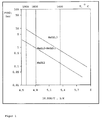
- FIG. 1 shows the known relationship between nitrogen pressure and temperature for the formation of different phases of metal silicides.
- Si 3 N 4 powder is mixed with 12 mass% Nd 2 O 3 and 0.5 mass% AlN in a planetary ball mill in isopropanol and dried in a vacuum rotary evaporator and baked at 450 ° C. The powder mixture is then hot pressed at 1800 ° C. Bending fracture bars are produced from the material thus produced, which are then subjected to a durability test in air at 1400 ° C and 300 MPa.
- Si 3 N 4 powder is mixed with 10% by mass Y 2 O 3 in a planetary ball mill in isopropanol and dried in a laboratory rotary evaporator. The powder is then cold isostatically pressed into bars of 25 x 25 x 60 mm at 200 MPa. These bars are sintered at 1900 ° C under an N 2 pressure of 100 bar over a period of 2 h. Bending fracture bars are produced from the material thus produced, which are then subjected to a durability test in air at 1400 ° C and 300 MPa.
- Si 3 N 4 powder is mixed with 12 mass% Nd 2 O 3 and 0.5 mass% AlN and 10 mass% MoSi 2 in a planetary ball mill in isopropanol and dried in a vacuum rotary evaporator and at 450 ° C baked out. Sintering is then carried out at 1900 ° C. under an N 2 pressure of 100 bar over the course of 2 h. Bending fracture bars are produced from the material thus produced and are subjected to a durability test in air at 1400 ° C and 300 MPa.
- Si 3 N 4 powder is mixed with 12 mass% Nd 2 O 3 and 0.5 mass% AlN and 10 mass% Mo 2 C in a planetary ball mill in isopropanol and dried in a vacuum rotary evaporator and at 450 ° C baked. The powder mixture is then hot pressed at 1800 ° C. Bending fracture bars are produced from the material thus produced and are subjected to a durability test in air at 1400 ° C and 300 MPa.
- Si 3 N 4 powder is mixed with 12 mass% Nd 2 O 3 and 0.5 mass% AlN and 15 mass% W in a planetary ball mill in isopropanol and dried in a vacuum rotary evaporator and baked at 450 ° C .
- the powder mixture is then hot pressed at 1800 ° C. Bending fracture bars are produced from the material thus produced and are subjected to a durability test in air at 1400 ° C and 300 MPa.
- Si 3 N 4 powder is mixed with 10% by mass Y 2 O 3 and 10% by mass MoSi 2 in a planetary ball mill in isopropanol and dried in a laboratory rotary evaporator.
- the powder is then cold isostatically pressed into bars of 25 x 25 x 60 mm at 200 MPa. These bars are sintered at 1900 ° C under an N 2 pressure of 100 bar over a period of 2 h. Bending fracture bars are produced from the material thus produced, which are then subjected to a durability test in air at 1400 ° C and 300 MPa.
- Si 3 N 4 powder with 12 mass% Y 2 O 3 is mixed with 10 mass% of a mixture of MoSi 2 and WSi 2 in a planetary ball mill in isopropanol, dried in a vacuum rotary evaporator and baked at 450 ° C.
- the powder mixture is then hot pressed at 1800 ° C. Bending fracture bars are produced from the material thus produced, which are then subjected to a durability test in air at 1400 ° C and 450 MPa.
- Si 3 N 4 powder with 12 mass% Y 2 O 3 is mixed with 10 mass% of a mixture of MoSi 2 and WSi 2 in a planetary ball mill in isopropanol, dried in a vacuum rotary evaporator and baked at 450 ° C.
- the powder mixture is then hot pressed at 1800 ° C. Bending fracture bars are produced from the material thus produced, which are then subjected to a service life test in air at 1450 ° C. and 300 MPa.
- Si 3 N 4 powder with 12 mass% Y 2 O 3 is mixed with 20 mass% of a mixture of VSi 2 and WSi 2 in a planetary ball mill in isopropanol, dried in a vacuum rotary evaporator and baked at 450 ° C.
- the powder mixture is then hot pressed at 1800 ° C. Bending fracture bars are produced from the material thus produced, which are then subjected to a durability test in air at 1400 ° C and 450 MPa.
Landscapes
- Chemical & Material Sciences (AREA)
- Engineering & Computer Science (AREA)
- Ceramic Engineering (AREA)
- Manufacturing & Machinery (AREA)
- Materials Engineering (AREA)
- Structural Engineering (AREA)
- Organic Chemistry (AREA)
- Inorganic Chemistry (AREA)
- Ceramic Products (AREA)
Description
Aufgrund der eingesetzten Ausgangsstoffe und der Verfahrensparameter entsteht neben dem Siliciumnitrid in der Keramik nur Mo5Si3 als weitere Phase.
Dabei stellen die Beispiele 1 und 2 den Stand der Technik dar.
In Beispiel 6 ist die beste Ausführungsform angegeben.
Die gemessenen Werte der Beispiele 1 - 6 sind in Tabelle 1 angegeben.
Die gemessenen Werte der Beispiele 7 - 9 sind in Tabelle 2 angegeben.
Figur 1 gibt den bekannten Zusammenhang von Stickstoffdruck und Temperatur für die Bildung von verschiedenen Phasen von Metallsiliziden an.
| Ergebnisse des Standzeittestes an Luft bei 1400 °C und 300 MPa | |||
| Beispiel | Verhältnis MeSi2/MeSi2+Me5Si3 | Massezunahme nach 1000 h Oxidat.bei 1400 °C in mg/cm2 | Zeit bis zum Versagen bei Standzeittest |
| 1 | 0 | 1,7 | 47 h |
| 2 | 0 | 1,9 | 37 h |
| 3 | 0,5 | 3,8 | nach 200 h kein Versagen |
| 4 | 0,2 | 3,0 | 179 h |
| 5 | 0,7 | 4,1 | 198 h |
| 6 | 0,3 | 0,8 | nach 700 h kein Versagen |
| Ergebnisse des Standzeittestes an Luft | |||
| Beispiel | Verhältnis der Silizidphasen in Ma.-% | Massezunahme nach 1000 h Oxidat.bei 1400 °C in mg/cm2 | Zeit bis zum Versagen bei Standzeittest |
| 7 | 3 % WSi2 + 4 % MoSi2 + 3 % Mo5Si3 | 0,8 | bei 1400 °C und 450 MPa nach 500 h noch kein Versagen |
| 8 | 3 % WSi2 + 4 % MoSi2 + 3 % Mo5Si3 | 0,8 | bei 1450 °C und 300 MPa nach 500 h noch kein Versagen, |
| 9 | 10 % VSi2 + 5 % WSi2 + 5 % W5Si3 | 0,7 | bei 1400 °C und 450 MPa nach 500 h noch kein Versagen |
Claims (13)
- Dichter Siliziumnitrid-Kompositwerkstoff enthaltend einen Anteil von 3 bis 50 Ma.-% einer Verstärkungskomponente, wobei die Verstärkungskomponente aus einem Gemisch aus Metallsilizidphasen mit 10 bis 90 Ma.-% Me5Si3 und 90 bis 10 Ma.-% MeSi2 oder MeSi2 und Silizide anderer Stöchiometrien besteht, wobei davon wiederum 10 bis 90 Ma.-% MeSi2 und 90 bis 10 Ma.-% Silizide anderer Stöchiometrien sind, und wobei Me ein Metall der Gruppe oder eine Mischung aus Metallen der Gruppe Molybdän, Wolfram, Chrom, Tantal, Niob, Mangan oder Vanadium ist.
- Werkstoff nach Anspruch 1, bei dem die Verstärkungskomponente zu 5 bis 40 Ma.-% enthalten ist.
- Werkstoff nach Anspruch 1, bei dem Me5Si3 mit 3 bis 10 Ma.-%, bezogen auf den Kompositwerkstoff, enthalten ist.
- Werkstoff nach Anspruch 1, bei dem MeSi2 mit 8 bis 20 Ma.-%, bezogen auf den Kompositwerkstoff, enthalten ist.
- Werkstoff nach Anspruch 1, bei dem MeSi2 und Silizide anderer Stöchiometrien mit 10 bis 30 Ma.-%, bezogen auf den Kompositwerkstoff, enthalten sind.
- Werkstoff nach Anspruch 1, bei dem das Metall Molybdän ist.
- Werkstoff nach Anspruch 1, bei dem ein oder mehrere Sinterhilfsmittel enthalten sind.
- Werkstoff nach Anspruch 1, bei dem weitere Verstärkungskomponenten in Form von SiC, TiN, TiC oder BN enthalten sind.
- Verfahren zur Herstellung eines dichten Siliziumnitrid-Kompositwerkstoffes, der 3 bis 50 Ma.-% einer Verstärkungskomponente, enthaltend ein Gemisch aus Metallsiliziden mit 10 bis 90 Ma.-% Me5Si3 und 90 bis 10 Ma.-% MeSi2 oder MeSi2 und Silizide anderer Stöchiometrien, wobei davon wiederum 10 bis 90 Ma.-% MeSi2 und 90 bis 10 Ma.-% Silizide anderer Stöchiometrien sind und wobei Me ein Metall der Gruppe oder eine Mischung aus Metallen der Gruppe Molybdän, Wolfram, Chrom, Tantal, Niob, Mangan oder Vanadium ist, bei dem der Werkstoff durch Sintern und/oder Heißpressen und/oder heißisostatisches Pressen hergestellt wird und die Verstärkungskomponente in Form von Metallsilizid-Pulver auf pulvermetallurgischem Wege zugegeben wird oder als eine Vorstufe der Metallsilizide, wobei dabei bis zum Erreichen der geschlossenen Porosität ein Stickstoff/Temperatur-Verhältnis entsprechend dem bekannten Zusammenhang nach Figur 1 eingestellt wird, das zur Bildung und Stabilisierung von Me5Si3 führt.
- Verfahren nach Anspruch 9, bei dem Me5Si3 und MeSi2 aus einem ihrer Vorstufen während der Plasma- oder Gasphasensynthese des Siliziumnitridpulver mit Metalldotierungen gebildet werden.
- Verfahren nach Anspruch 9, bei dem Me5Si3 und MeSi2 aus einem ihrer Vorstufen über chemische Synthesen durch Zersetzung von siliziumorganischen Precursoren mit Metallionen gebildet werden.
- Verfahren nach Anspruch 9, bei dem Me5Si3 und MeSi2 aus einem ihrer Vorstufen durch Reduktion von aufgefällten oxidischen Verbindungen der Metalle gebildet werden.
- Verfahren nach Anspruch 9, bei dem Me5Si3 und MeSi2 auf pulvermetallurgischem Wege aus Metallen oder Metallcarbiden oder Metallboriden oder Metallnitriden gebildet werden.
Applications Claiming Priority (2)
| Application Number | Priority Date | Filing Date | Title |
|---|---|---|---|
| DE19500832 | 1995-01-13 | ||
| DE19500832A DE19500832C2 (de) | 1995-01-13 | 1995-01-13 | Dichter Siliziumnitrid-Kompositwerkstoff und Verfahren zu seiner Herstellung |
Publications (3)
| Publication Number | Publication Date |
|---|---|
| EP0721925A2 EP0721925A2 (de) | 1996-07-17 |
| EP0721925A3 EP0721925A3 (de) | 1996-09-18 |
| EP0721925B1 true EP0721925B1 (de) | 1999-04-07 |
Family
ID=7751415
Family Applications (1)
| Application Number | Title | Priority Date | Filing Date |
|---|---|---|---|
| EP95119786A Expired - Lifetime EP0721925B1 (de) | 1995-01-13 | 1995-12-15 | Dichter Siliciumnitrid-Kompositwerkstoff und Verfahren zu seiner Herstellung |
Country Status (4)
| Country | Link |
|---|---|
| EP (1) | EP0721925B1 (de) |
| JP (1) | JPH08290973A (de) |
| AT (1) | ATE178574T1 (de) |
| DE (2) | DE19500832C2 (de) |
Families Citing this family (3)
| Publication number | Priority date | Publication date | Assignee | Title |
|---|---|---|---|---|
| DE19722321A1 (de) * | 1997-05-28 | 1998-12-03 | Bosch Gmbh Robert | Verfahren zur Herstellung von Formkörpern aus einem keramischen Verbundgefüge |
| DE19845532A1 (de) | 1998-10-02 | 2000-04-06 | Bosch Gmbh Robert | Verfahren zur Herstellung von Kompositwerkstoffen und Vertreter solcher Kompositwerkstoffe |
| DE19857958A1 (de) | 1998-12-16 | 2000-06-21 | Bosch Gmbh Robert | Verfahren zur Herstellung eines Stiftheizer |
Family Cites Families (5)
| Publication number | Priority date | Publication date | Assignee | Title |
|---|---|---|---|---|
| JPS5841770A (ja) * | 1981-09-01 | 1983-03-11 | 株式会社東芝 | セラミツクス焼結体及びその製造方法 |
| US5094986A (en) * | 1989-04-11 | 1992-03-10 | Hercules Incorporated | Wear resistant ceramic with a high alpha-content silicon nitride phase |
| CA2068979A1 (en) * | 1991-06-24 | 1992-12-25 | Allan B. Rosenthal | Silicon nitride ceramics containing a dispersed pentamolybdenum trisilicide base |
| US5252518A (en) * | 1992-03-03 | 1993-10-12 | Micron Technology, Inc. | Method for forming a mixed phase TiN/TiSi film for semiconductor manufacture using metal organometallic precursors and organic silane |
| JPH07505855A (ja) * | 1992-04-14 | 1995-06-29 | エス・アール・アイ・インターナシヨナル | 表面上にセラミック被膜を形成することによりセラミック構造材の強度を増大させる方法並びにそれによって作られた製品 |
-
1995
- 1995-01-13 DE DE19500832A patent/DE19500832C2/de not_active Expired - Fee Related
- 1995-12-15 AT AT95119786T patent/ATE178574T1/de active
- 1995-12-15 EP EP95119786A patent/EP0721925B1/de not_active Expired - Lifetime
- 1995-12-15 DE DE59505587T patent/DE59505587D1/de not_active Expired - Lifetime
-
1996
- 1996-01-09 JP JP8028413A patent/JPH08290973A/ja active Pending
Also Published As
| Publication number | Publication date |
|---|---|
| DE59505587D1 (de) | 1999-05-12 |
| DE19500832A1 (de) | 1996-07-18 |
| JPH08290973A (ja) | 1996-11-05 |
| DE19500832C2 (de) | 1998-09-17 |
| ATE178574T1 (de) | 1999-04-15 |
| EP0721925A2 (de) | 1996-07-17 |
| EP0721925A3 (de) | 1996-09-18 |
Similar Documents
| Publication | Publication Date | Title |
|---|---|---|
| EP0800495B1 (de) | Herstellung eines aluminidhaltigen keramischen formkörpers | |
| EP1070686B1 (de) | Flüssigphasengesinterte Siliciumcarbid-Formkörper mit verbesserter Bruchzähigkeit sowie hohem elektrischen Widerstand und Verfahren zu ihrer Herstellung | |
| EP0531378B1 (de) | Reaktionsgebundener mullit-haltiger keramikformkörper, seine herstellung und seine verwendung | |
| EP0902771B1 (de) | Metall-keramik-formkörper und verfahren zu ihrer herstellung | |
| EP1999087A1 (de) | Gesinterter verschleissbeständiger boridwerkstoff, sinterfähige pulvermischung zur herstellung des werkstoffs, verfahren zur herstellung des werkstoffs und dessen verwendung | |
| DE69032117T2 (de) | Verfahren zur herstellung von gesinterten keramischen materialien | |
| EP0433856A1 (de) | Hartmetall-Mischwerkstoffe auf Basis von Boriden, Nitriden und Eisenbindemetallen | |
| DE3123974A1 (de) | Gesinterter keramischer gegenstand | |
| DE2940629A1 (de) | Verfahren zur erzeugung oxidationsbestaendiger siliciumnitrid-sinterkoerper mit verbesserter mechanischer festigkeit | |
| DE68910363T2 (de) | Siliciumnitrid-Sinterkörper. | |
| DE69212398T2 (de) | Siliciumnitridkeramik mit einer dispergierten Pentamolybdäntrisilicidphase | |
| DE69427510T2 (de) | Auf Siliziumnitrid basierende Sinter | |
| DE3880335T2 (de) | Verfahren zur Herstellung eines Siliziumnitrid-Sinterformkörpers. | |
| DE19519864A1 (de) | Siliciumnitridsinterprodukt und Verfahren zu seiner Herstellung | |
| DE19500832C2 (de) | Dichter Siliziumnitrid-Kompositwerkstoff und Verfahren zu seiner Herstellung | |
| DE69011447T2 (de) | Gesinterter keramischer Verbundkörper und Verfahren zu seiner Herstellung. | |
| EP0918735B1 (de) | Verfahren zur herstellung von formkörpern aus einem keramischen verbundgefüge | |
| EP1560799A2 (de) | Keramik-metall- oder metall-keramik-komposite | |
| DE3603331A1 (de) | Siliciumcarbid-sintererzeugnis und verfahren zu dessen herstellung | |
| DE19839081B4 (de) | Siliciumnitridsinterkörper | |
| DE2302438A1 (de) | Dichte siliciumnitrid-gegenstaende und verfahren zu deren herstellung | |
| DE69111537T2 (de) | Verfahren zur Wärmebehandlung eines Sinterkörpers aus Siliziumnitrid. | |
| EP1144337A2 (de) | Reaktionsgebundene werkstoffe auf basis von siliciumnitrid und verfahren zu deren herstellung | |
| EP1047649A1 (de) | Verfahren zur herstellung von kompositwerkstoffen und vertreter solcher kompositwerkstoffe | |
| DE3708689C2 (de) |
Legal Events
| Date | Code | Title | Description |
|---|---|---|---|
| PUAI | Public reference made under article 153(3) epc to a published international application that has entered the european phase |
Free format text: ORIGINAL CODE: 0009012 |
|
| AK | Designated contracting states |
Kind code of ref document: A2 Designated state(s): AT BE CH DE ES FR GB IT LI LU NL SE |
|
| PUAL | Search report despatched |
Free format text: ORIGINAL CODE: 0009013 |
|
| AK | Designated contracting states |
Kind code of ref document: A3 Designated state(s): AT BE CH DE ES FR GB IT LI LU NL SE |
|
| 17P | Request for examination filed |
Effective date: 19961205 |
|
| 17Q | First examination report despatched |
Effective date: 19970310 |
|
| GRAG | Despatch of communication of intention to grant |
Free format text: ORIGINAL CODE: EPIDOS AGRA |
|
| GRAG | Despatch of communication of intention to grant |
Free format text: ORIGINAL CODE: EPIDOS AGRA |
|
| GRAH | Despatch of communication of intention to grant a patent |
Free format text: ORIGINAL CODE: EPIDOS IGRA |
|
| GRAH | Despatch of communication of intention to grant a patent |
Free format text: ORIGINAL CODE: EPIDOS IGRA |
|
| GRAA | (expected) grant |
Free format text: ORIGINAL CODE: 0009210 |
|
| AK | Designated contracting states |
Kind code of ref document: B1 Designated state(s): AT BE CH DE ES FR GB IT LI LU NL SE |
|
| PG25 | Lapsed in a contracting state [announced via postgrant information from national office to epo] |
Ref country code: SE Free format text: THE PATENT HAS BEEN ANNULLED BY A DECISION OF A NATIONAL AUTHORITY Effective date: 19990407 Ref country code: NL Free format text: LAPSE BECAUSE OF FAILURE TO SUBMIT A TRANSLATION OF THE DESCRIPTION OR TO PAY THE FEE WITHIN THE PRESCRIBED TIME-LIMIT Effective date: 19990407 Ref country code: IT Free format text: LAPSE BECAUSE OF FAILURE TO SUBMIT A TRANSLATION OF THE DESCRIPTION OR TO PAY THE FEE WITHIN THE PRESCRIBED TIME-LIMIT;WARNING: LAPSES OF ITALIAN PATENTS WITH EFFECTIVE DATE BEFORE 2007 MAY HAVE OCCURRED AT ANY TIME BEFORE 2007. THE CORRECT EFFECTIVE DATE MAY BE DIFFERENT FROM THE ONE RECORDED. Effective date: 19990407 Ref country code: ES Free format text: THE PATENT HAS BEEN ANNULLED BY A DECISION OF A NATIONAL AUTHORITY Effective date: 19990407 |
|
| REF | Corresponds to: |
Ref document number: 178574 Country of ref document: AT Date of ref document: 19990415 Kind code of ref document: T |
|
| REG | Reference to a national code |
Ref country code: CH Ref legal event code: EP |
|
| REF | Corresponds to: |
Ref document number: 59505587 Country of ref document: DE Date of ref document: 19990512 |
|
| GBT | Gb: translation of ep patent filed (gb section 77(6)(a)/1977) |
Effective date: 19990513 |
|
| ET | Fr: translation filed | ||
| NLV1 | Nl: lapsed or annulled due to failure to fulfill the requirements of art. 29p and 29m of the patents act | ||
| PG25 | Lapsed in a contracting state [announced via postgrant information from national office to epo] |
Ref country code: LU Free format text: LAPSE BECAUSE OF NON-PAYMENT OF DUE FEES Effective date: 19991215 Ref country code: AT Free format text: LAPSE BECAUSE OF NON-PAYMENT OF DUE FEES Effective date: 19991215 |
|
| PG25 | Lapsed in a contracting state [announced via postgrant information from national office to epo] |
Ref country code: LI Free format text: LAPSE BECAUSE OF NON-PAYMENT OF DUE FEES Effective date: 19991231 Ref country code: CH Free format text: LAPSE BECAUSE OF NON-PAYMENT OF DUE FEES Effective date: 19991231 Ref country code: BE Free format text: LAPSE BECAUSE OF NON-PAYMENT OF DUE FEES Effective date: 19991231 |
|
| PLBE | No opposition filed within time limit |
Free format text: ORIGINAL CODE: 0009261 |
|
| STAA | Information on the status of an ep patent application or granted ep patent |
Free format text: STATUS: NO OPPOSITION FILED WITHIN TIME LIMIT |
|
| 26N | No opposition filed | ||
| BERE | Be: lapsed |
Owner name: FRAUNHOFER-GESELLSCHAFT ZUR FORDERUNG DER ANGEWAN Effective date: 19991231 |
|
| PGFP | Annual fee paid to national office [announced via postgrant information from national office to epo] |
Ref country code: GB Payment date: 20001204 Year of fee payment: 6 |
|
| PGFP | Annual fee paid to national office [announced via postgrant information from national office to epo] |
Ref country code: FR Payment date: 20001215 Year of fee payment: 6 |
|
| PG25 | Lapsed in a contracting state [announced via postgrant information from national office to epo] |
Ref country code: GB Free format text: LAPSE BECAUSE OF NON-PAYMENT OF DUE FEES Effective date: 20011215 |
|
| REG | Reference to a national code |
Ref country code: GB Ref legal event code: IF02 |
|
| GBPC | Gb: european patent ceased through non-payment of renewal fee |
Effective date: 20011215 |
|
| PG25 | Lapsed in a contracting state [announced via postgrant information from national office to epo] |
Ref country code: FR Free format text: LAPSE BECAUSE OF NON-PAYMENT OF DUE FEES Effective date: 20020830 |
|
| REG | Reference to a national code |
Ref country code: FR Ref legal event code: ST |
|
| PGFP | Annual fee paid to national office [announced via postgrant information from national office to epo] |
Ref country code: DE Payment date: 20130220 Year of fee payment: 18 |
|
| REG | Reference to a national code |
Ref country code: DE Ref legal event code: R119 Ref document number: 59505587 Country of ref document: DE |
|
| REG | Reference to a national code |
Ref country code: DE Ref legal event code: R119 Ref document number: 59505587 Country of ref document: DE Effective date: 20140701 |
|
| PG25 | Lapsed in a contracting state [announced via postgrant information from national office to epo] |
Ref country code: DE Free format text: LAPSE BECAUSE OF NON-PAYMENT OF DUE FEES Effective date: 20140701 |