EP0713913B1 - Verbessertes Transkriptionsverfahren - Google Patents
Verbessertes Transkriptionsverfahren Download PDFInfo
- Publication number
- EP0713913B1 EP0713913B1 EP95118179A EP95118179A EP0713913B1 EP 0713913 B1 EP0713913 B1 EP 0713913B1 EP 95118179 A EP95118179 A EP 95118179A EP 95118179 A EP95118179 A EP 95118179A EP 0713913 B1 EP0713913 B1 EP 0713913B1
- Authority
- EP
- European Patent Office
- Prior art keywords
- nucleic acid
- sequence
- promoter
- template
- template nucleic
- Prior art date
- Legal status (The legal status is an assumption and is not a legal conclusion. Google has not performed a legal analysis and makes no representation as to the accuracy of the status listed.)
- Expired - Lifetime
Links
Images



Classifications
-
- C—CHEMISTRY; METALLURGY
- C12—BIOCHEMISTRY; BEER; SPIRITS; WINE; VINEGAR; MICROBIOLOGY; ENZYMOLOGY; MUTATION OR GENETIC ENGINEERING
- C12P—FERMENTATION OR ENZYME-USING PROCESSES TO SYNTHESISE A DESIRED CHEMICAL COMPOUND OR COMPOSITION OR TO SEPARATE OPTICAL ISOMERS FROM A RACEMIC MIXTURE
- C12P19/00—Preparation of compounds containing saccharide radicals
- C12P19/26—Preparation of nitrogen-containing carbohydrates
- C12P19/28—N-glycosides
- C12P19/30—Nucleotides
- C12P19/34—Polynucleotides, e.g. nucleic acids, oligoribonucleotides
Definitions
- the present invention relates to methods for the transcription of a Template nucleic acid sequence in a template nucleic acid in ribonucleic acid, suitable reagents and advantageous use of these reagents.
- RNA polymerase as well promoter functionally linked to the template nucleic acid sequence is required.
- RNA polymerases of phages T3, T7 or SP6 are preferably used, because they are easy to use and have a high transcription efficiency.
- template molecules which are called template nucleic acids in the following, Both polynucleotides and oligonucleotides are used. polynucleotides can, for example, be generated via PCR or in corresponding transcription vectors cloned. Even the use of oligonucleotides, that is, short nucleic acids for generating RNA oligonucleotides known.
- EP-A-0408295 proposes a method for amplifying nucleic acid, in which a partially double-stranded nucleic acid of a transcription reaction is subjected, wherein the nucleic acid from a DNA target sequence and a promoter nucleic acid, the promoter nucleic acid consisting of a Promoter sequence, a sequence complementary to the target DNA and one to the The opposite strand of the target DNA complementary sequence exists. From the reaction conditions it can be concluded that the promoter nucleic acid consists of DNA. Otherwise, the degradation of the promoter nucleic acid would result from that in the reaction mixture contained RNAse take place.
- the object of the present invention was to use the conventional transcription methods to improve, in particular to reduce the formation of abortive transcripts.
- the invention therefore relates to a method for transcribing a template nucleic acid sequence TN in a template nucleic acid T in ribonucleic acid R by forming a partially or completely double-stranded nucleic acid complex, containing a functional, at least partially double-stranded, promoter region from promoter sequences PP and PP ', one effector sequence PE and one with the nucleotide sequence TN and which are functionally linked to the promoter region Setting conditions under which the ribonucleic acid R is used is formed by TN as a template sequence under the control of the promoter.
- the essence of the invention is the knowledge that the amount of abortives that arise Transcripts through the presence of an effector sequence PE (e.g. in or to the Promoter region) is reduced without the yield of full-length transcripts to influence too negatively.
- This knowledge can in principle apply to all transcription processes applied when under the control of a promoter expire.
- the knowledge is particularly important for in vitro transcriptions as well as for transcriptions using phage RNA polymerases such as T7, T3 or SP6.
- nucleic acids Both natural and artificial are referred to below as nucleic acids Understand nucleic acids.
- Natural nucleic acids are like them for example in viruses, bacteria or multicellular organisms. she contain, on a sugar phosphate backbone, nucleobases, their sequence on the basic structure for the organism in question or parts of its genome is characteristic.
- An essential feature of nucleic acids is that Ability to form double strands with nucleic acids, one of which have complementary nucleobase sequence.
- Artificial nucleic acids are understood to mean those whose structure are modified, e.g. B. by replacing the sugar phosphate backbone with a Polypeptide backbone or by introducing non-naturally occurring bases instead of natural bases, which, however, still have the ability to form Double strands with other nucleic acids, especially the natural nucleic acids, exhibit.
- Transcription is the process known in the art of generating Ribonucleic acids under control using a template nucleic acid a promoter understood by an RNA polymerase.
- T is a single or double-stranded or partially understood double-stranded nucleic acid, which is a template nucleic acid sequence Contains TN, which is to be rewritten into ribonucleic acid (R).
- R ribonucleic acid
- the resulting ribonucleic acid is complementary to the template nucleic acid sequence. Therefore, the strand containing the template nucleic acid sequence TN becomes often referred to as a coding strand.
- the coding strand must be a deoxyribonucleic acid (DNA).
- a promoter in the sense of the present invention is at least partially double-stranded nucleic acid region as a binding site for an RNA polymerase and initiation site for transcription. If a template nucleic acid is attached to the 5 'end of its coding strand is attached under suitable reaction conditions Transcripts of the template nucleic acid sequence synthesized. This promoter is then considered functional with the template nucleic acid sequence referred to as linked. According to the present invention, part of a Promoter strands are missing. It appears important that for the functionality of the promoter required total length is retained, be it partial or complete double stranded.
- the coding strand of the promoter is hereinafter referred to as the promoter sequence PP ' and the non-coding strand is referred to as the promoter sequence PP.
- the sequence the nucleobase in the promoter region is for a number of promoters from phages, e.g. B. T3, T7 or SP6, known.
- sequence PT is a sequence that can be hybridized with the template nucleic acid designated. Sequence PT is therefore essentially complementary to part of the Template nucleic acid. This part of the template nucleic acid preferably follows an extended template nucleic acid sequence downstream of the promoter which, beginning with the part to which the sequence PT hybridizes can, is the subject of the transcription reaction.
- the sequence PT is preferably not for RNA.
- the effector sequence according to the invention is also a Nucleic acid.
- the sequence is the nucleobases in the effector sequence such that among the selected ones If possible, no hybridization of the effector sequence with the Template nucleic acid sequence TN, its counter strand TN ', the promoter sequence PP or its counter strand PP 'can take place.
- the effector sequence should be preferred also with other nucleic acids present in the reaction mixture do not hybridize.
- the Effector sequence preferred around RNA because of the overall effectiveness of the transcription reaction suffers when the effector sequence consists of DNA.
- the length of the effector sequence PE is largely insignificant. However, it has shown that it should be at least 4 nucleotides long. PE 5-50 is preferred, particularly preferably 10-30 nucleotides long.
- a promoter nucleic acid P is understood to mean a nucleic acid which, in addition to other nucleic acid sequences, either a promoter sequence PP or / and whose opposite strand contains PP '.
- a linker is understood to mean a part of a molecule which contains one or more Contains atoms and covalently connects two nucleic acid sequences.
- the linker can be non-nucleosidic, but also nucleosidic.
- the linker is any connection between a promoter strand and the effector sequence.
- FIG. 2 shows a model nucleic acid (double-stranded, SEQ.ID.NO. 10) with tolerance for nicks.
- the effector sequence When the effector sequence is linked to a promoter sequence, differentiate between several cases. Some of these case designs are in Figure 2 shown. In a first possibility, the effector sequence is PE linked directly or via a linker to the 3 'end of the promoter sequence PP.
- case A of FIG. 2 the effector sequence is directly on the nucleotide is linked in position -1 of the promoter sequence PP. This can be done easily Via a common phosphodiester bond between a 3'-hydroxyl group the promoter sequence and a 5'-hydroxyl group of the effector sequence happen.
- case B of FIG 2 is the effector sequence directly linked to a 3'-hydroxyl group of a PP promoter sequence opposite shortened the complete promoter sequence from position -1 to position -8 can be (in the case of the T7 promoter).
- the use of a second molecule which contains the nucleotides of the promoter which are not contained in PP contains, not required.
- the effector sequence is with a 3'-hydroxyl group the PP promoter sequence, with the 3 'end between about Nucleotide -9 and the 5 'end of the promoter region (for the case of the T7 promoter) is localized.
- a second promoter sequence separate from PP is that contains the promoter nucleotides not contained in PP. (Case C from FIG 2).
- the 3 'end of the effector sequence is with a 5'-hydroxyl group of a nucleotide in the promoter sequence PP, the Position downstream of position -12.
- a second promoter oligonucleotide which does not contain the PP Contains nucleotides of the promoter, preferably (case D of FIG 2).
- the effector sequence is PE directly linked to the 5 'end of the promoter sequence PP.
- the effector sequence PE is connected to the 3'-hydroxyl group of the coding strand of the promoter region PP 'linked.
- the effector sequence PE is like this linked to a 3 'end of PP' that only nucleotides -1 to about -14 or more the sequence PP 'are present. In this case there is no supplementary oligonucleotide required for the single-strand areas.
- the effector sequence is included its 5 'end linked to the 3' end of the coding strand of the promoter region so that the strand of the promoter region containing the effector sequence only the Contains nucleotides between position -1 and position approximately -12. In this case the use of another oligonucleotide is required.
- the 3 'end of the effector sequence is at the 5' end of strand PP 'bound within the promoter. It also recommends here itself, the single-stranded areas by hybridization with an oligonucleotide or to cover the extended template nucleic acid sequence.
- O is a 5 'end of one strand with the 3 'end of the effector sequence connected so that the coding strand links with the target sequence spanning the complete promoter sequence.
- the effector sequence is at the 3 'end of the template nucleic acid sequence bound so that the coding strand of the promoter is complete is preserved and is not linked to the template sequence.
- each of these cases there is also the possibility that the 5 'end of PP or the complementary oligonucleotide with the 3 'end of PP' or the supplementary one Oligonucleotides connected directly or via linkers via a loop structure is.
- the left ends of each case in FIG. 2 are preferably via a linker linked from 5 to 40 nucleotides.
- the transcription method according to the invention generally requires that for transcription reactions usual reaction conditions.
- transcription synthesizes a variety of RNA copies of the template nucleic acid sequence TN, regardless of whether this sequence single-stranded or in double-stranded form, e.g. B. in a larger template nucleic acid, is present.
- the RNA molecules are in the 3 'direction, starting from the starting position of the promoter.
- the promoter sequence will not translated.
- the transcriptase must be matched to the promoter used. If a typical promoter of the bacteriophage T7 is used, must also T7 RNA polymerase can be used.
- RNTP monoribonucleoside triphosphates
- rNTPs can be unmodified, but can also be modified be, e.g. B. by adding marker groups.
- a label in the sense of the present invention consists of a directly or indirectly detectable group.
- Directly detectable groups are, for example, radioactive ( 32 P), colored or fluorescent groups or metal atoms.
- Indirectly detectable groups are, for example, immunologically or enzymatically active compounds such as antibodies, antigens, haptens or enzymes or enzymatically active partial enzymes. These are detected in a subsequent reaction or reaction sequence. Haptens are particularly preferred, since nucleoside triphosphates labeled with them can generally be used particularly well as substrates for polymerases and a subsequent reaction with a labeled antibody against the hapten or the haptenized nucleoside can easily be carried out.
- nucleoside triphosphates are, for example, bromine nucleoside triphosphates or digoxigenin, digoxin, biotin or fluorescein-coupled nucleoside triphosphates.
- the steroids mentioned in EP-A-0 324 474 and their detection have proven to be particularly suitable.
- this template nucleic acid T with a Promoter nucleic acid P, the parts of the promoter sequence PP, with the template nucleic acid sequence TN contains hybridizable sequence PT and effector PE, below Hybridization conditions brought into contact. These conditions can already be designed so that the transcription reaction after formation of the hybrid can expire. However, it is also possible to set the conditions only after hybridization to start the transcription reaction. The one for transcription necessary sequences PP 'are therefore contained in T or are added. If you wait long enough, a large number of transcripts are formed. These transcripts can be the subject of any further processing or use.
- the ribonucleic acid can be primed with a PR are hybridized, the sequence of which is selected such that its extension to a Leads nucleic acid, which contains a part, which in turn with the PT part Promoter nucleic acid P can hybridize.
- they are for one Conventional cDNA synthesis required reagents, e.g. B. a reverse Transcriptase and the deoxyribonucleoside triphosphates (dNTP).
- dNTP deoxyribonucleoside triphosphates
- the ribonucleic acid and the extension product must either separated from PR or degraded the ribonucleic acid become.
- the second option is particularly advantageous since it enables an isothermal cyclic reaction.
- the Extension product of the primer can, after it is single-stranded, with the Hybridize promoter nucleic acid. Under the reaction conditions can then an extension of the 3 'end of the extension product by coding strand PP 'take place. The partially double-stranded thus formed Nucleic acid can be used again for transcription to form RNA. With the number of reaction cycles carried out, both the Number of extension products as well as those present in the reaction mixture Amount of ribonucleic acid.
- a single-stranded template nucleic acid T * which is a precursor to the Transcription reaction template nucleic acid used in this Embodiment can represent both DNA and RNA is with a Primer hybridizes.
- the primer is made using dNTPs and one of the nature of the template nucleic acid-dependent polymerase enzyme Extension product extended, which then serve as a template nucleic acid can. Care must be taken here that the primer is chosen such that its Extension product is the template nucleic acid sequence TN It must also be a contain sequence hybridizable with the sequence PT.
- PT is not necessary if PP 'is contained in T *. It is now ensured that the extension product of the primer is in single-stranded form. This can be done either by Denaturation (especially in the case of DNA as template nucleic acid T *) or by treatment with RNase H (in the event that the template nucleic acid T * RNA has happened). Then the extension product of the primer with hybridizes a promoter nucleic acid P, which in this order Contains components PP ', PT and PE. Then the transcription reaction expire. Here too it is possible to cyclically amplify the RNA formed, again the primer and the promoter nucleic acid P alternating Find use. The RNA formed is then again used as template nucleic acid T * used.
- a partially double-stranded one is used Nucleic acid, e.g. B. DNA, which has a single-stranded region, as a template nucleic acid T.
- These types of template nucleic acids are for example Fragments of double-stranded nucleic acid that are digested by Restriction enzymes are formed with the formation of overhanging ends. Such one overhanging end of the template nucleic acid is used for hybridization with the template-specific region PT of a partially double-stranded promoter nucleic acid P.
- the promoter nucleic acid contains the in a first strand Promoter sequence PP, on which, directly or via a linker at the 3 'end or within the effector sequence is bound to the promoter sequence.
- the Promoter nucleic acid P on a different strand the promoter sequence PP 'and, in 5 'direction the template-specific sequence PT.
- a complex of promoter nucleic acid and template nucleic acid forms. If desired, can have the 5 'end of the template-specific sequence nearby located 3 'end of the template nucleic acid covalently linked by means of a ligase become.
- the nucleic acid complex is then used to form transcripts to disposal.
- the sequence PT can be located at the 3 'end of PP and PT is complementary to parts of TN or TN.
- a very similar nucleic acid complex is used produced without the need for restriction enzyme cleavage.
- B. thymine bases are at least partially replaced by uracil bases, and at the 3 'end of the promoter sequence a first primer sequence PT * which corresponds to the Template nucleic acid is complementary implemented.
- a first primer sequence PT * which corresponds to the Template nucleic acid is complementary implemented.
- primer PR which is part of the primer using the first formed extension product V1 is complementary, becomes a double-stranded Nucleic acid formed, the double-stranded at one end Promoter sequence and at the other end the double-stranded sequence of the second Contains primers.
- the extension product of the primer PR later serves as Template nucleic acid T.
- Treatment with uracil-N-glycosilase removes the Promoter sequence PP * degraded.
- Single-stranded nucleic acid is partially or completely with an inventive single-stranded promoter nucleic acid P which hybridizes to the single-stranded Area complementary promoter sequence PP and bound directly to it contains an effector sequence PE.
- the nucleic acid complex thus formed is ready also available for transcription again.
- the invention also relates to promoter nucleic acids, the one Promoter sequence PP or / and its counter strand PP 'and an effector sequence PE, that is not DNA. Differentiate the promoter sequences PP and PP ' the nature of the constituent components of the effector sequence PE.
- the promoter sequences PP and PP 'DNA are preferred.
- the promoter nucleic acid is preferably a single-stranded molecule, but can also be double-stranded his. In the case of double-strandedness, the promoter nucleic acid contains both PP as well as PP * or parts thereof, so that the promoter region formed therefrom is functional is.
- sequences PP and PE preferred on one strand. If the promoter nucleic acid is also a template-specific Contains sequence PT, this is also preferably on the same strand like PP and PE or PP 'and PE (case G).
- PP 'and PE are preferably on one strand.
- the invention also relates to reagent kits containing those for those to be carried out Transcription reaction necessary reagents, with the exception of Template nucleic acid from which ribonucleic acids are to be produced, wherein at least one promoter nucleic acid P is contained.
- Another object of the invention is the use of overhangs, in particular from RNA on promoter sequences to reduce the formation of abortive Transcripts to improve the quantitative determination of nucleic acid products in transcription processes, to increase sensitivity Nucleic acid determinations, or to reduce the mononucleotide requirement in Transcription reactions.
- the known transcription methods are significantly improved.
- the overhangs to improve the quantitative determination of Nucleic acid products in transcription processes.
- the method according to the invention also to increase sensitivity in nucleic acid determinations in transcription processes can be used because the resulting abortive transcripts become one Background signal for the determination of the full-length transcripts led, which is now reduced.
- the creation of the abortive transcripts also had one increased demand for rNTPs, which are full for the emergence of transcripts Length were no longer available.
- the invention results in less Ribonucleotides can be used. It is also quite conceivable that the amount of full-length transcripts formed with the same amount of rNTP is increased.
- RNA polymerases such as the examined T7 RNA polymerase, by means of an RNA overhang on or in Promoter area can be converted from an abortive to a processive form can.
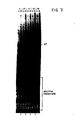
- a reaction batch A and a reaction batch B were prepared by pipetting together the components given in Table 1.
- Batch A contains all the characteristics of batch B with the exception of the effector sequence PE.
- This example shows that the effector sequence PE is at the 3 'end of the promoter sequence PP can be knotted even if this end is within the Promoter region and the non-coding strand of the promoter sequence is not is complete.
- the positions are -1 to -4 of the non-coding Stranges of the promoter region are not present because of the 5 'end of the effector sequence linked to the 3'-hydroxyl group of the nucleotide in position -5 (cytosine) is.
- FIG 1 Another example investigated the influence of a cut (nick) in the promoter region.
- Figure 1 it is shown whether a nick and lack of the phosphate group between the specified nucleotide positions in the coding or non-coding strand of the promoter region tolerated (+) or not tolerated (-) was (FIG 1).
Landscapes
- Life Sciences & Earth Sciences (AREA)
- Health & Medical Sciences (AREA)
- Chemical & Material Sciences (AREA)
- Organic Chemistry (AREA)
- Molecular Biology (AREA)
- Engineering & Computer Science (AREA)
- Zoology (AREA)
- Wood Science & Technology (AREA)
- Microbiology (AREA)
- General Chemical & Material Sciences (AREA)
- Chemical Kinetics & Catalysis (AREA)
- Biotechnology (AREA)
- Biochemistry (AREA)
- Bioinformatics & Cheminformatics (AREA)
- General Engineering & Computer Science (AREA)
- General Health & Medical Sciences (AREA)
- Genetics & Genomics (AREA)
- Measuring Or Testing Involving Enzymes Or Micro-Organisms (AREA)
- Saccharide Compounds (AREA)
Description
| 20 µl | A(µl) | B (µl) |
| PRO319R (10 pmol/µl) (SEQ.ID.NO. 1) | - | 1 |
| PRO3 (10 pmol/µl) (SEQ.ID.NO. 2) | 1 | - |
| ORPPMOK (10 pmol/µl) (SEQ.ID.NO. 3) | 1 | 1 |
| 10 mM ATP, CTP, GTP, UTP | 2 | 2 |
| 10 x Transkriptionspuffer | 2 | 2 |
| 1% Triton | 0,5 | 0,5 |
| Rnasin (40 U/µl) | 0,5 | 0,5 |
| H2O | 11 | 11 |
| T7-Pol (700 U/µl) | 1 | 1 |
| α-[32P]-CTP | 1 | 1 |

| 10 x Transkriptionspuffer: | ||
| 400 | mM | Tris (pH 7,9) |
| 60 | mM | MgCl2 |
| 100 | mM | DTT |
| 20 | mM | Spermidin. |









Claims (20)
- Verfahren zur Transkription einer Templat-Nukleinsäuresequenz TN in einer Templat-Nukleinsäure T in Ribonukleinsäure R durcha) Bildung eines partiell oder vollständig doppelsträngigen Nukleinsäurekomplexes, enthaltendeine funktionelle, zumindest partiell doppelsträngige Promotorregion aus Promotorsequenzen PP und PP' sowie eine Effektorsequenz PE, die weder mit der Templat-Nukleinsäuresequenz TN noch mit deren Gegenstrang TN', noch mit der Promotorsequenz PP noch deren Gegenstrang PP' unter den gegebenen Reaktionsbedingungen hybridisieren kann, wobei die Effektorsequenz PE RNA ist, undeine mit der Promotorregion funktionell verknüpfte Templat-Nukleinsäuresequenz TNb) und Einstellung von Bedingungen, unter denen die Ribonukleinsäure R unter Verwendung von TN als Templat unter Kontrolle des Promotors gebildet wird.
- Verfahren gemäß Anspruch 1, dadurch gekennzeichnet, daß die Effektorsequenz PE direkt oder über einen Linker an die Promotorregion gebunden ist.
- Verfahren gemäß Anspruch 1 oder 2, dadurch gekennzeichnet, daß PE am Ende oder innerhalb von PP oder PP' gebunden ist.
- Verfahren gemäß Anspruch 1 oder 2 dadurch gekennzeichnet, daß der Nukleinsäurekomplex dadurch gebildet wird, daß eine Promotornukleinsäure P an die Templat-Nukleinsäure T hybridisiert wird, wobei die Promotornukleinsäure P folgende Teile enthält:eine Promotorsequenz PP oder/und deren Gegenstrang PP'eine mit zumindest einem Teil der Templat-Nukleinsäure hybridisierbare Sequenz PT unddie Effektorsequenz PE.
- Verfahren gemäß Anspruch 1 oder 2, dadurch gekennzeichnet, daß die Templat-Nukleinsäuresequenz TN oder TN' Teil einer Nukleinsäure mit einem einzelsträngigen und einem doppelsträngigen Bereich ist, wobei eine Sequenz PT mit dem einzelsträngigen Bereich der Templat-Nukleinsäure hybridisiert ist oder hybridisiert wird.
- Verfahren gemäß Anspruch 1, 2 oder 3, dadurch gekennzeichnet, daß die Templat-Nukleinsäuresequenz TN mit der Promotorsequenz PP' kovalent verknüpft ist.
- Verfahren gemäß Anspruch 1 oder 2, dadurch gekennzeichnet, daß die Effektorsequenz PE an dem 3'-Ende der Promotorsequenz PP gelegen ist.
- Verfahren gemäß Anspruch 2, dadurch gekennzeichnet, daß die Effektorsequenz PE weder komplementär noch sequenzidentisch zu einem Teil der Templat-Nukleinsäure T ist.
- Verfahren gemäß Anspruch 1 oder 2, dadurch gekennzeichnet, daß die Effektorsequenz PE mindestens 4 Nukleotide bevorzugt mindestens 9 lang ist.
- Verfahren nach Anspruch 1 oder 2, gekennzeichnet durchHybridisierung einer ersten einzelsträngigen Templat-Nukleinsäure T*, die eine Vorstufe der in die Transkriptionsreaktion eingesetzten Templat-Nukleinsäure darstellt, mit einer ersten Promotornukleinsäure P*, die eine mit Uracil-N-Glycosilase abbaubare Promotorsequenz PP* und eine mit der Templat-Nukleinsäure T* hybridisierbare Sequenz PT* enthält,Verlängerung der Promotornukleinsäure P* unter Verwendung der Templat-Nukleinsäure T* als Templat zu einem Verlängerungsprodukt V1,Bildung eines zu dem Verlängerungsprodukt V1 komplementären Stranges,Abbau der Promotorsequenz PP*,Verwendung des entstandenen komplementären Stranges als Templat-Nukleinsäure T.
- Verfahren zum Nachweis von Nukleinsäuresequenzen, bei dem die nachzuweisenden Nukleinsäuresequenzen als Templat-Nukleinsäure T von Anspruch 1 oder 2 oder T* von Anspruch 10 verwendet werden und der Nachweis der Nukleinsäuresequenzen über die gebildete RNA geführt wird.
- Promotornukleinsäure enthaltend eine Promotorsequenz PP oder deren Gegenstrang PP' und eine Effektorsequenz PE, die RNA ist.
- Promotornukleinsäure gemäß Anspruch 12, dadurch gekennzeichnet, daß sie auch den jeweiligen Gegenstrang PP' bzw. PP enthält.
- Promotornukleinsäure nach Anspruch 12, dadurch gekennzeichnet, daß sie außerdem einen templatspezifischen Teil PT enthält.
- Promotornukleinsäure gemäß Anspruch 14, dadurch gekennzeichnet, daß die templatspezifische Sequenz auf dem gleichen Strang wie PP und PE liegt.
- Promotornukleinsäure gemäß Anspruch 14, dadurch gekennzeichnet, daß PT auf dem Gegenstrang zu PP und PE liegt.
- Verwendung von RNA-Überhängen einer Promotorregion zur Verringerung der Entstehung abortiver Transkripte.
- Verwendung von RNA-Überhängen einer Promotorregion zur Verbesserung der quantitativen Bestimmung von Nukleinsäuren in Transkriptionsverfahren.
- Verwendung von RNA-Überhängen einer Promotorregion zur Erhöhung der Sensitivität bei Nukleinsäurebestimmungen in Transkriptionsverfahren.
- Verwendung von RNA-Überhängen einer Promotorregion zur Verminderung des Mononukleotidbedarfs in Transkriptionsreaktionen.
Applications Claiming Priority (2)
| Application Number | Priority Date | Filing Date | Title |
|---|---|---|---|
| DE4441602A DE4441602A1 (de) | 1994-11-23 | 1994-11-23 | Verbessertes Transkriptionsverfahren |
| DE4441602 | 1994-11-23 |
Publications (3)
| Publication Number | Publication Date |
|---|---|
| EP0713913A2 EP0713913A2 (de) | 1996-05-29 |
| EP0713913A3 EP0713913A3 (de) | 1996-12-27 |
| EP0713913B1 true EP0713913B1 (de) | 2003-03-26 |
Family
ID=6533893
Family Applications (1)
| Application Number | Title | Priority Date | Filing Date |
|---|---|---|---|
| EP95118179A Expired - Lifetime EP0713913B1 (de) | 1994-11-23 | 1995-11-18 | Verbessertes Transkriptionsverfahren |
Country Status (4)
| Country | Link |
|---|---|
| US (1) | US5989812A (de) |
| EP (1) | EP0713913B1 (de) |
| JP (1) | JPH08228784A (de) |
| DE (2) | DE4441602A1 (de) |
Family Cites Families (5)
| Publication number | Priority date | Publication date | Assignee | Title |
|---|---|---|---|---|
| JP2553203B2 (ja) * | 1988-10-31 | 1996-11-13 | 株式会社東芝 | 極低温冷凍機 |
| CA2001110A1 (en) * | 1988-11-18 | 1990-05-18 | Zvi G. Loewy | Compositions and process for amplifying and detecting nucleic acid sequences |
| US5480784A (en) * | 1989-07-11 | 1996-01-02 | Gen-Probe Incorporated | Nucleic acid sequence amplification methods |
| WO1992018521A1 (en) * | 1991-04-10 | 1992-10-29 | Life Technologies, Inc. | Method for amplifying and altering an rna sequence |
| DE4213029A1 (de) * | 1991-09-26 | 1993-04-01 | Boehringer Mannheim Gmbh | Verfahren zur spezifischen vervielfaeltigung von nukleins aeuresequenzen |
-
1994
- 1994-11-23 DE DE4441602A patent/DE4441602A1/de not_active Withdrawn
-
1995
- 1995-11-18 DE DE59510605T patent/DE59510605D1/de not_active Expired - Fee Related
- 1995-11-18 EP EP95118179A patent/EP0713913B1/de not_active Expired - Lifetime
- 1995-11-22 US US08/561,637 patent/US5989812A/en not_active Expired - Fee Related
- 1995-11-22 JP JP7304426A patent/JPH08228784A/ja active Pending
Also Published As
| Publication number | Publication date |
|---|---|
| DE59510605D1 (de) | 2003-04-30 |
| JPH08228784A (ja) | 1996-09-10 |
| DE4441602A1 (de) | 1996-05-30 |
| EP0713913A3 (de) | 1996-12-27 |
| US5989812A (en) | 1999-11-23 |
| EP0713913A2 (de) | 1996-05-29 |
Similar Documents
| Publication | Publication Date | Title |
|---|---|---|
| DE69527171T2 (de) | Strangverdrängungsamplifikation unter Verwendung von thermophilen Enzymen | |
| DE69030955T2 (de) | Nukleinsäureverstärkung | |
| DE69219727T2 (de) | Nukleinsäure Zielerzeugung | |
| DE3850093T2 (de) | Verfahren zur Amplifizierung von Nukleinsäuren. | |
| DE69432586T2 (de) | Methode zum generieren von einzelsträngigen dna molekülen | |
| DE3856455T2 (de) | Selektive Amplifikation von Oligonukleotidenzielsequenzen | |
| DE69527392T2 (de) | Nachweis von Nukleinsäure-Amplifikation | |
| DE69829328T2 (de) | Strangverdrängungsamplifikation von RNA | |
| DE68915202T2 (de) | Verfahren zur Vermehrung und zum Nachweis von Nukleinsäuresequenzen. | |
| DE69507646T2 (de) | Mikrosatelliteverbindung für detektion genetisches polymorphismen | |
| DE69619959T2 (de) | Verfahren zur amplifizierung von nukleinsäuse sequenzen durch verdrängung mit hilfe von chimären primer | |
| DE69118930T2 (de) | Verbessertes Verfahren zur Amplifikation von Nuklein säurezielsequenz, einsetzbar für die Polymerase und Ligasekettenreaktion | |
| DE69028257T2 (de) | Verfahren zur Vervielfältigung von Nukleinsäuresequenzen | |
| DE69018631T2 (de) | Zielabhängige synthese einer replizierbaren rns. | |
| DE69514773T2 (de) | Chimärisches Oligonukleotid und dessen Verwendung zur Herstellung von Nukleinsäure-Transkripten | |
| EP0705905B1 (de) | Verfahren zum sensitiven Nachweis von Nukleinsäuren | |
| DE69412540T2 (de) | Gleichzeitige Amplifikation von Vielfachzielen | |
| DE69011101T2 (de) | Methoden zur in vitro-dna-amplifikation, zum genomischen klonieren und zur genkartierung. | |
| DE69512003T2 (de) | Oligonukleotid verwendbar als Primer in einem Amplifikationsverfahren auf der Basis einer Strangverdrängungsreplikation | |
| DE69128077T2 (de) | Nuklein-säure amplifikation mit dns abhängigen rns polymerasen aktivität von rns-replikasen | |
| DE69334092T2 (de) | Nachweis von Mycobacterium tuberculosis durch Vervielfältigung von Nukleinsäuresequenzen | |
| DE68926484T2 (de) | RNS-Template mit endverbundener Sonde und Verfahren zur Verwendung | |
| DE69333242T2 (de) | Verfahren, reagenz und salz zum nachweis und amplifikation von nukleinsäuresequenzen | |
| DE69225074T2 (de) | Verfahren zur vorbereitung von doppel strangiger rna und seine anwendungen | |
| DE69523360T2 (de) | Isotherme Amplifikation von Nukleinsäuren durch Strangverdrängung |
Legal Events
| Date | Code | Title | Description |
|---|---|---|---|
| PUAI | Public reference made under article 153(3) epc to a published international application that has entered the european phase |
Free format text: ORIGINAL CODE: 0009012 |
|
| AK | Designated contracting states |
Kind code of ref document: A2 Designated state(s): DE ES FR GB IT |
|
| PUAL | Search report despatched |
Free format text: ORIGINAL CODE: 0009013 |
|
| AK | Designated contracting states |
Kind code of ref document: A3 Designated state(s): DE ES FR GB IT |
|
| 17P | Request for examination filed |
Effective date: 19970627 |
|
| RAP3 | Party data changed (applicant data changed or rights of an application transferred) |
Owner name: ROCHE DIAGNOSTICS GMBH |
|
| 17Q | First examination report despatched |
Effective date: 20011127 |
|
| GRAH | Despatch of communication of intention to grant a patent |
Free format text: ORIGINAL CODE: EPIDOS IGRA |
|
| GRAH | Despatch of communication of intention to grant a patent |
Free format text: ORIGINAL CODE: EPIDOS IGRA |
|
| GRAA | (expected) grant |
Free format text: ORIGINAL CODE: 0009210 |
|
| AK | Designated contracting states |
Designated state(s): DE ES FR GB IT |
|
| PG25 | Lapsed in a contracting state [announced via postgrant information from national office to epo] |
Ref country code: IT Free format text: LAPSE BECAUSE OF FAILURE TO SUBMIT A TRANSLATION OF THE DESCRIPTION OR TO PAY THE FEE WITHIN THE PRESCRIBED TIME-LIMIT;WARNING: LAPSES OF ITALIAN PATENTS WITH EFFECTIVE DATE BEFORE 2007 MAY HAVE OCCURRED AT ANY TIME BEFORE 2007. THE CORRECT EFFECTIVE DATE MAY BE DIFFERENT FROM THE ONE RECORDED. Effective date: 20030326 Ref country code: GB Free format text: LAPSE BECAUSE OF FAILURE TO SUBMIT A TRANSLATION OF THE DESCRIPTION OR TO PAY THE FEE WITHIN THE PRESCRIBED TIME-LIMIT Effective date: 20030326 Ref country code: FR Free format text: LAPSE BECAUSE OF FAILURE TO SUBMIT A TRANSLATION OF THE DESCRIPTION OR TO PAY THE FEE WITHIN THE PRESCRIBED TIME-LIMIT Effective date: 20030326 |
|
| REG | Reference to a national code |
Ref country code: GB Ref legal event code: FG4D Free format text: NOT ENGLISH |
|
| REF | Corresponds to: |
Ref document number: 59510605 Country of ref document: DE Date of ref document: 20030430 Kind code of ref document: P |
|
| GBV | Gb: ep patent (uk) treated as always having been void in accordance with gb section 77(7)/1977 [no translation filed] |
Effective date: 20030326 |
|
| PG25 | Lapsed in a contracting state [announced via postgrant information from national office to epo] |
Ref country code: ES Free format text: LAPSE BECAUSE OF FAILURE TO SUBMIT A TRANSLATION OF THE DESCRIPTION OR TO PAY THE FEE WITHIN THE PRESCRIBED TIME-LIMIT Effective date: 20030930 |
|
| PGFP | Annual fee paid to national office [announced via postgrant information from national office to epo] |
Ref country code: FR Payment date: 20031110 Year of fee payment: 9 |
|
| PGFP | Annual fee paid to national office [announced via postgrant information from national office to epo] |
Ref country code: DE Payment date: 20031127 Year of fee payment: 9 |
|
| PLBE | No opposition filed within time limit |
Free format text: ORIGINAL CODE: 0009261 |
|
| STAA | Information on the status of an ep patent application or granted ep patent |
Free format text: STATUS: NO OPPOSITION FILED WITHIN TIME LIMIT |
|
| EN | Fr: translation not filed | ||
| 26N | No opposition filed |
Effective date: 20031230 |
|
| PG25 | Lapsed in a contracting state [announced via postgrant information from national office to epo] |
Ref country code: DE Free format text: LAPSE BECAUSE OF NON-PAYMENT OF DUE FEES Effective date: 20050601 |