EP0709472B1 - Procédé de traitement de boues métallifères - Google Patents
Procédé de traitement de boues métallifères Download PDFInfo
- Publication number
- EP0709472B1 EP0709472B1 EP95113465A EP95113465A EP0709472B1 EP 0709472 B1 EP0709472 B1 EP 0709472B1 EP 95113465 A EP95113465 A EP 95113465A EP 95113465 A EP95113465 A EP 95113465A EP 0709472 B1 EP0709472 B1 EP 0709472B1
- Authority
- EP
- European Patent Office
- Prior art keywords
- sludge
- accordance
- exhaust gas
- process stage
- rolling
- Prior art date
- Legal status (The legal status is an assumption and is not a legal conclusion. Google has not performed a legal analysis and makes no representation as to the accuracy of the status listed.)
- Expired - Lifetime
Links
- 238000000034 method Methods 0.000 title claims description 49
- 239000010802 sludge Substances 0.000 title claims description 48
- 239000007787 solid Substances 0.000 claims description 32
- 238000005096 rolling process Methods 0.000 claims description 31
- 238000001035 drying Methods 0.000 claims description 11
- XLYOFNOQVPJJNP-UHFFFAOYSA-N water Substances O XLYOFNOQVPJJNP-UHFFFAOYSA-N 0.000 claims description 8
- 239000002184 metal Substances 0.000 claims description 6
- 229910052751 metal Inorganic materials 0.000 claims description 6
- 239000002893 slag Substances 0.000 claims description 5
- 239000007789 gas Substances 0.000 description 28
- 239000000428 dust Substances 0.000 description 8
- 238000002386 leaching Methods 0.000 description 8
- 238000005054 agglomeration Methods 0.000 description 4
- 230000002776 aggregation Effects 0.000 description 4
- 239000000463 material Substances 0.000 description 4
- HCHKCACWOHOZIP-UHFFFAOYSA-N Zinc Chemical compound [Zn] HCHKCACWOHOZIP-UHFFFAOYSA-N 0.000 description 2
- 230000007613 environmental effect Effects 0.000 description 2
- 238000010438 heat treatment Methods 0.000 description 2
- 229910052725 zinc Inorganic materials 0.000 description 2
- 239000011701 zinc Substances 0.000 description 2
- 238000010586 diagram Methods 0.000 description 1
- 238000000605 extraction Methods 0.000 description 1
- 230000010354 integration Effects 0.000 description 1
- 239000007921 spray Substances 0.000 description 1
- 239000002912 waste gas Substances 0.000 description 1
Images
Classifications
-
- C—CHEMISTRY; METALLURGY
- C22—METALLURGY; FERROUS OR NON-FERROUS ALLOYS; TREATMENT OF ALLOYS OR NON-FERROUS METALS
- C22B—PRODUCTION AND REFINING OF METALS; PRETREATMENT OF RAW MATERIALS
- C22B19/00—Obtaining zinc or zinc oxide
- C22B19/34—Obtaining zinc oxide
- C22B19/38—Obtaining zinc oxide in rotary furnaces
-
- C—CHEMISTRY; METALLURGY
- C22—METALLURGY; FERROUS OR NON-FERROUS ALLOYS; TREATMENT OF ALLOYS OR NON-FERROUS METALS
- C22B—PRODUCTION AND REFINING OF METALS; PRETREATMENT OF RAW MATERIALS
- C22B7/00—Working up raw materials other than ores, e.g. scrap, to produce non-ferrous metals and compounds thereof; Methods of a general interest or applied to the winning of more than two metals
- C22B7/02—Working-up flue dust
-
- Y—GENERAL TAGGING OF NEW TECHNOLOGICAL DEVELOPMENTS; GENERAL TAGGING OF CROSS-SECTIONAL TECHNOLOGIES SPANNING OVER SEVERAL SECTIONS OF THE IPC; TECHNICAL SUBJECTS COVERED BY FORMER USPC CROSS-REFERENCE ART COLLECTIONS [XRACs] AND DIGESTS
- Y02—TECHNOLOGIES OR APPLICATIONS FOR MITIGATION OR ADAPTATION AGAINST CLIMATE CHANGE
- Y02P—CLIMATE CHANGE MITIGATION TECHNOLOGIES IN THE PRODUCTION OR PROCESSING OF GOODS
- Y02P10/00—Technologies related to metal processing
- Y02P10/20—Recycling
Definitions
- the present invention relates to a method for Processing of metal-containing sludge using of a rotary kiln.
- the object of the present invention is a environmentally friendly and economical process for Prepare metal-containing sludges.
- metal-containing sludge can include around a mud from the metal leach, especially around a sludge zinc leaching.
- This mud is usually lying with a solid with a grain size of about ⁇ 0.1 mm in front.
- the sludge has a water content of over 30 % By weight.
- the sludge is used to dry the sludge in one Sludge dryer initiated.
- a sludge dryer one can Drum dryer, spray dryer or other known Drying reactor can be used. In the sludge dryer the water content is reduced from the beginning over 30% by weight to below 20% by weight.
- the present invention takes place in the sludge dryer an agglomeration of the dried leaching residue to a grain size of up to about 30 mm.
- agglomerated solid is transferred to a roller oven.
- a rolling furnace one becomes in itself known rotary kiln used.
- the agglomerated Residue turns into rolling slag and Rolling oxide implemented.
- the rolling slag is about 60 % By weight of the residue used.
- exhaust gas containing solids is removed.
- the solid consists of fine-grained rolling oxide and coarse-grained so-called pre-oxide.
- the amount of the pre-oxide is up to about 30% by weight of that from the roller furnace with the exhaust gas discharged solid and about up to 10 wt .-% of agglomerated material entered in the rolling furnace.
- the pre-oxide is separated in one per se known dust chamber. With the exhaust gas can also in small Quantities of furnace return are discharged from the roller furnace, the invention with the coarse-grained solid in the Sludge dryer is recycled.
- the advantages of the present invention are opposite the methods known from the prior art, that the pre-oxide and possibly the furnace return in the sludge dryer be returned.
- Another The advantage is that part of the exhaust gas in the Sludge dryer is returned.
- Another advantage is that with the Exhaust gas discharged into the sludge dryer Improvement of the agglomeration of the leaching residue is effected.
- the solid that comes from the exhaust gas from the sludge dryer is discharged, returned to the sludge dryer becomes.
- the filter residue works just like that initiated rolling oxide a better agglomeration of the Leaching residue, since it is in the returned Solids is dry material and therefore the Water content of the leaching residue is distributed.
- the advantages of the present described above Invention cause savings for external heating of the pre-dryer and thus a heat saving for the Predrying.
- the heat consumption of the predrying lies in about 15% of the total process.
- the rolling oxide quality is achieved through the recirculation and integration of a part the amount of oxide in the dry goods improved.
- a preferred embodiment of the invention is a Process, the sludge according to process step (a) dried at a gas temperature of 500 to 800 ° C becomes. The greatest occurs at these temperatures Reduce the water content in the mud and there will be achieved the best results in agglomeration.
- An advantageous embodiment of the invention is a Process, where during rolling according to process step (b) a temperature of 1000 to 1200 ° C is set. At these temperatures will give very good results for that Get the amount of rolling oxide generated. The dwell time the material in the rolling furnace is over 5 hours.
- An advantageous embodiment of the invention is a Process, according to process step (c) coarse-grained solid with a grain size ⁇ 30 mm is deposited.
- the pre-oxide has a grain size of ⁇ 30 mm.
- This small amount of Rolling oxide is not in the dust chamber with the exhaust gas swept away. But it is with the pre-oxide in the Sludge dryer returned and therefore remains in the Method.
- a preferred embodiment of the invention is a Process, the amount of the according to process step (c) exhaust gas introduced into the sludge drying so is set so that according to process stage (a) dried sludge a water content of 10 to Has 20 wt .-%.
- the main function of the Mud drying is the water content in the mud from initially over 30% by weight to below 20% by weight reduce.
- the temperature of the sludge dryer must therefore on this water content for the in the roller oven sludge to be introduced.
- the amount of into the sludge dryer containing rolled oxide Exhaust gas depends once on that in the sludge dryer required temperature and on the other hand after the Temperature of the exhaust gas, which in turn is determined by the Heating temperature in the rolling furnace is specified.
- An advantageous embodiment of the invention is a Process, wherein according to process step (e) a solid with a grain size ⁇ 1 mm and a temperature of 100 up to 200 ° C is separated. With this filter solid will have very good results in agglomerating the Mud. The increased temperature of the Filter residue allows the amount of the off the waste gas which is recirculated to the dust chamber can advantageously be kept lower.
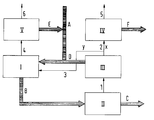
- the invention is based on a drawing and a Example further explained.
- the drawing includes a figure that has a flow diagram represents the inventive method.
- About the Line (A) is the leaching residue in the Sludge dryer (I) initiated.
- the pre-dried and Granulated sludge is fed into the rotary or Rolling furnace (II) initiated.
- the rolling furnace (II) becomes Rolling slag discharged via line (C).
- From the Rolling furnace (II) is containing solids via line (1)
- From the Dust chamber (III) becomes coarse-grained material, that is Voroxid, discharged via line (D).
- the line (D) goes into line (A) and leads into the Sludge dryer (I).
- the dust chamber (III) becomes over the line (2) exhaust gas containing rolling oxide is discharged.
- Line (2) is branched off the line (3) via the one Part of the exhaust gas containing rolling oxide (y) in the Sludge dryer (I) is initiated.
- the rest Exhaust gas (x) containing rolling oxide is fed in via line (2) the exhaust system (IV) initiated.
- the rolling oxide is separated from the exhaust gas and via the Line (F) discharged.
- the exhaust gas is from the exhaust system discharged via line (5).
- the exhaust from the Sludge dryer (I) is via line (4) in the Exhaust filter (V) initiated.
- the one in the exhaust filter (V) separated solid is via line (E) dissipated.
- Line (E) merges into line (A).
- the solid matter is thus via lines (E) and (A) returned to the sludge dryer (I).
- the exhaust off the exhaust gas filter (V) is discharged via line (6).
Landscapes
- Engineering & Computer Science (AREA)
- Chemical & Material Sciences (AREA)
- Manufacturing & Machinery (AREA)
- Materials Engineering (AREA)
- Mechanical Engineering (AREA)
- Metallurgy (AREA)
- Organic Chemistry (AREA)
- Environmental & Geological Engineering (AREA)
- Life Sciences & Earth Sciences (AREA)
- General Life Sciences & Earth Sciences (AREA)
- Geology (AREA)
- Treatment Of Sludge (AREA)
- Manufacture And Refinement Of Metals (AREA)
- Processing Of Solid Wastes (AREA)
- Solid Fuels And Fuel-Associated Substances (AREA)
- Organic Low-Molecular-Weight Compounds And Preparation Thereof (AREA)
Claims (6)
- Procédé de traitement de boues métallifères en utilisant un four tournant, qui consistea) à présécher la boue et à séparer le gaz qui s'échappe de la matière solide et à l'évacuer,b) à faire passer au four tubulaire la boue séchée suivant le stade a) du procédé, à décharger les scories formées lors du passage au four tubulaire et à évacuer le gaz d'échappement contenant de la matière solide,c) à séparer la matière solide à gros grains du gaz qui s'échappe suivant le stade b) du procédé et à l'envoyer au séchage de la boue suivant le stade a) du procédé et à envoyer une partie du gaz qui s'échappe et qui est séparé de la matière solide à gros grain au séchage de la boue suivant le stade a) du procédé,d) à séparer et à évacuer le gaz restant qui s'échappe suivant le stade c) du procédé de la matière solide et à recueillir comme produit la matière fine,e) à envoyer la matière solide séparée au stade a) du procédé au séchage de la boue suivant le stade a) du procédé,
- Procédé suivant la revendication 1, dans lequel la boue est séchée, suivant le stade a) du procédé, à une température des gaz de 500 à 800°C.
- Procédé suivant la revendication 1 ou 2, dans lequel on établit lors du passage au four tournant, suivant le stade b) du procédé, une température de 1000 à 1200°C.
- Procédé suivant l'une des revendications 1 à 3, dans lequel on sépare, suivant le stade c) du procédé, une matière solide à gros grains ayant une granulométrie inférieure à 30 mm.
- Procédé suivant les revendications 1 à 4, dans lequel on règle la quantité du gaz qui s'échappe qui est envoyé au séchage de la boue au stade c) du procédé, de manière que la boue séchée, suivant le stade a) du procédé, ait une teneur en eau de 10 à 20 % en poids.
- Procédé suivant les revendications 1 à 5, dans lequel on sépare, suivant le stade e) du procédé, une matière solide ayant une granulométrie inférieure à 1 mm et une température de 100 à 200°C.
Applications Claiming Priority (2)
| Application Number | Priority Date | Filing Date | Title |
|---|---|---|---|
| DE19944436918 DE4436918C1 (de) | 1994-10-15 | 1994-10-15 | Verfahren zum Wälzen von metallhaltigem Schlamm |
| DE4436918 | 1994-10-15 |
Publications (2)
| Publication Number | Publication Date |
|---|---|
| EP0709472A1 EP0709472A1 (fr) | 1996-05-01 |
| EP0709472B1 true EP0709472B1 (fr) | 1999-06-30 |
Family
ID=6530877
Family Applications (1)
| Application Number | Title | Priority Date | Filing Date |
|---|---|---|---|
| EP95113465A Expired - Lifetime EP0709472B1 (fr) | 1994-10-15 | 1995-08-28 | Procédé de traitement de boues métallifères |
Country Status (5)
| Country | Link |
|---|---|
| EP (1) | EP0709472B1 (fr) |
| BG (1) | BG61731B1 (fr) |
| DE (2) | DE4436918C1 (fr) |
| PE (1) | PE18396A1 (fr) |
| PL (1) | PL310919A1 (fr) |
Cited By (1)
| Publication number | Priority date | Publication date | Assignee | Title |
|---|---|---|---|---|
| WO2023089234A1 (fr) | 2021-11-16 | 2023-05-25 | Teknologian Tutkimuskeskus Vtt Oy | Procédé hydrométallurgique pour des déchets issus des industries du zinc et de l'acier |
Families Citing this family (1)
| Publication number | Priority date | Publication date | Assignee | Title |
|---|---|---|---|---|
| DE102016005787A1 (de) * | 2016-05-13 | 2017-11-16 | Befesa Zinc Duisburg GmbH | Verfahren und Anlage zum Gewinnen von hochreinem Wälzoxid aus zinkhaltigen Rohstoffen mittels gegenstrombetriebenem Drehrohrofen |
Family Cites Families (6)
| Publication number | Priority date | Publication date | Assignee | Title |
|---|---|---|---|---|
| DE542973C (de) * | 1930-08-14 | 1932-01-30 | Metallgesellschaft Ag | Verfahren zur Behandlung der kohlehaltigen Rueckstaende von Verfluechtigungsverfahren in Drehrohroefen |
| DE2743282A1 (de) * | 1977-09-27 | 1979-04-05 | Metallgesellschaft Ag | Waelzverfahren zur verfluechtigung von zink und blei aus eisenoxydhaltigen materialien |
| DE2936143A1 (de) * | 1978-11-02 | 1980-05-14 | Luebeck Metallhuette | Verfahren zur aufbereitung von bei der gasreinigung von hochofen- und stahlwerken entstehenden schlaemmen |
| DE4117716A1 (de) * | 1991-05-30 | 1992-12-03 | Metallgesellschaft Ag | Zinkentfernung aus phosphatschlaemmen |
| DE4303722C1 (de) * | 1993-02-10 | 1994-05-05 | Metallgesellschaft Ag | Verfahren zur thermischen Abtrennung von organischen und/oder anorganischen Stoffen aus kontaminiertem Material |
| DE4308549C2 (de) * | 1993-03-17 | 1995-07-06 | Sueddeutsche Kalkstickstoff | Verfahren zur Herstellung gebrannter Metallverbindungen in einem Drehrohrofen und deren Verwendung |
-
1994
- 1994-10-15 DE DE19944436918 patent/DE4436918C1/de not_active Expired - Lifetime
-
1995
- 1995-08-28 EP EP95113465A patent/EP0709472B1/fr not_active Expired - Lifetime
- 1995-08-28 DE DE59506305T patent/DE59506305D1/de not_active Expired - Lifetime
- 1995-09-21 PE PE27963895A patent/PE18396A1/es not_active Application Discontinuation
- 1995-10-09 BG BG100056A patent/BG61731B1/bg unknown
- 1995-10-12 PL PL31091995A patent/PL310919A1/xx unknown
Cited By (1)
| Publication number | Priority date | Publication date | Assignee | Title |
|---|---|---|---|---|
| WO2023089234A1 (fr) | 2021-11-16 | 2023-05-25 | Teknologian Tutkimuskeskus Vtt Oy | Procédé hydrométallurgique pour des déchets issus des industries du zinc et de l'acier |
Also Published As
| Publication number | Publication date |
|---|---|
| DE4436918C1 (de) | 1996-05-23 |
| PL310919A1 (en) | 1996-04-29 |
| EP0709472A1 (fr) | 1996-05-01 |
| PE18396A1 (es) | 1996-06-20 |
| BG100056A (bg) | 1996-05-31 |
| DE59506305D1 (de) | 1999-08-05 |
| BG61731B1 (bg) | 1998-04-30 |
Similar Documents
| Publication | Publication Date | Title |
|---|---|---|
| EP0499779B1 (fr) | Procédé de traitement des déchets | |
| DE2917751A1 (de) | Verfahren zur gewinnung von kupfer aus hochtoxischem, arsenhaltigem flugstaub aus schmelzoefen und bzw. oder aus raffinerieschlaemmen | |
| DE3334627C2 (de) | Salzröstverfahren für Vanadiumerze in Gegenwart von Kohlenstoff | |
| DE3145220C2 (de) | Verfahren zur Gewinnung von Lanthaniden, Actiniden sowie Elementen der Gruppen Vb und VIb aus den Verbrennungsrückständen von Kohlen, insbesondere Braunkohlen, durch Digerieren | |
| EP0131848B1 (fr) | Procédé pour l'élimination de corps étrangers de la circulation de matériaux dans la préparation électrothermique du phosphore jaune | |
| EP0709472B1 (fr) | Procédé de traitement de boues métallifères | |
| DE2914823C2 (fr) | ||
| DE4205096A1 (de) | Verfahren zum behandeln von abfaellen | |
| EP0012363B1 (fr) | Procédé et dispositif pour la réduction de minerais | |
| DE3042941C2 (de) | Verfahren zum Abtrennen von Nichteisenmetallen aus eisenhaltigen Stoffen | |
| DE69016593T2 (de) | Verfahren und Vorrichtung zum Behandeln von Zinkkonzentraten. | |
| AT405528B (de) | Verfahren zum verwerten von bei metallurgischen prozessen anfallenden stäuben | |
| EP0021465B1 (fr) | Procédé de briquettage d'un matériau contenant de l'éponge de fer | |
| DE1517166A1 (de) | Verfahren zum Behandeln einer organische und anorganische Stoffe enthaltenden Ablauge | |
| DE4122895C1 (fr) | ||
| EP0056880B1 (fr) | Procédé de préparation de briquettes d'addition pour four à zinc | |
| DE3540818C2 (fr) | ||
| DE4122894C1 (fr) | ||
| DE2253591A1 (de) | Verfahren zur reinigung und rueckgewinnung der inhaltsstoffe von abgasen metallurgischer schmelzprozesse | |
| DE2400451A1 (de) | Verfahren zur behandlung von sulfidhaltigen materialien | |
| AT407634B (de) | Verfahren zur verwertung von kohlenwasserstoff- und zunderhältigen schlämmen | |
| DE43231C (de) | Verfahren zur Gewinnung von Edelmetallen aus und mittels Zusetzens von zirconiumhaltigen Erzen | |
| DE2427158C3 (de) | Verfahren zur Behandlung von Kupfereisensulfiderzkonzentraten | |
| DE19507803C2 (de) | Verfahren zur Reduzierung der Schwermetallgehalte von schwermetallhaltigen Verbrennungs- und Pyrolyserückständen | |
| DD207932A1 (de) | Verfahren zur rueckgewinnung der kobalt-, tantal- und niobbestandteile aus hartmetallschrotten |
Legal Events
| Date | Code | Title | Description |
|---|---|---|---|
| PUAI | Public reference made under article 153(3) epc to a published international application that has entered the european phase |
Free format text: ORIGINAL CODE: 0009012 |
|
| AK | Designated contracting states |
Kind code of ref document: A1 Designated state(s): DE IT NL |
|
| 17P | Request for examination filed |
Effective date: 19961104 |
|
| GRAG | Despatch of communication of intention to grant |
Free format text: ORIGINAL CODE: EPIDOS AGRA |
|
| GRAG | Despatch of communication of intention to grant |
Free format text: ORIGINAL CODE: EPIDOS AGRA |
|
| GRAH | Despatch of communication of intention to grant a patent |
Free format text: ORIGINAL CODE: EPIDOS IGRA |
|
| GRAH | Despatch of communication of intention to grant a patent |
Free format text: ORIGINAL CODE: EPIDOS IGRA |
|
| 17Q | First examination report despatched |
Effective date: 19980812 |
|
| RAP1 | Party data changed (applicant data changed or rights of an application transferred) |
Owner name: METALLGESELLSCHAFT AKTIENGESELLSCHAFT |
|
| GRAH | Despatch of communication of intention to grant a patent |
Free format text: ORIGINAL CODE: EPIDOS IGRA |
|
| GRAA | (expected) grant |
Free format text: ORIGINAL CODE: 0009210 |
|
| AK | Designated contracting states |
Kind code of ref document: B1 Designated state(s): IT NL |
|
| PG25 | Lapsed in a contracting state [announced via postgrant information from national office to epo] |
Ref country code: NL Free format text: LAPSE BECAUSE OF FAILURE TO SUBMIT A TRANSLATION OF THE DESCRIPTION OR TO PAY THE FEE WITHIN THE PRESCRIBED TIME-LIMIT Effective date: 19990630 Ref country code: IT Free format text: LAPSE BECAUSE OF FAILURE TO SUBMIT A TRANSLATION OF THE DESCRIPTION OR TO PAY THE FEE WITHIN THE PRE;WARNING: LAPSES OF ITALIAN PATENTS WITH EFFECTIVE DATE BEFORE 2007 MAY HAVE OCCURRED AT ANY TIME BEFORE 2007. THE CORRECT EFFECTIVE DATE MAY BE DIFFERENT FROM THE ONE RECORDED.SCRIBED TIME-LIMIT Effective date: 19990630 |
|
| RBV | Designated contracting states (corrected) |
Designated state(s): IT NL |
|
| REF | Corresponds to: |
Ref document number: 59506305 Country of ref document: DE Date of ref document: 19990805 |
|
| NLV1 | Nl: lapsed or annulled due to failure to fulfill the requirements of art. 29p and 29m of the patents act | ||
| PLBE | No opposition filed within time limit |
Free format text: ORIGINAL CODE: 0009261 |
|
| STAA | Information on the status of an ep patent application or granted ep patent |
Free format text: STATUS: NO OPPOSITION FILED WITHIN TIME LIMIT |
|
| 26N | No opposition filed |