EP0708942B1 - Verfahren und struktur zur bewertung und verbesserung der leistung von cache-speicheranordnungen - Google Patents
Verfahren und struktur zur bewertung und verbesserung der leistung von cache-speicheranordnungen Download PDFInfo
- Publication number
- EP0708942B1 EP0708942B1 EP94922542A EP94922542A EP0708942B1 EP 0708942 B1 EP0708942 B1 EP 0708942B1 EP 94922542 A EP94922542 A EP 94922542A EP 94922542 A EP94922542 A EP 94922542A EP 0708942 B1 EP0708942 B1 EP 0708942B1
- Authority
- EP
- European Patent Office
- Prior art keywords
- cache
- statistics
- elements
- lru
- file
- Prior art date
- Legal status (The legal status is an assumption and is not a legal conclusion. Google has not performed a legal analysis and makes no representation as to the accuracy of the status listed.)
- Expired - Lifetime
Links
Images


Classifications
-
- G—PHYSICS
- G06—COMPUTING OR CALCULATING; COUNTING
- G06F—ELECTRIC DIGITAL DATA PROCESSING
- G06F12/00—Accessing, addressing or allocating within memory systems or architectures
- G06F12/02—Addressing or allocation; Relocation
- G06F12/08—Addressing or allocation; Relocation in hierarchically structured memory systems, e.g. virtual memory systems
- G06F12/12—Replacement control
- G06F12/121—Replacement control using replacement algorithms
- G06F12/123—Replacement control using replacement algorithms with age lists, e.g. queue, most recently used [MRU] list or least recently used [LRU] list
-
- G—PHYSICS
- G06—COMPUTING OR CALCULATING; COUNTING
- G06F—ELECTRIC DIGITAL DATA PROCESSING
- G06F11/00—Error detection; Error correction; Monitoring
- G06F11/30—Monitoring
- G06F11/34—Recording or statistical evaluation of computer activity, e.g. of down time, of input/output operation ; Recording or statistical evaluation of user activity, e.g. usability assessment
- G06F11/3447—Performance evaluation by modeling
-
- G—PHYSICS
- G06—COMPUTING OR CALCULATING; COUNTING
- G06F—ELECTRIC DIGITAL DATA PROCESSING
- G06F12/00—Accessing, addressing or allocating within memory systems or architectures
- G06F12/02—Addressing or allocation; Relocation
- G06F12/08—Addressing or allocation; Relocation in hierarchically structured memory systems, e.g. virtual memory systems
- G06F12/0802—Addressing of a memory level in which the access to the desired data or data block requires associative addressing means, e.g. caches
- G06F12/0888—Addressing of a memory level in which the access to the desired data or data block requires associative addressing means, e.g. caches using selective caching, e.g. bypass
-
- G—PHYSICS
- G06—COMPUTING OR CALCULATING; COUNTING
- G06F—ELECTRIC DIGITAL DATA PROCESSING
- G06F11/00—Error detection; Error correction; Monitoring
- G06F11/30—Monitoring
- G06F11/34—Recording or statistical evaluation of computer activity, e.g. of down time, of input/output operation ; Recording or statistical evaluation of user activity, e.g. usability assessment
- G06F11/3452—Performance evaluation by statistical analysis
-
- G—PHYSICS
- G06—COMPUTING OR CALCULATING; COUNTING
- G06F—ELECTRIC DIGITAL DATA PROCESSING
- G06F2201/00—Indexing scheme relating to error detection, to error correction, and to monitoring
- G06F2201/805—Real-time
-
- G—PHYSICS
- G06—COMPUTING OR CALCULATING; COUNTING
- G06F—ELECTRIC DIGITAL DATA PROCESSING
- G06F2201/00—Indexing scheme relating to error detection, to error correction, and to monitoring
- G06F2201/885—Monitoring specific for caches
Definitions
- This invention relates to methods and structures that can be used to predict the effectiveness of using a Least Recently Used (LRU) type of cache memory to improve computer performance.
- the method and structure collects a unique set of statistics for each element that can be cache enabled or cache disabled, and uses these and other known statistics to create a unique probabilistic model. This model is used to predict the effects of including or removing the element from the set of all elements that are to be cached. Finally, the method and structure of this invention can be used to rank the elements (using results of the probabilistic model) to determine the best elements to be cached.
- the method and structure of this invention is useful for, but not limited to, the analysis of measured systems to produce performance reports. It is also used as a real-time dynamic cache management scheme to optimize the performance of cached systems.
- Caching is a technique used to improve computer performance at all levels of the computer storage hierarchy.
- computer memory can vary in performance and cost.
- CPU Central Processing Unit
- data is often moved from slower, less costly memory to very high speed (and more costly) memory that can be accessed directly by the CPU.
- the higher speed memory is called the CPU memory cache. If the data in this memory is re-referenced many times, than it is said that there is a high cache hit rate. If the data is not re-referenced by the CPU, then it is replaced by other data that is needed. If data is never re-referenced, but always flushed out due to new data requests, then the cache hit rate is said to be very low.
- a good description of memory caching is presented in Friedman, Mark B, MVS Memory Management, CMG '91 Proceedings, 747-771.
- caching techniques are employed in two ways. First, a memory cache is available for some tape systems. This memory cache is similar to the cache used for spinning disks. A second kind of cache is also used. For robotic tape libraries, there are a limited number of tape readers being shared by a large silo of tapes. If tapes are re-referenced often this could be considered as a cache hit where the cache is now the tape reader. To achieve a specific level of performance (such as an average of two minutes to access tape data), a number of tape readers must be configured. This number is directly related to the hit rate of the tapes that are placed in the readers. A high hit rate implies less tape readers are needed to meet the requested performance level.
- a detailed discussion of caching and cache modeling techniques throughout the storage hierarchy is presented in Olcott, Richard, "Workload Characterization for Storage Modeling", CMG '91 Proceedings, 705-716.
- LRU Least Recently Used
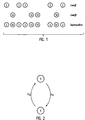
- the LRU algorithm uses a stack of a limited size. Specific elements are specified as being cache enabled. For example, for disk caching, specific files or specific disks are the elements that are cache enabled or disabled. For memory caching, specific addresses or pages are assigned to the cache. The most recently used request is placed on the top of the stack. The least recently used request is at the bottom of the stack. When a new request arrives, and there is no more room in the stack, the least recently used request is replaced by the new request. Table #1 shows an arrival process of ten requests for tracks of disk data. Disks 1 and 2 are enabled. The size of the LRU stack is three. The cache memory can hold three disk track's worth of data.
- the cache hit rate is 50%. Notice that the cache hit rate is a function of the arrival of data requests and the size of the LRU stack. The size of the LRU stack is determined by the size of cache memory. If the cache memory had been able to hold four track's worth, the eighth arrival would have pushed request 2/5 to the fourth position and the ninth arrival would have been a cache hit.
- the LRU caching algorithm is effective due to a quality that has been observed in computer systems called locality of reference. Although this quality has not been exactly quantified in the past, it has been shown empirically to follow certain principles.
- references are concentrated on a small set of the elements assigned to the cache.
- the probability of it being re-referenced is highest right after it is referenced, with the probability of re-referencing diminishing as the time interval since the first reference increases.
- the most common technique used to predict cache hit rates is to use a discrete event simulator.
- the input for the simulator is an I/O trace file. This file has an entry for each I/O that arrived during the measurement interval (which is usually about five minutes). In each entry is the unique disk name and the address on the disk for the READ or WRITE of the data. Using the address, the track for the address is calculated.
- An LRU stack is implemented in the simulation. This LRU stack is then used to determine if, in an actual system of similar configuration, the I/O would be a cache hit or miss. Basically, the simulation models the system's LRU stack behavior and then reports the percentage of I/Os that would have resulted in a cache hit or miss.
- LRU buffer refers to the LRU stack as mentioned above.
- IRM Independent Reference Model
- each pool is characterized by a "single reference residency time” and an “average residency time” (which is also called the “average holding time”).
- the single reference residency time which is also called the “back end” of the average residency time, is the average amount of time taken for an entry in the LRU stack to migrate to the end of the list and be removed, assuming that there are no more references.
- there is a "front end” residency time which is the average amount of time that the track remains in the LRU stack before its last reference and subsequent removal from the LRU stack.
- the average residency time is then the sum of the "front end" and "back end” times.
- This invention provides a unique method and structure for collecting the necessary statistics for quantifying locality of data. Once the necessary statistics are collected, the method and structure of this invention can then choose the best elements to be cache enabled, and can calculate the overall cache hit rate as a function of the elements that are sharing the cache.
- the LRU stack distance has a straight-forward probabilistic interpretation and is part of the statistics which are used to quantify locality of data for each element that is being considered for caching.
- the request rate for additional slots in the LRU stack are a function of the request rate for the element and a function of the size of the LRU itself.
- the cache hit rate is a function of the locality of data and the relative request rates for elements, but it is not the rate at which the overall cached data is being requested.
- An element can be a data set when disk caching is being performed, a tape cartridge when a library of tape cartridges are being cached, or a memory buffer when CPU memory is being cached.
- an exemplary embodiment is described in which disk caching is performed in accordance with this invention. However, it is to be understood that the teachings of this invention apply to all caching techniques which utilize an LRU stack.
- This invention uses specific locality parameters for each data set and the arrival rate of requests for the data sets to produce an exact analytical model which can be used to calculate the cache hit rate for combinations of various data sets, given a specific size of the LRU stack.
- one embodiment of this invention uses statistics that can be gathered in real time with no need for sorting.
- the results of the invention is an exact method for choosing which files will improve the overall cache hit rate, along with a method to calculate that hit rate given the data set's locality statistics, the arrival rates of the data sets and the LRU stack size.
- This invention consists of methods and structures that collect in real time specific locality parameters and the I/O request rate for each data set, and which then selects the optimal data sets for including in a disk cache. It can also calculate the exact cache hit rate for the collection of data sets.
- the invention is presented in exemplary form in the context of disk caching, but is not restricted solely to this domain. It applies equally when considering management of tape cartridge drives, CPU level memory cache, or any process where the LRU algorithm is employed.
- the following rather simple scenarios provide some intuition into the operation of cache systems.
- the file consists of t tracks of data, where the track size is assumed to be 32,000 bytes. If the total cache size is 16 Megabytes, then the size of the LRU stack is 500. If t ⁇ 500, then after a "sufficient" amount of time, all tracks will be present in the LRU list and all references to the file will result in a cache hit. After the "warm-up" period, since the probability of a cache hit is 1, the cache hit rate will be 100%. This scenario is not normally the case. Alternatively, if the file is 64 Megabytes large, then one quarter of the file can be stored in the cache.
- a very common type of reference to a file is sequential. Assume that there are 10 records in each 32,000 byte track of the file. If one user is sequentially reading the file, a track gets read into cache memory for the first record in the track. The next nine reads are then satisfied from the track which has been stored in cache memory. Note that no records are re-referenced, but the cache hit rate is nine out of ten, or 90%. In this example, the size of the cache could be one track large or 100 tracks large - in either case, the hit rate will be the same. Add to this scenario a second user accessing a different file sequentially, but sharing the same cache memory. Given two tracks' worth of cache, each user could realize a 90% hit rate, with the overall cache having a 90% hit rate.
- a cache hit will only occur when two of the same user's requests arrive one after the next. Otherwise, the cache will continually be alternating tracks.
- a novel cache memory model specifies that the probability of having a cache hit is not affected by elapsed time, but rather by the ratio of the request rates of File#1 and File#2. For example, the above scenario does not change if File#1 is accessed at a rate of 1 per second and File#2 is accessed at a rate of 0.1 per second.
- a novel cache memory model uses the fraction of memory accesses or "I/Os" for each file with respect to the total number of I/O's for all files, which is identified using the Greek symbol for lambda ( ⁇ ), together with a set of statistics that identify cycles of re-reference on a track basis for each file. These statistics are identified using the Greek letter gamma ( ⁇ ). In the previous scenario, the statistics would be: where the arrival rates are a column vector ⁇ and the cycles of re-reference for each file are a row of the ⁇ matrix. In this scenario, the probability of a re-reference given one track for a file is the first entry in the row of the ⁇ matrix.
- stack distance As in the above-mentioned references of Verkamo and Ho, this is a measure of "stack distance". The difference is that here, stack distances greater than one are calculated. In addition, this stack distance is given a probabilistic meaning. The probability of a re-reference given two tracks is in the second place. This row of re-reference can actually extend for the total number of tracks in the file. In the above scenario, the probability of re-reference given additional tracks in cache are near zero.
- the re-reference statistics for each file are used with the arrival rate for the file to calculate the overall cache hit rate, given that the files are sharing the cache memory.
- the re-reference statistics are used alone to determine which files are optimal for caching.
- an LRU stack is used for each file. As I/Os are processed (either in real time or using an I/O trace), the position in the LRU stack is used to determine these statistics. Using the preceding example, it can be shown that the frequency of hits at a level of the LRU stack determines the conditional frequency of a re-reference given the number of tracks occupied by the file. TABLE 2 Arrival Track 1 2 Level of Cache Hit 1 3 3 2 10 10 3 3 3 3 10 2 4 3 3 10 1 5 10 10 3 2 6 10 10 3 1 7 3 3 10 2 8 10 10 3 2 9 3 3 10 2
- Table #2 shows the LRU stack for each I/O arrival, in the example of Figure 1. Note that there are two hits at LRU level 1 and five hits at LRU level 2, as was calculated with reference to Figure 1. The I/O rates for the two files do not need to be normalized to any specific time interval, since it is their ratio that is needed.
- ⁇ .j the re-reference statistics for all files in the cache, where j ranges over the total number of tracks, t, that can be held in cache memory. If File#1 is cached alone, then and therefore for a given size of cache, k ⁇ t,
- the re-reference statistics for all files in the cache are calculated by adding one file at a time.
- ⁇ ' .j is a function of ⁇ 1i and ⁇ 2j .
- ⁇ " .j , ⁇ ′′′ .j are calculated recursively.
- the arrival rate to the cache is updated to be the sum of the arrival rates for File#1 and File#2.
- calculating the statistics involves the analysis of a birth-Death process or its corresponding discrete Markov process, or Markov chain. By keeping the number of files being evaluated to two, we reduce the number of states in the evaluation.
- the birth-Death process is used to show how, with each I/O arrival, the state of the cache changes. This change is only dependent on the previous state and the arrival of the I/O. To simplify the discussion, a process will be constructed to show how the two files compete for cache memory where cache memory can hold a maximum of one, two, and then three tracks.
- P 1,1 (1) The probability of File#1 occupying the one track is denoted as: P 1,1 (1) where the superscript is the number of tracks, the first subscript is the file number and the second subscript is the number of tracks in cache.
- P 1,1 (1) P 2,0 (1)
- P 1,0 (1) P 2,1 (1)
- Figure 2 is a state-transition diagram for a one track cache memory. As shown in Figure 2, this system has two states - a first state where File#l is using the cache memory and a second state when File#2 is using the cache memory.
- Figure 3 shows the state-transition diagram of such a cache memory having two tracks. Inspect the transition rate from state XO to XX. Compare this to the rate from OX to XO. Once an entry for File#1 is at the head of the LRU stack, there is a probability ⁇ 11 that the next arrival will be a re-reference of File#1. If that is the case, then the state will not transition from XO to XX. Therefore, the rate of transition is the arrival rate for File#1 times the probability that there will not be a re-reference. The same notion applies to the transition from OX to OO. Otherwise, the transitions between the various states is fairly straight-forward.
- Figure 4 shows the Transition-State diagram for such a three track cache memory system. Note that the transition rate from state OXO to XOO is ⁇ 1 ⁇ 11 Note that the only way to transition from OXO to XOO is if there is an arrival for File#1 and it re-references the one track occupied by File#1. The other transition rates are self-explanatory.
- the cache re-reference statistics, ⁇ .1 ' are calculated.
- File#1 will be shown for the first three tracks. This is followed by a general algorithm for t traces, where t is the total number of tracks to be calculated.
- the probabilities can then be calculated for each new file added to the cache memory.
- Discrete event simulations were run to validate the analytic model.
- the following model is an example of the validation. It is one of many that were run during the development of this invention.
- the following simulation results used ten independent runs of 1000 I/Os each.
- the confidence intervals were calculated using a Student-T distribution with nine degrees of freedom and a significance level of 95%.
- n) the probability of occupying m other slots given that it occupies the last slot of a cache of size n .
- O O 2 (0
- OX O 1 (0
- XX O 1 (1
- XXX O 1 (2
- XXO O 2 (0
- OOO O 2 (2
- ⁇ ' 11 O 1 (0
- the total cache hit rate for File#1 and File#2 in a cache of length T is:
- the ranking of the files can be performed without establishing the resulting cache hit rate. All that needs to be done is to choose the best candidates. Whatever the resulting cache hit rate, we can guarantee that the hit rate will be optimal for the optimal files.
- One useful implementation is to monitor the cache hit rate, choose an optimal set of files to include, choose the least optimal files to exclude, and then measure the hit rate again after a small time duration.
- a Ranking function is defined as: for all values of T where the gammas are non-zero.
- a general heuristic for choosing files, given a current set of re-reference statistics for the disk, is the following. Select all files whose rank is greater than the rank of the disk. After selecting these files, re-rank the files using the ranking function times the arrival rate. In this way, the file with the highest arrival rate that will improve the disk cache hit rate will be selected.
- the above heuristic has not been proven to work in all cases.
- the only certain way of picking the optimal file is to re-calculate the LRU model using the current disk statistics as one file and the candidate file for the other file and calculating the total cache hit rate. Since this can be performed in ⁇ (n 2 ) operations, the re-running of the model for the most active files will not require significant CPU power.
- the uniqueness of this invention is that it provides algorithms that can be directly implemented in software for constructing a precise model that can be used to predict cache hit rates for a cache using statistics that can be accumulated for each element of the cache independently.
- disk cache has been used as an example, with files being the elements considered.
- the same algorithms can be used to model main CPU memory cache or the caching of tape cartridges.
- FIGs 5 and 6 graphically show the difference between the prior art ( Figure 5) and this invention method ( Figure 6) for analyzing the effectiveness of cache.
- a cache can be used for CPU memory, disk drives, tape drives, or any system where a Least Recently Used (LRU) algorithm is applied.
- LRU Least Recently Used
- disks these elements would be files.
- tape libraries these elements would be tape cartridges.
- CPU memory these elements may be pages of memory belonging to a single program or user code.
- the majority of the current practitioners who evaluate the effectiveness of cache do the analysis by measuring the entire cache's cache hit rate.
- the cache hit rate is usually gathered by a computer system's operating system (Real-Time Statistics) and output as raw data to be read by the practitioner.
- the trace statistics are used. Trace statistics show the arrivals at the LRU stack. Using a simulation, the effectiveness of various cache sizes can be modeled and the cache hit rate predicted. In other cases, the trace statistics are used to provide estimators for the performance of the entire cache, which can then be used in statistical models to estimate and predict the cache hit rate. All of these techniques are shown graphically in Figure 5.
- the method of this invention is to use either real-time statistics from an operating system or use the trace data to find statistics that are independent for each element of the cache. Instead of considering the cache as a whole, the average arrival rates (lambdas) and re-reference statistics (gammas) for each element are estimated. These estimates can then be used in two ways. First, they can be used to consider various combinations of the elements and cache sizes in predicting the cache hit rate. In other words, one may want to consider what the cache hit rate would be for five specific files. The cache hit rate can be directly calculated (using an exact analytical model) using the five files' arrival rates and re-reference statistics with no need for additional LRU simulation. The arrival rates and re-reference statistics are the necessary statistics for the model. This could not be done using the prior art methods. Secondly, these statistics can be used to rank the elements of the cache to find the set that produces the optimal (highest) cache hit rate. This could not be calculated using the prior art methods since the necessary statistics had never been identified.
Landscapes
- Engineering & Computer Science (AREA)
- Theoretical Computer Science (AREA)
- General Engineering & Computer Science (AREA)
- General Physics & Mathematics (AREA)
- Physics & Mathematics (AREA)
- Evolutionary Biology (AREA)
- Computer Hardware Design (AREA)
- Bioinformatics & Computational Biology (AREA)
- Quality & Reliability (AREA)
- Life Sciences & Earth Sciences (AREA)
- Bioinformatics & Cheminformatics (AREA)
- Memory System Of A Hierarchy Structure (AREA)
- Management, Administration, Business Operations System, And Electronic Commerce (AREA)
- Complex Calculations (AREA)
Claims (19)
- Verfahren zum Betreiben eines Computersystems, umfassend einen Massenspeicher, einen oder mehrere Prozessoren und einen oder mehrere in dem Massenspeicher gespeicherte Elemente zum Bestimmen der Leistung des Computersystems, falls eines oder mehrere dieser Elemente bevorratet sind in einem Cache-Speicher unter Verwendung eines LRU Algorithmus, wobei das Verfahren die Schritte umfaßt:Verwenden mindestens eines der Prozessoren zum Sammeln eines Statistiksatzes für eine Mehrzahl der Elemente, wobei diese Statistiken sich unabhängig auf jedes Element beziehen;Benutzen mindestens eines der Pozessoren zum Erzeugen eines stochastischen Modells, basierend auf dem Statistiksatz; undBenutzen mindestens eines der Prozessoren zum Manipulieren des stochastischen Modells zum Vorhersagen der Effekte auf die Systemleistung einer oder beider Änderungen bestehend aus Einschließen oder Ausschließen eines oder mehrerer der Elemente von dem Cache-Speicher und Cache-Speichergröße.
- Verfahren nach Anspruch 1, das weiterhin umfaßt den Schritt eines Manipulierens des stochastischen Modells und dadurch Bestimmen, welches eine oder welche mehrere der Elemente vorzugsweise bevorratet sein sollten.
- Verfahren nach Anspruch 1, das weiterhin umfaßt den Schritt eines Rankings des einen oder der mehreren Elemente, die vorzugsweise bevorratet sein sollten, basierend auf der vorhergesagten Verbesserung im Computersystem, wodurch Leistung bewirkt wird auf Bevorratung hin eines jeden der Elemente.
- Verfahren nach Anspruch 1, wobei der Schritt des Sammelns ausgeführt wird während des normalen Betriebs des Computersystems, bezogen auf die Verwendung des einen Elementes oder der mehreren Elemente.
- Verfahren nach Anspruch 1, wobei der Massenspeicher eine Größe größer als und eine Arbeitsgeschwindigkeit kleiner als der Cache besitzt.
- Verfahren nach Anspruch 1, wobei der Massenspeicher eine Diskette und der Cache einen Festkörperspeicher umfassen.
- Verfahren nach Anspruch 1, wobei der Massenspeicher eine Band-Bibliothek und der Cache Bandlaufwerke umfassen.
- Verfahren nach Anspruch 1, wobei der Massenspeicher Zentralprozessoreinheit(CPU)-Speicherseiten und der Cache einen Zentralprozessoreinheit(CPU)-Speicher-Cache umfassen.
- Verfahren nach Anspruch 1, wobei der Statistiksatz für jedes Element, für das die Statistik bestimmt wird, umfaßt:den Bruch der Zugriffe für das Element in bezug auf die Gesamtzahl der Zugriffe für alle Elemente; undden Bruch der Wiederholungsreferenzzugriffe eines jeden Elements in bezug auf die Gesamtzahl der Zugriffe für das Element.
- Verfahren nach Anspruch 1, wobei der Schritt des Sammelns von Statistiken umfaßt den Schritt des Verwendens eines am längsten nicht benutzten (LRU) Stapelspeichers für jedes Element, wobei der LRU-Stapelspeicher eine Mehrzahl von Positionen enthält, die die Neuheit des Gebrauchs verschiedener Positionen des Elements anzeigen.
- Verfahren nach Anspruch 1, wobei eine Gesamt-Cache-Trefferquote berechnet wird unter Verwendung der Wiederholungsreferenzstatistik und der Anruffolgedichten.
- Verfahren nach Anspruch 1, wobei die Selektion der Elemente zur Bevorratung bestimmt wird durch Verwendung der Wiederholungsreferenzstatistik.
- Verfahren nach Anspruch 4, wobei der Schritt des Sammelns ausgeführt wird in Ist-Zeit.
- Verfahren nach Anspruch 4, wobei der Schritt des Sammelns ausgeführt wird durch Verwenden einer I/0-Spur einer vorhergehenden Betriebsperiode des Computersystems.
- Verfahren nach Anspruch 1, wobei der Schritt des Vorhersagens den Schritt einer Modellierung einer Mehrzahl von Cache-Größen unter Verwendung der Statistik umfaßt.
- Verfahren nach Anspruch 3, wobei die Ränge der Elemente bestimmt werden durch:Verwenden der Wiederholungsreferenzstatistik, Auswahl aller Elemente mit einem Rang höher als der Rang des Massenspeichers; undWiederholungs-Ranking der ausgewählten Elemente unter Verwendung einer Ranking-Funktion mal der Anruffolgedichte.
- Verfahren nach Anspruch 3, wobei die Elemente eine Rangordnung erhalten bezogen auf die Wiederholungsreferenzstatistik.
- Verfahren nach Anspruch 17, wobei die Elemente die Rangordnung erhalten bezogen auf eine Ranking-Funktion, definiert als
 Ri = die Rangordnung des iten Elements;t = der Index der Summation;T = die Zahl der LRU-Abschnitte; undγit = Wiederholungsreferenzstatistik für Element i.
- Verfahren nach Anspruch 17, wobei die Elemente eine Rangordnung erhalten, bezogen auf die Wahrscheinlichkeit, daß ein Element andere LRU-Abschnitte belegt, vorausgesetzt, daß das Element den letzten LRU-Abschnitt belegt.
Applications Claiming Priority (3)
| Application Number | Priority Date | Filing Date | Title |
|---|---|---|---|
| US93073 | 1993-07-16 | ||
| US08/093,073 US5452440A (en) | 1993-07-16 | 1993-07-16 | Method and structure for evaluating and enhancing the performance of cache memory systems |
| PCT/US1994/007858 WO1995002864A1 (en) | 1993-07-16 | 1994-07-13 | Method and structure for evaluating and enhancing the performance of cache memory systems |
Publications (2)
| Publication Number | Publication Date |
|---|---|
| EP0708942A1 EP0708942A1 (de) | 1996-05-01 |
| EP0708942B1 true EP0708942B1 (de) | 1997-09-17 |
Family
ID=22236828
Family Applications (1)
| Application Number | Title | Priority Date | Filing Date |
|---|---|---|---|
| EP94922542A Expired - Lifetime EP0708942B1 (de) | 1993-07-16 | 1994-07-13 | Verfahren und struktur zur bewertung und verbesserung der leistung von cache-speicheranordnungen |
Country Status (11)
| Country | Link |
|---|---|
| US (1) | US5452440A (de) |
| EP (1) | EP0708942B1 (de) |
| AT (1) | ATE158425T1 (de) |
| AU (1) | AU672719B2 (de) |
| CA (1) | CA2167307A1 (de) |
| DE (1) | DE69405758T2 (de) |
| DK (1) | DK0708942T3 (de) |
| ES (1) | ES2108475T3 (de) |
| GR (1) | GR3025221T3 (de) |
| HK (1) | HK1002941A1 (de) |
| WO (1) | WO1995002864A1 (de) |
Families Citing this family (96)
| Publication number | Priority date | Publication date | Assignee | Title |
|---|---|---|---|---|
| JP3169511B2 (ja) * | 1994-03-10 | 2001-05-28 | 三菱電機株式会社 | メモリ装置及びメモリ管理方法 |
| US6129458A (en) * | 1994-03-23 | 2000-10-10 | At&T Global Information Solutions Company | Cache optimization method |
| US5659743A (en) * | 1994-12-05 | 1997-08-19 | Legent Corporation | Method and apparatus for a pattern based spaced management system |
| US5713008A (en) * | 1995-06-08 | 1998-01-27 | Sun Microsystems | Determination of working sets by logging and simulating filesystem operations |
| US5787472A (en) * | 1995-07-31 | 1998-07-28 | Ibm Corporation | Disk caching system for selectively providing interval caching or segment caching of vided data |
| JPH0950401A (ja) * | 1995-08-09 | 1997-02-18 | Toshiba Corp | キャッシュメモリ及びそれを備えた情報処理装置 |
| JPH0981582A (ja) * | 1995-09-12 | 1997-03-28 | Fujitsu Ltd | 値を基本としたデータ管理装置及びデータ管理方法 |
| US5726913A (en) * | 1995-10-24 | 1998-03-10 | Intel Corporation | Method and apparatus for analyzing interactions between workloads and locality dependent subsystems |
| US5940621A (en) * | 1996-01-23 | 1999-08-17 | Hewlett-Packard Company | Language independent optimal size-based storage allocation |
| US5745737A (en) * | 1996-03-28 | 1998-04-28 | Sun Microsystems, Inc. | System and method for visually indicating cache activity in a computer system |
| US6513154B1 (en) * | 1996-10-21 | 2003-01-28 | John R. Porterfield | System and method for testing of computer programs in programming effort |
| US6065100A (en) * | 1996-11-12 | 2000-05-16 | Micro-Design International | Caching apparatus and method for enhancing retrieval of data from an optical storage device |
| US5822759A (en) * | 1996-11-22 | 1998-10-13 | Versant Object Technology | Cache system |
| US5918249A (en) * | 1996-12-19 | 1999-06-29 | Ncr Corporation | Promoting local memory accessing and data migration in non-uniform memory access system architectures |
| US5809528A (en) * | 1996-12-24 | 1998-09-15 | International Business Machines Corporation | Method and circuit for a least recently used replacement mechanism and invalidated address handling in a fully associative many-way cache memory |
| US5807449A (en) * | 1997-01-08 | 1998-09-15 | Hooker; Jeffrey A. | Workpiece treating apparatus and method of treating same |
| US7103794B2 (en) | 1998-06-08 | 2006-09-05 | Cacheflow, Inc. | Network object cache engine |
| US5999721A (en) * | 1997-06-13 | 1999-12-07 | International Business Machines Corporation | Method and system for the determination of performance characteristics of a cache design by simulating cache operations utilizing a cache output trace |
| US5940618A (en) * | 1997-09-22 | 1999-08-17 | International Business Machines Corporation | Code instrumentation system with non intrusive means and cache memory optimization for dynamic monitoring of code segments |
| US6072951A (en) * | 1997-10-15 | 2000-06-06 | International Business Machines Corporation | Profile driven optimization of frequently executed paths with inlining of code fragment (one or more lines of code from a child procedure to a parent procedure) |
| US6393526B1 (en) | 1997-10-28 | 2002-05-21 | Cache Plan, Inc. | Shared cache parsing and pre-fetch |
| US6128701A (en) * | 1997-10-28 | 2000-10-03 | Cache Flow, Inc. | Adaptive and predictive cache refresh policy |
| US6332178B1 (en) | 1997-11-26 | 2001-12-18 | Compaq Computer Corporation | Method for estimating statistics of properties of memory system transactions |
| US6237059B1 (en) * | 1997-11-26 | 2001-05-22 | Compaq Computer Corporation | Method for estimating statistics of properties of memory system interactions among contexts in a computer system |
| US6195748B1 (en) | 1997-11-26 | 2001-02-27 | Compaq Computer Corporation | Apparatus for sampling instruction execution information in a processor pipeline |
| US6163840A (en) * | 1997-11-26 | 2000-12-19 | Compaq Computer Corporation | Method and apparatus for sampling multiple potentially concurrent instructions in a processor pipeline |
| US6442585B1 (en) | 1997-11-26 | 2002-08-27 | Compaq Computer Corporation | Method for scheduling contexts based on statistics of memory system interactions in a computer system |
| US6237073B1 (en) | 1997-11-26 | 2001-05-22 | Compaq Computer Corporation | Method for providing virtual memory to physical memory page mapping in a computer operating system that randomly samples state information |
| US6175814B1 (en) | 1997-11-26 | 2001-01-16 | Compaq Computer Corporation | Apparatus for determining the instantaneous average number of instructions processed |
| US6549930B1 (en) | 1997-11-26 | 2003-04-15 | Compaq Computer Corporation | Method for scheduling threads in a multithreaded processor |
| US6374367B1 (en) | 1997-11-26 | 2002-04-16 | Compaq Computer Corporation | Apparatus and method for monitoring a computer system to guide optimization |
| AU2092399A (en) * | 1997-12-30 | 1999-07-19 | Genesis One Technologies, Inc. | Disk cache enhancer with dynamically sized read request based upon current cachehit rate |
| US6195622B1 (en) * | 1998-01-15 | 2001-02-27 | Microsoft Corporation | Methods and apparatus for building attribute transition probability models for use in pre-fetching resources |
| US6892173B1 (en) * | 1998-03-30 | 2005-05-10 | Hewlett-Packard Development Company, L.P. | Analyzing effectiveness of a computer cache by estimating a hit rate based on applying a subset of real-time addresses to a model of the cache |
| US6055650A (en) * | 1998-04-06 | 2000-04-25 | Advanced Micro Devices, Inc. | Processor configured to detect program phase changes and to adapt thereto |
| US6385699B1 (en) * | 1998-04-10 | 2002-05-07 | International Business Machines Corporation | Managing an object store based on object replacement penalties and reference probabilities |
| US6216154B1 (en) * | 1998-04-24 | 2001-04-10 | Microsoft Corporation | Methods and apparatus for entering and evaluating time dependence hypotheses and for forecasting based on the time dependence hypotheses entered |
| WO2000026786A1 (de) * | 1998-11-04 | 2000-05-11 | Siemens Aktiengesellschaft | Verfahren und anordnung zur auswertung einer ein technisches system modellierenden markovkette |
| JP2000235457A (ja) * | 1999-02-15 | 2000-08-29 | Mitsubishi Electric Corp | 階層型データ蓄積装置及びキャッシュデータ作成方法 |
| US6286080B1 (en) * | 1999-02-16 | 2001-09-04 | International Business Machines Corporation | Advanced read cache emulation |
| US6542861B1 (en) | 1999-03-31 | 2003-04-01 | International Business Machines Corporation | Simulation environment cache model apparatus and method therefor |
| US6282613B1 (en) | 1999-04-30 | 2001-08-28 | International Business Machines Corporation | Very efficient technique for dynamically tracking locality of a reference |
| DE19983963T1 (de) * | 1999-06-24 | 2002-06-27 | Seagate Technology Llc | Suchakustikreduktion mit minimierter Beeinträchtigung der Performance |
| US6259519B1 (en) | 1999-08-31 | 2001-07-10 | Intelligent Machine Concepts, L.L.C. | Method of determining the planar inclination of a surface |
| US6327520B1 (en) | 1999-08-31 | 2001-12-04 | Intelligent Machine Concepts, L.L.C. | Planar normality sensor |
| US6345337B1 (en) | 1999-11-16 | 2002-02-05 | International Business Machines Corporation | Method and system for determining a cache single reference residency time |
| US6704730B2 (en) | 2000-02-18 | 2004-03-09 | Avamar Technologies, Inc. | Hash file system and method for use in a commonality factoring system |
| US7062648B2 (en) * | 2000-02-18 | 2006-06-13 | Avamar Technologies, Inc. | System and method for redundant array network storage |
| US6826711B2 (en) | 2000-02-18 | 2004-11-30 | Avamar Technologies, Inc. | System and method for data protection with multidimensional parity |
| US7509420B2 (en) | 2000-02-18 | 2009-03-24 | Emc Corporation | System and method for intelligent, globally distributed network storage |
| US7194504B2 (en) * | 2000-02-18 | 2007-03-20 | Avamar Technologies, Inc. | System and method for representing and maintaining redundant data sets utilizing DNA transmission and transcription techniques |
| US8396780B1 (en) * | 2000-06-21 | 2013-03-12 | Ebay, Inc. | Community based financial product |
| US7039766B1 (en) | 2000-10-12 | 2006-05-02 | International Business Machines Corporation | Prescheduling sequential data prefetches in a preexisting LRU cache |
| US6810398B2 (en) | 2000-11-06 | 2004-10-26 | Avamar Technologies, Inc. | System and method for unorchestrated determination of data sequences using sticky byte factoring to determine breakpoints in digital sequences |
| US6507893B2 (en) | 2001-01-26 | 2003-01-14 | Dell Products, L.P. | System and method for time window access frequency based caching for memory controllers |
| US6487638B2 (en) * | 2001-01-26 | 2002-11-26 | Dell Products, L.P. | System and method for time weighted access frequency based caching for memory controllers |
| US6651153B1 (en) | 2001-02-16 | 2003-11-18 | Unisys Corporation | Methods for predicting cache memory performance in a proposed computer system |
| US6807522B1 (en) | 2001-02-16 | 2004-10-19 | Unisys Corporation | Methods for predicting instruction execution efficiency in a proposed computer system |
| US6654850B2 (en) | 2001-03-26 | 2003-11-25 | Seagate Technology Llc | Parametric optimization of a disc drive through I/O command sequence analysis |
| DE10124767A1 (de) * | 2001-05-21 | 2002-12-12 | Infineon Technologies Ag | Anordnung zur Abarbeitung von Datenverarbeitungsprozessen sowie Verfahren zur Ermittlung der optimalen Zugriffsstrategie |
| US7076544B2 (en) * | 2002-04-08 | 2006-07-11 | Microsoft Corporation | Caching techniques for streaming media |
| US7539608B1 (en) * | 2002-05-10 | 2009-05-26 | Oracle International Corporation | Techniques for determining effects on system performance of a memory management parameter |
| US7107400B2 (en) | 2003-03-31 | 2006-09-12 | International Business Machines Corporation | System, apparatus, and process for evaluating projected cache sizes |
| US20040225736A1 (en) * | 2003-05-06 | 2004-11-11 | Raphael Roger C. | Method and apparatus for providing a dynamic quality of service for serving file/block I/O |
| US20050106982A1 (en) * | 2003-11-17 | 2005-05-19 | 3M Innovative Properties Company | Nonwoven elastic fibrous webs and methods for making them |
| US20050131995A1 (en) * | 2003-12-11 | 2005-06-16 | International Business Machines Corporation | Autonomic evaluation of web workload characteristics for self-configuration memory allocation |
| US8010337B2 (en) * | 2004-09-22 | 2011-08-30 | Microsoft Corporation | Predicting database system performance |
| US7366871B2 (en) * | 2004-11-18 | 2008-04-29 | Sun Microsystems, Inc. | Apparatus and method for determining stack distance including spatial locality of running software for estimating cache miss rates based upon contents of a hash table |
| US7373480B2 (en) * | 2004-11-18 | 2008-05-13 | Sun Microsystems, Inc. | Apparatus and method for determining stack distance of running software for estimating cache miss rates based upon contents of a hash table |
| US7721061B1 (en) * | 2005-06-22 | 2010-05-18 | Hewlett-Packard Development Company, L.P. | Method of predicting response time for storage request |
| US8806166B2 (en) * | 2005-09-29 | 2014-08-12 | International Business Machines Corporation | Memory allocation in a multi-node computer |
| US7512591B2 (en) * | 2005-12-09 | 2009-03-31 | International Business Machines Corporation | System and method to improve processing time of databases by cache optimization |
| JP4915774B2 (ja) * | 2006-03-15 | 2012-04-11 | 株式会社日立製作所 | ストレージシステム及びストレージシステムの制御方法 |
| KR101381551B1 (ko) | 2006-05-05 | 2014-04-11 | 하이버 인크 | 그룹 기반의 완료 및 증분 컴퓨터 파일 백업 시스템, 프로세스 및 장치 |
| US8141058B2 (en) * | 2006-06-05 | 2012-03-20 | Rogue Wave Software, Inc. | System for and method of capturing application characteristics data from a computer system and modeling target system |
| US20080040591A1 (en) * | 2006-08-11 | 2008-02-14 | Moyer William C | Method for determining branch target buffer (btb) allocation for branch instructions |
| US20080040590A1 (en) * | 2006-08-11 | 2008-02-14 | Lea Hwang Lee | Selective branch target buffer (btb) allocaiton |
| US7788449B2 (en) * | 2006-09-20 | 2010-08-31 | International Business Machines Corporation | Cache configuration in a database system |
| US8443341B2 (en) | 2006-11-09 | 2013-05-14 | Rogue Wave Software, Inc. | System for and method of capturing application characteristics data from a computer system and modeling target system |
| WO2009022239A2 (en) * | 2007-03-26 | 2009-02-19 | Acumem Ab | System for and method of capturing performance characteristics data from a computer system and modeling target system performance |
| US8140788B2 (en) | 2007-06-14 | 2012-03-20 | International Business Machines Corporation | Apparatus, system, and method for selecting an input/output tape volume cache |
| US7890314B2 (en) * | 2007-12-05 | 2011-02-15 | Seagate Technology Llc | Method for modeling performance of embedded processors having combined cache and memory hierarchy |
| US8332586B2 (en) | 2009-03-30 | 2012-12-11 | Hitachi, Ltd. | Information processing system for measuring the cache effect in a virtual capacity |
| WO2011079443A1 (en) * | 2009-12-30 | 2011-07-07 | Nokia Corporation | Intelligent reception of broadcasted information items |
| US20110252215A1 (en) * | 2010-04-09 | 2011-10-13 | International Business Machines Corporation | Computer memory with dynamic cell density |
| JP5699854B2 (ja) * | 2011-08-15 | 2015-04-15 | 富士通株式会社 | 記憶制御システムおよび方法、置換方式および方法 |
| CN102799538A (zh) * | 2012-08-03 | 2012-11-28 | 中国人民解放军国防科学技术大学 | 一种基于分组LRU的Cache替换算法 |
| US9753833B2 (en) * | 2014-11-26 | 2017-09-05 | Vmware, Inc. | Workload selection and cache capacity planning for a virtual storage area network |
| US9977723B2 (en) | 2014-11-26 | 2018-05-22 | Vmware, Inc. | Workload selection and cache capacity planning for a virtual storage area network |
| EP3101549B1 (de) * | 2015-06-04 | 2018-09-26 | Tata Consultancy Services Limited | Cache-grössenschätzung für cache- router in informationszentrierten netzwerken |
| JP2018524737A (ja) * | 2015-07-13 | 2018-08-30 | サイオス テクノロジー コーポレーションSios Technology Corporation | エージェントレスリモートioキャッシングの予測および推薦 |
| US10095603B2 (en) | 2017-01-09 | 2018-10-09 | International Business Machines Corporation | Pre-fetching disassembly code for remote software debugging |
| US11281587B2 (en) * | 2018-01-02 | 2022-03-22 | Infinidat Ltd. | Self-tuning cache |
| US11656986B2 (en) | 2021-08-20 | 2023-05-23 | Google Llc | Distributed generic cacheability analysis |
| US12405888B2 (en) * | 2022-06-27 | 2025-09-02 | Advanced Micro Devices, Inc. | Dynamic performance adjustment |
| US11860784B1 (en) * | 2022-06-27 | 2024-01-02 | Advanced Micro Devices, Inc. | Live profile-driven cache aging policies |
Family Cites Families (14)
| Publication number | Priority date | Publication date | Assignee | Title |
|---|---|---|---|---|
| US4490782A (en) * | 1981-06-05 | 1984-12-25 | International Business Machines Corporation | I/O Storage controller cache system with prefetch determined by requested record's position within data block |
| US4669043A (en) * | 1984-02-17 | 1987-05-26 | Signetics Corporation | Memory access controller |
| DE3686291T2 (de) * | 1985-05-29 | 1993-03-11 | Toshiba Computer Eng | Cache-anordnung mit einem lru-verfahren und magnetscheibensteuereinrichtung mit einer solchen anordnung. |
| GB2210480B (en) * | 1987-10-02 | 1992-01-29 | Sun Microsystems Inc | Flush support |
| JP2872251B2 (ja) * | 1988-10-12 | 1999-03-17 | 株式会社日立製作所 | 情報処理システム |
| US5359713A (en) * | 1989-06-01 | 1994-10-25 | Legato Systems, Inc. | Method and apparatus for enhancing synchronous I/O in a computer system with a non-volatile memory and using an acceleration device driver in a computer operating system |
| US5133060A (en) * | 1989-06-05 | 1992-07-21 | Compuadd Corporation | Disk controller includes cache memory and a local processor which limits data transfers from memory to cache in accordance with a maximum look ahead parameter |
| US5093777A (en) * | 1989-06-12 | 1992-03-03 | Bull Hn Information Systems Inc. | Method and apparatus for predicting address of a subsequent cache request upon analyzing address patterns stored in separate miss stack |
| US5043885A (en) * | 1989-08-08 | 1991-08-27 | International Business Machines Corporation | Data cache using dynamic frequency based replacement and boundary criteria |
| US5257370A (en) * | 1989-08-29 | 1993-10-26 | Microsoft Corporation | Method and system for optimizing data caching in a disk-based computer system |
| JP2892430B2 (ja) * | 1990-03-28 | 1999-05-17 | 株式会社日立製作所 | 物理量の表示方法及びその装置 |
| WO1992015933A1 (en) * | 1991-03-05 | 1992-09-17 | Zitel Corporation | Cache memory system and method of operating the cache memory system |
| US5325509A (en) * | 1991-03-05 | 1994-06-28 | Zitel Corporation | Method of operating a cache memory including determining desirability of cache ahead or cache behind based on a number of available I/O operations |
| US5325504A (en) * | 1991-08-30 | 1994-06-28 | Compaq Computer Corporation | Method and apparatus for incorporating cache line replacement and cache write policy information into tag directories in a cache system |
-
1993
- 1993-07-16 US US08/093,073 patent/US5452440A/en not_active Expired - Lifetime
-
1994
- 1994-07-13 EP EP94922542A patent/EP0708942B1/de not_active Expired - Lifetime
- 1994-07-13 AT AT94922542T patent/ATE158425T1/de not_active IP Right Cessation
- 1994-07-13 CA CA002167307A patent/CA2167307A1/en not_active Abandoned
- 1994-07-13 ES ES94922542T patent/ES2108475T3/es not_active Expired - Lifetime
- 1994-07-13 WO PCT/US1994/007858 patent/WO1995002864A1/en not_active Ceased
- 1994-07-13 DK DK94922542.9T patent/DK0708942T3/da active
- 1994-07-13 AU AU73611/94A patent/AU672719B2/en not_active Ceased
- 1994-07-13 DE DE69405758T patent/DE69405758T2/de not_active Expired - Fee Related
-
1997
- 1997-10-29 GR GR970402858T patent/GR3025221T3/el unknown
-
1998
- 1998-03-11 HK HK98102009A patent/HK1002941A1/en not_active IP Right Cessation
Also Published As
| Publication number | Publication date |
|---|---|
| EP0708942A1 (de) | 1996-05-01 |
| DE69405758T2 (de) | 1998-04-09 |
| DE69405758D1 (de) | 1997-10-23 |
| WO1995002864A1 (en) | 1995-01-26 |
| ES2108475T3 (es) | 1997-12-16 |
| CA2167307A1 (en) | 1995-01-26 |
| ATE158425T1 (de) | 1997-10-15 |
| GR3025221T3 (en) | 1998-02-27 |
| US5452440A (en) | 1995-09-19 |
| AU7361194A (en) | 1995-02-13 |
| DK0708942T3 (da) | 1998-05-04 |
| AU672719B2 (en) | 1996-10-10 |
| HK1002941A1 (en) | 1998-09-25 |
Similar Documents
| Publication | Publication Date | Title |
|---|---|---|
| US5452440A (en) | Method and structure for evaluating and enhancing the performance of cache memory systems | |
| HK1002941B (en) | Method and structure for evaluating and enhancing the performance of cache memory systems | |
| Uysal et al. | A modular, analytical throughput model for modern disk arrays | |
| US6871272B2 (en) | Data sorting in information storage systems | |
| Varki et al. | Issues and challenges in the performance analysis of real disk arrays | |
| Hsu et al. | The performance impact of I/O optimizations and disk improvements | |
| EP0120330B1 (de) | Digitale Rechenvorrichtung und Verfahren zum Betreiben derselben | |
| Kotz et al. | Practical prefetching techniques for multiprocessor file systems | |
| US6681309B2 (en) | Method and apparatus for measuring and optimizing spatial segmentation of electronic storage workloads | |
| US20150379053A1 (en) | Managing database object placement on multiple storage devices | |
| JP6020448B2 (ja) | データベース性能予測装置及びデータベース予測方法 | |
| Pan et al. | predis: Penalty and locality aware memory allocation in redis | |
| Salkhordeh et al. | Constant time garbage collection in ssds | |
| Haring et al. | Performance evaluation: Origins and directions | |
| McNutt | The fractal structure of data reference: applications to the memory hierarchy | |
| EP0058846B1 (de) | Mehrprozessorsystem mit variabel gemeinsam genutztem Seitenspeicher | |
| Hospodor | The effect of prefetch in SCSI disk drive cache buffers | |
| Varki et al. | A performance model of disk array storage systems | |
| Salsburg | An analytical method for evaluating the performance of cache using the LRU process | |
| Vakali et al. | Data placement schemes in replicated mirrored disk systems | |
| Yeh et al. | Increasing predictive accuracy by prefetching multiple program and user specific files | |
| Hsu et al. | The real effect of I/O optimizations and disk improvements | |
| Niu | Hybrid system analysis and design for scale-out storage environments | |
| Bhandari | Optimizing Block Storage Servers Using Multi-tier Caches | |
| Ma | Read-modify-write optimization for shingled magnetic recording storage systems |
Legal Events
| Date | Code | Title | Description |
|---|---|---|---|
| PUAI | Public reference made under article 153(3) epc to a published international application that has entered the european phase |
Free format text: ORIGINAL CODE: 0009012 |
|
| 17P | Request for examination filed |
Effective date: 19960212 |
|
| AK | Designated contracting states |
Kind code of ref document: A1 Designated state(s): AT BE CH DE DK ES FR GB GR IE IT LI LU MC NL PT SE |
|
| GRAG | Despatch of communication of intention to grant |
Free format text: ORIGINAL CODE: EPIDOS AGRA |
|
| 17Q | First examination report despatched |
Effective date: 19960920 |
|
| GRAH | Despatch of communication of intention to grant a patent |
Free format text: ORIGINAL CODE: EPIDOS IGRA |
|
| GRAH | Despatch of communication of intention to grant a patent |
Free format text: ORIGINAL CODE: EPIDOS IGRA |
|
| GRAH | Despatch of communication of intention to grant a patent |
Free format text: ORIGINAL CODE: EPIDOS IGRA |
|
| GRAA | (expected) grant |
Free format text: ORIGINAL CODE: 0009210 |
|
| AK | Designated contracting states |
Kind code of ref document: B1 Designated state(s): AT BE CH DE DK ES FR GB GR IE IT LI LU MC NL PT SE |
|
| PG25 | Lapsed in a contracting state [announced via postgrant information from national office to epo] |
Ref country code: GR Free format text: LAPSE BECAUSE OF FAILURE TO SUBMIT A TRANSLATION OF THE DESCRIPTION OR TO PAY THE FEE WITHIN THE PRESCRIBED TIME-LIMIT Effective date: 19970917 |
|
| REF | Corresponds to: |
Ref document number: 158425 Country of ref document: AT Date of ref document: 19971015 Kind code of ref document: T |
|
| REG | Reference to a national code |
Ref country code: CH Ref legal event code: EP |
|
| REF | Corresponds to: |
Ref document number: 69405758 Country of ref document: DE Date of ref document: 19971023 |
|
| ITF | It: translation for a ep patent filed | ||
| REG | Reference to a national code |
Ref country code: ES Ref legal event code: FG2A Ref document number: 2108475 Country of ref document: ES Kind code of ref document: T3 |
|
| REG | Reference to a national code |
Ref country code: CH Ref legal event code: NV Representative=s name: ICB INGENIEURS CONSEILS EN BREVETS SA |
|
| ET | Fr: translation filed | ||
| REG | Reference to a national code |
Ref country code: PT Ref legal event code: SC4A Free format text: AVAILABILITY OF NATIONAL TRANSLATION Effective date: 19971104 Ref country code: GR Ref legal event code: FG4A Free format text: 3025221 |
|
| REG | Reference to a national code |
Ref country code: IE Ref legal event code: FG4D Free format text: 76595 |
|
| REG | Reference to a national code |
Ref country code: DK Ref legal event code: T3 |
|
| PG25 | Lapsed in a contracting state [announced via postgrant information from national office to epo] |
Ref country code: LU Free format text: LAPSE BECAUSE OF NON-PAYMENT OF DUE FEES Effective date: 19980713 Ref country code: IE Free format text: LAPSE BECAUSE OF NON-PAYMENT OF DUE FEES Effective date: 19980713 Ref country code: GB Free format text: LAPSE BECAUSE OF NON-PAYMENT OF DUE FEES Effective date: 19980713 Ref country code: AT Free format text: LAPSE BECAUSE OF NON-PAYMENT OF DUE FEES Effective date: 19980713 |
|
| PG25 | Lapsed in a contracting state [announced via postgrant information from national office to epo] |
Ref country code: SE Free format text: LAPSE BECAUSE OF NON-PAYMENT OF DUE FEES Effective date: 19980714 Ref country code: ES Free format text: LAPSE BECAUSE OF NON-PAYMENT OF DUE FEES Effective date: 19980714 |
|
| PLBE | No opposition filed within time limit |
Free format text: ORIGINAL CODE: 0009261 |
|
| STAA | Information on the status of an ep patent application or granted ep patent |
Free format text: STATUS: NO OPPOSITION FILED WITHIN TIME LIMIT |
|
| PG25 | Lapsed in a contracting state [announced via postgrant information from national office to epo] |
Ref country code: LI Free format text: LAPSE BECAUSE OF NON-PAYMENT OF DUE FEES Effective date: 19980731 Ref country code: DK Free format text: LAPSE BECAUSE OF NON-PAYMENT OF DUE FEES Effective date: 19980731 Ref country code: CH Free format text: LAPSE BECAUSE OF NON-PAYMENT OF DUE FEES Effective date: 19980731 Ref country code: BE Free format text: LAPSE BECAUSE OF NON-PAYMENT OF DUE FEES Effective date: 19980731 |
|
| 26N | No opposition filed | ||
| BERE | Be: lapsed |
Owner name: ZITEL CORP. Effective date: 19980731 |
|
| PG25 | Lapsed in a contracting state [announced via postgrant information from national office to epo] |
Ref country code: PT Free format text: LAPSE BECAUSE OF NON-PAYMENT OF DUE FEES Effective date: 19990131 Ref country code: MC Free format text: LAPSE BECAUSE OF NON-PAYMENT OF DUE FEES Effective date: 19990131 |
|
| PG25 | Lapsed in a contracting state [announced via postgrant information from national office to epo] |
Ref country code: NL Free format text: LAPSE BECAUSE OF NON-PAYMENT OF DUE FEES Effective date: 19990201 |
|
| GBPC | Gb: european patent ceased through non-payment of renewal fee |
Effective date: 19980713 |
|
| REG | Reference to a national code |
Ref country code: CH Ref legal event code: PL |
|
| EUG | Se: european patent has lapsed |
Ref document number: 94922542.9 |
|
| PG25 | Lapsed in a contracting state [announced via postgrant information from national office to epo] |
Ref country code: FR Free format text: LAPSE BECAUSE OF NON-PAYMENT OF DUE FEES Effective date: 19990331 |
|
| NLV4 | Nl: lapsed or anulled due to non-payment of the annual fee |
Effective date: 19990201 |
|
| PG25 | Lapsed in a contracting state [announced via postgrant information from national office to epo] |
Ref country code: DE Free format text: LAPSE BECAUSE OF NON-PAYMENT OF DUE FEES Effective date: 19990501 |
|
| REG | Reference to a national code |
Ref country code: FR Ref legal event code: ST |
|
| REG | Reference to a national code |
Ref country code: PT Ref legal event code: MM4A Free format text: LAPSE DUE TO NON-PAYMENT OF FEES Effective date: 19990131 |
|
| REG | Reference to a national code |
Ref country code: DK Ref legal event code: EBP |
|
| REG | Reference to a national code |
Ref country code: ES Ref legal event code: FD2A Effective date: 19990811 |
|
| PG25 | Lapsed in a contracting state [announced via postgrant information from national office to epo] |
Ref country code: IT Free format text: LAPSE BECAUSE OF NON-PAYMENT OF DUE FEES Effective date: 20050713 |