EP0701987A1 - Verfahren zur Herstellung von aromatischen Ketonen - Google Patents
Verfahren zur Herstellung von aromatischen Ketonen Download PDFInfo
- Publication number
- EP0701987A1 EP0701987A1 EP94810575A EP94810575A EP0701987A1 EP 0701987 A1 EP0701987 A1 EP 0701987A1 EP 94810575 A EP94810575 A EP 94810575A EP 94810575 A EP94810575 A EP 94810575A EP 0701987 A1 EP0701987 A1 EP 0701987A1
- Authority
- EP
- European Patent Office
- Prior art keywords
- alkyl
- zeolites
- reaction
- temperature
- isobutylacetophenone
- Prior art date
- Legal status (The legal status is an assumption and is not a legal conclusion. Google has not performed a legal analysis and makes no representation as to the accuracy of the status listed.)
- Withdrawn
Links
- 150000008365 aromatic ketones Chemical class 0.000 title claims abstract description 4
- 238000000034 method Methods 0.000 title claims description 24
- 238000002360 preparation method Methods 0.000 title claims description 4
- 239000010457 zeolite Substances 0.000 claims abstract description 25
- HNPSIPDUKPIQMN-UHFFFAOYSA-N dioxosilane;oxo(oxoalumanyloxy)alumane Chemical compound O=[Si]=O.O=[Al]O[Al]=O HNPSIPDUKPIQMN-UHFFFAOYSA-N 0.000 claims abstract description 14
- VYPSYNLAJGMNEJ-UHFFFAOYSA-N Silicium dioxide Chemical compound O=[Si]=O VYPSYNLAJGMNEJ-UHFFFAOYSA-N 0.000 claims abstract description 12
- 238000006243 chemical reaction Methods 0.000 claims abstract description 12
- 229910021536 Zeolite Inorganic materials 0.000 claims abstract description 11
- 229910052681 coesite Inorganic materials 0.000 claims abstract description 6
- 229910052906 cristobalite Inorganic materials 0.000 claims abstract description 6
- 239000000377 silicon dioxide Substances 0.000 claims abstract description 6
- 235000012239 silicon dioxide Nutrition 0.000 claims abstract description 6
- 229910052682 stishovite Inorganic materials 0.000 claims abstract description 6
- 229910052905 tridymite Inorganic materials 0.000 claims abstract description 6
- 125000000217 alkyl group Chemical group 0.000 claims abstract description 5
- 229910052710 silicon Inorganic materials 0.000 claims abstract description 5
- 239000010703 silicon Substances 0.000 claims abstract description 5
- 125000001997 phenyl group Chemical class [H]C1=C([H])C([H])=C(*)C([H])=C1[H] 0.000 claims abstract description 4
- 239000011148 porous material Substances 0.000 claims abstract description 4
- 229910052782 aluminium Inorganic materials 0.000 claims abstract description 3
- 125000001624 naphthyl group Chemical group 0.000 claims abstract description 3
- 150000001263 acyl chlorides Chemical class 0.000 claims abstract 2
- 229910052787 antimony Inorganic materials 0.000 claims abstract 2
- 229910052785 arsenic Inorganic materials 0.000 claims abstract 2
- 229910052796 boron Inorganic materials 0.000 claims abstract 2
- 150000001244 carboxylic acid anhydrides Chemical class 0.000 claims abstract 2
- 150000001735 carboxylic acids Chemical class 0.000 claims abstract 2
- 229910052804 chromium Inorganic materials 0.000 claims abstract 2
- 229910052733 gallium Inorganic materials 0.000 claims abstract 2
- 229910052738 indium Inorganic materials 0.000 claims abstract 2
- 229910052742 iron Inorganic materials 0.000 claims abstract 2
- 229910052720 vanadium Inorganic materials 0.000 claims abstract 2
- WFDIJRYMOXRFFG-UHFFFAOYSA-N Acetic anhydride Chemical compound CC(=O)OC(C)=O WFDIJRYMOXRFFG-UHFFFAOYSA-N 0.000 claims description 27
- 239000003054 catalyst Substances 0.000 claims description 21
- KEAGRYYGYWZVPC-UHFFFAOYSA-N 1-[4-(2-methylpropyl)phenyl]ethanone Chemical compound CC(C)CC1=CC=C(C(C)=O)C=C1 KEAGRYYGYWZVPC-UHFFFAOYSA-N 0.000 claims description 17
- KXUHSQYYJYAXGZ-UHFFFAOYSA-N isobutylbenzene Chemical compound CC(C)CC1=CC=CC=C1 KXUHSQYYJYAXGZ-UHFFFAOYSA-N 0.000 claims description 13
- 230000002378 acidificating effect Effects 0.000 claims description 6
- 150000001768 cations Chemical class 0.000 claims description 6
- -1 hydrogen ions Chemical class 0.000 claims description 6
- 239000007791 liquid phase Substances 0.000 claims description 5
- XUIMIQQOPSSXEZ-UHFFFAOYSA-N Silicon Chemical compound [Si] XUIMIQQOPSSXEZ-UHFFFAOYSA-N 0.000 claims description 4
- 239000003795 chemical substances by application Substances 0.000 claims description 4
- 125000001495 ethyl group Chemical group [H]C([H])([H])C([H])([H])* 0.000 claims description 4
- 229910052751 metal Inorganic materials 0.000 claims description 4
- 239000002184 metal Substances 0.000 claims description 4
- 125000002496 methyl group Chemical group [H]C([H])([H])* 0.000 claims description 4
- 150000004996 alkyl benzenes Chemical class 0.000 claims description 3
- 229910052739 hydrogen Inorganic materials 0.000 claims description 3
- 239000001257 hydrogen Substances 0.000 claims description 3
- 125000000959 isobutyl group Chemical group [H]C([H])([H])C([H])(C([H])([H])[H])C([H])([H])* 0.000 claims description 2
- 125000001449 isopropyl group Chemical group [H]C([H])([H])C([H])(*)C([H])([H])[H] 0.000 claims description 2
- 239000002253 acid Substances 0.000 abstract description 4
- 238000005917 acylation reaction Methods 0.000 description 10
- 230000010933 acylation Effects 0.000 description 7
- VSCWAEJMTAWNJL-UHFFFAOYSA-K aluminium trichloride Chemical compound Cl[Al](Cl)Cl VSCWAEJMTAWNJL-UHFFFAOYSA-K 0.000 description 6
- 230000015572 biosynthetic process Effects 0.000 description 5
- HEFNNWSXXWATRW-UHFFFAOYSA-N Ibuprofen Chemical compound CC(C)CC1=CC=C(C(C)C(O)=O)C=C1 HEFNNWSXXWATRW-UHFFFAOYSA-N 0.000 description 4
- 238000006640 acetylation reaction Methods 0.000 description 4
- 125000003118 aryl group Chemical group 0.000 description 4
- 238000004519 manufacturing process Methods 0.000 description 4
- 239000011541 reaction mixture Substances 0.000 description 4
- 239000000758 substrate Substances 0.000 description 4
- 238000003786 synthesis reaction Methods 0.000 description 4
- QGJOPFRUJISHPQ-UHFFFAOYSA-N Carbon disulfide Chemical compound S=C=S QGJOPFRUJISHPQ-UHFFFAOYSA-N 0.000 description 3
- YMWUJEATGCHHMB-UHFFFAOYSA-N Dichloromethane Chemical compound ClCCl YMWUJEATGCHHMB-UHFFFAOYSA-N 0.000 description 3
- 238000005863 Friedel-Crafts acylation reaction Methods 0.000 description 3
- WETWJCDKMRHUPV-UHFFFAOYSA-N acetyl chloride Chemical compound CC(Cl)=O WETWJCDKMRHUPV-UHFFFAOYSA-N 0.000 description 3
- 239000012346 acetyl chloride Substances 0.000 description 3
- 230000021736 acetylation Effects 0.000 description 3
- 229960001680 ibuprofen Drugs 0.000 description 3
- 239000000047 product Substances 0.000 description 3
- 150000007513 acids Chemical class 0.000 description 2
- 239000006227 byproduct Substances 0.000 description 2
- 238000001354 calcination Methods 0.000 description 2
- 230000003197 catalytic effect Effects 0.000 description 2
- 239000003153 chemical reaction reagent Substances 0.000 description 2
- 239000007789 gas Substances 0.000 description 2
- 239000007788 liquid Substances 0.000 description 2
- 239000000203 mixture Substances 0.000 description 2
- 239000012071 phase Substances 0.000 description 2
- 239000002904 solvent Substances 0.000 description 2
- 238000003756 stirring Methods 0.000 description 2
- 239000002699 waste material Substances 0.000 description 2
- XLYOFNOQVPJJNP-UHFFFAOYSA-N water Substances O XLYOFNOQVPJJNP-UHFFFAOYSA-N 0.000 description 2
- VLVILBSSXMZZCB-UHFFFAOYSA-N 1-[4-(2-methylpropyl)phenyl]ethanol Chemical compound CC(C)CC1=CC=C(C(C)O)C=C1 VLVILBSSXMZZCB-UHFFFAOYSA-N 0.000 description 1
- WRJZDDJYWWJLIS-UHFFFAOYSA-N 4-methyl-1-phenylpentan-1-one Chemical compound CC(C)CCC(=O)C1=CC=CC=C1 WRJZDDJYWWJLIS-UHFFFAOYSA-N 0.000 description 1
- IKHGUXGNUITLKF-UHFFFAOYSA-N Acetaldehyde Chemical compound CC=O IKHGUXGNUITLKF-UHFFFAOYSA-N 0.000 description 1
- 229910015900 BF3 Inorganic materials 0.000 description 1
- 238000005727 Friedel-Crafts reaction Methods 0.000 description 1
- 229910021578 Iron(III) chloride Inorganic materials 0.000 description 1
- QAOWNCQODCNURD-UHFFFAOYSA-N Sulfuric acid Chemical compound OS(O)(=O)=O QAOWNCQODCNURD-UHFFFAOYSA-N 0.000 description 1
- 229910003074 TiCl4 Inorganic materials 0.000 description 1
- 230000000397 acetylating effect Effects 0.000 description 1
- 150000008065 acid anhydrides Chemical class 0.000 description 1
- 150000001266 acyl halides Chemical class 0.000 description 1
- 125000004423 acyloxy group Chemical group 0.000 description 1
- XAGFODPZIPBFFR-UHFFFAOYSA-N aluminium Chemical compound [Al] XAGFODPZIPBFFR-UHFFFAOYSA-N 0.000 description 1
- PNEYBMLMFCGWSK-UHFFFAOYSA-N aluminium oxide Inorganic materials [O-2].[O-2].[O-2].[Al+3].[Al+3] PNEYBMLMFCGWSK-UHFFFAOYSA-N 0.000 description 1
- 229910000323 aluminium silicate Inorganic materials 0.000 description 1
- WTEOIRVLGSZEPR-UHFFFAOYSA-N boron trifluoride Chemical compound FB(F)F WTEOIRVLGSZEPR-UHFFFAOYSA-N 0.000 description 1
- 230000006315 carbonylation Effects 0.000 description 1
- 238000005810 carbonylation reaction Methods 0.000 description 1
- 238000009903 catalytic hydrogenation reaction Methods 0.000 description 1
- 239000007795 chemical reaction product Substances 0.000 description 1
- 150000001805 chlorine compounds Chemical class 0.000 description 1
- 239000000571 coke Substances 0.000 description 1
- 230000007797 corrosion Effects 0.000 description 1
- 238000005260 corrosion Methods 0.000 description 1
- 229910052593 corundum Inorganic materials 0.000 description 1
- 230000006378 damage Effects 0.000 description 1
- 238000000354 decomposition reaction Methods 0.000 description 1
- 238000011161 development Methods 0.000 description 1
- 230000018109 developmental process Effects 0.000 description 1
- 238000004821 distillation Methods 0.000 description 1
- 230000002349 favourable effect Effects 0.000 description 1
- 238000001914 filtration Methods 0.000 description 1
- 238000004817 gas chromatography Methods 0.000 description 1
- 229910052736 halogen Inorganic materials 0.000 description 1
- 150000002367 halogens Chemical class 0.000 description 1
- 230000007062 hydrolysis Effects 0.000 description 1
- 238000006460 hydrolysis reaction Methods 0.000 description 1
- 125000002887 hydroxy group Chemical group [H]O* 0.000 description 1
- 239000011261 inert gas Substances 0.000 description 1
- 229910052500 inorganic mineral Inorganic materials 0.000 description 1
- 229910052909 inorganic silicate Inorganic materials 0.000 description 1
- 239000000543 intermediate Substances 0.000 description 1
- RBTARNINKXHZNM-UHFFFAOYSA-K iron trichloride Chemical compound Cl[Fe](Cl)Cl RBTARNINKXHZNM-UHFFFAOYSA-K 0.000 description 1
- 150000002576 ketones Chemical class 0.000 description 1
- 229910001507 metal halide Inorganic materials 0.000 description 1
- 150000005309 metal halides Chemical class 0.000 description 1
- 229910021645 metal ion Inorganic materials 0.000 description 1
- 238000010327 methods by industry Methods 0.000 description 1
- 239000011707 mineral Substances 0.000 description 1
- 229910052760 oxygen Inorganic materials 0.000 description 1
- 239000001301 oxygen Substances 0.000 description 1
- 229940124641 pain reliever Drugs 0.000 description 1
- 239000000376 reactant Substances 0.000 description 1
- 230000035484 reaction time Effects 0.000 description 1
- 230000007420 reactivation Effects 0.000 description 1
- 239000007787 solid Substances 0.000 description 1
- 239000007858 starting material Substances 0.000 description 1
- 150000003431 steroids Chemical class 0.000 description 1
- 239000000126 substance Substances 0.000 description 1
- 235000011149 sulphuric acid Nutrition 0.000 description 1
- XJDNKRIXUMDJCW-UHFFFAOYSA-J titanium tetrachloride Chemical compound Cl[Ti](Cl)(Cl)Cl XJDNKRIXUMDJCW-UHFFFAOYSA-J 0.000 description 1
- 229910001845 yogo sapphire Inorganic materials 0.000 description 1
Classifications
-
- C—CHEMISTRY; METALLURGY
- C07—ORGANIC CHEMISTRY
- C07C—ACYCLIC OR CARBOCYCLIC COMPOUNDS
- C07C45/00—Preparation of compounds having >C = O groups bound only to carbon or hydrogen atoms; Preparation of chelates of such compounds
- C07C45/45—Preparation of compounds having >C = O groups bound only to carbon or hydrogen atoms; Preparation of chelates of such compounds by condensation
- C07C45/46—Friedel-Crafts reactions
Definitions
- the invention relates to a method for producing aromatic ketones according to the preamble of patent claim 1.
- acylation of aromatic substrates is a useful method for the preparation of starting materials or intermediates in the pharmaceutical industry, such as those used for the production of 2- (4'-isobutylphenyl) propionic acid (ibuprofen).
- Ibuprofen is a well-known, non-steroid pain reliever which is generally manufactured by acetylating isobutylbenzene (IBB) to p-isobutylacetophenone (IBAP).
- IBB isobutylbenzene
- IBAP p-isobutylacetophenone
- the reduction by catalytic hydrogenation of IBAP leads to 1- (4'-isobutylphenyl) ethanol (IBPE), carbonylation of IBPE ultimately results in ibuprofen (EP-A-0 284 310).
- p-isobutylacetophenone can be obtained by Friedel-Crafts acylation of isobutylbenzene using suitable acetylation reagents and anhydrous aluminum chloride in various solvents, such as preferably carbon disulfide or methylene chloride.
- suitable acetylation reagents and anhydrous aluminum chloride in various solvents, such as preferably carbon disulfide or methylene chloride.
- these processes only give the p-isobutylacetophenone in moderate purity and unfavorable yields, which is often due to the formation of a considerable proportion of by-products.
- EP-A-400,892 describes the production of isobutylacetophenone using acetic anhydride in the presence of HF as a catalyst and solvent.
- the industrial acylation of alkyl aromatics is generally carried out using acid chlorides as acylating agents together with stoichlometric amounts of protonic acids such as HF, H2SO4 and HCl or with metal halides such as AlCl3, TiCl4, FeCl3 and BF3.
- acid chlorides as acylating agents together with stoichlometric amounts of protonic acids such as HF, H2SO4 and HCl or with metal halides such as AlCl3, TiCl4, FeCl3 and BF3.
- metal halides such as AlCl3, TiCl4, FeCl3 and BF3.
- the object of the present invention is to provide a process of the type mentioned at the outset in which a regenerable catalyst which is required in a smaller amount can be used.
- This object is achieved according to the invention by means of a method according to claim 1, i.e. by acylating aromatic reactants with acid anhydrides or acyl halides over acidic zeolite catalysts.
- This method is particularly useful for the highly selective para-acylation of monosubstituted benzene.
- zeolites as catalysts for Friedel-Crafts acylation solves many of the problems to date. Zeolites are extremely stable thermally and can be regenerated or reactivated by a simple calcination step to remove coke-containing deposits. In addition, only really catalytic amounts (max. 10% of the substrate mixture) are necessary to catalyze the acetylation reaction. The catalyst can be separated from the reaction mixture by simple filtration.
- a solid, acidic catalyst (zeolite) is used and a method for using such a catalyst in the heterogeneously catalyzed acylation of aromatic substrates with acylating agents which have a relatively low molecular weight is described.
- the catalyst is preferably used under mild temperature conditions, in the liquid phase, use under gas phase conditions is also possible.
- the product is obtained in a highly selective acylation reaction, which eliminates the need to purify the end product from by-products.
- This acylation reaction is carried out by bringing together alkylbenzene and a suitable acylation reagent in the presence of catalytic amounts of a highly crystalline, silicon-rich zeolite (e.g. Beta, USY, ZSM-5) with the zeolite in the acidic H form.
- the reaction is carried out at a temperature of 50-250 ° C, preferably 100-200 ° C.
- the catalyst consists of a silicon-rich zeolite in the acidic H form, which is particularly suitable for the acylation of aromatic substrates using an acylation agent which has a low molecular weight.
- This invention is used in the acetylation of isobutylbenzene, in which p-isobutylacetophenone can be selectively produced under mild liquid phase conditions.
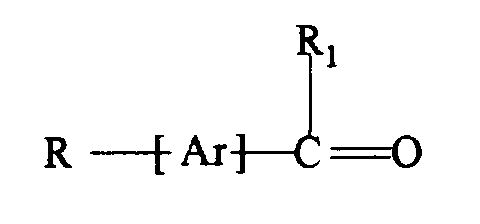
- acylation follows the following equation: wherein R is methyl, ethyl, isopropyl, isobutyl, straight-chain and branched C3 - C14 alkyl and Ar is phenyl or naphthyl-, R1 is methyl, ethyl, straight-chain or branched C3 - C6-alkyl and Y can be a group consisting of Hydroxy, acyloxy or halogen.
- This process is advantageously characterized by the use of a beta-type zeolite as a catalyst.
- Zeolites are characterized by the general formula (I): M1 m [mM2O2 ⁇ nSiO2] ⁇ qH2O (I)
- M1 corresponds to an equivalent of an exchangeable cation, the number m of which corresponds to the proportion of M2;
- M2 a trivalent element, which together with the Si forms the oxidic framework of the zeolite; n / m the SiO2 / M2O2 ratio; q the amount of water adsorbed.
- the basic structure of zeolites is crystalline aluminosilicates, which are made up of a network of SiO4 or M2O4 tetrahedra.
- the individual tetrahedra are linked with each other with oxygen bridges across the corners of the tetrahedra and form a spatial network that is evenly interspersed with channels and cavities.
- the individual zeolite structures differ in their arrangement and size of the channels and cavities as well as in their composition. Interchangeable cations are stored to compensate for the negative charge of the lattice, which is caused by the proportion of M2.
- the adsorbed water phase q H2O can be removed reversibly without the structure losing its structure.
- M2 is often aluminum, but can be partially or completely substituted by other trivalent elements.
- the types of zeolites that can be used according to the invention belong to the group of so-called medium and large-pore zeolites with pore sizes ⁇ 5 ⁇ .
- zeolites of the beta type in which at least some of the metal cations have been replaced by hydrogen ions, preferably 50-100%, particularly preferably 80-100% of all metal cations originally present.
- the acidic H+ forms of the zeolites are produced, for example, by exchanging metal ions for ammonium ions and then calcining the zeolites exchanged in this way.
- This 2-step exchange process can also be carried out with dilute mineral acids in a 1-step exchange process.
- SiO2 / M2O2 ratio n / m defined in formula (I) can assume values of 10-200: 1 and larger for silicon-rich zeolites, zeolites of the beta type, for example, in which n / m values are used for the present process from 5 - 100: 1. N / m values of 10 - 80: 1 are favored.
- the feed products can be brought into contact with the catalyst in gaseous form, but also in whole or in part in liquid form. However, it is advantageous if both the isobutylbenzene and the acetic anhydride or acetyl chloride are brought into the activated catalyst in liquid form. To do this, choose a temperature in the range of 50 to 250 ° C.
- the reaction is preferably carried out at atmospheric pressure, which also ensures that the reaction is simple in terms of process engineering.
- the isobutylbenzene / acetic anhydride (or acetyl chloride) reaction mixture is introduced into a batch reactor and stirred at room temperature.
- the freshly activated zeolite catalyst is optionally introduced into the reaction mixture under a gentle stream of inert gas.
- a particularly favorable temperature for this liquid phase reaction is the range of 100-200 ° C.
- the desired product p-isobutylacetophenone can be separated from the reaction mixture by distillation and purified. Unreacted isobutylbenzene and unreacted acetic acid hydride or acetyl chloride can be returned to the reaction in a known manner.
Landscapes
- Chemical & Material Sciences (AREA)
- Organic Chemistry (AREA)
- Chemical Kinetics & Catalysis (AREA)
- Organic Low-Molecular-Weight Compounds And Preparation Thereof (AREA)
- Catalysts (AREA)
- Low-Molecular Organic Synthesis Reactions Using Catalysts (AREA)
Abstract
Zur Herstellung von aromatischen Ketonen mit der allgemeinen Formel <IMAGE> worin R für Methyl, Ethyl, Isopropyl, Isobutyl, geradkettiges und verzweigtes C3 - C14-Alkyl, Ar gleich für Phenyl- oder Naphthyl, und R1 für Methyl, Ethyl, geradkettiges oder verzweigtes C3 - C6-Alkyl stehen kann, werden alkylsubstituierte Benzole mit Carbonsäureanhydriden, Acylchloriden oder freien Carbonsäuren bei einer Temperatur im Bereich von 50 - 250°C an einem sich in der aciden Form befindlichen siliciumreichen Zeolithen umgesetzt.
Description
- Die Erfindung betrifft ein Verfahren zur Herstellung von aromatischen Ketonen gemäss dem Oberbegriff des Patentanspruchs 1.
- Die Acylierung von aromatischen Substraten ist eine nützliche Methode zur Herstellung von Ausgangs- oder Zwischenprodukten in der pharmazeutischen Industrie, wie sie etwa zur Gewinnung der 2-(4'-Isobutylphenyl)-propionsäure (Ibuprofen) verwendet werden.
- Ibuprofen ist ein bekanntes, nicht-steroides Schmerzmittel welches generell über die Acetylierung von Isobutylbenzol (IBB) zu p-Isobutylacetophenon (IBAP) hergestellt wird. Die Reduktion durch katalytische Hydrierung von IBAP führt zu 1-(4'-Isobutylphenyl)ethanol (IBPE), Carbonylierung von IBPE resultiert schlussendlich in Ibuprofen (EP-A-0 284 310).
- Es ist bekannt, dass p-Isobutylacetophenon durch Friedel-Crafts-Acylierung von Isobutylbenzol mittels geeigneter Acetylierungsreagenzien und wasserfreiem Aluminiumchlorid in ver-schiedenen Lösungsmitteln, wie vorzugsweise Schwefelkohlenstoff oder Methylenchlorid, gewonnen werden kann. Diese Verfahren liefern das p-Isobutylacetophenon jedoch nur in mässiger Reinheit und ungünstigen Ausbeuten, was oft durch die Bildung eines beträchtlichen Anteils an Nebenprodukten bedingt ist.
- Die Synthese von p-Isobutylacetophenon (IBAP) aus Isobutylbenzol wird in der Literatur beschrieben. Zum Beispiel haben Bradford et al. im Journal of the American Chemical Society, 4943 - 4945 (1956) auf Seite 4945 die Synthese von p-Isobutylacetophenon (IBAP) mittels einer Friedel-Crafts-Acylierung von Isobutylbenzol mit Essigsäureanhydrid in Gegenwart von Aluminiumchlorid als Katalysator beschrieben.
- Die EP-A-400,892 beschreibt die Produktion von Isobutylacetophenon mittels Essigsäureanhydrid in Gegenwart von HF als Katalysator und Lösungsmittel.
- Zur Zeit erfolgt die industrielle Acylierung von Alkylaromaten allgemein mittels Säurechloriden als Acylierungsagens zusammen mit stöchlometrischen Mengen an Protonsäuren wie HF, H₂SO₄ und HCl oder mit Metallhalogeniden wie AlCl₃, TiCl₄, FeCl₃ und BF₃. In dieser Art von Syntheseprozess fallen grosse Abfallmengen an. Die teilweise grösser als stöchiometrischen Mengen an Katalysator werden zur Komplexierung des Ketons gebraucht. Der anschliessende Hydrolyseschritt verursacht die Zerstörung des Katalysators, die Freisetzung grosser Mengen an Zersetzungsgasen, was zu grossen Korrosionsproblemen führt.
- Aufgabe der vorliegenden Erfindung ist die Schaffung eines Verfahrens der eingangs genannten Art, bei welchem ein regenerierbarer und in geringerer Menge erforderlicher Katalysator verwendet werden kann.
- Diese Aufgabe wird erfindungsgemäss mittels eines Verfahrens nach Patentanspruch 1 gelöst, d.h. durch die Acylierung von aromatischen Reaktanden mit Säureanhydriden oder Acylhalogeniden an sauren Zeolith-Katalysatoren. Dieses Verfahren ist vor allem nützlich für die hoch selektive para-Acylierung von monosubstituiertem Benzol.
- Zweckmässige Weiterausgestaltungen des erfindungsgemässen Verfahrens sind Gegenstand der Ansprüche 2 bis 9.
- Der Gebrauch von Zeolithen als Katalysatoren für die Friedel-Crafts-Acylierung löst viele der bisherigen Probleme. Zeolithe sind thermisch äusserst stabil und können durch einen einfachen Kalzinierungsschritt zur Entfernung kokshaltiger Ablagerungen regeneriert bzw. neu aktiviert werden. Ausserdem sind nur wirklich katalytische Mengen (max. 10 % vom Substratgemisch) notwendig, um die Acetylierungsreaktion zu katalysieren. Die Separierung des Katalysators vom Reaktionsgemisch kann über eine einfache Filtration erfolgen.
- Gemäss dieser Erfindung wird ein fester, saurer Katalysator (Zeolith) verwendet und ein Verfahren zur Anwendung eines solchen Katalysators in der heterogen katalysierten Acylierung von aromatischen Substraten mit Acylierungsmitteln, die ein relativ niedriges Molekulargewicht besitzen, beschrieben. Obwohl der Katalysator bevorzugt unter milden Temperaturbedingungen, in der flüssigen Phase, benutzt wird, ist auch ein Gebrauch unter Gasphasenbedingungen möglich. Das Produkt wird in einer hoch selektiven Acylierungsreaktion gewonnen, was eine Reinigung des Endproduktes von entstandenen Nebenprodukten überflüssig macht. Diese Acylierungsreaktion wird durchgeführt über das Zusammenbringen von Alkylbenzol und einem geeigneten Acylierungsreagens in der Gegenwart von katalytischen Mengen eines hoch kristallinen, siliciumreichen Zeolithen (z.B. Beta, USY, ZSM-5), wobei der Zeolith sich in der aciden H-Form befindet. Die Reaktion wird bei einer Temperatur von 50 - 250 °C, vorzugsweise 100 - 200°C durchgeführt.
- Nachstehend wird die Erfindung anhand einer Anwendung in einem Syntheseprozess beispielsweise beschrieben.
- Der Katalysator besteht dabei aus einem siliciumreichen Zeolithen in der aciden H-Form, welcher vor allem für die Acylierung von aromatischen Substraten mittels einem Acylierungs-Agens, welches ein niedriges Molekulargewicht besitzt, geeignet ist. Diese Erfindung wird dabei in der Acetylierung von Isobutylbenzol, bei der unter milden Flüssigphasen-Bedingungen selektiv p-Isobutylacetophenon produziert werden kann, angewendet.
- Die Acylierung verläuft nach folgender Gleichung:

worin R für Methyl, Ethyl, Isopropyl, Isobutyl, geradkettiges und verzweigtes C₃ - C₁₄ Alkyl steht und Ar gleich Phenyl- oder Naphthyl- ist, R₁ ist Methyl, Ethyl, geradkettiges oder verzweigtes C₃ - C₆-Alkyl und Y kann eine Gruppe bestehend aus Hydroxy-, Acyloxy- oder Halogen sein. - Es wurde dabei gefunden, dass bei der Acetylierung von Isobutylbenzol mittels ausgewählter Zeolithkatalysatoren eine höhere Selektivität erreicht wird als beim klassischen Friedel-Crafts-System. Zudem treten keinerlei Abfallprobleme bezüglich des Katalysators auf, da dieser nach einer entsprechenden Reaktivierung erneut in das System zurückgeführt werden kann. Solche ausgewählten Katalysatoren sollen nun im Detail beschrieben werden.
- Dieses Verfahren ist vorteilhafterweise durch die Benutzung eines Zeolithen vom Beta-Typ als Katalysator gekennzeichnet.
- Zeolithe sind durch die allgemeine Formel (I) charakterisiert:
M¹m[mM²O₂·nSiO₂]·qH₂O (I)
Hierin entspricht M¹ einem Aequivalent eines austauschbaren Kations, dessen Anzahl m dem Anteil von M² entspricht;
M² einem dreiwertigen Element, welches gemeinsam mit dem Si das oxydische Gerüst des Zeolithen bildet;
n/m dem SiO₂/M²O₂-Verhältnis;
q der Menge des adsorbierten Wassers.
Zeolithe sind von ihrer Grundstruktur her kristalline Alumosilikate, die aus einem Netzwerk von SiO₄- bzw. M²O₄-Tetraedern aufgebaut sind. Die einzelnen Tetraeder sind mit Sauerstoffbrücken über die Ecken der Tetraeder untereinander verknüpft und bilden ein räumliches Netzwerk, das gleichmässig von Kanälen und Hohlräumen durchzogen ist. Die einzelnen Zeolithstrukturen unterscheiden sich durch ihre Anordnung und Grösse der Kanäle und Hohlräume sowie durch ihre Zusammensetzung. Als Ausgleich für die negative Ladung des Gitters, die durch den Anteil an M² zustande kommt, sind austauschbare Kationen eingelagert. Die adsorbierte Wasserphase q H₂O ist reversibel entfernbar, ohne dass das Gerüst seine Struktur verliert. - M² ist vielfach Aluminium, kann aber durch andere dreiwertige Elemente teilweise oder ganz substituiert sein.
- Die erfindungsgemäss einsetzbaren Zeolithtypen gehören zur Gruppe der sogenannten mittel- und grossporigen Zeolithe mit Porenweiten ≧ 5 Å.
- Bei der Herstellung von IBAP werden bevorzugt sind solche Zeolithe des Beta-Typs verwendet, bei denen mindestens ein Teil der Metallkationen gegen Wasserstoffionen ausgetauscht worden sind, vorzugsweise 50 - 100 %, besonders bevorzugt 80 - 100 % aller ursprünglich vorhandenen Metallkationen. Die sauren H⁺-Formen der Zeolithe werden beispielsweise dadurch hergestellt, dass man Metallionen gegen Ammoniumionen austauscht und den so ausgetauschten Zeolithen anschliessend kalziniert. Dieser 2-Schritt-Austausch-Vorgang lässt sich auch mit verdünnten Mineralsäuren in einem 1-Schritt-Austauschprozess durchführen.
- Während das in Formel (I) definierte SiO₂/M²O₂-Verhältnis n/m bei siliciumreichen Zeolithen Werte von 10 - 200 : 1 und grösser annehmen kann, werden für das vorliegende Verfahren beispielsweise Zeolithe vom Beta-Typ eingesetzt, bei denen n/m Werte von 5 - 100 : 1 annimmt. Begünstigt werden n/m Werte von 10 - 80 : 1.
- Die Einsatzprodukte können gasförmig, aber auch ganz oder teilweise flüssig mit dem Katalysator in Kontakt gebracht werden. Von Vorteil ist es jedoch, wenn sowohl das Isobutylbenzol alsauch das Essigsäureanhydrid bzw. Acetylchlorid flüssig an den aktivierten Katalysator herangebracht werden. Hierzu wählt man eine Temperatur im Bereich von 50 bis 250 °C.
- Bevorzugt wird die Reaktion bei Atmosphärendruck durchgeführt, was auch eine verfahrenstechnisch einfache Reaktionsführung gewährleistet.
- Bei der bevorzugten Durchführungsform wird das Reaktionsgemisch Isobutylbenzol/Essigsäureanhydrid (oder Acetylchlorid) in einen Batch-Reaktor eingebracht und bei Raumtemperatur gerührt. Der frisch aktivierte Zeolith-Katalysator wird gegebenenfalls unter einem leichten Inertgasstrom in das Reaktionsgemisch eingetragen. Eine besonders begünstigte Temperatur für diese Flüssigphasenreaktion ist hierbei der Bereich von 100 - 200 °C.
- Zur Aufarbeitung kann das gewünschte Produkt p-Isobutylacetophenon destillativ vom Reaktionsgemisch getrennt und gereinigt werden. Nicht umgesetztes Isobutylbenzol und nicht umgesetztes Essigsäurenahydrid bzw. Acetylchlorid können in bekannter Weise in die Reaktion zurückgeführt werden.
- In einen 100 ml Reaktor werden 13.4 g (0.1 mol) Isobutylbenzol (IBB) und 1.02 g (0.01 mol) Essigsäureanhydrid (Ac₂O) vorgelegt. Unter Rühren wird 1g frisch aktivierter Zeolith H-Beta unter Rühren bei einer Reaktionstemperatur von 140 °C in die Reaktionlösung überführt. Nach 1, 2 und 8 Stunden Reaktionszeit werden jeweils Proben entnommen und gaschromatographisch analysiert.
- Man erhielt folgende Ergebnisse:
Katalysator SiO₂/Al₂O₃ Temperatur [° C] Zeit[Std.] Ausbeute [mol %] * Selektivität [mol %] ** H-Beta 23 140 1.0 80.7 96.5 H-Beta 23 140 2.0 83.9 95.7 H-Beta 23 140 8.0 86.9 95.0 * mol % p-Isobutylacetophenon (IBAP) bezogen auf Ac₂O ** 100 x Ausbeute IBAP/Umsatz Ac₂O
Claims (10)
- Verfahren zur Herstellung von aromatischen Ketonen mit der allgemeinen Formel
- Verfahren nach Anspruch 1, dadurch gekennzeichnet, dass das Molverhältnis Alkylbenzol/ Acylierungsagens 1 - 30 : 1, vorzugsweise 8 - 20 : 1 beträgt.
- Verfahren nach Anspruch 1, dadurch gekennzeichnet, dass die Umsetzung bei einer Temperatur im Bereich von 100 - 200°C durchgeführt wird.
- Verfahren nach Anspruch 1 dadurch gekennzeichnet, dass Isobutylbenzol mit Essigsäure- anhydrid in der Flüssigphase zu p-Isobutylacetophenon umgesetzt wird, wobei ein Produkt mit gesteuerter Selektivität entsteht.
- Verfahren nach Anspruch 1 dadurch gekennzeichnet, dass es sich beim Katalysator um einen Beta-, USY oder ZSM-5-Zeolithen handelt.
- Verfahren nach Anspruch 5, dadurch gekennzeichnet, dass man Zeolithe des Beta-Typs verwendet, bei denen mindestens ein Teil der Metallkationen gegen Wasserstoffionen ausgetauscht worden ist.
- Verfahren nach Anspruch 6, dadurch gekennzeichnet, das 50 - 100 %, vorzugsweise 80 - 100 % aller ursprünglich vorhandener Metallkationen der Zeolithe gegen Wasserstoffionen ausgetauscht worden ist.
- Verfahren nach Anspruch 5, dadurch gekennzeichnet, dass man Zeolithe des Beta-Typs verwendet, bei denen das SiO₂/M²O₂ - Verhältnis 5 - 100 : 1, vorzugsweise 10 - 80 : 1, beträgt.
- Verfahren nach den Ansprüchen 4 und 5, dadurch gekennzeichnet, dass die Flüssig-phasenreaktion bei einer Temperatur im Bereich von 100 - 200 °C durchgeführt wird.
- Anwendung des Verfahrens nach Anspruch 1 zur Herstellung von p-Isobutylacetophenon.
Applications Claiming Priority (2)
| Application Number | Priority Date | Filing Date | Title |
|---|---|---|---|
| CH283794 | 1994-09-16 | ||
| CH2837/94 | 1994-09-16 |
Publications (1)
| Publication Number | Publication Date |
|---|---|
| EP0701987A1 true EP0701987A1 (de) | 1996-03-20 |
Family
ID=4242718
Family Applications (1)
| Application Number | Title | Priority Date | Filing Date |
|---|---|---|---|
| EP94810575A Withdrawn EP0701987A1 (de) | 1994-09-16 | 1994-10-03 | Verfahren zur Herstellung von aromatischen Ketonen |
Country Status (2)
| Country | Link |
|---|---|
| EP (1) | EP0701987A1 (de) |
| JP (1) | JPH08176058A (de) |
Cited By (5)
| Publication number | Priority date | Publication date | Assignee | Title |
|---|---|---|---|---|
| WO1997048665A1 (fr) * | 1996-06-20 | 1997-12-24 | Rhodia Chimie | Procede d'acylation d'un compose aromatique |
| EP1138662A1 (de) * | 2000-03-31 | 2001-10-04 | Council of Scientific and Industrial Research | Verfahren zur Herstellung von 4'-Isobutylacetophenon |
| WO2005030691A1 (en) * | 2003-10-02 | 2005-04-07 | Council Of Scientific And Industrial Research | Catalysed acylation of alkylated benzene derivatives |
| CN114213228A (zh) * | 2021-11-10 | 2022-03-22 | 煤炭科学技术研究院有限公司 | 一种2-甲基-6-丙酰基萘的制备方法 |
| US12551420B2 (en) * | 2020-10-05 | 2026-02-17 | Basf Se | 1-alkoxyethyl-3-isobutyl-benzene and 1-carboxyethyl-3-isobutyl-benzene as aroma ingredients |
Families Citing this family (1)
| Publication number | Priority date | Publication date | Assignee | Title |
|---|---|---|---|---|
| CN103304392A (zh) * | 2012-03-06 | 2013-09-18 | 北京澳林森科技有限公司 | 对异丁基苯乙酮的绿色合成方法 |
Citations (7)
| Publication number | Priority date | Publication date | Assignee | Title |
|---|---|---|---|---|
| EP0239383A1 (de) * | 1986-03-27 | 1987-09-30 | Celanese Corporation | Verfahren zur Herstellung von p-substituierten Phenyl-nieder-alkylketonen |
| EP0279322A2 (de) * | 1987-02-16 | 1988-08-24 | Boehringer Ingelheim Kg | Katalytische Acylierung von Aromaten in der Gasphase |
| EP0284310A1 (de) | 1987-03-20 | 1988-09-28 | Hoechst Celanese Corporation | Verfahren zur Herstellung von Ibuprofen |
| EP0334096A2 (de) * | 1988-03-19 | 1989-09-27 | Bayer Ag | Verfahren zur Herstellung von in 4-Stellung veretherten Phenylketonen |
| EP0400892A2 (de) | 1989-05-24 | 1990-12-05 | Hoechst Celanese Corporation | Verfahren zur Herstellung von Ibuprofen |
| EP0473023A1 (de) * | 1990-08-29 | 1992-03-04 | Bayer Ag | Verfahren zur Herstellung von Acylbenzolen |
| EP0488638A1 (de) * | 1990-11-27 | 1992-06-03 | Hoechst Celanese Corporation | BF3 katalysierte Acetylierung von Butylbenzol |
-
1994
- 1994-10-03 EP EP94810575A patent/EP0701987A1/de not_active Withdrawn
-
1995
- 1995-09-14 JP JP7237171A patent/JPH08176058A/ja active Pending
Patent Citations (7)
| Publication number | Priority date | Publication date | Assignee | Title |
|---|---|---|---|---|
| EP0239383A1 (de) * | 1986-03-27 | 1987-09-30 | Celanese Corporation | Verfahren zur Herstellung von p-substituierten Phenyl-nieder-alkylketonen |
| EP0279322A2 (de) * | 1987-02-16 | 1988-08-24 | Boehringer Ingelheim Kg | Katalytische Acylierung von Aromaten in der Gasphase |
| EP0284310A1 (de) | 1987-03-20 | 1988-09-28 | Hoechst Celanese Corporation | Verfahren zur Herstellung von Ibuprofen |
| EP0334096A2 (de) * | 1988-03-19 | 1989-09-27 | Bayer Ag | Verfahren zur Herstellung von in 4-Stellung veretherten Phenylketonen |
| EP0400892A2 (de) | 1989-05-24 | 1990-12-05 | Hoechst Celanese Corporation | Verfahren zur Herstellung von Ibuprofen |
| EP0473023A1 (de) * | 1990-08-29 | 1992-03-04 | Bayer Ag | Verfahren zur Herstellung von Acylbenzolen |
| EP0488638A1 (de) * | 1990-11-27 | 1992-06-03 | Hoechst Celanese Corporation | BF3 katalysierte Acetylierung von Butylbenzol |
Non-Patent Citations (1)
| Title |
|---|
| JOURNAL OF THE AMERICAN CHEMICAL SOCIETY, 1956, pages 4943 - 4945 |
Cited By (8)
| Publication number | Priority date | Publication date | Assignee | Title |
|---|---|---|---|---|
| WO1997048665A1 (fr) * | 1996-06-20 | 1997-12-24 | Rhodia Chimie | Procede d'acylation d'un compose aromatique |
| US6194616B1 (en) | 1996-06-20 | 2001-02-27 | Rhodia Chimie | Acylation method for an aromatic compound |
| RU2223938C2 (ru) * | 1996-06-20 | 2004-02-20 | Родиа Шими | Способ ацилирования ароматического соединения |
| EP1138662A1 (de) * | 2000-03-31 | 2001-10-04 | Council of Scientific and Industrial Research | Verfahren zur Herstellung von 4'-Isobutylacetophenon |
| WO2005030691A1 (en) * | 2003-10-02 | 2005-04-07 | Council Of Scientific And Industrial Research | Catalysed acylation of alkylated benzene derivatives |
| US12551420B2 (en) * | 2020-10-05 | 2026-02-17 | Basf Se | 1-alkoxyethyl-3-isobutyl-benzene and 1-carboxyethyl-3-isobutyl-benzene as aroma ingredients |
| CN114213228A (zh) * | 2021-11-10 | 2022-03-22 | 煤炭科学技术研究院有限公司 | 一种2-甲基-6-丙酰基萘的制备方法 |
| CN114213228B (zh) * | 2021-11-10 | 2024-02-06 | 煤炭科学技术研究院有限公司 | 一种2-甲基-6-丙酰基萘的制备方法 |
Also Published As
| Publication number | Publication date |
|---|---|
| JPH08176058A (ja) | 1996-07-09 |
Similar Documents
| Publication | Publication Date | Title |
|---|---|---|
| DE69412708T2 (de) | Verfahren zur Herstellung von Cumol | |
| EP0334096A2 (de) | Verfahren zur Herstellung von in 4-Stellung veretherten Phenylketonen | |
| DE2826865C2 (de) | ||
| DE3875587T2 (de) | Verfahren zur herstellung von 1,4-bis(4-phenoxybenzoyl)-benzen in gegenwart eines zeolithkatalysators. | |
| DE69518500T2 (de) | Verfahren zum Herstellen von Methylmethacrylat | |
| DE3903622A1 (de) | Verfahren zur herstellung von 1,4-diazabicyclo-2,2,2-octan | |
| EP0206143B1 (de) | Verfahren zur Herstellung von 4-Pentensäureestern | |
| EP0224220B1 (de) | Verfahren zur Herstellung von Diisobuten aus Isobuten | |
| DE2616583A1 (de) | Verfahren zum acylieren nicht- hydroxylierter aromatischer verbindungen | |
| EP0228675B1 (de) | Neue Phenylacetaldehyde und Verfahren zur Herstellung von Phenylacetaldehyden | |
| DE3787849T2 (de) | Verfahren zur katalytischen Transhalogenierung eines Polyiodobenzols. | |
| EP0352505B1 (de) | Verfahren zur Herstellung von Thymol | |
| EP0473023B1 (de) | Verfahren zur Herstellung von Acylbenzolen | |
| DE68905461T2 (de) | Verfahren zur behandlung eines abfallöls. | |
| DE3824725A1 (de) | Verfahren zur herstellung von phenylacetaldehyden | |
| DE3522727C2 (de) | ||
| EP0300324B1 (de) | Verfahren zur Herstellung von acylierten Imidazolen und Pyrazolen | |
| DE3878626T2 (de) | Verfahren zur herstellung von m-xylol aus o-xylol. | |
| EP0446759B1 (de) | Verfahren zur Herstellung von Cyclopentenonen | |
| EP0317911B1 (de) | Verfahren zur Herstellung von Phenylacetaldehyden | |
| EP0338427B1 (de) | Verfahren zur Herstellung von olefinisch ungesättigten, endständigen Carbonsäureestern | |
| EP0648724B1 (de) | Verfahren zur Herstellung von 1-Brom-3,5-difluorbenzol | |
| EP0769489A1 (de) | Verfahren zur Herstellung von (Bi)Cycloalkylanilinen | |
| EP0219042B1 (de) | Verfahren zur Herstellung von Dienen durch Dehydratisierung von Aldehyden | |
| JPH08176058A (ja) | 芳香族ケトンの製造方法 |
Legal Events
| Date | Code | Title | Description |
|---|---|---|---|
| PUAI | Public reference made under article 153(3) epc to a published international application that has entered the european phase |
Free format text: ORIGINAL CODE: 0009012 |
|
| AK | Designated contracting states |
Kind code of ref document: A1 Designated state(s): DE DK FR GB IT NL SE |
|
| 17P | Request for examination filed |
Effective date: 19960424 |
|
| 17Q | First examination report despatched |
Effective date: 19970403 |
|
| STAA | Information on the status of an ep patent application or granted ep patent |
Free format text: STATUS: THE APPLICATION IS DEEMED TO BE WITHDRAWN |
|
| 18D | Application deemed to be withdrawn |
Effective date: 19970715 |