EP0701555B1 - Indazolderivate - Google Patents
Indazolderivate Download PDFInfo
- Publication number
- EP0701555B1 EP0701555B1 EP94909209A EP94909209A EP0701555B1 EP 0701555 B1 EP0701555 B1 EP 0701555B1 EP 94909209 A EP94909209 A EP 94909209A EP 94909209 A EP94909209 A EP 94909209A EP 0701555 B1 EP0701555 B1 EP 0701555B1
- Authority
- EP
- European Patent Office
- Prior art keywords
- indazole
- alkyl
- ylmethyl
- aryl
- pyridin
- Prior art date
- Legal status (The legal status is an assumption and is not a legal conclusion. Google has not performed a legal analysis and makes no representation as to the accuracy of the status listed.)
- Expired - Lifetime
Links
- 125000003453 indazolyl group Chemical class N1N=C(C2=C1C=CC=C2)* 0.000 title claims abstract description 4
- 150000001875 compounds Chemical class 0.000 claims abstract description 95
- 229910052739 hydrogen Inorganic materials 0.000 claims abstract description 95
- 125000004169 (C1-C6) alkyl group Chemical group 0.000 claims abstract description 57
- 239000001257 hydrogen Substances 0.000 claims abstract description 40
- 125000004435 hydrogen atom Chemical group [H]* 0.000 claims abstract description 35
- VYFYYTLLBUKUHU-UHFFFAOYSA-N dopamine Chemical compound NCCC1=CC=C(O)C(O)=C1 VYFYYTLLBUKUHU-UHFFFAOYSA-N 0.000 claims abstract description 26
- 229960003638 dopamine Drugs 0.000 claims abstract description 13
- 125000000623 heterocyclic group Chemical group 0.000 claims abstract description 12
- 230000002265 prevention Effects 0.000 claims abstract description 9
- 125000003118 aryl group Chemical group 0.000 claims description 69
- 238000000034 method Methods 0.000 claims description 30
- -1 cyano, carboxy Chemical group 0.000 claims description 27
- 125000004191 (C1-C6) alkoxy group Chemical group 0.000 claims description 25
- 125000001072 heteroaryl group Chemical group 0.000 claims description 24
- 150000003839 salts Chemical class 0.000 claims description 23
- 125000001424 substituent group Chemical group 0.000 claims description 19
- 125000000882 C2-C6 alkenyl group Chemical group 0.000 claims description 17
- 229910052736 halogen Inorganic materials 0.000 claims description 17
- 150000002367 halogens Chemical group 0.000 claims description 17
- 150000002430 hydrocarbons Chemical class 0.000 claims description 16
- 239000000651 prodrug Substances 0.000 claims description 16
- 229940002612 prodrug Drugs 0.000 claims description 16
- 239000004215 Carbon black (E152) Substances 0.000 claims description 15
- 229930195733 hydrocarbon Natural products 0.000 claims description 15
- 125000000304 alkynyl group Chemical group 0.000 claims description 13
- 125000004432 carbon atom Chemical group C* 0.000 claims description 12
- 125000006239 protecting group Chemical group 0.000 claims description 12
- 125000006272 (C3-C7) cycloalkyl group Chemical group 0.000 claims description 11
- 125000000449 nitro group Chemical group [O-][N+](*)=O 0.000 claims description 11
- 125000002023 trifluoromethyl group Chemical group FC(F)(F)* 0.000 claims description 11
- 125000004890 (C1-C6) alkylamino group Chemical group 0.000 claims description 10
- 125000004448 alkyl carbonyl group Chemical group 0.000 claims description 8
- 125000001997 phenyl group Chemical group [H]C1=C([H])C([H])=C(*)C([H])=C1[H] 0.000 claims description 8
- 125000004093 cyano group Chemical group *C#N 0.000 claims description 7
- 125000001624 naphthyl group Chemical group 0.000 claims description 6
- 238000010561 standard procedure Methods 0.000 claims description 6
- 125000003601 C2-C6 alkynyl group Chemical group 0.000 claims description 5
- 238000002360 preparation method Methods 0.000 claims description 5
- 125000002924 primary amino group Chemical group [H]N([H])* 0.000 claims description 5
- 230000008569 process Effects 0.000 claims description 5
- XMKJEDGDMOUXME-UHFFFAOYSA-N 3-[[4-(2-phenylethyl)piperidin-1-yl]methyl]-2h-indazole Chemical compound C1CN(CC=2C3=CC=CC=C3NN=2)CCC1CCC1=CC=CC=C1 XMKJEDGDMOUXME-UHFFFAOYSA-N 0.000 claims description 4
- IJGRMHOSHXDMSA-UHFFFAOYSA-N Atomic nitrogen Chemical group N#N IJGRMHOSHXDMSA-UHFFFAOYSA-N 0.000 claims description 4
- 238000007126 N-alkylation reaction Methods 0.000 claims description 4
- 229910003827 NRaRb Inorganic materials 0.000 claims description 4
- NINIDFKCEFEMDL-UHFFFAOYSA-N Sulfur Chemical group [S] NINIDFKCEFEMDL-UHFFFAOYSA-N 0.000 claims description 4
- 239000005864 Sulphur Chemical group 0.000 claims description 4
- 125000004453 alkoxycarbonyl group Chemical group 0.000 claims description 4
- QVGXLLKOCUKJST-UHFFFAOYSA-N atomic oxygen Chemical group [O] QVGXLLKOCUKJST-UHFFFAOYSA-N 0.000 claims description 4
- 239000003937 drug carrier Substances 0.000 claims description 4
- 229910052760 oxygen Inorganic materials 0.000 claims description 4
- 239000001301 oxygen Substances 0.000 claims description 4
- PWNHHYOBHSTJKR-UHFFFAOYSA-N 2-(2h-indazol-3-ylmethyl)-3,4-dihydro-1h-isoquinoline Chemical compound C1=CC=C2C(CN3CC4=CC=CC=C4CC3)=NNC2=C1 PWNHHYOBHSTJKR-UHFFFAOYSA-N 0.000 claims description 3
- KXEWWPLXJKEZPV-UHFFFAOYSA-N 2-[(6-chloro-2h-indazol-3-yl)methyl]-3,4-dihydro-1h-isoquinoline Chemical compound C1CC2=CC=CC=C2CN1CC1=NNC2=CC(Cl)=CC=C21 KXEWWPLXJKEZPV-UHFFFAOYSA-N 0.000 claims description 3
- ZDOFQDDKOZOXEE-UHFFFAOYSA-N 2-[(6-fluoro-2h-indazol-3-yl)methyl]-3,4-dihydro-1h-isoquinoline Chemical compound C1CC2=CC=CC=C2CN1CC1=NNC2=CC(F)=CC=C21 ZDOFQDDKOZOXEE-UHFFFAOYSA-N 0.000 claims description 3
- NRLZSUXTHYRYTG-UHFFFAOYSA-N 2-[(7-chloro-2h-indazol-3-yl)methyl]-3,4-dihydro-1h-isoquinoline Chemical compound C1CC2=CC=CC=C2CN1CC1=NNC2=C1C=CC=C2Cl NRLZSUXTHYRYTG-UHFFFAOYSA-N 0.000 claims description 3
- MQJJIJVMTFATQI-UHFFFAOYSA-N 3-[(4-naphthalen-2-yl-3,6-dihydro-2h-pyridin-1-yl)methyl]-2h-indazole Chemical compound C1=CC=C2C(CN3CC=C(CC3)C=3C=C4C=CC=CC4=CC=3)=NNC2=C1 MQJJIJVMTFATQI-UHFFFAOYSA-N 0.000 claims description 3
- IUVQPCFGJMCICB-UHFFFAOYSA-N 3-[[4-(1,3-benzodioxol-5-yl)-3,6-dihydro-2h-pyridin-1-yl]methyl]-2h-indazole Chemical compound C1=CC=C2C(CN3CC=C(CC3)C=3C=C4OCOC4=CC=3)=NNC2=C1 IUVQPCFGJMCICB-UHFFFAOYSA-N 0.000 claims description 3
- DZWXUVJWTPDSFF-UHFFFAOYSA-N 3-[[4-(1-benzofuran-5-yl)-3,6-dihydro-2h-pyridin-1-yl]methyl]-2h-indazole Chemical compound C1=CC=C2C(CN3CC=C(CC3)C=3C=C4C=COC4=CC=3)=NNC2=C1 DZWXUVJWTPDSFF-UHFFFAOYSA-N 0.000 claims description 3
- LJSPQARZXRAQDG-UHFFFAOYSA-N 3-[[4-(1-benzofuran-5-yl)-3,6-dihydro-2h-pyridin-1-yl]methyl]-7-chloro-2h-indazole Chemical compound C1=C2OC=CC2=CC(C=2CCN(CC=2)CC2=C3C=CC=C(C3=NN2)Cl)=C1 LJSPQARZXRAQDG-UHFFFAOYSA-N 0.000 claims description 3
- OUUYEURLEYKUGI-UHFFFAOYSA-N 3-[[4-(1h-indol-5-yl)-3,6-dihydro-2h-pyridin-1-yl]methyl]-2h-indazole Chemical compound C1=CC=C2C(CN3CC=C(CC3)C=3C=C4C=CNC4=CC=3)=NNC2=C1 OUUYEURLEYKUGI-UHFFFAOYSA-N 0.000 claims description 3
- DDESYPWZWGGCRE-UHFFFAOYSA-N 3-[[4-(2-cyclohexylethyl)piperidin-1-yl]methyl]-2h-indazole Chemical compound C1CN(CC=2C3=CC=CC=C3NN=2)CCC1CCC1CCCCC1 DDESYPWZWGGCRE-UHFFFAOYSA-N 0.000 claims description 3
- NVQPSWHGBRUMCG-UHFFFAOYSA-N 3-[[4-(4-methoxyphenyl)-3,6-dihydro-2h-pyridin-1-yl]methyl]-2h-indazole Chemical compound C1=CC(OC)=CC=C1C(CC1)=CCN1CC1=NNC2=CC=CC=C12 NVQPSWHGBRUMCG-UHFFFAOYSA-N 0.000 claims description 3
- GZXQPCMGEWVATE-ZHACJKMWSA-N 3-[[4-[(e)-2-phenylethenyl]-3,6-dihydro-2h-pyridin-1-yl]methyl]-2h-indazole Chemical compound N=1NC2=CC=CC=C2C=1CN(CC=1)CCC=1\C=C\C1=CC=CC=C1 GZXQPCMGEWVATE-ZHACJKMWSA-N 0.000 claims description 3
- RIWPQHBDMHDIGO-UHFFFAOYSA-N 6,7-difluoro-3-[[4-(4-methoxyphenyl)-3,6-dihydro-2h-pyridin-1-yl]methyl]-2h-indazole Chemical compound C1=CC(OC)=CC=C1C(CC1)=CCN1CC1=C2C=CC(F)=C(F)C2=NN1 RIWPQHBDMHDIGO-UHFFFAOYSA-N 0.000 claims description 3
- KPRYXZMLVBQPBD-UHFFFAOYSA-N 7-chloro-3-[[4-(2-phenylethyl)-3,6-dihydro-2h-pyridin-1-yl]methyl]-2h-indazole Chemical compound N=1NC=2C(Cl)=CC=CC=2C=1CN(CC=1)CCC=1CCC1=CC=CC=C1 KPRYXZMLVBQPBD-UHFFFAOYSA-N 0.000 claims description 3
- PZCDLWOSGHINDG-UHFFFAOYSA-N 7-chloro-3-[[4-(4-chlorophenyl)-3,6-dihydro-2h-pyridin-1-yl]methyl]-2h-indazole Chemical compound C1=CC(Cl)=CC=C1C(CC1)=CCN1CC1=C2C=CC=C(Cl)C2=NN1 PZCDLWOSGHINDG-UHFFFAOYSA-N 0.000 claims description 3
- FLEVVFQPFHGEKE-UHFFFAOYSA-N 7-chloro-3-[[4-(4-methoxyphenyl)-3,6-dihydro-2h-pyridin-1-yl]methyl]-2h-indazole Chemical compound C1=CC(OC)=CC=C1C(CC1)=CCN1CC1=C2C=CC=C(Cl)C2=NN1 FLEVVFQPFHGEKE-UHFFFAOYSA-N 0.000 claims description 3
- URCRGHQVCCVEQK-UHFFFAOYSA-N 7-fluoro-3-[[4-(4-methoxyphenyl)-3,6-dihydro-2h-pyridin-1-yl]methyl]-2h-indazole Chemical compound C1=CC(OC)=CC=C1C(CC1)=CCN1CC1=C2C=CC=C(F)C2=NN1 URCRGHQVCCVEQK-UHFFFAOYSA-N 0.000 claims description 3
- 125000005530 alkylenedioxy group Chemical group 0.000 claims description 3
- 125000004618 benzofuryl group Chemical group O1C(=CC2=C1C=CC=C2)* 0.000 claims description 3
- 125000004122 cyclic group Chemical group 0.000 claims description 3
- 125000001041 indolyl group Chemical group 0.000 claims description 3
- 125000005956 isoquinolyl group Chemical group 0.000 claims description 3
- 229910052757 nitrogen Inorganic materials 0.000 claims description 3
- 125000004076 pyridyl group Chemical group 0.000 claims description 3
- 125000000714 pyrimidinyl group Chemical group 0.000 claims description 3
- 125000005493 quinolyl group Chemical group 0.000 claims description 3
- 239000000126 substance Substances 0.000 claims description 3
- 125000006700 (C1-C6) alkylthio group Chemical group 0.000 claims description 2
- 125000000171 (C1-C6) haloalkyl group Chemical group 0.000 claims description 2
- MVVBNAFDXGBTIE-UHFFFAOYSA-N 7-chloro-3-[[4-(1h-indol-5-yl)-3,6-dihydro-2h-pyridin-1-yl]methyl]-2h-indazole Chemical compound C1=C2NC=CC2=CC(C=2CCN(CC=2)CC=2C=3C=CC=C(C=3NN=2)Cl)=C1 MVVBNAFDXGBTIE-UHFFFAOYSA-N 0.000 claims description 2
- 229930194542 Keto Natural products 0.000 claims description 2
- 125000005073 adamantyl group Chemical group C12(CC3CC(CC(C1)C3)C2)* 0.000 claims description 2
- 125000005196 alkyl carbonyloxy group Chemical group 0.000 claims description 2
- 125000004644 alkyl sulfinyl group Chemical group 0.000 claims description 2
- 125000004390 alkyl sulfonyl group Chemical group 0.000 claims description 2
- 125000004103 aminoalkyl group Chemical group 0.000 claims description 2
- 125000005129 aryl carbonyl group Chemical group 0.000 claims description 2
- 125000005199 aryl carbonyloxy group Chemical group 0.000 claims description 2
- 125000004391 aryl sulfonyl group Chemical group 0.000 claims description 2
- 125000004104 aryloxy group Chemical group 0.000 claims description 2
- 125000003785 benzimidazolyl group Chemical group N1=C(NC2=C1C=CC=C2)* 0.000 claims description 2
- 238000007796 conventional method Methods 0.000 claims description 2
- 125000004987 dibenzofuryl group Chemical group C1(=CC=CC=2OC3=C(C21)C=CC=C3)* 0.000 claims description 2
- 239000003814 drug Substances 0.000 claims description 2
- 125000002541 furyl group Chemical group 0.000 claims description 2
- 125000005842 heteroatom Chemical group 0.000 claims description 2
- 125000002887 hydroxy group Chemical group [H]O* 0.000 claims description 2
- 125000002883 imidazolyl group Chemical group 0.000 claims description 2
- 125000000468 ketone group Chemical group 0.000 claims description 2
- 125000001715 oxadiazolyl group Chemical group 0.000 claims description 2
- 239000008194 pharmaceutical composition Substances 0.000 claims description 2
- 125000004309 pyranyl group Chemical group O1C(C=CC=C1)* 0.000 claims description 2
- 125000003373 pyrazinyl group Chemical group 0.000 claims description 2
- 125000002098 pyridazinyl group Chemical group 0.000 claims description 2
- 229910052705 radium Inorganic materials 0.000 claims description 2
- 229910052701 rubidium Inorganic materials 0.000 claims description 2
- 125000001113 thiadiazolyl group Chemical group 0.000 claims description 2
- 125000001544 thienyl group Chemical group 0.000 claims description 2
- 125000001183 hydrocarbyl group Chemical group 0.000 claims 1
- 238000004519 manufacturing process Methods 0.000 claims 1
- 238000002560 therapeutic procedure Methods 0.000 claims 1
- BAXOFTOLAUCFNW-UHFFFAOYSA-N 1H-indazole Chemical group C1=CC=C2C=NNC2=C1 BAXOFTOLAUCFNW-UHFFFAOYSA-N 0.000 abstract description 65
- 102000015554 Dopamine receptor Human genes 0.000 abstract description 8
- 108050004812 Dopamine receptor Proteins 0.000 abstract description 8
- 208000037265 diseases, disorders, signs and symptoms Diseases 0.000 abstract description 6
- 239000003446 ligand Substances 0.000 abstract description 4
- 201000000980 schizophrenia Diseases 0.000 abstract description 3
- 125000001570 methylene group Chemical group [H]C([H])([*:1])[*:2] 0.000 abstract 1
- XEKOWRVHYACXOJ-UHFFFAOYSA-N Ethyl acetate Chemical compound CCOC(C)=O XEKOWRVHYACXOJ-UHFFFAOYSA-N 0.000 description 61
- VLKZOEOYAKHREP-UHFFFAOYSA-N n-Hexane Chemical compound CCCCCC VLKZOEOYAKHREP-UHFFFAOYSA-N 0.000 description 36
- YMWUJEATGCHHMB-UHFFFAOYSA-N Dichloromethane Chemical compound ClCCl YMWUJEATGCHHMB-UHFFFAOYSA-N 0.000 description 34
- 235000019439 ethyl acetate Nutrition 0.000 description 30
- 238000005160 1H NMR spectroscopy Methods 0.000 description 25
- 239000007787 solid Substances 0.000 description 25
- OKKJLVBELUTLKV-UHFFFAOYSA-N Methanol Chemical compound OC OKKJLVBELUTLKV-UHFFFAOYSA-N 0.000 description 24
- 229910001868 water Inorganic materials 0.000 description 23
- IAZDPXIOMUYVGZ-WFGJKAKNSA-N Dimethyl sulfoxide Chemical compound [2H]C([2H])([2H])S(=O)C([2H])([2H])[2H] IAZDPXIOMUYVGZ-WFGJKAKNSA-N 0.000 description 21
- 239000000203 mixture Substances 0.000 description 21
- XLYOFNOQVPJJNP-UHFFFAOYSA-N water Substances O XLYOFNOQVPJJNP-UHFFFAOYSA-N 0.000 description 20
- 239000000243 solution Substances 0.000 description 19
- 229910052799 carbon Inorganic materials 0.000 description 17
- IANQTJSKSUMEQM-UHFFFAOYSA-N 1-benzofuran Chemical compound C1=CC=C2OC=CC2=C1 IANQTJSKSUMEQM-UHFFFAOYSA-N 0.000 description 14
- SIKJAQJRHWYJAI-UHFFFAOYSA-N Indole Chemical compound C1=CC=C2NC=CC2=C1 SIKJAQJRHWYJAI-UHFFFAOYSA-N 0.000 description 14
- CSNNHWWHGAXBCP-UHFFFAOYSA-L Magnesium sulfate Chemical compound [Mg+2].[O-][S+2]([O-])([O-])[O-] CSNNHWWHGAXBCP-UHFFFAOYSA-L 0.000 description 12
- ZMANZCXQSJIPKH-UHFFFAOYSA-N Triethylamine Chemical compound CCN(CC)CC ZMANZCXQSJIPKH-UHFFFAOYSA-N 0.000 description 12
- 125000001931 aliphatic group Chemical group 0.000 description 11
- MUBZPKHOEPUJKR-UHFFFAOYSA-N Oxalic acid Chemical compound OC(=O)C(O)=O MUBZPKHOEPUJKR-UHFFFAOYSA-N 0.000 description 10
- WYURNTSHIVDZCO-UHFFFAOYSA-N Tetrahydrofuran Chemical compound C1CCOC1 WYURNTSHIVDZCO-UHFFFAOYSA-N 0.000 description 10
- 125000002496 methyl group Chemical group [H]C([H])([H])* 0.000 description 9
- 239000002253 acid Substances 0.000 description 8
- WEVYAHXRMPXWCK-UHFFFAOYSA-N Acetonitrile Chemical compound CC#N WEVYAHXRMPXWCK-UHFFFAOYSA-N 0.000 description 7
- 239000000284 extract Substances 0.000 description 7
- PZOUSPYUWWUPPK-UHFFFAOYSA-N indole Natural products CC1=CC=CC2=C1C=CN2 PZOUSPYUWWUPPK-UHFFFAOYSA-N 0.000 description 7
- RKJUIXBNRJVNHR-UHFFFAOYSA-N indolenine Natural products C1=CC=C2CC=NC2=C1 RKJUIXBNRJVNHR-UHFFFAOYSA-N 0.000 description 7
- 125000000956 methoxy group Chemical group [H]C([H])([H])O* 0.000 description 7
- 108020003175 receptors Proteins 0.000 description 7
- 102000005962 receptors Human genes 0.000 description 7
- UWYZHKAOTLEWKK-UHFFFAOYSA-N 1,2,3,4-tetrahydroisoquinoline Chemical compound C1=CC=C2CNCCC2=C1 UWYZHKAOTLEWKK-UHFFFAOYSA-N 0.000 description 6
- WFDIJRYMOXRFFG-UHFFFAOYSA-N Acetic anhydride Chemical compound CC(=O)OC(C)=O WFDIJRYMOXRFFG-UHFFFAOYSA-N 0.000 description 6
- VEXZGXHMUGYJMC-UHFFFAOYSA-N Hydrochloric acid Chemical compound Cl VEXZGXHMUGYJMC-UHFFFAOYSA-N 0.000 description 6
- ZMXDDKWLCZADIW-UHFFFAOYSA-N N,N-Dimethylformamide Chemical compound CN(C)C=O ZMXDDKWLCZADIW-UHFFFAOYSA-N 0.000 description 6
- UIIMBOGNXHQVGW-UHFFFAOYSA-M Sodium bicarbonate Chemical compound [Na+].OC([O-])=O UIIMBOGNXHQVGW-UHFFFAOYSA-M 0.000 description 6
- HEMHJVSKTPXQMS-UHFFFAOYSA-M Sodium hydroxide Chemical compound [OH-].[Na+] HEMHJVSKTPXQMS-UHFFFAOYSA-M 0.000 description 6
- HEDRZPFGACZZDS-MICDWDOJSA-N Trichloro(2H)methane Chemical compound [2H]C(Cl)(Cl)Cl HEDRZPFGACZZDS-MICDWDOJSA-N 0.000 description 6
- 238000006243 chemical reaction Methods 0.000 description 6
- 239000000460 chlorine Substances 0.000 description 6
- 125000001309 chloro group Chemical group Cl* 0.000 description 6
- 229910052943 magnesium sulfate Inorganic materials 0.000 description 6
- RTZKZFJDLAIYFH-UHFFFAOYSA-N Diethyl ether Chemical compound CCOCC RTZKZFJDLAIYFH-UHFFFAOYSA-N 0.000 description 5
- UFHFLCQGNIYNRP-UHFFFAOYSA-N Hydrogen Chemical compound [H][H] UFHFLCQGNIYNRP-UHFFFAOYSA-N 0.000 description 5
- 208000035475 disorder Diseases 0.000 description 5
- 125000001495 ethyl group Chemical group [H]C([H])([H])C([H])([H])* 0.000 description 5
- 238000003818 flash chromatography Methods 0.000 description 5
- 125000001153 fluoro group Chemical group F* 0.000 description 5
- 239000003826 tablet Substances 0.000 description 5
- VHYFNPMBLIVWCW-UHFFFAOYSA-N 4-Dimethylaminopyridine Chemical compound CN(C)C1=CC=NC=C1 VHYFNPMBLIVWCW-UHFFFAOYSA-N 0.000 description 4
- VYPSYNLAJGMNEJ-UHFFFAOYSA-N Silicium dioxide Chemical compound O=[Si]=O VYPSYNLAJGMNEJ-UHFFFAOYSA-N 0.000 description 4
- WQDUMFSSJAZKTM-UHFFFAOYSA-N Sodium methoxide Chemical compound [Na+].[O-]C WQDUMFSSJAZKTM-UHFFFAOYSA-N 0.000 description 4
- 230000027455 binding Effects 0.000 description 4
- 230000015572 biosynthetic process Effects 0.000 description 4
- 125000003178 carboxy group Chemical group [H]OC(*)=O 0.000 description 4
- 150000007942 carboxylates Chemical group 0.000 description 4
- 239000002552 dosage form Substances 0.000 description 4
- 239000000543 intermediate Substances 0.000 description 4
- 239000000463 material Substances 0.000 description 4
- 239000006187 pill Substances 0.000 description 4
- DKGZKTPJOSAWFA-UHFFFAOYSA-N spiperone Chemical compound C1=CC(F)=CC=C1C(=O)CCCN1CCC2(C(NCN2C=2C=CC=CC=2)=O)CC1 DKGZKTPJOSAWFA-UHFFFAOYSA-N 0.000 description 4
- QKNYBSVHEMOAJP-UHFFFAOYSA-N 2-amino-2-(hydroxymethyl)propane-1,3-diol;hydron;chloride Chemical compound Cl.OCC(N)(CO)CO QKNYBSVHEMOAJP-UHFFFAOYSA-N 0.000 description 3
- QTBSBXVTEAMEQO-UHFFFAOYSA-N Acetic acid Chemical compound CC(O)=O QTBSBXVTEAMEQO-UHFFFAOYSA-N 0.000 description 3
- YXFVVABEGXRONW-UHFFFAOYSA-N Toluene Chemical compound CC1=CC=CC=C1 YXFVVABEGXRONW-UHFFFAOYSA-N 0.000 description 3
- 150000007513 acids Chemical class 0.000 description 3
- 239000004480 active ingredient Substances 0.000 description 3
- 125000000217 alkyl group Chemical group 0.000 description 3
- 239000002585 base Substances 0.000 description 3
- 230000008901 benefit Effects 0.000 description 3
- RFRXIWQYSOIBDI-UHFFFAOYSA-N benzarone Chemical compound CCC=1OC2=CC=CC=C2C=1C(=O)C1=CC=C(O)C=C1 RFRXIWQYSOIBDI-UHFFFAOYSA-N 0.000 description 3
- 125000000051 benzyloxy group Chemical group [H]C1=C([H])C([H])=C(C([H])=C1[H])C([H])([H])O* 0.000 description 3
- KRKNYBCHXYNGOX-UHFFFAOYSA-N citric acid Chemical compound OC(=O)CC(O)(C(O)=O)CC(O)=O KRKNYBCHXYNGOX-UHFFFAOYSA-N 0.000 description 3
- 125000000753 cycloalkyl group Chemical group 0.000 description 3
- 125000000592 heterocycloalkyl group Chemical group 0.000 description 3
- 239000003921 oil Substances 0.000 description 3
- 235000019198 oils Nutrition 0.000 description 3
- 229920006395 saturated elastomer Polymers 0.000 description 3
- 229910000030 sodium bicarbonate Inorganic materials 0.000 description 3
- 239000002904 solvent Substances 0.000 description 3
- YLQBMQCUIZJEEH-UHFFFAOYSA-N tetrahydrofuran Natural products C=1C=COC=1 YLQBMQCUIZJEEH-UHFFFAOYSA-N 0.000 description 3
- QPFMBZIOSGYJDE-UHFFFAOYSA-N 1,1,2,2-tetrachloroethane Chemical compound ClC(Cl)C(Cl)Cl QPFMBZIOSGYJDE-UHFFFAOYSA-N 0.000 description 2
- CTGQOICFEKCNSV-UHFFFAOYSA-N 1-(2-amino-4-fluorophenyl)ethanone Chemical compound CC(=O)C1=CC=C(F)C=C1N CTGQOICFEKCNSV-UHFFFAOYSA-N 0.000 description 2
- PPNQRXQVQQPRRV-UHFFFAOYSA-N 1-(3-methylindazol-1-yl)ethanone Chemical compound C1=CC=C2N(C(=O)C)N=C(C)C2=C1 PPNQRXQVQQPRRV-UHFFFAOYSA-N 0.000 description 2
- QTHKKKJTLLDXAQ-UHFFFAOYSA-N 1-[3-(bromomethyl)indazol-1-yl]ethanone Chemical compound C1=CC=C2N(C(=O)C)N=C(CBr)C2=C1 QTHKKKJTLLDXAQ-UHFFFAOYSA-N 0.000 description 2
- BHXVYTQDWMQVBI-UHFFFAOYSA-N 1h-indazole-3-carboxylic acid Chemical compound C1=CC=C2C(C(=O)O)=NNC2=C1 BHXVYTQDWMQVBI-UHFFFAOYSA-N 0.000 description 2
- 125000000094 2-phenylethyl group Chemical group [H]C1=C([H])C([H])=C(C([H])=C1[H])C([H])([H])C([H])([H])* 0.000 description 2
- FPQQSJJWHUJYPU-UHFFFAOYSA-N 3-(dimethylamino)propyliminomethylidene-ethylazanium;chloride Chemical compound Cl.CCN=C=NCCCN(C)C FPQQSJJWHUJYPU-UHFFFAOYSA-N 0.000 description 2
- 229960000549 4-dimethylaminophenol Drugs 0.000 description 2
- JTHZUSWLNCPZLX-UHFFFAOYSA-N 6-fluoro-3-methyl-2h-indazole Chemical compound FC1=CC=C2C(C)=NNC2=C1 JTHZUSWLNCPZLX-UHFFFAOYSA-N 0.000 description 2
- HJGUMYYAHACWER-MDZDMXLPSA-N 7-chloro-3-[[4-[(e)-2-phenylethenyl]-3,6-dihydro-2h-pyridin-1-yl]methyl]-2h-indazole Chemical compound N=1NC=2C(Cl)=CC=CC=2C=1CN(CC=1)CCC=1\C=C\C1=CC=CC=C1 HJGUMYYAHACWER-MDZDMXLPSA-N 0.000 description 2
- HBAQYPYDRFILMT-UHFFFAOYSA-N 8-[3-(1-cyclopropylpyrazol-4-yl)-1H-pyrazolo[4,3-d]pyrimidin-5-yl]-3-methyl-3,8-diazabicyclo[3.2.1]octan-2-one Chemical class C1(CC1)N1N=CC(=C1)C1=NNC2=C1N=C(N=C2)N1C2C(N(CC1CC2)C)=O HBAQYPYDRFILMT-UHFFFAOYSA-N 0.000 description 2
- CIWBSHSKHKDKBQ-JLAZNSOCSA-N Ascorbic acid Chemical compound OC[C@H](O)[C@H]1OC(=O)C(O)=C1O CIWBSHSKHKDKBQ-JLAZNSOCSA-N 0.000 description 2
- WKBOTKDWSSQWDR-UHFFFAOYSA-N Bromine atom Chemical compound [Br] WKBOTKDWSSQWDR-UHFFFAOYSA-N 0.000 description 2
- ZAMOUSCENKQFHK-UHFFFAOYSA-N Chlorine atom Chemical compound [Cl] ZAMOUSCENKQFHK-UHFFFAOYSA-N 0.000 description 2
- VZCYOOQTPOCHFL-OWOJBTEDSA-N Fumaric acid Chemical compound OC(=O)\C=C\C(O)=O VZCYOOQTPOCHFL-OWOJBTEDSA-N 0.000 description 2
- TWRXJAOTZQYOKJ-UHFFFAOYSA-L Magnesium chloride Chemical compound [Mg+2].[Cl-].[Cl-] TWRXJAOTZQYOKJ-UHFFFAOYSA-L 0.000 description 2
- JGFZNNIVVJXRND-UHFFFAOYSA-N N,N-Diisopropylethylamine (DIPEA) Chemical compound CCN(C(C)C)C(C)C JGFZNNIVVJXRND-UHFFFAOYSA-N 0.000 description 2
- PCLIMKBDDGJMGD-UHFFFAOYSA-N N-bromosuccinimide Chemical compound BrN1C(=O)CCC1=O PCLIMKBDDGJMGD-UHFFFAOYSA-N 0.000 description 2
- 239000007832 Na2SO4 Substances 0.000 description 2
- NBIIXXVUZAFLBC-UHFFFAOYSA-N Phosphoric acid Chemical compound OP(O)(O)=O NBIIXXVUZAFLBC-UHFFFAOYSA-N 0.000 description 2
- PMZURENOXWZQFD-UHFFFAOYSA-L Sodium Sulfate Chemical compound [Na+].[Na+].[O-]S([O-])(=O)=O PMZURENOXWZQFD-UHFFFAOYSA-L 0.000 description 2
- FAPWRFPIFSIZLT-UHFFFAOYSA-M Sodium chloride Chemical compound [Na+].[Cl-] FAPWRFPIFSIZLT-UHFFFAOYSA-M 0.000 description 2
- JINOJFKHTZXTNH-UHFFFAOYSA-N [N].C1=CC=C2C=NNC2=C1 Chemical group [N].C1=CC=C2C=NNC2=C1 JINOJFKHTZXTNH-UHFFFAOYSA-N 0.000 description 2
- 230000002378 acidificating effect Effects 0.000 description 2
- 125000003342 alkenyl group Chemical group 0.000 description 2
- VSCWAEJMTAWNJL-UHFFFAOYSA-K aluminium trichloride Chemical compound Cl[Al](Cl)Cl VSCWAEJMTAWNJL-UHFFFAOYSA-K 0.000 description 2
- 239000007900 aqueous suspension Substances 0.000 description 2
- 238000003556 assay Methods 0.000 description 2
- WPYMKLBDIGXBTP-UHFFFAOYSA-N benzoic acid Chemical compound OC(=O)C1=CC=CC=C1 WPYMKLBDIGXBTP-UHFFFAOYSA-N 0.000 description 2
- 125000001797 benzyl group Chemical group [H]C1=C([H])C([H])=C(C([H])=C1[H])C([H])([H])* 0.000 description 2
- GDTBXPJZTBHREO-UHFFFAOYSA-N bromine Substances BrBr GDTBXPJZTBHREO-UHFFFAOYSA-N 0.000 description 2
- 229910052794 bromium Inorganic materials 0.000 description 2
- 125000001246 bromo group Chemical group Br* 0.000 description 2
- 239000002775 capsule Substances 0.000 description 2
- PFKFTWBEEFSNDU-UHFFFAOYSA-N carbonyldiimidazole Chemical compound C1=CN=CN1C(=O)N1C=CN=C1 PFKFTWBEEFSNDU-UHFFFAOYSA-N 0.000 description 2
- 150000001732 carboxylic acid derivatives Chemical class 0.000 description 2
- 239000003795 chemical substances by application Substances 0.000 description 2
- 229910052801 chlorine Inorganic materials 0.000 description 2
- ZPUCINDJVBIVPJ-LJISPDSOSA-N cocaine Chemical compound O([C@H]1C[C@@H]2CC[C@@H](N2C)[C@H]1C(=O)OC)C(=O)C1=CC=CC=C1 ZPUCINDJVBIVPJ-LJISPDSOSA-N 0.000 description 2
- 239000013078 crystal Substances 0.000 description 2
- 238000006073 displacement reaction Methods 0.000 description 2
- 230000000694 effects Effects 0.000 description 2
- 239000012055 enteric layer Substances 0.000 description 2
- 150000002148 esters Chemical class 0.000 description 2
- 238000001914 filtration Methods 0.000 description 2
- 239000012458 free base Substances 0.000 description 2
- BXWNKGSJHAJOGX-UHFFFAOYSA-N hexadecan-1-ol Chemical compound CCCCCCCCCCCCCCCCO BXWNKGSJHAJOGX-UHFFFAOYSA-N 0.000 description 2
- 238000011534 incubation Methods 0.000 description 2
- 150000002473 indoazoles Chemical class 0.000 description 2
- 230000001939 inductive effect Effects 0.000 description 2
- 125000001449 isopropyl group Chemical group [H]C([H])([H])C([H])(*)C([H])([H])[H] 0.000 description 2
- 239000007788 liquid Substances 0.000 description 2
- 239000012280 lithium aluminium hydride Substances 0.000 description 2
- HQKMJHAJHXVSDF-UHFFFAOYSA-L magnesium stearate Chemical compound [Mg+2].CCCCCCCCCCCCCCCCCC([O-])=O.CCCCCCCCCCCCCCCCCC([O-])=O HQKMJHAJHXVSDF-UHFFFAOYSA-L 0.000 description 2
- 125000004123 n-propyl group Chemical group [H]C([H])([H])C([H])([H])C([H])([H])* 0.000 description 2
- 235000006408 oxalic acid Nutrition 0.000 description 2
- BWHMMNNQKKPAPP-UHFFFAOYSA-L potassium carbonate Chemical compound [K+].[K+].[O-]C([O-])=O BWHMMNNQKKPAPP-UHFFFAOYSA-L 0.000 description 2
- 239000000843 powder Substances 0.000 description 2
- 239000000741 silica gel Substances 0.000 description 2
- 229910002027 silica gel Inorganic materials 0.000 description 2
- 235000017557 sodium bicarbonate Nutrition 0.000 description 2
- LPXPTNMVRIOKMN-UHFFFAOYSA-M sodium nitrite Chemical compound [Na+].[O-]N=O LPXPTNMVRIOKMN-UHFFFAOYSA-M 0.000 description 2
- 229910052938 sodium sulfate Inorganic materials 0.000 description 2
- 239000007858 starting material Substances 0.000 description 2
- 239000000725 suspension Substances 0.000 description 2
- 238000003786 synthesis reaction Methods 0.000 description 2
- VZGDMQKNWNREIO-UHFFFAOYSA-N tetrachloromethane Chemical compound ClC(Cl)(Cl)Cl VZGDMQKNWNREIO-UHFFFAOYSA-N 0.000 description 2
- 238000004809 thin layer chromatography Methods 0.000 description 2
- FYSNRJHAOHDILO-UHFFFAOYSA-N thionyl chloride Chemical compound ClS(Cl)=O FYSNRJHAOHDILO-UHFFFAOYSA-N 0.000 description 2
- VZCYOOQTPOCHFL-UHFFFAOYSA-N trans-butenedioic acid Natural products OC(=O)C=CC(O)=O VZCYOOQTPOCHFL-UHFFFAOYSA-N 0.000 description 2
- 230000002792 vascular Effects 0.000 description 2
- 238000005406 washing Methods 0.000 description 2
- CMIBUZBMZCBCAT-HZPDHXFCSA-N (2r,3r)-2,3-bis[(4-methylbenzoyl)oxy]butanedioic acid Chemical compound C1=CC(C)=CC=C1C(=O)O[C@@H](C(O)=O)[C@H](C(O)=O)OC(=O)C1=CC=C(C)C=C1 CMIBUZBMZCBCAT-HZPDHXFCSA-N 0.000 description 1
- LNAZSHAWQACDHT-XIYTZBAFSA-N (2r,3r,4s,5r,6s)-4,5-dimethoxy-2-(methoxymethyl)-3-[(2s,3r,4s,5r,6r)-3,4,5-trimethoxy-6-(methoxymethyl)oxan-2-yl]oxy-6-[(2r,3r,4s,5r,6r)-4,5,6-trimethoxy-2-(methoxymethyl)oxan-3-yl]oxyoxane Chemical compound CO[C@@H]1[C@@H](OC)[C@H](OC)[C@@H](COC)O[C@H]1O[C@H]1[C@H](OC)[C@@H](OC)[C@H](O[C@H]2[C@@H]([C@@H](OC)[C@H](OC)O[C@@H]2COC)OC)O[C@@H]1COC LNAZSHAWQACDHT-XIYTZBAFSA-N 0.000 description 1
- 125000004178 (C1-C4) alkyl group Chemical group 0.000 description 1
- KWTSXDURSIMDCE-QMMMGPOBSA-N (S)-amphetamine Chemical compound C[C@H](N)CC1=CC=CC=C1 KWTSXDURSIMDCE-QMMMGPOBSA-N 0.000 description 1
- GZJIFTPMDILWCZ-UHFFFAOYSA-N 1-(6-fluoro-3-methylindazol-1-yl)ethanone Chemical compound C1=C(F)C=C2N(C(=O)C)N=C(C)C2=C1 GZJIFTPMDILWCZ-UHFFFAOYSA-N 0.000 description 1
- ASOKPJOREAFHNY-UHFFFAOYSA-N 1-Hydroxybenzotriazole Chemical compound C1=CC=C2N(O)N=NC2=C1 ASOKPJOREAFHNY-UHFFFAOYSA-N 0.000 description 1
- LGPUOUUNMYVMRD-UHFFFAOYSA-N 1-[3-[[4-(2-phenylethyl)piperidin-1-yl]methyl]indazol-1-yl]ethanone Chemical compound C12=CC=CC=C2N(C(=O)C)N=C1CN(CC1)CCC1CCC1=CC=CC=C1 LGPUOUUNMYVMRD-UHFFFAOYSA-N 0.000 description 1
- PJUPKRYGDFTMTM-UHFFFAOYSA-N 1-hydroxybenzotriazole;hydrate Chemical compound O.C1=CC=C2N(O)N=NC2=C1 PJUPKRYGDFTMTM-UHFFFAOYSA-N 0.000 description 1
- NGNBDVOYPDDBFK-UHFFFAOYSA-N 2-[2,4-di(pentan-2-yl)phenoxy]acetyl chloride Chemical group CCCC(C)C1=CC=C(OCC(Cl)=O)C(C(C)CCC)=C1 NGNBDVOYPDDBFK-UHFFFAOYSA-N 0.000 description 1
- 125000003903 2-propenyl group Chemical group [H]C([*])([H])C([H])=C([H])[H] 0.000 description 1
- 125000001494 2-propynyl group Chemical group [H]C#CC([H])([H])* 0.000 description 1
- QZVQQUVWFIZUBQ-UHFFFAOYSA-N 3-fluoroaniline Chemical compound NC1=CC=CC(F)=C1 QZVQQUVWFIZUBQ-UHFFFAOYSA-N 0.000 description 1
- FWOPJXVQGMZKEP-UHFFFAOYSA-N 3-methyl-2h-indazole Chemical compound C1=CC=CC2=C(C)NN=C21 FWOPJXVQGMZKEP-UHFFFAOYSA-N 0.000 description 1
- LSQATMKHORVIFV-UHFFFAOYSA-N 4-(2-phenylethyl)piperidine;hydrochloride Chemical compound Cl.C1CNCCC1CCC1=CC=CC=C1 LSQATMKHORVIFV-UHFFFAOYSA-N 0.000 description 1
- LIYPWDQJKOCVNN-UHFFFAOYSA-N 5-fluoro-3-methyl-2h-indazole Chemical compound C1=CC(F)=CC2=C(C)NN=C21 LIYPWDQJKOCVNN-UHFFFAOYSA-N 0.000 description 1
- FHVDTGUDJYJELY-UHFFFAOYSA-N 6-{[2-carboxy-4,5-dihydroxy-6-(phosphanyloxy)oxan-3-yl]oxy}-4,5-dihydroxy-3-phosphanyloxane-2-carboxylic acid Chemical compound O1C(C(O)=O)C(P)C(O)C(O)C1OC1C(C(O)=O)OC(OP)C(O)C1O FHVDTGUDJYJELY-UHFFFAOYSA-N 0.000 description 1
- GUBGYTABKSRVRQ-XLOQQCSPSA-N Alpha-Lactose Chemical compound O[C@@H]1[C@@H](O)[C@@H](O)[C@@H](CO)O[C@H]1O[C@@H]1[C@@H](CO)O[C@H](O)[C@H](O)[C@H]1O GUBGYTABKSRVRQ-XLOQQCSPSA-N 0.000 description 1
- 206010001928 Amenorrhoea Diseases 0.000 description 1
- 241000416162 Astragalus gummifer Species 0.000 description 1
- 229910015844 BCl3 Inorganic materials 0.000 description 1
- 239000005711 Benzoic acid Substances 0.000 description 1
- 239000004342 Benzoyl peroxide Substances 0.000 description 1
- OMPJBNCRMGITSC-UHFFFAOYSA-N Benzoylperoxide Chemical compound C=1C=CC=CC=1C(=O)OOC(=O)C1=CC=CC=C1 OMPJBNCRMGITSC-UHFFFAOYSA-N 0.000 description 1
- OYPRJOBELJOOCE-UHFFFAOYSA-N Calcium Chemical compound [Ca] OYPRJOBELJOOCE-UHFFFAOYSA-N 0.000 description 1
- UXVMQQNJUSDDNG-UHFFFAOYSA-L Calcium chloride Chemical compound [Cl-].[Cl-].[Ca+2] UXVMQQNJUSDDNG-UHFFFAOYSA-L 0.000 description 1
- OKTJSMMVPCPJKN-UHFFFAOYSA-N Carbon Chemical compound [C] OKTJSMMVPCPJKN-UHFFFAOYSA-N 0.000 description 1
- 206010007559 Cardiac failure congestive Diseases 0.000 description 1
- 229920002261 Corn starch Polymers 0.000 description 1
- FBPFZTCFMRRESA-FSIIMWSLSA-N D-Glucitol Natural products OC[C@H](O)[C@H](O)[C@@H](O)[C@H](O)CO FBPFZTCFMRRESA-FSIIMWSLSA-N 0.000 description 1
- FBPFZTCFMRRESA-JGWLITMVSA-N D-glucitol Chemical compound OC[C@H](O)[C@@H](O)[C@H](O)[C@H](O)CO FBPFZTCFMRRESA-JGWLITMVSA-N 0.000 description 1
- 229920002307 Dextran Polymers 0.000 description 1
- FEWJPZIEWOKRBE-JCYAYHJZSA-N Dextrotartaric acid Chemical compound OC(=O)[C@H](O)[C@@H](O)C(O)=O FEWJPZIEWOKRBE-JCYAYHJZSA-N 0.000 description 1
- 235000019739 Dicalciumphosphate Nutrition 0.000 description 1
- KCXVZYZYPLLWCC-UHFFFAOYSA-N EDTA Chemical compound OC(=O)CN(CC(O)=O)CCN(CC(O)=O)CC(O)=O KCXVZYZYPLLWCC-UHFFFAOYSA-N 0.000 description 1
- PXGOKWXKJXAPGV-UHFFFAOYSA-N Fluorine Chemical compound FF PXGOKWXKJXAPGV-UHFFFAOYSA-N 0.000 description 1
- 208000018522 Gastrointestinal disease Diseases 0.000 description 1
- 108010010803 Gelatin Proteins 0.000 description 1
- 206010019280 Heart failures Diseases 0.000 description 1
- 206010020772 Hypertension Diseases 0.000 description 1
- DGAQECJNVWCQMB-PUAWFVPOSA-M Ilexoside XXIX Chemical compound C[C@@H]1CC[C@@]2(CC[C@@]3(C(=CC[C@H]4[C@]3(CC[C@@H]5[C@@]4(CC[C@@H](C5(C)C)OS(=O)(=O)[O-])C)C)[C@@H]2[C@]1(C)O)C)C(=O)O[C@H]6[C@@H]([C@H]([C@@H]([C@H](O6)CO)O)O)O.[Na+] DGAQECJNVWCQMB-PUAWFVPOSA-M 0.000 description 1
- GUBGYTABKSRVRQ-QKKXKWKRSA-N Lactose Natural products OC[C@H]1O[C@@H](O[C@H]2[C@H](O)[C@@H](O)C(O)O[C@@H]2CO)[C@H](O)[C@@H](O)[C@H]1O GUBGYTABKSRVRQ-QKKXKWKRSA-N 0.000 description 1
- 235000010643 Leucaena leucocephala Nutrition 0.000 description 1
- 240000007472 Leucaena leucocephala Species 0.000 description 1
- 229910010084 LiAlH4 Inorganic materials 0.000 description 1
- 206010028813 Nausea Diseases 0.000 description 1
- 201000005625 Neuroleptic malignant syndrome Diseases 0.000 description 1
- 208000018737 Parkinson disease Diseases 0.000 description 1
- 235000019483 Peanut oil Nutrition 0.000 description 1
- OFOBLEOULBTSOW-UHFFFAOYSA-N Propanedioic acid Natural products OC(=O)CC(O)=O OFOBLEOULBTSOW-UHFFFAOYSA-N 0.000 description 1
- 229920001800 Shellac Polymers 0.000 description 1
- KEAYESYHFKHZAL-UHFFFAOYSA-N Sodium Chemical compound [Na] KEAYESYHFKHZAL-UHFFFAOYSA-N 0.000 description 1
- 235000021355 Stearic acid Nutrition 0.000 description 1
- KDYFGRWQOYBRFD-UHFFFAOYSA-N Succinic acid Natural products OC(=O)CCC(O)=O KDYFGRWQOYBRFD-UHFFFAOYSA-N 0.000 description 1
- 229930006000 Sucrose Natural products 0.000 description 1
- CZMRCDWAGMRECN-UGDNZRGBSA-N Sucrose Chemical compound O[C@H]1[C@H](O)[C@@H](CO)O[C@@]1(CO)O[C@@H]1[C@H](O)[C@@H](O)[C@H](O)[C@@H](CO)O1 CZMRCDWAGMRECN-UGDNZRGBSA-N 0.000 description 1
- QAOWNCQODCNURD-UHFFFAOYSA-N Sulfuric acid Chemical compound OS(O)(=O)=O QAOWNCQODCNURD-UHFFFAOYSA-N 0.000 description 1
- 206010043118 Tardive Dyskinesia Diseases 0.000 description 1
- FEWJPZIEWOKRBE-UHFFFAOYSA-N Tartaric acid Natural products [H+].[H+].[O-]C(=O)C(O)C(O)C([O-])=O FEWJPZIEWOKRBE-UHFFFAOYSA-N 0.000 description 1
- 229920001615 Tragacanth Polymers 0.000 description 1
- 235000011054 acetic acid Nutrition 0.000 description 1
- DPXJVFZANSGRMM-UHFFFAOYSA-N acetic acid;2,3,4,5,6-pentahydroxyhexanal;sodium Chemical compound [Na].CC(O)=O.OCC(O)C(O)C(O)C(O)C=O DPXJVFZANSGRMM-UHFFFAOYSA-N 0.000 description 1
- 125000002777 acetyl group Chemical group [H]C([H])([H])C(*)=O 0.000 description 1
- 229940081735 acetylcellulose Drugs 0.000 description 1
- 150000008065 acid anhydrides Chemical class 0.000 description 1
- 230000009471 action Effects 0.000 description 1
- 125000002252 acyl group Chemical group 0.000 description 1
- 239000000443 aerosol Substances 0.000 description 1
- 229940072056 alginate Drugs 0.000 description 1
- 235000010443 alginic acid Nutrition 0.000 description 1
- 229920000615 alginic acid Polymers 0.000 description 1
- 229910052783 alkali metal Inorganic materials 0.000 description 1
- 229910052784 alkaline earth metal Inorganic materials 0.000 description 1
- 150000001351 alkyl iodides Chemical class 0.000 description 1
- 230000029936 alkylation Effects 0.000 description 1
- 238000005804 alkylation reaction Methods 0.000 description 1
- HSFWRNGVRCDJHI-UHFFFAOYSA-N alpha-acetylene Natural products C#C HSFWRNGVRCDJHI-UHFFFAOYSA-N 0.000 description 1
- 229910000147 aluminium phosphate Inorganic materials 0.000 description 1
- 150000001408 amides Chemical class 0.000 description 1
- 229940025084 amphetamine Drugs 0.000 description 1
- 150000008064 anhydrides Chemical class 0.000 description 1
- 230000008485 antagonism Effects 0.000 description 1
- 230000001430 anti-depressive effect Effects 0.000 description 1
- 230000003110 anti-inflammatory effect Effects 0.000 description 1
- 239000000935 antidepressant agent Substances 0.000 description 1
- 229940005513 antidepressants Drugs 0.000 description 1
- 239000000164 antipsychotic agent Substances 0.000 description 1
- VMWNQDUVQKEIOC-CYBMUJFWSA-N apomorphine Chemical compound C([C@H]1N(C)CC2)C3=CC=C(O)C(O)=C3C3=C1C2=CC=C3 VMWNQDUVQKEIOC-CYBMUJFWSA-N 0.000 description 1
- 229960004046 apomorphine Drugs 0.000 description 1
- 239000007864 aqueous solution Substances 0.000 description 1
- 235000010323 ascorbic acid Nutrition 0.000 description 1
- 229960005070 ascorbic acid Drugs 0.000 description 1
- 239000011668 ascorbic acid Substances 0.000 description 1
- 239000012131 assay buffer Substances 0.000 description 1
- 229940090047 auto-injector Drugs 0.000 description 1
- 125000002393 azetidinyl group Chemical group 0.000 description 1
- 230000009286 beneficial effect Effects 0.000 description 1
- 235000010233 benzoic acid Nutrition 0.000 description 1
- 235000019400 benzoyl peroxide Nutrition 0.000 description 1
- 230000017531 blood circulation Effects 0.000 description 1
- 239000000872 buffer Substances 0.000 description 1
- KDYFGRWQOYBRFD-NUQCWPJISA-N butanedioic acid Chemical compound O[14C](=O)CC[14C](O)=O KDYFGRWQOYBRFD-NUQCWPJISA-N 0.000 description 1
- 125000000484 butyl group Chemical group [H]C([*])([H])C([H])([H])C([H])([H])C([H])([H])[H] 0.000 description 1
- 229910052791 calcium Inorganic materials 0.000 description 1
- 239000011575 calcium Substances 0.000 description 1
- 239000001110 calcium chloride Substances 0.000 description 1
- 229910001628 calcium chloride Inorganic materials 0.000 description 1
- 239000001506 calcium phosphate Substances 0.000 description 1
- 125000003917 carbamoyl group Chemical group [H]N([H])C(*)=O 0.000 description 1
- BVKZGUZCCUSVTD-UHFFFAOYSA-N carbonic acid Chemical compound OC(O)=O BVKZGUZCCUSVTD-UHFFFAOYSA-N 0.000 description 1
- 239000001768 carboxy methyl cellulose Substances 0.000 description 1
- 230000000747 cardiac effect Effects 0.000 description 1
- 230000009084 cardiovascular function Effects 0.000 description 1
- 229920002301 cellulose acetate Polymers 0.000 description 1
- 229960000541 cetyl alcohol Drugs 0.000 description 1
- 239000003638 chemical reducing agent Substances 0.000 description 1
- 150000001805 chlorine compounds Chemical class 0.000 description 1
- 125000004803 chlorobenzyl group Chemical group 0.000 description 1
- 125000000068 chlorophenyl group Chemical group 0.000 description 1
- 125000006378 chloropyridyl group Chemical group 0.000 description 1
- 238000013375 chromatographic separation Methods 0.000 description 1
- 235000015165 citric acid Nutrition 0.000 description 1
- 238000000576 coating method Methods 0.000 description 1
- 229960003920 cocaine Drugs 0.000 description 1
- 239000003240 coconut oil Substances 0.000 description 1
- 235000019864 coconut oil Nutrition 0.000 description 1
- 239000008120 corn starch Substances 0.000 description 1
- 235000012343 cottonseed oil Nutrition 0.000 description 1
- 239000002385 cottonseed oil Substances 0.000 description 1
- 125000000113 cyclohexyl group Chemical group [H]C1([H])C([H])([H])C([H])([H])C([H])(*)C([H])([H])C1([H])[H] 0.000 description 1
- 125000004210 cyclohexylmethyl group Chemical group [H]C([H])(*)C1([H])C([H])([H])C([H])([H])C([H])([H])C([H])([H])C1([H])[H] 0.000 description 1
- 125000001559 cyclopropyl group Chemical group [H]C1([H])C([H])([H])C1([H])* 0.000 description 1
- 125000004186 cyclopropylmethyl group Chemical group [H]C([H])(*)C1([H])C([H])([H])C1([H])[H] 0.000 description 1
- GHVNFZFCNZKVNT-UHFFFAOYSA-N decanoic acid Chemical class CCCCCCCCCC(O)=O GHVNFZFCNZKVNT-UHFFFAOYSA-N 0.000 description 1
- 239000003405 delayed action preparation Substances 0.000 description 1
- 230000003111 delayed effect Effects 0.000 description 1
- 238000013461 design Methods 0.000 description 1
- NEFBYIFKOOEVPA-UHFFFAOYSA-K dicalcium phosphate Chemical compound [Ca+2].[Ca+2].[O-]P([O-])([O-])=O NEFBYIFKOOEVPA-UHFFFAOYSA-K 0.000 description 1
- 229940038472 dicalcium phosphate Drugs 0.000 description 1
- 229910000390 dicalcium phosphate Inorganic materials 0.000 description 1
- 230000000916 dilatatory effect Effects 0.000 description 1
- 239000002270 dispersing agent Substances 0.000 description 1
- 210000001198 duodenum Anatomy 0.000 description 1
- 239000008157 edible vegetable oil Substances 0.000 description 1
- 239000000839 emulsion Substances 0.000 description 1
- 239000002702 enteric coating Substances 0.000 description 1
- 125000002534 ethynyl group Chemical group [H]C#C* 0.000 description 1
- 239000000706 filtrate Substances 0.000 description 1
- 235000020375 flavoured syrup Nutrition 0.000 description 1
- 239000011737 fluorine Substances 0.000 description 1
- 229910052731 fluorine Inorganic materials 0.000 description 1
- 125000001207 fluorophenyl group Chemical group 0.000 description 1
- 125000004005 formimidoyl group Chemical group [H]\N=C(/[H])* 0.000 description 1
- 238000001640 fractional crystallisation Methods 0.000 description 1
- 239000001530 fumaric acid Substances 0.000 description 1
- 230000006870 function Effects 0.000 description 1
- 230000030136 gastric emptying Effects 0.000 description 1
- 239000008273 gelatin Substances 0.000 description 1
- 229920000159 gelatin Polymers 0.000 description 1
- 235000019322 gelatine Nutrition 0.000 description 1
- 235000011852 gelatine desserts Nutrition 0.000 description 1
- 239000008187 granular material Substances 0.000 description 1
- 150000004820 halides Chemical class 0.000 description 1
- 125000005843 halogen group Chemical group 0.000 description 1
- 150000002390 heteroarenes Chemical class 0.000 description 1
- 238000004128 high performance liquid chromatography Methods 0.000 description 1
- 239000008240 homogeneous mixture Substances 0.000 description 1
- NPZTUJOABDZTLV-UHFFFAOYSA-N hydroxybenzotriazole Substances O=C1C=CC=C2NNN=C12 NPZTUJOABDZTLV-UHFFFAOYSA-N 0.000 description 1
- 208000031424 hyperprolactinemia Diseases 0.000 description 1
- 150000002466 imines Chemical class 0.000 description 1
- 238000001727 in vivo Methods 0.000 description 1
- 238000011065 in-situ storage Methods 0.000 description 1
- ZOAMBXDOGPRZLP-UHFFFAOYSA-N indole-3-acetamide Chemical compound C1=CC=C2C(CC(=O)N)=CNC2=C1 ZOAMBXDOGPRZLP-UHFFFAOYSA-N 0.000 description 1
- 239000004615 ingredient Substances 0.000 description 1
- 230000005764 inhibitory process Effects 0.000 description 1
- 238000002347 injection Methods 0.000 description 1
- 239000007924 injection Substances 0.000 description 1
- 238000010255 intramuscular injection Methods 0.000 description 1
- 239000007927 intramuscular injection Substances 0.000 description 1
- PNDPGZBMCMUPRI-UHFFFAOYSA-N iodine Chemical compound II PNDPGZBMCMUPRI-UHFFFAOYSA-N 0.000 description 1
- INQOMBQAUSQDDS-UHFFFAOYSA-N iodomethane Chemical compound IC INQOMBQAUSQDDS-UHFFFAOYSA-N 0.000 description 1
- FZWBNHMXJMCXLU-BLAUPYHCSA-N isomaltotriose Chemical compound O[C@@H]1[C@@H](O)[C@H](O)[C@@H](CO)O[C@@H]1OC[C@@H]1[C@@H](O)[C@H](O)[C@@H](O)[C@@H](OC[C@@H](O)[C@@H](O)[C@H](O)[C@@H](O)C=O)O1 FZWBNHMXJMCXLU-BLAUPYHCSA-N 0.000 description 1
- 239000008101 lactose Substances 0.000 description 1
- 230000004807 localization Effects 0.000 description 1
- 229910001629 magnesium chloride Inorganic materials 0.000 description 1
- 159000000003 magnesium salts Chemical class 0.000 description 1
- 235000019359 magnesium stearate Nutrition 0.000 description 1
- VZCYOOQTPOCHFL-UPHRSURJSA-N maleic acid Chemical compound OC(=O)\C=C/C(O)=O VZCYOOQTPOCHFL-UPHRSURJSA-N 0.000 description 1
- 239000011976 maleic acid Substances 0.000 description 1
- 238000002844 melting Methods 0.000 description 1
- 230000008018 melting Effects 0.000 description 1
- 239000012528 membrane Substances 0.000 description 1
- 108020004999 messenger RNA Proteins 0.000 description 1
- 229920000609 methyl cellulose Polymers 0.000 description 1
- 239000001923 methylcellulose Substances 0.000 description 1
- 235000010981 methylcellulose Nutrition 0.000 description 1
- 125000006384 methylpyridyl group Chemical group 0.000 description 1
- 238000002156 mixing Methods 0.000 description 1
- 125000002757 morpholinyl group Chemical group 0.000 description 1
- 230000004899 motility Effects 0.000 description 1
- 210000004165 myocardium Anatomy 0.000 description 1
- 125000004923 naphthylmethyl group Chemical group C1(=CC=CC2=CC=CC=C12)C* 0.000 description 1
- 229920001206 natural gum Polymers 0.000 description 1
- 230000008693 nausea Effects 0.000 description 1
- 239000003176 neuroleptic agent Substances 0.000 description 1
- 239000012299 nitrogen atmosphere Substances 0.000 description 1
- 125000006501 nitrophenyl group Chemical group 0.000 description 1
- QIQXTHQIDYTFRH-UHFFFAOYSA-N octadecanoic acid Chemical compound CCCCCCCCCCCCCCCCCC(O)=O QIQXTHQIDYTFRH-UHFFFAOYSA-N 0.000 description 1
- OQCDKBAXFALNLD-UHFFFAOYSA-N octadecanoic acid Natural products CCCCCCCC(C)CCCCCCCCC(O)=O OQCDKBAXFALNLD-UHFFFAOYSA-N 0.000 description 1
- 239000012053 oil suspension Substances 0.000 description 1
- 239000013110 organic ligand Substances 0.000 description 1
- 150000003891 oxalate salts Chemical class 0.000 description 1
- 239000003182 parenteral nutrition solution Substances 0.000 description 1
- 239000002245 particle Substances 0.000 description 1
- 239000000312 peanut oil Substances 0.000 description 1
- 239000008188 pellet Substances 0.000 description 1
- 239000000810 peripheral vasodilating agent Substances 0.000 description 1
- 229960002116 peripheral vasodilator Drugs 0.000 description 1
- 239000008024 pharmaceutical diluent Substances 0.000 description 1
- 125000004344 phenylpropyl group Chemical group 0.000 description 1
- 125000004193 piperazinyl group Chemical group 0.000 description 1
- 125000005936 piperidyl group Chemical group 0.000 description 1
- 239000001267 polyvinylpyrrolidone Substances 0.000 description 1
- 229920000036 polyvinylpyrrolidone Polymers 0.000 description 1
- 235000013855 polyvinylpyrrolidone Nutrition 0.000 description 1
- 229910000027 potassium carbonate Inorganic materials 0.000 description 1
- 159000000001 potassium salts Chemical class 0.000 description 1
- 238000002953 preparative HPLC Methods 0.000 description 1
- 238000004237 preparative chromatography Methods 0.000 description 1
- 230000002035 prolonged effect Effects 0.000 description 1
- 125000001436 propyl group Chemical group [H]C([*])([H])C([H])([H])C([H])([H])[H] 0.000 description 1
- 102000004169 proteins and genes Human genes 0.000 description 1
- 108090000623 proteins and genes Proteins 0.000 description 1
- 238000000746 purification Methods 0.000 description 1
- 125000005344 pyridylmethyl group Chemical group [H]C1=C([H])C([H])=C([H])C(=N1)C([H])([H])* 0.000 description 1
- 150000003242 quaternary ammonium salts Chemical class 0.000 description 1
- 239000000376 reactant Substances 0.000 description 1
- 230000009467 reduction Effects 0.000 description 1
- 230000008929 regeneration Effects 0.000 description 1
- 238000011069 regeneration method Methods 0.000 description 1
- 238000000611 regression analysis Methods 0.000 description 1
- 230000028327 secretion Effects 0.000 description 1
- 239000008159 sesame oil Substances 0.000 description 1
- 235000011803 sesame oil Nutrition 0.000 description 1
- 239000004208 shellac Substances 0.000 description 1
- 229940113147 shellac Drugs 0.000 description 1
- ZLGIYFNHBLSMPS-ATJNOEHPSA-N shellac Chemical compound OCCCCCC(O)C(O)CCCCCCCC(O)=O.C1C23[C@H](C(O)=O)CCC2[C@](C)(CO)[C@@H]1C(C(O)=O)=C[C@@H]3O ZLGIYFNHBLSMPS-ATJNOEHPSA-N 0.000 description 1
- 235000013874 shellac Nutrition 0.000 description 1
- 108010085082 sigma receptors Proteins 0.000 description 1
- 239000000377 silicon dioxide Substances 0.000 description 1
- 210000002460 smooth muscle Anatomy 0.000 description 1
- 239000011734 sodium Substances 0.000 description 1
- 229910052708 sodium Inorganic materials 0.000 description 1
- 235000019812 sodium carboxymethyl cellulose Nutrition 0.000 description 1
- 229920001027 sodium carboxymethylcellulose Polymers 0.000 description 1
- 239000011780 sodium chloride Substances 0.000 description 1
- 239000012312 sodium hydride Substances 0.000 description 1
- 229910000104 sodium hydride Inorganic materials 0.000 description 1
- 235000010288 sodium nitrite Nutrition 0.000 description 1
- 239000008247 solid mixture Substances 0.000 description 1
- 239000000600 sorbitol Substances 0.000 description 1
- 235000010356 sorbitol Nutrition 0.000 description 1
- 230000009870 specific binding Effects 0.000 description 1
- 239000007921 spray Substances 0.000 description 1
- 239000008117 stearic acid Substances 0.000 description 1
- 238000003756 stirring Methods 0.000 description 1
- 210000002784 stomach Anatomy 0.000 description 1
- 239000005720 sucrose Substances 0.000 description 1
- 239000001117 sulphuric acid Substances 0.000 description 1
- 235000011149 sulphuric acid Nutrition 0.000 description 1
- 239000000829 suppository Substances 0.000 description 1
- 239000000375 suspending agent Substances 0.000 description 1
- 239000000454 talc Substances 0.000 description 1
- 229910052623 talc Inorganic materials 0.000 description 1
- 235000012222 talc Nutrition 0.000 description 1
- 239000011975 tartaric acid Substances 0.000 description 1
- 229960001367 tartaric acid Drugs 0.000 description 1
- 235000002906 tartaric acid Nutrition 0.000 description 1
- 125000000999 tert-butyl group Chemical group [H]C([H])([H])C(*)(C([H])([H])[H])C([H])([H])[H] 0.000 description 1
- 238000012360 testing method Methods 0.000 description 1
- 125000005301 thienylmethyl group Chemical group [H]C1=C([H])C([H])=C(S1)C([H])([H])* 0.000 description 1
- FWPIDFUJEMBDLS-UHFFFAOYSA-L tin(II) chloride dihydrate Chemical compound O.O.Cl[Sn]Cl FWPIDFUJEMBDLS-UHFFFAOYSA-L 0.000 description 1
- 125000003944 tolyl group Chemical group 0.000 description 1
- 239000000196 tragacanth Substances 0.000 description 1
- 235000010487 tragacanth Nutrition 0.000 description 1
- 229940116362 tragacanth Drugs 0.000 description 1
- FAQYAMRNWDIXMY-UHFFFAOYSA-N trichloroborane Chemical compound ClB(Cl)Cl FAQYAMRNWDIXMY-UHFFFAOYSA-N 0.000 description 1
- 210000002438 upper gastrointestinal tract Anatomy 0.000 description 1
- 230000002227 vasoactive effect Effects 0.000 description 1
- 125000000391 vinyl group Chemical group [H]C([*])=C([H])[H] 0.000 description 1
- 229920002554 vinyl polymer Polymers 0.000 description 1
- 238000012800 visualization Methods 0.000 description 1
Classifications
-
- C—CHEMISTRY; METALLURGY
- C07—ORGANIC CHEMISTRY
- C07D—HETEROCYCLIC COMPOUNDS
- C07D401/00—Heterocyclic compounds containing two or more hetero rings, having nitrogen atoms as the only ring hetero atoms, at least one ring being a six-membered ring with only one nitrogen atom
- C07D401/02—Heterocyclic compounds containing two or more hetero rings, having nitrogen atoms as the only ring hetero atoms, at least one ring being a six-membered ring with only one nitrogen atom containing two hetero rings
- C07D401/06—Heterocyclic compounds containing two or more hetero rings, having nitrogen atoms as the only ring hetero atoms, at least one ring being a six-membered ring with only one nitrogen atom containing two hetero rings linked by a carbon chain containing only aliphatic carbon atoms
-
- A—HUMAN NECESSITIES
- A61—MEDICAL OR VETERINARY SCIENCE; HYGIENE
- A61P—SPECIFIC THERAPEUTIC ACTIVITY OF CHEMICAL COMPOUNDS OR MEDICINAL PREPARATIONS
- A61P25/00—Drugs for disorders of the nervous system
-
- A—HUMAN NECESSITIES
- A61—MEDICAL OR VETERINARY SCIENCE; HYGIENE
- A61P—SPECIFIC THERAPEUTIC ACTIVITY OF CHEMICAL COMPOUNDS OR MEDICINAL PREPARATIONS
- A61P43/00—Drugs for specific purposes, not provided for in groups A61P1/00-A61P41/00
-
- C—CHEMISTRY; METALLURGY
- C07—ORGANIC CHEMISTRY
- C07D—HETEROCYCLIC COMPOUNDS
- C07D401/00—Heterocyclic compounds containing two or more hetero rings, having nitrogen atoms as the only ring hetero atoms, at least one ring being a six-membered ring with only one nitrogen atom
- C07D401/14—Heterocyclic compounds containing two or more hetero rings, having nitrogen atoms as the only ring hetero atoms, at least one ring being a six-membered ring with only one nitrogen atom containing three or more hetero rings
-
- C—CHEMISTRY; METALLURGY
- C07—ORGANIC CHEMISTRY
- C07D—HETEROCYCLIC COMPOUNDS
- C07D405/00—Heterocyclic compounds containing both one or more hetero rings having oxygen atoms as the only ring hetero atoms, and one or more rings having nitrogen as the only ring hetero atom
- C07D405/14—Heterocyclic compounds containing both one or more hetero rings having oxygen atoms as the only ring hetero atoms, and one or more rings having nitrogen as the only ring hetero atom containing three or more hetero rings
Definitions
- This invention relates to a particular class of heteroaromatic compounds. More particularly, the invention is concerned with substituted indazole derivatives which are ligands for dopamine receptor subtypes within the body and are therefore of use in the treatment and/or prevention of disorders of the dopamine system, including schizophrenia, depression, nausea, Parkinson's disease, tardive dyskinesias and extrapyramidal side-effects associated with treatment by conventional neuroleptic agents, neuroleptic malignant syndrome, and disorders of hypothalamic-pituitary function such as hyperprolactinaemia and amenorrhoea.
- substituted indazole derivatives which are ligands for dopamine receptor subtypes within the body and are therefore of use in the treatment and/or prevention of disorders of the dopamine system, including schizophrenia, depression, nausea, Parkinson's disease, tardive dyskinesias and extrapyramidal side-effects associated with treatment by conventional neuroleptic agents, neuroleptic malignant syndrome, and disorders of hypothalamic-pitu
- the compounds according to the present invention may thus be of use in the prevention and/or treatment of gastrointestinal disorders, and the facilitation of gastric emptying.
- Dependence-inducing agents such as cocaine and amphetamine have been shown to interact with the dopamine system.
- Compounds capable of counteracting this effect including the compounds in accordance with the present invention, may accordingly be of value in the prevention or reduction of dependence on a dependence-inducing agent.
- Dopamine is known to be a peripheral vasodilator; for example, it has been shown to exert a dilatory effect on the renal vascular bed. This implies that the compounds of the present invention may be beneficial in controlling vascular blood flow.
- dopamine receptor mRNA in rat heart and large vessels has been noted. This suggests a role for dopamine receptor ligands in controlling cardiovascular function, either by affecting cardiac and smooth muscle contractility or by modulating the secretion of vasoactive substances.
- the compounds according to the present invention may therefore be of assistance in the prevention and/or treatment of such conditions as hypertension and congestive heart failure.
- the dopamine D 1 receptor subtype has been shown to occur in at least two discrete forms. Two forms of the D 2 receptor subtype, and at least one form of the D 3 receptor subtype, have also been discovered. More recently, the D 4 (Van Tol et al ., Nature (London), 1991, 350 , 610) and D 5 (Sunahara et al. , Nature (London), 1991, 350, 614) receptor subtypes have been described.
- US-3678059 generically encompasses inter alia a class of 3-[piperidin-1-ylalkyl]indazole derivatives substituted on the indazole nitrogen atom by an araliphatic or aromatic radical. These compounds are alleged therein to possess antidepressant and anti-inflammatory activity. There is, however, no suggestion in US-3678059 that such compounds would be of benefit in the treatment and/or prevention of disorders of the dopamine system.
- EP-A-0449186 encompasses inter alia a series of substituted piperidin-1-ylalkyl-indazole derivatives which are stated to be antipsychotic agents that act by selective antagonism of the sigma receptor. There is, however, no specific disclosure therein of a [4-substituted-piperidin-1-ylmethyl]-1H-indazole derivative. Moreover, there is no suggestion in EP-A-0449186 that the compounds described therein would be of benefit in the treatment and/or prevention of disorders of the dopamine system. Indeed, it is explicitly stated in EP-A-0449186 that the compounds described therein do not bind to the dopamine receptors or only have weak binding for the dopamine receptors.
- the compounds in accordance with the present invention being ligands for dopamine receptor subtypes within the body, are accordingly of use in the treatment and/or prevention of disorders of the dopamine system.
- the present invention accordingly provides a compound of formula I, or a salt or prodrug thereof: wherein
- the salts of the compounds of formula I will be pharmaceutically acceptable salts.
- Other salts may, however, be useful in the preparation of the compounds according to the invention or of their pharmaceutically acceptable salts.
- Suitable pharmaceutically acceptable salts of the compounds of this invention include acid addition salts which may, for example, be formed by mixing a solution of the compound according to the invention with a solution of a pharmaceutically acceptable acid such as hydrochloric acid, sulphuric acid, fumaric acid, maleic acid, succinic acid, acetic acid, benzoic acid, oxalic acid, citric acid, tartaric acid, carbonic acid or phosphoric acid.
- a pharmaceutically acceptable acid such as hydrochloric acid, sulphuric acid, fumaric acid, maleic acid, succinic acid, acetic acid, benzoic acid, oxalic acid, citric acid, tartaric acid, carbonic acid or phosphoric acid.
- suitable pharmaceutically acceptable salts thereof may include alkali metal salts, e.g. sodium or potassium salts; alkaline earth metal salts, e.g. calcium or magnesium salts; and salts formed with suitable organic ligands, e.g. quaternary ammonium salts.
- hydrocarbon refers to straight-chained, branched and cyclic groups containing up to 18 carbon atoms, suitably up to 15 carbon atoms, and conveniently up to 12 carbon atoms.
- Suitable hydrocarbon groups include C 1-6 alkyl, C 2-6 alkenyl, C 2-6 alkynyl, C 3-7 cycloalkyl, C 3-7 cycloalkyl(C 1-6 )alkyl, aryl, aryl(C 1-6 )alkyl, aryl(C 2-6 )alkenyl and aryl(C 2-6 )alkynyl.
- a heterocyclic group refers cyclic groups containing up to 18 carbon atoms and at least one heteroatom selected from oxygen, nitrogen and sulphur.
- the heterocyclic group suitably contains up to 15 carbon atoms and conveniently up to 12 carbon atoms, and is preferably linked through carbon.
- suitable heterocyclic groups include C 3-7 heterocycloalkyl, C 3-7 heterocycloalkyl(C 1-6 )alkyl, heteroaryl, heteroaryl(C 1-6 )alkyl, heteroaryl(C 2-6 )alkenyl and heteroaryl(C 2-6 )alkynyl groups.
- Suitable alkyl groups within the scope of the term "hydrocarbon" and within the definition of the substituents R, R 1 , R 2 and R 6 include straight-chained and branched alkyl groups containing from 1 to 6 carbon atoms. Typical examples include methyl and ethyl groups, and straight-chained or branched propyl and butyl groups. Particular alkyl groups are methyl, ethyl, n-propyl, isopropyl and t-butyl.
- Suitable alkenyl groups within the scope of the term "hydrocarbon" and within the definition of the substituents R 1 and R 2 include straight-chained and branched alkenyl groups containing from 2 to 6 carbon atoms. Typical examples include vinyl and allyl groups.
- Suitable alkynyl groups within the scope of the term "hydrocarbon" and within the definition of the substituents R 1 and R 2 include straight-chained and branched alkynyl groups containing from 2 to 6 carbon atoms. Typical examples include ethynyl and propargyl groups.
- Suitable cycloalkyl groups within the scope of the term "hydrocarbon" and within the definition of the substituents R 1 and R 2 include groups containing from 3 to 7 carbon atoms. Particular cycloalkyl groups are cyclopropyl and cyclohexyl.
- Particular cycloalkyl(C 1-6 )alkyl groups within the scope of the term "hydrocarbon" and within the definition of the substituents R 1 and R 2 include cyclopropylmethyl, cyclohexylmethyl and cyclohexylethyl.
- aryl groups within the scope of the term "hydrocarbon" and within the definition of the substituents R 1 and R 2 are selected from phenyl and naphthyl.
- aryl(C 1-6 )alkyl groups within the scope of the term "hydrocarbon" and within the definition of the substituents R 1 , R 2 and R 6 include benzyl, naphthylmethyl, phenethyl and phenylpropyl.
- a particular aryl(C 2-6 )alkenyl group within the scope of the term "hydrocarbon” and within the definition of the substituents R 1 and R 2 is phenylethenyl.
- a particular aryl(C 2-6 )alkynyl group within the scope of the term "hydrocarbon" and within the definition of the substituents R 1 and R 2 is phenylethynyl.
- Suitable heterocycloalkyl groups include azetidinyl, pyrrolidyl, piperidyl, piperazinyl and morpholinyl groups.
- heteroaryl groups within the scope of the expression "a heterocyclic group" and within the definition of the substituents R 1 and R 2 are selected from pyridyl, quinolyl, isoquinolyl, pyridazinyl, pyrimidinyl, pyrazinyl, pyranyl, furyl, benzofuryl, dibenzofuryl, thienyl, benzthienyl, indolyl, indazolyl, imidazolyl, benzimidazolyl, oxadiazolyl and thiadiazolyl groups.
- heteroaryl(C 1-6 )alkyl groups within the scope of the expression "a heterocyclic group" and within the definition of the substituents R 1 and R 2 include thienylmethyl, pyridylmethyl, pyrimidinylmethyl and pyrazinylmethyl.
- hydrocarbon and heterocyclic groups may in turn be optionally substituted by one or more groups selected from C 1-6 alkyl, adamantyl, phenyl, aryl(C 1-6 )alkyl, halogen, C 1-6 haloalkyl, C 1-6 aminoalkyl, trifluoromethyl, hydroxy, C 1-6 alkoxy, aryloxy, keto, C 1-3 alkylenedioxy, nitro, cyano, carboxy, C 2-6 alkoxycarbonyl, C 2-6 alkoxycarbonyl(C 1-6 )alkyl, C 2-6 alkylcarbonyloxy, arylcarbonyloxy, C 2-6 alkylcarbonyl, arylcarbonyl, C 1-6 alkylthio, C 1-6 alkylsulphinyl, C 1-6 alkylsulphonyl, arylsulphonyl, -NR v R w , -NR
- halogen as used herein includes fluorine, chlorine, bromine and iodine, especially chlorine.
- the present invention includes within its scope prodrugs of the compounds of formula I above.
- prodrugs will be functional derivatives of the compounds of formula I which are readily convertible in vivo into the required compound of formula I.
- Conventional procedures for the selection and preparation of suitable prodrug derivatives are described, for example, in "Design of Prodrugs", ed. H. Bundgaard, Elsevier, 1985.
- the compounds according to the invention may accordingly exist as enantiomers. Where the compounds according to the invention possess two or more asymmetric centres, they may additionally exist as diastereoisomers. It is to be understood that all such isomers and mixtures thereof are encompassed within the scope of the present invention.
- the substituent R represents hydrogen or methyl, especially hydrogen.
- the substituent R 1 represents hydrogen or methyl, especially hydrogen.
- Suitable values for the substituent R 2 include C 1-6 alkyl, C 3-7 cycloalkyl(C 1-6 )alkyl, aryl, aryl(C 1-6 )alkyl, aryl(C 2-6 )alkenyl and heteroaryl, any of which groups may be optionally substituted.
- optional substituents on the group R 2 include C 1-6 alkyl, halogen, trifluoromethyl, C 1-6 alkoxy, C 1-3 alkylenedioxy, nitro and C 2-6 alkylcarbonyl.
- R 2 Particular values of R 2 include methyl, ethyl, n-propyl, isopropyl, cyclohexyl-ethyl, phenyl, methylphenyl, ethylphenyl, fluorophenyl, chlorophenyl, trifluoromethyl-phenyl, methoxyphenyl, methylenedioxyphenyl, acetylphenyl, nitrophenyl, naphthyl, benzyl, chlorobenzyl, methylenedioxy-benzyl, phenethyl, phenylethenyl, benzofuryl, indolyl, pyridyl, chloropyridyl, methylpyridyl, methoxypyridyl, quinolyl, isoquinolyl and pyrimidinyl.
- Suitable values for the substituents R 3 , R 4 and R 5 include hydrogen, halogen, cyano, nitro, trifluoromethyl, amino, C 1-6 alkylamino, di(C 1-6 )alkylamino, C 1-6 alkyl, C 1-6 alkoxy, aryl(C 1-6 )alkoxy and C 2-6 alkylcarbonyl. Particular values include hydrogen, fluoro, chloro, methyl, methoxy and benzyloxy.
- R 6 include hydrogen, chloro and bromo.
- R 11 include hydrogen and methyl, especially hydrogen.
- R 13 and R 14 include hydrogen, halogen, methyl, ethyl, methoxy and benzyloxy, especially hydrogen, fluoro and chloro.
- R 13 and/or R 14 is hydrogen.
- R 17 include hydrogen, fluoro, chloro, trifluoromethyl, methyl, methoxy, acetyl and nitro.
- R 23 and R 24 include hydrogen, halogen, methyl, ethyl, methoxy and benzyloxy, especially hydrogen, fluoro and chloro.
- R 24 is hydrogen, fluoro or chloro.
- a further sub-class of compounds according to the invention is represented by the compounds of formula IID, and salts and prodrugs thereof: wherein
- R 16 include hydrogen, chloro and bromo, especially hydrogen.
- compositions comprising one or more compounds of this invention in association with a pharmaceutically acceptable carrier.
- these compositions are in unit dosage forms such as tablets, pills, capsules, powders, granules, sterile parenteral solutions or suspensions, metered aerosol or liquid sprays, drops, ampoules, auto-injector devices or suppositories; for oral, parenteral, intranasal, sublingual or rectal administration, or for administration by inhalation or insufflation.
- the compositions may be presented in a form suitable for once-weekly or once-monthly administration; for example, an insoluble salt of the active compound, such as the decanoate salt, may be adapted to provide a depot preparation for intramuscular injection.
- the principal active ingredient is mixed with a pharmaceutical carrier, e.g. conventional tableting ingredients such as corn starch, lactose, sucrose, sorbitol, talc, stearic acid, magnesium stearate, dicalcium phosphate or gums, and other pharmaceutical diluents, e.g. water, to form a solid preformulation composition containing a homogeneous mixture of a compound of the present invention, or a pharmaceutically acceptable salt thereof.
- a pharmaceutical carrier e.g. conventional tableting ingredients such as corn starch, lactose, sucrose, sorbitol, talc, stearic acid, magnesium stearate, dicalcium phosphate or gums, and other pharmaceutical diluents, e.g. water
- a pharmaceutical carrier e.g. conventional tableting ingredients such as corn starch, lactose, sucrose, sorbitol, talc, stearic acid, magnesium stearate, dicalcium phosphate
- This solid preformulation composition is then subdivided into unit dosage forms of the type described above containing from 0.1 to about 500 mg of the active ingredient of the present invention.
- the tablets or pills of the novel composition can be coated or otherwise compounded to provide a dosage form affording the advantage of prolonged action.
- the tablet or pill can comprise an inner dosage and an outer dosage component, the latter being in the form of an envelope over the former.
- the two components can be separated by an enteric layer which serves to resist disintegration in the stomach and permits the inner component to pass intact into the duodenum or to be delayed in release.
- enteric layers or coatings such materials including a number of polymeric acids and mixtures of polymeric acids with such materials as shellac, cetyl alcohol and cellulose acetate.
- liquid forms in which the novel compositions of the present invention may be incorporated for administration orally or by injection include aqueous solutions, suitably flavoured syrups, aqueous or oil suspensions, and flavoured emulsions with edible oils such as cottonseed oil, sesame oil, coconut oil or peanut oil, as well as elixirs and similar pharmaceutical vehicles.
- Suitable dispersing or suspending agents for aqueous suspensions include synthetic and natural gums such as tragacanth, acacia, alginate, dextran, sodium carboxymethylcellulose, methylcellulose, polyvinylpyrrolidone or gelatin.
- a suitable dosage level is about 0.01 to 250 mg/kg per day, preferably about 0.05 to 100 mg/kg per day, and especially about 0.05 to 5 mg/kg per day.
- the compounds may be administered on a regimen of 1 to 4 times per day.
- the compounds in accordance with the present invention may be prepared by a process which comprises reacting a compound of formula III with a compound of formula IV: wherein R 3 , R 4 and R 5 are as defined above, Q 1 represents the residue of a moiety of formula Qa to Qc as defined above, L represents a suitable leaving group, and R p corresponds to the group R as defined above or represents a suitable protecting group; followed, where required, by removal of the protecting group R p ; and subsequently, if necessary, N-alkylation by standard methods to introduce the moiety R.
- the leaving group L is suitably a halogen atom, e.g. bromine.
- the protecting group R p on the indazole nitrogen atom when present, is suitably an acyl moiety such as acetyl, which can conveniently be removed as necessary by treatment under strongly basic conditions, e.g. sodium methoxide in methanol.
- the protecting group R p may be a carbamoyl moiety such as t-butoxycarbonyl (BOC), which can conveniently be removed as necessary by treatment under mildly acidic conditions.
- reaction between compounds III and IV is conveniently carried out by stirring the reactants under basic conditions in a suitable solvent, for example potassium carbonate in N,N-dimethylformamide; triethylamine in tetrahydrofuran or acetonitrile; or diisopropylethylamine (Hünig's base) in dichloromethane.
- a suitable solvent for example potassium carbonate in N,N-dimethylformamide; triethylamine in tetrahydrofuran or acetonitrile; or diisopropylethylamine (Hünig's base) in dichloromethane.
- the compounds in accordance with the present invention may be prepared by a process which comprises reducing a compound of formula V: wherein Q 1 , R 3 , R 4 , R 5 and R p are as defined above; followed, where required, by removal of the protecting group R p ; and subsequently, if necessary, N-alkylation by standard methods to introduce the moiety R.
- reaction is conveniently carried out by treating the compound V with a reducing agent such as lithium aluminium hydride in an appropriate solvent, e.g. tetrahydrofuran.
- a reducing agent such as lithium aluminium hydride in an appropriate solvent, e.g. tetrahydrofuran.
- the intermediates of formula V above may suitably be prepared by reacting a compound of formula IV as defined above with a compound of formula VI: wherein R 3 , R 4 , R 5 and R p are as defined above; and W represents a reactive carboxylate moiety.
- Suitable values for the reactive carboxylate moiety W include esters, for example C 1-4 alkyl esters; acid anhydrides, for example mixed anhydrides with C 1-4 alkanoic acids; acid halides, for example acid chlorides; and acylimidazoles.
- the intermediates of formula VI above wherein W is an acid chloride moiety may be prepared by treating the corresponding carboxylic acid derivative with thionyl chloride in toluene.
- the intermediates of formula VI wherein W is an acylimidazole moiety may be prepared by treating the corresponding carboxylic acid derivative with 1,1'-carbonyldiimidazole.
- the reactive carboxylate moiety W may be obtained by treating the corresponding compound wherein W is carboxy with 1-(3-dimethylaminopropyl)-3-ethylcarbodiimide hydrochloride and l-hydroxybenzotriazole hydrate, optionally in the presence of triethylamine; the resulting activated carboxylate intermediate may then suitably be reacted in situ with the required compound of formula IV.
- any compound of formula I initially obtained from any of the above processes may, where appropriate, subsequently be elaborated into a further desired compound of formula I using techniques known from the art.
- a compound of formula I wherein R is hydrogen initially obtained may be converted into a compound of formula I wherein R represents C 1-6 alkyl by standard alkylation techniques, such as by treatment with an alkyl iodide, e.g. methyl iodide, typically under basic conditions, e.g. sodium hydride in dimethylformamide, or triethylamine in acetonitrile.
- the above-described processes for the preparation of the compounds according to the invention give rise to mixtures of stereoisomers
- these isomers may be separated by conventional techniques such as preparative chromatography.
- the compounds may be prepared in racemic form, or individual enantiomers may be prepared either by enantiospecific synthesis or by resolution.
- the compounds may, for example, be resolved into their component enantiomers by standard techniques such as preparative HPLC, or the formation of diastereomeric pairs by salt formation with an optically active acid, such as (-)-di-p-toluoyl-d-tartaric acid and/or (+)-di-p-toluoyl-l-tartaric acid, followed by fractional crystallization and regeneration of the free base.
- the compounds may also be resolved by formation of diastereomeric esters or amides, followed by chromatographic separation and removal of the chiral auxiliary.
- any of the above synthetic sequences it may be necessary and/or desirable to protect sensitive or reactive groups on any of the molecules concerned. This may be achieved by means of conventional protecting groups, such as those described in Protective Groups in Organic Chemistry , ed. J.F.W. McOmie, Plenum Press, 1973; and T.W. Greene & P.G.M. Wuts, Protective Groups in Organic Synthesis, John Wiley & Sons, 1991.
- the protecting groups may be removed at a convenient subsequent stage using methods known from the art.
- the compounds useful in this invention potently inhibit [ 3 H]-spiperone binding to human dopamine D 4 receptor subtypes expressed in clonal cell lines.
- Clonal cell lines expressing the human dopamine D 4 receptor subtype were harvested in PBS and then lysed in 10 mM Tris-HCl pH 7.4 buffer containing 5 mM MgSO 4 for 20 min on ice. Membranes were centrifuged at 50,000g for 15 min at 4°C and the resulting pellets resuspended in assay buffer (50 mM Tris-HCl pH 7.4 containing 5 mM EDTA, 1.5 mM CaCl 2 , 5 mM MgCl 2 , 5 mM KCl, 120 mM NaCl, and 0.1% ascorbic acid) at 20 mg/ml wet weight.
- assay buffer 50 mM Tris-HCl pH 7.4 containing 5 mM EDTA, 1.5 mM CaCl 2 , 5 mM MgCl 2 , 5 mM KCl, 120 mM NaCl, and 0.1% ascorbic acid
- Incubations were carried out for 60 min at room temperature (22°C) in the presence of 0.05-2 nM [ 3 H]-spiperone or 0.2 nM for displacement studies and were initiated by addition of 20-100 ⁇ g protein in a final assay volume of 0.5 ml.
- the incubation was terminated by rapid filtration over GF/B filters presoaked in 0.3% PEI and washed with 10 ml ice-cold 50 mM Tris-HCl, pH 7.4. Specific binding was determined by 10 ⁇ M apomorphine and radioactivity determined by counting in a LKB beta counter. Binding parameters were determined by non-linear least squares regression analysis, from which the inhibition constant K i could be calculated for each test compound.
- Step A 1-Acetyl-3-methyl-1 H -indazole
- Step B 1-Acetyl-3-bromomethyl-1 H -indazole
- Step C 3-(-4-Phenethylpiperidin 1-ylmethyl)-1 H -indazole
- Step B 6-Fluoro-3-methyl-1 H -indazole
- 1-(2-Amino-4-fluorophenyl)ethanone (9.618 g, 62.9 mmol) was treated with concentrated hydrochloric acid (16 mL) and water (16 mL), and the resulting white suspension was cooled to -10°C and treated with a solution of sodium nitrite (4.338 g, 62.9 mmol) in 10 mL H 2 O, maintaining the temperature below 0°C.
- the resulting solution was filtered directly into a rapidly stirred solution of SnCl 2 .2H 2 O (34 g in 200 mL H 2 O) and the rsulting mixture was stirred for 1 h at 20°C, basified (32 g NaOH in 200 mL H 2 O) and extracted with EtOAc.
- Step C 1-Acetyl-6-fluoro-3-methyl-1 H -indazole
- 6-Fluoro-3-methyl-1 H -indazole (2.79 g, 18.6 mmol) in CH 2 Cl 2 (50 mL) was treated with acetic anhydride (2.8 g, 30 mmol), Hünig's base (5.2 mL, 30 mmol) and DMAP (0.2 g, 1.7 mmol). The mixture was stirred 1 h at 20°C, poured into water (100 mL) and extracted with CH 2 Cl 2 (2 x 100 mL).
- Step D 1-Acetyl-3-bromomethyl-6-fluoro-1 H -indazole
- 1-Acetyl-3-bromomethyl-6-chloro-1 H -indazole, 1-acetyl-3-bromomethyl-7-iodo-1 H -indazole, 1-acetyl-3-bromomethyl-7-fluoro-1 H -indazole, 1-acetyl-3-bromomethyl-6,7-difluoro-1 H -indazole, and 1-acetyl-3-bromomethyl-7-chloro-1 H -indazole were similarly prepared from 3-chloroaniline, 2-iodoaniline, 2-fluoroaniline, 2,3-difluoroaniline and 2-chloroaniline, respectively.
- Step E 2-(1-Acetyl-6-fluoro-1 H -indazol-3-ylmethyl)-1,2,3,4-tetrahydroisoquinoline
- Step F 2-(6-Fluoro-1 H -indazol-3-ylmethyl)-1,2,3,4-tetrahydroisoquinoline
Landscapes
- Chemical & Material Sciences (AREA)
- Organic Chemistry (AREA)
- Health & Medical Sciences (AREA)
- Life Sciences & Earth Sciences (AREA)
- General Health & Medical Sciences (AREA)
- General Chemical & Material Sciences (AREA)
- Medicinal Chemistry (AREA)
- Nuclear Medicine, Radiotherapy & Molecular Imaging (AREA)
- Bioinformatics & Cheminformatics (AREA)
- Pharmacology & Pharmacy (AREA)
- Engineering & Computer Science (AREA)
- Animal Behavior & Ethology (AREA)
- Chemical Kinetics & Catalysis (AREA)
- Public Health (AREA)
- Veterinary Medicine (AREA)
- Biomedical Technology (AREA)
- Neurology (AREA)
- Neurosurgery (AREA)
- Pharmaceuticals Containing Other Organic And Inorganic Compounds (AREA)
- Plural Heterocyclic Compounds (AREA)
- Heterocyclic Carbon Compounds Containing A Hetero Ring Having Nitrogen And Oxygen As The Only Ring Hetero Atoms (AREA)
- Acyclic And Carbocyclic Compounds In Medicinal Compositions (AREA)
- Steroid Compounds (AREA)
Claims (10)
- Eine Verbindung der Formel I oder ein Salz oder ein Prodrug davon:worin
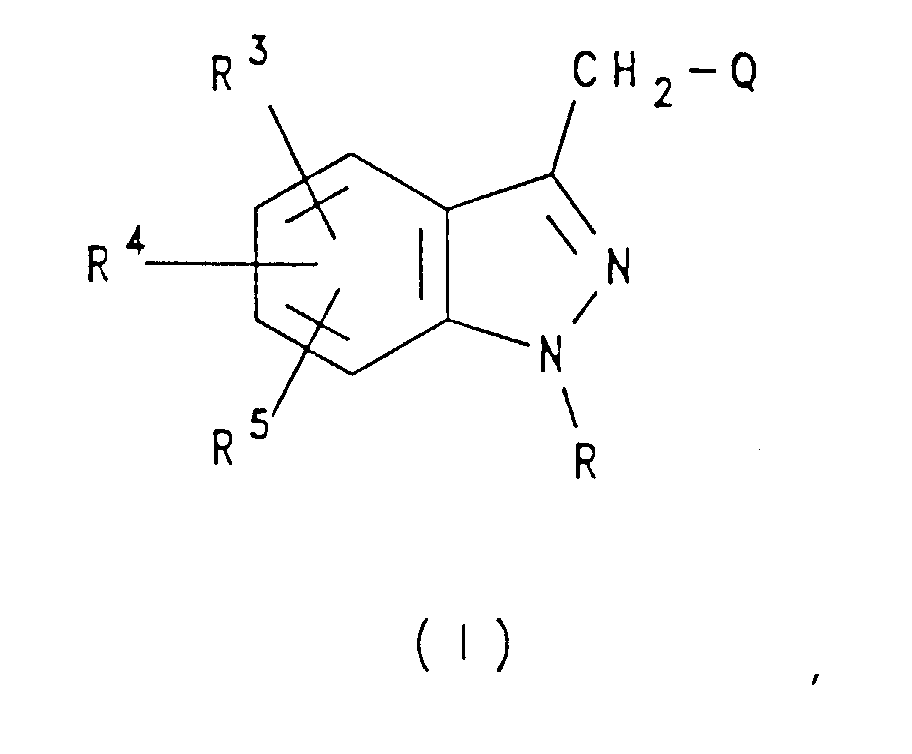 R Wasserstoff oder C1-6-Alkyl bedeutet,Q einen Rest der Formel Qa, Qb oder Qc bedeutet:worin die gestrichelte Linie eine fakultative chemische Bindung bedeutet,
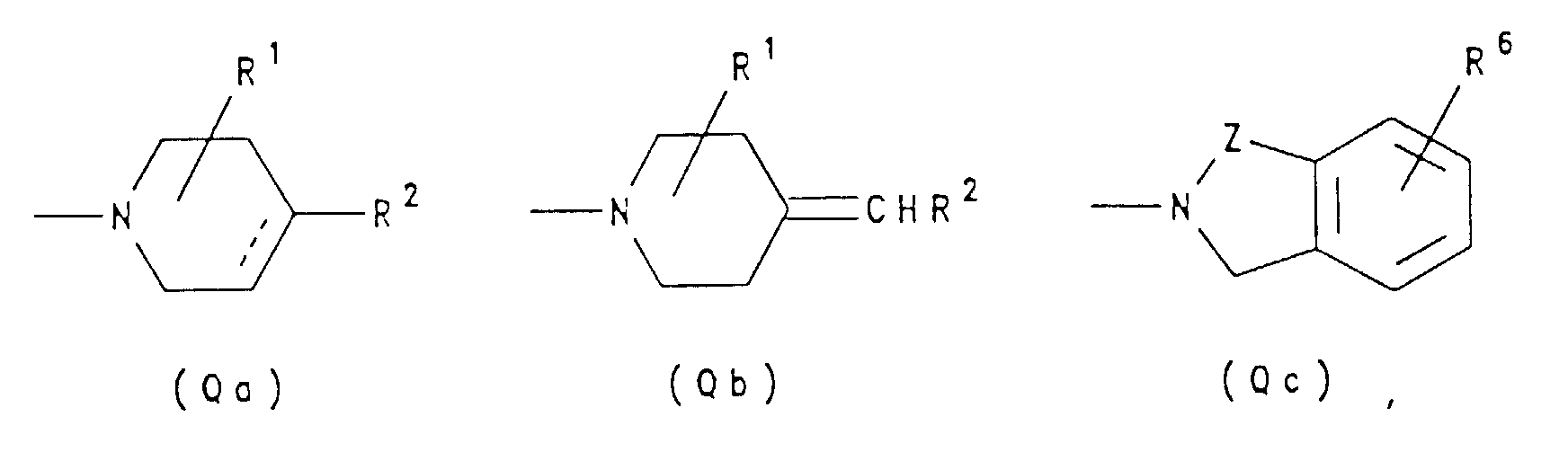 R1 Wasserstoff oder eine gegebenenfalls substituierte C1-6-Alkyl-, C1-6-Alkoxy-, C2-6-Alkenyl-, C2-6-Alkinyl-, C3-7-cycloalkyl-, C3-7-cycloalkyl(C1-6)alkyl-, Aryl-, Aryl(C1-6)alkyl-, Aryl(C1-6)alkoxy-, Aryl (C2-6)alkenyl-, Aryl(C2-6)alkinyl-, Heteroaryl-, Heteroaryl(C1-6)alkyl-, Heteroaryl(C2-6)alkenyl- oder Heteroaryl(C2-6)alkinylgruppe bedeutet,R2 eine gegebenenfalls substituierte C1-6-Alkyl-, C1-6-Alkoxy-, C2-6-Alkenyl-, C2-6-Alkinyl-, C3-7-Cycloalkyl-, C3-7-Cycloalkyl(C1-6)-alkyl-, Aryl-, Aryl(C1-6)alkyl-, Aryl(C1-6)alkoxy-, Aryl(C2-6)alkenyl-, Aryl(C2-6)alkinyl-, Heteroaryl-, Heteroaryl(C1-6)alkyl-, Heteroaryl(C2-6) alkenyl- oder Heteroaryl(C2-6) alkinylgruppe bedeutet,R3, R4 und R5 unabhängig Wasserstoff, eine gegebenenfalls substituierte Kohlenwasserstoffgruppe mit einer geradkettigen, verzweigten oder cyclischen Gruppe mit bis zu 18 Kohlenstoffatomen, eine gegebenenfalls substituierte heterocyclische Gruppe mit bis zu 18 Kohlenstoffatomen und wenigstens einem Heteroatom, ausgewählt aus Sauerstoff, Stickstoff und Schwefel, oder Halogen, Cyano, Trifluormethyl, Nitro, -ORa, -SRa, -SORa, -SO2Ra, -SO2NRaRb, -NRaRb, -NRaCORb, -NRaCO2Rb, -CORa, -CO2Ra oder -CONRaRbbedeuten,Z -CH2- oder -CH2CH2- bedeutet,R6 Wasserstoff, C1-6-Alkyl, C1-6-Alkoxy, Aryl(C1-6)alkyl oder Halogen bedeutet undRa und Rb unabhängig Wasserstoff oder eine wie oben definierte gegebenenfalls substituierte Kohlenwasserstoff- oder heterocyclische Gruppe bedeuten,die fakultativen Substituenten an den oben genannten Kohlenwasserstoff- und heterocyclischen Gruppen und an den oben genannten Substituenten R1 und R2 eine oder mehrere Gruppen sind, ausgewählt aus C1-6-Alkyl, Adamantyl, Phenyl, Aryl(C1-6)alkyl, Halogen, C1-6-Halogenalkyl, C1-6-Aminoalkyl, Trifluormethyl, Hydroxy, C1-6-Alkoxy, Aryloxy, Keto, C1-3-Alkylendioxy, Nitro, Cyano, Carboxy, C2-6-Alkoxycarbonyl, C2-6-Alkoxycarbonyl (C1-6)alkyl, C2-6-Alkylcarbonyloxy, Arylcarbonyloxy, C2-6-Alkylcarbonyl, Arylcarbonyl, C1-6-Alkylthio, C1-6-Alkylsulfinyl, C1-6-Alkylsulfonyl, Arylsulfonyl, -NRvRw, -NRvCORw, -NRvCO2Rw, -NRvSO2Rw, -CH2NRvSO2Rw, -NHCONRvRw, -CONRvRw, -SO2NRvRw und -CH2SO2NRvRw, worin Rv und Rw unabhängig Wasserstoff, C1-6-Alkyl, Aryl oder Aryl(C1-6)alkyl bedeuten,die oben genannten Arylreste ausgewählt sind aus Phenyl und Naphthyl unddie oben genannten Heteroarylreste ausgewählt sind aus Pyridyl, Chinolyl, Isochinolyl, Pyridazinyl, Pyrimidinyl, Pyrazinyl, Pyranyl, Furyl, Benzofuryl, Dibenzofuryl, Thienyl, Benzthienyl, Indolyl, Indazolyl, Imidazolyl, Benzimidazolyl, Oxadiazolyl und Thiadiazolyl.
- Eine wie in Anspruch 1 beanspruchte Verbindung, dargestellt durch Formel IIA, und Salze und Prodrugs davon:worin
 E -(CH2)n-, -CH=CH- oder -C≡C- bedeutet,n null, 1, 2 oder 3 ist,-X-Y- -CH2-CH- oder -CH=C- bedeutet,T eine Gruppe der Formel (i), (ii), (iii) oder (iv) bedeutet:
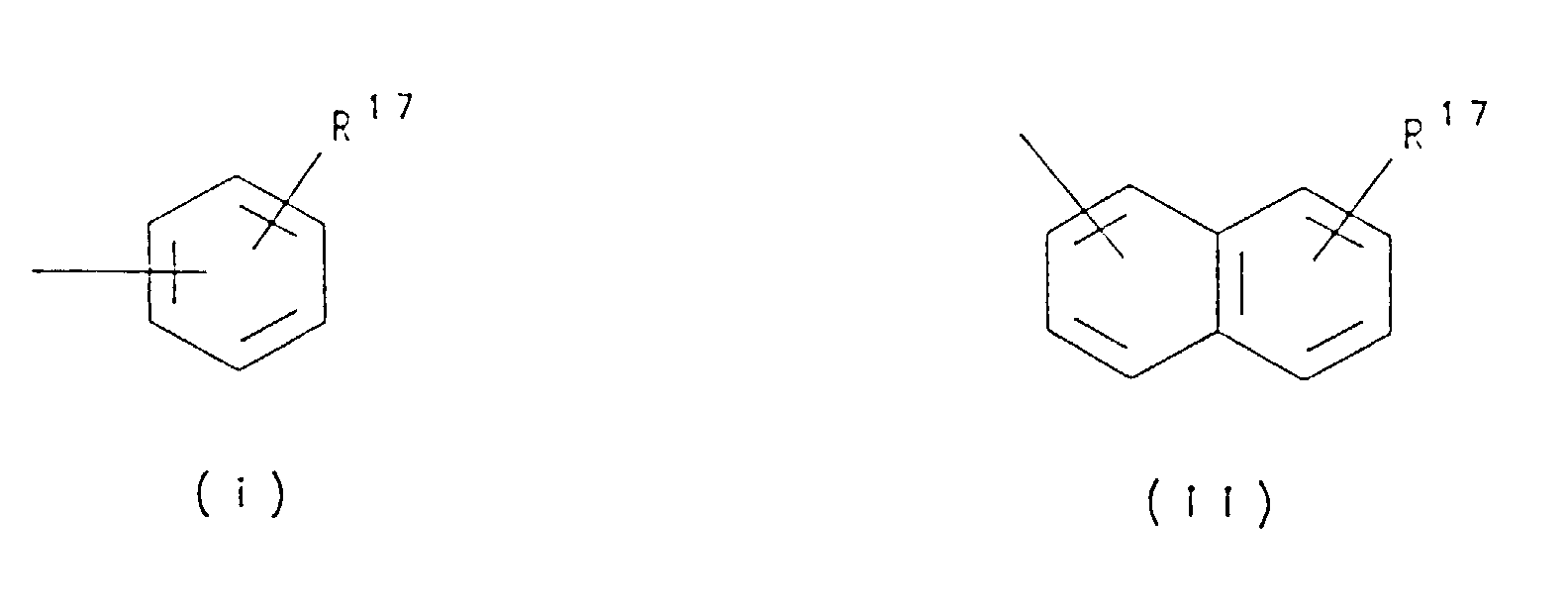 worin
 V Sauerstoff, Schwefel oder NH bedeutet,R11 Wasserstoff oder C1-6-Alkyl bedeutet undR13, R14 und R17 unabhängig Wasserstoff, Halogen, Cyano, Nitro, Trifluormethyl, Amino, C1-6-Alkylamino, Di(C1-6)alkylamino, C1-6-Alkyl, C1-6-Alkoxy, Aryl(C1-6)alkoxy (worin der Arylrest ausgewählt ist aus Phenyl und Naphthyl) oder C2-6-Alkylcarbonyl bedeuten.
- Eine wie in Anspruch 2 beanspruchte Verbindung, dargestellt durch Formel IIB, und Salze und Prodrugs davon:worin
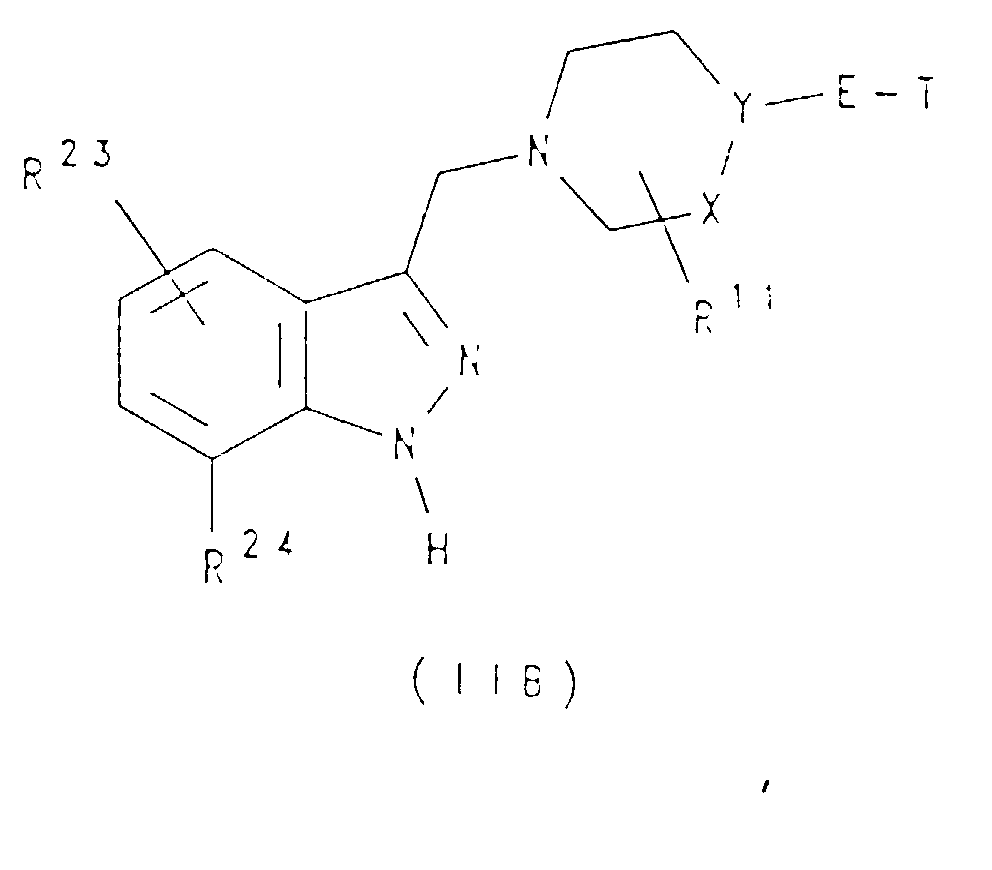 X, Y, R11, E und T wie in Anspruch 2 definiert sind undR23 und R24 unabhängig Wasserstoff, Halogen, Cyano, Nitro, Trifluormethyl, Amino, C1-6-Alkylamino, Di(C1-6)alkylamino, C1-6-Alkyl, C1-6-Alkoxy, Aryl(C1-6)alkoxy (worin der Arylrest ausgewählt ist aus Phenyl und Naphthyl) oder C2-6-Alkylcarbonyl bedeuten.
- Eine wie in Anspruch 2 beanspruchte Verbindung, dargestellt durch Formel IIC, und Salze und Prodrugs davon:worin n, X, Y, R11, R13 und R17 wie in Anspruch 2 definiert sind.
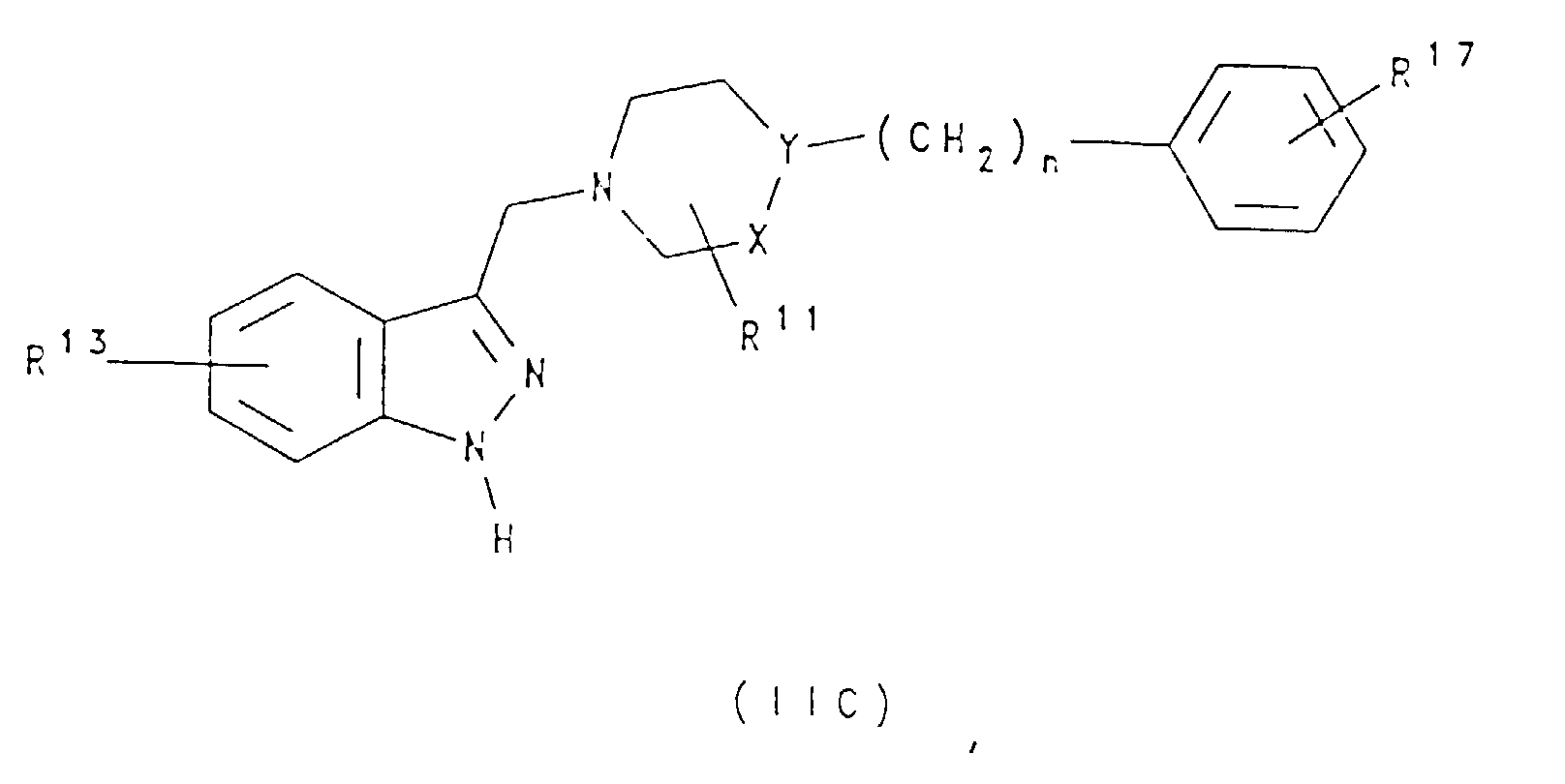
- Eine wie in Anspruch 1 beanspruchte Verbindung, dargestellt durch Formel IID, und Salze und Prodrugs davon:worin
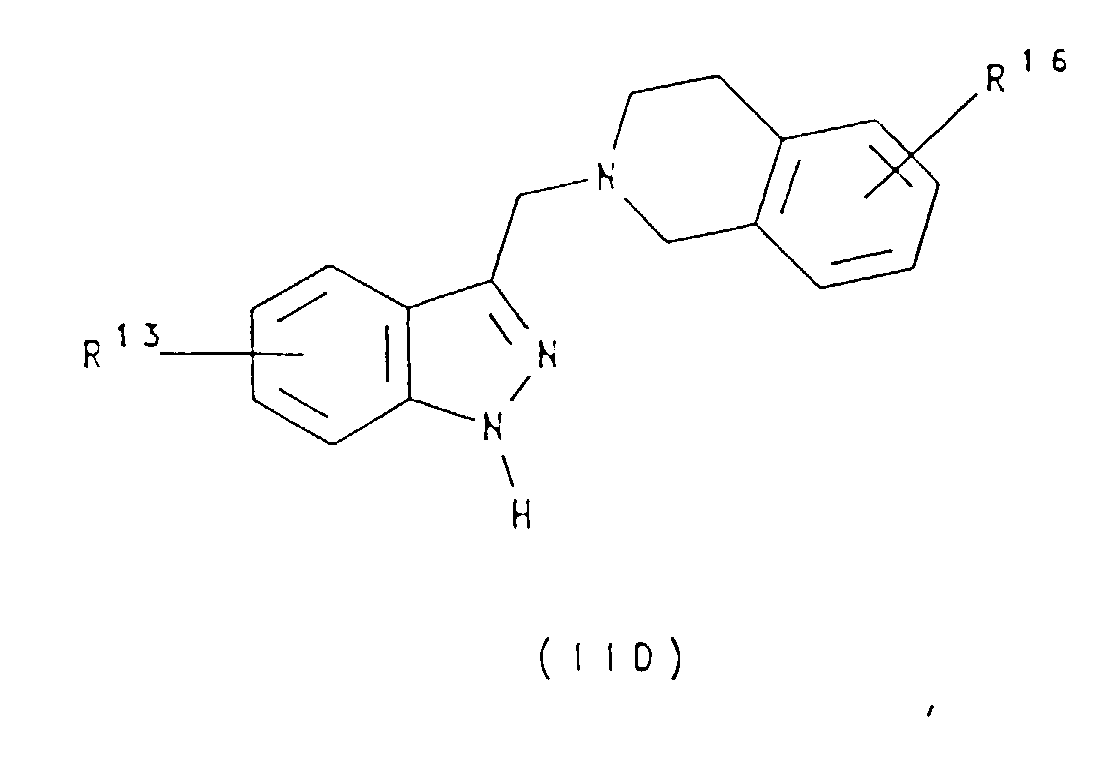 R13 wie in Anspruch 2 definiert ist undR16 Wasserstoff, C1-6-Alkyl, C1-6-Alkoxy, Aryl(C1-6)alkyl (worin der Arylrest ausgewählt ist aus Phenyl und Naphthyl) oder Halogen bedeutet.
- Eine wie in Anspruch 1 beanspruchte Verbindung, ausgewählt aus:und Salze und Prodrugs davon.3-(1,2,3,4-Tetrahydroisochinolin-2-ylmethyl)-1H-indazol,3-[4-(2-Phenylethyl)piperidin-1-ylmethyl]-1H-indazol,3-[4-(2-Cyclohexylethyl)piperidin-1-ylmethyl]-1H-indazol,6-Fluor-3-(1,2,3,4-tetrahydroisochinolin-2-ylmethyl)-1H-indazol,7-Chlor-3-(1,2,3,4-tetrahydroisochinolin-2-ylmethyl)-1H-indazol,6-Chlor-3-(1,2,3,4-tetrahydroisochinolin-2-ylmethyl)-1H-indazol,7-Chlor-3-[4-(2-phenylethyl)-3,6-dihydro-2H-pyridin-1-ylmethyl]-1H-indazol,(E)-3-[4-(2-Phenylethenyl)-3,6-dihydro-2H-pyridin-1-ylmethyl]-1H-indazol,7-Chlor-(E)-3-[4-(2-phenylethenyl)-3,6-dihydro-2H-pyridin-1-yl-methyl]-1H-indazol,3-[4-(Naphthalin-2-yl)-3,6-dihydro-2H-pyridin-1-ylmethyl]-1H-indazol,7-Chlor-3-[4-(4-chlorphenyl)-3,6-dihydro-2H-pyridin-1-ylmethyl]-1H-indazol,3-[4-(4-Methoxyphenyl)-3,6-dihydro-2H-pyridin-1-ylmethyl]-1H-indazol,7-Chlor-3-[4-(4-methoxyphenyl)-3,6-dihydro-2H-pyridin-1-ylmethyl]-1H-indazol,7-Fluor-3-[4-(4-methoxyphenyl)-3,6-dihydro-2H-pyridin-1-ylmethyl]-1H-indazol,6,7-Difluor-3-[4-(4-methoxyphenyl)-3,6-dihydro-2H-pyridin-1-ylmethyl]-1H-indazol,3-[4-(Benzofuran-5-yl)-3,6-dihydro-2H-pyridin-1-ylmethyl]-1H-indazol,3-[4-(Benzofuran-5-yl)-3,6-dihydro-2H-pyridin-1-ylmethyl]-7-chlor-1H-indazol,3-[4-(Benzo[1,3]dioxolan-5-yl)-3,6-dihydro-2H-pyridin-1-ylmethyl]-1H-indazol,3-[4-(1H-Indol-5-yl)-3,6-dihydro-2H-pyridin-1-ylmethyl]-1H-indazol,7-Chlor-3-[4-(1H-indol-5-yl)-3,6-dihydro-2H-pyridin-1-ylmethyl]-1H-indazol,
- Eine pharmazeutische Zusammensetzung, die eine wie in irgendeinem der vorhergehenden Ansprüche beanspruchte Verbindung in Verbindung mit einem pharmazeutisch annehmbaren Träger enthält.
- Eine wie in irgendeinem der Ansprüche 1 bis 6 beanspruchte Verbindung zur Verwendung in der Therapie.
- Die Verwendung einer wie in irgendeinem der Ansprüche 1 bis 6 beanspruchten Verbindung zur Herstellung eines Medikaments zur Behandlung und/oder Prävention von Störungen des Dopaminsystems.
- Ein Verfahren zur Herstellung einer wie in Anspruch 1 beanspruchten Verbindung, das umfaßt:(A) Umsetzung einer Verbindung der Formel III mit einer Verbindung der Formel IV:worin R3, R4 und R5 wie in Anspruch 1 definiert sind, Q1 den Rest einer wie in Anspruch 1 definierten Gruppe der Formel Qa bis Qc bedeutet, L eine geeignete Abgangsgruppe bedeutet, und Rp der wie in Anspruch 1 definierten Gruppe R entspricht oder eine geeignete Schutzgruppe bedeutet, gefolgt, wo erforderlich, von der Entfernung der Schutzgruppe Rp und anschließend, falls erforderlich, von der N-Alkylierung durch Standardverfahren, um den Rest R einzuführen, oder
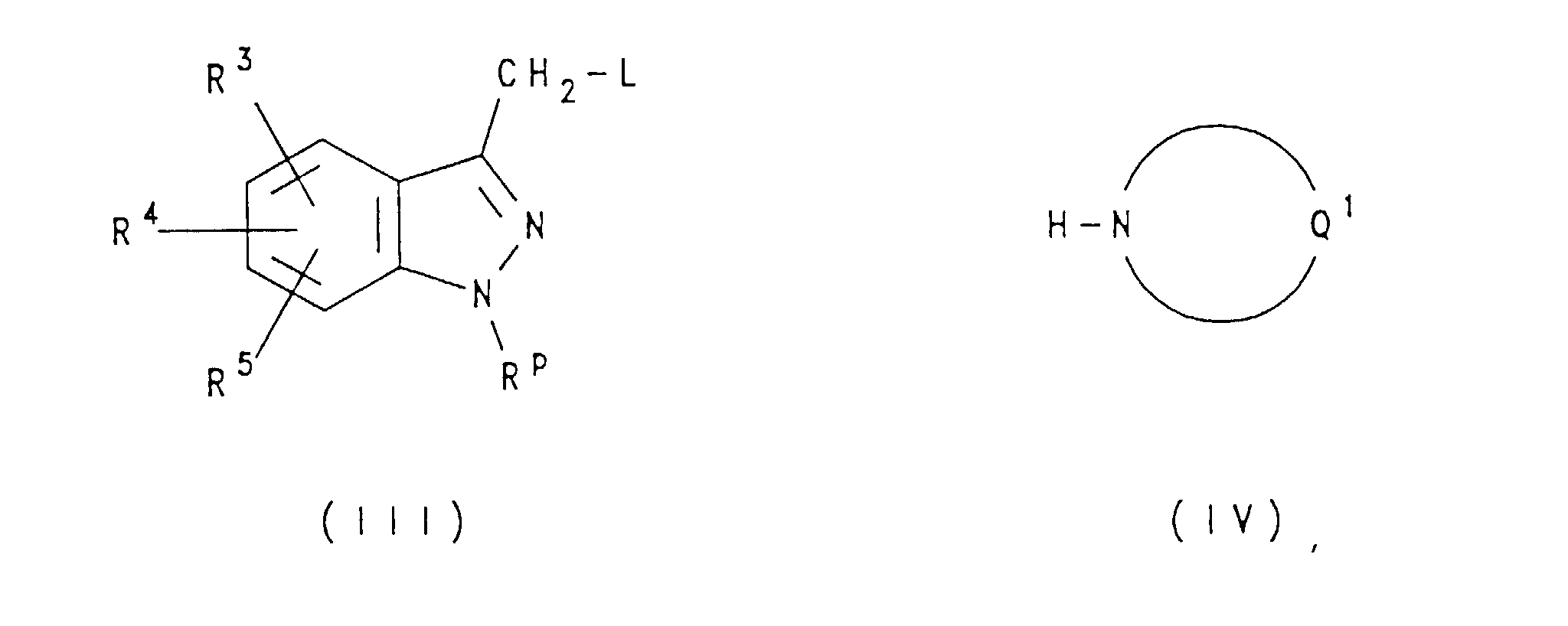 (B) Reduktion einer Verbindung der Formel V:worin R3, R4 und R5 wie in Anspruch 1 definiert sind und Q1 und Rp wie oben definiert sind, gefolgt, wo erforderlich, von der Entfernung der Schutzgruppe Rp und anschließend, falls erforderlich, von der N-Alkylierung durch Standardverfahren, um den Rest R einzuführen, und
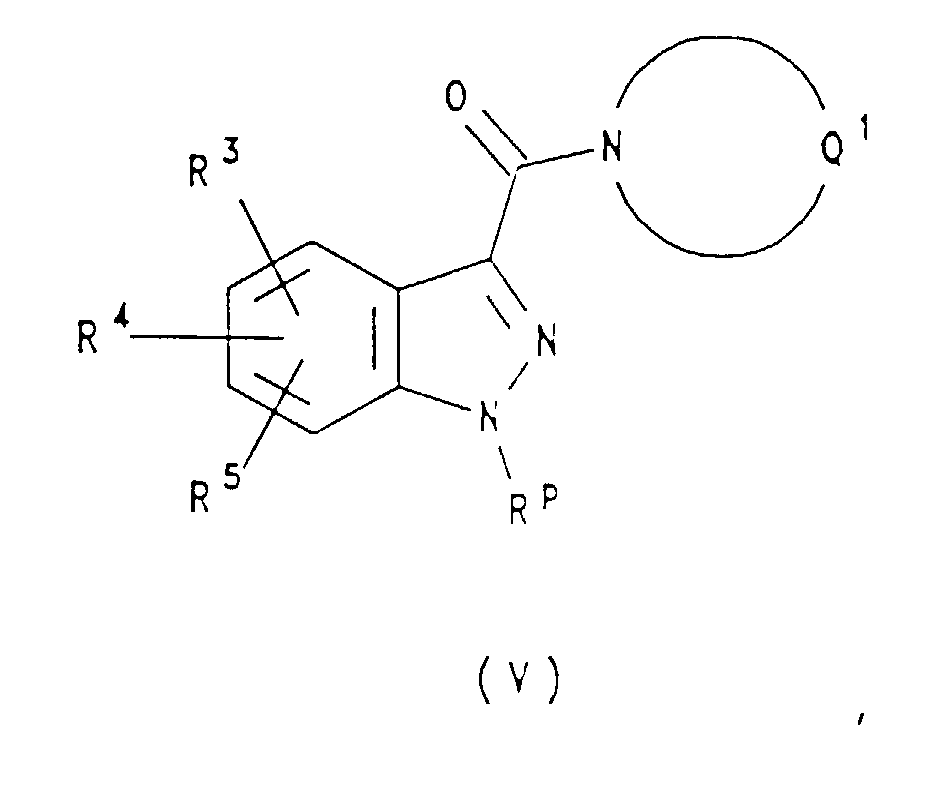 (C) anschließend, wo erforderlich, Umwandlung einer ursprünglich erhaltenen Verbindung der Formel I in eine weitere Verbindung der Formel I durch herkömmliche Verfahren.
Applications Claiming Priority (3)
| Application Number | Priority Date | Filing Date | Title |
|---|---|---|---|
| GB9305641 | 1993-03-18 | ||
| GB939305641A GB9305641D0 (en) | 1993-03-18 | 1993-03-18 | Therapeutic agents |
| PCT/GB1994/000503 WO1994021626A1 (en) | 1993-03-18 | 1994-03-14 | Indazole derivatives |
Publications (2)
| Publication Number | Publication Date |
|---|---|
| EP0701555A1 EP0701555A1 (de) | 1996-03-20 |
| EP0701555B1 true EP0701555B1 (de) | 1999-08-04 |
Family
ID=10732323
Family Applications (1)
| Application Number | Title | Priority Date | Filing Date |
|---|---|---|---|
| EP94909209A Expired - Lifetime EP0701555B1 (de) | 1993-03-18 | 1994-03-14 | Indazolderivate |
Country Status (10)
| Country | Link |
|---|---|
| US (1) | US5665732A (de) |
| EP (1) | EP0701555B1 (de) |
| JP (1) | JPH08507780A (de) |
| AT (1) | ATE182891T1 (de) |
| AU (1) | AU679214B2 (de) |
| CA (1) | CA2156839A1 (de) |
| DE (1) | DE69419917T2 (de) |
| ES (1) | ES2133544T3 (de) |
| GB (1) | GB9305641D0 (de) |
| WO (1) | WO1994021626A1 (de) |
Families Citing this family (18)
| Publication number | Priority date | Publication date | Assignee | Title |
|---|---|---|---|---|
| GB9305623D0 (en) * | 1993-03-18 | 1993-05-05 | Merck Sharp & Dohme | Therapeutic agents |
| TW421649B (en) * | 1995-01-31 | 2001-02-11 | Janssen Pharmaceutica Nv | 4-(1H-indol-1yl)-1-piperidinyl derivatives |
| GB9523462D0 (en) * | 1995-11-16 | 1996-01-17 | Merck Sharp & Dohme | Therapeutic agents |
| US6187774B1 (en) * | 1996-03-04 | 2001-02-13 | Yoshitomi Pharmaceutical Industries, Ltd. | Fused heterocyclic compounds and pharmaceutical applications thereof |
| ZA9711376B (en) | 1996-12-20 | 1998-07-21 | Lundbeck & Co As H | Indole or dihydroindole derivatives |
| AU6246198A (en) * | 1997-02-18 | 1998-09-08 | American Home Products Corporation | 4-aminoethoxyindazole derivatives |
| US5872144A (en) * | 1997-02-18 | 1999-02-16 | American Home Products Corporation | 4-aminoethoxyindazole derivatives |
| JP2003521443A (ja) * | 1998-06-19 | 2003-07-15 | ハー・ルンドベック・アクチエゼルスカベット | 4,5,6及び7−インドール及びインドリン誘導体、その製造方法及びその使用方法 |
| TR200003858T2 (tr) | 1998-06-19 | 2001-06-21 | H. Lundbeck A/S | 4,5,6 ve D-indol ve indolin türevlerinin kullanımı. |
| KR100704710B1 (ko) * | 1999-10-29 | 2007-04-09 | 주식회사 중외제약 | 간 섬유화 억제작용을 나타내는 벤조[3,4-d]1,3-디옥솔란 유도체 |
| US7094790B2 (en) | 2003-05-07 | 2006-08-22 | Abbott Laboratories | Fused bicyclic-substituted amines as histamine-3 receptor ligands |
| DE102004005172A1 (de) * | 2004-02-02 | 2005-08-18 | Aventis Pharma Deutschland Gmbh | Indazolderivate als Inhibitoren der Hormon Sensitiven Lipase |
| CA2743864A1 (en) * | 2008-11-25 | 2010-06-10 | Merck Sharp & Dohme Corp. | Soluble guanylate cyclase activators |
| CN108884050B (zh) * | 2016-04-13 | 2022-07-05 | Ucb生物制药私人有限公司 | 四氢异喹啉衍生物 |
| SI4408840T1 (sl) | 2021-09-27 | 2025-12-31 | Terns Pharmaceuticals, Inc. | Benzimidazolne karboksilne kisline kot agonisti GLP-1R |
| US12024507B2 (en) | 2021-10-25 | 2024-07-02 | Terns Pharmaceuticals, Inc. | Compounds as GLP-1R agonists |
| AU2023224854A1 (en) | 2022-02-23 | 2024-10-03 | Terns Pharmaceuticals, Inc. | Compounds as glp-1r agonists |
| PE20252787A1 (es) | 2023-04-07 | 2025-12-22 | Terns Pharmaceuticals Inc | Combinacion que comprende un agonista de thr-beta y un agonista de glp-1r para su uso en el tratamiento de un trastorno hepatico o una enfermedad cardiometabolica |
Family Cites Families (6)
| Publication number | Priority date | Publication date | Assignee | Title |
|---|---|---|---|---|
| US3488353A (en) * | 1967-05-29 | 1970-01-06 | Sterling Drug Inc | New 1-((2-azaindolyl)-lower-alkyl) 4-substituted-piperazines |
| US3678059A (en) * | 1969-10-07 | 1972-07-18 | Ciba Geigy Corp | 3-aminoalkylidene-indazoles |
| US5116846A (en) * | 1990-03-28 | 1992-05-26 | Du Pont Merck Pharmaceutical Company | N-aralkyl piperidine derivatives as psychotropic drugs |
| NZ243065A (en) * | 1991-06-13 | 1995-07-26 | Lundbeck & Co As H | Piperidine derivatives and pharmaceutical compositions |
| FR2692901B1 (fr) * | 1992-06-26 | 1994-08-19 | Cray Valley Sa | Résines et compositions pour la fabrication de matériaux de haut module résistants à la chaleur et articles moulés obtenus à partir de ces matériaux. |
| HUT71799A (en) * | 1993-03-01 | 1996-02-28 | Merck Sharp & Dohme | Pyrrolo-pyridine derivatives, pharmaceutical compositions containing the same, process for producing them |
-
1993
- 1993-03-18 GB GB939305641A patent/GB9305641D0/en active Pending
-
1994
- 1994-03-14 EP EP94909209A patent/EP0701555B1/de not_active Expired - Lifetime
- 1994-03-14 DE DE69419917T patent/DE69419917T2/de not_active Expired - Fee Related
- 1994-03-14 AT AT94909209T patent/ATE182891T1/de active
- 1994-03-14 CA CA002156839A patent/CA2156839A1/en not_active Abandoned
- 1994-03-14 ES ES94909209T patent/ES2133544T3/es not_active Expired - Lifetime
- 1994-03-14 WO PCT/GB1994/000503 patent/WO1994021626A1/en not_active Ceased
- 1994-03-14 JP JP6520765A patent/JPH08507780A/ja active Pending
- 1994-03-14 US US08/530,226 patent/US5665732A/en not_active Expired - Fee Related
- 1994-03-14 AU AU62139/94A patent/AU679214B2/en not_active Ceased
Also Published As
| Publication number | Publication date |
|---|---|
| AU679214B2 (en) | 1997-06-26 |
| EP0701555A1 (de) | 1996-03-20 |
| AU6213994A (en) | 1994-10-11 |
| DE69419917D1 (de) | 1999-09-09 |
| GB9305641D0 (en) | 1993-05-05 |
| ES2133544T3 (es) | 1999-09-16 |
| ATE182891T1 (de) | 1999-08-15 |
| WO1994021626A1 (en) | 1994-09-29 |
| DE69419917T2 (de) | 2000-02-24 |
| US5665732A (en) | 1997-09-09 |
| JPH08507780A (ja) | 1996-08-20 |
| CA2156839A1 (en) | 1994-09-29 |
Similar Documents
| Publication | Publication Date | Title |
|---|---|---|
| EP0689539B1 (de) | Antipsychotische indazolderivate | |
| US5792768A (en) | Antipsychotic benzimidazole derivatives | |
| US5665732A (en) | Indazole derivatives | |
| EP0689535B1 (de) | Benzimidazole derivate | |
| US5563150A (en) | Pyrrolo-pyridine derivatives | |
| US5563152A (en) | Pyrrolo-pyridine derivatives | |
| US5712285A (en) | Pyrrolo-pyridine derivatives | |
| WO1994024105A1 (en) | Indole derivatives as dopamine d4 antagonists | |
| US5670522A (en) | Dopamine receptor subtype ligands | |
| US6080745A (en) | Fused tricyclic heteroaromatic derivatives as dopamine receptor subtype ligands | |
| US5763448A (en) | Pyrmidine derivatives | |
| EP0717733B1 (de) | Kondensierte tricyclische heteroaromatische verbindungen als dopamin-rezeptor-subtyp-liganden | |
| JP4459437B2 (ja) | テトラヒドロベンズインドール誘導体 | |
| JP3162572B2 (ja) | インドロイルグアニジン誘導体 | |
| US5641787A (en) | Indole derivatives as dopamine D4 antagonists | |
| EP0719264B1 (de) | Imidanolon- und oxanolonderivate als dopaminantagonisten | |
| US5861407A (en) | Tetrahydropyridine derivatives as dopamine receptor subtype ligands | |
| US5700941A (en) | Octahydronaphthyridine derivatives | |
| GB2298421A (en) | 2-Heterocyclylmethyl-pyrrolo[2,3-b]pyridine derivatives as ligands for dopamine receptor subtypes | |
| GB2299582A (en) | Octahydronaphthyridine derivatives |
Legal Events
| Date | Code | Title | Description |
|---|---|---|---|
| PUAI | Public reference made under article 153(3) epc to a published international application that has entered the european phase |
Free format text: ORIGINAL CODE: 0009012 |
|
| 17P | Request for examination filed |
Effective date: 19951018 |
|
| AK | Designated contracting states |
Kind code of ref document: A1 Designated state(s): AT BE CH DE DK ES FR GB GR IE IT LI LU NL PT SE |
|
| 17Q | First examination report despatched |
Effective date: 19960816 |
|
| GRAG | Despatch of communication of intention to grant |
Free format text: ORIGINAL CODE: EPIDOS AGRA |
|
| GRAG | Despatch of communication of intention to grant |
Free format text: ORIGINAL CODE: EPIDOS AGRA |
|
| GRAH | Despatch of communication of intention to grant a patent |
Free format text: ORIGINAL CODE: EPIDOS IGRA |
|
| GRAH | Despatch of communication of intention to grant a patent |
Free format text: ORIGINAL CODE: EPIDOS IGRA |
|
| GRAA | (expected) grant |
Free format text: ORIGINAL CODE: 0009210 |
|
| AK | Designated contracting states |
Kind code of ref document: B1 Designated state(s): AT BE CH DE DK ES FR GB GR IE IT LI LU NL PT SE |
|
| PG25 | Lapsed in a contracting state [announced via postgrant information from national office to epo] |
Ref country code: SE Free format text: THE PATENT HAS BEEN ANNULLED BY A DECISION OF A NATIONAL AUTHORITY Effective date: 19990804 Ref country code: NL Free format text: LAPSE BECAUSE OF FAILURE TO SUBMIT A TRANSLATION OF THE DESCRIPTION OR TO PAY THE FEE WITHIN THE PRESCRIBED TIME-LIMIT Effective date: 19990804 Ref country code: LI Free format text: LAPSE BECAUSE OF FAILURE TO SUBMIT A TRANSLATION OF THE DESCRIPTION OR TO PAY THE FEE WITHIN THE PRESCRIBED TIME-LIMIT Effective date: 19990804 Ref country code: GR Free format text: LAPSE BECAUSE OF NON-PAYMENT OF DUE FEES Effective date: 19990804 Ref country code: CH Free format text: LAPSE BECAUSE OF FAILURE TO SUBMIT A TRANSLATION OF THE DESCRIPTION OR TO PAY THE FEE WITHIN THE PRESCRIBED TIME-LIMIT Effective date: 19990804 Ref country code: BE Free format text: LAPSE BECAUSE OF FAILURE TO SUBMIT A TRANSLATION OF THE DESCRIPTION OR TO PAY THE FEE WITHIN THE PRESCRIBED TIME-LIMIT Effective date: 19990804 Ref country code: AT Free format text: LAPSE BECAUSE OF FAILURE TO SUBMIT A TRANSLATION OF THE DESCRIPTION OR TO PAY THE FEE WITHIN THE PRESCRIBED TIME-LIMIT Effective date: 19990804 |
|
| REF | Corresponds to: |
Ref document number: 182891 Country of ref document: AT Date of ref document: 19990815 Kind code of ref document: T |
|
| REG | Reference to a national code |
Ref country code: CH Ref legal event code: EP |
|
| REF | Corresponds to: |
Ref document number: 69419917 Country of ref document: DE Date of ref document: 19990909 |
|
| REG | Reference to a national code |
Ref country code: ES Ref legal event code: FG2A Ref document number: 2133544 Country of ref document: ES Kind code of ref document: T3 |
|
| REG | Reference to a national code |
Ref country code: IE Ref legal event code: FG4D |
|
| ET | Fr: translation filed | ||
| ITF | It: translation for a ep patent filed | ||
| PG25 | Lapsed in a contracting state [announced via postgrant information from national office to epo] |
Ref country code: PT Free format text: LAPSE BECAUSE OF FAILURE TO SUBMIT A TRANSLATION OF THE DESCRIPTION OR TO PAY THE FEE WITHIN THE PRESCRIBED TIME-LIMIT Effective date: 19991104 Ref country code: DK Free format text: LAPSE BECAUSE OF FAILURE TO SUBMIT A TRANSLATION OF THE DESCRIPTION OR TO PAY THE FEE WITHIN THE PRESCRIBED TIME-LIMIT Effective date: 19991104 |
|
| NLV1 | Nl: lapsed or annulled due to failure to fulfill the requirements of art. 29p and 29m of the patents act | ||
| REG | Reference to a national code |
Ref country code: CH Ref legal event code: PL |
|
| PG25 | Lapsed in a contracting state [announced via postgrant information from national office to epo] |
Ref country code: LU Free format text: LAPSE BECAUSE OF NON-PAYMENT OF DUE FEES Effective date: 20000314 Ref country code: IE Free format text: LAPSE BECAUSE OF NON-PAYMENT OF DUE FEES Effective date: 20000314 |
|
| PLBE | No opposition filed within time limit |
Free format text: ORIGINAL CODE: 0009261 |
|
| STAA | Information on the status of an ep patent application or granted ep patent |
Free format text: STATUS: NO OPPOSITION FILED WITHIN TIME LIMIT |
|
| 26N | No opposition filed | ||
| REG | Reference to a national code |
Ref country code: IE Ref legal event code: MM4A |
|
| REG | Reference to a national code |
Ref country code: GB Ref legal event code: IF02 |
|
| PGFP | Annual fee paid to national office [announced via postgrant information from national office to epo] |
Ref country code: GB Payment date: 20020124 Year of fee payment: 9 |
|
| PGFP | Annual fee paid to national office [announced via postgrant information from national office to epo] |
Ref country code: FR Payment date: 20020221 Year of fee payment: 9 |
|
| PGFP | Annual fee paid to national office [announced via postgrant information from national office to epo] |
Ref country code: DE Payment date: 20020320 Year of fee payment: 9 |
|
| PGFP | Annual fee paid to national office [announced via postgrant information from national office to epo] |
Ref country code: ES Payment date: 20020409 Year of fee payment: 9 |
|
| PG25 | Lapsed in a contracting state [announced via postgrant information from national office to epo] |
Ref country code: GB Free format text: LAPSE BECAUSE OF NON-PAYMENT OF DUE FEES Effective date: 20030314 |
|
| PG25 | Lapsed in a contracting state [announced via postgrant information from national office to epo] |
Ref country code: ES Free format text: LAPSE BECAUSE OF NON-PAYMENT OF DUE FEES Effective date: 20030315 |
|
| PG25 | Lapsed in a contracting state [announced via postgrant information from national office to epo] |
Ref country code: DE Free format text: LAPSE BECAUSE OF NON-PAYMENT OF DUE FEES Effective date: 20031001 |
|
| GBPC | Gb: european patent ceased through non-payment of renewal fee |
Effective date: 20030314 |
|
| PG25 | Lapsed in a contracting state [announced via postgrant information from national office to epo] |
Ref country code: FR Free format text: LAPSE BECAUSE OF NON-PAYMENT OF DUE FEES Effective date: 20031127 |
|
| REG | Reference to a national code |
Ref country code: FR Ref legal event code: ST |
|
| REG | Reference to a national code |
Ref country code: ES Ref legal event code: FD2A Effective date: 20030315 |
|
| PG25 | Lapsed in a contracting state [announced via postgrant information from national office to epo] |
Ref country code: IT Free format text: LAPSE BECAUSE OF NON-PAYMENT OF DUE FEES;WARNING: LAPSES OF ITALIAN PATENTS WITH EFFECTIVE DATE BEFORE 2007 MAY HAVE OCCURRED AT ANY TIME BEFORE 2007. THE CORRECT EFFECTIVE DATE MAY BE DIFFERENT FROM THE ONE RECORDED. Effective date: 20050314 |