EP0701540B1 - Flammwidriger polyharnstoff-schaum - Google Patents
Flammwidriger polyharnstoff-schaum Download PDFInfo
- Publication number
- EP0701540B1 EP0701540B1 EP95914290A EP95914290A EP0701540B1 EP 0701540 B1 EP0701540 B1 EP 0701540B1 EP 95914290 A EP95914290 A EP 95914290A EP 95914290 A EP95914290 A EP 95914290A EP 0701540 B1 EP0701540 B1 EP 0701540B1
- Authority
- EP
- European Patent Office
- Prior art keywords
- mass
- foam
- polyurea
- water
- masse
- Prior art date
- Legal status (The legal status is an assumption and is not a legal conclusion. Google has not performed a legal analysis and makes no representation as to the accuracy of the status listed.)
- Expired - Lifetime
Links
- 239000006260 foam Substances 0.000 title claims abstract description 63
- XLYOFNOQVPJJNP-UHFFFAOYSA-N water Substances O XLYOFNOQVPJJNP-UHFFFAOYSA-N 0.000 claims abstract description 52
- 239000003063 flame retardant Substances 0.000 claims abstract description 21
- RNFJDJUURJAICM-UHFFFAOYSA-N 2,2,4,4,6,6-hexaphenoxy-1,3,5-triaza-2$l^{5},4$l^{5},6$l^{5}-triphosphacyclohexa-1,3,5-triene Chemical compound N=1P(OC=2C=CC=CC=2)(OC=2C=CC=CC=2)=NP(OC=2C=CC=CC=2)(OC=2C=CC=CC=2)=NP=1(OC=1C=CC=CC=1)OC1=CC=CC=C1 RNFJDJUURJAICM-UHFFFAOYSA-N 0.000 claims abstract description 19
- UPMLOUAZCHDJJD-UHFFFAOYSA-N 4,4'-Diphenylmethane Diisocyanate Chemical compound C1=CC(N=C=O)=CC=C1CC1=CC=C(N=C=O)C=C1 UPMLOUAZCHDJJD-UHFFFAOYSA-N 0.000 claims abstract description 10
- 238000009413 insulation Methods 0.000 claims abstract description 9
- PASHVRUKOFIRIK-UHFFFAOYSA-L calcium sulfate dihydrate Chemical compound O.O.[Ca+2].[O-]S([O-])(=O)=O PASHVRUKOFIRIK-UHFFFAOYSA-L 0.000 claims abstract 6
- 238000011065 in-situ storage Methods 0.000 claims abstract 2
- 229920002396 Polyurea Polymers 0.000 claims description 64
- 239000010440 gypsum Substances 0.000 claims description 59
- 229910052602 gypsum Inorganic materials 0.000 claims description 59
- 238000000034 method Methods 0.000 claims description 29
- 239000000203 mixture Substances 0.000 claims description 23
- 239000004114 Ammonium polyphosphate Substances 0.000 claims description 15
- 235000019826 ammonium polyphosphate Nutrition 0.000 claims description 15
- 229920001276 ammonium polyphosphate Polymers 0.000 claims description 15
- 238000005187 foaming Methods 0.000 claims description 10
- 238000006243 chemical reaction Methods 0.000 claims description 7
- 239000012765 fibrous filler Substances 0.000 claims description 7
- 239000012948 isocyanate Substances 0.000 claims description 7
- 150000002513 isocyanates Chemical class 0.000 claims description 7
- CURLTUGMZLYLDI-UHFFFAOYSA-N Carbon dioxide Chemical compound O=C=O CURLTUGMZLYLDI-UHFFFAOYSA-N 0.000 claims description 6
- 239000003054 catalyst Substances 0.000 claims description 6
- 239000004872 foam stabilizing agent Substances 0.000 claims description 6
- 150000002830 nitrogen compounds Chemical class 0.000 claims description 6
- 239000000375 suspending agent Substances 0.000 claims description 6
- -1 polysiloxanes Polymers 0.000 claims description 5
- 229910017464 nitrogen compound Inorganic materials 0.000 claims description 4
- 239000002245 particle Substances 0.000 claims description 4
- 229920001296 polysiloxane Polymers 0.000 claims description 4
- 230000015572 biosynthetic process Effects 0.000 claims description 3
- 229910002092 carbon dioxide Inorganic materials 0.000 claims description 3
- 239000001569 carbon dioxide Substances 0.000 claims description 3
- 239000006185 dispersion Substances 0.000 claims description 2
- 239000000126 substance Substances 0.000 claims description 2
- 239000000725 suspension Substances 0.000 claims description 2
- 229920003002 synthetic resin Polymers 0.000 claims description 2
- 239000000057 synthetic resin Substances 0.000 claims description 2
- DXZMANYCMVCPIM-UHFFFAOYSA-L zinc;diethylphosphinate Chemical compound [Zn+2].CCP([O-])(=O)CC.CCP([O-])(=O)CC DXZMANYCMVCPIM-UHFFFAOYSA-L 0.000 claims description 2
- 239000002270 dispersing agent Substances 0.000 claims 2
- 238000002156 mixing Methods 0.000 claims 1
- 230000009974 thixotropic effect Effects 0.000 claims 1
- 239000000945 filler Substances 0.000 abstract description 3
- 239000004254 Ammonium phosphate Substances 0.000 abstract 1
- 229910000148 ammonium phosphate Inorganic materials 0.000 abstract 1
- 235000019289 ammonium phosphates Nutrition 0.000 abstract 1
- MNNHAPBLZZVQHP-UHFFFAOYSA-N diammonium hydrogen phosphate Chemical compound [NH4+].[NH4+].OP([O-])([O-])=O MNNHAPBLZZVQHP-UHFFFAOYSA-N 0.000 abstract 1
- OSGAYBCDTDRGGQ-UHFFFAOYSA-L calcium sulfate Chemical compound [Ca+2].[O-]S([O-])(=O)=O OSGAYBCDTDRGGQ-UHFFFAOYSA-L 0.000 description 61
- GUSFEBGYPWJUSS-UHFFFAOYSA-N pentaazanium;[oxido(phosphonatooxy)phosphoryl] phosphate Chemical compound [NH4+].[NH4+].[NH4+].[NH4+].[NH4+].[O-]P([O-])(=O)OP([O-])(=O)OP([O-])([O-])=O GUSFEBGYPWJUSS-UHFFFAOYSA-N 0.000 description 54
- 229920001282 polysaccharide Polymers 0.000 description 32
- 238000012360 testing method Methods 0.000 description 28
- 229920002334 Spandex Polymers 0.000 description 19
- GQSGZTBDVNUIQS-DGCLKSJQSA-N ciclonicate Chemical compound C1C(C)(C)C[C@H](C)C[C@H]1OC(=O)C1=CC=CN=C1 GQSGZTBDVNUIQS-DGCLKSJQSA-N 0.000 description 19
- 150000004676 glycans Chemical class 0.000 description 17
- 239000005017 polysaccharide Substances 0.000 description 17
- 238000001035 drying Methods 0.000 description 9
- 230000003247 decreasing effect Effects 0.000 description 6
- 239000000047 product Substances 0.000 description 6
- 238000002411 thermogravimetry Methods 0.000 description 6
- UGFAIRIUMAVXCW-UHFFFAOYSA-N Carbon monoxide Chemical compound [O+]#[C-] UGFAIRIUMAVXCW-UHFFFAOYSA-N 0.000 description 5
- 239000003546 flue gas Substances 0.000 description 5
- 238000004519 manufacturing process Methods 0.000 description 5
- 238000002441 X-ray diffraction Methods 0.000 description 4
- 239000003795 chemical substances by application Substances 0.000 description 4
- 238000006477 desulfuration reaction Methods 0.000 description 4
- 230000023556 desulfurization Effects 0.000 description 4
- 239000011505 plaster Substances 0.000 description 4
- 229910052925 anhydrite Inorganic materials 0.000 description 3
- 239000004566 building material Substances 0.000 description 3
- ZOMBKNNSYQHRCA-UHFFFAOYSA-J calcium sulfate hemihydrate Chemical compound O.[Ca+2].[Ca+2].[O-]S([O-])(=O)=O.[O-]S([O-])(=O)=O ZOMBKNNSYQHRCA-UHFFFAOYSA-J 0.000 description 3
- 239000011507 gypsum plaster Substances 0.000 description 3
- 229920003043 Cellulose fiber Polymers 0.000 description 2
- RTZKZFJDLAIYFH-UHFFFAOYSA-N Diethyl ether Chemical compound CCOCC RTZKZFJDLAIYFH-UHFFFAOYSA-N 0.000 description 2
- 206010013786 Dry skin Diseases 0.000 description 2
- IAYPIBMASNFSPL-UHFFFAOYSA-N Ethylene oxide Chemical compound C1CO1 IAYPIBMASNFSPL-UHFFFAOYSA-N 0.000 description 2
- OWIKHYCFFJSOEH-UHFFFAOYSA-N Isocyanic acid Chemical compound N=C=O OWIKHYCFFJSOEH-UHFFFAOYSA-N 0.000 description 2
- 238000010521 absorption reaction Methods 0.000 description 2
- 239000000463 material Substances 0.000 description 2
- 230000004048 modification Effects 0.000 description 2
- 238000012986 modification Methods 0.000 description 2
- 239000000843 powder Substances 0.000 description 2
- 239000007858 starting material Substances 0.000 description 2
- 239000013008 thixotropic agent Substances 0.000 description 2
- QQGRFMIMXPWKPM-UHFFFAOYSA-N 2,3,4-tributylphenol Chemical class CCCCC1=CC=C(O)C(CCCC)=C1CCCC QQGRFMIMXPWKPM-UHFFFAOYSA-N 0.000 description 1
- 101100365384 Mus musculus Eefsec gene Proteins 0.000 description 1
- 229910000831 Steel Inorganic materials 0.000 description 1
- 230000002378 acidificating effect Effects 0.000 description 1
- QVGXLLKOCUKJST-UHFFFAOYSA-N atomic oxygen Chemical compound [O] QVGXLLKOCUKJST-UHFFFAOYSA-N 0.000 description 1
- 230000000052 comparative effect Effects 0.000 description 1
- 239000002131 composite material Substances 0.000 description 1
- 239000007859 condensation product Substances 0.000 description 1
- 230000018044 dehydration Effects 0.000 description 1
- 238000006297 dehydration reaction Methods 0.000 description 1
- 238000004455 differential thermal analysis Methods 0.000 description 1
- 238000010410 dusting Methods 0.000 description 1
- 230000000694 effects Effects 0.000 description 1
- 239000000835 fiber Substances 0.000 description 1
- 239000002657 fibrous material Substances 0.000 description 1
- 239000007789 gas Substances 0.000 description 1
- 239000003365 glass fiber Substances 0.000 description 1
- 239000008187 granular material Substances 0.000 description 1
- 238000000265 homogenisation Methods 0.000 description 1
- 239000011256 inorganic filler Substances 0.000 description 1
- 229910003475 inorganic filler Inorganic materials 0.000 description 1
- 230000010354 integration Effects 0.000 description 1
- 239000007788 liquid Substances 0.000 description 1
- 238000003801 milling Methods 0.000 description 1
- 230000007935 neutral effect Effects 0.000 description 1
- 239000001301 oxygen Substances 0.000 description 1
- 229910052760 oxygen Inorganic materials 0.000 description 1
- 239000010893 paper waste Substances 0.000 description 1
- 229920000151 polyglycol Polymers 0.000 description 1
- 239000010695 polyglycol Substances 0.000 description 1
- 239000011148 porous material Substances 0.000 description 1
- 238000012545 processing Methods 0.000 description 1
- 230000005855 radiation Effects 0.000 description 1
- 230000035484 reaction time Effects 0.000 description 1
- 239000007787 solid Substances 0.000 description 1
- 239000010959 steel Substances 0.000 description 1
- 238000003756 stirring Methods 0.000 description 1
- 238000002076 thermal analysis method Methods 0.000 description 1
- 238000012546 transfer Methods 0.000 description 1
- 230000004580 weight loss Effects 0.000 description 1
Images


Classifications
-
- C—CHEMISTRY; METALLURGY
- C09—DYES; PAINTS; POLISHES; NATURAL RESINS; ADHESIVES; COMPOSITIONS NOT OTHERWISE PROVIDED FOR; APPLICATIONS OF MATERIALS NOT OTHERWISE PROVIDED FOR
- C09K—MATERIALS FOR MISCELLANEOUS APPLICATIONS, NOT PROVIDED FOR ELSEWHERE
- C09K3/00—Materials not provided for elsewhere
- C09K3/32—Materials not provided for elsewhere for absorbing liquids to remove pollution, e.g. oil, gasoline, fat
-
- C—CHEMISTRY; METALLURGY
- C04—CEMENTS; CONCRETE; ARTIFICIAL STONE; CERAMICS; REFRACTORIES
- C04B—LIME, MAGNESIA; SLAG; CEMENTS; COMPOSITIONS THEREOF, e.g. MORTARS, CONCRETE OR LIKE BUILDING MATERIALS; ARTIFICIAL STONE; CERAMICS; REFRACTORIES; TREATMENT OF NATURAL STONE
- C04B26/00—Compositions of mortars, concrete or artificial stone, containing only organic binders, e.g. polymer or resin concrete
- C04B26/02—Macromolecular compounds
- C04B26/10—Macromolecular compounds obtained otherwise than by reactions only involving carbon-to-carbon unsaturated bonds
- C04B26/16—Polyurethanes
-
- C—CHEMISTRY; METALLURGY
- C08—ORGANIC MACROMOLECULAR COMPOUNDS; THEIR PREPARATION OR CHEMICAL WORKING-UP; COMPOSITIONS BASED THEREON
- C08G—MACROMOLECULAR COMPOUNDS OBTAINED OTHERWISE THAN BY REACTIONS ONLY INVOLVING UNSATURATED CARBON-TO-CARBON BONDS
- C08G18/00—Polymeric products of isocyanates or isothiocyanates
- C08G18/06—Polymeric products of isocyanates or isothiocyanates with compounds having active hydrogen
- C08G18/08—Processes
- C08G18/10—Prepolymer processes involving reaction of isocyanates or isothiocyanates with compounds having active hydrogen in a first reaction step
-
- C—CHEMISTRY; METALLURGY
- C08—ORGANIC MACROMOLECULAR COMPOUNDS; THEIR PREPARATION OR CHEMICAL WORKING-UP; COMPOSITIONS BASED THEREON
- C08G—MACROMOLECULAR COMPOUNDS OBTAINED OTHERWISE THAN BY REACTIONS ONLY INVOLVING UNSATURATED CARBON-TO-CARBON BONDS
- C08G2110/00—Foam properties
- C08G2110/0041—Foam properties having specified density
-
- C—CHEMISTRY; METALLURGY
- C08—ORGANIC MACROMOLECULAR COMPOUNDS; THEIR PREPARATION OR CHEMICAL WORKING-UP; COMPOSITIONS BASED THEREON
- C08G—MACROMOLECULAR COMPOUNDS OBTAINED OTHERWISE THAN BY REACTIONS ONLY INVOLVING UNSATURATED CARBON-TO-CARBON BONDS
- C08G2110/00—Foam properties
- C08G2110/0083—Foam properties prepared using water as the sole blowing agent
-
- C—CHEMISTRY; METALLURGY
- C08—ORGANIC MACROMOLECULAR COMPOUNDS; THEIR PREPARATION OR CHEMICAL WORKING-UP; COMPOSITIONS BASED THEREON
- C08G—MACROMOLECULAR COMPOUNDS OBTAINED OTHERWISE THAN BY REACTIONS ONLY INVOLVING UNSATURATED CARBON-TO-CARBON BONDS
- C08G2350/00—Acoustic or vibration damping material
-
- Y—GENERAL TAGGING OF NEW TECHNOLOGICAL DEVELOPMENTS; GENERAL TAGGING OF CROSS-SECTIONAL TECHNOLOGIES SPANNING OVER SEVERAL SECTIONS OF THE IPC; TECHNICAL SUBJECTS COVERED BY FORMER USPC CROSS-REFERENCE ART COLLECTIONS [XRACs] AND DIGESTS
- Y10—TECHNICAL SUBJECTS COVERED BY FORMER USPC
- Y10S—TECHNICAL SUBJECTS COVERED BY FORMER USPC CROSS-REFERENCE ART COLLECTIONS [XRACs] AND DIGESTS
- Y10S521/00—Synthetic resins or natural rubbers -- part of the class 520 series
- Y10S521/906—Polyurethane cellular product containing unreacted flame-retardant material
Definitions
- the invention relates to flame-retardant polyurea foam, a process for its production and its use.
- DE 39 09 083 C1 discloses a gypsum foam with a porous structure, containing a polyurea, which has a density of 100 to 400 kg / m 3 , is open-celled and as a polyurea the condensation product of diphenylmethane-4,4'-diisocyanate. Contains prepolymers and water. The gypsum foam is to be used as sound and / or thermal insulation.
- ammonium polyphosphate made it possible to produce open-cell and light (density: ⁇ 100 kg / m 3 ) polyurea foams that met the requirements of building material class DIN 4102-B2 if the density was over 35 kg / m 3 and the gypsum content was over 30 mass -% were. Furthermore, for the first time, ammonium polyphosphate was used to produce open-cell, light (density: ⁇ 100 kg / m 3 ) and flame-retardant polyurea foams that met the requirements of building material class DIN 4102-B1. This was surprising and unpredictable, because with decreasing density the proportion of non-combustible inorganic filler has to be reduced and the proportion of combustible polyurea has to be increased to the same extent.
- a very important side effect of using ammonium polyphosphate as a flame retardant is the better integration of the gypsum into the polyurea foam. While a gypsum-filled polyurea foam, which was produced without the use of ammonium polyphosphate, is very dusty during processing with partial loss of the powdery gypsum, dusting in the polyurea foams according to the invention is avoided even with small amounts of ammonium polyphosphate.
- the invention further relates to a method for producing the new polyurea foam, which is characterized in that calcium sulfate dihydrate, flame retardants, Prepolymers of diphenylmethane-4,4'-diisocyanate, water and optionally fibrous Fillers, catalysts, foam stabilizers and dispersing and / or Suspending and / or thixotropic agents mixed, due to the formation of carbon dioxide the foaming expires and that the cured foam to a residual moisture content less than 2%.
- the inventive step of removing the moisture of the filler Polyurea foam is essential because of the end of the foaming reaction obtained polyurea foam has a soft foam-like characteristic that only through the drying step, in which a weight loss of 20-30% occurs. With this drying step, the polyurea foam takes on a rigid foam structure with corresponding values for mechanical strength.
- the fibrous fillers serve to improve the mechanical strength of the polyurea foam; it can be inorganic (e.g. glass fibers) or organic (e.g. cellulose fibers from waste paper) fiber materials are used.
- the invention relates to the use of the new polyurea foam as Block foam or local foam for sound and / or thermal insulation.
- the block foam mentioned serves e.g. for the production of acoustic panels.
- Thermal insulation panels, Composite panels or of molded parts for example those produced by milling Insulation shells for pipes or apparatus, or as insulation granulate for bulk Fillings.
- the density of the damp foam block (after removal of the outer skin) was 52 kg / m 3 ; after drying at 60 ° C. to constant weight, the value decreased to 40 kg / m 3 .
- the test plates for the small burner test according to DIN 53438, Part 2 were sawn from this in the direction of climb and stored for 48 hours in a normal climate according to DIN 50014-23 / 50-2 before the fire test. The fire test was carried out on test specimens with a thickness of 13 mm.
- Test specimens were sawn from the dried, 49 mm thick foam sheets, which had a density of 89.6 kg / m 3 , for testing for flame resistance in accordance with DIN 4102, which in normal climate (DIN 50014-23 / 50-2) to constant weight were laid.
- Test specimens were sawn from the dried, 48 mm thick foam plates, which had a density of 85.6 kg / m 3 , for testing for flame resistance in accordance with DIN 4102, which were carried out in a normal climate (DIN 50014-23 / 50-2) to constant weight were stored.
- the reference symbol (1) stands for the X-ray diffractogram of REA-Gips F (gypsum from the return gas desulphurization plant of the Oberaurach power plant (DE), while the X-ray diffractograms of calcium sulfate dihydrate (CaSO 4 x 2 H 2 O) with (2), of calcium sulfate semihydrate (CaSO 4 x 1/2 H 2 O) with (3) and of calcium sulfate anhydride (CaSO 4 ) with (4).
- Figure 3 shows the X-ray diffractogram (6) of stucco plaster from Gebr. Knauf, Neuss plant (DE) in comparison to the CaSO 4 types already mentioned.
- thermogravimetric analysis of different types of plaster is in the Figures 4 to 6 reproduced. All analyzes were carried out with a simultaneous thermal analysis device (Model 409 C) from Netsch, Selb (DE). In Figures 4 to 6 are on the x-axis (left) the mass% and (right) the degree of heat in ( ⁇ V), while the y-axis shows the temperature in ° C.
- Curve (7) stands for differential thermal analysis (DSC) and curve (8) for thermogravimetry (TG).
- FIG 4 gives the thermogravimetric analysis of FGD gypsum from the power plant Oberaurach
- Figure 5 shows the thermogravimetric analysis of FGD gypsum from the power plant Heilbronn (each from the aforementioned flue gas desulfurization plant)
- illustration 6 the thermogravimetric analysis of stucco plaster from Gebr. Knauf, Neuss plant (DE) again.
- Figure 7 shows a device for producing halogen-free and filler-containing, flame-retardant polyurea foam, in which gypsum (10) from a container (9) via a motor-driven screw (11, 12) and the flame retardant (13) from a container (14), also via a motor-driven screw (11 ', 12'), to another motor-driven screw (11 '', 12 '') and then added via metering units (15) water and (16) isocyanate prepolymer. The entire mixture is then foamed in the mold (17).
- gypsum 10 from a container (9) via a motor-driven screw (11, 12) and the flame retardant (13) from a container (14), also via a motor-driven screw (11 ', 12'), to another motor-driven screw (11 '', 12 '') and then added via metering units (15) water and (16) isocyanate prepolymer.
- the entire mixture is then foamed in the mold (17).
Landscapes
- Chemical & Material Sciences (AREA)
- Engineering & Computer Science (AREA)
- Organic Chemistry (AREA)
- Ceramic Engineering (AREA)
- Chemical Kinetics & Catalysis (AREA)
- Materials Engineering (AREA)
- Health & Medical Sciences (AREA)
- Structural Engineering (AREA)
- Environmental & Geological Engineering (AREA)
- Oil, Petroleum & Natural Gas (AREA)
- Public Health (AREA)
- Medicinal Chemistry (AREA)
- Polymers & Plastics (AREA)
- Polyurethanes Or Polyureas (AREA)
- Manufacture Of Porous Articles, And Recovery And Treatment Of Waste Products (AREA)
- Compositions Of Macromolecular Compounds (AREA)
- Fireproofing Substances (AREA)
Abstract
Description
Ferner gelang es erstmalig, durch Zusatz von Ammoniumpolyphosphat offenzellige, leichte (Raumgewicht: < 100 kg/m3) und schwerentflammbare Polyharnstoffschäume herzustellen, die die Anforderungen der Baustoffklasse DIN 4102-B1 erfüllten. Dies war deswegen überraschend und nicht vorhersehbar, weil mit sinkendem Raumgewicht der Anteil an nicht brennbarem anorganischem Füllstoff zurückgenommen und in gleichem Maße der Anteil an brennbarem Polyharnstoff angehoben werden muß.
- er Calciumsulfat-Dihydrat enthält.
- er als Flammschutzmittel Ammoniumpolyphosphat, ggf. in Kombination mit weiteren halogenfreien Flammschutzmitteln und/oder halogenfreien Synergisten enthält,
- sein Raumgewicht 25 bis 250 kg/m3 beträgt.
- die Zahl seiner offenen Zeilen über 80 % seiner gesamten Zellen beträgt.
- der Polyharnstoff aus einer Reaktion von Präpolymeren des Diphenylmethan-4,4'-diisocyanats mit Wasser gebildet worden ist.
- a) 15 bis 70 %,
- vorzugsweise 20 bis 60 %, Polyharnstoff,
- b) 25 bis 80 %,
- vorzugsweise 30 bis 70 %, Calciumsulfat-Dihydrat,
- c) 1 bis 15 %,
- vorzugsweise 2 bis 10 %, Flammschutzmittel,
und gegebenenfalls - d) 0,1 bis 5 %,
- vorzugsweise 0,2 bis 2 %, faserförmige Füllstoffe,
- e) 0,1 bis 2 %
- Katalysatoren auf Basis von Stickstoffverbindungen für die Isocyanat/Wasser-Reaktion,
- f) 0,1 bis 2 %
- Schaumstabilisatoren auf Basis von Polysiloxanen,
- g) 0,01 bis 2 %
- Hilfsmittel für die Dispergierung und/oder Suspendierung und/oder Thixotropierung.
- 15 bis 60 Masse-%
- Calciumsulfat-Dihydrat,
- 15 bis 45 Masse-%
- Präpolymere des Diphenylmethan-4,4'-diisocyanats,
- 25 bis 50 Masse-%
- Wasser,
- 0,5 bis 10 Masse-%
- Flammschutzmittel,
und gegebenenfalls - 0,1 bis 5 Masse-%
- faserförmige Füllstoffe,
- 0,1 bis 2 Masse-%
- Katalysatoren auf Basis von Stickstoffverbindungen für die Isocyanat/Wasser-Reaktion,
- 0,1 bis 2 Masse-%
- Schaumstabilisatoren auf Basis von Polysiloxanen und
- 0,01 bis 2 Masse-%
- Dispergier- und/oder Suspendier- und/oder Thixotropierhilfsmittel vermischt.
- Calciumsulfat-Dihydrat (REA-Gips F)
Es wurde Gips aus der Rauchgasentschwefelungsanlage des Kraftwerks Frauenaurach eingesetzt, der eine mittlere Teilchengröße von 0,030 mm aufwies und dessen Röntgenanalyse (siehe Abb. 1) ergab, daß es sich um Calciumsulfat-Dihydrat mit Gehalten an Calciumsulfat-Semihydrat bzw. Calciumsulfat-Anhydrit von höchstens 1 % handelt. Dies bestätigt auch die thermogravimetrische Untersuchung (siehe Abb. 4). - Calciumsulfat-Dihydrat (REA-Gips H)
Es wurde Gips aus der Rauchgasentschwefelungsanlage des Kraftwerks Heilbronn eingesetzt, der eine mittlere Teilchengröße von 0,028 mm aufwies und dessen Röntgenanalyse (siehe Abb. 2) ergab, daß es sich um Calciumsulfat-Dihydrat mit Gehalten an Calciumsulfat-Semihydrat bzw. Calciumsulfat-Anhydrit von höchstens 1 % handelt. Dies bestätigt auch die thermogravimetrische Untersuchung (siehe Abb. 5). - Calciumsulfat-Semihydrat
Stuckgips der Fa. Gebr. Knauf, Werk Neuss, dessen Röntgenanalyse (siehe Abb. 3) ergab, daß es sich um Calciumsulfat-Semihydrat mit geringen Gehalten an Calciumsulfat-Dihydrat und Calciumsulfat-Anhydrit handelt. Dies bestätigt auch die thermogravimetrische Untersuchung (siehe Abb. 6). - ®Sapogenat T-040 (Hoechst AG, Frankfurt/Main)
dieser Tributylphenolpolyglykolether (mit 4 Mol Ethylenoxid) ist eine Flüssigkeit mit einer Dichte von 0,97 g/ml (bei 50 °C) und einer Viskosität von 40 - 60 mPa.s (bei 50 °C). - ®Hostaflam AB 462 (Hoechst AG, Frankfurt/Main)
ein mikroverkapseltes langkettiges Ammoniumpolyphosphat [(NH4PO3)n, n = ca. 1000] als feinkörniges weißes Pulver mit äußerst geringer Wasserlöslichkeit. - ®Elastan 8009 (Elastogran GmbH, Lemfoerde)
ein Präpolymer des Diphenylmethan-4,4'-diisocyanats mit einem NCO-Gehalt von 16,4 % und einer Viskosität bei 25 °C von ca. 5000 mPa.s.
- 31 Masse-%
- Calciumsulfat-Dihydrat
- 6 Masse-%
- ®Hostaflam AP 462
- 63 Masse-%
- Polyharnstoff
- <0,1 Masse-%
- Polysaccharid
Der gipsgefüllte Polyharnstoffschaum hatte folgende Zusammensetzung:
- 30 Masse-%
- Calciumsulfat-Dihydrat
- 9 Masse-%
- ®Hostaflam AP 462
- 61 Masse-%
- Polyharnstoff
- <0,1 Masse-%
- Polysaccharid
Der gipsgefüllte Polyharnstoffschaum hatte folgende Zusammensetzung:
- 29 Masse-%
- Calciumsulfat-Dihydrat
- 12 Masse-%
- ®Hostaflam AP 462
- 59 Masse-%
- Polyharnstoff
- <0,1 Masse-%
- Polysaccharid
- 36 Masse-%
- Calciumsulfat-Dihydrat
- 5 Masse-%
- ®Hostaflam AP 462
- 59 Masse-%
- Polyharnstoff
- <0,1 Masse-%
- Polysaccharid
Der gipsgefüllte Polyharnstoffschaum hatte folgende Zusammensetzung:
- 35 Masse-%
- Calciumsulfat-Dihydrat
- 6 Masse-%
- ®Hostaflam AP 462
- 59 Masse-%
- Polyharnstoff
- <0,1 Masse-%
- Polysaccharid
- 40 Masse-%
- Calciumsulfat-Dihydrat
- 4 Masse-%
- ®Hostaflam AP 462
- 56 Masse-%
- Polyharnstoff
- <0,1 Masse-%
- Polysaccharid
- 39 Masse-%
- Calciumsulfat-Dihydrat
- 6 Masse-%
- ®Hostaflam AP 462
- 55 Masse-%
- Polyharnstoff
- <0,1 Masse-%
- Polysaccharid
Der gipsgefüllte Polyharnstoffschaum hatte folgende Zusammensetzung:
- 44 Masse-%
- Calciumsulfat-Dihydrat
- 1 Masse-%
- ®Hostaflam AP 462
- 55 Masse-%
- Polyharnstoff
- <0,1 Masse-%
- Polysaccharid
- 43 Masse-%
- Calciumsulfat-Dihydrat
- 3 Masse-%
- ®Hostaflam AP 462
- 54 Masse-%
- Polyharnstoff
- <0,1 Masse-%
- Polysaccharid
- 50 Masse-%
- Calciumsulfat-Dihydrat
- 1 Masse-%
- ®Hostaflam AP 462
- 49 Masse-%
- Polyharnstoff
- <0.1 Masse-%
- Polysaccharid
- 49 Masse-%
- Calciumsulfat-Dihydrat
- 2 Masse-%
- ®Hostaflam AP 462
- 49 Masse-%
- Polyharnstoff
- <0,1 Masse-%
- Polysaccharid
- 49 Masse-%
- Calciumsulfat-Dihydrat
- 2 Masse-%
- ®Hostaflam AP 462
- 48 Masse-%
- Polyharnstoff
- 0,3 Masse-%
- Zellstoffasern
- <0,1 Masse-%
- Polysaccharid
- 52 Masse-%
- Calciumsulfat-Dihydrat
- 1 Masse-%
- ®Hostaflam AP 462
- 47 Masse-%
- Polyharnstoff
- <0,1 Masse-%
- Polysaccharid
- 54 Masse-%
- Calciumsulfat-Dihydrat
- 1 Masse-%
- ®Hostaflam AP 462
- 45 Masse-%
- Polyharnstoff
- <0,1 Masse-%
- Polysaccharid
- 90 kg
- REA-Gips F
- 11 kg
- ®Hostaflam AP 462
- 35 kg
- ®Elastan 8009
- 60 kg
- Wasser
| Sauerstoffindex | (ASTM-D2863) | 0,41 |
| Wärmeleitfähigkeit | (DIN 52612) | 0,048 W/m . K |
| Offenzelligkeit | (ASTM-D2856/87) | 98,3 % |
- 66 Masse-%
- Calciumsulfat-Dihydrat
- 8 Masse-%
- ®Hostaflam AP 462
- 26 Masse-%
- Polyharnstoff.
- 90 kg
- REA-Gips F
- 11 kg
- ®Hostaflam AP 462
- 35 kg
- ®Elastan 8009
- 65 kg
- Wasser, in dem 45 g eines handelsüblichen Suspensionsmittels auf Basis eines hochmolekularen Polysaccharids gelöst worden waren.
- 66 Masse-%
- Calciumsulfat-Dihydrat
- 8 Masse-%
- ®Hostaflam AP 462
- 26 Masse-%
- Polyharnstoff.
- <0,1 Masse-%
- Polysaccharid
- 90 kg
- REA-Gips H
- 11 kg
- ®Hostaflam AP 462
- 36 kg
- ®Elastan 8009
- 65 kg
- Wasser
- 66 Masse-%
- Calciumsulfat-Dihydrat
- 8 Masse-%
- ®Hostaflam AP 462
- 26 Masse-%
- Polyharnstoff.
- Bei der Vermischung von 360 g Stuckgips, 89,3 g Wasser, 89,3 g ®Elastan 8009 und
2,4 g ®Sapogenat T-040 gemäß Beispiel 1 wurde kein Schäumvorgang beobachtet und
ein grauweißes, steinartiges Produkt erhalten, das keinerlei porige Struktur aufwies.
Nach einer Lagerzeit von 24 Stunden bei Raumtemperatur wies das Produkt ein Raumgewicht von 1190 kg/m3 auf. Nach Trocknen bei 60 °C bis zur Gewichtskonstanz wurde ein Raumgewicht von 1125 kg/m3 ermittelt.
[Anmerkung: Die Trocknung ist ein Verfahrensschritt, der in der DE 39 09 083 nicht vorgesehen ist.] - Bei der Vermischung von 360 g Stuckgips, 119,2 g Wasser, 72,4 g ®Elastan 8009 und
2,4 g ®Sapogenat T-040 gemäß Beispiel 2 wurde kein Schäumvorgang beobachtet und
ebenfalls ein grauweißes, steinartiges Produkt erhalten, das keinerlei porige Struktur
aufwies.
Nach einer Lagerzeit von 24 Stunden bei Raumtemperatur wurde ein Raumgewicht von 1030 kg/m3 gemessen, das nach Trocknen bei 60 °C bis zur Gewichtskonstanz auf 930 kg/m3 zurückging.
- analog Beispiel 2, doppelte Wassermenge
Bei der Vermischung von 360 g Stuckgips, 238,4 g Wasser, 72,4 g ®Elastan 8009 und 2,4 g ®Sapogenat T-040 wurde kein Schäumvorgang beobachtet und ein grauweißes, steinartiges Produkt erhalten, das keine porige Struktur aufwies. Nach einer Lagerzeit von 24 Stunden bei Raumtemperatur wurde ein Raumgewicht von 1280 kg/m3 ermittelt, das sich nach Trocknung bis zur Gewichtskonstanz bei 60 °C auf 970 kg/m3 verringerte. - analog Beispiel 2, vierfache Wassermenge
Bei der Vermischung von 360 g Stuckgips, 476,8 g Wasser, 72,4 g ®Elastan 8009 und 2,4 g ®Sapogenat T-040 wurde kein Schäumvorgang beobachtet und ein grauweißes, steinartiges Produkt erhalten, das praktisch keine porige Struktur aufwies. Nach einer Lagerzeit von 24 Stunden bei Raumtemperatur lag das Raumgewicht bei 1120 kg/m3, das nach Trocknung bis zur Gewichtskonstanz bei 60 °C auf 620 kg/m3 zurückging. - analog Beispiel 2, doppelte Wassermenge, doppelte Isocyanat-Präpolymermenge
Bei der Vermischung von 360 g Stuckgips, 238,4 g Wasser, 144,8 g ®Elastan 8009 und 2,4 g ®Sapogenat T-040 wurde kein kein Schäumvorgang beobachtet und ein grauweißes, steinartiges Produkt erhalten, das eine nur schwach ausgeprägte, porige Struktur aufwies. Nach einer Lagerzeit von 24 Stunden bei Raumtemperatur lag das Raumgewicht bei 660 kg/m3, das nach Trocknung bis zur Gewichtskonstanz bei 60 °C auf 470 kg/m3 zurückging.

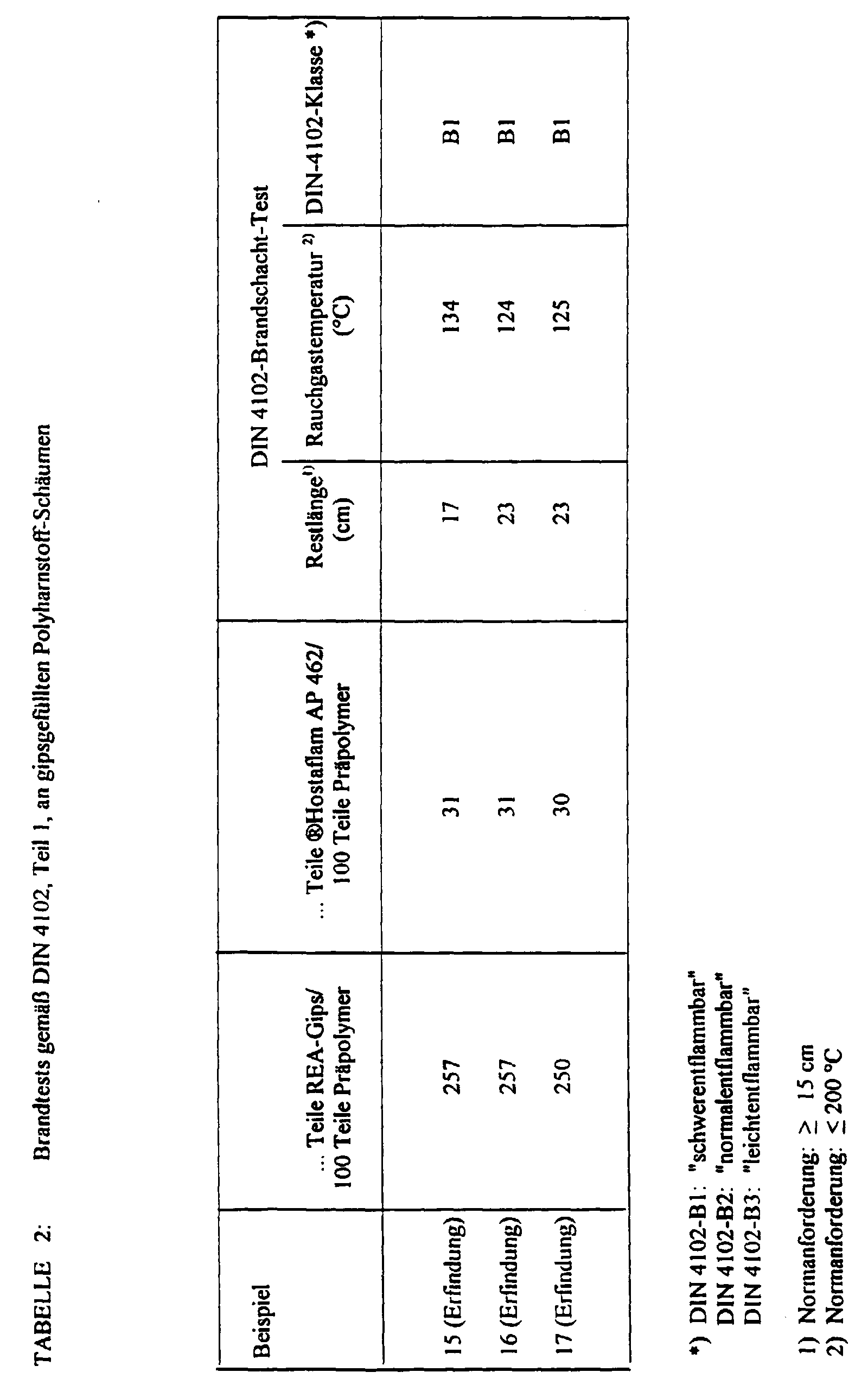
Claims (9)
- Flammwidriger Polyharnstoff-Schaum, dadurch gekennzeichnet, daßer Calciumsulfat-Dihydrat enthält,er als Flammschutzmittel Ammoniumpolyphosphat, ggf. in Kombination mit weiteren halogenfreien Flammschutzmitteln und/ oder halogenfreien Synergisten enthält,sein Raumgewicht 25 bis 250 kg/m3 beträgt,die Zahl seiner offenen Zellen über 80 % seiner gesamten Zellen beträgt,der Polyharnstoff aus einer Reaktion von Präpolymeren des Diphenylmethan-4,4'-diisocyanats mit Wasser gebildet worden ist.
- Polyharnstoff-Schaum nach Anspruch 1, dadurch gekennzeichnet, daß er Calciumsulfat-Dihydrat in Form von Naturgips oder Chemiegips enthält.
- Polyharnstoff-Schaum nach Anspruch 1 oder 2, dadurch gekennzeichnet, daß er als Flammschutzmittel ein freifließendes, pulverförmiges, in Wasser schwerlösliches Ammoniumpolyphosphat der Formel (NH4PO3)n mit n = 20 bis 1000, vorzugsweise 500 bis 1000, enthält.
- Polyharnstoff-Schaum nach Anspruch 3, dadurch gekennzeichnet, daß das Ammoniumpolyphosphat mikroverkapselt ist und 0,5 bis 25 Masse-% eines wasserunlöslichen, ggf. gehärteren Kunstharzes, welches die einzelnen Ammoniumpolyphosphatteilchen umhüllt, enthält.
- Polyharnstoff-Schaum nach einem der vorhergehenden Ansprüche, dadurch gekennzeichnet, daß sein Raumgewicht 35 bis 90 kg/m3 beträgt.
- Polyharnstoff-Schaum nach einem der vorhergehenden Ansprüche, gekennzeichnet durch folgende Zusammensetzung (Masse-%):
- a) 15 bis 70 %,
- vorzugsweise 20 bis 60 %, Polyharnstoff,
- b) 25 bis 80 %,
- vorzugsweise 30 bis 70 %, Calciumsulfat-Dihydrat,
- c) 1 bis 15 %,
- vorzugsweise 2 bis 10 %, Flammschutzmittel,
und gegebenenfalls - d) 0,1 bis 5 %,
- vorzugsweise 0,2 bis 2 %, faserförmige Füllstoffe,
- e) 0,1 bis 2 %
- Katalysatoren auf Basis von Stickstoffverbindungen für die Isocyanat/Wasser-Reaktion,
- f) 0,1 bis 2 %
- Schaumstabilisatoren auf Basis von Polysiloxanen,
- g) 0,01 bis 2 %
- Hilfsmittel für die Dispergierung und/oder Suspendierung und/oder Thixotropierung.
- Verfahren zur Herstellung des Polyharnstoff-Schaums gemäß einem der vorhergehenden Ansprüche, dadurch gekennzeichnet, daß man Calciumsulfat-Dihydrat, Flammschutzmittel, Präpolymere des Diphenylmethan-4,4'-diisocyanats, Wasser und ggf. faserförmige Füllstoffe, Katalysatoren, Schaumstabilisatoren sowie Dispergier- und/oder Suspendier- und/oder Thixotropierhilfsmittel vermischt, wobei infolge Bildung von Kohlendioxid die Verschäumung abläuft, und daß man den ausgehärteten Schaum auf einen Restfeuchtegehalt von unter 2 % bringt.
- Verfahren nach Anspruch 7, dadurch gekennzeichnet, daß man
- 15 bis 60 Masse-%
- Calciumsulfat-Dihydrat,
- 15 bis 45 Masse-%
- Präpolymere des Diphenylmethan-4,4'-diisocyanats,
- 25 bis 50 Masse-%
- Wasser,
- 0,5 bis 10 Masse-%
- Flammschutzmittel,
und gegebenenfalls - 0,1 bis 5 Masse-%
- faserförmige Füllstoffe,
- 0,1 bis 2 Masse-%
- Katalysatoren auf Basis von Stickstoffverbindungen für die Isocyanat/Wasser-Reaktion,
- 0,1 bis 2 Masse-%
- Schaumstabilisatoren auf Basis von Polysiloxenen und
- 0,01 bis 2 Masse-%
- Dispergier- und/oder Suspendier- und/oder Thixotropierhilfsmittel
vermischt.
- Verwendung des Polyharnstoff-Schaums gemäß einem der Ansprüche 1 bis 6 als Blockschaum oder Ortschaum für Schall- und/oder Wärmedämmungen.
Applications Claiming Priority (3)
| Application Number | Priority Date | Filing Date | Title |
|---|---|---|---|
| DE4410378A DE4410378A1 (de) | 1994-03-25 | 1994-03-25 | Halogenfreier und füllstoffhaltiger, schwerentflammbarer Polyharnstoff-Schaum, Verfahren zu seiner Herstellung und seine Verwendung |
| DE4410378 | 1994-03-25 | ||
| PCT/EP1995/001073 WO1995026322A1 (de) | 1994-03-25 | 1995-03-22 | Flammwidriger polyharnstoff-schaum |
Publications (2)
| Publication Number | Publication Date |
|---|---|
| EP0701540A1 EP0701540A1 (de) | 1996-03-20 |
| EP0701540B1 true EP0701540B1 (de) | 2000-07-19 |
Family
ID=6513834
Family Applications (1)
| Application Number | Title | Priority Date | Filing Date |
|---|---|---|---|
| EP95914290A Expired - Lifetime EP0701540B1 (de) | 1994-03-25 | 1995-03-22 | Flammwidriger polyharnstoff-schaum |
Country Status (11)
| Country | Link |
|---|---|
| US (1) | US5719200A (de) |
| EP (1) | EP0701540B1 (de) |
| JP (1) | JPH08511301A (de) |
| KR (1) | KR960702821A (de) |
| CN (1) | CN1128530A (de) |
| CZ (1) | CZ347295A3 (de) |
| DE (2) | DE4410378A1 (de) |
| HU (1) | HU213907B (de) |
| TW (1) | TW314533B (de) |
| WO (1) | WO1995026322A1 (de) |
| ZA (1) | ZA952401B (de) |
Families Citing this family (26)
| Publication number | Priority date | Publication date | Assignee | Title |
|---|---|---|---|---|
| DE19744951B4 (de) * | 1997-10-10 | 2004-01-29 | Preform Gmbh | Verfahren zur Herstellung eines Polyharnstoff enthaltenden porigen Gipsschaumstoffes |
| DE19905488A1 (de) * | 1999-02-10 | 2000-08-17 | Sueddeutsche Kalkstickstoff | Pulverförmige Polymerzusammensetzungen auf der Basis von Polyethercarboxylaten |
| SE518963C2 (sv) * | 2001-02-28 | 2002-12-10 | Fellert John | Putsbruk för ljudabsorberande och brandhämmande beläggning |
| GB0116678D0 (en) * | 2001-07-09 | 2001-08-29 | Clariant Int Ltd | Inherently coloured polyurea and polyurethane |
| US20040167283A1 (en) * | 2003-02-24 | 2004-08-26 | Michael Vinciguerra | Linear polyphosphonates that exhibit an advantageous combination of properties, and methods related thereto |
| US6861499B2 (en) * | 2003-02-24 | 2005-03-01 | Triton Systems, Inc. | Branched polyphosphonates that exhibit an advantageous combination of properties, and methods related thereto |
| DE10309805B4 (de) * | 2003-03-05 | 2005-07-21 | Clariant Gmbh | Flammschutzmittel-Dispersion |
| US11255332B2 (en) | 2003-03-20 | 2022-02-22 | Nortek Air Solutions, Llc | Modular fan housing with multiple modular units having sound attenuation for a fan array for an air-handling system |
| US7597534B2 (en) | 2003-03-20 | 2009-10-06 | Huntair, Inc. | Fan array fan section in air-handling systems |
| US7137775B2 (en) | 2003-03-20 | 2006-11-21 | Huntair Inc. | Fan array fan section in air-handling systems |
| US7560525B2 (en) * | 2004-04-02 | 2009-07-14 | Frx Polymers, Llc | Crystalline polyphosphonates and methods related thereto |
| JP4410665B2 (ja) | 2004-07-28 | 2010-02-03 | 株式会社イノアックコーポレーション | 軟質ポリウレタン発泡体の製造方法 |
| JP4584749B2 (ja) * | 2005-03-29 | 2010-11-24 | 株式会社イノアックコーポレーション | 硬質ポリウレタン発泡体の製造方法 |
| US7569717B2 (en) * | 2005-07-19 | 2009-08-04 | Frx Polymers, Llc | Diaryl alkylphosphonates and method for preparing same |
| US7645850B2 (en) * | 2005-08-11 | 2010-01-12 | Frx Polymers, Inc. | Poly(block-phosphonato-ester) and poly(block-phosphonato-carbonate) and methods of making same |
| US7666932B2 (en) * | 2005-10-17 | 2010-02-23 | Frx Polymers, Inc. | Compositions comprising polyphosphonates and additives that exhibit an advantageous combination of properties, and methods related thereto |
| WO2007079272A2 (en) * | 2005-10-18 | 2007-07-12 | Frx Polymers Llc | Diaryl alkylphosphonates and methods for preparing same |
| US20070107602A1 (en) * | 2005-11-17 | 2007-05-17 | Consolidated Cellars, Llc | Wine cellar insulation system |
| US7838604B2 (en) * | 2005-12-01 | 2010-11-23 | Frx Polymers, Inc. | Method for the production of block copolycarbonate/phosphonates and compositions therefrom |
| US8511978B2 (en) * | 2006-05-02 | 2013-08-20 | United Technologies Corporation | Airfoil array with an endwall depression and components of the array |
| US7928259B2 (en) * | 2008-02-12 | 2011-04-19 | Frx Polymers, Inc. | Diaryl alkylphosphonates and methods for preparing same |
| US9718254B2 (en) | 2012-05-14 | 2017-08-01 | Basf Se | Moisture-resistant gypsum boards and slurries for making same |
| EP2948464A4 (de) | 2013-01-22 | 2016-12-07 | Frx Polymers Inc | Phosphorhaltige epoxiverbindungen und zusammensetzungen daraus |
| JP6471523B2 (ja) * | 2014-04-16 | 2019-02-20 | 東ソー株式会社 | ポリウレア樹脂製造用硬化剤、及びそれを用いたポリウレア樹脂の製造方法 |
| CZ308169B6 (cs) * | 2015-05-29 | 2020-02-05 | HolĂk International s.r.o. | Ochranný oděv nebo oděvní část, zejména pro hasiče pro ochranu proti teplu |
| CN110423326A (zh) * | 2019-07-01 | 2019-11-08 | 陕西科技大学 | 一种改性硫酸钙晶须/聚氨酯复合发泡材料及其制备工艺 |
Family Cites Families (10)
| Publication number | Priority date | Publication date | Assignee | Title |
|---|---|---|---|---|
| SU910678A1 (ru) * | 1980-07-23 | 1982-03-07 | Всесоюзный научно-исследовательский и проектный институт галургии | Композици дл получени пенопласта |
| DE3208693A1 (de) * | 1982-03-11 | 1983-09-22 | Hoechst Ag, 6230 Frankfurt | Polyol-vormischung zur herstellung von flammwidrigen polyurethanschaumstoffen |
| DE3366944D1 (en) * | 1982-05-03 | 1986-11-20 | Bauer Schaum Chem | Improved polyurea foams |
| US4504603A (en) * | 1983-09-23 | 1985-03-12 | Hamilton Hicks | Fire-retardant polyurethane foam containing finely ground dry fire retardant particles containing a volatile active fire retardant component |
| DE3909083C1 (de) * | 1989-03-20 | 1990-06-21 | Fraunhofer-Gesellschaft Zur Foerderung Der Angewandten Forschung Ev, 8000 Muench | |
| GB8922930D0 (en) * | 1989-10-11 | 1989-11-29 | Ici Plc | Fire retardant compositions |
| DE4000014A1 (de) * | 1990-01-02 | 1991-07-04 | Basf Ag | Verfahren zur herstellung von elastischen, kompakten oder zelligen formkoerpern auf der grundlage von n-substituierte harnstoff- und amidgruppen gebunden enthaltenden elastomere derartige und hierfuer geeignete inhaltige polyoxyalkylen-polyamin-mischungen |
| DE4134550C2 (de) * | 1991-10-18 | 1995-05-04 | Fraunhofer Ges Forschung | Verfahren zur Herstellung von Ortschaum |
| CA2084494C (en) * | 1992-04-28 | 1997-06-24 | Peter Paul Roosen | Plasticised gypsum composition |
| DE4218791A1 (de) * | 1992-06-06 | 1993-12-09 | Basf Ag | Verfahren zur Herstellung von Urethan- und Harnstoffgruppen enthaltenden, kompakten oder zelligen Elastomeren oder Formkörpern hieraus |
-
1994
- 1994-03-25 DE DE4410378A patent/DE4410378A1/de not_active Withdrawn
-
1995
- 1995-03-22 CN CN95190439A patent/CN1128530A/zh active Pending
- 1995-03-22 KR KR1019950705351A patent/KR960702821A/ko not_active Withdrawn
- 1995-03-22 WO PCT/EP1995/001073 patent/WO1995026322A1/de not_active Ceased
- 1995-03-22 CZ CZ953472A patent/CZ347295A3/cs unknown
- 1995-03-22 HU HU9503381A patent/HU213907B/hu not_active IP Right Cessation
- 1995-03-22 EP EP95914290A patent/EP0701540B1/de not_active Expired - Lifetime
- 1995-03-22 DE DE59508579T patent/DE59508579D1/de not_active Expired - Lifetime
- 1995-03-22 US US08/586,681 patent/US5719200A/en not_active Expired - Fee Related
- 1995-03-22 JP JP7524951A patent/JPH08511301A/ja active Pending
- 1995-03-24 ZA ZA952401A patent/ZA952401B/xx unknown
- 1995-03-27 TW TW084102958A patent/TW314533B/zh active
Also Published As
| Publication number | Publication date |
|---|---|
| HU9503381D0 (en) | 1996-02-28 |
| HUT74310A (en) | 1996-12-30 |
| DE4410378A1 (de) | 1995-09-28 |
| JPH08511301A (ja) | 1996-11-26 |
| KR960702821A (ko) | 1996-05-23 |
| TW314533B (de) | 1997-09-01 |
| CN1128530A (zh) | 1996-08-07 |
| CZ347295A3 (en) | 1997-04-16 |
| EP0701540A1 (de) | 1996-03-20 |
| ZA952401B (en) | 1996-09-25 |
| WO1995026322A1 (de) | 1995-10-05 |
| DE59508579D1 (de) | 2000-08-24 |
| US5719200A (en) | 1998-02-17 |
| HU213907B (en) | 1997-11-28 |
Similar Documents
| Publication | Publication Date | Title |
|---|---|---|
| EP0701540A1 (de) | Flammwidriger polyharnstoff-schaum | |
| EP2045227B1 (de) | Anorganische Schäume auf Basis von Schnellzement als Brandschutzmasse zum Füllen von Hohlkörpern | |
| DE60016572T2 (de) | Wasserbeständiges vorgefertigtes gipsbauelement | |
| DE19628553C1 (de) | Schaumstoff für Brandschutz- und/oder Isolierzwecke | |
| DE2953525C2 (de) | Formkörper geringer Dichte aus Calciumsilikatkristallen und Verfahren zu ihrer Herstellung | |
| DE2547765A1 (de) | Ternaerer zement | |
| DE102008003932A1 (de) | Mit niedrigem Energieaufwand hergestellte Wandplatten und Verfahren zu deren Herstellung | |
| EP0464044B1 (de) | Gipsschaumstoff mit poriger struktur, verfahren zu seiner herstellung und seine verwendung | |
| DE4135144A1 (de) | Verfahren zur erzeugung von faserverstaerkten abgebundenen leichtgewichtserzeugnissen auf schlacke/gips/zement-basis | |
| WO2015124768A1 (de) | Massen oder formkörper aus anorganischen polymeren und deren herstellung | |
| DE3319017A1 (de) | Verfahren zur herstellung von gehaerteten, anorganischen produkten | |
| DE2756198C3 (de) | Anorganischer Schaumstoff auf Basis von Metallphosphaten, Verfahren zu dessen Herstellung und dessen Verwendung als Wärmeschutzmaterial | |
| EP0064793B1 (de) | Verfahren zur Herstellung von Gipsformsteinen | |
| DE60000860T2 (de) | Vorgefertigtes gipsbauelement, insbesondere gipsbauplatte, mit hoher feuerbeständigkeit | |
| DE2442098A1 (de) | Verfahren zur herstellung poroeser koerper auf basis von gips, insbesondere anhydrit | |
| DE10326623B4 (de) | Verwendung einer Mischung zur Herstellung von feuchtigkeitsbeständigen Gipsbauteilen | |
| EP0824508B1 (de) | Material mit guten brandschutzeigenschaften und verfahren zur herstellung desselben | |
| EP0001992B1 (de) | Verschäumbare Magnesiazementmischung, ihre Verwendung und Verfahren zur Herstellung poröser Formkörper | |
| DE2949390A1 (de) | Zusammensetzung zur bildung eines anorganischen gehaerteten produkts und verfahren zur herstellung von gehaerteten produkten daraus | |
| EP0500637B1 (de) | Wasserabweisender mörtel | |
| DE2745750B2 (de) | Zementfreie Mörtelmischung und ihre Verwendung | |
| EP0592837A2 (de) | Schalldämmender Schaumstoff | |
| DE10392839B4 (de) | Dynamisch isolierender, gehärteter, hauptsächlich Tobermorit enthaltender Formkörper und Verfahren zu seiner Herstellung | |
| DE19906764C2 (de) | Borverbindung enthaltende Gipsfaserplatte und Verfahren zu ihrer Herstellung | |
| DE2537492B2 (de) | Mischung zur Herstellung von Wärmeisoliermaterial |
Legal Events
| Date | Code | Title | Description |
|---|---|---|---|
| PUAI | Public reference made under article 153(3) epc to a published international application that has entered the european phase |
Free format text: ORIGINAL CODE: 0009012 |
|
| AK | Designated contracting states |
Kind code of ref document: A1 Designated state(s): DE FR GB IT |
|
| 17P | Request for examination filed |
Effective date: 19960409 |
|
| RAP1 | Party data changed (applicant data changed or rights of an application transferred) |
Owner name: CLARIANT GMBH |
|
| 17Q | First examination report despatched |
Effective date: 19980120 |
|
| GRAG | Despatch of communication of intention to grant |
Free format text: ORIGINAL CODE: EPIDOS AGRA |
|
| RAP1 | Party data changed (applicant data changed or rights of an application transferred) |
Owner name: PREFORM RAUMGLIEDERUNGSSYSTEME GMBH |
|
| GRAG | Despatch of communication of intention to grant |
Free format text: ORIGINAL CODE: EPIDOS AGRA |
|
| GRAH | Despatch of communication of intention to grant a patent |
Free format text: ORIGINAL CODE: EPIDOS IGRA |
|
| GRAH | Despatch of communication of intention to grant a patent |
Free format text: ORIGINAL CODE: EPIDOS IGRA |
|
| GRAA | (expected) grant |
Free format text: ORIGINAL CODE: 0009210 |
|
| AK | Designated contracting states |
Kind code of ref document: B1 Designated state(s): DE FR GB IT |
|
| REF | Corresponds to: |
Ref document number: 59508579 Country of ref document: DE Date of ref document: 20000824 |
|
| ET | Fr: translation filed | ||
| GBT | Gb: translation of ep patent filed (gb section 77(6)(a)/1977) |
Effective date: 20000911 |
|
| ITF | It: translation for a ep patent filed | ||
| PLBE | No opposition filed within time limit |
Free format text: ORIGINAL CODE: 0009261 |
|
| STAA | Information on the status of an ep patent application or granted ep patent |
Free format text: STATUS: NO OPPOSITION FILED WITHIN TIME LIMIT |
|
| 26N | No opposition filed | ||
| REG | Reference to a national code |
Ref country code: GB Ref legal event code: IF02 |
|
| REG | Reference to a national code |
Ref country code: GB Ref legal event code: 732E |
|
| REG | Reference to a national code |
Ref country code: FR Ref legal event code: TP |
|
| PGFP | Annual fee paid to national office [announced via postgrant information from national office to epo] |
Ref country code: IT Payment date: 20140326 Year of fee payment: 20 Ref country code: FR Payment date: 20140319 Year of fee payment: 20 |
|
| PGFP | Annual fee paid to national office [announced via postgrant information from national office to epo] |
Ref country code: GB Payment date: 20140319 Year of fee payment: 20 |
|
| PGFP | Annual fee paid to national office [announced via postgrant information from national office to epo] |
Ref country code: DE Payment date: 20140404 Year of fee payment: 20 |
|
| REG | Reference to a national code |
Ref country code: DE Ref legal event code: R071 Ref document number: 59508579 Country of ref document: DE |
|
| REG | Reference to a national code |
Ref country code: GB Ref legal event code: PE20 Expiry date: 20150321 |
|
| PG25 | Lapsed in a contracting state [announced via postgrant information from national office to epo] |
Ref country code: GB Free format text: LAPSE BECAUSE OF EXPIRATION OF PROTECTION Effective date: 20150321 |